

- Market Size (2026)
- USD 121.9 Mn
- Forecast (2036)
- USD 444.1 Mn
- CAGR (2026 to 2036)
- 13.8%
How big is GPU Cluster Burn-In Testing Services Market in 2026?
USD 121.9 million in 2026 and USD 444.1 million by 2036 at a 13.8% CAGR.
Demand for GPU cluster burn-in testing services is projected to expand at 13.8% CAGR between 2026 and 2036, increasing valuation from USD 121.9 million in 2026 to USD 444.1 million by 2036. Operators pay for burn-in because dense GPU halls must prove electrical stability and heat rejection before production hardware faces unresolved facility faults. Lawrence Berkeley National Laboratory estimated in June 2026 that data centers could represent 11.8% of total US electricity use by 2030. Higher facility loads make late electrical or thermal faults more expensive, so owners test infrastructure under controlled load before handover.
Large national AI campuses concentrate several hall-acceptance windows inside one construction program and increase the value of movable test fleets. Abu Dhabi Media Office announced in May 2025 that Stargate UAE will operate as a 1-gigawatt cluster inside a 5-gigawatt AI campus. Campus-scale construction favors modular test fleets that can move between turnover packages, though local grid availability still determines whether teams can exercise the full designed load before production GPUs arrive.
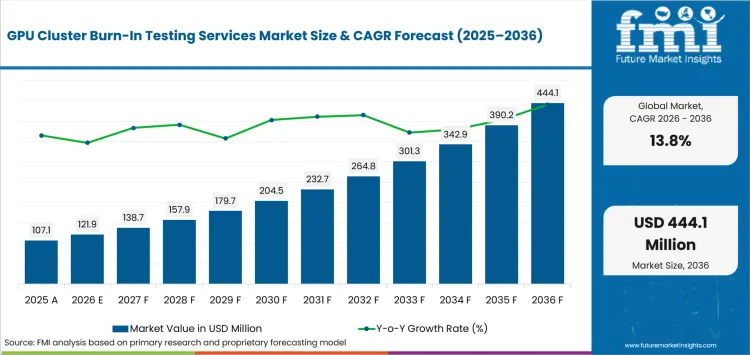
Key Takeaways of GPU Cluster Burn-In Testing Services Market
- AI infrastructure owners buy burn-in services before GPU installation to validate power and cooling plus control and failover behavior.
- By service scope, commissioning & acceptance is estimated to hold 27.0% in 2026 owing to handover requirements for documented readiness and defect closure.
- New AI hall build is set to lead the project stage category with 36.0% share in 2026 due to full-system testing before initial turnover.
- By AI rack density, 251-500 kW is forecast to represent 32.0% in 2026 driven by coordinated electrical and liquid-loop validation.
- Grid timing and site-specific electrical or hydraulic interfaces can narrow testing windows and raise mobilization risk for field teams.
- Some of the key players in this market include Avtron Power Solutions, Mosebach Manufacturing, and Crestchic Loadbanks.
Analyst Perspective
"Burn-in providers should be evaluated on whether they can reproduce the planned GPU load profile and keep electrical telemetry synchronized with liquid-loop data during retests. Equipment day rates become secondary once an incomplete acceptance record forces another mobilization or delays release of commissioned compute capacity."
- Nikhil Kaitwade, Principal Consultant, Future Market Insights
How is the GPU Cluster Burn-In Testing Services Market segmented?
The market is segmented by service scope, project stage, AI rack density, data center type, and commercial model.
Service scope covers commissioning & acceptance, design & engineering, performance validation, retrofit & migration, and managed support. Project stage includes new AI hall build, rack - pod deployment, capacity expansion, legacy conversion, and ongoing operations. AI rack density spans below 100 kW, 100-250 kW, 251-500 kW, and above 500 kW. Data center type includes hyperscale AI data centers, colocation AI facilities, enterprise private AI, and HPC & research centers. Commercial models include direct enterprise contract, system integrator - EPC-led, subscription - license, and managed-service contract.
How do 251-500 kW deployments shape the AI rack density category?
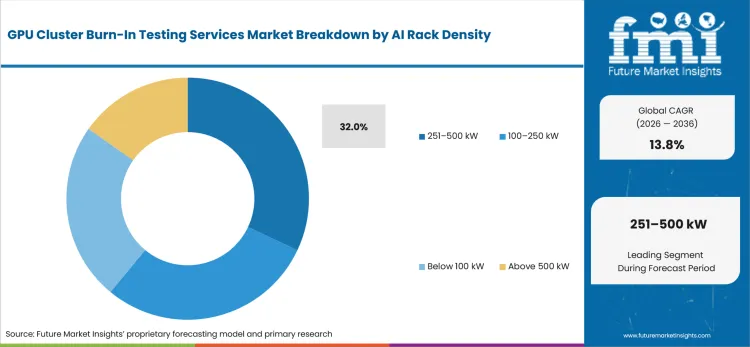
The 251-500 kW band requires electrical loading and liquid-loop validation to run as one test plan. Crestchic launched a 600 kW liquid-cooled platform in March 2026 with automated profiling and clustered operation. AI datacenter liquid cooling therefore favors compact rigs that can inject heat without consuming excessive white-space floor area.
- By AI rack density, 251-500 kW is estimated to hold 32.0% in 2026 owing to broad deployment relevance and coordinated thermal plus electrical validation requirements.
- Equipment above the segment midpoint lets commissioning teams reproduce dense GPU loads without dividing the intended profile into several smaller test steps.
What makes commissioning & acceptance central to the service scope category?
Commissioning teams buy coordinated load emulation because an electrical or cooling mismatch can block handover under the acceptance script. A data center infrastructure management record gives owners one evidence trail for alarms and failover retests.
- Based on service scope, commissioning & acceptance is projected to account for 27.0% in 2026 due to documented readiness being tied directly to owner acceptance and turnover.
- Crestchic documented in January 2026 that 1,550 rack-mounted load banks completed 8 MW of L4 and L5 testing at a Saudi data-center project. The deployment establishes the field scale required for staged hall acceptance before production turnover begins.
Why does new AI hall build lead the project stage category?
A greenfield AI hall places utility feeds and switchgear inside the same acceptance boundary as UPS systems and generators. France stated in May 2026 that RTE had secured grid access for 200 industrial or data-center projects totaling 33 GW. The data center power path therefore needs staged energization before sustained full-load testing begins.
- New AI hall build is set to lead the project stage category with 36.0% share in 2026 due to full-system acceptance before initial production turnover.
- Cooling loops and controls also need proof at the planned load, so test equipment is reserved against confirmed energization milestones instead of the nominal construction finish date.
What supports hyperscale AI data centers within the data center type category?
Hyperscale operators repeat commissioning scripts through successive halls but still need local proof that each power block and cooling loop meets design load. Data center liquid cooling introduces a validation boundary because thermal performance can differ by hall configuration.
- Hyperscale AI data centers are projected to hold 46.0% share in 2026 owing to phased construction programs that generate repeated power and cooling acceptance events.
- Uptime Institute published in February 2025 that 79% of colocation respondents described overall capacity as growing. Expansion increases the number of facilities competing for suitable test equipment and field engineering time.
What drives direct enterprise contract within the commercial model category?
Direct contracts place the burn-in provider close to the owner acceptance plan and keep scripts plus data capture under one accountable relationship. Uptime Institute found in April 2025 that 68% of organizations performing AI training used central on-premises facilities. Datacenter infrastructure services gain value when facility teams coordinate directly with equipment specialists during narrow turnover windows.
- By commercial model, direct enterprise contract is forecast to represent 42.0% in 2026 driven by one accountable relationship for test scope and acceptance evidence.
- Owner-led contracts keep test scripts and defect records under the same approval route through retesting and final acceptance.
What are the drivers, restraints and opportunities in the GPU Cluster Burn-In Testing Services Market?
Higher GPU power density increases pre-live validation needs, site integration limits execution flexibility, and higher-capacity liquid test equipment expands the addressable commissioning scope.
- Driver: Concentrated AI electrical loads make power quality and cooling faults more expensive to discover after live compute enters the hall.
- Restraint: Liquid-loop standards plus physical access and connection geometry can prevent one test setup from transferring cleanly between sites during late construction.
- Opportunity: Providers can extend revenue by pairing high-capacity load equipment with automated profiling and synchronized telemetry for liquid-cooled acceptance programs.
Large AI facilities can swing electrical demand quickly enough to strain grid controls during full-load operation. The US Department of Energy noted in May 2026 that AI training centers use thousands of specialized chips working in coordinated cycles. Providers familiar with data center UPS behavior can test transition events before production traffic depends on those systems and defects become costlier to isolate.
Liquid cooling increases site integration work because connection hardware and flow conditions differ between facilities. Uptime Institute documented in July 2025 that 39% of surveyed operators named missing standardization between systems as a barrier to direct liquid cooling. Data center chillers therefore need commissioning plans that match each hydraulic boundary and control sequence instead of relying on a generic thermal script.
High-voltage and liquid-cooled programs favor providers that can bring suitably scaled equipment into short commissioning windows without delaying adjacent construction work. Crestchic added a 3.8 MVA step-up transformer to its active hire fleet in May 2025, extending the voltage range available for field testing alongside Liquid-cooled edge data center acceptance packages during handover and scheduled defect retesting at compact sites.
Which country CAGRs are covered in the GPU Cluster Burn-In Testing Services Market?
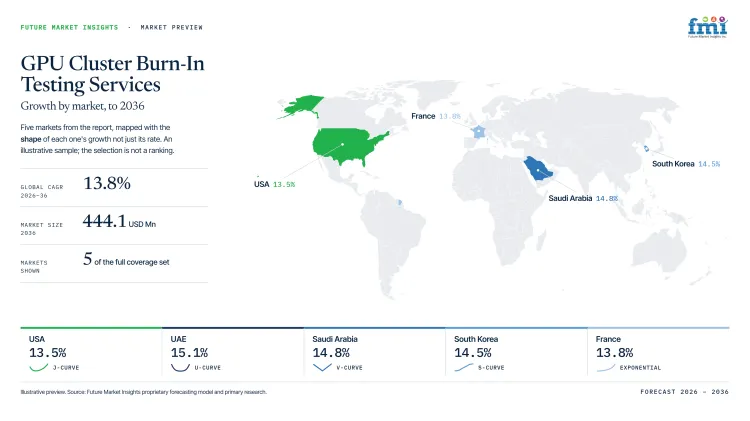
| Country | CAGR |
|---|---|
| UAE | 15.1% |
| Saudi Arabia | 14.8% |
| South Korea | 14.4% |
| Japan | 14.1% |
| France | 13.8% |
| USA | 13.5% |
How do country-level CAGRs compare in the GPU Cluster Burn-In Testing Services Market?
The country spread is 1.6 percentage points between UAE at 15.1% and USA at 13.5%. UAE and Saudi Arabia form the upper group because concentrated new infrastructure produces repeated acceptance events. South Korea and Japan follow through public compute investment while France and USA carry deeper installed-base and grid constraints.
- UAE campus construction concentrates turnover packages and increases demand for movable fleets during acceptance.
- Saudi project concentration pushes critical-power testing into compressed schedules where equipment reservations become decisions.
- South Korea's accelerator development increases demand for load records usable by technical review teams.
- Japan's distributed compute model spreads commissioning work between host facilities with different operating standards.
- France's clustered AI pipeline increases competition for specialist test equipment during overlapping turnover periods.
- USA pairs an installed base with expansion which keeps retrofit and revalidation work commercially material.
Comparable CAGRs produce different service economics because project concentration changes how field teams deploy. The full report provides country-level CAGR analysis across North America, Latin America, Western Europe, Eastern Europe, East Asia, South Asia and Pacific, and Middle East and Africa.
Country-wise Analysis
- Grid-connected US AI expansions force commissioning teams to stage generator and UPS tests against utility energization limits at active campuses. The US GPU cluster burn-in testing services outlook is forecast to grow at 13.5% CAGR through 2036, supported by capacity additions and retrofit work. Lawrence Berkeley National Laboratory estimated in May 2026 that US data-center energy use could double or triple 2023 levels by 2028. Growing electricity exposure gives Data center generator testing a larger installed base but constrained energization can split full-load acceptance into several mobilizations before operators close defects. Repeat mobilization raises field cost because one site may require separate generator and cooling validation windows.
- Regional test fleets are becoming a practical commissioning constraint as Saudi data-center construction concentrates large power systems inside compressed turnover schedules. Saudi Press Agency reported in April 2026 that operational data-center capacity exceeded 440 MW in 2025 and more than 60 facilities were active. Saudi Arabia is projected to expand at 14.8% CAGR over the assessment period, driven by continued digital infrastructure construction and repeat acceptance work. Nearby inventory lowers cross-border lead time although specialized equipment and field engineers must still follow each project's energization sequence. Gulf fleet depth reduces delay exposure during repeat acceptance windows without requiring long equipment movements at peak build periods.
- Abu Dhabi's sovereign compute estate gives testing providers concentrated hall sequences where acceptance records must remain comparable from one energized block to the next. UAE demand is anticipated to record 15.1% CAGR through 2036, attributable to campus-scale AI construction and government compute investment. The Department of Government Enablement announced in October 2025 that its unified government data center provides 19 MW of AI-ready capacity for more than 40 entities. Local service access shortens repeat mobilization but compressed schedules leave little room for equipment shortages or manual reconciliation. Automated records reduce defect-closure work between successive electrical and thermal turnover packages at large campuses.
- Public compute projects in South Korea increasingly tie facility readiness to domestic accelerator development and national AI infrastructure goals. Korea.net documented in August 2026 that construction had started on the National AI Computing Center in Haenam with completion planned for 2028. Public-private delivery broadens the acceptance boundary and can multiply documentation requirements for facility operators and accelerator validation teams. The country is positioned to record 14.4% CAGR during the forecast period, supported by new public compute capacity and associated commissioning work. Field providers can gain repeat assignments if load profiles transfer between accelerator platforms and documentation stays traceable through later retesting cycles.
- French AI campus developers must align full-load acceptance with grid connection milestones because available capacity can arrive in stages instead of one final energization event. The Economy Ministry reported in May 2025 that 28 additional candidate data-center sites had been identified beyond 35 sites announced earlier that year. France is expected to maintain 13.8% CAGR through 2036, driven by additional AI infrastructure sites and accelerated connection work. Staged commissioning can release completed power blocks earlier but equipment bookings must follow confirmed grid milestones. Providers that resize test packages between milestones can reduce idle field time as campus capacity becomes available.
- Japanese model developers obtain supported compute through several providers and ownership structures without a single campus controlling the entire acceptance sequence. Japan is set to post 14.1% CAGR during the assessment period, supported by wider access to advanced computing resources and continuing AI model development. Service coverage becomes less predictable outside major data-center clusters and contract scope must account for travel plus local engineering availability. METI selected 16 GENIAC projects in June 2026 for fiscal-year computing-resource support, so Modular UPS systems and repeatable test methods need to transfer between host facilities with different operating standards and local project commissioning authorities.
Who are the notable companies in the GPU Cluster Burn-In Testing Services Market?
Avtron Power Solutions, Mosebach Manufacturing, and Crestchic Loadbanks are notable companies serving this market.
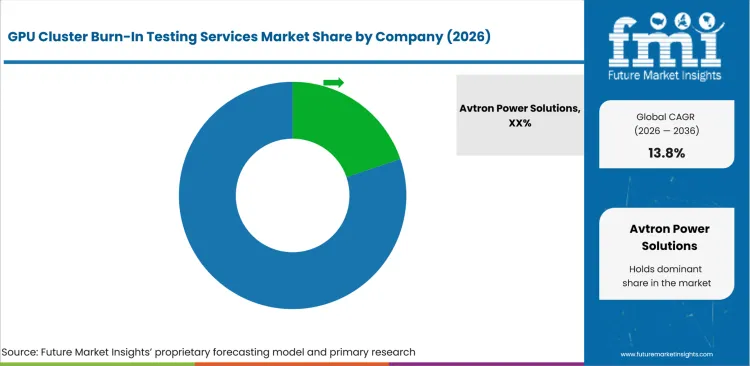
Competition centers on whether a provider can reproduce electrical and thermal load conditions at the required scale and document the result for acceptance. Entry barriers depend on fleet availability plus automated control and liquid-loop test capability, with field coverage determining how quickly teams can retest defects.
- Avtron Power Solutions (acquired by Legrand in November 2025) and Crestchic Loadbanks document liquid-cooled data-center platforms alongside higher-capacity equipment and regional operating support.
- Mosebach Manufacturing concentrates on US-made resistive load banks and trailer systems with recent data-center customer deliveries from its Pennsylvania manufacturing base.
Competitive Benchmarking: GPU Cluster Burn-In Testing Services Market
| Company | Liquid-Cooled Test Capability | Documented Data-Center Load Range | Automated Test Control | Geographic Reach |
|---|---|---|---|---|
| Avtron Power Solutions | High | Medium | High | North America and Europe manufacturing with EMEA and Asia product support |
| Mosebach Manufacturing | Low | High | Low | North America manufacturing with worldwide sales stated by the company |
| Crestchic Loadbanks | High | High | High | Europe, Middle East, North America and Asia Pacific service network |
Scoring basis: High liquid-cooled capability requires a dated data-center platform rated 500 kW or more, and Low identifies recent exact-market evidence limited to resistive equipment. High documented load range requires recent data-center evidence at or above 1,000 kW and Medium covers documented equipment between 500 and 999 kW. High automated control requires multi-unit operation with automated profiling, and Low identifies unit-level controls in current data-center evidence.
Key Developments in the GPU Cluster Burn-In Testing Services Market
- In January 2026, Avtron Power Solutions now operating as a business unit within Legrand following Legrand's acquisition of the company in November 2025 expanded its liquid-cooled range with the 500 kW LC35 and 720 kW LC20 for liquid-cooled data centers. The added capacity lets commissioning teams reproduce higher GPU heat loads without splitting one target profile between several smaller units.
- In October 2025, Bridgeville Borough granted Mosebach Manufacturing a conditional-use permit to operate a light-manufacturing facility at 1124 McLaughlin Run Road in Pennsylvania. The additional site gives the company more local manufacturing room while keeping the expansion inside the approved light-manufacturing use.
- In February 2025, Crestchic Loadbanks acquired Gulf Incon International's load-bank rental division and moved its assets plus staff into the company's Jebel Ali operation. Regional fleet access reduces mobilization distance for Gulf projects that need short-notice power testing before turnover.
Key Players in the GPU Cluster Burn-In Testing Services Market
High-capacity liquid-cooled and automated test platforms
- Avtron Power Solutions
- Crestchic Loadbanks
Resistive load-bank and data-center rack emulation specialist
- Mosebach Manufacturing
GPU Cluster Burn-In Testing Services Market - Report Scope
| Coverage field | Report scope |
|---|---|
| Market breakdown | By service scope, project stage, AI rack density, data center type, commercial model, and region. |
| Quantitative Units | Revenue in USD million and CAGR in %. |
| Market Definition | Commercial services that emulate sustained GPU-cluster electrical and thermal loads to validate power, cooling, controls, resilience, and acceptance before or during production turnover. |
| Regions Covered | North America, Latin America, Western Europe, Eastern Europe, East Asia, South Asia and Pacific, and Middle East and Africa. |
| Countries Covered | USA, Saudi Arabia, UAE, South Korea, France, Japan, and 20+ countries included in the full report. |
| Key Companies | Avtron Power Solutions, Mosebach Manufacturing, Crestchic Loadbanks. |
| Forecast Period | 2026 to 2036. |
| Approach | Primary and secondary research with market triangulation. |
GPU Cluster Burn-In Testing Services Market - Research Methodology
| Method | Approach |
|---|---|
| Primary Research | FMI analysts gathered input from manufacturers, service providers, technology developers, distributors, end users, procurement teams, and subject-matter experts. Interviews examined purchasing decisions, product or service evaluation, adoption barriers, approval requirements, pricing considerations, and expectations for technical or commercial support. Respondents were also asked what evidence is required before a trial, pilot, or initial order develops into regular purchasing. |
| Desk Research | Desk research covered government statistics, regulatory publications, trade data, industry associations, technical literature, standards, company filings, product information, and official corporate announcements. Sources were reviewed for relevance, publication date, geographic coverage, and consistency with the defined market scope. Claims relating to performance, applications, approvals, capacity, investment, and commercial activity were retained only when supported by credible public evidence. |
| Market Sizing and Forecasting | The market model combined the baseline value with historical performance, segment structure, pricing and volume indicators, adoption levels, company participation, and country-level demand conditions. Forecast assumptions considered economic activity, investment trends, regulatory developments, technology adoption, purchasing cycles, supply availability, and barriers to wider market use. Segment and regional estimates were reconciled before the final market total was calculated. |
| Data Validation | Estimates were checked against multiple independent indicators, including public data, company activity, trade patterns, industry developments, and findings from primary interviews. Validation also tested whether products, services, applications, and company revenues fell within the defined market boundaries. Adjacent categories, unsupported claims, overlapping revenues, and activities without direct market relevance were excluded to reduce double counting and maintain consistency across segments and countries. |
GPU Cluster Burn-In Testing Services Market by Segments
GPU Cluster Burn-In Testing Services Market Segmented by Service Scope:
- Commissioning & acceptance
- Design & engineering
- Performance validation
- Retrofit & migration
- Managed support
GPU Cluster Burn-In Testing Services Market Segmented by Project Stage:
- New AI hall build
- Rack - pod deployment
- Capacity expansion
- Legacy conversion
- Ongoing operations
GPU Cluster Burn-In Testing Services Market Segmented by AI Rack Density:
- 251-500 kW
- 100-250 kW
- Below 100 kW
- Above 500 kW
GPU Cluster Burn-In Testing Services Market Segmented by Data Center Type:
- Hyperscale AI data centers
- Colocation AI facilities
- Enterprise private AI
- HPC & research centers
GPU Cluster Burn-In Testing Services Market Segmented by Commercial Model:
- Direct enterprise contract
- System integrator - EPC-led
- Subscription - license
- Managed-service contract
GPU Cluster Burn-In Testing Services Market by Region:
- North America
- United States
- Canada
- Latin America
- Brazil
- Mexico
- Argentina
- Chile
- Western Europe
- Germany
- France
- United Kingdom
- Italy
- Spain
- Benelux
- Nordics
- Eastern Europe
- Poland
- Czech Republic
- Romania
- Hungary
- East Asia
- China
- Japan
- South Korea
- South Asia and Pacific
- India
- ASEAN
- Australia and New Zealand
- Middle East and Africa
- GCC Countries
- South Africa
- Türkiye
- Israel
Research Sources and Bibliography
- Lawrence Berkeley National Laboratory. (2026, June). United States Data Center Energy Usage Report: 2025 Update.
- Abu Dhabi Media Office. (2025, May 22). Global tech alliance launches 'Stargate UAE'.
- Crestchic Loadbanks. (2026, January 7). Crestchic Completes Major Load Testing Project in Saudi Arabia.
- Ministry for Ecological Transition, Biodiversity, Forests, the Sea and Fisheries. (2026, May 26). Électrifions la France.
- Crestchic Loadbanks. (2026, March 4). Crestchic Unveils 600kW Liquid Cooled Loadbank at Data Centre World, London.
- Uptime Institute. (2025, February 28). AI adds to rising demand for capacity.
- Uptime Institute. (2025, April 17). Data center AI strategies are mixed in early 2025.
- USA Department of Energy. (2026, May 28). Monitoring Oscillations from Large Data Centers.
- Uptime Institute. (2025, July 30). DLC adoption remains slow and steady.
- Crestchic Loadbanks. (2025, May 27). Another step up transformer rolls off the production line.
- Lawrence Berkeley National Laboratory. (2026, May). Integrating AI Data Centers with the Power Grid.
- Saudi Press Agency. (2026, April 27). Saudi Arabia Strengthens Its Global Position in Artificial Intelligence Through Data Center Growth and Accelerated Smart Manufacturing.
- Department of Government Enablement - Abu Dhabi. (2025, October 17). Department of Government Enablement and e& Partner to Launch Abu Dhabi Unified Government Data Centre to Power 40+ Government Entities.
- Korea.net. (2026, August 4). Construction of Nat'l AI Computing Center begins, to end in 2028.
- Ministry for the Economy, Finance and Industrial and Digital Sovereignty. (2025, May 21). IA : des investissements records annoncés lors du Sommet Choose France 2025.
- Ministry of Economy, Trade and Industry. (2026, June 4). Selection of 16 New Projects to support the development of AI Models under the GENIAC Computing Resource Provision Support Project (Cycle 4).
- Avtron Power Solutions. (2026, January 13). Avtron Power Solutions Expands Liquid Cooled Load Bank Portfolio with New LC35 and LC20 High-Capacity Models.
- Crestchic Loadbanks. (2025, February 17). Crestchic Loadbanks acquisition expands reach in UAE.
- Bridgeville Borough. (2025, October 13). Bridgeville Borough Council Minutes.
- Crestchic Loadbanks. (2026, April 8). Built for hyperscale: Crestchic's trailer-mounted loadbank meets testing needs for European data centre.
- Crestchic Loadbanks. (2026, February 9). Crestchic expands UK manufacturing capacity with new Midlands facility.
- Crestchic Loadbanks. (2026, June 10). Crestchic Loadbanks expands into Australia.
- Crestchic Loadbanks. (2026, May 4). Crestchic Loadbanks expands into Sweden to serve booming Nordic data centre market.
- Crestchic Loadbanks. (2026, January 22). 10MW generator test in Frankfurt.
- Avtron Power Solutions. (n.d.). Retrieved September 8, 2026. About us.
- Crestchic Loadbanks. (n.d.). Retrieved September 8, 2026. ISO 9001 Certificate.
- Legrand. (2025, November 7). Legrand Acquires Avtron Power Solutions, a Global Provider of Load Banks & Power Quality Solutions.
- Mosebach Manufacturing Company. (2026, February). 3,000 kW data-center customer load bank deployment [LinkedIn post].
- Crestchic Loadbanks. (2026, May 14). German customer tests their generators with Crestchic.
This bibliography is provided for reader reference and is not exhaustive. The full report contains the complete reference list and detailed citations.
This Report Answers
- How does GPU power density change burn-in testing before handover?
- Why does commissioning & acceptance hold 27.0% of service scope?
- How do new AI halls change power and cooling acceptance?
- Why does the 251-500 kW band require coordinated load emulation?
- How do grid connections alter full-load testing schedules by country?
- Which local conditions explain the six-country CAGR spread?
- How do direct enterprise contracts allocate testing and retesting responsibility?
- How do Avtron Power Solutions, Mosebach Manufacturing, and Crestchic Loadbanks differ?
Frequently Asked Questions
How big is the GPU Cluster Burn-In Testing Services Market in 2026?
The GPU cluster burn-in testing services market is valued at USD 121.9 million in 2026 and is projected to reach USD 444.1 million by 2036. Growth comes from pre-live electrical and cooling validation that protects high-value GPU infrastructure before production.
What is the CAGR of the GPU Cluster Burn-In Testing Services Market from 2026 to 2036?
The GPU cluster burn-in testing services market is projected to grow at a 13.8% CAGR between 2026 and 2036. Higher rack density and liquid cooling increase acceptance work before AI compute enters production.
Which service scope leads the GPU Cluster Burn-In Testing Services Market?
The commissioning & acceptance segment is expected to hold 27.0% of the GPU cluster burn-in testing services market in 2026, attributable to documented handover requirements. The service closes electrical and thermal defects before owners make final acceptance and production turnover decisions.
Which countries record the country growth comparison in the GPU Cluster Burn-In Testing Services Market?
UAE is projected to grow at 15.1% CAGR followed by Saudi Arabia at 14.8% and South Korea at 14.4% through 2036. Concentrated infrastructure and public compute programs give these countries repeated commissioning events during new capacity turnover.
Which companies are active in the GPU Cluster Burn-In Testing Services Market?
Key companies operating in the market include Avtron Power Solutions and Mosebach Manufacturing alongside Crestchic Loadbanks. Avtron and Crestchic document liquid-cooled platforms while Mosebach focuses on resistive equipment and recent data-center deliveries.
Preview the report firsthand - request a free sample
Get SampleGet the brochure for pricing and purchase details.
Get PDFTable of Content
- Key Takeaways
- Market Size and CAGR
- Top Growth Driver
- Fastest Growing Segment
- Leading Region
- Key Companies
- Emerging Opportunities
- Executive Summary
- Global Market Outlook
- Demand-side Trends
- Supply-side Trends
- Technology Roadmap Analysis
- Analysis and Recommendations
- Analyst Perspective (What is happening? Why now? What should investors know?)
- Key Questions Answered
- How large is the market?
- What is the CAGR?
- What are key trends?
- Which region dominates?
- Who are the leaders?
- Market Overview
- Market Coverage / Taxonomy
- Market Definition / Scope / Limitations
- Research Methodology
- Chapter Orientation
- Analytical Lens and Working Hypotheses
- Market Structure, Signals, and Trend Drivers
- Benchmarking and Cross-market Comparability
- Market Sizing, Forecasting, and Opportunity Mapping
- Research Design and Evidence Framework
- Desk Research Programme (Secondary Evidence)
- Expert Input and Fieldwork (Primary Evidence)
- Tooling, Models, and Reference Databases
- Data Engineering and Model Build
- Quality Assurance and Audit Trail
- Market Background
- Market Dynamics (Drivers, Restraints, Opportunity, Trends)
- Scenario Forecast (Optimistic, Likely, Conservative)
- Impact Analysis
- AI Impact
- Sustainability Impact
- Regulatory Impact
- Technology Impact
- Consumer / Buyer Analysis
- Purchase Drivers
- Adoption Barriers
- Buyer Journey
- Opportunity Map Analysis
- Product Life Cycle Analysis
- Supply Chain Analysis
- Investment Feasibility Matrix
- Value Chain Analysis
- PESTLE and Porter's Analysis
- Regulatory Landscape
- Regional Parent Market Outlook
- Production and Consumption Statistics
- Import and Export Statistics
- Global Market Analysis and Forecast, 2021 to 2036
- Historical Market Size Value (USD Million) Analysis, 2021 to 2025
- Current and Future Market Size Value (USD Million) Projections, 2026 to 2036
- Y-o-Y Growth Trend Analysis
- Absolute $ Opportunity Analysis
- Global Market Pricing Analysis, 2021 to 2036
- Global Market Analysis and Forecast, By Service Scope, 2021 to 2036
- Introduction / Key Findings
- Historical Market Size Value (USD Million) Analysis By Service Scope, 2021 to 2025
- Current and Future Market Size Value (USD Million) Analysis and Forecast By Service Scope, 2026 to 2036
- Commissioning & acceptance
- Design & engineering
- Performance validation
- Retrofit & migration
- Managed support
- Commissioning & acceptance
- Y-o-Y Growth Trend Analysis By Service Scope, 2021 to 2025
- Absolute $ Opportunity Analysis By Service Scope, 2026 to 2036
- Global Market Analysis and Forecast, By Project Stage, 2021 to 2036
- Introduction / Key Findings
- Historical Market Size Value (USD Million) Analysis By Project Stage, 2021 to 2025
- Current and Future Market Size Value (USD Million) Analysis and Forecast By Project Stage, 2026 to 2036
- New AI hall build
- Rack/pod deployment
- Capacity expansion
- Legacy conversion
- Ongoing operations
- New AI hall build
- Y-o-Y Growth Trend Analysis By Project Stage, 2021 to 2025
- Absolute $ Opportunity Analysis By Project Stage, 2026 to 2036
- Global Market Analysis and Forecast, By AI Rack Density, 2021 to 2036
- Introduction / Key Findings
- Historical Market Size Value (USD Million) Analysis By AI Rack Density, 2021 to 2025
- Current and Future Market Size Value (USD Million) Analysis and Forecast By AI Rack Density, 2026 to 2036
- 251-500 kW
- 100-250 kW
- Below 100 kW
- Above 500 kW
- 251-500 kW
- Y-o-Y Growth Trend Analysis By AI Rack Density, 2021 to 2025
- Absolute $ Opportunity Analysis By AI Rack Density, 2026 to 2036
- Global Market Analysis and Forecast, By Data Center Type, 2021 to 2036
- Introduction / Key Findings
- Historical Market Size Value (USD Million) Analysis By Data Center Type, 2021 to 2025
- Current and Future Market Size Value (USD Million) Analysis and Forecast By Data Center Type, 2026 to 2036
- Hyperscale AI data centers
- Colocation AI facilities
- Enterprise private AI
- HPC & research centers
- Hyperscale AI data centers
- Y-o-Y Growth Trend Analysis By Data Center Type, 2021 to 2025
- Absolute $ Opportunity Analysis By Data Center Type, 2026 to 2036
- Global Market Analysis and Forecast, By Commercial Model, 2021 to 2036
- Introduction / Key Findings
- Historical Market Size Value (USD Million) Analysis By Commercial Model, 2021 to 2025
- Current and Future Market Size Value (USD Million) Analysis and Forecast By Commercial Model, 2026 to 2036
- Direct enterprise contract
- System integrator / EPC-led
- Subscription / license
- Managed-service contract
- Direct enterprise contract
- Y-o-Y Growth Trend Analysis By Commercial Model, 2021 to 2025
- Absolute $ Opportunity Analysis By Commercial Model, 2026 to 2036
- Global Market Analysis and Forecast, By Region, 2021 to 2036
- Introduction
- Historical Market Size Value (USD Million) Analysis By Region, 2021 to 2025
- Current Market Size Value (USD Million) Analysis and Forecast By Region, 2026 to 2036
- North America
- Latin America
- Western Europe
- Eastern Europe
- East Asia
- South Asia and Pacific
- Middle East & Africa
- Market Attractiveness Analysis By Region
- North America Market Analysis and Forecast, By Country, 2021 to 2036
- Historical Market Size Value (USD Million) Trend Analysis By Market Taxonomy, 2021 to 2025
- Market Size Value (USD Million) Forecast By Market Taxonomy, 2026 to 2036
- By Country
- USA
- Canada
- By Service Scope
- By Project Stage
- By AI Rack Density
- By Data Center Type
- By Commercial Model
- By Country
- Market Attractiveness Analysis
- By Country
- By Service Scope
- By Project Stage
- By AI Rack Density
- By Data Center Type
- By Commercial Model
- Key Takeaways
- Latin America Market Analysis and Forecast, By Country
- Historical Market Size Value (USD Million) Trend Analysis By Market Taxonomy, 2021 to 2025
- Market Size Value (USD Million) Forecast By Market Taxonomy, 2026 to 2036
- By Country
- Brazil
- Mexico
- Chile
- Rest of Latin America
- By Service Scope
- By Project Stage
- By AI Rack Density
- By Data Center Type
- By Commercial Model
- By Country
- Market Attractiveness Analysis
- By Country
- By Service Scope
- By Project Stage
- By AI Rack Density
- By Data Center Type
- By Commercial Model
- Key Takeaways
- Western Europe Market Analysis and Forecast, By Country
- Historical Market Size Value (USD Million) Trend Analysis By Market Taxonomy, 2021 to 2025
- Market Size Value (USD Million) Forecast By Market Taxonomy, 2026 to 2036
- By Country
- Germany
- UK
- Italy
- Spain
- France
- Nordic
- BENELUX
- Rest of Western Europe
- By Service Scope
- By Project Stage
- By AI Rack Density
- By Data Center Type
- By Commercial Model
- By Country
- Market Attractiveness Analysis
- By Country
- By Service Scope
- By Project Stage
- By AI Rack Density
- By Data Center Type
- By Commercial Model
- Key Takeaways
- Eastern Europe Market Analysis and Forecast, By Country
- Historical Market Size Value (USD Million) Trend Analysis By Market Taxonomy, 2021 to 2025
- Market Size Value (USD Million) Forecast By Market Taxonomy, 2026 to 2036
- By Country
- Russia
- Poland
- Hungary
- Balkan & Baltic
- Rest of Eastern Europe
- By Service Scope
- By Project Stage
- By AI Rack Density
- By Data Center Type
- By Commercial Model
- By Country
- Market Attractiveness Analysis
- By Country
- By Service Scope
- By Project Stage
- By AI Rack Density
- By Data Center Type
- By Commercial Model
- Key Takeaways
- East Asia Market Analysis and Forecast, By Country
- Historical Market Size Value (USD Million) Trend Analysis By Market Taxonomy, 2021 to 2025
- Market Size Value (USD Million) Forecast By Market Taxonomy, 2026 to 2036
- By Country
- China
- Japan
- South Korea
- By Service Scope
- By Project Stage
- By AI Rack Density
- By Data Center Type
- By Commercial Model
- By Country
- Market Attractiveness Analysis
- By Country
- By Service Scope
- By Project Stage
- By AI Rack Density
- By Data Center Type
- By Commercial Model
- Key Takeaways
- South Asia and Pacific Market Analysis and Forecast, By Country
- Historical Market Size Value (USD Million) Trend Analysis By Market Taxonomy, 2021 to 2025
- Market Size Value (USD Million) Forecast By Market Taxonomy, 2026 to 2036
- By Country
- India
- ASEAN
- Australia & New Zealand
- Rest of South Asia and Pacific
- By Service Scope
- By Project Stage
- By AI Rack Density
- By Data Center Type
- By Commercial Model
- By Country
- Market Attractiveness Analysis
- By Country
- By Service Scope
- By Project Stage
- By AI Rack Density
- By Data Center Type
- By Commercial Model
- Key Takeaways
- Middle East & Africa Market Analysis and Forecast, By Country
- Historical Market Size Value (USD Million) Trend Analysis By Market Taxonomy, 2021 to 2025
- Market Size Value (USD Million) Forecast By Market Taxonomy, 2026 to 2036
- By Country
- Kingdom of Saudi Arabia
- Other GCC Countries
- Türkiye
- South Africa
- Other African Union
- Rest of Middle East & Africa
- By Service Scope
- By Project Stage
- By AI Rack Density
- By Data Center Type
- By Commercial Model
- By Country
- Market Attractiveness Analysis
- By Country
- By Service Scope
- By Project Stage
- By AI Rack Density
- By Data Center Type
- By Commercial Model
- Key Takeaways
- Key Countries Market Analysis
- USA
- Pricing Analysis
- Market Share Analysis, 2025
- By Service Scope
- By Project Stage
- By AI Rack Density
- By Data Center Type
- By Commercial Model
- Canada
- Pricing Analysis
- Market Share Analysis, 2025
- By Service Scope
- By Project Stage
- By AI Rack Density
- By Data Center Type
- By Commercial Model
- Mexico
- Pricing Analysis
- Market Share Analysis, 2025
- By Service Scope
- By Project Stage
- By AI Rack Density
- By Data Center Type
- By Commercial Model
- Brazil
- Pricing Analysis
- Market Share Analysis, 2025
- By Service Scope
- By Project Stage
- By AI Rack Density
- By Data Center Type
- By Commercial Model
- Chile
- Pricing Analysis
- Market Share Analysis, 2025
- By Service Scope
- By Project Stage
- By AI Rack Density
- By Data Center Type
- By Commercial Model
- Germany
- Pricing Analysis
- Market Share Analysis, 2025
- By Service Scope
- By Project Stage
- By AI Rack Density
- By Data Center Type
- By Commercial Model
- UK
- Pricing Analysis
- Market Share Analysis, 2025
- By Service Scope
- By Project Stage
- By AI Rack Density
- By Data Center Type
- By Commercial Model
- Italy
- Pricing Analysis
- Market Share Analysis, 2025
- By Service Scope
- By Project Stage
- By AI Rack Density
- By Data Center Type
- By Commercial Model
- Spain
- Pricing Analysis
- Market Share Analysis, 2025
- By Service Scope
- By Project Stage
- By AI Rack Density
- By Data Center Type
- By Commercial Model
- France
- Pricing Analysis
- Market Share Analysis, 2025
- By Service Scope
- By Project Stage
- By AI Rack Density
- By Data Center Type
- By Commercial Model
- India
- Pricing Analysis
- Market Share Analysis, 2025
- By Service Scope
- By Project Stage
- By AI Rack Density
- By Data Center Type
- By Commercial Model
- ASEAN
- Pricing Analysis
- Market Share Analysis, 2025
- By Service Scope
- By Project Stage
- By AI Rack Density
- By Data Center Type
- By Commercial Model
- Australia & New Zealand
- Pricing Analysis
- Market Share Analysis, 2025
- By Service Scope
- By Project Stage
- By AI Rack Density
- By Data Center Type
- By Commercial Model
- China
- Pricing Analysis
- Market Share Analysis, 2025
- By Service Scope
- By Project Stage
- By AI Rack Density
- By Data Center Type
- By Commercial Model
- Japan
- Pricing Analysis
- Market Share Analysis, 2025
- By Service Scope
- By Project Stage
- By AI Rack Density
- By Data Center Type
- By Commercial Model
- South Korea
- Pricing Analysis
- Market Share Analysis, 2025
- By Service Scope
- By Project Stage
- By AI Rack Density
- By Data Center Type
- By Commercial Model
- Russia
- Pricing Analysis
- Market Share Analysis, 2025
- By Service Scope
- By Project Stage
- By AI Rack Density
- By Data Center Type
- By Commercial Model
- Poland
- Pricing Analysis
- Market Share Analysis, 2025
- By Service Scope
- By Project Stage
- By AI Rack Density
- By Data Center Type
- By Commercial Model
- Hungary
- Pricing Analysis
- Market Share Analysis, 2025
- By Service Scope
- By Project Stage
- By AI Rack Density
- By Data Center Type
- By Commercial Model
- Kingdom of Saudi Arabia
- Pricing Analysis
- Market Share Analysis, 2025
- By Service Scope
- By Project Stage
- By AI Rack Density
- By Data Center Type
- By Commercial Model
- Türkiye
- Pricing Analysis
- Market Share Analysis, 2025
- By Service Scope
- By Project Stage
- By AI Rack Density
- By Data Center Type
- By Commercial Model
- South Africa
- Pricing Analysis
- Market Share Analysis, 2025
- By Service Scope
- By Project Stage
- By AI Rack Density
- By Data Center Type
- By Commercial Model
- USA
- Market Structure Analysis
- Competition Dashboard
- Competition Benchmarking
- Market Share Analysis of Top Players
- By Regional
- By Service Scope
- By Project Stage
- By AI Rack Density
- By Data Center Type
- By Commercial Model
- Emerging Startups
- Innovation Benchmarking
- Competition Analysis
- Competition Deep Dive
- Avtron Power Solutions
- Overview
- Product Portfolio
- Profitability by Market Segments
- Sales Footprint
- Strategy Overview
- Marketing Strategy
- Product Strategy
- Channel Strategy
- Mosebach Manufacturing
- Crestchic Loadbanks
- Avtron Power Solutions
- Case Studies
- Success Stories
- Recent Developments
- Competition Deep Dive
- Assumptions & Acronyms Used


