

- Market Size (2026)
- USD 17.2 Mn
- Forecast (2036)
- USD 87.0 Mn
- CAGR (2026 to 2036)
- 17.6%
How big is Graphdiyne Nanosheets Market in 2026?
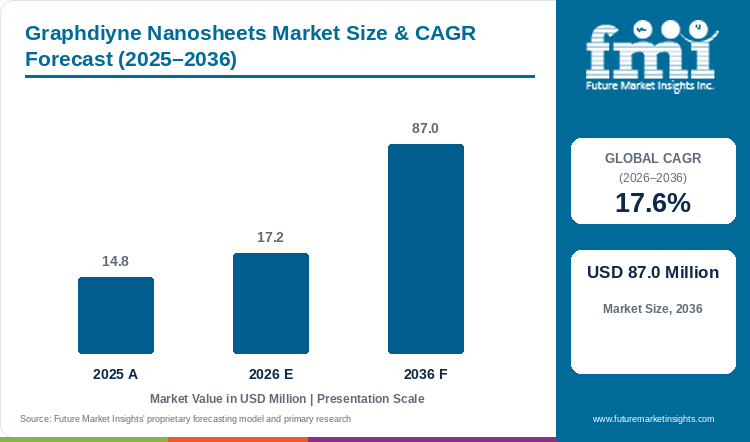
Projected to compound at 17.6% per annum through 2036, worldwide graphdiyne nanosheets demand rises above USD 14.8 million registered in 2025 toward a projected USD 17.2 million during 2026 and is expected to culminate at USD 87.0 million by 2036.
Platinum-group metal dissolution inside acidic proton-exchange-membrane electrolyzers and halide ion migration across perovskite photovoltaic interfaces are compelling clean-energy engineers to adopt sp-sp2 hybridized carbon networks featuring 18-carbon acetylenic cavities. When compared with three-dimensional foams or nanotube arrays, Ultrathin 2D Graphdiyne Nanosheets are expected to command 51.4% of sp-sp2 hybridization morphology demand in 2026 because sub-nanometer planar films expose uniform triangular pores that chelate zero-valent metal atoms without thermal sintering. During February 2026, chemical engineers at the Georgia Institute of Technology and Sandia National Laboratories reported in ACS Materials Au (PMID 42146743) that preserving diacetylenic triple-bond conjugation in pyridine rather than dimethylformamide is essential to prevent partial graphitization and maintain high electrical conductivity across functionalized graphene nanocomposites and 2D carbon networks [1]. Future Market Insights estimates that global graphdiyne nanosheets orders will rise past a 2025 baseline of USD 14.8 million to post an expected USD 17.2 million in 2026, subsequently rising toward USD 87.0 million as predicted for 2036 at an anticipated 17.6% CAGR that expands annual market revenue by USD 69.8 million from 2026 to 2036.
Key Market Trends & Insights
- By sp-sp2 hybridization morphology: Ultrathin 2D Graphdiyne Nanosheets are expected to generate 51.4% of 2026 morphology volume because few-layer planar sheets minimize ion-transport tortuosity in catalytic and photovoltaic interfaces.
- By synthesis method: Glaser-Hay Cross-Coupling on Copper Foil is projected to claim 56.8% of 2026 synthesis sales since in-situ deprotection of hexakis(trimethylsilylethynyl)benzene on copper foil produces continuous crystalline films.
- By doping & functionalization: Pristine Undoped Graphdiyne is anticipated to secure 46.0% of 2026 functionalization demand as researchers purchase baseline sp-sp2 carbon frameworks for custom in-house metalation or optoelectronic doping.
- By end-use application: Zero-Valence Single-Atom Electrocatalysis is forecast to hold 39.5% of 2026 application revenue due to unmatched charge-transfer stabilization of isolated palladium and iron atoms alongside nickel sites inside alkyne cavities.
Regional Highlights
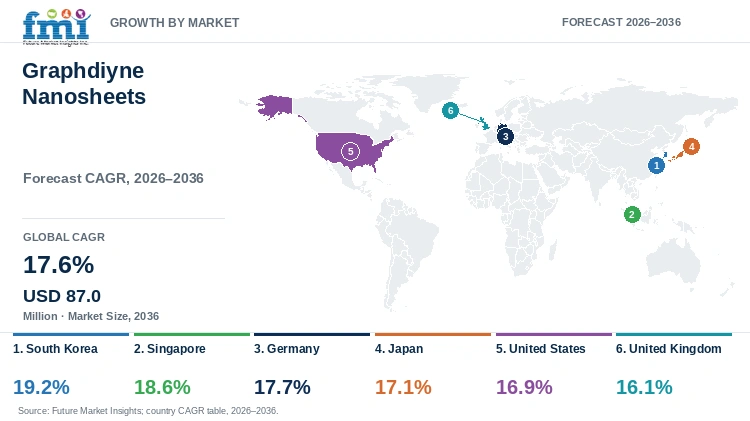
- Highest national growth velocity: South Korea is projected to pace leading hydrogen and battery manufacturing nations at 19.2% annual growth through 2036 on sodium-ion battery anode and water-splitting catalyst investments.
- Singaporean and German expansion: Singapore is anticipated to gain 18.6% each year until 2036 via nanoporous gas-separation and desalination membrane trials, whereas German demand is predicted to increase 17.7% per annum through industrial electrolyzer and precursor catalog distribution.
- Japanese and Western outlooks: Japanese monomer and catalysis labs are estimated to expand by 17.1% annually, ahead of United States laboratories (forecast at 16.9%) and British research centers (slated at 16.1%) across catalysis and bioelectronic sensing.
Market Size & Forecast
Table 1: Market Size and Forecast for the Graphdiyne Nanosheets Market (USD million and CAGR percentage), 2025 to 2036
| Metric | Value |
|---|---|
| Market Value (2025) | USD 14.8 million |
| Estimated Market Size in 2026 | USD 17.2 million |
| Projected Market Size by 2036 | USD 87.0 million |
| CAGR (2026 to 2036) | 17.6% |
| Absolute Dollar Opportunity (2026 to 2036) | USD 69.8 million |
Expanding commercial catalog availability of protected hexaethynylbenzene (HEB-TMS) precursors and copper-supported graphdiyne films is lowering the entry barrier for academic and industrial electrochemistry groups. In August 2026, Tokyo Chemical Industry Corporation published TCIMAIL application guidelines (No. 202-20) for gamma-graphdiyne precursor hexakis(trimethylsilylethynyl)benzene (Product H2011) detailing tetrabutylammonium fluoride deprotection and interfacial coupling to prevent amorphous carbon formation [2]. Electrode designers consequently combine porous graphdiyne nanosheets with multi-walled carbon nanotubes to construct hierarchical conductive scaffolds for water electrolyzers and metal-ion batteries. Fine-chemical manufacturers that supply high-purity monomer crystals alongside pre-synthesized graphdiyne powders capture repeat procurement across catalysis and solar laboratories.
Monomer Precursor and Synthesized Nanosheet Production Sizing
Table 2: Monomer and Nanosheet Production Sizing for the Graphdiyne Nanosheets Market (USD million, kilograms, and USD per gram), mixed historical and forecast years from 2025 to 2036
| Metric | 2025 | 2026 | 2036 |
|---|---|---|---|
| Market size (USD million) | 14.8 | 17.2 | 87.0 |
| Synthesized graphdiyne powder & film output (kilograms) | 26.0 to 31.0 | 32.0 to 38.0 | 245.0 to 290.0 |
| HEB-TMS monomer precursor consumption (kilograms) | 42.0 to 50.0 | 51.0 to 61.0 | 380.0 to 450.0 |
| Average realized graphdiyne powder price (USD per gram) | 380 to 594 | 360 to 550 | 210 to 265 |
Operational note: Synthesized kilogram output includes copper-foil-grown 2D nanosheets and liquid-liquid interfacial films alongside ball-milled powders derived from hexakis(trimethylsilylethynyl)benzene feedstock.
Because unprotected hexaethynylbenzene monomers polymerize or decompose rapidly under ambient light and oxygen, commercial graphdiyne production relies on trimethylsilyl-protected HEB-TMS precursors cleaved in situ with tetrabutylammonium fluoride. Maintaining mild processing temperatures during electrode fabrication is projected to preserve diacetylenic conjugation for perovskite photovoltaic cells and hydrogen evolution cathodes. During August 2026, nanotech scientists at the Alan G. MacDiarmid NanoTech Institute at The University of Texas at Dallas reported at the ACS Fall 2026 Digital Meeting (Session 4541226) that simultaneous DSC-TGA and Raman spectroscopy reveal an irreversible exothermic triple-bond reorganization in graphdiyne starting at 150°C and peaking near 300°C with disappearance of diyne peaks at 2,175 and 2,285 cm-1 [3].
Per Capita & Catalysis/Membrane Facility Sizing
Table 3: Per Capita and Research Facility Spending Indicators for the Graphdiyne Nanosheets Market (USD), mixed historical and forecast years from 2025 to 2036
| Metric | 2025 | 2026 | 2036 |
|---|---|---|---|
| World population (billion) | 8.23 | 8.30 | 8.95 |
| Spend per 1,000 people (USD) | 1.80 | 2.07 | 9.72 |
| Active catalysis, solar & membrane labs worldwide | 820 | 910 | 2,150 |
| Annual graphdiyne spend per active facility (USD) | 18,049 | 18,901 | 40,465 |
Table 4: Morphology, Synthesis, and Application Spending Indicators for the Graphdiyne Nanosheets Market (USD million and percentages), mixed reporting years from 2025 to 2026
| Benchmark Indicator | Reported / Modeled Value | Institutional Reference Basis |
|---|---|---|
| Market size, 2026 | USD 17.2 million | Report value |
| Ultrathin 2D graphdiyne nanosheets revenue, 2026 | USD 8.8 million | 51.4% morphology share |
| Glaser-Hay cross-coupling revenue, 2026 | USD 9.8 million | 56.8% synthesis method share |
| Single-atom electrocatalysis revenue, 2026 | USD 6.8 million | 39.5% application share |
Institutional procurement spans green-hydrogen electrolyzer developers and third-generation solar research institutes alongside reverse-osmosis membrane engineering groups. Mounting ultrathin graphdiyne layers onto porous polymer supports inside industrial water desalination plants exploits uniform 18-carbon triangular pores that pass water molecules at high flux while rejecting hydrated salt ions. Suppliers that verify sp-to-sp2 carbon hybridization ratios of 2:1 via solid-state 13C nuclear magnetic resonance and Raman 2,190 cm-1 diyne peaks secure preferred vendor status.
Analyst Perspective
"Uniform acetylenic cavities make graphdiyne an unmatched two-dimensional support for zero-valence single-atom electrocatalysts and selective ion-sieving membranes. Lowering hexaethynylbenzene monomer synthesis costs and scaling interfacial film growth remain essential to move beyond laboratory gram orders."
- Nikhil Kaitwade, Principal Consultant, Future Market Insights.
How is the graphdiyne nanosheets market segmented?
The graphdiyne nanosheets market is segmented by sp-sp2 hybridization morphology, synthesis method, doping & functionalization, end-use application, and region. In 2026, Ultrathin 2D Graphdiyne Nanosheets are expected at 51.4%, Glaser-Hay Cross-Coupling on Copper Foil is projected at 56.8%, Pristine Undoped Graphdiyne is anticipated at 46.0%, and Zero-Valence Single-Atom Electrocatalysis is forecast at 39.5%.
By sp-sp2 hybridization morphology: Ultrathin 2D Graphdiyne Nanosheets, 3D Porous Graphdiyne Aerogels & Foams, and 1D Graphdiyne Nanotube Arrays.
By synthesis method: Glaser-Hay Cross-Coupling on Copper Foil, Interfacial Liquid-Liquid Synthesis, and Mechanochemical Ball-Milling Synthesis.
By doping & functionalization: Pristine Undoped Graphdiyne, Nitrogen & Sulfur Heteroatom-Doped GDY, and Zero-Valent Metal Atom Anchored GDY.
By end-use application: Zero-Valence Single-Atom Electrocatalysis, Perovskite Solar Cell Hole-Transport Layers, Ion-Sieving Desalination Membranes, and High-Rate Lithium/Sodium Storage Anodes.
What Enables Ultrathin 2D Graphdiyne Nanosheets to Lead Hybridization Morphologies?
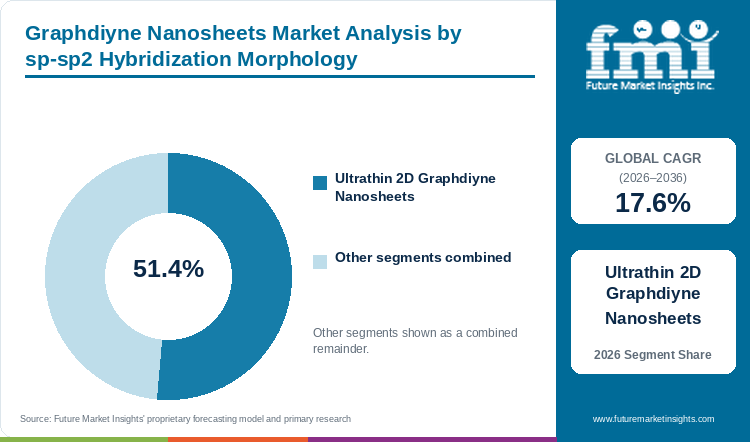
In 2026, 51.4% of sp-sp2 hybridization morphology volume belongs to Ultrathin 2D Graphdiyne Nanosheets, benefiting from sub-nanometer alkyne pores.
Table 5: sp-sp2 Hybridization Morphology Share for the Graphdiyne Nanosheets Market (percentage share), 2026
| sp-sp2 Hybridization Morphology Segment | Share (2026) |
|---|---|
| Ultrathin 2D Graphdiyne Nanosheets | 51.4% |
| Other Segments Combined | 48.6%* |
| Total | 100.0% |
*Note: Combined share of remaining sp-sp2 hybridization morphology categories totaling 100.0% of 2026 market demand.
Table 6: sp-sp2 Hybridization Morphology Leadership and Market Growth for the Graphdiyne Nanosheets Market (segment and CAGR percentage), 2026 to 2036
| Metric | Value |
|---|---|
| Global CAGR (2026 to 2036) | 17.6% |
| Leading Segment | Ultrathin 2D Graphdiyne Nanosheets |
Exfoliated or interfacially grown two-dimensional nanosheets with thicknesses between 1.5 and 24 nanometers expose the maximum density of conjugated diacetylenic rings while minimizing cross-plane ion diffusion resistance. When transferred onto conductive glass or porous polymer supports, planar nanosheets form conformal hole-extraction layers and ultrathin desalination barriers for solar-powered desalination modules. Meanwhile, 3D Porous Graphdiyne Aerogels & Foams grown on copper foam skeletons and 1D Graphdiyne Nanotube Arrays synthesized inside anodized alumina templates are projected to capture 48.6% combined demand where high volumetric electrolyte wetting is required.
- Short cross-plane diffusion pathways and uniform sub-nanometer porosity are expected to give Ultrathin 2D Graphdiyne Nanosheets 51.4% of 2026 morphology sales.
- In January 2026, a synthesis review in Chemical Synthesis documented that liquid-liquid and gas-liquid interfacial coupling yields crystalline ABC-stacked graphdiyne nanosheets as thin as 3 nm to 24 nm while MXene interlayer-confined monolayer graphdiyne reaches 5.1 x 10^3 S/m electrical conductivity and 231.4 cm2/V·s carrier mobility [4].
Why Does Glaser-Hay Cross-Coupling on Copper Foil Dominate Synthesis Methods?
Within synthesis method categories, Glaser-Hay Cross-Coupling on Copper Foil generates 56.8% in 2026, accompanied by direct catalytic copper-surface polymerization.
Immersion of cleaned copper foils or copper nanowires into a pyridine or dichloromethane/TMEDA solution of deprotected ethynyl monomers allows surface-leached Cu(I) ions to drive terminal alkyne homocoupling directly on the metal interface. This dual role of metallic copper as both catalyst reservoir and planar growth template prevents bulk solution precipitation and yields cohesive graphdiyne films that can be used directly as current collectors or delaminated via 0.5 M ammonium persulfate etching. Interfacial liquid-liquid synthesis and mechanochemical ball-milling are estimated to account for 43.2% of synthesis demand, supplying freestanding nanosheets for lithium-ion battery separators and slurry coatings.
- Direct growth on conductive copper current collectors is projected to enable Glaser-Hay Cross-Coupling on Copper Foil to secure 56.8% of 2026 synthesis method revenue.
- In July 2026, Chongqing Normal University chemists demonstrated in the Journal of Chemical Education that copper-foil-templated Glaser-Hay coupling with TMEDA at 35°C for 24 hours followed by 0.5 M ammonium persulfate delamination yields ordered 2D films featuring a 2,162 cm-1 Raman C≡C peak and a 2.34 eV optical bandgap alongside 100 mA/cm2 photocurrent density [5].
How Does Pristine Undoped Graphdiyne Retain the Top Doping & Functionalization Share?
Across doping & functionalization segments, Pristine Undoped Graphdiyne captures 46.0% in 2026, supported by intrinsic semiconductor bandgap uniformity.
Unlike sp2 graphene which requires destructive oxidation or substitutional doping to open a narrow bandgap, pristine undoped graphdiyne possesses a natural direct bandgap and non-uniform surface charge distribution out of the box. University and corporate catalysis groups predominantly purchase unfunctionalized graphdiyne powder or films so they can anchor specific transition-metal or noble-metal atoms in-house via controlled incipient wetness or electrodeposition. Nitrogen & Sulfur Heteroatom-Doped GDY and Zero-Valent Metal Atom Anchored GDY together are anticipated to represent 54.0% of functionalization turnover, serving buyers testing advanced battery electrolyte systems and turnkey oxygen-reduction electrodes.
- Versatility as a baseline host for custom post-synthetic metalation is anticipated to give Pristine Undoped Graphdiyne 46.0% of 2026 doping & functionalization sales.
- In March 2025, a review in the Journal of Nanobiotechnology (PMC11881411) highlighted how pristine graphdiyne's 18-carbon triangular pores and intrinsic semiconductor bandgap deliver a 20% photoelectric conversion efficiency gain in solar cells alongside twice the theoretical lithium storage capacity of graphite before heteroatom or metal doping [6].
Why Does Zero-Valence Single-Atom Electrocatalysis Lead End-Use Applications?
Zero-Valence Single-Atom Electrocatalysis secures 39.5% of end-use application turnover in 2026, reflecting strong alkyne-ring metal atom anchoring.
Eighteen-carbon triangular cavities bordered by electron-rich diacetylenic linkages provide six-coordinate d-pi orbital overlap that locks isolated palladium or platinum alongside iron or nickel atoms in a stable zero-valence state. Whereas conventional nitrogen-doped carbon supports suffer demetalation under acidic or reductive electrolysis, graphdiyne's alkyne rings donate reversible electron density during hydrogen evolution and CO2 electroreduction. Achieving 100% atomic metal utilization allows electrolyzer designers to cut platinum-group metal loading by 80% to 90% compared with commercial Pt/C nanoparticles.
- Complete atomic metal utilization and leaching resistance are forecast to place Zero-Valence Single-Atom Electrocatalysis at 39.5% of 2026 end-use application revenue.
- In August 2024, researchers in RSC Advances demonstrated the rational design of graphdiyne-based single-atom catalysts where transition-metal atoms coordinated inside 18-carbon diacetylenic cavities lower limiting potentials for selective electrochemical CO2 reduction [7].
How Do Perovskite Solar Cells, Desalination Membranes & Battery Anodes Shape Non-Catalytic Demand?
Solar Hole-Transport, Desalination Membranes & Storage Anodes account for 60.5% of non-catalytic application demand in 2026, driven by ion-sieving channels.
Beyond single-atom catalysis, Perovskite Solar Cell Hole-Transport Layers and Ion-Sieving Desalination Membranes alongside High-Rate Lithium/Sodium Storage Anodes are predicted to combine for 60.5% of 2026 graphdiyne application volume. Doping graphdiyne nanoflakes into hole-transport layers passivates grain-boundary traps through Lewis-base alkyne coordination and boosts solar cell efficiency. In energy storage, graphdiyne's 18-carbon pores and oxidized derivatives permit rapid in-plane and cross-plane ion transport with exceptional high-rate cycling stability.
- Perovskite defect passivation and sub-nanometer membrane separation alongside solid-state battery transport are expected to generate 60.5% of 2026 non-catalytic application sales.
- In August 2026, Institute of Chemistry Chinese Academy of Sciences researchers demonstrated in Angewandte Chemie International Edition (PMID 42322151) that a graphdiyne oxide and phosphoric acid (GDYO@H3PO4) solid-state proton battery electrolyte retains 53.6% capacity at an ultrahigh 50C rate and 90.2% capacity after 4,500 cycles at 102.2 mAh/g [8].
What are the drivers, restraints, and opportunities in the graphdiyne nanosheets market?
Single-atom green-hydrogen and CO2 electrocatalysis alongside solid-state battery commercialization are expected to propel graphdiyne nanosheets sales through 2036, whereas multi-step hexaethynylbenzene monomer synthesis costs and batch cross-coupling scalability restrain bulk industrial adoption.
- Driver: Rapid growth in selective CO2-to-CH4 photocatalysts and green-hydrogen electrolyzers alongside high-rate batteries fuels demand for sp-sp2 carbon nanosheets with atomic metal-anchoring cavities.
- Restraint: Multi-step palladium-mediated synthesis of trimethylsilyl-protected hexaethynylbenzene monomers and slow batch copper-foil cross-coupling keep per-gram prices elevated.
- Opportunity: Scaling mechanochemical ball-milling and direct acetylene-gas synthesis enables kilogram-scale graphdiyne powders for hydrogen production and bioelectronic sensors.
Growth Analysis and Future Potential: Qualitative Demand Catalysts
Electrolyzer manufacturers and artificial-photosynthesis developers are seeking chemically stable carbon matrices that eliminate precious-metal sintering and accelerate multi-electron charge transfer. Anchoring quantum dots or single metal atoms via sp-C-metal bonds inside graphdiyne's acetylenic cavities creates ohmic contact interfaces that suppress photogenerated carrier recombination. In May 2024, catalysis teams at the Chinese Academy of Sciences and Shandong University demonstrated in National Science Review that anchoring 2.47 nm palladium quantum dots on ABC-stacked single-crystalline graphdiyne via sp-C-Pd bonds (283.9 eV) cuts charge-transfer resistance from 2,421 ohms to 574 ohms and achieves near-100% methane selectivity at 26.2 micromoles per gram per hour from CO2 and H2O [9]. Concurrently, encapsulating solar and catalytic modules with two-component epoxy structural adhesives protects air-sensitive electrode interfaces during outdoor operation.
Risk Assessment of the Graphdiyne Nanosheets Market: Operational and Formulation Friction
High precursor synthesis cost and thermal sensitivity of deprotected hexaethynylbenzene monomers represent the primary commercial bottlenecks restricting multi-ton graphdiyne production. Synthesizing hexakis(trimethylsilylethynyl)benzene from hexabromobenzene via Sonogashira cross-coupling requires palladium/copper catalysts and anhydrous tetrahydrofuran alongside column chromatography purification. Furthermore, deprotected HEB monomers can undergo uncontrolled exothermic cross-linking if oxygen or concentration gradients spike, unlike stable reactive epoxy diluents. Through its 2026 catalog, Tokyo Chemical Industry Corporation lists 1,2,3,4,5,6-Hexakis[(trimethylsilyl)ethynyl]benzene (Product No. H2011 carrying CAS RN 100516-62-9 at >95.0% GC purity stored refrigerated under inert gas) at USD 144.00 per 1 gram and USD 499.00 per 5 grams [10].
Commercial Opportunity Analysis: Formulation Differentiation and Value-Add Formats
Chemical suppliers can capture high-growth industrial accounts by commercializing one-day mechanochemical ball-milling synthesis and direct acetylene-gas graphdiyne production alongside pre-metalated catalyst inks. Mechanochemical reaction of hexabromobenzene with calcium carbide in a planetary ball mill bypasses expensive TMS-protected monomers and cuts synthesis time from seven days on copper foil down to one day. Integrating conductive graphdiyne interlayers onto substrate-like circuit boards and micro-supercapacitors also opens high-margin opportunities in wearable bioelectronics. In November 2025, University of Toyama and Inner Mongolia University researchers documented in Inorganic Chemistry Frontiers that 2024 mechanical ball-milling and direct acetylene-gas synthesis routes enable graphdiyne heterojunction photocatalysts reaching 72.18 mmol/g hydrogen evolution over 7 hours [11].
Graphdiyne Nanosheets Market by Country (2026 to 2036)
Sodium-ion battery anode interfaces and water-splitting catalyst programs are projected to push South Korea to a leading 19.2% annual clip through 2036, trailed by Singaporean gas-separation and desalination membrane labs (anticipated at 18.6%) and German electrolyzer and reagent hubs (predicted at 17.7%). Concurrently, Japanese HEB-TMS monomer and heterojunction researchers (estimated at 17.1%) and United States national laboratories (forecast at 16.9%) alongside British nano-bio and solar institutes (slated at 16.1%) sustain steady cleanroom procurement.
Table 7: Country CAGR and Primary Growth Levers for the Graphdiyne Nanosheets Market (CAGR percentage and operational drivers), 2026 to 2036
| Country | CAGR (2026 to 2036) | Primary Growth Lever |
|---|---|---|
| South Korea | 19.2% | Self-adaptive graphdiyne/tin sodium-ion battery anodes and tandem solar hole-transport layers |
| Singapore | 18.6% | Nanoporous graphdiyne CO2/CH4 gas-separation and ion-sieving seawater desalination membranes |
| Germany | 17.7% | Industrial green-hydrogen electrolyzer single-atom catalyst R&D and Merck KGaA precursor distribution |
| Japan | 17.1% | Domestic TCI HEB-TMS monomer synthesis leadership and University of Toyama photocatalytic H2 |
| United States | 16.9% | Georgia Tech/Sandia HsGDY conductivity studies and N/S dual-doped battery anode research |
| United Kingdom | 16.1% | Electronic-structure-modulated graphdiyne nano-bio sensors and perovskite photovoltaic spin-outs |
Source: Future Market Insights analysis
South Korea Graphdiyne Nanosheets Market Outlook (2026 to 2036)
Whereas global graphdiyne demand is predominantly driven by laboratory electrocatalysis, South Korea is unique because domestic battery and display conglomerates are co-developing high-rate sodium-ion battery anodes alongside tandem perovskite-silicon solar modules. Electrochemical engineering teams in Daejeon and Ulsan incorporate flexible graphdiyne protective layers onto high-capacity tin and silicon anodes to suppress particle pulverization, with South Korean graphdiyne nanosheets turnover projected to progress at a 19.2% annual rate through 2036. In May 2024, researchers in Advanced Science (PMID 38733090) demonstrated a self-adaptive flexible chain-doped 2D graphdiyne/tin interface for sodium-ion batteries that endures 1,800 cycles at a high current density of 2.5 A/g [12]. Reliance on imported Japanese HEB-TMS monomer precursors nonetheless adds procurement lead times.
Key takeaway: In South Korea, self-adaptive sodium-ion battery anode interfaces and tandem solar passivation are projected to deliver a 19.2% annual expansion clip until 2036.
Singapore Graphdiyne Nanosheets Market Outlook (2026 to 2036)
Unlike continental markets focused on solid-state battery anodes, Singapore uniquely prioritizes nanoporous graphdiyne membranes for selective carbon-dioxide capture and low-energy seawater desalination across Jurong Island petrochemical and national water facilities. Membrane research centers across Nanyang and Kent Ridge fabricate interfacial liquid-liquid graphdiyne nanosheets on porous supports to separate gas mixtures and reject monovalent salts, with Singaporean graphdiyne nanosheets orders anticipated to rise by 18.6% annually through 2036. In May 2024, density functional theory research in Physical Chemistry Chemical Physics demonstrated that triangular pores in graphdiyne membranes impose a 0.28 eV crossing barrier for linear CO2 molecules versus 0.51 eV for spherical CH4 molecules [13]. Scaling defect-free interfacial film transfer onto spiral-wound modules remains the primary engineering hurdle.
Key takeaway: In Singapore, nanoporous CO2/CH4 gas-separation and desalination membrane testbeds are anticipated to support an 18.6% yearly expansion to 2036.
Germany Graphdiyne Nanosheets Market Outlook (2026 to 2036)
In contrast to Asian photovoltaic-led demand, Germany's graphdiyne market is uniquely structured around replacing scarce iridium and platinum in proton-exchange-membrane water electrolyzers backed by domestic fine-chemical catalog logistics in Darmstadt. Electrochemical research institutes in Julich and Freiburg alongside Munich synthesize zero-valent transition-metal single-atom catalysts on 3D graphdiyne foams, with German graphdiyne nanosheets sales predicted to advance at a 17.7% yearly clip through 2036. Through its 2026 catalog, Darmstadt-headquartered Merck KGaA (Sigma-Aldrich) supplies 97%-pure 1,2,3,4,5,6-Hexakis((trimethylsilyl)ethynyl)benzene (Product CIAH987ECED7 carrying CAS RN 100516-62-9 with molecular weight 655.34 stored at 4°C under nitrogen) in 100 mg to 25 g quantities [14]. Strict federal hazardous-solvent regulations governing anhydrous pyridine cross-coupling baths nevertheless increase domestic synthesis overhead.
Key takeaway: In Germany, non-precious electrolyzer catalyst engineering and Merck KGaA precursor distribution are slated to generate a 17.7% compounded yearly climb until 2036.
Japan Graphdiyne Nanosheets Market Outlook (2026 to 2036)
Compared with monomer-importing nations that purchase pre-synthesized powders, Japan stands apart as the global upstream synthesis hub for crystalline hexakis(trimethylsilylethynyl)benzene (HEB-TMS) precursors and interfacial 2D carbon nanosheets. Fine-chemical manufacturers in Tokyo and university catalysis groups in Toyama supply ultra-pure HEB-TMS crystals and gas-liquid interfacial films, with Japanese graphdiyne nanosheets revenue estimated to grow 17.1% per annum until 2036. In January 2024, an ACS Applied Nano Materials review detailed how CuI/CuBr-mediated cross-coupling yields lamellar graphdiyne reaching 137.8 F/g capacitance while 700°C vapor-liquid-solid growth on ZnO nanorod arrays achieves 2,800 S/cm electrical conductivity and 100 cm2/V·s mobility [15]. High domestic chromatography purification labor costs still encourage university buyers to order pre-synthesized powders.
Key takeaway: In Japan, domestic TCI HEB-TMS monomer synthesis leadership and photocatalytic hydrogen programs are estimated to fuel a 17.1% CAGR through 2036.
United States Graphdiyne Nanosheets Market Outlook (2026 to 2036)
Distinct from European electrolyzer-focused adoption, United States graphdiyne demand is uniquely diversified across Department of Energy national-laboratory conjugation studies and high-capacity heteroatom-doped alkali-metal storage anodes. National laboratories and universities in Georgia and New Mexico alongside Texas evaluate hydrogen-substituted graphdiyne conductivity and thermal stability, with United States graphdiyne nanosheets orders forecast to progress by 16.9% per year until 2036. In March 2025, battery researchers in MDPI Batteries documented that nitrogen-and-sulfur dual-doped 2D carbon anodes achieve reversible storage of 1,460 mAh/g at 0.25 C while anodes represent 17.9% of sodium-ion and 15.6% of lithium-ion battery material cost [16]. Refrigerated inert-gas shipping requirements for ethynyl monomer precursors remain a recurring logistical cost friction point.
Key takeaway: In the United States, Sandia/Georgia Tech HsGDY research and domestic 2D material catalog suppliers are forecast to support a 16.9% yearly expansion rate through 2036.
United Kingdom Graphdiyne Nanosheets Market Outlook (2026 to 2036)
Unlike state-directed Asian industrial consortia, the United Kingdom graphdiyne market is uniquely anchored by university spin-outs commercializing perovskite photovoltaics and electrochemical nano-bio diagnostic sensors across Oxford and Cambridge alongside London. British photovoltaic and biomedical researchers modulate the sp-hybridized alkyne electronic structure of graphdiyne nanosheets to engineer selective aptasensors and hole-transport layers, with United Kingdom graphdiyne nanosheets demand slated to progress at a 16.1% annual pace through 2036. In May 2025, an Advanced Drug Delivery Reviews study (PMID 40147533) detailed how modulating the electronic structure and d-band center of graphdiyne-based nanomaterials optimizes nano-bio catalytic and biosensing interfaces [17]. Post-Brexit customs clearance inspections and refrigerated courier surcharges on imported organic precursors periodically lengthen laboratory delivery windows.
Key takeaway: In the United Kingdom, nano-bio sensor engineering and perovskite solar commercialization are slated to underpin a 16.1% yearly growth rate through 2036.
Full report country CAGRs cover: North America; Latin America; Western Europe; Eastern Europe; East Asia; South Asia and Pacific; Middle East and Africa.
Who are the notable companies in the graphdiyne nanosheets market?
ACS Material, LLC, Nanochemazone (Chemazone Inc.), Tokyo Chemical Industry Co., Ltd. (TCI), Sigma-Aldrich (Merck KGaA), 2D Semiconductors, Inc., Ossila Ltd., Nanografi Nano Technology, and Otto Chemie Pvt. Ltd. are the notable companies in the graphdiyne nanosheets market.
Competitive participation across the graphdiyne nanosheets sector separates confirmed graphdiyne powder and film suppliers from hexaethynylbenzene monomer synthesizers and adjacent 2D carbon distributors. Confirmed graphdiyne allotrope suppliers ACS Material LLC and Nanochemazone (Chemazone Inc.) commercialize synthesized graphdiyne powders and copper-templated graphdiyne films alongside graphdiyne nanowalls and HEB-TMS monomer kits. Fine-chemical synthesizers Tokyo Chemical Industry Corporation (TCI) and Sigma-Aldrich (Merck KGaA) specialize in >95% to 97% pure hexakis[(trimethylsilyl)ethynyl]benzene precursors (Product H2011 and Product CIAH987ECED7 / 05846 carrying verified CAS 100516-62-9) for in-situ Glaser-Hay cross-coupling. At the adjacent materials tier, Nanografi Nano Technology and Ossila Ltd. alongside Otto Chemie Private Limited and 2D Semiconductors Inc. supply co-dispersed conductive carbon additives and optoelectronic substrates for hybrid electrodes.
- Confirmed Graphdiyne Nanosheet & Monomer Suppliers: ACS Material LLC (SKU GDYP0011 and SKU GDYM0025) and Nanochemazone (Product Code NCZ-GD-104 Graphdiyne Powder alongside Graphdiyne Film and Graphdiyne Oxide) supply commercial sp-sp2 graphdiyne materials.
- Hexaethynylbenzene Monomer (HEB-TMS, CAS 100516-62-9) Synthesizers: Tokyo Chemical Industry Corporation (TCI Product H2011) and Sigma-Aldrich (Merck KGaA Product CIAH987ECED7 / 05846) manufacture high-purity gamma-graphdiyne precursors and cross-coupling catalysts.
- Adjacent 2D Carbon & Optoelectronic Substrate Suppliers: Nanografi Nano Technology and Ossila Ltd. alongside Otto Chemie Private Limited and 2D Semiconductors Inc. distribute adjacent 2D conductive additives and charge-transport substrates rather than standalone synthesized graphdiyne.
Competitive Benchmarking: Graphdiyne Nanosheets Market
Table 8: Competitive Benchmarking for the Graphdiyne Nanosheets Market (qualitative capability ratings), 2026
| Company | GDY Nanosheet & Film Portfolio | HEB-TMS Monomer Purity | Doping & Custom Synthesis | Global Cold-Chain Distribution |
|---|---|---|---|---|
| ACS Material, LLC | High | High | High | High |
| Nanochemazone (Chemazone Inc.) | High | High | High | High |
| Tokyo Chemical Industry Co., Ltd. (TCI) | Medium | High | High | High |
| Sigma-Aldrich (Merck KGaA) | Medium | High | High | High |
| 2D Semiconductors, Inc. | Medium | Medium | Medium | Medium |
| Ossila Ltd. | Medium | Medium | High | High |
| Nanografi Nano Technology | Medium | Medium | High | High |
| Otto Chemie Pvt. Ltd. | Medium | Medium | Medium | High |
Scoring basis: GDY Nanosheet & Film Portfolio earns a High mark only when a vendor supplies explicitly verified sp-sp2 graphdiyne powders or copper-foil films alongside graphdiyne oxide (ACS Material and Nanochemazone), while Medium indicates focus on upstream HEB-TMS monomers (TCI and Merck KGaA) or adjacent 2D carbon conductive additives and substrates. HEB-TMS Monomer Purity reflects documented GC/HPLC/NMR purity of 95% to 97%+ for hexakis[(trimethylsilyl)ethynyl]benzene (CAS 100516-62-9) to prevent amorphous carbon side-products. Global Cold-Chain Distribution evaluates international fulfillment of light-sensitive and temperature-controlled (0°C to 10°C under nitrogen) ethynyl precursors and 2D dispersions.
Key Developments in the Graphdiyne Nanosheets Market
- Through its 2026 Graphyne Series catalog, Pasadena-based ACS Material LLC supplies TEM-characterized Graphdiyne Powder (SKU GDYP0011 with 40 to 200 nm flake size and 0.47 eV natural bandgap starting at USD 594.00 per 10 mg) for lithium/sodium storage and single-atom catalysis [18].
- Through its 2026 catalog, ACS Material LLC also supplies Graphdiyne Monomer HEB-TMS (SKU GDYM0025 carrying verified CAS 100516-62-9 for light-yellow hexakis[(trimethylsilyl)ethynyl]benzene powder) in 500 mg packages starting at USD 516.00 for in-situ copper-foil film growth [19].
- In October 2026, a multi-modal biosensing review in MDPI Biosensors documented that 2D graphdiyne materials integrated into electrochemical and photoelectrochemical dual-modal sensors push early tumor biomarker detection limits down to the femtomolar and attomolar range [20].
Key Players in the Graphdiyne Nanosheets Market
Confirmed Graphdiyne Nanosheet, Film & Monomer Suppliers
- ACS Material, LLC
- Nanochemazone (Chemazone Inc.)
Hexaethynylbenzene Monomer (HEB-TMS, CAS 100516-62-9) Synthesizers
- Tokyo Chemical Industry Co., Ltd. (TCI)
- Sigma-Aldrich (Merck KGaA)
Adjacent 2D Carbon & Optoelectronic Substrate Suppliers
- 2D Semiconductors, Inc.
- Ossila Ltd.
- Nanografi Nano Technology
- Otto Chemie Pvt. Ltd.
Graphdiyne Nanosheets Market - Report Scope
Table 9: Report Scope for the Graphdiyne Nanosheets Market (coverage fields and definitions), 2026 to 2036
| Coverage field | Report scope |
|---|---|
| Market breakdown | sp-sp2 Hybridization Morphology; Synthesis Method; Doping & Functionalization; End-Use Application; Region |
| Quantitative Units | USD Million |
| Market Definition | Includes supplier revenue from synthesized graphdiyne (GDY) nanosheets, 3D porous graphdiyne foams, 1D graphdiyne nanotube arrays, and dedicated hexakis[(trimethylsilyl)ethynyl]benzene (HEB-TMS, CAS 100516-62-9) precursors sold for in-situ graphdiyne growth. Category Scope Note: The valuation measures sp-sp2 hybridized carbon allotropes containing diacetylenic (-C≡C-C≡C-) linkages and benzene rings, excluding conventional sp2 graphene nanoplatelets, graphene oxide, reduced graphene oxide, carbon nanotubes, and bulk activated carbon. |
| Regions Covered | North America; Latin America; Western Europe; Eastern Europe; East Asia; South Asia and Pacific; Middle East and Africa |
| Countries Covered | South Korea, Singapore, Germany, Japan, United States, United Kingdom, and additional countries in the full report |
| Key Companies Covered | ACS Material, LLC, Nanochemazone (Chemazone Inc.), Tokyo Chemical Industry Co., Ltd. (TCI), Sigma-Aldrich (Merck KGaA), 2D Semiconductors, Inc., Ossila Ltd., Nanografi Nano Technology, Otto Chemie Pvt. Ltd. |
| Forecast Period | 2026 to 2036 |
| Approach | Primary and secondary research with rigorous market triangulation. |
Graphdiyne Nanosheets Market - Research Methodology
Table 10: Research Methodology for the Graphdiyne Nanosheets Market (research methods and approach), 2026 edition
| Method | Approach |
|---|---|
| Primary Research | Primary interviews were conducted with organic synthesis chemists, electrocatalysis researchers, perovskite solar module engineers, and nanomaterial catalog managers to validate HEB-TMS monomer yields, copper-foil cross-coupling protocols, and gram-scale pricing. |
| Secondary Research | Secondary research included ACS Materials Au, Angewandte Chemie, National Science Review, RSC Advances, and Inorganic Chemistry Frontiers publications alongside verified product and application disclosures from TCI, ACS Material, Nanochemazone, and Merck KGaA. |
| Market Sizing and Forecasting | Market sizing and forecasting from 2026 to 2036 combined bottom-up tracking of commercial HEB-TMS monomer and synthesized graphdiyne powder batches with top-down adoption modeling across single-atom catalysis, photovoltaics, desalination, and batteries. |
| Data Triangulation and Validation | Estimates were triangulated against synthesis stoichiometry (HEB-TMS CAS 100516-62-9 to GDY conversion yields), research laboratory consumption rates, and catalog price tiers to eliminate double counting with sp2 graphene products. |
| Country Forecasting Model | Country CAGRs (16.1% to 19.2%) are calibrated around the 17.6% global CAGR using national green-hydrogen electrolyzer R&D budgets, perovskite solar commercialization activity, desalination membrane investments, and domestic fine-chemical synthesis capacity. |
| Operational Benchmark Traceability | Operational indicators in Tables 2, 3, and 4 (synthesized GDY kilogram volume, HEB-TMS precursor consumption, and per-facility spending) are modeled from TCI, ACS Material, and Nanochemazone synthesis disclosures and catalog gram pricing. |
Graphdiyne Nanosheets Market by Segments
Graphdiyne Nanosheets Market segmented by sp-sp2 Hybridization Morphology:
- Ultrathin 2D Graphdiyne Nanosheets
- 3D Porous Graphdiyne Aerogels & Foams
- 1D Graphdiyne Nanotube Arrays
Graphdiyne Nanosheets Market segmented by Synthesis Method:
- Glaser-Hay Cross-Coupling on Copper Foil
- Interfacial Liquid-Liquid Synthesis
- Mechanochemical Ball-Milling Synthesis
Graphdiyne Nanosheets Market segmented by Doping & Functionalization:
- Pristine Undoped Graphdiyne
- Nitrogen & Sulfur Heteroatom-Doped GDY
- Zero-Valent Metal Atom Anchored GDY
Graphdiyne Nanosheets Market segmented by End-Use Application:
- Zero-Valence Single-Atom Electrocatalysis
- Perovskite Solar Cell Hole-Transport Layers
- Ion-Sieving Desalination Membranes
- High-Rate Lithium/Sodium Storage Anodes
Graphdiyne Nanosheets Market by Region
- North America
- United States
- Canada
- Latin America
- Brazil
- Mexico
- Argentina
- Chile
- Western Europe
- Germany
- France
- United Kingdom
- Italy
- Spain
- Benelux
- Nordics
- Eastern Europe
- Poland
- Czech Republic
- Romania
- Hungary
- East Asia
- China
- Japan
- South Korea
- South Asia and Pacific
- India
- ASEAN
- Australia and New Zealand
- Middle East and Africa
- GCC Countries
- South Africa
- Türkiye
- Israel
Research Sources and Bibliography
- [1] Eeso, K., Sarswat, A., Chen, Z., Hsieh, C.-T., Lambert, T. N., & Liu, N. (2026, February 04). Effects of Synthesis Conditions on the Structure and Conductivity of Hydrogen-Substituted Graphdiyne. ACS Materials Au / U.S. National Library of Medicine (PMID: 42146743; PMCID: PMC13177400).
- [2] Tokyo Chemical Industry Co., Ltd. (TCI). (2026, August 09). γ-Graphdiyne Precursor. TCIMAIL Application Notes (No. 202-20).
- [3] Sepasi, Z., & Aliev, A. (2026, August 26). Thermal stability of graphdiyne. American Chemical Society Fall 2026 Digital Meeting (Session 4541226).
- [4] Pan, C., Zhang, H., Liu, Y., et al. (2026, January 27). Graphdiyne: research advances in synthesis strategy. Chemical Synthesis (Vol. 6, Issue 1, 13).
- [5] Hu, G., Zhou, X., & Zhang, J. (2026, July 07). Controllable Synthesis of Hydrogen-Substituted Graphdiyne: A Safe Undergraduate Experiment on Advanced Carbon Materials. Journal of Chemical Education (Vol. 103, Issue 8, 4521-4528).
- [6] Zhao, L.-X., Fan, Y.-G., Zhang, X., Li, C., Cheng, X.-Y., Guo, F., & Wang, Z.-Y. (2025, March 04). Graphdiyne biomaterials: from characterization to properties and applications. Journal of Nanobiotechnology / U.S. National Library of Medicine (PMC11881411).
- [7] Theerathanagorn, T., Vidal-Lopez, A., Comas-Vives, A., et al. (2024, August 28). Rational design of graphdiyne-based single-atom catalysts for electrochemical CO2 reduction reaction. RSC Advances (Vol. 14, Issue 37, 27365-27371).
- [8] Huang, Y., Xiong, Z., Liu, H., Sun, H., Su, W., Chen, Z., Zhoumei, W., & Liu, H. (2026, August 24). Graphdiyne Oxide-Enabled Solid-State Proton Battery Exhibiting Superior Rate Capability. Angewandte Chemie International Edition / U.S. National Library of Medicine (PMID: 42322151).
- [9] Zhang, C., Zheng, X., Gao, Y., Xing, C., Chen, S., Xue, Y., & Li, Y. (2024, May 29). Direct conversion of CO2 to CH4 on Pd/graphdiyne single-crystalline. National Science Review (Vol. 11, Issue 8, nwae189).
- [10] Tokyo Chemical Industry Co., Ltd. (TCI). (2026, January 15). 1,2,3,4,5,6-Hexakis[(trimethylsilyl)ethynyl]benzene. TCI Chemicals Product Catalog (Product No. H2011, CAS 100516-62-9).
- [11] Zhao, X., Zhang, L., Liu, G., Jin, Z., Yang, G., & Tsubaki, N. (2025, November 12). Graphdiyne-based heterojunctions for photocatalytic hydrogen production. Inorganic Chemistry Frontiers (Vol. 13, Issue 4, 1353-1384).
- [12] Cheng, S., Zuo, Z., & Li, Y. (2024, May 10). Self-Adaptive Graphdiyne/Sn Interface for High-Performance Sodium Storage. Advanced Science / U.S. National Library of Medicine (PMID: 38733090).
- [13] Mahnaee, S., López, M. J., & Alonso, J. A. (2024, May 28). Separation of CO2/CH4 gas mixtures using nanoporous graphdiyne and boron-graphdiyne membranes: influence of the pore size. Physical Chemistry Chemical Physics (Vol. 26, Issue 22, 15916-15926).
- [14] Sigma-Aldrich (Merck KGaA). (2026, January 20). 1,2,3,4,5,6-Hexakis((trimethylsilyl)ethynyl)benzene | 100516-62-9. Merck KGaA Product Catalog (Product No. CIAH987ECED7 / 05846).
- [15] Wu, X., Lu, Y., Li, P., Shen, Q., Xiao, D., Wu, H., Kang, J., Qi, Y., & Dong, A. (2024, January 25). Current Advances in the Synthesis, Properties, and Biomedical Applications of Two-Dimensional Graphdiyne: A Review. ACS Applied Nano Materials (Vol. 7, Issue 3, 2461-2493).
- [16] Nikgoftar, K., Reddy, A. K. M. R., Reddy, M. V., & Zaghib, K. (2025, March 24). Carbonaceous Materials as Anodes for Lithium-Ion and Sodium-Ion Batteries. Batteries (Vol. 11, Issue 4, 123).
- [17] Wang, H., Zhang, X., Liu, J., & Chen, C. (2025, May 15). Modulating the electronic structure of graphdiyne-based nanomaterials for engineering nano-bio interfaces in biomedical applications. Advanced Drug Delivery Reviews / U.S. National Library of Medicine (PMID: 40147533).
- [18] ACS Material, LLC. (2026, January 10). Shop Graphdiyne Powder | ACS Material. ACS Material Product Catalog (SKU GDYP0011).
- [19] ACS Material, LLC. (2026, January 10). Graphdiyne Monomer HEB-TMS | ACS Material. ACS Material Product Catalog (SKU GDYM0025, verified CAS 100516-62-9).
- [20] Chang, R., Wang, J., Li, Y., Jia, S., Li, L., & Zhang, R. (2026, October 15). From Single-Modal Signal Recognition to Multidimensional Precision Detection: Breakthroughs and Innovations of Multi-Modal Sensors in Tumor Biomarker Detection. Biosensors (Vol. 16, Issue 10, 579).
- [21] Nanochemazone (Chemazone Inc.). (2026, January 15). Graphdiyne Powder Price | Carbon Nanomaterial Supplier. Nanochemazone 2026-27 Product Catalogue (Product Code NCZ-GD-104).
- [22] Nanochemazone (Chemazone Inc.). (2026, January 15). Graphdiyne | Nanochemazone | Graphdiyne nanoproducts range. Nanochemazone Carbon & 2D Materials Catalog.
This bibliography is provided for reader reference and is not exhaustive. The full report contains the complete reference list and detailed citations.
This Report Answers
- How large is the graphdiyne nanosheets market in 2026 and what is forecast for 2036?
- Which single-atom catalysis and solar-cell developments drive demand for graphdiyne nanosheets?
- Why do Ultrathin 2D Graphdiyne Nanosheets lead the sp-sp2 hybridization morphology category?
- Why does Glaser-Hay Cross-Coupling on Copper Foil command the largest synthesis method share?
- How do country CAGRs compare across South Korea, Singapore, Germany, Japan, the United States, and the United Kingdom?
- Which companies supply synthesized graphdiyne powders and HEB-TMS monomer precursors today?
- What monomer synthesis and stability bottlenecks restrain faster graphdiyne adoption?
- What spectroscopic and pore-uniformity criteria should buyers verify when sourcing graphdiyne nanosheets?
Frequently Asked Questions
How big is the graphdiyne nanosheets market in 2026, and what is forecast for 2036?
Worldwide graphdiyne nanosheets sales are estimated at USD 17.2 million in 2026 (up from USD 14.8 million in 2025) and are projected to hit USD 87.0 million by 2036 across single-atom catalysis and solar or desalination membranes.
What is the 10-year CAGR for the graphdiyne nanosheets market from 2026 to 2036?
FMI analysts forecast that global graphdiyne nanosheets demand will compound at 17.6% per year from 2026 through 2036, expanding annual market revenue by USD 69.8 million over the ten-year horizon.
Which sp-sp2 hybridization morphology leads the graphdiyne nanosheets market?
Ultrathin 2D Graphdiyne Nanosheets are expected to capture 51.4% of 2026 morphology demand because sub-nanometer planar films expose uniform 18-carbon triangular pores with minimal cross-plane transport resistance.
Which synthesis method and functionalization grade lead the market in 2026?
Glaser-Hay Cross-Coupling on Copper Foil is projected to command 56.8% of 2026 synthesis method volume due to direct catalytic growth on copper current collectors, while Pristine Undoped Graphdiyne is anticipated to hold 46.0% of functionalization demand.
Which country exhibits the highest growth rate in the graphdiyne nanosheets market?
FMI estimates that South Korea is projected to top major clean-energy and semiconductor nations with a 19.2% annual clip through 2036, backed by self-adaptive sodium-ion battery anodes and water-splitting electrocatalyst pilot programs.
Who are the notable suppliers in the graphdiyne nanosheets market?
Notable market participants comprise confirmed sp-sp2 graphdiyne producers ACS Material, LLC and Nanochemazone (Chemazone Inc.), protected HEB-TMS monomer manufacturers Tokyo Chemical Industry Co., Ltd. (TCI) and Sigma-Aldrich (Merck KGaA), and adjacent 2D carbon or substrate distributors 2D Semiconductors, Inc., Ossila Ltd., Nanografi Nano Technology, and Otto Chemie Pvt. Ltd.
Preview the report firsthand - request a free sample
Get SampleGet the brochure for pricing and purchase details.
Get PDFTable of Content
- Key Takeaways
- Market Size and CAGR
- Top Growth Driver
- Fastest Growing Segment
- Leading Region
- Key Companies
- Emerging Opportunities
- Executive Summary
- Global Market Outlook
- Demand-side Trends
- Supply-side Trends
- Technology Roadmap Analysis
- Analysis and Recommendations
- Analyst Perspective (What is happening? Why now? What should investors know?)
- Key Questions Answered
- How large is the market?
- What is the CAGR?
- What are key trends?
- Which region dominates?
- Who are the leaders?
- Market Overview
- Market Coverage / Taxonomy
- Market Definition / Scope / Limitations
- Research Methodology
- Chapter Orientation
- Analytical Lens and Working Hypotheses
- Market Structure, Signals, and Trend Drivers
- Benchmarking and Cross-market Comparability
- Market Sizing, Forecasting, and Opportunity Mapping
- Research Design and Evidence Framework
- Desk Research Programme (Secondary Evidence)
- Expert Input and Fieldwork (Primary Evidence)
- Tooling, Models, and Reference Databases
- Data Engineering and Model Build
- Quality Assurance and Audit Trail
- Market Background
- Market Dynamics (Drivers, Restraints, Opportunity, Trends)
- Scenario Forecast (Optimistic, Likely, Conservative)
- Impact Analysis
- AI Impact
- Sustainability Impact
- Regulatory Impact
- Technology Impact
- Consumer / Buyer Analysis
- Purchase Drivers
- Adoption Barriers
- Buyer Journey
- Opportunity Map Analysis
- Product Life Cycle Analysis
- Supply Chain Analysis
- Investment Feasibility Matrix
- Value Chain Analysis
- PESTLE and Porter's Analysis
- Regulatory Landscape
- Regional Parent Market Outlook
- Production and Consumption Statistics
- Import and Export Statistics
- Global Market Analysis and Forecast, 2021 to 2036
- Historical Market Size Value (USD Million) Analysis, 2021 to 2025
- Current and Future Market Size Value (USD Million) Projections, 2026 to 2036
- Y-o-Y Growth Trend Analysis
- Absolute $ Opportunity Analysis
- Global Market Pricing Analysis, 2021 to 2036
- Global Market Analysis and Forecast, By sp-sp2 Hybridization Morphology, 2021 to 2036
- Introduction / Key Findings
- Historical Market Size Value (USD Million) Analysis By sp-sp2 Hybridization Morphology, 2021 to 2025
- Current and Future Market Size Value (USD Million) Analysis and Forecast By sp-sp2 Hybridization Morphology, 2026 to 2036
- Ultrathin 2D Graphdiyne Nanosheets
- 3D Porous Graphdiyne Aerogels & Foams
- 1D Graphdiyne Nanotube Arrays
- Y-o-Y Growth Trend Analysis By sp-sp2 Hybridization Morphology, 2021 to 2025
- Absolute $ Opportunity Analysis By sp-sp2 Hybridization Morphology, 2026 to 2036
- Global Market Analysis and Forecast, By Synthesis Method, 2021 to 2036
- Introduction / Key Findings
- Historical Market Size Value (USD Million) Analysis By Synthesis Method, 2021 to 2025
- Current and Future Market Size Value (USD Million) Analysis and Forecast By Synthesis Method, 2026 to 2036
- Glaser-Hay Cross-Coupling on Copper Foil
- Interfacial Liquid-Liquid Synthesis
- Mechanochemical Ball-Milling Synthesis
- Y-o-Y Growth Trend Analysis By Synthesis Method, 2021 to 2025
- Absolute $ Opportunity Analysis By Synthesis Method, 2026 to 2036
- Global Market Analysis and Forecast, By Doping & Functionalization, 2021 to 2036
- Introduction / Key Findings
- Historical Market Size Value (USD Million) Analysis By Doping & Functionalization, 2021 to 2025
- Current and Future Market Size Value (USD Million) Analysis and Forecast By Doping & Functionalization, 2026 to 2036
- Pristine Undoped Graphdiyne
- Nitrogen & Sulfur Heteroatom-Doped GDY
- Zero-Valent Metal Atom Anchored GDY
- Y-o-Y Growth Trend Analysis By Doping & Functionalization, 2021 to 2025
- Absolute $ Opportunity Analysis By Doping & Functionalization, 2026 to 2036
- Global Market Analysis and Forecast, By End-Use Application, 2021 to 2036
- Introduction / Key Findings
- Historical Market Size Value (USD Million) Analysis By End-Use Application, 2021 to 2025
- Current and Future Market Size Value (USD Million) Analysis and Forecast By End-Use Application, 2026 to 2036
- Zero-Valence Single-Atom Electrocatalysis
- Perovskite Solar Cell Hole-Transport Layers
- Ion-Sieving Desalination Membranes
- High-Rate Lithium/Sodium Storage Anodes
- Y-o-Y Growth Trend Analysis By End-Use Application, 2021 to 2025
- Absolute $ Opportunity Analysis By End-Use Application, 2026 to 2036
- Global Market Analysis and Forecast, By Region, 2021 to 2036
- Introduction
- Historical Market Size Value (USD Million) Analysis By Region, 2021 to 2025
- Current Market Size Value (USD Million) Analysis and Forecast By Region, 2026 to 2036
- North America
- Latin America
- Western Europe
- Eastern Europe
- East Asia
- South Asia and Pacific
- Middle East and Africa
- Market Attractiveness Analysis By Region
- North America Market Analysis and Forecast, By Country, 2021 to 2036
- Historical Market Size Value (USD Million) Trend Analysis By Market Taxonomy, 2021 to 2025
- Market Size Value (USD Million) Forecast By Market Taxonomy, 2026 to 2036
- By Country
- United States
- Canada
- By sp-sp2 Hybridization Morphology
- By Synthesis Method
- By Doping & Functionalization
- By End-Use Application
- By Country
- Market Attractiveness Analysis
- By Country
- By sp-sp2 Hybridization Morphology
- By Synthesis Method
- By Doping & Functionalization
- By End-Use Application
- Key Takeaways
- Latin America Market Analysis and Forecast, By Country
- Historical Market Size Value (USD Million) Trend Analysis By Market Taxonomy, 2021 to 2025
- Market Size Value (USD Million) Forecast By Market Taxonomy, 2026 to 2036
- By Country
- Brazil
- Mexico
- Argentina
- Chile
- By sp-sp2 Hybridization Morphology
- By Synthesis Method
- By Doping & Functionalization
- By End-Use Application
- By Country
- Market Attractiveness Analysis
- By Country
- By sp-sp2 Hybridization Morphology
- By Synthesis Method
- By Doping & Functionalization
- By End-Use Application
- Key Takeaways
- Western Europe Market Analysis and Forecast, By Country
- Historical Market Size Value (USD Million) Trend Analysis By Market Taxonomy, 2021 to 2025
- Market Size Value (USD Million) Forecast By Market Taxonomy, 2026 to 2036
- By Country
- Germany
- France
- United Kingdom
- Italy
- Spain
- Benelux
- Nordics
- By sp-sp2 Hybridization Morphology
- By Synthesis Method
- By Doping & Functionalization
- By End-Use Application
- By Country
- Market Attractiveness Analysis
- By Country
- By sp-sp2 Hybridization Morphology
- By Synthesis Method
- By Doping & Functionalization
- By End-Use Application
- Key Takeaways
- Eastern Europe Market Analysis and Forecast, By Country
- Historical Market Size Value (USD Million) Trend Analysis By Market Taxonomy, 2021 to 2025
- Market Size Value (USD Million) Forecast By Market Taxonomy, 2026 to 2036
- By Country
- Poland
- Czech Republic
- Romania
- Hungary
- By sp-sp2 Hybridization Morphology
- By Synthesis Method
- By Doping & Functionalization
- By End-Use Application
- By Country
- Market Attractiveness Analysis
- By Country
- By sp-sp2 Hybridization Morphology
- By Synthesis Method
- By Doping & Functionalization
- By End-Use Application
- Key Takeaways
- East Asia Market Analysis and Forecast, By Country
- Historical Market Size Value (USD Million) Trend Analysis By Market Taxonomy, 2021 to 2025
- Market Size Value (USD Million) Forecast By Market Taxonomy, 2026 to 2036
- By Country
- China
- Japan
- South Korea
- By sp-sp2 Hybridization Morphology
- By Synthesis Method
- By Doping & Functionalization
- By End-Use Application
- By Country
- Market Attractiveness Analysis
- By Country
- By sp-sp2 Hybridization Morphology
- By Synthesis Method
- By Doping & Functionalization
- By End-Use Application
- Key Takeaways
- South Asia and Pacific Market Analysis and Forecast, By Country
- Historical Market Size Value (USD Million) Trend Analysis By Market Taxonomy, 2021 to 2025
- Market Size Value (USD Million) Forecast By Market Taxonomy, 2026 to 2036
- By Country
- India
- ASEAN
- Australia and New Zealand
- By sp-sp2 Hybridization Morphology
- By Synthesis Method
- By Doping & Functionalization
- By End-Use Application
- By Country
- Market Attractiveness Analysis
- By Country
- By sp-sp2 Hybridization Morphology
- By Synthesis Method
- By Doping & Functionalization
- By End-Use Application
- Key Takeaways
- Middle East and Africa Market Analysis and Forecast, By Country
- Historical Market Size Value (USD Million) Trend Analysis By Market Taxonomy, 2021 to 2025
- Market Size Value (USD Million) Forecast By Market Taxonomy, 2026 to 2036
- By Country
- GCC Countries
- South Africa
- Türkiye
- Israel
- By sp-sp2 Hybridization Morphology
- By Synthesis Method
- By Doping & Functionalization
- By End-Use Application
- By Country
- Market Attractiveness Analysis
- By Country
- By sp-sp2 Hybridization Morphology
- By Synthesis Method
- By Doping & Functionalization
- By End-Use Application
- Key Takeaways
- Key Countries Market Analysis
- United States
- Pricing Analysis
- Market Share Analysis, 2025
- By sp-sp2 Hybridization Morphology
- By Synthesis Method
- By Doping & Functionalization
- By End-Use Application
- Canada
- Pricing Analysis
- Market Share Analysis, 2025
- By sp-sp2 Hybridization Morphology
- By Synthesis Method
- By Doping & Functionalization
- By End-Use Application
- Mexico
- Pricing Analysis
- Market Share Analysis, 2025
- By sp-sp2 Hybridization Morphology
- By Synthesis Method
- By Doping & Functionalization
- By End-Use Application
- Brazil
- Pricing Analysis
- Market Share Analysis, 2025
- By sp-sp2 Hybridization Morphology
- By Synthesis Method
- By Doping & Functionalization
- By End-Use Application
- Chile
- Pricing Analysis
- Market Share Analysis, 2025
- By sp-sp2 Hybridization Morphology
- By Synthesis Method
- By Doping & Functionalization
- By End-Use Application
- Germany
- Pricing Analysis
- Market Share Analysis, 2025
- By sp-sp2 Hybridization Morphology
- By Synthesis Method
- By Doping & Functionalization
- By End-Use Application
- United Kingdom
- Pricing Analysis
- Market Share Analysis, 2025
- By sp-sp2 Hybridization Morphology
- By Synthesis Method
- By Doping & Functionalization
- By End-Use Application
- Italy
- Pricing Analysis
- Market Share Analysis, 2025
- By sp-sp2 Hybridization Morphology
- By Synthesis Method
- By Doping & Functionalization
- By End-Use Application
- Spain
- Pricing Analysis
- Market Share Analysis, 2025
- By sp-sp2 Hybridization Morphology
- By Synthesis Method
- By Doping & Functionalization
- By End-Use Application
- France
- Pricing Analysis
- Market Share Analysis, 2025
- By sp-sp2 Hybridization Morphology
- By Synthesis Method
- By Doping & Functionalization
- By End-Use Application
- India
- Pricing Analysis
- Market Share Analysis, 2025
- By sp-sp2 Hybridization Morphology
- By Synthesis Method
- By Doping & Functionalization
- By End-Use Application
- ASEAN
- Pricing Analysis
- Market Share Analysis, 2025
- By sp-sp2 Hybridization Morphology
- By Synthesis Method
- By Doping & Functionalization
- By End-Use Application
- Australia and New Zealand
- Pricing Analysis
- Market Share Analysis, 2025
- By sp-sp2 Hybridization Morphology
- By Synthesis Method
- By Doping & Functionalization
- By End-Use Application
- China
- Pricing Analysis
- Market Share Analysis, 2025
- By sp-sp2 Hybridization Morphology
- By Synthesis Method
- By Doping & Functionalization
- By End-Use Application
- Japan
- Pricing Analysis
- Market Share Analysis, 2025
- By sp-sp2 Hybridization Morphology
- By Synthesis Method
- By Doping & Functionalization
- By End-Use Application
- South Korea
- Pricing Analysis
- Market Share Analysis, 2025
- By sp-sp2 Hybridization Morphology
- By Synthesis Method
- By Doping & Functionalization
- By End-Use Application
- Poland
- Pricing Analysis
- Market Share Analysis, 2025
- By sp-sp2 Hybridization Morphology
- By Synthesis Method
- By Doping & Functionalization
- By End-Use Application
- Hungary
- Pricing Analysis
- Market Share Analysis, 2025
- By sp-sp2 Hybridization Morphology
- By Synthesis Method
- By Doping & Functionalization
- By End-Use Application
- Türkiye
- Pricing Analysis
- Market Share Analysis, 2025
- By sp-sp2 Hybridization Morphology
- By Synthesis Method
- By Doping & Functionalization
- By End-Use Application
- South Africa
- Pricing Analysis
- Market Share Analysis, 2025
- By sp-sp2 Hybridization Morphology
- By Synthesis Method
- By Doping & Functionalization
- By End-Use Application
- Singapore
- Pricing Analysis
- Market Share Analysis, 2025
- By sp-sp2 Hybridization Morphology
- By Synthesis Method
- By Doping & Functionalization
- By End-Use Application
- United States
- Market Structure Analysis
- Competition Dashboard
- Competition Benchmarking
- Market Share Analysis of Top Players
- By Regional
- By sp-sp2 Hybridization Morphology
- By Synthesis Method
- By Doping & Functionalization
- By End-Use Application
- Emerging Startups
- Innovation Benchmarking
- Competition Analysis
- Competition Deep Dive
- ACS Material, LLC
- Overview
- Product Portfolio
- Profitability by Market Segments
- Sales Footprint
- Strategy Overview
- Marketing Strategy
- Product Strategy
- Channel Strategy
- Nanochemazone (Chemazone Inc.)
- Tokyo Chemical Industry Co., Ltd. (TCI)
- Sigma-Aldrich (Merck KGaA)
- 2D Semiconductors, Inc.
- Ossila Ltd.
- Nanografi Nano Technology
- Otto Chemie Pvt. Ltd.
- ACS Material, LLC
- Case Studies
- Success Stories
- Recent Developments
- Competition Deep Dive
- Assumptions & Acronyms Used


