

- Market Size (2026)
- USD 3.7 Bn
- Forecast (2036)
- USD 7.6 Bn
- CAGR (2026 to 2036)
- 7.5%
How big is Gravimetric Filling Machines Market in 2026?
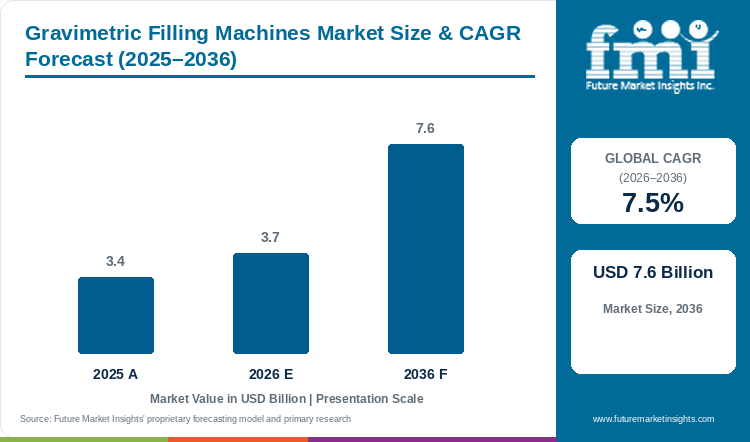
Global gravimetric filling machines shipments are projected to advance at a 7.5% CAGR over the decade, moving from a 2025 baseline of USD 3.4 billion to an estimated USD 3.7 billion in 2026 and reaching a forecast USD 7.6 billion in 2036.
Fluid thermal expansion across continuous production shifts alters liquid specific gravity on conventional packaging machinery, forcing bottling plants to choose between legal short-weight fines and costly product giveaway. Gravimetric pedestals eliminate this density drift by weighing each container on high-speed load cells prior to valve cutoff, a transition reinforced in December 2025 when U.S. commerce officials released the 2026 Edition of NIST Handbook 133 updating gravimetric test procedures for checking the net contents of packaged goods [1]. Owing to zero-point container tare subtraction that isolates net fluid mass from blow-molded bottle wall variations, net-weight fillers are anticipated to capture 40.1% of filling technology demand in 2026. Equipment tracking by FMI indicates that global gravimetric filling machines turnover rose from USD 3.4 billion in 2025 to an estimated USD 3.7 billion in 2026 and is projected to reach USD 7.6 billion in 2036, expanding on a 7.5% CAGR anticipated to add USD 3.9 billion to annual equipment turnover by 2036. Nevertheless, high acquisition costs for electromagnetic force restoration load cells and sensitivity to plant-floor conveyor vibrations continue to restrain rapid adoption among small contract packagers.
Key Market Trends & Insights
- By filling technology: Net-weight fillers are anticipated to claim 40.1% of 2026 technology revenue because individual pedestal taring cancels empty bottle weight variations before bulk-and-dribble valve opening.
- By product form: Liquids are projected to hold 32.4% of 2026 product form sales as edible oils and specialty solvents experience temperature-driven density drift during multi-shift bottling runs.
- By automation: Fully automatic machinery is expected to secure 38.8% of 2026 automation spending through rotary carousels that synchronize pitch-time weighing with servo-driven capping turrets.
- By end use: Food and beverage is forecast to represent 43.8% of 2026 end use turnover owing to hygienic 316L stainless-steel clean-in-place manifolds and retail prepackage audits.
Regional Highlights
- Fastest national machinery expansion: British packaging plants are expected to head international growth with a 7.9% CAGR between 2026 and 2036 as contract spirits and condiment packers upgrade to e-mark compliant rotary fillers.
- Subsequent national trajectories: French bottling line installations are projected to expand at a 7.7% CAGR and American facilities are anticipated to gain 7.6% per year, whereas Japanese demand is forecast to rise at 7.5% ahead of German (7.4%) and Italian (7.3%) installations.
Market Size & Forecast
Table 1: Market Size and Forecast for the Gravimetric Filling Machines Market (USD billion and CAGR percentage), 2025 to 2036
| Metric | Value |
|---|---|
| 2025 Market Size | USD 3.4 billion |
| Estimated Market Size in 2026 | USD 3.7 billion |
| Projected Market Size by 2036 | USD 7.6 billion |
| CAGR, 2026 to 2036 | 7.5% |
| Added Revenue, 2026 to 2036 | USD 3.9 billion |
Escalating prices for cold-pressed culinary oils and fluorinated agrochemicals have turned volumetric overfill giveaway into an unsustainable margin leak for industrial bottlers. When plant managers run piston or magnetic flowmeter fillers across 12-degree Celsius ambient shift swings, operators routinely overfill containers by 1.5% to avoid legal short-weight rejections. During January 2026, federal weights-and-measures authorities published the 2026 Edition of NIST Handbook 44 establishing updated specifications and tolerances for commercial weighing and automatic gravimetric filling instruments [2]. Consequently, food and chemical plants are replacing mechanical pistons with dual-stage gravimetric carousels that are projected to lock dosing errors below 0.2% while protecting shipments from metrological recall.
Gravimetric Load-Cell Accuracy and Giveaway Reduction Sizing
Table 2: Gravimetric Load-Cell Accuracy and Giveaway Reduction Sizing for the Gravimetric Filling Machines Market (USD billion, percentages, and USD thousand), mixed historical and forecast years from 2025 to 2036
| Metric | 2025 | 2026 | 2036 |
|---|---|---|---|
| Market size (USD billion) | 3.4 | 3.7 | 7.6 |
| Average volumetric overfill giveaway (%) | 1.4% to 2.2% | 1.3% to 2.1% | 0.9% to 1.5% |
| Gravimetric net-weight dosing tolerance (grams per kg) | 1.0 to 2.5 | 0.8 to 2.0 | 0.5 to 1.2 |
| Annual raw material savings per high-speed line (USD thousand) | 145.0 to 220.0 | 155.0 to 240.0 | 210.0 to 330.0 |
Operational note: Giveaway reduction benchmarks compare piston or flowmeter fillers operating across 12-degree Celsius shift temperature swings against OIML R 61 Class 0.2 gravimetric platforms. Material savings model a two-shift edible oil or specialty chemical bottling line processing 18,000 containers per hour.
Line Throughput & Container Tare Compensation Indicators
Commercial packaging lines handle containers with wide empty-weight dispersion, ranging from thin-walled recycled PET bottles to heavy 200-liter steel drums. Gross-weight scales transfer container wall thickness variations directly into finished liquid volume errors. Net-weight pedestals solve this problem by executing zero-point tare subtraction on every container before opening bulk-and-dribble valves, preserving legal fill accuracy across rigid bottles and flexible pouches.
Table 3: Line Throughput and Container Tare Compensation Indicators for the Gravimetric Filling Machines Market (containers per minute and grams), mixed historical and forecast years from 2025 to 2036
| Metric | 2025 | 2026 | 2036 |
|---|---|---|---|
| Rotary net-weight bottle throughput (containers/min) | 320 to 480 | 340 to 520 | 450 to 680 |
| Load-cell signal settling time (milliseconds) | 35 to 50 | 30 to 45 | 15 to 28 |
| Container tare variance compensated (grams per bottle) | 1.5 to 4.8 | 1.8 to 5.2 | 2.5 to 6.5 |
| Drum and IBC gravimetric fill accuracy (grams per 200 kg) | 50 to 100 | 45 to 90 | 25 to 60 |
Table 4: End-Use Sector Gravimetric Equipment Spend Indicators for the Gravimetric Filling Machines Market (USD billion and percentages), 2026
| Metric | Value | Basis |
|---|---|---|
| Market size, 2026 | USD 3.7 billion | Report value |
| Food and beverage equipment revenue, 2026 | USD 1.6 billion | 43.8% share |
| Net-weight fillers technology revenue, 2026 | USD 1.5 billion | 40.1% share |
| Fully automatic system revenue, 2026 | USD 1.4 billion | 38.8% share |
Analyst Perspective
"Packaging line directors no longer tolerate the 1.5% ingredient giveaway caused by thermal density drift on volumetric fillers. Equipment builders that pair digital load cells with millisecond floor-vibration filtering win multi-line replacement contracts across edible oil and chemical plants."
- Nandini Roy Choudhury, Principal Consultant, Future Market Insights.
How is the gravimetric filling machines market segmented?
The gravimetric filling machines market is segmented by filling technology, product form, automation, and end use. In 2026, net-weight fillers are projected at 40.1%, liquids at 32.4%, fully automatic at 38.8%, and food and beverage at 43.8%.
By filling technology: Net-Weight Fillers, Loss-in-Weight Fillers, Multihead Weighers, and Bulk Weigh Fillers.
By product form: Liquids, Powders, Granules, and Bulk Solids.
By automation: Fully Automatic, Semi-Automatic, Manual-Assisted, and Integrated Lines.
By end use: Food & Beverage, Chemicals, Pharmaceuticals, and Agriculture.
What Makes Net-Weight Fillers the Largest Filling Technology Segment?
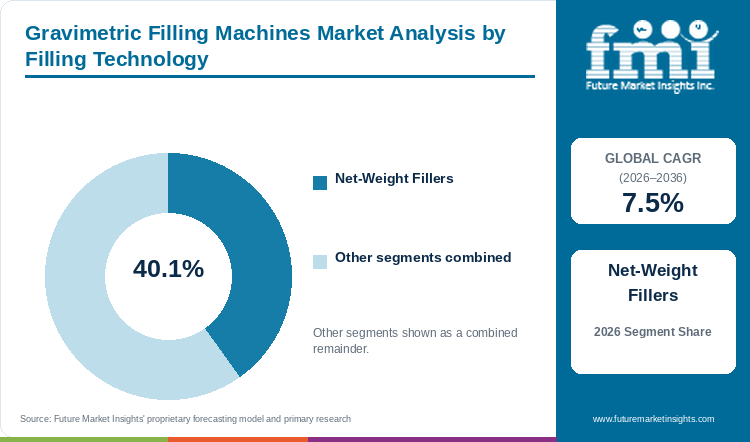
Individual container tare subtraction is expected to anchor net-weight fillers at 40.1% of 2026 filling technology sales, backed by dual-stage laminar valves.
Table 5: Filling Technology Share for the Gravimetric Filling Machines Market (percentage share), 2026
| Filling Technology | Share (2026) |
|---|---|
| Net-Weight Fillers | 40.1% |
| Other Segments Combined | 59.9%* |
| Total | 100.0% |
*Note: Residual filling technology classifications account for the remaining balance to reach 100.0% in 2026.
Table 6: Filling Technology Leadership and Market Growth for the Gravimetric Filling Machines Market (segment and CAGR percentage), 2026 to 2036
| Metric | Value |
|---|---|
| Global CAGR (2026 to 2036) | 7.5% |
| Leading Segment | Net-Weight Fillers |
Weighing every empty container milliseconds before valve actuation isolates net product mass from blow-molded bottle and steel drum tare fluctuations. Recycled PET preforms and reconditioned chemical drums exhibit wide wall thickness variance that distorts gross-weight scales. To prevent off-weight shipments, rotary pedestals integrate electronic weighing scale sensors with two-stage coarse and dribble laminar nozzles during edible oil packaging runs. Closed-loop inflight cutoff algorithms automatically adjust valve closure timing so each container is projected to meet legal mass tolerances.
- Dual-stage coarse and dribble valve cutoffs paired with individual tare subtraction are projected to give net-weight fillers 40.1% of 2026 filling technology revenue.
- At drinktec 2025 in September 2025, Krones AG presented its Primafill CLASS high-precision filler that suppresses foaming alongside the compact 100-square-meter Contipure AseptBloc [3].
Why Do Liquids Represent the Dominant Product Form Category?
Thermal viscosity shifts in edible oils are projected to keep liquids at 32.4% of 2026 product form volume, owing to mass-based cutoffs.
Fluid density and surface tension shift noticeably across daily production runs when culinary oils and industrial solvents undergo warm filling or ambient temperature swings. Volumetric pistons and time-gravity dosers deliver inconsistent gram weights whenever entrained micro-bubbles or viscosity changes alter flow velocity. Gravimetric liquid fillers paired with hot fill packaging lines eliminate this density error by measuring actual mass accumulation on pedestal load cells and closing magnetic valves without splashing. Processors are expected to switch between viscous sauces and low-density solvents without mechanical cam recalibration.
- Compensating for foaming and thermal density swings is anticipated to enable liquids to capture 32.4% of 2026 product form machinery sales.
- Serac Group documented in December 2025 that its rotary net-weight liquid fillers maintain 1-gram sigma accuracy across viscosities up to 40,000 cP while reducing product giveaway by 83.0%, or 59.8 tonnes per year [4].
How Do Fully Automatic Systems Anchor the Automation Breakdown?
Unmanned high-speed bottling carousels are anticipated to secure 38.8% of 2026 automation expenditure for fully automatic lines, linked to servo-driven pitch weighing.
High-volume beverage and chemical plants concentrate capital expenditure on rotary monoblocks that synchronize starwheel container transfers with dynamic in-motion taring. Digital electromagnetic force restoration cells filter out conveyor harmonic frequencies above 400 bottles per minute, enabling continuous end-of-line packaging and high-speed food packaging lines to operate across three-shift plants. Servo-guided neck handling and automated recipe changeovers remove manual operator adjustments while keeping dosing error within OIML R 61 limits.
- Unmanned rotary bottle indexing and automated drum conveyor integration are forecast to lift fully automatic systems to 38.8% of 2026 automation revenue.
- Sidel launched its EvoFILL PET high-speed filler in April 2026, boosting filling speed by up to 20.0% past 90,000 bottles per hour while shrinking equipment footprint by 15.0% [5].
Which Factors Position Food & Beverage at the Forefront of End Use?
Hygienic washdown bottling upgrades are forecast to assign food and beverage 43.8% of 2026 end use procurement, stemming from strict net-content audits.
Edible oil refiners and aseptic dairy bottlers lead gravimetric machinery orders because they face daily retail weights-and-measures audits alongside strict microbiological sanitation rules. Food packagers integrate 316L stainless-steel gravimetric carousels with sustainable plastic packaging formats to eliminate bacterial dead-legs while curbing expensive oil and dairy giveaway. Touchless magnetic filling valves and automated clean-in-place recovery loops are expected to allow processors to sanitize product contact paths rapidly between allergen changeovers.
- Strict retail prepackage weight enforcement and sanitary clean-in-place manifold designs are estimated to give food and beverage 43.8% of 2026 vertical machinery orders.
- The European Hygienic Engineering and Design Group published the Fourth Edition of Guideline 8 Hygienic Design Principles in December 2025 establishing risk-based sanitary equipment criteria for food plants [6].
What are the drivers, restraints, and opportunities in the gravimetric filling machines market?
Stringent NIST Handbook 133 and OIML R 61 legal-metrology enforcement and raw material giveaway savings are expected to propel gravimetric filling machines demand through 2036, whereas cGMP validation and floor-vibration isolation costs restrain small co-packers and ATEX Zone 1 drum systems create high-margin chemical contracts.
- Driver: Rising culinary oil and specialty chemical prices alongside OIML R 61 and NIST Handbook 133 net-content audits compel plants to replace volumetric pistons with gravimetric pedestals.
- Restraint: High acquisition prices for electromagnetic force restoration load cells and strict pharmaceutical calibration validation protocols extend payback periods for smaller packagers.
- Opportunity: Intrinsically safe ATEX-certified net-weight stations with monitored earthing capture turnkey automation contracts across battery electrolyte and chemical drum plants.
Growth Analysis and Future Potential: Qualitative Demand Catalysts
High ingredient costs for cold-pressed edible oils and specialty agricultural formulations heavily penalize bottling lines that rely on volumetric pistons or flowmeters. When liquid temperature climbs by 10 degrees Celsius over a continuous shift, specific gravity drops and causes volumetric cylinders to under-dose or overfill. Plant audits by Future Market Insights confirm that pairing industrial weighing equipment with digital electromagnetic force restoration cells beneath each filling station is projected to cut net-weight tolerances below 0.15%. In August 2025, PMMI published its State of the Industry 2025 report documenting sustained North American plant capital investment in automated dosing and rapid-changeover packaging machinery [7]. Automated individual tare deduction protects processors from retail short-weight penalties while eliminating chronic overfill margin loss.
Risk Assessment of the Gravimetric Filling Machines Market: Operational and Metrological Friction
Elevated upfront capital expenditure for rotary gravimetric monoblocks compared with pneumatic piston fillers remains a primary barrier for smaller contract packagers. High-frequency load cells capable of resolving 0.1-gram increments within milliseconds are sensitive to mechanical floor harmonics transmitted from adjacent case packers and forklift traffic. In May 2026, the U.S. Food and Drug Administration updated its Current Good Manufacturing Practice guidance on production and process controls emphasizing strict 21 CFR Part 211 equipment calibration and batch weight verification across pharmaceutical lines [8]. Furthermore, high-speed pouch lines running flexible plastic packaging require hermetically laser-welded IP69K load cells and vibration-isolation frames that lengthen capital amortization schedules for single-shift plants.
Commercial Opportunity Analysis: ATEX Bulk Dosing and Hygienic Valve Differentiation
Surging regional production of lithium-ion battery electrolytes and ultra-pure semiconductor solvents is anticipated to create lucrative demand for heavy-duty gravimetric dosing cells. These automated stations fill 200-liter drums and 1,000-liter intermediate bulk container units to certified legal-for-trade mass tolerances. Dosing flammable organic solvents in hazardous zones requires intrinsically safe load cells paired with sub-surface diving lances that stay submerged beneath the rising liquid level. In June 2025, Feige FILLING GmbH detailed its ATEX Directive 2014/34/EU Zone 1 and Zone 2 explosion-proof filling equipment featuring monitored earthing devices and intrinsically safe circuits [9]. Machinery builders supplying optical bunghole vision alignment and automated nitrogen purging secure high-margin turnkey contracts across chemical hubs.
Gravimetric Filling Machines Market by Country (2026 to 2036)
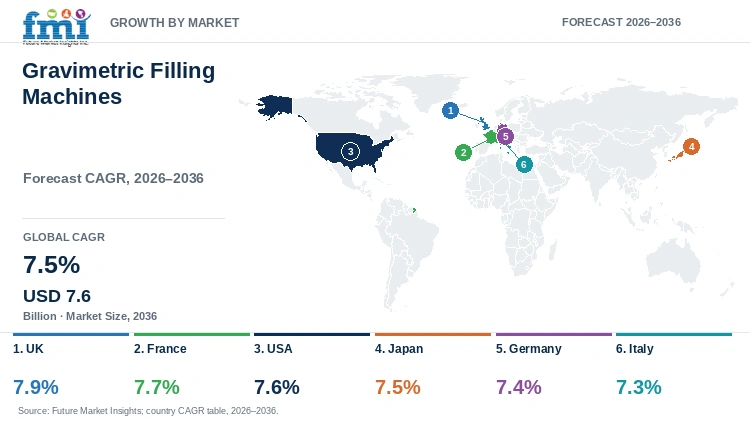
Strict OPSS legal-metrology oversight is projected to place the United Kingdom at a 7.9% annual rate to 2036, ahead of French neck-handling rotary lines (anticipated at 7.7%) and United States petrochemical drum stations (forecast at 7.6%) whereas Japanese multihead weighers (7.5%) and German ATEX lances (7.4%) are expected to outpace Italian olive-oil carousels (7.3%). National legal-metrology inspection regimes and seasonal fluid viscosity compensation govern equipment procurement across these manufacturing hubs.
Table 7: Country CAGR and Primary Growth Levers for the Gravimetric Filling Machines Market (CAGR percentage and operational drivers), 2026 to 2036
| Country | CAGR (2026 to 2036) | Primary Growth Lever |
|---|---|---|
| UK | 7.9% | OPSS average-weight metrological audits and contract beverage/edible-oil co-packing |
| France | 7.7% | High-value dairy, culinary oil, and cosmetic bottling using neck-handling laminar valves |
| USA | 7.6% | NIST Handbook 133 net-content enforcement across bulk chemical drums and foodservice lines |
| Japan | 7.5% | Ultra-precision multihead combination weighing for snacks, frozen foods, and battery chemicals |
| Germany | 7.4% | OIML R 61 and PTB certified ATEX Zone 1 chemical drum and IBC lance filling |
| Italy | 7.3% | Mediterranean olive oil and sauce bottling requiring thermal viscosity drift compensation |
Source: Future Market Insights analysis
UK Gravimetric Filling Machines Market Outlook (2026 to 2036)
Whereas global gravimetric machinery demand is dominated by brand-owned bottling halls, the United Kingdom relies heavily on third-party contract co-packers bottling retailer private-label spirits and culinary oils on razor-thin margins. Under strict Three Packers' Rules enforcement by Trading Standards officers, any batch failing statutory average-weight audits faces immediate supermarket rejection. In August 2026, the UK Office for Product Safety and Standards Delivery Report 2025-2026 documented implementation of the Product Regulation and Metrology Act 2025 alongside legal metrology oversight across 306,890 UK businesses [10]. Contract bottling retrofits are consequently projected to lift British gravimetric filling machines shipments by a 7.9% yearly clip to 2036. Cramped legacy factory bays still restrict wide carousels, favoring compact monoblocks.
Key takeaway: In the UK, stringent OPSS legal-metrology oversight and co-packing margin pressures drive upgrades to compact rotary net-weight fillers.
France Gravimetric Filling Machines Market Outlook (2026 to 2036)
French gravimetric filling machines orders are anticipated to achieve a 7.7% compound annual rate over the ten-year horizon because gourmet oil and luxury cosmetic processors are modernizing high-speed rotary bottling lines. What distinguishes France from international packaging markets is the statutory AGEC plastic-reduction push toward ultra-lightweight recycled PET preforms whose thin base walls buckle under conventional downward platform scales. According to June 2025 European Commission assessments for France, 532 edge computing nodes and EUR 18.6 billion in public funding across 33 roadmap initiatives now support domestic factory digitalization [11]. To avoid container wall deflection while meeting French net-content tolerances, domestic bottlers increasingly specify suspended neck-handling laminar net-weight monoblocks.
Key takeaway: In France, high-value culinary oil and cosmetic bottling paired with lightweight rPET handling requirements favor neck-handling net-weight monoblocks.
USA Gravimetric Filling Machines Market Outlook (2026 to 2036)
In September 2025, PMMI reported in its 2025 Packaging State of the Industry analysis that U.S. packaging machinery shipments reached USD 11.3 billion as plants prioritized servo-driven automation and rapid changeovers [12]. Unlike European plants that run smaller regional batch lots, United States Gulf Coast petrochemical complexes and Midwestern foodservice bottlers operate continuous 24/7 mega-lines where NIST Handbook 133 net-content fines carry multi-state recall exposure. These high-volume compliance workloads are forecast to sustain a 7.6% compound annual rate across American gravimetric filling machines demand through 2036. Severe conveyor harmonics and aggressive caustic washdown cycles in American plants still degrade analog strain gauges, prompting engineering directors to specify hermetically sealed digital EMFR load cells.
Key takeaway: In the USA, strict NIST Handbook 133 audits and aggressive caustic washdown routines favor hermetically sealed digital EMFR load cells.
Japan Gravimetric Filling Machines Market Outlook (2026 to 2036)
Demographic factory labor shortages and strict semiconductor chemical purity tolerances distinguish Japanese bottling plants from North American and European packaging markets that focus primarily on bulk beverage throughput. Japanese snack and electronics suppliers require unmanned sub-gram multihead combination weighing and battery electrolyte dosing across compact multi-story plants. Supported by zero-defect automation investments, Japanese gravimetric filling machines installations are predicted to expand at a 7.5% compound annual pace over the forecast window. Tokyo industrial officials announced the April 2025 METI DX Stocks 2025 selection recognizing 31 Japanese manufacturing leaders advancing smart factory automation and digital production [13]. Viscous tare sauces and cathode slurries still cling to hoppers, prompting Japanese builders to deploy embossed weigh buckets.
Key takeaway: In Japan, acute factory workforce shortages and zero-defect mass tolerances propel investment in multihead weighers and sub-gram liquid fillers.
Germany Gravimetric Filling Machines Market Outlook (2026 to 2036)
Germany differs from consumer-led packaging markets because domestic demand is concentrated across export-oriented machinery builders and Rhine-Ruhr chemical corridors where hazardous solvents require legal-for-trade verification before containers enter rail transit. In July 2026, Krones AG reported that first-half 2026 order intake increased 4.5% to EUR 2,852.5 million with an order backlog of EUR 4,328.0 million following EUR 5.66 billion in 2025 revenue [14]. Certified ATEX drum lances and brewery keg fillers are expected to climb at a 7.4% annual clip across Germany through 2036. Stringent ATEX Zone 1 explosion codes create electrostatic ignition liabilities during rapid solvent dosing, compelling German machinery engineers to supply camera-guided sub-bunghole diving lances paired with automated nitrogen blanketing.
Key takeaway: In Germany, export machinery engineering and ATEX Zone 1 safety mandates anchor demand for sub-surface drum and rotary filling stations.
Italy Gravimetric Filling Machines Market Outlook (2026 to 2036)
Export-oriented bottling of extra virgin olive oil and tomato condiments across cooperatives in Puglia and Tuscany sets Italy apart from northern European markets that process climate-controlled dairy or chemical fluids. Because southern Mediterranean bottling halls frequently operate without full ambient HVAC control, olive oil density and viscosity shift sharply between winter pressings and summer bottling runs. Cooperative olive-oil carousels and sterile pharmaceutical vial lines are projected to progress at a 7.3% annual rate across Italy through 2036. In July 2026, Centro Studi MECS-UCIMA confirmed that Italian packaging machinery turnover rose 4.0% in 2025 to nearly EUR 10.5 billion on strong international orders [15]. Summer oil foaming during rapid valve shutoff still challenges packagers, favoring two-stage laminar nozzles.
Key takeaway: In Italy, export olive oil and sauce bottling exposed to seasonal thermal viscosity drift sustains demand for laminar net-weight fillers.
Full report country CAGRs cover: North America; Latin America; Western Europe; Eastern Europe; East Asia; South Asia and Pacific; Middle East and Africa.
Who are the notable companies in the gravimetric filling machines market?
Krones AG, Ishida Co., Ltd., Mettler-Toledo International Inc., Sidel (Tetra Laval Group), FEIGE FILLING GmbH (HAVER & BOECKER), Coperion GmbH (Coperion K-Tron), Serac Group, and KHS GmbH are the notable companies in the gravimetric filling machines market.
Survey work by Future Market Insights confirms that supplier competition divides across high-speed rotary liquid monoblock builders and precision dry-solid combination weigher specialists alongside heavy industrial drum and keg weighing engineers. Rotary liquid platform builders integrate washdown load cells directly into blow-fill-cap carousels for edible oils and aseptic dairy beverages. Meanwhile, metrology component leaders supply OIML R 61 electromagnetic force restoration cells to OEM machinery builders, whereas chemical and beverage bulk specialists manufacture explosion-proof lance stations for 200-liter drums and gross-tare keg scales. Plant engineering directors qualify suppliers on millisecond signal settling speed and local legal-for-trade calibration support.
- Rotary Liquid & Aseptic Net-Weight Monoblock Leaders: Krones AG and Sidel (Tetra Laval Group) alongside Serac Group manufacture high-speed rotary net-weight fillers for dairy and edible oil bottling.
- Precision Weighing, Multihead & Loss-in-Weight Specialists: Ishida and Mettler-Toledo International together with Coperion GmbH (Coperion K-Tron) supply high-frequency load-cell modules and continuous loss-in-weight powder feeders.
- Heavy-Duty Chemical Drum, IBC & Keg Weighing Specialists: FEIGE FILLING GmbH (HAVER & BOECKER) engineers ATEX-compliant net-weight pallet and drum filling centers, while KHS GmbH supplies Innokeg gross-tare keg weighers alongside competing volumetric Innofill beverage turrets.
Competitive Benchmarking: Gravimetric Filling Machines Market
Table 8: Competitive Benchmarking for the Gravimetric Filling Machines Market (qualitative capability ratings), 2026
| Company | Rotary & Inline Filling Breadth | Load-Cell Metrology Precision | Hygienic / ATEX Compliance | Geographic Reach |
|---|---|---|---|---|
| Krones AG | High | High | High | High |
| Ishida Co., Ltd. | High | High | High | High |
| Mettler-Toledo International Inc. | Medium | High | High | High |
| Sidel (Tetra Laval Group) | High | High | High | High |
| FEIGE FILLING GmbH (HAVER & BOECKER) | High | High | High | Medium |
| Coperion GmbH (Coperion K-Tron) | Medium | High | High | High |
| Serac Group | High | High | High | High |
| KHS GmbH | Medium | Medium | High | High |
Scoring basis: Rotary and inline filling breadth receives a High mark when verified gravimetric machinery portfolios span rigid bottles and flexible pouches alongside bulk drums, whereas Medium denotes specialization in feeder subsystems or keg gross-tare scales alongside competing volumetric turrets. Load-cell metrology precision is rated High where primary OIML R 61 Class 0.2 net-weight cutoffs and millisecond digital harmonic filtering are standard. Hygienic or ATEX compliance earns a High rating when EHEDG aseptic or ATEX Zone 1 explosion-proof certifications are documented across global service hubs.
Key Developments in the Gravimetric Filling Machines Market
- In January 2026, Feige FILLING GmbH expanded its digital liquid-filling configuration and spare-parts service program for automated drum and IBC filling lines [16].
- In October 2025, Serac Group highlighted its North American rotary net-weight yogurt and cultured dairy fillers delivering 1-gram sigma accuracy per 1,000-gram bottle at up to 50,000 bottles per hour under 3-A Sanitary Standards [17].
- In January 2026, Mettler-Toledo International Inc. detailed its 25-millimeter-wide WMF electromagnetic force restoration weigh module featuring 2-million-point resolution and integrated calibration weights for multi-lane filling machines [18].
Key Players in the Gravimetric Filling Machines Market
Rotary Liquid & Aseptic Net-Weight Monoblock Leaders
- Krones AG
- Sidel (Tetra Laval Group)
- Serac Group
Precision Weighing, Multihead & Loss-in-Weight Specialists
- Ishida Co., Ltd.
- Mettler-Toledo International Inc.
- Coperion GmbH (Coperion K-Tron)
Heavy-Duty Chemical Drum, IBC & Keg Weighing Specialists
- FEIGE FILLING GmbH (HAVER & BOECKER)
- KHS GmbH
Gravimetric Filling Machines Market - Report Scope
Table 9: Report Scope for the Gravimetric Filling Machines Market (coverage fields and definitions), 2026 to 2036
| Coverage field | Report scope |
|---|---|
| Market breakdown | Filling Technology; Product Form; Automation; End Use; Region |
| Quantitative Units | USD Billion |
| Market Definition | Includes B2B capital equipment revenue from complete gravimetric filling machines, net-weight rotary and inline fillers, loss-in-weight dosing systems, multihead weigh fillers, and bulk drum/IBC/keg gravimetric stations. Category Scope Note: The valuation strictly covers primary gravimetric dosing and weighing-while-filling machinery, excluding standalone laboratory analytical balances, downstream secondary checkweighers, and volumetric piston or electromagnetic inductive flowmeter fillers without load-cell mass cutoffs. |
| Regions Covered | North America; Latin America; Western Europe; Eastern Europe; East Asia; South Asia and Pacific; Middle East and Africa |
| Countries Covered | UK, France, USA, Japan, Germany, Italy, and additional countries in the full report |
| Key Companies Covered | Krones AG, Ishida Co., Ltd., Mettler-Toledo International Inc., Sidel (Tetra Laval Group), FEIGE FILLING GmbH (HAVER & BOECKER), Coperion GmbH (Coperion K-Tron), Serac Group, KHS GmbH |
| Forecast Period | 2026 to 2036 |
| Approach | Primary and secondary research with bottom-up and top-down market triangulation. |
Gravimetric Filling Machines Market - Research Methodology
Table 10: Research Methodology for the Gravimetric Filling Machines Market (research methods and approach), 2026 edition
| Method | Approach |
|---|---|
| Primary Research | Primary interviews were conducted with packaging line engineering directors, OEM filling machine designers, OIML legal-metrology auditors, and plant procurement managers across food, chemical, and pharmaceutical facilities. |
| Secondary Research | Secondary research included company annual reports, NIST Handbook 133 and Handbook 44 2026 Editions, EHEDG hygienic design guidelines, FDA cGMP process validation guidance, UCIMA machinery statistics, and PMMI State of the Industry reports. |
| Market Sizing and Forecasting | Market sizing and forecasting for the 2026 to 2036 period were developed using top-down and bottom-up models reconciling active rotary, inline, multihead, and bulk drum machinery shipments with average selling prices. |
| Data Triangulation and Validation | Machinery revenue estimates were triangulated against industrial packaging capital expenditure registries and legal-metrology verification filings while strictly excluding standalone downstream checkweighers and volumetric flowmeter turrets. |
| Country Forecasting Model | Country-level CAGRs were calibrated against the 7.5% global baseline by weighting national legal-metrology inspection frequency, contract co-packing density, ATEX chemical drum production, and factory automation rates. |
| Operational Benchmark Traceability | Operational benchmarks in Tables 2, 3, and 4 (volumetric giveaway percentages, gravimetric dosing tolerances, rotary bottle throughput, load-cell settling times, and tare variance) are synthesized from NIST Handbook 133, NIST Handbook 44, EHEDG, PMMI, and OEM engineering disclosures. |
Gravimetric Filling Machines Market by Segments
Gravimetric Filling Machines Market segmented by Filling Technology:
- Net-Weight Fillers
- Loss-in-Weight Fillers
- Multihead Weighers
- Bulk Weigh Fillers
Gravimetric Filling Machines Market segmented by Product Form:
- Liquids
- Powders
- Granules
- Bulk Solids
Gravimetric Filling Machines Market segmented by Automation:
- Fully Automatic
- Semi-Automatic
- Manual-Assisted
- Integrated Lines
Gravimetric Filling Machines Market segmented by End Use:
- Food & Beverage
- Chemicals
- Pharmaceuticals
- Agriculture
Gravimetric Filling Machines Market by Region
- North America
- United States
- Canada
- Latin America
- Brazil
- Mexico
- Argentina
- Chile
- Western Europe
- UK
- France
- Germany
- Italy
- Spain
- Benelux
- Nordics
- Eastern Europe
- Poland
- Czech Republic
- Romania
- Hungary
- East Asia
- China
- Japan
- South Korea
- South Asia and Pacific
- India
- ASEAN
- Australia and New Zealand
- Middle East and Africa
- GCC Countries
- South Africa
- Türkiye
- Israel
Research Sources and Bibliography
- [1] National Institute of Standards and Technology (NIST). (2025, December 29). NIST Handbook 133: Checking the Net Contents of Packaged Goods (2026 Ed.). U.S. Department of Commerce.
- [2] National Institute of Standards and Technology (NIST). (2026, January 5). NIST Handbook 44: Specifications, Tolerances and Other Technical Requirements for Weighing and Measuring Devices (2026 Ed.). U.S. Department of Commerce.
- [3] Krones AG. (2025, September 15). Krones at drinktec 2025 - Smart solutions for the future of machinery and plant manufacture. Krones Corporate Press Releases.
- [4] Serac Group. (2025, December 12). Sauce Bottling & Liquid Food Filling Machines - USA & Canada. Serac Inc.
- [5] Sidel Group. (2026, April 20). Sidel launches its new EvoFILL PET, the fastest-ever speed filler. Sidel Media Press Releases.
- [6] European Hygienic Engineering & Design Group (EHEDG). (2025, December 16). GL 8 Hygienic Design Principles. EHEDG Guideline Catalogue.
- [7] PMMI - The Association for Packaging and Processing Technologies. (2025, August 20). State of the Industry 2025. PMMI Reports.
- [8] U.S. Food and Drug Administration (FDA). (2026, May 5). Questions and Answers on Current Good Manufacturing Practice Regulations | Production and Process Controls. U.S. Department of Health and Human Services.
- [9] Feige FILLING GmbH. (2025, June 2). ATEX-Certified, Explosion-Proof Filling Equipment for Hazardous Environments. FEIGE FILLING | A HAVER & BOECKER COMPANY.
- [10] Office for Product Safety and Standards (OPSS). (2026, August 5). OPSS Delivery Report 2025-2026. GOV.UK Corporate Reports.
- [11] European Commission. (2025, June 18). France 2025 Digital Decade Country Report. Shaping Europe's digital future.
- [12] PMMI - The Association for Packaging and Processing Technologies. (2025, September 11). 2025 Packaging State of the Industry: U.S. Expands, Canada Maintains Strong Base. PMMI Show News.
- [13] Ministry of Economy, Trade and Industry (METI). (2025, April 11). DX Stocks 2025, Noteworthy DX Companies 2025 and DX Platinum Companies 2025-2027 Selected. Government of Japan.
- [14] Krones AG. (2026, July 29). Corporate news release - Krones further increases order intake and profitability in first half of 2026. Krones Investor Relations.
- [15] Unione Costruttori Italiani Macchine Automatiche per il Confezionamento e l'Imballaggio (UCIMA). (2026, July 2). I costruttori macchine packaging mantengono la crescita: fatturato 2025 a +4% che sfiora i 10,5 miliardi di euro. Centro Studi MECS-UCIMA.
- [16] Feige FILLING GmbH. (2026, January 23). Feige FILLING News & Press Releases. FEIGE FILLING | A HAVER & BOECKER COMPANY.
- [17] Serac Group. (2025, October 15). Filling Machines for Yogurt in Cups and Bottles - U.S. and Canada. Serac Inc.
- [18] Mettler-Toledo International Inc. (2026, January 15). Automated Precision Weigh Modules | METTLER TOLEDO. Mettler-Toledo Industrial Weighing Solutions.
- [19] Coperion GmbH. (2025, October 10). Liquid feeder gravimetric for food & pharmaceuticals - Coperion. Coperion Process Technologies.
- [20] Ishida Europe Ltd. (2026, January 12). AS Series Multihead Weighers | Automated Weighing | Ishida. Ishida Europe Products.
- [21] KHS GmbH. (2026, February 10). Innokeg check weigher keg and can accessory. KHS Group Products.
This bibliography is provided for reader reference and is not exhaustive. The full report contains the complete reference list and detailed citations.
This Report Answers
- How large is the gravimetric filling machines market in 2026 and what is forecast for 2036?
- How do thermal density shifts and container tare variations drive transitions from volumetric to gravimetric filling?
- What makes net-weight fillers the largest filling technology segment globally?
- Why do liquids lead the product form category across food and chemical plants?
- How do growth trajectories differ across the UK, France, the USA, Japan, Germany, and Italy?
- Which leading companies supply rotary net-weight monoblocks, multihead weighers, and ATEX drum fillers today?
- What capital and floor-vibration constraints limit adoption or supplier switching in the gravimetric filling machines market?
- What should buyers evaluate before purchasing a gravimetric filling machine?
Frequently Asked Questions
How big is the gravimetric filling machines market in 2026, and what is forecast for 2036?
Worldwide gravimetric filling machinery shipments are estimated at USD 3.7 billion in 2026 (up from a 2025 baseline of USD 3.4 billion) and are projected to climb to USD 7.6 billion in 2036 as bottlers eliminate thermal overfill giveaway.
What is the CAGR for the gravimetric filling machines market from 2026 to 2036?
As per FMI, global machinery turnover is anticipated to compound at 7.5% per year over the ten-year window, expected to deliver an increase in annual market revenue of USD 3.9 billion between 2026 and 2036 under OIML R 61 and NIST Handbook 133 net-content enforcement.
Which filling technology segment leads the gravimetric filling machines market?
Net-weight fillers are projected to secure 40.1% of 2026 filling technology sales because zero-point tare subtraction on every pedestal isolates liquid mass from blow-molded rPET and steel drum weight variance.
Which end use segment leads the gravimetric filling machines market?
Food and beverage processors are expected to account for 43.8% of 2026 end use procurement owing to high-speed edible oil and aseptic dairy bottling lines that require sanitary 316L stainless-steel washdown construction.
Which country has a strong growth outlook during the assessment period?
Future Market Insights finds that the UK is forecast to pace Western European expansion with a 7.9% CAGR through 2036, driven by OPSS e-mark average-weight inspections across contract spirits and condiment co-packers.
Who are the key players in the market?
Leading equipment builders include Krones AG, Ishida Co., Ltd., Mettler-Toledo International Inc., Sidel (Tetra Laval Group), FEIGE FILLING GmbH (HAVER & BOECKER), Coperion GmbH (Coperion K-Tron), Serac Group, and KHS GmbH, supplying rotary net-weight monoblocks, multihead weighers, ATEX drum stations, and keg gross-tare weighers.
Preview the report firsthand - request a free sample
Get SampleGet the brochure for pricing and purchase details.
Get PDFTable of Content
- Key Takeaways
- Market Size and CAGR
- Top Growth Driver
- Fastest Growing Segment
- Leading Region
- Key Companies
- Emerging Opportunities
- Executive Summary
- Global Market Outlook
- Demand-side Trends
- Supply-side Trends
- Technology Roadmap Analysis
- Analysis and Recommendations
- Analyst Perspective (What is happening? Why now? What should investors know?)
- Key Questions Answered
- How large is the market?
- What is the CAGR?
- What are key trends?
- Which region dominates?
- Who are the leaders?
- Market Overview
- Market Coverage / Taxonomy
- Market Definition / Scope / Limitations
- Research Methodology
- Chapter Orientation
- Analytical Lens and Working Hypotheses
- Market Structure, Signals, and Trend Drivers
- Benchmarking and Cross-market Comparability
- Market Sizing, Forecasting, and Opportunity Mapping
- Research Design and Evidence Framework
- Desk Research Programme (Secondary Evidence)
- Expert Input and Fieldwork (Primary Evidence)
- Tooling, Models, and Reference Databases
- Data Engineering and Model Build
- Quality Assurance and Audit Trail
- Market Background
- Market Dynamics (Drivers, Restraints, Opportunity, Trends)
- Scenario Forecast (Optimistic, Likely, Conservative)
- Impact Analysis
- AI Impact
- Sustainability Impact
- Regulatory Impact
- Technology Impact
- Consumer / Buyer Analysis
- Purchase Drivers
- Adoption Barriers
- Buyer Journey
- Opportunity Map Analysis
- Product Life Cycle Analysis
- Supply Chain Analysis
- Investment Feasibility Matrix
- Value Chain Analysis
- PESTLE and Porter's Analysis
- Regulatory Landscape
- Regional Parent Market Outlook
- Production and Consumption Statistics
- Import and Export Statistics
- Global Market Analysis and Forecast, 2021 to 2036
- Historical Market Size Value (USD Billion) Analysis, 2021 to 2025
- Current and Future Market Size Value (USD Billion) Projections, 2026 to 2036
- Y-o-Y Growth Trend Analysis
- Absolute $ Opportunity Analysis
- Global Market Pricing Analysis, 2021 to 2036
- Global Market Analysis and Forecast, By Filling Technology, 2021 to 2036
- Introduction / Key Findings
- Historical Market Size Value (USD Billion) Analysis By Filling Technology, 2021 to 2025
- Current and Future Market Size Value (USD Billion) Analysis and Forecast By Filling Technology, 2026 to 2036
- Net-Weight Fillers
- Loss-in-Weight Fillers
- Multihead Weighers
- Bulk Weigh Fillers
- Y-o-Y Growth Trend Analysis By Filling Technology, 2021 to 2025
- Absolute $ Opportunity Analysis By Filling Technology, 2026 to 2036
- Global Market Analysis and Forecast, By Product Form, 2021 to 2036
- Introduction / Key Findings
- Historical Market Size Value (USD Billion) Analysis By Product Form, 2021 to 2025
- Current and Future Market Size Value (USD Billion) Analysis and Forecast By Product Form, 2026 to 2036
- Liquids
- Powders
- Granules
- Bulk Solids
- Y-o-Y Growth Trend Analysis By Product Form, 2021 to 2025
- Absolute $ Opportunity Analysis By Product Form, 2026 to 2036
- Global Market Analysis and Forecast, By Automation, 2021 to 2036
- Introduction / Key Findings
- Historical Market Size Value (USD Billion) Analysis By Automation, 2021 to 2025
- Current and Future Market Size Value (USD Billion) Analysis and Forecast By Automation, 2026 to 2036
- Fully Automatic
- Semi-Automatic
- Manual-Assisted
- Integrated Lines
- Y-o-Y Growth Trend Analysis By Automation, 2021 to 2025
- Absolute $ Opportunity Analysis By Automation, 2026 to 2036
- Global Market Analysis and Forecast, By End Use, 2021 to 2036
- Introduction / Key Findings
- Historical Market Size Value (USD Billion) Analysis By End Use, 2021 to 2025
- Current and Future Market Size Value (USD Billion) Analysis and Forecast By End Use, 2026 to 2036
- Food & Beverage
- Chemicals
- Pharmaceuticals
- Agriculture
- Y-o-Y Growth Trend Analysis By End Use, 2021 to 2025
- Absolute $ Opportunity Analysis By End Use, 2026 to 2036
- Global Market Analysis and Forecast, By Region, 2021 to 2036
- Introduction
- Historical Market Size Value (USD Billion) Analysis By Region, 2021 to 2025
- Current Market Size Value (USD Billion) Analysis and Forecast By Region, 2026 to 2036
- North America
- Latin America
- Western Europe
- Eastern Europe
- East Asia
- South Asia and Pacific
- Middle East and Africa
- Market Attractiveness Analysis By Region
- North America Market Analysis and Forecast, By Country, 2021 to 2036
- Historical Market Size Value (USD Billion) Trend Analysis By Market Taxonomy, 2021 to 2025
- Market Size Value (USD Billion) Forecast By Market Taxonomy, 2026 to 2036
- By Country
- United States
- Canada
- By Filling Technology
- By Product Form
- By Automation
- By End Use
- By Country
- Market Attractiveness Analysis
- By Country
- By Filling Technology
- By Product Form
- By Automation
- By End Use
- Key Takeaways
- Latin America Market Analysis and Forecast, By Country
- Historical Market Size Value (USD Billion) Trend Analysis By Market Taxonomy, 2021 to 2025
- Market Size Value (USD Billion) Forecast By Market Taxonomy, 2026 to 2036
- By Country
- Brazil
- Mexico
- Argentina
- Chile
- By Filling Technology
- By Product Form
- By Automation
- By End Use
- By Country
- Market Attractiveness Analysis
- By Country
- By Filling Technology
- By Product Form
- By Automation
- By End Use
- Key Takeaways
- Western Europe Market Analysis and Forecast, By Country
- Historical Market Size Value (USD Billion) Trend Analysis By Market Taxonomy, 2021 to 2025
- Market Size Value (USD Billion) Forecast By Market Taxonomy, 2026 to 2036
- By Country
- UK
- France
- Germany
- Italy
- Spain
- Benelux
- Nordics
- By Filling Technology
- By Product Form
- By Automation
- By End Use
- By Country
- Market Attractiveness Analysis
- By Country
- By Filling Technology
- By Product Form
- By Automation
- By End Use
- Key Takeaways
- Eastern Europe Market Analysis and Forecast, By Country
- Historical Market Size Value (USD Billion) Trend Analysis By Market Taxonomy, 2021 to 2025
- Market Size Value (USD Billion) Forecast By Market Taxonomy, 2026 to 2036
- By Country
- Poland
- Czech Republic
- Romania
- Hungary
- By Filling Technology
- By Product Form
- By Automation
- By End Use
- By Country
- Market Attractiveness Analysis
- By Country
- By Filling Technology
- By Product Form
- By Automation
- By End Use
- Key Takeaways
- East Asia Market Analysis and Forecast, By Country
- Historical Market Size Value (USD Billion) Trend Analysis By Market Taxonomy, 2021 to 2025
- Market Size Value (USD Billion) Forecast By Market Taxonomy, 2026 to 2036
- By Country
- China
- Japan
- South Korea
- By Filling Technology
- By Product Form
- By Automation
- By End Use
- By Country
- Market Attractiveness Analysis
- By Country
- By Filling Technology
- By Product Form
- By Automation
- By End Use
- Key Takeaways
- South Asia and Pacific Market Analysis and Forecast, By Country
- Historical Market Size Value (USD Billion) Trend Analysis By Market Taxonomy, 2021 to 2025
- Market Size Value (USD Billion) Forecast By Market Taxonomy, 2026 to 2036
- By Country
- India
- ASEAN
- Australia and New Zealand
- By Filling Technology
- By Product Form
- By Automation
- By End Use
- By Country
- Market Attractiveness Analysis
- By Country
- By Filling Technology
- By Product Form
- By Automation
- By End Use
- Key Takeaways
- Middle East and Africa Market Analysis and Forecast, By Country
- Historical Market Size Value (USD Billion) Trend Analysis By Market Taxonomy, 2021 to 2025
- Market Size Value (USD Billion) Forecast By Market Taxonomy, 2026 to 2036
- By Country
- GCC Countries
- South Africa
- Türkiye
- Israel
- By Filling Technology
- By Product Form
- By Automation
- By End Use
- By Country
- Market Attractiveness Analysis
- By Country
- By Filling Technology
- By Product Form
- By Automation
- By End Use
- Key Takeaways
- Key Countries Market Analysis
- United States
- Pricing Analysis
- Market Share Analysis, 2025
- By Filling Technology
- By Product Form
- By Automation
- By End Use
- Canada
- Pricing Analysis
- Market Share Analysis, 2025
- By Filling Technology
- By Product Form
- By Automation
- By End Use
- Mexico
- Pricing Analysis
- Market Share Analysis, 2025
- By Filling Technology
- By Product Form
- By Automation
- By End Use
- Brazil
- Pricing Analysis
- Market Share Analysis, 2025
- By Filling Technology
- By Product Form
- By Automation
- By End Use
- Chile
- Pricing Analysis
- Market Share Analysis, 2025
- By Filling Technology
- By Product Form
- By Automation
- By End Use
- Germany
- Pricing Analysis
- Market Share Analysis, 2025
- By Filling Technology
- By Product Form
- By Automation
- By End Use
- UK
- Pricing Analysis
- Market Share Analysis, 2025
- By Filling Technology
- By Product Form
- By Automation
- By End Use
- Italy
- Pricing Analysis
- Market Share Analysis, 2025
- By Filling Technology
- By Product Form
- By Automation
- By End Use
- Spain
- Pricing Analysis
- Market Share Analysis, 2025
- By Filling Technology
- By Product Form
- By Automation
- By End Use
- France
- Pricing Analysis
- Market Share Analysis, 2025
- By Filling Technology
- By Product Form
- By Automation
- By End Use
- India
- Pricing Analysis
- Market Share Analysis, 2025
- By Filling Technology
- By Product Form
- By Automation
- By End Use
- ASEAN
- Pricing Analysis
- Market Share Analysis, 2025
- By Filling Technology
- By Product Form
- By Automation
- By End Use
- Australia and New Zealand
- Pricing Analysis
- Market Share Analysis, 2025
- By Filling Technology
- By Product Form
- By Automation
- By End Use
- China
- Pricing Analysis
- Market Share Analysis, 2025
- By Filling Technology
- By Product Form
- By Automation
- By End Use
- Japan
- Pricing Analysis
- Market Share Analysis, 2025
- By Filling Technology
- By Product Form
- By Automation
- By End Use
- South Korea
- Pricing Analysis
- Market Share Analysis, 2025
- By Filling Technology
- By Product Form
- By Automation
- By End Use
- Poland
- Pricing Analysis
- Market Share Analysis, 2025
- By Filling Technology
- By Product Form
- By Automation
- By End Use
- Hungary
- Pricing Analysis
- Market Share Analysis, 2025
- By Filling Technology
- By Product Form
- By Automation
- By End Use
- Türkiye
- Pricing Analysis
- Market Share Analysis, 2025
- By Filling Technology
- By Product Form
- By Automation
- By End Use
- South Africa
- Pricing Analysis
- Market Share Analysis, 2025
- By Filling Technology
- By Product Form
- By Automation
- By End Use
- United States
- Market Structure Analysis
- Competition Dashboard
- Competition Benchmarking
- Market Share Analysis of Top Players
- By Regional
- By Filling Technology
- By Product Form
- By Automation
- By End Use
- Emerging Startups
- Innovation Benchmarking
- Competition Analysis
- Competition Deep Dive
- Krones AG
- Overview
- Product Portfolio
- Profitability by Market Segments
- Sales Footprint
- Strategy Overview
- Marketing Strategy
- Product Strategy
- Channel Strategy
- Ishida Co., Ltd.
- Mettler-Toledo International Inc.
- Sidel (Tetra Laval Group)
- FEIGE FILLING GmbH (HAVER & BOECKER)
- Coperion GmbH (Coperion K-Tron)
- Serac Group
- KHS GmbH
- Krones AG
- Case Studies
- Success Stories
- Recent Developments
- Competition Deep Dive
- Assumptions & Acronyms Used


