

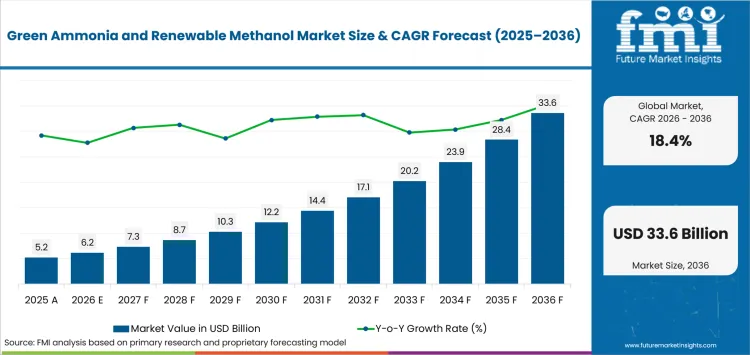
- Market Size (2026)
- USD 6.2 Bn
- Forecast (2036)
- USD 33.6 Bn
- CAGR (2026 to 2036)
- 18.4%
How big is Green Ammonia and Renewable Methanol Market in 2026?
USD 6.2 billion in 2026 and USD 33.6 billion by 2036 at an 18.4% CAGR.
Demand for green ammonia and renewable methanol is projected to expand at 18.4% CAGR between 2026 and 2036, increasing valuation from USD 6.2 billion in 2026 to USD 33.6 billion by 2036. Marine fuel conversion gives renewable methanol a recurring purchase route as vessel operators must source eligible fuel for scheduled voyages. In January 2025, the European Commission required covered ships to cut onboard-energy greenhouse-gas intensity by 2% during 2025, giving that purchase route a regulatory trigger. Qualified renewable methanol and ammonia can compete for recurring fuel contracts instead of relying on voluntary emissions commitments.
Country conversion differs between Australia’s developing shared export infrastructure and Germany’s heavier reliance on imported renewable derivatives. Australia’s planned route has a physical aggregation point at Newcastle that can combine production with storage and export handling. In July 2025 the Australian Government described a 220-hectare clean-energy precinct designed for green hydrogen and ammonia production plus storage and distribution. Shared infrastructure can shorten export handling, whereas German projects remain more exposed to import qualification and delivered-cost discipline.
Key Takeaways of Green Ammonia And Renewable Methanol Market
- Demand strengthens as shipping and industrial users convert emissions requirements into recurring fuel and feedstock purchase commitments with defined delivery terms.
- Green ammonia is set to lead the product category with 61.0% share in 2026 due to established fertilizer and chemical handling routes.
- In 2026, marine fuel is expected to lead application with 27.0% share because alternative-fuel vessels require repeated bunkering along scheduled routes.
- The end-use category is forecast to be led by shipping at 31.0% share in 2026 due to fuel purchasing that repeats with vessel operations.
- Renewable-hydrogen cost and limited qualified molecule supply can delay project financing even once production routes have passed technical demonstration and initial qualification.
- Key players in the industry includes Yara, First Ammonia, Mitsubishi Gas Chemical, Topsoe, Methanex, Maersk, thyssenkrupp Uhde and ACME Group.
Analyst Perspective
"Green ammonia economics depend first on renewable-hydrogen cost and whether existing ammonia assets can accept that supply without major downstream changes. Renewable methanol offers simpler liquid-fuel handling, but producers still need eligible carbon and dependable port delivery before contracted volumes become reliable revenue."
- Nikhil Kaitwade, Principal Consultant, Future Market Insights
How is the Green Ammonia and Renewable Methanol Market segmented?
Segmentation covers product, feedstock - pathway, application, production scale, offtake model, end use and region.
Taxonomy covers product (green ammonia, renewable methanol), feedstock - pathway (renewable hydrogen + nitrogen, biogenic CO2 + green hydrogen, biomass / waste gasification, carbon capture + renewable power), application (marine fuel, fertilizers, chemical feedstock, power / energy storage, industrial fuel), production scale (pilot / demonstration, small commercial, large-scale integrated plants, export hub projects), offtake model (long-term contracts, spot / merchant sales, captive industrial use, joint venture / project equity), end use (shipping, agriculture, chemicals, energy & utilities) and region.
What supports marine fuel in the application category?
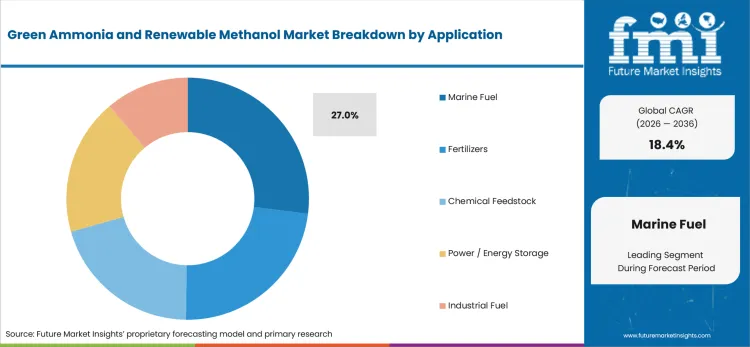
Marine fuel turns renewable molecules into recurring consumption once compatible ships enter scheduled service and require qualified bunkering at regular port calls. Maersk named Adrian Mærsk in March 2025 as a dual-fuel methanol vessel above 16,000 TEU scheduled for the Asia-Mediterranean lane, tying future scheduled service to recurring methanol availability.
- By application, marine fuel is forecast to represent 27.0% in 2026 driven by alternative-fuel fleet deployment and repeated bunkering requirements.
- Fuel providers must match lifecycle eligibility with port availability and delivery timing so low-carbon methanol or ammonia remains available across routine vessel calls and established service corridors.
What makes green ammonia central to the product category?
Green ammonia uses the familiar ammonia molecule but replaces fossil-derived hydrogen with renewable hydrogen during synthesis inside established fertilizer and chemical systems. OPAZ reported in May 2025 that ACME’s second and third Duqm phases each plan about 400,000 tonnes annually for large Power-to-X systems producing green ammonia.
- Green ammonia is projected to hold 61.0% share in 2026 owing to established fertilizer uses and transferable storage infrastructure across existing ammonia supply chains.
- Industrial ammonia users can qualify renewable hydrogen inside familiar storage and conversion systems, reducing the number of downstream interfaces that must change for initial adoption.
Why does renewable hydrogen + nitrogen lead the feedstock - pathway category?
The renewable hydrogen + nitrogen route feeds hydrogen directly into ammonia synthesis and does not require a separate qualified carbon source or carbon capture. Economics depend mainly on renewable electricity and hydrogen electrolyzers because hydrogen output must follow variable power supply.
- Based on feedstock - pathway, renewable hydrogen + nitrogen is projected to account for 42.0% in 2026 due to direct compatibility with green ammonia synthesis and established nitrogen handling.
- In January 2026 ACWA selected Topsoe’s dynamic ammonia technology for planned Yanbu units totaling 2,700 metric tons per day. The design can follow variable hydrogen input and reduce dedicated hydrogen storage requirements.
What drives long-term contracts in the offtake model category?
Long-term contracts address the timing mismatch between project construction and recurring demand for qualified renewable molecules. Developers need revenue visibility for financing, and fertilizer or shipping users need defined volumes plus delivery terms ahead of planned supply.
- By offtake model, long-term contracts are estimated to hold 43.0% in 2026 owing to revenue visibility that lenders can use to finance new renewable-molecule capacity.
- In March 2026 India’s Press Information Bureau documented SECI allocation of about 724,000 tonnes of green ammonia annually across 13 fertilizer units under ten-year supply arrangements. Contracted fertilizer supply gives project sponsors a measurable sales base during plant construction and early commissioning.
What are the drivers, restraints and opportunities in the Green Ammonia and Renewable Methanol Market?
Alternative-fuel fleet deployment strengthens recurring fuel demand while renewable-hydrogen scarcity raises delivered cost and long-term commercial contracts improve delivery certainty.
- Driver: Alternative-fuel vessel deployment converts qualified molecule availability into repeat fuel purchases along established shipping routes and scheduled port calls.
- Restraint: Renewable-hydrogen scarcity increases delivered molecule cost and delays commitments from industrial users that cannot absorb an uncertain fuel or feedstock premium.
- Opportunity: Long-term commercial contracts can align planned molecule volumes with dedicated delivery capacity ahead of routine production.
Alternative-Fuel Fleets Turn Fuel Availability into Repeat Purchasing
Shipping demand strengthens as alternative-fuel vessel investment converts planned fuel shifts into recurring commercial bunkering requirements. Mitsui O.S.K. Lines announced the May 2025 delivery of Kohzan Maru VII for long-term Mitsubishi Gas Chemical service using sustainable methanol as marine fuel. The vessel also transports renewable methanol, linking fuel consumption with a dedicated commercial cargo route.
Renewable Hydrogen Scarcity Pressures Delivered Molecule Cost
Renewable hydrogen remains the main cost and availability constraint owing to substantial electrolytic hydrogen requirements across green ammonia and e-methanol production. The IEA reported in September 2025 that low-emissions technologies supplied less than 1% of global hydrogen production during 2024. Limited qualified hydrogen raises molecule cost and can increase storage requirements, delaying long-term commitments from industrial users unable to absorb uncertain premiums.
Long-Term Commercial Contracts Improve Delivery Certainty
Long-term contracts reduce delivery uncertainty for projects that finance production capacity before routine demand is established. A dedicated transport contract connects future ammonia output with a defined delivery route and gives producers clearer logistics planning. Yara Clean Ammonia and NYK concluded a time-charter agreement in February 2025 for a vessel scheduled for delivery in November 2026.
Which country CAGRs are profiled in the Green Ammonia and Renewable Methanol Market?
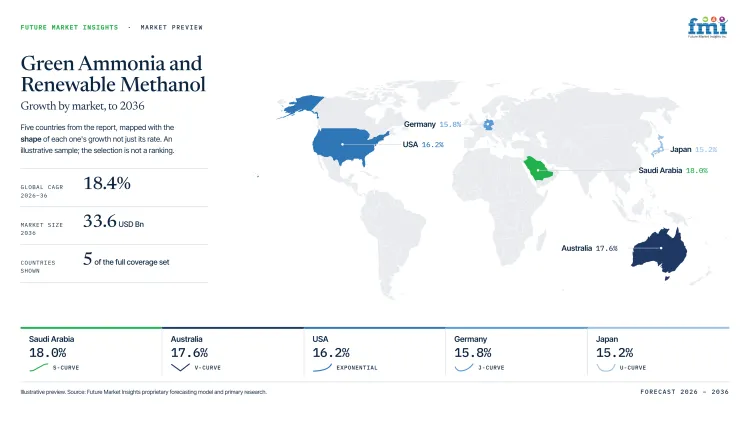
| Country | CAGR |
|---|---|
| Saudi Arabia | 18.0% |
| Australia | 17.6% |
| United States | 16.2% |
| Germany | 15.8% |
| Japan | 15.2% |
How do country-level CAGRs compare in the Green Ammonia and Renewable Methanol Market?
Five country forecasts fit inside a narrow 2.8-percentage-point band despite distinct commercialization routes. Saudi Arabia and Australia form an export-led pair whose pace depends on commissioned production and secure offtake. The United States and Germany depend more on plant or port qualification, whereas Japan relies on imported supply supported by bunkering procedures.
- Saudi Arabia depends on NEOM commissioning to convert export contracts into repeat shipments.
- Australia pairs existing ammonia assets with renewable hydrogen for brownfield industrial conversion.
- United States commercialization depends on proving lower-pressure green-ammonia systems beyond commercial pilots.
- Germany has approved methanol bunkering but remains exposed to imported renewable-fuel economics.
- Japan is testing anchorage bunkering around imported renewable-methanol supply for vessel schedules.
Comparable CAGRs therefore mask different project, infrastructure and supply-conversion risks for entrants. The full report provides country-level CAGR analysis across North America, Latin America, Europe, East Asia, South Asia, Oceania and the Middle East and Africa.
Country-wise Analysis
- Saudi Arabia is building an export-oriented ammonia chain at Oxagon as NEOM Green Hydrogen Company reported 90% construction completion across all project sites in March 2026 ahead of planned 2027 production for export customers. Green ammonia and renewable methanol demand in Saudi Arabia is forecast to rise at 18.0% CAGR over the forecast period, supported directly by dedicated renewable generation and planned ammonia conversion for overseas customers. Commissioning remains the local constraint as electrolysis and synthesis must operate reliably across one integrated chain so export contracts become repeat shipments with sustained utilization and dependable commercial ramp-up during initial commercial operations.
- Australia can integrate renewable hydrogen into Orica’s established Kooragang ammonia system, and the Australian Government reported in July 2026 that Orica reached final investment decision for a 50 MW electrolyzer at the site. Green ammonia and renewable methanol sales in Australia are forecast to expand at 17.6% CAGR by 2036, reinforced by brownfield access to existing ammonia production and local fertilizer demand across the Hunter industrial corridor. Construction and plant integration remain the local constraint as electrolyzer output must match existing ammonia operations for this route to sustain repeat domestic orders and credible future export volumes during early commercial operations.
- United States developers are testing lower-pressure green-ammonia routes that aim to reduce conventional synthesis pressure and retain familiar ammonia storage and downstream handling for fertilizer and chemical applications at established industrial sites nationwide. An August 2025 USA Department of Energy record describes Syzygy’s plan to develop and validate a fully electric low-pressure photoreactor system at lower temperature, including prototypes and a full-scale production system. The United States is estimated to post 16.2% CAGR over the forecast period, but commercial scale remains the limiting condition until pilot validation establishes stable production economics for repeat fertilizer and chemical purchasing across larger industrial sites.
- Ship-to-ship methanol bunkering gained approval at two central Hamburg container terminals in August 2025 according to Port of Hamburg Marketing, giving German marine demand a defined port route for regular international liner calls. The German green ammonia and renewable methanol sector is projected to record 15.8% CAGR during the assessment period, supported by approved fuel handling and established container traffic at a major European port in Hamburg. Import dependence remains the local constraint as qualified renewable fuel must arrive with lifecycle documentation and workable delivered economics for approved bunkering capacity to convert into routine purchasing across scheduled international services for operators.
- Japan is moving green methanol from bunkering procedures into operating experience at Yokohama, giving imported supply a practical delivery route for coastal and international vessel calls on established port schedules under real port conditions. In Japan, green ammonia and renewable methanol demand is predicted to advance at 15.2% CAGR through 2036 owing to domestic shipping and chemical users that can contract qualified imported molecules under documented specifications. Mitsui O.S.K. Lines joined the February 2026 Yokohama operation that completed Japan’s first ship-to-ship methanol bunkering at anchorage, and long import lead times remain the friction for dependable recurring deliveries across national customer programs.
Who are the notable companies in the Green Ammonia and Renewable Methanol Market?
Yara, CF Industries, Mitsubishi Gas Chemical, Topsoe, Methanex, Maersk, thyssenkrupp Uhde and ACME Group are notable companies in this market.
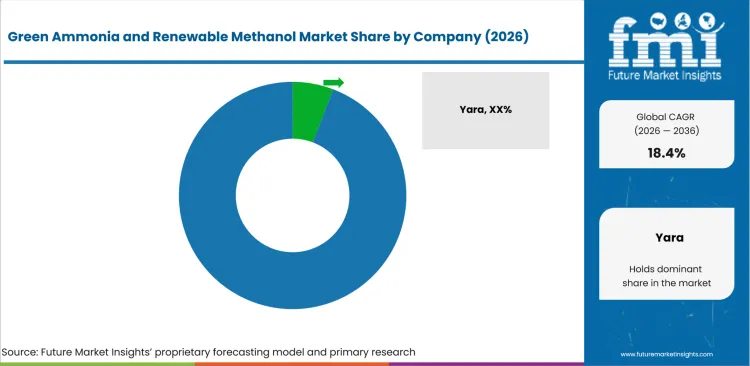
Competition is fragmented across molecule production and project development plus process licensing and marine-fuel distribution. Entry requires renewable feedstocks plus plant integration and financeable delivery contracts that connect qualified output with recurring orders.
- Yara and Methanex combine molecule supply with logistics for industrial and marine customers across established channels. CF Industries reported that management decided in December 2025 not to make the additional investment needed to complete its suspended 20 MW alkaline electrolyzer project.
- Mitsubishi Gas Chemical and Maersk shape contracted demand, whereas ACME Group combines project development with planned renewable-molecule production.
- Topsoe and thyssenkrupp Uhde compete on process integration that connects renewable feedstocks with synthesis systems. Ammonia propulsion adds downstream fuel-qualification requirements for port distribution, bunkering safety and vessel service.
Competitive Benchmarking: Green Ammonia and Renewable Methanol Market
| Company | Renewable Molecule Supply Exposure | Plant and Pathway Integration | Offtake and Delivery Access | Geographic Reach |
|---|---|---|---|---|
| Yara | High | Medium | High | Europe, Americas and Asia |
| CF Industries | Low | Medium | Low | North America and export markets |
| Mitsubishi Gas Chemical | Medium | Low | Medium | Japan and Asia |
| Topsoe | Low | High | Low | Europe, Middle East and Asia |
| Methanex | Medium | Medium | High | Americas, Europe and Asia Pacific |
| Maersk | Low | Low | High | Global |
| thyssenkrupp Uhde | Low | High | Low | Europe, Americas, Middle East and Asia |
| ACME Group | High | High | High | India, Oman and Asia |
Key Developments in the Green Ammonia and Renewable Methanol Market
- In July 2026, Mitsubishi Gas Chemical signed an agreement with ACME Group covering about 100,000 tons of planned green methanol annually from Odisha starting in 2030.
- In March 2026, thyssenkrupp Uhde received a Nova Sustainable Fuels contract for an integration study covering planned Canadian renewable-methanol output above 450,000 metric tons annually.
- In February 2026, Methanex joined Exolum and Ørsted to launch a commercially ready biomethanol storage and supply service at the Port of Immingham.
Key Players in the Green Ammonia and Renewable Methanol Market
Renewable Molecule Production and Market Access
- Yara
- CF Industries
- Methanex
Demand and Project Development
- Mitsubishi Gas Chemical
- Maersk
- ACME Group
Process Technology and Plant Integration
- Topsoe
- thyssenkrupp Uhde
Green Ammonia and Renewable Methanol Market - Report Scope
| Coverage field | Report scope |
|---|---|
| Market breakdown | By product, feedstock - pathway, application, production scale, offtake model, end use and region. |
| Quantitative Units | Revenue in USD billion and CAGR in %. |
| Market Definition | Commercial green ammonia and renewable methanol produced from renewable hydrogen or eligible renewable carbon pathways for fertilizer, chemical, marine fuel, energy and industrial uses. |
| Regions Covered | North America, Latin America, Europe, East Asia, South Asia and Pacific, and Middle East and Africa. |
| Countries Covered | Saudi Arabia, Australia, United States, Germany, Japan, and 20+ countries included in the full report. |
| Key Companies Profiled | Yara, CF Industries, Mitsubishi Gas Chemical, Topsoe, Methanex, Maersk, thyssenkrupp Uhde and ACME Group. |
| Forecast Period | 2026 to 2036. |
| Approach | Primary and secondary research with market triangulation. |
Green Ammonia and Renewable Methanol Market - Research Methodology
| Method | Approach |
|---|---|
| Primary Research | FMI analysts gathered input from manufacturers, service providers, technology developers, distributors, end users, procurement teams, and subject-matter experts. Interviews examined purchasing decisions, product or service evaluation, adoption barriers, approval requirements, pricing considerations, and expectations for technical or commercial support. Respondents were also asked what evidence is required before a trial, pilot, or initial order develops into regular purchasing. |
| Desk Research | Desk research covered government statistics, regulatory publications, trade data, industry associations, technical literature, standards, company filings, product information, and official corporate announcements. Sources were reviewed for relevance, publication date, geographic coverage, and consistency with the defined market scope. Claims relating to performance, applications, approvals, capacity, investment, and commercial activity were retained only when supported by credible public evidence. |
| Market Sizing and Forecasting | The market model combined the baseline value with historical performance, segment structure, pricing and volume indicators, adoption levels, company participation, and country-level demand conditions. Forecast assumptions considered economic activity, investment trends, regulatory developments, technology adoption, purchasing cycles, supply availability, and barriers to wider market use. Segment and regional estimates were reconciled before the final market total was calculated. |
| Data Validation | Estimates were checked against multiple independent indicators, including public data, company activity, trade patterns, industry developments, and findings from primary interviews. Validation also tested whether products, services, applications, and company revenues fell within the defined market boundaries. Adjacent categories, unsupported claims, overlapping revenues, and activities without direct market relevance were excluded to reduce double counting and maintain consistency across segments and countries. |
Green Ammonia and Renewable Methanol Market by Segments
Green Ammonia and Renewable Methanol Market segmented by Product:
- Green Ammonia
- Renewable Methanol
Green Ammonia and Renewable Methanol Market segmented by Feedstock - pathway:
- Renewable Hydrogen + Nitrogen
- Biogenic CO2 + Green Hydrogen
- Biomass / Waste Gasification
- Carbon Capture + Renewable Power
Green Ammonia and Renewable Methanol Market segmented by Application:
- Marine Fuel
- Fertilizers
- Chemical Feedstock
- Power / Energy Storage
- Industrial Fuel
Green Ammonia and Renewable Methanol Market segmented by Production Scale:
- Pilot / Demonstration
- Small Commercial
- Large-scale Integrated Plants
- Export Hub Projects
Green Ammonia and Renewable Methanol Market segmented by Offtake Model:
- Long-term Contracts
- Spot / Merchant Sales
- Captive Industrial Use
- Joint Venture / Project Equity
Green Ammonia and Renewable Methanol Market segmented by End Use:
- Shipping
- Agriculture
- Chemicals
- Energy & Utilities
Green Ammonia and Renewable Methanol Market by Region:
- North America
- United States
- Canada
- Latin America
- Brazil
- Mexico
- Chile
- Rest of Latin America
- Western Europe
- Germany
- United Kingdom
- Italy
- Spain
- France
- Nordics
- Benelux
- Rest of Western Europe
- Eastern Europe
- Russia
- Poland
- Hungary
- Balkan and Baltic States
- Rest of Eastern Europe
- East Asia
- China
- Japan
- South Korea
- South Asia and Pacific
- India
- ASEAN
- Australia and New Zealand
- Rest of South Asia and Pacific
- Middle East and Africa
- Kingdom of Saudi Arabia
- Other GCC Countries
- Türkiye
- South Africa
- Other African Union Countries
- Rest of Middle East and Africa
Research Sources and Bibliography
- European Commission, Directorate-General for Mobility and Transport. (2025, January 10). New EU rules aiming to decarbonise the maritime sector take effect.
- Australian Government, Department of Climate Change, Energy, the Environment and Water. (2025, July 4). Joint media release: Designs unveiled for Newcastle green energy precinct.
- Public Authority for Special Economic Zones and Free Zones. (2025, May 18). Signing of Land Use Agreement for Phases Two and Three of ACME Green Hydrogen Project in Duqm.
- Topsoe. (2026, January 27). Topsoe to support green ammonia flagship project in Saudi Arabia.
- A.P. Moller - Maersk. (2025, March 27). Maersk names dual-fuel methanol vessel “Adrian Mærsk” at its flagship terminal Maasvlakte II in Rotterdam.
- Press Information Bureau, Government of India. (2026, March 30). Exchange of Green Ammonia Agreements Under NGHM Mark Key Step for India’s Energy Security: Union Minister Pralhad Joshi.
- Mitsui O.S.K. Lines, Ltd. (2025, June 2). Dual-fuel Methanol Carrier Kohzan Maru VII Delivered - Serving Mitsubishi Gas Chemical under Long-term Charter Contract -.
- International Energy Agency. (2025, September 12). Global Hydrogen Review 2025.
- Yara International ASA. (2025, February 10). Yara Clean Ammonia and NYK conclude world’s first time-charter agreement for ammonia-fueled medium gas carrier.
- NEOM Green Hydrogen Company. (2026, March 26). World’s Largest Green Hydrogen Plant Achieves 90% Overall Construction Completion Across All Sites.
- Australian Government, Department of Climate Change, Energy, the Environment and Water. (2026, July 1). Joint media release: Orica backs Australian-made renewable hydrogen in Hunter.
- USA Department of Energy. (2025, August 1). CX-270804: Syzygy Plasmonics Inc.- Electrified Low-Pressure Green Ammonia for Carbon-Free Energy Future.
- Port of Hamburg Marketing. (2025, August 27). Waltershof Hafen is bunker-ready for methanol and LNG - a milestone for alternative marine fuels in Hamburg.
- Mitsui O.S.K. Lines, Ltd. (2026, February 9). MOL Joins 5-way Public-private Partnership in 1st Ship-to-ship Methanol Bunkering at Anchorage in Yokohama.
- CF Industries Holdings, Inc. (2026, February 18). CF Industries Holdings, Inc. Reports Full Year 2025 Net Earnings of $1.46 Billion, Adjusted EBITDA of $2.89 Billion.
- Mitsubishi Gas Chemical Company, Inc. (2026, July 3). Mitsubishi Gas Chemical and ACME Group Sign Agreement for the Purchase and Sale of Green Methanol.
- thyssenkrupp Uhde. (2026, March 2). thyssenkrupp Uhde selected for biomass-to-methanol technology integration study for Nova Sustainable Fuels in Canada.
- Methanex Corporation. (2026, February 10). UK’s First Commercial Biomethanol Bunkering Service Launches at Port of Immingham.
This bibliography is provided for reader reference and is not exhaustive. The full report contains the complete reference list and detailed citations
This Report Answers
- How large is the green ammonia and renewable methanol market in 2026 and 2036?
- Which conditions convert decarbonization requirements into renewable-molecule contracts across shipping and industry?
- Why does green ammonia hold the largest approved product share in 2026?
- How does renewable hydrogen + nitrogen affect green-ammonia production economics and plant design?
- Why does marine fuel generate recurring renewable-molecule demand across shipping routes?
- How do growth conditions differ across the five profiled country markets?
- Which competitive roles separate molecule producers from process licensors and marine fuel users?
- Which hydrogen-cost and delivery constraints delay commercial conversion of announced capacity?
Frequently Asked Questions
How big is the Green Ammonia and Renewable Methanol Market in 2026?
The green ammonia and renewable methanol market is expected to be valued at USD 6.2 billion in 2026. Marine fuel and fertilizer contracts convert qualified renewable molecules into recurring commercial purchases across routes.
What is the CAGR of the Green Ammonia and Renewable Methanol Market from 2026 to 2036?
The green ammonia and renewable methanol market is forecast to grow at 18.4% CAGR from 2026 to 2036. Expansion depends on converting decarbonization requirements into qualified contracts with credible delivery economics for projects.
Which product segment is projected to account for 61.0% of the Green Ammonia and Renewable Methanol Market?
The green ammonia and renewable methanol market is expected to record a 61.0% product share for green ammonia in 2026. Established ammonia handling gives renewable hydrogen a practical route into industrial supply chains for industrial producers.
Which application segment is projected to account for 27.0% of the Green Ammonia and Renewable Methanol Market?
The green ammonia and renewable methanol market is projected to record a 27.0% application share for marine fuel in 2026. Methanol-capable vessels require recurring fuel purchases as qualified bunkering supply develops along scheduled commercial routes.
Which companies are active in the Green Ammonia and Renewable Methanol Market?
The green ammonia and renewable methanol market includes Yara, CF Industries, Mitsubishi Gas Chemical, Topsoe, Methanex, Maersk, thyssenkrupp Uhde and ACME Group. Their roles span molecule supply and offtake plus project development and synthesis integration across projects.
Preview the report firsthand - request a free sample
Get SampleGet the brochure for pricing and purchase details.
Get PDFTable of Content
- Key Takeaways
- Market Size and CAGR
- Top Growth Driver
- Fastest Growing Segment
- Leading Region
- Key Companies
- Emerging Opportunities
- Executive Summary
- Global Market Outlook
- Demand-side Trends
- Supply-side Trends
- Technology Roadmap Analysis
- Analysis and Recommendations
- Analyst Perspective (What is happening? Why now? What should investors know?)
- Key Questions Answered
- How large is the market?
- What is the CAGR?
- What are key trends?
- Which region dominates?
- Who are the leaders?
- Market Overview
- Market Coverage / Taxonomy
- Market Definition / Scope / Limitations
- Research Methodology
- Chapter Orientation
- Analytical Lens and Working Hypotheses
- Market Structure, Signals, and Trend Drivers
- Benchmarking and Cross-market Comparability
- Market Sizing, Forecasting, and Opportunity Mapping
- Research Design and Evidence Framework
- Desk Research Programme (Secondary Evidence)
- Expert Input and Fieldwork (Primary Evidence)
- Tooling, Models, and Reference Databases
- Data Engineering and Model Build
- Quality Assurance and Audit Trail
- Market Background
- Market Dynamics (Drivers, Restraints, Opportunity, Trends)
- Scenario Forecast (Optimistic, Likely, Conservative)
- Impact Analysis
- AI Impact
- Sustainability Impact
- Regulatory Impact
- Technology Impact
- Consumer / Buyer Analysis
- Purchase Drivers
- Adoption Barriers
- Buyer Journey
- Opportunity Map Analysis
- Product Life Cycle Analysis
- Supply Chain Analysis
- Investment Feasibility Matrix
- Value Chain Analysis
- PESTLE and Porter's Analysis
- Regulatory Landscape
- Regional Parent Market Outlook
- Production and Consumption Statistics
- Import and Export Statistics
- Global Market Analysis and Forecast, 2021 to 2036
- Historical Market Size Value (USD Billion) Analysis, 2021 to 2025
- Current and Future Market Size Value (USD Billion) Projections, 2026 to 2036
- Y-o-Y Growth Trend Analysis
- Absolute $ Opportunity Analysis
- Global Market Pricing Analysis, 2021 to 2036
- Global Market Analysis and Forecast, By Product, 2021 to 2036
- Introduction / Key Findings
- Historical Market Size Value (USD Billion) Analysis By Product, 2021 to 2025
- Current and Future Market Size Value (USD Billion) Analysis and Forecast By Product, 2026 to 2036
- Green Ammonia
- Renewable Methanol
- Green Ammonia
- Y-o-Y Growth Trend Analysis By Product, 2021 to 2025
- Absolute $ Opportunity Analysis By Product, 2026 to 2036
- Global Market Analysis and Forecast, By Feedstock - Pathway, 2021 to 2036
- Introduction / Key Findings
- Historical Market Size Value (USD Billion) Analysis By Feedstock - Pathway, 2021 to 2025
- Current and Future Market Size Value (USD Billion) Analysis and Forecast By Feedstock - Pathway, 2026 to 2036
- Renewable Hydrogen + Nitrogen
- Biogenic CO2 + Green Hydrogen
- Biomass / Waste Gasification
- Carbon Capture + Renewable Power
- Renewable Hydrogen + Nitrogen
- Y-o-Y Growth Trend Analysis By Feedstock - Pathway, 2021 to 2025
- Absolute $ Opportunity Analysis By Feedstock - Pathway, 2026 to 2036
- Global Market Analysis and Forecast, By Application, 2021 to 2036
- Introduction / Key Findings
- Historical Market Size Value (USD Billion) Analysis By Application, 2021 to 2025
- Current and Future Market Size Value (USD Billion) Analysis and Forecast By Application, 2026 to 2036
- Marine Fuel
- Fertilizers
- Chemical Feedstock
- Power / Energy Storage
- Industrial Fuel
- Marine Fuel
- Y-o-Y Growth Trend Analysis By Application, 2021 to 2025
- Absolute $ Opportunity Analysis By Application, 2026 to 2036
- Global Market Analysis and Forecast, By Production Scale, 2021 to 2036
- Introduction / Key Findings
- Historical Market Size Value (USD Billion) Analysis By Production Scale, 2021 to 2025
- Current and Future Market Size Value (USD Billion) Analysis and Forecast By Production Scale, 2026 to 2036
- Large-Scale Integrated Plants
- Export Hub Projects
- Small Commercial
- Pilot / Demonstration
- Large-Scale Integrated Plants
- Y-o-Y Growth Trend Analysis By Production Scale, 2021 to 2025
- Absolute $ Opportunity Analysis By Production Scale, 2026 to 2036
- Global Market Analysis and Forecast, By Offtake Model, 2021 to 2036
- Introduction / Key Findings
- Historical Market Size Value (USD Billion) Analysis By Offtake Model, 2021 to 2025
- Current and Future Market Size Value (USD Billion) Analysis and Forecast By Offtake Model, 2026 to 2036
- Long-Term Contracts
- Spot / Merchant Sales
- Captive Industrial Use
- Joint Venture / Project Equity
- Long-Term Contracts
- Y-o-Y Growth Trend Analysis By Offtake Model, 2021 to 2025
- Absolute $ Opportunity Analysis By Offtake Model, 2026 to 2036
- Global Market Analysis and Forecast, By End Use
- Introduction / Key Findings
- Historical Market Size Value (USD Billion) Analysis By End Use, 2021 to 2025
- Current and Future Market Size Value (USD Billion) Analysis and Forecast By End Use, 2026 to 2036
- Shipping
- Agriculture
- Chemicals
- Energy & Utilities
- Shipping
- Y-o-Y Growth Trend Analysis By End Use, 2021 to 2025
- Absolute $ Opportunity Analysis By End Use, 2026 to 2036
- Global Market Analysis and Forecast, By Region, 2021 to 2036
- Introduction
- Historical Market Size Value (USD Billion) Analysis By Region, 2021 to 2025
- Current Market Size Value (USD Billion) Analysis and Forecast By Region, 2026 to 2036
- North America
- Latin America
- Western Europe
- Eastern Europe
- East Asia
- South Asia and Pacific
- Middle East & Africa
- Market Attractiveness Analysis By Region
- North America Market Analysis and Forecast, By Country, 2021 to 2036
- Historical Market Size Value (USD Billion) Trend Analysis By Market Taxonomy, 2021 to 2025
- Market Size Value (USD Billion) Forecast By Market Taxonomy, 2026 to 2036
- By Country
- USA
- Canada
- By Product
- By Feedstock - Pathway
- By Application
- By Production Scale
- By Offtake Model
- By End Use
- By Country
- Market Attractiveness Analysis
- By Country
- By Product
- By Feedstock - Pathway
- By Application
- By Production Scale
- By Offtake Model
- By End Use
- Key Takeaways
- Latin America Market Analysis and Forecast, By Country
- Historical Market Size Value (USD Billion) Trend Analysis By Market Taxonomy, 2021 to 2025
- Market Size Value (USD Billion) Forecast By Market Taxonomy, 2026 to 2036
- By Country
- Brazil
- Mexico
- Chile
- Rest of Latin America
- By Product
- By Feedstock - Pathway
- By Application
- By Production Scale
- By Offtake Model
- By End Use
- By Country
- Market Attractiveness Analysis
- By Country
- By Product
- By Feedstock - Pathway
- By Application
- By Production Scale
- By Offtake Model
- By End Use
- Key Takeaways
- Western Europe Market Analysis and Forecast, By Country
- Historical Market Size Value (USD Billion) Trend Analysis By Market Taxonomy, 2021 to 2025
- Market Size Value (USD Billion) Forecast By Market Taxonomy, 2026 to 2036
- By Country
- Germany
- UK
- Italy
- Spain
- France
- Nordic
- BENELUX
- Rest of Western Europe
- By Product
- By Feedstock - Pathway
- By Application
- By Production Scale
- By Offtake Model
- By End Use
- By Country
- Market Attractiveness Analysis
- By Country
- By Product
- By Feedstock - Pathway
- By Application
- By Production Scale
- By Offtake Model
- By End Use
- Key Takeaways
- Eastern Europe Market Analysis and Forecast, By Country
- Historical Market Size Value (USD Billion) Trend Analysis By Market Taxonomy, 2021 to 2025
- Market Size Value (USD Billion) Forecast By Market Taxonomy, 2026 to 2036
- By Country
- Russia
- Poland
- Hungary
- Balkan & Baltic
- Rest of Eastern Europe
- By Product
- By Feedstock - Pathway
- By Application
- By Production Scale
- By Offtake Model
- By End Use
- By Country
- Market Attractiveness Analysis
- By Country
- By Product
- By Feedstock - Pathway
- By Application
- By Production Scale
- By Offtake Model
- By End Use
- Key Takeaways
- East Asia Market Analysis and Forecast, By Country
- Historical Market Size Value (USD Billion) Trend Analysis By Market Taxonomy, 2021 to 2025
- Market Size Value (USD Billion) Forecast By Market Taxonomy, 2026 to 2036
- By Country
- China
- Japan
- South Korea
- By Product
- By Feedstock - Pathway
- By Application
- By Production Scale
- By Offtake Model
- By End Use
- By Country
- Market Attractiveness Analysis
- By Country
- By Product
- By Feedstock - Pathway
- By Application
- By Production Scale
- By Offtake Model
- By End Use
- Key Takeaways
- South Asia and Pacific Market Analysis and Forecast, By Country
- Historical Market Size Value (USD Billion) Trend Analysis By Market Taxonomy, 2021 to 2025
- Market Size Value (USD Billion) Forecast By Market Taxonomy, 2026 to 2036
- By Country
- India
- ASEAN
- Australia & New Zealand
- Rest of South Asia and Pacific
- By Product
- By Feedstock - Pathway
- By Application
- By Production Scale
- By Offtake Model
- By End Use
- By Country
- Market Attractiveness Analysis
- By Country
- By Product
- By Feedstock - Pathway
- By Application
- By Production Scale
- By Offtake Model
- By End Use
- Key Takeaways
- Middle East & Africa Market Analysis and Forecast, By Country
- Historical Market Size Value (USD Billion) Trend Analysis By Market Taxonomy, 2021 to 2025
- Market Size Value (USD Billion) Forecast By Market Taxonomy, 2026 to 2036
- By Country
- Kingdom of Saudi Arabia
- Other GCC Countries
- Türkiye
- South Africa
- Other African Union
- Rest of Middle East & Africa
- By Product
- By Feedstock - Pathway
- By Application
- By Production Scale
- By Offtake Model
- By End Use
- By Country
- Market Attractiveness Analysis
- By Country
- By Product
- By Feedstock - Pathway
- By Application
- By Production Scale
- By Offtake Model
- By End Use
- Key Takeaways
- Key Countries Market Analysis
- USA
- Pricing Analysis
- Market Share Analysis, 2025
- By Product
- By Feedstock - Pathway
- By Application
- By Production Scale
- By Offtake Model
- By End Use
- Canada
- Pricing Analysis
- Market Share Analysis, 2025
- By Product
- By Feedstock - Pathway
- By Application
- By Production Scale
- By Offtake Model
- By End Use
- Mexico
- Pricing Analysis
- Market Share Analysis, 2025
- By Product
- By Feedstock - Pathway
- By Application
- By Production Scale
- By Offtake Model
- By End Use
- Brazil
- Pricing Analysis
- Market Share Analysis, 2025
- By Product
- By Feedstock - Pathway
- By Application
- By Production Scale
- By Offtake Model
- By End Use
- Chile
- Pricing Analysis
- Market Share Analysis, 2025
- By Product
- By Feedstock - Pathway
- By Application
- By Production Scale
- By Offtake Model
- By End Use
- Germany
- Pricing Analysis
- Market Share Analysis, 2025
- By Product
- By Feedstock - Pathway
- By Application
- By Production Scale
- By Offtake Model
- By End Use
- UK
- Pricing Analysis
- Market Share Analysis, 2025
- By Product
- By Feedstock - Pathway
- By Application
- By Production Scale
- By Offtake Model
- By End Use
- Italy
- Pricing Analysis
- Market Share Analysis, 2025
- By Product
- By Feedstock - Pathway
- By Application
- By Production Scale
- By Offtake Model
- By End Use
- Spain
- Pricing Analysis
- Market Share Analysis, 2025
- By Product
- By Feedstock - Pathway
- By Application
- By Production Scale
- By Offtake Model
- By End Use
- France
- Pricing Analysis
- Market Share Analysis, 2025
- By Product
- By Feedstock - Pathway
- By Application
- By Production Scale
- By Offtake Model
- By End Use
- India
- Pricing Analysis
- Market Share Analysis, 2025
- By Product
- By Feedstock - Pathway
- By Application
- By Production Scale
- By Offtake Model
- By End Use
- ASEAN
- Pricing Analysis
- Market Share Analysis, 2025
- By Product
- By Feedstock - Pathway
- By Application
- By Production Scale
- By Offtake Model
- By End Use
- Australia & New Zealand
- Pricing Analysis
- Market Share Analysis, 2025
- By Product
- By Feedstock - Pathway
- By Application
- By Production Scale
- By Offtake Model
- By End Use
- China
- Pricing Analysis
- Market Share Analysis, 2025
- By Product
- By Feedstock - Pathway
- By Application
- By Production Scale
- By Offtake Model
- By End Use
- Japan
- Pricing Analysis
- Market Share Analysis, 2025
- By Product
- By Feedstock - Pathway
- By Application
- By Production Scale
- By Offtake Model
- By End Use
- South Korea
- Pricing Analysis
- Market Share Analysis, 2025
- By Product
- By Feedstock - Pathway
- By Application
- By Production Scale
- By Offtake Model
- By End Use
- Russia
- Pricing Analysis
- Market Share Analysis, 2025
- By Product
- By Feedstock - Pathway
- By Application
- By Production Scale
- By Offtake Model
- By End Use
- Poland
- Pricing Analysis
- Market Share Analysis, 2025
- By Product
- By Feedstock - Pathway
- By Application
- By Production Scale
- By Offtake Model
- By End Use
- Hungary
- Pricing Analysis
- Market Share Analysis, 2025
- By Product
- By Feedstock - Pathway
- By Application
- By Production Scale
- By Offtake Model
- By End Use
- Kingdom of Saudi Arabia
- Pricing Analysis
- Market Share Analysis, 2025
- By Product
- By Feedstock - Pathway
- By Application
- By Production Scale
- By Offtake Model
- By End Use
- Türkiye
- Pricing Analysis
- Market Share Analysis, 2025
- By Product
- By Feedstock - Pathway
- By Application
- By Production Scale
- By Offtake Model
- By End Use
- South Africa
- Pricing Analysis
- Market Share Analysis, 2025
- By Product
- By Feedstock - Pathway
- By Application
- By Production Scale
- By Offtake Model
- By End Use
- USA
- Market Structure Analysis
- Competition Dashboard
- Competition Benchmarking
- Market Share Analysis of Top Players
- By Regional
- By Product
- By Feedstock - Pathway
- By Application
- By Production Scale
- By Offtake Model
- By End Use
- Emerging Startups
- Innovation Benchmarking
- Competition Analysis
- Competition Deep Dive
- Yara
- Overview
- Product Portfolio
- Profitability by Market Segments
- Sales Footprint
- Strategy Overview
- Marketing Strategy
- Product Strategy
- Channel Strategy
- CF Industries
- Mitsubishi Gas Chemical
- Topsoe
- Methanex
- Maersk
- thyssenkrupp Uhde
- ACME Group
- Yara
- Case Studies
- Success Stories
- Recent Developments
- Competition Deep Dive
- Assumptions & Acronyms Used


