

- Industry Size (2025)
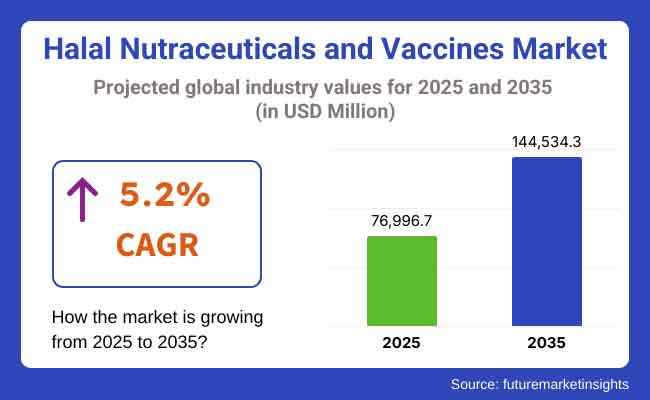
- USD 76996.7 Mn
- Forecast (2035)
- USD 144534.3 Mn
- CAGR (2025 to 2035)
- 5.2%
Halal Nutraceuticals and Vaccines Market Outlook 2025 to 2035
The halal nutraceuticals and vaccines market is expected to reach approximately USD 76,996.7 million in 2025 and expand to around USD 144,534.3 million by 2035, reflecting a compound annual growth rate (CAGR) of 5.2% over the forecast period.
The halal nutraceuticals and vaccines market is booming tremendously with the increasing global population of Muslims and hence its demand for Shariah-compliant health products. Nutraceuticals (functional foods, dietary supplements, and herbal products) are widely accepted products because of their health benefits and compliance to halalness. The halal vaccine market is also growing, with pharmaceutical companies and governments developing vaccines that comply with Islamic regulations.
Market expansion is being driven by factors such as enhanced consumer awareness, biotechnological advancements, and government policies that support growth. To ensure products conform to halal standards, industry leaders are investing in research and certification procedures while maintaining product safety and efficacy.
These are regions with a significant Muslim population, driving the market's expansion in these areas, particularly in the Asia-Pacific and the Middle East. The halal nutraceuticals and vaccines market is expected to experience growth in demand for ethical and religiously acceptable healthcare products over the upcoming years.
The yearly scope of the Halal Nutraceuticals and Vaccines Market between 2020 and 2024 was forecasted to be between the years when halals products were more and more observed by consumers from all over the world, ignited the emergence of the halals products along with the awareness of healthiness. The COVID-19 outbreak in 2020 ignited the interest in immune-boosting supplements, which consequently converted into halal vitamins, probiotics and herbal supplements selling at an unprecedented rate.
Governments and drug manufacturers responded by investing in halal-certified vaccines, particularly in Muslim countries. Malaysia, Indonesia, UAE, and others established halal certification frameworks that made compliance compulsory for market players.
Multinationals entered the halal sector in 2021 to 2023 with growth in product innovation. Up increased access, as well, with digital health platforms and online stores." By 2024, the market would be mature with harmonized halal regulations and increasing consumer trust. The introduction of ethical, organic and plant-based nutraceuticals also contributed to this trend, further validating the capability of halal healthcare solutions to expand and gain acceptance across the world.
Regional Market Trends
North America
The halal nutraceuticals and vaccines market in North America grew due to increased consumer awareness of halal-compatible products, an increase in diaspora demand, and the ethical branding of halal products. The multicultural nature of the region, with an emerging Muslim consumer base, fueled demand for certified halal health products. Unlike Asia and the Middle East, where laws are stringent, the United States and Canada rely on private halal certification agencies to sanction nutraceuticals and supplements.
The increasing demand for clean-label, non-GMO, and organic products among vegan and plant-based consumers also fueled demand for halal nutraceuticals. The demand for halal vaccines in the pharmaceutical industry was initially small but was increasing, particularly for export to Middle Eastern and Southeast Asian markets.
Independent start-ups, offering new halal herbal supplements, further contributed to the market's growth. As of 2024, the North American halal health market was well established, demonstrating momentum through direct-to-consumer marketing, online sales, and targeted branding directed at ethical consumers.
Europe
Regulatory compliance, halal tourism and government support were major contributors to the European halal nutraceuticals and vaccines market. Halal standards were included in the national food and pharmaceutical policy of European nations such as France, Germany, and the UK, unlike North America, where certification was driven by private firms. This led to greater market formalization, attracting investment from multinational corporations.
One important growth catalyst was the emergence of halal tourism, with destinations such as Spain and the UK seeing a demand for halal-certified wellness products by Muslim holidaymakers. Moreover, government-supported research programmes in halal pharmaceuticals promoted Shariah-compliant vaccines.
An increasing demand for probiotic-based nutraceuticals and sports nutrition supplements was also observed, which has been driven by the European population, particularly those involved in fitness promotion. From 2024 onward, the market shifted from merely serving Muslims to attracting a wider audience in pursuit of ethical, natural, and transparent health solutions. Hence, Europe became the lead exporter of halal nutraceuticals.
Asia-Pacific
Asia was the largest contributor to the halal nutraceuticals and vaccines market, driven by government regulations, advancements in technology and a growing domestic consumer market. In contrast to Europe and North America, where halal compliance is optional, Malaysia and Indonesia require nutraceuticals to obtain halal certification, contributing to the rapid formalization of the market. As a result, Asia is the global leader in halal health products, boasting robust regulatory frameworks and standards.
Biotechnology and Islamic finance were one force that promoted the halal vaccine industry. China and South Korea also developed halal-certified pharmaceutical programs with an eye toward export opportunities in the Middle East and Africa.
Similarly, the growing popularity of Ayurvedic traditional herbal supplements in countries such as India and Indonesia served as the driving force for innovations in producing Ayurveda-based halal nutraceuticals. By 2024, not only would Asia have bolstered its domestic market, but it would also have become the leading exporter of halal-certified pharmaceuticals, powerfully transforming the landscape of biotech-led halal health solutions.
Challenges and Opportunities
Challenges
Regulatory Inconsistencies and Certification Barriers in Halal Nutraceuticals and Vaccines
Regulatory differences by region pose a major challenge to the global expansion of halal nutraceuticals and vaccines. Halal health products are similar to regular pharmaceuticals, but they must comply with Shariah-based certification in addition to the standard requirements for medicines, which are usually country-based. Although countries such as Malaysia and Indonesia boast comprehensive halal regulatory regimes, other regions such as North America and Europe are plagued by fragmented halal certification schemes, resulting in ambiguity and burdensome compliance for enterprises.
Moreover, the lack of mutual recognition of halal accreditations between various markets confines global trade, which leads to higher costs and time involved in getting multiple certifications. International regulations make it extremely difficult for small and mid-sized manufacturers to enter the global market.
Banning or preventing the trading of nutraceuticals and vaccines that are halal definitely affects the halal industry in its entirety as there is currently no harmonized global standard for halal nutraceuticals and vaccines causing companies to incur higher operating costs, longer time to gather approvals from all regulations wherever they go and the need to invest large amount of capital into market expansion ultimately causing the industry not to reach the full potential global growth.
Opportunities
Expansion of Halal-Certified Biotech and Personalized Nutrition
The increased demand from consumers for personalized health solutions, combined with the rapid growth of biotechnology, is a key factor driving the expansion of halal nutraceuticals and vaccines. There is growing demand for halal-certified supplements to support individual health conditions, dietary needs, and religious beliefs as the world increasingly adopts personalized nutrition plans based on genetic profiling and other lifestyle factors. Those embracing science-based innovations that focus on human and planetary needs, including personalized halal probiotics and other functional foods, are outpacing their rivals.
Furthermore, growing investments in halal-certified biopharmaceuticals pave the way for the evolution of vaccines that comply with Islamic values. Research on gelatin-free and ethically sourced vaccines is being more readily accepted, especially in Muslim-majority countries.
Building partnerships with halal certification agencies for businesses operating in the biotech sector will enhance credibility and expedite market penetration. Companies providing scientifically substantiated, and halal-compliant health solutions will be adequately positioned to leverage an emerging global market driven by health conscious and ethically driven consumers.
Halal Nutraceuticals and Vaccines Market Overview 2020 to 2024 and Future Projections 2025 to 2035
The halal nutraceuticals and vaccines market experienced significant growth from 2020 to 2024, driven by increasing health consciousness, improved regulations and standards, and rising demand for Shariah-compliant health products. The pandemic accelerated interest in immune-boosting supplements, and governments in Muslim-majority countries strengthened halal certification frameworks. The expansion of e-commerce and improved global trade partnerships also contributed to the increase in market penetration.
The Future of the Industry: Moving forward, the industry will be propelled by innovations in biotechnology, AI-driven personalized health solutions, and new approaches to ethical vaccine development. Nutrigenomics will lead to more personalized halal supplements, while blockchain tracking systems can greatly increase supply chain visibility for halal certifications.
Halal nutraceuticals and vaccines will appeal to both Muslim and non-Muslim consumers as clean-label and ethical products become a market imperative. The next stage of market growth will be fueled by heightened investments into R&D, along with advancements and innovations in plant-based and fermentation-based halal supplements.
Market Shifts: A Comparative Analysis 2020 to 2024 vs. 2025 to 2035
| Market Shift | 2020 to 2024 |
|---|---|
| Regulatory Landscape | Guidelines were implemented to ensure the safety and efficacy of herbal medicinal products which regulated the protocols and usage |
| Technological Advancements | New extraction and formulation techniques enhance product efficacy and shelf life. |
| Consumer Demand | Consumers and health care providers demand natural and plant-based remedies: as herbal medicinal products are increasingly preferred by consumers, their patient acceptance among health care providers can lead to higher demand for herbal medicinal products. |
| Market Growth Drivers | Increasing prevalence of chronic diseases, advancements in herbal product development, and a trend toward natural and preventive healthcare approaches. |
| Sustainability | Changing manufacturing processes to make them greener and products more sustainable. |
| Supply Chain Dynamics | Relies on specialized suppliers for high-quality raw materials, taking local actions to prevent supply chain issues seen in global contexts |
| Market Shift | 2025 to 2035 |
|---|---|
| Regulatory Landscape | Continuous monitoring and potential adjustments of regulations to balance consumer safety with technological innovation, alongside efforts to harmonize global standards for herbal products to facilitate international trade. |
| Technological Advancements | Next-gen products: Focus on developing next-gen products that leverage digital technologies, like AI-driven personalized recommendations and blockchain for supply chain clarity, to drive consumer trust and engagement |
| Consumer Demand | Increasing adoption of herbal products among active and reclusive use consumer groups in domestic and foreign countries, and the thrust of improved technologies for providing personalized and preventive healthcare solutions focused on overall well-being |
| Market Growth Drivers | Emerging markets continued to expand their product offerings, with rising investments in research and development, as well as continuous technological innovations that enhance product efficacy and ultimately lead to increased consumer satisfaction. A worldwide focus on sustainable and ethical consumption also emerged. |
| Sustainability | The use of recyclable materials, energy-efficient stages in manufacturing and distribution, as well as the shaping of global manufacturing and distribution standards, will all help to protect the environment while also lowering the carbon footprint of the herbal medicinal products. |
| Supply Chain Dynamics | Increased local cultivation and manufacturing capabilities, enabled by technology and regulation, aside from efforts through public-private partnerships, not only ensure faster growth but also provide protection against imports, while maintaining a secure and agile supply chain to meet emerging consumer demands for herbal products. |
Country-Wise Analysis
United States
Market Outlook
The United States herbal medicinal products market has experienced significant growth in recent years, driven by increasing consumer awareness of natural and plant-based remedies, particularly for stress relief, immune support, and digestive health. Although herbal products are regulated as dietary supplements instead of drugs, the interest in scientifically validated, clean-label items is growing.
Market Growth Factors
- Increasing Awareness of Self-Care & Natural Wellness: Consumers are taking matters into their own hands with their health with herbal remedies.
- The Growing Demand for Immune and Mental Health Support Products: Particularly in the post-pandemic world, with a great interest in adaptogens, echinacea, and elderberry.
- Increase in Sales Channels of Health Foods Retail & E-Commerce: A herbal supplements are highly available via online or specialty retailers.
- Heightened Transparency/ Efficacy: Brands making third-party testing and clean sourcing a priority find themselves with consumer trust.
- Influence of Complementary and Integrative Medicine: Herbal products are being used in conjunction with conventional therapies.
Market Forecast
| Year | CAGR (2025 to 2035) |
|---|---|
| 2025 to 2035 | 5.8% |
India
Market Outlook
The market for herbal medicinal products in India is substantial and expanding, driven by the country’s deep-seated Ayurvedic heritage, its formidable export potential and government-supported efforts to promote natural medicine. The government is a major supplier of herbal ingredients and finished products globally, and domestic use remains a growing trend among the urban and rural populations.
Market Growth Factors
- Widespread Cultural and Traditional Usage: Ayurveda is practiced in both homes and clinical settings.
- Government Promotion Through the AYUSH Ministry: National policies and subsidies support the development and standardization of herbal medicine.
- Growth in Preventive & Holistic Wellness: Increasing use of herbal supplements for immunity, digestion, and lifestyle diseases.
- Large Export Market: India exports herbal products to the USA, EU, Middle East, and Southeast Asia.
- Rising Demand for Organic and Clean-Label Products: Herbal products align with global trends in natural and sustainable health solutions.
Market Forecast
| Year | CAGR (2025 to 2035) |
|---|---|
| 2025 to 2035 | 7.0% |
China
Market Outlook
With its deep-rooted tradition in traditional Chinese medicine (TCM) and the Chinese government's strong integration of TCM into its mainstream healthcare, China boasts a thriving herbal medicinal products market. The market includes over-the-counter products, prescription herbal drugs, and functional foods. China is also working on modernizing herbal formulas and expanding overseas.
Market Growth Factors
- Integration of Traditional Chinese Medicine (TCM) in the National Healthcare System: Herbal medicine is prescribed in hospitals and reimbursed under public health insurance.
- Government Investment in TCM Modernization: Policies Support Standardization, Clinical Validation, and Exports.
- Expansion of Herbal-Based Functional Foods & Drinks: Blurring the line between nutrition and medicine.
- Strong Domestic Consumption: Urban consumers increasingly trust herbal solutions for stress, sleep, and immunity.
- Internationalization Strategy: China is positioning traditional Chinese medicine (TCM) products in overseas wellness and pharmaceutical markets.
Market Forecast
| Year | CAGR (2025 to 2035) |
|---|---|
| 2025 to 2035 | 7.5% |
Germany
Market Outlook
Germany is one of the most developed and regulated markets for herbal medicinal products in the world. This country has deep historical roots in phytotherapy, and herbal medicines are recognized as official pharmaceuticals, reimbursed by public health insurance. Plant-based medicines for treating everyday ailments, such as colds, digestive issues, or conditions caused by stress, enjoy high trust among German consumers.
Market Growth Factors
- Robust Regulatory Framework (Commission E Monographs): Provides scientific validation for the efficacy and safety of herbal products.
- Widespread Use in Mainstream Medicine: Physicians frequently prescribe herbal products in conjunction with conventional treatments.
- Strong R&D and Pharmaceutical Integration: German pharma companies produce standardized, clinically tested herbal medicines.
- Aging Population Seeking Gentler Treatments: Elderly patients prefer herbal remedies for chronic conditions and mild symptoms.
- High Consumer Awareness & Trust in Natural Products: Longstanding cultural acceptance of herbal healing supports demand.
Market Forecast
| Year | CAGR (2025 to 2035) |
|---|---|
| 2025 to 2035 | 6.5% |
Brazil
Market Outlook
With high biodiversity, cultural use of traditional herbal medicine, and an increase in phytotherapy acceptance by mainstream health care, the market of Brazil’s herbal medicinal products is rapidly developing. Government regulation leans toward support of formalization for herbal medicines, and domestic companies are working to develop products that utilize native botanicals and Amazonian varieties.
Market Growth Factors
- Abundance of Medicinal Plant Resources: The Amazon provides a vast source of bioactive compounds for herbal remedies.
- Government Regulation via ANVISA: Ensures product safety, efficacy, and market entry of traditional herbal medicines.
- Public Use in Unified Health System (SUS): Certain herbal medicines are integrated into public healthcare services.
- Rising Urban Consumer Demand: Especially for herbal teas, immune support, and wellness products.
- Export Potential of Native Botanicals: Companies are expanding internationally with ingredients like guarana, acerola, and cat’s claw.
Market Forecast
| Year | CAGR (2025 to 2035) |
|---|---|
| 2025 to 2035 | 4.3% |
Market Outlook: Halal Nutraceuticals and Vaccines Market
By Product Type
Dietary Supplements Leading the Halal Nutraceuticals Market Due to Health Awareness and Lifestyle Changes
Balanced lifestyle changes and increased health awareness are boosting the demand for halal dietary supplements. Dietary supplements capture the major application segment, as they are an ideal method for disease prevention. With growing health concerns and preventive healthcare trends among consumers, the halal nutraceuticals market is expected to grow significantly in the coming years. The explosion of vegan, organic and plant-based supplements has also helped cement demand, as they meet halal and clean-label trends.
The post-pandemic period accelerated the adoption of vitamins, probiotics, and herbal supplements, as the population sought natural immunity boosters. Furthermore, the aging population and increasing disposable incomes in Malaysia, Indonesia, and the UAE have contributed to demand for halal-certified dietary supplements to address particular health conditions.
These products are also readily available, thanks to e-commerce platforms and direct-to-consumer sales, which fuel market growth. Dietary supplements are projected to remain the leading segment of the halal health market, powered by increased regulatory support and standardization of halal certifications.
Vaccines Emerging as a Key Product Segment in the Market
Vaccines are emerging fast in halal healthcare market due to demand for Shariah-compliant immunization solutions. Halal VaccineThe modern worldakan for vaccination is not without controversy formed for its practice, and several of their vaccination works may derive porcine ingredients that contribute to stabilize, whereas previous studies proven
The COVID-19 pandemic has fuelled the need for the development of halal vaccines, one of which may be formed from porcine-derived ingredients and non-compliant stabilizers. Malaysia, Indonesia, and the UAE have spearheaded the effort to develop and produce halal vaccines in accordance with both medical and religious principles.
Fueling the momentum towards gelatin-free and plant-based vaccines is also the growing presence of biotechnology and the adoption of ethical sourcing practices in the pharmaceutical industry. Besides, governments and regulatory bodies are also funding halal biopharmaceutical R&D, which helps to innovate the production of vaccines.
With increasing public awareness and demand for ethical healthcare solutions, halal vaccines are poised to become a ubiquitous segment, catering not only to the needs of Islamic populations but also to those seeking ethical, high-quality immunization options globally.
By Application
General Well-Being Leading the Halal Nutraceuticals Market by Application
General well-being has emerged as the leading application segment in the halal nutraceuticals market, driven by the increasing consumer inclination towards preventive healthcare and holistic wellness. Vitamins, minerals & herbal supplements are already allowed for halal certification by consumers since they want to maintain overall wellness, plus food energy & mental health as well. The increasing popularity of self-care and natural healing has also pushed the sales of nutraceutical components that support daily nutritional needs, immune functioning, digestive health, and stress management.
In the wake of the pandemic, consumers have placed a higher premium on foods high in nutrients and, ideally, responsibly sourced nutrients, which means broadly health-promoting supplements have become staples in daily health-related routines.
The convergence of e-commerce and direct-to-consumer sales has also facilitated broader market penetration by putting such products within reach of consumers. In terms of application, the overall well-being segment is anticipated to continue leading the sales in the worldwide halal nutraceuticals sector in part due to rising disposable incomes and government backing of halal-certified wellness products.
Immune & Digestive Health Emerging as a Key Application in the Halal Nutraceuticals Market
Growing awareness about gut health, immunity, and disease prevention is expected to propel the immune and digestive health applications in the halal nutraceuticals market. The growing understanding of gut-immune interactions has led to an increased demand for halal-certified probiotics, prebiotics, and functional foods, which may promote digestive balance and provide additional immune support.
Interest in immune supplements has been supercharged in the post-pandemic era, as consumers are focused on natural ways to boost their body’s defense systems. Moreover, new dietary trends, including a preference for plant-based options and herbal formulations, have spurred innovation in fermented, high-fiber, and gut-friendly halal supplements.
Both governments and healthcare providers are promoting preventive healthcare, thereby increasing the adoption of digestive and immunity-relief nutraceuticals. As research continues to establish the importance of microbiome health on overall wellness, this sector is poised for substantial growth, driving the future of halal nutraceutical innovation.
Competitive Outlook
The global herbal medicinal products market is highly competitive. It is expanding rapidly due to growing consumer preference for natural remedies, increasing awareness of herbal alternatives, and favorable regulatory frameworks in many regions.
The market covers everything from immunity, digestion and mental health to chronic disease management through botanical-based formulations. To create a food-grade entry, companies have invested in standardized herbal extracts, scientific validation, and sustainable sourcing. The sector encompassed traditional medicine companies, pharmaceutical firms, and nutraceutical players.
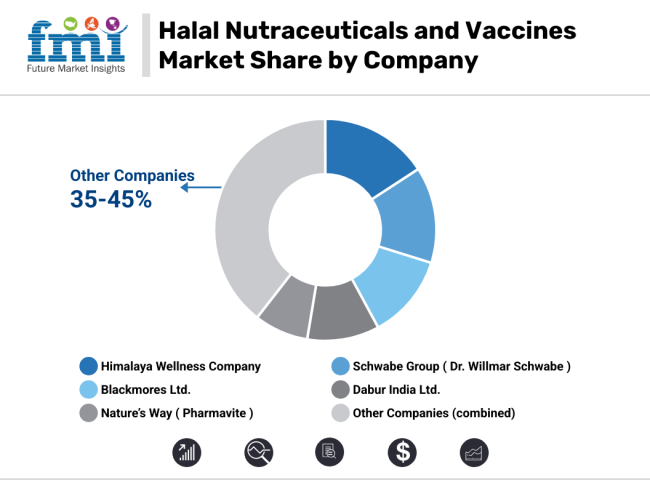
Market Share Analysis by Company
Key Company Offerings and Activities
| Company Name | Key Offerings/Activities |
|---|---|
| Himalaya Wellness Company | Offers a broad range of clinically studied herbal medicinal products for immunity, digestion, and wellness. |
| Schwabe Group | A pioneer in phytopharmaceuticals, known for homeopathy and plant-based medications standardized to European standards. |
| Blackmores Ltd. | Offers premium herbal and nutritional supplements, with a focus on mental health, immunity, and joint care. |
| Dabur India Ltd. | A leader in Ayurvedic formulations, Dabur offers a wide range of herbal medicines, including chyawanprash and syrups. |
| Nature’s Way | Manufactures herbal supplements with certified organic ingredients and a focus on immune and digestive health. |
Key Company Insights
Himalaya Wellness Company (14-18%)
A global leader in Ayurvedic herbal medicines, Himalaya emphasizes scientific validation and exports to over 90 countries.
Schwabe Group (12-16%)
A major player in Europe, Schwabe leads in evidence-based herbal remedies with GMP-certified manufacturing and clinical research.
Blackmores Ltd. (10-14%)
Known for high-quality natural health products, Blackmores maintains strong brand equity in the Asia-Pacific herbal markets.
Dabur India Ltd. (8-12%)
One of the oldest and most recognized herbal product companies globally, Dabur combines Ayurvedic heritage with modern production.
Nature’s Way (5-9%)
A significant USA-based herbal brand, Nature’s Way leverages sustainable sourcing and transparent labeling for consumer trust.
Other Key Players
Beyond the leading companies, several other manufacturers make significant contributions to the market, thereby enhancing product diversity and driving technological advancements. These include:
- Chemical Company of Malaysia Berhad
- Abbott Laboratories
- Nestlé
- Amway
- Herbalife International of America, Inc.
- AJ Biologics Sdn Bhd.
- Agropur, Inc. (Davisco Business Unit)
- PT Kalbe Farma Tbk
- Kotra Pharma (M) Sdn Bhd
- NoorVitamins
Key Segments
By Product Type:
Vaccines and Dietary Supplements
By Application:
Sports Nutrition, General Well-Being, Immune & Digestive Health, Bone & Joint Health, Heart Health, Disease Prevention, Weight loss
By Distribution Channel:
Hospital Pharmacies, Retail Pharmacies, Online Sales and Super Markets
By Region:
North America, Latin America, Western Europe, Eastern Europe, East Asia, South Asia & Pacific, Middle East & Africa
Frequently Asked Questions
What was the overall size of the Halal Nutraceuticals and Vaccines Market in 2025?
The overall market size for halal nutraceuticals and vaccines market was USD 76,996.7 million in 2025.
How big is the Halal Nutraceuticals and Vaccines Market expected in 2035?
The halal nutraceuticals and vaccines market is expected to reach USD 144,534.3 million in 2035.
What will drive the demand for Halal Nutraceuticals and Vaccines Market during the forecast period?
The rise of online retail and direct-to-consumer sales is making halal health products more accessible worldwide aiding in the market growth
List the top 5 Key players of the Halal Nutraceuticals and Vaccines Market?
The top key players that drives the development of halal nutraceuticals and vaccines market are Himalaya Wellness Company, Schwabe Group, Blackmores Ltd., Dabur India Ltd. And Nature’s Way.
Which segment in product is expected to lead in Halal Nutraceuticals and Vaccines Market?
Dietary supplements is expected to command significant share over the assessment period.
Preview the report firsthand - request a free sample
Get SampleGet the brochure for pricing and purchase details.
Get PDFTable of Content
- Executive Summary
- Industry Introduction, including Taxonomy and Market Definition
- Market Trends and Success Factors, including Macro-economic Factors, Market Dynamics, and Recent Industry Developments
- Global Market Demand Analysis 2020 to 2024 and Forecast 2025 to 2035, including Historical Analysis and Future Projections
- Global Market Analysis 2020 to 2024 and Forecast 2025 to 2035
- By Product
- By Application
- By Distribution Channel
- By Region
- Global Market Analysis 2020 to 2024 and Forecast 2025 to 2035, by Product
- Vaccines
- Dietary Supplements
- Global Market Analysis 2020 to 2024 and Forecast 2025 to 2035, by Application
- Sports Nutrition
- General Well-Being
- Immune & Digestive Health
- Bone & Joint Health
- Heart Health
- Disease Prevention
- Weight Loss
- Global Market Analysis 2020 to 2024 and Forecast 2025 to 2035, by Distribution Channel
- Hospital Pharmacies
- Retail Pharmacies
- Online Sales
- Super Markets
- Global Market Analysis 2020 to 2024 and Forecast 2025 to 2035, by Region
- North America
- Latin America
- East Asia
- South Asia and Pacific
- Western Europe
- Eastern Europe
- Middle East and Africa
- North America Sales Analysis 2020 to 2024 and Forecast 2025 to 2035, by Key Segments and Countries
- Latin America Sales Analysis 2020 to 2024 and Forecast 2025 to 2035, by Key Segments and Countries
- East Asia Sales Analysis 2020 to 2024 and Forecast 2025 to 2035, by Key Segments and Countries
- South Asia & Pacific Sales Analysis 2020 to 2024 and Forecast 2025 to 2035, by Key Segments and Countries
- Western Europe Sales Analysis 2020 to 2024 and Forecast 2025 to 2035, by Key Segments and Countries
- Eastern Europe Sales Analysis 2020 to 2024 and Forecast 2025 to 2035, by Key Segments and Countries
- Middle East and Africa Sales Analysis 2020 to 2024 and Forecast 2025 to 2035, by Key Segments and Countries
- Sales Forecast 2025 to 2035 by Product, Application, and Distribution Channel for 30 Countries
- Competition Outlook, including Market Structure Analysis, Company Share Analysis by Key Players, and Competition Dashboard
- Company Profile
- Himalaya Wellness Company
- Schwabe Group
- Blackmores Ltd.
- Dabur India Ltd.
- Nature’s Way
- Chemical Company of Malaysia Berhad
- Abbott Laboratories
- Nestlé
- Amway
- Herbalife International of America, Inc.
- AJ Biologics Sdn Bhd.
- Agropur, Inc. (Davisco Business Unit)
- PT Kalbe Farma Tbk
- Kotra Pharma (M) Sdn Bhd
- NoorVitamins


