

- Market Size (2026)
- USD 142.2 Mn
- Forecast (2036)
- USD 342.8 Mn
- CAGR (2026 to 2036)
- 9.2%
How big is Hepatic Sarcopenia Nutrition Market in 2026?
Demand for hepatic sarcopenia nutrition is projected to rise at 9.2% CAGR by 2036. Valuation of the sector increases from USD 130.2 million in 2025 to USD 142.2 million in 2026 and is predicted to reach USD 342.8 million by 2036.
Poor appetite and early satiety has increased the need for nutrition that supplies protein without a large meal. High-protein oral nutrition and late-evening formulas are used when food intake remains inadequate, while BCAA-enriched sources provide liver-relevant amino acids in smaller servings. The May 2025 American College of Gastroenterology guideline recommends adequate protein, late-evening carbohydrate intake, and plant-based or BCAA-enriched protein sources.[1] Owing to this, FMI estimates the market to rise from USD 130.2 million in 2025 to USD 142.2 million in 2026 and reach USD 342.8 million by 2036 at 9.2% CAGR during 2026 to 2036. Continued use after discharge is expected to upkeep product demand.
Muscle-health screening and liver-care follow-up are developing differently across countries, which in turn affects product adoption. Japan is anticipated to expand at 9.7% CAGR during 2026 to 2036, whereas South Korea is forecast at 9.4%. Japan has added muscle-health assessment for adults aged 50 to 64 through AWGS 2025 criteria, creating scope for earlier identification and planned amino-acid nutrition. In South Korea, a 2026 study of 243 cirrhosis patients found 35.8% at high nutritional risk and 14.4% at moderate risk.[2] FMI expects smaller and tolerable servings supplied through specialized nutrition channels to create growth avenues, although availability and follow-up will influence repeated home use.
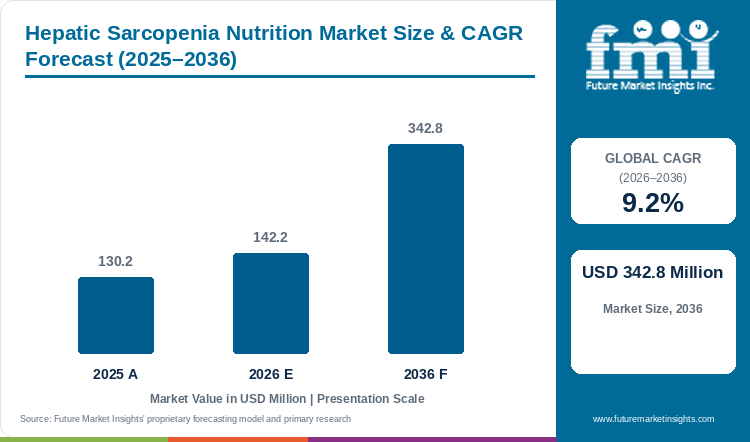
Hepatic Sarcopenia Nutrition Market Size & CAGR Forecast (2025-2036)
| Year | Basis | Market value (USD million) |
|---|---|---|
| 2025 | Actual | 130.2 |
| 2026 | Estimate | 142.2 |
| 2036 | Forecast | 342.8 |
| CAGR, 2026 to 2036 | 9.2% | |
Source: Future Market Insights proprietary forecasting model and primary research.
Key Takeaways
- Increasing focus on adequate protein and shorter fasting intervals is supporting recurring use of oral nutrition in cirrhosis care.
- Based on formulation, BCAA-enriched high-protein ONS is projected to account for 41.5% in 2026, owing to the requirement for protein-dense liver-relevant nutrition.
- By liver disease stage, compensated cirrhosis is estimated to hold 55.3% in 2026, as nutrition support can begin before repeated decompensation affects daily intake.
- In 2026, RTD is expected to lead product form with 38.2% share, due to measured servings and no mixing requirement.
- Japan is projected to grow at 9.7% CAGR and South Korea at 9.4% through 2036, supported by structured muscle-health and nutrition assessment.
- Notable companies include Otsuka Pharmaceutical, Abbott, Nestle Health Science, Danone Nutricia, Ajinomoto, Meiji Holdings, Fresenius Kabi, and Medtrition.
Analyst Perspective
“In my experience, demand is moving towards smaller nutrition servings that patients can complete without disturbing the normal meal routine. Liver-relevant evidence and simple home instructions will decide which products continue regularly after hospital discharge.”
- Nandini Roy Choudhury, Principal Consultant, Future Market Insights.
How is the hepatic sarcopenia nutrition market segmented?
Hepatic sarcopenia nutrition market is segmented by formulation, liver disease stage, product form, end user, sales channel and region. In 2026, BCAA-enriched high-protein ONS is projected to hold 41.5%, compensated cirrhosis 55.3%, RTD 38.2%, homecare 42.9% and hospital pharmacy 47.1%.
Hepatic sarcopenia nutrition market is segmented by formulation, liver disease stage, product form, end user, sales channel and region.
By formulation: BCAA-enriched high-protein ONS, late-evening snack formulas, leucine or HMB blends, and others.
By liver disease stage: compensated cirrhosis, decompensated cirrhosis, and pre- or post-transplant.
By product form: RTD, powders, puddings and semi-solids, and others.
By end user: homecare, hospitals and liver centers, long-term care, and others.
By sales channel: hospital pharmacy, retail pharmacy, online, institutional tender, and others.
By region: North America, Latin America, Western Europe, Eastern Europe, East Asia, South Asia and Pacific, and Middle East and Africa.
What supports BCAA-enriched ONS as a preferred formulation choice?
Based on formulation, BCAA-enriched high-protein ONS is projected to account for 41.5% in 2026, owing to increasing requirement for protein-dense liver-relevant nutrition.
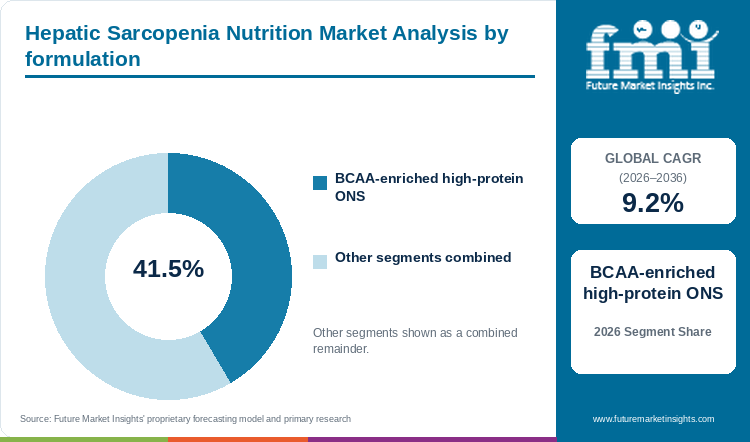
| Formulation | Share (2026) |
|---|---|
| BCAA-enriched high-protein ONS | 41.5% |
| Other segments combined | 58.5%* |
| Total | 100.0% |
| Metric | Value |
|---|---|
| Global CAGR (2026-2036) | 9.2% |
| Leading segment | BCAA-enriched high-protein ONS |
BCAA-enriched high-protein ONS provides concentrated protein where normal food intake remains inadequate. The 2025 ACG guideline includes BCAA-enriched sources and advises against unnecessary protein restriction. Owing to this, these formulations are increasingly integrated into clinical nutrition protocols for supplying liver-relevant amino acids without increasing the daily serving burden.
- BCAA-enriched high-protein ONS is projected to hold 41.5% of formulation demand in 2026, supported by protein density and liver-relevant amino acids.
- Smaller serving volume makes these products suitable for between-meal and late-evening intake where a larger serving may remain unfinished.
Why does compensated cirrhosis account for notable stage demand?
By liver disease stage, compensated cirrhosis is estimated to hold 55.3% in 2026, as nutrition support can begin before repeated decompensation affects daily intake.
Compensated cirrhosis gives a wider period for identifying muscle loss before repeated hospitalization affects food intake. A 2026 clinical review described malnutrition and sarcopenia as prevalent conditions associated with poor outcomes in cirrhosis [3]. Stable patients can continue oral nutrition alongside targeted liver health supplements at home, which is expected to support the use of nutrition products before recurrent decompensation.
- Compensated cirrhosis is estimated to hold 55.3% of stage demand in 2026, as stable outpatients can follow a regular protein and meal-timing routine.
- Earlier intervention provides more time for adjusting protein quantity, meal timing and serving volume according to patient intake.
How does RTD meet recurring product-form requirements today?
In 2026, RTD is expected to lead product form with 38.2% share, driven by measured serving quantity and preparation-free consumption.
RTD products remove preparation and mixing from between-meal and bedtime nutrition. Fresenius Kabi provides 18 g protein in a 125 ml Fresubin PRO COMPACT serving [4]. This measured quantity can be carried outside the home and consumed without additional preparation. Due to these advantages, compact cirrhosis-specific oral nutrition formats are gaining higher preference among patients unable to finish larger bottles.
- RTD is expected to account for 38.2% of product-form demand in 2026, owing to premeasured servings and no mixing requirement.
- Pre-portioned packaging and stable shelf life determine whether patients maintain the prescribed feeding schedule at home.
Which conditions keep homecare relevant among end users?
Homecare is likely to capture 42.9% share in 2026, supported by long-duration nutrition use between hospital and specialist visits.
Homecare becomes important after the liver team selects a suitable product and the patient leaves the hospital. Frimley Health NHS guidance, reviewed in April 2026, advises regular protein intake, frequent eating and a bedtime snack [5]. Prescribed medical food options that can be stored and consumed without difficult preparation are expected to witness repeated use between specialist visits.
- Homecare is likely to hold 42.9% of end-user demand in 2026, as supplementation generally continues for a longer period after hospital assessment.
- Clear serving instructions and availability through community channels are supporting the continuation of nutrition routines at home.
What drives hospital pharmacy use in the sales channel?
Hospital pharmacy is set to lead sales channel with 47.1% share in 2026, reinforced by specialist selection and initial product supply at discharge.
Hospital pharmacy connects specialist assessment with the first supply of therapeutic nutrition. Abbott lists Ensure Plus High Protein for oral use and institutional ordering [6]. This enables patients to receive structured therapeutic food delivery from the same care setting where nutrition requirement is evaluated, while retail and online channels remain useful for replenishment.
- Hospital pharmacy is projected to hold 47.1% of sales in 2026, as clinical selection and initial product supply generally take place together.
- Initial supply through hospital pharmacy reduces the gap between dietitian recommendation and actual product use.
What are the drivers, restraints, and opportunities in the hepatic sarcopenia nutrition market?
In the hepatic sarcopenia nutrition market, guideline-led protein care supports demand, intake tolerance constrains routine qualification, and compact adherence-focused nutrition expands use across clinical pathways through 2036.
- Driver: Hepatology guidance converts sarcopenia screening into a repeatable protein and meal-timing plan.
- Restraint: Early satiety, taste fatigue, and complex routines can interrupt prescribed oral nutrition use.
- Opportunity: Compact products can deliver high protein and targeted amino acids in smaller servings for home use.
Guidelines Create Repeat Nutrition Use
Hepatology guidance is helping clinicians move from identified muscle loss towards a daily protein and meal-timing plan. A 2025 clinical meta-analysis in Frontiers in Nutrition highlighted that structured oral intake and late-evening supplementation significantly improve nitrogen balance and counter muscle loss [7]. Aligning oral regimens with enteral nutrition standards when oral intake remains insufficient ensures consistent patient nourishment. Products that fit appetite and the home routine are expected to witness recurring use, which in turn will support market growth during the forecast period.
Low Appetite Restricts Sustained Intake
A major factor restricting continued oral nutrition is poor appetite, as patients with early satiety may leave a large serving unfinished. A 2025 study of 195 cirrhosis patients found greater energy and protein deficits among inpatients than outpatients, while low muscle function remained common in hospitalized patients [8]. When voluntary oral intake drops sharply, clinicians may evaluate temporary parenteral nutrition support, though repeated sweet flavours and difficult intake schedules continue to challenge routine compliance.
Compact Formats Improve Regimen Fit
Smaller servings are creating new growth opportunities where normal meals cannot provide required protein quantity. In March 2025, Medtrition launched ProSource Cup products with 20 g protein in a low-volume cup for oral or tube-fed use [9]. Integrating high-density protein ingredients into compact servings supports transition from acute care to home use where a larger bottle may remain unfinished. Compact cups and concentrated liquids are expected to create new avenues in the market.
Which country CAGRs are profiled in the hepatic sarcopenia nutrition market?
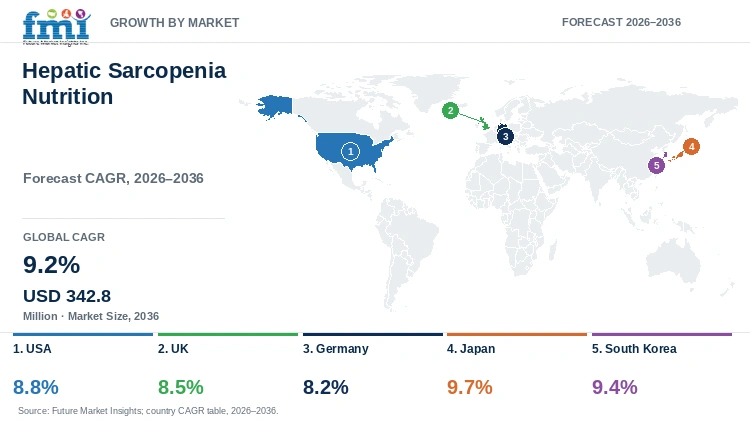
| Country | CAGR |
|---|---|
| USA | 8.8% |
| UK | 8.5% |
| Germany | 8.2% |
| Japan | 9.7% |
| South Korea | 9.4% |
How do country-level CAGRs compare in the hepatic sarcopenia nutrition market?
As per the analysis from FMI, country growth rates differ through 2036 because muscle-health screening frameworks, clinical access, and nutrition support systems vary across markets. Japan and South Korea lead projected growth above 9.0 per cent, while the USA and Western Europe follow established medical nutrition structures.
- USA demand is supported by specialist nutrition assessment and a broad hospital-to-home clinical nutrition channel.
- The UK connects liver-disease nutrition advice with NHS dietetic review and prescribed supplements where normal food intake remains inadequate.
- Germany relies on formal clinical nutrition guidance, specialist hepatology and documented product use within clinical care.
- Japan combines updated muscle-health assessment with established use of amino-acid nutrition in liver care.
- South Korea is strengthening nutrition assessment through hospital-based cirrhosis screening and specialist follow-up.
Full report country CAGRs cover: North America; Latin America; Western Europe; Eastern Europe; East Asia; South Asia and Pacific; Middle East and Africa.
Country-wise Analysis
- Chronic liver disease burden is keeping nutrition assessment important across specialist centers and hospitals in the USA. The CDC reported 52,274 chronic liver disease and cirrhosis deaths in 2024, equal to 15.4 deaths per 100,000 people, on a page reviewed in February 2026 [10]. Hepatic sarcopenia nutrition demand in the USA is forecast to rise at 8.8% CAGR through 2036, as more patients incorporate condition-specific dietary supplements and medical formulas to address inadequate intake. Coverage, serving volume and refill availability will influence continuation after discharge.
- Liver disease burden and NHS dietetic pathways are supporting earlier nutrition review in the UK. The Office for Health Improvement and Disparities stated in November 2025 that alcohol, obesity and hepatitis B or C account for up to 90% of liver disease cases [11]. The UK market is projected to expand at 8.5% CAGR through 2036, owing to regular protein guidance and community follow-up. Compact products available through prescribed and community channels are expected to support home use.
- Presence of specialist hepatology and formal clinical nutrition standards is supporting hepatic sarcopenia nutrition use in Germany. The German Liver Foundation states that at least 5 million people in Germany are estimated to have liver disease [12]. Sales are forecast to expand at 8.2% CAGR through 2036, owing to assessment before muscle loss becomes difficult to manage. Clear protein composition, tolerability information and medical-food documentation remain important for hospital procurement.
- Muscle-health assessment and liver-specific nutrition are gaining higher attention in Japan. The AWGS 2025 consensus added criteria for adults aged 50 to 64, including grip-strength thresholds below 34 kg for men and 20 kg for women [13]. FMI data suggests that adoption of hepatic sarcopenia nutrition in Japan is estimated to expand at 9.7% CAGR through 2036. Earlier screening and familiarity with amino-acid nutrition are expected to support country growth.
- South Korea is estimated to post 9.4% CAGR over the forecast period, backed by hospital-based cirrhosis screening and specialist follow-up. In April 2026, the Korean Association for the Study of the Liver (KASL) updated its clinical practice guidelines for liver cirrhosis, emphasizing early malnutrition identification and complication management [14]. Measured nutritional risk is increasingly connected with outpatient dietetic reviews. Protein density, serving size, taste and caregiver instructions will influence regular outpatient use.
Who are the notable companies in the hepatic sarcopenia nutrition market?
Otsuka Pharmaceutical, Abbott, Nestle Health Science, Danone Nutricia, Ajinomoto, Meiji Holdings, Fresenius Kabi, and Medtrition are notable companies profiled in this market.
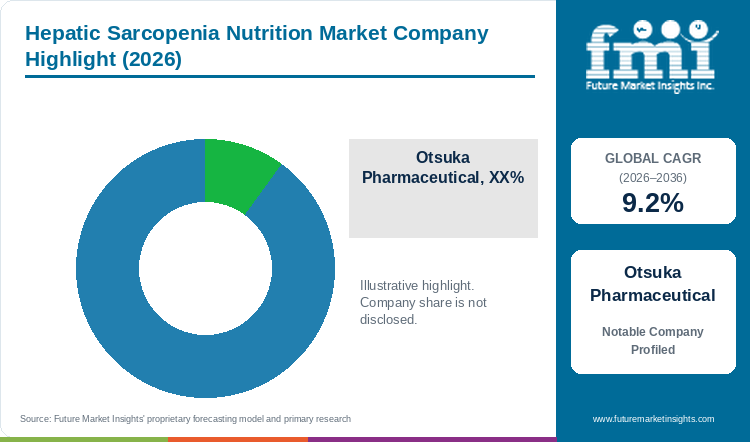
In the FMI report, competitive position is connected with liver relevance, protein quantity, serving volume and availability after discharge. Otsuka Pharmaceutical and Ajinomoto focus on liver or amino-acid nutrition, whereas Abbott, Nestle Health Science and Danone Nutricia have wider medical nutrition portfolios. Fresenius Kabi, Meiji Holdings and Medtrition offer concentrated liquids and modular protein formats. Product development around smaller servings and flavour choice is expected to support the customer base across specialist and homecare use.
- Liver-specific amino-acid nutrition: Otsuka Pharmaceutical and Ajinomoto are active where BCAA or amino-acid relevance influences product selection.
- Broad medical nutrition platforms: Abbott, Nestle Health Science and Danone Nutricia offer wider clinical nutrition portfolios and hospital access.
- Compact and modular delivery: Meiji Holdings, Fresenius Kabi and Medtrition provide concentrated liquids or modular protein formats.
Competitive Benchmarking: Hepatic Sarcopenia Nutrition Market
| Company | Liver-specific position | Format breadth | Hospital-to-home fit | Reach |
|---|---|---|---|---|
| Otsuka Pharmaceutical | High | Medium | High | Medium |
| Abbott | Low | High | High | High |
| Nestle Health Science | Low | High | High | High |
| Danone Nutricia | Low | High | High | High |
| Ajinomoto | Medium | Low | Medium | High |
| Meiji Holdings | Low | Medium | Medium | Medium |
| Fresenius Kabi | Low | High | High | High |
| Medtrition | Low | Medium | High | Medium |
High indicates broad documented capability, Medium indicates credible but narrower capability, and Low indicates limited documented breadth for the stated aspect. Ratings describe public evidence and do not indicate product quality, revenue share, or company ranking.
Key Developments in the Hepatic Sarcopenia Nutrition Market
- In 2026, Abbott maintained institutional ordering information for Ensure Plus High Protein, supporting initial product access through hospitals before retail or online replenishment [15].
- In January 2026, the Japan Association of Rehabilitation Nutrition highlighted the publication of the 2025 nutritional management guideline for sarcopenia and frailty, strengthening the evidence environment for structured nutrition care [16].
- In October 2025, Danone Nutricia launched Fortimel PlantBased Protein with savory options for disease-related malnutrition to reduce flavor fatigue during repeated oral nutrition [17].
- In March 2025, Medtrition launched the ProSource Cup portfolio with 20 g protein in a low-volume cup for oral or tube-fed use, supporting patients unable to finish larger servings [9].
Key Players in the Hepatic Sarcopenia Nutrition Market
Liver-specific amino-acid nutrition
- Otsuka Pharmaceutical
- Ajinomoto
Broad medical nutrition platforms
- Abbott
- Nestle Health Science
- Danone Nutricia
Compact and modular clinical nutrition
- Meiji Holdings
- Fresenius Kabi
- Medtrition
Hepatic Sarcopenia Nutrition Market - Report Scope
| Coverage field | Report scope |
|---|---|
| Market breakdown | Formulation; liver disease stage; product form; end user; sales channel; region. |
| Quantitative units | USD million. |
| Market definition | Supplier revenue from packaged oral or enteral medical nutrition used for liver-disease-associated sarcopenia. Parenteral nutrition, routine foods, and non-nutrition liver therapies are excluded. |
| Regions covered | North America; Latin America; Western Europe; Eastern Europe; East Asia; South Asia and Pacific; Middle East and Africa. |
| Countries covered | USA; UK; Germany; Japan; South Korea; and additional countries in the full report. |
| Key companies profiled | Otsuka Pharmaceutical, Abbott, Nestle Health Science, Danone Nutricia, Ajinomoto, Meiji Holdings, Fresenius Kabi, Medtrition. |
| Forecast period | 2026 to 2036. |
| Approach | As noted by FMI, the report covers supplier activity, segment structure, clinical use conditions, and country adoption within the stated boundary. |
Hepatic Sarcopenia Nutrition Market - Research Methodology
| Method | Approach |
|---|---|
| Primary Research | Analysts gathered input from manufacturers, service providers, technology developers, distributors, end users, procurement teams, and subject-matter experts. Interviews examined purchasing decisions, product or service evaluation, adoption barriers, approval requirements, pricing considerations, and expectations for technical or commercial support. Respondents were also asked what evidence is required before a trial, pilot, or initial order develops into regular purchasing. |
| Desk Research | Desk research covered government statistics, regulatory publications, trade data, industry associations, technical literature, standards, company filings, product information, and official corporate announcements. Sources were reviewed for relevance, publication date, geographic coverage, and consistency with the defined market scope. Claims relating to performance, applications, approvals, capacity, investment, and commercial activity were retained only when supported by credible public evidence. |
| Market Sizing and Forecasting | The market model combined the baseline value with historical performance, segment structure, pricing and volume indicators, adoption levels, company participation, and country-level demand conditions. Forecast assumptions considered economic activity, investment trends, regulatory developments, technology adoption, purchasing cycles, supply availability, and barriers to wider market use. Segment and regional estimates were reconciled before the final market total was calculated. |
| Data Validation | Estimates were checked against multiple independent indicators, including public data, company activity, trade patterns, industry developments, and findings from primary interviews. Validation also tested whether products, services, applications, and company revenues fell within the defined market boundaries. Adjacent categories, unsupported claims, overlapping revenues, and activities without direct market relevance were excluded to reduce double counting and maintain consistency across segments and countries. |
Segment shares and forecast estimates are proprietary analytical estimates. They are not government statistics or direct measurements of global market share.
Hepatic Sarcopenia Nutrition Market by Segments
Hepatic sarcopenia nutrition market segmented by formulation:
- BCAA-enriched high-protein ONS
- Late-evening snack formulas
- Leucine or HMB blends
- Others
Hepatic sarcopenia nutrition market segmented by liver disease stage:
- Compensated cirrhosis
- Decompensated cirrhosis
- Pre- or post-transplant
Hepatic sarcopenia nutrition market segmented by product form:
- RTD
- Powders
- Puddings and semi-solids
- Others
Hepatic sarcopenia nutrition market segmented by end user:
- Homecare
- Hospitals and liver centers
- Long-term care
- Others
Hepatic sarcopenia nutrition market segmented by sales channel:
- Hospital pharmacy
- Retail pharmacy
- Online
- Institutional tender
- Others
Hepatic Sarcopenia Nutrition Market by Region
- North America
- United States
- Canada
- Latin America
- Brazil
- Mexico
- Argentina
- Chile
- Western Europe
- Germany
- France
- United Kingdom
- Italy
- Spain
- Benelux
- Nordics
- Eastern Europe
- Poland
- Czech Republic
- Romania
- Hungary
- East Asia
- Japan
- South Korea
- South Asia and Pacific
- ASEAN
- Australia and New Zealand
- Middle East and Africa
- GCC Countries
- South Africa
- Türkiye
- Israel
Research Sources and Bibliography
- [1] American College of Gastroenterology. (2025, May 20). Fueling the failing liver: ACG clinical guideline on malnutrition and nutritional recommendations in liver disease.
- [2] Park, H. J., Jung, J. K., Noh, J., Kim, Y., Lee, S. U., Yun, B. C., Lee, J. W., Kim, H. J., & Seo, K. I. (2026). Nutritional risk assessed by Royal Free Hospital-Nutritional Prioritizing Tool predicts survival in cirrhosis with or without hepatocellular carcinoma. Journal of Korean Medical Science, 41(17), e134.
- [3] Miwa, T., Shimizu, M., & Schnabl, B. (2026). Burden of malnutrition and sarcopenia in patients with cirrhosis. Clinical and Molecular Hepatology, 32(2), 487-510.
- [4] Fresenius Kabi. (2025). Fresubin PRO COMPACT Drink: Product specification and clinical profile.
- [5] Frimley Health NHS Foundation Trust. (2025, May 1; reviewed 2026, April 20). Liver disease and diet: Practical guidance for patients.
- [6] Abbott Nutrition. (2026). Ensure Plus High Protein Therapeutic Nutrition Shake: Product guide.
- [7] Wang, X., Liu, Y., Zhang, H., & Chen, J. (2025). Efficacy of different nutrition interventions on sarcopenia in patients with liver cirrhosis: A systematic review and network meta-analysis. Frontiers in Nutrition, 12, 1493202.
- [8] Khan, S., Ahmed, R., Patel, M., & Davies, L. (2025). A comparative study of dietary intake, nutritional status, and frailty in patients with liver cirrhosis. Nutrients, 17(3), 580.
- [9] Medtrition. (2025, March 25). ProSource Cup launch and clinical administration overview.
- [10] Centers for Disease Control and Prevention. (2026, February 20). FastStats: Chronic liver disease or cirrhosis.
- [11] Office for Health Improvement and Disparities. (2025, November 4). Liver disease profile: November 2025 update.
- [12] Deutsche Leberstiftung. (2026). Liver disease information and national health burden report.
- [13] Japan Society for the Study of Obesity. (2025, November 4). Diagnostic criteria for sarcopenia and clinical consensus (AWGS 2025).
- [14] Korean Association for the Study of the Liver. (2026, April). KASL clinical practice guidelines for liver cirrhosis: Ascites and related complications.
- [15] Abbott Nutrition. (2026). Ensure Plus High Protein Therapeutic Nutrition Shake: Institutional ordering and healthcare logistics.
- [16] Japan Association of Rehabilitation Nutrition. (2026, January 29). Guidelines for nutritional management of sarcopenia and frailty 2025.
- [17] Nutricia. (2025, October 1). Nutricia’s savory plant-based medical nutrition range for oncology and chronic illness adherence.
This bibliography is provided for reader reference. The full report contains the complete reference list and detailed citations.
This Report Answers
- What is Hepatic Sarcopenia Nutrition Market worth during 2026?
- What value is Hepatic Sarcopenia Nutrition Market projected by 2036?
- Which formulation holds notable Hepatic Sarcopenia Nutrition Market share?
- Which disease stage holds notable Hepatic Sarcopenia Nutrition Market share?
- Which countries have notable Hepatic Sarcopenia Nutrition Market growth?
- Which companies are notable in Hepatic Sarcopenia Nutrition Market today?
Frequently Asked Questions
How large is the Hepatic Sarcopenia Nutrition Market expected to be in 2026?
Future Market Insights estimates that the hepatic sarcopenia nutrition market will reach USD 142.2 million in 2026. The market is projected to expand further and reach USD 342.8 million by 2036.
What CAGR is forecast for the Hepatic Sarcopenia Nutrition Market through 2036?
As per FMI, the hepatic sarcopenia nutrition market is projected to grow at a 9.2% CAGR from 2026 to 2036. Growth is supported by increasing identification of muscle loss and continued supplementation after discharge.
Which formulation holds a notable hepatic sarcopenia nutrition demand share in 2026?
Future Market Insights projects BCAA-enriched high-protein ONS to hold 41.5% of formulation demand in 2026. The segment benefits from higher protein density and liver-relevant amino acids.
Which disease stage holds a notable hepatic sarcopenia nutrition share in 2026?
FMI finds that compensated cirrhosis will hold 55.3% of stage demand in 2026. Demand is supported by a wider window for outpatient nutrition before repeated decompensation.
Which country has a notable hepatic sarcopenia nutrition expansion outlook during the forecast period?
Future Market Insights predicts Japan to expand at a 9.7% CAGR during the 2026 to 2036 assessment period. Growth is supported by updated muscle-health criteria and established use of amino-acid nutrition.
Which companies are active in the Hepatic Sarcopenia Nutrition Market during 2026?
As per FMI analysis, notable companies include Otsuka Pharmaceutical, Abbott, Nestle Health Science, Danone Nutricia, Ajinomoto, Meiji Holdings, Fresenius Kabi, and Medtrition. These companies are focusing on liver relevance, protein density, smaller formats, and hospital-to-home availability.
Preview the report firsthand - request a free sample
Get SampleGet the brochure for pricing and purchase details.
Get PDFTable of Content
- Key Takeaways
- Market Size and CAGR
- Top Growth Driver
- Fastest Growing Segment
- Leading Region
- Key Companies
- Emerging Opportunities
- Executive Summary
- Global Market Outlook
- Demand-side Trends
- Supply-side Trends
- Technology Roadmap Analysis
- Analysis and Recommendations
- Analyst Perspective (What is happening? Why now? What should investors know?)
- Key Questions Answered
- How large is the market?
- What is the CAGR?
- What are key trends?
- Which region dominates?
- Who are the leaders?
- Market Overview
- Market Coverage / Taxonomy
- Market Definition / Scope / Limitations
- Research Methodology
- Chapter Orientation
- Analytical Lens and Working Hypotheses
- Market Structure, Signals, and Trend Drivers
- Benchmarking and Cross-market Comparability
- Market Sizing, Forecasting, and Opportunity Mapping
- Research Design and Evidence Framework
- Desk Research Programme (Secondary Evidence)
- Expert Input and Fieldwork (Primary Evidence)
- Tooling, Models, and Reference Databases
- Data Engineering and Model Build
- Quality Assurance and Audit Trail
- Market Background
- Market Dynamics (Drivers, Restraints, Opportunity, Trends)
- Scenario Forecast (Optimistic, Likely, Conservative)
- Impact Analysis
- AI Impact
- Sustainability Impact
- Regulatory Impact
- Technology Impact
- Consumer / Buyer Analysis
- Purchase Drivers
- Adoption Barriers
- Buyer Journey
- Opportunity Map Analysis
- Product Life Cycle Analysis
- Supply Chain Analysis
- Investment Feasibility Matrix
- Value Chain Analysis
- PESTLE and Porter's Analysis
- Regulatory Landscape
- Regional Parent Market Outlook
- Production and Consumption Statistics
- Import and Export Statistics
- Global Market Analysis and Forecast, 2021 to 2036
- Historical Market Size Value (USD Million) Analysis, 2021 to 2025
- Current and Future Market Size Value (USD Million) Projections, 2026 to 2036
- Y-o-Y Growth Trend Analysis
- Absolute $ Opportunity Analysis
- Global Market Pricing Analysis, 2021 to 2036
- Global Market Analysis and Forecast, By formulation, 2021 to 2036
- Introduction / Key Findings
- Historical Market Size Value (USD Million) Analysis By formulation, 2021 to 2025
- Current and Future Market Size Value (USD Million) Analysis and Forecast By formulation, 2026 to 2036
- BCAA-enriched high-protein ONS
- Late-evening snack formulas
- Leucine or HMB blends
- Others
- Y-o-Y Growth Trend Analysis By formulation, 2021 to 2025
- Absolute $ Opportunity Analysis By formulation, 2026 to 2036
- Global Market Analysis and Forecast, By liver disease stage, 2021 to 2036
- Introduction / Key Findings
- Historical Market Size Value (USD Million) Analysis By liver disease stage, 2021 to 2025
- Current and Future Market Size Value (USD Million) Analysis and Forecast By liver disease stage, 2026 to 2036
- Compensated cirrhosis
- Decompensated cirrhosis
- Pre- or post-transplant
- Y-o-Y Growth Trend Analysis By liver disease stage, 2021 to 2025
- Absolute $ Opportunity Analysis By liver disease stage, 2026 to 2036
- Global Market Analysis and Forecast, By product form, 2021 to 2036
- Introduction / Key Findings
- Historical Market Size Value (USD Million) Analysis By product form, 2021 to 2025
- Current and Future Market Size Value (USD Million) Analysis and Forecast By product form, 2026 to 2036
- RTD
- Powders
- Puddings and semi-solids
- Others
- Y-o-Y Growth Trend Analysis By product form, 2021 to 2025
- Absolute $ Opportunity Analysis By product form, 2026 to 2036
- Global Market Analysis and Forecast, By end user, 2021 to 2036
- Introduction / Key Findings
- Historical Market Size Value (USD Million) Analysis By end user, 2021 to 2025
- Current and Future Market Size Value (USD Million) Analysis and Forecast By end user, 2026 to 2036
- Homecare
- Hospitals and liver centers
- Long-term care
- Others
- Y-o-Y Growth Trend Analysis By end user, 2021 to 2025
- Absolute $ Opportunity Analysis By end user, 2026 to 2036
- Global Market Analysis and Forecast, By sales channel, 2021 to 2036
- Introduction / Key Findings
- Historical Market Size Value (USD Million) Analysis By sales channel, 2021 to 2025
- Current and Future Market Size Value (USD Million) Analysis and Forecast By sales channel, 2026 to 2036
- Hospital pharmacy
- Retail pharmacy
- Online
- Institutional tender
- Others
- Y-o-Y Growth Trend Analysis By sales channel, 2021 to 2025
- Absolute $ Opportunity Analysis By sales channel, 2026 to 2036
- Global Market Analysis and Forecast, By Region, 2021 to 2036
- Introduction
- Historical Market Size Value (USD Million) Analysis By Region, 2021 to 2025
- Current Market Size Value (USD Million) Analysis and Forecast By Region, 2026 to 2036
- North America
- Latin America
- Western Europe
- Eastern Europe
- East Asia
- South Asia and Pacific
- Middle East and Africa
- Market Attractiveness Analysis By Region
- North America Market Analysis and Forecast, By Country, 2021 to 2036
- Historical Market Size Value (USD Million) Trend Analysis By Market Taxonomy, 2021 to 2025
- Market Size Value (USD Million) Forecast By Market Taxonomy, 2026 to 2036
- By Country
- United States
- Canada
- By formulation
- By liver disease stage
- By product form
- By end user
- By sales channel
- By Country
- Market Attractiveness Analysis
- By Country
- By formulation
- By liver disease stage
- By product form
- By end user
- By sales channel
- Key Takeaways
- Latin America Market Analysis and Forecast, By Country
- Historical Market Size Value (USD Million) Trend Analysis By Market Taxonomy, 2021 to 2025
- Market Size Value (USD Million) Forecast By Market Taxonomy, 2026 to 2036
- By Country
- Brazil
- Mexico
- Argentina
- Chile
- By formulation
- By liver disease stage
- By product form
- By end user
- By sales channel
- By Country
- Market Attractiveness Analysis
- By Country
- By formulation
- By liver disease stage
- By product form
- By end user
- By sales channel
- Key Takeaways
- Western Europe Market Analysis and Forecast, By Country
- Historical Market Size Value (USD Million) Trend Analysis By Market Taxonomy, 2021 to 2025
- Market Size Value (USD Million) Forecast By Market Taxonomy, 2026 to 2036
- By Country
- Germany
- France
- United Kingdom
- Italy
- Spain
- Benelux
- Nordics
- By formulation
- By liver disease stage
- By product form
- By end user
- By sales channel
- By Country
- Market Attractiveness Analysis
- By Country
- By formulation
- By liver disease stage
- By product form
- By end user
- By sales channel
- Key Takeaways
- Eastern Europe Market Analysis and Forecast, By Country
- Historical Market Size Value (USD Million) Trend Analysis By Market Taxonomy, 2021 to 2025
- Market Size Value (USD Million) Forecast By Market Taxonomy, 2026 to 2036
- By Country
- Poland
- Czech Republic
- Romania
- Hungary
- By formulation
- By liver disease stage
- By product form
- By end user
- By sales channel
- By Country
- Market Attractiveness Analysis
- By Country
- By formulation
- By liver disease stage
- By product form
- By end user
- By sales channel
- Key Takeaways
- East Asia Market Analysis and Forecast, By Country
- Historical Market Size Value (USD Million) Trend Analysis By Market Taxonomy, 2021 to 2025
- Market Size Value (USD Million) Forecast By Market Taxonomy, 2026 to 2036
- By Country
- Japan
- South Korea
- By formulation
- By liver disease stage
- By product form
- By end user
- By sales channel
- By Country
- Market Attractiveness Analysis
- By Country
- By formulation
- By liver disease stage
- By product form
- By end user
- By sales channel
- Key Takeaways
- South Asia and Pacific Market Analysis and Forecast, By Country
- Historical Market Size Value (USD Million) Trend Analysis By Market Taxonomy, 2021 to 2025
- Market Size Value (USD Million) Forecast By Market Taxonomy, 2026 to 2036
- By Country
- ASEAN
- Australia and New Zealand
- By formulation
- By liver disease stage
- By product form
- By end user
- By sales channel
- By Country
- Market Attractiveness Analysis
- By Country
- By formulation
- By liver disease stage
- By product form
- By end user
- By sales channel
- Key Takeaways
- Middle East and Africa Market Analysis and Forecast, By Country
- Historical Market Size Value (USD Million) Trend Analysis By Market Taxonomy, 2021 to 2025
- Market Size Value (USD Million) Forecast By Market Taxonomy, 2026 to 2036
- By Country
- GCC Countries
- South Africa
- Türkiye
- Israel
- By formulation
- By liver disease stage
- By product form
- By end user
- By sales channel
- By Country
- Market Attractiveness Analysis
- By Country
- By formulation
- By liver disease stage
- By product form
- By end user
- By sales channel
- Key Takeaways
- Key Countries Market Analysis
- United States
- Pricing Analysis
- Market Share Analysis, 2025
- By formulation
- By liver disease stage
- By product form
- By end user
- By sales channel
- Canada
- Pricing Analysis
- Market Share Analysis, 2025
- By formulation
- By liver disease stage
- By product form
- By end user
- By sales channel
- Mexico
- Pricing Analysis
- Market Share Analysis, 2025
- By formulation
- By liver disease stage
- By product form
- By end user
- By sales channel
- Brazil
- Pricing Analysis
- Market Share Analysis, 2025
- By formulation
- By liver disease stage
- By product form
- By end user
- By sales channel
- Chile
- Pricing Analysis
- Market Share Analysis, 2025
- By formulation
- By liver disease stage
- By product form
- By end user
- By sales channel
- Germany
- Pricing Analysis
- Market Share Analysis, 2025
- By formulation
- By liver disease stage
- By product form
- By end user
- By sales channel
- United Kingdom
- Pricing Analysis
- Market Share Analysis, 2025
- By formulation
- By liver disease stage
- By product form
- By end user
- By sales channel
- Italy
- Pricing Analysis
- Market Share Analysis, 2025
- By formulation
- By liver disease stage
- By product form
- By end user
- By sales channel
- Spain
- Pricing Analysis
- Market Share Analysis, 2025
- By formulation
- By liver disease stage
- By product form
- By end user
- By sales channel
- France
- Pricing Analysis
- Market Share Analysis, 2025
- By formulation
- By liver disease stage
- By product form
- By end user
- By sales channel
- ASEAN
- Pricing Analysis
- Market Share Analysis, 2025
- By formulation
- By liver disease stage
- By product form
- By end user
- By sales channel
- Australia and New Zealand
- Pricing Analysis
- Market Share Analysis, 2025
- By formulation
- By liver disease stage
- By product form
- By end user
- By sales channel
- Japan
- Pricing Analysis
- Market Share Analysis, 2025
- By formulation
- By liver disease stage
- By product form
- By end user
- By sales channel
- South Korea
- Pricing Analysis
- Market Share Analysis, 2025
- By formulation
- By liver disease stage
- By product form
- By end user
- By sales channel
- Poland
- Pricing Analysis
- Market Share Analysis, 2025
- By formulation
- By liver disease stage
- By product form
- By end user
- By sales channel
- Hungary
- Pricing Analysis
- Market Share Analysis, 2025
- By formulation
- By liver disease stage
- By product form
- By end user
- By sales channel
- Türkiye
- Pricing Analysis
- Market Share Analysis, 2025
- By formulation
- By liver disease stage
- By product form
- By end user
- By sales channel
- South Africa
- Pricing Analysis
- Market Share Analysis, 2025
- By formulation
- By liver disease stage
- By product form
- By end user
- By sales channel
- United States
- Market Structure Analysis
- Competition Dashboard
- Competition Benchmarking
- Market Share Analysis of Top Players
- By Regional
- By formulation
- By liver disease stage
- By product form
- By end user
- By sales channel
- Emerging Startups
- Innovation Benchmarking
- Competition Analysis
- Competition Deep Dive
- Otsuka Pharmaceutical
- Overview
- Product Portfolio
- Profitability by Market Segments
- Sales Footprint
- Strategy Overview
- Marketing Strategy
- Product Strategy
- Channel Strategy
- Abbott
- Nestle Health Science
- Danone Nutricia
- Ajinomoto
- Meiji Holdings
- Fresenius Kabi
- Medtrition
- Otsuka Pharmaceutical
- Case Studies
- Success Stories
- Recent Developments
- Competition Deep Dive
- Assumptions & Acronyms Used


