

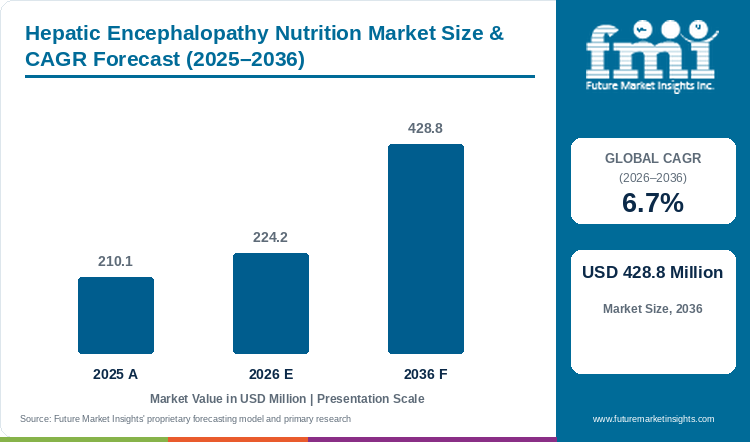
- Market Size (2026)
- USD 224.2 Mn
- Forecast (2036)
- USD 428.8 Mn
- CAGR (2026 to 2036)
- 6.7%
How big is Hepatic Encephalopathy Nutrition Market in 2026?
Sales in the Hepatic Encephalopathy Nutrition Market are projected to grow at 6.7% CAGR through 2036. Market size rises from USD 210.1 million in 2025 to USD 224.2 million in 2026 and is expected to reach USD 428.8 million by 2036.
Sales of hepatic encephalopathy nutrition are estimated to rise at 6.7% CAGR through 2036. Market valuation increases from USD 210.1 million in 2025 to USD 224.2 million in 2026 and is estimated to reach USD 428.8 million by 2036. Hepatic encephalopathy nutrition is used for providing protein, energy and amino acids when patients with cirrhosis are not able to consume sufficient ordinary food. In May 2025, the American College of Gastroenterology recommended adequate protein, plant-based or BCAA-enriched sources and enteral nutrition where oral intake remains insufficient[4]. This is increasing the adoption of clinical nutrition in cirrhosis treatment. Future Market Insights notes that demand is increasing for products which can be easily prepared and continued at home. Poor tolerance and unsuitable feeding route, however, can affect regular use of hepatic encephalopathy nutrition.
South Korea hepatic encephalopathy nutrition market is expected to expand at 7.1% CAGR during 2026 to 2036, while the USA market is projected to rise at 6.2% CAGR. In September 2026, Statistics Korea reported 362,968 deaths in 2025 and included liver disease among the ten leading causes[11]. Increasing liver disease burden is keeping nutrition assessment important in specialist hospitals. The reported deaths, however, are not a measure of nutrition product sales. The USA has wider availability of oral clinical nutrition through hospitals and outpatient channels. In South Korea, specialist follow-up and product refill after discharge is expected to play a major role in market growth.
Key Takeaways
- Current liver-care guidance is increasing the use of medically directed nutrition, as routine restriction of protein is not advised in hepatic encephalopathy.
- BCAA-enriched formulas are estimated to hold 47.7% of formulation in 2026, owing to increasing requirement for liver-directed amino-acid nutrition.
- Powder sachets are projected to account for 44.6% of product form in 2026, due to measured preparation and less requirement for storage.
- Covert / Grade 1 is forecast to account for 46.8% of disease grade in 2026, owing to longer use of nutrition in ambulatory patients.
- South Korea is expected to expand at 7.1% CAGR through 2036, whereas the USA is projected to grow at 6.2% CAGR.
- Some of the key players in hepatic encephalopathy nutrition market are Otsuka Pharmaceutical, Fresenius Kabi, Abbott, Nestle Health Science, Danone Nutricia, Ajinomoto, B. Braun and Medtrition.
Analyst Perspective
“Increasing hospital-to-home nutrition is expected to support longer use after an acute episode. Easy preparation and regular product availability will remain important for market growth.”
- Nandini Roy Choudhury, Principal Consultant, Future Market Insights
How is the hepatic encephalopathy nutrition market segmented?
The Hepatic Encephalopathy Nutrition Market is segmented by formulation, product form, disease grade, end user, sales channel, and region. In 2026, BCAA-enriched formulas are estimated at 47.7%, powder sachets at 44.6%, covert / Grade 1 at 46.8%, hospitals at 47.3%, and hospital pharmacy at 38.6% within their categories.
On the basis of formulation, hepatic encephalopathy nutrition market is segmented into BCAA-enriched formulas, low-aromatic-amino-acid blends, late-evening snack formulas and others.
On the basis of product form, the market is segmented into powder sachets, RTD ONS, enteral tube feeds and others.
On the basis of disease grade, the market is segmented into covert / Grade 1, Grade 2-3 and Grade 4 / Critical.
On the basis of end user, hepatic encephalopathy nutrition market is segmented into hospitals, homecare, long-term care and others.
On the basis of sales channel, the market is segmented into hospital pharmacy, retail pharmacy, online, institutional tender and others.
On the basis of region, hepatic encephalopathy nutrition market is segmented across North America, Latin America, Western Europe, Eastern Europe, East Asia, South Asia and Pacific, and Middle East and Africa.
Why do BCAA-enriched formulas remain preferred within the formulation category?
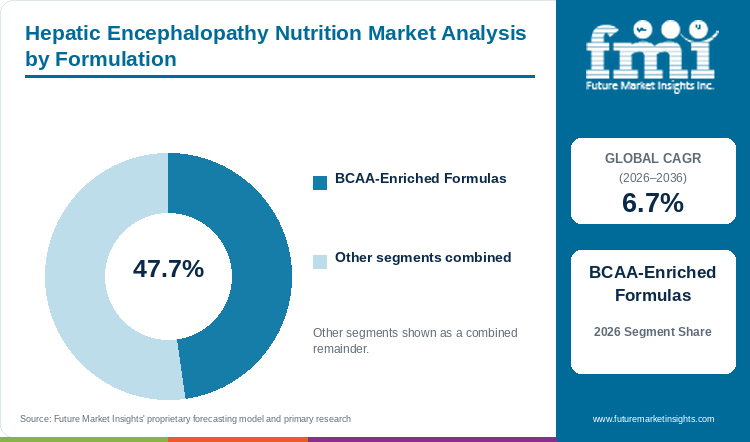
BCAA-enriched formulas are projected to account for 47.7% of formulation in 2026, owing to increasing use of liver-directed amino-acid nutrition.
BCAA-enriched formulas are nutrition products containing a higher proportion of branched-chain amino acids. These formulas are used for patients with cirrhosis who cannot maintain required protein intake through ordinary food. The American College of Gastroenterology listed its hepatic encephalopathy guideline in March 2026 and continued clinical attention on nutrition during treatment[5]. BCAA-enriched formulas have a defined liver-care use when compared with ordinary protein supplements. In addition to this, increasing use of branched-chain amino acids in medical nutrition is anticipated to propel the demand for BCAA-enriched formulas during the forecast period.
- BCAA-enriched formulas are projected at 47.7% of formulation in 2026, owing to increasing use of liver-directed amino-acid nutrition.
- Increasing preference for a defined amino-acid composition is expected to support the demand for BCAA-enriched formulas.
What makes powder sachets practical within the product form category?
Powder sachets are estimated to hold 44.6% of product form in 2026, due to measured preparation and low storage requirement.
Powder sachets are measured nutrition products which are mixed with water or another prescribed liquid before consumption. These sachets allow caregivers to prepare only the required quantity and reduces the need for storing several ready-to-drink units. In March 2026, Fresenius Kabi launched a ready-to-use plant-based tube feed, which shows increasing development of prepared and alternative nutrition formats[15]. However, powder sachets remain easy to transport and store for repeated home use. Expansion of enteral nutrition outside hospital care is likely to fuel the demand for measured powder formats.
- Powder sachets are estimated to hold 44.6% of product form in 2026, attributed to measured preparation and low storage requirement.
- Preparation of the required quantity at one time is expected to increase the preference for powder sachets in home care.
How does covert / Grade 1 support longer disease grade use?
Covert / Grade 1 is expected to lead disease grade with 46.8% share in 2026, owing to longer ambulatory nutrition use.
Covert / Grade 1 hepatic encephalopathy can affect meal timing, food preparation and regular intake even when the patient does not need intensive feeding. Due to this, nutrition support can be started during ambulatory care and can continue for a longer period. BCAA formulas, energy-rich products and planned meals are used for preventing further decline in nutritional intake. Increasing screening of mild cognitive changes and poor food intake is anticipated to support the demand from covert / Grade 1 patients.
- Covert / Grade 1 is estimated to hold 46.8% of disease grade in 2026, owing to longer nutrition use in ambulatory care.
- Mild cognitive changes can affect normal meal routine, due to which earlier nutrition assessment is becoming important.
Why do hospitals remain central within the end user category?
Hospitals are projected to lead end user with 47.3% share in 2026, due to supervised nutrition assessment and feeding-route selection.
Hospitals are one of the major end users of hepatic encephalopathy nutrition as patients with acute episodes generally receive first nutrition assessment in hospital. Hepatology and dietetics teams check food intake, cognition and feeding route for selecting oral supplement or enteral feed. The nutrition product selected in hospital is also continued after discharge in several cases. Increasing number of patients requiring supervised feeding and discharge nutrition plans is expected to keep hospitals prominent in hepatic encephalopathy nutrition market.
- Hospitals are projected to hold 47.3% of end user in 2026, due to supervised nutrition assessment and feeding-route selection.
- The product and daily quantity selected in hospital can continue at home, which is supporting repeat demand.
Which conditions keep hospital pharmacy relevant in the sales channel?
Hospital pharmacy is expected to hold 38.6% of sales channel in 2026, owing to formulary supply and regular product availability.
Hospital pharmacies supply hepatic encephalopathy nutrition products included in the hospital formulary. These pharmacies maintain product codes, stock and regular orders for oral and enteral nutrition used during treatment. Patients and caregivers also become familiar with the product supplied by hospital pharmacy, due to which the same format is often preferred after discharge. Availability of liver-directed formulas and regular refill arrangements is expected to support hospital pharmacy sales.
- Hospital pharmacy is projected to hold 38.6% of sales channel in 2026, owing to formulary supply and product availability during treatment.
- Regular stock and use of the same preparation method are expected to support the hospital pharmacy channel.
What are the drivers, restraints, and opportunities in the hepatic encephalopathy nutrition market?
Increasing nutrition guidance is the key driver, poor adherence after discharge is the major restraint, and home follow-up is creating growth opportunities.
- Driver: Increasing nutrition guidance is supporting the use of oral supplements and enteral feeds during cirrhosis care.
- Restraint: Poor taste, cognition and preparation difficulty can reduce regular product intake after discharge.
- Opportunity: Expansion of home follow-up and product delivery is creating longer sales opportunities for nutrition suppliers.
Clear Guidance Defines Nutrition Use
Increasing attention towards nutrition in cirrhosis treatment is one of the major factors driving hepatic encephalopathy nutrition market. A 2026 Delphi consensus validated 22 practical recommendations for initiation, selection and monitoring of oral nutritional supplements[6]. These recommendations provide a clearer basis for starting supplements when ordinary meals are not sufficient. Furthermore, rising use of medical nutrition along with defined treatment guidance is expected to impel the growth of hepatic encephalopathy nutrition market.
Adherence Weakens After Hospital Discharge
Regular use of nutrition products after hospital discharge is a key challenge for hepatic encephalopathy nutrition market. A January 2025 review covering 137 oral nutritional supplement studies found wide differences in adherence reporting, and nearly one fifth of studies did not report adherence[7]. Taste, low appetite, cognitive changes and multiple preparation steps can interrupt daily intake. Also, patients may discontinue a product when it is difficult to prepare or tolerate, which in turn can hamper the growth of the market.
Home Follow-Up Extends Directed Use
Increasing hospital-to-home nutrition use is creating growth opportunities for hepatic encephalopathy nutrition companies. In July 2025, Danone completed acquisition of a majority stake in Kate Farms for improving access across hospitals, homes, online channels and retail settings[18]. Wider product availability can help patients continue the same nutrition used during supervised care. Moreover, expansion of therapeutic food delivery is increasing access to prescribed products at home. This is expected to create new avenues for companies providing easy preparation and regular refill formats.
Which country CAGRs are profiled in the hepatic encephalopathy nutrition market?
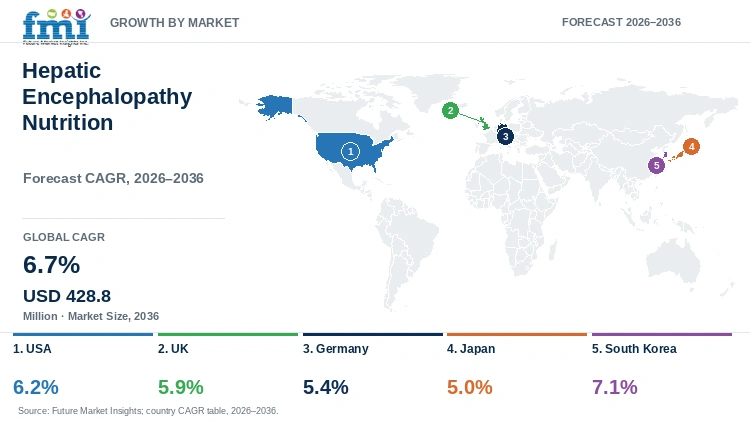
| Country | CAGR |
|---|---|
| USA | 6.2% from 2026 to 2036 |
| UK | 5.9% from 2026 to 2036 |
| Germany | 5.4% from 2026 to 2036 |
| Japan | 5.0% from 2026 to 2036 |
| South Korea | 7.1% from 2026 to 2036 |
How do country-level CAGRs compare in the hepatic encephalopathy nutrition market?
Hospital initiation, community prescribing and availability of repeat refills are the major factors affecting country growth. Countries having hospital as well as home supply of the same liver-directed nutrition are expected to witness higher repeat sales during the forecast period.
- USA demand is supported by hospital nutrition use and availability of oral clinical nutrition. However, coverage and refill conditions can change the product continued after discharge.
- UK hospital dietetics and community prescribing supports nutrition use outside specialist care. Variation in product eligibility between care settings can affect repeat purchasing.
- Germany has formal hospital nutrition processes, due to which product documentation and entry in hospital formularies are important for regular supply.
- Japan has an established use of liver-directed amino-acid nutrition. Increasing home healthcare is likely to raise the preference for products having easy preparation.
- South Korean specialist hospitals support the initial nutrition use, whereas regular follow-up and refill availability can increase its continuation at home.
Full report country CAGRs cover: North America; Latin America; Western Europe; Eastern Europe; East Asia; South Asia and Pacific; Middle East and Africa.
Country-wise Analysis
- The USA hepatic encephalopathy nutrition market is anticipated to grow at 6.2% CAGR from 2026 to 2036. Hospital liver teams use oral supplements and enteral feeds when patients are not able to maintain ordinary intake. In February 2026, CDC reported 52,274 deaths from chronic liver disease and cirrhosis in 2024[9]. The figure does not indicate product revenue, but the high disease burden is increasing the importance of nutrition management across hospital and outpatient care. Wider availability of clinical nutrition supplements and home refill channels is expected to support the USA market.
- The UK hepatic encephalopathy nutrition market is projected to grow at 5.9% CAGR during 2026 to 2036. Hospital dietitians start nutrition support and community prescribing is used for continuing the same outside specialist hospitals. In May 2026, the Office for Health Improvement and Disparities stated that cancer, cardiovascular disease, dementia and Alzheimer disease, respiratory disease and liver disease together accounted for 77% of deaths in England during 2025[2]. This keeps liver disease within a large national care burden. Alignment of hospital and community product eligibility is anticipated to support repeat demand in the UK.
- Germany has formal hospital nutrition processes, due to which product documentation and entry in hospital formularies are important for regular supply.
- Japan hepatic encephalopathy nutrition market is projected to rise at 5.0% CAGR through 2036. Liver-directed amino-acid nutrition has an established use through specialist care in the country. The Ministry of Health, Labour and Welfare reported 1,589,489 deaths nationwide during 2025[3]. This is an overall health figure and does not indicate product demand. Expansion of home healthcare is shifting nutrition preparation towards patients and caregivers. Due to this, products having easy directions and regular refill access are likely to witness higher preference.
- South Korea hepatic encephalopathy nutrition market is expected to witness 7.1% CAGR from 2026 to 2036, which is the highest among the profiled countries. Specialist hospitals provide a direct place for starting nutrition during an acute liver episode. Statistics Korea reported 362,968 deaths in 2025 and included liver disease among the ten leading causes.[11] The source is already used in the opening country paragraph and is not cited again. Increasing dietetics follow-up and regular product access after discharge is likely to fuel the growth of South Korea market.
Who are the notable companies in the hepatic encephalopathy nutrition market?
Otsuka Pharmaceutical (Aminoleban), Fresenius Kabi, Abbott, Nestlé Health Science, Danone Nutricia, Ajinomoto, B. Braun, and Medtrition are current companies relevant to the defined market boundary.
The hepatic encephalopathy nutrition market includes companies offering liver-directed nutrition as well as wider oral and enteral products. Otsuka Pharmaceutical and B. Braun have products used for impaired liver function. Fresenius Kabi, Nestle Health Science and Danone Nutricia provide a wider range of medical nutrition formats. Abbott and Medtrition are present in oral or modular protein nutrition, while Ajinomoto adds amino-acid and clinical nutrition capabilities. Increasing product availability, different feeding forms and expansion of home use are the key areas of competition in this market.
- Targeted liver and amino-acid nutrition: Otsuka Pharmaceutical (Aminoleban) and B. Braun supply liver-directed formulas, and Ajinomoto adds amino-acid capability through Nualtra.
- Broad enteral medical nutrition platforms: Fresenius Kabi and Nestlé Health Science provide broad clinical nutrition formats, and Danone Nutricia adds specialized hospital-to-home nutrition.
- Oral and modular nutrition platforms: Abbott supplies adult oral nutrition, and Medtrition provides modular protein for oral or tube administration.
Competitive Benchmarking: Hepatic Encephalopathy Nutrition Market
| Company | Liver-Specific BCAA Formulation | Oral/Enteral Format Breadth | Hospital-to-Home Pathway Support | Geographic Reach |
|---|---|---|---|---|
| Otsuka Pharmaceutical (Aminoleban) | High | Medium | Medium | Medium |
| Fresenius Kabi | Low | High | High | High |
| Abbott | Low | Medium | High | High |
| Nestlé Health Science | Low | High | High | High |
| Danone Nutricia | Low | High | High | High |
| Ajinomoto | Low | Medium | Medium | Medium |
| B. Braun | High | High | High | High |
| Medtrition | Low | Medium | Medium | Low |
High represents wider availability of documented products and feeding routes. Medium represents presence in limited products or routes, whereas Low represents limited activity in that area. These ratings are used only for company comparison and do not indicate market share or product quality.
Key Developments in the Hepatic Encephalopathy Nutrition Market
- In March 2026, Fresenius Kabi launched Fresubin PLANT-BASED Tube Feed in the UK.[15] Through this launch, the company increased ready-to-use plant-based choice for patients receiving medically supervised enteral feeding.
- In October 2025, Nestle Health Science entered into a strategic research partnership with the UC Davis Innovation Institute for Food & Health. The partnership is focusing on nutrition research, startup development and development of new nutrition solutions[16].
- In August 2025, Ajinomoto announced plans for establishing a Nualtra Centre of Excellence in Ireland.[17] The center is planned for supporting clinical trials, product development, digital programs and manufacturing activities of the company.
Key Players in the Hepatic Encephalopathy Nutrition Market
Targeted Liver and Amino-Acid Nutrition
- Otsuka Pharmaceutical (Aminoleban)
- B. Braun
- Ajinomoto
Broad Enteral Medical Nutrition Platforms
- Fresenius Kabi
- Nestlé Health Science
- Danone Nutricia
Oral and Modular Nutrition Platforms
- Abbott
- Medtrition
What does the Hepatic Encephalopathy Nutrition Market report cover?
| Coverage field | Report scope |
|---|---|
| Market breakdown | Formulation, Product Form, Disease Grade, End User, and Sales Channel |
| Quantitative Units | USD Million |
| Market Definition | Revenue includes supplier-level sales of oral or enteral medical nutrition products used specifically in the nutritional management of hepatic encephalopathy or cirrhosis with hepatic encephalopathy risk within the listed segmentation. Revenue excludes medicines, diagnostics, ordinary foods, general wellness supplements without a directed use, parenteral nutrition, standalone feeding devices, and downstream pharmacy or service markups. |
| Regions Covered | North America; Latin America; Western Europe; Eastern Europe; East Asia; South Asia and Pacific; Middle East and Africa |
| Countries Covered | USA, UK, Germany, Japan, South Korea, and more than twenty-five additional countries in the full report |
| Key Companies Profiled | Otsuka Pharmaceutical (Aminoleban), Fresenius Kabi, Abbott, Nestlé Health Science, Danone Nutricia, Ajinomoto, B. Braun, Medtrition |
| Forecast Period | 2026 to 2036 |
| Approach | Hybrid bottom-up and top-down market sizing using product-level availability and channel activity, cross-checked against clinical utilization, country care pathways, and manufacturer reporting. |
Hepatic Encephalopathy Nutrition Market - Research Methodology
| Method | Approach |
|---|---|
| Primary Research | FMI analysts conducted interviews with manufacturers, distributors, healthcare professionals, dietitians, hospitals, homecare participants and subject experts. The interviews covered product use, feeding route, pricing, access, adherence and barriers affecting regular purchasing. |
| Desk Research | Government statistics, clinical guidelines, regulatory publications, company product pages, official announcements and industry literature were used for desk research. Only evidence matching with the defined hepatic encephalopathy nutrition market was retained. |
| Market Sizing and Forecasting | Market estimates are prepared using product availability, channel activity, clinical utilization, pricing, company participation and country demand conditions. Segment and regional estimates are further reconciled with the overall market value. |
| Data Validation | Market estimates are checked with public evidence, primary interviews and company activities. Medicines, diagnostics, ordinary foods, parenteral nutrition, feeding devices and unsupported adjacent revenues are excluded from the market. |
Hepatic Encephalopathy Nutrition Market by Segments
Hepatic Encephalopathy Nutrition Market segmented by Formulation:
- BCAA-Enriched Formulas
- Low-Aromatic-Amino-Acid Blends
- Late-Evening Snack Formulas
- Others
Hepatic Encephalopathy Nutrition Market segmented by Product Form:
- Powder Sachets
- RTD ONS
- Enteral Tube Feeds
- Others
Hepatic Encephalopathy Nutrition Market segmented by Disease Grade:
- Covert / Grade 1
- Grade 2-3
- Grade 4 / Critical
Hepatic Encephalopathy Nutrition Market segmented by End User:
- Hospitals
- Homecare
- Long-Term Care
- Others
Hepatic Encephalopathy Nutrition Market segmented by Sales Channel:
- Hospital Pharmacy
- Retail Pharmacy
- Online
- Institutional Tender
- Others
Hepatic Encephalopathy Nutrition Market by Region:
- North America
- United States
- Canada
- Latin America
- Brazil
- Mexico
- Argentina
- Chile
- Western Europe
- Germany
- France
- United Kingdom
- Italy
- Spain
- Benelux
- Nordics
- Eastern Europe
- Poland
- Czech Republic
- Romania
- Hungary
- East Asia
- China
- Japan
- South Korea
- South Asia and Pacific
- India
- ASEAN
- Australia and New Zealand
- Middle East and Africa
- GCC Countries
- South Africa
- Türkiye
- Israel
Research Sources and Bibliography
- [1] Ahmad, F. B., Cisewski, J. A., & Anderson, R. N. (2026, July). Mortality in the United States: Provisional data, 2025 (Vital Statistics Rapid Release Report No. 44). National Center for Health Statistics.
- [2] Office for Health Improvement and Disparities. (2026, May 6). Mortality profile: Statistical commentary, May 2026
- [3] Ministry of Health, Labour and Welfare. (2026, June 3). [Monthly vital statistics report (provisional), December 2025, including annual totals].
- [4] American College of Gastroenterology. (2025, May). ACG Clinical Guideline: Malnutrition and Nutritional Recommendations in Liver Disease. The American Journal of Gastroenterology, 120(5), 950-972.
- [5] American College of Gastroenterology. (2026, March). ACG Clinical Guideline: Hepatic Encephalopathy. The American Journal of Gastroenterology, 121(3), 588-618.
- [6] Bahat, G., et al. (2026). Nutritional care using oral nutritional supplements: 22 questions every clinician asks-answered by global experts in a Delphi consensus study. Clinical Nutrition, 57, 106552. Published online December 2025.
- [7] Skinnars Josefsson, M., Einarsson, S., Seppälä, L., et al. (2025). Adherence to oral nutritional supplements: A review of trends in intervention characteristics and terminology use since the year 2000. Food Science & Nutrition, 13(1), e4722.
- [8] Zhao, Q., et al. (2025). Comprehensive nutritional management incorporating home-based dietary consultation improves hepatic encephalopathy in cirrhotic patients: A retrospective cohort study. BMC Gastroenterology, 26, 6.
- [9] National Center for Health Statistics. (2026, January). Mortality in the United States, 2024 (NCHS Data Brief No. 548).
- [10] Statistisches Bundesamt (Destatis). (2025, October 15). Gestorbene: Deutschland, Jahre, Todesursachen, Geschlecht.
- [11] Ministry of Data and Statistics. (2026, September 22). 2025 [2025 Cause of Death Statistics].
- [12] Otsuka Pharmaceutical (H.K.) Limited. (n.d.; accessed September 2026). Aminoleban EN.
- [13] B. Braun. (n.d.; accessed September 2026). Nutricomp® Hepa.
- [14] Medtrition. (n.d.; accessed September 2026). ProSource® TF Protein.
- [15] Fresenius Kabi. (2026, March 18). Innovating in PLANT-BASED Nutrition.
- [16] Nestlé Health Science. (2025, October 15). Nestlé Health Science and University of California, Davis Innovation Institute for Food & Health Announce Strategic Partnership to Accelerate Innovation in Nutrition and Health Science.
- [17] Ajinomoto Group. (2025, August). Nualtra: Designing for the Human Experience.
- [18] Danone. (2025, July 1). Danone completes the acquisition of Kate Farms, enhancing its U.S. specialized nutrition offerings.
- [19] Nestlé Health Science. (2026, March 30). Nestlé introduces an innovative complete nutritional solution for children with special medical nutrition needs.
- [20] Nutricia. (2025, October 1). Nutricia’s new savory plant-based medical nutrition proven to improve patient adherence.
- [21] Abbott Nutrition. (n.d.; accessed September 2026). Ensure® Plus Therapeutic Nutrition.
- [22] Medtrition, Inc. (2025, March 25). Medtrition, Inc. launches the ProSource® Cup portfolio.
- [23] Nestlé Health Science. (n.d.; accessed September 2026). Isosource®.
- [24] Nutricia. (n.d.; accessed September 2026). The Nutrison range.
This bibliography is provided for reader reference. The full report contains the complete reference list and detailed citations.
This Report Answers
- How large is the Hepatic Encephalopathy Nutrition Market in 2026?
- What value is forecast for Hepatic Encephalopathy Nutrition by 2036?
- Which segments hold notable 2026 shares in hepatic encephalopathy nutrition?
- How do country outlooks differ for hepatic encephalopathy nutrition by 2036?
- Which companies supply products relevant to hepatic encephalopathy nutrition care?
- What does the hepatic encephalopathy nutrition report include and exclude?
Frequently Asked Questions
How large is the Hepatic Encephalopathy Nutrition Market expected to be in 2026?
Future Market Insights estimates that the hepatic encephalopathy nutrition market will reach USD 224.2 million in 2026. The market is projected to expand further and reach USD 428.8 million by 2036.
What CAGR is forecast for the Hepatic Encephalopathy Nutrition Market through 2036?
As per FMI, the hepatic encephalopathy nutrition market is projected to grow at a 6.7% CAGR from 2026 to 2036. Growth is supported by increasing use of medically directed oral and enteral nutrition during cirrhosis care.
Which formulation holds a notable hepatic encephalopathy nutrition demand share in 2026?
Future Market Insights projects BCAA-enriched formulas to hold 47.7% of formulation demand in 2026. The segment benefits from its liver-directed amino-acid composition and use where ordinary protein intake remains inadequate.
Which product form holds a notable hepatic encephalopathy nutrition share in 2026?
FMI finds that powder sachets will hold 44.6% of product form demand in 2026. Demand is supported by measured preparation, easier transport, and lower storage requirement during home use.
Which country has a notable hepatic encephalopathy nutrition expansion outlook during the forecast period?
Future Market Insights predicts South Korea to expand at a 7.1% CAGR during the 2026 to 2036 assessment period. Growth is supported by specialist hospital use and increasing nutrition follow-up after discharge.
Which companies are active in the Hepatic Encephalopathy Nutrition Market during 2026?
As per FMI analysis, notable companies include Otsuka Pharmaceutical, Fresenius Kabi, Abbott, Nestle Health Science, Danone Nutricia, Ajinomoto, B. Braun, and Medtrition. These companies are focusing on wider feeding formats, easy preparation, and hospital-to-home nutrition availability.
Preview the report firsthand - request a free sample
Get SampleGet the brochure for pricing and purchase details.
Get PDFTable of Content
- Key Takeaways
- Market Size and CAGR
- Top Growth Driver
- Fastest Growing Segment
- Leading Region
- Key Companies
- Emerging Opportunities
- Executive Summary
- Global Market Outlook
- Demand-side Trends
- Supply-side Trends
- Technology Roadmap Analysis
- Analysis and Recommendations
- Analyst Perspective (What is happening? Why now? What should investors know?)
- Key Questions Answered
- How large is the market?
- What is the CAGR?
- What are key trends?
- Which region dominates?
- Who are the leaders?
- Market Overview
- Market Coverage / Taxonomy
- Market Definition / Scope / Limitations
- Research Methodology
- Chapter Orientation
- Analytical Lens and Working Hypotheses
- Market Structure, Signals, and Trend Drivers
- Benchmarking and Cross-market Comparability
- Market Sizing, Forecasting, and Opportunity Mapping
- Research Design and Evidence Framework
- Desk Research Programme (Secondary Evidence)
- Expert Input and Fieldwork (Primary Evidence)
- Tooling, Models, and Reference Databases
- Data Engineering and Model Build
- Quality Assurance and Audit Trail
- Market Background
- Market Dynamics (Drivers, Restraints, Opportunity, Trends)
- Scenario Forecast (Optimistic, Likely, Conservative)
- Impact Analysis
- AI Impact
- Sustainability Impact
- Regulatory Impact
- Technology Impact
- Consumer / Buyer Analysis
- Purchase Drivers
- Adoption Barriers
- Buyer Journey
- Opportunity Map Analysis
- Product Life Cycle Analysis
- Supply Chain Analysis
- Investment Feasibility Matrix
- Value Chain Analysis
- PESTLE and Porter's Analysis
- Regulatory Landscape
- Regional Parent Market Outlook
- Production and Consumption Statistics
- Import and Export Statistics
- Global Market Analysis and Forecast, 2021 to 2036
- Historical Market Size Value (USD Million) Analysis, 2021 to 2025
- Current and Future Market Size Value (USD Million) Projections, 2026 to 2036
- Y-o-Y Growth Trend Analysis
- Absolute $ Opportunity Analysis
- Global Market Pricing Analysis, 2021 to 2036
- Global Market Analysis and Forecast, By Formulation, 2021 to 2036
- Introduction / Key Findings
- Historical Market Size Value (USD Million) Analysis By Formulation, 2021 to 2025
- Current and Future Market Size Value (USD Million) Analysis and Forecast By Formulation, 2026 to 2036
- BCAA-Enriched Formulas
- Low-Aromatic-Amino-Acid Blends
- Late-Evening Snack Formulas
- Others
- Y-o-Y Growth Trend Analysis By Formulation, 2021 to 2025
- Absolute $ Opportunity Analysis By Formulation, 2026 to 2036
- Global Market Analysis and Forecast, By Product Form, 2021 to 2036
- Introduction / Key Findings
- Historical Market Size Value (USD Million) Analysis By Product Form, 2021 to 2025
- Current and Future Market Size Value (USD Million) Analysis and Forecast By Product Form, 2026 to 2036
- Powder Sachets
- RTD ONS
- Enteral Tube Feeds
- Others
- Y-o-Y Growth Trend Analysis By Product Form, 2021 to 2025
- Absolute $ Opportunity Analysis By Product Form, 2026 to 2036
- Global Market Analysis and Forecast, By Disease Grade, 2021 to 2036
- Introduction / Key Findings
- Historical Market Size Value (USD Million) Analysis By Disease Grade, 2021 to 2025
- Current and Future Market Size Value (USD Million) Analysis and Forecast By Disease Grade, 2026 to 2036
- Covert / Grade 1
- Grade 2-3
- Grade 4 / Critical
- Y-o-Y Growth Trend Analysis By Disease Grade, 2021 to 2025
- Absolute $ Opportunity Analysis By Disease Grade, 2026 to 2036
- Global Market Analysis and Forecast, By End User, 2021 to 2036
- Introduction / Key Findings
- Historical Market Size Value (USD Million) Analysis By End User, 2021 to 2025
- Current and Future Market Size Value (USD Million) Analysis and Forecast By End User, 2026 to 2036
- Hospitals
- Homecare
- Long-Term Care
- Others
- Y-o-Y Growth Trend Analysis By End User, 2021 to 2025
- Absolute $ Opportunity Analysis By End User, 2026 to 2036
- Global Market Analysis and Forecast, By Sales Channel, 2021 to 2036
- Introduction / Key Findings
- Historical Market Size Value (USD Million) Analysis By Sales Channel, 2021 to 2025
- Current and Future Market Size Value (USD Million) Analysis and Forecast By Sales Channel, 2026 to 2036
- Hospital Pharmacy
- Retail Pharmacy
- Online
- Institutional Tender
- Others
- Y-o-Y Growth Trend Analysis By Sales Channel, 2021 to 2025
- Absolute $ Opportunity Analysis By Sales Channel, 2026 to 2036
- Global Market Analysis and Forecast, By Region, 2021 to 2036
- Introduction
- Historical Market Size Value (USD Million) Analysis By Region, 2021 to 2025
- Current Market Size Value (USD Million) Analysis and Forecast By Region, 2026 to 2036
- North America
- Latin America
- Western Europe
- Eastern Europe
- East Asia
- South Asia and Pacific
- Middle East and Africa
- Market Attractiveness Analysis By Region
- North America Market Analysis and Forecast, By Country, 2021 to 2036
- Historical Market Size Value (USD Million) Trend Analysis By Market Taxonomy, 2021 to 2025
- Market Size Value (USD Million) Forecast By Market Taxonomy, 2026 to 2036
- By Country
- United States
- Canada
- By Formulation
- By Product Form
- By Disease Grade
- By End User
- By Sales Channel
- By Country
- Market Attractiveness Analysis
- By Country
- By Formulation
- By Product Form
- By Disease Grade
- By End User
- By Sales Channel
- Key Takeaways
- Latin America Market Analysis and Forecast, By Country
- Historical Market Size Value (USD Million) Trend Analysis By Market Taxonomy, 2021 to 2025
- Market Size Value (USD Million) Forecast By Market Taxonomy, 2026 to 2036
- By Country
- Brazil
- Mexico
- Argentina
- Chile
- By Formulation
- By Product Form
- By Disease Grade
- By End User
- By Sales Channel
- By Country
- Market Attractiveness Analysis
- By Country
- By Formulation
- By Product Form
- By Disease Grade
- By End User
- By Sales Channel
- Key Takeaways
- Western Europe Market Analysis and Forecast, By Country
- Historical Market Size Value (USD Million) Trend Analysis By Market Taxonomy, 2021 to 2025
- Market Size Value (USD Million) Forecast By Market Taxonomy, 2026 to 2036
- By Country
- Germany
- France
- United Kingdom
- Italy
- Spain
- Benelux
- Nordics
- By Formulation
- By Product Form
- By Disease Grade
- By End User
- By Sales Channel
- By Country
- Market Attractiveness Analysis
- By Country
- By Formulation
- By Product Form
- By Disease Grade
- By End User
- By Sales Channel
- Key Takeaways
- Eastern Europe Market Analysis and Forecast, By Country
- Historical Market Size Value (USD Million) Trend Analysis By Market Taxonomy, 2021 to 2025
- Market Size Value (USD Million) Forecast By Market Taxonomy, 2026 to 2036
- By Country
- Poland
- Czech Republic
- Romania
- Hungary
- By Formulation
- By Product Form
- By Disease Grade
- By End User
- By Sales Channel
- By Country
- Market Attractiveness Analysis
- By Country
- By Formulation
- By Product Form
- By Disease Grade
- By End User
- By Sales Channel
- Key Takeaways
- East Asia Market Analysis and Forecast, By Country
- Historical Market Size Value (USD Million) Trend Analysis By Market Taxonomy, 2021 to 2025
- Market Size Value (USD Million) Forecast By Market Taxonomy, 2026 to 2036
- By Country
- China
- Japan
- South Korea
- By Formulation
- By Product Form
- By Disease Grade
- By End User
- By Sales Channel
- By Country
- Market Attractiveness Analysis
- By Country
- By Formulation
- By Product Form
- By Disease Grade
- By End User
- By Sales Channel
- Key Takeaways
- South Asia and Pacific Market Analysis and Forecast, By Country
- Historical Market Size Value (USD Million) Trend Analysis By Market Taxonomy, 2021 to 2025
- Market Size Value (USD Million) Forecast By Market Taxonomy, 2026 to 2036
- By Country
- India
- ASEAN
- Australia and New Zealand
- By Formulation
- By Product Form
- By Disease Grade
- By End User
- By Sales Channel
- By Country
- Market Attractiveness Analysis
- By Country
- By Formulation
- By Product Form
- By Disease Grade
- By End User
- By Sales Channel
- Key Takeaways
- Middle East and Africa Market Analysis and Forecast, By Country
- Historical Market Size Value (USD Million) Trend Analysis By Market Taxonomy, 2021 to 2025
- Market Size Value (USD Million) Forecast By Market Taxonomy, 2026 to 2036
- By Country
- GCC Countries
- South Africa
- Türkiye
- Israel
- By Formulation
- By Product Form
- By Disease Grade
- By End User
- By Sales Channel
- By Country
- Market Attractiveness Analysis
- By Country
- By Formulation
- By Product Form
- By Disease Grade
- By End User
- By Sales Channel
- Key Takeaways
- Key Countries Market Analysis
- United States
- Pricing Analysis
- Market Share Analysis, 2025
- By Formulation
- By Product Form
- By Disease Grade
- By End User
- By Sales Channel
- Canada
- Pricing Analysis
- Market Share Analysis, 2025
- By Formulation
- By Product Form
- By Disease Grade
- By End User
- By Sales Channel
- Mexico
- Pricing Analysis
- Market Share Analysis, 2025
- By Formulation
- By Product Form
- By Disease Grade
- By End User
- By Sales Channel
- Brazil
- Pricing Analysis
- Market Share Analysis, 2025
- By Formulation
- By Product Form
- By Disease Grade
- By End User
- By Sales Channel
- Chile
- Pricing Analysis
- Market Share Analysis, 2025
- By Formulation
- By Product Form
- By Disease Grade
- By End User
- By Sales Channel
- Germany
- Pricing Analysis
- Market Share Analysis, 2025
- By Formulation
- By Product Form
- By Disease Grade
- By End User
- By Sales Channel
- United Kingdom
- Pricing Analysis
- Market Share Analysis, 2025
- By Formulation
- By Product Form
- By Disease Grade
- By End User
- By Sales Channel
- Italy
- Pricing Analysis
- Market Share Analysis, 2025
- By Formulation
- By Product Form
- By Disease Grade
- By End User
- By Sales Channel
- Spain
- Pricing Analysis
- Market Share Analysis, 2025
- By Formulation
- By Product Form
- By Disease Grade
- By End User
- By Sales Channel
- France
- Pricing Analysis
- Market Share Analysis, 2025
- By Formulation
- By Product Form
- By Disease Grade
- By End User
- By Sales Channel
- India
- Pricing Analysis
- Market Share Analysis, 2025
- By Formulation
- By Product Form
- By Disease Grade
- By End User
- By Sales Channel
- ASEAN
- Pricing Analysis
- Market Share Analysis, 2025
- By Formulation
- By Product Form
- By Disease Grade
- By End User
- By Sales Channel
- Australia and New Zealand
- Pricing Analysis
- Market Share Analysis, 2025
- By Formulation
- By Product Form
- By Disease Grade
- By End User
- By Sales Channel
- China
- Pricing Analysis
- Market Share Analysis, 2025
- By Formulation
- By Product Form
- By Disease Grade
- By End User
- By Sales Channel
- Japan
- Pricing Analysis
- Market Share Analysis, 2025
- By Formulation
- By Product Form
- By Disease Grade
- By End User
- By Sales Channel
- South Korea
- Pricing Analysis
- Market Share Analysis, 2025
- By Formulation
- By Product Form
- By Disease Grade
- By End User
- By Sales Channel
- Poland
- Pricing Analysis
- Market Share Analysis, 2025
- By Formulation
- By Product Form
- By Disease Grade
- By End User
- By Sales Channel
- Hungary
- Pricing Analysis
- Market Share Analysis, 2025
- By Formulation
- By Product Form
- By Disease Grade
- By End User
- By Sales Channel
- Türkiye
- Pricing Analysis
- Market Share Analysis, 2025
- By Formulation
- By Product Form
- By Disease Grade
- By End User
- By Sales Channel
- South Africa
- Pricing Analysis
- Market Share Analysis, 2025
- By Formulation
- By Product Form
- By Disease Grade
- By End User
- By Sales Channel
- United States
- Market Structure Analysis
- Competition Dashboard
- Competition Benchmarking
- Market Share Analysis of Top Players
- By Regional
- By Formulation
- By Product Form
- By Disease Grade
- By End User
- By Sales Channel
- Emerging Startups
- Innovation Benchmarking
- Competition Analysis
- Competition Deep Dive
- Otsuka Pharmaceutical (Aminoleban)
- Overview
- Product Portfolio
- Profitability by Market Segments
- Sales Footprint
- Strategy Overview
- Marketing Strategy
- Product Strategy
- Channel Strategy
- Fresenius Kabi
- Abbott
- Nestlé Health Science
- Danone Nutricia
- Ajinomoto
- B. Braun
- Medtrition
- Otsuka Pharmaceutical (Aminoleban)
- Case Studies
- Success Stories
- Recent Developments
- Competition Deep Dive
- Assumptions & Acronyms Used


