

- Market Size (2026)
- USD 980.7 Mn
- Forecast (2036)
- USD 2156.8 Mn
- CAGR (2026 to 2036)
- 8.2%
How big is High CTI Resins Market in 2026?
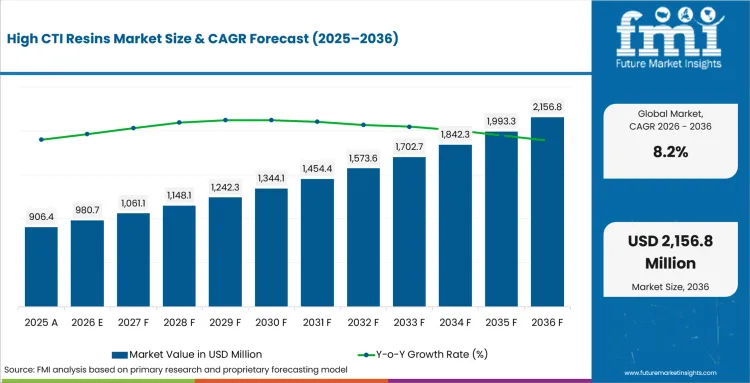
USD 980.7 million in 2026 and USD 2,156.8 million by 2036 at an 8.2% CAGR.
Demand for high CTI resins is projected to expand at 8.2% CAGR between 2026 and 2036, increasing valuation from USD 980.7 million in 2026 to USD 2,156.8 million by 2036. Vehicle electrification expands compact interfaces that require qualified engineering plastic compounds across vehicle and charging programs in several regions. The International Energy Agency reported in May 2026 that electric-car sales exceeded 20 million during 2025 and represented one-quarter of global car sales. The expanding production base increases repeated resin approvals across voltage classes and regional vehicle architectures during platform rollout.
Molded tracking resistance under moisture and contamination determines approval more directly than nominal system voltage. Automotive connector systems require stable color and flame performance across several qualified production sites worldwide. Power electronics assemblies require documented processing limits that preserve creepage assumptions during commercial molding operations.
Key Takeaways of High CTI Resins Market
- Higher operating voltages increase demand for resins that preserve insulation across compact electrical components exposed to contamination.
- High CTI PBT is projected to represent 32.0% share in 2026 owing to stable molding and electrical performance.
- CTI 600 V and above is estimated to account for 54.0% share in 2026 due to compact creepage requirements.
- UL94 V-0 materials are forecast to capture 41.0% share in 2026 driven by equipment-level fire specifications.
- Moisture and pigment variation can change molded tracking behavior and force repeat approval across finished components and production tools.
- BASF, Celanese, SABIC, Envalior, Syensqo, Covestro, EMS-GRIVORY and Kuraray compete through high-voltage materials and application support.
Analyst Perspective
"Resin certification cannot predict every finished-part result, so connector programs should qualify molded housings in the intended color and drying window. Material platforms gain commercial value through evidence that transfers across related tools and production sites without repeating complete approval programs."
- Nikhil Kaitwade, Principal Consultant, Future Market Insights
How is the High CTI Resins Market segmented?
The high CTI resins industry is segmented by resin type, CTI rating, flame rating, application, end use, sales channel and region.
The market is segmented by resin type, CTI rating, flame rating, application, end use, sales channel and region. Resin types include PBT, PA66 or PA6, PPS, LCP and PC blends, with CTI ratings covering 600 V and above or 400-600 V. Flame ratings include UL94 V-0, V-1 or V-2, halogen-free and non-FR grades for commercial specifications. Applications span connectors, power electronics, switchgear, inverters, controls and appliances, with end uses covering electronics, automotive electrification, renewable energy and industrial automation through direct supply, compounders and molding programs.
What makes high CTI PBT central to the resin type category?
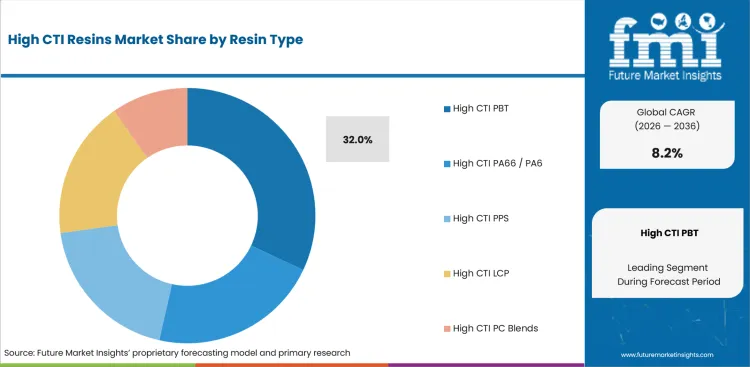
High CTI PBT balances dimensional stability with familiar processing for connector housings and power-distribution parts. Charging-equipment manufacturers use high CTI PBT in charging station components that require stable terminal retention and insulation during thermal cycling.
- High CTI PBT is set to lead the resin type category with 32.0% share in 2026 due to balanced flow and dependable electrical performance.
- Connector manufacturers favor high CTI PBT as qualified grades retain thin-wall flow and tracking resistance across approved color packages. Transferable molding windows reduce repeated validation across related tools and regional vehicle programs during complex production transfers.
How does CTI 600 V and above shape the CTI rating category?
CTI 600 V and above supports shorter creepage paths inside compact electrical assemblies exposed to contamination. Polyphenylene sulfide grades enter hotter applications that require tracking resistance with lower moisture sensitivity during service.
- By CTI rating, CTI 600 V and above is estimated to hold 54.0% share in 2026 owing to compact spacing requirements across connectors and switches.
- Electrical engineers qualify CTI 600 V and above through molded-part testing across pigments and representative production tools. Kuraray reported in July 2025 that Genestar™ passed UL 2597 surface-tracking tests at 900 V, giving component teams a standardized route beyond conventional 600 V assessment.
What role does UL94 V-0 play within the flame rating category?
UL94 V-0 supports rapid flame extinction alongside dependable insulation inside compact electrical enclosures that carry elevated current. Qualified flame-retardant technologies must also preserve flow and tracking resistance during thin-wall molding across complex terminal geometries.
- By flame rating, UL94 V-0 is forecast to represent 41.0% share in 2026 driven by documented fire requirements across restricted electrical spaces.
- Electrical enclosure manufacturers qualify UL94 V-0 grades through cavity trials covering specified colors and representative wall thicknesses during commercial molding. Replacement tools must preserve the documented processing window without increasing serial-production scrap during manufacturing transfers across regional production sites.
What supports demand for EV connectors within the application category?
EV connector programs compare liquid crystal polymers with high-CTI resins for terminals exposed to elevated voltage and repeated thermal cycling. EMS-GRIVORY reported in April 2026 that its polymers support compact high-voltage connections up to 1,000 V. The application links resin choice with automated terminal production across tightly packaged commercial electrical systems.
- The EV connector segment is likely to capture 26.0% share in 2026 attributable to expanding high-voltage interfaces across vehicles and charging equipment.
- Connector engineers compare heat aging and terminal retention across service conditions during high-CTI resin approval. Repeatable results let connector programs transfer materials across related housings without reopening every production decision.
What are the drivers, restraints and opportunities in the High CTI Resins Market?
Driver: Compact high-voltage assemblies require tracking-resistant insulation across smaller creepage distances. Restraint: Moisture and pigment changes can alter finished-part CTI across commercial molding tools. Opportunity: Shared component protocols can extend qualification evidence across related connectors and switching families.
- Driver: Higher system voltage concentrates conductors inside smaller housings and increases the value of proven tracking resistance.
- Restraint: Resin drying and pigment loading can change finished-part CTI across approved commercial molding conditions.
- Opportunity: Common test protocols can extend one qualification package across related connectors and switching components.
Higher operating voltage now concentrates conductors inside smaller enclosures and reduces available creepage distance during compact component design. Electrical design teams therefore value electrical insulation materials that preserve tracking resistance alongside heat aging and dimensional stability during component approval.
Moisture variation and heavy pigment loading can shift molded CTI beyond the approved commercial process window. The resulting retesting delays commercial conversion across regional production tools and specified color packages during platform release.
Application laboratories can pair contamination testing with terminal geometry during early approval of compact connector designs. A shared protocol supports related switching components across industrial automation installations and reduces repeated engineering work at approved production sites.
Which country CAGRs are profiled in the High CTI Resins Market?
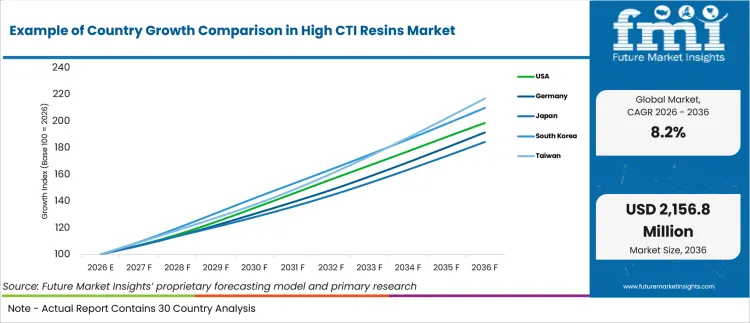
| Country | CAGR |
|---|---|
| United States | 7.1% |
| Germany | 6.7% |
| Japan | 6.3% |
| South Korea | 7.7% |
| Taiwan | 8.1% |
How do country-level CAGRs compare in the High CTI Resins Market?
The country forecasts remain closely grouped across the high CTI (Comparative Tracking Index) resins market, with only 1.8 percentage points separating Taiwan and Japan. Taiwan and South Korea form an upper group, reflecting strong demand from semiconductor packaging, power electronics and advanced electrical component manufacturing. The United States follows within a narrow range and benefits from increasing adoption of high-performance insulating materials across industrial and electrification applications. Germany and Japan create a lower pair with limited separation, indicating steady demand supported by established electronics, automotive and electrical equipment industries. The pattern suggests that growth is being driven by higher voltage requirements, miniaturization trends and the need for materials with superior electrical insulation performance in advanced electronic systems.
- Taiwan benefits from its leadership in semiconductor manufacturing, where high CTI resins are increasingly used to improve insulation reliability and component performance.
- South Korea supports strong demand through advanced electronics, EV component and power module production that require high-tracking-resistance materials.
- The United States reflects steady adoption across industrial electronics, renewable energy systems and electrical infrastructure applications.
- Germany maintains growth through demand from automotive electrification, industrial automation and high-reliability electrical equipment manufacturing.
- Japan continues to support the market through innovation in electronic materials and the development of compact, high-performance electrical components.
Comparable CAGRs may still reflect different market conditions because semiconductor intensity, electrical safety standards, material qualification requirements and end-use applications vary across countries. The full report provides country-level CAGR analysis across North America, Latin America, Europe, East Asia, South Asia, Oceania and the Middle East and Africa.
Country-wise Analysis
- United States connector programs use domestic laboratories and transferable UL records to qualify housings for passenger vehicles, charging equipment and power-distribution assemblies. The Energy Information Administration reported in July 2026 that electrified powertrains represented 24% of second-quarter light-duty vehicle sales. The expanding domestic platform base sustains recurring commercial resin trials for new connector designs across active domestic and export vehicle programs. The United States is estimated to post 7.1% CAGR over the forecast period, supported by accessible engineering services. Separate validation for each specified color and molding tool extends production transfers across contract molding networks and several regional factories.
- Germany combines automotive engineering centers with connector molders and specialized laboratories that support high-voltage component programs for domestic and neighboring assembly plants. High CTI resin demand in Germany is forecast to rise at 6.7% CAGR over the forecast period, reinforced by regional laboratory and molding access. The European Alternative Fuels Observatory recorded 84,057 German battery-electric registrations during June 2026 alone. The registration base sustains repeated connector qualification across new regional platforms, scheduled model updates and neighboring assembly programs. Each tooling package and specified color requires separate electrical evidence, which extends approval cycles during regional production transfers and commercial tool changes.
- Japan relies on controlled automotive qualification and long technical relationships for safety-critical electrical components across domestic vehicle platforms. The Agency for Natural Resources and Energy reported in June 2025 that electrified vehicles represented 57% of new passenger-car sales during 2024. The established domestic platform base supports connector testing across several model generations and domestic production networks. Adoption of high CTI resins in Japan is estimated to expand at 6.3% CAGR through 2036, aided by local compounding and test support. Conservative replacement reviews remain a material friction across approved molding partners and color packages during platform updates and production transfers.
- South Korea links major automotive groups with electronics manufacturers through concentrated industrial networks that support local material trials and export programs. In South Korea, high CTI resin demand is predicted to advance at 7.7% CAGR through 2036, driven by nearby technical centers. The Ministry of Trade, Industry and Resources reported in May 2025 that electric and hybrid vehicles represented 46% of April domestic automobile sales. The electrified production mix supports joint connector qualification across several regional vehicle and electronics programs. Export-specific colors and flame packages require separate validation under overseas standards, extending release work during platform launches and regional tool changes.
- Taiwan combines precision molding with electronics production inside compact industrial districts that shorten coordination across resin and tooling specialists. The Ministry of Economic Affairs reported in June 2025 that 8,796 locally developed Model C vehicles had been registered by the end of May. The domestic vehicle program provides active qualification work for connectors and power-distribution parts across specialized molding operations. High CTI resin sales in Taiwan are forecast to expand at 8.1% CAGR by 2036, influenced by specialized molding capacity. Limited domestic vehicle scale remains a material friction for export approval and regional inventory commitments across automotive and electronics programs.
Who are the notable companies in the High CTI Resins Market?
BASF, Celanese, SABIC, Envalior, Syensqo, Covestro, EMS-GRIVORY and Kuraray support high-voltage resin qualification and application development in this market.
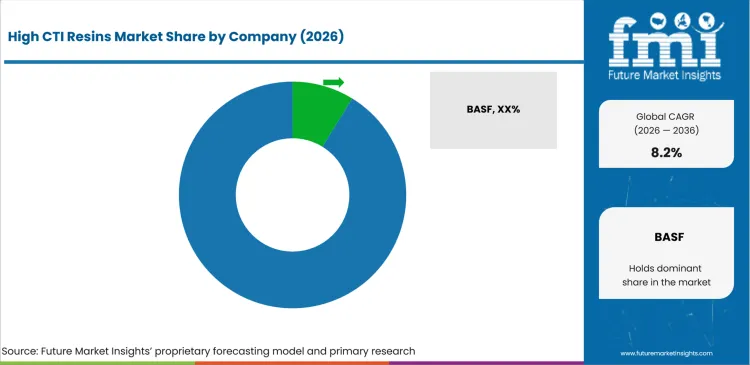
The competitive field is moderately concentrated around global engineering-material groups with specialist entry through one validated resin family. Competition centers on transferable CTI and flame evidence across colors, tooling and regional vehicle programs instead of broad polymer scale.
- BASF, Celanese and SABIC combine multiple engineering-resin families with global application support for connectors and automotive electronics platforms.
- Envalior, Syensqo and Covestro compete through high-CTI grades plus component testing for charging and battery applications.
- EMS-GRIVORY and Kuraray address focused qualification routes through heat-resistant polyamides and direct high-voltage application engineering.
Competitive Benchmarking: High CTI Resins Market
| Company | High-CTI Portfolio | Flame-Retardant Breadth | Electrification Support | Geographic Reach |
|---|---|---|---|---|
| BASF | High | High | High | Global |
| Celanese | High | High | High | Global |
| SABIC | High | High | High | Global |
| Envalior | Medium | Medium | High | Global |
| Syensqo | Medium | Medium | High | Global |
| Covestro | Medium | High | Medium | Global |
| EMS-GRIVORY | Medium | Medium | High | Global |
| Kuraray | Medium | Medium | Medium | Global |
Scoring basis: High-CTI portfolio rates High for three families, Medium for one or two and Low for one grade. Flame-retardant breadth rates High across two families, Medium within one family and Low for one grade. Electrification support rates High for three uses, Medium for two and Low for one application.
Key Developments in the High CTI Resins Market
- In May 2026, BASF confirmed Weidmüller’s use of Ultramid® Advanced N3U41 G6 in compact PCB connectors and terminals requiring color-stable insulation.
- In October 2025, Envalior introduced Pocan® BFN4232ZHR S1 for 800-volt connectors requiring CTI 600 and UL94 V-0 performance.
- In June 2025, Syensqo introduced Amodel® PPA HFFR-4133 Orange for high-voltage connectors and busbars requiring stable safety identification.
- In May 2025, SABIC presented high-CTI specialty thermoplastics for higher-voltage power electronics and electrical components at PCIM Europe.
Key Players in the High CTI Resins Market
Global High-Voltage Materials Platforms
- BASF
- Celanese
- SABIC
Specialty High-CTI Engineering Polymers
- Envalior
- Syensqo
- Covestro
Application-Led Compounders
- EMS-GRIVORY
- Kuraray
High CTI Resins Market - Report Scope
| Coverage field | Report scope |
|---|---|
| Market breakdown | Resin type, CTI rating, flame rating, application, end use, sales channel and region. |
| Quantitative Units | Revenue in USD million and CAGR in %. |
| Market Definition | The market covers thermoplastic resins sold for electrical components that require elevated tracking resistance under defined commercial operating conditions. |
| Regions Covered | North America, Latin America, Western Europe, Eastern Europe, East Asia, South Asia and Pacific, Middle East and Africa. |
| Countries Covered | United States, Germany, Japan, South Korea, Taiwan and more than twenty-five additional countries included in the full report. |
| Key Companies Profiled | BASF, Celanese, SABIC, Envalior, Syensqo, Covestro, EMS-GRIVORY and Kuraray. |
| Forecast Period | 2026 to 2036. |
| Approach | Primary and secondary research with market triangulation across segments and country-level demand conditions. |
High CTI Resins Market - Research Methodology
| Method | Approach |
|---|---|
| Primary Research | FMI analysts gathered input from manufacturers, service providers, technology developers, distributors, end users, procurement teams, and subject-matter experts. Interviews examined purchasing decisions, product or service evaluation, adoption barriers, approval requirements, pricing considerations, and expectations for technical or commercial support. Respondents were also asked what evidence is required before a trial, pilot, or initial order develops into regular purchasing. |
| Desk Research | Desk research covered government statistics, regulatory publications, trade data, industry associations, technical literature, standards, company filings, product information, and official corporate announcements. Sources were reviewed for relevance, publication date, geographic coverage, and consistency with the defined market scope. Claims relating to performance, applications, approvals, capacity, investment, and commercial activity were retained only when supported by credible public evidence. |
| Market Sizing and Forecasting | The market model combined the baseline value with historical performance, segment structure, pricing and volume indicators, adoption levels, company participation, and country-level demand conditions. Forecast assumptions considered economic activity, investment trends, regulatory developments, technology adoption, purchasing cycles, supply availability, and barriers to wider market use. Segment and regional estimates were reconciled before the final market total was calculated. |
| Data Validation | Estimates were checked against multiple independent indicators, including public data, company activity, trade patterns, industry developments, and findings from primary interviews. Validation also tested whether products, services, applications, and company revenues fell within the defined market boundaries. Adjacent categories, unsupported claims, overlapping revenues, and activities without direct market relevance were excluded to reduce double counting and maintain consistency across segments and countries. |
High CTI Resins Market by Segments
High CTI Resins Market segmented by Resin Type:
- High CTI PBT
- High CTI PA66 / PA6
- High CTI PPS
- High CTI LCP
- High CTI PC Blends
High CTI Resins Market segmented by CTI Rating:
- CTI 600 V and Above
- CTI 400-600 V
High CTI Resins Market segmented by Flame Rating:
- UL94 V-0
- UL94 V-1 / V-2
- Halogen-free Flame Retardant
- Non-FR High CTI
High CTI Resins Market segmented by Application:
- EV Connectors
- Power Electronics
- Switchgear Components
- Solar / Inverter Parts
- Industrial Controls
- Appliance Electrical Parts
High CTI Resins Market segmented by End Use:
- Electrical & Electronics
- Automotive Electrification
- Renewable Energy
- Industrial Automation
High CTI Resins Market segmented by Sales Channel:
- Direct Resin Supply
- Compounders
- Molders / OEM Programs
High CTI Resins Market by Region:
- North America
- United States
- Canada
- Latin America
- Brazil
- Chile
- Mexico
- Rest of Latin America
- Western Europe
- Germany
- United Kingdom
- Italy
- Spain
- France
- Nordics
- Benelux
- Rest of Western Europe
- Eastern Europe
- Russia
- Poland
- Hungary
- Balkan and Baltic States
- Rest of Eastern Europe
- East Asia
- China
- Japan
- South Korea
- South Asia and Pacific
- India
- ASEAN
- Australia and New Zealand
- Rest of South Asia and Pacific
- Middle East and Africa
- Kingdom of Saudi Arabia
- Other GCC Countries
- Türkiye
- South Africa
- Other African Union Countries
- Rest of Middle East and Africa
Research Sources and Bibliography
- International Energy Agency. (2026, May 20). Global EV Outlook 2026.
- USA Energy Information Administration. (2026, July 27). Hybrid sales rise while battery electric sales remain lower after tax credit expiration.
- European Alternative Fuels Observatory. (2026, July 22). EAFO Data Update & News Flash July 2026.
- Agency for Natural Resources and Energy. (2025, June). 第1章 第3節 一次エネルギーの動向│エネルギー動向(2025年6月版).
- Ministry of Trade, Industry and Resources. (2025, May 20). Korea’s automobile exports record $6.5 billion in April.
- Ministry of Economic Affairs. (2025, June 26). 支持在地研發驅動技術升級,打造電動車生態系助力淨零碳排,拓展全球市場.
- BASF. (2026, May 22). Colorful and robust: Ultramid® Advanced for durable, safe PCB connectors and terminals.
- Envalior. (2025, October 6). Envalior redefines high-voltage charging at The Battery Show NA.
- Syensqo. (2025, June 24). Syensqo introduces orange-colored grades for critical electric vehicle components.
- SABIC. (2025, May 6). SABIC features at PCIM Europe 2025 specialty thermoplastics that help address challenges with higher-voltage electrical applications.
- Celanese. (2025, October 2). Celanese Designing the Future at K 2025.
- Covestro. (2025, October 8). High CTI Polycarbonates: Enhance Battery Systems.
- EMS-GRIVORY. (2026, April 22). Metal replacement in e-mobility: high-voltage innovations reduce costs and weight.
- Kuraray. (2025, July 7). Kuraray Confirms the Robustness of High-Voltage Tracking Resistance Afforded by Genestar™ through Third-Party Assessments: Contributing to Vehicle Safety in the Coming Era of 1000-Volt EVs.
This bibliography is provided for reader reference and is not exhaustive. The full report contains the complete reference list and detailed citations.
This Report Answers
- How large is the high CTI resins market in 2026 and 2036?
- Which electrical conditions support demand for high CTI resins?
- Which resin type is projected to hold the largest share in 2026?
- How does CTI rating shape commercial resin selection?
- Which flame rating anchors qualification across compact electrical parts?
- How do country growth rates differ across the profiled markets?
- Which companies provide verified high-CTI resin portfolios?
- What currently limits high CTI resin adoption?
- How should engineering teams compare resin and application options?
Frequently Asked Questions
How big is the High CTI Resins Market in 2026?
The high CTI resins market is valued at USD 980.7 million in 2026 and is forecast to reach USD 2,156.8 million by 2036. Growth is supported by vehicle electrification expanding compact high-voltage interfaces that sustain recurring resin approvals across connector housings, power electronics assemblies, and charging equipment programs in several regions worldwide.
What is the CAGR of the High CTI Resins Market from 2026 to 2036?
The high CTI resins market grows at a CAGR of 8.2% between 2026 and 2036, supported by automotive and electrical equipment programs adopting tracking-resistant engineering polymers once molded-part CTI evidence transfers across approved colors, production tools, and regional manufacturing sites without reopening complete qualification programs.
Which resin type leads the High CTI Resins Market?
High CTI PBT accounts for 32.0% of the high CTI resins market by resin type in 2026, driven by balanced dimensional stability, thin-wall flow, and dependable electrical performance that connector manufacturers rely on across approved color packages and transferable molding windows within regional vehicle and charging equipment programs.
How much will the High CTI Resins Market add between 2026 and 2036?
The high CTI resins market is set to add USD 1,176.1 million between 2026 and 2036, growing from USD 980.7 million to USD 2,156.8 million as higher operating voltages, compact creepage requirements, and expanding EV connector and power electronics qualification programs drive sustained resin demand across automotive, renewable energy, and industrial automation applications globally.
Who are the leading companies in the High CTI Resins Market?
Eight companies shape competition in the high CTI resins market, including BASF, Celanese, SABIC, Envalior, Syensqo, Covestro, EMS-GRIVORY, and Kuraray, competing through multi-family high-voltage engineering resin portfolios, flame-retardant compound breadth, electrification application support, and transferable qualification evidence across connector, power electronics, and charging equipment programs worldwide.
Preview the report firsthand - request a free sample
Get SampleGet the brochure for pricing and purchase details.
Get PDFTable of Content
- Key Takeaways
- Market Size and CAGR
- Top Growth Driver
- Fastest Growing Segment
- Leading Region
- Key Companies
- Emerging Opportunities
- Executive Summary
- Global Market Outlook
- Demand-side Trends
- Supply-side Trends
- Technology Roadmap Analysis
- Analysis and Recommendations
- Analyst Perspective (What is happening? Why now? What should investors know?)
- Key Questions Answered
- How large is the market?
- What is the CAGR?
- What are key trends?
- Which region dominates?
- Who are the leaders?
- Market Overview
- Market Coverage / Taxonomy
- Market Definition / Scope / Limitations
- Research Methodology
- Chapter Orientation
- Analytical Lens and Working Hypotheses
- Market Structure, Signals, and Trend Drivers
- Benchmarking and Cross-market Comparability
- Market Sizing, Forecasting, and Opportunity Mapping
- Research Design and Evidence Framework
- Desk Research Programme (Secondary Evidence)
- Expert Input and Fieldwork (Primary Evidence)
- Tooling, Models, and Reference Databases
- Data Engineering and Model Build
- Quality Assurance and Audit Trail
- Market Background
- Market Dynamics (Drivers, Restraints, Opportunity, Trends)
- Scenario Forecast (Optimistic, Likely, Conservative)
- Impact Analysis
- AI Impact
- Sustainability Impact
- Regulatory Impact
- Technology Impact
- Consumer / Buyer Analysis
- Purchase Drivers
- Adoption Barriers
- Buyer Journey
- Opportunity Map Analysis
- Product Life Cycle Analysis
- Supply Chain Analysis
- Investment Feasibility Matrix
- Value Chain Analysis
- PESTLE and Porter's Analysis
- Regulatory Landscape
- Regional Parent Market Outlook
- Production and Consumption Statistics
- Import and Export Statistics
- Global Market Analysis and Forecast, 2021 to 2036
- Historical Market Size Value (USD Million) Analysis, 2021 to 2025
- Current and Future Market Size Value (USD Million) Projections, 2026 to 2036
- Y-o-Y Growth Trend Analysis
- Absolute $ Opportunity Analysis
- Global Market Pricing Analysis, 2021 to 2036
- Global Market Analysis and Forecast, By Resin Type, 2021 to 2036
- Introduction / Key Findings
- Historical Market Size Value (USD Million) Analysis By Resin Type, 2021 to 2025
- Current and Future Market Size Value (USD Million) Analysis and Forecast By Resin Type, 2026 to 2036
- High CTI PBT
- High CTI PA66 / PA6
- High CTI PPS
- High CTI LCP
- High CTI PC Blends
- High CTI PBT
- Y-o-Y Growth Trend Analysis By Resin Type, 2021 to 2025
- Absolute $ Opportunity Analysis By Resin Type, 2026 to 2036
- Global Market Analysis and Forecast, By CTI Rating, 2021 to 2036
- Introduction / Key Findings
- Historical Market Size Value (USD Million) Analysis By CTI Rating, 2021 to 2025
- Current and Future Market Size Value (USD Million) Analysis and Forecast By CTI Rating, 2026 to 2036
- CTI 600 V and Above
- CTI 400-600 V
- CTI 600 V and Above
- Y-o-Y Growth Trend Analysis By CTI Rating, 2021 to 2025
- Absolute $ Opportunity Analysis By CTI Rating, 2026 to 2036
- Global Market Analysis and Forecast, By Flame Rating, 2021 to 2036
- Introduction / Key Findings
- Historical Market Size Value (USD Million) Analysis By Flame Rating, 2021 to 2025
- Current and Future Market Size Value (USD Million) Analysis and Forecast By Flame Rating, 2026 to 2036
- UL94 V-0
- UL94 V-1 / V-2
- Halogen-free Flame Retardant
- Non-FR High CTI
- UL94 V-0
- Y-o-Y Growth Trend Analysis By Flame Rating, 2021 to 2025
- Absolute $ Opportunity Analysis By Flame Rating, 2026 to 2036
- Global Market Analysis and Forecast, By Application, 2021 to 2036
- Introduction / Key Findings
- Historical Market Size Value (USD Million) Analysis By Application, 2021 to 2025
- Current and Future Market Size Value (USD Million) Analysis and Forecast By Application, 2026 to 2036
- EV Connectors
- Power Electronics
- Switchgear Components
- Solar / Inverter Parts
- Industrial Controls
- Appliance Electrical Parts
- EV Connectors
- Y-o-Y Growth Trend Analysis By Application, 2021 to 2025
- Absolute $ Opportunity Analysis By Application, 2026 to 2036
- Global Market Analysis and Forecast, By End Use, 2021 to 2036
- Introduction / Key Findings
- Historical Market Size Value (USD Million) Analysis By End Use, 2021 to 2025
- Current and Future Market Size Value (USD Million) Analysis and Forecast By End Use, 2026 to 2036
- Electrical & Electronics
- Automotive Electrification
- Renewable Energy
- Industrial Automation
- Electrical & Electronics
- Y-o-Y Growth Trend Analysis By End Use, 2021 to 2025
- Absolute $ Opportunity Analysis By End Use, 2026 to 2036
- Global Market Analysis and Forecast, By Sales Channel
- Introduction / Key Findings
- Historical Market Size Value (USD Million) Analysis By Sales Channel, 2021 to 2025
- Current and Future Market Size Value (USD Million) Analysis and Forecast By Sales Channel, 2026 to 2036
- Direct Resin Supply
- Compounders
- Molders / OEM Programs
- Direct Resin Supply
- Y-o-Y Growth Trend Analysis By Sales Channel, 2021 to 2025
- Absolute $ Opportunity Analysis By Sales Channel, 2026 to 2036
- Global Market Analysis and Forecast, By Region, 2021 to 2036
- Introduction
- Historical Market Size Value (USD Million) Analysis By Region, 2021 to 2025
- Current Market Size Value (USD Million) Analysis and Forecast By Region, 2026 to 2036
- North America
- Latin America
- Western Europe
- Eastern Europe
- East Asia
- South Asia and Pacific
- Middle East & Africa
- Market Attractiveness Analysis By Region
- North America Market Analysis and Forecast, By Country, 2021 to 2036
- Historical Market Size Value (USD Million) Trend Analysis By Market Taxonomy, 2021 to 2025
- Market Size Value (USD Million) Forecast By Market Taxonomy, 2026 to 2036
- By Country
- USA
- Canada
- By Resin Type
- By CTI Rating
- By Flame Rating
- By Application
- By End Use
- By Sales Channel
- By Country
- Market Attractiveness Analysis
- By Country
- By Resin Type
- By CTI Rating
- By Flame Rating
- By Application
- By End Use
- By Sales Channel
- Key Takeaways
- Latin America Market Analysis and Forecast, By Country
- Historical Market Size Value (USD Million) Trend Analysis By Market Taxonomy, 2021 to 2025
- Market Size Value (USD Million) Forecast By Market Taxonomy, 2026 to 2036
- By Country
- Brazil
- Mexico
- Chile
- Rest of Latin America
- By Resin Type
- By CTI Rating
- By Flame Rating
- By Application
- By End Use
- By Sales Channel
- By Country
- Market Attractiveness Analysis
- By Country
- By Resin Type
- By CTI Rating
- By Flame Rating
- By Application
- By End Use
- By Sales Channel
- Key Takeaways
- Western Europe Market Analysis and Forecast, By Country
- Historical Market Size Value (USD Million) Trend Analysis By Market Taxonomy, 2021 to 2025
- Market Size Value (USD Million) Forecast By Market Taxonomy, 2026 to 2036
- By Country
- Germany
- UK
- Italy
- Spain
- France
- Nordic
- BENELUX
- Rest of Western Europe
- By Resin Type
- By CTI Rating
- By Flame Rating
- By Application
- By End Use
- By Sales Channel
- By Country
- Market Attractiveness Analysis
- By Country
- By Resin Type
- By CTI Rating
- By Flame Rating
- By Application
- By End Use
- By Sales Channel
- Key Takeaways
- Eastern Europe Market Analysis and Forecast, By Country
- Historical Market Size Value (USD Million) Trend Analysis By Market Taxonomy, 2021 to 2025
- Market Size Value (USD Million) Forecast By Market Taxonomy, 2026 to 2036
- By Country
- Russia
- Poland
- Hungary
- Balkan & Baltic
- Rest of Eastern Europe
- By Resin Type
- By CTI Rating
- By Flame Rating
- By Application
- By End Use
- By Sales Channel
- By Country
- Market Attractiveness Analysis
- By Country
- By Resin Type
- By CTI Rating
- By Flame Rating
- By Application
- By End Use
- By Sales Channel
- Key Takeaways
- East Asia Market Analysis and Forecast, By Country
- Historical Market Size Value (USD Million) Trend Analysis By Market Taxonomy, 2021 to 2025
- Market Size Value (USD Million) Forecast By Market Taxonomy, 2026 to 2036
- By Country
- China
- Japan
- South Korea
- By Resin Type
- By CTI Rating
- By Flame Rating
- By Application
- By End Use
- By Sales Channel
- By Country
- Market Attractiveness Analysis
- By Country
- By Resin Type
- By CTI Rating
- By Flame Rating
- By Application
- By End Use
- By Sales Channel
- Key Takeaways
- South Asia and Pacific Market Analysis and Forecast, By Country
- Historical Market Size Value (USD Million) Trend Analysis By Market Taxonomy, 2021 to 2025
- Market Size Value (USD Million) Forecast By Market Taxonomy, 2026 to 2036
- By Country
- India
- ASEAN
- Australia & New Zealand
- Rest of South Asia and Pacific
- By Resin Type
- By CTI Rating
- By Flame Rating
- By Application
- By End Use
- By Sales Channel
- By Country
- Market Attractiveness Analysis
- By Country
- By Resin Type
- By CTI Rating
- By Flame Rating
- By Application
- By End Use
- By Sales Channel
- Key Takeaways
- Middle East & Africa Market Analysis and Forecast, By Country
- Historical Market Size Value (USD Million) Trend Analysis By Market Taxonomy, 2021 to 2025
- Market Size Value (USD Million) Forecast By Market Taxonomy, 2026 to 2036
- By Country
- Kingdom of Saudi Arabia
- Other GCC Countries
- Türkiye
- South Africa
- Other African Union
- Rest of Middle East & Africa
- By Resin Type
- By CTI Rating
- By Flame Rating
- By Application
- By End Use
- By Sales Channel
- By Country
- Market Attractiveness Analysis
- By Country
- By Resin Type
- By CTI Rating
- By Flame Rating
- By Application
- By End Use
- By Sales Channel
- Key Takeaways
- Key Countries Market Analysis
- USA
- Pricing Analysis
- Market Share Analysis, 2025
- By Resin Type
- By CTI Rating
- By Flame Rating
- By Application
- By End Use
- By Sales Channel
- Canada
- Pricing Analysis
- Market Share Analysis, 2025
- By Resin Type
- By CTI Rating
- By Flame Rating
- By Application
- By End Use
- By Sales Channel
- Mexico
- Pricing Analysis
- Market Share Analysis, 2025
- By Resin Type
- By CTI Rating
- By Flame Rating
- By Application
- By End Use
- By Sales Channel
- Brazil
- Pricing Analysis
- Market Share Analysis, 2025
- By Resin Type
- By CTI Rating
- By Flame Rating
- By Application
- By End Use
- By Sales Channel
- Chile
- Pricing Analysis
- Market Share Analysis, 2025
- By Resin Type
- By CTI Rating
- By Flame Rating
- By Application
- By End Use
- By Sales Channel
- Germany
- Pricing Analysis
- Market Share Analysis, 2025
- By Resin Type
- By CTI Rating
- By Flame Rating
- By Application
- By End Use
- By Sales Channel
- UK
- Pricing Analysis
- Market Share Analysis, 2025
- By Resin Type
- By CTI Rating
- By Flame Rating
- By Application
- By End Use
- By Sales Channel
- Italy
- Pricing Analysis
- Market Share Analysis, 2025
- By Resin Type
- By CTI Rating
- By Flame Rating
- By Application
- By End Use
- By Sales Channel
- Spain
- Pricing Analysis
- Market Share Analysis, 2025
- By Resin Type
- By CTI Rating
- By Flame Rating
- By Application
- By End Use
- By Sales Channel
- France
- Pricing Analysis
- Market Share Analysis, 2025
- By Resin Type
- By CTI Rating
- By Flame Rating
- By Application
- By End Use
- By Sales Channel
- India
- Pricing Analysis
- Market Share Analysis, 2025
- By Resin Type
- By CTI Rating
- By Flame Rating
- By Application
- By End Use
- By Sales Channel
- ASEAN
- Pricing Analysis
- Market Share Analysis, 2025
- By Resin Type
- By CTI Rating
- By Flame Rating
- By Application
- By End Use
- By Sales Channel
- Australia & New Zealand
- Pricing Analysis
- Market Share Analysis, 2025
- By Resin Type
- By CTI Rating
- By Flame Rating
- By Application
- By End Use
- By Sales Channel
- China
- Pricing Analysis
- Market Share Analysis, 2025
- By Resin Type
- By CTI Rating
- By Flame Rating
- By Application
- By End Use
- By Sales Channel
- Japan
- Pricing Analysis
- Market Share Analysis, 2025
- By Resin Type
- By CTI Rating
- By Flame Rating
- By Application
- By End Use
- By Sales Channel
- South Korea
- Pricing Analysis
- Market Share Analysis, 2025
- By Resin Type
- By CTI Rating
- By Flame Rating
- By Application
- By End Use
- By Sales Channel
- Russia
- Pricing Analysis
- Market Share Analysis, 2025
- By Resin Type
- By CTI Rating
- By Flame Rating
- By Application
- By End Use
- By Sales Channel
- Poland
- Pricing Analysis
- Market Share Analysis, 2025
- By Resin Type
- By CTI Rating
- By Flame Rating
- By Application
- By End Use
- By Sales Channel
- Hungary
- Pricing Analysis
- Market Share Analysis, 2025
- By Resin Type
- By CTI Rating
- By Flame Rating
- By Application
- By End Use
- By Sales Channel
- Kingdom of Saudi Arabia
- Pricing Analysis
- Market Share Analysis, 2025
- By Resin Type
- By CTI Rating
- By Flame Rating
- By Application
- By End Use
- By Sales Channel
- Türkiye
- Pricing Analysis
- Market Share Analysis, 2025
- By Resin Type
- By CTI Rating
- By Flame Rating
- By Application
- By End Use
- By Sales Channel
- South Africa
- Pricing Analysis
- Market Share Analysis, 2025
- By Resin Type
- By CTI Rating
- By Flame Rating
- By Application
- By End Use
- By Sales Channel
- USA
- Market Structure Analysis
- Competition Dashboard
- Competition Benchmarking
- Market Share Analysis of Top Players
- By Regional
- By Resin Type
- By CTI Rating
- By Flame Rating
- By Application
- By End Use
- By Sales Channel
- Emerging Startups
- Innovation Benchmarking
- Competition Analysis
- Competition Deep Dive
- BASF
- Overview
- Product Portfolio
- Profitability by Market Segments
- Sales Footprint
- Strategy Overview
- Marketing Strategy
- Product Strategy
- Channel Strategy
- Celanese
- DuPont
- SABIC
- Solvay
- Toray
- Polyplastics
- Mitsubishi Chemical
- LANXESS
- Kingfa
- BASF
- Case Studies
- Success Stories
- Recent Developments
- Competition Deep Dive
- Assumptions & Acronyms Used


