

- Market Size (2026)
- USD 395.8 Mn
- Forecast (2036)
- USD 650.9 Mn
- CAGR (2026 to 2036)
- 5.1%
How big is Hydrating Hand Masks Market in 2026?
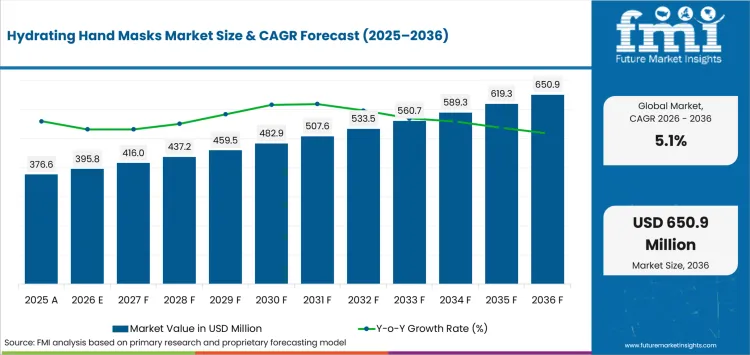
USD 395.8 million in 2026 and USD 650.9 million by 2036 at a 5.1% CAGR.
Demand for hydrating hand masks is projected to expand at 5.1% CAGR between 2026 and 2036. Valuation is projected to rise from USD 395.8 million in 2026 to USD 650.9 million by 2036. Recurring dryness gives brands a defined treatment occasion above everyday hand cream during periods of visible roughness or irritation. University Hospitals of Leicester reviewed patient guidance in November 2025 stating that hand eczema can affect about one in twenty people. The prevalence identifies a recurring hand-care problem that gives intensive moisturization a credible use occasion alongside ordinary cream.
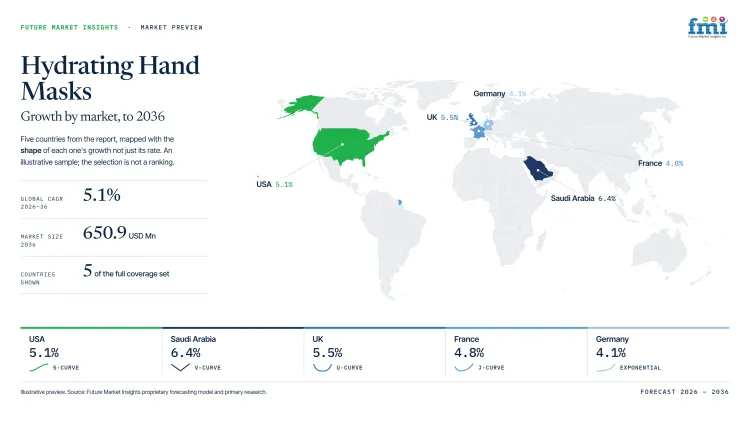
Saudi Arabia is forecast at 6.4% CAGR through 2036 compared with 5.1% for the United States across the same period. The Saudi Central Bank reported in April 2026 that electronic payments represented 85% of retail payments during 2025. That payment density reduces checkout friction for discovery-led cosmetics channels and supports faster testing of specialized hand treatments. The United States grows more steadily because established hand creams already provide a familiar substitute across mass and specialty retail.
Key Takeaways of Hand Masks Market
- Recurring dryness and repeated hand cleansing support demand for intensive hydration when ordinary hand cream does not satisfy the intended treatment occasion.
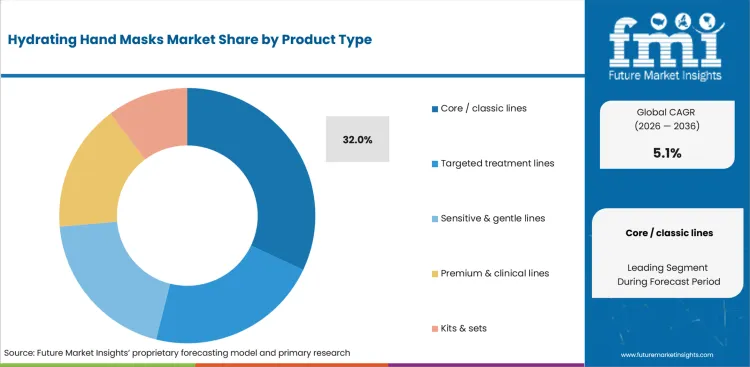
- By product type, core - classic lines are estimated to hold 32.0% in 2026 owing to familiar hydration language that lowers comparison effort.
- In 2026, conventional is expected to lead nature with 50.0% share because formulators retain wider choices across texture and fragrance.
- Cream & balm is projected to hold 28.0% share in 2026 owing to flexible dosing that fits established hand-care and overnight routines.
- Hand-cream substitution limits repeat purchases when mask wear feels inconvenient or the formula cannot justify a higher treatment price.
- Some of the key players in this market include Kao Corporation, Beiersdorf, Amorepacific, Shiseido, Estée Lauder Companies, L'Oréal, Unilever, and e.l.f. Beauty.
Analyst Perspective
“Hydrating hand masks earn repeat revenue when wear time feels useful enough to justify a separate purchase beside everyday hand cream. Brand teams should evaluate glove dexterity and dry-down beside hydration claims because inconvenience can erase the value of a stronger treatment routine.”
- Rahul Pandita, Principal Consultant, Future Market Insights
How is the Hydrating Hand Masks Market segmented?
The market is segmented by product type, nature, format, price positioning, sales channel and region.
Product type includes core - classic lines, targeted treatment lines, sensitive & gentle lines, premium & clinical lines, and kits & sets. Nature covers conventional, vegan & cruelty-free, natural & organic, dermocosmetic / clinical, and fragrance-free & sensitive. Format includes cream & balm, liquid & serum, stick & solid, spray & mist, sheet & patch, and powder. Price positioning covers mass, masstige, premium, and professional. Sales channels include e-commerce & DTC, specialty beauty retail, pharmacies & drugstores, supermarkets & hypermarkets, and salons & spas.
What makes Core - classic lines central to the Product type category?
Core - classic lines give consumers a familiar moisture proposition before brands ask them to adopt a dedicated hand-mask routine. Skin repair treatments and probiotic face masks show how intensive skin-care routines are already merchandised around defined treatment occasions.
- Based on product type, core - classic lines are projected to account for 32.0% in 2026 due to familiar care language that lowers trial friction.
- Health and Safety Executive guidance updated in June 2025 states that dry cracked skin reflects inadequate hydration and reduced barrier properties. Regular moisturization gives core treatment lines a familiar job before brands ask consumers to adopt a specialized mask format.
Why does Conventional lead the Nature category?
Conventional formulations give developers wider control over emollience and sensory finish across mass and premium price points. Vegan cosmetics and natural cosmetics attract consumers who screen ingredient or animal-testing claims before choosing a treatment format for regular use.
- In 2026, conventional is expected to lead nature with 50.0% share because broader formula latitude supports multiple price and texture positions.
- The European Union adopted Regulation (EU) 2025/877 in May 2025 to amend cosmetics rules for specified CMR substances. Formula breadth therefore carries a continuing compliance burden even when conventional positioning offers more development flexibility.
How does Cream & Balm sustain leadership in the Format category?
Hand-care users already understand cream and balm application during familiar moisture routines completed at home or before bedtime. Hydrogel mask formats and peel-off mask formats offer stronger ritual cues, yet hand treatments also need enough dexterity for practical wear.
- Cream & balm is set to lead the format category with 28.0% share in 2026 due to familiar application across short-session and overnight routines.
- Kao announced Curél Boosting Hand Care Gloves in October 2025 with a two-layer Fine Fiber structure that retains moisturizer during smartphone use. The design addresses convenience and helps richer cream routines become repeat hand-mask occasions for regular users.
What drives E-commerce & DTC in the Sales channel category?
E-commerce & DTC gives brands more room to explain wear time and replenishment than a small shelf label permits. Waterless cosmetics and beauty packaging illustrate how digital merchandising can explain unfamiliar treatment formats before trial.
- By sales channel, e-commerce & DTC is forecast to represent 27.0% in 2026 driven by product education and bundle visibility online.
- The USA Census Bureau reported in August 2026 that second-quarter e-commerce sales rose 12.2% year over year and reached 17.1% of retail sales. That channel scale supports repeated education and reorder prompts for specialized treatments that need explanation before purchase.
What are the drivers, restraints and opportunities in the Hydrating Hand Masks Market?
Recurring hand dryness supports intensive-care demand across occasions that exceed ordinary daily moisturization needs for consumers. Familiar hand cream limits repeat conversion and more wearable treatment formats provide the clearest route to additional occasions.
- Driver: Repeated washing and environmental exposure produce recurring dryness episodes that give concentrated hand treatments a defined job above daily moisturization.
- Restraint: Medical treatment boundaries and lower-cost hand creams limit how far cosmetic masks can stretch claims or pricing for persistent hand conditions.
- Opportunity: Digital prestige channels can teach unfamiliar mask routines with richer content and can test bundles without depending on limited physical shelf space.
Repeated Dryness Supports Defined Treatment Occasions
Repeated washing gives hand masks a defined escalation point above ordinary lotion during recurring care routines. The UK Health and Safety Executive reported in June 2025 that wet work and frequent soaps or cleaners account for over one quarter of work-related contact dermatitis cases. The exposure pattern places recurring moisturization inside daily skincare routines and gives intensive treatments a clear escalation point during persistent dryness.
Clinical Boundaries and Substitution Limit Repeat Conversion
Cosmetic hand masks compete near a medical boundary that restricts aggressive treatment claims for persistent symptoms. The USA Food and Drug Administration approved ANZUPGO in July 2025 for adults with moderate-to-severe chronic hand eczema after inadequate response to topical corticosteroids or unsuitable steroid use. Brands therefore need disciplined cosmetic claims and should not present intensive moisturization as a substitute for indicated medical treatment.
Digital Retail Expands Education and Replenishment Routes
Digital retail gives treatment brands enough space to explain texture and wear time before repeat purchase. FEVAD reported in February 2026 that 44.8% of French cyberbuyers purchased at least one beauty or hygiene product online during 2025. That category penetration gives hand-mask brands a practical route to test instructions and bundles before seeking wider physical distribution.
Which country CAGRs are profiled in the Hydrating Hand Masks Market?
| Country | CAGR |
|---|---|
| Saudi Arabia | 6.4% |
| UK | 5.5% |
| USA | 5.1% |
| France | 4.8% |
| Germany | 4.1% |
How do country-level CAGRs compare in the Hydrating Hand Masks Market?
The 2.3 percentage-point spread separates Saudi Arabia as the fastest-growing market from a slower European group and a mature USA endpoint. Saudi Arabia benefits from premium beauty discovery and digital retail adoption. UK and USA show moderate growth, while France and Germany reflect more established skincare markets and stronger product substitution.
- Saudi Arabia benefits from rapid mobile beauty discovery and premium skincare adoption.
- UK digital retail supports product discovery and established skincare purchasing routines.
- USA benefits from broad channel availability but faces substitution from conventional hand creams.
- France reflects mature skincare habits and gradual adoption of specialized hand treatments.
- Germany shows slower adoption as established hand-care products limit migration toward hydrating masks.
Comparable growth rates still produce different entry conditions across channel structures.
The full report provides country-level CAGR analysis across North America, Latin America, Europe, East Asia, South Asia, Oceania and the Middle East and Africa.
Country-wise Analysis
- Saudi Arabia’s beauty market is moving from social-media discovery toward app-based purchasing across imported skincare assortments and modern beauty chains. Hydrating hand mask demand is projected to expand at 6.4% CAGR through 2036, supported by digitally engaged consumers and strong interest in specialized treatments. GASTAT reported in December 2025 that the digital economy represented 16.0% of national GDP in 2024, highlighting the importance of digitally mediated retail. Imported skincare still creates assortment and education challenges. Hand masks therefore need localized instructions, clear wear-time benefits, and convenient application formats to gain broader placement across beauty chains and online marketplaces.
- UK consumers increasingly compare specialized hand treatments through drugstores, specialty beauty websites, and online marketplaces, giving brands more opportunities to communicate treatment benefits before purchase. Hydrating hand mask sales are forecast to expand at 5.5% CAGR through 2036, supported by established digital shopping and replenishment behavior. The Office for National Statistics reported in April 2026 that first-quarter online spending values were 11.7% higher than in the same quarter of 2025. Click-and-collect further supports repeat purchasing after initial digital discovery. However, mature shelf competition means hand masks must communicate convenience and stronger treatment value than conventional hand creams.
- USA demand benefits from extensive access to mass retailers, specialty beauty chains, e-commerce platforms, and direct-to-consumer channels, allowing hydrating hand masks to reach shoppers through multiple discovery routes. The market is anticipated to grow at 5.1% CAGR over the forecast period. The Food and Drug Administration reported in May 2026 more than 15,000 active cosmetic facilities and over one million active product listings, illustrating the breadth of the competitive environment. MoCRA registration also increases regulatory visibility for cosmetic market participants. Despite strong distribution access, conventional hand creams remain widely available, making differentiated treatment occasions and visible hydration benefits important for securing greater retail attention.
- France presents a mature beauty environment where consumers are familiar with targeted skincare and treatment-led product positioning. Hydrating hand mask demand is expected to develop at 4.8% CAGR through 2036 as specialized formats gain gradual acceptance across pharmacies, beauty retailers, department stores, and online channels. French shoppers typically encounter new skincare concepts through established beauty routines, which can reduce the education required for treatment products. Nevertheless, hand masks compete with established creams, balms, and intensive hand-care products. Brands can improve conversion by emphasizing concentrated hydration, simple application, and a practical treatment occasion that complements rather than replaces everyday hand-care routines.
- Germany represents the slower-growth end of the country group, with hydrating hand mask demand projected to advance at 4.1% CAGR through 2036. The market’s established skincare and hand-care infrastructure gives consumers numerous alternatives, making specialized masks more dependent on clear functional differentiation. Pharmacies, drugstores, beauty retailers, and online marketplaces provide broad access, but conventional hand creams remain deeply embedded in everyday purchasing habits. Product formats that combine intensive moisturization with short, convenient application can help encourage trial. Transparent ingredient communication, practical packaging, and credible hydration claims should support wider acceptance as brands compete for limited shelf and digital visibility.
Who are the notable companies in the Hydrating Hand Masks Market?
Kao Corporation, Beiersdorf, Amorepacific, Shiseido, Estée Lauder Companies, L'Oréal, Unilever, and e.l.f. Beauty are the notable companies serving this market.
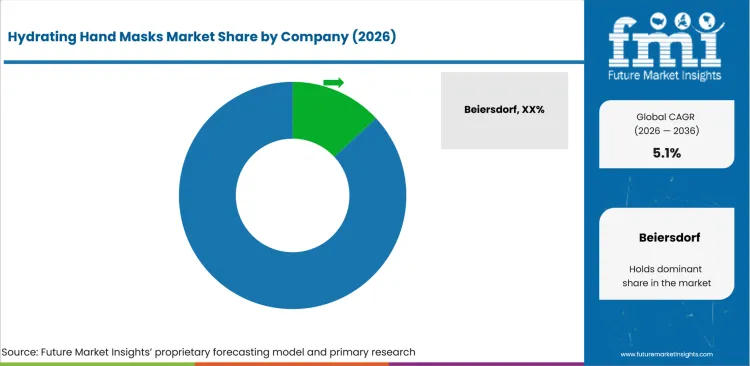
Competition spans sensitive-skin specialists and global beauty groups with different paths into hand-focused treatment across wider cosmetics portfolios. Entry barriers arise from formulation credibility and documented experience with intensive mask formats that support repeat treatment use. Retail access must also explain wear time without losing the treatment beside ordinary hand cream across crowded skin-care assortments.
- Kao Corporation and Beiersdorf bring direct dry-skin or barrier-care depth from established moisture platforms with broad consumer recognition.
- Amorepacific and Shiseido bring intensive treatment formats plus skin-care routines that translate readily into mask education across prestige channels.
- Estée Lauder Companies, L'Oréal, Unilever, and e.l.f. Beauty contribute wider beauty portfolios with strong digital or multi-channel distribution routes.
Competitive Benchmarking: Hydrating Hand Masks Market
| Company | Barrier-Care Depth | Intensive Treatment Format | Digital / Retail Access | Geographic Reach |
|---|---|---|---|---|
| Kao Corporation | High | High | Medium | Asia, Europe and North America |
| Beiersdorf | High | Medium | High | Global |
| Amorepacific | Medium | High | High | Asia, North America and Europe |
| Shiseido | High | High | High | Global |
| Estée Lauder Companies | Medium | High | High | Global |
| L'Oréal | High | High | High | Global |
| Unilever | Medium | Medium | High | Global |
| e.l.f. Beauty | Medium | Medium | High | North America, Europe and selected Gulf markets |
Scoring basis: High barrier-care depth requires multiple documented dry-skin or sensitive-skin platforms while Medium reflects one substantial adjacent platform and Low indicates limited documented depth. High intensive-treatment format requires several masks or concentrated treatment formats while Medium reflects narrower adjacency and Low identifies little verified format evidence. High digital / retail access requires verified multi-channel reach across major regions while Medium reflects narrower regional reach and Low identifies limited documented access.
Key Developments in the Hydrating Hand Masks Market
- In May 2025, e.l.f. Beauty signed a definitive agreement to acquire rhode in a transaction valued at up to USD 1.0 billion.
- In May 2025, Amorepacific announced HANYUL's USA Sephora launch online and in stores nationwide with Yuja Brightening Sleeping Mask in the opening assortment.
- In February 2025, Estée Lauder Companies entered a research partnership with Serpin Pharma to investigate anti-inflammatory technology for future cosmetic skincare applications, supporting broader innovation in treatment-focused skincare formulations.
Key Players in the Hydrating Hand Masks Market
Sensitive-Skin and Hand-Care Platforms
- Kao Corporation
- Beiersdorf
Prestige Treatment and Mask Portfolios
- Amorepacific
- Shiseido
- Estée Lauder Companies
- L'Oréal
Mass and Digital-Access Beauty Platforms
- Unilever
- e.l.f. Beauty
Hydrating Hand Masks Market - Report Scope
| Coverage field | Report scope |
|---|---|
| Market breakdown | By product type, nature, format, price positioning, sales channel and region. |
| Quantitative Units | USD Million. |
| Market Definition | Revenue includes products sold specifically as hydrating hand masks or hand-specific intensive mask treatments. Ordinary daily hand moisturizers and downstream salon service revenue are excluded. |
| Regions Covered | North America, Latin America, Western Europe, Eastern Europe, East Asia, South Asia and Pacific and Middle East and Africa. |
| Countries Covered | Saudi Arabia, UAE, South Korea, UK, USA, and 20+ additional countries included in the full report. |
| Key Companies Profiled | Kao Corporation, Beiersdorf, Amorepacific, Shiseido, Estée Lauder Companies, L'Oréal, Unilever, e.l.f. Beauty. |
| Forecast Period | 2026 to 2036. |
| Approach | Primary and secondary research with market triangulation. |
Hydrating Hand Masks Market - Research Methodology
| Method | Approach |
|---|---|
| Primary Research | FMI analysts gathered input from manufacturers, service providers, technology developers, distributors, end users, procurement teams, and subject-matter experts. Interviews examined purchasing decisions, product or service evaluation, adoption barriers, approval requirements, pricing considerations, and expectations for technical or commercial support. Respondents were also asked what evidence is required before a trial, pilot, or initial order develops into regular purchasing. |
| Desk Research | Desk research covered government statistics, regulatory publications, trade data, industry associations, technical literature, standards, company filings, product information, and official corporate announcements. Sources were reviewed for relevance, publication date, geographic coverage, and consistency with the defined market scope. Claims relating to performance, applications, approvals, capacity, investment, and commercial activity were retained only when supported by credible public evidence. |
| Market Sizing and Forecasting | The market model combined the baseline value with historical performance, segment structure, pricing and volume indicators, adoption levels, company participation, and country-level demand conditions. Forecast assumptions considered economic activity, investment trends, regulatory developments, technology adoption, purchasing cycles, supply availability, and barriers to wider market use. Segment and regional estimates were reconciled before the final market total was calculated. |
| Data Validation | Estimates were checked against multiple independent indicators, including public data, company activity, trade patterns, industry developments, and findings from primary interviews. Validation also tested whether products, services, applications, and company revenues fell within the defined market boundaries. Adjacent categories, unsupported claims, overlapping revenues, and activities without direct market relevance were excluded to reduce double counting and maintain consistency across segments and countries. |
Hydrating Hand Masks Market by Segments
Hydrating Hand Masks Market segmented by Product Type:
- Core - classic lines
- Targeted treatment lines
- Sensitive & gentle lines
- Premium & clinical lines
- Kits & sets
Hydrating Hand Masks Market segmented by Nature:
- Conventional
- Vegan & cruelty-free
- Natural & organic
- Dermocosmetic / clinical
- Fragrance-free & sensitive
Hydrating Hand Masks Market segmented by Format:
- Cream & balm
- Liquid & serum
- Stick & solid
- Spray & mist
- Sheet & patch
- Powder
Hydrating Hand Masks Market segmented by Price Positioning:
- Mass
- Masstige
- Premium
- Professional
Hydrating Hand Masks Market segmented by Sales Channel:
- E-commerce & DTC
- Specialty beauty retail
- Pharmacies & drugstores
- Supermarkets & hypermarkets
- Salons & spas
Hydrating Hand Masks Market by Region:
- North America
- United States
- Canada
- Latin America
- Brazil
- Mexico
- Argentina
- Chile
- Western Europe
- Germany
- France
- United Kingdom
- Italy
- Spain
- Benelux
- Nordics
- Eastern Europe
- Poland
- Czech Republic
- Romania
- Hungary
- East Asia
- China
- Japan
- South Korea
- South Asia and Pacific
- India
- ASEAN
- Australia and New Zealand
- Middle East and Africa
- GCC Countries
- South Africa
- Türkiye
- Israel
Research Sources and Bibliography
- Health and Safety Executive. (2025, June 17). Work-related contact dermatitis in the health services.
- Saudi Central Bank. (2026, April 12). E-Payments Account for 85% of Total Retail Payments in 2025.
- Health and Safety Executive. (2025, June 4). Skin at Work - Frequently asked questions.
- European Union. (2025, May 13). Commission Regulation (EU) 2025/877 of 12 May 2025 amending Regulation (EC) No 1223/2009 of the European Parliament and of the Council as regards the use in cosmetic products of certain substances classified as carcinogenic, mutagenic or toxic for reproduction.
- Kao Corporation. (2025, October 8). Curél Unveils Boosting Hand Care Gloves and Boosting Heel Care Socks Featuring Kao’s Fine Fiber Technology.
- USA Census Bureau. (2026, August 18). Quarterly Retail E-Commerce Sales Report.
- University Hospitals of Leicester NHS Trust. (2025, November 18). Treating and preventing hand eczema (hand dermatitis).
- USA Food and Drug Administration. (2025, July 23). Approval Package for: Anzupgo cream, 2%.
- FEVAD. (2026, February 4). Classement FEVAD 2025 des sites e-commerce en nombre de clients.
- General Authority for Statistics, Saudi Arabia. (2025, December 31). “GASTAT” Digital economy’s share of Saudi Arabia’s GDP reaches 16.0% in 2024.
- Telecommunications and Digital Government Regulatory Authority, UAE. (2026, May 18). The UAE continues its leadership in digital transformation: More than 11 million users on the official UAE Government platform.
- Ministry of Data and Statistics, Republic of Korea. (2026, August 3). Online Shopping in June 2026.
- Office for National Statistics. (2026, April 24). Retail sales, Great Britain: March 2026.
- USA Food and Drug Administration. (2026, May 4). How FDA is Implementing Landmark Cosmetics Legislation to Positively Impact Public Health.
- Amorepacific. (2025, May 8). HANYUL Exclusively Launches at Sephora, Bringing Authentic Korean Beauty to USA Consumers.
- The Estée Lauder Companies. (2025, February 26). The Estée Lauder Companies Partners with Serpin Pharma, Inc to Develop Breakthrough Skin Care Ingredients to Advance Longevity.
- e.l.f. Beauty. (2025, May 28). e.l.f. Beauty Announces Definitive Agreement to Acquire rhode in $1 Billion Deal.
- Kao Corporation. (2025, June 13). Kao Releases the Kao Integrated Report 2025.
- Beiersdorf. (2026, March 2). Full year results 2025: Beiersdorf grows in a slowing market, Derma outperforms.
- Amorepacific. (2026, February 6). Amorepacific Group 2025 Earnings Summary.
- Shiseido Company. (2026, April 27). Integrated Report 2025.
- The Estée Lauder Companies. (2025, August 20). The Estée Lauder Companies Reports Fiscal 2025 Results.
- L’Oréal. (2026, February 12). 2025 Annual Results.
- Unilever. (2026, February 12). Focus and execution drive competitive performance.
- e.l.f. Beauty. (2026, May 20). e.l.f. Beauty Announces Fourth Quarter Fiscal 2026 Results.
- L’Oréal. (2025, June 9). L’Oréal Groupe to acquire a majority stake in Medik8.
- Unilever. (2025, January 22). HUL to acquire premium beauty brand Minimalist.
- e.l.f. Beauty. (2026, April 30). rhode Continues Its Global Retail Expansion Into Sephora Europe.
- Kao Corporation. (2026, June 2). Kao Accelerates Skin Care Growth in EMEA with Launch of Japan’s Leading Sensitive Skincare Brand Curél in the Netherlands.
- Beiersdorf. (2025, August 13). Beiersdorf brings epigenetic innovation to the mass market: NIVEA serum featuring skin rejuvenation ingredient EPICELLINE®.
- Amorepacific. (2026, March 9). AESTURA Announces Official Launch at Sephora Across 17 European Countries.
- Shiseido Company. (2025, January 22). Backed by world-leading skin research, SHISEIDO’s iconic ULTIMUNE is a serum reborn - to slow the skin aging cycle.
- The Estée Lauder Companies. (2025, August 11). Clinique Launches in the Amazon.com.mx Premium Beauty Store.
This bibliography is provided for reader reference and is not exhaustive. The full report contains the complete reference list and detailed citations.
This Report Answers
- What are the 2026 and 2036 values?
- What supports intensive hand hydration demand?
- Why do core - classic lines lead?
- Why does conventional positioning lead?
- Why does cream & balm lead?
- How do country CAGRs compare?
- Which companies have barrier-care depth?
- What limits repeat hand-mask purchases?
Frequently Asked Questions
How big is the Hydrating Hand Masks Market in 2026?
The hydrating hand masks market is valued at USD 395.8 million in 2026 and is projected to reach USD 650.9 million by 2036. Recurring dryness and longer-contact treatment occasions support demand beyond routine hand cream during repeated dryness episodes.
What is the CAGR of the Hydrating Hand Masks Market from 2026 to 2036?
The hydrating hand masks market is projected to grow at a CAGR of 5.1% between 2026 and 2036. Repeat hydration routines and digital beauty discovery support expansion across mass and specialty retail channels.
Which product type leads the Hydrating Hand Masks Market?
The core - classic lines segment is expected to hold 32.0% of the hydrating hand masks market in 2026, driven by familiar hydration language. Familiar care positioning reduces comparison effort against standard hand cream during trial and replenishment decisions.
Which format leads the Hydrating Hand Masks Market?
The cream & balm segment is expected to hold 28.0% of the hydrating hand masks market in 2026, supported by flexible dosing. Short-session and overnight use fit familiar hand-care behavior while keeping format education manageable across retail.
Which countries are projected to record the highest growth in the Hydrating Hand Masks Market?
Saudi Arabia is projected to grow at 6.4% CAGR, followed by the UAE at 6.1% and South Korea at 5.8% through 2036. Digital beauty discovery and mobile purchasing routes support faster category testing across these three markets.
Which companies are active in the Hydrating Hand Masks Market?
Key companies operating in the market include Kao Corporation, Beiersdorf, Amorepacific, Shiseido, Estée Lauder Companies, L'Oréal, Unilever, and e.l.f. Beauty. Their positions differ across barrier-care expertise and treatment-format depth with broad digital or retail reach.
Preview the report firsthand - request a free sample
Get SampleGet the brochure for pricing and purchase details.
Get PDFTable of Content
- Key Takeaways
- Market Size and CAGR
- Top Growth Driver
- Fastest Growing Segment
- Leading Region
- Key Companies
- Emerging Opportunities
- Executive Summary
- Global Market Outlook
- Demand-side Trends
- Supply-side Trends
- Technology Roadmap Analysis
- Analysis and Recommendations
- Analyst Perspective (What is happening? Why now? What should investors know?)
- Key Questions Answered
- How large is the market?
- What is the CAGR?
- What are key trends?
- Which region dominates?
- Who are the leaders?
- Market Overview
- Market Coverage / Taxonomy
- Market Definition / Scope / Limitations
- Research Methodology
- Chapter Orientation
- Analytical Lens and Working Hypotheses
- Market Structure, Signals, and Trend Drivers
- Benchmarking and Cross-market Comparability
- Market Sizing, Forecasting, and Opportunity Mapping
- Research Design and Evidence Framework
- Desk Research Programme (Secondary Evidence)
- Expert Input and Fieldwork (Primary Evidence)
- Tooling, Models, and Reference Databases
- Data Engineering and Model Build
- Quality Assurance and Audit Trail
- Market Background
- Market Dynamics (Drivers, Restraints, Opportunity, Trends)
- Scenario Forecast (Optimistic, Likely, Conservative)
- Impact Analysis
- AI Impact
- Sustainability Impact
- Regulatory Impact
- Technology Impact
- Consumer / Buyer Analysis
- Purchase Drivers
- Adoption Barriers
- Buyer Journey
- Opportunity Map Analysis
- Product Life Cycle Analysis
- Supply Chain Analysis
- Investment Feasibility Matrix
- Value Chain Analysis
- PESTLE and Porter's Analysis
- Regulatory Landscape
- Regional Parent Market Outlook
- Production and Consumption Statistics
- Import and Export Statistics
- Global Market Analysis and Forecast, 2021 to 2036
- Historical Market Size Value (USD Million) Analysis, 2021 to 2025
- Current and Future Market Size Value (USD Million) Projections, 2026 to 2036
- Y-o-Y Growth Trend Analysis
- Absolute $ Opportunity Analysis
- Global Market Pricing Analysis, 2021 to 2036
- Global Market Analysis and Forecast, By Product Type, 2021 to 2036
- Introduction / Key Findings
- Historical Market Size Value (USD Million) Analysis By Product Type, 2021 to 2025
- Current and Future Market Size Value (USD Million) Analysis and Forecast By Product Type, 2026 to 2036
- Core / classic lines
- Targeted treatment lines
- Sensitive & gentle lines
- Premium & clinical lines
- Kits & sets
- Core / classic lines
- Y-o-Y Growth Trend Analysis By Product Type, 2021 to 2025
- Absolute $ Opportunity Analysis By Product Type, 2026 to 2036
- Global Market Analysis and Forecast, By Nature, 2021 to 2036
- Introduction / Key Findings
- Historical Market Size Value (USD Million) Analysis By Nature, 2021 to 2025
- Current and Future Market Size Value (USD Million) Analysis and Forecast By Nature, 2026 to 2036
- Conventional
- Vegan & cruelty-free
- Natural & organic
- Dermocosmetic / clinical
- Fragrance-free & sensitive
- Conventional
- Y-o-Y Growth Trend Analysis By Nature, 2021 to 2025
- Absolute $ Opportunity Analysis By Nature, 2026 to 2036
- Global Market Analysis and Forecast, By Format, 2021 to 2036
- Introduction / Key Findings
- Historical Market Size Value (USD Million) Analysis By Format, 2021 to 2025
- Current and Future Market Size Value (USD Million) Analysis and Forecast By Format, 2026 to 2036
- Cream & balm
- Liquid & serum
- Stick & solid
- Spray & mist
- Sheet & patch
- Powder
- Cream & balm
- Y-o-Y Growth Trend Analysis By Format, 2021 to 2025
- Absolute $ Opportunity Analysis By Format, 2026 to 2036
- Global Market Analysis and Forecast, By Price Positioning, 2021 to 2036
- Introduction / Key Findings
- Historical Market Size Value (USD Million) Analysis By Price Positioning, 2021 to 2025
- Current and Future Market Size Value (USD Million) Analysis and Forecast By Price Positioning, 2026 to 2036
- Mass
- Masstige
- Premium
- Professional
- Mass
- Y-o-Y Growth Trend Analysis By Price Positioning, 2021 to 2025
- Absolute $ Opportunity Analysis By Price Positioning, 2026 to 2036
- Global Market Analysis and Forecast, By Sales Channel, 2021 to 2036
- Introduction / Key Findings
- Historical Market Size Value (USD Million) Analysis By Sales Channel, 2021 to 2025
- Current and Future Market Size Value (USD Million) Analysis and Forecast By Sales Channel, 2026 to 2036
- E-commerce & DTC
- Specialty beauty retail
- Pharmacies & drugstores
- Supermarkets & hypermarkets
- Salons & spas
- E-commerce & DTC
- Y-o-Y Growth Trend Analysis By Sales Channel, 2021 to 2025
- Absolute $ Opportunity Analysis By Sales Channel, 2026 to 2036
- Global Market Analysis and Forecast, By Region, 2021 to 2036
- Introduction
- Historical Market Size Value (USD Million) Analysis By Region, 2021 to 2025
- Current Market Size Value (USD Million) Analysis and Forecast By Region, 2026 to 2036
- North America
- Latin America
- Western Europe
- Eastern Europe
- East Asia
- South Asia and Pacific
- Middle East & Africa
- Market Attractiveness Analysis By Region
- North America Market Analysis and Forecast, By Country, 2021 to 2036
- Historical Market Size Value (USD Million) Trend Analysis By Market Taxonomy, 2021 to 2025
- Market Size Value (USD Million) Forecast By Market Taxonomy, 2026 to 2036
- By Country
- USA
- Canada
- By Product Type
- By Nature
- By Format
- By Price Positioning
- By Sales Channel
- By Country
- Market Attractiveness Analysis
- By Country
- By Product Type
- By Nature
- By Format
- By Price Positioning
- By Sales Channel
- Key Takeaways
- Latin America Market Analysis and Forecast, By Country
- Historical Market Size Value (USD Million) Trend Analysis By Market Taxonomy, 2021 to 2025
- Market Size Value (USD Million) Forecast By Market Taxonomy, 2026 to 2036
- By Country
- Brazil
- Mexico
- Chile
- Rest of Latin America
- By Product Type
- By Nature
- By Format
- By Price Positioning
- By Sales Channel
- By Country
- Market Attractiveness Analysis
- By Country
- By Product Type
- By Nature
- By Format
- By Price Positioning
- By Sales Channel
- Key Takeaways
- Western Europe Market Analysis and Forecast, By Country
- Historical Market Size Value (USD Million) Trend Analysis By Market Taxonomy, 2021 to 2025
- Market Size Value (USD Million) Forecast By Market Taxonomy, 2026 to 2036
- By Country
- Germany
- UK
- Italy
- Spain
- France
- Nordic
- BENELUX
- Rest of Western Europe
- By Product Type
- By Nature
- By Format
- By Price Positioning
- By Sales Channel
- By Country
- Market Attractiveness Analysis
- By Country
- By Product Type
- By Nature
- By Format
- By Price Positioning
- By Sales Channel
- Key Takeaways
- Eastern Europe Market Analysis and Forecast, By Country
- Historical Market Size Value (USD Million) Trend Analysis By Market Taxonomy, 2021 to 2025
- Market Size Value (USD Million) Forecast By Market Taxonomy, 2026 to 2036
- By Country
- Russia
- Poland
- Hungary
- Balkan & Baltic
- Rest of Eastern Europe
- By Product Type
- By Nature
- By Format
- By Price Positioning
- By Sales Channel
- By Country
- Market Attractiveness Analysis
- By Country
- By Product Type
- By Nature
- By Format
- By Price Positioning
- By Sales Channel
- Key Takeaways
- East Asia Market Analysis and Forecast, By Country
- Historical Market Size Value (USD Million) Trend Analysis By Market Taxonomy, 2021 to 2025
- Market Size Value (USD Million) Forecast By Market Taxonomy, 2026 to 2036
- By Country
- China
- Japan
- South Korea
- By Product Type
- By Nature
- By Format
- By Price Positioning
- By Sales Channel
- By Country
- Market Attractiveness Analysis
- By Country
- By Product Type
- By Nature
- By Format
- By Price Positioning
- By Sales Channel
- Key Takeaways
- South Asia and Pacific Market Analysis and Forecast, By Country
- Historical Market Size Value (USD Million) Trend Analysis By Market Taxonomy, 2021 to 2025
- Market Size Value (USD Million) Forecast By Market Taxonomy, 2026 to 2036
- By Country
- India
- ASEAN
- Australia & New Zealand
- Rest of South Asia and Pacific
- By Product Type
- By Nature
- By Format
- By Price Positioning
- By Sales Channel
- By Country
- Market Attractiveness Analysis
- By Country
- By Product Type
- By Nature
- By Format
- By Price Positioning
- By Sales Channel
- Key Takeaways
- Middle East & Africa Market Analysis and Forecast, By Country
- Historical Market Size Value (USD Million) Trend Analysis By Market Taxonomy, 2021 to 2025
- Market Size Value (USD Million) Forecast By Market Taxonomy, 2026 to 2036
- By Country
- Kingdom of Saudi Arabia
- Other GCC Countries
- Türkiye
- South Africa
- Other African Union
- Rest of Middle East & Africa
- By Product Type
- By Nature
- By Format
- By Price Positioning
- By Sales Channel
- By Country
- Market Attractiveness Analysis
- By Country
- By Product Type
- By Nature
- By Format
- By Price Positioning
- By Sales Channel
- Key Takeaways
- Key Countries Market Analysis
- USA
- Pricing Analysis
- Market Share Analysis, 2025
- By Product Type
- By Nature
- By Format
- By Price Positioning
- By Sales Channel
- Canada
- Pricing Analysis
- Market Share Analysis, 2025
- By Product Type
- By Nature
- By Format
- By Price Positioning
- By Sales Channel
- Mexico
- Pricing Analysis
- Market Share Analysis, 2025
- By Product Type
- By Nature
- By Format
- By Price Positioning
- By Sales Channel
- Brazil
- Pricing Analysis
- Market Share Analysis, 2025
- By Product Type
- By Nature
- By Format
- By Price Positioning
- By Sales Channel
- Chile
- Pricing Analysis
- Market Share Analysis, 2025
- By Product Type
- By Nature
- By Format
- By Price Positioning
- By Sales Channel
- Germany
- Pricing Analysis
- Market Share Analysis, 2025
- By Product Type
- By Nature
- By Format
- By Price Positioning
- By Sales Channel
- UK
- Pricing Analysis
- Market Share Analysis, 2025
- By Product Type
- By Nature
- By Format
- By Price Positioning
- By Sales Channel
- Italy
- Pricing Analysis
- Market Share Analysis, 2025
- By Product Type
- By Nature
- By Format
- By Price Positioning
- By Sales Channel
- Spain
- Pricing Analysis
- Market Share Analysis, 2025
- By Product Type
- By Nature
- By Format
- By Price Positioning
- By Sales Channel
- France
- Pricing Analysis
- Market Share Analysis, 2025
- By Product Type
- By Nature
- By Format
- By Price Positioning
- By Sales Channel
- India
- Pricing Analysis
- Market Share Analysis, 2025
- By Product Type
- By Nature
- By Format
- By Price Positioning
- By Sales Channel
- ASEAN
- Pricing Analysis
- Market Share Analysis, 2025
- By Product Type
- By Nature
- By Format
- By Price Positioning
- By Sales Channel
- Australia & New Zealand
- Pricing Analysis
- Market Share Analysis, 2025
- By Product Type
- By Nature
- By Format
- By Price Positioning
- By Sales Channel
- China
- Pricing Analysis
- Market Share Analysis, 2025
- By Product Type
- By Nature
- By Format
- By Price Positioning
- By Sales Channel
- Japan
- Pricing Analysis
- Market Share Analysis, 2025
- By Product Type
- By Nature
- By Format
- By Price Positioning
- By Sales Channel
- South Korea
- Pricing Analysis
- Market Share Analysis, 2025
- By Product Type
- By Nature
- By Format
- By Price Positioning
- By Sales Channel
- Russia
- Pricing Analysis
- Market Share Analysis, 2025
- By Product Type
- By Nature
- By Format
- By Price Positioning
- By Sales Channel
- Poland
- Pricing Analysis
- Market Share Analysis, 2025
- By Product Type
- By Nature
- By Format
- By Price Positioning
- By Sales Channel
- Hungary
- Pricing Analysis
- Market Share Analysis, 2025
- By Product Type
- By Nature
- By Format
- By Price Positioning
- By Sales Channel
- Kingdom of Saudi Arabia
- Pricing Analysis
- Market Share Analysis, 2025
- By Product Type
- By Nature
- By Format
- By Price Positioning
- By Sales Channel
- Türkiye
- Pricing Analysis
- Market Share Analysis, 2025
- By Product Type
- By Nature
- By Format
- By Price Positioning
- By Sales Channel
- South Africa
- Pricing Analysis
- Market Share Analysis, 2025
- By Product Type
- By Nature
- By Format
- By Price Positioning
- By Sales Channel
- USA
- Market Structure Analysis
- Competition Dashboard
- Competition Benchmarking
- Market Share Analysis of Top Players
- By Regional
- By Product Type
- By Nature
- By Format
- By Price Positioning
- By Sales Channel
- Emerging Startups
- Innovation Benchmarking
- Competition Analysis
- Competition Deep Dive
- Beiersdorf
- Overview
- Product Portfolio
- Profitability by Market Segments
- Sales Footprint
- Strategy Overview
- Marketing Strategy
- Product Strategy
- Channel Strategy
- Amorepacific
- Estee Lauder Companies
- Shiseido
- Unilever
- Coty
- Procter & Gamble
- Kao Corporation
- L'Oreal
- e.l.f. Beauty
- Beiersdorf
- Case Studies
- Success Stories
- Recent Developments
- Competition Deep Dive
- Assumptions & Acronyms Used


