

- Market Size (2026)
- USD 12.1 Bn
- Forecast (2036)
- USD 21.7 Bn
- CAGR (2026 to 2036)
- 6.0%
How big is Hydrocolloids & Plant-Based Gummy Stabilizers Market in 2026?
USD 12.1 billion in 2026 and USD 21.7 billion by 2036 at a 6.0% CAGR.
Demand for hydrocolloids & plant-based gummy stabilizers is projected to expand industry valuation from USD 12.1 billion in 2026 to USD 21.7 billion by 2036 at a 6.0% CAGR, supported by wider use of plant-based texture systems. Plant-based gummy stabilizers create commercial value by controlling gel strength and water binding in acidic confectionery recipes. In March 2026, Tate & Lyle extended a partnership covering citrus-pulp co-products from its German pectin facility. The agreement provides consistent off-take for those co-products and lets the company focus on its core food-ingredient offering. The partnership gives the food hydrocolloids operation a defined route for residual material beside the core ingredient business.
Product developers must balance chew and flavor release against high acid loads in reduced-sugar recipes. National approval systems also change documentation requirements for ingredient declarations and each commercial product launch. Even well-designed food stabilizer systems can behave differently as solids concentration and depositing temperature change during production. In March 2025, Cargill introduced a cost-focused pectin replacer for gummies and jellies at AAHAR in India. The launch gives local confectionery producers another route to lower ingredient expense and retain familiar jelly-processing equipment. Commercial adoption requires repeatable texture across full batches and clear declarations under local food rules. Plant operators must also protect molding speed so lower ingredient cost does not create more rework or longer cooling.
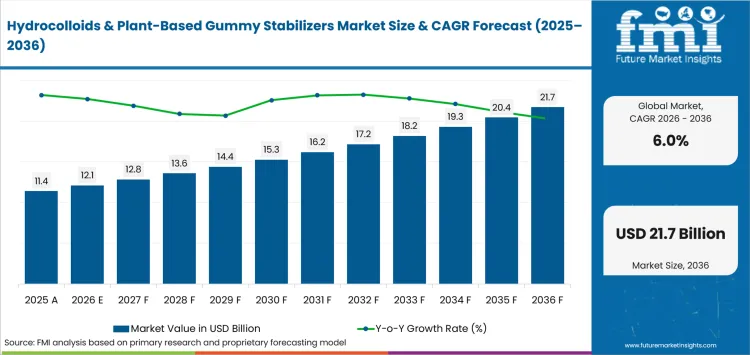
Key Takeaways of Hydrocolloids & Plant-Based Gummy Stabilizers Market
- Demand for hydrocolloids and plant-based gummy stabilizers is driven by producers requiring stable gel formation across acidic and reduced-sugar recipes carrying concentrated active ingredients.
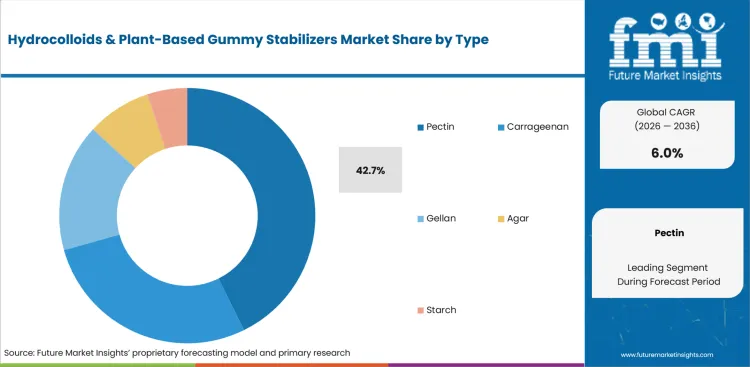
- By type, pectin holds the leading share at 42.7% in 2026, due to adjustable gel strength across vegan gummy recipes, with high-methoxyl and low-methoxyl grades serving different sugar-acid and reduced-sugar formulation needs.
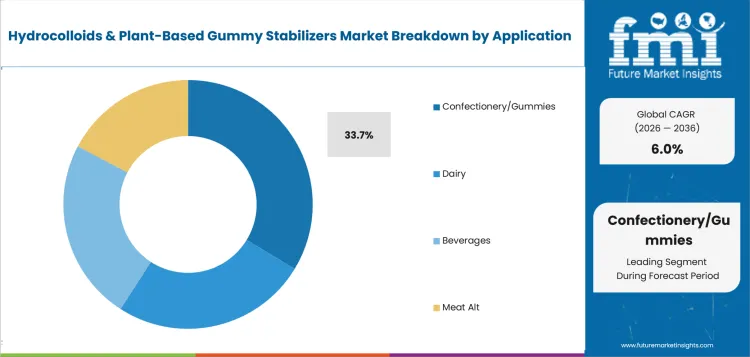
- Confectionery/gummies lead the application category at 33.7% share in 2026, attributable to strict texture and storage requirements across functional gummy recipes.
- Carrageenan and gellan support elastic or suspended textures distinct from pectin systems, while agar and starch remain relevant for plant-based formats using familiar cooking or molding equipment.
- Small changes in pH and solids content can alter gel timing and create production losses, making process sensitivity the main barrier to reliable scale-up despite growing functional gummy demand.
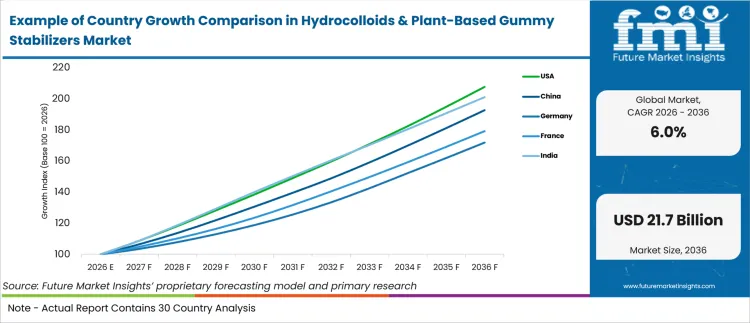
- India, China, and the USA record CAGRs of 7.2%, 6.8%, and 6.4% respectively through 2036, while France and Germany offer established production bases under different legal and cost conditions.
- Competition centers on IFF, Tate & Lyle, Cargill, Ingredion, Roquette, CEAMSA, Nexira, and Herbstreith & Fox, with vendors differentiating through pectin and specialty-gum portfolios, starch-based cost/sugar-reduction systems, and natural-gum expertise for specialized texture problems.
Analyst Perspective
Pectin's dominant share owes as much to formulation flexibility as gel strength, since producers can shift between high-methoxyl and low-methoxyl grades to handle sugar-acid systems or reduced-sugar recipes without rebuilding the depositing process each time a recipe changes. The real qualification risk sits in active-ingredient loading, not the base gel: a recipe carrying concentrated minerals or microencapsulated actives can pass bench trials and still fail at commercial line speed if mineral dispersion or particle size wasn't validated under the full active load. Buyers evaluating pilot-scale results should treat them as a starting point rather than proof of scale-up readiness, since gel timing shifts with acid sequence and depositing temperature in ways that only show up once production volume and warm-climate distribution conditions enter the picture.
-Nandini Roy Choudhury, Principal Analyst at Future Market Insights
Source: FMI's proprietary forecasting model and primary research
How is the Hydrocolloids & Plant-Based Gummy Stabilizers Market segmented?
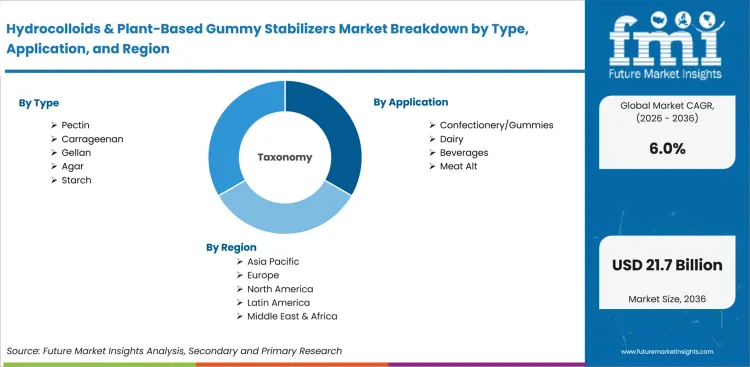
The hydrocolloids & plant-based gummy stabilizers market is segmented by type, application, and region.
Type analysis separates pectin and carrageenan from gellan systems and from agar or starch systems used for gel formation or stability. Application analysis covers confectionery and gummies alongside dairy beverages and meat alternatives under distinct processing conditions. Regional analysis compares approval routes and formulation capacity across North America and Europe alongside major Asian manufacturing bases. The framework groups ingredients by operating function rather than botanical origin alone during commercial evaluation. It also explains why pectin formulations need different validation across acidic gummies and broader food systems. Gummy producers therefore compare setting behavior and processing tolerance alongside technical support during each commercial qualification program.
What supports demand for pectin within the type category?
Pectin-based confectionery ingredients create clear plant-derived gels and controlled flavor release across fruit and functional gummies. In April 2026, Lubrizol presented a scale-ready sugar-free pectin gummy containing 100 mg of microencapsulated curcumin per serving. The concept shows that pectin can carry concentrated actives within a plant-based reduced-sugar format during commercial development. Commercial trials must confirm chew and storage stability across the final acid level and full active load.
- Pectin is set to lead the type with 42.7% share in 2026 due to adjustable gel strength across vegan gummy recipes. High-methoxyl grades fit sugar-acid systems and provide familiar setting behavior across established commercial production lines. Low-methoxyl grades support reduced-sugar products through controlled calcium activation across several commercial gummy recipe designs. Gummy producers can change grade and dosage without rebuilding the complete depositing process for new products.
- Gummy producers adopt pectin to replace animal gelatin and preserve fruit flavor with a clean bite. Blended stabilizer systems gain value as minerals and botanical actives change pH or gel timing in concentrated recipes. Full-scale trials must reproduce the final active load under normal temperatures and planned commercial line speeds. Full-scale evidence prevents strong bench results from hiding weak release or storage performance during regional distribution.
How do confectionery/gummies shape demand within the application category?
Gummy production exposes stabilizers to concentrated sweeteners and acids together with vitamins or minerals that can weaken gel formation. In June 2026, IFF launched Danisco Grindsted DuoGel across EMEA for low-pH fruit-based gummy production. The pectin and carrageenan system targets elastic chew with improved melt resistance and lower surface stickiness. Commercial recipes therefore need coordinated control of solids and setting conditions across production and warm-climate distribution.
- Confectionery/gummies are likely to capture 33.7% share in 2026 attributable to strict texture and storage requirements across functional gummy recipes. Commercial lines need gels that release cleanly from molds and preserve bite during regional distribution. Application-specific gum combinations maintain those properties across acidic formulas and warmer regional commercial storage conditions. Precise depositing also reduces mold-release failures during longer commercial production runs with concentrated active ingredients.
- Plant-based gummy producers favor hydrocolloid systems that carry active ingredients without adding long cooling or drying stages. Food texturing agents support faster mold release and steadier texture across repeated commercial production batches. Each commercial recipe needs validation against local labeling rules and the intended regional storage profile. Pilot trials must show that cooling time remains practical at the planned line speed and throughput level.
What are the drivers, restraints, and opportunities in the Hydrocolloids & Plant-Based Gummy Stabilizers Market?
Plant-based format expansion and recipe reformulation support demand across functional gummy production, but process sensitivity and local approvals slow substitution. Flexible pilot lines create a commercial opening by testing complete recipes under realistic conditions ahead of full production.
- Driver: Functional gummy recipes require stabilizers that consistently maintain texture despite acids and concentrated active ingredients.
- Restraint: Small changes in pH and solids content can alter gel timing and create production losses.
- Opportunity: Flexible hydrocolloid pilot lines can connect laboratory validation with controlled industrial implementation ahead of customer scale-up.
Concentrated minerals create direct demand as supplement brands place meaningful nutrient loads inside compact gummy servings. In July 2025, Jungbunzlauer introduced a finer magnesium citrate granulation designed for smoother texture and improved processing in pectin gummies. The development shows how active particle size can affect chew separately from the selected commercial gelling system. Carrageenan systems can provide elastic textures, but mineral dispersion remains a different formulation task during high-volume depositing.
Hydrocolloid performance changes with acid sequence and depositing temperature, making process sensitivity the main barrier to reliable scale-up. In April 2025, the Food Standards Agency changed Great Britain’s authorization process for regulated products and retained safety review. New stabilizer ingredients therefore need formulation evidence together with the relevant authorization route ahead of commercial sale. Launch timing can lengthen if a recipe introduces an additive that lacks current authorization in the target category.
Pilot infrastructure creates an opportunity by connecting laboratory validation with industrial process development for natural hydrocolloid systems. In April 2025, CEAMSA announced the FABRINTYSO project for a flexible digital pilot line with process modelling and validation. Gummy developers can use comparable facilities to test setting behavior and traceability under realistic production conditions. Commercial value appears through repeatable plant settings rather than digital modelling alone during qualification at full production scale.
Which country CAGRs are profiled in the Hydrocolloids & Plant-Based Gummy Stabilizers Market?
| Country | CAGR |
|---|---|
| USA | 6.4% |
| China | 6.8% |
| Germany | 5.6% |
| France | 6.0% |
| India | 7.2% |
How do country-level CAGRs compare in the Hydrocolloids & Plant-Based Gummy Stabilizers Market?
India and China form the upper growth band among the five profiled markets with a 0.4-point difference. The USA follows China by another 0.4 points and France matches the 6.0% global forecast. Germany closes the comparison and creates a 1.6-point spread from India across the complete country set. The narrow range reflects measured differences in commercialization pace rather than completely different demand conditions.
- India and China form the upper growth cluster despite different food-approval systems and application-support networks across both countries.
- The USA follows China by 0.4 points as reformulation deadlines support technical work without guaranteeing immediate stabilizer replacement.
- France matches the global forecast and follows a distinct compliance route through national confectionery rules alongside shared European additive permissions.
- Germany trails France by 0.4 points as established confectionery output supports demand amid pressure on premium formulation spending.
- The 1.6-point range requires commercial sequencing that considers scale-up support and documented ingredient acceptance alongside forecast growth.
Markets with similar CAGRs can present different entry conditions through local regulation and formulation capacity. The full report provides country-level analysis across North America and Latin America together with Europe and East Asia. Coverage also includes South Asia and Oceania together with the Middle East and Africa across the complete regional framework.
Country-wise Analysis
- Gummy producers in the United States face a federal reformulation deadline for products that contain FD&C Red No. 3. The FDA revoked the color authorization in January 2025 and set January 15, 2027 as the food-manufacturer deadline. The rule does not create stabilizer demand directly, but recipe changes can reopen texture validation across established gummy lines. Hydrocolloids & plant-based gummy stabilizer sales in the United States are forecast to expand at 6.4% CAGR by 2036, supported by established confectionery capacity and a defined reformulation window. The deadline gives confectionery companies time to coordinate color changes with acid and texture trials. Repeated validation across active loads and storage conditions remains the main friction during commercial reformulation.
- Gummy recipes in China enter commercial sale through a formal review route for new food ingredients and additive varieties. The hydrocolloids & plant-based gummy stabilizers sector in China is projected to record 6.8% CAGR during the assessment period, linked to approved lower-sugar ingredients and large food-manufacturing capacity. In July 2025, the National Health Commission published approvals covering five new food ingredients and nine new additive varieties. D-allulose was included and gives product developers an approved route for lower-sugar gummies under stated use conditions. The review system enables formulation work through a clear legal route for newly approved ingredients and additives. Strict limits on permitted use and labeling remain the main friction for each commercial launch.
- Confectionery producers in Germany can source pectin from a domestic plant connected with Tate & Lyle's wider production network. In September 2025, Tate & Lyle marked 75 years of pectin production at its Großenbrode facility. Adoption of plant-based gummy stabilizers in Germany is estimated to expand at 5.6% CAGR through 2036, reinforced by domestic pectin output and established formulation knowledge. The operating site gives local manufacturers a nearby source of commercial pectin for repeated scale-up trials. Price pressure remains a material friction and forces premium pectin systems to outperform starch or blended alternatives. Product teams should compare batch consistency with total recipe cost across reduced-sugar and vitamin-enriched gummies.
- Confectionery recipes in France operate under national product rules in areas without fully harmonized European legislation. Hydrocolloids & plant-based gummy stabilizer demand in France is forecast to rise at 6.0% CAGR over the forecast period, shaped by specialty confectionery production and established food manufacturing. In April 2025, the Directorate General for Enterprise updated its confectionery guidance and restated the mutual-recognition route. Mutual recognition can support regional sale for products already marketed lawfully in another European Union country. National definitions and dossier-transfer requirements remain a material friction across several coordinated multi-country launch plans. Product developers should confirm category status early and align ingredient declarations with the intended distribution route.
- Gummy companies in India planning a vegan claim must prepare for a revised official logo requirement from July 1, 2027. In May 2026, FSSAI issued the Vegan Foods Amendment Regulations and specified an updated package logo. The hydrocolloids & plant-based gummy stabilizers outlook in India is set to advance at 7.2% CAGR over the assessment period, aided by a clearer vegan-label route and expanding confectionery use. The amendment gives gelatin-free gummy developers a defined packaging route for plant-derived stabilizer systems. Approval records and compliance documentation remain a material friction for smaller companies with limited regulatory staff. Product teams should align texture trials with approval work and packaging changes across each planned launch.
Who are the notable companies in the Hydrocolloids & Plant-Based Gummy Stabilizers Market?
IFF, Tate & Lyle, Cargill, Ingredion, Roquette, Nexira, CEAMSA, and Herbstreith & Fox are the notable companies shaping this market.
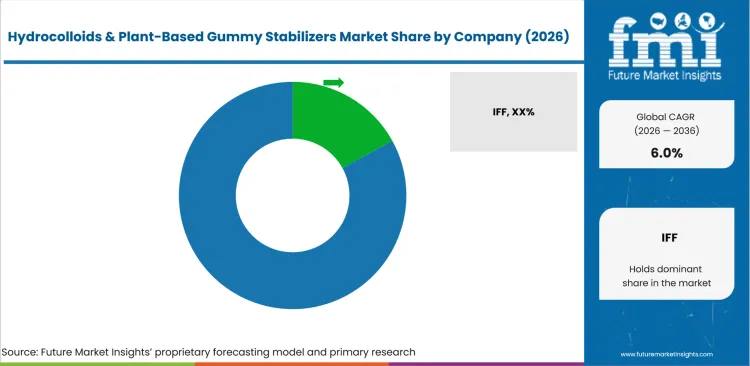
The competitive outlook combines broad gum portfolios with specialized pectin knowledge and regional application support. In May 2026, Tate & Lyle reported that CP Kelco integration was complete and its cross-selling pipeline had more than doubled during the second half. Cargill and Ingredion connect starch systems with confectionery development across reduced-sugar and value-focused commercial recipes. Integrated food ingredients increase competition as food companies compare texture with sweetening and fiber functions during one reformulation program. Smaller specialists compete through focused gummy knowledge and faster technical response across regional production sites.
- IFF and Tate & Lyle provide multi-hydrocolloid systems for plant-based gummy formulation and regional commercial scale-up. IFF combines pectin with carrageenan for low-pH gummy products across EMEA manufacturing and regional distribution. Tate & Lyle combines pectin and carrageenan with gellan through a wider commercial ingredient mouthfeel portfolio. Their commercial strength depends on reliable texture across different production lines and regional labeling conditions.
- Cargill and Ingredion use starch technologies in gummy concepts focused on cost control and sugar reduction. Roquette adds plant-based starch systems with current gummy formulation guidance and pilot support in China. CEAMSA contributes pectin and carrageenan together with locust bean gum for specialized commercial gummy development. Their competitive position depends on linking texture choices with familiar equipment and practical scale-up support for manufacturers.
- Nexira and Herbstreith & Fox focus on natural gums and narrower texture problems across specialized food applications. Nexira supplies acacia and locust bean gums through a global network supported by Moroccan production. Herbstreith & Fox concentrates on pectin systems designed for soft or chewy commercial functional gummy textures. Their narrower offers compete through focused application knowledge and direct technical response across specialized formulation programs.
Competitive Benchmarking: Hydrocolloids & Plant-Based Gummy Stabilizers Market
| Company | Hydrocolloid Portfolio | Gummy Formulation Support | Application and Regulatory Support | Geographic Reach |
|---|---|---|---|---|
| IFF | Medium | High | Medium | EMEA commercialization |
| Tate & Lyle | High | High | High | Global |
| Cargill | Low | High | Medium | India commercialization |
| Ingredion | Low | High | Medium | North America program |
| Roquette | Low | Medium | Medium | China pilot support with global formulation resources |
| Nexira | Medium | Low | Medium | Global network with Moroccan production |
| CEAMSA | High | High | Medium | Global technical and commercial network |
| Herbstreith & Fox | Low | High | Medium | Europe and selected export markets |
Key Developments in the Hydrocolloids & Plant-Based Gummy Stabilizers Market
- In July 2025, Tate & Lyle presented a dual-texture gummy lollipop with a pectin exterior and a carrageenan-supported aerated center. The prototype showed how separate gel networks can create different sensory layers within one confectionery format. Plant-based gummy developers can use this design to add texture contrast and manage sugar reduction through familiar processing requirements. The concept also demonstrates how two hydrocolloids can divide structural roles inside one scalable product design.
- In July 2025, Ingredion showcased multitextural gummies with plant-based and clean-label positioning during its IFT FIRST program. The concepts connected sugar reduction with a layered chew rather than treating texture as a secondary outcome. Starch and stabilizer combinations can support differentiated sensory profiles without forcing a complete change in depositing or molding equipment. The program gives confectionery teams a practical route for testing texture choices beside nutrition and label targets.
- In July 2026, Nexira announced its acquisition of Keragum and secured direct access to Moroccan carob raw materials and modern processing capacity. The transaction expands Nexira’s natural hydrocolloid position through locust bean gum with stronger origin-level traceability. Greater raw-material control can improve continuity for food developers that depend on consistent carob-gum quality. The acquisition also links commercial gum sales with production assets located closer to the underlying raw-material source.
- In April 2025, CEAMSA published sugar-free gummy supplement formulas built around controlled texture and production performance. The formulations cover vitamins and minerals together with protein or customized functional dietary supplement applications. The development gives supplement companies a direct commercial reference for plant-based gummies that require long-term stability without conventional sugar levels. It also connects texture control with several active-load profiles instead of presenting one narrow demonstration recipe.
Key Players in the Hydrocolloids & Plant-Based Gummy Stabilizers Market
Global Hydrocolloid and Texture Groups
- IFF
- Tate & Lyle
- Cargill
Integrated Formulation and Application Groups
- Ingredion
- Roquette
- CEAMSA
Specialized Plant-Derived Gum Companies
- Nexira
- Herbstreith & Fox
Hydrocolloids & Plant-Based Gummy Stabilizers Market - Report Scope
| Coverage field | Report scope |
|---|---|
| Market breakdown | type and application across regional markets. |
| Quantitative Units | USD Billion, CAGR in %. |
| Market Definition | Revenue from food-grade hydrocolloids and stabilizer systems used to create or maintain texture in plant-based gummies and the named food applications. |
| Regions Covered | North America, Latin America, Europe, East Asia, South Asia, Oceania, and Middle East and Africa. |
| Countries Covered | USA, China, Germany, France, and India along with more than twenty-five additional countries across the regions covered. |
| Key Companies Profiled | IFF, Tate & Lyle, Cargill, Ingredion, Roquette, Nexira, CEAMSA, and Herbstreith & Fox |
| Forecast Period | 2026 to 2036. |
| Approach | Hybrid bottom-up and top-down market sizing supported by primary interviews and official desk research. |
Hydrocolloids & Plant-Based Gummy Stabilizers Market - Research Methodology
| Method | Approach |
|---|---|
| Primary Research | FMI analysts gathered input from manufacturers, service providers, technology developers, distributors, end users, sourcing teams, and subject-matter experts. Interviews examined purchasing decisions, product or service evaluation, adoption barriers, approval requirements, pricing considerations, and expectations for technical or commercial support. Respondents were also asked what evidence is required before a trial, pilot, or initial order develops into regular purchasing. |
| Desk Research | Desk research covered government statistics, regulatory publications, trade data, industry associations, technical literature, standards, company filings, product information, and official corporate announcements. Sources were reviewed for relevance, publication date, geographic coverage, and consistency with the defined market scope. Claims relating to performance, applications, approvals, capacity, investment, and commercial activity were retained only when supported by credible public evidence. |
| Market Sizing and Forecasting | The market model combined the baseline value with historical performance, segment structure, pricing and volume indicators, adoption levels, company participation, and country-level demand conditions. Forecast assumptions considered economic activity, investment trends, regulatory developments, technology adoption, purchasing cycles, supply availability, and barriers to wider market use. Segment and regional estimates were reconciled before the final market total was calculated. |
| Data Validation | Estimates were checked against multiple independent indicators, including public data, company activity, trade patterns, industry developments, and findings from primary interviews. Validation also tested whether products, services, applications, and company revenues fell within the defined market boundaries. Adjacent categories, unsupported claims, overlapping revenues, and activities without direct market relevance were excluded to reduce double counting and maintain consistency across segments and countries. |
Hydrocolloids & Plant-Based Gummy Stabilizers Market by Segments
Hydrocolloids & Plant-Based Gummy Stabilizers Market segmented by type:
- Pectin
- Carrageenan
- Gellan
- Agar
- Starch
Hydrocolloids & Plant-Based Gummy Stabilizers Market segmented by application:
- Confectionery/Gummies
- Dairy
- Beverages
- Meat Alt
Hydrocolloids & Plant-Based Gummy Stabilizers Market by region:
- North America
- United States
- Canada
- Latin America
- Brazil
- Mexico
- Argentina
- Chile
- Western Europe
- Germany
- France
- United Kingdom
- Italy
- Spain
- Benelux
- Nordics
- Eastern Europe
- Poland
- Czech Republic
- Romania
- Hungary
- East Asia
- China
- Japan
- South Korea
- South Asia and Pacific
- India
- ASEAN
- Australia and New Zealand
- Middle East and Africa
- GCC Countries
- South Africa
- Türkiye
- Israel
Research Sources and Bibliography
- Tate & Lyle. (2026, March 30). Tate & Lyle and Van Triest CirQlar extend partnership to advance circular food systems.
- Cargill. (2025, March 4). Cargill Showcases Full Range of Innovative Food Solutions at AAHAR 2025.
- Lubrizol. (2026, April 9). Lubrizol showcases Curcushine gummy concept at Vitafoods Europe.
- IFF. (2026, June 23). IFF launches first-of-its-kind stabilizer system in Europe, the Middle East and Africa.
- Jungbunzlauer. (2025, July 10). Jungbunzlauer showcases bioavailable mineral innovations for Gummies at IFT FIRST 2025.
- Food Standards Agency. (2025, April 1). Reforms to the market authorisation process for regulated products come into force.
- CEAMSA. (2025, April 29). Fabrintyso: Our new multifunctional, connected, and sustainable pilot plant.
- USA Food and Drug Administration. (2025, January 15). FDA to Revoke Authorization for the Use of Red No. 3 in Food and Ingested Drugs.
- National Health Commission of the People’s Republic of China. (2025, July 2). 关于D-阿洛酮糖等20种“三新食品”的公告.
- Tate & Lyle. (2025, September 4). 75 years of pectin innovation at our plant in Großenbrode.
- Direction générale des Entreprises. (2024, October 14; updated 2025, April 15). Produits de la confiserie et de la sucrerie.
- Food Safety and Standards Authority of India. (2026, May 21). Food Safety and Standards (Vegan Foods) Amendment Regulations, 2026.
- Tate & Lyle. (2026, May 21). Tate & Lyle PLC: Results for the Year Ended 31 March 2026.
- Tate & Lyle. (2025, July 7). Tate & Lyle debuts expanded portfolio and mouthfeel leadership at IFT FIRST 2025.
- Ingredion. (2025, July 22). Ingredion at IFT FIRST 2025 - Connecting texture, health and innovation.
- Nexira. (2026, July 9). Nexira acquiert Keragum.
- Roquette. (2026, July 20). Plant-based gummies.
- Roquette. (2026, April 6). Roquette Inaugurates its New Pilot Center at Lianyungang.
- Herbstreith & Fox. (2024, October 17). Soft & chewy textures in gummy confectionery - Perfect adjustment with H&F Pectin.
- CEAMSA. (2025, April 29). Gummy Supplements: Innovative Sugar-Free Solutions with Perfect Texture.
- CEAMSA. (2025, July 18). CEAMSA at IFT FIRST 2025: Innovation with Texturizing Solutions.
This bibliography is provided for reader reference and is not exhaustive. The full report contains the complete reference list and detailed citations.
This Report Answers
- How large is the hydrocolloids & plant-based gummy stabilizers market in 2026 and 2036?
- Which formulation pressures support investment in plant-based gummy stabilizers?
- Why is pectin projected to hold the largest type share in 2026?
- How do confectionery/gummies influence hydrocolloid qualification and purchasing?
- How do country growth rates compare across the USA, China, Germany, France, and India?
- Which companies combine hydrocolloid production with application and regulatory support?
- What process conditions limit reliable scale-up across acidic and reduced-sugar recipes?
- How do current regulations influence gummy reformulation across major countries?
- Which commercial tests should manufacturers complete ahead of approving broader supply?
Frequently Asked Questions
How big is the Hydrocolloids & Plant-Based Gummy Stabilizers Market in 2026?
The hydrocolloids and plant-based gummy stabilizers market is valued at USD 12.1 billion in 2026 and is forecast to reach USD 21.7 billion by 2036. Growth reflects plant-based gummy stabilizers creating value by controlling gel strength and water binding in acidic confectionery recipes worldwide.
What is the CAGR of the Hydrocolloids & Plant-Based Gummy Stabilizers Market from 2026 to 2036?
The hydrocolloids and plant-based gummy stabilizers market grows at a CAGR of 6.0% between 2026 and 2036, supported by functional gummy recipes requiring stabilizers that consistently maintain texture despite acids and concentrated active ingredients.
Which type leads the Hydrocolloids & Plant-Based Gummy Stabilizers Market?
Pectin accounts for 42.7% of the hydrocolloids and plant-based gummy stabilizers market by type in 2026, due to adjustable gel strength across vegan gummy recipes that lets producers change grade and dosage without rebuilding depositing processes.
How much will the Hydrocolloids & Plant-Based Gummy Stabilizers Market add between 2026 and 2036?
The hydrocolloids and plant-based gummy stabilizers market is set to add USD 9.6 billion between 2026 and 2036, growing from USD 12.1 billion to USD 21.7 billion as plant-derived texture systems extend across a widening base of confectionery and functional gummy applications.
Who are the leading companies in the Hydrocolloids & Plant-Based Gummy Stabilizers Market?
Five companies lead the hydrocolloids and plant-based gummy stabilizers market, including IFF, Tate & Lyle, Cargill, Ingredion, and Roquette, competing through pectin and specialty-gum portfolios, starch-based confectionery systems, and regional formulation support.
Preview the report firsthand - request a free sample
Get SampleGet the brochure for pricing and purchase details.
Get PDFTable of Content
- Key Takeaways
- Market Size and CAGR
- Top Growth Driver
- Fastest Growing Segment
- Leading Region
- Key Companies
- Emerging Opportunities
- Executive Summary
- Global Market Outlook
- Demand-side Trends
- Supply-side Trends
- Technology Roadmap Analysis
- Analysis and Recommendations
- Analyst Perspective (What is happening? Why now? What should investors know?)
- Key Questions Answered
- How large is the market?
- What is the CAGR?
- What are key trends?
- Which region dominates?
- Who are the leaders?
- Market Overview
- Market Coverage / Taxonomy
- Market Definition / Scope / Limitations
- Research Methodology
- Chapter Orientation
- Analytical Lens and Working Hypotheses
- Market Structure, Signals, and Trend Drivers
- Benchmarking and Cross-market Comparability
- Market Sizing, Forecasting, and Opportunity Mapping
- Research Design and Evidence Framework
- Desk Research Programme (Secondary Evidence)
- Expert Input and Fieldwork (Primary Evidence)
- Tooling, Models, and Reference Databases
- Data Engineering and Model Build
- Quality Assurance and Audit Trail
- Market Background
- Market Dynamics (Drivers, Restraints, Opportunity, Trends)
- Scenario Forecast (Optimistic, Likely, Conservative)
- Impact Analysis
- AI Impact
- Sustainability Impact
- Regulatory Impact
- Technology Impact
- Consumer / Buyer Analysis
- Purchase Drivers
- Adoption Barriers
- Buyer Journey
- Opportunity Map Analysis
- Product Life Cycle Analysis
- Supply Chain Analysis
- Investment Feasibility Matrix
- Value Chain Analysis
- PESTLE and Porter's Analysis
- Regulatory Landscape
- Regional Parent Market Outlook
- Production and Consumption Statistics
- Import and Export Statistics
- Global Market Analysis and Forecast, 2021 to 2036
- Historical Market Size Value (USD Billion) Analysis, 2021 to 2025
- Current and Future Market Size Value (USD Billion) Projections, 2026 to 2036
- Y-o-Y Growth Trend Analysis
- Absolute $ Opportunity Analysis
- Global Market Pricing Analysis, 2021 to 2036
- Global Market Analysis and Forecast, By Type, 2021 to 2036
- Introduction / Key Findings
- Historical Market Size Value (USD Billion) Analysis By Type, 2021 to 2025
- Current and Future Market Size Value (USD Billion) Analysis and Forecast By Type, 2026 to 2036
- Pectin
- Carrageenan
- Gellan
- Agar
- Starch
- Pectin
- Y-o-Y Growth Trend Analysis By Type, 2021 to 2025
- Absolute $ Opportunity Analysis By Type, 2026 to 2036
- Global Market Analysis and Forecast, By Application, 2021 to 2036
- Introduction / Key Findings
- Historical Market Size Value (USD Billion) Analysis By Application, 2021 to 2025
- Current and Future Market Size Value (USD Billion) Analysis and Forecast By Application, 2026 to 2036
- Confectionery/Gummies
- Dairy
- Beverages
- Meat Alt
- Confectionery/Gummies
- Y-o-Y Growth Trend Analysis By Application, 2021 to 2025
- Absolute $ Opportunity Analysis By Application, 2026 to 2036
- Global Market Analysis and Forecast, By Region, 2021 to 2036
- Introduction
- Historical Market Size Value (USD Billion) Analysis By Region, 2021 to 2025
- Current Market Size Value (USD Billion) Analysis and Forecast By Region, 2026 to 2036
- North America
- Latin America
- Western Europe
- Eastern Europe
- East Asia
- South Asia and Pacific
- Middle East & Africa
- Market Attractiveness Analysis By Region
- North America Market Analysis and Forecast, By Country, 2021 to 2036
- Historical Market Size Value (USD Billion) Trend Analysis By Market Taxonomy, 2021 to 2025
- Market Size Value (USD Billion) Forecast By Market Taxonomy, 2026 to 2036
- By Country
- USA
- Canada
- By Type
- By Application
- By Country
- Market Attractiveness Analysis
- By Country
- By Type
- By Application
- Key Takeaways
- Latin America Market Analysis and Forecast, By Country
- Historical Market Size Value (USD Billion) Trend Analysis By Market Taxonomy, 2021 to 2025
- Market Size Value (USD Billion) Forecast By Market Taxonomy, 2026 to 2036
- By Country
- Brazil
- Mexico
- Chile
- Rest of Latin America
- By Type
- By Application
- By Country
- Market Attractiveness Analysis
- By Country
- By Type
- By Application
- Key Takeaways
- Western Europe Market Analysis and Forecast, By Country
- Historical Market Size Value (USD Billion) Trend Analysis By Market Taxonomy, 2021 to 2025
- Market Size Value (USD Billion) Forecast By Market Taxonomy, 2026 to 2036
- By Country
- Germany
- UK
- Italy
- Spain
- France
- Nordic
- BENELUX
- Rest of Western Europe
- By Type
- By Application
- By Country
- Market Attractiveness Analysis
- By Country
- By Type
- By Application
- Key Takeaways
- Eastern Europe Market Analysis and Forecast, By Country
- Historical Market Size Value (USD Billion) Trend Analysis By Market Taxonomy, 2021 to 2025
- Market Size Value (USD Billion) Forecast By Market Taxonomy, 2026 to 2036
- By Country
- Russia
- Poland
- Hungary
- Balkan & Baltic
- Rest of Eastern Europe
- By Type
- By Application
- By Country
- Market Attractiveness Analysis
- By Country
- By Type
- By Application
- Key Takeaways
- East Asia Market Analysis and Forecast, By Country
- Historical Market Size Value (USD Billion) Trend Analysis By Market Taxonomy, 2021 to 2025
- Market Size Value (USD Billion) Forecast By Market Taxonomy, 2026 to 2036
- By Country
- China
- Japan
- South Korea
- By Type
- By Application
- By Country
- Market Attractiveness Analysis
- By Country
- By Type
- By Application
- Key Takeaways
- South Asia and Pacific Market Analysis and Forecast, By Country
- Historical Market Size Value (USD Billion) Trend Analysis By Market Taxonomy, 2021 to 2025
- Market Size Value (USD Billion) Forecast By Market Taxonomy, 2026 to 2036
- By Country
- India
- ASEAN
- Australia & New Zealand
- Rest of South Asia and Pacific
- By Type
- By Application
- By Country
- Market Attractiveness Analysis
- By Country
- By Type
- By Application
- Key Takeaways
- Middle East & Africa Market Analysis and Forecast, By Country
- Historical Market Size Value (USD Billion) Trend Analysis By Market Taxonomy, 2021 to 2025
- Market Size Value (USD Billion) Forecast By Market Taxonomy, 2026 to 2036
- By Country
- Kingdom of Saudi Arabia
- Other GCC Countries
- Türkiye
- South Africa
- Other African Union
- Rest of Middle East & Africa
- By Type
- By Application
- By Country
- Market Attractiveness Analysis
- By Country
- By Type
- By Application
- Key Takeaways
- Key Countries Market Analysis
- USA
- Pricing Analysis
- Market Share Analysis, 2025
- By Type
- By Application
- Canada
- Pricing Analysis
- Market Share Analysis, 2025
- By Type
- By Application
- Mexico
- Pricing Analysis
- Market Share Analysis, 2025
- By Type
- By Application
- Brazil
- Pricing Analysis
- Market Share Analysis, 2025
- By Type
- By Application
- Chile
- Pricing Analysis
- Market Share Analysis, 2025
- By Type
- By Application
- Germany
- Pricing Analysis
- Market Share Analysis, 2025
- By Type
- By Application
- UK
- Pricing Analysis
- Market Share Analysis, 2025
- By Type
- By Application
- Italy
- Pricing Analysis
- Market Share Analysis, 2025
- By Type
- By Application
- Spain
- Pricing Analysis
- Market Share Analysis, 2025
- By Type
- By Application
- France
- Pricing Analysis
- Market Share Analysis, 2025
- By Type
- By Application
- India
- Pricing Analysis
- Market Share Analysis, 2025
- By Type
- By Application
- ASEAN
- Pricing Analysis
- Market Share Analysis, 2025
- By Type
- By Application
- Australia & New Zealand
- Pricing Analysis
- Market Share Analysis, 2025
- By Type
- By Application
- China
- Pricing Analysis
- Market Share Analysis, 2025
- By Type
- By Application
- Japan
- Pricing Analysis
- Market Share Analysis, 2025
- By Type
- By Application
- South Korea
- Pricing Analysis
- Market Share Analysis, 2025
- By Type
- By Application
- Russia
- Pricing Analysis
- Market Share Analysis, 2025
- By Type
- By Application
- Poland
- Pricing Analysis
- Market Share Analysis, 2025
- By Type
- By Application
- Hungary
- Pricing Analysis
- Market Share Analysis, 2025
- By Type
- By Application
- Kingdom of Saudi Arabia
- Pricing Analysis
- Market Share Analysis, 2025
- By Type
- By Application
- Türkiye
- Pricing Analysis
- Market Share Analysis, 2025
- By Type
- By Application
- South Africa
- Pricing Analysis
- Market Share Analysis, 2025
- By Type
- By Application
- USA
- Market Structure Analysis
- Competition Dashboard
- Competition Benchmarking
- Market Share Analysis of Top Players
- By Regional
- By Type
- By Application
- Emerging Startups
- Innovation Benchmarking
- Competition Analysis
- Competition Deep Dive
- IFF
- Overview
- Product Portfolio
- Profitability by Market Segments
- Sales Footprint
- Strategy Overview
- Marketing Strategy
- Product Strategy
- Channel Strategy
- CP Kelco
- Cargill
- Ingredion
- Kerry
- Tate & Lyle
- Nexira
- Palsgaard
- IFF
- Case Studies
- Success Stories
- Recent Developments
- Competition Deep Dive
- Assumptions & Acronyms Used


