

- Market Size (2026)
- USD 302.6 Mn
- Forecast (2036)
- USD 784.9 Mn
- CAGR (2026 to 2036)
- 10.0%
How big is Hydrolyzed Protein Inputs Market in 2026?
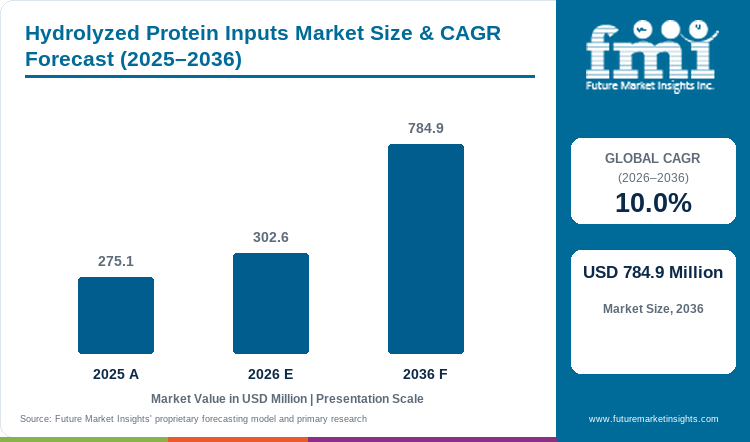
USD 302.6 million in 2026 and USD 784.9 million by 2036, expanding at 10.0% CAGR.
Sales of hydrolyzed protein inputs are estimated to rise at 10.0% CAGR through 2036, increasing valuation from USD 275.1 million in 2025 to USD 302.6 million in 2026, and reaching USD 784.9 million by 2036. Growers want products that work with crop feeding steps already in place. In May 2026 Bioiberica described Terra-Sorb granum for broadacre tank mixes. It combines free L-alpha amino acids with sulfur and micronutrients. The single-pass route can cut extra field work during trials. Product makers still need a stable mix from batch to batch. They also need clear crop doses before a trial becomes a regular order.
Country rules change how sellers move these products into farm use. Japan's agriculture ministry issued a national label guide in May 2025. It also held an information exchange in March 2026. The UK opened a 2026 review of fertilizer rules for new products. Japanese sellers now work with a clear guide for labels and proof. UK sellers must plan while new rules remain under review. Country growth depends on how fast field proof becomes accepted product information.
Key Takeaways
- Higher nutrient costs support peptide and amino-acid products that work with crop feeding steps already in use.
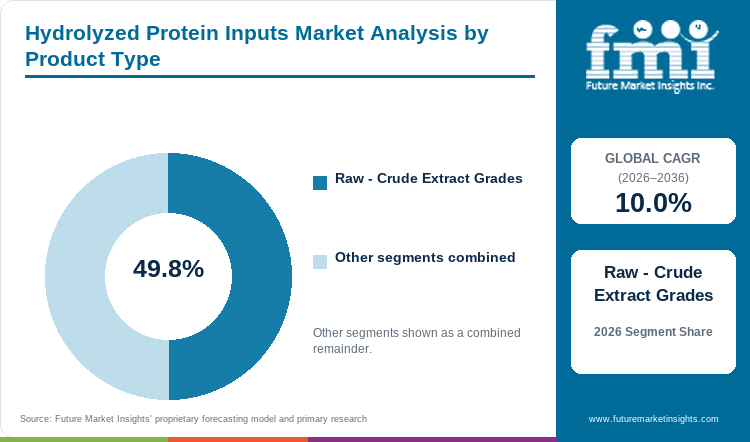
- By product type, Raw - Crude Extract Grades are projected to account for 49.8% in 2026, supported by use in many finished products.
- Cereals & Grains are estimated to hold 37.2% of crop type demand in 2026, influenced by large acreage and per-hectare costs.
- In 2026, Soil Application is expected to lead application method with 36.1% share, tied to familiar root-zone feeding steps.
- Changes in raw material or protein breakdown can extend testing because crop results must stay stable from one batch to another.
- Some of the key players in this market include Hello Nature, SICIT Group, Bioiberica, Rovensa Next, Clariant, Agro-Sorb, Coromandel International, and Southern Petrochemical Industries Corporation (SPIC).
Analyst Perspective
"Buyers now want proof that an ingredient works in a clear crop plan. Suppliers that control protein breakdown and ease field tests can turn that proof into regular orders."
- Nandini Roy Choudhury, Principal Consultant, Future Market Insights
How is the hydrolyzed protein inputs market segmented?
Hydrolyzed Protein Inputs Market is segmented by Product Type, Crop Type, Application Method, Farm Type, Sales Channel, and Region. Forecast period from 2026 to 2036.
The market has five main ways to group demand plus region. Product type includes Raw - Crude Extract Grades, Refined & Standardized Fractions, Formulated End-Use Blends, and Others. Crop type includes Cereals & Grains, Fruits & Vegetables, Oilseeds & Pulses, Turf & Ornamentals, and Others. Application method includes Soil Application, Foliar Application, Fertigation - Drip, Seed Application, and Others. Farm type covers Large Commercial Farms, Mid-Size Farms, Smallholders, Greenhouses & Nurseries, and Others. Sales channel covers Agri-Input Distributors, Cooperatives, Agri-Retail Chains, Online - Direct-to-Farm, and Others.
What supports Raw - Crude Extract Grades within the product type category?
Raw - Crude Extract Grades let product makers choose peptide strength and carrier type. SICIT says it breaks collagen into short peptides and amino acids for farm use. Product makers can use that base in several biostimulant formulations. They can set the strength and delivery form for each crop. Each final blend still needs dose, storage, and field tests before sale.
- Based on product type, Raw - Crude Extract Grades are projected to account for 49.8% in 2026, supported by use in several finished products.
- Batch checks matter because the protein mix can change with raw material or with the way the protein is broken down.
Why do Cereals & Grains shape crop type demand?
Large farms judge new crop products by cost per acre and simple use. In May 2026 Bioiberica described a broadacre product for one-pass tank mixes. It combines free amino acids with micronutrients for farm use. The same cost test also affects specialty fertilizers used in these crop programs. Clear dose steps matter because a small cost or yield change grows fast over large acreage.
- By crop type, Cereals & Grains are estimated to hold 37.2% in 2026, influenced by large acreage and clear per-hectare cost tests.
- USDA reported in February 2024 that oilseed and grain farms used 32% of US farmland, giving suppliers a large base for field trials.
How does Soil Application influence application method selection?
Soil Application puts the product close to plant roots and can avoid a separate spray pass. Growers can add it to current feeding plans and irrigation. The route also links with fertigation monitoring when irrigation controls nutrient delivery. The product must stay stable in the carrier. Dose steps must also be easy to follow. These checks decide whether the simpler work flow holds up in routine farm use.
- In 2026, Soil Application is expected to lead application method with 36.1% share, tied to root-zone delivery and familiar nutrition routines.
- A 2026 Phyton review found that results can change with source material, protein breakdown, crop conditions, and the way the product is applied.
What makes Large Commercial Farms important within the farm type category?
Large farms can spread trial costs over many acres. USDA said farms with at least USD 1 million in sales made up 6% of US farms and 31% of farmland. These farms can test one product on many fields before wider use. A small cost per acre also grows fast at that scale. Managers therefore need plot data and a clear use plan before they add a product to normal field work.
- Large Commercial Farms are likely to capture 44.3% of farm type demand in 2026, supported by acreage that can justify formal trials.
- Large crop programs favor products with a stable mix and clear steps that farm managers can repeat on many fields.
Why do Agri-Input Distributors matter within the sales channel category?
Agri-Input Distributors turn product data and dose steps into local crop advice. Their crop advisers also answer tank-mix questions about fertilizers and agricultural adjuvants. SICIT sells protein-hydrolysate products to business customers that need clear product notes. Simple documents help distributors train staff and support farm accounts. They also reduce the need for custom advice on every order.
- Agri-Input Distributors are set to lead sales channel with 41.4% share in 2026, linked to local crop advice and product availability.
- Distributor training matters when dose and timing can change the field result. Tank-mix use can also affect whether results match the approved recommendation.
What are the drivers, restraints and opportunities in the Hydrolyzed Protein Inputs Market?
Input-cost pressure is tightening the value test, variable hydrolysis can delay qualification, and standardized fractions can reduce formulation work.
- Driver: Growers are testing products that protect nutrient use without adding another hard field task.
- Restraint: Changes in raw material or protein breakdown can force more crop tests before repeat use.
- Opportunity: More consistent peptide and amino-acid products can cut the work needed to make crop-ready blends.
Farm input costs are making growers question each added crop product. Defra said UK farm input prices were 6.1% higher in August 2026 than one year earlier. Fertilizers and soil improvers made the largest upward contribution at 2.6 percentage points. Growers now compare a new biological input with the value of current feed programs. Each hydrolyzed protein dose needs a clear job in the crop plan. Fertilizer additives also need to work with current handling steps. Field teams prefer products that use the same spray or irrigation pass. Orders slow when sellers cannot show a clear cost per acre.
Repeat results are the main test before regular use. A 2026 review by Starr and co-authors found that results change with source material and the protein breakdown method. Crop type and field conditions can also change the outcome. Product makers must test each input in the crop and use method named on the label. Buyers need enough data to judge batch quality and likely field response. Trials take longer when the product record does not explain these limits. A weak record can also narrow the crop or dose range. Orders wait until the field result can be repeated.
More uniform products can turn a flexible raw input into a crop-ready product. Refined fractions give product makers more control over peptide and amino-acid content. Finished blends can add clear dose and tank-mix steps. EU rules require plant-biostimulant claims to match named effects and use notes. That rule raises the value of stable product data. biofertilizers face the same need for clear use conditions. Sellers can cut customer test work by pairing stable batches with crop proof. They can earn more value when buyers need fewer checks before repeat use.
Which country CAGRs are profiled in the Hydrolyzed Protein Inputs Market?
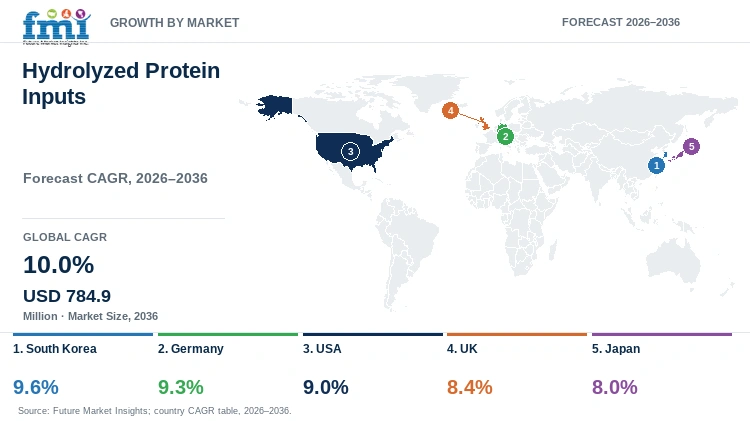
| Country | CAGR |
|---|---|
| South Korea | 9.6% |
| Germany | 9.3% |
| USA | 9.0% |
| UK | 8.4% |
| Japan | 8.0% |
How do country-level CAGRs compare in the Hydrolyzed Protein Inputs Market?
South Korea and Germany form the upper forecast group, with the USA close behind. The UK and Japan grow more slowly. The 1.6-point range is small, so proof rules and farm costs can matter more than CAGR.
- South Korea’s fertilizer-support programs keep input efficiency and return on investment central to farm purchasing decisions.
- Germany’s extensive cereal cultivation supports recurring field trials and performance validation for crop-nutrition products.
- In the USA, regulatory treatment often depends on product claims, increasing the importance of substantiated performance evidence.
- The UK’s evolving fertilizer policy framework keeps emerging crop-nutrition products under active regulatory review.
- Japan’s biostimulant guidance framework places greater emphasis on clear labeling, documented benefits, and product transparency.
Similar CAGRs can still produce different buying conditions because crop scale and claim rules vary by country. Channel support also changes how fast sellers can turn field proof into repeat orders. The full report provides country-level CAGR analysis across North America, Latin America, Western Europe, Eastern Europe, East Asia, South Asia and Pacific, and the Middle East and Africa.
Country-wise Analysis
- Farm input costs are a clear issue for South Korean growers in 2026. South Korea is projected to record 9.6% CAGR through 2036, influenced by the need to protect value from each fertilizer dollar. Water-soluble fertilizers and amino-acid inputs compete for the same crop budget. MAFRA began extra fertilizer price aid in June 2026. The ministry said the aid covered 80% of the price rise. That support keeps input cost in every product review. Hydrolyzed protein sellers still need local crop trials because price aid does not prove field results. Distributors need simple proof before they can support repeat farm orders.
- Germany has a large cereal base that supports repeat field tests and seasonal advice. Germany is projected to grow at 9.3% CAGR through 2036, supported by broad cereal acreage and active crop-input sales. Destatis put the 2026 cereal area at 6.03 million hectares. Winter wheat including spelt covered 2.9 million hectares of land. Distributors often compare these inputs with crop micronutrients used in the same cereal plans. Large rotations expose weak batch or dose results quickly. EU biostimulant claim rules add another proof step. Suppliers can scale a program after results stay stable between farms and seasons.
- US suppliers face a legal line that can change the route for plant-response products. USA is forecast to expand at 9.0% CAGR through 2036, shaped by large farm acreage and product claims. EPA says biostimulants are not named as a separate class under FIFRA. Some plant-regulator claims can make a product subject to pesticide rules. The same line affects plant growth regulators sold beside crop-nutrition products. Large farms can fund trials but expose weak costs quickly. Suppliers need claims that match product use and field data that justify the added cost. Clear labels can speed distributor review without replacing crop proof.
- UK farm advisers are testing new inputs while fertilizer rules are being rewritten. UK is estimated to post 8.4% CAGR over the forecast period, supported by farm-cost pressure and rule changes. Defra opened its UK FPR consultation in March 2026. The agency received 83 responses before the June close. The proposals include new and novel fertilizer products. Suppliers of organic fertilizer and amino-acid inputs need clear product notes without broad claims. Growers still compare each added input with current nutrition budgets. Simple dose and use notes can reduce needless review work.
- Japan now has national guidance on what biostimulant labels should tell growers. Japan is estimated to post 8.0% CAGR over the forecast period, reinforced by clearer rules for proof and use. MAFF issued its biostimulant label guide in May 2025. The ministry also held an information exchange in March 2026. The guide covers product definitions plus proof for effects and safety. Crop-specific proof is easier to explain than broad benefit claims. Local distributors still need simple dose and use notes for each crop. Clear technical files can cut repeat review during channel onboarding.
Who are the notable companies in the Hydrolyzed Protein Inputs Market?
Hello Nature, SICIT Group, Bioiberica, Rovensa Next, Clariant, Agro-Sorb, Coromandel International, Southern Petrochemical Industries Corporation (SPIC) are active within the defined hydrolyzed protein input boundary.
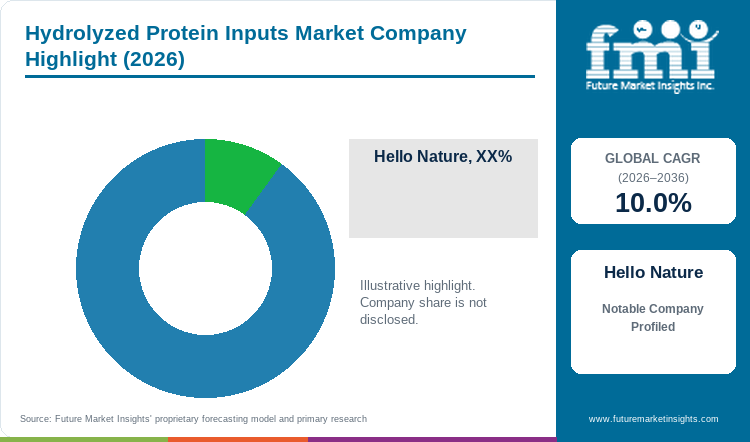
Direct hydrolysate makers compete with crop-product firms that use amino acids. Hello Nature and SICIT Group make hydrolysates. Bioiberica, Rovensa Next, Clariant, and Agro-Sorb sell amino-acid or protein-based crop products. Coromandel International and SPIC sell similar products in India. New suppliers need stable batches and field proof before repeat sales. Size does not replace product proof.
- Direct makers: Hello Nature, SICIT Group, and Agro-Sorb sell farm inputs made from broken-down proteins.
- Amino-acid product firms: Bioiberica, Rovensa Next, and Clariant sell crop products based on amino acids or plant peptides.
- India-based firms: Coromandel International and Southern Petrochemical Industries Corporation (SPIC) sell registered crop products made from plant protein hydrolysates.
Competitive Benchmarking: Hydrolyzed Protein Inputs Market
| Company | Hydrolysate Specialization | Application Breadth | Documentation Evidence | Geographic Reach |
|---|---|---|---|---|
| Hello Nature | High | High | High | Global agricultural distribution |
| SICIT Group | High | Medium | High | Europe with international B2B sales |
| Bioiberica | Medium | High | High | Europe with international plant-health sales |
| Rovensa Next | Medium | High | High | Multi-region crop-input distribution |
| Clariant | Medium | Medium | High | Global specialty-chemical network |
| Agro-Sorb | High | Medium | Medium | Europe with export distribution |
| Coromandel International | High | Medium | High | India with broader agricultural operations |
| Southern Petrochemical Industries Corporation (SPIC) | High | Medium | High | India-focused agricultural distribution |
Scoring basis: High specialization needs public proof of farm protein hydrolysates or named amino-acid products. Medium covers related products with less detail on how the protein is broken down. High application breadth needs use on several crops or delivery routes. High documentation evidence needs current rules, product records, or field tests tied to the named crop input.
Key Developments in the Hydrolyzed Protein Inputs Market
- In September 2026, Clariant presented Tivogen PHP 100 at Biostimulants Latam. The product uses plant peptides and amino acids to support crop stress response.
- In July 2026, Bioiberica published two years of soybean test results for Terra-Sorb complex. The company reported a stronger yield response during the dry season.
- In February 2026, Rovensa Next published its nutrient-use program. It named Delfan Plus and Vegenergy as amino-acid products that help crops take up nutrients.
Key Players in the Hydrolyzed Protein Inputs Market
Direct protein-hydrolysate platforms
- Hello Nature
- SICIT Group
- Agro-Sorb
Amino-acid and peptide formulation platforms
- Bioiberica
- Rovensa Next
- Clariant
India protein-hydrolysate suppliers
- Coromandel International
- Southern Petrochemical Industries Corporation (SPIC)
Hydrolyzed Protein Inputs Market - Report Scope
| Coverage field | Report scope |
|---|---|
| Market breakdown | By product type, crop type, application method, farm type, sales channel, and region. |
| Quantitative Units | USD million. |
| Market Definition | Agricultural protein hydrolysates and amino-acid inputs sold for crop nutrition, stress management, or related biostimulant use are included. Finished crop revenue and unrelated biological inputs are excluded. |
| Regions Covered | North America, Latin America, Western Europe, Eastern Europe, East Asia, South Asia and Pacific, and Middle East and Africa. |
| Countries Covered | South Korea, Germany, USA, UK, Japan, and 20+ countries included in the full report. |
| Key Companies Profiled | Hello Nature, SICIT Group, Bioiberica, Rovensa Next, Clariant, Agro-Sorb, Coromandel International, Southern Petrochemical Industries Corporation (SPIC). |
| Forecast Period | 2026 to 2036. |
| Approach | Primary and secondary research with market triangulation. |
Hydrolyzed Protein Inputs Market - Research Methodology
| Method | Approach |
|---|---|
| Primary Research | FMI analysts gathered input from manufacturers, service providers, technology developers, distributors, end users, procurement teams, and subject-matter experts. Interviews examined purchasing decisions, product or service evaluation, adoption barriers, approval requirements, pricing considerations, and expectations for technical or commercial support. Respondents were also asked what evidence is required before a trial, pilot, or initial order develops into regular purchasing. |
| Desk Research | Desk research covered government statistics, regulatory publications, trade data, industry associations, technical literature, standards, company filings, product information, and official corporate announcements. Sources were reviewed for relevance, publication date, geographic coverage, and consistency with the defined market scope. Claims relating to performance, applications, approvals, capacity, investment, and commercial activity were retained only when supported by credible public evidence. |
| Market Sizing and Forecasting | The market model combined the baseline value with historical performance, segment structure, pricing and volume indicators, adoption levels, company participation, and country-level demand conditions. Forecast assumptions considered economic activity, investment trends, regulatory developments, technology adoption, purchasing cycles, supply availability, and barriers to wider market use. Segment and regional estimates were reconciled before the final market total was calculated. |
| Data Validation | Estimates were checked against multiple independent indicators, including public data, company activity, trade patterns, industry developments, and findings from primary interviews. Validation also tested whether products, services, applications, and company revenues fell within the defined market boundaries. Adjacent categories, unsupported claims, overlapping revenues, and activities without direct market relevance were excluded to reduce double counting and maintain consistency across segments and countries. |
Hydrolyzed Protein Inputs Market by Segments
Hydrolyzed Protein Inputs Market segmented by Product Type:
- Raw - Crude Extract Grades
- Refined & Standardized Fractions
- Formulated End-Use Blends
- Others
Hydrolyzed Protein Inputs Market segmented by Crop Type:
- Cereals & Grains
- Fruits & Vegetables
- Oilseeds & Pulses
- Turf & Ornamentals
- Others
Hydrolyzed Protein Inputs Market segmented by Application Method:
- Soil Application
- Foliar Application
- Fertigation - Drip
- Seed Application
- Others
Hydrolyzed Protein Inputs Market segmented by Farm Type:
- Large Commercial Farms
- Mid-Size Farms
- Smallholders
- Greenhouses & Nurseries
- Others
Hydrolyzed Protein Inputs Market segmented by Sales Channel:
- Agri-Input Distributors
- Cooperatives
- Agri-Retail Chains
- Online - Direct-to-Farm
- Others
Hydrolyzed Protein Inputs Market by Region:
- North America
- United States
- Canada
- Mexico
- Latin America
- Brazil
- Chile
- Rest of Latin America
- Western Europe
- Germany
- United Kingdom
- Italy
- Spain
- France
- Nordics
- Benelux
- Rest of Western Europe
- Eastern Europe
- Russia
- Poland
- Hungary
- Balkan and Baltic States
- Rest of Eastern Europe
- East Asia
- China
- Japan
- South Korea
- South Asia and Pacific
- India
- ASEAN
- Australia and New Zealand
- Rest of South Asia and Pacific
- Middle East and Africa
- Kingdom of Saudi Arabia
- Other GCC Countries
- Türkiye
- South Africa
- Other African Union Countries
- Rest of Middle East and Africa
Research Sources and Bibliography
- Bioiberica. (2026, May 26). A next-generation biostimulant formulation designed for the demands of extensive crops.
- Ministry of Agriculture, Forestry and Fisheries, Japan. (2025, May 30). Guidelines on labeling and related information for biostimulants.
- Department for Environment, Food & Rural Affairs. (2026, March 19). Marketing fertilising products in the UK: regulatory reform.
- SICIT Group. (n.d.). Biostimulants for agriculture. Retrieved September 21, 2026.
- U.S. Department of Agriculture, National Agricultural Statistics Service. (2024, February 13). USDA releases 2022 Census of Agriculture data.
- Starr, M., Unruh-Snyder, L., Gatiboni, L., & Jayaratne, K. (2026, April 28). Biostimulants in modern agriculture: A comprehensive review with emphasis on protein hydrolysates.
- Department for Environment, Food & Rural Affairs. (2026, August 27). Agricultural price indices - United Kingdom: June 2026.
- European Parliament and Council. (2019, June 25). Regulation (EU) 2019/1009 on EU fertilising products.
- Ministry of Agriculture, Food and Rural Affairs, Republic of Korea. (2026, June 8). Rapid implementation of supplementary budget support for inorganic fertilizer price increases.
- Federal Statistical Office of Germany (Destatis). (2026, May 19). Cereal cultivation area in 2026 continued to stabilize after the 2024 low.
- U.S. Environmental Protection Agency. (n.d.). Pesticide labeling questions & answers. Retrieved September 21, 2026.
- Bioiberica. (2026, July 21). Steady under pressure: Terra-Sorb complex sustains soybean yield season after season.
- Clariant. (2026, September 2-3). 6th Biostimulants Latam & Redagricola Biocontrol Congress.
- Rovensa Next. (2026, February 19). Biosolutionize Agriculture: how nutrient availability and nutrient use efficiency drive sustainable farming ecosystems.
- Hello Nature. (n.d.). Biostimulants - PSP. Retrieved September 21, 2026.
- Clariant. (2026, August 12). Tivogen PHP 100.
- Rovensa Next. (n.d.). Delfan Plus. Retrieved September 21, 2026.
- Coromandel International. (n.d.). Bio products for crop nutrition. Retrieved September 21, 2026.
- Southern Petrochemical Industries Corporation. (n.d.). Plant biostimulants. Retrieved September 21, 2026.
- Agro-Sorb. (n.d.). Agro-Sorb. Retrieved September 21, 2026.
- Bioiberica. (2026, June 17). Bioiberica Plant Health and the Universidad Autónoma de Guadalajara advance research into agricultural biostimulation.
- Bioiberica. (2026, September 8). Biostimulants Latam 2026: innovation from the root.
This bibliography is provided for reader reference and is not exhaustive. The full report contains the complete reference list and detailed citations.
This Report Answers
- How large is the hydrolyzed protein inputs market in 2026 and 2036?
- What farm needs and use conditions support demand for hydrolyzed protein inputs?
- Why do Raw - Crude Extract Grades hold 49.8% of product type demand in 2026?
- Why do Cereals & Grains account for 37.2% of crop type demand in 2026?
- Why does Soil Application hold 36.1% of application method demand in 2026?
- What can slow repeat purchases of hydrolyzed protein inputs?
- How do growth rates differ across South Korea, Germany, USA, UK, and Japan?
- Which companies sell hydrolysates or amino-acid crop products?
- Which product rules and proof needs affect sales in major country markets?
Frequently Asked Questions
How big is the hydrolyzed protein inputs market in 2026?
The hydrolyzed protein inputs market is valued at USD 302.6 million in 2026 and is projected to reach USD 784.9 million by 2036. Growers are testing peptide and amino-acid inputs that work with current nutrition passes and show clear crop value.
What is the CAGR of the hydrolyzed protein inputs market from 2026 to 2036?
The hydrolyzed protein inputs market is projected to grow at 10.0% CAGR between 2026 and 2036. Growth depends on stable composition and crop proof that can move a successful trial into regular use.
Which product type leads the hydrolyzed protein inputs market in 2026?
The Raw - Crude Extract Grades segment is projected to account for 49.8% of the product type category in 2026. Formulators use these grades when they want control over peptide strength and the final carrier or delivery form.
Which countries record the highest profiled growth in the hydrolyzed protein inputs market?
South Korea is projected to grow at 9.6% CAGR and Germany at 9.3% through 2036. Farm costs and crop scale change how product proof turns into distributor programs and repeat orders.
Which companies are active in the hydrolyzed protein inputs market?
Key companies include Hello Nature, SICIT Group, Bioiberica, Rovensa Next, and Clariant. Agro-Sorb, Coromandel International, and Southern Petrochemical Industries Corporation (SPIC) also compete through crop proof and regional sales routes.
Preview the report firsthand - request a free sample
Get SampleGet the brochure for pricing and purchase details.
Get PDFTable of Content
- Key Takeaways
- Market Size and CAGR
- Top Growth Driver
- Fastest Growing Segment
- Leading Region
- Key Companies
- Emerging Opportunities
- Executive Summary
- Global Market Outlook
- Demand-side Trends
- Supply-side Trends
- Technology Roadmap Analysis
- Analysis and Recommendations
- Analyst Perspective (What is happening? Why now? What should investors know?)
- Key Questions Answered
- How large is the market?
- What is the CAGR?
- What are key trends?
- Which region dominates?
- Who are the leaders?
- Market Overview
- Market Coverage / Taxonomy
- Market Definition / Scope / Limitations
- Research Methodology
- Chapter Orientation
- Analytical Lens and Working Hypotheses
- Market Structure, Signals, and Trend Drivers
- Benchmarking and Cross-market Comparability
- Market Sizing, Forecasting, and Opportunity Mapping
- Research Design and Evidence Framework
- Desk Research Programme (Secondary Evidence)
- Expert Input and Fieldwork (Primary Evidence)
- Tooling, Models, and Reference Databases
- Data Engineering and Model Build
- Quality Assurance and Audit Trail
- Market Background
- Market Dynamics (Drivers, Restraints, Opportunity, Trends)
- Scenario Forecast (Optimistic, Likely, Conservative)
- Impact Analysis
- AI Impact
- Sustainability Impact
- Regulatory Impact
- Technology Impact
- Consumer / Buyer Analysis
- Purchase Drivers
- Adoption Barriers
- Buyer Journey
- Opportunity Map Analysis
- Product Life Cycle Analysis
- Supply Chain Analysis
- Investment Feasibility Matrix
- Value Chain Analysis
- PESTLE and Porter's Analysis
- Regulatory Landscape
- Regional Parent Market Outlook
- Production and Consumption Statistics
- Import and Export Statistics
- Global Market Analysis and Forecast, 2021 to 2036
- Historical Market Size Value (USD Million) Analysis, 2021 to 2025
- Current and Future Market Size Value (USD Million) Projections, 2026 to 2036
- Y-o-Y Growth Trend Analysis
- Absolute $ Opportunity Analysis
- Global Market Pricing Analysis, 2021 to 2036
- Global Market Analysis and Forecast, By Product Type, 2021 to 2036
- Introduction / Key Findings
- Historical Market Size Value (USD Million) Analysis By Product Type, 2021 to 2025
- Current and Future Market Size Value (USD Million) Analysis and Forecast By Product Type, 2026 to 2036
- Raw - Crude Extract Grades
- Refined & Standardized Fractions
- Formulated End-Use Blends
- Others
- Y-o-Y Growth Trend Analysis By Product Type, 2021 to 2025
- Absolute $ Opportunity Analysis By Product Type, 2026 to 2036
- Global Market Analysis and Forecast, By Crop Type, 2021 to 2036
- Introduction / Key Findings
- Historical Market Size Value (USD Million) Analysis By Crop Type, 2021 to 2025
- Current and Future Market Size Value (USD Million) Analysis and Forecast By Crop Type, 2026 to 2036
- Cereals & Grains
- Fruits & Vegetables
- Oilseeds & Pulses
- Turf & Ornamentals
- Others
- Y-o-Y Growth Trend Analysis By Crop Type, 2021 to 2025
- Absolute $ Opportunity Analysis By Crop Type, 2026 to 2036
- Global Market Analysis and Forecast, By Application Method, 2021 to 2036
- Introduction / Key Findings
- Historical Market Size Value (USD Million) Analysis By Application Method, 2021 to 2025
- Current and Future Market Size Value (USD Million) Analysis and Forecast By Application Method, 2026 to 2036
- Soil Application
- Foliar Application
- Fertigation - Drip
- Seed Application
- Others
- Y-o-Y Growth Trend Analysis By Application Method, 2021 to 2025
- Absolute $ Opportunity Analysis By Application Method, 2026 to 2036
- Global Market Analysis and Forecast, By Farm Type, 2021 to 2036
- Introduction / Key Findings
- Historical Market Size Value (USD Million) Analysis By Farm Type, 2021 to 2025
- Current and Future Market Size Value (USD Million) Analysis and Forecast By Farm Type, 2026 to 2036
- Large Commercial Farms
- Mid-Size Farms
- Smallholders
- Greenhouses & Nurseries
- Others
- Y-o-Y Growth Trend Analysis By Farm Type, 2021 to 2025
- Absolute $ Opportunity Analysis By Farm Type, 2026 to 2036
- Global Market Analysis and Forecast, By Sales Channel, 2021 to 2036
- Introduction / Key Findings
- Historical Market Size Value (USD Million) Analysis By Sales Channel, 2021 to 2025
- Current and Future Market Size Value (USD Million) Analysis and Forecast By Sales Channel, 2026 to 2036
- Agri-Input Distributors
- Cooperatives
- Agri-Retail Chains
- Online - Direct-to-Farm
- Others
- Y-o-Y Growth Trend Analysis By Sales Channel, 2021 to 2025
- Absolute $ Opportunity Analysis By Sales Channel, 2026 to 2036
- Global Market Analysis and Forecast, By Region, 2021 to 2036
- Introduction
- Historical Market Size Value (USD Million) Analysis By Region, 2021 to 2025
- Current Market Size Value (USD Million) Analysis and Forecast By Region, 2026 to 2036
- North America
- Latin America
- Western Europe
- Eastern Europe
- East Asia
- South Asia and Pacific
- Middle East and Africa
- Market Attractiveness Analysis By Region
- North America Market Analysis and Forecast, By Country, 2021 to 2036
- Historical Market Size Value (USD Million) Trend Analysis By Market Taxonomy, 2021 to 2025
- Market Size Value (USD Million) Forecast By Market Taxonomy, 2026 to 2036
- By Country
- United States
- Canada
- Mexico
- By Product Type
- By Crop Type
- By Application Method
- By Farm Type
- By Sales Channel
- By Country
- Market Attractiveness Analysis
- By Country
- By Product Type
- By Crop Type
- By Application Method
- By Farm Type
- By Sales Channel
- Key Takeaways
- Latin America Market Analysis and Forecast, By Country
- Historical Market Size Value (USD Million) Trend Analysis By Market Taxonomy, 2021 to 2025
- Market Size Value (USD Million) Forecast By Market Taxonomy, 2026 to 2036
- By Country
- Brazil
- Chile
- Rest of Latin America
- By Product Type
- By Crop Type
- By Application Method
- By Farm Type
- By Sales Channel
- By Country
- Market Attractiveness Analysis
- By Country
- By Product Type
- By Crop Type
- By Application Method
- By Farm Type
- By Sales Channel
- Key Takeaways
- Western Europe Market Analysis and Forecast, By Country
- Historical Market Size Value (USD Million) Trend Analysis By Market Taxonomy, 2021 to 2025
- Market Size Value (USD Million) Forecast By Market Taxonomy, 2026 to 2036
- By Country
- Germany
- United Kingdom
- Italy
- Spain
- France
- Nordics
- Benelux
- Rest of Western Europe
- By Product Type
- By Crop Type
- By Application Method
- By Farm Type
- By Sales Channel
- By Country
- Market Attractiveness Analysis
- By Country
- By Product Type
- By Crop Type
- By Application Method
- By Farm Type
- By Sales Channel
- Key Takeaways
- Eastern Europe Market Analysis and Forecast, By Country
- Historical Market Size Value (USD Million) Trend Analysis By Market Taxonomy, 2021 to 2025
- Market Size Value (USD Million) Forecast By Market Taxonomy, 2026 to 2036
- By Country
- Russia
- Poland
- Hungary
- Balkan and Baltic States
- Rest of Eastern Europe
- By Product Type
- By Crop Type
- By Application Method
- By Farm Type
- By Sales Channel
- By Country
- Market Attractiveness Analysis
- By Country
- By Product Type
- By Crop Type
- By Application Method
- By Farm Type
- By Sales Channel
- Key Takeaways
- East Asia Market Analysis and Forecast, By Country
- Historical Market Size Value (USD Million) Trend Analysis By Market Taxonomy, 2021 to 2025
- Market Size Value (USD Million) Forecast By Market Taxonomy, 2026 to 2036
- By Country
- China
- Japan
- South Korea
- By Product Type
- By Crop Type
- By Application Method
- By Farm Type
- By Sales Channel
- By Country
- Market Attractiveness Analysis
- By Country
- By Product Type
- By Crop Type
- By Application Method
- By Farm Type
- By Sales Channel
- Key Takeaways
- South Asia and Pacific Market Analysis and Forecast, By Country
- Historical Market Size Value (USD Million) Trend Analysis By Market Taxonomy, 2021 to 2025
- Market Size Value (USD Million) Forecast By Market Taxonomy, 2026 to 2036
- By Country
- India
- ASEAN
- Australia and New Zealand
- Rest of South Asia and Pacific
- By Product Type
- By Crop Type
- By Application Method
- By Farm Type
- By Sales Channel
- By Country
- Market Attractiveness Analysis
- By Country
- By Product Type
- By Crop Type
- By Application Method
- By Farm Type
- By Sales Channel
- Key Takeaways
- Middle East and Africa Market Analysis and Forecast, By Country
- Historical Market Size Value (USD Million) Trend Analysis By Market Taxonomy, 2021 to 2025
- Market Size Value (USD Million) Forecast By Market Taxonomy, 2026 to 2036
- By Country
- Kingdom of Saudi Arabia
- Other GCC Countries
- Türkiye
- South Africa
- Other African Union Countries
- Rest of Middle East and Africa
- By Product Type
- By Crop Type
- By Application Method
- By Farm Type
- By Sales Channel
- By Country
- Market Attractiveness Analysis
- By Country
- By Product Type
- By Crop Type
- By Application Method
- By Farm Type
- By Sales Channel
- Key Takeaways
- Key Countries Market Analysis
- United States
- Pricing Analysis
- Market Share Analysis, 2025
- By Product Type
- By Crop Type
- By Application Method
- By Farm Type
- By Sales Channel
- Canada
- Pricing Analysis
- Market Share Analysis, 2025
- By Product Type
- By Crop Type
- By Application Method
- By Farm Type
- By Sales Channel
- Mexico
- Pricing Analysis
- Market Share Analysis, 2025
- By Product Type
- By Crop Type
- By Application Method
- By Farm Type
- By Sales Channel
- Brazil
- Pricing Analysis
- Market Share Analysis, 2025
- By Product Type
- By Crop Type
- By Application Method
- By Farm Type
- By Sales Channel
- Chile
- Pricing Analysis
- Market Share Analysis, 2025
- By Product Type
- By Crop Type
- By Application Method
- By Farm Type
- By Sales Channel
- Germany
- Pricing Analysis
- Market Share Analysis, 2025
- By Product Type
- By Crop Type
- By Application Method
- By Farm Type
- By Sales Channel
- United Kingdom
- Pricing Analysis
- Market Share Analysis, 2025
- By Product Type
- By Crop Type
- By Application Method
- By Farm Type
- By Sales Channel
- Italy
- Pricing Analysis
- Market Share Analysis, 2025
- By Product Type
- By Crop Type
- By Application Method
- By Farm Type
- By Sales Channel
- Spain
- Pricing Analysis
- Market Share Analysis, 2025
- By Product Type
- By Crop Type
- By Application Method
- By Farm Type
- By Sales Channel
- France
- Pricing Analysis
- Market Share Analysis, 2025
- By Product Type
- By Crop Type
- By Application Method
- By Farm Type
- By Sales Channel
- India
- Pricing Analysis
- Market Share Analysis, 2025
- By Product Type
- By Crop Type
- By Application Method
- By Farm Type
- By Sales Channel
- ASEAN
- Pricing Analysis
- Market Share Analysis, 2025
- By Product Type
- By Crop Type
- By Application Method
- By Farm Type
- By Sales Channel
- Australia and New Zealand
- Pricing Analysis
- Market Share Analysis, 2025
- By Product Type
- By Crop Type
- By Application Method
- By Farm Type
- By Sales Channel
- China
- Pricing Analysis
- Market Share Analysis, 2025
- By Product Type
- By Crop Type
- By Application Method
- By Farm Type
- By Sales Channel
- Japan
- Pricing Analysis
- Market Share Analysis, 2025
- By Product Type
- By Crop Type
- By Application Method
- By Farm Type
- By Sales Channel
- South Korea
- Pricing Analysis
- Market Share Analysis, 2025
- By Product Type
- By Crop Type
- By Application Method
- By Farm Type
- By Sales Channel
- Russia
- Pricing Analysis
- Market Share Analysis, 2025
- By Product Type
- By Crop Type
- By Application Method
- By Farm Type
- By Sales Channel
- Poland
- Pricing Analysis
- Market Share Analysis, 2025
- By Product Type
- By Crop Type
- By Application Method
- By Farm Type
- By Sales Channel
- Hungary
- Pricing Analysis
- Market Share Analysis, 2025
- By Product Type
- By Crop Type
- By Application Method
- By Farm Type
- By Sales Channel
- Kingdom of Saudi Arabia
- Pricing Analysis
- Market Share Analysis, 2025
- By Product Type
- By Crop Type
- By Application Method
- By Farm Type
- By Sales Channel
- Türkiye
- Pricing Analysis
- Market Share Analysis, 2025
- By Product Type
- By Crop Type
- By Application Method
- By Farm Type
- By Sales Channel
- South Africa
- Pricing Analysis
- Market Share Analysis, 2025
- By Product Type
- By Crop Type
- By Application Method
- By Farm Type
- By Sales Channel
- United States
- Market Structure Analysis
- Competition Dashboard
- Competition Benchmarking
- Market Share Analysis of Top Players
- By Regional
- By Product Type
- By Crop Type
- By Application Method
- By Farm Type
- By Sales Channel
- Emerging Startups
- Innovation Benchmarking
- Competition Analysis
- Competition Deep Dive
- Hello Nature
- Overview
- Product Portfolio
- Profitability by Market Segments
- Sales Footprint
- Strategy Overview
- Marketing Strategy
- Product Strategy
- Channel Strategy
- SICIT Group
- Bioiberica
- Rovensa Next
- Clariant
- Agro-Sorb
- Coromandel International
- Southern Petrochemical Industries Corporation (SPIC)
- Hello Nature
- Case Studies
- Success Stories
- Recent Developments
- Competition Deep Dive
- Assumptions & Acronyms Used


