

- Market Size (2026)
- USD 2.8 Bn
- Forecast (2036)
- USD 6.2 Bn
- CAGR (2026 to 2036)
- 8.3%
How big is Inhaled Intranasal Products Contract Service Providers Market in 2026?
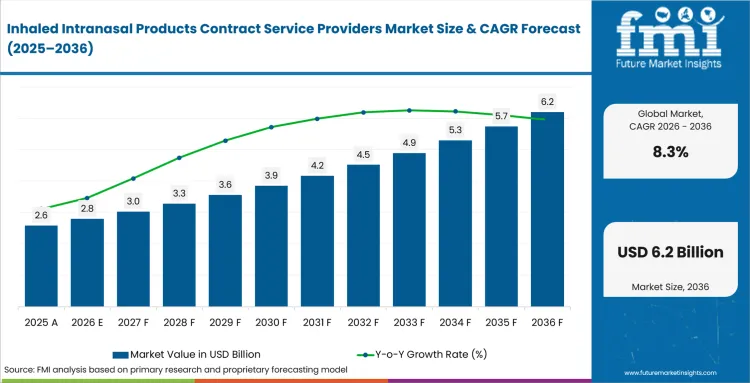
USD 2.8 billion in 2026 and USD 6.2 billion by 2036 at an 8.3% CAGR.
Demand for inhaled and intranasal contract services is projected to rise at 8.3% CAGR from 2026 to 2036 supported by scarce validated capacity. Valuation is set to increase from USD 2.8 billion in 2026 to USD 6.2 billion by 2036. Scarce validated capacity gives the inhalation CDMO sector its commercial foundation and not just laboratory capability. Revenue becomes more durable as one provider carries formulation and device work through transfer into repeat commercial supply.
Regulatory changes and lifecycle work can continue even as sponsor financing alters individual program timing. The European Medicines Agency published an updated quality guideline in July 2025 that became effective during February 2026 across inhaled and nasal products. Broader drug delivery technology programs add device compatibility and postapproval evidence requirements across regulated product lifecycles. Delayed approvals and underused dedicated lines remain material earnings risks for providers carrying fixed specialist capacity.
Key Takeaways of Inhaled Intranasal Products Contract Service Providers Market
- Low-GWP pMDI conversion and product-specific equivalence work require coordinated formulation and analytical services plus device and manufacturing support across regulated programs.
- Contract manufacturing is expected to account for 34.0% share in 2026 owing to repeat commercial supply following successful transfer and validation.
- Pharmaceutical companies are projected to represent 42.0% of end-user demand in 2026 reflecting limited internal access to every specialist inhalation and nasal platform.
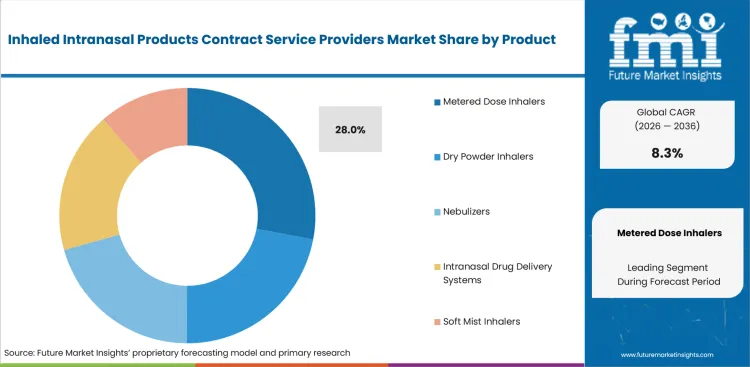
- Metered dose inhalers are estimated to hold 28.0% of product demand in 2026 supported by reformulation and device-change requirements across existing respiratory portfolios.
- Direct contract sales are likely to capture 46.0% of distribution activity in 2026 underpinned by confidential diligence and negotiated quality obligations.
- Lonza and Catalent compete alongside Kindeva Drug Delivery and Bespak while Hovione and Quotient Sciences with Arcinova focus on specialist development. LTS Nasal & Sterile Drug Products and Aptar Pharma add nasal plus device-led coverage across commercial programs.
Analyst Perspective
"Commercial value concentrates in programs that reach validated supply rather than isolated laboratory assignments with limited recurring revenue. Providers should measure transfer success and platform utilization alongside repeat commercial revenue before committing additional specialist capacity. Customer concentration also deserves quarterly attention because one delayed program can leave expensive equipment below planned utilization."
- Anurag Sharma, Principal Analyst, Future Market Insights
How is the Inhaled Intranasal Products Contract Service Providers Market segmented?
The inhaled intranasal products contract service providers industry is segmented by product, application, end user, distribution channel, service and region.
Product coverage includes metered dose inhalers and dry powder inhalers plus nebulizers and intranasal systems with soft mist inhalers. Applications span respiratory disease and allergy plus central nervous system disorders and pain management with vaccination programs. End users include pharmaceutical and biotechnology companies plus contract development and manufacturing organizations with research institutions and medical device companies. Distribution routes cover direct contracts and strategic partnerships plus tenders and distributor networks with digital sourcing platforms. Services include contract manufacturing and fill-finish plus analytical testing and formulation development with regulatory support.
What supports demand for metered dose inhalers within the product category?
Metered dose inhalers combine propellant performance with valve and actuator behavior inside one regulated drug-device system. The European Commission confirmed in October 2025 that HFC-containing pMDIs require quota coverage and compliant labeling from January 2025 which increases reformulation and transfer work across established portfolios.
- The metered dose inhalers segment is likely to capture 28.0% share in 2026 attributable to installed respiratory portfolios requiring coordinated propellant and device changes. Commercial programs also need repeatable dose performance across the selected filling process before technical teams approve volume production.
- Program teams compare pMDI conversion against dry powder inhalers during lifecycle planning for established respiratory portfolios. A format switch changes patient handling and equivalence obligations while introducing different device and supply requirements.
How do respiratory diseases shape demand within the application category?
Respiratory diseases provide the deepest installed base for respiratory inhaler devices although prevalence does not directly equal outsourced service revenue. The World Health Organization reported in April 2026 that asthma affected 363 million people during 2023 and caused 442,000 deaths which confirms the clinical scale without proving contract spending.
- By application, respiratory diseases are estimated to hold 39.0% in 2026 owing to established asthma and COPD portfolios requiring lifecycle services. The position reflects accumulated products requiring ongoing technical work across regulated portfolios rather than disease prevalence alone.
- Pharmaceutical sponsors purchase external support during reformulation and generic development plus site transfer and remediation programs. Each defined program event activates analytical and manufacturing work that ordinary prevalence data cannot prove.
Why are pharmaceutical companies central to the end user category?
Pharmaceutical companies retain marketing authorization plus supply responsibility and therefore approve each outsourced site through technical operations. Programs involving smart inhalers add software and human-factors review to established formulation and manufacturing diligence.
- The end user category is forecast to be led by pharmaceutical companies at 42.0% share in 2026 due to specialist platform costs and difficult transfer requirements. Innovator and generic portfolios both require controlled external capacity across multiple regulated inhaled and nasal dosage forms.
- Retention strengthens following validation because a provider change requires comparability work and stability evidence packages. Renewed device testing plus regulatory filings can also delay an otherwise attractive transfer between qualified sites.
How do direct contract sales influence the distribution channel category?
Direct evaluation remains necessary for CMO/CDMO services as technical teams must confirm platform fit and capacity prior to assigning regulated work. Digital portals organize requests efficiently but cannot settle device compatibility or quality responsibility across complex sponsor programs.
- By distribution channel, direct contract sales are forecast to represent 46.0% in 2026 driven by confidential diligence and negotiated quality obligations. Complex programs require site-specific commitments rather than catalogue purchasing across regulated service scopes and capacity reservations.
- Providers protect margin through staged feasibility and transfer decisions that price uncertain method work early. Capacity reservations begin once sponsors supply enough data to estimate technical and schedule risk credibly.
Why does contract manufacturing lead the service category?
Contract manufacturing produces recurring supply revenue following development and validation across registered inhaled or nasal products. Fill-finish manufacturing links process controls with release performance and final presentation across regulated commercial supply programs.
- Contract manufacturing is set to lead the service category with 34.0% share in 2026 due to commercial batches and continuing supply obligations. Process validation also embeds the provider inside the approved operating chain for each registered product.
- Executives compare development bookings with programs that reached validated commercial status across each specialist platform. The second measure better reflects asset utilization and customer switching cost across recurring supply relationships.
What are the drivers, restraints and opportunities in the Inhaled Intranasal Products Contract Service Providers Market?
Driver: Low-GWP pMDI conversion creates formulation, device and manufacturing work. Restraint: Method and validation failures delay approvals and reduce specialized asset utilization. Opportunity: Intranasal systemic and nose-to-brain programs widen the addressable service base.
- Driver: Propellant conversion and lifecycle changes require coordinated formulation and analytical work plus regulatory transfer and commercial manufacturing support.
- Restraint: Method variability and failed transfer work extend schedules while dedicated equipment remains below planned utilization across specialist platforms.
- Opportunity: Intranasal rescue and biologic programs plus central nervous system candidates require integrated formulation and device support with controlled fill-finish services.
Low-GWP conversion affects the complete pMDI system rather than the propellant alone across regulated commercial products. Kindeva explained in March 2026 that next-generation propellants alter formulation stability and device compatibility while requiring bioequivalence work plus specialized infrastructure. Established platforms can therefore earn formulation and transfer revenue prior to repeat commercial supply across converted portfolios. Sponsors also reduce capital exposure through equipment that already supports the selected propellant and filling method.
Method transfer remains a material restraint because aerosol testing can vary across instruments and product presentations. A June 2025 FDA workshop examined standardization challenges for inhalation and nasal methods within complex generic development. Failed acceptance criteria consume engineering batches and delay revenue from equipment already reserved for the program. Repeated method bridging also weakens schedule confidence during sponsor diligence and commercial planning decisions materially.
Intranasal delivery through nasal spray systems provides a credible service route across local and systemic therapies plus selected central nervous system programs. The EMA quality guideline published in July 2025 covers nasal liquids and powders alongside inhalation formats within one updated framework. Broader pharmaceutical drug delivery programs can combine formulation and device work with controlled fill-finish support. Early candidates remain exposed to dose-delivery failures and financing risk prior to commercial capacity becoming valuable.
Which country CAGRs are profiled in the Inhaled Intranasal Products Contract Service Providers Market?
| Country | CAGR |
|---|---|
| Canada | 10.8% |
| Japan | 10.3% |
| Germany | 9.6% |
| Brazil | 8.6% |
| USA | 8.1% |
| Australia | 7.7% |
| United Kingdom | 6.1% |
How do country-level CAGRs compare in the Inhaled Intranasal Products Contract Service Providers Market?
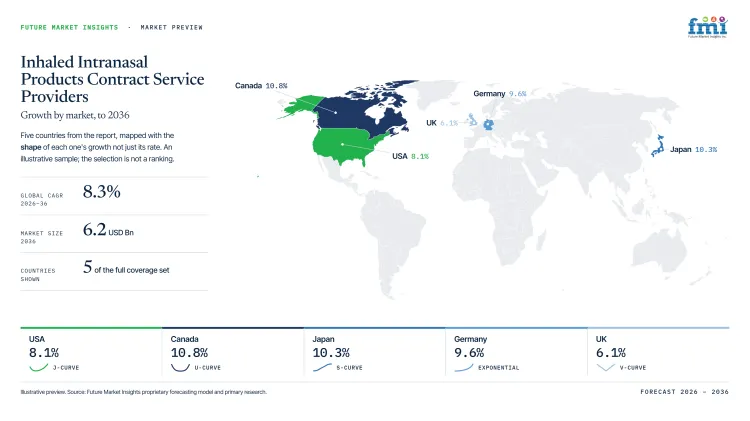
The country comparison spans 4.7 percentage points and forms three practical bands across the complete ten-year forecast interval.
- Canada remains 0.5 percentage point above Japan because both markets require product-specific comparison work through different submission routes.
- Japan edges Germany by 0.7 percentage point through local equivalence interpretation that differs from the shared European quality framework.
- Germany exceeds Brazil by 1.0 percentage point as European quality rules support a more established transfer pathway for inhaled products.
- Brazil remains 0.5 percentage point above the USA through regulatory translation and regional supply planning across national submission routes.
- The USA exceeds Australia by 0.4 percentage point amid deeper sponsor activity and stronger competition among qualified service providers.
- Australia remains 1.6 percentage points above the United Kingdom as focused submissions provide a different growth base from mature lifecycle work.
- The United Kingdom forms the lower boundary of the displayed range through technically valuable low-carbon inhaler change programs.
Comparable CAGRs produce different entry conditions because approval routes and specialist service networks vary across each country. The full report provides country-level CAGR analysis across North America, Latin America, Europe, East Asia, South Asia, Oceania and the Middle East and Africa.
Country-wise Analysis
- Health Canada applies comparative pharmacokinetic guidance to pMDIs and DPIs plus nebulized products and significant postapproval changes. Adoption of inhaled contract services in Canada is estimated to expand at 10.8% CAGR through 2036, aided by coordinated bridging and device-comparison requirements. Experienced testing networks support program execution across the national submission pathway and commercial transfer process. Late reference-product selection can force redesigned studies and delay transfer into Canadian commercial supply programs.
- Japan’s generic dry powder inhaler route depends on product-specific bioequivalence principles and detailed local regulatory interpretation. In Japan inhaled contract-service demand is predicted to advance at 10.3% CAGR through 2036, linked to device testing and submission bridging. Domestic specialists support communication with reviewers and help sponsors interpret detailed product-level evidence expectations during development. A global package can require rework if its comparator strategy misses Japanese requirements during review.
- German submissions follow the EMA inhalation and nasal quality guideline that became effective during February 2026. Germany’s contract-service outlook is anticipated to advance at 9.6% CAGR over the assessment period, enabled by EU-ready development and release networks. Established technical capacity supports transfers across several regulated dosage forms and established European release routes. Every formulation or device change requires a dossier-specific evidence package prior to commercial supply approval.
- ANVISA’s current bioequivalence page references Instruction 458 of July 2026 for administration forms and quantified analytes. The Brazilian contract-service sector is projected to record 8.6% CAGR during the assessment period, shaped by regulatory translation and regional supply planning. Current national lists give sponsors a defined procedural starting point for study preparation and review. Foreign providers face local representation and comparator-selection requirements that can extend program preparation timelines materially.
- FDA’s May 2026 development plan included complex inhaled liposomal amikacin plus metered nasal nafarelin among upcoming product-specific guidances. Contract-service sales in the USA are forecast to expand at 8.1% CAGR by 2036, supported by a broad sponsor base and advanced laboratories. Numerous qualified competitors improve sourcing depth across specialist inhalation and nasal platforms during sponsor diligence. New entrants must prove exact equipment and inspection history for each proposed site during technical diligence.
- The Therapeutic Goods Administration requests pre-submission discussion for systemically acting generic inhalation or nasal spray medicines. Australia is estimated to post 7.7% CAGR over the forecast period, influenced by focused comparability and change packages. Regional supply from established global sites supports access across a comparatively smaller national production base. Australian reference-product selection remains a material constraint for generic programs that rely on overseas comparators.
- The MHRA granted a low-carbon Trixeo Aerosphere variation in May 2025 following review of quality and device evidence. By 2036, the United Kingdom is projected to grow at 6.1% CAGR reinforced by reformulation and lifecycle work. The approval provides a direct commercial pathway for specialist providers serving converted pMDI portfolios nationally. Mature product portfolios and specific comparability requirements limit the number of large transfer programs nationally.
Who are the notable companies in the Inhaled Intranasal Products Contract Service Providers Market?
Lonza, Catalent, Kindeva Drug Delivery, Bespak, Hovione, Quotient Sciences and Arcinova, LTS Nasal & Sterile Drug Products and Aptar Pharma are notable companies shaping this market.
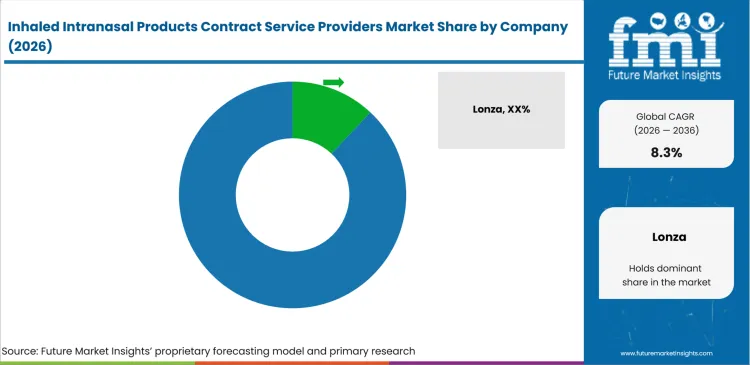
Competition is fragmented across integrated CDMOs and particle-engineering specialists plus device-led nasal platforms with unequal development-to-supply coverage. Few providers cover every format from formulation through repeat supply which limits direct concentration around one service model. Entry remains possible through low-GWP pMDI transfer or aseptic nasal filling yet broader accounts require validated equipment and repeatable release performance.
- Catalent and Kindeva Drug Delivery compete with Bespak across broad inhalation platforms and commercial manufacturing routes. Their differentiation rests on exact dosage-form coverage plus device integration and available capacity at the proposed site.
- Lonza and Hovione focus more heavily on particle engineering plus formulation design for complex powders and biologics. Quotient Sciences with Arcinova supports earlier inhaled development and clinical manufacturing through a narrower service route.
- LTS Nasal & Sterile Drug Products connects nasal formulation with aseptic filling and commercial transfer across regulated programs. Aptar Pharma combines device platforms with development services across inhaled and intranasal delivery programs for commercial sponsors.
Competitive Benchmarking: Inhaled Intranasal Products Contract Service Providers Market
| Company | Inhalation and Nasal Platform | Development-to-Supply Reach | Device Integration | Geographic Reach |
|---|---|---|---|---|
| Lonza | Medium | Medium | Medium | North America and Europe |
| Catalent | High | High | High | North America |
| Kindeva Drug Delivery | High | High | High | North America and Europe |
| Bespak | High | High | High | Europe |
| Hovione | High | High | High | Global |
| Quotient Sciences / Arcinova | High | Medium | Medium | Europe |
| LTS Nasal & Sterile Drug Products | Medium | High | High | North America and Europe |
| Aptar Pharma | High | Medium | High | Global |
Key Developments in the Inhaled Intranasal Products Contract Service Providers Market
- In January 2025, Lonza and Iconovo began developing spray-dried formulations for an intranasal biologic while testing device compatibility and biological activity within one coordinated early-development program.
- In July 2025, Aptar Pharma acquired Mod3 Pharma capabilities that added formulation and fill-finish support for early orally inhaled plus nasal clinical-material programs.
- In November 2025, LTS completed the Renaissance Lakewood acquisition and formed LTS Nasal & Sterile Drug Products around nasal spray plus aseptic CDMO services.
- In March 2026, Bespak expanded its Chiesi partnership and increased low-GWP pMDI production capacity at the Holmes Chapel specialist inhalation site.
Inhaled Intranasal Products Contract Service Providers Market - Report Scope
| Coverage field | Report scope |
|---|---|
| Market breakdown | By product, application, end user, distribution channel, service and region. |
| Quantitative Units | Revenue USD billion and CAGR in %. |
| Market Definition | The market covers contract formulation, analytical, regulatory, fill-finish, device-integration and commercial manufacturing services for inhaled and intranasal medicinal products. |
| Regions Covered | North America, Latin America, Europe, East Asia, South Asia and Pacific and Middle East and Africa. |
| Countries Covered | Canada, Japan, Germany, Brazil, USA, Australia, United Kingdom |
| Key Companies Profiled | Lonza, Catalent, Kindeva Drug Delivery, Bespak, Hovione, Quotient Sciences / Arcinova, LTS Nasal & Sterile Drug Products, Aptar Pharma |
| Forecast Period | 2026 to 2036. |
| Approach | Primary and secondary research with market triangulation. |
Inhaled Intranasal Products Contract Service Providers Market - Research Methodology
| Method | Approach |
|---|---|
| Primary Research | FMI analysts gathered input from manufacturers, service providers, technology developers, distributors, end users, procurement teams, and subject-matter experts. Interviews examined purchasing decisions, product or service evaluation, adoption barriers, approval requirements, pricing considerations, and expectations for technical or commercial support. Respondents were also asked what evidence is required before a trial, pilot, or initial order develops into regular purchasing. |
| Desk Research | Desk research covered government statistics, regulatory publications, trade data, industry associations, technical literature, standards, company filings, product information, and official corporate announcements. Sources were reviewed for relevance, publication date, geographic coverage, and consistency with the defined market scope. Claims relating to performance, applications, approvals, capacity, investment, and commercial activity were retained only when supported by credible public evidence. |
| Market Sizing and Forecasting | The market model combined the baseline value with historical performance, segment structure, pricing and volume indicators, adoption levels, company participation, and country-level demand conditions. Forecast assumptions considered economic activity, investment trends, regulatory developments, technology adoption, purchasing cycles, supply availability, and barriers to wider market use. Segment and regional estimates were reconciled before the final market total was calculated. |
| Data Validation | Estimates were checked against multiple independent indicators, including public data, company activity, trade patterns, industry developments, and findings from primary interviews. Validation also tested whether products, services, applications, and company revenues fell within the defined market boundaries. Adjacent categories, unsupported claims, overlapping revenues, and activities without direct market relevance were excluded to reduce double counting and maintain consistency across segments and countries. |
Inhaled Intranasal Products Contract Service Providers Market by Segments
Inhaled Intranasal Products Contract Service Providers Market segmented by Product:
- Metered Dose Inhalers
- Pressurized Metered Dose Inhalers
- Breath-Actuated Metered Dose Inhalers
- Dry Powder Inhalers
- Capsule-Based Dry Powder Inhalers
- Reservoir Dry Powder Inhalers
- Nebulizers
- Jet Nebulizers
- Mesh Nebulizers
- Intranasal Drug Delivery Systems
- Nasal Sprays
- Nasal Powders
- Soft Mist Inhalers
- Reusable Soft Mist Inhalers
- Disposable Soft Mist Inhalers
Inhaled Intranasal Products Contract Service Providers Market segmented by Application:
- Respiratory Diseases
- Asthma
- Chronic Obstructive Pulmonary Disease
- Allergy Management
- Allergic Rhinitis
- Seasonal Allergic Rhinitis
- Central Nervous System Disorders
- Migraine
- Epilepsy
- Pain Management
- Acute Pain
- Chronic Pain
- Vaccination
- Influenza Vaccination
- COVID-19 Vaccination
Inhaled Intranasal Products Contract Service Providers Market segmented by End User:
- Pharmaceutical Companies
- Innovator Pharmaceutical Companies
- Generic Pharmaceutical Companies
- Biotechnology Companies
- Emerging Biotechnology Companies
- Established Biotechnology Companies
- Contract Development and Manufacturing Organizations
- Full-Service CDMOs
- Specialty CDMOs
- Research Organizations
- Academic Research Institutes
- Government Research Institutes
- Medical Device Companies
- Inhalation Device Manufacturers
- Nasal Delivery Device Manufacturers
Inhaled Intranasal Products Contract Service Providers Market segmented by Distribution Channel:
- Direct Contract Sales
- Global Supply Agreements
- Long-Term Manufacturing Contracts
- Strategic Partnerships
- Co-Development Agreements
- Licensing Agreements
- Tender-Based Purchasing
- Public Healthcare Tenders
- Institutional Purchasing
- Distributor Network
- Regional Distributors
- Authorized Sales Partners
- Digital Sourcing Platforms
- B2B Sourcing Portals
- Electronic Sourcing Platforms
Inhaled Intranasal Products Contract Service Providers Market segmented by Service:
- Contract Manufacturing
- Commercial Manufacturing
- Bulk Drug Manufacturing
- Fill-Finish Services
- Aseptic Filling
- Final Packaging
- Analytical and Testing Services
- Method Development
- Stability Testing
- Formulation Development Services
- Preformulation Studies
- Formulation Optimization
- Regulatory Affairs Services
- CMC Documentation
- Regulatory Submission Support
Inhaled Intranasal Products Contract Service Providers Market by Region:
- North America
- United States
- Canada
- Latin America
- Brazil
- Chile
- Mexico
- Rest of Latin America
- Western Europe
- Germany
- United Kingdom
- Italy
- Spain
- France
- Nordics
- Benelux
- Rest of Western Europe
- Eastern Europe
- Russia
- Poland
- Hungary
- Balkan and Baltic States
- Rest of Eastern Europe
- East Asia
- China
- Japan
- South Korea
- South Asia and Pacific
- India
- ASEAN
- Australia and New Zealand
- Rest of South Asia and Pacific
- Middle East and Africa
- Kingdom of Saudi Arabia
- Other GCC Countries
- Türkiye
- South Africa
- Other African Union Countries
- Rest of Middle East and Africa
Research Sources and Bibliography
- European Commission. (2025, October 14). F-gases in equipment and products.
- European Medicines Agency. (2025, July 21). Pharmaceutical quality of inhalation and nasal products.
- USA Food and Drug Administration. (2025, June 3). Fiscal Year 2025 Generic Drug Science and Research Initiatives Public Workshop.
- USA Food and Drug Administration. (2026, May 26). Upcoming product-specific guidances for generic drug product development.
- World Health Organization. (2026, April 28). Asthma.
- Health Canada. (2020, December 21). Comparative pharmacokinetic studies for orally inhaled products: Guidance document.
- Ministry of Health, Labour and Welfare. (2016, March 11). Basic principles on bioequivalence evaluation of generic dry powder inhalers.
- Therapeutic Goods Administration. (2024, October 26). Applying for new inhalation or nasal spray medicines or changing existing medicines.
- Agência Nacional de Vigilância Sanitária. (2026, July 13). Vigente.
- Medicines and Healthcare products Regulatory Agency. (2025, May 12). MHRA approves world’s first low-carbon version of COPD inhaler Trixeo Aerosphere.
- Kindeva Drug Delivery. (2026, March 6). Where the propellants are greener: Inside the MDI facility of the future.
- Kindeva Drug Delivery. (2025, April 1). Novel Nasal Formulation & Delivery Summit.
- Lonza. (2025, January 13). Iconovo and Lonza to collaborate on the formulation development of an intranasal biologic.
- Lonza Group Ltd. (2026, April 1). Lonza Annual Report 2025.
- Aptar Pharma. (2025, July 15). Aptar Pharma bolsters clinical trial capabilities with strategic materials manufacturing acquisition.
- LTS Lohmann Therapie-Systeme AG. (2025, November 7). LTS completes acquisition of Renaissance Lakewood, expanding global CDMO capabilities.
- LTS Lohmann Therapie-Systeme AG. (2026, May 5). Nasal spray development: Key formulation and device considerations for combination nasal drug products.
- Bespak. (2026, March 11). Chiesi and Bespak partner to advance Carbon Minimal Inhaler production with UK manufacturing site.
- Catalent. (2026, May 10). Respiratory Drug Delivery.
- Hovione. (2026, May 7). Hovione and IDC intranasal drug delivery platform available for commercial partnerships.
- Arcinova. (2025, June 24). Arcinova inhaled product development info sheet.
This Report Answers
- How large is the inhaled intranasal products contract service providers market in 2026 and 2036?
- Which technical and regulatory conditions support demand across inhaled and intranasal contract services?
- Which product, application, end-user, distribution and service categories hold the largest 2026 shares?
- How do country growth rates differ across the seven profiled national markets?
- Which local operating conditions support or limit country-level commercial entry?
- Which companies provide verified inhalation, nasal, device and commercial manufacturing capabilities?
- How should sourcing teams compare development reach, device integration and geographic coverage?
- Which validation and utilization risks most often weaken returns on specialist capacity?
- Which current developments are changing platform depth and ownership across the competitive field?
Frequently Asked Questions
How big is the Inhaled Intranasal Products Contract Service Providers Market in 2026?
The inhaled intranasal products contract service providers market is valued at USD 2.8 billion in 2026 and is forecast to reach USD 6.2 billion by 2036. Growth is supported by scarce validated capacity that anchors repeat commercial supply once formulation and device work moves through transfer into regulated production.
What is the CAGR of the Inhaled Intranasal Products Contract Service Providers Market from 2026 to 2036?
The inhaled intranasal products contract service providers market grows at a CAGR of 8.3% between 2026 and 2036, supported by low-GWP pMDI conversion and product-specific equivalence work that requires coordinated formulation, analytical, device, and manufacturing support across regulated inhaled and nasal delivery programs.
Which service category leads the Inhaled Intranasal Products Contract Service Providers Market?
Contract manufacturing accounts for 34.0% of the inhaled intranasal products contract service providers market by service category in 2026, driven by recurring commercial batch supply and continuing obligations that embed the provider inside the approved operating chain for each registered inhaled or nasal product.
How much will the Inhaled Intranasal Products Contract Service Providers Market add between 2026 and 2036?
The inhaled intranasal products contract service providers market is set to add USD 3.4 billion between 2026 and 2036, growing from USD 2.8 billion to USD 6.2 billion as propellant conversion and intranasal systemic programs widen the addressable base of specialist contract service work.
Who are the leading companies in the Inhaled Intranasal Products Contract Service Providers Market?
Eight companies lead the inhaled intranasal products contract service providers market, including Lonza, Catalent, Kindeva Drug Delivery, Bespak, Hovione, Quotient Sciences/Arcinova, LTS Nasal & Sterile Drug Products, and Aptar Pharma, competing through formulation development, device integration, fill-finish, and commercial manufacturing across regulated inhaled and nasal delivery platforms.
Preview the report firsthand - request a free sample
Get SampleGet the brochure for pricing and purchase details.
Get PDFTable of Content
- Key Takeaways
- Market Size and CAGR
- Top Growth Driver
- Fastest Growing Segment
- Leading Region
- Key Companies
- Emerging Opportunities
- Executive Summary
- Global Market Outlook
- Demand-side Trends
- Supply-side Trends
- Technology Roadmap Analysis
- Analysis and Recommendations
- Analyst Perspective (What is happening? Why now? What should investors know?)
- Key Questions Answered
- How large is the market?
- What is the CAGR?
- What are key trends?
- Which region dominates?
- Who are the leaders?
- Market Overview
- Market Coverage / Taxonomy
- Market Definition / Scope / Limitations
- Research Methodology
- Chapter Orientation
- Analytical Lens and Working Hypotheses
- Market Structure, Signals, and Trend Drivers
- Benchmarking and Cross-market Comparability
- Market Sizing, Forecasting, and Opportunity Mapping
- Research Design and Evidence Framework
- Desk Research Programme (Secondary Evidence)
- Expert Input and Fieldwork (Primary Evidence)
- Tooling, Models, and Reference Databases
- Data Engineering and Model Build
- Quality Assurance and Audit Trail
- Market Background
- Market Dynamics (Drivers, Restraints, Opportunity, Trends)
- Scenario Forecast (Optimistic, Likely, Conservative)
- Impact Analysis
- AI Impact
- Sustainability Impact
- Regulatory Impact
- Technology Impact
- Consumer / Buyer Analysis
- Purchase Drivers
- Adoption Barriers
- Buyer Journey
- Opportunity Map Analysis
- Product Life Cycle Analysis
- Supply Chain Analysis
- Investment Feasibility Matrix
- Value Chain Analysis
- PESTLE and Porter's Analysis
- Regulatory Landscape
- Regional Parent Market Outlook
- Production and Consumption Statistics
- Import and Export Statistics
- Global Market Analysis and Forecast, 2021 to 2036
- Historical Market Size Value (USD Billion) Analysis, 2021 to 2025
- Current and Future Market Size Value (USD Billion) Projections, 2026 to 2036
- Y-o-Y Growth Trend Analysis
- Absolute $ Opportunity Analysis
- Global Market Pricing Analysis, 2021 to 2036
- Global Market Analysis and Forecast, By Product, 2021 to 2036
- Introduction / Key Findings
- Historical Market Size Value (USD Billion) Analysis By Product, 2021 to 2025
- Current and Future Market Size Value (USD Billion) Analysis and Forecast By Product, 2026 to 2036
- Metered Dose Inhalers
- Pressurized Metered Dose Inhalers
- Breath-Actuated Metered Dose Inhalers
- Dry Powder Inhalers
- Capsule-Based Dry Powder Inhalers
- Reservoir Dry Powder Inhalers
- Nebulizers
- Jet Nebulizers
- Mesh Nebulizers
- Intranasal Drug Delivery Systems
- Nasal Sprays
- Nasal Powders
- Soft Mist Inhalers
- Reusable Soft Mist Inhalers
- Disposable Soft Mist Inhalers
- Metered Dose Inhalers
- Y-o-Y Growth Trend Analysis By Product, 2021 to 2025
- Absolute $ Opportunity Analysis By Product, 2026 to 2036
- Global Market Analysis and Forecast, By Application, 2021 to 2036
- Introduction / Key Findings
- Historical Market Size Value (USD Billion) Analysis By Application, 2021 to 2025
- Current and Future Market Size Value (USD Billion) Analysis and Forecast By Application, 2026 to 2036
- Respiratory Diseases
- Asthma
- Chronic Obstructive Pulmonary Disease
- Allergy Management
- Allergic Rhinitis
- Seasonal Allergic Rhinitis
- Central Nervous System Disorders
- Migraine
- Epilepsy
- Pain Management
- Acute Pain
- Chronic Pain
- Vaccination
- Influenza Vaccination
- COVID-19 Vaccination
- Respiratory Diseases
- Y-o-Y Growth Trend Analysis By Application, 2021 to 2025
- Absolute $ Opportunity Analysis By Application, 2026 to 2036
- Global Market Analysis and Forecast, By End User, 2021 to 2036
- Introduction / Key Findings
- Historical Market Size Value (USD Billion) Analysis By End User, 2021 to 2025
- Current and Future Market Size Value (USD Billion) Analysis and Forecast By End User, 2026 to 2036
- Pharmaceutical Companies
- Innovator Pharmaceutical Companies
- Generic Pharmaceutical Companies
- Biotechnology Companies
- Emerging Biotechnology Companies
- Established Biotechnology Companies
- Contract Development and Manufacturing Organizations
- Full-Service CDMOs
- Specialty CDMOs
- Research Organizations
- Academic Research Institutes
- Government Research Institutes
- Medical Device Companies
- Inhalation Device Manufacturers
- Nasal Delivery Device Manufacturers
- Pharmaceutical Companies
- Y-o-Y Growth Trend Analysis By End User, 2021 to 2025
- Absolute $ Opportunity Analysis By End User, 2026 to 2036
- Global Market Analysis and Forecast, By Distribution Channel, 2021 to 2036
- Introduction / Key Findings
- Historical Market Size Value (USD Billion) Analysis By Distribution Channel, 2021 to 2025
- Current and Future Market Size Value (USD Billion) Analysis and Forecast By Distribution Channel, 2026 to 2036
- Direct Contract Sales
- Global Supply Agreements
- Long-Term Manufacturing Contracts
- Strategic Partnerships
- Co-Development Agreements
- Licensing Agreements
- Tender-Based Procurement
- Public Healthcare Tenders
- Institutional Procurement
- Distributor Network
- Regional Distributors
- Authorized Sales Partners
- Digital Procurement Platforms
- B2B Procurement Portals
- Electronic Sourcing Platforms
- Direct Contract Sales
- Y-o-Y Growth Trend Analysis By Distribution Channel, 2021 to 2025
- Absolute $ Opportunity Analysis By Distribution Channel, 2026 to 2036
- Global Market Analysis and Forecast, By Service, 2021 to 2036
- Introduction / Key Findings
- Historical Market Size Value (USD Billion) Analysis By Service, 2021 to 2025
- Current and Future Market Size Value (USD Billion) Analysis and Forecast By Service, 2026 to 2036
- Contract Manufacturing
- Commercial Manufacturing
- Bulk Drug Manufacturing
- Fill-Finish Services
- Aseptic Filling
- Final Packaging
- Analytical and Testing Services
- Method Development
- Stability Testing
- Formulation Development Services
- Preformulation Studies
- Formulation Optimization
- Regulatory Affairs Services
- CMC Documentation
- Regulatory Submission Support
- Contract Manufacturing
- Y-o-Y Growth Trend Analysis By Service, 2021 to 2025
- Absolute $ Opportunity Analysis By Service, 2026 to 2036
- Global Market Analysis and Forecast, By Region, 2021 to 2036
- Introduction
- Historical Market Size Value (USD Billion) Analysis By Region, 2021 to 2025
- Current Market Size Value (USD Billion) Analysis and Forecast By Region, 2026 to 2036
- North America
- Latin America
- Western Europe
- Eastern Europe
- East Asia
- South Asia and Pacific
- Middle East & Africa
- Market Attractiveness Analysis By Region
- North America Market Analysis and Forecast, By Country, 2021 to 2036
- Historical Market Size Value (USD Billion) Trend Analysis By Market Taxonomy, 2021 to 2025
- Market Size Value (USD Billion) Forecast By Market Taxonomy, 2026 to 2036
- By Country
- USA
- Canada
- By Product
- By Application
- By End User
- By Distribution Channel
- By Service
- By Country
- Market Attractiveness Analysis
- By Country
- By Product
- By Application
- By End User
- By Distribution Channel
- By Service
- Key Takeaways
- Latin America Market Analysis and Forecast, By Country
- Historical Market Size Value (USD Billion) Trend Analysis By Market Taxonomy, 2021 to 2025
- Market Size Value (USD Billion) Forecast By Market Taxonomy, 2026 to 2036
- By Country
- Brazil
- Mexico
- Chile
- Rest of Latin America
- By Product
- By Application
- By End User
- By Distribution Channel
- By Service
- By Country
- Market Attractiveness Analysis
- By Country
- By Product
- By Application
- By End User
- By Distribution Channel
- By Service
- Key Takeaways
- Western Europe Market Analysis and Forecast, By Country
- Historical Market Size Value (USD Billion) Trend Analysis By Market Taxonomy, 2021 to 2025
- Market Size Value (USD Billion) Forecast By Market Taxonomy, 2026 to 2036
- By Country
- Germany
- UK
- Italy
- Spain
- France
- Nordic
- BENELUX
- Rest of Western Europe
- By Product
- By Application
- By End User
- By Distribution Channel
- By Service
- By Country
- Market Attractiveness Analysis
- By Country
- By Product
- By Application
- By End User
- By Distribution Channel
- By Service
- Key Takeaways
- Eastern Europe Market Analysis and Forecast, By Country
- Historical Market Size Value (USD Billion) Trend Analysis By Market Taxonomy, 2021 to 2025
- Market Size Value (USD Billion) Forecast By Market Taxonomy, 2026 to 2036
- By Country
- Russia
- Poland
- Hungary
- Balkan & Baltic
- Rest of Eastern Europe
- By Product
- By Application
- By End User
- By Distribution Channel
- By Service
- By Country
- Market Attractiveness Analysis
- By Country
- By Product
- By Application
- By End User
- By Distribution Channel
- By Service
- Key Takeaways
- East Asia Market Analysis and Forecast, By Country
- Historical Market Size Value (USD Billion) Trend Analysis By Market Taxonomy, 2021 to 2025
- Market Size Value (USD Billion) Forecast By Market Taxonomy, 2026 to 2036
- By Country
- China
- Japan
- South Korea
- By Product
- By Application
- By End User
- By Distribution Channel
- By Service
- By Country
- Market Attractiveness Analysis
- By Country
- By Product
- By Application
- By End User
- By Distribution Channel
- By Service
- Key Takeaways
- South Asia and Pacific Market Analysis and Forecast, By Country
- Historical Market Size Value (USD Billion) Trend Analysis By Market Taxonomy, 2021 to 2025
- Market Size Value (USD Billion) Forecast By Market Taxonomy, 2026 to 2036
- By Country
- India
- ASEAN
- Australia & New Zealand
- Rest of South Asia and Pacific
- By Product
- By Application
- By End User
- By Distribution Channel
- By Service
- By Country
- Market Attractiveness Analysis
- By Country
- By Product
- By Application
- By End User
- By Distribution Channel
- By Service
- Key Takeaways
- Middle East & Africa Market Analysis and Forecast, By Country
- Historical Market Size Value (USD Billion) Trend Analysis By Market Taxonomy, 2021 to 2025
- Market Size Value (USD Billion) Forecast By Market Taxonomy, 2026 to 2036
- By Country
- Kingdom of Saudi Arabia
- Other GCC Countries
- Türkiye
- South Africa
- Other African Union
- Rest of Middle East & Africa
- By Product
- By Application
- By End User
- By Distribution Channel
- By Service
- By Country
- Market Attractiveness Analysis
- By Country
- By Product
- By Application
- By End User
- By Distribution Channel
- By Service
- Key Takeaways
- Key Countries Market Analysis
- USA
- Pricing Analysis
- Market Share Analysis, 2025
- By Product
- By Application
- By End User
- By Distribution Channel
- By Service
- Canada
- Pricing Analysis
- Market Share Analysis, 2025
- By Product
- By Application
- By End User
- By Distribution Channel
- By Service
- Mexico
- Pricing Analysis
- Market Share Analysis, 2025
- By Product
- By Application
- By End User
- By Distribution Channel
- By Service
- Brazil
- Pricing Analysis
- Market Share Analysis, 2025
- By Product
- By Application
- By End User
- By Distribution Channel
- By Service
- Chile
- Pricing Analysis
- Market Share Analysis, 2025
- By Product
- By Application
- By End User
- By Distribution Channel
- By Service
- Germany
- Pricing Analysis
- Market Share Analysis, 2025
- By Product
- By Application
- By End User
- By Distribution Channel
- By Service
- UK
- Pricing Analysis
- Market Share Analysis, 2025
- By Product
- By Application
- By End User
- By Distribution Channel
- By Service
- Italy
- Pricing Analysis
- Market Share Analysis, 2025
- By Product
- By Application
- By End User
- By Distribution Channel
- By Service
- Spain
- Pricing Analysis
- Market Share Analysis, 2025
- By Product
- By Application
- By End User
- By Distribution Channel
- By Service
- France
- Pricing Analysis
- Market Share Analysis, 2025
- By Product
- By Application
- By End User
- By Distribution Channel
- By Service
- India
- Pricing Analysis
- Market Share Analysis, 2025
- By Product
- By Application
- By End User
- By Distribution Channel
- By Service
- ASEAN
- Pricing Analysis
- Market Share Analysis, 2025
- By Product
- By Application
- By End User
- By Distribution Channel
- By Service
- Australia & New Zealand
- Pricing Analysis
- Market Share Analysis, 2025
- By Product
- By Application
- By End User
- By Distribution Channel
- By Service
- China
- Pricing Analysis
- Market Share Analysis, 2025
- By Product
- By Application
- By End User
- By Distribution Channel
- By Service
- Japan
- Pricing Analysis
- Market Share Analysis, 2025
- By Product
- By Application
- By End User
- By Distribution Channel
- By Service
- South Korea
- Pricing Analysis
- Market Share Analysis, 2025
- By Product
- By Application
- By End User
- By Distribution Channel
- By Service
- Russia
- Pricing Analysis
- Market Share Analysis, 2025
- By Product
- By Application
- By End User
- By Distribution Channel
- By Service
- Poland
- Pricing Analysis
- Market Share Analysis, 2025
- By Product
- By Application
- By End User
- By Distribution Channel
- By Service
- Hungary
- Pricing Analysis
- Market Share Analysis, 2025
- By Product
- By Application
- By End User
- By Distribution Channel
- By Service
- Kingdom of Saudi Arabia
- Pricing Analysis
- Market Share Analysis, 2025
- By Product
- By Application
- By End User
- By Distribution Channel
- By Service
- Türkiye
- Pricing Analysis
- Market Share Analysis, 2025
- By Product
- By Application
- By End User
- By Distribution Channel
- By Service
- South Africa
- Pricing Analysis
- Market Share Analysis, 2025
- By Product
- By Application
- By End User
- By Distribution Channel
- By Service
- USA
- Market Structure Analysis
- Competition Dashboard
- Competition Benchmarking
- Market Share Analysis of Top Players
- By Regional
- By Product
- By Application
- By End User
- By Distribution Channel
- By Service
- Emerging Startups
- Innovation Benchmarking
- Competition Analysis
- Competition Deep Dive
- Lonza
- Overview
- Product Portfolio
- Profitability by Market Segments
- Sales Footprint
- Strategy Overview
- Marketing Strategy
- Product Strategy
- Channel Strategy
- Catalent
- Kindeva Drug Delivery
- Recipharm
- Hovione
- Quotient Sciences
- Colep Packaging
- Orion Corporation
- DPT Laboratories
- Beximco Pharmaceuticals
- Lonza
- Case Studies
- Success Stories
- Recent Developments
- Competition Deep Dive
- Assumptions & Acronyms Used


