

- Industry Size (2026)
- USD 1.4 Bn
- Forecast (2036)
- USD 3.1 Bn
- CAGR (2026 to 2036)
- 8.3%
Injectable Epoxy Anchor Glue Market Forecast and Outlook 2026 to 2036
Structural anchoring systems used in commercial and infrastructure projects place injectable epoxy anchor glue at USD 1.4 billion in 2026, with awarded specifications carrying that base to USD 3.1 billion by 2036 at a CAGR of 8.3%. Selection begins inside calculation packages that bind product names to diameter, embed depth, and substrate class. Once written, these items behave as controlled components inside inspection workflows. Site supervisors favor systems with familiar dispensing tools and predictable cure profiles. Rework exposure shapes conservative choice. Training records and batch traceability accompany each job file. Distribution follows approval sets and regional code practice rather than open catalog assortment.
Competitive position in injectable epoxy anchor glue depends on approval coverage, service reach, and liability management rather than price lists. Product portfolios expand through additional certifications tied to substrates and load classes. Technical support influences retention during audits and site disputes. Manufacturing plans balance blending, filling, and kitting around storage limits and pot life. Release depends on bond strength and gel time checks. Inventory sits near dense project zones to control temperature exposure. Claims history shapes formulation strategy. Profit formation follows scrap control, uptime, and packaging efficiency rather than discounting.
Quick Stats for Injectable Epoxy Anchor Glue Market
- Injectable Epoxy Anchor Glue Market Value (2026): USD 1.4 billion
- Injectable Epoxy Anchor Glue Market Forecast Value (2036): USD 3.1 billion
- Injectable Epoxy Anchor Glue Market Forecast CAGR 2026 to 2036: 8.3%
- Leading Product Type in Injectable Epoxy Anchor Glue Market: Fast-setting epoxy glue
- Leading Application in Injectable Epoxy Anchor Glue Market: Construction and infrastructure
- Key Growth Regions in Injectable Epoxy Anchor Glue Market: Asia Pacific, Europe, North America
- Top Players in Injectable Epoxy Anchor Glue Market: Hilti AG, Sika AG, Simpson Strong-Tie Company, BASF SE, Adolf Würth GmbH & Co. KG

What Is the Growth Forecast for the Injectable Epoxy Anchor Glue Market through 2036?
Project specification and approval frameworks drive the injectable epoxy anchor glue market more than short term construction cycles. In 2026, at about USD 1.4 billion, demand is anchored in structural retrofits, heavy equipment mounting, and infrastructure repair programs where fastening methods are locked into engineering drawings. Once a product family is approved under a given code path, site teams continue to specify the same system across many projects. Volume growth follows inspection regimes, retrofit backlogs, and renewal budgets rather than new build starts. The gradual rise reflects wider use in bridge, transit, and industrial facilities, with purchasing schedules shaped by contractor frameworks and distributor stocking policies instead of spot job demand.
Performance liability and installation economics shape the later phase of the injectable epoxy anchor glue market. As value moves toward roughly USD 3.1 billion by 2036, buyers place greater weight on load ratings, cure predictability, and tolerance to variable site conditions. Training, certification, and application tooling become part of the commercial offer. Production effort rises as formulations diversify by temperature range and substrate type. The move from the mid one billions into the three billion range reflects accumulated adoption across many infrastructure and industrial maintenance programs rather than a single construction boom. Suppliers that combine code compliance support, consistent batch behavior, and dependable field logistics tend to hold preferred positions with large contractors and public agencies.
Injectable Epoxy Anchor Glue Market Key Takeaways
| Metric | Value |
|---|---|
| Market Value (2026) | USD 1.4 billion |
| Forecast Value (2036) | USD 3.1 billion |
| Forecast CAGR 2026 to 2036 | 8.3% |
How Is the Injectable Epoxy Anchor Glue Market Supporting Structural Fixing in Concrete and Masonry?
Injectable epoxy anchor glue is used to bond threaded rods and rebar into drilled holes in concrete, stone, and masonry. Earlier fixing methods relied on mechanical anchors or site mixed grouts, which produced variable load performance and inconsistent cure behavior. Cartridge based injection systems changed installation by delivering controlled ratios, predictable set times, and repeatable bond strength. Engineers specify these products for bridges, industrial floors, rail structures, and retrofits where pull out resistance and crack tolerance must meet defined standards. Performance depends on resin formulation, filler quality, and adhesion to damp or aged substrates. Adoption follows project specifications rather than contractor preference, since anchoring becomes part of the structural calculation. Shelf life, temperature tolerance, and certification coverage influence product selection across infrastructure and commercial construction programs.
Buying decisions in this segment are driven by engineers, inspectors, and approved materials lists, not by price competition alone. Earlier supply patterns favored local brands with limited testing scope, which restricted use in regulated projects. Current tenders require documented load tables, fire resistance data, and third party approvals before any product is accepted. Manufacturers compete on test coverage, batch traceability, and consistency across cartridge formats and nozzle systems. Contractors evaluate installed cost by combining material use, installation speed, and failure risk during inspection. Distributors add value through jobsite availability, training support, and stock management rather than through margin alone. Over time, demand tracks renovation work, seismic upgrades, and code driven reinforcement projects. Suppliers that maintain certification continuity and stable formulations retain specification positions across long infrastructure programs.
What Factors Are Shaping the Injectable Epoxy Anchor Glue Demand by Product Type and Application?
Most demand in Injectable Epoxy Anchor Glue Market is decided at the point where structural responsibility is assigned, not when a tube is ordered. Anchoring systems become part of load calculations, inspection regimes, and liability chains. Once a fixing method is written into drawings and approvals, the adhesive becomes a controlled construction input rather than a discretionary consumable. This ties volumes to project pipelines, inspection schedules, and retrofit programs. The segment structure reflects differences in cure behavior and long term load performance, then how those properties fit site workflows. Buyers value predictable behavior under field conditions, documented test data, and stable supply more than marginal price differences.
How Does Product Type Selection Influence Site Productivity and Risk Allocation in the Injectable Epoxy Anchor Glue Market?
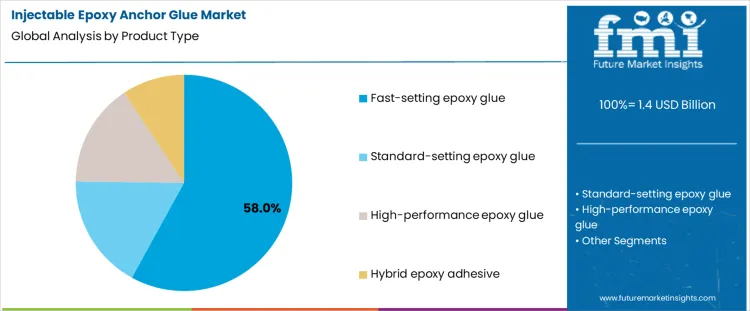
Fast setting epoxy glue represents about 58% of demand in the Injectable Epoxy Anchor Glue Market because it shortens waiting time between drilling, injection, and loading. This matters on sites where labor scheduling and access equipment dominate cost. Rapid cure systems allow crews to close tasks within a single shift, reducing idle time and temporary supports. Standard setting products serve projects where working time and placement accuracy matter more than speed, such as deep or congested holes. High performance epoxy targets anchors carrying sustained or critical loads, where creep resistance and long term strength drive specification. Hybrid adhesives address mixed substrates and variable site conditions, trading some peak performance for broader tolerance and easier handling.
From a commercial standpoint, product type choice defines more than chemical formulation. Fast setting systems require tight control of temperature windows and cartridge changeover, which affects waste rates and training needs. Standard setting products extend working time but keep crews on site longer before inspection sign off. High performance grades increase documentation, testing, and approval steps, which shifts cost toward engineering and quality control. Hybrids simplify logistics by reducing the number of SKUs on site, yet often need conservative design margins. Once a product is written into a method statement and approved by inspectors, changes are avoided because retesting and reapproval interrupt schedules. Demand by type therefore follows construction workflow priorities rather than material substitution strategies.
Why Does Application Mix Determine Volume Scale and Specification Strictness in the Injectable Epoxy Anchor Glue Market?
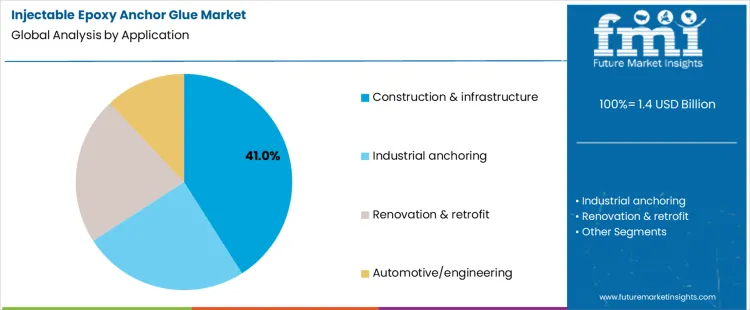
Construction and infrastructure accounts for about 41% of demand in the Injectable Epoxy Anchor Glue Market because these projects consume large numbers of anchors across bridges, buildings, and public works. The focus here sits on throughput, inspection compliance, and predictable performance across many crews. Industrial anchoring uses fewer fixings but often in higher consequence locations, which raises documentation and testing requirements. Renovation and retrofit work depends on variable substrates and limited access, increasing reliance on products with broader tolerance and proven bond behavior in aged concrete. Automotive and engineering applications operate at smaller volumes and tighter process control, where repeatability and integration into assembly routines matter more than site speed.
Application mix also shapes ordering patterns and supplier relationships. Infrastructure contractors favor framework agreements and steady deliveries aligned with project phases. Industrial users place more episodic orders tied to shutdowns and maintenance windows. Retrofit contractors value local availability and flexible packaging because work scopes change frequently after exposure. Engineering and automotive users often lock specifications for long periods and qualify suppliers through internal testing. This spread explains why high volume sits in construction while technical scrutiny intensifies in industrial and engineering segments. The balance across applications reflects where anchor density, liability exposure, and scheduling pressure intersect in real projects rather than differences in adhesive chemistry alone.
How Is the Injectable Epoxy Anchor Glue Market Being Shaped by Structural Safety Requirements and Installation Accountability?
The injectable epoxy anchor glue market is increasingly shaped by how engineers, contractors, and inspectors manage structural risk and liability. In bridges, industrial facilities, transport structures, and large buildings, anchor performance becomes part of the load path rather than a secondary detail. Buyers focus on certified performance, installation reliability, and predictable curing behavior under site conditions. Product selection is tied to approvals, testing records, and documented installation procedures. This shifts competition toward suppliers that support specification work, training, and compliance documentation, making injectable epoxy anchor glue a system-critical material rather than a routine construction consumable.
How Is Jobsite Reality Changing Product Expectations in The Injectable Epoxy Anchor Glue Market?
Construction environments rarely match controlled conditions, and this is reshaping expectations in the injectable epoxy anchor glue market. Contractors need products that perform consistently across variable hole quality, temperature ranges, moisture presence, and installation skill levels. This increases emphasis on forgiving formulations, stable extrusion behavior, and clear indicators of proper mixing. Designers and applicators also value predictable working time and reliable curing to maintain schedules. Demand is shifting toward products that reduce execution risk on site, not only those that deliver strong laboratory test results.
Where Is Sustained Demand Being Built in The Injectable Epoxy Anchor Glue Market Beyond New Construction?
Sustained demand is increasingly coming from repair, strengthening, and modification of existing structures rather than only from new builds. Equipment installation, structural upgrades, code compliance work, and change-of-use projects all rely on post-installed anchoring solutions. These activities create repeat demand because they are driven by asset lifecycle management rather than by project cycles alone. There is also growth potential in standardized anchoring systems supplied with documentation, training support, and approved installation methods. Suppliers that work closely with engineering consultants and maintenance contractors can secure repeat business across long-lived asset portfolios.
Why Do Specification Rigidity and Cost Pressure Limit Faster Expansion in The Injectable Epoxy Anchor Glue Market?
Once an anchoring system is approved for a project type or regulatory framework, changing products often requires requalification, new testing, and revised documentation. This makes engineers and asset owners cautious about switching suppliers. At the same time, injectable epoxy anchor glue carries a higher unit cost than mechanical anchors or simpler chemical systems, which restricts use in cost-driven projects. Many contractors reserve epoxy systems only for applications where performance necessity is clear. This combination of specification lock-in and budget sensitivity slows broader substitution.
What is the Demand Outlook for Injectable Epoxy Anchor Glue by Country?
| Country | CAGR |
|---|---|
| USA | 7.8% |
| UK | 7.5% |
| China | 8.8% |
| India | 9.2% |
| Brazil | 8.0% |
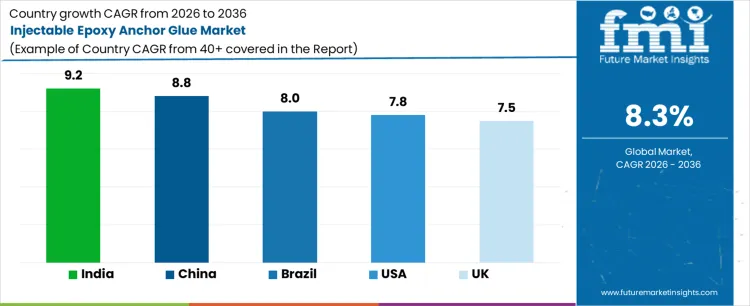
Demand for injectable epoxy anchor glue is rising as construction and infrastructure projects require reliable post installed anchoring solutions for concrete, masonry, and structural retrofitting. India leads with a 9.2% CAGR, supported by large scale urban infrastructure programs, transport projects, and increasing use of chemical anchoring in commercial and industrial buildings. China follows at 8.8%, driven by ongoing metro, bridge, and industrial facility construction and stricter structural safety practices. Brazil records 8.0%, reflecting investment in commercial construction and renovation activity. The USA grows at 7.8%, shaped by repair, strengthening, and seismic retrofit work. The UK, at 7.5%, reflects steady adoption in refurbishment and regulated construction environments.
How Do Code Compliance and Retrofit Programs Shape Demand in The United States?
Seismic codes and retrofit programs keep the injectable epoxy anchor glue market in the United States on a 7.8% CAGR path. Demand comes from bridge rehabilitation, transit stations, industrial plants, and commercial towers. Structural engineers control specifications through approved product lists tied to load tables and fire ratings. Contractors purchase material within project contracts covering anchors, fasteners, and drilling services. Site conditions require predictable cure behavior and documented pull out test results. Batch traceability and shelf life control influence repeat selection. Distribution networks determine availability across metropolitan regions. Training records for installers affect brand continuity. Replacement of corroded anchors sustains baseline volume in older assets. New construction absorbs the remaining share. Commercial standing depends on specification placement and consistent field results rather than competition for short cycle purchase orders alone.
Why Do Testing Protocols and Framework Control Guide Procurement in The United Kingdom?
Independent certification regimes place the injectable epoxy anchor glue market in the United Kingdom on a 7.5% CAGR track. Transport projects, public buildings, energy facilities, and commercial sites generate steady usage. Consulting engineers manage acceptance through test certificates covering bond strength and fire performance. Asset owners maintain controlled product schedules for framework contractors. Orders align with access plans set during project programming. Refurbishment work in older structures supplies a large share of volume. Installer competence records influence product continuity across programs. Storage conditions receive attention due to temperature sensitivity. Distribution partners coordinate regional availability. Audit trails remain part of handover documentation. New build projects contribute incremental demand. Commercial access depends on framework inclusion and clean test histories rather than price competition in site level purchasing processes and tendering decisions alone.
What Role Do Centralized Programs and Standardized Design Play in China?
Large program construction places the injectable epoxy anchor glue market in China on an 8.8% growth trajectory. High speed rail, metro systems, energy plants, and heavy industry facilities account for most consumption. Design institutes define material standards used across bundled projects. State contractors apply uniform installation procedures supported by inspection records. Order releases follow project schedules rather than individual site requests. Local production supports volume continuity and delivery control. Quality systems focus on bond strength, temperature performance, and shelf life management. Replacement activity runs alongside new builds in dense corridors. Logistics planning follows regional staging plans. Payment schedules align with milestone approvals. Supplier audits remain part of project governance. Commercial position depends on access to national programs and prime contractor supply chains rather than fragmented regional distributor sales channels alone.
How Do Urban Expansion and Contractor Led Procurement Shape Demand in India?
Urban infrastructure expansion fixes the injectable epoxy anchor glue market in India at a 9.2% CAGR. Metro corridors, highways, industrial facilities, and commercial developments generate steady site demand. Engineering contractors control material selection through project approval lists. Product choice reflects load ratings, handling tolerance, and regional availability. Importers and domestic producers compete under qualification checks. Release timing follows milestone based payment schedules. Site conditions require attention to curing behavior and moisture exposure. Training programs for installers affect consistency. Retrofit work in older buildings contributes recurring volume. Distribution coverage shapes contractor preference. Inventory planning follows project calendars. Quality documentation remains part of handover packages for inspectors and owners. Commercial results depend on recurring tender participation and maintaining approval status across successive project phases within public and private construction programs nationwide alone.
How Do Transport Corridors and Industrial Upgrades Structure Spending in Brazil?
Transport investment and industrial upgrades keep the injectable epoxy anchor glue market in Brazil near an 8.0% CAGR. Bridges, ports, energy facilities, and commercial buildings represent core application areas. Engineering firms define acceptance lists based on load capacity and durability requirements. Contractors source materials within project contracts covering drilling and fixing systems. Import logistics and local blending capacity shape lead times. Field conditions place focus on handling stability and curing behavior. Distributor networks manage stock positioning near major projects. Replacement of aging fixings sustains baseline demand. New builds contribute additional volume. Documentation for inspections remains part of handover packages. Training programs for crews influence consistent application across regions and contractors. Commercial position depends on distributor reach and engineering approvals rather than competition for short term site purchases alone.
How Do Suppliers Secure Positions in the Injectable Epoxy Anchor Glue Market?

Injectable epoxy anchor glue demand comes from retrofit projects, seismic upgrades, plant expansions, and rehabilitation programs. Selection happens during structural detailing rather than at site level purchasing. Engineers define load cases, edge distances, embedment depth, temperature limits, and inspection class. Those choices narrow acceptable product families before bidding begins. Hilti, Sika, Simpson Strong Tie, BASF, and Würth compete inside that specification window. Hilti links adhesives with drilling systems and test records.
Sika supplies wide chemical ranges tied to repair portfolios. Simpson Strong Tie benefits from prescriptive details embedded in drawings. BASF contributes formulation depth and certification files. Würth reaches contractors through distribution density. Once drawings freeze, material changes trigger new approvals and repeat testing during active construction phases.
Competitive dynamics follow inspection regimes, distribution access, and contractor working habits rather than headline pricing. Buyers examine load tables, creep behavior, cure profiles, shelf life, and storage rules during submittal review. Inventory coverage matters for distributors serving maintenance crews and retrofit contractors. Hilti relies on field engineers and on site testing support to maintain specification positions. Sika uses portfolio breadth across bonding, sealing, and repair systems. Simpson Strong Tie secures repeat use through details already embedded in project templates.
BASF supports complex projects through laboratory data and certification packages. Würth competes through branch networks and purchasing contracts with trade customers. Requalification delays affect schedules and inspection sign off. Market positions differ across code regimes, contractor preferences, and local approval practices.
Key Players in the Injectable Epoxy Anchor Glue Market
- Hilti AG
- Sika AG
- Simpson Strong-Tie Company, Inc.
- BASF SE
- Adolf Würth GmbH & Co. KG
Scope of the Report
| Items | Values |
|---|---|
| Quantitative Units (2026) | USD billion |
| Product Type | Fast-setting epoxy glue, Standard-setting epoxy glue, High-performance epoxy glue, Hybrid epoxy adhesive |
| Application | Construction and infrastructure, Industrial anchoring, Renovation and retrofit, Automotive and engineering |
| Region | Asia Pacific, Europe, North America, Latin America, Middle East & Africa |
| Countries Covered | China, Japan, South Korea, India, Australia & New Zealand, ASEAN, Germany, United Kingdom, France, Italy, Spain, Nordic, BENELUX, United States, Canada, Mexico, Brazil, Chile, Saudi Arabia, Turkey, South Africa, and other regional markets |
| Key Companies Profiled | Hilti AG, Sika AG, Simpson Strong-Tie Company, Inc., BASF SE, Adolf Würth GmbH & Co. KG |
| Additional Attributes | Dollar by sales by product type and application; demand driven by structural retrofits, infrastructure upgrades, and code compliance; purchasing shaped by approvals, load tables, cure profiles, installer training, batch traceability, and specification lock-in; growth led by repair, strengthening, and post-installed anchoring programs rather than new build cycles. |
Injectable Epoxy Anchor Glue Market Segmentation
Product Type:
- Fast-setting epoxy glue
- Standard-setting epoxy glue
- High-performance epoxy glue
- Hybrid epoxy adhesive
Application:
- Construction & infrastructure
- Industrial anchoring
- Renovation & retrofit
- Automotive and engineering
Region:
- Asia Pacific
- China
- Japan
- South Korea
- India
- Australia & New Zealand
- ASEAN
- Rest of Asia Pacific
- Europe
- Germany
- United Kingdom
- France
- Italy
- Spain
- Nordic
- BENELUX
- Rest of Europe
- North America
- United States
- Canada
- Mexico
- Latin America
- Brazil
- Chile
- Rest of Latin America
- Middle East & Africa
- Kingdom of Saudi Arabia
- Other GCC Countries
- Turkey
- South Africa
- Other African Union
- Rest of Middle East & Africa
Bibliography
- American Concrete Institute. (2023). Building code requirements for structural concrete and commentary (ACI 318-19, including anchoring to concrete provisions). American Concrete Institute.
- American Concrete Institute. (2023). Qualification of post-installed adhesive anchors in concrete (ACI 355.4). American Concrete Institute.
- ASTM International. (2024). Standard test methods for strength of anchors in concrete and masonry elements (ASTM E488/E488M). ASTM International.
- European Organisation for Technical Assessment. (2024). EAD 330499-00-0601: Post-installed fasteners in concrete under static and quasi-static loading. EOTA.
- European Organisation for Technical Assessment. (2023). EAD 330087-01-0601: Bonded fasteners for use in concrete. EOTA.
Frequently Asked Questions
How big is the injectable epoxy anchor glue market in 2026?
The global injectable epoxy anchor glue market is estimated to be valued at USD 1.4 billion in 2026.
What will be the size of injectable epoxy anchor glue market in 2036?
The market size for the injectable epoxy anchor glue market is projected to reach USD 3.1 billion by 2036.
How much will be the injectable epoxy anchor glue market growth between 2026 and 2036?
The injectable epoxy anchor glue market is expected to grow at a 8.3% CAGR between 2026 and 2036.
What are the key product types in the injectable epoxy anchor glue market?
The key product types in injectable epoxy anchor glue market are fast‑setting epoxy glue , standard‑setting epoxy glue, high‑performance epoxy glue and hybrid epoxy adhesive.
Which application segment to contribute significant share in the injectable epoxy anchor glue market in 2026?
In terms of application, construction & infrastructure segment to command 41.0% share in the injectable epoxy anchor glue market in 2026.
Preview the report firsthand - request a free sample
Get SampleGet the brochure for pricing and purchase details.
Get PDFTable of Content
- Executive Summary
- Global Market Outlook
- Demand-side Trends
- Supply-side Trends
- Technology Roadmap Analysis
- Analysis and Recommendations
- Market Overview
- Market Coverage / Taxonomy
- Market Definition / Scope / Limitations
- Market Background
- Market Dynamics
- Drivers
- Restraints
- Opportunity
- Trends
- Scenario Forecast
- Demand in Optimistic Scenario
- Demand in Likely Scenario
- Demand in Conservative Scenario
- Opportunity Map Analysis
- Product Life Cycle Analysis
- Supply Chain Analysis
- Investment Feasibility Matrix
- Value Chain Analysis
- PESTLE and Porter’s Analysis
- Regulatory Landscape
- Regional Parent Market Outlook
- Production and Consumption Statistics
- Import and Export Statistics
- Market Dynamics
- Global Market Analysis 2021 to 2025 and Forecast, 2026 to 2036
- Historical Market Size Value (USD Million) Analysis, 2021 to 2025
- Current and Future Market Size Value (USD Million) Projections, 2026 to 2036
- Y-o-Y Growth Trend Analysis
- Absolute $ Opportunity Analysis
- Global Market Pricing Analysis 2021 to 2025 and Forecast 2026 to 2036
- Global Market Analysis 2021 to 2025 and Forecast 2026 to 2036, By Product Type
- Introduction / Key Findings
- Historical Market Size Value (USD Million) Analysis By Product Type , 2021 to 2025
- Current and Future Market Size Value (USD Million) Analysis and Forecast By Product Type , 2026 to 2036
- Fast‑setting epoxy glue
- Standard‑setting epoxy glue
- High‑performance epoxy glue
- Hybrid epoxy adhesive
- Fast‑setting epoxy glue
- Y-o-Y Growth Trend Analysis By Product Type , 2021 to 2025
- Absolute $ Opportunity Analysis By Product Type , 2026 to 2036
- Global Market Analysis 2021 to 2025 and Forecast 2026 to 2036, By Application
- Introduction / Key Findings
- Historical Market Size Value (USD Million) Analysis By Application, 2021 to 2025
- Current and Future Market Size Value (USD Million) Analysis and Forecast By Application, 2026 to 2036
- Construction & infrastructure
- Industrial anchoring
- Renovation & retrofit
- Automotive/engineering
- Construction & infrastructure
- Y-o-Y Growth Trend Analysis By Application, 2021 to 2025
- Absolute $ Opportunity Analysis By Application, 2026 to 2036
- Global Market Analysis 2021 to 2025 and Forecast 2026 to 2036, By Region
- Introduction
- Historical Market Size Value (USD Million) Analysis By Region, 2021 to 2025
- Current Market Size Value (USD Million) Analysis and Forecast By Region, 2026 to 2036
- North America
- Latin America
- Western Europe
- Eastern Europe
- East Asia
- South Asia and Pacific
- Middle East & Africa
- Market Attractiveness Analysis By Region
- North America Market Analysis 2021 to 2025 and Forecast 2026 to 2036, By Country
- Historical Market Size Value (USD Million) Trend Analysis By Market Taxonomy, 2021 to 2025
- Market Size Value (USD Million) Forecast By Market Taxonomy, 2026 to 2036
- By Country
- USA
- Canada
- Mexico
- By Product Type
- By Application
- By Country
- Market Attractiveness Analysis
- By Country
- By Product Type
- By Application
- Key Takeaways
- Latin America Market Analysis 2021 to 2025 and Forecast 2026 to 2036, By Country
- Historical Market Size Value (USD Million) Trend Analysis By Market Taxonomy, 2021 to 2025
- Market Size Value (USD Million) Forecast By Market Taxonomy, 2026 to 2036
- By Country
- Brazil
- Chile
- Rest of Latin America
- By Product Type
- By Application
- By Country
- Market Attractiveness Analysis
- By Country
- By Product Type
- By Application
- Key Takeaways
- Western Europe Market Analysis 2021 to 2025 and Forecast 2026 to 2036, By Country
- Historical Market Size Value (USD Million) Trend Analysis By Market Taxonomy, 2021 to 2025
- Market Size Value (USD Million) Forecast By Market Taxonomy, 2026 to 2036
- By Country
- Germany
- UK
- Italy
- Spain
- France
- Nordic
- BENELUX
- Rest of Western Europe
- By Product Type
- By Application
- By Country
- Market Attractiveness Analysis
- By Country
- By Product Type
- By Application
- Key Takeaways
- Eastern Europe Market Analysis 2021 to 2025 and Forecast 2026 to 2036, By Country
- Historical Market Size Value (USD Million) Trend Analysis By Market Taxonomy, 2021 to 2025
- Market Size Value (USD Million) Forecast By Market Taxonomy, 2026 to 2036
- By Country
- Russia
- Poland
- Hungary
- Balkan & Baltic
- Rest of Eastern Europe
- By Product Type
- By Application
- By Country
- Market Attractiveness Analysis
- By Country
- By Product Type
- By Application
- Key Takeaways
- East Asia Market Analysis 2021 to 2025 and Forecast 2026 to 2036, By Country
- Historical Market Size Value (USD Million) Trend Analysis By Market Taxonomy, 2021 to 2025
- Market Size Value (USD Million) Forecast By Market Taxonomy, 2026 to 2036
- By Country
- China
- Japan
- South Korea
- By Product Type
- By Application
- By Country
- Market Attractiveness Analysis
- By Country
- By Product Type
- By Application
- Key Takeaways
- South Asia and Pacific Market Analysis 2021 to 2025 and Forecast 2026 to 2036, By Country
- Historical Market Size Value (USD Million) Trend Analysis By Market Taxonomy, 2021 to 2025
- Market Size Value (USD Million) Forecast By Market Taxonomy, 2026 to 2036
- By Country
- India
- ASEAN
- Australia & New Zealand
- Rest of South Asia and Pacific
- By Product Type
- By Application
- By Country
- Market Attractiveness Analysis
- By Country
- By Product Type
- By Application
- Key Takeaways
- Middle East & Africa Market Analysis 2021 to 2025 and Forecast 2026 to 2036, By Country
- Historical Market Size Value (USD Million) Trend Analysis By Market Taxonomy, 2021 to 2025
- Market Size Value (USD Million) Forecast By Market Taxonomy, 2026 to 2036
- By Country
- Kingdom of Saudi Arabia
- Other GCC Countries
- Turkiye
- South Africa
- Other African Union
- Rest of Middle East & Africa
- By Product Type
- By Application
- By Country
- Market Attractiveness Analysis
- By Country
- By Product Type
- By Application
- Key Takeaways
- Key Countries Market Analysis
- USA
- Pricing Analysis
- Market Share Analysis, 2025
- By Product Type
- By Application
- Canada
- Pricing Analysis
- Market Share Analysis, 2025
- By Product Type
- By Application
- Mexico
- Pricing Analysis
- Market Share Analysis, 2025
- By Product Type
- By Application
- Brazil
- Pricing Analysis
- Market Share Analysis, 2025
- By Product Type
- By Application
- Chile
- Pricing Analysis
- Market Share Analysis, 2025
- By Product Type
- By Application
- Germany
- Pricing Analysis
- Market Share Analysis, 2025
- By Product Type
- By Application
- UK
- Pricing Analysis
- Market Share Analysis, 2025
- By Product Type
- By Application
- Italy
- Pricing Analysis
- Market Share Analysis, 2025
- By Product Type
- By Application
- Spain
- Pricing Analysis
- Market Share Analysis, 2025
- By Product Type
- By Application
- France
- Pricing Analysis
- Market Share Analysis, 2025
- By Product Type
- By Application
- India
- Pricing Analysis
- Market Share Analysis, 2025
- By Product Type
- By Application
- ASEAN
- Pricing Analysis
- Market Share Analysis, 2025
- By Product Type
- By Application
- Australia & New Zealand
- Pricing Analysis
- Market Share Analysis, 2025
- By Product Type
- By Application
- China
- Pricing Analysis
- Market Share Analysis, 2025
- By Product Type
- By Application
- Japan
- Pricing Analysis
- Market Share Analysis, 2025
- By Product Type
- By Application
- South Korea
- Pricing Analysis
- Market Share Analysis, 2025
- By Product Type
- By Application
- Russia
- Pricing Analysis
- Market Share Analysis, 2025
- By Product Type
- By Application
- Poland
- Pricing Analysis
- Market Share Analysis, 2025
- By Product Type
- By Application
- Hungary
- Pricing Analysis
- Market Share Analysis, 2025
- By Product Type
- By Application
- Kingdom of Saudi Arabia
- Pricing Analysis
- Market Share Analysis, 2025
- By Product Type
- By Application
- Turkiye
- Pricing Analysis
- Market Share Analysis, 2025
- By Product Type
- By Application
- South Africa
- Pricing Analysis
- Market Share Analysis, 2025
- By Product Type
- By Application
- USA
- Market Structure Analysis
- Competition Dashboard
- Competition Benchmarking
- Market Share Analysis of Top Players
- By Regional
- By Product Type
- By Application
- Competition Analysis
- Competition Deep Dive
- Hilti AG
- Overview
- Product Portfolio
- Profitability by Market Segments (Product/Age /Sales Channel/Region)
- Sales Footprint
- Strategy Overview
- Marketing Strategy
- Product Strategy
- Channel Strategy
- Sika AG
- Simpson Strong‑Tie Company, Inc.
- BASF SE
- Adolf Würth GmbH & Co. KG
- Hilti AG
- Competition Deep Dive
- Assumptions & Acronyms Used
- Research Methodology


