

- Market Size (2026)
- USD 720.7 Mn
- Forecast (2036)
- USD 1769.8 Mn
- CAGR (2026 to 2036)
- 9.4%
How big is the inline color monitoring system market in 2026?
USD 720.7 million in 2026 and USD 1,769.8 million by 2036 at a 9.4% CAGR.
The inline color monitoring system market is expected to move from USD 658.8 million in 2025 to USD 1,769.8 million by 2036. Demand is supported by production lines that need live shade checks before rework becomes expensive. Inline spectrophotometers are forecast to hold 38.6% share in 2026. Dyeing lines are expected to represent 36.8% share in 2026 through direct exposure to off-shade fabric losses.
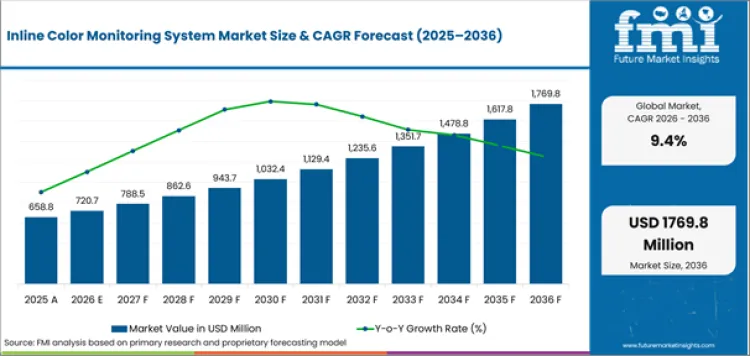
| Metric | Value |
|---|---|
| 2026 Market Size | USD 720.7 million |
| 2036 Market Size | USD 1,769.8 million |
| Forecast CAGR (2026-2036) | 9.4% |
| Leading System Type | Inline Spectrophotometers |
| Inline Spectrophotometers Share (2026) | 38.6% |
| Leading Application | Dyeing Lines |
| Dyeing Lines Share (2026) | 36.8% |
| Fastest-growing Country | India |
| India CAGR by 2036 | 11.1% |
Summary of Inline Color Monitoring System Market
| Market Signal | Commercial Impact |
|---|---|
| Demand and Growth Drivers | Demand for inline color monitoring systems is increasing as textile dyeing, packaging printing, and process industries seek real-time color control to reduce waste and improve production consistency.
|
| Product and Segment View | Inline spectrophotometers, dyeing lines, textiles, and PLC/MES integrated systems lead their respective market segments.
|
| Geography and Growth Outlook | Asia remains the leading manufacturing region while Europe continues to strengthen demand through advanced industrial automation.
|
| Competitive Landscape | Competition increasingly focuses on measurement accuracy, software integration, and production analytics.
|
| Analyst Perspective | Inline color monitoring systems are becoming a strategic production control investment as manufacturers prioritize quality consistency, lower scrap rates, and digital process automation.
- Nikhil Kaitwade, Principal Analyst at Future Market Insights |
The industry is predicted to expand as textile and packaging producers need earlier color-drift detection during continuous production. U.S. textile mill shipments stood at USD 2,009 million in April 2026. China’s textile industry value added grew 4.6% year over year in December 2024. Datacolor’s July 2025 acquisition of TECHKON USA adds a supplier-side signal because TECHKON brings ChromaQA software and in-line spectrometers into Datacolor’s portfolio. This matters because buyers want systems that detect shade variation before rework reaches finished rolls and brand approval stages.
Why is the inline color monitoring system market growing?
Dyehouses are buying inline systems to cut off-shade lots before fabric reaches final inspection.
Packaging converters are adding live spectral checks inside broader packaging machinery upgrades that protect brand color across plants. Dyeing line demand is changing from a quality-assurance issue into a production economics issue. A failed shade can consume extra dyestuff and machine time before the lot is released. China’s National Bureau of Statistics reported textile industry value added growth of 4.6% in 2024. This supports automation spending in large processing environments.
Brand owners need the same red and blue across plants. Black and other high-use colors require the same control. This raises the value of press-side systems that combine sensor accuracy with reporting software. Datacolor’s July 2025 TECHKON USA acquisition added ChromaQA software and in-line spectrometers to its portfolio. Packaging users therefore compare color systems with wider machine vision system investments.
How is the inline color monitoring system market segmented?
The inline color monitoring system industry is segmented by system type, application, end use, integration, sales channel, and region
- Inline Spectrophotometers are projected to secure 38.6% share in 2026 with direct spectral readings on moving substrates.
- Dyeing Lines are expected to account for 36.8% share in 2026 with rejected shade approvals creating cost exposure.
- Textiles are forecast to represent 42.5% share in 2026 with buyer acceptance tied to repeatable color output.
- PLC / MES Integrated systems are anticipated to hold 44.2% share in 2026 with color alerts moving into line control.
- Direct OEM is projected to hold 46.1% share in 2026 with machine builders embedding sensors during new line specification.
Which system type category holds a notable share in the inline color monitoring system market?
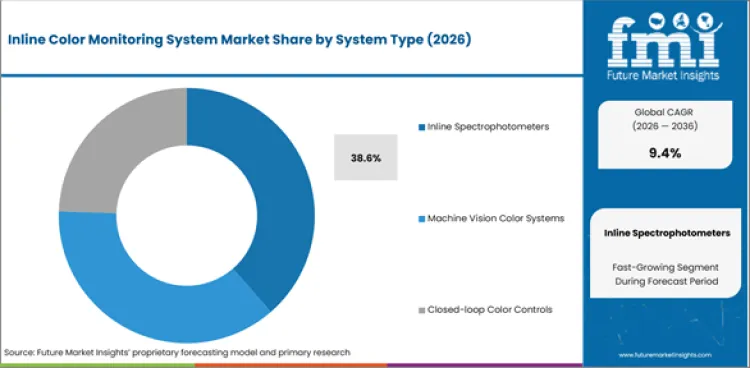
- Inline Spectrophotometers are projected to account for 38.6% share in 2026 through repeatable spectral reflectance data.
- Machine Vision Color Systems gain use in plants that need color checks alongside defect detection and placement inspection.
How does the application segment perform in the inline color monitoring system market?
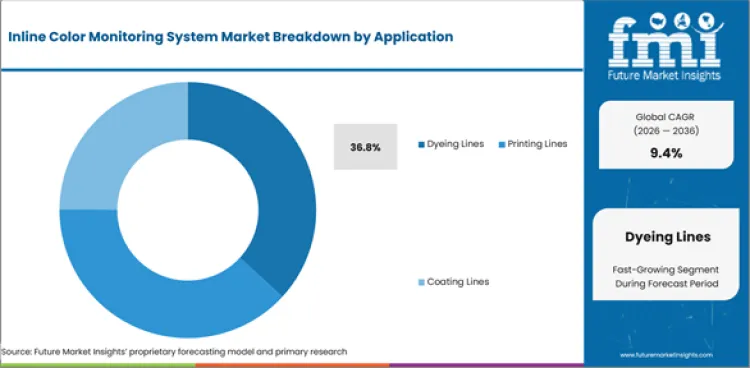
- Dyeing Lines are expected to represent 36.8% share in 2026 with shade correction protecting lot value during processing.
- Printing Lines are forecast to hold 27.4% share in 2026 in response to brand color reporting needs in packaging and textile print runs.
What drives demand across end-use options in the inline color monitoring system market?
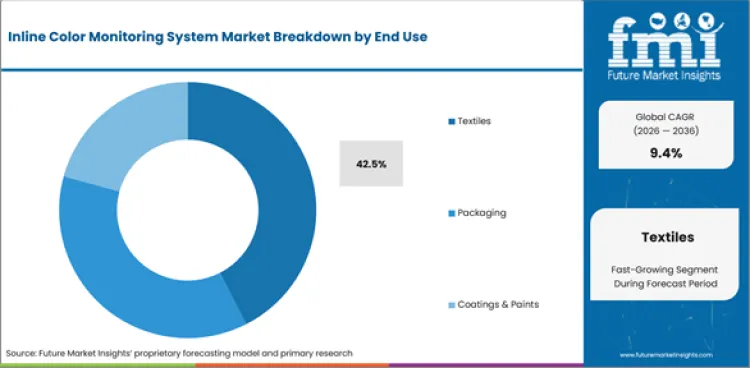
- Textiles are anticipated to hold 42.5% share in 2026 with visible shade bands across apparel and home textile rolls.
- Packaging users add inline checks to align color control with fabric inspection machine systems used on high-speed webs.
Which integration segment shows a prominent position in the inline color monitoring system market?
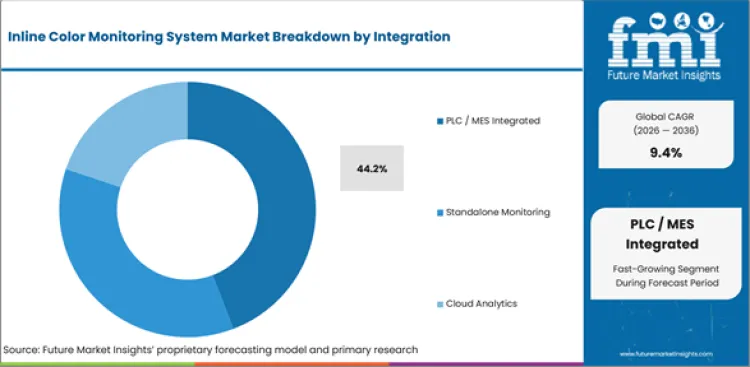
- PLC / MES Integrated systems are expected to account for 44.2% share in 2026 with alarms reaching operators without manual transfer.
- Standalone Monitoring remains relevant for retrofit buyers that need controlled measurement before full automation approval.
How are buyers selecting across sales channel options in the inline color monitoring system market?
- Direct OEM is projected to hold 46.1% share in 2026 with line builders matching sensor placement to machine width and speed.
- System Integrators remain important in retrofit projects that need PLC mapping and calibration support. Operator training remains part of the sale.
What are the driver, restraints, and opportunities in the inline color monitoring system market?
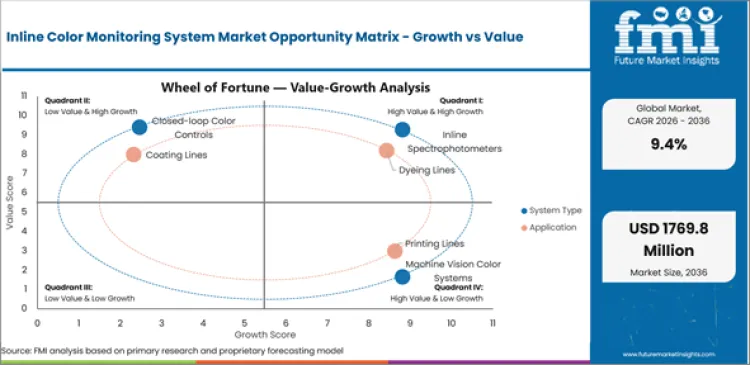
Off-shade cost reduction supports growth. Integration cost and calibration risk limit faster rollout.
- Driver: Closed-loop dye control is expected to raise demand by correcting shade drift before fabric exits the range.
- Restraint: Integration cost can delay smaller mill projects through PLC access and line downtime. Calibration service needs add further approval risk.
- Opportunity: Cloud analytics creates added value for multi-site textile and packaging groups that need common color records.
Shade Drift Cost Control
Color drift becomes expensive after a roll or batch is complete. Inline systems move the control point closer to the source of variation. The U.S. Census Bureau reported textile mills shipments of USD 2,009 million in April 2026. The figure shows an active production base that can justify systems through waste reduction and faster release.
Brand Color Traceability
Packaging and textile buyers are moving from visual approval toward stored color data. Datacolor acquired TECHKON USA in July 2025 and added ChromaQA software with in-line spectrometers. This means converters that need production records beside colorimeter demand workflows.
Integration Service Bottleneck
A significant restraint is commissioning risk more than sensor accuracy alone. Buyers hesitate if PLC mapping requires long shutdowns or scarce service support. Suppliers that reduce this risk can reach mills upgrading textile winding machine and other fabric handling lines.
Which countries are growing fastest in the inline color monitoring system market?
India 11.1% CAGR, China 10.4% CAGR, South Korea 9.6% CAGR, Germany 8.9% CAGR, United States 8.7% CAGR, United Kingdom 8.3% CAGR, France 8.2% CAGR, and Japan 8.0% CAGR through 2036.
.webp "Top Country Growth Comparison Inline Color Monitoring System Market Cagr (2026 2036)")
| Country | CAGR |
|---|---|
| India | 11.1% |
| China | 10.4% |
| South Korea | 9.6% |
| Germany | 8.9% |
| United States | 8.7% |
| United Kingdom | 8.3% |
| France | 8.2% |
| Japan | 8.0% |
Source: Future Market Insights, 2026.
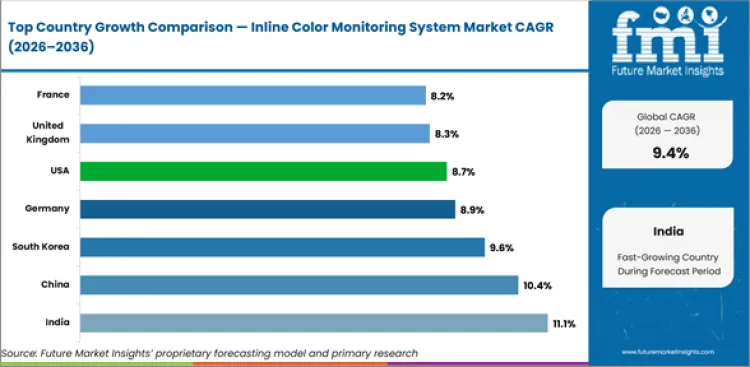
How do country-level CAGRs compare in the inline color monitoring system market?
- India is forecast to record 11.1% CAGR by 2036, driven by growing export-oriented production requirements and modernization of processing hubs.
- China is projected to expand at 10.4% CAGR through 2036, supported by its extensive base of dyeing facilities and packaging production lines.
- South Korea is expected to grow at 9.6% CAGR by 2036, aided by demand from specialty material applications and stringent export quality standards.
- Germany is anticipated to rise at 8.9% CAGR through 2036, benefiting from established machinery networks that facilitate system deployment.
- The United States is forecast to post 8.7% CAGR by 2036, fueled by increasing adoption of software-enabled quality control solutions.
- The United Kingdom is expected to advance at 8.3% CAGR through 2036, supported by gradual implementation across converter manufacturing facilities.
- France is projected to grow at 8.2% CAGR by 2036, encouraged by demand for high-end packaging solutions and enhanced product traceability.
- Japan is estimated to expand at 8.0% CAGR through 2036, underpinned by a focus on precision-driven investments and extended approval processes.
How fast is the inline color monitoring system market growing in the United States?
An 8.7% CAGR through 2036 reflects disciplined replacement demand and software-led color assurance needs.
Country Market Snapshot Table
| Parameter | Value |
|---|---|
| Market Size in 2025 (Value) | USD 115.0 million |
| Market Size in 2026 (Value) | USD 125.0 million |
| Market Forecast in 2036 (Value) | USD 287.9 million |
| CAGR (2026 to 2036) | 8.7% |
| Years Considered | 2021 to 2036 |
| Base Year | 2025 |
| Forecast Period | 2026 to 2036 |
| Units Considered | Value (USD million) |
| Leading Sub-Region | Northeast and Midwest converter corridors |
United States Inline Color Monitoring System Market Outlook
United States demand is tied to high-value production more than mass textile volume. Buyers justify inline color systems through scrap reduction and brand protection. Faster customer release also supports the business case.
Packaging converters and coatings users often move faster than apparel mills. Supplier selection depends on reporting software and field service speed. Line acceptance support remains important.
Key Growth Drivers
- Converter and textile users have a working production base. The U.S. Census Bureau reported textile mills shipments of USD 2,009 million in April 2026.
- Manufacturing output conditions support automation budgets. ISM reported the Production Index at 53.4 in April 2026.
- Brand owners require numeric color records for packaging and specialty textile supplier audits.
- Local color-management suppliers reduce adoption risk through service networks and software training.
Key Restraints
- Input-cost pressure can slow discretionary projects. FRED listed the textile and fabric finishing mills PPI at 159.791 in May 2026.
- Replacement cycles remain disciplined with buyers expecting proof before wider plant rollout.
- Retrofit projects can stall if production teams cannot spare line downtime for sensor placement.
What makes United States unique
The United States is distinct for software-led color assurance tied to brand-owner and converter audit programs.
Key Companies
- X-Rite
- Datacolor
- HunterLab
- TECHKON USA
- AVT
- BST North America
- Valmet
Sales & Marketing Channels
- Direct enterprise sales
- OEM partnerships
- Distributor support
- System integrator projects
- Brand-owner programs
- Regional service contracts
Country Segment Breakdown Table
| Segment | Sub-Segments |
|---|---|
| By System Type | Inline Spectrophotometers · Machine Vision Color Systems · Closed-loop Color Controls · Portable-linked Systems |
| By Application | Dyeing Lines · Printing Lines · Coating Lines · Extrusion / Film Lines |
| By End Use | Textiles · Packaging · Coatings & Paints · Plastics |
| By Integration | Standalone Monitoring · PLC / MES Integrated · Cloud Analytics |
| By Sales Channel | Direct OEM · System Integrators · Distributors |
| Key Sub-Regions Covered, Industrial Clusters | Northeast · Midwest · Southeast · California · Texas · Pacific Northwest |
Frequently Asked Questions
How fast is the inline color monitoring system market growing in the United States?
United States sales are forecast to expand at 8.7% CAGR from 2026 to 2036 with local production-line quality needs.
Who leads United States inline color monitoring system market?
X-Rite, Datacolor and HunterLab support United States color-measurement demand. TECHKON USA and AVT add packaging inspection depth.
What is driving adoption in United States inline color monitoring system market?
Color repeatability and export customer checks support adoption. Lower rework risk and stronger digital quality records also help purchasing decisions.
How fast is the inline color monitoring system market growing in the United Kingdom?
An 8.3% CAGR through 2036 reflects selective adoption across converters and technical textiles. Brand compliance programs add demand support.
Country Market Snapshot Table
| Parameter | Value |
|---|---|
| Market Size in 2025 (Value) | USD 38.8 million |
| Market Size in 2026 (Value) | USD 42.0 million |
| Market Forecast in 2036 (Value) | USD 93.2 million |
| CAGR (2026 to 2036) | 8.3% |
| Years Considered | 2021 to 2036 |
| Base Year | 2025 |
| Forecast Period | 2026 to 2036 |
| Units Considered | Value (USD million) |
| Leading Sub-Region | Midlands and Northern converter clusters |
United Kingdom Inline Color Monitoring System Market Outlook
United Kingdom demand is selective and tied to quality-sensitive plants. Converters and technical textile users shape demand. Brands also need evidence of color consistency.
Buyers often start with portable-connected systems or press-side tools. Full closed-loop investment usually follows after the first workflow proves audit and waste benefits.
Key Growth Drivers
- Manufacturing activity gives suppliers a base for staged upgrades. ONS reported production output up 1.2% in the three months to February 2026.
- Factory users can justify quality projects through broader manufacturing recovery. ONS reported manufacturing output up 1.2% in the same period.
- Packaging converters need color records for consumer brand contracts and supplier claims.
- Technical textile users use shade control to reduce material loss in shorter production runs.
Key Restraints
- Capex caution remains visible. CBI reported a manufacturing order book balance of -45 in June 2026.
- Smaller textile firms may delay inline projects with uneven production schedules.
- Country-specific supplier evidence is thinner than in Germany or the United States.
What makes United Kingdom unique
The United Kingdom has a staged adoption profile with buyers testing portable-connected workflows before funding full line control.
Key Companies
- Datacolor UK Ltd
- X-Rite UK
- Konica Minolta Sensing Europe
- HunterLab Europe
- VeriVide
- Industrial Physics
- BYK-Gardner
Sales & Marketing Channels
- Industrial distributors
- European service centers
- Converter sales
- OEM upgrades
- Quality consultancy
- Brand programs
Country Segment Breakdown Table
| Segment | Sub-Segments |
|---|---|
| By System Type | Inline Spectrophotometers · Machine Vision Color Systems · Closed-loop Color Controls · Portable-linked Systems |
| By Application | Dyeing Lines · Printing Lines · Coating Lines · Extrusion / Film Lines |
| By End Use | Textiles · Packaging · Coatings & Paints · Plastics |
| By Integration | Standalone Monitoring · PLC / MES Integrated · Cloud Analytics |
| By Sales Channel | Direct OEM · System Integrators · Distributors |
| Key Sub-Regions Covered, Industrial Clusters | Midlands · North West England · Yorkshire · Scotland · Wales · London converter base |
Frequently Asked Questions
How fast is the inline color monitoring system market growing in the United Kingdom?
United Kingdom sales are forecast to expand at 8.3% CAGR from 2026 to 2036 through local production-line quality needs.
Who leads United Kingdom inline color monitoring system market?
Datacolor UK Ltd, X-Rite UK and Konica Minolta Sensing Europe support local measurement demand. HunterLab Europe adds reference-device access.
What is driving adoption in United Kingdom inline color monitoring system market?
Purchase decisions reflect color repeatability and export customer checks. Lower rework risk and stronger digital quality records also support adoption.
How fast is the inline color monitoring system market growing in Germany?
An 8.9% CAGR through 2036 reflects machinery integration strength and local measurement supplier depth.
Country Market Snapshot Table
| Parameter | Value |
|---|---|
| Market Size in 2025 (Value) | USD 50.5 million |
| Market Size in 2026 (Value) | USD 55.0 million |
| Market Forecast in 2036 (Value) | USD 129.0 million |
| CAGR (2026 to 2036) | 8.9% |
| Years Considered | 2021 to 2036 |
| Base Year | 2025 |
| Forecast Period | 2026 to 2036 |
| Units Considered | Value (USD million) |
| Leading Sub-Region | North Rhine-Westphalia and Bavaria |
Germany Inline Color Monitoring System Market Outlook
Germany is both a demand country and a supplier country. Machinery builders and print equipment firms shape adoption across Europe. Precision measurement suppliers reinforce that role.
German buyers are demanding on documentation and measurement stability. TECHKON and BYK-Gardner support a strong print route. Datacolor and BST add web inspection capability.
Key Growth Drivers
- OEM channels support line-level integration. VDMA Textile Machinery represents around 140 manufacturers in Germany.
- Supplier concentration supports export-facing equipment design. VDMA says its members represent about 90% of German textile machinery volume.
- German machinery channels embed color measurement into textile and converting equipment packages.
- Coatings and plastics users need repeatable color data for customer qualification.
Key Restraints
- Cost sensitivity remains a hurdle. Destatis reported producer prices for industrial products up 2.2% year on year in May 2026.
- Buyers require strong validation data before approving new sensors for production lines.
- Higher labor and service costs can raise total project cost for smaller users.
What makes Germany unique
Germany is distinct for the way measurement companies and machinery channels reinforce each other.
Key Companies
- TECHKON GmbH
- BYK-Gardner GmbH
- Datacolor GmbH
- BST GmbH
- X-Rite GmbH
- Konica Minolta Sensing Europe
- Micro-Epsilon Messtechnik
Sales & Marketing Channels
- OEM packages
- Engineering sales
- Converting integrators
- Distributor networks
- Trade fairs
- Retrofit service programs
Country Segment Breakdown Table
| Segment | Sub-Segments |
|---|---|
| By System Type | Inline Spectrophotometers · Machine Vision Color Systems · Closed-loop Color Controls · Portable-linked Systems |
| By Application | Dyeing Lines · Printing Lines · Coating Lines · Extrusion / Film Lines |
| By End Use | Textiles · Packaging · Coatings & Paints · Plastics |
| By Integration | Standalone Monitoring · PLC / MES Integrated · Cloud Analytics |
| By Sales Channel | Direct OEM · System Integrators · Distributors |
| Key Sub-Regions Covered, Industrial Clusters | North Rhine-Westphalia · Bavaria · Baden-Wurttemberg · Hesse · Saxony · Lower Saxony |
Frequently Asked Questions
How fast is the inline color monitoring system market growing in Germany?
Germany sales are forecast to expand at 8.9% CAGR from 2026 to 2036 under local production-line quality needs.
Who leads Germany inline color monitoring system market?
TECHKON GmbH, BYK-Gardner GmbH and BST GmbH support Germany color-measurement demand. Datacolor GmbH adds software access.
What is driving adoption in Germany inline color monitoring system market?
Color repeatability and export customer checks shape adoption. Lower rework risk and stronger digital quality records also support purchase decisions.
How fast is the inline color monitoring system market growing in France?
An 8.2% CAGR through 2036 reflects premium packaging and fashion supply chains. Traceability-led quality control adds support.
Country Market Snapshot Table
| Parameter | Value |
|---|---|
| Market Size in 2025 (Value) | USD 33.3 million |
| Market Size in 2026 (Value) | USD 36.0 million |
| Market Forecast in 2036 (Value) | USD 79.2 million |
| CAGR (2026 to 2036) | 8.2% |
| Years Considered | 2021 to 2036 |
| Base Year | 2025 |
| Forecast Period | 2026 to 2036 |
| Units Considered | Value (USD million) |
| Leading Sub-Region | Auvergne-Rhone-Alpes and Ile-de-France supplier corridors |
France Inline Color Monitoring System Market Outlook
France demand is shaped by quality reputation and policy pressure. Brands and luxury packaging users value traceable production evidence. Technical textiles and coatings processors add demand.
French buyers often ask whether color monitoring can reduce claims and support supplier audits. Country-specific public supplier evidence remains moderate.
Key Growth Drivers
- Manufacturing users have a recent production base. INSEE reported manufacturing output up 0.3% in November 2025.
- Policy discussion supports traceability tools. OECD identified France among countries with garment EPR operating experience in December 2024.
- Luxury packaging buyers need strict color repeatability across short and long runs.
- Coatings and plastics processors use color control to support premium product acceptance.
Key Restraints
- Monthly output volatility can delay equipment decisions. INSEE reported manufacturing output down 0.8% in December 2025.
- High project costs can slow adoption among smaller textile processors.
- Supplier activity is often routed through European hubs instead of local product teams.
What makes France unique
France stands out in applications that combine premium brand assurance with compliance documentation.
Key Companies
- Datacolor France
- X-Rite France
- Konica Minolta Sensing Europe
- BYK-Gardner
- BST
- Valmet
- TECHKON
Sales & Marketing Channels
- Direct sales
- Converter channels
- Quality consultants
- OEM retrofit routes
- Instrument distributors
- Brand supplier programs
Country Segment Breakdown Table
| Segment | Sub-Segments |
|---|---|
| By System Type | Inline Spectrophotometers · Machine Vision Color Systems · Closed-loop Color Controls · Portable-linked Systems |
| By Application | Dyeing Lines · Printing Lines · Coating Lines · Extrusion / Film Lines |
| By End Use | Textiles · Packaging · Coatings & Paints · Plastics |
| By Integration | Standalone Monitoring · PLC / MES Integrated · Cloud Analytics |
| By Sales Channel | Direct OEM · System Integrators · Distributors |
| Key Sub-Regions Covered, Industrial Clusters | Ile-de-France · Auvergne-Rhone-Alpes · Hauts-de-France · Grand Est · Nouvelle-Aquitaine · Occitanie |
Frequently Asked Questions
How fast is the inline color monitoring system market growing in France?
France sales are forecast to expand at 8.2% CAGR from 2026 to 2036 with local production-line quality needs.
Who leads France inline color monitoring system market?
Datacolor France, X-Rite France and Konica Minolta Sensing Europe support local supplier access. BYK-Gardner adds coatings measurement depth.
What is driving adoption in France inline color monitoring system market?
Export customer checks and lower rework risk guide adoption. Stronger digital quality records also support purchase decisions.
How fast is the inline color monitoring system market growing in Japan?
An 8.0% CAGR through 2036 reflects precision-led purchases and longer qualification cycles.
Country Market Snapshot Table
| Parameter | Value |
|---|---|
| Market Size in 2025 (Value) | USD 46.3 million |
| Market Size in 2026 (Value) | USD 50.0 million |
| Market Forecast in 2036 (Value) | USD 107.9 million |
| CAGR (2026 to 2036) | 8.0% |
| Years Considered | 2021 to 2036 |
| Base Year | 2025 |
| Forecast Period | 2026 to 2036 |
| Units Considered | Value (USD million) |
| Leading Sub-Region | Kanto and Kansai precision manufacturing belts |
Japan Inline Color Monitoring System Market Outlook
Japan is a precision-led market. Buyers value repeatability and calibration history more than low purchase price. Long-term service also affects selection.
Film and specialty material users are relevant with customer acceptance risk from small color shifts. Qualification cycles are slower but can support premium pricing.
Key Growth Drivers
- Instrument development supports buyer trust. Konica Minolta announced two CM-17d and CM-16d spectrophotometers in June 2024.
- Automation needs are supported by labor pressure. The U.S. International Trade Administration cited a projected 5.5 million population decrease over ten years in Japan.
- Specialty materials producers need stable color data for high-spec customer approvals.
- Film and printing users value non-contact color checks on sensitive substrates.
Key Restraints
- Qualification cycles can be long. Konica Minolta’s CM-17d uses 3mm and 8mm apertures that require application-specific validation.
- Mature plants may extend equipment life if existing service support remains reliable.
- Buyers compare inline systems against proven offline standards before approval.
What makes Japan unique
Japan is distinct for precision-reference behavior and conservative qualification habits.
Key Companies
- Konica Minolta Japan
- Nireco Corporation
- X-Rite Japan
- Datacolor Japan
- HunterLab
- BYK-Gardner
- Valmet Japan
Sales & Marketing Channels
- Direct instrument sales
- OEM packages
- Automation integrators
- Distributor networks
- Maintenance contracts
- Qualification trials
Country Segment Breakdown Table
| Segment | Sub-Segments |
|---|---|
| By System Type | Inline Spectrophotometers · Machine Vision Color Systems · Closed-loop Color Controls · Portable-linked Systems |
| By Application | Dyeing Lines · Printing Lines · Coating Lines · Extrusion / Film Lines |
| By End Use | Textiles · Packaging · Coatings & Paints · Plastics |
| By Integration | Standalone Monitoring · PLC / MES Integrated · Cloud Analytics |
| By Sales Channel | Direct OEM · System Integrators · Distributors |
| Key Sub-Regions Covered, Industrial Clusters | Kanto · Kansai · Chubu · Kyushu · Tohoku · Shikoku |
Frequently Asked Questions
How fast is the inline color monitoring system market growing in Japan?
Japan sales are forecast to expand at 8.0% CAGR from 2026 to 2036 through local production-line quality needs.
Who leads Japan inline color monitoring system market?
Konica Minolta Japan, Nireco Corporation and X-Rite Japan support local quality-control demand. Datacolor Japan adds color-management access.
What is driving adoption in Japan inline color monitoring system market?
Color repeatability makes adoption easier for mills serving export customers. Lower rework risk and digital quality records also support decisions.
How fast is the inline color monitoring system market growing in China?
A 10.4% CAGR through 2036 reflects large production scale and export quality pressure.
Country Market Snapshot Table
| Parameter | Value |
|---|---|
| Market Size in 2025 (Value) | USD 190.2 million |
| Market Size in 2026 (Value) | USD 210.0 million |
| Market Forecast in 2036 (Value) | USD 564.8 million |
| CAGR (2026 to 2036) | 10.4% |
| Years Considered | 2021 to 2036 |
| Base Year | 2025 |
| Forecast Period | 2026 to 2036 |
| Units Considered | Value (USD million) |
| Leading Sub-Region | Zhejiang, Jiangsu and Guangdong processing clusters |
China Inline Color Monitoring System Market Outlook
China has the broadest addressable line pool in the selected country set. Large dyeing and printing clusters support scale adoption. Packaging and plastics clusters add demand.
Large mills may buy global brands for critical lines. Mid-tier producers often seek lower-cost integration through local machinery builders and regional integrators.
Key Growth Drivers
- Large textile output supports automation demand. China’s National Bureau of Statistics reported textile industry value added growth of 4.6% in 2024.
- Machinery ecosystems can spread integrated systems quickly. China Textile Machinery Association lists 685 members and 10 committees.
- Export-facing mills use digital color proof to reduce buyer disputes.
- Local integrators can offer lower-cost retrofit routes for routine applications.
Key Restraints
- Price pressure remains high. NBS reported a product sales rate of 98.7% for industrial enterprises above designated size in December 2024.
- Mid-tier buyers may choose lower-cost systems with weaker calibration support.
- Local competition can pressure imported supplier margins in routine applications.
What makes China unique
China has a broad scale profile for line-level adoption across textile and packaging production. Plastics production density adds further demand.
Key Companies
- CHNSpec Technology
- Shenzhen 3nh Technology
- Datacolor China
- X-Rite China
- Konica Minolta China
- BST China
- Valmet China
Sales & Marketing Channels
- Machinery OEMs
- System integrators
- Direct supplier teams
- Distributor networks
- Export mill programs
- Trade fairs
Country Segment Breakdown Table
| Segment | Sub-Segments |
|---|---|
| By System Type | Inline Spectrophotometers · Machine Vision Color Systems · Closed-loop Color Controls · Portable-linked Systems |
| By Application | Dyeing Lines · Printing Lines · Coating Lines · Extrusion / Film Lines |
| By End Use | Textiles · Packaging · Coatings & Paints · Plastics |
| By Integration | Standalone Monitoring · PLC / MES Integrated · Cloud Analytics |
| By Sales Channel | Direct OEM · System Integrators · Distributors |
| Key Sub-Regions Covered, Industrial Clusters | Zhejiang · Jiangsu · Guangdong · Shandong · Fujian · Shanghai |
Frequently Asked Questions
How fast is the inline color monitoring system market growing in China?
China sales are forecast to expand at 10.4% CAGR from 2026 to 2036 with local production-line quality needs.
Who leads China inline color monitoring system market?
CHNSpec Technology, Shenzhen 3nh Technology and Datacolor China support local color-measurement demand. X-Rite China adds global portfolio access.
What is driving adoption in China inline color monitoring system market?
Export customer checks support adoption in mills that need lower rework risk. Stronger digital quality records also help purchasing decisions.
How fast is the inline color monitoring system market growing in South Korea?
A 9.6% CAGR through 2036 reflects specialty production and export customer quality requirements.
Country Market Snapshot Table
| Parameter | Value |
|---|---|
| Market Size in 2025 (Value) | USD 33.8 million |
| Market Size in 2026 (Value) | USD 37.0 million |
| Market Forecast in 2036 (Value) | USD 92.5 million |
| CAGR (2026 to 2036) | 9.6% |
| Years Considered | 2021 to 2036 |
| Base Year | 2025 |
| Forecast Period | 2026 to 2036 |
| Units Considered | Value (USD million) |
| Leading Sub-Region | Daegu, Gyeonggi and Busan specialty production clusters |
South Korea Inline Color Monitoring System Market Outlook
South Korea demand is concentrated in technical textiles and specialty materials. Industrial users often work with tighter quality requirements.
Buyers evaluate inline systems through process reliability and local service access. Public evidence on country-specific vendors remains narrower than in Japan or Germany.
Key Growth Drivers
- Export demand supports measurement records. OEC reported South Korea exported USD 10.3 billion of textiles in 2024.
- Trade infrastructure supports supplier access. KITA states that it has more than 77,000 member companies.
- Technical textile users need repeatable color data for export customer approval.
- Automation-friendly factories can absorb PLC-connected color systems faster than manual plants.
Key Restraints
- Textile export pressure can limit capex. OEC reported South Korea textile exports at USD 9.29 billion in 2025.
- Country-specific public vendor evidence is limited for this exact niche.
- Smaller processors may delay adoption with integration and calibration costs.
What makes South Korea unique
South Korea is distinct for specialty-material tolerance requirements that support premium inline monitoring demand.
Key Companies
- Maestech Company
- Nireco Korea Corporation
- Konica Minolta Korea
- X-Rite
- Datacolor Asia Pacific
- BST
- AVT
Sales & Marketing Channels
- Automation integrators
- Industrial distributors
- Direct supplier sales
- OEM packages
- Service partners
- Export audits
Country Segment Breakdown Table
| Segment | Sub-Segments |
|---|---|
| By System Type | Inline Spectrophotometers · Machine Vision Color Systems · Closed-loop Color Controls · Portable-linked Systems |
| By Application | Dyeing Lines · Printing Lines · Coating Lines · Extrusion / Film Lines |
| By End Use | Textiles · Packaging · Coatings & Paints · Plastics |
| By Integration | Standalone Monitoring · PLC / MES Integrated · Cloud Analytics |
| By Sales Channel | Direct OEM · System Integrators · Distributors |
| Key Sub-Regions Covered, Industrial Clusters | Daegu · Gyeonggi · Busan · Ulsan · Incheon · Seoul |
Frequently Asked Questions
How fast is the inline color monitoring system market growing in South Korea?
South Korea sales are forecast to expand at 9.6% CAGR from 2026 to 2036 through local production-line quality needs.
Who leads South Korea inline color monitoring system market?
Maestech Company, Nireco Korea Corporation and Konica Minolta Korea support local color-measurement demand. X-Rite adds global color tools.
What is driving adoption in South Korea inline color monitoring system market?
Color repeatability and export checks guide adoption among specialty material suppliers. Lower rework risk also supports purchase decisions.
How fast is the inline color monitoring system market growing in India?
An 11.1% CAGR through 2036 reflects export pressure and first-time automation in processing clusters.
Country Market Snapshot Table
| Parameter | Value |
|---|---|
| Market Size in 2025 (Value) | USD 64.8 million |
| Market Size in 2026 (Value) | USD 72.0 million |
| Market Forecast in 2036 (Value) | USD 206.3 million |
| CAGR (2026 to 2036) | 11.1% |
| Years Considered | 2021 to 2036 |
| Base Year | 2025 |
| Forecast Period | 2026 to 2036 |
| Units Considered | Value (USD million) |
| Leading Sub-Region | Surat, Tirupur, Ludhiana and Ahmedabad |
India Inline Color Monitoring System Market Outlook
India has a high-growth profile from pressure on processing clusters to improve consistency and export readiness. Dyeing and printing lines are the clearest entry points.
Larger exporters want systems that reduce claims and rework. Smaller mills often need financing and dealer support before approval. Simple service access remains part of the buying case.
Key Growth Drivers
- Export mills need digital shade records. The Ministry of Textiles reported textile and apparel exports of USD 37.8 billion in 2025.
- Policy ambition supports technology upgrades. The ministry’s annual report targets a USD 250 billion textile industry by 2030.
- Dyeing clusters can reduce rework by catching shade drift before final inspection.
- Machinery dealers can bundle monitoring systems with line upgrades in Surat and Tirupur.
Key Restraints
- Capital access remains uneven. The same annual report targets USD 100 billion in textile exports by 2030 and shows the scale of investment pressure.
- MSME processors may delay purchases if finance or subsidy support is uncertain.
- Skilled service availability varies across clusters and affects uptime confidence.
What makes India unique
India is distinct for first-time adoption potential in export-focused dyeing and printing clusters.
Key Companies
- BST eltromat India
- Konica Minolta India
- Datacolor Solutions Private Limited
- X-Rite
- Jay Instruments & Systems
- IR Technology Services
- Presto Group
Sales & Marketing Channels
- Textile machinery dealers
- Dyehouse integrators
- Exporter sales
- OEM packages
- Cluster service partners
- Trade exhibitions
Country Segment Breakdown Table
| Segment | Sub-Segments |
|---|---|
| By System Type | Inline Spectrophotometers · Machine Vision Color Systems · Closed-loop Color Controls · Portable-linked Systems |
| By Application | Dyeing Lines · Printing Lines · Coating Lines · Extrusion / Film Lines |
| By End Use | Textiles · Packaging · Coatings & Paints · Plastics |
| By Integration | Standalone Monitoring · PLC / MES Integrated · Cloud Analytics |
| By Sales Channel | Direct OEM · System Integrators · Distributors |
| Key Sub-Regions Covered, Industrial Clusters | Surat · Tirupur · Ludhiana · Ahmedabad · Coimbatore · Panipat |
Frequently Asked Questions
How fast is the inline color monitoring system market growing in India?
India sales are forecast to expand at 11.1% CAGR from 2026 to 2036 with local production-line quality needs.
Who leads India inline color monitoring system market?
BST eltromat India, Konica Minolta India and Datacolor Solutions Private Limited support local supplier access. X-Rite adds global color tools.
What is driving adoption in India inline color monitoring system market?
Lower rework risk and export customer checks support adoption. Stronger digital quality records also help purchasing decisions.
Who are the leading companies in the inline color monitoring system market?
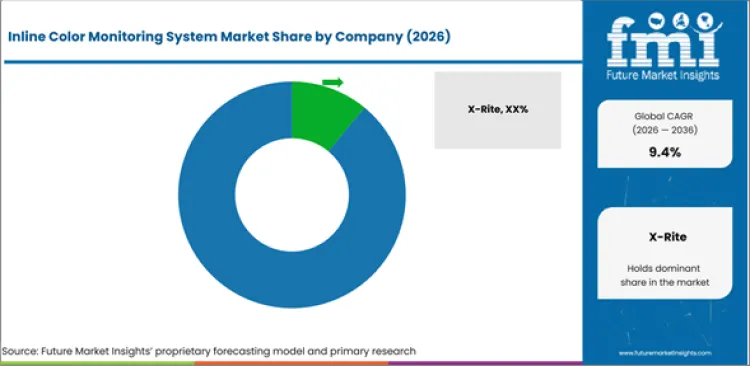
X-Rite and Datacolor are profiled with Konica Minolta and HunterLab. BYK-Gardner and TECHKON add color-management depth. BST and AVT add inspection capability. Valmet and Nireco complete the supplier set.
- Competition centers on calibration stability and line-speed measurement. Software reporting and service access also affect supplier selection.
- Color measurement specialists compete through spectrophotometer portfolios and reference-device credibility.
- Web inspection firms compete by combining color checks with register and defect functions. Web-control functions support broader line value.
- Automation suppliers compete by embedding color measurement inside wider quality-control and production systems.
Competition is moderately concentrated in spectral measurement and more fragmented in integration-heavy projects. Established suppliers defend share through calibration depth and installed references. Service networks add buyer confidence. Specialist firms win in packaging and coating lines by proving line-speed stability.
Capability depth separates global suppliers from regional sellers. Inline color systems must measure moving substrates without false alarms during speed changes. Valmet expanded its IQ Quality Control System in November 2024 with online measurement capabilities that support color and spectrum control. Buyers compare these systems with dye fixatives and related process quality investments.
Buyer selection is shifting toward data continuity. Color numbers must move from the sensor to operators and production databases. Customer reports complete the data route. Suppliers that connect color records with textile testing inspection workflows are better placed for regulated and brand-audited production.
How do top inline color monitoring system market companies compare?
Profiled companies differ by spectral depth and line integration. Workflow software and channel reach separate project capability. Service footprint also affects project confidence.
| Company | Spectral Depth | Line Integration | Color Workflow | Channel Reach | Geographic Footprint |
|---|---|---|---|---|---|
| X-Rite | High | High | Strong | Strong | Global |
| Datacolor | High | High | High | Strong | Global |
| Konica Minolta | High | Medium | Strong | Strong | Global |
| HunterLab | High | Medium | Moderate | Medium | Global |
| BYK-Gardner | Medium | Medium | Strong | Medium | Global |
| TECHKON | High | High | Strong | Medium | Europe and Americas |
| BST | Medium | High | Moderate | Medium | Europe and Asia |
| AVT | High | High | Strong | Strong | Global |
| Valmet | Medium | High | Moderate | Strong | Global |
| Nireco | Low | High | Moderate | Medium | Japan and Asia |
Source: Future Market Insights competitive analysis, 2026.
Who are the key players in the inline color monitoring system market?
Prominent suppliers include color measurement specialists and web inspection firms. Process automation companies add line-control depth.
Key global companies leading the Inline Color Monitoring System Market include:
- X-Rite
- Datacolor
- Konica Minolta
- HunterLab
- BYK-Gardner
- TECHKON
- BST
- AVT
- Valmet
- Nireco
Key Developments in Inline Color Monitoring System Market
- In June 2024, Konica Minolta announced the CM-17d and CM-16d portable spectrophotometers for high-accuracy color measurement.
- In January 2025, Datacolor acquired TECHKON GmbH to expand its print and packaging color measurement portfolio.
- In July 2025, Datacolor acquired TECHKON USA and added ChromaQA software with in-line spectrometers.
Key Players in the Inline Color Monitoring System Market
Color Measurement Specialists
- X-Rite
- Datacolor
- Konica Minolta
- HunterLab
- BYK-Gardner
Web and Print Inspection Specialists
- TECHKON
- BST
- AVT
Process Automation and Line Control Suppliers
- Valmet
- Nireco
Inline Color Monitoring System Market - Report Scope
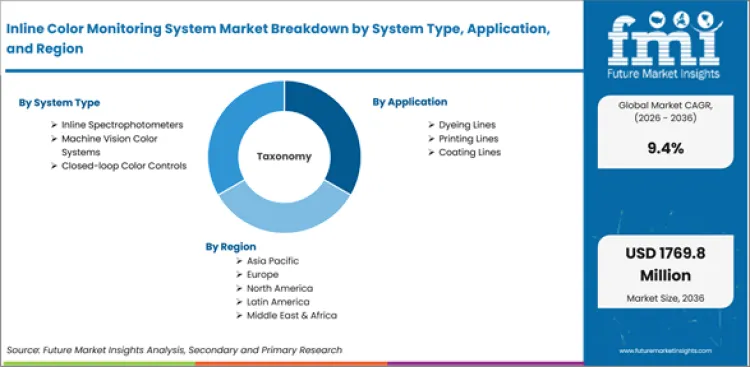
| Parameter | Details |
|---|---|
| Forecast period | 2026 to 2036 |
| Historical period | 2021 to 2025 |
| Quantitative unit | USD million in value and CAGR in percent |
| System Type | Inline Spectrophotometers · Machine Vision Color Systems · Closed-loop Color Controls · Portable-linked Systems |
| Application | Dyeing Lines · Printing Lines · Coating Lines · Extrusion / Film Lines |
| End Use | Textiles · Packaging · Coatings & Paints · Plastics |
| Integration | Standalone Monitoring · PLC / MES Integrated · Cloud Analytics |
| Sales Channel | Direct OEM · System Integrators · Distributors |
| Regions covered | North America · Western Europe · East Asia · South Asia and Pacific |
| Countries covered | United States · United Kingdom · Germany · France · Japan · China · South Korea · India |
| Key companies profiled | X-Rite · Datacolor · Konica Minolta · HunterLab · BYK-Gardner · TECHKON · BST · AVT · Valmet · Nireco |
| Approach | Hybrid bottom-up and top-down methodology using production line counts, supplier portfolio checks, country evidence, and segment adoption rates |
Source: Future Market Insights, 2026.
Inline Color Monitoring System Market Scope & Definition
| Attribute | Detail |
|---|---|
| Market Definition | Fixed or line-connected instruments that measure color during production without removing samples from the process. |
| Functions Covered | Spectral measurement, camera-based color inspection, closed-loop shade correction, reporting, and line-control alerting. |
| Applications Covered | Dyeing lines, printing lines, coating lines, extrusion lines, film lines, and adjacent web production lines. |
| End-Use Industries | Textiles, packaging, coatings and paints, plastics, technical materials, and selected specialty manufacturing users. |
| Grades Covered | Inline spectrophotometers, machine vision color systems, closed-loop color controls, and portable-linked systems. |
| Inclusions | Hardware, software, calibration support, line integration, reporting tools, and service revenue tied to production monitoring. |
| Exclusions | Lab-only colorimeters, consumer color readers, manual shade cards, design-stage color software, and general inspection systems without color measurement. |
Inline Color Monitoring System Market Research Methodology
| Method | Description |
|---|---|
| Primary Research | FMI analysts reviewed buying behavior across dyehouses, textile finishers, packaging converters, coatings processors, and plastics extrusion users. |
| Desk Research | Desk research reviewed official manufacturing data, color measurement product portfolios, machinery association material, and company development sources. |
| Market Sizing & Forecasting | The model combined installed production lines, estimated attachment rates, selling prices, service revenue, and country production scale. |
| Data Validation | Forecasts were checked against textile machinery activity, printing automation needs, country evidence, and public supplier portfolios. |
Inline Color Monitoring System Market Breakdown by System Type, Application, End Use, Integration, Sales Channel, and Region
Inline Color Monitoring System Market Segmented by System Type:
- Inline Spectrophotometers
- Machine Vision Color Systems
- Closed-loop Color Controls
- Portable-linked Systems
Inline Color Monitoring System Market Segmented by Application:
- Dyeing Lines
- Printing Lines
- Coating Lines
- Extrusion / Film Lines
Inline Color Monitoring System Market Segmented by End Use:
- Textiles
- Packaging
- Coatings & Paints
- Plastics
Inline Color Monitoring System Market Segmented by Integration:
- Standalone Monitoring
- PLC / MES Integrated
- Cloud Analytics
Inline Color Monitoring System Market Segmented by Sales Channel:
- Direct OEM
- System Integrators
- Distributors
Inline Color Monitoring System Market by Region:
- North America
- Latin America
- Europe
- East Asia
- South Asia and Pacific
- Middle East and Africa
Research Sources and Bibliography
- U.S. Census Bureau. (2026, June 3). Manufacturers’ Shipments, Inventories, and Orders: April 2026 full report. U.S. Department of Commerce.
- Federal Reserve Bank of St. Louis. (2026, June 11). Producer Price Index by Industry: Textile and Fabric Finishing Mills. FRED.
- Institute for Supply Management. (2026, May 1). April 2026 Manufacturing PMI report.
- National Bureau of Statistics of China. (2025, January 24). Industrial Production Operation in December 2024.
- VDMA Textile Machinery. (2026, June). Textile Machinery. VDMA.
- Office for National Statistics. (2026, April 16). Index of Production, UK: February 2026.
- Federal Statistical Office of Germany. (2026, February 6). New orders in manufacturing in December 2025: +7.8% on the previous month.
- Federal Statistical Office of Germany. (2026, June 19). Producer prices in May 2026: +2.2% on May 2025.
- Organisation for Economic Co-operation and Development. (2024, December). Extended producer responsibility in the garments sector. OECD.
- Institut national de la statistique et des études économiques. (2026, January 9). In November 2025, manufacturing output was back on the rise.
- Institut national de la statistique et des études économiques. (2026, February 5). In December 2025, manufacturing output fell back sharply.
- Ministry of Economy, Trade and Industry. (2026, June). Current Survey of Production.
- U.S. International Trade Administration. (2025, November 18). Japan
- Ministry of Textiles, Government of India. (2025, December 24). Year End Review 2025 of Ministry of Textiles. Press Information Bureau.
- Ministry of Textiles, Government of India. (2025, December 31). Annual report 2024-2025.
- China Textile Machinery Association. (2026, June). About CTMA.
- Konica Minolta, Inc. (2024, June 5). Konica Minolta to launch the CM-17d and CM-16d portable spectrophotometers.
- Datacolor. (2025, January 30). Datacolor expands global color technology leadership with acquisition of TECHKON.
- Datacolor. (2025, July 8). Datacolor acquires TECHKON USA.
- Valmet. (2024, November 12). Valmet expands IQ Quality Control System for sustainable packaging and nonwoven industries.
- X-Rite. (2025, May 15). X-Rite launches CiF3200 imaging benchtop spectrophotometer.
This Report Answers
- The report explains the current and forecast value of the Inline Color Monitoring System Market from 2026 to 2036.
- The report identifies the growth rate forecast for inline color monitoring systems during the assessment period.
- The report shows which system type is projected to lead the market and why this matters for buyers.
- The report compares dyeing and printing line needs in color monitoring. Coating and extrusion lines add further application context.
- The report evaluates which countries show notable growth profiles and what local conditions explain the difference.
- The report profiles companies competing in inline color monitoring and the capabilities that separate them.
- The report defines the market against lab-only colorimeters and general inspection systems.
- The report explains the methodology used to size the inline color monitoring system opportunity.
- The report outlines integration risks that CEOs should assess before investing in color monitoring systems.
- The report maps segmentation by system type and application. End use and integration complete the operating scope. Sales channel and region complete the commercial scope.
Frequently Asked Questions
How large is the Inline Color Monitoring System Market expected to be in the near term?
The market is expanding as manufacturers adopt live color measurement to prevent costly off shade production.
What is the long term outlook for the Inline Color Monitoring System Market?
The outlook remains strong as inline color control becomes a standard part of production quality workflows in textiles and packaging.
How fast is the Inline Color Monitoring System Market expected to grow?
Growth is driven by continuous production lines that need earlier color drift detection and faster customer approval cycles.
Which system type is projected to lead the market?
Inline spectrophotometers are projected to lead with repeatable spectral measurement on moving substrates.
Which application is expected to lead demand in 2026?
Dyeing lines are expected to lead demand. Early shade correction helps protect fabric value.
Which country shows a notable growth outlook in this market?
India shows a notable growth outlook with export pressure and first-time automation in processing clusters.
What does the inline color monitoring system market include?
The market includes line-connected spectrophotometers and machine vision color systems. Closed-loop controls and portable-connected systems are also included.
Preview the report firsthand - request a free sample
Get SampleGet the brochure for pricing and purchase details.
Get PDFTable of Content
- Key Takeaways
- Market Size and CAGR
- Top Growth Driver
- Fastest Growing Segment
- Leading Region
- Key Companies
- Emerging Opportunities
- Executive Summary
- Global Market Outlook
- Demand-side Trends
- Supply-side Trends
- Technology Roadmap Analysis
- Analysis and Recommendations
- Analyst Perspective (What is happening? Why now? What should investors know?)
- Key Questions Answered
- How large is the market?
- What is the CAGR?
- What are key trends?
- Which region dominates?
- Who are the leaders?
- Market Overview
- Market Coverage / Taxonomy
- Market Definition / Scope / Limitations
- Research Methodology
- Chapter Orientation
- Analytical Lens and Working Hypotheses
- Market Structure, Signals, and Trend Drivers
- Benchmarking and Cross-market Comparability
- Market Sizing, Forecasting, and Opportunity Mapping
- Portable-linked Systems
- Research Design and Evidence Framework
- Desk Research Programme (Secondary Evidence)
- Expert Input and Fieldwork (Primary Evidence)
- Tooling, Models, and Reference Databases
- Portable-linked Systems
- Data Engineering and Model Build
- Quality Assurance and Audit Trail
- Market Background
- Market Dynamics (Drivers, Restraints, Opportunity, Trends)
- Scenario Forecast (Optimistic, Likely, Conservative)
- Impact Analysis
- AI Impact
- Sustainability Impact
- Regulatory Impact
- Technology Impact
- Portable-linked Systems
- Consumer / Buyer Analysis
- Purchase Drivers
- Adoption Barriers
- Buyer Journey
- Portable-linked Systems
- Opportunity Map Analysis
- Product Life Cycle Analysis
- Supply Chain Analysis
- Investment Feasibility Matrix
- Value Chain Analysis
- PESTLE and Porter's Analysis
- Regulatory Landscape
- Regional Parent Market Outlook
- Production and Consumption Statistics
- Import and Export Statistics
- Global Market Analysis and Forecast, 2021 to 2036
- Historical Market Size Value (USD Million) & Volume (Unit) Analysis, 2021 to 2025
- Current and Future Market Size Value (USD Million) & Volume (Unit) Projections, 2026 to 2036
- Y-o-Y Growth Trend Analysis
- Absolute $ Opportunity Analysis
- Global Market Pricing Analysis, 2021 to 2036
- Global Market Analysis and Forecast, By System Type, 2021 to 2036
- Introduction / Key Findings
- Historical Market Size Value (USD Million) & Volume (Unit) Analysis By System Type, 2021 to 2025
- Current and Future Market Size Value (USD Million) & Volume (Unit) Analysis and Forecast By System Type, 2026 to 2036
- Inline Spectrophotometers
- Machine Vision Color Systems
- Closed-loop Color Controls
- Portable-linked Systems
- Inline Spectrophotometers
- Y-o-Y Growth Trend Analysis By System Type, 2021 to 2025
- Absolute $ Opportunity Analysis By System Type, 2026 to 2036
- Global Market Analysis and Forecast, By Application, 2021 to 2036
- Introduction / Key Findings
- Historical Market Size Value (USD Million) & Volume (Unit) Analysis By Application, 2021 to 2025
- Current and Future Market Size Value (USD Million) & Volume (Unit) Analysis and Forecast By Application, 2026 to 2036
- Dyeing Lines
- Printing Lines
- Coating Lines
- Portable-linked Systems
- Dyeing Lines
- Y-o-Y Growth Trend Analysis By Application, 2021 to 2025
- Absolute $ Opportunity Analysis By Application, 2026 to 2036
- Global Market Analysis and Forecast, By End Use, 2021 to 2036
- Introduction / Key Findings
- Historical Market Size Value (USD Million) & Volume (Unit) Analysis By End Use, 2021 to 2025
- Current and Future Market Size Value (USD Million) & Volume (Unit) Analysis and Forecast By End Use, 2026 to 2036
- Textiles
- Packaging
- Coatings & Paints
- Portable-linked Systems
- Textiles
- Y-o-Y Growth Trend Analysis By End Use, 2021 to 2025
- Absolute $ Opportunity Analysis By End Use, 2026 to 2036
- Global Market Analysis and Forecast, By Integration, 2021 to 2036
- Introduction / Key Findings
- Historical Market Size Value (USD Million) & Volume (Unit) Analysis By Integration, 2021 to 2025
- Current and Future Market Size Value (USD Million) & Volume (Unit) Analysis and Forecast By Integration, 2026 to 2036
- PLC / MES Integrated
- Standalone Monitoring
- Cloud Analytics
- Portable-linked Systems
- PLC / MES Integrated
- Y-o-Y Growth Trend Analysis By Integration, 2021 to 2025
- Absolute $ Opportunity Analysis By Integration, 2026 to 2036
- Global Market Analysis and Forecast, By Sales Channel, 2021 to 2036
- Introduction / Key Findings
- Historical Market Size Value (USD Million) & Volume (Unit) Analysis By Sales Channel, 2021 to 2025
- Current and Future Market Size Value (USD Million) & Volume (Unit) Analysis and Forecast By Sales Channel, 2026 to 2036
- Direct OEM
- System Integrators
- Distributors
- Portable-linked Systems
- Direct OEM
- Y-o-Y Growth Trend Analysis By Sales Channel, 2021 to 2025
- Absolute $ Opportunity Analysis By Sales Channel, 2026 to 2036
- Global Market Analysis and Forecast, By Region, 2021 to 2036
- Introduction
- Historical Market Size Value (USD Million) & Volume (Unit) Analysis By Region, 2021 to 2025
- Current Market Size Value (USD Million) & Volume (Unit) Analysis and Forecast By Region, 2026 to 2036
- North America
- Latin America
- Western Europe
- Eastern Europe
- East Asia
- South Asia and Pacific
- Middle East & Africa
- Portable-linked Systems
- Market Attractiveness Analysis By Region
- North America Market Analysis and Forecast, By Country, 2021 to 2036
- Historical Market Size Value (USD Million) & Volume (Unit) Trend Analysis By Market Taxonomy, 2021 to 2025
- Market Size Value (USD Million) & Volume (Unit) Forecast By Market Taxonomy, 2026 to 2036
- By Country
- USA
- Canada
- Mexico
- By System Type
- By Application
- By End Use
- By Integration
- By Sales Channel
- Portable-linked Systems
- By Country
- Market Attractiveness Analysis
- By Country
- By System Type
- By Application
- By End Use
- By Integration
- By Sales Channel
- Portable-linked Systems
- Key Takeaways
- Latin America Market Analysis and Forecast, By Country
- Historical Market Size Value (USD Million) & Volume (Unit) Trend Analysis By Market Taxonomy, 2021 to 2025
- Market Size Value (USD Million) & Volume (Unit) Forecast By Market Taxonomy, 2026 to 2036
- By Country
- Brazil
- Chile
- Rest of Latin America
- By System Type
- By Application
- By End Use
- By Integration
- By Sales Channel
- Portable-linked Systems
- By Country
- Market Attractiveness Analysis
- By Country
- By System Type
- By Application
- By End Use
- By Integration
- By Sales Channel
- Portable-linked Systems
- Key Takeaways
- Western Europe Market Analysis and Forecast, By Country
- Historical Market Size Value (USD Million) & Volume (Unit) Trend Analysis By Market Taxonomy, 2021 to 2025
- Market Size Value (USD Million) & Volume (Unit) Forecast By Market Taxonomy, 2026 to 2036
- By Country
- Germany
- UK
- Italy
- Spain
- France
- Nordic
- BENELUX
- Rest of Western Europe
- By System Type
- By Application
- By End Use
- By Integration
- By Sales Channel
- Portable-linked Systems
- By Country
- Market Attractiveness Analysis
- By Country
- By System Type
- By Application
- By End Use
- By Integration
- By Sales Channel
- Portable-linked Systems
- Key Takeaways
- Eastern Europe Market Analysis and Forecast, By Country
- Historical Market Size Value (USD Million) & Volume (Unit) Trend Analysis By Market Taxonomy, 2021 to 2025
- Market Size Value (USD Million) & Volume (Unit) Forecast By Market Taxonomy, 2026 to 2036
- By Country
- Russia
- Poland
- Hungary
- Balkan & Baltic
- Rest of Eastern Europe
- By System Type
- By Application
- By End Use
- By Integration
- By Sales Channel
- Portable-linked Systems
- By Country
- Market Attractiveness Analysis
- By Country
- By System Type
- By Application
- By End Use
- By Integration
- By Sales Channel
- Portable-linked Systems
- Key Takeaways
- East Asia Market Analysis and Forecast, By Country
- Historical Market Size Value (USD Million) & Volume (Unit) Trend Analysis By Market Taxonomy, 2021 to 2025
- Market Size Value (USD Million) & Volume (Unit) Forecast By Market Taxonomy, 2026 to 2036
- By Country
- China
- Japan
- South Korea
- By System Type
- By Application
- By End Use
- By Integration
- By Sales Channel
- Portable-linked Systems
- By Country
- Market Attractiveness Analysis
- By Country
- By System Type
- By Application
- By End Use
- By Integration
- By Sales Channel
- Portable-linked Systems
- Key Takeaways
- South Asia and Pacific Market Analysis and Forecast, By Country
- Historical Market Size Value (USD Million) & Volume (Unit) Trend Analysis By Market Taxonomy, 2021 to 2025
- Market Size Value (USD Million) & Volume (Unit) Forecast By Market Taxonomy, 2026 to 2036
- By Country
- India
- ASEAN
- Australia & New Zealand
- Rest of South Asia and Pacific
- By System Type
- By Application
- By End Use
- By Integration
- By Sales Channel
- Portable-linked Systems
- By Country
- Market Attractiveness Analysis
- By Country
- By System Type
- By Application
- By End Use
- By Integration
- By Sales Channel
- Portable-linked Systems
- Key Takeaways
- Middle East & Africa Market Analysis and Forecast, By Country
- Historical Market Size Value (USD Million) & Volume (Unit) Trend Analysis By Market Taxonomy, 2021 to 2025
- Market Size Value (USD Million) & Volume (Unit) Forecast By Market Taxonomy, 2026 to 2036
- By Country
- Kingdom of Saudi Arabia
- Other GCC Countries
- Türkiye
- South Africa
- Other African Union
- Rest of Middle East & Africa
- By System Type
- By Application
- By End Use
- By Integration
- By Sales Channel
- Portable-linked Systems
- By Country
- Market Attractiveness Analysis
- By Country
- By System Type
- By Application
- By End Use
- By Integration
- By Sales Channel
- Portable-linked Systems
- Key Takeaways
- Key Countries Market Analysis
- USA
- Pricing Analysis
- Market Share Analysis, 2025
- By System Type
- By Application
- By End Use
- By Integration
- By Sales Channel
- Portable-linked Systems
- Canada
- Pricing Analysis
- Market Share Analysis, 2025
- By System Type
- By Application
- By End Use
- By Integration
- By Sales Channel
- Portable-linked Systems
- Mexico
- Pricing Analysis
- Market Share Analysis, 2025
- By System Type
- By Application
- By End Use
- By Integration
- By Sales Channel
- Portable-linked Systems
- Brazil
- Pricing Analysis
- Market Share Analysis, 2025
- By System Type
- By Application
- By End Use
- By Integration
- By Sales Channel
- Portable-linked Systems
- Chile
- Pricing Analysis
- Market Share Analysis, 2025
- By System Type
- By Application
- By End Use
- By Integration
- By Sales Channel
- Portable-linked Systems
- Germany
- Pricing Analysis
- Market Share Analysis, 2025
- By System Type
- By Application
- By End Use
- By Integration
- By Sales Channel
- Portable-linked Systems
- UK
- Pricing Analysis
- Market Share Analysis, 2025
- By System Type
- By Application
- By End Use
- By Integration
- By Sales Channel
- Portable-linked Systems
- Italy
- Pricing Analysis
- Market Share Analysis, 2025
- By System Type
- By Application
- By End Use
- By Integration
- By Sales Channel
- Portable-linked Systems
- Spain
- Pricing Analysis
- Market Share Analysis, 2025
- By System Type
- By Application
- By End Use
- By Integration
- By Sales Channel
- Portable-linked Systems
- France
- Pricing Analysis
- Market Share Analysis, 2025
- By System Type
- By Application
- By End Use
- By Integration
- By Sales Channel
- Portable-linked Systems
- India
- Pricing Analysis
- Market Share Analysis, 2025
- By System Type
- By Application
- By End Use
- By Integration
- By Sales Channel
- Portable-linked Systems
- ASEAN
- Pricing Analysis
- Market Share Analysis, 2025
- By System Type
- By Application
- By End Use
- By Integration
- By Sales Channel
- Portable-linked Systems
- Australia & New Zealand
- Pricing Analysis
- Market Share Analysis, 2025
- By System Type
- By Application
- By End Use
- By Integration
- By Sales Channel
- Portable-linked Systems
- China
- Pricing Analysis
- Market Share Analysis, 2025
- By System Type
- By Application
- By End Use
- By Integration
- By Sales Channel
- Portable-linked Systems
- Japan
- Pricing Analysis
- Market Share Analysis, 2025
- By System Type
- By Application
- By End Use
- By Integration
- By Sales Channel
- Portable-linked Systems
- South Korea
- Pricing Analysis
- Market Share Analysis, 2025
- By System Type
- By Application
- By End Use
- By Integration
- By Sales Channel
- Portable-linked Systems
- Russia
- Pricing Analysis
- Market Share Analysis, 2025
- By System Type
- By Application
- By End Use
- By Integration
- By Sales Channel
- Portable-linked Systems
- Poland
- Pricing Analysis
- Market Share Analysis, 2025
- By System Type
- By Application
- By End Use
- By Integration
- By Sales Channel
- Portable-linked Systems
- Hungary
- Pricing Analysis
- Market Share Analysis, 2025
- By System Type
- By Application
- By End Use
- By Integration
- By Sales Channel
- Portable-linked Systems
- Kingdom of Saudi Arabia
- Pricing Analysis
- Market Share Analysis, 2025
- By System Type
- By Application
- By End Use
- By Integration
- By Sales Channel
- Portable-linked Systems
- Türkiye
- Pricing Analysis
- Market Share Analysis, 2025
- By System Type
- By Application
- By End Use
- By Integration
- By Sales Channel
- Portable-linked Systems
- South Africa
- Pricing Analysis
- Market Share Analysis, 2025
- By System Type
- By Application
- By End Use
- By Integration
- By Sales Channel
- USA
- Market Structure Analysis
- Competition Dashboard
- Competition Benchmarking
- Market Share Analysis of Top Players
- By Regional
- By System Type
- By Application
- By End Use
- By Integration
- By Sales Channel
- Emerging Startups
- Innovation Benchmarking
- Portable-linked Systems
- Competition Analysis
- Competition Deep Dive
- X-Rite
- Overview
- Product Portfolio
- Profitability by Market Segments (Product/Region/Sales Channel)
- Sales Footprint
- Strategy Overview
- Marketing Strategy
- Product Strategy
- Channel Strategy
- Datacolor
- Konica Minolta
- HunterLab
- BYK-Gardner
- TECHKON
- BST
- X-Rite
- Case Studies
- Success Stories
- Recent Developments
- Competition Deep Dive
- Assumptions & Acronyms Used


