

- Market Size (2026)
- USD 392.0 Mn
- Forecast (2036)
- USD 1313.0 Mn
- CAGR (2026 to 2036)
- 12.9%
Chiplet-Based System Thermal Cycling and Interconnect Fatigue Test Systems Market Size, Market Forecast and Outlook By FMI
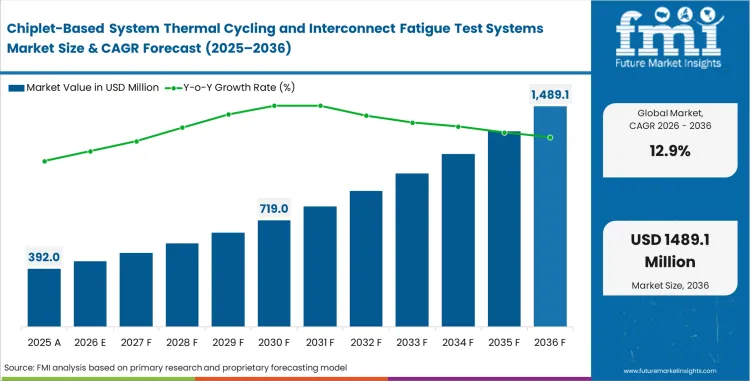
The chiplet-based system thermal cycling and interconnect fatigue test systems market surpassed a valuation of USD 348.0 million in 2025 and is estimated to reach USD 392.0 million in 2026. Industry valuation is projected to expand at a CAGR of 12.9% from 2026 to 2036, reaching nearly USD 1,313.0 million by 2036.
Summary of Chiplet-Based System Thermal Cycling and Interconnect Fatigue Test Systems Market
- The market is forecast to reach USD 1,313.0 million by 2036.
- The market is expected to grow at a CAGR of 12.90% from 2026 to 2036.
- The market was estimated at USD 348.0 million in 2025.
- Market value is expected to reach USD 392.0 million in 2026.
- Thermal Cycling is projected to lead test modality demand with 41.0% share in 2026.
- Micro-bumps are expected to remain the leading interconnect focus with 29.0% share in 2026.
- 2.5D Packages are anticipated to account for 27.0% share in 2026, reflecting broad qualification activity across dense multi-die package programs.
- OSATs are likely to remain the leading end-user group with 30.0% share in 2026, while Qualification Labs are expected to represent 33.0% of deployment-stage demand.
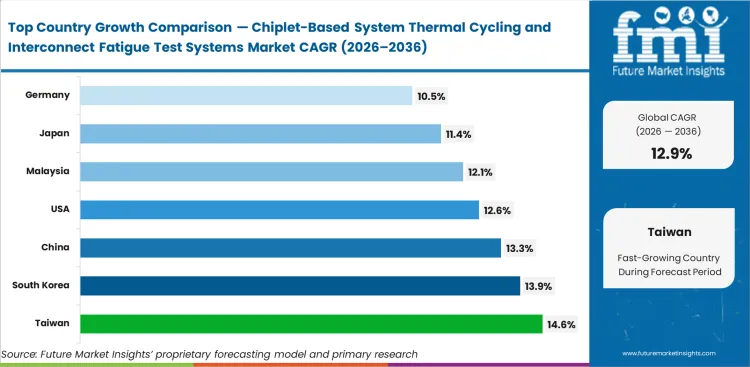
- Country-level growth is strongest in Taiwan at 14.6% CAGR, followed by South Korea at 13.9% and China at 13.3% through 2036.
Key Takeaways, Market Size, and Forecast
- Chiplet-Based System Thermal Cycling and Interconnect Fatigue Test Systems Market is projected to grow from USD 392.0 million in 2026 to USD 1,313.0 million by 2036, at a CAGR of 12.9%.
- The chiplet-based system thermal cycling and interconnect fatigue test systems market was valued at USD 348.0 million in 2025.
- By 2036, the Chiplet-Based System Thermal Cycling and Interconnect Fatigue Test Systems Market is expected to be worth USD 1,313.0 million.
- From 2026 to 2036, the market is projected to expand at a CAGR of 12.9%.
- The market is projected to create an incremental opportunity of USD 921.0 million between 2026 and 2036.
- In 2026, Thermal Cycling is expected to account for 41.0% of the test modality segment.
- Taiwan (14.6%) and South Korea (13.9%) are two of the fastest growing markets.
Chiplet-Based System Thermal Cycling and Interconnect Fatigue Test Systems Market Key Takeaways
| Parameter | Details |
|---|---|
| Market value (2026) | USD 392.0 million |
| Forecast value (2036) | USD 1,313.0 million |
| CAGR (2026 to 2036) | 12.9% |
| Estimated market value (2025) | USD 348.0 million |
| Incremental opportunity | USD 921.0 million |
| Leading test modality | Thermal Cycling |
| Leading interconnect focus | Micro-bumps |
| Leading package architecture | 2.5D Packages |
| Leading thermal profile | Air-forced |
| Leading automation level | Semi-automated systems |
| Leading deployment stage | Qualification Labs |
| Leading end user | OSATs |
| Leading measurement stack | Daisy-chain methods |
| Key supplier brands referenced in market landscape | ESPEC CORP., Advantest, MPI Corporation |
| Brands referenced in market landscape | ESPEC CORP., Advantest, MPI Corporation, Thermotron, inTEST Thermal Solutions, Cohu |
Source: Future Market Insights (FMI) analysis, based on proprietary forecasting model and primary research
Purchase urgency rises when interconnect fatigue results become part of package signoff rather than a follow-up check after electrical drift appears. Semiconductor assembly and testing service providers, IDMs, and foundry-linked packaging groups move in that direction when customer release schedules start depending on faster fault isolation and tighter test consistency within semiconductor packaging operations. System demand strengthens once ownership is tied directly to release timing and qualification accountability.
Taiwan is projected to record a 14.6% CAGR through 2036, supported by its deep concentration of chiplet development, backend engineering activity, and tight linkage between package design and qualification execution. South Korea is likely to expand at 13.9%, reflecting strong package complexity and heavy reliability demands tied to advanced memory and logic integration. China is expected to register 13.3% as domestic packaging capability continues to widen and more qualification work is retained closer to local development cycles. The United States is anticipated to post 12.6%, backed by high-value chiplet programs and strong demand for cleaner interconnect validation across complex package architectures. Malaysia is set to grow at 12.1%, helped by its role in outsourced backend operations and rising qualification depth across export-oriented packaging lines. Japan is projected to advance at 11.4%, where reliability discipline remains strong, but adoption tends to move through more selective program ramps. Germany is likely to expand at 10.5%, with growth still tied to narrower high-specification use cases and a more measured pace of backend qualification investment.
Thermal Stress Is Becoming A Design Gate
For chiplet-based systems, thermal cycling is no longer a back-end validation step; it is increasingly shaping architecture choices much earlier in development. That matters because chiplets bring together dies, bridges, substrates, underfills, and interconnect structures with different thermal expansion behaviors, which raises the probability of fatigue, delamination, and time-dependent failure at package level. UCIe’s published direction on expanded reliability mechanisms and health monitoring reinforces that the industry is treating interconnect robustness as a system issue, not a narrow PHY issue.
Segmental Analysis
Key Facts About Segments
- Repeated temperature exposure remains the core qualification route in this industry, which leaves Thermal Cycling expected to account for 41.0% share in 2026.
- Joint-level reliability pressure keeps Micro-bumps as the leading interconnect focus, with 29.0% share projected for 2026.
- Wider commercial use across dense multi-die programs supports 2.5D Packages, which are anticipated to contribute 27.0% share in 2026.
- Routine qualification work continues to favor Air-forced thermal profiles, and this segment is likely to secure 36.0% share in 2026.
- A balance between consistency and engineering flexibility keeps Semi-automated systems in the leading position, with 38.0% share expected in 2026.
- Release pressure remains concentrated in Qualification Labs, which are projected to account for 33.0% share in 2026.
- Backend assembly and customer-facing package validation keep OSATs at 30.0% share in 2026.
- Simpler setup and easier continuity interpretation support Daisy-chain methods, which are forecast to hold 32.0% share in 2026.
Chiplet-Based System Thermal Cycling and Interconnect Fatigue Test Systems Market Analysis by Test Modality
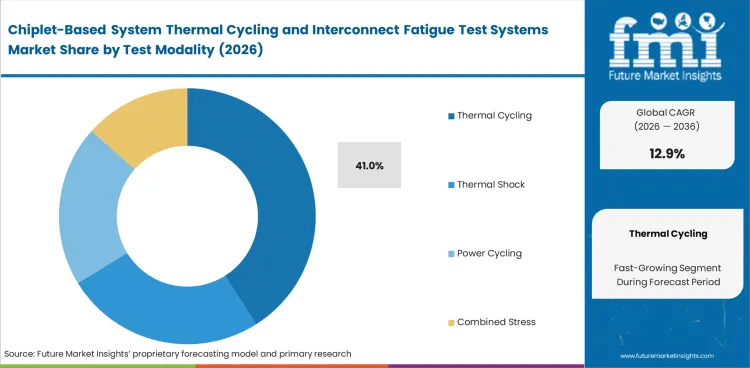
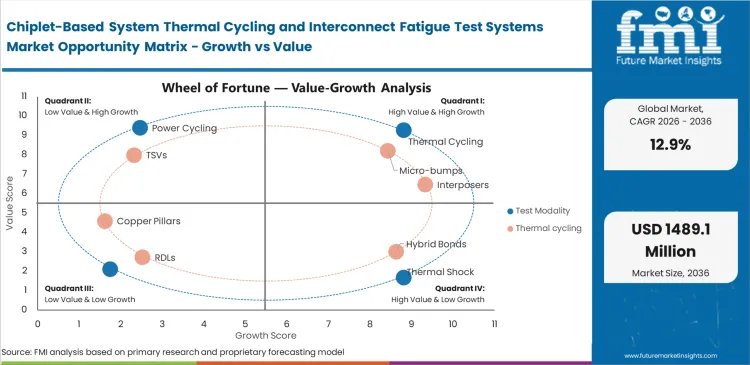
Thermal cycling is expected to account for 41.0% share in 2026. Package reliability work in chiplet systems still leans first toward repeated thermal stress rather than broader one-time screening routines because interconnect weakness usually develops gradually across expansion and contraction cycles. Buyers rely on this modality when they need to understand how micro-bumps, hybrid-bond joints, and substrate connections behave over time under controlled conditions. Thermal shock and power cycling still matter, but they are used more selectively when a narrower failure pattern needs to be isolated. Thermal cycling stays ahead because it fits qualification workflows better than other test methods used in package reliability work. Engineering teams also prefer the repeatability of this setup when comparing package revisions or customer-specific builds. Early fatigue signs become easier to interpret when the stress path remains disciplined across long runs. Commercial value stays strongest where the method helps labs turn interconnect behavior into approval-grade reliability evidence rather than isolated failure snapshots.
- Cycle repeatability: Repeated temperature swings make weak interconnect behavior easier to expose before package issues spread into larger production lots.
- Failure visibility: Controlled stress sequences reveal fatigue progression more clearly than irregular screening routines.
- Qualification alignment: Lab teams favor this modality because it fits package approval and customer validation work more directly.
Chiplet-Based System Thermal Cycling and Interconnect Fatigue Test Systems Market Analysis by Interconnect Focus
Interconnect testing in chiplet systems begins where mechanical weakness is most likely to be built under repeated thermal exposure. Micro-bumps stay at the center of that effort because they support many die-to-die and package-level connections where pitch is tight, and tolerance for continuity loss is low. Engineering teams return to this interconnect type repeatedly, since small shifts in joint behavior can affect signal integrity, usable package life, and eventual customer acceptance. Market estimates suggest micro-bumps will represent 29.0% share in 2026. Hybrid bonds, TSVs, RDLs, interposers, and copper pillars also remain relevant, but their testing priority depends more directly on the package route being qualified. Micro-bumps keep the lead because they remain one of the clearest fatigue-sensitive points in current chiplet designs. That is also why adjacent demand is rising around chiplet integration and die-to-die interconnect test solutions where joint-level behavior matters early.
- Joint sensitivity: Small joints react quickly to thermal strain, making them a practical first target in fatigue testing.
- Package dependence: Test demand rises when interconnect density increases, and tolerance for continuity loss becomes tighter.
- Screening priority: Teams often start with micro-bumps because weakness can affect the entire package structure.
Chiplet-Based System Thermal Cycling and Interconnect Fatigue Test Systems Market Analysis by Package Architecture
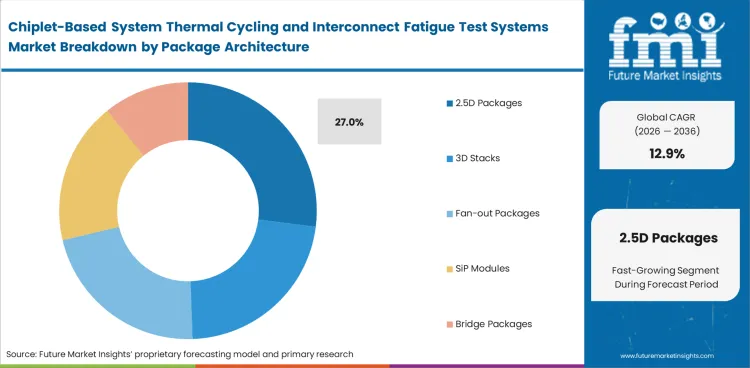
Package architecture shapes how thermal stress travels through a chiplet assembly and where reliability teams place their first attention. Buyers working on AI, HPC, and memory-linked designs often prefer 2.5D routes when they need dense integration without taking on the full process burden of more vertically stacked structures. Their lead comes from a practical balance between performance ambition and packaging manageability. In 2026, 2.5D packages are projected to contribute 27.0% of total market share because they are widely used in designs that depend on interposers and high-density die integration. Three-dimensional stacks, fan-out packages, SiP modules, and bridge-based designs all create testing demand as well, but 2.5D remains tied more broadly to current qualification programs. Its commercial base is therefore wider than that of narrower architecture choices. That position also keeps testing demand closely linked with the broader advanced packaging space, where adoption of width strongly influences reliability spending.
- Interposer reliance: Stress behavior in 2.5D designs needs closer review because multiple dies depend on a common package path.
- Adoption width: More active design programs use this architecture, giving it a broader testing base than narrower package forms.
- Validation depth: Qualification teams spend more time here because reliability must hold across several connected die elements.
Chiplet-Based System Thermal Cycling and Interconnect Fatigue Test Systems Market Analysis by Thermal Profile
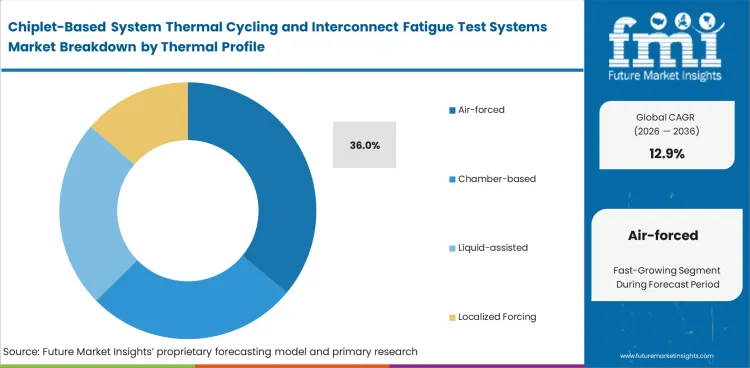
Thermal forcing choice depends on how buyers balance control, facility burden, maintenance effort, and day-to-day usability in the lab. Many programs prefer air-based systems for routine qualification work because they are easier to deploy, easier to maintain, and easier to adapt across changing package studies. Chamber-based setups, liquid-assisted methods, and localized forcing approaches still serve specific needs, especially when tighter profile control or faster response matters more than operating simplicity. Even so, broader use remains with air-forced systems because they cover a wide range of qualification conditions without pushing complexity too far. That practical fit keeps them ahead in a market where routine usability still matters as much as performance precision. Air-forced systems are likely to secure 36.0% share in 2026. Their lead also overlaps clearly with the broader automated test equipment environment, where deployment ease can outweigh more specialized thermal extremes.
- Lab usability: Air-based systems suit routine package testing where teams need control without a heavy setup burden.
- Operating balance: Buyers choose them when acceptable thermal precision matters more than specialized forcing extremes.
- Deployment ease: Simpler installation and broader usability keep this profile active in many everyday test cells.
Chiplet-Based System Thermal Cycling and Interconnect Fatigue Test Systems Market Analysis by Automation Level
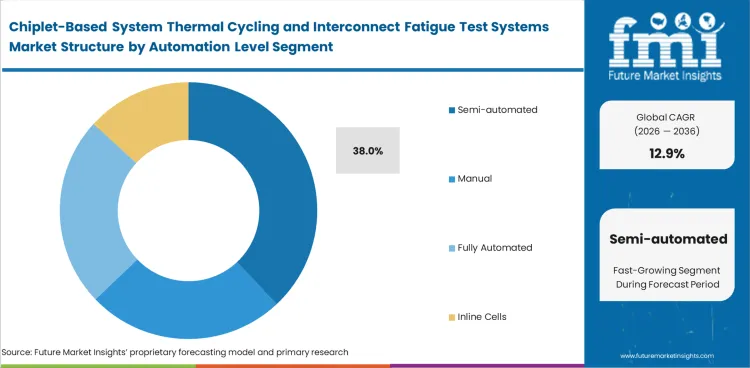
Test automation in this market is shaped less by full production logic and more by the need to balance flexibility with consistency across changing package designs. Full manual setups slow work too much once chiplet programs expand, while fully automated cells are not always justified where sample volumes remain limited or thermal conditions keep changing. Semi-automated systems are set to make up 38.0% of the market in 2026. These tools fit the middle ground because they reduce handling variation, improve logging discipline, and still leave room for engineering adjustment during qualification work. That balance becomes especially important when package structures vary from one program to another and the work remains design-specific rather than fully standardized. Similar mixed deployment logic can be seen in system level test platforms, where rigid automation does not always match early-stage validation reality. Buyers usually prefer this level when full automation cannot yet be justified by sample volume or program maturity.
- Workflow control: Semi-automated systems improve consistency without locking users into rigid routines.
- Program flexibility: Mixed engineering and validation work is easier when test flow can be adjusted without rebuilding the full cell.
- Cost discipline: Buyers often prefer this level when full automation does not match sample volume or program maturity.
Chiplet-Based System Thermal Cycling and Interconnect Fatigue Test Systems Market Analysis by Deployment Stage
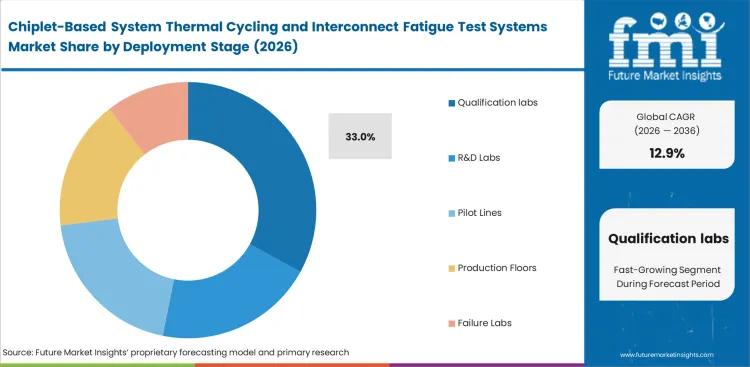
Deployment stage reveals how this market still behaves commercially because much of the demand remains tied to proving package reliability before broader volume use begins. Chiplet programs bring enough design variation that approval work stays concentrated inside controlled validation settings rather than moving quickly into routine production-floor operation. R&D labs help with early learning, pilot lines bridge the move toward scaling, and failure labs step in when root-cause work becomes necessary. Qualification labs still lead because they sit at the point where engineering intent meets customer acceptance. Buyers continue to spend here first since weak package reliability at this stage can delay entire programs, which also explains the wider relevance of semiconductor inspection systems. Qualification labs are expected to account for 33.0% share in 2026. Spending concentration at this stage reflects the fact that approval pressure arrives before standardization does.
- Approval pressure: Qualification labs carry the heaviest burden because package acceptance depends on documented reliability evidence.
- Program timing: Most spending begins here before systems move deeper into scaled manufacturing use.
- Risk control: Early testing in validation environments helps prevent downstream delays tied to package failure concerns.
Chiplet-Based System Thermal Cycling and Interconnect Fatigue Test Systems Market Analysis by End User
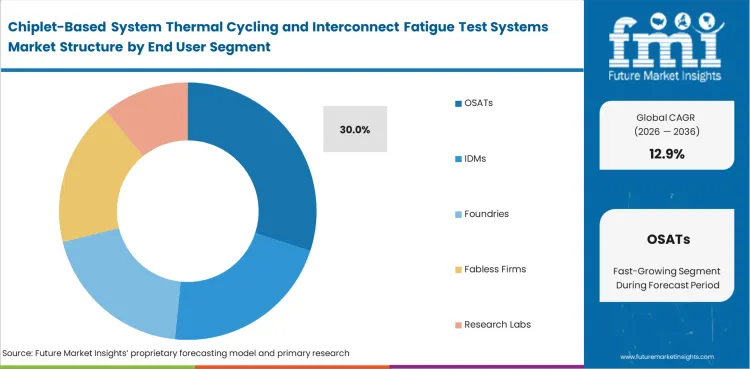
Backend assembly and validation activity makes OSATs one of the most visible demand centers in this market. Their role places them close to package assembly, customer qualification, and failure screening across a wide mix of chiplet programs. That exposure matters because OSATs face reliability demands from several customers rather than from one internal product line, which keeps equipment use cases active across more programs. IDMs and foundries remain important users, especially where advanced package work stays in-house, while fabless firms and research labs shape demand through design and qualification activity. OSATs lead demand because they carry much of the package qualification burden across multiple customer programs. That commercial position also links naturally with the broader semiconductor assembly and testing services value chain. OSATs are anticipated to represent 30.0% share in 2026. Value in this segment comes from supporting users embedded in repeated customer‑facing reliability reviews, where a shared platform can shape multiple package qualifications and release decisions in parallel.
- Customer mix: Serving multiple programs gives OSATs broader exposure to package reliability demands.
- Backend proximity: Close involvement in assembly and validation pulls test-system demand toward this user group.
- Qualification burden: Customer-facing approval work keeps investment pressure higher in OSAT environments.
Chiplet-Based System Thermal Cycling and Interconnect Fatigue Test Systems Market Analysis by Measurement Stack
Measurement-stack choice determines how quickly fatigue behavior can be noticed and how clearly failure progression can be interpreted during repeated stress work. Many users begin with daisy-chain methods because the first question in qualification is often whether interconnect continuity is degrading at all before deeper diagnosis is layered in. Kelvin sensing, resistance logging, warpage tracking, and event monitoring all deepen the analysis, but they usually add complexity beyond what standard approval routines require in the first pass. Daisy-chain methods remain popular because they are easier to deploy, easier to compare across runs, and easier to explain in routine package review settings. Their commercial lead therefore reflects usability as much as technical relevance. Buyers often start here before moving into more detailed monitoring layers, especially where workflows connect with wider semiconductor-packaging qualification practices. Daisy-chain methods are forecast to account for 32.0% share in 2026. Commercial value is highest when the measurement stack identifies continuity drift early while keeping the output practical enough for routine reliability decisions across multiple chiplet programs.
- Continuity focus: Daisy-chain methods help reveal when repeated stress begins to affect electrical-path stability.
- Interpretation ease: Test teams use them widely because results are easier to compare across qualification runs.
- Routine adoption: Simpler setup and familiar output keep this method active in everyday reliability workflows.
Chiplet-Based System Thermal Cycling and Interconnect Fatigue Test Systems Market Drivers, Restraints, and Opportunities
Package release requirements are making thermal cycling and interconnect fatigue tools more central to chiplet qualification. Reliability groups are being asked to show earlier proof that package joints and die-to-die paths can survive repeated thermal stress before wider customer acceptance begins. That shift matters because late failure discovery now carries a higher cost once advanced packaging work becomes more complex and more tightly scheduled. Demand also benefits from adjacent stress validation habits already visible in Burn-In and System-Level Test (SLT) platforms for AI accelerators, where heat, package density, and system conditions are increasingly judged together. Buyers who move earlier usually gain cleaner debug loops and faster handoff into qualification review.
Internal approval still slows this market more than broad interest does. Many labs already own environmental chambers, so a dedicated chiplet fatigue system must prove that it improves repeatability, data clarity, and release timing rather than simply adding another piece of hardware. That hesitation exists because ownership often sits across package reliability, lab operations, and capital budgeting groups. Some suppliers offer modular setups or smaller entry systems, but these options do not always reduce integration effort, training needs, or software mismatch. Spending can stall when buyers see the need clearly but cannot agree on where the tool belongs in the release process.
Opportunities in the Chiplet-Based System Thermal Cycling and Interconnect Fatigue Test Systems Market
- Custom Qualification Cells: Suppliers can win where package groups need compact systems tuned for one family of interconnect structures. Buyers capture that value when tool setup matches the actual release path instead of a broad lab wish list.
- Lab-to-Line Standardization: Opportunity opens when reliability data, monitoring output, and reporting structure line up with broader high-speed memory signal integrity test and interface validation routines. Buyers value that alignment because it reduces time lost in format conversion and repeated review.
- Package-Specific Expansion: Additional demand can come from designs that share packaging stress behavior with high-volume RF front-end module test systems and other tightly qualified electronics. Suppliers that keep tool adaptation simple have a better chance of turning that adjacency into live orders.
Regional Analysis
Key Facts About Country
- Dense chiplet development activity and close coupling between package design and qualification keep Taiwan in the strongest growth position. Demand for chiplet-based system thermal cycling and interconnect fatigue test systems in Taiwan is expected to rise at a CAGR of 14.6% through 2036.
- Advanced memory and logic integration continue to raise reliability demands in South Korea, where the market is projected to expand at 13.9% CAGR over the forecast period.
- Domestic backend capability is widening in China, and more qualification work is being retained closer to local development cycles. Industry expansion in China is expected to register a 13.3% CAGR through 2036.
- High-value chiplet programs and stronger need for interconnect validation support the United States, where market growth is anticipated at a 12.6% CAGR during the assessment period.
- Export-oriented backend operations and rising qualification depth keep Malaysia commercially relevant. Demand in Malaysia is set to advance at a 12.1% CAGR by 2036 as OSAT sites take on more package validation work.
- A more selective but disciplined qualification culture shapes Japan, where the market is projected to grow at 11.4% CAGR through 2036.
- Reliability-sensitive semiconductor use cases keep Germany in the study, though expansion is more measured than in Asia Pacific. Sales in Germany are likely to increase at a 10.5% CAGR through 2036.
Based on the regional analysis, the chiplet-based system thermal cycling and interconnect fatigue test systems market is segmented into Asia Pacific, North America, and Europe across 40 plus countries.
.webp "Top Country Growth Comparison Chiplet Based System Thermal Cycling And Interconnect Fatigue Test Systems Market Cagr (2026 2036)")
| Country | CAGR (2026 to 2036) |
|---|---|
| Taiwan | 14.6% |
| South Korea | 13.9% |
| China | 13.3% |
| United States | 12.6% |
| Malaysia | 12.1% |
| Japan | 11.4% |
| Germany | 10.5% |
Source: Future Market Insights (FMI) analysis, based on proprietary forecasting model and primary research
Asia Pacific Chiplet-Based System Thermal Cycling and Interconnect Fatigue Test Systems Market Analysis
Package qualification work in Asia Pacific sits closest to active backend lines, so buying decisions tend to move when package programs move rather than when broad lab budgets reopen. Taiwan, South Korea, China, Malaysia, and Japan all bring different strengths, yet they share the same pressure: interconnect failures must be found early enough to protect expensive package turns. Demand in this region also rises because advanced packaging, memory integration, and substrate work are clustered across a small number of production corridors linked to AI-enabled semiconductor defect classification and review systems and related package verification needs. General chambers can still support early study, but dedicated fatigue tools become easier to defend once release timing tightens.
- Taiwan: Hsinchu and Tainan keep Taiwan close to the front end of chiplet package development, so reliability work often sits beside active package revision rather than far downstream. Demand for these systems in Taiwan is expected to rise at a CAGR of 14.6% by 2036 because interposer-heavy builds and fast design turns leave little room for slow fatigue diagnosis. OSAT and foundry-linked packaging groups need temperature cycling results that can be compared across customer programs without rebuilding the test setup each time.
- South Korea: Memory-led package development keeps South Korea focused on dense interconnect structures that must survive repeated thermal stress before wider system release. Advanced packaging demand here stays tied to AI memory stacks and logic-memory integration, and the local market is expected to expand at 13.9% CAGR from 2026 to 2036 as qualification intensity rises with package density. Reliability groups are not just checking for survival. They need a cleaner separation between interconnect fatigue, warpage effects, and package material to drift. Slow diagnosis creates avoidable delay when product windows are short.
- China: Domestic expansion in China keeps pushing more packaging and validation work into local programs, especially where backend capability is being built around faster customer response. Buyers want systems that can handle varied package types without long reconfiguration because one tool often serves more than one project stream. Local demand keeps growing as chiplet activity spreads across design and packaging hubs from the Yangtze River Delta to Shenzhen. Industry expansion in China is projected at a CAGR of 13.3% during the assessment period, and that pace reflects a broader effort to bring more qualification work closer to domestic packaging lines.
- Malaysia: Penang and Kulim give Malaysia a clear advantage in backend execution, so buying logic here centers on whether test systems can support customer qualification without slowing assembly flow. Chiplet-related demand in Malaysia is likely to advance at a CAGR of 12.1% by 2036 as OSAT sites take on more package validation work tied to advanced devices. Lab groups prefer flexible chambers and monitoring stacks because a single site may support several customer requirements at once. Spending remains practical rather than experimental. Buyers want repeatable results, low downtime, and service coverage that does not depend on long overseas response cycles. Weak local support can turn a useful system into an operational delay.
- Japan: Japan brings a careful qualification culture to this category, and that keeps demand steady even when purchase cycles move more slowly than in Taiwan or South Korea. Package work tied to industrial electronics, memory, and high-reliability devices still needs disciplined thermal stress review before release. Demand for these systems in Japan is anticipated to rise at a CAGR of 11.4% over the forecast years as chiplet-style integration expands across high-performance and specialty applications. Kyushu and other semiconductor corridors help keep backend knowledge close to device development, yet buying decisions still weigh long service life and measurement stability heavily.
FMI's report also reviews Singapore, India, and other Asia Pacific markets where advanced packaging capability is developing at different speeds. Wider regional demand does not move in one line. Countries with strong backend concentration adopt sooner, while countries with early-stage packaging plans first build test knowledge through shared labs and pilot programs.
North America Chiplet-Based System Thermal Cycling and Interconnect Fatigue Test Systems Market Analysis
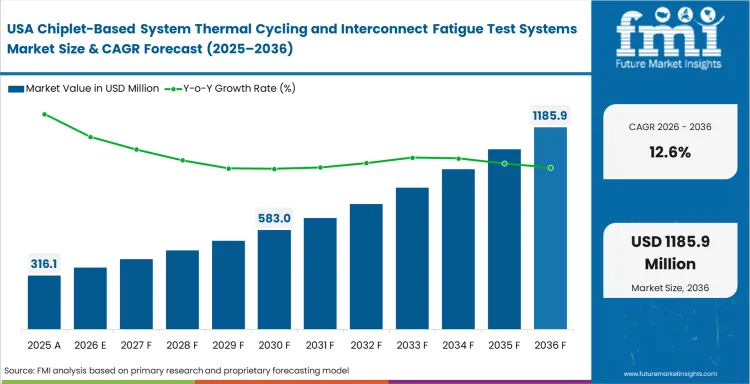
In North America, demand is shaped more by design ownership and qualification planning than by backend manufacturing scale. Package architects and validation groups often define stress requirements before assembly scale is fixed, which changes how systems are evaluated. Equipment selection leans heavily on data quality, software fit, and the ability to align with wider demand for automated test equipment in USA decisions rather than on chamber hardware alone. Package groups also spend more time deciding whether dedicated chiplet fatigue tools should sit in central reliability labs or near pilot packaging lines. That internal placement question can slow orders, yet it also makes requirements sharper once budgets are approved. Buying mistakes here show up as longer release cycles rather than simple lab inconvenience.
- United States: Arizona, Texas, and California keep the United States close to chiplet design, high-performance compute, and advanced packaging development. Demand for these systems is expected to grow at a CAGR of 12.6% over the forecast period because design ownership and package qualification often sit in the same decision chain. Buyers usually look beyond chamber speed. They want cleaner continuity data, easier software export, and test conditions that can be defended in customer review. Release risk matters more than headline hardware cost when package programs serve AI, defense, or data center applications.
FMI's report also covers Canada and Mexico, where electronics manufacturing and test activity create narrower but still relevant demand pockets. Regional growth remains tied to design concentration in the United States, while nearby markets benefit when validation work or assembly support spreads across the broader semiconductor base.
Europe Chiplet-Based System Thermal Cycling and Interconnect Fatigue Test Systems Market Analysis
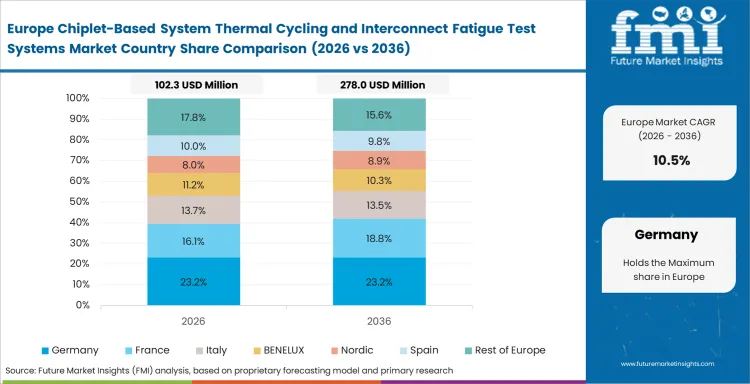
Europe approaches this market with a stronger reliability and application-fit lens than a pure volume lens. Buying decisions often sit closer to automotive, industrial, and specialized semiconductor requirements, which means system choice is judged by stability and service support before it is judged by raw throughput. That pattern keeps the regional opportunity relevant even without the same backend scale seen in Asia Pacific. Interest also overlaps with advanced node wafer defect inspection systems and other precision test tools because package verification is rarely purchased in isolation. Slow approval can limit near-term installs, yet qualified demand stays durable when devices serve long-life applications.
- Germany: Dresden and southern Germany keep local semiconductor work tied to industrial and automotive needs, and that shapes demand differently from Asia's volume-led packaging hubs. Buyers usually want dependable cycling control and service continuity before they expand chamber fleets. German demand for chiplet thermal cycling and interconnect fatigue test systems is projected to rise at a CAGR of 10.5% from 2026 to 2036 as advanced package use widens in reliability-sensitive electronics. Growth looks steadier than a faster industry in Asia, but it is also more disciplined.
FMI's report further reviews France, the United Kingdom, the Netherlands, Italy, and other Europe segment where demand builds around automotive electronics, power devices, and specialist packaging programs. Regional expansion is shaped less by broad packaging scale and more by how strongly each country links advanced semiconductor work to local end-use industries.
Competitive Aligners for Market Players
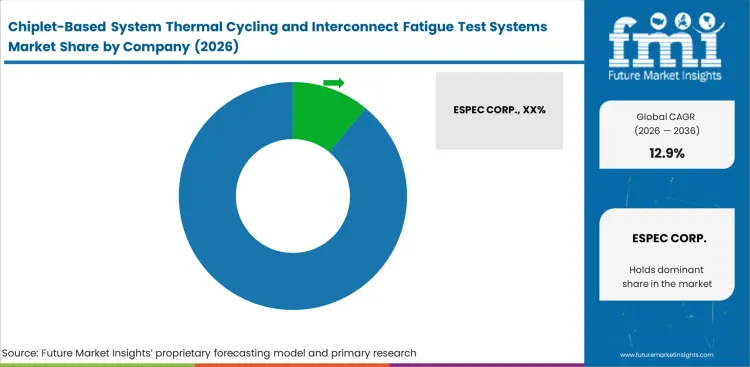
Service depth continues to play a defining role in vendor selection, often outweighing headline chamber specifications. Buyers place sustained emphasis on stable thermal performance, dependable control behavior, and maintenance support that does not slow active qualification programs. Suppliers that perform well in localized stress work tend to remain in shortlists because they help limit variability during fatigue testing and reduce diagnosis time after long stress runs. Weaknesses in software export or service response can quickly negate hardware strengths once package schedules begin to tighten.
Evaluation criteria also extend beyond the tool to how well a system fits into existing test environments and purchasing logic. Vendors with broad semiconductor test exposure, such as Advantest, are often reviewed through the lens of advanced packaging share analysis and established backend relationships. At the same time, buyers favor solutions that can be positioned alongside semiconductor defect inspection equipment without adding workflow friction. Across both approaches, training effort, system upkeep, and ease of integration remain central to final approval decisions.
Looking forward, the vendor landscape is not expected to converge around a single dominant group, as chiplet fatigue testing continues to sit between environmental stress, reliability engineering, and semiconductor test operations. Buyer tolerance for loosely connected systems is likely to narrow as package complexity increases. Vendors such as Cohu and inTEST Thermal Solutions stay relevant by addressing complementary aspects of the requirement, from chamber‑level performance to alignment with wider test workflows. Competitive differentiation will depend on local service availability, usable software, and the ability to adapt the system to daily package qualification work.
Key Players in Chiplet-Based System Thermal Cycling and Interconnect Fatigue Test Systems Market
- ESPEC CORP.
- Advantest
- MPI Corporation
- Thermotron
- inTEST Thermal Solutions
- Cohu
Scope of the Report
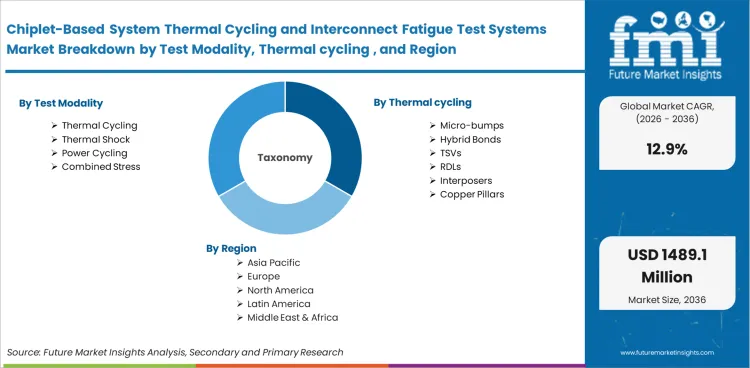
| Metric | Value |
|---|---|
| Quantitative Units | USD 392.0 million to USD 1,313.0 million, at a CAGR of 12.90% |
| Market Definition | Thermal cycling and interconnect fatigue systems used to qualify chiplet packages, expose package-level failure paths, and support release-stage reliability decisions for multi-die assemblies. |
| Test Modality Segmentation | Thermal Cycling, Thermal Shock, Power Cycling, Combined Stress |
| Interconnect Focus Segmentation | Micro-bumps, Hybrid Bonds, TSVs, RDLs, Interposers, Copper Pillars |
| Package Architecture Segmentation | 2.5D Packages, 3D Stacks, Fan-out Packages, SiP Modules, Bridge Packages |
| End User Segmentation | OSATs, IDMs, Foundries, Fabless Firms, Research Labs |
| Regions Covered | Asia Pacific, North America, Europe |
| Countries Covered | Taiwan, South Korea, China, United States, Malaysia, Japan, Germany, and 40 plus countries |
| Key Companies Profiled | ESPEC CORP., Advantest, MPI Corporation, Thermotron, inTEST Thermal Solutions, Cohu |
| Forecast Period | 2026 to 2036 |
| Approach | FMI combines supplier mapping, package qualification workflow analysis, technical review of chiplet interconnect stress needs, and primary interviews across reliability, packaging, and backend validation roles. Market sizing follows the portion of advanced packaging and semiconductor test spend that is directed toward dedicated thermal cycling and interconnect fatigue use cases. |
Source: Future Market Insights (FMI) analysis, based on proprietary forecasting model and primary research
Chiplet-Based System Thermal Cycling and Interconnect Fatigue Test Systems Market Analysis by Segments
Test Modality:
- Thermal Cycling
- Thermal Shock
- Power Cycling
- Combined Stress
Interconnect Focus:
- Micro-bumps
- Hybrid Bonds
- TSVs
- RDLs
- Interposers
- Copper Pillars
Package Architecture:
- 2.5D Packages
- 3D Stacks
- Fan-out Packages
- SiP Modules
- Bridge Packages
Thermal Profile:
- Air-forced
- Chamber-based
- Liquid-assisted
- Localized Forcing
Automation Level:
- Manual
- Semi-automated
- Fully Automated
- Inline Cells
Deployment Stage:
- R&D Labs
- Qualification Labs
- Pilot Lines
- Production Floors
- Failure Labs
End User:
- OSATs
- IDMs
- Foundries
- Fabless Firms
- Research Labs
Measurement Stack:
- Daisy-chain
- Kelvin Sensing
- Resistance Logging
- Warpage Tracking
- Event Monitoring
Region:
- North America
- United States
- Canada
- Europe
- Germany
- United Kingdom
- France
- Italy
- Spain
- Asia Pacific
- China
- Japan
- South Korea
- Taiwan
- Singapore
- Latin America
- Brazil
- Mexico
- Argentina
- Middle East & Africa
- GCC Countries
- South Africa
Bibliography
- Cao, L. (2025). Integrated Design Ecosystem™ for chiplets and heterogeneous integration in advanced packaging technology.
- Iyer, S., & Samadi, G. (2024). Manufacturing roadmap for heterogeneous integration and electronics packaging (MRHIEP): Final report.
- Keysight Technologies, Inc. (2025). Keysight expands chiplet interconnect standards support in Chiplet PHY Designer 2025.
- Virmani, D., Kalia, R., & Ahn, J. (2025). Thermal Management Challenges in 2.5D and 3D Chiplet Integration: A Review _Int_g7xki4gJ">on Architecture-Cooling Co-Design.
This bibliography is provided for reader reference. The full FMI report contains the complete reference list with primary source documentation.
This Report Addresses
- Market intelligence to support strategic decision making across thermal cycling chambers, interconnect fatigue monitoring stacks, chiplet package qualification cells, and package-level reliability workflows.
- Market size estimation and 10-year revenue forecasts from 2026 to 2036, supported by package qualification workflow analysis, supplier mapping, and test equipment adoption benchmarks.
- Growth opportunity mapping across Test Modality, Interconnect Focus, Package Architecture, and End User with emphasis on release-stage qualification needs.
- Segment and regional revenue forecasts covering Thermal Cycling, Micro-bumps, 2.5D Packages, and OSAT-led demand across chiplet packaging and backend validation settings.
- Competition strategy assessment including service response, thermal control stability, software usability, and package adaptation depth.
- Product development tracking including chiplet package cycling, continuity logging, warpage review, hybrid bond validation, and interposer-linked stress analysis.
- Market access analysis covering qualification workflows, customer signoff requirements, lab-to-line deployment decisions, and semiconductor package reliability practices.
- Market report delivery in PDF, Excel, PPT, and interactive dashboard formats for executive strategy, capacity planning, and operational benchmarking use.
Frequently Asked Questions
What is the current value of the chiplet thermal cycling and interconnect fatigue test systems industry?
FMI estimates the industry at USD 348.0 million in 2025 and expects it to reach USD 392.0 million in 2026.
How fast is the industry expected to grow through 2036?
FMI projects demand to expand at a CAGR of 12.9% from 2026 to 2036.
What valuation is expected by the end of the forecast period?
Industry value is forecast to reach USD 1,313.0 million by 2036.
Why are thermal cycling systems leading this space?
Thermal cycling remains the most widely used approach because repeated temperature exposure gives a clearer view of interconnect fatigue in chiplet packages.
Which interconnect type generates the highest testing focus?
Micro-bumps lead the interconnect focus segment since they are among the first connection points where thermal stress can affect long-term package reliability.
Which package architecture is creating the most demand for these systems?
2.5D packages are expected to stay ahead because they are widely used in advanced multi-die integration and need close qualification work at the package level.
Who are the main end users of these test systems?
OSATs, IDMs, foundries, fabless firms, and research labs are the main user groups, with OSATs holding the strongest position in current demand.
Which end user segment is expected to lead in 2026?
OSATs are projected to remain the leading end user group as backend assembly and customer qualification work continue to concentrate there.
Which countries are likely to see the fastest expansion?
Taiwan, South Korea, and China are expected to post the strongest growth, supported by advanced packaging activity and rising chiplet validation needs.
What is driving adoption of chiplet interconnect fatigue test systems?
Adoption is rising because package complexity is increasing and buyers need more dependable ways to check how die-to-die connections behave under repeated thermal stress.
What does this report include within its scope?
The report covers thermal cycling and related fatigue test systems used for chiplet package validation across test modality, interconnect focus, package architecture, thermal profile, automation level, deployment stage, end user, and measurement stack.
Which companies are discussed in the competitive landscape?
Key companies covered in the report include ESPEC CORP., Advantest, MPI Corporation, Thermotron, inTEST Thermal Solutions, and Cohu.
Preview the report firsthand - request a free sample
Get SampleGet the brochure for pricing and purchase details.
Get PDFTable of Content
- Executive Summary
- Global Market Outlook
- Demand-side Trends
- Supply-side Trends
- Technology Roadmap Analysis
- Analysis and Recommendations
- Market Overview
- Market Coverage / Taxonomy
- Market Definition / Scope / Limitations
- Research Methodology
- Chapter Orientation
- Analytical Lens and Working Hypotheses
- Market Structure, Signals, and Trend Drivers
- Benchmarking and Cross-market Comparability
- Market Sizing, Forecasting, and Opportunity Mapping
- Research Design and Evidence Framework
- Desk Research Programme (Secondary Evidence)
- Company Annual and Sustainability Reports
- Peer-reviewed Journals and Academic Literature
- Corporate Websites, Product Literature, and Technical Notes
- Earnings Decks and Investor Briefings
- Statutory Filings and Regulatory Disclosures
- Technical White Papers and Standards Notes
- Trade Journals, Industry Magazines, and Analyst Briefs
- Conference Proceedings, Webinars, and Seminar Materials
- Government Statistics Portals and Public Data Releases
- Press Releases and Reputable Media Coverage
- Specialist Newsletters and Curated Briefings
- Sector Databases and Reference Repositories
- FMI Internal Proprietary Databases and Historical Market Datasets
- Subscription Datasets and Paid Sources
- Social Channels, Communities, and Digital Listening Inputs
- Additional Desk Sources
- Expert Input and Fieldwork (Primary Evidence)
- Primary Modes
- Qualitative Interviews and Expert Elicitation
- Quantitative Surveys and Structured Data Capture
- Blended Approach
- Why Primary Evidence is Used
- Field Techniques
- Interviews
- Surveys
- Focus Groups
- Observational and In-context Research
- Social and Community Interactions
- Stakeholder Universe Engaged
- C-suite Leaders
- Board Members
- Presidents and Vice Presidents
- R&D and Innovation Heads
- Technical Specialists
- Domain Subject-matter Experts
- Scientists
- Physicians and Other Healthcare Professionals
- Governance, Ethics, and Data Stewardship
- Research Ethics
- Data Integrity and Handling
- Primary Modes
- Tooling, Models, and Reference Databases
- Desk Research Programme (Secondary Evidence)
- Data Engineering and Model Build
- Data Acquisition and Ingestion
- Cleaning, Normalisation, and Verification
- Synthesis, Triangulation, and Analysis
- Quality Assurance and Audit Trail
- Market Background
- Market Dynamics
- Drivers
- Restraints
- Opportunity
- Trends
- Scenario Forecast
- Demand in Optimistic Scenario
- Demand in Likely Scenario
- Demand in Conservative Scenario
- Opportunity Map Analysis
- Product Life Cycle Analysis
- Supply Chain Analysis
- Investment Feasibility Matrix
- Value Chain Analysis
- PESTLE and Porter’s Analysis
- Regulatory Landscape
- Regional Parent Market Outlook
- Production and Consumption Statistics
- Import and Export Statistics
- Market Dynamics
- Global Market Analysis 2021 to 2025 and Forecast, 2026 to 2036
- Historical Market Size Value (USD Million) Analysis, 2021 to 2025
- Current and Future Market Size Value (USD Million) Projections, 2026 to 2036
- Y-o-Y Growth Trend Analysis
- Absolute $ Opportunity Analysis
- Global Market Pricing Analysis 2021 to 2025 and Forecast 2026 to 2036
- Global Market Analysis 2021 to 2025 and Forecast 2026 to 2036, By Test Modality
- Introduction / Key Findings
- Historical Market Size Value (USD Million) Analysis By Test Modality , 2021 to 2025
- Current and Future Market Size Value (USD Million) Analysis and Forecast By Test Modality , 2026 to 2036
- Thermal Cycling
- Thermal Shock
- Power Cycling
- Combined Stress
- Thermal Cycling
- Y-o-Y Growth Trend Analysis By Test Modality , 2021 to 2025
- Absolute $ Opportunity Analysis By Test Modality , 2026 to 2036
- Global Market Analysis 2021 to 2025 and Forecast 2026 to 2036, By Thermal cycling
- Introduction / Key Findings
- Historical Market Size Value (USD Million) Analysis By Thermal cycling, 2021 to 2025
- Current and Future Market Size Value (USD Million) Analysis and Forecast By Thermal cycling, 2026 to 2036
- Micro-bumps
- Hybrid Bonds
- TSVs
- RDLs
- Interposers
- Copper Pillars
- Micro-bumps
- Y-o-Y Growth Trend Analysis By Thermal cycling, 2021 to 2025
- Absolute $ Opportunity Analysis By Thermal cycling, 2026 to 2036
- Global Market Analysis 2021 to 2025 and Forecast 2026 to 2036, By Package Architecture
- Introduction / Key Findings
- Historical Market Size Value (USD Million) Analysis By Package Architecture, 2021 to 2025
- Current and Future Market Size Value (USD Million) Analysis and Forecast By Package Architecture, 2026 to 2036
- 2.5D Packages
- 3D Stacks
- Fan-out Packages
- SiP Modules
- Bridge Packages
- 2.5D Packages
- Y-o-Y Growth Trend Analysis By Package Architecture, 2021 to 2025
- Absolute $ Opportunity Analysis By Package Architecture, 2026 to 2036
- Global Market Analysis 2021 to 2025 and Forecast 2026 to 2036, By Thermal Profile
- Introduction / Key Findings
- Historical Market Size Value (USD Million) Analysis By Thermal Profile, 2021 to 2025
- Current and Future Market Size Value (USD Million) Analysis and Forecast By Thermal Profile, 2026 to 2036
- Air-forced
- Chamber-based
- Liquid-assisted
- Localized Forcing
- Air-forced
- Y-o-Y Growth Trend Analysis By Thermal Profile, 2021 to 2025
- Absolute $ Opportunity Analysis By Thermal Profile, 2026 to 2036
- Global Market Analysis 2021 to 2025 and Forecast 2026 to 2036, By Automation Level
- Introduction / Key Findings
- Historical Market Size Value (USD Million) Analysis By Automation Level, 2021 to 2025
- Current and Future Market Size Value (USD Million) Analysis and Forecast By Automation Level, 2026 to 2036
- Semi-automated
- Manual
- Fully Automated
- Inline Cells
- Semi-automated
- Y-o-Y Growth Trend Analysis By Automation Level, 2021 to 2025
- Absolute $ Opportunity Analysis By Automation Level, 2026 to 2036
- Global Market Analysis 2021 to 2025 and Forecast 2026 to 2036, By Deployment Stage
- Introduction / Key Findings
- Historical Market Size Value (USD Million) Analysis By Deployment Stage, 2021 to 2025
- Current and Future Market Size Value (USD Million) Analysis and Forecast By Deployment Stage, 2026 to 2036
- Qualification labs
- R&D Labs
- Pilot Lines
- Production Floors
- Failure Labs
- Qualification labs
- Y-o-Y Growth Trend Analysis By Deployment Stage, 2021 to 2025
- Absolute $ Opportunity Analysis By Deployment Stage, 2026 to 2036
- Global Market Analysis 2021 to 2025 and Forecast 2026 to 2036, By End User
- Introduction / Key Findings
- Historical Market Size Value (USD Million) Analysis By End User, 2021 to 2025
- Current and Future Market Size Value (USD Million) Analysis and Forecast By End User, 2026 to 2036
- OSATs
- IDMs
- Foundries
- Fabless Firms
- Research Labs
- OSATs
- Y-o-Y Growth Trend Analysis By End User, 2021 to 2025
- Absolute $ Opportunity Analysis By End User, 2026 to 2036
- Global Market Analysis 2021 to 2025 and Forecast 2026 to 2036, By Region
- Introduction
- Historical Market Size Value (USD Million) Analysis By Region, 2021 to 2025
- Current Market Size Value (USD Million) Analysis and Forecast By Region, 2026 to 2036
- North America
- Latin America
- Western Europe
- Eastern Europe
- East Asia
- South Asia and Pacific
- Middle East & Africa
- Market Attractiveness Analysis By Region
- North America Market Analysis 2021 to 2025 and Forecast 2026 to 2036, By Country
- Historical Market Size Value (USD Million) Trend Analysis By Market Taxonomy, 2021 to 2025
- Market Size Value (USD Million) Forecast By Market Taxonomy, 2026 to 2036
- By Country
- USA
- Canada
- Mexico
- By Test Modality
- By Thermal cycling
- By Package Architecture
- By Thermal Profile
- By Automation Level
- By Deployment Stage
- By End User
- By Country
- Market Attractiveness Analysis
- By Country
- By Test Modality
- By Thermal cycling
- By Package Architecture
- By Thermal Profile
- By Automation Level
- By Deployment Stage
- By End User
- Key Takeaways
- Latin America Market Analysis 2021 to 2025 and Forecast 2026 to 2036, By Country
- Historical Market Size Value (USD Million) Trend Analysis By Market Taxonomy, 2021 to 2025
- Market Size Value (USD Million) Forecast By Market Taxonomy, 2026 to 2036
- By Country
- Brazil
- Chile
- Rest of Latin America
- By Test Modality
- By Thermal cycling
- By Package Architecture
- By Thermal Profile
- By Automation Level
- By Deployment Stage
- By End User
- By Country
- Market Attractiveness Analysis
- By Country
- By Test Modality
- By Thermal cycling
- By Package Architecture
- By Thermal Profile
- By Automation Level
- By Deployment Stage
- By End User
- Key Takeaways
- Western Europe Market Analysis 2021 to 2025 and Forecast 2026 to 2036, By Country
- Historical Market Size Value (USD Million) Trend Analysis By Market Taxonomy, 2021 to 2025
- Market Size Value (USD Million) Forecast By Market Taxonomy, 2026 to 2036
- By Country
- Germany
- UK
- Italy
- Spain
- France
- Nordic
- BENELUX
- Rest of Western Europe
- By Test Modality
- By Thermal cycling
- By Package Architecture
- By Thermal Profile
- By Automation Level
- By Deployment Stage
- By End User
- By Country
- Market Attractiveness Analysis
- By Country
- By Test Modality
- By Thermal cycling
- By Package Architecture
- By Thermal Profile
- By Automation Level
- By Deployment Stage
- By End User
- Key Takeaways
- Eastern Europe Market Analysis 2021 to 2025 and Forecast 2026 to 2036, By Country
- Historical Market Size Value (USD Million) Trend Analysis By Market Taxonomy, 2021 to 2025
- Market Size Value (USD Million) Forecast By Market Taxonomy, 2026 to 2036
- By Country
- Russia
- Poland
- Hungary
- Balkan & Baltic
- Rest of Eastern Europe
- By Test Modality
- By Thermal cycling
- By Package Architecture
- By Thermal Profile
- By Automation Level
- By Deployment Stage
- By End User
- By Country
- Market Attractiveness Analysis
- By Country
- By Test Modality
- By Thermal cycling
- By Package Architecture
- By Thermal Profile
- By Automation Level
- By Deployment Stage
- By End User
- Key Takeaways
- East Asia Market Analysis 2021 to 2025 and Forecast 2026 to 2036, By Country
- Historical Market Size Value (USD Million) Trend Analysis By Market Taxonomy, 2021 to 2025
- Market Size Value (USD Million) Forecast By Market Taxonomy, 2026 to 2036
- By Country
- China
- Japan
- South Korea
- By Test Modality
- By Thermal cycling
- By Package Architecture
- By Thermal Profile
- By Automation Level
- By Deployment Stage
- By End User
- By Country
- Market Attractiveness Analysis
- By Country
- By Test Modality
- By Thermal cycling
- By Package Architecture
- By Thermal Profile
- By Automation Level
- By Deployment Stage
- By End User
- Key Takeaways
- South Asia and Pacific Market Analysis 2021 to 2025 and Forecast 2026 to 2036, By Country
- Historical Market Size Value (USD Million) Trend Analysis By Market Taxonomy, 2021 to 2025
- Market Size Value (USD Million) Forecast By Market Taxonomy, 2026 to 2036
- By Country
- India
- ASEAN
- Australia & New Zealand
- Rest of South Asia and Pacific
- By Test Modality
- By Thermal cycling
- By Package Architecture
- By Thermal Profile
- By Automation Level
- By Deployment Stage
- By End User
- By Country
- Market Attractiveness Analysis
- By Country
- By Test Modality
- By Thermal cycling
- By Package Architecture
- By Thermal Profile
- By Automation Level
- By Deployment Stage
- By End User
- Key Takeaways
- Middle East & Africa Market Analysis 2021 to 2025 and Forecast 2026 to 2036, By Country
- Historical Market Size Value (USD Million) Trend Analysis By Market Taxonomy, 2021 to 2025
- Market Size Value (USD Million) Forecast By Market Taxonomy, 2026 to 2036
- By Country
- Kingdom of Saudi Arabia
- Other GCC Countries
- Turkiye
- South Africa
- Other African Union
- Rest of Middle East & Africa
- By Test Modality
- By Thermal cycling
- By Package Architecture
- By Thermal Profile
- By Automation Level
- By Deployment Stage
- By End User
- By Country
- Market Attractiveness Analysis
- By Country
- By Test Modality
- By Thermal cycling
- By Package Architecture
- By Thermal Profile
- By Automation Level
- By Deployment Stage
- By End User
- Key Takeaways
- Key Countries Market Analysis
- USA
- Pricing Analysis
- Market Share Analysis, 2025
- By Test Modality
- By Thermal cycling
- By Package Architecture
- By Thermal Profile
- By Automation Level
- By Deployment Stage
- By End User
- Canada
- Pricing Analysis
- Market Share Analysis, 2025
- By Test Modality
- By Thermal cycling
- By Package Architecture
- By Thermal Profile
- By Automation Level
- By Deployment Stage
- By End User
- Mexico
- Pricing Analysis
- Market Share Analysis, 2025
- By Test Modality
- By Thermal cycling
- By Package Architecture
- By Thermal Profile
- By Automation Level
- By Deployment Stage
- By End User
- Brazil
- Pricing Analysis
- Market Share Analysis, 2025
- By Test Modality
- By Thermal cycling
- By Package Architecture
- By Thermal Profile
- By Automation Level
- By Deployment Stage
- By End User
- Chile
- Pricing Analysis
- Market Share Analysis, 2025
- By Test Modality
- By Thermal cycling
- By Package Architecture
- By Thermal Profile
- By Automation Level
- By Deployment Stage
- By End User
- Germany
- Pricing Analysis
- Market Share Analysis, 2025
- By Test Modality
- By Thermal cycling
- By Package Architecture
- By Thermal Profile
- By Automation Level
- By Deployment Stage
- By End User
- UK
- Pricing Analysis
- Market Share Analysis, 2025
- By Test Modality
- By Thermal cycling
- By Package Architecture
- By Thermal Profile
- By Automation Level
- By Deployment Stage
- By End User
- Italy
- Pricing Analysis
- Market Share Analysis, 2025
- By Test Modality
- By Thermal cycling
- By Package Architecture
- By Thermal Profile
- By Automation Level
- By Deployment Stage
- By End User
- Spain
- Pricing Analysis
- Market Share Analysis, 2025
- By Test Modality
- By Thermal cycling
- By Package Architecture
- By Thermal Profile
- By Automation Level
- By Deployment Stage
- By End User
- France
- Pricing Analysis
- Market Share Analysis, 2025
- By Test Modality
- By Thermal cycling
- By Package Architecture
- By Thermal Profile
- By Automation Level
- By Deployment Stage
- By End User
- India
- Pricing Analysis
- Market Share Analysis, 2025
- By Test Modality
- By Thermal cycling
- By Package Architecture
- By Thermal Profile
- By Automation Level
- By Deployment Stage
- By End User
- ASEAN
- Pricing Analysis
- Market Share Analysis, 2025
- By Test Modality
- By Thermal cycling
- By Package Architecture
- By Thermal Profile
- By Automation Level
- By Deployment Stage
- By End User
- Australia & New Zealand
- Pricing Analysis
- Market Share Analysis, 2025
- By Test Modality
- By Thermal cycling
- By Package Architecture
- By Thermal Profile
- By Automation Level
- By Deployment Stage
- By End User
- China
- Pricing Analysis
- Market Share Analysis, 2025
- By Test Modality
- By Thermal cycling
- By Package Architecture
- By Thermal Profile
- By Automation Level
- By Deployment Stage
- By End User
- Japan
- Pricing Analysis
- Market Share Analysis, 2025
- By Test Modality
- By Thermal cycling
- By Package Architecture
- By Thermal Profile
- By Automation Level
- By Deployment Stage
- By End User
- South Korea
- Pricing Analysis
- Market Share Analysis, 2025
- By Test Modality
- By Thermal cycling
- By Package Architecture
- By Thermal Profile
- By Automation Level
- By Deployment Stage
- By End User
- Russia
- Pricing Analysis
- Market Share Analysis, 2025
- By Test Modality
- By Thermal cycling
- By Package Architecture
- By Thermal Profile
- By Automation Level
- By Deployment Stage
- By End User
- Poland
- Pricing Analysis
- Market Share Analysis, 2025
- By Test Modality
- By Thermal cycling
- By Package Architecture
- By Thermal Profile
- By Automation Level
- By Deployment Stage
- By End User
- Hungary
- Pricing Analysis
- Market Share Analysis, 2025
- By Test Modality
- By Thermal cycling
- By Package Architecture
- By Thermal Profile
- By Automation Level
- By Deployment Stage
- By End User
- Kingdom of Saudi Arabia
- Pricing Analysis
- Market Share Analysis, 2025
- By Test Modality
- By Thermal cycling
- By Package Architecture
- By Thermal Profile
- By Automation Level
- By Deployment Stage
- By End User
- Turkiye
- Pricing Analysis
- Market Share Analysis, 2025
- By Test Modality
- By Thermal cycling
- By Package Architecture
- By Thermal Profile
- By Automation Level
- By Deployment Stage
- By End User
- South Africa
- Pricing Analysis
- Market Share Analysis, 2025
- By Test Modality
- By Thermal cycling
- By Package Architecture
- By Thermal Profile
- By Automation Level
- By Deployment Stage
- By End User
- USA
- Market Structure Analysis
- Competition Dashboard
- Competition Benchmarking
- Market Share Analysis of Top Players
- By Regional
- By Test Modality
- By Thermal cycling
- By Package Architecture
- By Thermal Profile
- By Automation Level
- By Deployment Stage
- By End User
- Competition Analysis
- Competition Deep Dive
- ESPEC CORP.
- Overview
- Product Portfolio
- Profitability by Market Segments (Product/Age /Sales Channel/Region)
- Sales Footprint
- Strategy Overview
- Marketing Strategy
- Product Strategy
- Channel Strategy
- Advantest
- MPI Corporation
- Thermotron
- inTEST Thermal Solutions
- Cohu
- ESPEC CORP.
- Competition Deep Dive
- Assumptions & Acronyms Used


