

- Market Size (2026)
- USD 879.6 Mn
- Forecast (2036)
- USD 7143.6 Mn
- CAGR (2026 to 2036)
- 23.3%
How big is Insect Farming Infrastructure & Production Facilities Market in 2026?
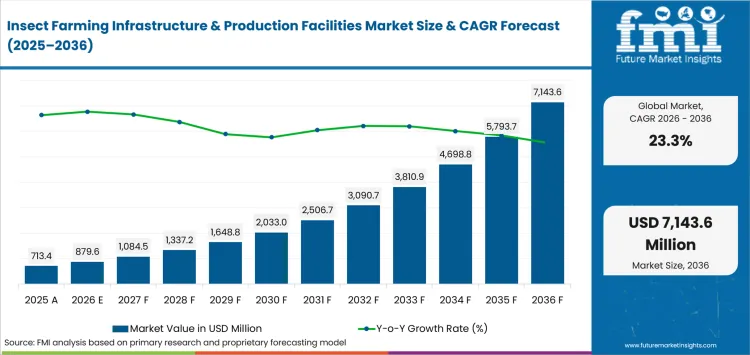
USD 879.6 million in 2026 and USD 7,143.6 million by 2036 at a 23.3% CAGR.
Demand for insect farming infrastructure & production facilities is projected to rise at 23.3% CAGR from 2026 to 2036, pushing industry valuation from USD 879.6 million in 2026 to USD 7143.6 million by 2036 as approved routes for insect-based ingredients make commercial capacity easier to finance. The European Commission authorized UV-treated whole yellow mealworm powder in January 2025, giving mealworm operators another defined food route. The added route strengthens the revenue case for controlled rearing and processing assets that can meet the authorized conditions.
Country growth also depends on whether operators can sell qualifying output into established customer channels. In April 2026 the FDA completed its review of EnviroFlight dried black soldier fly larvae for cat and dog food. The agency reported no questions about the company’s GRAS conclusion, giving USA insect-protein pet food projects a defined route. Facility financing depends on stable yield and operating cost as farms progress from controlled trials to commercial operation.
Key Takeaways of Insect Farming Infrastructure & Production Facilities Market
- Demand increases as approved feed and food channels give farm developers defined outlets that justify capital commitments to dedicated production assets.
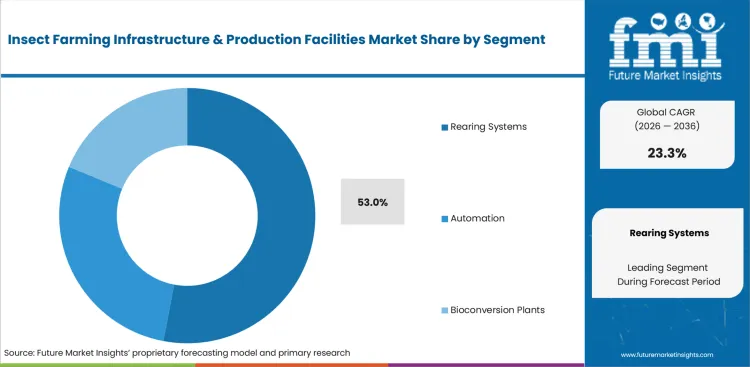
- Based on segment, rearing systems are projected to account for 53.0% in 2026 due to direct control over survival and biological throughput.
- In 2026 black soldier fly is expected to lead the insect category with 30.9% share because commercial farms have accumulated deeper operating experience around BSF biology.
- By output, feed is estimated to hold 48.5% in 2026 owing to established animal-nutrition channels that can absorb recurring insect volume.
- High capital requirements and uneven biological ramp-up can extend commissioning schedules and weaken financing ahead of stable commercial utilization.
- Some of the key companies are Entocycle, Bühler AG, Big Dutchman International GmbH, Insect Engineers, Flybox, LIVIN farms, VDL Insect Systems and Nasekomo.
Analyst Perspective
"Insect-farm economics should be tested at the production-cell level before developers commit to site-wide automation and processing capacity. A credible offer links survival rates with labor demand, energy use and contracted offtake so each expansion stage has measurable operating gates."
- Nandini Roy Choudhury, Principal Consultant, Future Market Insights
How is the Insect Farming Infrastructure & Production Facilities Market segmented?
The market is segmented by Segment, Insect, Output and Region.
The segment category includes rearing systems, automation, and bioconversion plants while the insect category includes black soldier fly, mealworm, cricket, and others. Output includes feed, fertilizer, and food while region follows the standard geographic taxonomy used in the report.
What makes rearing systems central to the segment category?
Rearing systems set the biological baseline for later industrial automation decisions as temperature and stocking control determine repeatable output. In September 2025 Nasekomo reported routine industrial BSF egg production near 25 g/m³/day, then began selling its reproduction technology to mid- and large-scale operators. The operating result gives farm developers a measurable rearing benchmark for evaluating handling and downstream equipment.
- By segment, rearing systems are estimated to hold 53.0% in 2026 owing to their direct control over survival rates and harvest timing.
- Automation can improve tray movement and dosing around proven rearing cells, but poor climate control causes yield variation that software cannot recover.
How does black soldier fly shape demand within the insect category?
Black soldier fly facilities coordinate breeding rhythm with food waste management and larval dosing to maintain predictable harvest timing. In January 2026 Innovafeed and NaturAlleva signed a commercial partnership moving BSFL ingredients into sea bass and sea bream feed at meaningful volumes. The agreement gives BSF operators a recurring insect protein outlet tied to defined aquafeed formulations.
- In 2026, black soldier fly is expected to lead the insect category with 30.9% share because commercial farms have accumulated deeper operating experience around BSF biology.
- Farm operators specify breeding control and neonate dosing against production targets so biological bottlenecks shape equipment selection ahead of plant-wide automation.
What supports feed leadership within the output category?
Feed provides the clearest recurring outlet among covered outputs as animal nutrition can absorb standardized protein and oil volumes. In September 2025 BioMar, Innovafeed, and Auchan announced large-scale integration of insect protein into commercial shrimp feed in Ecuador. The agreement links qualifying insect output to a recurring aquafeed channel that can support planned production schedules.
- The output category is forecast to be led by feed at 48.5% share in 2026 due to clearer qualification and repeat-volume pathways in animal nutrition.
- Projects using insect feed can size rearing and processing stages against contracted nutrition channels once ingredient specifications and supply reliability pass customer qualification.
What are the drivers, restraints and opportunities in the Insect Farming Infrastructure & Production Facilities Market?
Approved output routes are increasing facility demand while scale-up economics restrain investment and staged factory automation gives suppliers a practical route to lower commissioning risk.
- Driver: Feed and food eligibility gives operators defined commercial outlets that can justify investment in controlled rearing and handling capacity.
- Restraint: Capital-intensive builds can fail if biological throughput never reaches the utilization level assumed by project financing.
- Opportunity: Modular rearing cells and connected controls let farm developers validate performance ahead of full-site capital commitments.
Approved feed routes make facility investment easier to model as operators can connect planned output with established animal-nutrition uses. The CFIA amended the Canadian Feed Ingredients Table in June 2026 and retains approved black soldier fly oil plus whole-larvae and defatted-meal uses under defined conditions. That regulatory clarity lets Canadian developers size rearing and processing capacity against known animal feed ingredients while offtake contracts and feedstock economics determine project bankability.
Capital intensity becomes a material restraint when biological ramp-up takes longer than a project’s financing assumptions. In May 2025 the Ontario Superior Court appointed FTI Consulting as receiver and manager of the Aspire Group and its assets. The event increases scrutiny of utilization evidence and operating cost during large-facility financing, which can extend sales cycles for integrated commercial insect-farm systems.
Modular rearing and factory automation let developers stage capital while keeping production blocks comparable during scale-up. In January 2026 LIVIN farms documented a current pig-farm project designed to integrate BSF production directly into an existing livestock operation. The project gives farm operators a defined commercial capacity expansion route inside a working livestock site without requiring a separate large greenfield facility.
Which country CAGRs are profiled in the Insect Farming Infrastructure & Production Facilities Market?
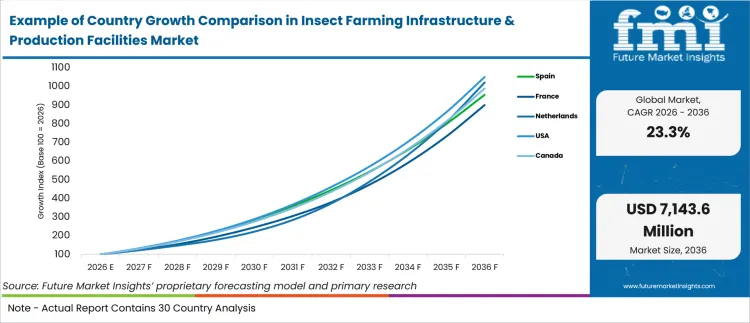
| Country | CAGR |
|---|---|
| USA | 26.5% |
| Netherlands | 26.2% |
| Canada | 25.8% |
| Spain | 25.4% |
| France | 24.6% |
How do country-level CAGRs compare in the Insect Farming Infrastructure & Production Facilities Market?
A 1.9 percentage-point range keeps the profiled country CAGRs inside one compact band, yet the routes to financeable commercial projects differ sharply across these five markets. USA and Netherlands have operating or approval references while Canada has feed rules and Spain and France center on commissioning or industrial scale-up.
- USA projects pair FDA-reviewed pet-food routes with pilot data ahead of major capital commitments.
- Netherlands projects benchmark equipment against a full-capacity commercial BSF operation at Protix.
- Canada combines approved BSF feed uses with final licensing rules for imported feed.
- Spain's Salamanca project makes staged commissioning central to a six-phase mealworm build.
- France pairs Nesle operating experience with FrenchFly research on industrial scale-up barriers.
Similar CAGRs mask different approval and financing conditions across commercial insect-farm projects.
The full report provides country-level CAGR analysis across North America, Latin America, Europe, East Asia, South Asia, Oceania and the Middle East and Africa.
Country-wise Analysis
- Demand for insect farming infrastructure & production facilities in Spain is forecast to rise at 25.4% CAGR over the forecast period as each phase requires dedicated rearing and handling systems commissioned against defined production targets. Tebrio's large mealworm build anchors the commercial project pipeline in Salamanca, and the company laid the first stone for a 90,000-square-meter plant in February 2025 with six planned construction phases. Energy demand and biological ramp costs can outpace early offtake during commissioning so engineering firms need cell-level validation and phased equipment acceptance as the full site is loaded against contracted future commercial output volumes.
- French farm developers can benchmark new designs against industrial BSF experience at Nesle but financing now places greater weight on cost per tonne and repeatable biological output under commercial operating conditions in projects. France is estimated to post 24.6% CAGR over the forecast period as local operating knowledge lowers technical uncertainty while current sector restructuring raises the documented proof required for financing new greenfield commercial projects. In March 2026 the FrenchFly program joined Innovafeed with IRBI to address technical barriers limiting large-scale BSF deployment, giving equipment firms a local research route for scale-up problems tied to future major capacity commitments.
- Dutch project teams can evaluate new equipment against an established commercial BSF plant instead of relying on short pilot assumptions during local plant design and supplier qualification for large planned commercial production blocks. Protix reported in October 2025 that its Netherlands operation runs continuously at full capacity, giving local engineering teams industrial operating data for comparing automation changes against normal commercial production conditions during routine plant operations. Adoption of insect farming infrastructure & production facilities in the Netherlands is estimated to expand at 26.2% CAGR through 2036 as operating benchmarks shorten technical evaluation despite persistent local energy and labor costs.
- USA developers often pair customer qualification with pilot production as greenfield farm economics depend on downstream acceptance plus site-level feedstock and local energy costs during early investment screening and commercial site selection. In the USA, insect farming infrastructure & production facilities demand is predicted to advance at 26.5% CAGR through 2036 as defined pet-food routes improve the commercial case for qualifying BSF output in pet-food formulations. The FDA completed its review of EnviroFlight black soldier fly larvae oil in December 2025 and reported no questions about the company's GRAS conclusion for cat and dog food, giving projects a route.
- Canadian feed projects operate inside a centralized licensing framework and the CFIA confirmed in June 2026 that import provisions under the Feeds Regulations 2024 would reach full implementation at the July transition deadline. Commercial scale remains the main local friction as automated farms need biological yield and uptime to reach financing gates during commercial ramp-up as additional production cells justify further capital at each stage. By 2036, Canada is projected to grow at 25.8% CAGR supported by approved insect-feed routes and import requirements that reward proposals pairing regulatory readiness with staged capacity evidence during project qualification and lender review.
Who are the notable companies in the Insect Farming Infrastructure & Production Facilities Market?
Entocycle, Bühler AG, Big Dutchman International GmbH, Insect Engineers, Flybox, LIVIN farms, VDL Insect Systems and Nasekomo serve this market.
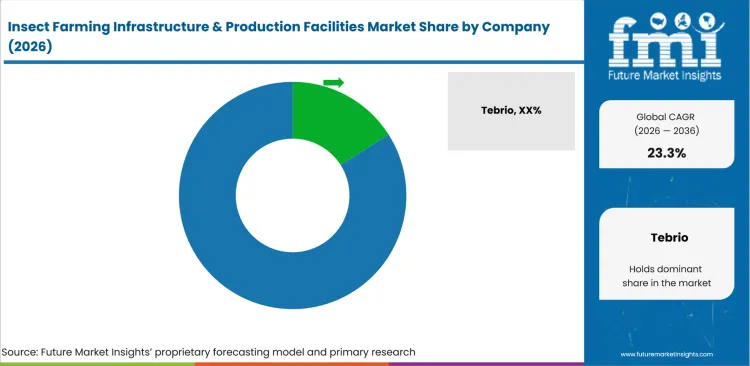
The field is fragmented between full-line engineering groups and specialist insect-farm developers. Entry depends on proving that climate control and handling preserve biological yield during scale-up. Farm owners value commercial references and uptime when selecting larger insect protein animal feed systems.
- Bühler AG and Big Dutchman International GmbH combine insect rearing, climate control and process engineering for facilities.
- Entocycle, Insect Engineers, Flybox and LIVIN farms use modular designs that progress from pilots into commercial production.
- Nasekomo and VDL Insect Systems concentrate on biology-led automation and specialized handling within commercial production lines.
Competitive Benchmarking: Insect Farming Infrastructure & Production Facilities Market
| Company | Farm Integration Depth | Automation & Biological Control | Commercial Deployment Evidence | Geographic Reach |
|---|---|---|---|---|
| Entocycle | High | High | High | United Kingdom and international projects |
| Bühler AG | High | High | High | International insect projects |
| Big Dutchman International GmbH | High | High | High | International agribusiness network |
| Insect Engineers | High | Medium | High | International BSF projects |
| Flybox | High | Medium | Medium | Europe and Global South |
| LIVIN farms | High | High | High | Five European countries |
| VDL Insect Systems | Medium | Medium | Medium | International VDL network |
| Nasekomo | High | High | High | Europe and international partners |
Key Developments in the Insect Farming Infrastructure & Production Facilities Market
- In July 2026, Nasekomo completed Project 3B and reported an automated black soldier fly multiplication center integrating robotics with digital control across industrial reproduction.
- In June 2026, LIVIN farms reported that facilities built with its technology process more than 100,000 tonnes of organic by-products annually across commercial projects.
- In June 2026, Innovafeed completed its industrialization phase and reorganized activity around its fully operational Nesle site for commercial product development.
Key Players in the Insect Farming Infrastructure & Production Facilities Market
Integrated Farm Engineering and Automation Platforms
- Entocycle
- Bühler AG
- Big Dutchman International GmbH
Modular Insect Facility Specialists
- Insect Engineers
- Flybox
- LIVIN farms
Biology-Led Production and Handling Platforms
- VDL Insect Systems
- Nasekomo
Insect Farming Infrastructure & Production Facilities Market - Report Scope
| Coverage field | Report scope |
|---|---|
| Market breakdown | By segment, insect, output and region. |
| Quantitative Units | Revenue in USD million and CAGR in %. |
| Market Definition | Dedicated insect-rearing systems, automation and process-control equipment, and integrated bioconversion facility solutions sold for farmed-insect production. Downstream ingredient, finished feed, food and fertilizer revenue are excluded. |
| Regions Covered | North America, Latin America, Europe, East Asia, South Asia and Pacific, and Middle East and Africa. |
| Countries Covered | USA, Netherlands, Canada, Spain, France, and 20+ countries included in the full report. |
| Key Companies Profiled | Entocycle, Bühler AG, Big Dutchman International GmbH, Insect Engineers, Flybox, LIVIN farms, VDL Insect Systems, Nasekomo. |
| Forecast Period | 2026 to 2036. |
| Approach | Primary and secondary research with market triangulation. |
Insect Farming Infrastructure & Production Facilities Market - Research Methodology
| Method | Approach |
|---|---|
| Primary Research | FMI analysts gathered input from manufacturers, service providers, technology developers, distributors, end users, procurement teams, and subject-matter experts. Interviews examined purchasing decisions, product or service evaluation, adoption barriers, approval requirements, pricing considerations, and expectations for technical or commercial support. Respondents were also asked what evidence is required before a trial, pilot, or initial order develops into regular purchasing. |
| Desk Research | Desk research covered government statistics, regulatory publications, trade data, industry associations, technical literature, standards, company filings, product information, and official corporate announcements. Sources were reviewed for relevance, publication date, geographic coverage, and consistency with the defined market scope. Claims relating to performance, applications, approvals, capacity, investment, and commercial activity were retained only when supported by credible public evidence. |
| Market Sizing and Forecasting | The market model combined the baseline value with historical performance, segment structure, pricing and volume indicators, adoption levels, company participation, and country-level demand conditions. Forecast assumptions considered economic activity, investment trends, regulatory developments, technology adoption, purchasing cycles, supply availability, and barriers to wider market use. Segment and regional estimates were reconciled before the final market total was calculated. |
| Data Validation | Estimates were checked against multiple independent indicators, including public data, company activity, trade patterns, industry developments, and findings from primary interviews. Validation also tested whether products, services, applications, and company revenues fell within the defined market boundaries. Adjacent categories, unsupported claims, overlapping revenues, and activities without direct market relevance were excluded to reduce double counting and maintain consistency across segments and countries. |
Insect Farming Infrastructure & Production Facilities Market by Segments
Insect Farming Infrastructure & Production Facilities Market segmented by Segment:
- Rearing Systems
- Automation
- Bioconversion Plants
Insect Farming Infrastructure & Production Facilities Market segmented by Insect:
- Black Soldier Fly
- Mealworm
- Cricket
- Others
Insect Farming Infrastructure & Production Facilities Market segmented by Output:
- Feed
- Fertilizer
- Food
Insect Farming Infrastructure & Production Facilities Market by Region:
- North America
- United States
- Canada
- Latin America
- Brazil
- Mexico
- Chile
- Rest of Latin America
- Western Europe
- Germany
- United Kingdom
- Italy
- Spain
- France
- Nordics
- Benelux
- Rest of Western Europe
- Eastern Europe
- Russia
- Poland
- Hungary
- Balkan and Baltic States
- Rest of Eastern Europe
- East Asia
- China
- Japan
- South Korea
- South Asia and Pacific
- India
- ASEAN
- Australia and New Zealand
- Rest of South Asia and Pacific
- Middle East and Africa
- Kingdom of Saudi Arabia
- Other GCC Countries
- Türkiye
- South Africa
- Other African Union Countries
- Rest of Middle East and Africa
Research Sources and Bibliography
- European Commission. (2025, January 20). Approval of another insect/insect-derived food as a Novel Food.
- USA Food and Drug Administration. (2026, April 16). GRAS Notice AGRN 85, Dried Black Soldier Fly Larvae.
- Nasekomo. (2025, September 19). Nasekomo reports stable industrial BSF eggs production rate of ~25 g/m³/day; begins technology sales to mid- and large-scale operators.
- Innovafeed. (2026, January 22). NaturAlleva and Innovafeed announce a commercial partnership to further deploy insect-based ingredients in aquaculture.
- Innovafeed. (2025, September 2). BioMar, Innovafeed and Auchan announce landmark partnership to accelerate the commercialisation of insect meal.
- Canadian Food Inspection Agency. (2026, June 26). Canadian Feed Ingredients Table (CFIT).
- FTI Consulting Canada Inc. (2025, May 6). FTI Consulting Canada Inc. / Aspire.
- LIVIN farms. (2026, January 30). Integrating Black Soldier Fly Larvae as Pig Feed.
- Tebrio. (2025, February 20). Tebrio pone la primera piedra de la granja de insectos más grande del mundo.
- Innovafeed. (2026, March 30). IRBI and Innovafeed join forces to create FrenchFly to unlock the final scientific and technological barriers to sustainable insect protein production in France.
- Protix. (2025, October 28). Protix’s strong sustainability data confirmed by peer review.
- USA Food and Drug Administration. (2025, December 23). GRAS Notice AGRN 80 - Black Soldier Fly Larvae Oil.
- Canadian Food Inspection Agency. (2026, June 16). Notice to industry - Importation of livestock feed into Canada: Final implementation of the Feeds Regulations, 2024.
- Nasekomo. (2026, July 7). Nasekomo successfully completes the 3B project / Насекомо успешно завършва проекта 3B.
- LIVIN farms. (2026, June 12). Frequently Asked Questions About LIVIN farms.
- Innovafeed. (2026, June 5). Innovafeed successfully scales up operations and enters a new phase of development backed by a €51 million funding round.
- Entocycle. (2026, February 19). Designing With Intention: The R&D Journey Behind our Egg Traps.
- Bühler Group. (2026). Insect Technology. Retrieved August 13, 2026.
- Big Dutchman AG. (2025, September 3). Ulf Meyer new member of the Board of Management of Big Dutchman AG.
- Big Dutchman. (2024, January 4). Largest facility for insect farming in Northern Europe opens.
- Insect Engineers. (n.d.). Projects. Retrieved August 13, 2026.
- UK Research and Innovation. (n.d.). 360 farm: First end-to-end modular insect farm for a sustainable protein source on commercial farms. Retrieved August 13, 2026.
- UK Research and Innovation. (n.d.). FlySpy: AI-Driven Counting of BSF for Improved Efficiency in Sustainable Waste Management. Retrieved August 13, 2026.
- Entocycle. (2025, June 10). Siemens partners with Entocycle to digitalise insect farming industry.
- Nasekomo. (2026, February 24). NASEKOMO and REINARTZ Sign Strategic Partnership to Industrialize Insect Bioconversion Technology Worldwide.
- LIVIN farms. (2025, September 15). Case Study: Circular Feed Solutions at a German Pig Farm.
This bibliography is provided for reader reference and is not exhaustive. The full report contains the complete reference list and detailed citations
This Report Answers
- What operating conditions turn insect-farm pilots into financeable commercial facilities?
- How do rearing systems and automation divide infrastructure spending across a new insect facility?
- Why does black soldier fly biology require different equipment choices from mealworm or cricket production?
- How do feed and food output routes change equipment specifications and facility financing?
- Which country conditions alter commissioning risk across the five profiled markets?
- Why do scale-up economics remain a restraint even as downstream approvals expand?
- Which supplier types compete across turnkey farms, modular equipment and biology-led automation?
- Which criteria should project owners compare for climate-control, dosing and handling systems?
- Which dated company developments indicate where insect production technology is moving?
Frequently Asked Questions
How big is the Insect Farming Infrastructure & Production Facilities Market in 2026?
The insect farming infrastructure & production facilities market is valued at USD 879.6 million in 2026 and is projected to reach USD 7,143.6 million by 2036. Growth is driven by increasing investment in commercial insect production facilities and the adoption of automated rearing systems for feed and food applications.
What is the CAGR of the Insect Farming Infrastructure & Production Facilities Market from 2026 to 2036?
The insect farming infrastructure & production facilities market is projected to grow at a CAGR of 23.3% between 2026 and 2036. Expansion is supported by improving production economics, increasing demand for alternative protein sources, and scaling of industrial insect farming operations.
Which segment leads the Insect Farming Infrastructure & Production Facilities Market?
Rearing systems are projected to account for 53.0% of the market in 2026. Their leading share is supported by their critical role in maintaining environmental control, productivity, and operational consistency across insect production facilities.
Which insect leads the Insect Farming Infrastructure & Production Facilities Market?
Black soldier fly is projected to account for 30.9% of the market in 2026. Its dominance is driven by established feed applications, strong commercialization activity, and growing acceptance across agricultural value chains.
Which companies are active in the Insect Farming Infrastructure & Production Facilities Market?
Key companies operating in the market include Entocycle, Bühler AG, Big Dutchman International GmbH, Insect Engineers, Flybox, LIVIN farms, VDL Insect Systems, and Nasekomo. These companies compete through facility engineering, automation technologies
Preview the report firsthand - request a free sample
Get SampleGet the brochure for pricing and purchase details.
Get PDFTable of Content
- Key Takeaways
- Market Size and CAGR
- Top Growth Driver
- Fastest Growing Segment
- Leading Region
- Key Companies
- Emerging Opportunities
- Executive Summary
- Global Market Outlook
- Demand-side Trends
- Supply-side Trends
- Technology Roadmap Analysis
- Analysis and Recommendations
- Analyst Perspective (What is happening? Why now? What should investors know?)
- Key Questions Answered
- How large is the market?
- What is the CAGR?
- What are key trends?
- Which region dominates?
- Who are the leaders?
- Market Overview
- Market Coverage / Taxonomy
- Market Definition / Scope / Limitations
- Research Methodology
- Chapter Orientation
- Analytical Lens and Working Hypotheses
- Market Structure, Signals, and Trend Drivers
- Benchmarking and Cross-market Comparability
- Market Sizing, Forecasting, and Opportunity Mapping
- Research Design and Evidence Framework
- Desk Research Programme (Secondary Evidence)
- Expert Input and Fieldwork (Primary Evidence)
- Tooling, Models, and Reference Databases
- Data Engineering and Model Build
- Quality Assurance and Audit Trail
- Market Background
- Market Dynamics (Drivers, Restraints, Opportunity, Trends)
- Scenario Forecast (Optimistic, Likely, Conservative)
- Impact Analysis
- AI Impact
- Sustainability Impact
- Regulatory Impact
- Technology Impact
- Consumer / Buyer Analysis
- Purchase Drivers
- Adoption Barriers
- Buyer Journey
- Opportunity Map Analysis
- Product Life Cycle Analysis
- Supply Chain Analysis
- Investment Feasibility Matrix
- Value Chain Analysis
- PESTLE and Porter's Analysis
- Regulatory Landscape
- Regional Parent Market Outlook
- Production and Consumption Statistics
- Import and Export Statistics
- Global Market Analysis and Forecast, 2021 to 2036
- Historical Market Size Value (USD Million) Analysis, 2021 to 2025
- Current and Future Market Size Value (USD Million) Projections, 2026 to 2036
- Y-o-Y Growth Trend Analysis
- Absolute $ Opportunity Analysis
- Global Market Pricing Analysis, 2021 to 2036
- Global Market Analysis and Forecast, By Segment, 2021 to 2036
- Introduction / Key Findings
- Historical Market Size Value (USD Million) Analysis By Segment, 2021 to 2025
- Current and Future Market Size Value (USD Million) Analysis and Forecast By Segment, 2026 to 2036
- Rearing Systems
- Automation
- Bioconversion Plants
- Rearing Systems
- Y-o-Y Growth Trend Analysis By Segment, 2021 to 2025
- Absolute $ Opportunity Analysis By Segment, 2026 to 2036
- Global Market Analysis and Forecast, By Insect, 2021 to 2036
- Introduction / Key Findings
- Historical Market Size Value (USD Million) Analysis By Insect, 2021 to 2025
- Current and Future Market Size Value (USD Million) Analysis and Forecast By Insect, 2026 to 2036
- Black Soldier Fly
- Mealworm
- Cricket
- Others
- Black Soldier Fly
- Y-o-Y Growth Trend Analysis By Insect, 2021 to 2025
- Absolute $ Opportunity Analysis By Insect, 2026 to 2036
- Global Market Analysis and Forecast, By Output, 2021 to 2036
- Introduction / Key Findings
- Historical Market Size Value (USD Million) Analysis By Output, 2021 to 2025
- Current and Future Market Size Value (USD Million) Analysis and Forecast By Output, 2026 to 2036
- Feed
- Fertilizer
- Food
- Feed
- Y-o-Y Growth Trend Analysis By Output, 2021 to 2025
- Absolute $ Opportunity Analysis By Output, 2026 to 2036
- Global Market Analysis and Forecast, By Region, 2021 to 2036
- Introduction
- Historical Market Size Value (USD Million) Analysis By Region, 2021 to 2025
- Current Market Size Value (USD Million) Analysis and Forecast By Region, 2026 to 2036
- North America
- Latin America
- Western Europe
- Eastern Europe
- East Asia
- South Asia and Pacific
- Middle East & Africa
- Market Attractiveness Analysis By Region
- North America Market Analysis and Forecast, By Country, 2021 to 2036
- Historical Market Size Value (USD Million) Trend Analysis By Market Taxonomy, 2021 to 2025
- Market Size Value (USD Million) Forecast By Market Taxonomy, 2026 to 2036
- By Country
- USA
- Canada
- By Segment
- By Insect
- By Output
- By Country
- Market Attractiveness Analysis
- By Country
- By Segment
- By Insect
- By Output
- Key Takeaways
- Latin America Market Analysis and Forecast, By Country
- Historical Market Size Value (USD Million) Trend Analysis By Market Taxonomy, 2021 to 2025
- Market Size Value (USD Million) Forecast By Market Taxonomy, 2026 to 2036
- By Country
- Brazil
- Mexico
- Chile
- Rest of Latin America
- By Segment
- By Insect
- By Output
- By Country
- Market Attractiveness Analysis
- By Country
- By Segment
- By Insect
- By Output
- Key Takeaways
- Western Europe Market Analysis and Forecast, By Country
- Historical Market Size Value (USD Million) Trend Analysis By Market Taxonomy, 2021 to 2025
- Market Size Value (USD Million) Forecast By Market Taxonomy, 2026 to 2036
- By Country
- Germany
- UK
- Italy
- Spain
- France
- Nordic
- BENELUX
- Rest of Western Europe
- By Segment
- By Insect
- By Output
- By Country
- Market Attractiveness Analysis
- By Country
- By Segment
- By Insect
- By Output
- Key Takeaways
- Eastern Europe Market Analysis and Forecast, By Country
- Historical Market Size Value (USD Million) Trend Analysis By Market Taxonomy, 2021 to 2025
- Market Size Value (USD Million) Forecast By Market Taxonomy, 2026 to 2036
- By Country
- Russia
- Poland
- Hungary
- Balkan & Baltic
- Rest of Eastern Europe
- By Segment
- By Insect
- By Output
- By Country
- Market Attractiveness Analysis
- By Country
- By Segment
- By Insect
- By Output
- Key Takeaways
- East Asia Market Analysis and Forecast, By Country
- Historical Market Size Value (USD Million) Trend Analysis By Market Taxonomy, 2021 to 2025
- Market Size Value (USD Million) Forecast By Market Taxonomy, 2026 to 2036
- By Country
- China
- Japan
- South Korea
- By Segment
- By Insect
- By Output
- By Country
- Market Attractiveness Analysis
- By Country
- By Segment
- By Insect
- By Output
- Key Takeaways
- South Asia and Pacific Market Analysis and Forecast, By Country
- Historical Market Size Value (USD Million) Trend Analysis By Market Taxonomy, 2021 to 2025
- Market Size Value (USD Million) Forecast By Market Taxonomy, 2026 to 2036
- By Country
- India
- ASEAN
- Australia & New Zealand
- Rest of South Asia and Pacific
- By Segment
- By Insect
- By Output
- By Country
- Market Attractiveness Analysis
- By Country
- By Segment
- By Insect
- By Output
- Key Takeaways
- Middle East & Africa Market Analysis and Forecast, By Country
- Historical Market Size Value (USD Million) Trend Analysis By Market Taxonomy, 2021 to 2025
- Market Size Value (USD Million) Forecast By Market Taxonomy, 2026 to 2036
- By Country
- Kingdom of Saudi Arabia
- Other GCC Countries
- Türkiye
- South Africa
- Other African Union
- Rest of Middle East & Africa
- By Segment
- By Insect
- By Output
- By Country
- Market Attractiveness Analysis
- By Country
- By Segment
- By Insect
- By Output
- Key Takeaways
- Key Countries Market Analysis
- USA
- Pricing Analysis
- Market Share Analysis, 2025
- By Segment
- By Insect
- By Output
- Canada
- Pricing Analysis
- Market Share Analysis, 2025
- By Segment
- By Insect
- By Output
- Mexico
- Pricing Analysis
- Market Share Analysis, 2025
- By Segment
- By Insect
- By Output
- Brazil
- Pricing Analysis
- Market Share Analysis, 2025
- By Segment
- By Insect
- By Output
- Chile
- Pricing Analysis
- Market Share Analysis, 2025
- By Segment
- By Insect
- By Output
- Germany
- Pricing Analysis
- Market Share Analysis, 2025
- By Segment
- By Insect
- By Output
- UK
- Pricing Analysis
- Market Share Analysis, 2025
- By Segment
- By Insect
- By Output
- Italy
- Pricing Analysis
- Market Share Analysis, 2025
- By Segment
- By Insect
- By Output
- Spain
- Pricing Analysis
- Market Share Analysis, 2025
- By Segment
- By Insect
- By Output
- France
- Pricing Analysis
- Market Share Analysis, 2025
- By Segment
- By Insect
- By Output
- India
- Pricing Analysis
- Market Share Analysis, 2025
- By Segment
- By Insect
- By Output
- ASEAN
- Pricing Analysis
- Market Share Analysis, 2025
- By Segment
- By Insect
- By Output
- Australia & New Zealand
- Pricing Analysis
- Market Share Analysis, 2025
- By Segment
- By Insect
- By Output
- China
- Pricing Analysis
- Market Share Analysis, 2025
- By Segment
- By Insect
- By Output
- Japan
- Pricing Analysis
- Market Share Analysis, 2025
- By Segment
- By Insect
- By Output
- South Korea
- Pricing Analysis
- Market Share Analysis, 2025
- By Segment
- By Insect
- By Output
- Russia
- Pricing Analysis
- Market Share Analysis, 2025
- By Segment
- By Insect
- By Output
- Poland
- Pricing Analysis
- Market Share Analysis, 2025
- By Segment
- By Insect
- By Output
- Hungary
- Pricing Analysis
- Market Share Analysis, 2025
- By Segment
- By Insect
- By Output
- Kingdom of Saudi Arabia
- Pricing Analysis
- Market Share Analysis, 2025
- By Segment
- By Insect
- By Output
- Türkiye
- Pricing Analysis
- Market Share Analysis, 2025
- By Segment
- By Insect
- By Output
- South Africa
- Pricing Analysis
- Market Share Analysis, 2025
- By Segment
- By Insect
- By Output
- USA
- Market Structure Analysis
- Competition Dashboard
- Competition Benchmarking
- Market Share Analysis of Top Players
- By Regional
- By Segment
- By Insect
- By Output
- Emerging Startups
- Innovation Benchmarking
- Competition Analysis
- Competition Deep Dive
- Tebrio
- Overview
- Product Portfolio
- Profitability by Market Segments
- Sales Footprint
- Strategy Overview
- Marketing Strategy
- Product Strategy
- Channel Strategy
- Ÿnsect
- InnovaFeed
- Protix
- Entocycle
- Aspire
- Beta Hatch
- Tebrio
- Case Studies
- Success Stories
- Recent Developments
- Competition Deep Dive
- Assumptions & Acronyms Used


