

- Industry Size (2026)
- USD 550.0 Mn
- Forecast (2036)
- USD 1314.0 Mn
- CAGR (2026 to 2036)
- 9.1%
Isokinetic Diagnostic and Training System Market Forecast and Outlook 2026 to 2036
In 2026, the isokinetic diagnostic and training system market is likely to be valued at USD 550.0 million and is projected to reach USD 1,314.0 million by 2036, implying a CAGR of 9.1%. These systems sit at the intersection of measurement and rehabilitation, where controlled movement and repeatable load profiles are required for both assessment and therapy. Use is concentrated in sports medicine centers, orthopedic rehabilitation clinics, and performance laboratories rather than in general fitness settings. The value of the equipment lies in objective strength profiling, imbalance detection, and protocol driven recovery tracking, which makes it part of clinical decision making rather than a discretionary training tool.
Clinical workflow and reimbursement structures shape purchasing behavior more than headline equipment specifications. Once a system is incorporated into evaluation protocols and patient pathways, it becomes embedded in reporting formats and longitudinal data sets, which raises switching costs. Utilization rates depend on therapist training, patient throughput, and integration with broader rehabilitation programs. Large hospitals and sports institutes standardize platforms to support research, benchmarking, and multi-site comparability, while smaller clinics adopt selectively based on case mix. The market grows through the formalization of outcomes based rehabilitation and performance monitoring, not through broad diffusion into general purpose exercise or wellness facilities.
Quick Stats for Isokinetic Diagnostic and Training System Market
- Isokinetic Diagnostic and Training System Market Value (2026): USD 550.0 million
- Isokinetic Diagnostic and Training System Market Forecast Value (2036): USD 1,314.0 million
- Isokinetic Diagnostic and Training System Market Forecast CAGR 2026 to 2036: 9.1%
- Leading Type in Isokinetic Diagnostic and Training System Market: Isokinetic strength testing systems
- Key Growth Regions in Isokinetic Diagnostic and Training System Market: Asia Pacific, North America, Europe
- Top Players in Isokinetic Diagnostic and Training System Market: Biodex Medical Systems, Cybex (HUR USA), HUMAC®/Norm™ (Computer Sports Medicine Inc.), HUR USA
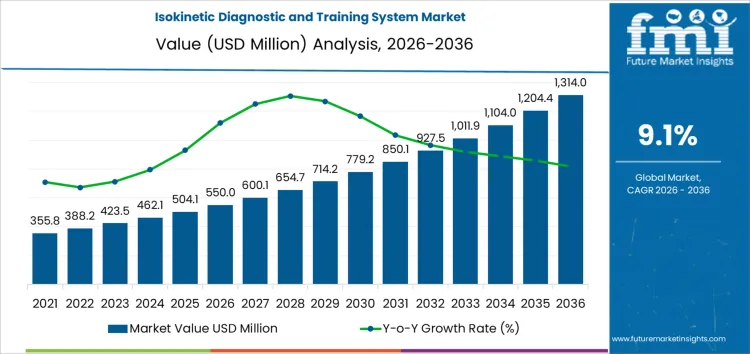
What is the Growth Forecast for the Isokinetic Diagnostic and Training System Market through 2036?
The isokinetic diagnostic and training system segment is expanding as rehabilitation, sports medicine, and orthopedic care become more standardized and outcome-driven. Healthcare providers increasingly rely on objective strength measurement and protocol-based rehabilitation planning, which raises the clinical value of isokinetic systems beyond exercise alone. In the early stage, installations are mainly concentrated in specialized sports institutes, military rehabilitation centers, and selected tertiary care hospitals. As adoption increases, these systems are used more widely for functional assessment, recovery documentation, and evidence-based treatment planning, supporting clinical governance and insurance-related reporting requirements.
Over time, growth is shaped more by institutional standardization than by a simple rise in patient volumes. Isokinetic testing and training become integrated into routine post-surgical rehabilitation, sports injury management, and occupational health programs. Wider deployment is also supported by increasing use in neurology rehabilitation and long-term musculoskeletal care, where progress tracking and repeatable evaluation are essential. Procurement trends shift toward multi-joint platforms with advanced software, digital reporting, and data integration capabilities, which improves clinical workflow and raises system value per installation. Overall, demand is driven by deeper institutional adoption and greater dependence on quantified outcomes. Purchasing decisions prioritize measurement accuracy, reproducibility, data integrity, and strong long-term service support over initial equipment cost.
Isokinetic Diagnostic and Training System Market Key Takeaways
| Metric | Value |
|---|---|
| Market Value (2026) | USD 550.0 million |
| Forecast Value (2036) | USD 1,314.0 million |
| Forecast CAGR 2026 to 2036 | 9.1% |
How Is the Isokinetic Diagnostic and Training System Market Supporting Performance and Rehabilitation?
Isokinetic diagnostic and training systems are increasingly adopted to assess muscle strength, joint function, and rehabilitation progress for athletes, clinical patients, and research subjects. Historically, strength evaluation relied on manual resistance exercises or basic dynamometers, which provided limited accuracy, repeatability, and data tracking. Modern isokinetic systems integrate motorized resistance control, precise angular velocity measurement, and digital data recording to deliver reproducible testing, targeted training, and quantifiable performance metrics. Rehabilitation centers, sports medicine clinics, and research laboratories prioritize measurement accuracy, system versatility, and patient safety. Early adoption focused on elite sports performance monitoring, while current demand spans physical therapy, orthopedic recovery, and functional fitness programs, driven by the need for personalized rehabilitation, data-driven progress tracking, and injury prevention. Velocity control, torque measurement accuracy, and exercise programmability influence supplier selection.
Delivering consistent, measurable outcomes and supporting evidence-based training is shaping market expansion. Compared with conventional resistance methods, isokinetic systems offer controlled motion, precise load application, and objective assessment of muscular performance. Cost structures depend on actuator quality, sensor precision, and software sophistication, concentrating margins among suppliers capable of providing reliable, data-driven platforms. Healthcare providers and athletic trainers adopt these systems to optimize rehabilitation protocols, track recovery milestones, and improve functional performance. Moving forward, isokinetic diagnostic and training systems are expected to become integral in clinical and sports environments, enabling individualized therapy, injury prevention strategies, and performance enhancement supported by accurate biomechanical insights.
What Is Driving Demand for Isokinetic Diagnostic and Training Systems Across Key Segments in 2026?
The Isokinetic Diagnostic and Training System Market in 2026 is structured around clinical workflow requirements and institutional usage models rather than by equipment size or peak torque capacity alone. By product type, demand in the Isokinetic Diagnostic and Training System Market is distributed across isokinetic strength testing systems, isokinetic rehabilitation and training systems, portable isokinetic devices, and integrated isokinetic EMG diagnostic platforms. By end-user, demand in the Isokinetic Diagnostic and Training System Market is concentrated in hospitals and rehabilitation centers, sports medicine clinics, physical therapy practices, and research and academic institutions. These segments reflect differences in patient throughput, documentation requirements, and tolerance for setup complexity.
How Do Clinical Validation Needs and Throughput Constraints Shape Product Type Demand in the Isokinetic Diagnostic and Training System Market?

Isokinetic strength testing systems account for approximately 44% of demand in the Isokinetic Diagnostic and Training System Market because they serve as standardized reference tools for objective muscle performance assessment. In clinical environments, these systems are used to establish baselines, document recovery progress, and support return-to-activity decisions. Their value lies not only in training capability but also in measurement repeatability and data comparability across patient populations and time periods. In the Isokinetic Diagnostic and Training System Market, procurement decisions in hospitals and large clinics often prioritize diagnostic consistency and reporting reliability over multifunctional training features.
Rehabilitation-focused systems extend functionality into therapeutic exercise, but their utilization depends on session length, staffing models, and reimbursement structures. Portable devices support outreach and space-constrained practices, but they typically sacrifice measurement depth and load range. Integrated EMG platforms offer richer diagnostic insight but require higher capital investment and more specialized staff training. The product structure of the Isokinetic Diagnostic and Training System Market is therefore shaped primarily by institutional requirements for validated measurement and efficient patient processing rather than by maximum technical capability alone.
Why Do Hospitals and Rehabilitation Centers Represent the Largest End User Segment in the Isokinetic Diagnostic and Training System Market?

Hospitals and rehabilitation centers account for approximately 47% of demand in the Isokinetic Diagnostic and Training System Market because they combine high patient volumes with formalized assessment and documentation protocols. These institutions manage post-surgical recovery, neurological rehabilitation, and musculoskeletal injury treatment, all of which benefit from objective strength measurement and controlled resistance training. In the Isokinetic Diagnostic and Training System Market, such centers also operate under regulatory and insurance reporting requirements that favor standardized, quantifiable outcome measures.
Sports medicine clinics and physical therapy practices use isokinetic systems selectively, often focusing more on functional training and manual assessment methods. Research and academic institutions employ advanced platforms but in limited numbers and under project-based funding. Hospitals and large rehabilitation centers, by contrast, integrate these systems into routine care pathways and justify investment through sustained utilization across multiple departments. This combination of scale, procedural standardization, and documentation intensity explains why hospitals and rehabilitation centers remain the dominant end-user segment in the Isokinetic Diagnostic and Training System Market.
How Are the Key Dynamics Reshaping the Isokinetic Diagnostic and Training System Market?
The Isokinetic Diagnostic and Training System Market sits between clinical measurement, rehabilitation practice, and institutional procurement. Its growth is not driven by fitness fashion or routine equipment replacement, but by how hospitals, sports centers, and military or academic labs organize injury management and performance evaluation. Adoption depends on whether organizations value quantified strength data enough to restructure workflows around it. Budget decisions, staff training models, and evidence standards all shape outcomes. In some settings the system becomes a central reference tool. In others it remains a rarely used asset. The market advances through changes in practice models, not through hardware cycles.
Why the Isokinetic Diagnostic and Training System Market Is Clinician Driven?
These systems usually enter through champions, not committees. A rehabilitation lead, sports physician, or research director wants objective strength curves instead of subjective assessment. Once installed, the device changes how progress is discussed, documented, and defended. It creates numbers that influence return to play or return to work decisions. Where clinical culture values measurement and documentation, usage grows and justifies expansion. Where therapy remains experience driven, the machine becomes an expensive accessory. This makes demand uneven across institutions. The market grows when clinical authority shifts toward quantified decision making, not when budgets simply allow new equipment purchases.
Why the Isokinetic Diagnostic and Training System Market Stalls After Purchase?
Many installations underperform. The machine arrives, protocols are not rewritten, schedules are not adapted, and staff revert to familiar tools. Isokinetic systems take time per patient and require structured testing workflows. Without operational commitment, utilization stays low. Administrators then label the category as low return equipment. This is not a technology problem. It is a process ownership problem. Centers that embed testing into care pathways extract value. Those that treat it as optional do not. The market is therefore limited less by clinical need and more by whether institutions are willing to reorganize daily practice around measurement.
Why the Isokinetic Diagnostic and Training System Market Follows Institutional Models?
These systems thrive in environments that think in programs, not visits. Elite sports centers, military rehab units, and academic hospitals use them to build longitudinal data sets, compare cohorts, and standardize decisions. In small clinics, that logic rarely exists. As healthcare and sports performance organizations consolidate and standardize protocols across sites, the value of consistent measurement increases. This shifts the system from a single room machine into a network reference tool. The market therefore follows institutional scale and governance maturity more than injury rates or athlete counts. It grows where organizations start managing outcomes as structured data.
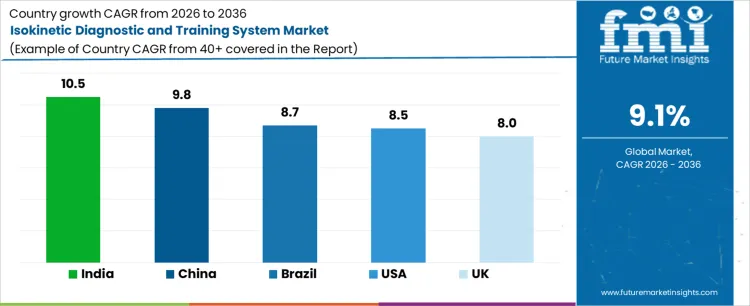
What is the Demand for Isokinetic Diagnostic and Training Systems by Country?
| Country | CAGR (%) |
|---|---|
| USA | 8.5% |
| UK | 8.0% |
| China | 9.8% |
| India | 10.5% |
| Brazil | 8.7% |
Demand for isokinetic diagnostic and training systems is rising as healthcare providers, sports facilities, and rehabilitation centers adopt advanced equipment for muscle assessment, injury prevention, and rehabilitation training. India leads with a 10.5% CAGR, driven by growing physiotherapy and sports medicine services, rising awareness of injury prevention, and adoption of advanced diagnostic equipment. China follows at 9.8%, supported by expansion of rehabilitation centers and sports medicine facilities. Brazil records 8.7% growth, shaped by adoption in clinical and athletic training settings. The USA grows at 8.5%, influenced by replacement demand and integration in healthcare and sports rehabilitation programs. The UK shows 8.0% CAGR, reflecting steady adoption in clinical and professional training facilities.
What is shaping adoption of Isokinetic Diagnostic and Training System equipment in the United States?
United States is recording a CAGR of 8.5%, with demand led by sports medicine centers, orthopedic hospitals, and rehabilitation networks using isokinetic diagnostic and training system equipment. Utilization focuses on post-surgery recovery programs, injury assessment, and strength balance evaluation across professional and collegiate sports. Procurement decisions emphasize measurement repeatability, calibration stability, and software reporting capability. Hospital groups integrate these systems into physical therapy departments and performance clinics. Research institutions use them for controlled biomechanics studies and long term outcome tracking. Service contracts and upgrade paths influence supplier selection. Equipment placement concentrates in large urban medical centers and specialized sports facilities. Budget planning follows multi-year equipment refresh cycles. Patient throughput targets and therapist workflow design shape room level deployment choices. Adoption progresses through departmental expansion rather than full facility replacement programs.
Which forces are guiding Isokinetic Diagnostic and Training System usage in the United Kingdom?
United Kingdom is recording a CAGR of 8%, with usage centered on orthopedic clinics, sports rehabilitation providers, and teaching hospitals deploying isokinetic diagnostic and training system platforms. Clinical teams rely on these systems for controlled strength testing, joint performance analysis, and structured recovery programs. Equipment evaluation focuses on accuracy, reporting clarity, and compatibility with electronic patient record systems. University hospitals use these systems for training and clinical research programs. Private clinics adopt them to support specialized injury recovery services. Procurement reviews include service coverage, training support, and long term maintenance planning. Installation activity concentrates in metropolitan medical hubs and sports performance centers. Capital budgets favor predictable utilization and documented clinical value. Expansion follows growth in rehabilitation service lines and professional sports medicine programs across healthcare networks.
How are industrial scale healthcare programs in China increasing use of Isokinetic Diagnostic and Training System platforms?
China is recording a CAGR of 9.8%, supported by hospital expansion programs and sports medicine development projects using isokinetic diagnostic and training system equipment. Large medical centers integrate these systems into rehabilitation departments and orthopedic specialty units. Usage focuses on post trauma recovery, surgical follow up evaluation, and performance assessment for athletes. Domestic equipment suppliers expand manufacturing, software localization, and service coverage. Clinical staff training programs accompany most installations. Procurement teams emphasize throughput capacity, measurement stability, and long duty cycle reliability. Deployment remains concentrated in tier one and tier two city hospitals. Research institutes use these systems for biomechanics studies and therapy protocol development. Budget allocation follows hospital modernization plans and regional healthcare investment programs. Adoption grows through department level additions rather than uniform rollout across entire hospital groups.
What is supporting faster installation of Isokinetic Diagnostic and Training System solutions in India?
India is recording a CAGR of 10.5%, with demand rising across orthopedic hospitals, sports injury clinics, and rehabilitation centers using isokinetic diagnostic and training system equipment. Expansion of organized sports medicine and physical therapy networks supports equipment adoption. Clinics use these systems for strength testing, recovery monitoring, and functional assessment programs. Procurement priorities include operating simplicity, maintenance access, and local service support. Import systems serve premium hospital chains and sports institutes. Domestic distributors focus on training, installation, and after sales support. Usage spreads across metropolitan healthcare clusters and emerging medical hubs. Investment decisions link to expansion of rehabilitation departments and sports performance programs. Patient awareness of structured recovery protocols supports utilization growth. Equipment deployment follows phased clinic expansion plans rather than single stage large scale purchases.
Which factors influence deployment of Isokinetic Diagnostic and Training System equipment across Brazil?
Brazil is recording a CAGR of 8.7%, with demand coming from private hospitals, rehabilitation clinics, and sports performance centers using isokinetic diagnostic and training system platforms. Utilization focuses on orthopedic recovery, injury evaluation, and long term mobility programs. Equipment choice emphasizes durability, calibration stability, and manageable service requirements. Import dependence shapes pricing and delivery schedules. Local service partners handle installation, training, and routine maintenance. Usage concentrates in large urban medical centers and private sports clinics. Research use remains limited to selected academic hospitals. Procurement planning aligns with expansion of rehabilitation service lines and private healthcare investment cycles. Budget holders prefer systems with clear utilization visibility and predictable operating cost. Adoption advances through clinic level upgrades rather than network wide equipment replacement programs.
How Are Providers Advancing the Isokinetic Diagnostic and Training System Market?

Suppliers in the isokinetic diagnostic and training system market differentiate through precision measurement, usability, and integration with rehabilitation protocols. Biodex Medical Systems offers systems engineered for accurate muscle strength and endurance assessment, with software that tracks progress over repeat sessions. Cybex, now part of HUR USA, provides equipment that combines adjustable resistance profiles with ergonomic designs suited for athletic training and clinical evaluation. HUMAC®/Norm™ from Computer Sports Medicine Inc. supplies platforms that emphasize comprehensive range-of-motion analysis and customizable testing protocols for clinicians and researchers. HUR USA delivers systems that integrate pneumatic resistance with digital control, supporting gradual load adjustments and objective performance data across rehabilitation and performance settings. Other regional and niche suppliers contribute solutions for specific therapeutic populations or compact footprint needs where space or budget constraints are critical.
Material performance and software support shape supplier positioning in this segment. Biodex Medical Systems focuses on validated protocols and robust data export for clinical documentation. Cybex/HUR systems prioritize intuitive interfaces and modular add-ons that support multi-joint assessment. HUMAC®/Norm™ enhances diagnostics with integrated analytics that inform targeted training prescriptions. HUR USA emphasizes pneumatic resistance that accommodates smooth load transitions and reduces impact on joints. Competitive differentiation arises from measurement accuracy, user interface clarity, software analytics, and capacity to integrate with broader rehabilitation or athletic performance workflows. Adoption reflects demand from physical therapy clinics, sports medicine facilities, and research institutions seeking objective, repeatable assessment tools that inform treatment decisions and track functional improvements over time.
Key Players in the Isokinetic Diagnostic and Training System Market
- Biodex Medical Systems
- Cybex (part of HUR USA)
- HUMAC®/Norm™ (Computer Sports Medicine Inc.)
- HUR USA
Scope of the Report
| Items | Values |
|---|---|
| Quantitative Units (2026) | USD million |
| Product Type | Isokinetic strength testing systems, Isokinetic rehabilitation and training systems, Portable isokinetic devices, Integrated isokinetic-EMG diagnostic platforms |
| End-User | Hospitals and rehabilitation centers, Sports medicine clinics, Physical therapy practices, Research and academic institutions |
| Region | Asia Pacific, Europe, North America, Latin America, Middle East & Africa |
| Countries Covered | China, Japan, South Korea, India, Australia & New Zealand, ASEAN, Germany, United Kingdom, France, Italy, Spain, Nordic, BENELUX, United States, Canada, Mexico, Brazil, Chile, Saudi Arabia, Turkey, South Africa, and other regional markets |
| Key Companies Profiled | Biodex Medical Systems, Cybex (part of HUR USA), HUMAC®/Norm™ (Computer Sports Medicine Inc.), HUR USA |
| Additional Attributes | Dollar by sales by product type and end-user; demand led by hospitals and strength testing systems; adoption driven by outcomes-based rehabilitation, standardized assessment protocols, and institutional reporting needs; growth supported by multi-joint, software-integrated platforms and higher system specification; purchasing shaped by measurement accuracy, reproducibility, workflow integration, and long-term service support. |
Isokinetic Diagnostic and Training System Market Segmentation
Product Type:
- Isokinetic strength testing systems
- Isokinetic rehabilitation and training systems
- Portable isokinetic devices
- Integrated isokinetic-EMG diagnostic platforms
End-User:
- Hospitals and rehabilitation centers
- Sports medicine clinics
- Physical therapy practices
- Research and academic institutions
Region:
- Asia Pacific
- China
- Japan
- South Korea
- India
- Australia & New Zealand
- ASEAN
- Rest of Asia Pacific
- Europe
- Germany
- United Kingdom
- France
- Italy
- Spain
- Nordic
- BENELUX
- Rest of Europe
- North America
- United States
- Canada
- Mexico
- Latin America
- Brazil
- Chile
- Rest of Latin America
- Middle East & Africa
- Kingdom of Saudi Arabia
- Other GCC Countries
- Turkey
- South Africa
- Other African Union
- Rest of Middle East & Africa
Bibliography
- International Organization for Standardization. (2024). ISO 9001:2024 Quality management systems – Requirements. ISO.
- American College of Sports Medicine. (2024). ACSM's guidelines for exercise testing and prescription. Wolters Kluwer.
- National Institutes of Health. (2024). Guidelines for safe and effective strength testing in rehabilitation. U.S. Department of Health and Human Services.
Frequently Asked Questions
How big is the isokinetic diagnostic and training system market in 2026?
The global isokinetic diagnostic and training system market is estimated to be valued at USD 550.0 million in 2026.
What will be the size of isokinetic diagnostic and training system market in 2036?
The market size for the isokinetic diagnostic and training system market is projected to reach USD 1,314.0 million by 2036.
How much will be the isokinetic diagnostic and training system market growth between 2026 and 2036?
The isokinetic diagnostic and training system market is expected to grow at a 9.1% CAGR between 2026 and 2036.
What are the key product types in the isokinetic diagnostic and training system market?
The key product types in isokinetic diagnostic and training system market are isokinetic strength testing systems , isokinetic rehabilitation and training systems, portable isokinetic devices and integrated isokinetic‑emg diagnostic platforms.
Which end‑user segment to contribute significant share in the isokinetic diagnostic and training system market in 2026?
In terms of end‑user, hospitals and rehabilitation centers segment to command 47.0% share in the isokinetic diagnostic and training system market in 2026.
Preview the report firsthand - request a free sample
Get SampleGet the brochure for pricing and purchase details.
Get PDFTable of Content
- Executive Summary
- Global Market Outlook
- Demand-side Trends
- Supply-side Trends
- Technology Roadmap Analysis
- Analysis and Recommendations
- Market Overview
- Market Coverage / Taxonomy
- Market Definition / Scope / Limitations
- Market Background
- Market Dynamics
- Drivers
- Restraints
- Opportunity
- Trends
- Scenario Forecast
- Demand in Optimistic Scenario
- Demand in Likely Scenario
- Demand in Conservative Scenario
- Opportunity Map Analysis
- Product Life Cycle Analysis
- Supply Chain Analysis
- Investment Feasibility Matrix
- Value Chain Analysis
- PESTLE and Porter’s Analysis
- Regulatory Landscape
- Regional Parent Market Outlook
- Production and Consumption Statistics
- Import and Export Statistics
- Market Dynamics
- Global Market Analysis 2021 to 2025 and Forecast, 2026 to 2036
- Historical Market Size Value (USD Million) Analysis, 2021 to 2025
- Current and Future Market Size Value (USD Million) Projections, 2026 to 2036
- Y-o-Y Growth Trend Analysis
- Absolute $ Opportunity Analysis
- Global Market Pricing Analysis 2021 to 2025 and Forecast 2026 to 2036
- Global Market Analysis 2021 to 2025 and Forecast 2026 to 2036, By Product Type
- Introduction / Key Findings
- Historical Market Size Value (USD Million) Analysis By Product Type , 2021 to 2025
- Current and Future Market Size Value (USD Million) Analysis and Forecast By Product Type , 2026 to 2036
- Isokinetic strength testing systems
- Isokinetic rehabilitation and training systems
- Portable isokinetic devices
- Integrated isokinetic‑EMG diagnostic platforms
- Isokinetic strength testing systems
- Y-o-Y Growth Trend Analysis By Product Type , 2021 to 2025
- Absolute $ Opportunity Analysis By Product Type , 2026 to 2036
- Global Market Analysis 2021 to 2025 and Forecast 2026 to 2036, By End‑User
- Introduction / Key Findings
- Historical Market Size Value (USD Million) Analysis By End‑User, 2021 to 2025
- Current and Future Market Size Value (USD Million) Analysis and Forecast By End‑User, 2026 to 2036
- Hospitals and rehabilitation centers
- Sports medicine clinics
- Physical therapy practices
- Research and academic institutions
- Hospitals and rehabilitation centers
- Y-o-Y Growth Trend Analysis By End‑User, 2021 to 2025
- Absolute $ Opportunity Analysis By End‑User, 2026 to 2036
- Global Market Analysis 2021 to 2025 and Forecast 2026 to 2036, By Region
- Introduction
- Historical Market Size Value (USD Million) Analysis By Region, 2021 to 2025
- Current Market Size Value (USD Million) Analysis and Forecast By Region, 2026 to 2036
- North America
- Latin America
- Western Europe
- Eastern Europe
- East Asia
- South Asia and Pacific
- Middle East & Africa
- Market Attractiveness Analysis By Region
- North America Market Analysis 2021 to 2025 and Forecast 2026 to 2036, By Country
- Historical Market Size Value (USD Million) Trend Analysis By Market Taxonomy, 2021 to 2025
- Market Size Value (USD Million) Forecast By Market Taxonomy, 2026 to 2036
- By Country
- USA
- Canada
- Mexico
- By Product Type
- By End‑User
- By Country
- Market Attractiveness Analysis
- By Country
- By Product Type
- By End‑User
- Key Takeaways
- Latin America Market Analysis 2021 to 2025 and Forecast 2026 to 2036, By Country
- Historical Market Size Value (USD Million) Trend Analysis By Market Taxonomy, 2021 to 2025
- Market Size Value (USD Million) Forecast By Market Taxonomy, 2026 to 2036
- By Country
- Brazil
- Chile
- Rest of Latin America
- By Product Type
- By End‑User
- By Country
- Market Attractiveness Analysis
- By Country
- By Product Type
- By End‑User
- Key Takeaways
- Western Europe Market Analysis 2021 to 2025 and Forecast 2026 to 2036, By Country
- Historical Market Size Value (USD Million) Trend Analysis By Market Taxonomy, 2021 to 2025
- Market Size Value (USD Million) Forecast By Market Taxonomy, 2026 to 2036
- By Country
- Germany
- UK
- Italy
- Spain
- France
- Nordic
- BENELUX
- Rest of Western Europe
- By Product Type
- By End‑User
- By Country
- Market Attractiveness Analysis
- By Country
- By Product Type
- By End‑User
- Key Takeaways
- Eastern Europe Market Analysis 2021 to 2025 and Forecast 2026 to 2036, By Country
- Historical Market Size Value (USD Million) Trend Analysis By Market Taxonomy, 2021 to 2025
- Market Size Value (USD Million) Forecast By Market Taxonomy, 2026 to 2036
- By Country
- Russia
- Poland
- Hungary
- Balkan & Baltic
- Rest of Eastern Europe
- By Product Type
- By End‑User
- By Country
- Market Attractiveness Analysis
- By Country
- By Product Type
- By End‑User
- Key Takeaways
- East Asia Market Analysis 2021 to 2025 and Forecast 2026 to 2036, By Country
- Historical Market Size Value (USD Million) Trend Analysis By Market Taxonomy, 2021 to 2025
- Market Size Value (USD Million) Forecast By Market Taxonomy, 2026 to 2036
- By Country
- China
- Japan
- South Korea
- By Product Type
- By End‑User
- By Country
- Market Attractiveness Analysis
- By Country
- By Product Type
- By End‑User
- Key Takeaways
- South Asia and Pacific Market Analysis 2021 to 2025 and Forecast 2026 to 2036, By Country
- Historical Market Size Value (USD Million) Trend Analysis By Market Taxonomy, 2021 to 2025
- Market Size Value (USD Million) Forecast By Market Taxonomy, 2026 to 2036
- By Country
- India
- ASEAN
- Australia & New Zealand
- Rest of South Asia and Pacific
- By Product Type
- By End‑User
- By Country
- Market Attractiveness Analysis
- By Country
- By Product Type
- By End‑User
- Key Takeaways
- Middle East & Africa Market Analysis 2021 to 2025 and Forecast 2026 to 2036, By Country
- Historical Market Size Value (USD Million) Trend Analysis By Market Taxonomy, 2021 to 2025
- Market Size Value (USD Million) Forecast By Market Taxonomy, 2026 to 2036
- By Country
- Kingdom of Saudi Arabia
- Other GCC Countries
- Turkiye
- South Africa
- Other African Union
- Rest of Middle East & Africa
- By Product Type
- By End‑User
- By Country
- Market Attractiveness Analysis
- By Country
- By Product Type
- By End‑User
- Key Takeaways
- Key Countries Market Analysis
- USA
- Pricing Analysis
- Market Share Analysis, 2025
- By Product Type
- By End‑User
- Canada
- Pricing Analysis
- Market Share Analysis, 2025
- By Product Type
- By End‑User
- Mexico
- Pricing Analysis
- Market Share Analysis, 2025
- By Product Type
- By End‑User
- Brazil
- Pricing Analysis
- Market Share Analysis, 2025
- By Product Type
- By End‑User
- Chile
- Pricing Analysis
- Market Share Analysis, 2025
- By Product Type
- By End‑User
- Germany
- Pricing Analysis
- Market Share Analysis, 2025
- By Product Type
- By End‑User
- UK
- Pricing Analysis
- Market Share Analysis, 2025
- By Product Type
- By End‑User
- Italy
- Pricing Analysis
- Market Share Analysis, 2025
- By Product Type
- By End‑User
- Spain
- Pricing Analysis
- Market Share Analysis, 2025
- By Product Type
- By End‑User
- France
- Pricing Analysis
- Market Share Analysis, 2025
- By Product Type
- By End‑User
- India
- Pricing Analysis
- Market Share Analysis, 2025
- By Product Type
- By End‑User
- ASEAN
- Pricing Analysis
- Market Share Analysis, 2025
- By Product Type
- By End‑User
- Australia & New Zealand
- Pricing Analysis
- Market Share Analysis, 2025
- By Product Type
- By End‑User
- China
- Pricing Analysis
- Market Share Analysis, 2025
- By Product Type
- By End‑User
- Japan
- Pricing Analysis
- Market Share Analysis, 2025
- By Product Type
- By End‑User
- South Korea
- Pricing Analysis
- Market Share Analysis, 2025
- By Product Type
- By End‑User
- Russia
- Pricing Analysis
- Market Share Analysis, 2025
- By Product Type
- By End‑User
- Poland
- Pricing Analysis
- Market Share Analysis, 2025
- By Product Type
- By End‑User
- Hungary
- Pricing Analysis
- Market Share Analysis, 2025
- By Product Type
- By End‑User
- Kingdom of Saudi Arabia
- Pricing Analysis
- Market Share Analysis, 2025
- By Product Type
- By End‑User
- Turkiye
- Pricing Analysis
- Market Share Analysis, 2025
- By Product Type
- By End‑User
- South Africa
- Pricing Analysis
- Market Share Analysis, 2025
- By Product Type
- By End‑User
- USA
- Market Structure Analysis
- Competition Dashboard
- Competition Benchmarking
- Market Share Analysis of Top Players
- By Regional
- By Product Type
- By End‑User
- Competition Analysis
- Competition Deep Dive
- Biodex Medical Systems
- Overview
- Product Portfolio
- Profitability by Market Segments (Product/Age /Sales Channel/Region)
- Sales Footprint
- Strategy Overview
- Marketing Strategy
- Product Strategy
- Channel Strategy
- Cybex (part of HUR USA)
- HUMAC®/Norm™ (Computer Sports Medicine Inc.)
- HUR USA
- Biodex Medical Systems
- Competition Deep Dive
- Assumptions & Acronyms Used
- Research Methodology


