

- Industry Size (2025)
- USD 418.2 Mn
- Forecast (2035)
- USD 687.7 Mn
- CAGR (2025 to 2035)
- 5.1%
Demand for 2D Bar Code Marketing in Japan Forecast and Outlook 2025 to 2035
Demand for 2D bar code marketing in Japan is valued at USD 418.2 million in 2025 and is projected to reach USD 687.7 million by 2035, reflecting a CAGR of 5.1%. The progression from USD 326.1 million in 2020 to USD 418.2 million in 2025 reflects the steady integration of scannable codes into retail and promotional workflows. Quick response codes account for the dominant share of the technology market due to broad smartphone compatibility and low deployment costs. Retailing accounts for the largest application base, as product labeling, promotions, and payment access continue to rely on rapid-scan engagement. Advertising and logistics contribute stable secondary volumes tied to campaign tracking and shipment identification. Early phase demand reflects operational standardization across packaging, displays, and transaction points rather than experimental digital outreach formats.
From 2026 onward, demand expands from USD 439.5 million to USD 563.6 million by 2031, then rises to USD 687.7 million by 2035 through consistent annual gains. Advertising use grows as campaign attribution shifts further toward scan based response tracking. Logistics adoption expands with wider use of DataMatrix and PDF417 codes for parcel identification and warehouse routing. Entertainment and healthcare maintain moderate volumes linked to ticketing, patient identification, and access control. Government use remains limited to public service access and document tagging. After 2030, value growth reflects higher scan density per campaign rather than rapid expansion in user base. Annual value movement remains controlled, indicating low volatility. The long range pattern reflects continued reliance on standardized two dimensional coding across commerce, public services, and media distribution in Japan.
Quick Stats of the Demand for 2D Bar Code Marketing in Japan:
- Demand for 2D Bar Code Marketing in Japan Value (2025): USD 418.2 million
- Demand for 2D Bar Code Marketing in Japan Forecast Value (2035): USD 687.7 million
- Demand for 2D Bar Code Marketing in Japan Forecast CAGR (2025-2035): 5.1%
- Demand for 2D Bar Code Marketing in Japan Leading Technology: Quick Response (QR) Code (85%)
- Demand for 2D Bar Code Marketing in Japan Key Growth Regions: Kyushu & Okinawa, Kanto, Kansai
- Demand for 2D Bar Code Marketing in Japan Top Players: Akamai Technologies, Zebra Technologies, Honeywell International, Denso Wave Inc., Avery Dennison
-
What is the Growth Forecast for 2D Bar Code Marketing in Japan through 2035?
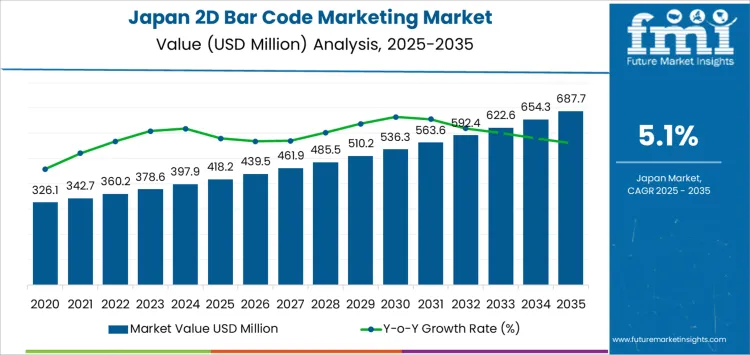
Between 2025 and 2030, demand for 2D bar code marketing in Japan rises from USD 418.2 million to USD 536.3 million, creating an absolute expansion of USD 118.1 million over five years. Average annual value addition during this phase remains close to USD 23.6 million. Growth is supported by rising use of QR based promotions in convenience retail, packaged food, event ticketing, and transit advertising. Brand campaigns increasingly rely on scan based engagement for coupon delivery and traffic redirection. Earlier adoption centered on basic payment linkage. Near term growth reflects higher campaign tracking needs, stronger mobile content integration, and steady usage across mass consumer touchpoints.
From 2030 to 2035, demand increases from USD 536.3 million to USD 687.7 million, adding USD 151.4 million across the latter phase of the forecast period. Average yearly value creation moves closer to USD 30.3 million, indicating faster commercial scaling than the earlier phase. Expansion is driven by deeper use in loyalty platforms, connected packaging, location based promotions, and entertainment marketing. Integration with retail data systems strengthens campaign monetization. Earlier growth depended on consumer scanning behavior, while later expansion reflects structured marketing automation, higher retailer participation, and stable advertiser budgets tied to measurable mobile engagement performance.
2D Bar Code Marketing Industry in Japan Key Takeaways
| Metric | Value |
|---|---|
| Industry Value (2025) | USD 418.2 million |
| Forecast Value (2035) | USD 687.7 million |
| Forecast CAGR (2025 to 2035) | 5.1% |
What Is Driving the Demand for 2D Bar Code Marketing in Japan Across Historical and Future Growth Cycles?
Demand for 2D bar code marketing in Japan developed from early domestic creation of QR code standards and fast adoption in mobile phones, transport systems, and retail transactions. Retailers used printed codes on posters, packaging, and receipts to link physical promotions with mobile content. Rail operators adopted codes for ticketing and access control, which normalized scanning behavior among consumers. Historical growth relied on smartphone penetration, compact advertising formats, and low deployment cost for printed codes. Marketing use focused on store traffic generation, coupon access, and product information delivery. Adoption remained broad across large chains and small merchants due to minimal infrastructure requirements. Growth followed consumer comfort with mobile scanning rather than structured digital marketing strategy within early deployment phases.
Future demand for 2D bar code marketing in Japan is expected to rely on integration with cashless payments, loyalty platforms, and retail data systems. Retailers seek tighter linkage between physical store behavior and digital customer profiling. Dynamic code use supports real time content updates, authentication, and transaction tracking. Historical growth relied on simple redirection and static campaigns. Future growth centers on backend data integration, fraud control, and transaction linked marketing. Transport hubs, vending networks, and automated retail formats expand use cases. Regulatory oversight of consumer data handling influences platform design. Demand growth will depend on merchant system upgrades, mobile wallet compatibility, and consumer trust in code based transactions across retail, transport, and service sectors nationwide.
What Is the Demand for 2D Bar Code Marketing in Japan by Technology and Code Type?
The demand for 2D bar code marketing in Japan is shaped by mobile centric consumer behavior, cashless payment infrastructure, and strong adoption of contactless engagement tools. Quick response based systems lead within marketing technology due to universal smartphone compatibility and instant access to brand content. QR code also leads by code type because it connects print media, packaging, and outdoor advertising with mobile platforms. Procurement is driven by retail brands, transit operators, event organizers, and digital advertising agencies. Import reliance remains present for campaign analytics engines and scanning software frameworks. Substitution pressure exists from near field communication in selected payments and access control use cases. Demand stability is supported by routine promotional usage across retail, tourism, and public services.
Why do quick response based systems account for 85% of the demand for 2D bar code marketing in Japan by technology?

Quick response based systems account for 85% of the demand for 2D bar code marketing in Japan by technology, reflecting their dominant role in mobile driven consumer interaction. Consumption intensity is driven by product packaging campaigns, transit based promotions, restaurant menus, and digital coupon distribution. Usage remains stable because QR scanning is embedded within native smartphone camera functions. Procurement is led by large retailers, fast food chains, beverage brands, and regional tourism boards. Price sensitivity remains moderate because code generation and deployment remain low cost at scale. Specification control emphasizes scan speed, error correction capacity, cross device compatibility, and integration with customer data platforms.
Quick response systems also generate steady repeat demand through short cycle marketing campaigns and seasonal promotional rotations. Repeat utilization remains predictable due to frequent campaign refresh needs. Buyers favor platforms that provide real time scan analytics and geolocation tracking. Margin structure remains controlled under high competition among marketing technology vendors. Regulatory exposure centers on consumer data consent and campaign tracking transparency. Import reliance persists for cloud based campaign management tools. Substitution pressure from proprietary app based engagement remains present in large retailer ecosystems.
Why does QR code represent 55.0% of the demand for 2D bar code marketing in Japan by code type?
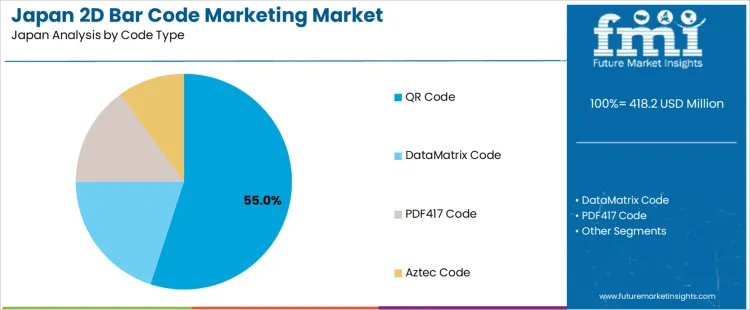
QR code represents 55.0% of the demand for 2D bar code marketing in Japan by code type, reflecting its role as the default format for consumer facing digital access. Consumption intensity is driven by payment links, loyalty registration, social media redirects, and digital ticketing. Usage remains stable because QR codes support both static and dynamic campaign deployment. Procurement is dominated by retailers, payment service providers, entertainment venues, and public transport operators. Price sensitivity remains moderate because QR deployment carries minimal incremental cost compared with print media budgets. Specification control emphasizes code density accuracy, damage tolerance, and secure redirect validation.
QR code based marketing also generates consistent repeat demand through transaction based usage and repeated customer engagement. Repeat utilization remains predictable as codes are regenerated for product batches, event tickets, and promotional offers. Buyers favor QR formats due to ease of consumer education and low scanning friction. Margin structure remains controlled under bundled digital marketing service contracts. Regulatory exposure centers on consumer privacy protection and redirection security compliance. Import reliance persists for backend data routing tools and mobile analytics engines. Substitution pressure from DataMatrix and Aztec remains limited to logistics and transport ticketing rather than consumer marketing.
What Is Driving the Demand for 2D Bar Code Marketing in Japan Offline to Online Consumer Access?
Demand for 2D bar code marketing in Japan is shaped by smartphone ubiquity, cashless payment behavior, and compact urban advertising spaces. QR style codes connect physical posters, packaging, tickets, and screens to mobile content within seconds. Retailers use them for coupons, membership points, and product traceability. Transport operators link codes to timetables and service updates. Entertainment venues trigger content access through scans at entry points. Users expect instant page loading and clean interface design. Demand grows through offline to online linkage within daily routines rather than through long form digital advertising campaigns alone across varied consumer touchpoints nationwide today networks.
How Are Retail Chains and Product Packaging Structuring 2D Bar Code Use in Japan?
Japan retail chains place 2D codes on shelf labels, receipts, and packaging to extend in store engagement beyond checkout. Shoppers scan codes to access ingredient details, allergy guidance, and usage videos while standing in narrow aisles. Loyalty programs reward repeat scans with point accumulation that replaces paper stamps. Limited space storefronts use window codes to operate after closing hours. Beverage brands link codes to campaign games tied to seasonal promotions. This retail driven usage creates high frequency scanning behavior aligned with daily shopping rather than with rare advertising exposure during larger brand events across urban neighborhoods and commuter corridors nationwide.
How Are Transport, Tourism, and Public Information Systems Using 2D Bar Codes in Japan?
Japan rail operators, municipalities, and tourism boards rely on 2D bar codes to deliver location specific digital guidance at scale. Station signage links to multi language maps and transfer tools through scan access. Temples, museums, and regional attractions replace printed brochures with mobile content delivery. Disaster readiness messaging uses codes to distribute evacuation routes and shelter data quickly. Event organizers issue ticket verification through secure code validation at entry points. This public sector deployment embeds scanning into everyday mobility and cultural activity. Demand flows from information distribution efficiency and multilingual access rather than from commercial advertising reach alone within Japan.
What Factors Limit the Expansion of 2D Bar Code Marketing Use in Japan?
2D bar code marketing in Japan faces limits linked to scan fatigue, fraudulent code risk, and uneven senior adoption. Consumers ignore codes that open slow pages or demand repeated registration. Spoofed stickers raise concern around phishing and payment diversion near vending machines and parking kiosks. Elderly users prefer physical instructions over mobile navigation in some retail settings. Brands struggle to measure true engagement when shared scans blur conversion attribution. Visual saturation also reduces attention in crowded streets. These factors restrain uncontrolled expansion despite everyday visibility. Adoption remains strongest where value delivery stays immediate, simple, and trusted within daily consumer journeys.
What is the Demand for 2D Bar Code Marketing in Japan by Region?
| Region | CAGR (%) |
|---|---|
| Kyushu & Okinawa | 6.4% |
| Kanto | 5.9% |
| Kansai | 5.2% |
| Chubu | 4.5% |
| Tohoku | 4.0% |
| Rest of Japan | 3.8% |
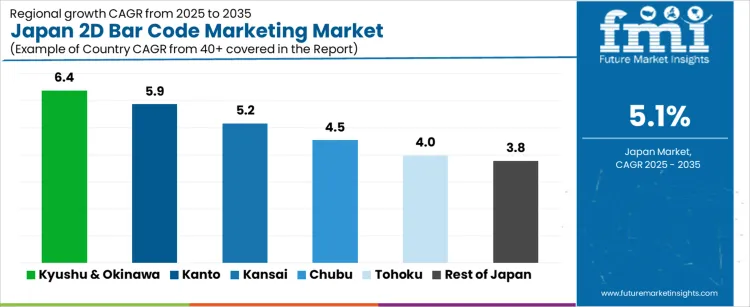
The demand for 2D bar code marketing in Japan is expanding steadily across retail, logistics, and consumer engagement platforms, led by Kyushu and Okinawa at a 6.4% CAGR. Growth in this region is supported by strong tourism driven promotions, mobile based coupon adoption, and widespread use of QR-linked foodservice menus and retail campaigns. Kanto follows at 5.9%, driven by dense urban retail networks, advanced digital advertising penetration, and frequent use in cashless payments and loyalty programs. Kansai records 5.2% growth, reflecting stable uptake across shopping arcades, transit advertising, and packaged consumer goods promotions. Chubu at 4.5% shows moderate adoption linked to regional retail chains and manufacturing led traceability efforts. Tohoku and the Rest of Japan, at 4.0% and 3.8%, reflect slower growth shaped by lower digital campaign intensity and more traditional retail engagement models.
How Is Tourism Led Mobile Engagement Lifting 2D Bar Code Marketing Use in Kyushu and Okinawa?
Demand for 2D bar code marketing in Kyushu and Okinawa is advancing at a CAGR of 6.4% through 2035, supported by high visitor activity, mobile first retail engagement, and digital coupon distribution across hospitality and transport locations. Restaurants, souvenir outlets, and tour operators rely on scan based menus, promotions, and payment access. Local governments also use QR based platforms for public communication and transit services. Growth reflects strong smartphone penetration, preference for contact based digital access, and rising use of mobile driven customer interaction tools in tourism dependent economies.
- Hospitality outlets rely on QR based menus and payments
- Tourist promotions apply scan driven discount access
- Public transport platforms support digital ticket interfaces
- Mobile first consumer behavior sustains engagement growth
Why Is Dense Consumer Marketing Infrastructure Driving 2D Bar Code Growth in Kanto?
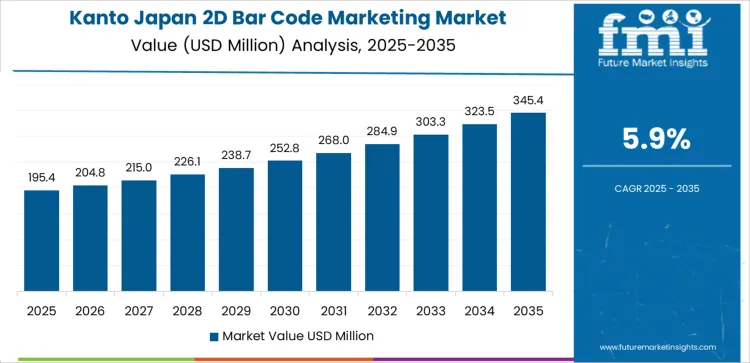
Demand for 2D bar code marketing in Kanto is rising at a CAGR of 5.9% through 2035, driven by high retail density, advanced digital advertising activity, and broad consumer exposure to mobile promotions. Retail chains, beverage brands, and entertainment venues embed QR codes in packaging, displays, and outdoor campaigns. E commerce integration linked to offline scanning also supports adoption. Growth reflects strong brand competition for mobile engagement, continuous campaign refresh activity, and heavy reliance on smartphone based content discovery across metropolitan consumers.
- Retail advertising integrates QR enabled promotional routing
- Brand packaging uses scan access to loyalty platforms
- E commerce links extend offline to online conversion
- High campaign renewal rate sustains steady deployment
What Is Supporting Structured 2D Bar Code Marketing Adoption Across Kansai?
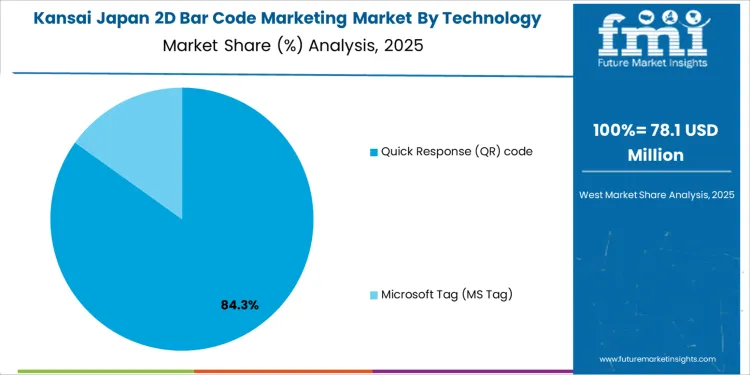
Demand for 2D bar code marketing in Kansai is progressing at a CAGR of 5.2% through 2035, supported by stable retail foot traffic, consistent use in food and beverage promotions, and steady application within event based marketing. Kansai businesses apply QR codes for digital menus, feedback collection, and limited time offers. Adoption remains balanced across independent retailers and chain outlets. Growth reflects stable consumer spending, strong culture of in store engagement, and steady digital marketing tool integration across urban shopping districts.
- Food and beverage outlets drive daily scanning activity
- Event promotions support temporary campaign usage
- Independent stores adopt low cost digital touchpoints
- Urban shopping zones sustain routine consumer interaction
How Is Manufacturing and Regional Retail Activity Shaping 2D Bar Code Demand in Chubu?
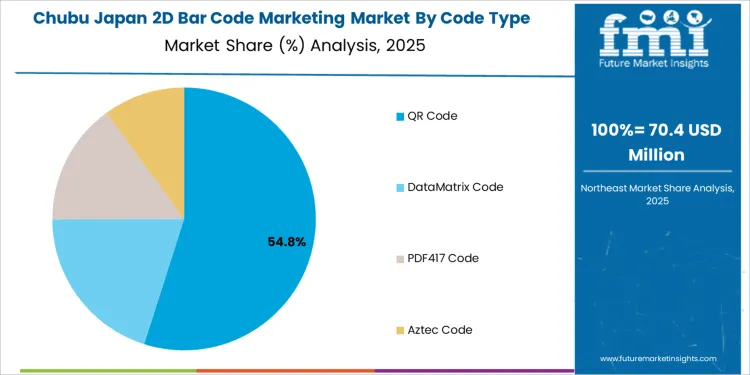
Demand for 2D bar code marketing in Chubu is advancing at a CAGR of 4.5% through 2035, supported by factory linked retail outlets, regional shopping centers, and steady application in product traceability communication. Automotive supplier stores and appliance retailers apply QR codes for product information access and warranty registration. Consumer interaction remains functional rather than promotional. Growth reflects controlled retail digitization, emphasis on product information transparency, and steady adoption of scan based service access across regional commercial environments.
- Product warranty access drives QR code application
- Appliance retail uses scan based specification delivery
- Factory retail outlets support functional engagement
- Regional mall traffic shapes steady usage patterns
Why Is Public Service Digitization Supporting 2D Bar Code Marketing Growth in Tohoku?
Demand for 2D bar code marketing in Tohoku is advancing at a CAGR of 4.0% through 2035, supported by public service digitization, healthcare appointment access, and retail point of service communication. Municipal offices use QR codes for notices, service access, and disaster communication. Retail adoption remains focused on basic promotions and digital receipts. Growth reflects stable public sector adoption, essential service digitization, and gradual consumer shift toward mobile based information access across regional communities.
- Municipal services rely on QR access for citizen interaction
- Healthcare facilities support appointment routing via scans
- Digital receipts drive basic retail integration
- Public adoption increases through service driven exposure
How Is Small Town Retail Modernization Guiding 2D Bar Code Marketing in Rest of Japan?
Demand for 2D bar code marketing in Rest of Japan is advancing at a CAGR of 3.8% through 2035, supported by small store digitization, basic cashless transaction support, and gradual use in local promotions. Independent retailers use QR codes for payment access, limited product information, and community event promotion. Advanced campaign analytics remain limited. Growth remains steady and guided by local broadband expansion, mobile wallet adoption, and low cost digital marketing tools suited for small business operations.
- Independent stores apply QR codes for payment routing
- Community events use scans for promotion access
- Low cost tools drive small business participation
- Mobile wallet use supports basic integration growth
What Is Driving the Demand for 2D Bar Code Marketing in Japan and Which Companies Shape Brand and Retail Adoption
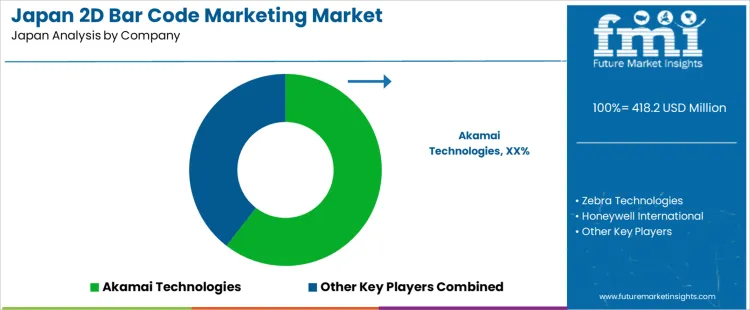
The demand for 2D bar code marketing in Japan is shaped by near universal smartphone usage, strong QR code payment culture, and brand focus on linking offline packaging with digital engagement. Denso Wave holds a central domestic position as the originator of QR code technology and continues to guide standardization, licensing, and industrial adoption across retail and logistics. Avery Dennison supports demand through label materials and smart packaging formats that integrate scannable codes into consumer goods, logistics, and apparel tags. Zebra Technologies anchors in store and warehouse deployment through scanners, mobile computers, and data capture infrastructure used by retailers and fulfillment operators. Honeywell International supports similar use through industrial scanning and automatic identification systems used across distribution and manufacturing.
Akamai Technologies participates through content delivery and security platforms that support high traffic landing pages triggered by QR code campaigns used in promotions and event marketing. Platform selection in Japan is governed by scan accuracy under low light, print contrast stability, mobile network speed, and security against code manipulation. Buyer preference favors suppliers that ensure high read rates, fast page loading, and reliable analytics tracking. Usage spans product authentication, menu access, loyalty programs, transit information, and social media integration. Demand visibility tracks cashless payment expansion, retailer shift toward contactless engagement, tourism recovery in urban shopping districts, and continued growth in data driven in store marketing across convenience stores and mass retail chains.
Key Players in the 2D Bar Code Marketing Industry in Japan
- Akamai Technologies
- Zebra Technologies
- Honeywell International
- Denso Wave Inc.
- Avery Dennison
Scope of the Report
| Items | Values |
|---|---|
| Quantitative Units (2025) | USD million |
| Type | Quick Response (QR) Code, Microsoft Tag (MS Tag) |
| Code Type | QR Code, DataMatrix Code, PDF417 Code, Aztec Code |
| Application | Retailing, Advertising, Logistics, Entertainment, Health Care, Government |
| End User | Retail Chains, Advertising Agencies, Logistics Operators, Entertainment Venues, Hospitals, Public Service Organizations |
| Regions Covered | Kyushu and Okinawa, Kanto, Kansai, Chubu, Tohoku, Rest of Japan |
| Countries Covered | Japan |
| Key Companies Profiled | Akamai Technologies, Zebra Technologies, Honeywell International, Denso Wave Inc., Avery Dennison |
| Additional Attributes | Dollar by sales across QR based promotions and logistics scanning, campaign level scan density versus user base growth, packaging led engagement intensity, payment linked QR usage expansion, backend analytics and security integration trends, retailer versus public sector deployment share, regional tourism driven usage concentration, and regulatory compliance related to consumer data protection and redirect security |
2D Bar Code Marketing Industry in Japan Segmentation
Technology:
- Quick Response (QR) code
- Microsoft Tag (MS Tag)
Code Type:
- QR Code
- DataMatrix Code
- PDF417 Code
- Aztec Code
Application:
- Retailing
- Advertising
- Logistics
- Entertainment
- Health care
- Government
Region
- Kyushu & Okinawa
- Kanto
- Kansai
- Chubu
- Tohoku
- Rest of Japan
Frequently Asked Questions
How big is the demand for 2D bar code marketing in Japan in 2025?
The demand for 2D bar code marketing in Japan is estimated to be valued at USD 418.2 million in 2025.
What will be the size of 2D bar code marketing in Japan in 2035?
The market size for the 2D bar code marketing in Japan is projected to reach USD 687.7 million by 2035.
How much will be the demand for 2D bar code marketing in Japan growth between 2025 and 2035?
The demand for 2D bar code marketing in Japan is expected to grow at a 5.1% CAGR between 2025 and 2035.
What are the key product types in the 2D bar code marketing in Japan?
The key product types in 2D bar code marketing in Japan are quick response (qr) code and microsoft tag (ms tag).
Which code type segment is expected to contribute significant share in the 2D bar code marketing in Japan in 2025?
In terms of code type, qr code segment is expected to command 55.0% share in the 2D bar code marketing in Japan in 2025.
Preview the report firsthand - request a free sample
Get SampleGet the brochure for pricing and purchase details.
Get PDFTable of Content
- Executive Summary
- Japan Market Outlook
- Demand-side Trends
- Supply-side Trends
- Technology Roadmap Analysis
- Analysis and Recommendations
- Market Overview
- Market Coverage / Taxonomy
- Market Definition / Scope / Limitations
- Market Background
- Market Dynamics
- Drivers
- Restraints
- Opportunity
- Trends
- Scenario Forecast
- Demand in Optimistic Scenario
- Demand in Likely Scenario
- Demand in Conservative Scenario
- Opportunity Map Analysis
- Product Life Cycle Analysis
- Supply Chain Analysis
- Investment Feasibility Matrix
- Value Chain Analysis
- PESTLE and Porter’s Analysis
- Regulatory Landscape
- Regional Parent Market Outlook
- Production and Consumption Statistics
- Import and Export Statistics
- Market Dynamics
- Japan Market Analysis 2020 to 2024 and Forecast, 2025 to 2035
- Historical Market Size Value (USD Million) Analysis, 2020 to 2024
- Current and Future Market Size Value (USD Million) Projections, 2025 to 2035
- Y-o-Y Growth Trend Analysis
- Absolute $ Opportunity Analysis
- Japan Market Pricing Analysis 2020 to 2024 and Forecast 2025 to 2035
- Japan Market Analysis 2020 to 2024 and Forecast 2025 to 2035, By Technology
- Introduction / Key Findings
- Historical Market Size Value (USD Million) Analysis By Technology , 2020 to 2024
- Current and Future Market Size Value (USD Million) Analysis and Forecast By Technology , 2025 to 2035
- Quick Response (QR) code
- Microsoft Tag (MS Tag)
- Y-o-Y Growth Trend Analysis By Technology , 2020 to 2024
- Absolute $ Opportunity Analysis By Technology , 2025 to 2035
- Japan Market Analysis 2020 to 2024 and Forecast 2025 to 2035, By Code Type
- Introduction / Key Findings
- Historical Market Size Value (USD Million) Analysis By Code Type, 2020 to 2024
- Current and Future Market Size Value (USD Million) Analysis and Forecast By Code Type, 2025 to 2035
- QR Code
- DataMatrix Code
- PDF417 Code
- Aztec Code
- Y-o-Y Growth Trend Analysis By Code Type, 2020 to 2024
- Absolute $ Opportunity Analysis By Code Type, 2025 to 2035
- Japan Market Analysis 2020 to 2024 and Forecast 2025 to 2035, By Application
- Introduction / Key Findings
- Historical Market Size Value (USD Million) Analysis By Application, 2020 to 2024
- Current and Future Market Size Value (USD Million) Analysis and Forecast By Application, 2025 to 2035
- Retailing
- Advertising
- Logistics
- Entertainment
- Health care
- Government
- Y-o-Y Growth Trend Analysis By Application, 2020 to 2024
- Absolute $ Opportunity Analysis By Application, 2025 to 2035
- Market Structure Analysis
- Competition Dashboard
- Competition Benchmarking
- Market Share Analysis of Top Players
- By Regional
- By Technology
- By Code Type
- By Application
- Competition Analysis
- Competition Deep Dive
- Akamai Technologies
- Overview
- Product Portfolio
- Profitability by Market Segments (Product/Age /Sales Channel/Region)
- Sales Footprint
- Strategy Overview
- Marketing Strategy
- Product Strategy
- Channel Strategy
- Zebra Technologies
- Honeywell International
- Denso Wave Inc.
- Avery Dennison
- Akamai Technologies
- Competition Deep Dive
- Assumptions & Acronyms Used
- Research Methodology


