

- Industry Size (2025)
- USD 492.9 Mn
- Forecast (2035)
- USD 1441.1 Mn
- CAGR (2025 to 2035)
- 11.3%
Demand for 3D TSV Packages in Japan Forecast and Outlook 2025 to 2035
The demand for 3D TSV (Through-Silicon Via) packages in Japan is expected to grow from USD 492.9 million in 2025 to USD 1,441.1 million by 2035, reflecting a compound annual growth rate (CAGR) of 11.3%. 3D TSV packages, widely used in semiconductor devices for advanced packaging applications, are gaining popularity for their ability to reduce space requirements and improve performance. The increasing demand for high-performance electronics, driven by the growth of the consumer electronics and telecommunications industries, is expected to drive market growth throughout the forecast period.
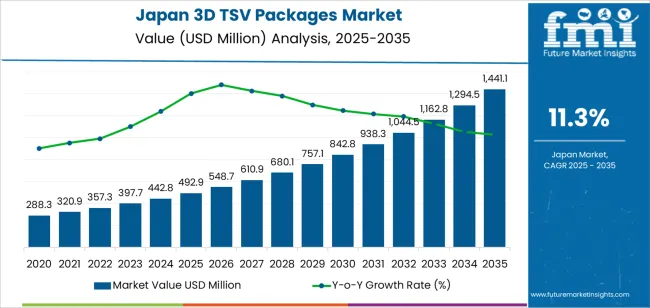
The market will experience substantial growth, starting at USD 492.9 million in 2025 and growing to USD 548.7 million in 2026. By 2027, the demand for 3D TSV packages will increase to USD 610.9 million, continuing its upward trajectory. By 2029, the market is projected to reach USD 757.1 million, with demand accelerating further to USD 1,441.1 million by 2035. This rapid growth is expected to be fueled by technological advancements, the expansion of 5G networks, and increasing adoption of advanced packaging solutions across various industries.
Quick Stats of the Demand for 3D TSV Packages in Japan
- Demand for 3D TSV Packages in Japan Value (2025): USD 492.9 million
- Demand for 3D TSV Packages in Japan Forecast Value (2035): USD 1,441.1 million
- Demand for 3D TSV Packages in Japan Forecast CAGR (2025-2035): 11.3%
- Demand for 3D TSV Packages in Japan Key Application: 47.0% Logic & Memory Devices
- Demand for 3D TSV Packages in Japan Key Growth Regions: Kyushu & Okinawa, Kanto, Kinki, Chubu, Tohoku, Rest of Japan
- Demand for 3D TSV Packages in Japan Key Players: TSMC, Intel Corporation, Samsung Electronics, ASE Group, Amkor Technology
What is the Growth Forecast for the 3D TSV Packages Industry in Japan through 2035?
The 3D TSV packages market in Japan is expected to experience significant growth through 2035. Starting at USD 492.9 million in 2025, the market will grow to USD 548.7 million in 2026, and USD 610.9 million in 2027. By 2029, demand for 3D TSV packages will rise to USD 757.1 million, continuing upward to USD 842.8 million by 2030. By 2035, the demand is forecasted to reach USD 1,441.1 million, reflecting a significant increase driven by advances in semiconductor technology and the growing need for high-density, energy-efficient packaging solutions.
The Year-on-Year (YoY) growth analysis shows strong and consistent demand for 3D TSV packages. The market will experience steady YoY growth, with an average increase in demand of around 10-12% annually. The highest YoY growth will be seen in the early and middle years of the forecast period, with demand continuing to accelerate as new technologies, such as 5G, IoT, and AI, drive the need for advanced semiconductor packaging. As a result, the market for 3D TSV packages will continue to expand at an impressive rate, with an overall increase of over USD 900 million by 2035.
Key Takeaways of 3D TSV Packages Industry in Japan
| Metric | Value |
|---|---|
| Industry Sales Value (2025) | USD 492.9 million |
| Industry Forecast Value (2035) | USD 1,441.1 million |
| Industry Forecast CAGR (2025-2035) | 11.3% |
Why is the Demand for 3D TSV Packages in Japan Growing?
The demand for 3D TSV (Through Silicon Via) packages in Japan is increasing as Japanese semiconductor and electronics firms shift toward high performance, high density integrated circuits. 3D TSV enables vertical stacking of multiple dies with short interconnections, which reduces signal delay, improves power efficiency and allows more compact chip form factors compared with traditional 2D packaging. This capability appeals strongly to Japan’s electronics industry, especially in applications such as high bandwidth memory, 5G devices, artificial intelligence accelerators and integrated sensors. As global demand for compact, power efficient, high performance electronics grows, Japanese manufacturers are adopting 3D packaging to remain competitive and meet performance standards.
Further momentum comes from increasing demand in automotive electronics, consumer devices, computing, and industrial electronics sectors. As vehicles become more electronics intensive, with advanced driver assistance systems, infotainment, EV power management and sensor suites, the requirement for more capable but compact semiconductor packages rises. In consumer electronics and computing, demand for devices with greater performance, lower power consumption and smaller size continues to climb.
The broader global trend toward heterogeneous integration, stacking logic, memory and sensors into a single package increases the attractiveness of 3D TSV. Japan’s established semiconductor ecosystem, manufacturing capabilities and technical know how support adoption of advanced packaging. As these factors converge, demand for 3D TSV packages in Japan is expected to grow steadily in coming years.
What Is the Current State of the Demand for 3D TSV Packages in Japan in Terms of Process Realization and Application?
The demand for 3D TSV (Through-Silicon Via) packages in Japan is driven by process realization and application. The leading process realization method is via middle, capturing 42% of the market share, while logic & memory devices is the dominant application, accounting for 47% of the demand. 3D TSV technology is increasingly used to improve the performance, miniaturization, and integration of semiconductor devices, particularly in sectors like electronics and telecommunications. As the need for higher-performance, compact, and efficient electronic components grows, the demand for 3D TSV packages continues to expand.
How Is via Middle Leading the Process Realization Demand for 3D TSV Packages in Japan?
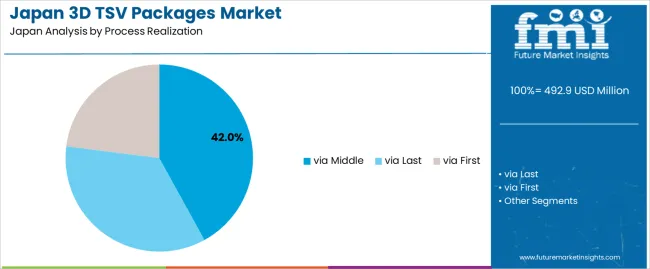
Via middle process realization leads the demand for 3D TSV packages in Japan, holding 42% of the market share. This method involves the creation of vias (vertical interconnects) through the middle of the silicon wafer, allowing for high-density interconnection and better thermal performance. The via middle technique is favored for its ability to offer efficient stacking and integration of multiple semiconductor layers, which is essential for improving the performance of devices such as logic processors and memory chips.
The demand for via middle 3D TSV packages is driven by the need for advanced packaging solutions that can provide higher performance, reduced form factor, and enhanced functionality. This process method allows for smaller, more efficient chips with improved power delivery and thermal management, which is crucial for applications in high-performance computing, mobile devices, and memory modules. As demand for more compact and efficient electronics rises, via middle technology is expected to continue leading the market in Japan, offering a critical solution for the semiconductor industry.
How Is Logic & Memory Devices Leading the Application Demand for 3D TSV Packages in Japan?
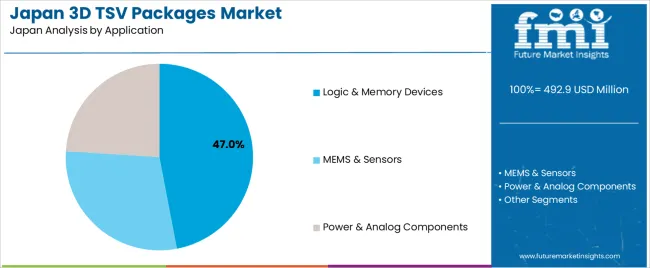
Logic & memory devices are the leading application for 3D TSV packages in Japan, accounting for 47% of the demand. Logic and memory devices, including processors, DRAM, and flash memory, require advanced packaging solutions like 3D TSV to meet the growing demand for higher data throughput, improved speed, and reduced power consumption. 3D TSV technology allows for the integration of multiple memory layers or logic chips, increasing the capacity and speed of data transfer while minimizing the space required for components.
The demand for 3D TSV packages in logic and memory devices is driven by the need for more powerful, compact, and energy-efficient electronics. As data processing demands increase, particularly in applications like cloud computing, AI, and mobile devices, the need for high-performance memory and logic components has surged. 3D TSV packages provide an effective solution for overcoming the limitations of traditional packaging, allowing for increased functionality without compromising on size or efficiency. As the semiconductor industry continues to push for more advanced and miniaturized devices, 3D TSV packages will remain central to the development of next-generation logic and memory devices in Japan.
What is the Summary of Demand for 3D TSV Packages in Japan?
Demand for 3D TSV (through silicon via) packages in Japan is growing steadily as semiconductor makers and electronics firms seek more compact, high performance chips. The market in Japan is part of a broader expansion of 3D semiconductor packaging globally. Firms in Japan are increasingly using TSV based 3D packages to meet requirements for higher data transfer speeds, reduced device size, and improved power efficiency.
Demand is driven by increasing use in memory modules, logic chips, MEMS, sensors, and high performance computing equipment. Adoption is spreading across consumer electronics, automotive electronics, and industrial electronics segments. As chip integration intensifies, demand for 3D TSV packaging in Japan is expected to expand, especially in mobile devices, high speed computing and next generation electronics.
What are the Drivers of Demand for 3D TSV Packages in Japan?
A key driver is rising demand for smaller, faster, and more energy efficient electronic devices. As smartphones, tablets, wearables, high performance computing (HPC) systems, and automotive electronics evolve, the need for compact packaging with high interconnect density pushes adoption of 3D TSV solutions. Another driver is growth in sectors such as consumer electronics, automotive electronics, memory devices, and sensor rich applications. Demand for high bandwidth memory, advanced processors, MEMS and sensor chips supports uptake of TSV-based 3D packages.
Technology trends such as stacking of multiple dies, heterogeneous integration, and vertical interconnection for better signal integrity and thermal performance encourage use of TSV over traditional 2D packaging. Japanese firms’ strong presence in semiconductor materials, manufacturing capability and packaging expertise helps accelerate adoption. The growth of 5G networks, Internet of Things (IoT), and higher computing needs contribute to increased demand for compact, high-density chip packaging that 3D TSV enables.
What are the Restraints on Demand for 3D TSV Packages in Japan?
One restraint comes from higher manufacturing complexity and cost associated with 3D TSV packaging compared with conventional 2D packaging. Implementing TSV requires advanced fabrication, precision alignment, and additional testing which can increase cost per unit and reduce yield. This may discourage some chip designers or manufacturers from adopting 3D TSV for cost sensitive products or low volume chips. Another restraint is thermal management and reliability challenges.
When multiple dies are stacked, heat dissipation becomes more difficult, and chips may require more advanced cooling or design adjustments this may limit TSV use in certain high power applications. Also, supply chain constraints for advanced packaging materials or equipment may slow adoption rates. For some legacy applications or lower performance devices, the added benefits of TSV may not justify additional cost and complexity. Finally, migration from established packaging standards and qualification cycles in industries such as automotive or industrial electronics can delay broad adoption.
What are the Key Trends Influencing Demand for 3D TSV Packages in Japan?
A notable trend is the shift toward vertical integration of chips stacking memory, logic, sensors and other dies in a single package to meet performance, size and energy efficiency requirements. This heterogeneous integration is increasingly common in consumer electronics, HPC, automotive and IoT devices. Another trend is rising adoption of TSV packaging for memory applications (DRAM, 3D stack memory) and high bandwidth memory modules requiring dense interconnects and high data throughput.
Also, automotive electronics and advanced driver assistance systems (ADAS) are driving demand for compact, high reliability chips packaged with TSV. Growing demand for AI, machine learning, edge computing and 5G enabled devices pushes semiconductor firms to deploy 3D TSV based packaging more widely. In parallel, packaging and foundry companies in Japan and Asia Pacific are enhancing capability for wafer level packaging, TSV fabrication and testing which reduces barriers for adoption and supports expansion of 3D TSV usage across multiple end use sectors.
What is the Regional Demand Outlook for 3D TSV Packages in Japan?
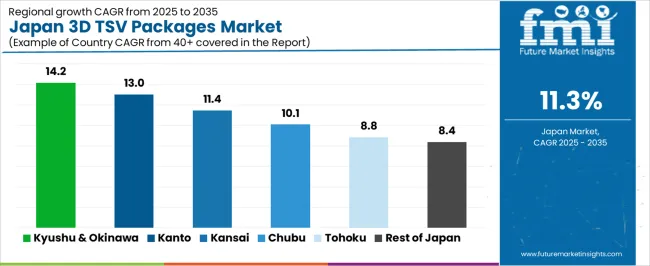
The demand for 3D TSV (Through-Silicon Via) packages in Japan shows strong growth, with Kyushu & Okinawa leading at a CAGR of 14.2%. Kanto follows with a CAGR of 13.0%, driven by the region's advanced semiconductor and electronics industry. The Kinki region shows steady growth at 11.4%, while Chubu, Tohoku, and the Rest of Japan exhibit more moderate growth, with respective CAGRs of 10.1%, 8.8%, and 8.4%. These variations reflect differences in regional industrial focus, technological advancements, and the adoption of 3D TSV packaging in the semiconductor sector.
| Region | CAGR (%) |
|---|---|
| Kyushu & Okinawa | 14.2 |
| Kanto | 13.0 |
| Kinki | 11.4 |
| Chubu | 10.1 |
| Tohoku | 8.8 |
| Rest of Japan | 8.4 |
What factors are driving the demand for 3D TSV packages in Kyushu & Okinawa?
The demand for 3D TSV packages in Kyushu & Okinawa is expected to grow at a CAGR of 14.2%, driven by the region’s strong semiconductor and electronics industry. Kyushu & Okinawa are home to a growing number of semiconductor manufacturing plants and R&D facilities focused on advanced packaging technologies.
As the demand for smaller, more powerful electronic devices rises, the need for 3D TSV packages, which provide high-density integration and efficient power consumption, is increasing. Additionally, Kyushu’s emphasis on technological innovation, along with the region's focus on manufacturing miniaturized electronics and high-performance semiconductors, supports the robust demand for 3D TSV packages. As these technologies become more critical in consumer electronics, automotive, and industrial applications, Kyushu & Okinawa’s market for 3D TSV packages is set to continue growing rapidly.
Why is the demand for 3D TSV packages increasing in Kanto?
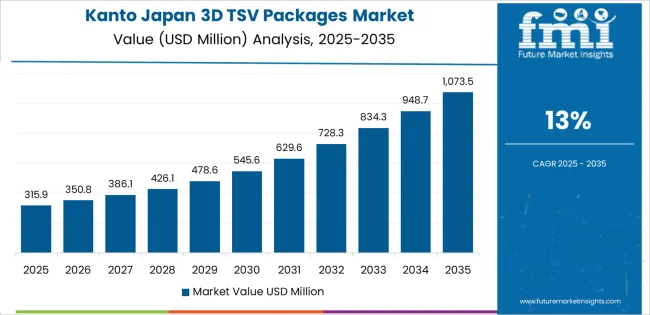
In Kanto, the demand for 3D TSV packages is projected to grow at a CAGR of 13.0%, driven by the region's advanced semiconductor industry. Kanto, home to Tokyo and major technology companies, plays a key role in Japan’s electronics and semiconductor manufacturing sectors. The growing demand for high-performance chips in consumer electronics, telecommunications, and automotive applications is driving the need for 3D TSV packages, which offer improved performance, miniaturization, and heat dissipation compared to traditional packaging solutions.
Kanto's established semiconductor ecosystem, coupled with increasing adoption of cutting-edge technologies like AI, 5G, and IoT, fuels the demand for advanced packaging solutions like 3D TSV. As the region continues to lead in technology innovation, the demand for these packages is expected to remain strong.
What supports the demand for 3D TSV packages in Kinki?
The demand for 3D TSV packages in Kinki is projected to grow at a CAGR of 11.4%, reflecting steady growth driven by the region’s robust electronics and automotive sectors. Kinki, which includes cities like Osaka and Kyoto, has a significant presence in the manufacturing of consumer electronics and automotive components, industries that increasingly rely on advanced semiconductor packaging solutions. As consumer demand for smaller, more powerful devices rises, the adoption of 3D TSV packages in Kinki is becoming more prominent.
The region's focus on innovation in electronics, particularly in the development of automotive electronics and IoT devices, supports the growing use of 3D TSV packages. Additionally, Kinki’s position as a hub for technology development ensures continued demand for these packaging solutions as the region advances in manufacturing high-performance electronics.
How is the demand for 3D TSV packages growing in Chubu?
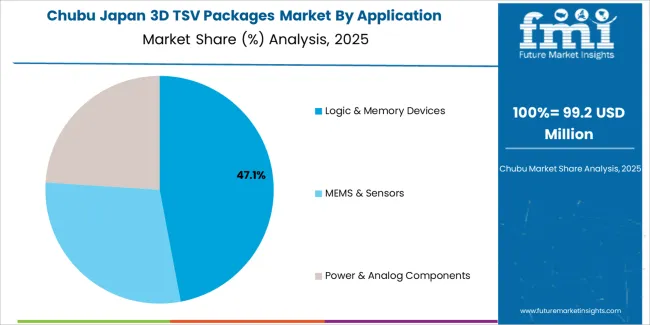
The demand for 3D TSV packages in Chubu is expected to grow at a CAGR of 10.1%, supported by the region's manufacturing and automotive industries. Chubu, home to Nagoya and other industrial centers, plays a critical role in Japan’s automotive and semiconductor industries.
As automotive electronics and advanced driver-assistance systems (ADAS) become more prevalent, the need for high-density, high-performance semiconductor packaging, such as 3D TSV packages, is increasing. Additionally, Chubu’s strong presence in industrial electronics, which requires smaller and more efficient chip designs, contributes to the rising demand for advanced packaging solutions. While growth in Chubu is slightly slower compared to Kyushu & Okinawa and Kanto, the region’s focus on automotive and industrial applications will continue to drive the adoption of 3D TSV packages.
What factors are influencing the demand for 3D TSV packages in Tohoku?
In Tohoku, the demand for 3D TSV packages is projected to grow at a CAGR of 8.8%, reflecting moderate growth compared to other regions. Tohoku’s industrial base, while smaller than more industrialized regions, is gradually adopting advanced semiconductor packaging technologies as the region's electronics industry expands.
Tohoku is focusing on improving the performance and efficiency of its semiconductor manufacturing, particularly for applications in renewable energy and industrial automation, which require efficient packaging solutions like 3D TSV. As these industries grow, the need for high-performance, miniaturized semiconductor packages is increasing. Though growth in Tohoku is slower than in other regions, its shift toward more advanced semiconductor applications ensures steady demand for 3D TSV packages.
How is the demand for 3D TSV packages evolving in the Rest of Japan?
In the Rest of Japan, the demand for 3D TSV packages is expected to grow at a CAGR of 8.4%, reflecting steady growth in less industrialized areas. This region, which includes rural and smaller urban areas, has fewer large-scale semiconductor manufacturing plants but is seeing increasing adoption of advanced packaging technologies in smaller-scale electronics and consumer products. As Japan’s focus on sustainability and efficiency extends across all regions, the need for smaller, more powerful electronic devices with enhanced performance characteristics, such as those enabled by 3D TSV packages, is growing. While growth in the Rest of Japan is more gradual, the demand for advanced semiconductor packaging solutions is expected to rise steadily, particularly as local industries and manufacturers modernize their technologies.
How Are Companies Competing in the 3D TSV Packages Industry in Japan?
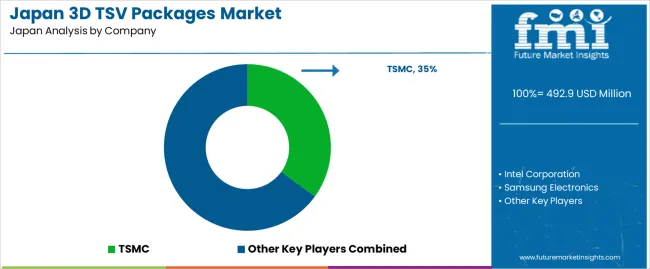
Demand for 3D TSV (through-silicon via) packages in Japan is rising as global semiconductor makers and chip designers push for smaller, faster and more power-efficient devices. 3D TSV packages enable vertical stacking of multiple dies or memory modules, which supports high-bandwidth memory, compact form factors and high interconnect density. Major firms serving this domain include TSMC (about 35 percent share among major providers), Intel Corporation, Samsung Electronics, ASE Group and Amkor Technology. These companies offer high-density TSV solutions and advanced 3D -IC packaging capabilities to Japanese semiconductor manufacturers and OEMs.
Competition in this market is shaped by packaging performance, thermal and signal integrity, and integration support. Suppliers focus on enabling high-bandwidth memory (HBM), system-on-chip (SoC) integration, and heterogeneous-die stacking that combine logic, memory and analog components efficiently in compact packages. Another competitive dimension is manufacturing and supply-chain readiness. Firms offering reliable yield, consistent TSV fabrication, good thermal management, and design support for Japanese clients tend to stand out.
Because demand spans industries, from consumer electronics to automotive, infrastructure and data-center computing, packaging providers that offer flexibility across application types gain an edge. Technical documentation for offerings often highlights interconnect density, package footprint reduction, thermal performance, and compatibility with high-performance memory and multi-die configurations. By aligning their packaging portfolios with Japan’s semiconductor manufacturing needs for performance, density and reliability, these companies aim to strengthen their position in the Japanese 3D TSV packages market.
Key Players of the 3D TSV Packages Industry in Japan
- TSMC
- Intel Corporation
- Samsung Electronics
- ASE Group
- Amkor Technology
Scope of the Report
| Items | Details |
|---|---|
| Quantitative Units | USD Million |
| Regions Covered | Japan |
| Process Realization | via Middle, via Last, via First |
| Application | Logic & Memory Devices, MEMS & Sensors, Power & Analog Components |
| End Users | Consumer Electronics, Information & Communication Technologies, Automotive, Military & Defense, Aerospace, Medical |
| Key Companies Profiled | TSMC, Intel Corporation, Samsung Electronics, ASE Group, Amkor Technology |
| Additional Attributes | The market analysis includes dollar sales by process realization, application, end-user, and company categories. It also covers regional demand trends in Japan, driven by the increasing use of 3D TSV (Through-Silicon Vias) packages in logic, memory devices, and sensors. The competitive landscape highlights key manufacturers focusing on innovations in TSV packaging for high-performance and miniaturized electronic components. Trends in the growing demand for 3D TSV packages across consumer electronics, automotive, aerospace, and medical sectors are explored, along with advancements in TSV technology to improve chip integration, power efficiency, and signal processing. |
Key Segments of the Demand for 3D TSV Packages in Japan
Process Realization
- via Middle
- via Last
- via First
Application
- Logic & Memory Devices
- MEMS & Sensors
- Power & Analog Components
End Users
- Consumer Electronics
- Information & Communication Technologies
- Automotive
- Military & Defense
- Aerospace
- Medical
Region
- Kyushu & Okinawa
- Kanto
- Kinki
- Chubu
- Tohoku
- Rest of Japan
Frequently Asked Questions
How big is the demand for 3D TSV packages in Japan in 2025?
The demand for 3D TSV packages in Japan is estimated to be valued at USD 492.9 million in 2025.
What will be the size of 3D TSV packages in Japan in 2035?
The market size for the 3D TSV packages in Japan is projected to reach USD 1,441.1 million by 2035.
How much will be the demand for 3D TSV packages in Japan growth between 2025 and 2035?
The demand for 3D TSV packages in Japan is expected to grow at a 11.3% CAGR between 2025 and 2035.
What are the key product types in the 3D TSV packages in Japan?
The key product types in 3D TSV packages in Japan are via middle, via last and via first.
Which application segment is expected to contribute significant share in the 3D TSV packages in Japan in 2025?
In terms of application, logic & memory devices segment is expected to command 47.0% share in the 3D TSV packages in Japan in 2025.
Preview the report firsthand - request a free sample
Get SampleGet the brochure for pricing and purchase details.
Get PDFTable of Content
- Executive Summary
- Japan Market Outlook
- Demand-side Trends
- Supply-side Trends
- Technology Roadmap Analysis
- Analysis and Recommendations
- Market Overview
- Market Coverage / Taxonomy
- Market Definition / Scope / Limitations
- Market Background
- Market Dynamics
- Drivers
- Restraints
- Opportunity
- Trends
- Scenario Forecast
- Demand in Optimistic Scenario
- Demand in Likely Scenario
- Demand in Conservative Scenario
- Opportunity Map Analysis
- Product Life Cycle Analysis
- Supply Chain Analysis
- Investment Feasibility Matrix
- Value Chain Analysis
- PESTLE and Porter’s Analysis
- Regulatory Landscape
- Regional Parent Market Outlook
- Production and Consumption Statistics
- Import and Export Statistics
- Market Dynamics
- Japan Market Analysis 2020 to 2024 and Forecast, 2025 to 2035
- Historical Market Size Value (USD Million) Analysis, 2020 to 2024
- Current and Future Market Size Value (USD Million) Projections, 2025 to 2035
- Y-o-Y Growth Trend Analysis
- Absolute $ Opportunity Analysis
- Japan Market Pricing Analysis 2020 to 2024 and Forecast 2025 to 2035
- Japan Market Analysis 2020 to 2024 and Forecast 2025 to 2035, By Process Realization
- Introduction / Key Findings
- Historical Market Size Value (USD Million) Analysis By Process Realization , 2020 to 2024
- Current and Future Market Size Value (USD Million) Analysis and Forecast By Process Realization , 2025 to 2035
- via Middle
- via Last
- via First
- Y-o-Y Growth Trend Analysis By Process Realization , 2020 to 2024
- Absolute $ Opportunity Analysis By Process Realization , 2025 to 2035
- Japan Market Analysis 2020 to 2024 and Forecast 2025 to 2035, By Application
- Introduction / Key Findings
- Historical Market Size Value (USD Million) Analysis By Application, 2020 to 2024
- Current and Future Market Size Value (USD Million) Analysis and Forecast By Application, 2025 to 2035
- Logic & Memory Devices
- MEMS & Sensors
- Power & Analog Components
- Y-o-Y Growth Trend Analysis By Application, 2020 to 2024
- Absolute $ Opportunity Analysis By Application, 2025 to 2035
- Japan Market Analysis 2020 to 2024 and Forecast 2025 to 2035, By End Users
- Introduction / Key Findings
- Historical Market Size Value (USD Million) Analysis By End Users, 2020 to 2024
- Current and Future Market Size Value (USD Million) Analysis and Forecast By End Users, 2025 to 2035
- Consumer Electronics
- Information & Communication Technologies
- Automotive
- Military & Defense
- Aerospace
- Medical
- Y-o-Y Growth Trend Analysis By End Users, 2020 to 2024
- Absolute $ Opportunity Analysis By End Users, 2025 to 2035
- Market Structure Analysis
- Competition Dashboard
- Competition Benchmarking
- Market Share Analysis of Top Players
- By Regional
- By Process Realization
- By Application
- By End Users
- Competition Analysis
- Competition Deep Dive
- TSMC
- Overview
- Product Portfolio
- Profitability by Market Segments (Product/Age /Sales Channel/Region)
- Sales Footprint
- Strategy Overview
- Marketing Strategy
- Product Strategy
- Channel Strategy
- Intel Corporation
- Samsung Electronics
- ASE Group
- Amkor Technology
- TSMC
- Competition Deep Dive
- Assumptions & Acronyms Used
- Research Methodology


