

- Industry Size (2026)
- USD 25.4 Mn
- Forecast (2036)
- USD 62.4 Mn
- CAGR (2026 to 2036)
- 13.5%
Demand for 3D Motion Capture in Japan Forecast and Outlook 2026 to 2036
The demand for 3D motion capture in Japan is valued at USD 25.4 million in 2026 and is projected to reach USD 62.4 million by 2036, reflecting a CAGR of 13.5%. Growth from 2020 to 2026 shows an increase from USD 14.9 million to USD 25.4 million, driven by steady use in media production, animation, and biomechanical research. Optical systems hold the largest share due to precision requirements, while hardware remains the leading component category across early adoption environments in Japan.
From 2027 onward, values rise from USD 27.8 million to USD 39.8 million by 2031, then reach USD 62.4 million by 2036 through widening annual increments. Engineering and industrial design applications expand as manufacturers integrate motion capture into prototyping workflows. Education and automotive segments contribute consistent secondary volumes. Software and service demand grows with workflow integration needs and multi system coordination. Long term growth reflects broader application diversity rather than rapid expansion in any single sector.
Quick Stats of the Demand for 3D Motion Capture in Japan
- Demand for 3D Motion Capture in Japan Value (2026): USD 25.4 million
- Demand for 3D Motion Capture in Japan Forecast Value (2036): USD 62.4 million
- Demand for 3D Motion Capture in Japan Forecast CAGR (2026-2036): 13.5%
- Demand for 3D Motion Capture in Japan Leading System Type: Optical Systems (60%)
- Demand for 3D Motion Capture in Japan Key Growth Regions: Kyushu & Okinawa, Kanto, Kansai
- Demand for 3D Motion Capture in Japan Top Players: Qualisys, Noitom, Rokoko, Noraxon USA, STT Systems

What is the Growth Forecast for 3D Motion Capture in Japan through 2036?
Between 2026 and 2031, demand for 3D motion capture in Japan increases from USD 25.4 million to USD 36.4 million, reflecting a gain of USD 11.0 million across five years. Growth in this stage is influenced by expanding adoption across animation studios, sports performance centers, rehabilitation clinics, and product design environments. Earlier demand was driven by entertainment sector usage, while near term expansion reflects higher reliance on real time kinematic data, improved sensor precision, and broader integration within research laboratories and biomechanics programs supporting engineering and medical applications.
From 2031 to 2036, demand rises from USD 36.4 million to USD 62.4 million, adding USD 26.0 million through the latter period. Growth accelerates as advanced capture systems gain traction in robotics development, autonomous system testing, industrial training simulations, and high accuracy virtual production pipelines. Earlier uptake was limited to specialized professional users, while later expansion reflects wider deployment across manufacturing R&D, motion analysis centers, and cross sector digital content production. Increasing complexity in animation workflows, rising use of volumetric capture, and stronger institutional investment in performance analytics support continued scaling across Japan’s technical and creative industries.
3D Motion Capture Industry in Japan Key Takeaways
| Metric | Value |
|---|---|
| Industry Value (2026) | USD 25.4 million |
| Forecast Value (2036) | USD 62.4 million |
| Forecast CAGR (2026-2036) | 13.5% |
What Is Driving the Demand for 3D Motion Capture in Japan from 2026 to 2036?
Demand for 3D motion capture in Japan has grown with adoption of advanced animation, game development, and digital content production. Entertainment studios, academic research labs, and visual effects houses used motion capture to record human movement for realistic character animation. Industrial users applied the technology in ergonomics studies, robotics calibration, and sports science to analyse biomechanics. Historical uptake depended on availability of hardware systems, skilled operators, and integration with 3D animation pipelines.
From 2026 to 2036 demand is expected to broaden with growth in virtual production, immersive experiences, and human performance analytics. Industries such as automotive design, healthcare rehabilitation, and augmented reality development increasingly incorporate motion capture for simulation, training, and product validation. Higher resolution capture systems with marker-less tracking appeal to live performance capture and real-time visualization. Expansion of esports, remote collaboration tools, and digital twin applications supports uptake beyond traditional media sectors. Buyers evaluate system flexibility, software interoperability, and ease of use across multidisciplinary teams.
What Is the Demand for 3D Motion Capture in Japan by System and Component for 2026 to 2036?
The demand for 3D motion capture in Japan from 2026 to 2036 is shaped by expanding animation production, biomechanics research, clinical movement analysis, and growth in virtual content creation. Optical systems lead by system type due to high capture precision and broad use in film, gaming, sports science, and robotics. Hardware leads by component because sensors, cameras, and capture rigs form the core investment required for accurate data acquisition. Procurement is driven by animation studios, universities, sports institutions, and industrial automation developers. Import reliance remains present for advanced camera arrays and marker technologies. Substitution pressure exists from inertial systems in field environments. Demand stability is supported by consistent media production and research projects.
Why do optical 3D motion capture systems account for 60% of the demand in Japan by system type from 2026 to 2036?
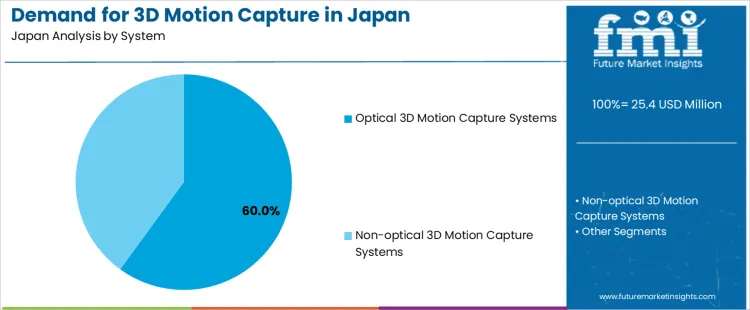
Optical 3D motion capture systems account for 60% of the demand in Japan by system type due to their accuracy, marker tracking stability, and suitability for controlled indoor environments. Consumption intensity is driven by film studios, gaming companies, animation houses, and sports science labs where precise skeletal mapping supports performance analysis and digital content creation. Usage remains stable because optical systems deliver detailed positional data across complex motions. Procurement is led by research institutions and production studios requiring high fidelity motion datasets.
Optical systems generate strong repeat demand between 2026 and 2036 through equipment upgrades, expanded capture spaces, and new content projects. Repeat utilization remains predictable due to technology refresh cycles. Buyers favor modular camera rigs that scale with studio requirements. Margin structure remains steady under well-established vendor competition. Regulatory exposure remains low, limited to workplace safety and data handling norms. Import reliance persists for precision optical sensors and specialized lenses. Substitution pressure from non-optical systems remains contained where accuracy and frame synchronization take priority.
Why does hardware represent 50.0% of the demand for 3D motion capture in Japan by component?
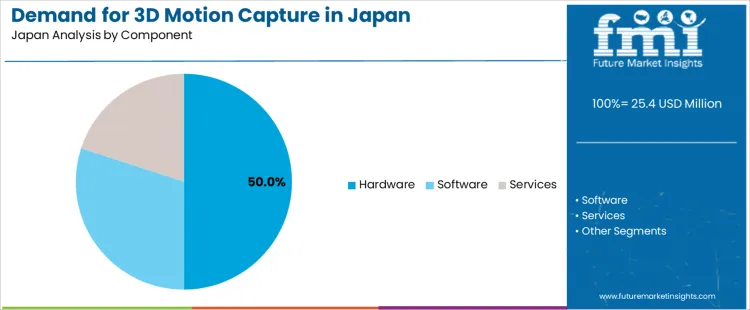
Hardware represents 50.0% of the demand for 3D motion capture in Japan by component because physical capture infrastructure forms the largest share of investment for motion tracking environments. Consumption intensity is driven by multi-camera arrays, sensor modules, calibration tools, and rigging structures required for controlled recording spaces. Usage remains stable as hardware operates continuously across production cycles, research trials, and training sessions. Procurement is dominated by studios, universities, medical centers, and robotics labs that require dependable equipment longevity.
Hardware demand remains consistent across 2026 to 2036 as institutions expand capture volumes, add new cameras, and replace aging units. Repeat utilization remains predictable due to mechanical wear and the need for periodic upgrades. Buyers favor hardware ecosystems that integrate easily with existing software workflows. Margin structure remains steady under project-based procurement. Regulatory exposure focuses on electrical safety and facility compliance. Import reliance persists for cameras, optical sensors, and precision mounts. Substitution pressure from software-heavy systems remains limited because hardware remains the foundation of accurate motion capture performance.
What Is Driving the Demand for 3D Motion Capture in Japan Across Entertainment, Sports, and Robotics?
Demand for 3D motion capture in Japan grows through the expansion of animation studios, game development pipelines, performance capture for virtual concerts, and robotics calibration work. Anime and gaming teams rely on accurate body tracking to shorten keyframe cycles and preserve stylistic movement. Idol groups and virtual entertainers use motion capture for live streaming stages that require consistent character motion. Research labs integrate motion capture to train humanoid robots on dexterous tasks. Sports programs analyze posture for injury prevention. Demand follows technical precision, pipeline acceleration, and Japan’s distinctive digital entertainment culture rather than widespread global production patterns.
How Are Animation Studios and Virtual Entertainment Platforms Reshaping Motion Capture Needs in Japan?
Animation and virtual entertainment teams in Japan use motion capture to streamline character blocking, reduce manual correction, and extend production capacity within short broadcast windows. Studios running multiple series per season use compact optical or inertial setups to record expressive motion with minimal stage preparation. Virtual YouTuber agencies rely on full-body capture for daily content, driving continuous demand for stable tracking, fast calibration, and low-latency preview. Motion from multiple performers must synchronize accurately to support ensemble scenes. Demand strengthens through Japan’s large pipeline of episodic content, virtual auditions, and platform-driven live performance output.
Why Are Sports Science, Biomechanics, and Rehabilitation Expanding Capture Usage in Japan?
Sports institutes, rehabilitation centers, and university biomechanics labs across Japan integrate motion capture to observe joint loading, gait symmetry, and fatigue patterns under controlled conditions. Baseball, soccer, and track programs use detailed kinematic analysis to refine technique and plan training loads. Hospitals apply capture systems for stroke recovery evaluation and prosthetic alignment checks. Researchers require consistent marker visibility and stable frame rates for comparative studies. These uses create steady institutional demand distinct from entertainment cycles. Adoption follows scientific rigor, clinical tracking needs, and Japan’s structured rehabilitation programs rather than broad consumer-facing applications.
What is the Demand for 3D Motion Capture in Japan by Region?

| Region | CAGR (%) |
|---|---|
| Kyushu & Okinawa | 11.7% |
| Kanto | 10.8% |
| Kansai | 9.5% |
| Chubu | 8.3% |
| Tohoku | 7.3% |
| Rest of Japan | 6.9% |
The demand for 3D motion capture in Japan is expanding rapidly across animation, gaming, sports science, and robotics research, led by Kyushu and Okinawa at an 11.7% CAGR. Growth in this region is supported by rising adoption in university labs, creative studios, and biomechanical research centers. Kanto follows at 10.8%, driven by major anime and gaming production houses, advanced VR and AR development clusters, and widespread use in film studios. Kansai records 9.5% growth, reflecting steady uptake in robotics development, sports performance centers, and industrial simulation environments. Chubu at 8.3% shows moderate adoption linked to automotive human factor research and manufacturing ergonomics. Tohoku and the Rest of Japan, at 7.3% and 6.9%, reflect slower but consistent growth shaped by smaller innovation hubs and gradual expansion of motion analysis applications.
How Are Creative Industries Advancing 3D Motion Capture Adoption in Kyushu and Okinawa?
Demand for 3D motion capture in Kyushu and Okinawa is expanding at a CAGR of 11.7% from 2026 to 2036, driven by animation studios, gaming developers, and universities investing in performance digitization tools. Regional creators apply motion capture for character movement, virtual scene development, and research programs exploring biomechanics. Local training centers incorporate the technology into curriculum modules that prepare students for digital production roles. Growth reflects broader use of capture systems across small studios, multimedia projects, and academic initiatives. Adoption remains steady as creative communities pursue improved workflow efficiency, expanded digital content output, and alignment with national trends in immersive content creation.
- Animation teams use motion capture for character mapping
- Gaming developers rely on accurate movement tracking
- Universities apply systems for research applications
- Training centers introduce students to digital workflows
Why Are Production Hubs Sustaining Strong 3D Motion Capture Demand in Kanto?
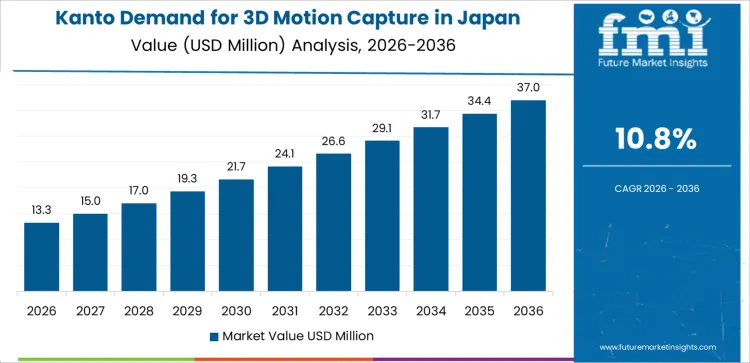
Demand for 3D motion capture in Kanto is rising at a CAGR of 10.8% from 2026 to 2036, supported by major media companies, advanced gaming studios, and film production facilities. High output digital content pipelines require precise performance data and efficient capture sessions. Studios apply motion capture in character animation, virtual cinematography, and extended reality development. Collaborative projects between technology firms and creative houses strengthen usage across large production teams. Demand reflects continuous adoption of visual effects workflows across commercial entertainment and corporate communication content. Kanto maintains sizable investment levels due to dense creative networks, specialized service providers, and steady production schedules.
- Film studios integrate capture into digital scenes
- Gaming studios depend on refined movement data
- Corporate content teams explore virtual production
- Technology providers support capture system deployment
How Are Regional Creative Clusters Supporting Motion Capture Growth in Kansai?
Demand for 3D motion capture in Kansai is increasing at a CAGR of 9.5% from 2026 to 2036, sustained by mixed media enterprises, design institutions, and gaming developers. Creative groups rely on motion capture for realistic character motion, rapid animation cycles, and efficient blending of digital assets. Educational centers integrate motion capture into design programs to strengthen technical skills. Adoption also occurs across research initiatives examining ergonomics and movement analysis. Kansai’s balanced creative ecosystem supports consistent use of performance capture tools that reinforce digital production capacity across diverse teams working on animation, interactive content, and applied movement studies.
- Design institutes train students with capture systems
- Interactive media teams use motion capture for realism
- Animation studios depend on accurate motion data
- Research centers study movement behavior
What Is Guiding Continued Motion Capture Use Across Chubu Technical Environments?
Demand for 3D motion capture in Chubu is moving at a CAGR of 8.3% from 2026 to 2036, supported by engineering universities, robotics research groups, and industrial design teams. Motion capture is used in evaluating human machine interaction, testing body movement patterns, and refining robotic motion. Creative studios in the region apply systems for animation and simulation projects linked to industrial storytelling and training content. Replacement cycles reflect technology upgrades, expanded project requirements, and rising interest in precise movement analysis. Chubu’s combination of engineering research and applied digital content development contributes to steady adoption of motion capture solutions across technical domains.
- Robotics teams study movement with capture systems
- Universities apply motion capture in biomechanics research
- Industrial designers use capture for simulation content
- Creative groups integrate capture into digital projects
How Are Research Driven Applications Supporting Motion Capture Demand in Tohoku?
Demand for 3D motion capture in Tohoku is progressing at a CAGR of 7.3% from 2026 to 2036, supported by medical research centers, sports science labs, and regional universities. Facilities adopt motion capture to study gait patterns, athletic performance, rehabilitation progress, and ergonomic assessments. Academic programs continue to incorporate capture technology into laboratory work that examines movement efficiency and training methods. Adoption extends into small creative studios experimenting with motion based content. Tohoku demand remains steady as specialized research programs seek precise data collection tools that support analytical models across healthcare, sports evaluation, and controlled human movement studies.
- Medical labs use capture for rehabilitation analysis
- Sports scientists track athletic motion
- Universities integrate systems into research programs
- Creative teams test capture in small projects
What Is Encouraging Steady Motion Capture Usage Across Rest of Japan?
Demand for 3D motion capture in Rest of Japan is growing at a CAGR of 6.9% from 2026 to 2036, supported by regional colleges, independent animation studios, and community research initiatives. Facilities adopt motion capture for simplified digital production, basic character movement recording, and educational demonstrations. Growth reflects expanding interest in digital arts programs and gradual integration of performance capture into small scale creative workflows. Research centers apply capture systems in studies related to movement and functional assessment. Localized adoption remains practical as institutions and studios pursue accessible tools that enhance project quality while matching budget considerations across diverse content development environments.
- Colleges use capture for teaching digital techniques
- Independent studios apply systems for animation tasks
- Research groups collect movement data for studies
- Community labs explore motion based projects
What Is Driving the Demand for 3D Motion Capture in Japan and Which Companies Shape Research and Commercial Adoption?
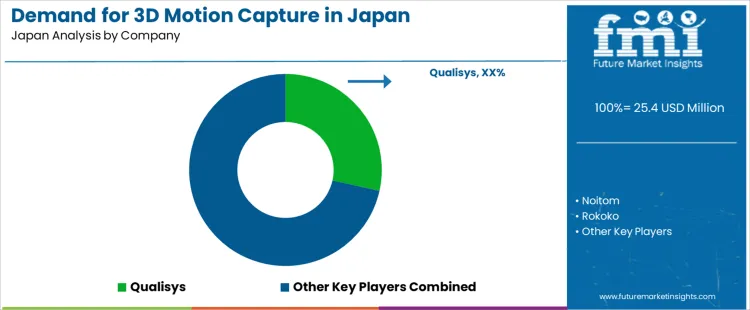
The demand for 3D motion capture in Japan is shaped by investments in animation, gaming, robotics, sports science, and medical rehabilitation. Qualisys holds a strong presence through optical motion capture systems used in universities, sports institutes, and biomechanics laboratories. Noraxon USA supports adoption through integrated motion analysis platforms used in gait assessment, physical therapy, and ergonomic evaluation. Noitom participates through inertial systems favored by animation studios and indie game developers working in compact spaces. Rokoko reaches creative users through affordable suits and glove systems used in virtual production and VTuber content creation across major cities. STT Systems engages selective projects in clinical and performance research through optical and markerless solutions. Domestic engineering teams rely on these platforms for robot control studies, workplace safety assessments, and digital character development.
System selection in Japan is governed by capture accuracy, latency stability, calibration time, and suitability for small indoor studios or lab environments. Buyers emphasize compatibility with animation software, biomechanics tools, and real time rendering engines. Universities prioritize platforms with comprehensive Japanese language support and long term maintenance. Sports centers focus on durability, portability, and integration with force plates and EMG systems. Rehabilitation clinics value simplified workflows and reliable patient progress tracking. Demand visibility tracks growth in VTuber production, metaverse content development, advanced humanoid robot research, and data driven sports training programs. Continued expansion of film, game, and industrial simulation sectors sustains long term interest in precise and flexible motion capture systems across research and commercial settings.
Key Players in the 3D Motion Capture Industry in Japan
- Qualisys
- Noitom
- Rokoko
- Noraxon USA
- STT Systems
Scope of the Report
| Items | Values |
|---|---|
| Quantitative Units (2026) | USD million |
| System Type | Optical; Non Optical (Inertial; Markerless) |
| Component | Hardware; Software; Services |
| Application | Animation and Gaming; Sports Science; Biomechanics; Robotics; Rehabilitation; Industrial Design and Simulation |
| End Users | Animation Studios; Gaming Companies; Universities; Research Labs; Medical Centers; Robotics Developers |
| Regions Covered | Kyushu and Okinawa; Kanto; Kansai; Chubu; Tohoku; Rest of Japan |
| Countries Covered | Japan |
| Key Companies Profiled | Qualisys; Noitom; Rokoko; Noraxon USA; STT Systems |
| Additional Attributes | Dollar sales by system type and component; optical system precision needs; hardware led demand; import reliance for advanced sensors and camera arrays; substitution limits between optical and inertial systems; workflow integration across animation, sports, and clinical environments; calibration and latency requirements; multi system coordination in research labs; adoption influenced by digital content pipelines, robotics testing routines, and biomechanics analysis frameworks. |
3D Motion Capture Industry in Japan Segmentation
Vehicle Type:
- Passenger Car
- LCV
- HCV
- Off-Highway Vehicles
Sales Channel:
- OEM
- Aftermarket
Product Type:
- Chain
- Belt
Engine Type:
- Gasoline
- Diesel
Region:
- Kyushu & Okinawa
- Kanto
- Kansai
- Chubu
- Tohoku
- Rest of Japan
Frequently Asked Questions
How big is the demand for 3D motion capture in Japan in 2026?
The demand for 3D motion capture in Japan is estimated to be valued at USD 25.4 million in 2026.
What will be the size of 3D motion capture in Japan in 2036?
The market size for the 3D motion capture in Japan is projected to reach USD 62.4 million by 2036.
How much will be the demand for 3D motion capture in Japan growth between 2026 and 2036?
The demand for 3D motion capture in Japan is expected to grow at a 13.5% CAGR between 2026 and 2036.
What are the key product types in the 3D motion capture in Japan?
The key product types in 3D motion capture in Japan are optical 3D motion capture systems and non-optical 3D motion capture systems.
Which component segment is expected to contribute significant share in the 3D motion capture in Japan in 2026?
In terms of component, hardware segment is expected to command 50.0% share in the 3D motion capture in Japan in 2026.
Preview the report firsthand - request a free sample
Get SampleGet the brochure for pricing and purchase details.
Get PDFTable of Content
- Executive Summary
- Japan Market Outlook
- Demand-side Trends
- Supply-side Trends
- Technology Roadmap Analysis
- Analysis and Recommendations
- Market Overview
- Market Coverage / Taxonomy
- Market Definition / Scope / Limitations
- Market Background
- Market Dynamics
- Drivers
- Restraints
- Opportunity
- Trends
- Scenario Forecast
- Demand in Optimistic Scenario
- Demand in Likely Scenario
- Demand in Conservative Scenario
- Opportunity Map Analysis
- Product Life Cycle Analysis
- Supply Chain Analysis
- Investment Feasibility Matrix
- Value Chain Analysis
- PESTLE and Porter’s Analysis
- Regulatory Landscape
- Regional Parent Market Outlook
- Production and Consumption Statistics
- Import and Export Statistics
- Market Dynamics
- Japan Market Analysis 2020 to 2024 and Forecast, 2025 to 2035
- Historical Market Size Value (USD Million) Analysis, 2020 to 2024
- Current and Future Market Size Value (USD Million) Projections, 2025 to 2035
- Y-o-Y Growth Trend Analysis
- Absolute $ Opportunity Analysis
- Japan Market Pricing Analysis 2020 to 2024 and Forecast 2025 to 2035
- Japan Market Analysis 2020 to 2024 and Forecast 2025 to 2035, By System
- Introduction / Key Findings
- Historical Market Size Value (USD Million) Analysis By System , 2020 to 2024
- Current and Future Market Size Value (USD Million) Analysis and Forecast By System , 2025 to 2035
- Optical 3D Motion Capture Systems
- Non-optical 3D Motion Capture Systems
- Y-o-Y Growth Trend Analysis By System , 2020 to 2024
- Absolute $ Opportunity Analysis By System , 2025 to 2035
- Japan Market Analysis 2020 to 2024 and Forecast 2025 to 2035, By Component
- Introduction / Key Findings
- Historical Market Size Value (USD Million) Analysis By Component, 2020 to 2024
- Current and Future Market Size Value (USD Million) Analysis and Forecast By Component, 2025 to 2035
- Hardware
- Software
- Services
- Y-o-Y Growth Trend Analysis By Component, 2020 to 2024
- Absolute $ Opportunity Analysis By Component, 2025 to 2035
- Japan Market Analysis 2020 to 2024 and Forecast 2025 to 2035, By Application
- Introduction / Key Findings
- Historical Market Size Value (USD Million) Analysis By Application, 2020 to 2024
- Current and Future Market Size Value (USD Million) Analysis and Forecast By Application, 2025 to 2035
- Media & Entertainment
- Biomechanical Research and Medical
- Engineering Design and Industrial Applications
- Education
- Automotive
- Y-o-Y Growth Trend Analysis By Application, 2020 to 2024
- Absolute $ Opportunity Analysis By Application, 2025 to 2035
- Market Structure Analysis
- Competition Dashboard
- Competition Benchmarking
- Market Share Analysis of Top Players
- By Regional
- By System
- By Component
- By Application
- Competition Analysis
- Competition Deep Dive
- Qualisys
- Overview
- Product Portfolio
- Profitability by Market Segments (Product/Age /Sales Channel/Region)
- Sales Footprint
- Strategy Overview
- Marketing Strategy
- Product Strategy
- Channel Strategy
- Noitom
- Rokoko
- Noraxon USA
- STT Systems
- Qualisys
- Competition Deep Dive
- Assumptions & Acronyms Used
- Research Methodology


