

- Industry Size (2025)
- USD 180.5 Bn
- Forecast (2035)
- USD 275.3 Bn
- CAGR (2025 to 2035)
- 4.3%
Demand for 3D Motion Capture in USA Forecast and Outlook 2025 to 2035
The demand for 3D motion capture in the USA is projected to grow from USD 181.2 million in 2025 to USD 556.6 million in 2035, with a high CAGR of 11.90%. The industry follows a distinct acceleration and deceleration pattern, with initial years reflecting steady growth and later years showing sharper increases. From 2025 to 2027, demand increases incrementally, starting at USD 181.2 million in 2025 and rising to USD 202.7 million in 2026 and USD 226.8 million in 2027. This steady growth in the early years is driven by the increasing use of 3D motion capture technology in industries such as entertainment, gaming, and sports. As these industries increasingly adopt motion capture for realism in animations, virtual reality, and athlete performance analysis, the industry experiences consistent demand without dramatic fluctuations.
Quick Stats of the Demand for 3D Motion Capture in USA
- Demand for 3D Motion Capture in USA Value (2025): USD 181.2 million
- Demand for 3D Motion Capture in USA Forecast Value (2035): USD 556.6 million
- Demand for 3D Motion Capture in USA Forecast CAGR (2025 to 2035): 11.9%
- Demand for 3D Motion Capture in USA Leading System: Optical 3D Motion Capture Systems
- Demand for 3D Motion Capture in USA Key Growth Regions: West USA, South USA, Northeast USA, Midwest USA
- Demand for 3D Motion Capture in USA Top Players: Qualisys, Noitom, Rokoko, Noraxon USA, STT Systems
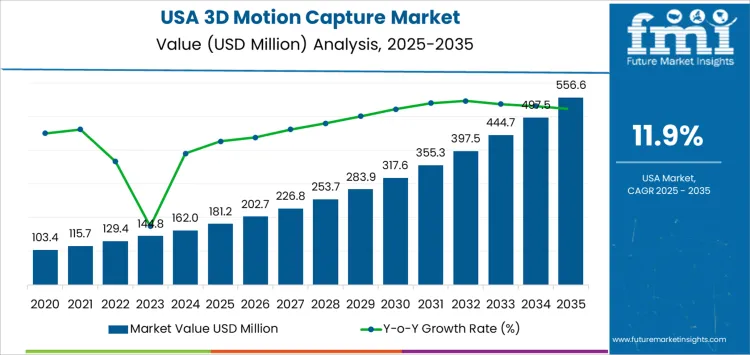
From 2028 to 2035, the industry shows a noticeable acceleration, with demand rising from USD 253.7 million in 2028 to USD 556.6 million by 2035. This phase of rapid growth is due to several factors, including advancements in motion capture technology, the expansion of virtual production, and the growing integration of 3D motion capture in new fields like healthcare, robotics, and simulation training. The increasing affordability of motion capture equipment and the growing popularity of virtual and augmented reality applications are also contributing to the industry’s acceleration. The most significant jumps in demand are seen from 2030 onward, with growth becoming more pronounced, as industries embrace motion capture technology for broader applications, including in entertainment, medical research, and robotics. This sharp acceleration reflects the transformative impact of technological developments, leading to increased adoption and a broadening of the industry's use cases.
Demand for 3D Motion Capture in USA Key Takeaways
| Metric | Value |
|---|---|
| Demand for 3D Motion Capture in USA Value (2025) | USD 181.2 million |
| Demand for 3D Motion Capture in USA Forecast Value (2035) | USD 556.6 million |
| Demand for 3D Motion Capture in USA Forecast CAGR (2025 to 2035) | 11.9% |
Why is the Demand for 3D Motion Capture in USA Growing?
The demand for 3D motion capture in the USA is growing due to the increasing adoption of this technology across various industries, including entertainment, healthcare, sports, and virtual reality (VR). 3D motion capture is a powerful tool for recording and analyzing the movement of objects or people in three-dimensional space, and it plays a vital role in creating realistic animations for movies, video games, and simulations. The growing trend of high-quality digital content production, including special effects and realistic character animation, is a significant factor contributing to this rise.
The use of 3D motion capture in healthcare for applications like rehabilitation, prosthetics, and biomechanics is expanding. Motion capture is increasingly being used to analyze human movement to develop better treatments and improve outcomes for patients with motor impairments or injuries. The sports sector is also benefiting from motion capture, as athletes and coaches use the technology to analyze performance, refine techniques, and prevent injuries. The rise in popularity of virtual reality and augmented reality (AR) applications further boosts demand, as these technologies require precise motion capture to create immersive experiences.
Key drivers include technological advancements in motion capture systems, making them more affordable, accurate, and accessible. As industries continue to innovate and create more realistic digital environments, the demand for 3D motion capture technology is expected to rise rapidly. Challenges related to data processing, high initial costs, and the complexity of integration into existing workflows may limit the broader adoption of the technology. Despite these hurdles, the expanding use of 3D motion capture in various sectors is expected to drive robust growth in the USA through 2035.
What is the Segment-Wise Analysis of Demand for 3D Motion Capture in USA?
Demand for 3D motion capture in the USA is segmented by system type, application, component, and region. By system type, optical 3D motion capture systems lead with 60% of the demand, followed by non-optical 3D motion capture systems. In terms of application, media and entertainment account for 30% of the demand, with biomechanical research and medical, engineering design and industrial applications, education, and automotive making up the remaining share. Regarding component type, hardware, software, and services are the primary categories driving demand. Regionally, demand is distributed across West USA, South USA, Northeast USA, and Midwest USA.
Why Do Optical 3D Motion Capture Systems Lead the Demand for 3D Motion Capture in USA?
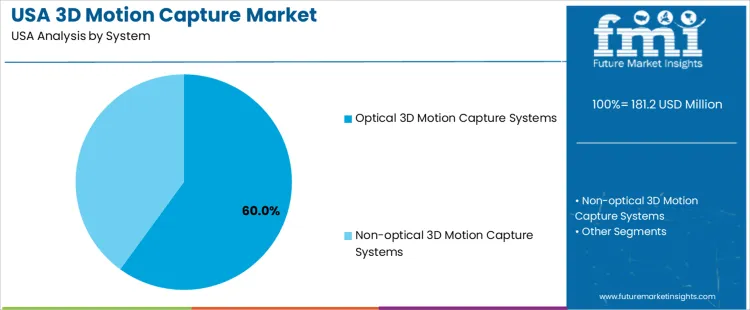
Optical 3D motion capture systems account for 60% of the demand for 3D motion capture in the USA, driven by their high precision and ability to capture detailed movement in real time. These systems are extensively used in media and entertainment for creating realistic animations, visual effects, and special effects, as they provide highly accurate tracking of both human and object movement. The optical systems utilize cameras and reflective markers to track movement with exceptional clarity, making them ideal for intricate motion capture tasks. Their versatility extends beyond entertainment, also being used in biomechanics and medical research for movement analysis and rehabilitation purposes. Optical 3D systems are non-invasive, making them highly suitable for research and clinical applications. As industries continue to demand high-quality visual content, immersive experiences, and precise motion tracking, optical 3D motion capture systems remain the dominant technology in the industry, continuing to meet evolving needs across various sectors.
How Does Media & Entertainment Lead the Demand for 3D Motion Capture in USA?
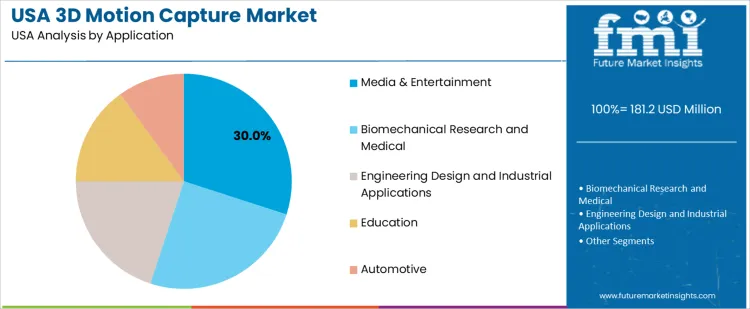
The media and entertainment sector accounts for 30% of the demand for 3D motion capture in the USA, driven by its essential role in creating realistic animations, visual effects, and video games. 3D motion capture is widely used in film and television production to generate lifelike characters and simulate intricate movements, significantly enhancing the quality of visual content. The increasing demand for immersive, high-quality entertainment experiences further drives the need for advanced motion capture technologies. In video game development, motion capture enables developers to create fluid and natural character animations, improving the overall gaming experience. As the entertainment industry continues to evolve with new technologies like virtual reality and augmented reality, the demand for cutting-edge motion capture systems remains strong. This growing reliance on 3D motion capture to produce high-quality, realistic media ensures the sector’s continued dominance in the industry.
What are the Key Trends, Drivers, and Restraints in Demand for 3D Motion Capture in USA?
Industries like entertainment, sports analytics, healthcare, biomechanics research, and virtual or augmented reality increasingly rely on precise motion tracking. The proliferation of immersive media and VR or AR applications is pushing studios and developers to adopt advanced optical and markerless motion capture technologies for realistic animation and interactive experiences. Growth in sports and healthcare use cases for performance analysis, rehabilitation, and ergonomic assessments is also fueling adoption. High upfront costs for hardware, sensors, cameras, and specialized software can restrain demand, especially among small studios or institutions. The complexity of setup, calibration, and operation, along with the need for skilled operators, presents additional barriers.
Why is Demand for 3D Motion Capture Growing in USA?
Demand for 3D motion capture in the USA is growing largely due to the need for realistic motion data across various industries. Film studios and video game developers use 3D motion capture to create lifelike character movements and realistic animations. The rise of VR and AR technologies is increasing the demand for motion-captured data to power virtual avatars or interactive environments. In sports, motion capture is used for biomechanics analysis, performance improvement, and injury prevention, driving its adoption in professional sports teams, training facilities, and educational programs. Healthcare professionals are using it for gait analysis, physical therapy monitoring, and ergonomic or biomechanical studies. As these sectors continue to expand, investing in data-driven performance and user experiences, the demand for 3D motion capture technology increases.
How are Technological and Industry Innovations Driving 3D Motion Capture Demand in USA?
Improvements in optical systems, markerless capture, wearable sensors, and real-time rendering have made it possible to obtain high-quality motion data at lower costs. The integration of AI and advanced algorithms allows for smoother motion reconstruction, real-time processing, gesture recognition, and predictive analytics, making motion capture useful not only for entertainment but also for sports, healthcare, robotics, and industrial applications. Developments in compact, portable, and cloud-based motion capture solutions have reduced the setup complexity and cost, enabling smaller studios, research labs, and institutions to adopt them. As motion capture hardware and software continue to evolve, new sectors find more value in adopting these systems. The increasing demand for immersive experiences in media and entertainment, along with the growth of data-driven performance analysis in sports and healthcare, is further driving the need for advanced motion capture technologies in the USA.
What are the Key Challenges and Risks That Could Limit 3D Motion Capture Demand in USA?
One of the primary barriers is the high initial investment cost for the required hardware, sensors, cameras, and specialized software. This is often prohibitive for smaller organizations or independent studios that are unable to afford such a large upfront investment. The complexity of setting up, calibrating, and operating motion capture systems, combined with the need for trained personnel to operate them, creates another challenge for widespread adoption. In some cases, motion capture technology may be considered overkill for certain applications where simpler methods such as manual animation or 2D tracking could suffice. Concerns over data privacy and security, particularly when motion data is linked to personal or biometric information, may limit the use of this technology in sensitive sectors like healthcare or public settings. New technologies like computer vision or AI-based motion estimation may offer cheaper alternatives, reducing the need for full 3D motion capture systems.
What is the Regional Demand Outlook for 3D Motion Capture in USA?
| Region | CAGR (%) |
|---|---|
| West USA | 13.7% |
| South USA | 12.2% |
| Northeast USA | 10.9% |
| Midwest USA | 9.5% |
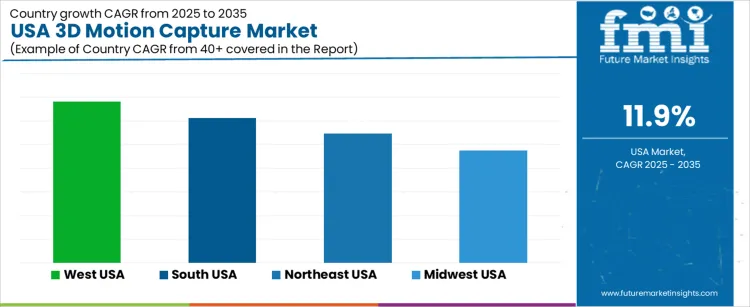
Demand for 3D motion capture in the USA is growing rapidly, with West USA leading at a 13.7% CAGR, driven by its strong entertainment, gaming, and technology sectors. South USA follows with a 12.2% CAGR, fueled by expanding industries in film, gaming, sports, and healthcare. Northeast USA experiences a 10.9% CAGR, supported by its established entertainment and healthcare industrys, where 3D motion capture is used for media production and rehabilitation. Midwest USA shows a 9.5% CAGR, with growing demand from automotive, healthcare, and educational sectors. As the technology expands into diverse fields, demand for 3D motion capture will continue to rise across all regions.
How is Demand for 3D Motion Capture Growing in West USA?
West USA leads the demand for 3D motion capture, growing at a 13.7% CAGR. The region's dominant entertainment and gaming industries are the primary drivers of this growth. Cities like Los Angeles and San Francisco are major hubs for film production, video game development, and virtual reality, where motion capture is used to create realistic animations and immersive experiences. The growing popularity of augmented reality (AR) and virtual reality (VR) technologies in sectors such as gaming, entertainment, and education is further fueling the adoption of 3D motion capture systems. The tech-driven ecosystem in the West, including industries like robotics, healthcare, and sports, is adopting motion capture for applications like performance analysis and physical rehabilitation. The region’s high concentration of R&D and innovation also contributes to expanding use cases for this technology. As the demand for more advanced and interactive entertainment and functional applications grows, West USA will continue to drive the industry for 3D motion capture, with strong growth expected in the coming years.
Why is Demand for 3D Motion Capture Rising in South USA?
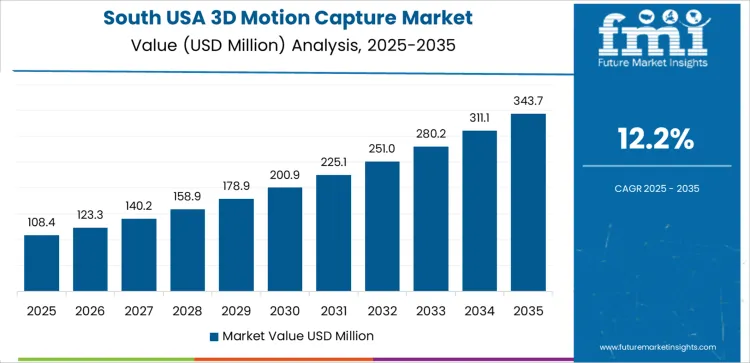
South USA is experiencing significant demand for 3D motion capture, with a 12.2% CAGR. The region's growing presence in the entertainment, technology, and sports sectors is contributing to this increase. Cities like Austin and Atlanta are becoming important hubs for film, video game production, and virtual reality, where 3D motion capture is widely used to create lifelike animations and interactive experiences. The region’s increasing investment in esports and gaming further drives demand for motion capture technologies, which are used to capture human movement and enhance player experiences. Beyond entertainment, industries like healthcare are adopting 3D motion capture for applications such as physical therapy, biomechanics analysis, and sports performance. The use of this technology in sports training and injury prevention is also expanding. As the South continues to grow as a key player in both entertainment and tech, demand for 3D motion capture systems will continue to rise across diverse sectors, enhancing creativity and functionality in media and healthcare applications.
How is Demand for 3D Motion Capture Expanding in Northeast USA?
Northeast USA is seeing steady demand for 3D motion capture, with a 10.9% CAGR. The region’s well-established entertainment, healthcare, and education sectors are major contributors to this growth. In cities like New York and Boston, 3D motion capture is used in film production, television, and digital media to create realistic animations and virtual environments. The growing adoption of this technology in healthcare is also significant, as it plays a vital role in physical therapy, rehabilitation, and biomechanical studies. Educational institutions in the Northeast are incorporating 3D motion capture into research and training programs for fields such as sports science, robotics, and human movement analysis. As the technology advances, the demand for motion capture in various field ranging from entertainment to medical research and education is expected to grow steadily. With its ability to capture human movement and translate it into digital formats for use in diverse applications, 3D motion capture will continue to be a valuable tool in the Northeast’s creative and functional industries.
Why is Demand for 3D Motion Capture Growing in Midwest USA?
Midwest USA is experiencing moderate demand for 3D motion capture, with a 9.5% CAGR. The region’s diverse industrial sectors, including automotive, manufacturing, healthcare, and education, are driving the adoption of this technology. Major cities like Detroit and Chicago, known for their strong automotive and robotics industries, are increasingly using 3D motion capture for product design, simulation, and testing. Automotive manufacturers are adopting motion capture to model human movement and test vehicle ergonomics. The healthcare sector in the Midwest is utilizing 3D motion capture for sports performance analysis, physical therapy, and biomechanics research. As more universities and research institutions in the Midwest incorporate 3D motion capture into their programs for movement analysis and virtual simulations, demand for the technology continues to grow. With a focus on improving efficiency and performance across multiple sectors, the Midwest is embracing 3D motion capture not only in creative fields but also in practical applications like healthcare and automotive design, contributing to steady growth in the region.
What is the Competitive Landscape of 3D Motion Capture Demand in USA?
Demand for 3D motion capture technology in the USA is increasing across industries such as entertainment, sports, healthcare, and research. This technology is used to capture the movement of objects or people, converting it into digital data for various applications like animation, biomechanics analysis, and virtual reality. As industries look for more accurate, efficient, and cost-effective solutions for motion analysis, the demand for advanced 3D motion capture systems continues to grow, particularly with the rise of digital content creation and sports performance analysis.
Other key players in the industry include Noitom, Rokoko, Noraxon USA, and STT Systems. Noitom focuses on offering affordable, high-quality motion capture solutions, with an emphasis on accessibility and ease of use. Rokoko offers flexible and portable motion capture systems, allowing users to capture data remotely and efficiently, appealing to creative professionals and small studios. Noraxon USA specializes in motion capture systems tailored for biomechanics and sports science, providing data for health and performance analysis. STT Systems is known for its integration of motion capture technology into medical and clinical applications. As the industry evolves, these companies continue to innovate, offering specialized solutions that cater to the growing demand for 3D motion capture across different sectors.
Key Players in 3D Motion Capture Demand
- Qualisys
- Noitom
- Rokoko
- Noraxon USA
- STT Systems
Scope of Report
| Items | Values |
|---|---|
| Quantitative Units (2025) | USD million |
| System | Optical 3D Motion Capture Systems, Non-optical 3D Motion Capture Systems |
| Component | Hardware, Software, Services |
| Application | Media & Entertainment, Biomechanical Research and Medical, Engineering Design and Industrial Applications, Education, Automotive |
| Regions Covered | West USA, South USA, Northeast USA, Midwest USA |
| Countries Covered | USA |
| Key Companies Profiled | Qualisys, Noitom, Rokoko, Noraxon USA, STT Systems |
| Additional Attributes | Dollar sales by system, application, and region; regional CAGR and growth outlook; increasing adoption in entertainment and automotive sectors; emerging trends in biomechanics. |
USA 3D Motion Capture Demand by Key Segments
System:
- Optical 3D Motion Capture Systems
- Non-optical 3D Motion Capture Systems
Component:
- Hardware
- Software
- Services
Application:
- Media & Entertainment
- Biomechanical Research and Medical
- Engineering Design and Industrial Applications
- Education
- Automotive
Region:
- West USA
- South USA
- Northeast USA
- Midwest USA
Frequently Asked Questions
How big is the demand for 3D motion capture in USA in 2025?
The demand for 3D motion capture in USA is estimated to be valued at USD 181.2 million in 2025.
What will be the size of 3D motion capture in USA in 2035?
The market size for the 3D motion capture in USA is projected to reach USD 556.6 million by 2035.
How much will be the demand for 3D motion capture in USA growth between 2025 and 2035?
The demand for 3D motion capture in USA is expected to grow at a 11.9% CAGR between 2025 and 2035.
What are the key product types in the 3D motion capture in USA?
The key product types in 3D motion capture in USA are optical 3D motion capture systems and non-optical 3D motion capture systems.
Which component segment is expected to contribute significant share in the 3D motion capture in USA in 2025?
In terms of component, hardware segment is expected to command 50.0% share in the 3D motion capture in USA in 2025.
Preview the report firsthand - request a free sample
Get SampleGet the brochure for pricing and purchase details.
Get PDFTable of Content
- Executive Summary
- USA Market Outlook
- Demand-side Trends
- Supply-side Trends
- Technology Roadmap Analysis
- Analysis and Recommendations
- Market Overview
- Market Coverage / Taxonomy
- Market Definition / Scope / Limitations
- Market Background
- Market Dynamics
- Drivers
- Restraints
- Opportunity
- Trends
- Scenario Forecast
- Demand in Optimistic Scenario
- Demand in Likely Scenario
- Demand in Conservative Scenario
- Opportunity Map Analysis
- Product Life Cycle Analysis
- Supply Chain Analysis
- Investment Feasibility Matrix
- Value Chain Analysis
- PESTLE and Porter’s Analysis
- Regulatory Landscape
- Regional Parent Market Outlook
- Production and Consumption Statistics
- Import and Export Statistics
- Market Dynamics
- USA Market Analysis 2020 to 2024 and Forecast, 2025 to 2035
- Historical Market Size Value (USD Million) Analysis, 2020 to 2024
- Current and Future Market Size Value (USD Million) Projections, 2025 to 2035
- Y-o-Y Growth Trend Analysis
- Absolute $ Opportunity Analysis
- USA Market Pricing Analysis 2020 to 2024 and Forecast 2025 to 2035
- USA Market Analysis 2020 to 2024 and Forecast 2025 to 2035, By System
- Introduction / Key Findings
- Historical Market Size Value (USD Million) Analysis By System , 2020 to 2024
- Current and Future Market Size Value (USD Million) Analysis and Forecast By System , 2025 to 2035
- Optical 3D Motion Capture Systems
- Non-optical 3D Motion Capture Systems
- Y-o-Y Growth Trend Analysis By System , 2020 to 2024
- Absolute $ Opportunity Analysis By System , 2025 to 2035
- USA Market Analysis 2020 to 2024 and Forecast 2025 to 2035, By Component
- Introduction / Key Findings
- Historical Market Size Value (USD Million) Analysis By Component, 2020 to 2024
- Current and Future Market Size Value (USD Million) Analysis and Forecast By Component, 2025 to 2035
- Hardware
- Software
- Services
- Y-o-Y Growth Trend Analysis By Component, 2020 to 2024
- Absolute $ Opportunity Analysis By Component, 2025 to 2035
- USA Market Analysis 2020 to 2024 and Forecast 2025 to 2035, By Application
- Introduction / Key Findings
- Historical Market Size Value (USD Million) Analysis By Application, 2020 to 2024
- Current and Future Market Size Value (USD Million) Analysis and Forecast By Application, 2025 to 2035
- Media & Entertainment
- Biomechanical Research and Medical
- Engineering Design and Industrial Applications
- Education
- Automotive
- Y-o-Y Growth Trend Analysis By Application, 2020 to 2024
- Absolute $ Opportunity Analysis By Application, 2025 to 2035
- Market Structure Analysis
- Competition Dashboard
- Competition Benchmarking
- Market Share Analysis of Top Players
- By Regional
- By System
- By Component
- By Application
- Competition Analysis
- Competition Deep Dive
- Qualisys
- Overview
- Product Portfolio
- Profitability by Market Segments (Product/Age /Sales Channel/Region)
- Sales Footprint
- Strategy Overview
- Marketing Strategy
- Product Strategy
- Channel Strategy
- Noitom
- Rokoko
- Noraxon USA
- STT Systems
- Qualisys
- Competition Deep Dive
- Assumptions & Acronyms Used
- Research Methodology


