

- Industry Size (2025)
- USD 83.8 Mn
- Forecast (2035)
- USD 128.3 Mn
- CAGR (2025 to 2035)
- 4.4%
Demand for Arylamide Pigments in Japan Forecast and Outlook 2025 to 2035
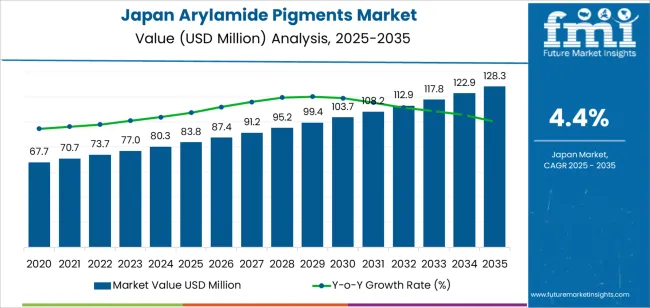
In 2025 the market for arylamide pigments in Japan stands at USD 83.8 million. By 2035 demand is expected to reach USD 128.3 million, corresponding to a CAGR of 4.4%. In the early phase (2025-2030) the market rises gradually from USD 83.8 million to about USD 99.4 million. This period reflects growing demand from the coatings, plastics, and textile sectors. Manufacturers respond to consumer preferences for vivid and long lasting colors in automotive coatings, home appliances, and consumer goods. Regulatory standards on paint quality and color consistency encourage use of high performance pigments. Demand also grows in specialty printing and packaging materials.
The later phase (2030-2035) shows a stronger momentum as the market moves from roughly USD 99.4 million to USD 128.3 million. During this stage adoption extends to newer applications such as high end plastics, advanced coatings for electric vehicles, and premium consumer products. Innovation in pigment purity, light fastness, and compatibility with eco friendly resins supports adoption. Local pigment producers and global chemical firms operating in Japan invest in R&D and high precision production methods. Shift towards higher end applications lead to greater value per unit consumption. The later growth curve reflects rising technical requirements in end use industries, enhanced pigment performance demand, and expansion across traditional and emerging applications.
Quick Stats for Arylamide Pigments Industry in Japan
- Demand for Arylamide Pigments in Japan Value (2025): USD 83.8 million
- Demand for Arylamide Pigments in Japan Forecast Value (2035): USD 128.3 million
- Demand for Arylamide Pigments in Japan Forecast CAGR (2025-2035): 4.4%
- Leading Pigment Type in Japan: Arylamide Yellow (38%)
- Key Growth Regions for Arylamide Pigments in Japan: Kyushu & Okinawa, Kanto, Kinki, Chubu, Tohoku, Rest of Japan
- Top Players in Arylamide Pigments Industry in Japan: BASF SE, Clariant AG, Sun Chemical Corporation, DIC Corporation, Heubach GmbH
What is the Growth Forecast for Arylamide Pigments in Japan through 2035?
From 2025 to 2030, demand for arylamide pigments in Japan is expected to rise from USD 83.8 million to about USD 87.4 million. This increment reflects a modest but stable increase, indicating a gradual expansion driven by increased use in coatings, inks, and specialty materials. The growth during this phase is underpinned by consistent demand in traditional end use industries such as automotive coatings and industrial paints. The steady incremental growth suggests no major disruption in supply or demand and indicates that the industry is consolidating its base while maintaining predictable annual increases.
From 2030 to 2035, the market moves from USD 87.4 million to USD 128.3 million, representing an absolute growth of USD 44.5 million and an overall scale-up of roughly 53% over the decade. This phase marks a breakpoint where demand accelerates substantially. Drivers for this breakpoint likely include expanded application of arylamide pigments in high-performance coatings, increased regulatory focus on pigment durability and lightfastness, and rising demand in sectors such as industrial coatings, automotive refinishing, and specialty polymers. The shift from gradual growth to accelerated expansion suggests structural change in demand patterns, making this period critical for capacity planning and strategic investment by pigment producers.
Arylamide Pigments Industry in Japan Key Takeaways
| Metric | Value |
|---|---|
| Industry Value (2025) | USD 83.8 million |
| Forecast Value (2035) | USD 128.3 million |
| Forecast CAGR (2025 to 2035) | 4.4% |
What Is Driving the Demand for Arylamide Pigments in Japan?
The demand for arylamide pigments in Japan reflects broader growth in the national pigments sector, which increasingly favours high performance and speciality pigments over legacy inorganic pigments. As manufacturers in automotive coatings, plastics, printing inks, and consumer goods seek pigments with superior lightfastness, heat resistance, and vivid colour strength, arylamide pigments have gained traction. The structural expansion of industries such as automotive, electronics, packaging, and textiles in Japan has increased demand for speciality pigment types rather than standard inorganic or conventional organic pigments. This trend has pushed pigment buyers and formulators to adopt arylamide pigments for applications requiring durable, high quality colour performance.
Looking ahead the demand outlook for arylamide pigments in Japan appears favourable as several market and regulatory factors evolve. Growing regulatory pressure on heavy metal based pigments and rising preference for pigments that meet stricter environmental and performance standards encourage adoption of arylamide solutions. Expansion in printing inks for high end packaging, increased production of plastics with aesthetic demands, and growing output of automotive coatings with durable finish requirements will drive further uptake.
Advances in pigment dispersion and formulation technology will enable broader use across plastics, textiles, and industrial coatings. While cost premiums relative to conventional pigments remain a constraint, the balance of regulatory compliance, performance needs, and industrial demand supports rising adoption of arylamide pigments in Japan.
What Factors Are Affecting the Demand for Arylamide Pigments in Japan in Terms of Type and End User Industry?
The demand for arylamide pigments in Japan is driven by both pigment type and end-user industry. The primary types of arylamide pigments include yellow, red, orange, and others, with arylamide yellow accounting for 38% of the total demand. In terms of end-user industries, the key sectors include printing inks (32%), paints and coatings, plastics, textiles, paper, and other applications. The choice of pigment type depends on the specific color requirements, application needs, and performance characteristics, such as lightfastness, heat stability, and chemical resistance. Industries like printing and coatings dominate the demand due to their reliance on vibrant, durable pigments for high-quality output.
What Drives the Leading Demand for Arylamide Yellow Pigments in Japan?
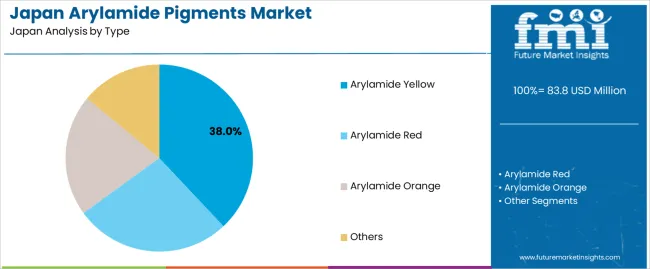
Arylamide yellow pigments represent 38% of the total demand for arylamide pigments in Japan. This dominance is driven by their strong, vibrant color and excellent performance in various applications. Arylamide yellow pigments are widely used in printing inks, where they provide bright, consistent hues necessary for high-quality printing. These pigments also offer good lightfastness and heat resistance, making them suitable for use in outdoor applications and products exposed to sunlight. Their versatility allows them to be used in a wide range of industries, including paints and coatings, where durability and color accuracy are critical.
The continued demand for arylamide yellow pigments is also fueled by their cost-effectiveness and ease of incorporation into various formulations. In the printing industry, where high-quality color reproduction is paramount, these pigments provide a reliable and stable option. Additionally, the ongoing expansion of packaging and label printing in Japan’s thriving consumer goods sector continues to support the use of arylamide yellow pigments. As the demand for bright, durable colors across multiple industries remains strong, arylamide yellow will continue to be a key player in the pigment market.
What Is Driving the Demand for Printing Inks in Arylamide Pigment Applications in Japan?
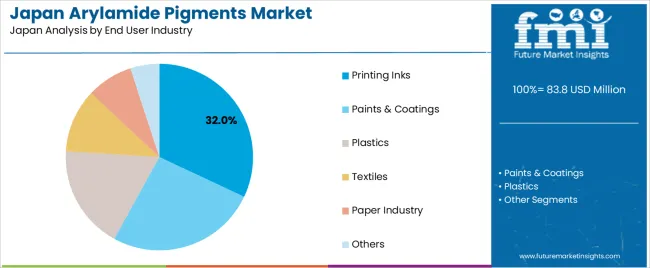
Printing inks account for 32% of the total demand for arylamide pigments in Japan. This demand is primarily driven by the widespread use of printing inks in packaging, labels, and advertising materials, where vibrant and accurate color reproduction is crucial. Arylamide pigments, particularly yellow and red, are favored in the printing industry for their ability to deliver high-quality colors that are both stable and durable. The growing demand for visually appealing packaging and printed materials in Japan’s consumer goods market continues to drive the use of these pigments in printing inks.
The printing inks sector’s demand for arylamide pigments is also supported by the increasing emphasis on eco-friendly and sustainable printing practices. As consumer preferences shift toward environmentally conscious packaging, manufacturers are turning to pigments that meet these criteria without compromising on color intensity or performance. Arylamide pigments’ ability to provide excellent coverage and resistance to fading under UV exposure makes them ideal for high-quality printed materials. As the printing industry continues to expand and innovate, the demand for arylamide pigments in printing inks will remain robust in Japan.
What Are the Key Drivers Shaping Demand for Arylamide Pigments in Japan?
Demand for arylamide pigments in Japan gains momentum from the country’s advanced manufacturing sectors such as automotive, electronics, consumer goods and high end coatings. Japanese auto makers and component suppliers require pigments capable of withstanding high heat, UV exposure and chemical stress, which makes arylamide pigments a favorable choice. Growth in plastic consumer electronics, appliances and decorative coatings adds further demand because these pigments offer strong tinting strength, good lightfastness and chemical resistance. Evolving consumer expectations for vibrant, durable finishes in products also encourages formulators to rely on high performance pigment solutions instead of conventional dyes or lower grade pigments.
How Does Industry and End Use Diversification Drive Arylamide Pigment Use in Japan?
In Japan diverse end use industries such as printing inks, plastics, textile coatings and industrial paints underpin arylamide pigment demand. Printing and packaging sectors increasingly favour organic pigments over traditional inorganic ones for brighter colours and lighter weight plastic packaging. Electronics and consumer goods manufacturers seek pigments that provide stable colour under repeated heat cycles and exposure to light. The presence of domestic chemical firms producing specialty pigments, combined with local formulation expertise, encourages industrial users to adopt arylamide-based colourants. This diversified demand base helps maintain stable uptake in spite of cyclic economic fluctuations.
What Material, Regulatory and Competitive Constraints Limit Wider Adoption of Arylamide Pigments in Japan?
Adoption of arylamide pigments in Japan faces constraints arising from cost, competition and regulatory pressures. Compared with standard inorganic pigments, arylamide pigments require more complex synthesis, which increases raw material and processing costs. In cost-sensitive segments such as basic coatings or low end plastic goods manufacturers may opt for cheaper alternatives. Regulatory scrutiny on pigment safety, heavy metal content and environmental compliance raises testing and documentation costs for suppliers and formulators. Intense competition from global and local pigment suppliers, producing inorganic, hybrid or newer pigment chemistries, limits pricing power for arylamide pigment producers in lower-margin segments.
What Trends in Formulation, Sustainability and Performance Are Influencing Arylamide Pigment Demand in Japan?
In Japan the pigment market is shifting toward high performance, specialty and environmentally compliant formulations, which works in favor of arylamide pigments. Rising demand exists for pigments with high heat stability, excellent fade resistance and compatibility with advanced plastics and resins used in automotive and electronics. Simultaneously there is growing interest in pigments formulated for reduced volatile organic compound (VOC) coatings, waterborne paints, and solvent free ink systems, aligning with environmental regulations and consumer preferences. Custom pigment grading and improved dispersion technologies are enabling arylamide pigments to meet stringent Japanese quality expectations in sectors such as automotive coatings, consumer electronics, and premium packaging.
What is the Demand for Arylamide Pigments in Japan by Region?
| Region | CAGR (%) |
|---|---|
| Kyushu & Okinawa | 5.4% |
| Kanto | 5.0% |
| Kinki | 4.4% |
| Chubu | 3.9% |
| Tohoku | 3.4% |
| Rest of Japan | 3.2% |
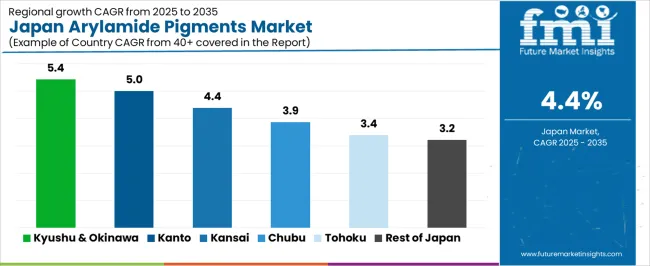
The demand for arylamide pigments in Japan is expected to grow unevenly across regions, with Kyushu & Okinawa leading at a CAGR of 5.4%. This higher growth likely reflects expanding demand from coatings, plastics, textiles and printing ink sectors that value arylamide pigments for their strong colour strength, heat resistance, and lightfastness. The Kanto region follows at 5.0%, supported by its concentration of automotive, electronic, and manufacturing industries that consume coatings and plastics.
In the Kinki region a 4.4% growth rate aligns with moderate industrial and manufacturing activity. The Chubu region at 3.9% shows slower but steady uptake. Tohoku and the Rest of Japan, at 3.4% and 3.2%, show comparatively lower growth. Overall the pattern reflects correlation between regional industrial concentration and pigment demand intensity.
What is Driving the Demand for Arylamide Pigments in Kyushu and Okinawa Regions of Japan?
Growth in Kyushu and Okinawa reflects a CAGR of 5.4% through 2035 for arylamide pigments, supported by expanding plastics, printing, and packaging activity across manufacturing hubs. Coatings, industrial inks, and polymer coloring remain primary application areas due to stable construction output and export focused manufacturing. The regional presence of packaging converters and molded plastics suppliers sustains pigment blending and dispersion demand. Marine exposure across coastal zones encourages color stability requirements in coatings. Logistics access through southern ports improves raw material availability and outbound pigment shipments serving domestic converters and overseas buyers with steady batch driven purchasing cycles.
- Plastics and packaging production supports pigment volume growth
- Coastal exposure raises demand for stable color formulations
- Export focused manufacturing sustains pigment output
- Ports improve raw material and finished pigment logistics
How is Kanto Shaping the Demand for Arylamide Pigments in Japan?
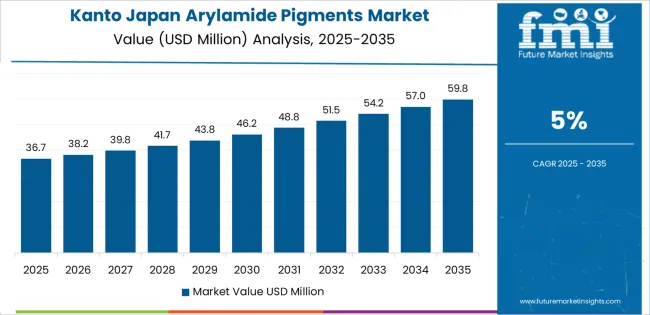
Kanto advances at a CAGR of 5.0% through 2035 for arylamide pigment demand, driven by dense printing, packaging, automotive coatings, and consumer goods manufacturing. High consumption of branded packaging and commercial printing keeps ink and toner pigment usage elevated. Automotive refinishing and appliance coatings add steady industrial color requirements. Strong distributor networks in Tokyo and surrounding prefectures maintain inventory flow to downstream users. Demand is reinforced by fast turnover in retail packaging formats and large scale polymer processors supplying domestic consumer markets with frequent color reformulation cycles tied to product design updates.
- Commercial printing sustains steady ink pigment consumption
- Automotive and appliance coatings reinforce industrial demand
- Distributor networks maintain consistent supply availability
- Retail packaging turnover accelerates pigment usage frequency
Why is Arylamide Pigment Demand Expanding in Kinki Region of Japan?
Kinki records a CAGR of 4.4% through 2035 for arylamide pigment demand, supported by balanced contributions from packaging, plastics processing, and industrial coatings. Manufacturing clusters around Osaka drive sustained pigment usage in molded consumer goods and film packaging. Printing inks for commercial and food packaging remain stable demand channels. Architectural coatings for renovation projects also add incremental pigment consumption. Supply chains depend on regional chemical distributors serving medium scale processors. Color standardization requirements across branded packaging sustain purchase consistency even where overall manufacturing growth remains moderate.
- Packaging film and molded goods drive baseline pigment usage
- Commercial printing maintains stable ink demand
- Renovation coatings contribute incremental pigment volume
- Distributor led supply supports medium scale processors
What is Supporting Arylamide Pigment Demand Growth in Chubu Region of Japan?
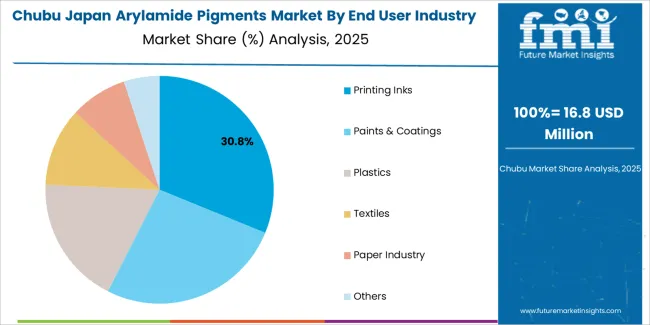
Chubu expands at a CAGR of 3.9% through 2035 for arylamide pigment demand, led by plastics, automotive components, and industrial coatings consumption tied to manufacturing supply chains. Automotive interior parts and under hood plastics rely on durable pigmentation for heat and wear resistance. Packaging demand remains steady from food and industrial goods logistics. Pigment demand follows OEM production rhythms rather than retail volatility. Access to upstream chemical feedstocks supports stable formulation activity. Supply flows remain structured around contract manufacturing and long term procurement agreements with large polymer and coatings producers.
- Automotive plastics remain a key pigment application
- Industrial packaging sustains routine color consumption
- OEM driven production governs pigment ordering patterns
- Contract manufacturing stabilizes long term pigment demand
How is Arylamide Pigment Demand Developing in Tohoku Region of Japan?
Tohoku posts a CAGR of 3.4% through 2035 for arylamide pigment demand, shaped by moderate packaging, agricultural plastics, and construction coatings usage. Regional food packaging and farm equipment components use pigmented polymers at steady volumes. Infrastructure upkeep sustains limited but consistent architectural coatings demand. Manufacturing density remains lower than central regions, keeping overall pigment throughput moderate. Distribution relies on interregional supply from Kanto and Chubu. Demand grows through replacement cycles rather than capacity expansion, with bulk color concentrates preferred for cost control by smaller processors.
- Agricultural plastics support steady pigment demand
- Food packaging provides routine polymer coloring needs
- Infrastructure coatings add selective pigment usage
- Interregional supply fulfills most formulation requirements
What is Driving Arylamide Pigment Demand in the Rest of Japan?
The rest of Japan reflects a CAGR of 3.2% through 2035 for arylamide pigment demand, supported by rural packaging, municipal coatings, and small scale plastics manufacturing. Local food processors, consumer goods workshops, and maintenance contractors account for most pigment use. Demand remains tied to repair cycles, seasonal packaging needs, and limited export oriented plastics output. Manufacturing density is dispersed, favoring distributor stocked pigment grades. Growth remains steady rather than rapid due to slower industrial turnover and lower automation intensity in secondary prefectures compared with core industrial regions.
- Rural packaging sustains baseline pigment consumption
- Municipal maintenance coatings support routine demand
- Small plastics workshops rely on distributor stock supply
- Seasonal production cycles influence purchase frequency
What Is Driving the Demand for Arylamide Pigments in Japan and Who Are the Key Players Shaping the Industry?
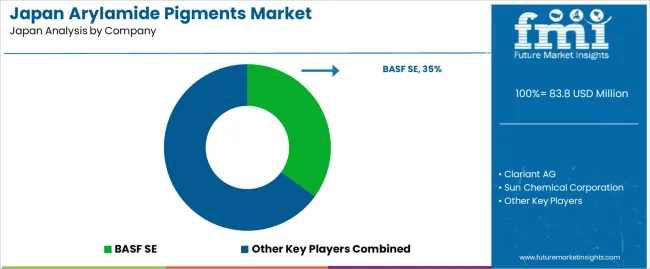
Demand for arylamide pigments in Japan is rising because downstream industries require high performance organic pigments for paints, coatings, plastics, printing inks, textiles, and automotive finishes. As Japanese manufacturers aim for durable colorants with strong tint strength, chemical and heat resistance, and good lightfastness, arylamide pigments meet those needs. Growth in automotive coatings, industrial machinery, plastics goods, and packaging drives demand. The shift toward high quality finishes and stable coloration in coatings and printing inks also increases reliance on pigments whose properties support long term performance and consistent visuals.
Major suppliers in the Japanese arylamide pigment segment include BASF SE, Clariant AG, Sun Chemical Corporation, DIC Corporation, and Heubach GmbH. BASF (through its pigments business, now integrated with DIC in Japan) offers a broad range of pigment types used in coatings and plastics applications. Clariant supplies organic pigment solutions valued for stable color and performance in coatings, inks, and plastics. Sun Chemical and DIC (which are associated via corporate ownership) provide pigments and colorants tailored to printing inks, packaging, and industrial coatings. Heubach specialises in custom pigment solutions for textile, coatings, and printing applications. These companies influence the market by offering a mix of global pigment expertise and local supply chains to meet Japan’s diverse industrial colorant requirements.
Key Players in Demand for Arylamide Pigments Industry in Japan
- BASF SE
- Clariant AG
- Sun Chemical Corporation
- DIC Corporation
- Heubach GmbH
Scope of the report
| Items | Values |
|---|---|
| Quantitative Units (2025) | USD million |
| Type | Arylamide Yellow, Arylamide Red, Arylamide Orange, Others |
| End User Industry | Printing Inks, Paints & Coatings, Plastics, Textiles, Paper Industry, Others |
| Region | Kyushu & Okinawa, Kanto, Kinki, Chubu, Tohoku, Rest of Japan |
| Countries Covered | Japan |
| Key Companies Profiled | BASF SE, Clariant AG, Sun Chemical Corporation, DIC Corporation, Heubach GmbH |
| Additional Attributes | Dollar by sales by pigment type and end-user industry; regional CAGR and volume growth projections; breakdown of pigment demand by color type; key end-use trends in automotive coatings, plastics, and printing inks; regulatory compliance impact on pigment selection; lightfastness, heat stability, and chemical resistance requirements; emerging applications in EV coatings, premium plastics, and industrial coatings; innovation in pigment dispersion and high-performance formulations; competition from inorganic and hybrid pigments; local vs global supplier activity and capacity trends. |
Demand for Arylamide Pigments Industry in Japan Segmentation
Type:
- Arylamide Yellow
- Arylamide Red
- Arylamide Orange
- Others
End User Industry:
- Printing Inks
- Paints & Coatings
- Plastics
- Textiles
- Paper Industry
- Others
Region
- Kyushu & Okinawa
- Kanto
- Kinki
- Chubu
- Tohoku
- Rest of Japan
Frequently Asked Questions
How big is the demand for arylamide pigments in Japan in 2025?
The demand for arylamide pigments in Japan is estimated to be valued at USD 83.8 million in 2025.
What will be the size of arylamide pigments in Japan in 2035?
The market size for the arylamide pigments in Japan is projected to reach USD 128.3 million by 2035.
How much will be the demand for arylamide pigments in Japan growth between 2025 and 2035?
The demand for arylamide pigments in Japan is expected to grow at a 4.4% CAGR between 2025 and 2035.
What are the key product types in the arylamide pigments in Japan?
The key product types in arylamide pigments in Japan are arylamide yellow, arylamide red, arylamide orange and others.
Which end user industry segment is expected to contribute significant share in the arylamide pigments in Japan in 2025?
In terms of end user industry, printing inks segment is expected to command 32.0% share in the arylamide pigments in Japan in 2025.
Preview the report firsthand - request a free sample
Get SampleGet the brochure for pricing and purchase details.
Get PDFTable of Content
- Executive Summary
- Japan Market Outlook
- Demand-side Trends
- Supply-side Trends
- Technology Roadmap Analysis
- Analysis and Recommendations
- Market Overview
- Market Coverage / Taxonomy
- Market Definition / Scope / Limitations
- Market Background
- Market Dynamics
- Drivers
- Restraints
- Opportunity
- Trends
- Scenario Forecast
- Demand in Optimistic Scenario
- Demand in Likely Scenario
- Demand in Conservative Scenario
- Opportunity Map Analysis
- Product Life Cycle Analysis
- Supply Chain Analysis
- Investment Feasibility Matrix
- Value Chain Analysis
- PESTLE and Porter’s Analysis
- Regulatory Landscape
- Regional Parent Market Outlook
- Production and Consumption Statistics
- Import and Export Statistics
- Market Dynamics
- Japan Market Analysis 2020 to 2024 and Forecast, 2025 to 2035
- Historical Market Size Value (USD Million) Analysis, 2020 to 2024
- Current and Future Market Size Value (USD Million) Projections, 2025 to 2035
- Y-o-Y Growth Trend Analysis
- Absolute $ Opportunity Analysis
- Japan Market Pricing Analysis 2020 to 2024 and Forecast 2025 to 2035
- Japan Market Analysis 2020 to 2024 and Forecast 2025 to 2035, By Type
- Introduction / Key Findings
- Historical Market Size Value (USD Million) Analysis By Type , 2020 to 2024
- Current and Future Market Size Value (USD Million) Analysis and Forecast By Type , 2025 to 2035
- Arylamide Yellow
- Arylamide Red
- Arylamide Orange
- Others
- Y-o-Y Growth Trend Analysis By Type , 2020 to 2024
- Absolute $ Opportunity Analysis By Type , 2025 to 2035
- Japan Market Analysis 2020 to 2024 and Forecast 2025 to 2035, By End User Industry
- Introduction / Key Findings
- Historical Market Size Value (USD Million) Analysis By End User Industry, 2020 to 2024
- Current and Future Market Size Value (USD Million) Analysis and Forecast By End User Industry, 2025 to 2035
- Printing Inks
- Paints & Coatings
- Plastics
- Textiles
- Paper Industry
- Others
- Y-o-Y Growth Trend Analysis By End User Industry, 2020 to 2024
- Absolute $ Opportunity Analysis By End User Industry, 2025 to 2035
- Market Structure Analysis
- Competition Dashboard
- Competition Benchmarking
- Market Share Analysis of Top Players
- By Regional
- By Type
- By End User Industry
- Competition Analysis
- Competition Deep Dive
- BASF SE
- Overview
- Product Portfolio
- Profitability by Market Segments (Product/Age /Sales Channel/Region)
- Sales Footprint
- Strategy Overview
- Marketing Strategy
- Product Strategy
- Channel Strategy
- Clariant AG
- Sun Chemical Corporation
- DIC Corporation
- Heubach GmbH
- BASF SE
- Competition Deep Dive
- Assumptions & Acronyms Used
- Research Methodology


