

- Industry Size (2025)
- USD 2.5 Bn
- Forecast (2035)
- USD 3.6 Bn
- CAGR (2025 to 2035)
- 3.8%
Demand for Bag in Japan Forecast and Outlook 2025 to 2035
The demand for bag in Japan is valued at USD 2.5 billion in 2025 and is projected to reach USD 3.6 billion by 2035, reflecting a compound annual growth rate of 3.8%. Growth is shaped by expanding use of bag products across retail packaging, industrial containment and consumer carrying applications. Retailers, logistics providers and consumer goods companies continue to integrate these solutions into operations that require portable storage and product protection. As supply chain managers refine packaging strategies and incorporate more sustainable material options, demand strengthens across a widening set of distribution scenarios. These adoption patterns support a stable and consistent rise throughout the forecast horizon.
The growth curve shows a clear upward trajectory, beginning at USD 2.2 billion in earlier years and increasing to USD 2.5 billion in 2025 before progressing toward USD 3.6 billion by 2035. Yearly values advance in steady increments, with demand rising from USD 2.6 billion in 2026 to USD 2.7 billion in 2027 and continuing through USD 3.1 billion in 2032 and USD 3.4 billion in 2034. This pattern reflects predictable expansion driven by regular packaging procurement, broader application in retail and logistics settings and the growing use of bag solutions across product distribution and consumer convenience. The curve highlights consistent growth supported by the combination of routine commercial need and extended adoption across Japan's retail, logistics and manufacturing landscape.
Quick Stats for the Bag Industry in Japan
- Bag Industry in Japan Value (2025): USD 2.5 billion
- Bag Industry in Japan Forecast Value (2035): USD 3.6 billion
- Bag Industry in Japan Forecast CAGR (2025–2035): 3.8%
- Bag Industry in Japan Leading Product Type: Plastic (34%)
- Bag Industry in Japan Key Growth Regions: Kyushu & Okinawa, Kanto, Kinki, Chubu
- Bag Industry in Japan Top Players: LouisVuitton, Gucci, SamsoniteInternational, AdidasAG, NikeInc
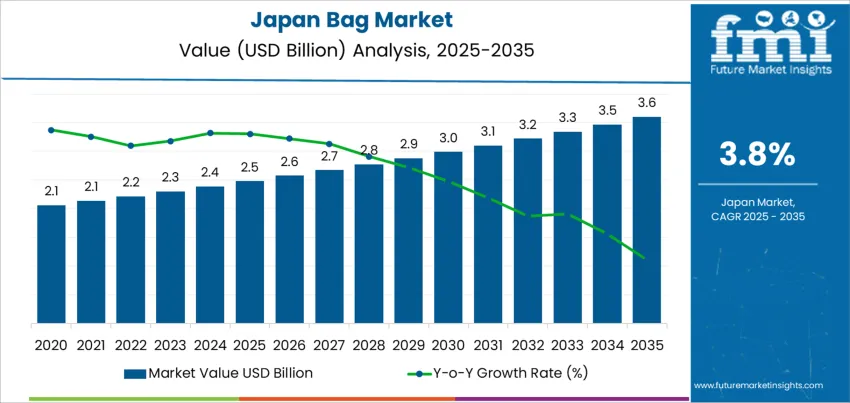
What is the Growth Forecast for Bag Industry in Japan through 2035?
Demand in Japan for bag is projected to increase from USD 2.5 billion in 2025 to USD 3.6 billion by 2035, reflecting a compound annual growth rate (CAGR) of approximately 3.8%. Starting at USD 2.2 billion in 2020, the value rises steadily: USD 2.3 billion in 2022, USD 2.4 billion in 2024, and USD 2.5 billion in 2025. From 2025 to 2030, demand climbs to around USD 2.9 billion, and by 2035 it reaches USD 3.6 billion. Growth is driven by expanding applications of bag products in retail packaging, logistics containment, consumer carrying solutions and e-commerce delivery in Japan's distribution-intensive commercial context.
Over the forecast period, the value uplift from USD 2.5 billion to USD 3.6 billion translates into an incremental opportunity of USD 1.1 billion. Early growth (2025 2030) is primarily volume driven as more retailers and logistics operators adopt bag solutions. In the latter years (2030-2035), value growth becomes increasingly significant: premium bag variants with enhanced durability, sustainable material composition, branded design elements and functional innovations elevate average selling prices. Suppliers who innovate in material sustainability, design differentiation and functional performance are best positioned to capture the full breadth of this demand growth in Japan.
Bag Industry in Japan Key Takeaways
| Metric | Value |
|---|---|
| Industry Value (2025) | USD 2.5 billion |
| Forecast Value (2035) | USD 3.6 billion |
| Forecast CAGR (2025–2035) | 3.8% |
What Is Driving the Demand for Bag in Japan?
The demand for bag in Japan has historically been shaped by the strength of domestic retail operations, where plastic carrier bags dominated point-of-sale packaging across convenience stores, supermarkets and specialty retail outlets. Japanese retailers focused on delivering convenient product transport, branded customer experience and efficient checkout operations, which supported steady procurement of polyethylene and polypropylene bag products. E-commerce expansion accelerated demand as Japan's online shopping growth required protective packaging solutions for home delivery shipments. Historical growth was reinforced by consistent retail density, since Japan maintained one of the world's highest convenience store concentrations per capita, creating predictable bag consumption tied to transaction volumes. These conditions created predictable, long-term demand for bag products tied closely to the retail activity levels and logistics throughput across urban centers within the country.
Future growth will be influenced by Japan's transition toward plastic reduction policies, regulatory pressure for sustainable packaging and the need for reusable bag systems that meet environmental compliance standards. Premium reusable bags, which serve both functional and fashion purposes, require durable materials that withstand repeated use while maintaining aesthetic appeal. This creates a continuing but more value-focused demand. Long-term challenges arise from the expansion of plastic bag charging policies that reduce single-use consumption. As Japan moves toward stricter environmental regulations, bag demand will rely increasingly on reusable variants, biodegradable alternatives and paper-based substitutes rather than broad, disposable plastic bag volumes.
What Factors Are Affecting the Demand for Bag in Japan in Terms of Product Type and Material?
The demand for bag in Japan is shaped by the product types used for carrying and containment purposes and the material compositions that determine environmental impact and durability. Product categories include plastic, paper, textile and others, each offering different strength characteristics and sustainability profiles. Materials such as woven bags, non-woven bags, household bags, industrial bags, institutional bags and end-user bags support varied commercial and consumer requirements. As retailers and logistics operators focus on consistent performance delivery and practical regulatory compliance, the combination of product type and material selection influences purchasing decisions across Japan's retail packaging, logistics supply and consumer goods settings.
What Drives the Leading Demand for Plastic Type Bag Products in Japan?
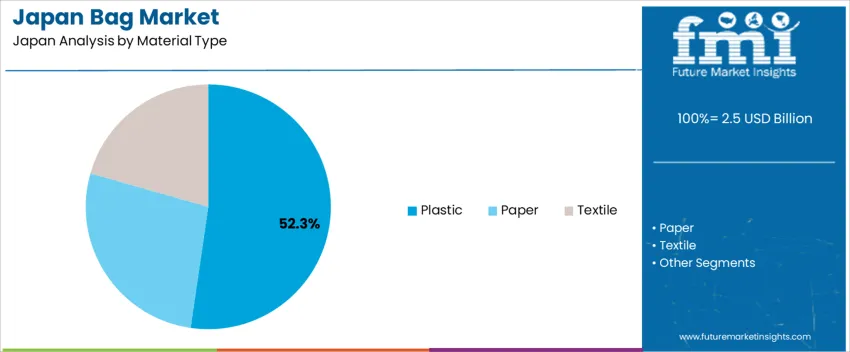
Plastic type accounts for 52.3% of total demand across product type categories in Japan. Its leading share reflects straightforward manufacturing economics, predictable load-bearing capacity and suitability for high-volume retail applications. Many convenience stores value plastic bags for consistent sealing performance that supports liquid containment, moisture protection and brand printing clarity. These products offer manageable cost structures and easy integration into existing checkout workflows. Their lightweight characteristics suit environments that prioritize minimal packaging weight without compromising carrying strength, reinforcing steady use across convenience retail operations.
Demand for plastic type bags also grows as retailers adopt thinner gauge films that reduce material consumption per unit. Facilities appreciate the reduced storage space requirements and predictable dispensing behavior associated with these products. Their transparent or semi-transparent properties support visual product identification, making them practical for grocery and retail applications. The material provides sufficient tear resistance for typical shopping loads, meeting expectations for routine consumer use. As retailers continue seeking cost-effective packaging solutions, plastic type bags maintain a strong presence in Japan.
What Drives the Leading Demand for Woven Bags Material Classification in Bag Applications in Japan?
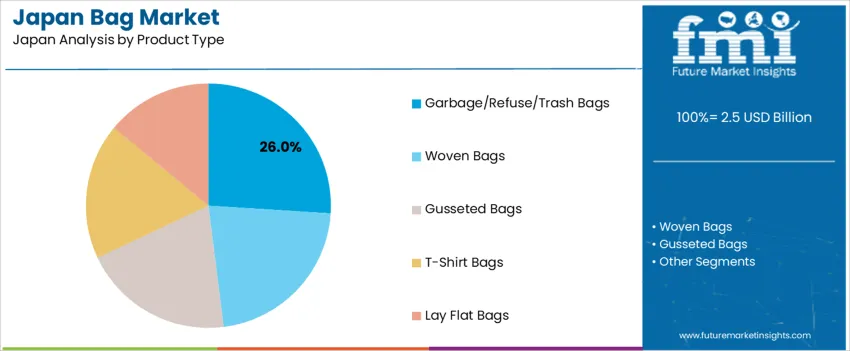
Woven bags material accounts for 22.0% of total demand across material categories in Japan. Its leading position reflects clear advantages in structural strength, reusability potential and premium positioning capability. Woven material bag products support repeated use scenarios in retail shopping, promotional distribution and consumer fashion applications, enabling retailers to deliver durable alternatives that align with plastic reduction initiatives. Their textile construction allows brand customization through printing, weaving patterns and handle designs that enhance customer experience. Retailers rely on these products for applications that require extended lifecycle performance and consumer appeal beyond single-use functionality.
Demand for woven bags material grows as environmental consciousness drives preference for reusable shopping solutions. The material classification supports marketing narratives that emphasize waste reduction and sustainable consumer behavior. Product developers value the material's compatibility with both functional retail needs and fashion accessory positioning. Consumer acceptance panels appreciate the tactile quality and visual variety that emerge from polypropylene weaving and cotton blending. As Japan continues to emphasize waste reduction, woven bags material remains central to sustainable packaging adoption.
What Is Shaping the Current Demand for Bag in Japan?
Demand for bag in Japan is influenced by dense retail networks, strict plastic reduction regulations and a consumer base that increasingly values environmental responsibility in packaging choices. Japan's retail ecosystem favors solutions that offer consistent performance across diverse weather conditions, extended reusability for cost amortization and compatibility with space-constrained urban living environments, which positions reusable bag systems well for supermarket shopping, convenience store purchases and department store transactions. At the same time, procurement decisions remain price-sensitive, and bag products must meet strict domestic standards for material safety, load capacity and compatibility with Japanese retail operational standards across distribution networks.
How Are Japan's Regulatory Environment and Consumer Behavior Encouraging New Adoption Patterns?
Bag products gain traction because Japan's plastic bag charging policies create economic incentives for reusable alternatives that deliver value through repeated use. Retailers and consumers rely heavily on cost-effective solutions that balance environmental compliance with practical carrying needs, and durable reusable bags align with this long-standing preference for long-term value. Japanese consumers also favor products that fold compactly for storage in limited apartment spaces, making portable reusable bag designs useful in daily shopping routines, commuting scenarios and travel applications. These patterns reflect Japan's focus on space efficiency and practical environmental action across urban consumer lifestyles.
Where Are Practical Growth Opportunities for Bag Products in Japan?
Opportunities exist in premium fashion-forward reusable bags, compact foldable designs for commuter use, branded promotional bags for retail loyalty programs and sustainable material innovations combining recycled content with aesthetic appeal. Japan's established retail merchandising culture creates openings for specialized bag products that integrate with seasonal campaigns, limited-edition collaborations and local design preferences. As municipalities expand plastic reduction enforcement, demand increases for affordable reusable alternatives with sufficient durability for daily use. Product suppliers offering Japan-specific sizing, cultural design sensitivity and reliable supply chain performance may find strong adoption.
What Local Factors Are Constraining Wider Adoption of Premium Bag Products in Japan?
Constraints stem from consumer price sensitivity for reusable alternatives, habit persistence around disposable bag convenience and strong preference for minimal carrying burden among aging demographics. Some consumer segments rely on existing plastic bag inventory accumulated at home rather than purchasing dedicated reusable options, slowing replacement cycles. Integration challenges with compact urban storage solutions and the need for alignment with Japanese aesthetic preferences further delay uptake. In addition, smaller independent retailers may hesitate due to limited awareness of sustainable bag sourcing options, creating uneven adoption across Japan.
What is the Demand for Bag in Japan by Region?
| Region | CAGR (%) |
|---|---|
| Kyushu & Okinawa | 5.5% |
| Kanto | 3.8% |
| Kinki | 2.8% |
| Chubu | 2.8% |
| Tohoku | 2.2% |
| Rest of Japan | 2.1% |
Demand for bag in Japan is rising across regions, with Kyushu and Okinawa leading at 5.5%. Growth in this region reflects expanding use of reusable bag solutions in retail chains, tourism-related retail and regional shopping districts. Kanto follows at 3.8%, supported by dense retail concentration and steady adoption in supermarket and convenience store channels. Kinki records 2.8%, shaped by active retail operations and consumer goods distribution applying bag products in everyday transactions. Chubu grows at 2.8%, influenced by regional retail networks and logistics providers integrating bag solutions into distribution operations. Tohoku reaches 2.2%, showing gradual but consistent adoption. The rest of Japan posts 2.1%, reflecting broader interest in bag products across smaller retail operations.
How Is Kyushu & Okinawa Driving Demand for Bag Products?
Kyushu & Okinawa is projected to grow at a CAGR of 5.5% through 2035 in demand for bag. Fukuoka retail operations and surrounding shopping districts are increasingly adopting reusable bag solutions for supermarket transactions, convenience store purchases and tourism retail applications. Rising demand for sustainable packaging alternatives, regulatory compliance solutions and consumer convenience options drives adoption. Suppliers provide durable, cost-effective and design-appealing bag products suitable for retail chains and independent shops. Distributors ensure accessibility across urban, semi-urban and retail facilities. Growth in sustainable retail packaging, tourism shopping experiences and convenience retail expansion supports steady adoption of bag products in Kyushu & Okinawa.
- Fukuoka retail chains adopt reusable solutions for supermarket and convenience applications.
- Sustainable packaging alternatives and regulatory compliance drive regional adoption trends.
- Durable and design-appealing products suit retail chain requirements.
- Distributors ensure access across urban, semi-urban and retail facilities.
How Is Kanto Supporting Demand for Bag Products?
Kanto is projected to grow at a CAGR of 3.8% through 2035 in demand for bag. Tokyo and surrounding regions are increasingly using bag products for supermarket shopping, department store purchases and e-commerce delivery packaging. Rising focus on plastic reduction compliance, consumer convenience and brand differentiation drives adoption. Suppliers provide functional, sustainable and customizable bag solutions suitable for large retail chains and logistics operators. Distributors ensure accessibility across urban, semi-urban and retail networks. Expansion in sustainable retail practices, e-commerce packaging and branded customer experiences supports steady adoption of bag products across Kanto.
- Tokyo retail operations adopt bag solutions for supermarket and e-commerce applications.
- Plastic reduction compliance and brand differentiation drive regional procurement trends.
- Functional, sustainable and customizable solutions support diverse retail needs.
- Distributors ensure access across urban, semi-urban and retail networks.
How Is Kinki Contributing to Demand for Bag Products?
Kinki is projected to grow at a CAGR of 2.8% through 2035 in demand for bag. Osaka, Kyoto and surrounding regions are increasingly adopting bag products for retail shopping, commercial distribution and consumer carrying applications. Rising demand for reusable alternatives, cost-effective solutions and regulatory compliance drives adoption. Suppliers provide practical, affordable and compliant bag products suitable for retail operators and distribution facilities. Distributors ensure accessibility across urban and semi-urban commercial centers. Growth in retail sustainability initiatives, commercial packaging needs and consumer shopping habits supports steady adoption of bag products across Kinki.
- Osaka and Kyoto retail operations adopt bag solutions for shopping and distribution applications.
- Reusable alternatives and regulatory compliance drive regional procurement trends.
- Practical, affordable and compliant products support retail operations.
- Distributors ensure access across urban and semi-urban commercial centers.
How Is Chubu Contributing to Demand for Bag Products?
Chubu is projected to grow at a CAGR of 2.8% through 2035 in demand for bag. Nagoya and surrounding areas are increasingly adopting bag products for retail packaging, logistics containment and consumer convenience applications in commercial facilities. Rising focus on operational efficiency, cost management and basic sustainability compliance drives adoption. Suppliers provide reliable, economical and standard-compliant bag solutions suitable for regional retail chains and logistics operators. Distributors ensure availability across urban and semi-urban commercial facilities. Expansion in retail operations, logistics distribution and consumer shopping supports steady adoption of bag products across Chubu.
- Nagoya retail chains adopt bag solutions for packaging and logistics applications.
- Operational efficiency and cost management drive regional procurement trends.
- Reliable, economical and standard-compliant solutions support commercial operations.
- Distributors ensure availability across urban and semi-urban commercial facilities.
How Is Tohoku Contributing to Demand for Bag Products?
Tohoku is projected to grow at a CAGR of 2.2% through 2035 in demand for bag. Sendai and surrounding retail operations are gradually adopting bag products for shopping convenience, basic packaging needs and regional retail applications. Rising focus on affordable solutions, functional performance and gradual environmental awareness drives adoption. Suppliers provide dependable, cost-accessible and functional bag products suitable for local retail chains and small-format stores. Distributors ensure accessibility across urban, semi-urban and regional commercial facilities. Expansion in regional retail operations, basic packaging needs and consumer shopping patterns supports steady adoption of bag products across Tohoku.
- Sendai retail operations adopt bag solutions for shopping and regional applications.
- Affordable solutions and functional performance drive local procurement trends.
- Dependable and cost-accessible products support regional retail needs.
- Distributors ensure access across urban, semi-urban and regional facilities.
How Is Rest of Japan Supporting Demand for Bag Products?
The Rest of Japan is projected to grow at a CAGR of 2.1% through 2035 in demand for bag. Smaller towns and rural retail operations gradually adopt bag products for local shopping, basic commercial packaging and community retail applications. Rising demand for functional carrying solutions, cost-effective options and basic environmental compliance drives adoption. Suppliers provide accessible, straightforward and adequate-performance bag products suitable for small-scale retailers, regional shops and local commercial operations. Distributors ensure accessibility across urban, semi-urban and rural commercial centers. Expansion in local retail operations, basic packaging requirements and rural shopping patterns supports steady adoption of bag products across the Rest of Japan.
- Rural retail operations adopt bag solutions for local shopping and commercial packaging.
- Functional carrying solutions and cost-effective options drive local procurement trends.
- Accessible, straightforward and adequate-performance products support small-scale operations.
- Distributors ensure access across urban, semi-urban and rural facilities.
What Is Driving the Demand for Bag in Japan and Who Are the Key Players Shaping the Industry?
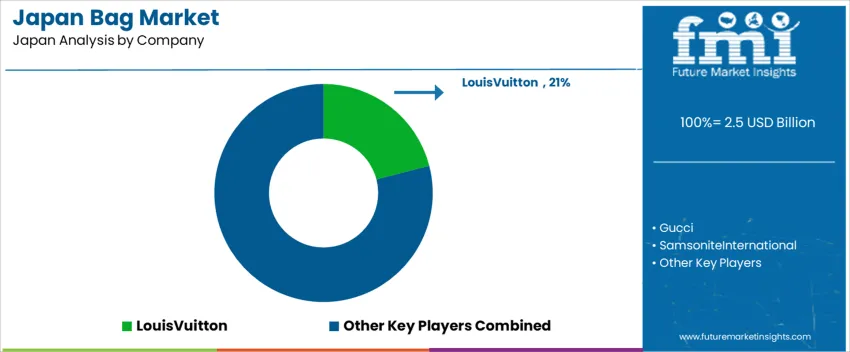
The demand for bag in Japan is driven by the country's dense retail infrastructure, evolving plastic reduction regulations and growing consumer awareness regarding environmental impact of single-use packaging. Retailers seek versatile bag solutions to maintain customer convenience, comply with regulatory requirements and communicate brand values through sustainable packaging choices. Concurrently, premium and fashion-oriented segments expand, pushing interest in bag products capable of providing aesthetic appeal, durability for repeated use and differentiation through design innovation. Material improvements such as recycled content integration, biodegradable polymer development and strength-to-weight optimization further enhance suitability of bag products in Japanese supermarket chains, convenience store networks and e-commerce logistics operations.
Key companies active in Japan's bag space include luxury brand Gucci, global luggage manufacturer Samsonite International and regional packaging suppliers serving retail and logistics sectors. Gucci offers premium fashion bags that command high price points and serve aspirational consumer segments, while Samsonite maintains distribution networks in Japan for travel and business bag categories. Regional packaging companies supply retail chains with customized shopping bags, promotional carriers and sustainable alternatives. This mix of luxury brands, global consumer goods companies and regional packaging specialists reflects the competitive landscape in Japan, ensuring that bag adoption is shaped by both premium fashion positioning and practical retail packaging requirements.
Key Players in Bag Industry in Japan
- LouisVuitton
- Gucci
- SamsoniteInternational
- AdidasAG
- NikeInc
Report Scope for Bag Industry in Japan
| Items | Values |
|---|---|
| Quantitative Units (2025) | USD billion |
| Product Type | Plastic, Paper, Textile, Others |
| Material | Woven Bags, Non-Woven Bags, Household, Industrial, Institutional, End User |
| Application | T-Shirt Bags, Lay Flat Bags |
| Region | Kyushu & Okinawa, Kanto, Kinki, Chubu, Tohoku, Rest of Japan |
| Countries Covered | Japan |
| Key Companies Profiled | LouisVuitton, Gucci, SamsoniteInternational, AdidasAG, NikeInc |
| Additional Attributes | Dollar sales by product type and material, regional CAGR trends, and value–volume contributions are evaluated alongside retail vs. logistics adoption, plastic vs. reusable penetration, woven vs. non-woven preferences, sustainability alignment, premium reusable opportunities, behavioral and price constraints, regulatory-driven growth, and competition among luxury brands, consumer goods firms, and Japanese packaging suppliers. |
Bag Industry in Japan Segmentation
Product Type:
- Plastic
- Paper
- Textile
- Others
Material:
- Woven Bags
- Non-Woven Bags
- Household
- Industrial
- Institutional
- End User
Application:
- T-Shirt Bags
- Lay Flat Bags
Region:
- Kyushu & Okinawa
- Kanto
- Kinki
- Chubu
- Tohoku
- Rest of Japan
Frequently Asked Questions
How big is the demand for bag in Japan in 2025?
The demand for bag in Japan is estimated to be valued at USD 2.5 billion in 2025.
What will be the size of bag in Japan in 2035?
The market size for the bag in Japan is projected to reach USD 3.6 billion by 2035.
How much will be the demand for bag in Japan growth between 2025 and 2035?
The demand for bag in Japan is expected to grow at a 3.8% CAGR between 2025 and 2035.
What are the key product types in the bag in Japan?
The key product types in bag in Japan are plastic, paper and textile.
Which product type segment is expected to contribute significant share in the bag in Japan in 2025?
In terms of product type, garbage/refuse/trash bags segment is expected to command 26.0% share in the bag in Japan in 2025.
Preview the report firsthand - request a free sample
Get SampleGet the brochure for pricing and purchase details.
Get PDFTable of Content
- Executive Summary
- Japan Market Outlook
- Demand-side Trends
- Supply-side Trends
- Technology Roadmap Analysis
- Analysis and Recommendations
- Market Overview
- Market Coverage / Taxonomy
- Market Definition / Scope / Limitations
- Market Background
- Market Dynamics
- Drivers
- Restraints
- Opportunity
- Trends
- Scenario Forecast
- Demand in Optimistic Scenario
- Demand in Likely Scenario
- Demand in Conservative Scenario
- Opportunity Map Analysis
- Product Life Cycle Analysis
- Supply Chain Analysis
- Investment Feasibility Matrix
- Value Chain Analysis
- PESTLE and Porter’s Analysis
- Regulatory Landscape
- Regional Parent Market Outlook
- Production and Consumption Statistics
- Import and Export Statistics
- Market Dynamics
- Japan Market Analysis 2020 to 2024 and Forecast, 2025 to 2035
- Historical Market Size Value (USD Million) Analysis, 2020 to 2024
- Current and Future Market Size Value (USD Million) Projections, 2025 to 2035
- Y-o-Y Growth Trend Analysis
- Absolute $ Opportunity Analysis
- Japan Market Pricing Analysis 2020 to 2024 and Forecast 2025 to 2035
- Japan Market Analysis 2020 to 2024 and Forecast 2025 to 2035, By Material Type
- Introduction / Key Findings
- Historical Market Size Value (USD Million) Analysis By Material Type , 2020 to 2024
- Current and Future Market Size Value (USD Million) Analysis and Forecast By Material Type , 2025 to 2035
- Plastic
- Paper
- Textile
- Y-o-Y Growth Trend Analysis By Material Type , 2020 to 2024
- Absolute $ Opportunity Analysis By Material Type , 2025 to 2035
- Japan Market Analysis 2020 to 2024 and Forecast 2025 to 2035, By Product Type
- Introduction / Key Findings
- Historical Market Size Value (USD Million) Analysis By Product Type, 2020 to 2024
- Current and Future Market Size Value (USD Million) Analysis and Forecast By Product Type, 2025 to 2035
- Garbage/Refuse/Trash Bags
- Woven Bags
- Gusseted Bags
- T-Shirt Bags
- Lay Flat Bags
- Y-o-Y Growth Trend Analysis By Product Type, 2020 to 2024
- Absolute $ Opportunity Analysis By Product Type, 2025 to 2035
- Japan Market Analysis 2020 to 2024 and Forecast 2025 to 2035, By End User
- Introduction / Key Findings
- Historical Market Size Value (USD Million) Analysis By End User, 2020 to 2024
- Current and Future Market Size Value (USD Million) Analysis and Forecast By End User, 2025 to 2035
- Retail & Consumer
- Industrial End Use
- Institutional Services
- Household
- Y-o-Y Growth Trend Analysis By End User, 2020 to 2024
- Absolute $ Opportunity Analysis By End User, 2025 to 2035
- Market Structure Analysis
- Competition Dashboard
- Competition Benchmarking
- Market Share Analysis of Top Players
- By Regional
- By Material Type
- By Product Type
- By End User
- Competition Analysis
- Competition Deep Dive
- LouisVuitton
- Overview
- Product Portfolio
- Profitability by Market Segments (Product/Age /Sales Channel/Region)
- Sales Footprint
- Strategy Overview
- Marketing Strategy
- Product Strategy
- Channel Strategy
- Gucci
- SamsoniteInternational
- AdidasAG
- NikeInc
- LouisVuitton
- Competition Deep Dive
- Assumptions & Acronyms Used
- Research Methodology


