

- Market Size (2026)
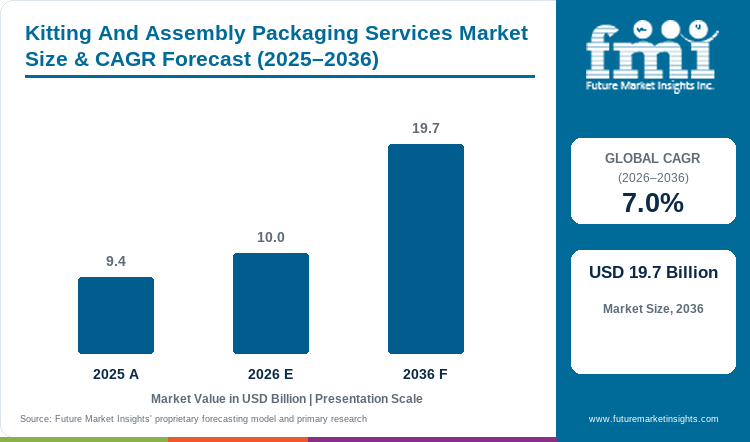
- USD 10.0 Bn
- Forecast (2036)
- USD 19.7 Bn
- CAGR (2026 to 2036)
- 7.0%
How big is Kitting And Assembly Packaging Services Market in 2026?
The kitting and assembly packaging services market is projected to expand at a CAGR of 7.0% through 2036, rising from USD 9.4 billion in 2025 to USD 10.0 billion in 2026 and reaching USD 19.7 billion by the end of the forecast period.
The global market is expected to grow at 7.0% CAGR between 2026 and 2036. Earlier, final pack work was carried out at supplier facilities. More ecommerce orders are now moving this work close to the inventory location. The change is creating demand for kitting and assembly services near fulfillment sites. The U.S. Census Bureau reported ecommerce sales of USD 340.2 billion for the second quarter of 2026.
Ecommerce sales are increasing the need for final pack work near order fulfillment. 3PLs are using shared facilities for kitting and labeling work. These facilities also manage packing and order returns. This reduces the steps between inventory and the customer. The need to reduce handling is expected to support outsourced services through 2036.
Demand for pack work is developing differently in Germany and Mexico. Mexico is projected to grow at 7.1% CAGR through 2036. Mexico produced 354,221 light vehicles in June 2026. It also exported 301,009 vehicles during the same month. Vehicle production is keeping pack work close to manufacturing sites. Germany is projected to grow at 5.8% CAGR through 2036. Its pack work is more closely linked to ecommerce fulfillment.
Key Takeaways
- Outsourced kitting will continue to postpone final product configuration until orders, promotions, or channel requirements become clearer through 2036.
- By service type, kitting is estimated to account for 46.1% of demand in 2026, reflecting repeatable bundle and SKU preparation.
- Boxes are estimated to hold 44.0% of packaging format demand in 2026, owing to their fit with inserts, dividers, labels, and mixed-item kits.
- Corrugated & paperboard is estimated to hold 48.0% of material demand in 2026, underpinned by broad use across cartons and inserts.
- Electronics is estimated to lead end user demand with 30.0% share in 2026, driven by accessory matching and configuration requirements.
- A few notable companies include Ryder System, DHL Supply Chain, FedEx Supply Chain, GXO Logistics, GEODIS, ShipBob, Kuehne+Nagel, and DSV.
Analyst Perspective
“Service providers will gain an advantage by keeping kitting, packaging, labeling, and inventory data inside one controlled fulfillment process. Accurate instructions and material compliance will remain the main adoption challenge as SKU combinations change across channels.”
- Nandini Roy Choudhury, Principal Consultant, Future Market Insights.
How is the kitting and assembly packaging services market segmented?
Kitting And Assembly Packaging Services Market is segmented by Service Type, Packaging Format, Material, End User, and Region. Kitting is expected to lead Service Type with 46.1% share in 2026. Boxes are estimated to lead Packaging Format with 44.0%. Corrugated & paperboard is projected to lead Material with 48.0%. Electronics is anticipated to lead End User with 30.0%.
In the FMI report, the market is segmented across five categories: service type, packaging format, material, end user, and region.
The market uses five segment axes with region as the geographic split.
Service type covers kitting, light assembly, packaging & repacking, labeling & serialization, and returns & rework.
Packaging format covers boxes, pouches & bags, trays & clamshells, blisters, and other formats.
Material covers corrugated & paperboard, plastics, foams, composites, and other materials.
End user covers electronics, healthcare, consumer goods, automotive, e-commerce & retail, and other applications.
Why does kitting lead the service type category?
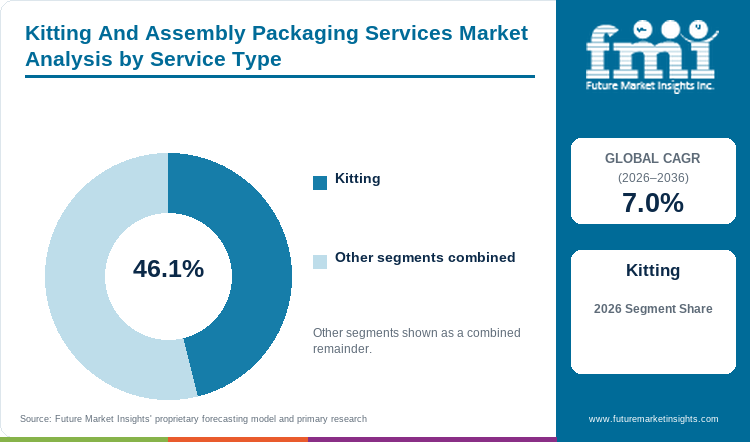
Kitting is expected to hold 46.1% of service type demand in 2026, given repeatable bundle and SKU preparation needs.
Kitting is used to bring several components into one product set before shipment. It allows brands to delay final configuration until channel demand becomes clear. Service teams use approved bills of materials during contract packaging work. Scan checks keep each completed kit linked with inventory records. This makes kitting suitable for promotions and subscription packs. It also helps in preparing spare-part sets and channel-specific bundles. Correct instructions and component availability remain important for every production run.
- By service type, kitting is estimated to account for 46.1% of demand in 2026, linked to repeatable bundle creation and final SKU preparation.
- In June 2025, GXO introduced an enhanced GXO Direct service that includes kitting, personalization, gift boxes, and wrapping for shared fulfillment users.
Why do boxes lead the packaging format category?
Boxes are estimated to represent 44.0% of packaging format demand in 2026, reflecting flexible sizing for mixed-item kit configurations.
Boxes continue to be used for multi-item kits and retail packs. They are also used for direct-to-consumer orders. Many corrugated boxes can be fitted with dividers and inserts. Labels and cushioning can be added without changing the main assembly process. This allows service teams to handle changing order sizes. Right-sizing remains important because unused space increases material and freight cost.
- By packaging format, boxes are estimated to hold 44.0% of demand in 2026, influenced by flexible sizing and compatibility with mixed-item kits.
- Box selection still changes by product weight, fragility, presentation, and parcel requirements, so providers maintain several approved sizes and inserts.
Why does corrugated & paperboard lead the material category?
Corrugated & paperboard is anticipated to hold 48.0% of material demand in 2026, underpinned by broad carton and insert use.
Corrugated and paperboard is used for cartons and sleeves. It is also used for dividers and trays. Printed inserts are made from the same material for smaller kits. Corrugated material can be cut and stored flat before use. It is therefore used in sustainable packaging programs. This helps companies reduce material use. Heavy products still require other materials.
- By material, corrugated & paperboard is estimated to hold 48.0% of demand in 2026, reinforced by broad use across cartons and inserts.
- Material engineering remains important because cushioning, moisture control, electrostatic protection, and appearance requirements can shift part of a kit toward plastics, foams, or composites.
Why does electronics lead the end-user category?
Electronics is projected to capture 30.0% of end user demand in 2026, driven by accessory matching and configuration requirements.
Electronic kits usually include devices with the required accessories. Cables and manuals are added before shipment. Adapters and regional components are added where required. Service providers use serial checks and protective packaging for fragile parts. Product combinations can change across models and sales channels. This makes inventory records and assembly instructions important. A wrong part or label can lead to rework or returns.
- By end user, electronics is estimated to lead with 30.0% share in 2026, attributable to accessory matching and configuration requirements.
- Electronics kits require accurate component identification, labeling, and inspection because configuration errors can create returns, rework, or inventory mismatches.
What are the drivers, restraints and opportunities in the Kitting and Assembly Packaging Services Market?
Through 2036, in kitting and assembly packaging services market, the omnichannel SKU complexity is expected to sustain outsourced work, packaging compliance and changeovers will constrain execution.
- Driver: Omnichannel ordering and frequent SKU combinations will continue to support outsourced kitting, assembly, packing, and labeling near inventory through 2036.
- Restraint: Packaging rules and channel-specific specifications are expected to increase validation work as materials, labels, inserts, or pack formats change.
- Opportunity: Digital work instructions and flexible automation will expand late-stage customization without requiring a dedicated line for every SKU.
Omnichannel programs are increasing the need for pack work near shared inventory. Brands prepare the same goods for store orders and online orders. Bundle plans also create demand for late-stage kitting. DHL Supply Chain announced an ecommerce hub for George at Asda in Derby in March 2026. The site is being built for high order volumes. Providers use packaging automation for routine work. Flexible stations then handle changing kits and inserts.
Pack rules make late changes difficult for service teams. The Packaging and Packaging Waste Regulation began applying on 12 August 2026. The regulation has increased attention to pack design. It has also increased attention to recycling and material choice. Service teams need approved materials and packaging labels before production starts. Retail rules can also change barcodes or pallet requirements. Each change requires revised instructions and replacement stock. Providers use version control to manage these changes.
Digital work instructions are helping providers manage kitting at shared sites. ShipBob added kitting order creation through its API in Spring 2026. Merchants can use the same instructions for several work orders. Providers connect these instructions with barcode scans and stock records. Modular workcells can then handle changing kit requirements. Manual work is still needed for inserts and visual checks. This approach can reduce setup work between shifts.
Which country CAGRs are profiled in the Kitting And Assembly Packaging Services Market?
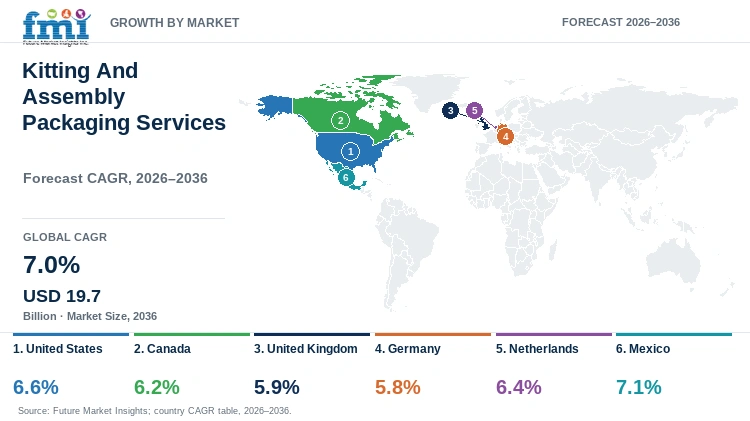
| Country | CAGR |
|---|---|
| United States | 6.6% |
| Canada | 6.2% |
| United Kingdom | 5.9% |
| Germany | 5.8% |
| Netherlands | 6.4% |
| Mexico | 7.1% |
How do country-level CAGRs compare in the Kitting And Assembly Packaging Services Market?
FMI projects country CAGRs from 5.8% to 7.1% through 2036. Retail fulfillment is shaping demand in some countries. Manufacturing activity is shaping demand in others. Cross-border movement and packaging requirements are also influencing service needs.
- United States demand is being shaped by retail volume, promotional kitting, returns, and fulfillment networks that are expected to support capacity needs through 2036.
- Canada is combining e-commerce with cross-border distribution, which is expected to keep demand for consistent packing and inventory visibility high through 2036.
- United Kingdom online spending is supporting direct-to-consumer packing, while seasonal peaks are expected to keep flexible labor important through 2036.
- Germany is combining online retail with detailed packaging rules, which will keep documentation, material control, and warehouse integration important through 2036.
- Netherlands fulfillment is benefiting from online retail and electronics distribution, while cross-border orders will keep labeling and SKU preparation requirements high through 2036.
- Mexico is linking kitting demand to vehicle production and export programs, which are expected to sustain line-side preparation through 2036.
The country outlooks show different demand conditions across retail and manufacturing channels. The full FMI report covers seven regions and more than 20 countries through 2036.
Country-wise Analysis
- Retail networks in the United States handle changing SKUs across stores and ecommerce fulfillment. This is increasing kitting work near outbound operations. The same sites also manage reverse logistics. The United States is projected to grow at 6.6% CAGR through 2036. The U.S. Census Bureau reported retail and food-services sales of USD 773.9 billion for August 2026. Sales were 6.0% above August 2025. Peak promotions increase the need for labor and pack materials. Buyers are comparing capacity with error control and unit pricing.
- Canadian fulfillment networks connect domestic retail demand with cross-border stock movement. Assembly work must be completed before goods move farther through the network. Canada is projected to grow at 6.2% CAGR through 2036. Statistics Canada reported that ecommerce represented 7.5% of total retail trade in July 2026. Online sales fell 3.5% from June. Long shipping distances make post-dispatch errors expensive. Buyers need clear stock data and standard instructions.
- Online spending in the United Kingdom is increasing demand for direct-to-consumer pack work. The country is projected to grow at 5.9% CAGR through 2036. The Office for National Statistics reported a 10.1% year-over-year rise in online spending values in September 2026. Online sales accounted for 28.8% of retail spending in August. Fashion and holiday periods can change work volumes quickly. Providers need flexible staff and clear channel instructions during these periods.
- Germany has a mature industrial and retail network. Pack rules place strong attention on documentation in this market. Germany is projected to grow at 5.8% CAGR through 2036. Destatis reported that real internet and mail-order retail sales fell 0.8% year over year in July 2026. Late-stage setup is still required when monthly sales change. Material or instruction changes need process control. Providers connect assembly with warehouse flows to reduce extra handling.
- Netherlands fulfillment benefits from dense distribution links and cross-border ecommerce movement. This gives service providers steady regional orders. The country is projected to grow at 6.4% CAGR through 2036. Statistics Netherlands reported that online retail turnover rose 3.8% year over year in July 2026. Online consumer electronics turnover increased 5.4% in the same month. This is supporting accessory kitting and consumer electronics packaging. Cross-border orders also need clear labels and part records.
- Mexican demand is closely linked with factory programs. These programs need parts sequencing and export-ready packs near production sites. Mexico is projected to grow at 7.1% CAGR through 2036. INEGI reported production of 1.3 million light vehicles during the first four months of 2026. This was 0.9% above the same period in 2025. Service providers build component kits before parts reach the production line. Tight schedules leave little room for missing parts or incorrect quantities.
Who are the notable companies in the Kitting And Assembly Packaging Services Market?
A few notable companies active within the defined kitting and assembly packaging services market include Ryder System, DHL Supply Chain, FedEx Supply Chain, GXO Logistics, GEODIS, ShipBob, Kuehne+Nagel, and DSV. FedEx announced an agreed sale of FedEx Supply Chain in July 2026, with closing expected during 2026 subject to completion conditions.
FMI covers major logistics and fulfillment providers in its competitive review. Ryder System and DHL Supply Chain handle contract packaging with distribution work. FedEx Supply Chain and GXO Logistics support fulfillment and kitting programs. GEODIS and ShipBob are also included in the review. Kuehne+Nagel and DSV link kitting services with broader contract logistics. These companies support ecommerce and manufacturing programs in different ways. Their work also includes industrial electronics packaging.
- Integrated contract packaging and value-added logistics: Ryder System, DHL Supply Chain, GXO Logistics, and GEODIS combine kitting with broader packaging or warehouse services.
- Fulfillment and configurable kitting: FedEx Supply Chain and ShipBob connect kitting, labeling, packaging, and returns work with order fulfillment operations.
- Manufacturing-support contract logistics: Kuehne+Nagel and DSV provide kitting or assembly beside in-plant, warehouse, distribution, and other value-added services.
Competitive Benchmarking:
| Company | Kitting & Assembly | Packaging / Repacking | Labeling / Customization | Geographic Reach |
|---|---|---|---|---|
| Ryder System | High | High | High | United States, Canada and Mexico |
| DHL Supply Chain | High | High | High | Global contract logistics network |
| FedEx Supply Chain | High | High | High | North America with wider FedEx network access |
| GXO Logistics | High | High | High | North America and Europe with wider contract logistics coverage |
| GEODIS | High | High | High | Global logistics network |
| ShipBob | High | Medium | High | United States, Canada, United Kingdom, European Union and Australia |
| Kuehne+Nagel | High | High | Medium | 44 countries across contract logistics operations |
| DSV | High | High | High | Global contract logistics network |
Benchmark ratings are based on documented service capability. A High rating shows direct commercial-scale evidence. A Medium rating shows a narrower role. Geographic reach is shown for reference. It does not receive a capability score. The table does not rank companies.
Key Developments
- July 2026: FedEx announced an agreement for CMA CGM Group to acquire FedEx Supply Chain. The transaction carried a USD 1.4 billion enterprise value and was expected to close in 2026.
- March 2026: Kuehne+Nagel described expanded John Deere support in China that includes inbound handling, kitting, line-feeding, and material replenishment.
- April 2025: DSV completed its acquisition of Schenker, adding contract-logistics capacity and services to the combined global operating network.
Key Players
Integrated contract packaging and value-added logistics
- Ryder System
- DHL Supply Chain
- FedEx Supply Chain
- GXO Logistics
- GEODIS
E-commerce fulfillment and kitting
- ShipBob
Manufacturing-support contract logistics
- Kuehne+Nagel
- DSV
Report Scope
| Coverage field | Report scope |
|---|---|
| Market breakdown | By service type, packaging format, material, end user and region. |
| Quantitative Units | USD billion. |
| Market Definition | Outsourced kitting, light assembly, packaging and repacking, labeling and serialization, and returns or rework performed as value-added packaging or logistics services. Core product manufacturing, packaging-material-only sales, and transport or storage without a defined value-added packaging task are excluded. |
| Regions Covered | North America, Latin America, Western Europe, Eastern Europe, East Asia, South Asia and Pacific, and Middle East and Africa. |
| Countries Covered | United States, Canada, United Kingdom, Germany, Netherlands, Mexico, and 20+ countries included in the full report. |
| Key Companies Profiled | Ryder System, DHL Supply Chain, FedEx Supply Chain, GXO Logistics, GEODIS, ShipBob, Kuehne+Nagel, DSV. |
| Forecast Period | 2026 to 2036. |
| Approach | Primary and secondary research with market triangulation. |
Research Methodology
| Method | Approach |
|---|---|
| Primary Research | FMI analysts gathered input from manufacturers, service providers, technology developers, distributors, end users, procurement teams, and subject-matter experts. Interviews examined purchasing decisions, product or service evaluation, adoption barriers, approval requirements, pricing considerations, and expectations for technical or commercial support. Respondents were also asked what evidence is required before a trial, pilot, or initial order develops into regular purchasing. |
| Desk Research | Desk research covered government statistics, regulatory publications, trade data, industry associations, technical literature, standards, company filings, product information, and official corporate announcements. Sources were reviewed for relevance, publication date, geographic coverage, and consistency with the defined market scope. Claims relating to performance, applications, approvals, capacity, investment, and commercial activity were retained only when supported by credible public evidence. |
| Market Sizing and Forecasting | The market model combined the baseline value with historical performance, segment structure, pricing and volume indicators, adoption levels, company participation, and country-level demand conditions. Forecast assumptions considered economic activity, investment trends, regulatory developments, technology adoption, purchasing cycles, supply availability, and barriers to wider market use. Segment and regional estimates were reconciled before the final market total was calculated. |
| Data Validation | Estimates were checked against multiple independent indicators, including public data, company activity, trade patterns, industry developments, and findings from primary interviews. Validation also tested whether products, services, applications, and company revenues fell within the defined market boundaries. Adjacent categories, unsupported claims, overlapping revenues, and activities without direct market relevance were excluded to reduce double counting and maintain consistency across segments and countries. |
Kitting And Assembly Packaging Services Market by Segments:
Kitting And Assembly Packaging Services Market segmented by Service Type:
- Kitting
- Light Assembly
- Packaging & Repacking
- Labeling & Serialization
- Returns & Rework
Kitting And Assembly Packaging Services Market segmented by Packaging Format:
- Boxes
- Pouches & Bags
- Trays & Clamshells
- Blisters
- Other
Kitting And Assembly Packaging Services Market segmented by Material:
- Corrugated & Paperboard
- Plastics
- Foams
- Composites
- Other
Kitting And Assembly Packaging Services Market segmented by End User:
- Electronics
- Healthcare
- Consumer Goods
- Automotive
- E-commerce & Retail
- Other
Kitting And Assembly Packaging Services Market by Region:
- North America
- United States
- Canada
- Latin America
- Brazil
- Mexico
- Chile
- Rest of Latin America
- Western Europe
- Germany
- United Kingdom
- Italy
- Spain
- France
- Nordics
- Benelux
- Rest of Western Europe
- Eastern Europe
- Russia
- Poland
- Hungary
- Balkan and Baltic States
- Rest of Eastern Europe
- East Asia
- China
- Japan
- South Korea
- South Asia and Pacific
- India
- ASEAN
- Australia and New Zealand
- Rest of South Asia and Pacific
- Middle East and Africa
- Kingdom of Saudi Arabia
- Other GCC Countries
- Türkiye
- South Africa
- Other African Union Countries
- Rest of Middle East and Africa
Research Sources and Bibliography
- U.S. Census Bureau. (2026, August 18). Quarterly retail e-commerce sales, second quarter 2026. https://www.census.gov/retail/ecommerce.html
- European Commission. (2026, August 11). New EU rules on packaging enter into application. https://environment.ec.europa.eu/news/new-eu-rules-packaging-enter-application-2026-08-11_en
- Statistics Canada. (2026, September 24). Retail trade, July 2026. https://www150.statcan.gc.ca/n1/daily-quotidien/260924/dq260924a-eng.htm
- U.S. Census Bureau. (2026, September 16). Advance monthly sales for retail and food services, August 2026.
- Office for National Statistics. (2026, September 18). Retail sales, Great Britain: August 2026.
- Statistisches Bundesamt (Destatis). (2026, August 3). Einzelhandelsumsatz im Juni 2026 real um 1,1 % niedriger als im Vormonat.
- Statistisches Bundesamt (Destatis). (2026, September 1). Einzelhandelsumsatz im Juli 2026.
- Statistics Netherlands. (2026, September 1). Retail turnover up by nearly 3 percent in July.
- Instituto Nacional de Estadística y Geografía. (2026, July 7). Registro administrativo de la industria automotriz de vehículos ligeros: Junio de 2026.
- Instituto Nacional de Estadística y Geografía. (2026, May 11). Administrative record of the light vehicle automotive industry: April 2026.
- FedEx Corporation. (2026, July 1). CMA CGM Group to acquire FedEx Supply Chain at an enterprise value of USD 1.4 billion.
- Kuehne+Nagel. (2026, March 10). Kuehne+Nagel honoured by John Deere for best logistics services.
- DSV A/S. (2025, April 30). DSV completes the acquisition of Schenker.
- DHL Supply Chain. (2026, March 11). DHL Supply Chain to transform Derby facility into next-generation ecommerce fulfilment hub with George at Asda.
- ShipBob. (2026, April 22). Spring ’26 release.
- GXO Logistics, Inc. (2025, June 10). GXO introduces enhanced GXO Direct solution in the U.S.
- ShipBob. (2026, September). Product release notes: New Returns Report.
- GXO Logistics, Inc. (2026, September 23). GXO begins deployment of Labor Management System to advance productivity and operational excellence across global footprint.
- DHL Supply Chain. (2026, June 17). DHL to launch state-of-the-art automated healthcare hub at Infinity Park Derby.
- GEODIS. (2025, April 1). Packaging case study: Beverage brand optimization.
- Ryder System, Inc. (n.d.). Co-packaging solutions. Retrieved September 25, 2026.
- DHL Supply Chain. (n.d.). Packaging solutions for large businesses. Retrieved September 25, 2026.
- FedEx. (n.d.). Supply chain services. Retrieved September 25, 2026.
- GXO Logistics. (n.d.). Value-added services. Retrieved September 25, 2026.
- GEODIS. (n.d.). Kitting & assembly services. Retrieved September 25, 2026.
- ShipBob. (n.d.). Kitting and assembly services for ecommerce brands. Retrieved September 25, 2026.
- Kuehne+Nagel. (n.d.). Warehousing, kitting & contract logistics. Retrieved September 25, 2026.
- DSV. (n.d.). Contract logistics. Retrieved September 25, 2026.
This bibliography is provided for reader reference and is not exhaustive. The full report contains the complete reference list and detailed citations.
This Report Answers
- How large is the kitting and assembly packaging services market in 2026 and 2036?
- Why do brands outsource kitting and late-stage packaging close to fulfillment inventory?
- Why does kitting hold 46.1% of service type demand in 2026?
- Why do boxes account for 44.0% of packaging format demand in 2026?
- Why does corrugated & paperboard hold 48.0% of material demand in 2026?
- Why does electronics lead end user demand with 30.0% share in 2026?
- How do country growth conditions differ across the United States, Canada, United Kingdom, Germany, Netherlands, and Mexico?
- Which logistics and packaging service providers are active across kitting, assembly, repacking, labeling, and returns?
Frequently Asked Questions
How big is the kitting and assembly packaging services market in 2026?
The kitting and assembly packaging services market is valued at USD 10.0 billion in 2026. It is expected to reach USD 19.7 billion by 2036. Growing outsourcing of late-stage packaging work is supporting market growth.
What is the CAGR of the kitting and assembly packaging services market from 2026 to 2036?
The market is projected to grow at 7.0% CAGR between 2026 and 2036. Growing SKU variation is supporting demand for kitting services. Packaging rules and changeovers are creating execution challenges.
Which service type leads the kitting and assembly packaging services market in 2026?
Kitting is estimated to hold 46.1% of service type demand in 2026. It brings components together before shipment. The service is used for promotions and subscription packs. It also supports spare-part sets and channel-specific bundles.
Which packaging format leads the kitting and assembly packaging services market in 2026?
Boxes are estimated to hold 44.0% of packaging format demand in 2026. They are used for mixed-item kits. Dividers and inserts keep items in position. Labels or cushioning can be added as required.
Which material leads the kitting and assembly packaging services market in 2026?
Corrugated and paperboard is estimated to hold 48.0% of material demand in 2026. It is used for cartons and sleeves. It is also used for dividers and trays. Printed inserts are also made from this material. Corrugated and paperboard is widely used in outsourced packaging programs.
Which end user leads the kitting and assembly packaging services market in 2026?
Electronics is estimated to lead end user demand with 30.0% share in 2026. Kitting supports accessory matching and labeling. It also supports configuration and inspection across product variations.
Which companies are active in the kitting and assembly packaging services market?
FMI has covered major providers in the kitting and assembly packaging services market. Ryder System and DHL Supply Chain are included in the report. FedEx Supply Chain and GXO Logistics are also covered. GEODIS and ShipBob form part of the competitive review. Kuehne+Nagel and DSV are also included. These companies are active across fulfillment kitting and packaging services.
Preview the report firsthand - request a free sample
Get SampleGet the brochure for pricing and purchase details.
Get PDFTable of Content
- Key Takeaways
- Market Size and CAGR
- Top Growth Driver
- Fastest Growing Segment
- Leading Region
- Key Companies
- Emerging Opportunities
- Executive Summary
- Global Market Outlook
- Demand-side Trends
- Supply-side Trends
- Technology Roadmap Analysis
- Analysis and Recommendations
- Analyst Perspective (What is happening? Why now? What should investors know?)
- Key Questions Answered
- How large is the market?
- What is the CAGR?
- What are key trends?
- Which region dominates?
- Who are the leaders?
- Market Overview
- Market Coverage / Taxonomy
- Market Definition / Scope / Limitations
- Research Methodology
- Chapter Orientation
- Analytical Lens and Working Hypotheses
- Market Structure, Signals, and Trend Drivers
- Benchmarking and Cross-market Comparability
- Market Sizing, Forecasting, and Opportunity Mapping
- Research Design and Evidence Framework
- Desk Research Programme (Secondary Evidence)
- Expert Input and Fieldwork (Primary Evidence)
- Tooling, Models, and Reference Databases
- Data Engineering and Model Build
- Quality Assurance and Audit Trail
- Market Background
- Market Dynamics (Drivers, Restraints, Opportunity, Trends)
- Scenario Forecast (Optimistic, Likely, Conservative)
- Impact Analysis
- AI Impact
- Sustainability Impact
- Regulatory Impact
- Technology Impact
- Consumer / Buyer Analysis
- Purchase Drivers
- Adoption Barriers
- Buyer Journey
- Opportunity Map Analysis
- Product Life Cycle Analysis
- Supply Chain Analysis
- Investment Feasibility Matrix
- Value Chain Analysis
- PESTLE and Porter's Analysis
- Regulatory Landscape
- Regional Parent Market Outlook
- Production and Consumption Statistics
- Import and Export Statistics
- Global Market Analysis and Forecast, 2021 to 2036
- Historical Market Size Value (USD Billion) Analysis, 2021 to 2025
- Current and Future Market Size Value (USD Billion) Projections, 2026 to 2036
- Y-o-Y Growth Trend Analysis
- Absolute $ Opportunity Analysis
- Global Market Pricing Analysis, 2021 to 2036
- Global Market Analysis and Forecast, By Service Type, 2021 to 2036
- Introduction / Key Findings
- Historical Market Size Value (USD Billion) Analysis By Service Type, 2021 to 2025
- Current and Future Market Size Value (USD Billion) Analysis and Forecast By Service Type, 2026 to 2036
- Kitting
- Light Assembly
- Packaging & Repacking
- Labeling & Serialization
- Returns & Rework
- Y-o-Y Growth Trend Analysis By Service Type, 2021 to 2025
- Absolute $ Opportunity Analysis By Service Type, 2026 to 2036
- Global Market Analysis and Forecast, By Packaging Format, 2021 to 2036
- Introduction / Key Findings
- Historical Market Size Value (USD Billion) Analysis By Packaging Format, 2021 to 2025
- Current and Future Market Size Value (USD Billion) Analysis and Forecast By Packaging Format, 2026 to 2036
- Boxes
- Pouches & Bags
- Trays & Clamshells
- Blisters
- Other
- Y-o-Y Growth Trend Analysis By Packaging Format, 2021 to 2025
- Absolute $ Opportunity Analysis By Packaging Format, 2026 to 2036
- Global Market Analysis and Forecast, By Material, 2021 to 2036
- Introduction / Key Findings
- Historical Market Size Value (USD Billion) Analysis By Material, 2021 to 2025
- Current and Future Market Size Value (USD Billion) Analysis and Forecast By Material, 2026 to 2036
- Corrugated & Paperboard
- Plastics
- Foams
- Composites
- Other
- Y-o-Y Growth Trend Analysis By Material, 2021 to 2025
- Absolute $ Opportunity Analysis By Material, 2026 to 2036
- Global Market Analysis and Forecast, By End User, 2021 to 2036
- Introduction / Key Findings
- Historical Market Size Value (USD Billion) Analysis By End User, 2021 to 2025
- Current and Future Market Size Value (USD Billion) Analysis and Forecast By End User, 2026 to 2036
- Electronics
- Healthcare
- Consumer Goods
- Automotive
- E-commerce & Retail
- Other
- Y-o-Y Growth Trend Analysis By End User, 2021 to 2025
- Absolute $ Opportunity Analysis By End User, 2026 to 2036
- Global Market Analysis and Forecast, By Region, 2021 to 2036
- Introduction
- Historical Market Size Value (USD Billion) Analysis By Region, 2021 to 2025
- Current Market Size Value (USD Billion) Analysis and Forecast By Region, 2026 to 2036
- North America
- Latin America
- Western Europe
- Eastern Europe
- East Asia
- South Asia and Pacific
- Middle East and Africa
- Market Attractiveness Analysis By Region
- North America Market Analysis and Forecast, By Country, 2021 to 2036
- Historical Market Size Value (USD Billion) Trend Analysis By Market Taxonomy, 2021 to 2025
- Market Size Value (USD Billion) Forecast By Market Taxonomy, 2026 to 2036
- By Country
- United States
- Canada
- By Service Type
- By Packaging Format
- By Material
- By End User
- By Country
- Market Attractiveness Analysis
- By Country
- By Service Type
- By Packaging Format
- By Material
- By End User
- Key Takeaways
- Latin America Market Analysis and Forecast, By Country
- Historical Market Size Value (USD Billion) Trend Analysis By Market Taxonomy, 2021 to 2025
- Market Size Value (USD Billion) Forecast By Market Taxonomy, 2026 to 2036
- By Country
- Brazil
- Mexico
- Chile
- Rest of Latin America
- By Service Type
- By Packaging Format
- By Material
- By End User
- By Country
- Market Attractiveness Analysis
- By Country
- By Service Type
- By Packaging Format
- By Material
- By End User
- Key Takeaways
- Western Europe Market Analysis and Forecast, By Country
- Historical Market Size Value (USD Billion) Trend Analysis By Market Taxonomy, 2021 to 2025
- Market Size Value (USD Billion) Forecast By Market Taxonomy, 2026 to 2036
- By Country
- Germany
- United Kingdom
- Italy
- Spain
- France
- Nordics
- Benelux
- Rest of Western Europe
- By Service Type
- By Packaging Format
- By Material
- By End User
- By Country
- Market Attractiveness Analysis
- By Country
- By Service Type
- By Packaging Format
- By Material
- By End User
- Key Takeaways
- Eastern Europe Market Analysis and Forecast, By Country
- Historical Market Size Value (USD Billion) Trend Analysis By Market Taxonomy, 2021 to 2025
- Market Size Value (USD Billion) Forecast By Market Taxonomy, 2026 to 2036
- By Country
- Russia
- Poland
- Hungary
- Balkan and Baltic States
- Rest of Eastern Europe
- By Service Type
- By Packaging Format
- By Material
- By End User
- By Country
- Market Attractiveness Analysis
- By Country
- By Service Type
- By Packaging Format
- By Material
- By End User
- Key Takeaways
- East Asia Market Analysis and Forecast, By Country
- Historical Market Size Value (USD Billion) Trend Analysis By Market Taxonomy, 2021 to 2025
- Market Size Value (USD Billion) Forecast By Market Taxonomy, 2026 to 2036
- By Country
- China
- Japan
- South Korea
- By Service Type
- By Packaging Format
- By Material
- By End User
- By Country
- Market Attractiveness Analysis
- By Country
- By Service Type
- By Packaging Format
- By Material
- By End User
- Key Takeaways
- South Asia and Pacific Market Analysis and Forecast, By Country
- Historical Market Size Value (USD Billion) Trend Analysis By Market Taxonomy, 2021 to 2025
- Market Size Value (USD Billion) Forecast By Market Taxonomy, 2026 to 2036
- By Country
- India
- ASEAN
- Australia and New Zealand
- Rest of South Asia and Pacific
- By Service Type
- By Packaging Format
- By Material
- By End User
- By Country
- Market Attractiveness Analysis
- By Country
- By Service Type
- By Packaging Format
- By Material
- By End User
- Key Takeaways
- Middle East and Africa Market Analysis and Forecast, By Country
- Historical Market Size Value (USD Billion) Trend Analysis By Market Taxonomy, 2021 to 2025
- Market Size Value (USD Billion) Forecast By Market Taxonomy, 2026 to 2036
- By Country
- Kingdom of Saudi Arabia
- Other GCC Countries
- Türkiye
- South Africa
- Other African Union Countries
- Rest of Middle East and Africa
- By Service Type
- By Packaging Format
- By Material
- By End User
- By Country
- Market Attractiveness Analysis
- By Country
- By Service Type
- By Packaging Format
- By Material
- By End User
- Key Takeaways
- Key Countries Market Analysis
- United States
- Pricing Analysis
- Market Share Analysis, 2025
- By Service Type
- By Packaging Format
- By Material
- By End User
- Canada
- Pricing Analysis
- Market Share Analysis, 2025
- By Service Type
- By Packaging Format
- By Material
- By End User
- Mexico
- Pricing Analysis
- Market Share Analysis, 2025
- By Service Type
- By Packaging Format
- By Material
- By End User
- Brazil
- Pricing Analysis
- Market Share Analysis, 2025
- By Service Type
- By Packaging Format
- By Material
- By End User
- Chile
- Pricing Analysis
- Market Share Analysis, 2025
- By Service Type
- By Packaging Format
- By Material
- By End User
- Germany
- Pricing Analysis
- Market Share Analysis, 2025
- By Service Type
- By Packaging Format
- By Material
- By End User
- United Kingdom
- Pricing Analysis
- Market Share Analysis, 2025
- By Service Type
- By Packaging Format
- By Material
- By End User
- Italy
- Pricing Analysis
- Market Share Analysis, 2025
- By Service Type
- By Packaging Format
- By Material
- By End User
- Spain
- Pricing Analysis
- Market Share Analysis, 2025
- By Service Type
- By Packaging Format
- By Material
- By End User
- France
- Pricing Analysis
- Market Share Analysis, 2025
- By Service Type
- By Packaging Format
- By Material
- By End User
- India
- Pricing Analysis
- Market Share Analysis, 2025
- By Service Type
- By Packaging Format
- By Material
- By End User
- ASEAN
- Pricing Analysis
- Market Share Analysis, 2025
- By Service Type
- By Packaging Format
- By Material
- By End User
- Australia and New Zealand
- Pricing Analysis
- Market Share Analysis, 2025
- By Service Type
- By Packaging Format
- By Material
- By End User
- China
- Pricing Analysis
- Market Share Analysis, 2025
- By Service Type
- By Packaging Format
- By Material
- By End User
- Japan
- Pricing Analysis
- Market Share Analysis, 2025
- By Service Type
- By Packaging Format
- By Material
- By End User
- South Korea
- Pricing Analysis
- Market Share Analysis, 2025
- By Service Type
- By Packaging Format
- By Material
- By End User
- Russia
- Pricing Analysis
- Market Share Analysis, 2025
- By Service Type
- By Packaging Format
- By Material
- By End User
- Poland
- Pricing Analysis
- Market Share Analysis, 2025
- By Service Type
- By Packaging Format
- By Material
- By End User
- Hungary
- Pricing Analysis
- Market Share Analysis, 2025
- By Service Type
- By Packaging Format
- By Material
- By End User
- Kingdom of Saudi Arabia
- Pricing Analysis
- Market Share Analysis, 2025
- By Service Type
- By Packaging Format
- By Material
- By End User
- Türkiye
- Pricing Analysis
- Market Share Analysis, 2025
- By Service Type
- By Packaging Format
- By Material
- By End User
- South Africa
- Pricing Analysis
- Market Share Analysis, 2025
- By Service Type
- By Packaging Format
- By Material
- By End User
- Netherlands
- Pricing Analysis
- Market Share Analysis, 2025
- By Service Type
- By Packaging Format
- By Material
- By End User
- United States
- Market Structure Analysis
- Competition Dashboard
- Competition Benchmarking
- Market Share Analysis of Top Players
- By Regional
- By Service Type
- By Packaging Format
- By Material
- By End User
- Emerging Startups
- Innovation Benchmarking
- Competition Analysis
- Competition Deep Dive
- Ryder System
- Overview
- Product Portfolio
- Profitability by Market Segments
- Sales Footprint
- Strategy Overview
- Marketing Strategy
- Product Strategy
- Channel Strategy
- DHL Supply Chain
- FedEx Supply Chain
- GXO Logistics
- GEODIS
- ShipBob
- Kuehne+Nagel
- DSV
- Ryder System
- Case Studies
- Success Stories
- Recent Developments
- Competition Deep Dive
- Assumptions & Acronyms Used


