

- Industry Size (2026)
- USD 17.40 Bn
- Forecast (2036)
- USD 32.06 Bn
- CAGR (2026 to 2036)
- 6.3%
Lactose Free Probiotic Yogurt Market Size, Market Forecast and Outlook By FMI
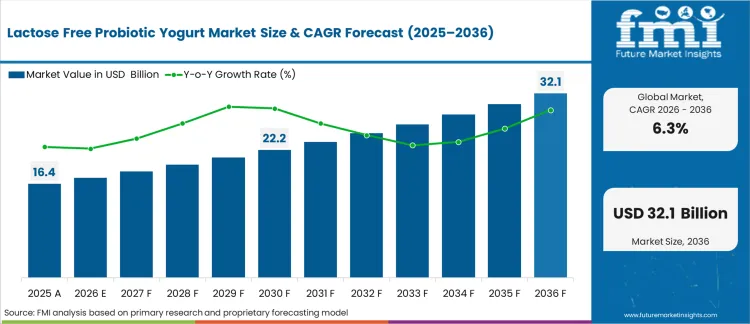
In 2025, the lactose free probiotic yogurt market was valued at USD 16.37 billion. Based on Future Market Insights' analysis, demand for lactose free probiotic yogurt is estimated to grow to USD 17.40 billion in 2026 and USD 32.06 billion by 2036. FMI projects a CAGR of 6.3% during the forecast period.
Absolute dollar growth of USD 14.66 billion over the decade reflects the broadening of the lactose-free probiotic yogurt demand base from a single intolerance management use case into a multi-driver category spanning performance nutrition, gut health management, plant-based sourcing preference, and clinical functional food positioning. Chobani's January 2025 rollout of its High Protein drink line, specifically formulated to be lactose-free with 20 to 30 grams of protein and billions of active probiotics, directly converts the performance nutrition consumer from a separate market segment into the lactose-free probiotic yogurt addressable base. [1]
Summary of Lactose Free Probiotic Yogurt Market
- Lactose Free Probiotic Yogurt Market Definition
- The market covers dairy-based enzymatically treated and plant-based lactose-free yogurt products incorporating defined viable probiotic cultures, in spoonable and drinkable formats across conventional and organic lines for the retail, foodservice, and direct-to-consumer channels.
- Demand Drivers in the Market
- Chobani's January 2025 official rollout of its High Protein drink line specifically formulated to be lactose-free with 20 to 30 grams of protein and billions of active probiotics, converting the performance nutrition consumer base into the lactose-free probiotic yogurt addressable market and enabling on-the-go functional nutrition positioning. [1]
- Danone's December 2025 multi-year partnership as the first official US Yogurt and Plant-Based Beverages Partner of the Big Ten Conference, expanding access to Oikos high-protein dairy and Silk probiotic plant-based lactose-free products across 18 university campuses with Brand Activations and Nutrition Education programs targeting student-athlete consumers. [2]
- India's 13.4% CAGR growth trajectory, driven by rapid urbanization-linked dietary shift toward packaged fermented dairy, growing awareness of probiotic functional benefits among the country's large lactose-intolerant population, and expanding cold chain retail infrastructure enabling refrigerated probiotic yogurt distribution in tier-2 and tier-3 markets.
- Key Segments Analyzed in the FMI Report
- Product Type: Spoonable Yogurt holds 58.3% of product type share in 2026, reflecting the established retail shelf format dominance and consumer preference for traditional yogurt texture in the lactose-free category.
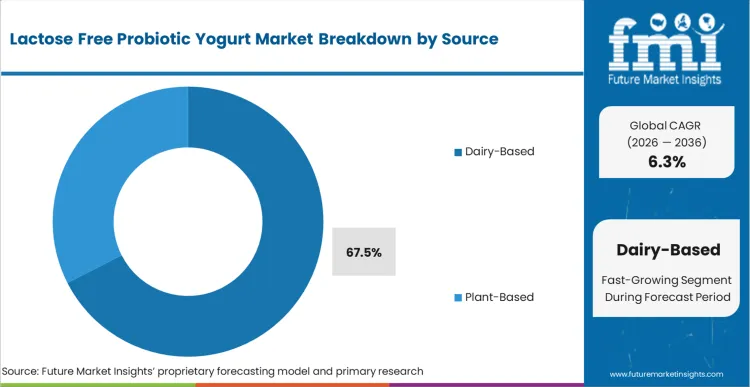
- Source: Dairy-Based accounts for 67.5% of source share in 2026, as enzymatic lactose hydrolysis of dairy milk maintains the familiar taste profile that drives purchase retention among consumers transitioning from conventional to lactose-free formats.
- Flavour: Flavored accounts for 63.4% of flavour share in 2026, with Vanilla and Strawberry as the leading specific flavour sub-segments in the probiotic yogurt category across dairy and plant-based formats.
- Analyst Opinion at FMI
- Nandini Roy Choudhury, Principal Consultant for Food & Beverage Industry at Future Market Insights, opines, "In the updated version of the Lactose Free Probiotic Yogurt Market Report for 2026 to 2036, CXOs will find that India's 13.4% CAGR represents the single largest dollar-volume growth opportunity in the global lactose-free probiotic yogurt category over the forecast period, driven by a structural intersection of high lactose intolerance prevalence, rapid cold chain retail build-out, and urbanization-linked dietary premiumization that no other major market replicates at the same rate. My findings indicate that dairy brands entering the Indian market through local manufacturing partnerships and regional flavour adaptation will capture disproportionate share relative to imported product positioning, and that the high-protein lactose-free format pioneered by Chobani in the US is two to three years from mainstream Indian retail adoption as protein awareness grows among urban consumer cohorts."
- Strategic Implications / Executive Takeaways
- Establish local manufacturing or co-packing agreements in India before 2027 to capture the 13.4% CAGR growth window, where cold chain expansion is progressively enabling refrigerated probiotic yogurt distribution in tier-2 and tier-3 cities and first-mover brand awareness compounds into sustainable market share.
- Develop high-protein lactose-free probiotic yogurt formats targeting the active lifestyle and performance nutrition consumer in North America and Europe, where Chobani's January 2025 rollout has demonstrated the format's commercial viability and opened a shelf adjacency between the free-from and sports nutrition categories.
- Pursue plant-based source development with validated probiotic culture compatibility for oat, almond, and coconut milk bases, as the Plant-Based source segment's 32.5% share in 2026 is growing at a premium rate driven by consumers who are both lactose-intolerant and seeking plant-based sourcing credentials simultaneously.
- Methodology
- Validated through primary interviews with lactose-free dairy manufacturers and retail category buyers, supported by CODEX Alimentarius fermented milk standards and EU Regulation EC No 1924/2006 health claim data.
- Grounded in retail scanner data for free-from dairy category performance, cold chain infrastructure development indices, and producer annual report yogurt segment revenue disclosures.
- Zero reliance on speculative third-party market research; all forecasts reflect verifiable product launch data, retail partnership announcements, and confirmed regional infrastructure development benchmarks.
As a Chobani spokesperson noted regarding the high-protein drink formulation strategy and lactose-free positioning, the company focuses on 'being lactose-free, containing 20g to 30g of protein, and incorporating billions of probiotics without added sugar' to target the on-the-go functional nutrition segment through advanced filtration technology. [1]
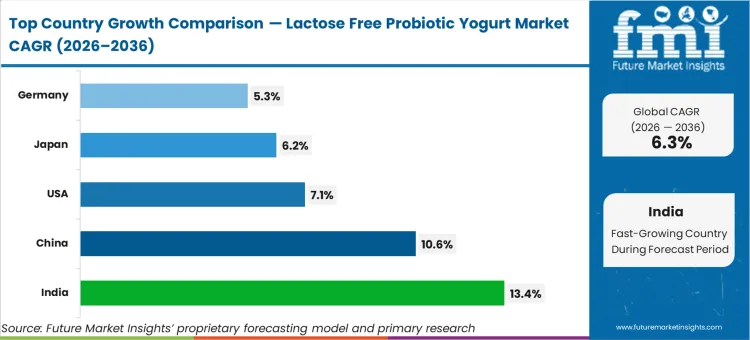
India leads growth at 13.4% CAGR through 2036, driven by rapid cold chain infrastructure development, urbanization-linked dietary shift toward packaged fermented dairy, and growing awareness of probiotic functional benefits among the country's large lactose-intolerant consumer base. China follows at 10.6%, where organized yogurt sector expansion and growing consumer premiumization toward probiotic-enriched dairy products supports high-rate adoption. The USA grows at 7.1% as the high-protein lactose-free probiotic format targets the active lifestyle consumer. Japan grows at 6.2% in an established functional dairy market. Germany grows at 5.3% as EU organic probiotic yogurt demand expands. Spoonable Yogurt holds 58.3% of product type share; Dairy-Based source accounts for 67.5%; Conventional nature holds 71.2%; Flavored accounts for 63.4% of flavour preference.
Lactose Free Probiotic Yogurt Market Definition
The lactose free probiotic yogurt market encompasses the global production, trade, and retail of yogurt products that combine lactase enzyme treatment or plant-based dairy-free formulation to eliminate or reduce lactose content to below 0.1 grams per 100 grams, with the simultaneous incorporation of defined, viable probiotic cultures at commercially significant concentrations. The market covers dairy-based lactose-free yogurt produced through enzymatic lactose hydrolysis and plant-based lactose-free probiotic yogurt made from soy, almond, oat, coconut, and other plant milks fermented with probiotic strains, in spoonable and drinkable formats across conventional and organic product lines.
Lactose Free Probiotic Yogurt Market Inclusions
The report includes comprehensive global and regional market sizing by value with a 10-year forecast from 2026 to 2036. Segmental analysis covers product type, source, nature, and flavour dimensions. Country-level CAGR analysis includes the USA, China, Germany, India, and Japan. High-protein format integration analysis, plant-based dairy market growth linkage, retailer channel strategy for lactose-free probiotic SKU expansion, and competitive positioning among Danone, Nestle, Yakult, Lifeway Foods, Chobani, and emerging brands are incorporated.
Lactose Free Probiotic Yogurt Market Exclusions
The scope excludes non-probiotic lactose-free yogurt products where no viable, labeled probiotic culture is present in defined quantities. Regular conventional yogurt products where lactose content is naturally reduced through standard fermentation but not specifically processed or labeled as lactose-free are outside scope. Yogurt flavoring agents, probiotic supplement capsules marketed alongside but not incorporated into yogurt, and industrial yogurt ingredient supply to bakery and confectionery manufacturers are excluded from market sizing.
Lactose Free Probiotic Yogurt Market Research Methodology
- Primary Research: Interviews were conducted with lactose-free dairy product manufacturers, plant-based yogurt brand management teams, retail category buyers managing free-from and functional dairy sections, cold chain logistics specialists, probiotic culture suppliers for yogurt applications, and regulatory affairs specialists tracking EU and FDA lactose-free labeling and probiotic health claim frameworks.
- Desk Research: CODEX Alimentarius standards for fermented milks and lactose-free labeling, FDA lactose-free labeling guidance, EU Regulation (EC) No 1924/2006 health claim authorization data for yogurt-associated probiotic strains, retail scanner data for free-from dairy category performance, and producer annual report yogurt segment revenue disclosures supported the quantitative framework.
- Market-Sizing and Forecasting: A hybrid bottom-up and top-down model reconstructed demand from dairy-based lactose-free yogurt production volumes by region, plant-based yogurt market data with probiotic-fortified subset penetration rates, high-protein lactose-free format adoption curves, and organic lactose-free probiotic yogurt channel data, validated against retail scanner benchmarks and producer shipment data.
- Data Validation and Update Cycle: Outputs underwent cross-validation against lactose intolerance prevalence data by region, cold chain infrastructure development indices in South and East Asia, consumer purchase intent surveys for lactose-free probiotic yogurt by format and flavour, and expert review by dairy technologists and functional food market analysts prior to release.
Key Industry Highlights
Rising Health Consciousness Driving Demand
High health and wellness awareness increases demand for lactose-free probiotic yogurt. As individuals come to understand the relevance of gut health, they choose digestive health-promoting products. Lactose-free probiotic yogurt comes with the benefits of probiotics without the discomfort resulting from lactose. Indeed, the brands like Chobani and Activia successfully exploited this market, providing a wide choice of lactose-free products loaded with live culture.
Thus reaching beyond the consumers who are sensitive to lactose but also satisfy their urge to keep fit. The increased emphasis on health priorities is the reason for the strong growth of the market, forcing manufacturers to innovate and align their offerings with consumer demands for nutritious, gut-friendly options.
Growth of Plant Based Ingredients
The demand for plant-based alternatives in the lactose-free probiotic yogurt market is quickly growing as consumers are demanding substitutes for dairy. The different reasons for this rising demand include diet-related restrictions, vegan movements, health advantages and sustainability. Consumers are going for a vegan or flexitarian diet that has led to increased demand for non-dairy products made from almonds, coconut, soy, or oat.
These plant-based yogurts cater to health-conscious consumers who look for lower-calorie and cholesterol-free alternatives. Further, the growing concern of environmental sustainability is also propelling consumers to prefer plant-based products, as these are often perceived as environmentally friendly than traditional dairy products.
The growing trend is challenging manufacturers to innovate and extend their lines to produce more diversified plant-based lactose-free probiotic yogurts in line with changing consumer tastes.
Innovating New Flavours Boost the Industry Expansion
The lactose-free probiotic yogurt industry is focusing on in innovations, specifically in flavour developments as manufacturers seek to reach diversified audiences and improve experience for the consumers. Vanilla and strawberry are traditional and popular flavours but now, brands are trying more exotic flavours to keep their product stand out and target specific consumer group.
For example, Mother Dairy recently launched a range of lactose-free yogurts and added flavours like Mango and Mixed Berry to its brand offerings. These flavours allow it to reach consumers craving fresh and fruity flavours. These innovative flavours may help companies to attract people who would normally not consider yogurt as their snack. With innovative flavour blends manufacturers are reacting to the rising demand for tasty and healthy lactose-free probiotic yogurt.
This flavour variety helps a brands to stimulate trials among newer customers while building the trust of current consumer base, thus fostering market growth. As tastes of the consumer change with time, brands will need to put flavours innovation on the agenda to gain market shares and capture the consumers’ need.
2021 to 202 Global Lactose Free Probiotic Yogurt Sales Analysis Compared to Demand Forecasts for 2026 to 2036
Global sales increased at a CAGR of 5.8% from 2021 to 2025. For the next ten years (2026 to 2036), projections are that expenditure on such products will rise at 6.3% CAGR.
Between 2021 to 2025, the lactose-free probiotic yogurt market experienced a dramatic transformation as growing health awareness and demand for naturals were seen as critical drivers. With greater consciousness of the importance of gut health and immunity support, it increased rapidly post-COVID-19 pandemic when wellness and immunity became prominent aspects for consumers. This period also witnessed a rise in the popularity of plant-based and organic products, forcing many manufacturers to innovate their offerings.
Companies such as Nestlé and Danone started including natural ingredients and probiotics in their lactose-free yogurt lines to attract health-conscious consumers. However, the market experienced challenges such as supply chain disruptions that affected ingredient availability and pricing.
From 2026 through 2036, the worldwide lactose-free probiotic yogurt market will be strongly driven by several factors besides health awareness. Technological advancements in fermentation processes and in sourcing ingredients are going to improve product quality and bring down the cost of production. Innovative start-ups which are innovative in flavours profile and environmentally friendly packaging are going to disrupt the established dynamics in the market and win over customers who are mindful of environmental concerns.
Strategic partnerships between well-established brands and emerging companies will encourage product diversification and widen the market reach. Online platforms will continue to grow, thus making lactose-free probiotic yogurt a regular component of healthy diets globally.
Market Concentration
Tier 1 players in the global lactose-free probiotic yogurt market are regarded as global leaders that command a large share in the market. These are innovators and leaders in terms of research and development. The companies, such as Danone and Nestlé, are leading the market with their wide distribution networks and high-quality product portfolios. Market leadership with a diversified array of lactose-free yogurts that contain beneficial probiotic bacteria is secured by Danone, considering the firm's focus on healthy products and sustainability.
Tier 2 firms are domestic players, operating regionally, with special product offerings with sufficient market reach. Specialized niche offerings and direct consumer needs drive these offerings. For instance, in India, Mother Dairy has garnered a significant market share by catering to the native taste buds with lactose-free yogurts. Likewise, a company like Lifeway Foods specializes in probiotic-rich kefir and yogurt for North America that is keenly health-minded. These companies outshine in their specific regions based on quality and innovation through their product offers.
Tier 3 manufacturers are smaller players that only penetrate local or regional markets. They may not be highly developed in terms of research and development, but they are important for filling the gaps to meet the needs of consumers locally and regionally.
These companies will develop unique flavors or artisanal-type production methods, where building a strong relationship with a customer base is vital for their survival. They, despite being small in size, contribute much to the market due to tailored solutions and very good customer service, whereby specific community needs are served adequately.
Country-wise Insights
The following table shows the estimated growth rates of the top five territories. India and China are set to exhibit high growth, recording CAGRs of 13.4% and 10.6%, respectively, through 2036.
.webp "Top Country Growth Comparison Lactose Free Probiotic Yogurt Market Cagr (2026 2036)")
| Countries | CAGR 2024 to 2034 |
|---|---|
| USA | 7.1% |
| China | 10.6% |
| Germany | 5.3% |
| India | 13.4% |
| Japan | 6.2% |
High Consumption Trends Driven by Health Consciousness in USA
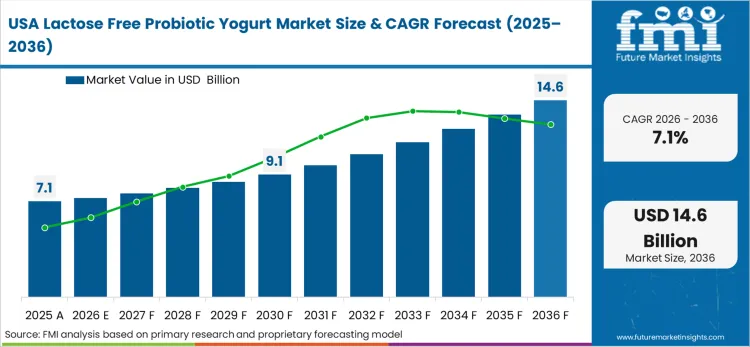
High consumption levels characterize the lactose-free probiotic yogurt market within the United States. Increased health-consciousness drives its growth. As consumers develop a greater awareness of their gut health and benefits derived from consuming probiotics, the demand for lactose-free options that resonate with this preference continues to rise.
This trend is especially observed among lactose intolerant persons who have a need to find wholesome alternatives that should not trade off on flavours or nutritional value. Customers are moving to yogurts that are both lactose-free and contain higher levels of proteins, vitamins, and probiotics.
Another area of growth is the increasing demand for clean-label products, forcing manufacturers to seek natural ingredients and transparent sources, as health-conscious consumers look for these products. Hence, the lactose-free probiotic yogurt segment is expanding, in line with the changing taste buds of American consumers.
Demand Outlook in China
In China, there is fast-growing demand for lactose-free probiotic yogurt as it becomes more and more essential for busy people to maintain their nutrition while on-the-go. Such a development has seen many new products surface, including ready-to-drink formats and single-serve packaging, to make this yogurt convenient to use for consumers on a daily basis.
In addition, awareness of gut health and the benefits of probiotics continues to drive interest in lactose-free options, especially among the younger, health-conscious consumers. Sustainability is also now becoming a major consideration with most consumers wanting to identify brands that have a responsible approach to environmental issues.
For example, Mengniu Dairy has been aggressively promoting its commitment to sustainability by using recyclable packaging and sourcing high-quality ingredients responsibly. With an increasing focus on environmental responsibility, combined with growing demand for lactose-free products, the Chinese lactose-free probiotic yogurt market is in for a substantial growth over the next years, aligning with changes in consumer preference and responsibility towards health and sustainability.
Influence of Social Media and Raw Materials Availability Boosting Sales in India's
The Indian lactose-free probiotic yogurt market is likely to see significant growth in the coming years, due easy availability of raw materials, social media influence, and increased demand from urban consumers. With an increase in accessibility of high-quality dairy alternatives and plant-based ingredients, it has become easier for manufacturers to produce lactose-free yogurt according to diverse consumer preferences.
This accessibility aids in creating innovative products for the ever-increasing health-conscious consumer base. Social media is playing a crucial role in how consumers are shaped, especially the younger generation. Brands are now using platforms such as Instagram and Facebook to introduce their lactose-free probiotic yogurt, which features health benefits and flavours.
This social media activity is not only creating awareness but also engaging communities in healthy discussions. Consequently, lactose-free probiotic yogurt is emerging as a popular choice, which is going to position the market for robust growth in the coming years.
Category-Wise Insights
Manufacturers Focus on Spoonable Probiotic Yogurt for Higher Sales
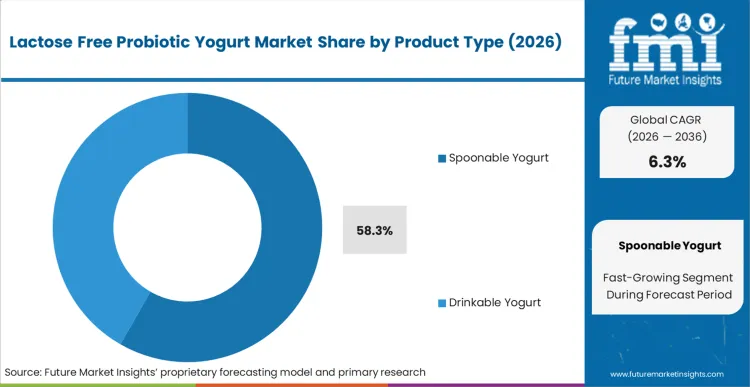
| Segment | Spoonable Yogurt (By Product Type) |
|---|---|
| Value Share (2026) | 58.3% |
The spoonable yogurt segment in the lactose-free probiotic yogurt market is dominant segment as manufacturers focus on delivering high-quality, convenient products that cater to consumer preferences. This segment appeals to health-conscious individuals seeking nutritious snacks that are easy to consume and versatile for various meal occasions.
Companies are innovating with rich textures and creamy formulations, enhancing the overall eating experience. For example, Fage has launched lactose-free spoonable Greek yogurt emphasizing that it is rich in protein and full of flavor.
Oikos is another brand that offers lactose-free spoonable yogurts which vary in flavor according to the taste buds but stay keen on quality ingredients. Spoonable yogurt, due to its convenience and healthy value, hold the majority value share in the global market revenue and expected to grow steadily during forecast period catering to the rising demand from consumers.
Rising Demand for Vegan Products Drives Growth of Plant-Based Products
| Segment | Plant-Based (By Source) |
|---|---|
| Value Share (2026) | 16.4% |
The plant-based segment of the lactose-free probiotic yogurt market is emerging as one of the fastest-growing categories, driven by increasing consumer demand for dairy alternatives and healthier lifestyle choices. As more individuals adopt vegan or flexitarian diets, the appeal of plant-based yogurts made from ingredients like almond, coconut, and soy is rapidly expanding.
These products not only cater to those with lactose intolerance but also attract health-conscious consumers seeking lower-calorie and cholesterol-free options. Companies like Almond Breeze are capitalizing on this trend by offering almond-based yogurt alternatives that are rich in flavor and nutrients.
Similarly, Coconut Collaborative specializes in coconut-based yogurts that provide a creamy texture and unique taste, appealing to a diverse audience. As awareness of the benefits of plant-based diets continues to grow, the plant-based segment is set to experience significant growth, reshaping the landscape of the lactose-free probiotic yogurt market.
Competitive Aligners for Market Players
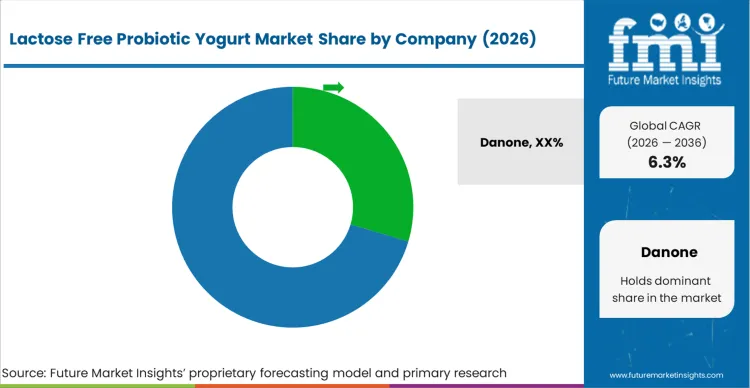
The lactose free probiotic yogurt market is moderately concentrated with global dairy groups competing alongside regional specialists and emerging plant-based brands. Danone holds an estimated 29.6% share in 2026, with Nestle SA, General Mills, Yakult Honsha, Lifeway Foods, Valio, Chobani, Mother Dairy, Kite Hill, Forager Project, Silk, Lactalis Group, and Fage as major competitors. Danone's December 2025 Big Ten Conference partnership expands its Oikos and Silk brand presence across 18 US university campuses with a structured nutrition education program that simultaneously builds probiotic and lactose-free category awareness among the 18-24 consumer demographic. [2]
Chobani's January 2025 High Protein drink line launch represents the most commercially significant format innovation in the US lactose-free probiotic yogurt category in recent years, combining 20 to 30 grams of protein, lactose-free formulation, and active probiotic cultures in a portable drink format targeting the fitness and on-the-go nutrition occasion. [1] This format directly competes with whey protein drinks and sports nutrition beverages while importing the probiotic health positioning from the yogurt category, creating a new competitive space where dairy and sports nutrition converge.
Plant-based competitors including Kite Hill, Forager Project, and Silk face the technical challenge of maintaining probiotic viability in non-dairy matrices under refrigerated shelf conditions while matching the taste profile of dairy-based lactose-free yogurt, a barrier that has maintained dairy-based formats at 67.5% of source share despite growing plant-based sourcing preference among the lactose-intolerant consumer base.
Recent Developments
- January 2025: Chobani officially rolled out its Chobani High Protein drink line following the late 2024 release of its high-protein cups. The formulations are specifically lactose-free, containing 20 to 30 grams of protein and billions of active probiotics without added sugar. The launch targets the on-the-go functional nutrition segment using advanced filtration to maintain high protein density in a liquid format, directly integrating lactose-free probiotic positioning with the performance nutrition channel. [1]
- December 2025: Danone announced a multi-year partnership becoming the first official US Yogurt and Plant-Based Beverages Partner of the Big Ten Conference. The collaboration expands access to Oikos high-protein dairy and Silk probiotic plant-based lactose-free products across 18 university campuses, with a 2026 rollout of Brand Activations and Nutrition Education initiatives led by Danone's Research and Innovation team to highlight the benefits of probiotics and dairy-free alternatives for student-athletes. [2]
Key Players in Lactose Free Probiotic Yogurt Market
- Danone
- Nestle SA
- General Mills Inc.
- Yakult Honsha Co. Ltd.
- Lifeway Foods Incorporation
- Valio
- Chobani
- Mother Dairy Fruit and Vegetable Pvt. Ltd.
- Moringa Milk Industry
- Stonyfield Farm
- Kite Hill
- Forager Project
- Silk
- Lactalis Group
- Fage
Scope of the Report
| Metric | Value |
|---|---|
| Quantitative Units | USD 17.40 billion (2026) to USD 32.06 billion (2036), at a CAGR of 6.3% |
| Market Definition | The lactose free probiotic yogurt market covers dairy-based enzymatically treated and plant-based lactose-free yogurt products incorporating defined viable probiotic cultures at commercial concentrations, in spoonable and drinkable formats across conventional and organic lines for retail, foodservice, and direct-to-consumer channels. |
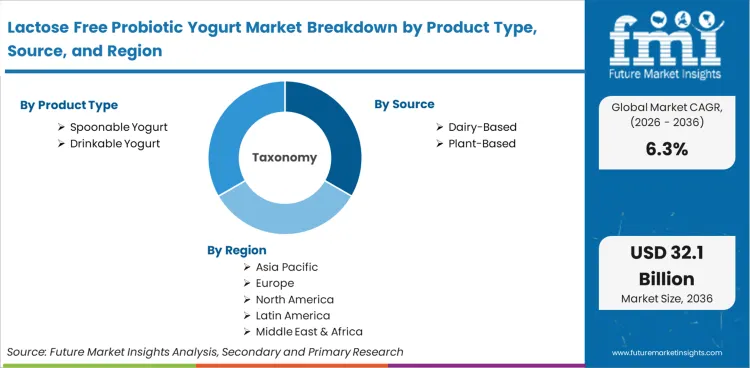
| Product Type Segmentation | Spoonable Yogurt, Drinkable Yogurt |
| Source Segmentation | Dairy-Based, Plant-Based |
| Nature Segmentation | Conventional, Organic |
| Flavour Segmentation | Flavored, Regular/Unflavored, Vanilla, Strawberry, Others |
| Regions Covered | North America, Latin America, Europe, East Asia, South Asia, Oceania, Middle East and Africa |
| Countries Covered | United States, China, Germany, India, Japan, France, United Kingdom, Brazil, South Korea, Australia and 40 plus countries |
| Key Companies Profiled | Danone, Nestle SA, General Mills Inc., Yakult Honsha Co. Ltd., Lifeway Foods Incorporation, Valio, Chobani, Mother Dairy, Kite Hill, Forager Project, Silk, Lactalis Group, Fage |
| Forecast Period | 2026 to 2036 |
| Approach | Hybrid bottom-up and top-down market modeling validated through primary interviews with lactose-free dairy manufacturers and retail category buyers, supported by CODEX Alimentarius fermented milk standards and retail scanner data for free-from dairy category performance |
Lactose Free Probiotic Yogurt Market Analysis by Segments
Product Type
- Spoonable Yogurt (58.3% share, 2026)
- Drinkable Yogurt
Source
- Dairy-Based (67.5% share, 2026)
- Plant-Based
Nature
- Conventional (71.2% share, 2026)
- Organic
Flavour
- Flavored (63.4% share, 2026)
- Regular/Unflavored
- Vanilla
- Strawberry
- Others
Region
- North America: United States (7.1% CAGR), Canada, Mexico
- Latin America: Brazil, Argentina, Chile, Rest of Latin America
- Europe: Germany (5.3% CAGR), France, United Kingdom, Italy, Spain, Benelux, Nordics, Rest of Europe
- East Asia: China (10.6% CAGR), Japan (6.2% CAGR), South Korea
- South Asia: India (13.4% CAGR), Indonesia, Malaysia, Thailand, Rest of South Asia
- Oceania: Australia, New Zealand
- Middle East & Africa: Saudi Arabia, UAE, South Africa, Rest of Middle East & Africa
Bibliography
- [1] Chobani. (2025). Chobani Expands in High Protein Greek Yogurt Category with New Line of 20g Protein Yogurt and 15g, 20g and 30g Protein Yogurt Drinks. Corporate Newsroom, January 2025.
- [2] Danone. (2025). Danone Becomes the First Official US Yogurt and Plant-Based Beverages Partner of the Big Ten Conference. PR Newswire, December 2025.
- [3] Food Dive. (2025). Chobani Taps into Probiotics, Nutrition-Packed Yogurt with New Offerings. Industry News, 2025.
- [4] Lifeway Foods. (2025). Lifeway Foods Annual Report 2024: 16.7% Sales Growth in Lactose-Free Probiotic Kefir and Yogurt. Annual Report, March 2025.
- [5] Arla Foods. (2024). Arla LactoFREE Natural Yogurt Launch in United Kingdom. Corporate Press Release, November 2024.
This Report Addresses
- Market intelligence to enable lactose-free probiotic yogurt formulation strategy, format development decisions, and regional market entry planning across dairy-based and plant-based source categories
- Market size estimation and 10-year revenue forecasts from 2026 to 2036, incorporating India high-growth trajectory modeling, plant-based adoption curve analysis, and high-protein format market penetration data
- Growth opportunity mapping across product type, source, nature, and flavour dimensions with emphasis on high-protein lactose-free format development and plant-based probiotic culture compatibility advances
- Segment and regional revenue forecasts with country-level CAGR analysis for the USA, China, Germany, India, and Japan
- Competition strategy assessment including Danone Big Ten partnership model, Chobani high-protein format innovation, Yakult functional dairy positioning, and emerging plant-based brand growth in Kite Hill and Forager Project
- Regulatory impact analysis covering CODEX Alimentarius lactose-free labeling standards, EU Regulation EC No 1924/2006 health claim authorization for yogurt probiotic strains, and India FSSAI lactose-free and probiotic food labeling development
- Cold chain market readiness analysis covering South Asian distribution infrastructure development and its impact on refrigerated lactose-free probiotic yogurt market access in India, Indonesia, and Southeast Asia
- Market report delivery in PDF, Excel, PPT, and interactive dashboard formats for executive and operational use
Frequently Asked Questions
How large is the demand for Lactose Free Probiotic Yogurt in the global market in 2026?
Demand for Lactose Free Probiotic Yogurt in the global market is estimated to be valued at USD 17.40 billion in 2026.
What will be the market size of Lactose Free Probiotic Yogurt by 2036?
Market size for Lactose Free Probiotic Yogurt is projected to reach USD 32.06 billion by 2036.
What is the expected CAGR for the Lactose Free Probiotic Yogurt market between 2026 and 2036?
Demand for Lactose Free Probiotic Yogurt is expected to grow at a CAGR of 6.3% between 2026 and 2036.
Which product type leads the Lactose Free Probiotic Yogurt market in 2026?
Spoonable Yogurt holds 58.3% of product type share in 2026, reflecting its dominant shelf presence in the free-from dairy refrigerated section and consumer preference for traditional yogurt texture in the lactose-free category.
Which source dominates the Lactose Free Probiotic Yogurt market?
Dairy-Based accounts for 67.5% of source share in 2026, as enzymatic lactose hydrolysis of dairy milk maintains the familiar taste profile that drives purchase retention among consumers transitioning from conventional to lactose-free yogurt formats.
Which country leads Lactose Free Probiotic Yogurt growth through 2036?
India leads at 13.4% CAGR through 2036, driven by rapid urbanization-linked dietary shift toward packaged fermented dairy, high lactose intolerance prevalence in the population, expanding cold chain retail infrastructure, and growing consumer awareness of probiotic functional health benefits.
What is driving the Lactose Free Probiotic Yogurt market in China?
China grows at 10.6% CAGR, supported by organized yogurt sector expansion, growing consumer premiumization toward probiotic-enriched dairy products, and increasing cold chain retail infrastructure enabling wider distribution of lactose-free probiotic yogurt in urban and suburban markets.
What is the significance of Chobani's High Protein lactose-free launch?
Chobani's January 2025 High Protein drink line, formulated to be lactose-free with 20 to 30 grams of protein and active probiotics, converts the performance nutrition consumer into the lactose-free probiotic yogurt addressable market, opening a new category adjacency where free-from and sports nutrition consumers overlap and creating a higher-value format tier above standard probiotic yogurt SKUs.
How does FMI validate its Lactose Free Probiotic Yogurt forecast?
Forecast is developed using hybrid bottom-up and top-down modeling validated through primary interviews with lactose-free dairy manufacturers and retail category buyers, CODEX Alimentarius fermented milk standards, EU Regulation EC No 1924/2006 health claim data, and retail scanner benchmarks for free-from dairy category performance.
Preview the report firsthand - request a free sample
Get SampleGet the brochure for pricing and purchase details.
Get PDFTable of Content
- Executive Summary
- Global Market Outlook
- Demand-side Trends
- Supply-side Trends
- Technology Roadmap Analysis
- Analysis and Recommendations
- Market Overview
- Market Coverage / Taxonomy
- Market Definition / Scope / Limitations
- Research Methodology
- Chapter Orientation
- Analytical Lens and Working Hypotheses
- Market Structure, Signals, and Trend Drivers
- Benchmarking and Cross-market Comparability
- Market Sizing, Forecasting, and Opportunity Mapping
- Research Design and Evidence Framework
- Desk Research Programme (Secondary Evidence)
- Company Annual and Sustainability Reports
- Peer-reviewed Journals and Academic Literature
- Corporate Websites, Product Literature, and Technical Notes
- Earnings Decks and Investor Briefings
- Statutory Filings and Regulatory Disclosures
- Technical White Papers and Standards Notes
- Trade Journals, Industry Magazines, and Analyst Briefs
- Conference Proceedings, Webinars, and Seminar Materials
- Government Statistics Portals and Public Data Releases
- Press Releases and Reputable Media Coverage
- Specialist Newsletters and Curated Briefings
- Sector Databases and Reference Repositories
- FMI Internal Proprietary Databases and Historical Market Datasets
- Subscription Datasets and Paid Sources
- Social Channels, Communities, and Digital Listening Inputs
- Additional Desk Sources
- Expert Input and Fieldwork (Primary Evidence)
- Primary Modes
- Qualitative Interviews and Expert Elicitation
- Quantitative Surveys and Structured Data Capture
- Blended Approach
- Why Primary Evidence is Used
- Field Techniques
- Interviews
- Surveys
- Focus Groups
- Observational and In-context Research
- Social and Community Interactions
- Stakeholder Universe Engaged
- C-suite Leaders
- Board Members
- Presidents and Vice Presidents
- R&D and Innovation Heads
- Technical Specialists
- Domain Subject-matter Experts
- Scientists
- Physicians and Other Healthcare Professionals
- Governance, Ethics, and Data Stewardship
- Research Ethics
- Data Integrity and Handling
- Primary Modes
- Tooling, Models, and Reference Databases
- Desk Research Programme (Secondary Evidence)
- Data Engineering and Model Build
- Data Acquisition and Ingestion
- Cleaning, Normalisation, and Verification
- Synthesis, Triangulation, and Analysis
- Quality Assurance and Audit Trail
- Market Background
- Market Dynamics
- Drivers
- Restraints
- Opportunity
- Trends
- Scenario Forecast
- Demand in Optimistic Scenario
- Demand in Likely Scenario
- Demand in Conservative Scenario
- Opportunity Map Analysis
- Product Life Cycle Analysis
- Supply Chain Analysis
- Investment Feasibility Matrix
- Value Chain Analysis
- PESTLE and Porter’s Analysis
- Regulatory Landscape
- Regional Parent Market Outlook
- Production and Consumption Statistics
- Import and Export Statistics
- Market Dynamics
- Global Market Analysis 2021 to 2025 and Forecast, 2026 to 2036
- Historical Market Size Value (USD Million) Analysis, 2021 to 2025
- Current and Future Market Size Value (USD Million) Projections, 2026 to 2036
- Y-o-Y Growth Trend Analysis
- Absolute $ Opportunity Analysis
- Global Market Pricing Analysis 2021 to 2025 and Forecast 2026 to 2036
- Global Market Analysis 2021 to 2025 and Forecast 2026 to 2036, By Product Type
- Introduction / Key Findings
- Historical Market Size Value (USD Million) Analysis By Product Type , 2021 to 2025
- Current and Future Market Size Value (USD Million) Analysis and Forecast By Product Type , 2026 to 2036
- Spoonable Yogurt
- Drinkable Yogurt
- Spoonable Yogurt
- Y-o-Y Growth Trend Analysis By Product Type , 2021 to 2025
- Absolute $ Opportunity Analysis By Product Type , 2026 to 2036
- Global Market Analysis 2021 to 2025 and Forecast 2026 to 2036, By Source
- Introduction / Key Findings
- Historical Market Size Value (USD Million) Analysis By Source, 2021 to 2025
- Current and Future Market Size Value (USD Million) Analysis and Forecast By Source, 2026 to 2036
- Dairy-Based
- Plant-Based
- Dairy-Based
- Y-o-Y Growth Trend Analysis By Source, 2021 to 2025
- Absolute $ Opportunity Analysis By Source, 2026 to 2036
- Global Market Analysis 2021 to 2025 and Forecast 2026 to 2036, By Nature
- Introduction / Key Findings
- Historical Market Size Value (USD Million) Analysis By Nature, 2021 to 2025
- Current and Future Market Size Value (USD Million) Analysis and Forecast By Nature, 2026 to 2036
- Conventional
- Organic
- Conventional
- Y-o-Y Growth Trend Analysis By Nature, 2021 to 2025
- Absolute $ Opportunity Analysis By Nature, 2026 to 2036
- Global Market Analysis 2021 to 2025 and Forecast 2026 to 2036, By Flavour
- Introduction / Key Findings
- Historical Market Size Value (USD Million) Analysis By Flavour, 2021 to 2025
- Current and Future Market Size Value (USD Million) Analysis and Forecast By Flavour, 2026 to 2036
- Flavored
- Regular/Unflavored
- Vanilla
- Strawberry
- Others
- Flavored
- Y-o-Y Growth Trend Analysis By Flavour, 2021 to 2025
- Absolute $ Opportunity Analysis By Flavour, 2026 to 2036
- Global Market Analysis 2021 to 2025 and Forecast 2026 to 2036, By Region
- Introduction
- Historical Market Size Value (USD Million) Analysis By Region, 2021 to 2025
- Current Market Size Value (USD Million) Analysis and Forecast By Region, 2026 to 2036
- North America
- Latin America
- Western Europe
- Eastern Europe
- East Asia
- South Asia and Pacific
- Middle East & Africa
- Market Attractiveness Analysis By Region
- North America Market Analysis 2021 to 2025 and Forecast 2026 to 2036, By Country
- Historical Market Size Value (USD Million) Trend Analysis By Market Taxonomy, 2021 to 2025
- Market Size Value (USD Million) Forecast By Market Taxonomy, 2026 to 2036
- By Country
- USA
- Canada
- Mexico
- By Product Type
- By Source
- By Nature
- By Flavour
- By Country
- Market Attractiveness Analysis
- By Country
- By Product Type
- By Source
- By Nature
- By Flavour
- Key Takeaways
- Latin America Market Analysis 2021 to 2025 and Forecast 2026 to 2036, By Country
- Historical Market Size Value (USD Million) Trend Analysis By Market Taxonomy, 2021 to 2025
- Market Size Value (USD Million) Forecast By Market Taxonomy, 2026 to 2036
- By Country
- Brazil
- Chile
- Rest of Latin America
- By Product Type
- By Source
- By Nature
- By Flavour
- By Country
- Market Attractiveness Analysis
- By Country
- By Product Type
- By Source
- By Nature
- By Flavour
- Key Takeaways
- Western Europe Market Analysis 2021 to 2025 and Forecast 2026 to 2036, By Country
- Historical Market Size Value (USD Million) Trend Analysis By Market Taxonomy, 2021 to 2025
- Market Size Value (USD Million) Forecast By Market Taxonomy, 2026 to 2036
- By Country
- Germany
- UK
- Italy
- Spain
- France
- Nordic
- BENELUX
- Rest of Western Europe
- By Product Type
- By Source
- By Nature
- By Flavour
- By Country
- Market Attractiveness Analysis
- By Country
- By Product Type
- By Source
- By Nature
- By Flavour
- Key Takeaways
- Eastern Europe Market Analysis 2021 to 2025 and Forecast 2026 to 2036, By Country
- Historical Market Size Value (USD Million) Trend Analysis By Market Taxonomy, 2021 to 2025
- Market Size Value (USD Million) Forecast By Market Taxonomy, 2026 to 2036
- By Country
- Russia
- Poland
- Hungary
- Balkan & Baltic
- Rest of Eastern Europe
- By Product Type
- By Source
- By Nature
- By Flavour
- By Country
- Market Attractiveness Analysis
- By Country
- By Product Type
- By Source
- By Nature
- By Flavour
- Key Takeaways
- East Asia Market Analysis 2021 to 2025 and Forecast 2026 to 2036, By Country
- Historical Market Size Value (USD Million) Trend Analysis By Market Taxonomy, 2021 to 2025
- Market Size Value (USD Million) Forecast By Market Taxonomy, 2026 to 2036
- By Country
- China
- Japan
- South Korea
- By Product Type
- By Source
- By Nature
- By Flavour
- By Country
- Market Attractiveness Analysis
- By Country
- By Product Type
- By Source
- By Nature
- By Flavour
- Key Takeaways
- South Asia and Pacific Market Analysis 2021 to 2025 and Forecast 2026 to 2036, By Country
- Historical Market Size Value (USD Million) Trend Analysis By Market Taxonomy, 2021 to 2025
- Market Size Value (USD Million) Forecast By Market Taxonomy, 2026 to 2036
- By Country
- India
- ASEAN
- Australia & New Zealand
- Rest of South Asia and Pacific
- By Product Type
- By Source
- By Nature
- By Flavour
- By Country
- Market Attractiveness Analysis
- By Country
- By Product Type
- By Source
- By Nature
- By Flavour
- Key Takeaways
- Middle East & Africa Market Analysis 2021 to 2025 and Forecast 2026 to 2036, By Country
- Historical Market Size Value (USD Million) Trend Analysis By Market Taxonomy, 2021 to 2025
- Market Size Value (USD Million) Forecast By Market Taxonomy, 2026 to 2036
- By Country
- Kingdom of Saudi Arabia
- Other GCC Countries
- Turkiye
- South Africa
- Other African Union
- Rest of Middle East & Africa
- By Product Type
- By Source
- By Nature
- By Flavour
- By Country
- Market Attractiveness Analysis
- By Country
- By Product Type
- By Source
- By Nature
- By Flavour
- Key Takeaways
- Key Countries Market Analysis
- USA
- Pricing Analysis
- Market Share Analysis, 2025
- By Product Type
- By Source
- By Nature
- By Flavour
- Canada
- Pricing Analysis
- Market Share Analysis, 2025
- By Product Type
- By Source
- By Nature
- By Flavour
- Mexico
- Pricing Analysis
- Market Share Analysis, 2025
- By Product Type
- By Source
- By Nature
- By Flavour
- Brazil
- Pricing Analysis
- Market Share Analysis, 2025
- By Product Type
- By Source
- By Nature
- By Flavour
- Chile
- Pricing Analysis
- Market Share Analysis, 2025
- By Product Type
- By Source
- By Nature
- By Flavour
- Germany
- Pricing Analysis
- Market Share Analysis, 2025
- By Product Type
- By Source
- By Nature
- By Flavour
- UK
- Pricing Analysis
- Market Share Analysis, 2025
- By Product Type
- By Source
- By Nature
- By Flavour
- Italy
- Pricing Analysis
- Market Share Analysis, 2025
- By Product Type
- By Source
- By Nature
- By Flavour
- Spain
- Pricing Analysis
- Market Share Analysis, 2025
- By Product Type
- By Source
- By Nature
- By Flavour
- France
- Pricing Analysis
- Market Share Analysis, 2025
- By Product Type
- By Source
- By Nature
- By Flavour
- India
- Pricing Analysis
- Market Share Analysis, 2025
- By Product Type
- By Source
- By Nature
- By Flavour
- ASEAN
- Pricing Analysis
- Market Share Analysis, 2025
- By Product Type
- By Source
- By Nature
- By Flavour
- Australia & New Zealand
- Pricing Analysis
- Market Share Analysis, 2025
- By Product Type
- By Source
- By Nature
- By Flavour
- China
- Pricing Analysis
- Market Share Analysis, 2025
- By Product Type
- By Source
- By Nature
- By Flavour
- Japan
- Pricing Analysis
- Market Share Analysis, 2025
- By Product Type
- By Source
- By Nature
- By Flavour
- South Korea
- Pricing Analysis
- Market Share Analysis, 2025
- By Product Type
- By Source
- By Nature
- By Flavour
- Russia
- Pricing Analysis
- Market Share Analysis, 2025
- By Product Type
- By Source
- By Nature
- By Flavour
- Poland
- Pricing Analysis
- Market Share Analysis, 2025
- By Product Type
- By Source
- By Nature
- By Flavour
- Hungary
- Pricing Analysis
- Market Share Analysis, 2025
- By Product Type
- By Source
- By Nature
- By Flavour
- Kingdom of Saudi Arabia
- Pricing Analysis
- Market Share Analysis, 2025
- By Product Type
- By Source
- By Nature
- By Flavour
- Turkiye
- Pricing Analysis
- Market Share Analysis, 2025
- By Product Type
- By Source
- By Nature
- By Flavour
- South Africa
- Pricing Analysis
- Market Share Analysis, 2025
- By Product Type
- By Source
- By Nature
- By Flavour
- USA
- Market Structure Analysis
- Competition Dashboard
- Competition Benchmarking
- Market Share Analysis of Top Players
- By Regional
- By Product Type
- By Source
- By Nature
- By Flavour
- Competition Analysis
- Competition Deep Dive
- Danone
- Overview
- Product Portfolio
- Profitability by Market Segments (Product/Age /Sales Channel/Region)
- Sales Footprint
- Strategy Overview
- Marketing Strategy
- Product Strategy
- Channel Strategy
- Nestlé SA
- General Mills Inc.
- Yakult Honsha Co. Ltd.
- Lifeway Foods Incorporation
- Valio
- Chobani
- Mother Dairy Fruit and Vegetable Pvt. Ltd
- Moringa Milk Industry
- Stonyfield Farm
- Kefir Company
- Kite Hill
- Forager Project
- Nancy's Probiotic
- Silk
- Almond Breeze
- Lactalis Group
- Fage
- Lancashire Farm
- Danone
- Competition Deep Dive
- Assumptions & Acronyms Used


