

- Industry Size (2025)
- USD 24.8 Mn
- Forecast (2035)
- USD 60.2 Mn
- CAGR (2025 to 2035)
- 9.3%
Laminaria Digitata Extract Market Forecast and Outlook 2025 to 2035
In 2025, the laminaria digitata extract market is valued at USD 24.8 million and is projected to reach USD 60.2 million by 2035 at a CAGR of 9.3%. Early growth reflects rising use of brown seaweed extracts in skin care, dietary supplements, and functional food formulations, where mineral density, polysaccharide content, and antioxidant activity are primary selection drivers. Marine-sourced actives gain wider acceptance in formulations as brands seek traceable coastal biomass and consistent bioactive profiles. Cosmetic applications lead initial demand, supported by use in moisturizing, firming, and scalp care products that rely on alginate and fucoidan content for functional performance. Extraction investment during this phase focuses on improving yield stability, iodine control, and heavy metal compliance to meet tighter quality requirements.
After 2030, market expansion becomes more diversified across nutraceutical, food fortification, and medical nutrition channels. Market value rises from about USD 38.7 million in 2030 toward USD 60.2 million by 2035 as applications extend into metabolic support, thyroid related supplementation, and gut health products where marine polysaccharides serve as functional ingredients. Demand also strengthens in professional cosmetic care and spa formulations that emphasize marine efficacy positioning. Product differentiation during this phase centers on standardized extract grades, bioavailability profiling, and controlled sensory impact in oral formats. Supply chain development increasingly relies on contract harvesting, aquaculture linked sourcing, and vertical integration between seaweed processors and downstream ingredient formulators to manage seasonal variability and long term cost stability.
Quick Stats of the Laminaria Digitata Extract Market:
- Laminaria Digitata Extract Market Value (2025): USD 24.8 million
- Laminaria Digitata Extract Market Forecast Value (2035): USD 60.2 million
- Laminaria Digitata Extract Market Forecast CAGR (2025 to 2035): 9.3%
- Laminaria Digitata Extract Market Leading End Use Application: Skin Care (9.0%)
- Laminaria Digitata Extract Market Key Growth Regions: India, China, Japan, UK, Germany, USA
- Laminaria Digitata Extract Market Top Players: BASF SE, Croda International, Evonik Industries, Symrise (incl. IFF/Givaudan actives), Dow / Dow Inc., Ashland, Clariant, Seppic, Lubrizol, Lonza, Inolex
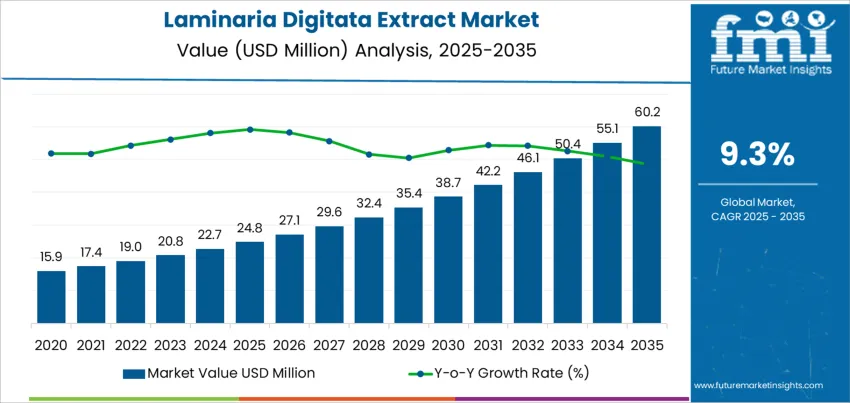
What is the Growth Forecast for the Laminaria Digitata Extract Market through 2035?
Global demand for Laminaria digitata extract increases from USD 24.8 million in 2025 to USD 27.1 million in 2026 and USD 29.6 million in 2027, reflecting early acceleration driven by expansion in cosmetic actives, nutraceutical formulations, and functional food ingredients. By 2030, the market reaches USD 35.4 million, adding USD 10.6 million from the 2025 base. This phase is shaped by rising use of brown algae extracts for skin hydration, mineral supplementation, metabolic wellness, and anti-inflammatory positioning. Adoption remains strongest in premium beauty, sports nutrition, and clean-label supplement segments, where traceability, marine sourcing, and bioactive standardization support controlled but steady scale-up.
From 2030 to 2035, the global market expands from USD 35.4 million to USD 60.2 million, generating a larger USD 24.8 million in absolute growth within five years. This back-weighted acceleration reflects broader penetration of Laminaria digitata into mass-market skincare, clinical nutrition, and fortified food systems. Higher inclusion rates, standardized iodine and polyphenol profiles, and improved extraction yields raise value density per unit. Expansion of seaweed-based bioactives across Asia, Europe, and North America further supports volume scalability. As marine-derived functional ingredients move from specialty positioning toward routine formulation inputs, the extract transitions into a structurally embedded component of global health, beauty, and nutrition supply chains.
Laminaria Digitata Extract Industry Key Takeaways
| Metric | Value |
|---|---|
| Industry Value (2025) | USD 24.8 million |
| Forecast Value (2035) | USD 60.2 million |
| Forecast CAGR (2025 to 2035) | 9.3% |
How Is the Global Laminaria Digitata Extract Market Developing?
The global demand for extracts from Laminaria digitata a large brown seaweed expanded as industries recognized its bioactive compounds such as fucoidans, alginates, and polyphenols. Early use was concentrated in food-grade alginates for stabilization and as thickeners in processed foods. Cosmetic and personal care manufacturers adopted Laminaria digitata extract for its reputed skin conditioning, antioxidant, and anti-inflammatory attributes. Supplement producers began using extracts in dietary formulations targeting joint health, digestion support, and general wellness. The coexistence of food, cosmetic, and nutraceutical applications created a broad market base that carried growth beyond any single sector.
Future growth of the Laminaria digitata extract market will rely on expanding claims and regulatory acceptance across multiple sectors. Demand is likely to increase in skincare and cosmetic products as interest grows in marine-derived, “natural origin” ingredients for skin barrier support, anti-aging, and sun-damage repair. Nutraceutical and functional food developers may explore algal extracts as sources of dietary fiber, bioactive polysaccharides, or mineral-rich supplements for digestive health and metabolic support. Research into sustainable seaweed harvesting, traceable supply chains, and eco-certified processing will strengthen acceptance among environmentally conscious consumers and brands. Barriers include variability in raw-material composition, supply seasonality, and regulatory differences across markets. Market expansion will depend on standardization of extract quality, efficacy data, and transparent sourcing practices.
How Are End Use Segments and Product Forms Structuring the Global Laminaria Digitata Extract Landscape?
Global demand for Laminaria digitata extract is structured by end use application and product form, with consumption concentrated across East Asia, Western Europe, and North America. Skin care represents a 9.0% share, supported by formulation activity in South Korea, Japan, France, Germany, and the USA. Body care, hair care, sun care, color cosmetics, men grooming, baby and kids care, and dermocosmetic or professional care follow across mass and regulated product categories. On the product form side, powder accounts for a 15.1% share alongside liquids, concentrates, dispersions, emulsions, gels, pastes, wax blocks, and oils. Selection trends reflect bioactive stability, formulation compatibility, and processing efficiency across cosmetic production hubs.
Why Does Skin Care Lead End Use Demand in the Global Laminaria Digitata Extract Market?
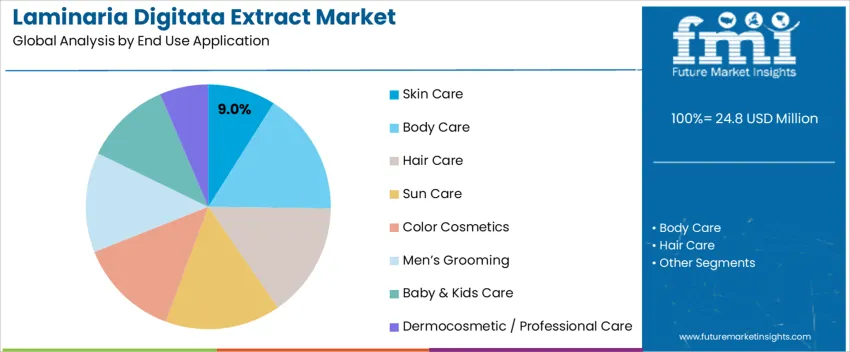
Skin care accounts for 9.0% of global Laminaria digitata extract usage due to its functional role in hydration support, soothing formulations, and mineral enrichment of topical products. The extract is widely used in facial creams, serums, masks, and cleansers where marine derived actives are positioned for skin conditioning and surface repair. Demand is strongest across South Korea, Japan, France, and the USA, where algae based cosmetic ingredients hold established regulatory and consumer acceptance. Anti pollution, moisture retention, and barrier support formulations remain the primary drivers of application growth.
Skin care also shows higher ingredient loading per unit compared with rinse off body and hair formats. Dermocosmetic and professional brands rely on Laminaria digitata extract for use in sensitive skin, post treatment care, and hydration focused product lines. Clinical formulation standards in Europe and North America further reinforce its use in regulated cosmetic categories. These efficacy positioning, compliance requirements, and formulation safety factors sustain skin care as the leading global application for Laminaria digitata extract.
Why Does Powder Form Dominate Product Positioning in the Global Laminaria Digitata Extract Market?
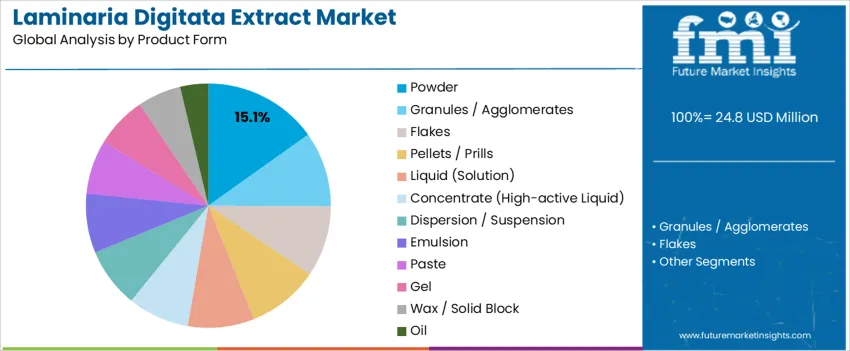
Powder form accounts for 15.1% of global Laminaria digitata extract demand due to superior shelf stability, reduced risk of microbial growth, and controlled active concentration during formulation. Powders allow precise dosing into emulsions, gels, masks, and serums while preserving bioactive integrity under extended storage conditions. Contract manufacturers across Asia, Europe, and North America favor powdered extracts for repeatability in batch processing and predictable dispersion across large scale cosmetic production.
Powder formats also improve logistics efficiency by lowering transport weight, minimizing leakage risk, and reducing dependence on temperature controlled shipping. Regulatory documentation for dry marine extracts remains more standardized for export handling across international supply chains. Powders integrate effectively with automated cosmetic mixing systems used in high volume manufacturing. These storage, processing, and compliance advantages position powder as the preferred global product form for Laminaria digitata extract.
How Is Laminaria Digitata Being Repositioned from Seaweed Raw Material to Bioactive Extract Platform?
Laminaria digitata is no longer treated only as a bulk seaweed input for iodine or alginate recovery. Extraction technologies now isolate targeted polysaccharides, polyphenols, minerals, and bioactive compounds for controlled functional roles. This shift moves the material from low-margin hydrocolloid supply into higher-value nutrition, skin care, agriculture, and biostimulant markets. Product developers focus on selective fractionation rather than whole-biomass usage. As extraction precision increases, the market increasingly values consistency, molecular profile control, and application-specific performance rather than simple origin claims.
Why Are Nutrition, Skin Care, and Agriculture Creating Parallel Demand Pathways?
Human nutrition adopts Laminaria digitata extracts for mineral density, fermentable fibers, and metabolic support positioning. Skin care formulators focus on hydration, protective film formation, and oxidative stress moderation linked to seaweed bioactivity. Agriculture applies the extract as a plant stimulant that influences root growth, stress tolerance, and nutrient uptake. These application areas operate under different regulatory and formulation constraints, yet they converge around the same biological functionality of the algae. This parallel demand structure stabilizes the market by preventing dependence on a single consumption channel.
What Structural Constraints Limit Faster Scale-Up of the Laminaria Digitata Extract Market?
Market expansion is constrained by seasonal harvesting cycles, marine ecosystem controls, and biomass variation driven by water temperature and light exposure. Extract quality fluctuates with harvest timing and geography, complicating standardization. Processing infrastructure remains capital intensive due to dehydration, milling, and solvent recovery requirements. Regulatory classification varies by application, which fragments commercial strategy across food, cosmetics, and agriculture. Logistics and drying costs affect profitability due to the high water content of raw seaweed. These structural constraints prevent rapid commoditization and preserve entry barriers.
How Is the Market Shifting in Terms of Extraction Logic and Application Integration?
The market is shifting from crude extracts toward standardized functional fractions aligned with defined use cases. Controlled enzymatic extraction, membrane filtration, and low-temperature drying are gaining adoption to preserve labile compounds. In nutrition, extraction now targets fermentability and mineral bioavailability rather than iodine concentration alone. Skin care focuses on molecular weight control for film-forming behavior. Agriculture prioritizes soluble fractions that influence signaling pathways in plants. This shift signals that Laminaria digitata extract is transitioning from a generic marine input into a precision biological performance ingredient.
What is the Global Growth Outlook for the Laminaria Digitata Extract Market by Country?
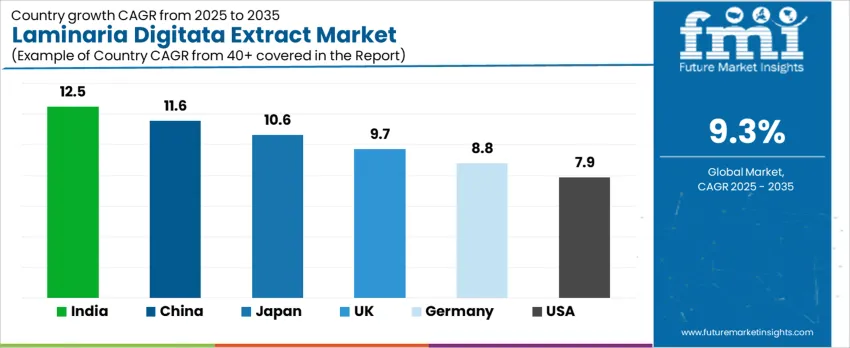
| Country | CAGR (%) |
|---|---|
| India | 12.5 |
| China | 11.6 |
| Japan | 10.6 |
| UK | 9.7 |
| Germany | 8.8 |
| USA | 7.9 |
The global market for Laminaria Digitata extract is forecast to grow across all listed nations, with India leading at 12.5% CAGR. Growth in India is supported by increasing demand in cosmetic, nutraceutical and functional food segments that use seaweed derivatives. China follows at 11.6%, driven by expanding ingredient sourcing, rising consumer interest in marine-derived compounds and growing personal care product penetration. Japan’s 10.6% reflects stable adoption of seaweed extracts in skincare and dietary supplement markets. The UK at 9.7% and Germany at 8.8% show moderate growth, linked to clean-label trends and increased use of natural marine extracts. The USA, at 7.9%, indicates a mature but gradually expanding market for Laminaria Digitata extract especially in cosmetics, wellness and specialty nutrition.
Why Is India Emerging as a High Growth Market for Laminaria Digitata Extract?
India records a CAGR of 12.5% through 2035 for Laminaria digitata extract growth, driven by expanding nutraceutical production, rising functional food demand, and widening application in herbal personal care products. Supplement brands integrate seaweed extracts for iodine content, metabolic support, and digestive health positioning. Skincare and haircare manufacturers adopt kelp derived actives for conditioning and antioxidant benefits. Domestic extraction and formulation capacity improves ingredient availability for midsized brands. Growth aligns with preventive wellness spending and wider Ayurvedic product integration across urban and semi urban consumer segments.
- Nutraceutical supplements drive primary extract consumption
- Herbal personal care supports cosmetic grade demand
- Local extraction improves supply accessibility
- Preventive wellness spending sustains long term uptake
What Is Powering Expansion of Laminaria Digitata Extract in China?
China posts a CAGR of 11.6% through 2035 for Laminaria digitata extract growth, supported by strong functional food development, marine ingredient processing, and pharmaceutical nutrition use. Seaweed extracts are widely applied in metabolism support supplements, fortified beverages, and traditional medicine formulations. Coastal processing hubs scale drying and extraction output to meet rising domestic and export demand. Cosmetics manufacturers also integrate kelp extracts for moisturizing and protective skin products. Growth follows marine ingredient industrialization and rising health spending across urban populations with growing interest in natural dietary actives.
- Marine processing hubs support high extract output
- Functional beverages adopt seaweed based ingredients
- Traditional medicine formulations sustain steady demand
- Cosmetic applications add secondary volume growth
How Is Japan Maintaining Momentum in the Laminaria Digitata Extract Market?
Japan reflects a CAGR of 10.6% through 2035 for Laminaria digitata extract growth, shaped by daily seaweed consumption culture, functional ingredient refinement, and clinical nutrition integration. Kelp based extracts are used in dietary supplements, broth concentrates, and metabolism support formulations. Aging population demand reinforces consistent intake for thyroid and mineral balance applications. Scientific validation and standardized extraction quality guide formulation strategies. Growth remains quality driven rather than volume driven, supported by stable consumption habits and continuous product refinement within health oriented food and supplement categories.
- Daily dietary integration sustains baseline consumption
- Clinical nutrition supports structured supplement use
- Standardized extraction quality strengthens formulation trust
- Aging population ensures long term intake stability
What Factors Are Sustaining Laminaria Digitata Extract Growth in the UK?
The UK records a CAGR of 9.7% through 2035 for Laminaria digitata extract growth, supported by rising plant based nutrition, clean label supplement demand, and natural cosmetic formulation adoption. Seaweed extracts gain traction in mineral supplements, detox beverages, and functional snack products. Skincare brands adopt kelp actives for hydration and barrier support positioning. Pharmacy retail and online wellness platforms expand consumer access. Growth reflects lifestyle nutrition spending rather than medical channel dominance, with strong interest in marine sourced micronutrients among health conscious adult populations.
- Plant based supplements drive mineral nutrition demand
- Skincare brands integrate kelp for hydration benefits
- Online wellness platforms expand consumer access
- Clean label positioning strengthens ingredient adoption
Why Is Germany Experiencing Stable Expansion in the Laminaria Digitata Extract Market?
Germany shows a CAGR of 8.8% through 2035 for Laminaria digitata extract growth, supported by pharmaceutical nutrition, regulated supplement manufacturing, and functional food development. Seaweed extracts are used in iodine supplementation, metabolic support powders, and digestive health formulas. Pharmacy distribution anchors consistent sales. Regulatory discipline encourages standardized sourcing and dosage accuracy. Cosmetic usage remains selective and clinically positioned. Growth remains structured and compliance oriented, guided by medical nutrition credibility and long term digestive and metabolic health management rather than rapid consumer lifestyle adoption.
- Pharmacy distribution anchors steady supplement demand
- Iodine supplementation remains a key application area
- Regulated sourcing supports consistent ingredient quality
- Medical nutrition frameworks guide controlled growth
How Is the USA Maintaining Measured Growth in the Laminaria Digitata Extract Market?
The USA records a CAGR of 7.9% through 2035 for Laminaria digitata extract growth, shaped by dietary supplement maturity, functional beverage development, and clean label personal care production. Seaweed extracts are incorporated into thyroid support supplements, protein blends, and natural skincare formulations. Direct to consumer brands test marine actives across wellness platforms. Food application remains selective outside specialty products. Growth remains measured due to strong competition from alternative botanical extracts and established iodine sources, keeping adoption focused on premium nutrition and cosmetic product lines.
- Thyroid support supplements anchor core demand
- Direct to consumer brands expand marine active trials
- Functional beverages add secondary application volume
- Botanical extract competition moderates rapid expansion
What Is Driving the Global Demand for Laminaria Digitata Extract and Who Are the Key Players Shaping the Industry?
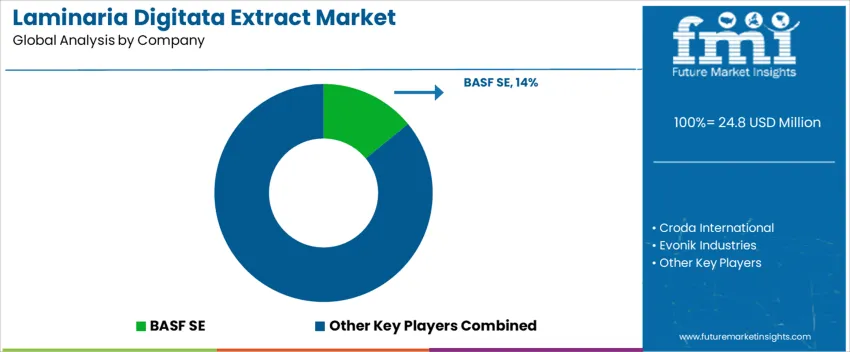
Global demand for Laminaria Digitata Extract is rising as manufacturers of cosmetics, personal care, functional foods and nutraceuticals increasingly seek natural, marine-derived ingredients rich in bioactives. The extract is valued for its antioxidant, hydrating, and skin-soothing properties, along with vitamins, minerals, polysaccharides and phlorotannins that support skin barrier function, moisture retention and protection against environmental stress. Rising consumer interest in “clean label” products and natural ingredients, coupled with growing awareness of skin health and wellness, boosts adoption across cosmetic and nutritional product lines worldwide. Expanding application scope into hair care, dietary supplements and wellness products further drives demand.
Major ingredient suppliers influencing the global market include BASF SE, Croda International, Evonik Industries, Symrise (including IFF/Givaudan actives), Dow Inc., Ashland, Clariant, and specialist firms like Seppic, Lubrizol, Lonza and Inolex. Global-scale players such as BASF and Evonik supply bulk seaweed-derived ingredients and support large-volume demand. Croda, Symrise and Ashland tailor formulations for skincare, nutraceutical and personal care segments, offering refined, application-specific extracts. The smaller specialised companies deliver niche or customised variants for high-end cosmetic, dietary and wellness markets. Together they ensure supply diversity, support innovation, and drive wider adoption of Laminaria Digitata Extract globally.
Key Players in the Laminaria Digitata Extract Market
- BASF SE
- Croda International
- Evonik Industries
- Symrise (incl. IFF/Givaudan actives)
- Dow / Dow Inc.
- Ashland
- Clariant
- Seppic / Others (Seppic, Lubrizol, Lonza, Inolex etc.)
- Others
Scope of the Report
| Items | Values |
|---|---|
| Quantitative Units (2025) | USD million |
| End-Use Applications | Skin Care, Body Care, Hair Care, Sun Care, Color Cosmetics, Men’s Grooming, Baby & Kids Care, Dermocosmetic / Professional Care |
| Product Forms | Powder, Granules/Agglomerates, Flakes, Pellets/Prills, Liquid (Solution), Concentrate (High-active Liquid), Dispersion/Suspension, Emulsion, Paste, Gel, Wax / Solid Block, Oil |
| Regions Covered | East Asia, Europe, North America, South Asia, Latin America, Middle East & Africa, Eastern Europe |
| Countries Covered | China, Japan, South Korea, Taiwan, Germany, UK, France, Italy, USA, Canada, Mexico, India, Pakistan, Brazil, Argentina, Saudi Arabia, Russia, plus 40+ additional countries globally |
| Key Companies Profiled | BASF SE, Croda International, Evonik Industries, Symrise (incl. IFF/Givaudan actives), Dow Inc., Ashland, Clariant, Seppic, Lubrizol, Lonza, Inolex |
| Additional Attributes | Dollar-value breakdown by region, country, end-use, and product form, global growth projections, multi-sector adoption (cosmetic, nutraceutical, functional food), extract bioactivity profiling, iodine and polyphenol standardization, contract harvesting, vertical integration, supply chain stability, regulatory compliance, sensory and bioavailability performance |
Laminaria Digitata Extract Market Segmentation
End Use Application:
- Skin Care
- Body Care
- Hair Care
- Sun Care
- Color Cosmetics
- Men’s Grooming
- Baby & Kids Care
- Dermocosmetic / Professional Care
Product Form:
- Powder
- Granules / Agglomerates
- Flakes
- Pellets / Prills
- Liquid (Solution)
- Concentrate (High-active Liquid)
- Dispersion / Suspension
- Emulsion
- Paste
- Gel
- Wax / Solid Block
- Oil
Region:
- East Asia
- China
- Japan
- South Korea
- Taiwan
- Rest of East Asia
- Europe
- Germany
- UK
- France
- Italy
- Spain
- Switzerland
- Nordic
- BENELUX
- Rest of Europe
- North America
- USA
- Canada
- Mexico
- South Asia
- India
- Pakistan
- Bangladesh
- Rest of South Asia
- Latin America
- Brazil
- Argentina
- Chile
- Rest of Latin America
- Middle East & Africa
- Kingdom of Saudi Arabia
- Other GCC Countries
- Turkey
- South Africa
- Other African Union
- Rest of Middle East & Africa
- Eastern Europe
- Russia
- Poland
- Czech Republic
- Rest of Eastern Europe
Frequently Asked Questions
How big is the laminaria digitata extract market in 2025?
The global laminaria digitata extract market is estimated to be valued at USD 24.8 million in 2025.
What will be the size of laminaria digitata extract market in 2035?
The market size for the laminaria digitata extract market is projected to reach USD 60.2 million by 2035.
How much will be the laminaria digitata extract market growth between 2025 and 2035?
The laminaria digitata extract market is expected to grow at a 9.3% CAGR between 2025 and 2035.
What are the key product types in the laminaria digitata extract market?
The key product types in laminaria digitata extract market are skin care, body care, hair care, sun care, color cosmetics, men’s grooming, baby & kids care and dermocosmetic / professional care.
Which product form segment to contribute significant share in the laminaria digitata extract market in 2025?
In terms of product form , powder segment to command 15.1% share in the laminaria digitata extract market in 2025.
Preview the report firsthand - request a free sample
Get SampleGet the brochure for pricing and purchase details.
Get PDFTable of Content
- Executive Summary
- Global Market Outlook
- Demand-side Trends
- Supply-side Trends
- Technology Roadmap Analysis
- Analysis and Recommendations
- Market Overview
- Market Coverage / Taxonomy
- Market Definition / Scope / Limitations
- Market Background
- Market Dynamics
- Drivers
- Restraints
- Opportunity
- Trends
- Scenario Forecast
- Demand in Optimistic Scenario
- Demand in Likely Scenario
- Demand in Conservative Scenario
- Opportunity Map Analysis
- Product Life Cycle Analysis
- Supply Chain Analysis
- Investment Feasibility Matrix
- Value Chain Analysis
- PESTLE and Porter’s Analysis
- Regulatory Landscape
- Regional Parent Market Outlook
- Production and Consumption Statistics
- Import and Export Statistics
- Market Dynamics
- Global Market Analysis 2020 to 2024 and Forecast, 2025 to 2035
- Historical Market Size Value (USD Million) Analysis, 2020 to 2024
- Current and Future Market Size Value (USD Million) Projections, 2025 to 2035
- Y-o-Y Growth Trend Analysis
- Absolute $ Opportunity Analysis
- Global Market Pricing Analysis 2020 to 2024 and Forecast 2025 to 2035
- Global Market Analysis 2020 to 2024 and Forecast 2025 to 2035, By End Use Application
- Introduction / Key Findings
- Historical Market Size Value (USD Million) Analysis By End Use Application , 2020 to 2024
- Current and Future Market Size Value (USD Million) Analysis and Forecast By End Use Application , 2025 to 2035
- Skin Care
- Body Care
- Hair Care
- Sun Care
- Color Cosmetics
- Men’s Grooming
- Baby & Kids Care
- Dermocosmetic / Professional Care
- Y-o-Y Growth Trend Analysis By End Use Application , 2020 to 2024
- Absolute $ Opportunity Analysis By End Use Application , 2025 to 2035
- Global Market Analysis 2020 to 2024 and Forecast 2025 to 2035, By Product Form
- Introduction / Key Findings
- Historical Market Size Value (USD Million) Analysis By Product Form, 2020 to 2024
- Current and Future Market Size Value (USD Million) Analysis and Forecast By Product Form, 2025 to 2035
- Powder
- Granules / Agglomerates
- Flakes
- Pellets / Prills
- Liquid (Solution)
- Concentrate (High-active Liquid)
- Dispersion / Suspension
- Emulsion
- Paste
- Gel
- Wax / Solid Block
- Y-o-Y Growth Trend Analysis By Product Form, 2020 to 2024
- Absolute $ Opportunity Analysis By Product Form, 2025 to 2035
- Global Market Analysis 2020 to 2024 and Forecast 2025 to 2035, By Region
- Introduction
- Historical Market Size Value (USD Million) Analysis By Region, 2020 to 2024
- Current Market Size Value (USD Million) Analysis and Forecast By Region, 2025 to 2035
- North America
- Latin America
- Western Europe
- Eastern Europe
- East Asia
- South Asia and Pacific
- Middle East & Africa
- Market Attractiveness Analysis By Region
- North America Market Analysis 2020 to 2024 and Forecast 2025 to 2035, By Country
- Historical Market Size Value (USD Million) Trend Analysis By Market Taxonomy, 2020 to 2024
- Market Size Value (USD Million) Forecast By Market Taxonomy, 2025 to 2035
- By Country
- USA
- Canada
- Mexico
- By End Use Application
- By Product Form
- By Country
- Market Attractiveness Analysis
- By Country
- By End Use Application
- By Product Form
- Key Takeaways
- Latin America Market Analysis 2020 to 2024 and Forecast 2025 to 2035, By Country
- Historical Market Size Value (USD Million) Trend Analysis By Market Taxonomy, 2020 to 2024
- Market Size Value (USD Million) Forecast By Market Taxonomy, 2025 to 2035
- By Country
- Brazil
- Chile
- Rest of Latin America
- By End Use Application
- By Product Form
- By Country
- Market Attractiveness Analysis
- By Country
- By End Use Application
- By Product Form
- Key Takeaways
- Western Europe Market Analysis 2020 to 2024 and Forecast 2025 to 2035, By Country
- Historical Market Size Value (USD Million) Trend Analysis By Market Taxonomy, 2020 to 2024
- Market Size Value (USD Million) Forecast By Market Taxonomy, 2025 to 2035
- By Country
- Germany
- UK
- Italy
- Spain
- France
- Nordic
- BENELUX
- Rest of Western Europe
- By End Use Application
- By Product Form
- By Country
- Market Attractiveness Analysis
- By Country
- By End Use Application
- By Product Form
- Key Takeaways
- Eastern Europe Market Analysis 2020 to 2024 and Forecast 2025 to 2035, By Country
- Historical Market Size Value (USD Million) Trend Analysis By Market Taxonomy, 2020 to 2024
- Market Size Value (USD Million) Forecast By Market Taxonomy, 2025 to 2035
- By Country
- Russia
- Poland
- Hungary
- Balkan & Baltic
- Rest of Eastern Europe
- By End Use Application
- By Product Form
- By Country
- Market Attractiveness Analysis
- By Country
- By End Use Application
- By Product Form
- Key Takeaways
- East Asia Market Analysis 2020 to 2024 and Forecast 2025 to 2035, By Country
- Historical Market Size Value (USD Million) Trend Analysis By Market Taxonomy, 2020 to 2024
- Market Size Value (USD Million) Forecast By Market Taxonomy, 2025 to 2035
- By Country
- China
- Japan
- South Korea
- By End Use Application
- By Product Form
- By Country
- Market Attractiveness Analysis
- By Country
- By End Use Application
- By Product Form
- Key Takeaways
- South Asia and Pacific Market Analysis 2020 to 2024 and Forecast 2025 to 2035, By Country
- Historical Market Size Value (USD Million) Trend Analysis By Market Taxonomy, 2020 to 2024
- Market Size Value (USD Million) Forecast By Market Taxonomy, 2025 to 2035
- By Country
- India
- ASEAN
- Australia & New Zealand
- Rest of South Asia and Pacific
- By End Use Application
- By Product Form
- By Country
- Market Attractiveness Analysis
- By Country
- By End Use Application
- By Product Form
- Key Takeaways
- Middle East & Africa Market Analysis 2020 to 2024 and Forecast 2025 to 2035, By Country
- Historical Market Size Value (USD Million) Trend Analysis By Market Taxonomy, 2020 to 2024
- Market Size Value (USD Million) Forecast By Market Taxonomy, 2025 to 2035
- By Country
- Kingdom of Saudi Arabia
- Other GCC Countries
- Turkiye
- South Africa
- Other African Union
- Rest of Middle East & Africa
- By End Use Application
- By Product Form
- By Country
- Market Attractiveness Analysis
- By Country
- By End Use Application
- By Product Form
- Key Takeaways
- Key Countries Market Analysis
- USA
- Pricing Analysis
- Market Share Analysis, 2024
- By End Use Application
- By Product Form
- Canada
- Pricing Analysis
- Market Share Analysis, 2024
- By End Use Application
- By Product Form
- Mexico
- Pricing Analysis
- Market Share Analysis, 2024
- By End Use Application
- By Product Form
- Brazil
- Pricing Analysis
- Market Share Analysis, 2024
- By End Use Application
- By Product Form
- Chile
- Pricing Analysis
- Market Share Analysis, 2024
- By End Use Application
- By Product Form
- Germany
- Pricing Analysis
- Market Share Analysis, 2024
- By End Use Application
- By Product Form
- UK
- Pricing Analysis
- Market Share Analysis, 2024
- By End Use Application
- By Product Form
- Italy
- Pricing Analysis
- Market Share Analysis, 2024
- By End Use Application
- By Product Form
- Spain
- Pricing Analysis
- Market Share Analysis, 2024
- By End Use Application
- By Product Form
- France
- Pricing Analysis
- Market Share Analysis, 2024
- By End Use Application
- By Product Form
- India
- Pricing Analysis
- Market Share Analysis, 2024
- By End Use Application
- By Product Form
- ASEAN
- Pricing Analysis
- Market Share Analysis, 2024
- By End Use Application
- By Product Form
- Australia & New Zealand
- Pricing Analysis
- Market Share Analysis, 2024
- By End Use Application
- By Product Form
- China
- Pricing Analysis
- Market Share Analysis, 2024
- By End Use Application
- By Product Form
- Japan
- Pricing Analysis
- Market Share Analysis, 2024
- By End Use Application
- By Product Form
- South Korea
- Pricing Analysis
- Market Share Analysis, 2024
- By End Use Application
- By Product Form
- Russia
- Pricing Analysis
- Market Share Analysis, 2024
- By End Use Application
- By Product Form
- Poland
- Pricing Analysis
- Market Share Analysis, 2024
- By End Use Application
- By Product Form
- Hungary
- Pricing Analysis
- Market Share Analysis, 2024
- By End Use Application
- By Product Form
- Kingdom of Saudi Arabia
- Pricing Analysis
- Market Share Analysis, 2024
- By End Use Application
- By Product Form
- Turkiye
- Pricing Analysis
- Market Share Analysis, 2024
- By End Use Application
- By Product Form
- South Africa
- Pricing Analysis
- Market Share Analysis, 2024
- By End Use Application
- By Product Form
- USA
- Market Structure Analysis
- Competition Dashboard
- Competition Benchmarking
- Market Share Analysis of Top Players
- By Regional
- By End Use Application
- By Product Form
- Competition Analysis
- Competition Deep Dive
- BASF SE
- Overview
- Product Portfolio
- Profitability by Market Segments (Product/Age /Sales Channel/Region)
- Sales Footprint
- Strategy Overview
- Marketing Strategy
- Product Strategy
- Channel Strategy
- Croda International
- Evonik Industries
- Symrise (incl. IFF/Givaudan actives)
- Dow / Dow Inc.
- Ashland
- Clariant
- Seppic / Others (Seppic, Lubrizol, Lonza, Inolex etc.)
- Others
- BASF SE
- Competition Deep Dive
- Assumptions & Acronyms Used
- Research Methodology


