

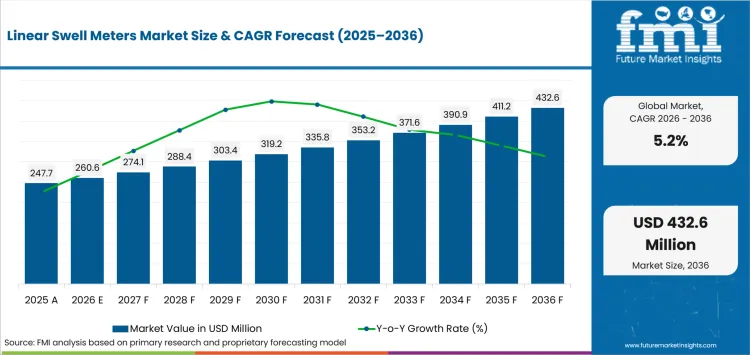
- Market Size (2026)
- USD 260.6 Mn
- Forecast (2036)
- USD 432.6 Mn
- CAGR (2026 to 2036)
- 5.2%
How big is Linear Swell Meters Market in 2026?
USD 260.6 million in 2026 and USD 432.6 million by 2036 at a 5.2% CAGR.
Sales of linear swell meters are projected to expand at a 5.2% CAGR between 2026 and 2036 while valuation rises from USD 260.6 million to USD 432.6 million. Drilling-fluid laboratories buy these instruments when shale hydration data changes inhibitor selection before a fluid plan reaches the well. Oil India's January 2025 purchase-order report records a January 22 contract for a linear swell meter and capillary suction timer, with delivery scheduled for July. The order documents dedicated spending where shale-fluid measurement directly informs the fluid-selection workflow.
Laboratory demand differs because installed test capacity and sample-governance routes do not follow one global replacement cycle. Brazil's ANP updated its SisRoc system in February 2026 to manage regulatory procedures and digital information for the national rock-and-fluid sample archive. That national data route favors documented laboratory workflows, while mature USA laboratories weigh replacement gains more heavily. Japanese and German ownership decisions depend more on specialist research programs than broad shale-drilling volume.
Key Takeaways
- Shale-reactive drilling programs sustain instrument demand where swelling results influence fluid formulation before field use.
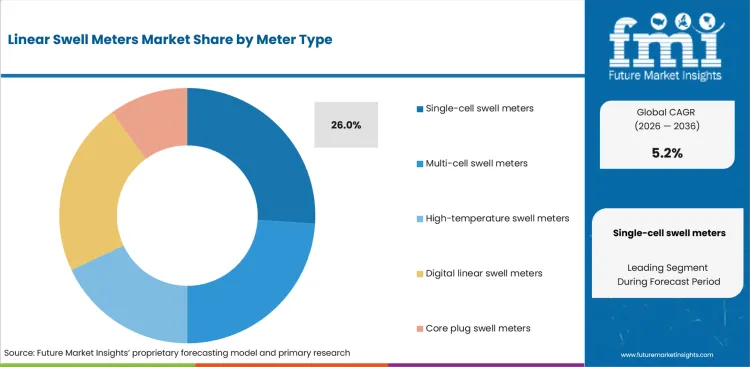
- Single-cell swell meters are projected to hold 26.0% by meter type in 2026 because routine comparisons need simple controlled setups.
- Shale samples are estimated at 44.0% of test material demand because formation-relevant specimens improve hydration comparisons.
- Shale inhibition testing is anticipated at 31.0% of application demand because measurements directly support inhibitor screening.
- Premium replacement slows when basic meters answer routine quality-control questions or sample preparation weakens added-feature value.
- Key players in the linear swell meters market include Fann Instrument Company, OFI Testing Equipment, Chandler Engineering, Grace Instrument, Core Laboratories, Vinci Technologies, RIGCHINA, Centurion Accommodation & Modular, Geo-Con Products, and Cement Test Equipment.
Analyst Perspective
"A linear swell meter earns its place only if the result changes a fluid-selection or wellbore-stability decision. Buyers should compare test-condition fit with repeatability and software records before checking calibration access and service support."
- Nikhil Kaitwade, Principal Consultant, Future Market Insights
How is the linear swell meters market segmented?
The linear swell meters market is segmented by meter type, test material, application, end use, sales channel, and region.
Meter types include single-cell, multi-cell, high-temperature, digital, and core plug models while test materials cover shale samples, clay-rich cores, drilling cuttings, and compacted pellets. Applications cover shale inhibition testing, mud formulation QC, clay swelling evaluation, research testing, and additive screening. End users are mud laboratories, oilfield service companies, universities - research labs, and chemical suppliers. Sales channels are lab instrument OEMs, oilfield lab distributors, direct project sales, and aftermarket service.
What makes single-cell swell meters central to the meter type category?
Routine laboratories often need one controlled swelling trace instead of simultaneous multichannel throughput for verification and training work. Higher-condition platforms become justified once temperature or parallel runs change decisions involving drilling and completion fluids program design.
- By meter type, single-cell swell meters are estimated to hold 26.0% in 2026 owing to straightforward operation for routine comparative testing.
- Grace Instrument presented a compact multifunction drilling simulator at an AADE Houston meeting in February 2025 for real mud and core testing under elevated conditions. The presentation linked laboratory hardware selection with controlled rock-fluid measurements needed before broader field decisions.
Why do shale samples lead the test material category?
Shale specimens keep the measurement tied to formation response before drilling-fluid engineers change a mud package. The same rock-fluid question appears in shale gas hydraulic fracturing programs because hydration behavior can alter fluid design.
- Shale samples are projected to account for 44.0% in 2026, driven by their direct relevance to formation-specific hydration and inhibitor screening.
- A 2025 AADE method study prepared compacted shale wafers from screened cuttings before controlled linear swelling tests. Standardized specimen preparation improves comparison without implying that one laboratory geometry reproduces every downhole condition.
How does shale inhibition testing anchor the application category?
Shale inhibition testing earns instrument time when a laboratory must reject weak fluid systems before field exposure raises operating risk. The same decision appears in onshore drilling fluids work that compares chemistry with formation-specific wellbore risks.
- Shale inhibition testing is expected to hold 31.0% of application demand in 2026, attributable to its role in comparing inhibitor performance before field deployment.
- ISO approved work item 26652 in July 2026 for determining shale linear swelling ratio in water-based fluids with a dilatometer. Its scope covers the apparatus and specimen requirements plus testing and calculation with precision and reporting rules. That work keeps inhibition measurement tied to a defined laboratory method rather than broad drilling activity.
What supports mud laboratories in the end use category?
Mud laboratories read swelling data beside rheology and filtration results because fluid qualification rarely depends on one response alone. The same technicians may pair linear swelling with capillary suction timers before approving a formation-specific fluid program.
- By end use, mud laboratories are forecast to represent 35.0% in 2026 driven by repeated formulation checks inside routine drilling-fluid workflows.
- OFI Testing Equipment introduced static ovens with automated temperature profiles and power-outage in August 2025. The release documents tighter control expectations for adjacent shale-fluid laboratory work that depends on repeatable conditioning.
What drives lab instrument OEMs in the sales channel category?
Instrument manufacturers retain technical responsibility when hardware and software must work with sample preparation plus recorded test results. Integration requirements place linear swell equipment beside drilling tools programs that need dependable laboratory data before field decisions.
- Lab instrument OEMs are projected to hold 42.0% of sales channel demand in 2026 because integrated support reduces compatibility and service uncertainty.
- API's current digital catalog lists RP 13I for laboratory testing of drilling fluids alongside the 13-series field and material standards. That specification route keeps instrument selection tied to repeatable fluid-test procedures and documented results rather than generic upstream measurement.
What are the drivers, restraints and opportunities in the Linear Swell Meters Market?
Reactive shale keeps inhibition testing relevant, representative laboratory methods limit premium replacement, and digitally recorded multichannel systems provide a practical upgrade route.
- Driver: Reactive formations keep shale-fluid qualification tied to wellbore-stability decisions before drilling programs commit to a fluid system.
- Restraint: A swelling trace covers one controlled rock-fluid response, so sample preparation and method representativeness can limit the value of premium equipment.
- Opportunity: Digital records and higher-condition testing can support upgrades where laboratories need faster comparison plus better traceability between technical teams.
Repeatable Inhibition Testing Supports Formulation Decisions
Reactive shale keeps inhibition work close to operating risk because fluid chemistry must control hydration before field exposure. A 2025 AADE study reproduced anti-accretion results among multiple laboratories using one standardized procedure. Linear swell meters support the same drilling mud chemicals decision by testing whether additive changes reduce rock-fluid expansion.
Method Scope Limits Premium Replacement
Linear swelling measures one response under defined specimen geometry, so laboratories must judge whether the setup represents the formation closely enough. A 2025 AADE field study covering nine wells paired linear swell measurements with capillary suction and high-temperature filtration tests. The combined suite explains why one trace seldom closes every wellbore-stability question. Basic units can therefore remain in service when they still support oilfield chemicals screening.
Digital Laboratory Programs Create an Upgrade Route
Digital logging and multichannel operation offer an upgrade route for laboratories that need faster comparisons with traceable records. OFI Testing Equipment introduced its Advanced Digital Wettability Tester in April 2026 with software and data acquisition for non-aqueous drilling-fluid spacer tests. The same recordkeeping need appears in hydraulic fracturing decisions. Premium linear swell systems are easier to justify when extra channels reduce repeat work without weakening method control.
Which country CAGRs are profiled in the Linear Swell Meters Market?
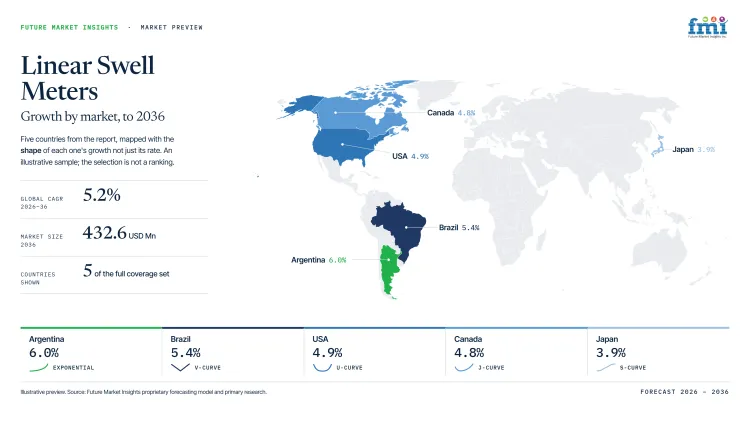
| Country | CAGR |
|---|---|
| Argentina | 6.0% |
| Brazil | 5.4% |
| USA | 4.9% |
| Canada | 4.8% |
| Germany | 4.6% |
| Norway | 4.5% |
| Japan | 3.9% |
How do country-level CAGRs compare in the Linear Swell Meters Market?
The country rates span 2.1 percentage points from Argentina at 6.0% to Japan at 3.9%. Argentina and Brazil form the upper pair. The USA and Canada cluster with Germany and Norway between 4.5% and 4.9%. The middle group depends more on replacement timing than greenfield laboratory build-out. Buying conditions differ.
- Argentina’s drilling activity remains heavily concentrated in the Vaca Muerta region, creating sustained demand across upstream operations and field services.
- In Brazil, offshore development continues to drive market activity, with investment focused on large-scale mobilization and production projects.
- The USA’s high production levels support equipment upgrades and operational improvements across existing assets rather than purely new deployments.
- Canada’s Montney play provides a steady flow of drilling and completion work, helping maintain consistent industry workloads.
- Germany’s relatively limited domestic production base places greater emphasis on replacement demand and asset maintenance.
- Norway’s offshore exploration programs continue to support testing, inspection, and well-evaluation activities throughout the project cycle.
- Japan maintains industry participation through overseas energy investments, where ownership stakes and international projects influence equipment demand.
Comparable CAGRs can produce different sales conditions because installed capacity and service economics vary by country. The full report provides country-level CAGR analysis across North America, Latin America, Western Europe, Eastern Europe, East Asia, South Asia and Pacific, and the Middle East and Africa.
Country-wise Analysis
- Argentina's strongest laboratory route is Vaca Muerta where formation-specific rock work feeds directly into well planning. The country is projected to expand at 6.0% CAGR over the forecast period as repeated unconventional programs keep sample preparation and interpretation in the technical workflow. In August 2026 the national government said its updated Vaca Muerta oil-resource study combined specialists from seven leading operators with two national universities and experts from the Energy Secretariat and IAPG. A February 2026 SPWLA Petrophysics study separately processed 208 drill-cutting samples from two horizontal wells using standardized preparation with imaging plus XRF and selected XRD. Suppliers therefore compete on repeatability and calibration with local support.
- Brazil's national technical-data regime keeps rock and fluid analysis inside a documented laboratory chain before results return to the regulator. Linear swell meter demand in Brazil is forecast to rise at 5.4% CAGR over the forecast period because formation-specific tests must fit project specifications and auditable sample workflows. ANP's rock-and-fluid sample rules updated in March 2026 cover cores and plugs plus cuttings and fluids from Brazilian sedimentary basins. The rules require results from authorized public-sample analysis to return to the agency. Import timing and service access remain practical purchase constraints that favor complete systems with local technical response.
- US laboratories operate in a mature service market where instrument upgrades must fit established drilling-fluid methods and demonstrate a gain over equipment already in service. Demand for linear swell meters in the USA is projected to grow at 4.9% CAGR over the forecast period as laboratories renew data capture and demanding-condition capability selectively. API's current standards plan lists the next edition of RP 13I Laboratory Testing of Drilling Fluids in development, keeping laboratory purchases tied to an active specification route. A new meter therefore competes beside drill bit and other drilling-support budgets only when repeatability or throughput and data records improve a defined test workflow.
- Canadian laboratories support shale and tight-resource work over long service distances, so uptime and traceable test practice matter alongside purchase price. Linear swell meter demand in Canada is predicted to advance at 4.8% CAGR through 2036 as formation-response testing is part of broader wellbore-integrity work. Natural Resources Canada's technology roadmap was updated in January 2025 and organizes testing needs over the well life cycle. Its inputs come from industry alongside academia and technical specialists. Laboratories that also support mud pumps and circulation programs therefore place extra value on remote diagnostics with calibration access and stocked parts.
- German demand is concentrated in specialized research and rock-testing laboratories instead of a large domestic shale-drilling fleet. The German linear swell meters sector is anticipated to record 4.6% CAGR during the assessment period as selective research programs and replacement cycles sustain purchases. Germany's Federal Institute for Geosciences and Natural Resources maintains an ISO/IEC 17025-accredited rock-mechanics laboratory for rock-physical testing and sample preparation. The accredited scope is reassessed on a recurring basis. Suppliers therefore need flexible research configurations and traceable calibration more than maximum multichannel throughput between selective testing programs.
- Norwegian laboratories work inside a specification-heavy offshore system where drilling-fluid test hardware must fit established well-fluid methods. Adoption of linear swell meters in Norway is forecast to expand at 4.5% CAGR through 2036 as controlled laboratory evidence supports complex-well qualification. Standards Norway lists an active NORSOK Well Fluids expert group for drilling and completion fluids plus well cements and treatment fluids. The group coordinates with ISO/TC 67/SC 3. That standards route raises the sales hurdle for new meters because replacement decisions depend on high-condition capability with calibration and local technical service.
- Japanese purchases are concentrated in technical organizations that use laboratory work to support domestic research and overseas upstream projects. Japan is projected to post 3.9% CAGR over the forecast period because ownership must be justified by specialist use instead of routine shale-drilling volume. JOGMEC states that its shale-section work includes laboratory examination of rock mechanical and chemical properties before mud weight and wellbore trajectory are optimized. Compact systems with reliable calibration and research-grade records therefore matter more than high fleet utilization. This favors technical support that protects low-frequency specialist utilization.
Who are the notable companies in the Linear Swell Meters Market?
Fann Instrument Company, OFI Testing Equipment, Chandler Engineering, Grace Instrument, Core Laboratories, Vinci Technologies, RIGCHINA, Centurion Accommodation & Modular, Geo-Con Products, and Cement Test Equipment are notable companies serving this market.
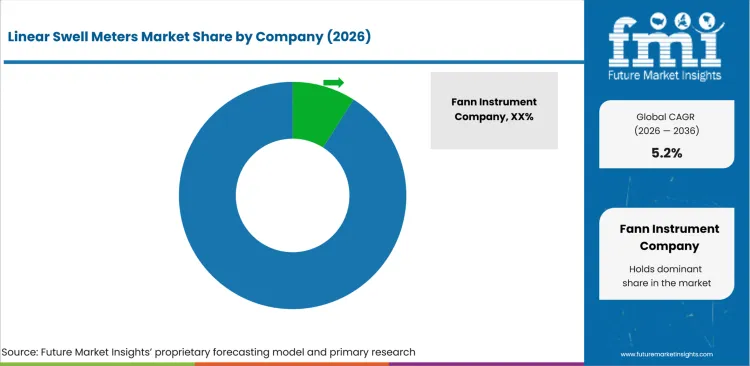
Direct shale-fluid instrument makers compete with broader oilfield laboratory platforms for the same technical budget. Adjacent companies compete by offering reservoir analysis alongside well-construction testing and laboratory infrastructure.
- Direct suppliers include Fann Instrument Company and OFI Testing Equipment alongside Grace Instrument and Chandler Engineering plus RIGCHINA.
- Core Laboratories and Vinci Technologies serve adjacent reservoir laboratory routes alongside Cement Test Equipment.
- Centurion Accommodation & Modular is the current business formed from former Labtech and Conserve trading names. Geo-Con Products supplies construction-material laboratory equipment outside direct shale-fluid testing.
Competitive Benchmarking: Linear Swell Meters Market
| Company | Shale-Fluid Testing Relevance | HPHT / Dynamic Test Capability | Lab Integration & Lifecycle Support | Geographic Reach |
|---|---|---|---|---|
| Fann Instrument Company | High | Medium | High | International distribution |
| OFI Testing Equipment | High | High | High | Worldwide distributor and service network |
| Chandler Engineering | High | High | High | International oilfield laboratory markets |
| Grace Instrument | High | High | High | United States with international customers |
| Core Laboratories | Medium | High | High | International reservoir laboratory markets |
| Vinci Technologies | Medium | High | High | Europe with international laboratory deployments |
| RIGCHINA | High | High | Medium | China with international sales partners |
| Centurion Accommodation & Modular | Low | Low | Medium | United Kingdom with international modular support |
| Geo-Con Products | Low | Low | Medium | Australia and New Zealand |
| Cement Test Equipment | Medium | High | High | United States with regional service support |
Scoring basis: High shale-fluid relevance requires swelling or drilling-fluid test systems. Medium marks an adjacent oilfield laboratory route and Low marks activity outside direct shale-fluid testing. High HPHT or dynamic capability requires multiple documented demanding-condition routes. Medium requires one route and Low means no verified route. High lifecycle support requires software plus service or calibration coverage. Narrower support is Medium or Low. Geographic reach is descriptive.
Key Developments in the Linear Swell Meters Market
- In April 2026 OFI Testing Equipment announced a cement expansion/shrinkage test innovation and the new Advanced Digital Wettability Tester for the AADE Fluids Technical Conference.
- In March 2026, Core Laboratories completed phase one of an unconventional-reservoir study using Shale Matrix Permeameter with high-frequency NMR and NANOk 100 nano-permeametry.
- In February 2026, LEMIGAS began operational training on a Vinci Technologies Multipurpose EOR Coreflooding System for automated high-temperature and high-pressure testing.
Key Players in the Linear Swell Meters Market
Dedicated Drilling-Fluid Instrument Makers
- Fann Instrument Company
- OFI Testing Equipment
- Chandler Engineering
- Grace Instrument
- RIGCHINA
Reservoir and Well-Construction Laboratory Platforms
- Core Laboratories
- Vinci Technologies
- Cement Test Equipment
Laboratory Infrastructure and Regional Equipment Participants
- Centurion Accommodation & Modular
- Geo-Con Products
Linear Swell Meters Market - Report Scope
| Coverage field | Report scope |
|---|---|
| Market breakdown | By meter type, test material, application, end use, sales channel, and region. |
| Quantitative Units | USD million. |
| Market Definition | Commercial revenue from linear swell meters and integrated linear-swell test systems used to measure time-dependent specimen expansion or contraction during fluid exposure. |
| Regions Covered | North America, Latin America, Western Europe, Eastern Europe, East Asia, South Asia and Pacific, and Middle East and Africa. |
| Countries Covered | Argentina, Brazil, USA, Canada, Germany, Norway, Japan, and 30+ countries included in the full report. |
| Key Companies Profiled | Fann Instrument Company, OFI Testing Equipment, Chandler Engineering, Grace Instrument, Core Laboratories, Vinci Technologies, RIGCHINA, Centurion Accommodation & Modular, Geo-Con Products, Cement Test Equipment. |
| Forecast Period | 2026 to 2036. |
| Approach | Primary and secondary research with market triangulation. |
Linear Swell Meters Market - Research Methodology
| Method | Approach |
|---|---|
| Primary Research | FMI analysts gathered input from manufacturers, service providers, technology developers, distributors, end users, procurement teams, and subject-matter experts. Interviews examined purchasing decisions, product or service evaluation, adoption barriers, approval requirements, pricing considerations, and expectations for technical or commercial support. Respondents were also asked what evidence is required before a trial, pilot, or initial order develops into regular purchasing. |
| Desk Research | Desk research covered government statistics, regulatory publications, trade data, industry associations, technical literature, standards, company filings, product information, and official corporate announcements. Sources were reviewed for relevance, publication date, geographic coverage, and consistency with the defined market scope. Claims relating to performance, applications, approvals, capacity, investment, and commercial activity were retained only when supported by credible public evidence. |
| Market Sizing and Forecasting | The market model combined the baseline value with historical performance, segment structure, pricing and volume indicators, adoption levels, company participation, and country-level demand conditions. Forecast assumptions considered economic activity, investment trends, regulatory developments, technology adoption, purchasing cycles, supply availability, and barriers to wider market use. Segment and regional estimates were reconciled before the final market total was calculated. |
| Data Validation | Estimates were checked against multiple independent indicators, including public data, company activity, trade patterns, industry developments, and findings from primary interviews. Validation also tested whether products, services, applications, and company revenues fell within the defined market boundaries. Adjacent categories, unsupported claims, overlapping revenues, and activities without direct market relevance were excluded to reduce double counting and maintain consistency across segments and countries. |
Linear Swell Meters Market by Segments
Linear Swell Meters Market segmented by Meter Type:
- Single-cell swell meters
- Multi-cell swell meters
- High-temperature swell meters
- Digital linear swell meters
- Core plug swell meters
Linear Swell Meters Market segmented by Test Material:
- Shale samples
- Clay-rich cores
- Drilling cuttings
- Compacted pellets
Linear Swell Meters Market segmented by Application:
- Shale inhibition testing
- Mud formulation QC
- Clay swelling evaluation
- Research testing
- Additive screening
Linear Swell Meters Market segmented by End Use:
- Mud laboratories
- Oilfield service companies
- Universities - research labs
- Chemical suppliers
Linear Swell Meters Market segmented by Sales Channel:
- Lab instrument OEMs
- Oilfield lab distributors
- Direct project sales
- Aftermarket service
Linear Swell Meters Market by Region:
- North America
- United States
- Canada
- Latin America
- Brazil
- Mexico
- Argentina
- Chile
- Western Europe
- Germany
- France
- United Kingdom
- Italy
- Spain
- Benelux
- Nordics
- Eastern Europe
- Poland
- Czech Republic
- Romania
- Hungary
- East Asia
- China
- Japan
- South Korea
- South Asia and Pacific
- India
- ASEAN
- Australia and New Zealand
- Middle East and Africa
- GCC Countries
- South Africa
- Türkiye
- Israel
Research Sources and Bibliography
- American Association of Drilling Engineers. (2025, April 15). Method Development to Evaluate Wellbore Instability of Mid- to Deep-Shale Formations.
- American Association of Drilling Engineers. (2025, April). Standardizing and Optimizing Lab-Scale Performance Evaluation of Anti-Accretion Additives in Drilling Fluids.
- American Association of Drilling Engineers. (2025, April). Nanotechnology-based High Performance Drilling Fluid.
- American Association of Drilling Engineers, Houston Chapter. (2025, February 20). AADE Houston FMG Meeting.
- Oil India Limited. (2025, January). Details of Purchase Orders placed during the Month of January 2025 from IP Section, Materials Dept., Duliajan.
- Agência Nacional do Petróleo, Gás Natural e Biocombustíveis. (2026, February 11). Sistema de Gestão do Acervo de Amostras de Rochas e Fluidos da União (SisRoc).
- International Organization for Standardization. (2026, July 2). ISO/AWI 26652: Natural gas upstream area - Determination of linear swelling ratio of shale under the action of fluid using dilatometer.
- OFI Testing Equipment. (2025, August 15). Introducing OFITE static ovens.
- American Petroleum Institute. (2026, accessed September 14). Digital Catalog.
- OFI Testing Equipment. (2026, April 24). New advances in spacer wettability testing.
- Society of Petrophysicists and Well Log Analysts. (2026, February). Enhanced Reservoir Characterization Using Drill-Cuttings-Based Image and Elemental Analysis With AI: A Vaca Muerta Formation Case Study.
- Agência Nacional do Petróleo, Gás Natural e Biocombustíveis. (2026, March 31). Amostras de rochas e fluidos.
- American Petroleum Institute. (2026, accessed September 14). API Standards Plan: Industry Standards in Development.
- Natural Resources Canada. (2025, January 13). A Technology Roadmap to Improve Wellbore Integrity.
- Federal Institute for Geosciences and Natural Resources. (2026, accessed September 14). Accreditation of the rock mechanics laboratory.
- Standards Norway. (2026, accessed September 14). NORSOK/EG WF Well fluids.
- Japan Organization for Metals and Energy Security. (2026, accessed September 14). Geomechanics.
- Government of Argentina. (2026, August 24). La producción de petróleo registró otro mes de crecimiento en julio.
- Government of Argentina. (2026, August 12). Vaca Muerta aumentó en un 89% sus recursos de petróleo respecto de las últimas estimaciones de 2013.
- Ministério de Minas e Energia. (2026, May 21). MME destaca expansão de investimentos e fortalecimento da indústria offshore brasileira.
- USA Energy Information Administration. (2026, March 31). USA crude oil production rose in 2025, setting new record.
- Canada Energy Regulator. (2026, May 20). Market Snapshot: Canada's natural gas production kept climbing in 2025.
- Landesamt für Bergbau, Energie und Geologie. (2026, July 17). Erdgasförderung in Deutschland erstmals nicht rückläufig: LBEG legt aktuellen Jahresbericht Erdöl und Erdgas vor.
- Norwegian Offshore Directorate. (2026, January 8). Oil and gas on the NCS moving forward.
- Ministry of Economy, Trade and Industry, Japan. (2026, February 17). FY2024 Independent Development Ratio of Oil and Natural Gas in Japan Released.
- OFI Testing Equipment. (2026, April 1). OFITE Presenting at the AADE Fluids Tech Conference & Exhibition.
- Core Laboratories. (2026, March 26). Core in Action: Advancing Unconventional Reservoir Understanding.
- Balai Besar Pengujian Minyak dan Gas Bumi LEMIGAS. (2026, February 9). LEMIGAS Perkuat Kapasitas Uji EOR Lewat Pelatihan Multipurpose EOR Coreflooding System dari Vinci Technologies.
- Fann Instrument Company. (2026, accessed September 14). Linear Swell Meter.
- OFI Testing Equipment. (2026, accessed September 14). Dynamic Linear Swell Meter with Compactor and Computer.
- Chandler Engineering. (2026, accessed September 14). Drilling Fluids.
- Grace Instrument. (2026, accessed September 14). M7500 Ultra HPHT Linear Swell Meter Module.
- Core Laboratories. (2026, April 30). 2025 Core Laboratories Annual Report.
- Vinci Technologies. (2026, accessed September 14). About Us.
- RIGCHINA. (2026, accessed September 14). Swell Meter portfolio.
- Centurion Accommodation & Modular. (2026, accessed September 14). Accommodation & Modular.
- Geo-Con Products. (2026, accessed September 14). Laboratory & Field Testing Equipment.
- Cement Test Equipment. (2026, accessed September 14). About.
- Core Laboratories. (2026, May 26). Core in Action: Turning Measured Data into Intelligent Insight with RAPID.
- Core Laboratories. (2026, May 14). Core In Action: Evaluating the Future of Plug-Less Completions.
- Core Laboratories. (2026, May 6). Core In Action: SpectraStim.
- OFI Testing Equipment. (2026, January 16). Introducing the Free Flow LCM Receiver.
- Core Laboratories. (2026, May 1). Advancing Reservoir Characterization in Colombia's Palagua Field.
- IFP Energies nouvelles. (2026, February 2). Natural hydrogen: IFPEN and Vinci Technologies launch a consortium.
- Chandler Engineering. (2026). Cementing Maintenance & Calibration Training Course.
This bibliography is provided for reader reference and is not exhaustive. The full report contains the complete reference list and detailed citations.
This Report Answers
- How large is the linear swell meters market in 2026 and 2036?
- What operating conditions keep shale-fluid measurement relevant before field use?
- Why do single-cell swell meters hold 26.0% by meter type?
- Why do shale samples hold 44.0% of test material demand?
- Why does shale inhibition testing hold 31.0% of application demand?
- How do growth rates differ among the seven profiled countries?
- Which companies supply direct instruments or broader laboratory services?
- What limits premium replacement in existing shale-testing laboratories?
Frequently Asked Questions
How big is the linear swell meters market in 2026?
The linear swell meters market is valued at USD 260.6 million in 2026 and is projected to reach USD 432.6 million by 2036. Demand centers on laboratories that use shale-fluid results to change inhibitor selection before field deployment.
What is the CAGR of the linear swell meters market from 2026 to 2036?
The linear swell meters market is projected to grow at a CAGR of 5.2% between 2026 and 2036. Unconventional drilling and selective replacement support demand where recorded tests improve fluid-formulation decisions.
Which meter type leads the linear swell meters market?
Single-cell swell meters are expected to hold 26.0% of the meter type category in 2026 because routine laboratories need simple controlled comparisons. Multichannel systems gain value when larger test queues justify parallel measurement.
Which test material leads the linear swell meters market?
Shale samples are expected to hold 44.0% of test material demand in 2026 because they keep hydration testing formation-specific. Controlled preparation improves comparisons between candidate fluids without claiming that one laboratory geometry reproduces every downhole condition.
Which companies are active in the linear swell meters market?
Key companies include Fann Instrument Company, OFI Testing Equipment, Chandler Engineering, Grace Instrument, Core Laboratories, Vinci Technologies, RIGCHINA, Centurion Accommodation & Modular, Geo-Con Products, and Cement Test Equipment. Direct suppliers sell shale-fluid test hardware. Adjacent companies serve reservoir and cement laboratory budgets plus laboratory-support work.
Preview the report firsthand - request a free sample
Get SampleGet the brochure for pricing and purchase details.
Get PDFTable of Content
- Key Takeaways
- Market Size and CAGR
- Top Growth Driver
- Fastest Growing Segment
- Leading Region
- Key Companies
- Emerging Opportunities
- Executive Summary
- Global Market Outlook
- Demand-side Trends
- Supply-side Trends
- Technology Roadmap Analysis
- Analysis and Recommendations
- Analyst Perspective (What is happening? Why now? What should investors know?)
- Key Questions Answered
- How large is the market?
- What is the CAGR?
- What are key trends?
- Which region dominates?
- Who are the leaders?
- Market Overview
- Market Coverage / Taxonomy
- Market Definition / Scope / Limitations
- Research Methodology
- Chapter Orientation
- Analytical Lens and Working Hypotheses
- Market Structure, Signals, and Trend Drivers
- Benchmarking and Cross-market Comparability
- Market Sizing, Forecasting, and Opportunity Mapping
- Research Design and Evidence Framework
- Desk Research Programme (Secondary Evidence)
- Expert Input and Fieldwork (Primary Evidence)
- Tooling, Models, and Reference Databases
- Data Engineering and Model Build
- Quality Assurance and Audit Trail
- Market Background
- Market Dynamics (Drivers, Restraints, Opportunity, Trends)
- Scenario Forecast (Optimistic, Likely, Conservative)
- Impact Analysis
- AI Impact
- Sustainability Impact
- Regulatory Impact
- Technology Impact
- Consumer / Buyer Analysis
- Purchase Drivers
- Adoption Barriers
- Buyer Journey
- Opportunity Map Analysis
- Product Life Cycle Analysis
- Supply Chain Analysis
- Investment Feasibility Matrix
- Value Chain Analysis
- PESTLE and Porter's Analysis
- Regulatory Landscape
- Regional Parent Market Outlook
- Production and Consumption Statistics
- Import and Export Statistics
- Global Market Analysis and Forecast, 2021 to 2036
- Historical Market Size Value (USD Million) Analysis, 2021 to 2025
- Current and Future Market Size Value (USD Million) Projections, 2026 to 2036
- Y-o-Y Growth Trend Analysis
- Absolute $ Opportunity Analysis
- Global Market Pricing Analysis, 2021 to 2036
- Global Market Analysis and Forecast, By Meter Type, 2021 to 2036
- Introduction / Key Findings
- Historical Market Size Value (USD Million) Analysis By Meter Type, 2021 to 2025
- Current and Future Market Size Value (USD Million) Analysis and Forecast By Meter Type, 2026 to 2036
- Single-cell swell meters
- Multi-cell swell meters
- High-temperature swell meters
- Digital linear swell meters
- Core plug swell meters
- Single-cell swell meters
- Y-o-Y Growth Trend Analysis By Meter Type, 2021 to 2025
- Absolute $ Opportunity Analysis By Meter Type, 2026 to 2036
- Global Market Analysis and Forecast, By Test Material, 2021 to 2036
- Introduction / Key Findings
- Historical Market Size Value (USD Million) Analysis By Test Material, 2021 to 2025
- Current and Future Market Size Value (USD Million) Analysis and Forecast By Test Material, 2026 to 2036
- Shale samples
- Clay-rich cores
- Drilling cuttings
- Compacted pellets
- Shale samples
- Y-o-Y Growth Trend Analysis By Test Material, 2021 to 2025
- Absolute $ Opportunity Analysis By Test Material, 2026 to 2036
- Global Market Analysis and Forecast, By Application, 2021 to 2036
- Introduction / Key Findings
- Historical Market Size Value (USD Million) Analysis By Application, 2021 to 2025
- Current and Future Market Size Value (USD Million) Analysis and Forecast By Application, 2026 to 2036
- Shale inhibition testing
- Mud formulation QC
- Clay swelling evaluation
- Research testing
- Additive screening
- Shale inhibition testing
- Y-o-Y Growth Trend Analysis By Application, 2021 to 2025
- Absolute $ Opportunity Analysis By Application, 2026 to 2036
- Global Market Analysis and Forecast, By End Use, 2021 to 2036
- Introduction / Key Findings
- Historical Market Size Value (USD Million) Analysis By End Use, 2021 to 2025
- Current and Future Market Size Value (USD Million) Analysis and Forecast By End Use, 2026 to 2036
- Mud laboratories
- Oilfield service companies
- Universities / research labs
- Chemical suppliers
- Mud laboratories
- Y-o-Y Growth Trend Analysis By End Use, 2021 to 2025
- Absolute $ Opportunity Analysis By End Use, 2026 to 2036
- Global Market Analysis and Forecast, By Sales Channel, 2021 to 2036
- Introduction / Key Findings
- Historical Market Size Value (USD Million) Analysis By Sales Channel, 2021 to 2025
- Current and Future Market Size Value (USD Million) Analysis and Forecast By Sales Channel, 2026 to 2036
- Lab instrument OEMs
- Oilfield lab distributors
- Direct project sales
- Aftermarket service
- Lab instrument OEMs
- Y-o-Y Growth Trend Analysis By Sales Channel, 2021 to 2025
- Absolute $ Opportunity Analysis By Sales Channel, 2026 to 2036
- Global Market Analysis and Forecast, By Region, 2021 to 2036
- Introduction
- Historical Market Size Value (USD Million) Analysis By Region, 2021 to 2025
- Current Market Size Value (USD Million) Analysis and Forecast By Region, 2026 to 2036
- North America
- Latin America
- Western Europe
- Eastern Europe
- East Asia
- South Asia and Pacific
- Middle East & Africa
- Market Attractiveness Analysis By Region
- North America Market Analysis and Forecast, By Country, 2021 to 2036
- Historical Market Size Value (USD Million) Trend Analysis By Market Taxonomy, 2021 to 2025
- Market Size Value (USD Million) Forecast By Market Taxonomy, 2026 to 2036
- By Country
- USA
- Canada
- By Meter Type
- By Test Material
- By Application
- By End Use
- By Sales Channel
- By Country
- Market Attractiveness Analysis
- By Country
- By Meter Type
- By Test Material
- By Application
- By End Use
- By Sales Channel
- Key Takeaways
- Latin America Market Analysis and Forecast, By Country
- Historical Market Size Value (USD Million) Trend Analysis By Market Taxonomy, 2021 to 2025
- Market Size Value (USD Million) Forecast By Market Taxonomy, 2026 to 2036
- By Country
- Brazil
- Mexico
- Chile
- Rest of Latin America
- By Meter Type
- By Test Material
- By Application
- By End Use
- By Sales Channel
- By Country
- Market Attractiveness Analysis
- By Country
- By Meter Type
- By Test Material
- By Application
- By End Use
- By Sales Channel
- Key Takeaways
- Western Europe Market Analysis and Forecast, By Country
- Historical Market Size Value (USD Million) Trend Analysis By Market Taxonomy, 2021 to 2025
- Market Size Value (USD Million) Forecast By Market Taxonomy, 2026 to 2036
- By Country
- Germany
- UK
- Italy
- Spain
- France
- Nordic
- BENELUX
- Rest of Western Europe
- By Meter Type
- By Test Material
- By Application
- By End Use
- By Sales Channel
- By Country
- Market Attractiveness Analysis
- By Country
- By Meter Type
- By Test Material
- By Application
- By End Use
- By Sales Channel
- Key Takeaways
- Eastern Europe Market Analysis and Forecast, By Country
- Historical Market Size Value (USD Million) Trend Analysis By Market Taxonomy, 2021 to 2025
- Market Size Value (USD Million) Forecast By Market Taxonomy, 2026 to 2036
- By Country
- Russia
- Poland
- Hungary
- Balkan & Baltic
- Rest of Eastern Europe
- By Meter Type
- By Test Material
- By Application
- By End Use
- By Sales Channel
- By Country
- Market Attractiveness Analysis
- By Country
- By Meter Type
- By Test Material
- By Application
- By End Use
- By Sales Channel
- Key Takeaways
- East Asia Market Analysis and Forecast, By Country
- Historical Market Size Value (USD Million) Trend Analysis By Market Taxonomy, 2021 to 2025
- Market Size Value (USD Million) Forecast By Market Taxonomy, 2026 to 2036
- By Country
- China
- Japan
- South Korea
- By Meter Type
- By Test Material
- By Application
- By End Use
- By Sales Channel
- By Country
- Market Attractiveness Analysis
- By Country
- By Meter Type
- By Test Material
- By Application
- By End Use
- By Sales Channel
- Key Takeaways
- South Asia and Pacific Market Analysis and Forecast, By Country
- Historical Market Size Value (USD Million) Trend Analysis By Market Taxonomy, 2021 to 2025
- Market Size Value (USD Million) Forecast By Market Taxonomy, 2026 to 2036
- By Country
- India
- ASEAN
- Australia & New Zealand
- Rest of South Asia and Pacific
- By Meter Type
- By Test Material
- By Application
- By End Use
- By Sales Channel
- By Country
- Market Attractiveness Analysis
- By Country
- By Meter Type
- By Test Material
- By Application
- By End Use
- By Sales Channel
- Key Takeaways
- Middle East & Africa Market Analysis and Forecast, By Country
- Historical Market Size Value (USD Million) Trend Analysis By Market Taxonomy, 2021 to 2025
- Market Size Value (USD Million) Forecast By Market Taxonomy, 2026 to 2036
- By Country
- Kingdom of Saudi Arabia
- Other GCC Countries
- Türkiye
- South Africa
- Other African Union
- Rest of Middle East & Africa
- By Meter Type
- By Test Material
- By Application
- By End Use
- By Sales Channel
- By Country
- Market Attractiveness Analysis
- By Country
- By Meter Type
- By Test Material
- By Application
- By End Use
- By Sales Channel
- Key Takeaways
- Key Countries Market Analysis
- USA
- Pricing Analysis
- Market Share Analysis, 2025
- By Meter Type
- By Test Material
- By Application
- By End Use
- By Sales Channel
- Canada
- Pricing Analysis
- Market Share Analysis, 2025
- By Meter Type
- By Test Material
- By Application
- By End Use
- By Sales Channel
- Mexico
- Pricing Analysis
- Market Share Analysis, 2025
- By Meter Type
- By Test Material
- By Application
- By End Use
- By Sales Channel
- Brazil
- Pricing Analysis
- Market Share Analysis, 2025
- By Meter Type
- By Test Material
- By Application
- By End Use
- By Sales Channel
- Chile
- Pricing Analysis
- Market Share Analysis, 2025
- By Meter Type
- By Test Material
- By Application
- By End Use
- By Sales Channel
- Germany
- Pricing Analysis
- Market Share Analysis, 2025
- By Meter Type
- By Test Material
- By Application
- By End Use
- By Sales Channel
- UK
- Pricing Analysis
- Market Share Analysis, 2025
- By Meter Type
- By Test Material
- By Application
- By End Use
- By Sales Channel
- Italy
- Pricing Analysis
- Market Share Analysis, 2025
- By Meter Type
- By Test Material
- By Application
- By End Use
- By Sales Channel
- Spain
- Pricing Analysis
- Market Share Analysis, 2025
- By Meter Type
- By Test Material
- By Application
- By End Use
- By Sales Channel
- France
- Pricing Analysis
- Market Share Analysis, 2025
- By Meter Type
- By Test Material
- By Application
- By End Use
- By Sales Channel
- India
- Pricing Analysis
- Market Share Analysis, 2025
- By Meter Type
- By Test Material
- By Application
- By End Use
- By Sales Channel
- ASEAN
- Pricing Analysis
- Market Share Analysis, 2025
- By Meter Type
- By Test Material
- By Application
- By End Use
- By Sales Channel
- Australia & New Zealand
- Pricing Analysis
- Market Share Analysis, 2025
- By Meter Type
- By Test Material
- By Application
- By End Use
- By Sales Channel
- China
- Pricing Analysis
- Market Share Analysis, 2025
- By Meter Type
- By Test Material
- By Application
- By End Use
- By Sales Channel
- Japan
- Pricing Analysis
- Market Share Analysis, 2025
- By Meter Type
- By Test Material
- By Application
- By End Use
- By Sales Channel
- South Korea
- Pricing Analysis
- Market Share Analysis, 2025
- By Meter Type
- By Test Material
- By Application
- By End Use
- By Sales Channel
- Russia
- Pricing Analysis
- Market Share Analysis, 2025
- By Meter Type
- By Test Material
- By Application
- By End Use
- By Sales Channel
- Poland
- Pricing Analysis
- Market Share Analysis, 2025
- By Meter Type
- By Test Material
- By Application
- By End Use
- By Sales Channel
- Hungary
- Pricing Analysis
- Market Share Analysis, 2025
- By Meter Type
- By Test Material
- By Application
- By End Use
- By Sales Channel
- Kingdom of Saudi Arabia
- Pricing Analysis
- Market Share Analysis, 2025
- By Meter Type
- By Test Material
- By Application
- By End Use
- By Sales Channel
- Türkiye
- Pricing Analysis
- Market Share Analysis, 2025
- By Meter Type
- By Test Material
- By Application
- By End Use
- By Sales Channel
- South Africa
- Pricing Analysis
- Market Share Analysis, 2025
- By Meter Type
- By Test Material
- By Application
- By End Use
- By Sales Channel
- USA
- Market Structure Analysis
- Competition Dashboard
- Competition Benchmarking
- Market Share Analysis of Top Players
- By Regional
- By Meter Type
- By Test Material
- By Application
- By End Use
- By Sales Channel
- Emerging Startups
- Innovation Benchmarking
- Competition Analysis
- Competition Deep Dive
- Fann Instrument Company
- Overview
- Product Portfolio
- Profitability by Market Segments
- Sales Footprint
- Strategy Overview
- Marketing Strategy
- Product Strategy
- Channel Strategy
- OFI Testing Equipment
- Chandler Engineering
- Grace Instrument
- Core Laboratories
- Vinci Technologies
- RIGCHINA
- Labtech Services
- Geo-Con Products
- Cement Test Equipment
- Fann Instrument Company
- Case Studies
- Success Stories
- Recent Developments
- Competition Deep Dive
- Assumptions & Acronyms Used


