

- Market Size (2026)
- USD 1182.6 Mn
- Forecast (2036)
- USD 1882.6 Mn
- CAGR (2026 to 2036)
- 4.8%
How big is Log Debarkers Market in 2026?
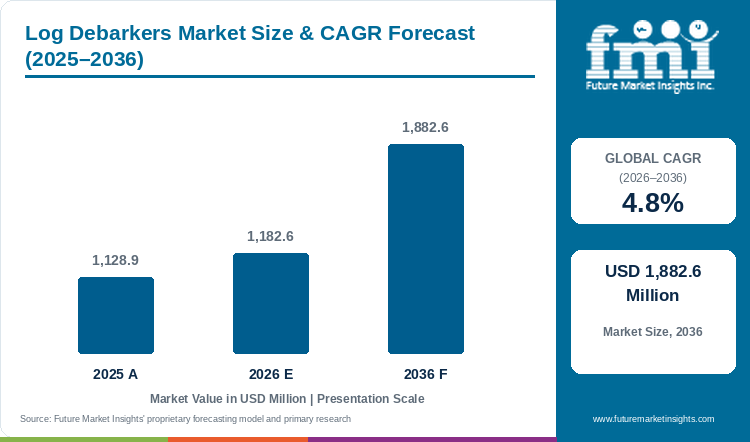
Demand for log debarkers is projected to expand at 4.8% CAGR between 2026 and 2036. Industry value grows from USD 1,128.9 million in 2025 to an estimated USD 1,182.6 million in 2026. It is projected to reach USD 1,882.6 million by 2036.
FMI forecasts log debarkers to grow from USD 1,182.6 million in 2026 to USD 1,882.6 million by 2036 at a 4.8% CAGR, compared to sawmill headrig systems and board edgers, both of which are each forecast to grow 4.7% over the projected period. Mills are investing in log preparation because damaged fiber reduces saleable wood before the first cut and can disrupt later production. USDA guaranteed USD 115.2 million for sawmill and wood-processing expansion in eight states in March 2026, showing current investment in primary processing capacity.
Germany is projected to grow 6.1%, as higher stemwood prices raise the cost of fiber loss. Destatis reported a 57.3 million cubic meter harvest in 2025. Mexico is forecast at 5.7%, with financing limits and service distance supporting staged upgrades. CONAFOR's November 2025 program supports woodworking machines modernization without requiring mills to replace a complete production line. These conditions favor equipment improvements that protect yield while controlling investment cost.
Key Takeaways
- Mills protect usable wood before logs reach board edgers because aggressive debarking can reduce fiber recovery.
- Ring debarkers are expected to account for 31.0% of debarker type revenue in 2026, supported by controlled single-log contact at production speed.
- Medium logs are estimated to represent 39.0% of log size demand in 2026, owing to compatibility with common feed systems.
- Sawmills are projected to hold 34.0% of end use demand in 2026, linked to lumber recovery and chip quality.
- Germany is forecast at 6.1% CAGR as fiber recovery gains weight, while Mexico is projected at 5.7% CAGR as smaller upgrades fit local mills.
- In the FMI report, the Log Debarkers Market includes Valon Kone, USNR, ANDRITZ, Raute, Comact, Nicholson Manufacturing, Kadant Carmanah Design, and Morbark.
Analyst Perspective
"Debarker upgrades make financial sense if mills can measure fiber loss and downtime before the first saw cut. Brownfield projects also need a clear shutdown plan and reliable service support before the investment case is complete."
- Nikhil Kaitwade, Principal Consultant, Future Market Insights.
How is the log debarkers market segmented?
Log Debarkers Market is segmented by five primary commercial axes and region: debarker type, log size, end use, automation, and sales channel. In 2026, projected leaders are ring debarkers at 31.0% of debarker type revenue, medium logs at 39.0% of log size demand, sawmills at 34.0% of end use demand, fully automated systems at 39.0% of automation demand, and wood processing OEMs at 42.0% of sales channel revenue.
Debarker type includes ring debarkers, drum debarkers, Rosserhead debarkers, flail debarkers, and Cambio-style debarkers.
Log size includes medium logs, small logs, large logs, and mixed-diameter logs.
End use includes sawmills, pulp mills, panel mills, biomass plants, and wood pellet mills.
Automation includes fully automated, semi-automatic, manual feed, and line-integrated scanning.
Sales channel includes wood processing OEMs, sawmill projects, dealer/service network, and aftermarket rebuild.
Region covers North America, Latin America, Western Europe, Eastern Europe, East Asia, South Asia and Pacific, and Middle East and Africa.
Why do ring debarkers retain a notable share of debarker type revenue?
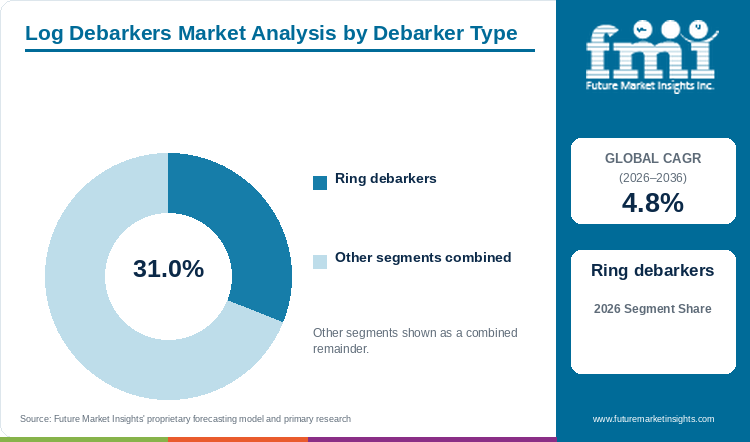
Ring debarkers are projected at 31.0% of debarker type revenue in 2026, supported by controlled contact at line speed.
Ring debarkers suit mills needing controlled bark removal at speed without cutting into saleable wood. Feedworks center each stem before rotor contact so tool pressure stays stable as diameter changes. Machine control systems repeat those settings as species and line speed change. FMI's segment analysis links the share to controlled contact and steady production.
- By debarker type, ring debarkers are projected to account for 31.0% in 2026, underpinned by controlled tool contact that protects usable wood.
- Ring-debarker buyers test centering and tool-pressure response on the mill’s actual species mix before accepting production-rate claims for routine use.
Why do medium logs account for a notable log size share?
Medium logs are estimated at 39.0% of log size demand in 2026, owing to fit with common feed systems.
Medium logs match the working range of many industrial debarkers and common sawmill feed systems. Mills can often keep existing conveyor systems because this log range does not require the wider clearances used for large stems. Retaining the existing log path reduces retrofit work and keeps spending focused on bark removal and fiber recovery.
- By log size, medium logs are estimated to hold 39.0% in 2026, supported by common feed systems built for this range.
- A broad working diameter range reduces the chance that normal log variation forces a second debarker or separate material route.
How do sawmills shape demand within the end use category?
Sawmills are expected to hold 34.0% of end use demand in 2026, driven by lumber recovery and chip quality.
Sawmills place debarkers immediately before scanning and sawing, so preparation quality carries into the next production step. Bark left on the stem can reduce chip quality, while aggressive tool contact removes saleable wood. The cleaned log then moves through material handling equipment into primary breakdown. Debarker settings directly affect both wood recovery and line uptime.
- In 2026, sawmills are expected to lead end use with 34.0% share, supported by lumber recovery and downstream chip quality.
- Sawmill buyers test whether debarker settings can match feedworks and scanners inside the planned primary-line commissioning window.
Why do buyers select fully automated systems within the automation category?
Fully automated systems are forecast at 39.0% of automation demand in 2026, underpinned by repeatable settings during production shifts.
Fully automated systems handle changing log diameter and bark condition with fewer manual adjustments. Sensors link feed speed to rotor response, while condition monitoring systems show whether wear affects performance. Operators can correct settings before a change reaches the rest of the line. Earlier correction keeps production steadier and reduces manual work during each shift.
- Fully automated systems are projected to hold 39.0% of automation demand in 2026, reinforced by repeatable settings that reduce manual intervention.
- Automation has more operating value if diagnostics and service access keep control faults from extending a mill shutdown.
Which conditions keep wood processing OEMs relevant in the sales channel?
Wood processing OEMs are anticipated at 42.0% of sales channel revenue in 2026, reinforced by integrated commissioning responsibility.
Wood processing OEMs fit projects in which one supplier manages the debarker, infeed, scanning, and controls. The single project scope reduces interface work during brownfield upgrades. Mills may also invest in lumber drying kilns later in the process, but drying does not change the debarker integration requirement.
- Wood processing OEMs are expected to command 42.0% of sales channel revenue in 2026, linked to one project team managing equipment interfaces.
- Aftermarket rebuild providers fit smaller projects where serviceable rotors or controls can be modernized without replacing the complete log-handling line.
What are the drivers, restraints, and opportunities in the log debarkers market?
In the log debarkers market, fiber recovery is the key driver while shutdown risk is the key restraint and retrofits are the key opportunity.
- Driver: Fiber recovery expands replacement demand because poor debarking removes usable wood before primary breakdown.
- Restraint: Brownfield interfaces delay approval if foundations or control migration extend the planned shutdown.
- Opportunity: Adaptive controls can extend installed debarkers during the forecast period if modern sensing fits serviceable mechanical equipment.
Fiber Recovery Supports Replacement Demand
Fiber loss has a direct cost because wood removed during debarking never reaches the saw. According to FMI analysis, mills compare that loss with repair cost and the price of replacement. Destatis reported in April 2026 that 32 million cubic meters of Germany's 2025 harvest went to saw and veneer processing. The figure measures wood moving into primary processing, not debarker demand. A mill has a clearer replacement case once repeated fiber loss costs more than keeping worn equipment in service.
Brownfield Interfaces Extend Shutdown Risk
Brownfield replacement is difficult because the new debarker must fit equipment that is already producing. Existing feedworks and foundations limit the physical layout, while control migration determines how much work fits into the shutdown. Valon Kone opened a Canadian spare-parts center in October 2025 to shorten delivery times for local users. Predictive maintenance can identify parts and service needs before the outage. A project is easier to approve if the mill knows the installation scope and the expected restart date.
Adaptive Controls Extend Installed Equipment
Adaptive controls let mills improve debarking without replacing serviceable mechanical equipment. FMI's forecast model expects retrofit activity during the forecast period as mills add modern sensing and control layers. Comact's VTO ring debarker uses incoming log diameter to position tools, while scanner data adjusts pressure and feed speed as material changes. The control upgrade can keep the existing rotor and separate wood chippers in service without changing their basic mechanical role. The retrofit works best if sensor reliability and local service are already in place.
Which country CAGRs are profiled in the Log Debarkers Market?
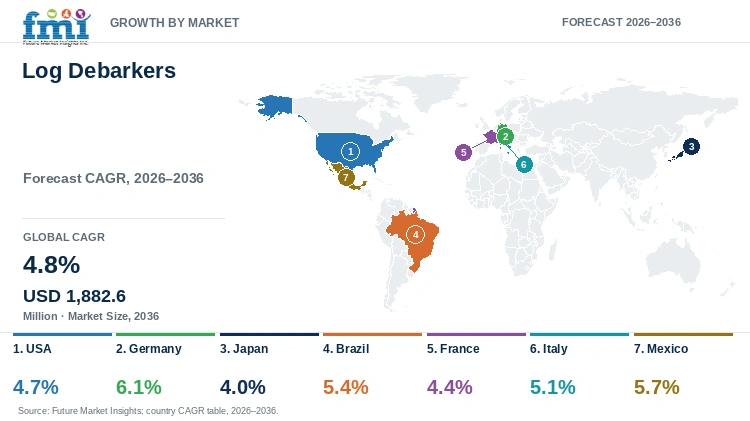
| Country | CAGR |
|---|---|
| USA | 4.7% |
| Germany | 6.1% |
| Japan | 4.0% |
| Brazil | 5.4% |
| France | 4.4% |
| Italy | 5.1% |
| Mexico | 5.7% |
How do country-level CAGRs compare in the Log Debarkers Market?
Country outlooks differ because mills face different reasons to replace or rebuild a debarker. Higher wood value raises fiber-loss costs, while labor pressure raises automation value and service or funding limits can favor smaller projects.
- USA mills compare repair cost with plant scale and local service reach before setting a planned shutdown window.
- German mills place more weight on fiber recovery because mature lines process higher-value stemwood at normal operating speed.
- Japanese buyers connect equipment renewal with labor savings because compact mill layouts limit manual intervention.
- Brazilian mills balance plantation log volumes with service distance and local parts access during continuous production.
- French mills need flexible debarkers because hardwood and conifer operations use different log sizes and production rates.
- Italian processors favor staged upgrades because fragmented wood supply makes large single-purpose projects harder to justify.
- Mexican mills favor right-sized upgrades because financing and service access can limit full-line modernization.
Full report country CAGRs cover: North America; Latin America; Western Europe; Eastern Europe; East Asia; South Asia and Pacific; Middle East and Africa.
Country-wise Analysis
- Many U.S. debarker projects begin inside mills that are already producing, so the investment case starts with downtime and recoverable wood. Demand in the USA is forecast to rise at 4.7% CAGR over the assessment period. In 2026, the U.S. Forest Service published national data on timber output and removals in Forest Resources of the United States, 2022. The report confirms the scale and geographic spread of primary wood processing, although it does not measure debarker sales. For a mill manager, replacement becomes easier to justify if repeated repairs and fiber loss are already reducing output. The project still has to fit a planned shutdown because lost production can erase part of the expected return.
- German mills have a stronger economic reason to protect each log because stemwood prices moved higher in 2025. Destatis reported in May 2026 that Germany's stemwood producer-price index rose 10.5% during 2025. Higher raw-material cost makes poor centering and aggressive bark removal more expensive over a full production run. Germany's log debarker outlook is projected to advance at 6.1% CAGR during the forecast period. Many plants still operate around older foundations and control systems, so replacement cannot be planned on recovery alone. The preferred project improves fiber retention without forcing a wider rebuild of the existing log line.
- Japanese mills often have less floor space for major line changes, which makes targeted automation practical for existing sites. The Forestry Agency published its FY2025 forest and forestry white paper in June 2026 and described industry conditions and smart-forestry work planned for FY2026. Adoption of log debarkers in Japan is estimated to expand at 4.0% CAGR between 2026 and 2036. Sensors can reduce routine manual adjustment as log diameter and bark condition change during production. Compact mills benefit because automation can improve log preparation without moving every surrounding machine. A strong project uses controls that fit the existing footprint and service support that keeps the system stable.
- Brazil's large plantation-based wood flows support long production runs, so debarker uptime has a direct effect on mill output. In September 2026, IBGE reported that the value of national forestry activities increased 6.7% in 2025. The figure measures forestry activity and does not measure debarker sales. The national total still confirms the scale of the processing base. Sales of log debarkers in Brazil are forecast to expand at 5.4% CAGR over the forecast period. Service distance is the main commercial challenge because a small control fault can stop production longer if parts or technicians are distant. Regional parts stock and modular upgrades help plants limit downtime without expanding the project into a complete line replacement.
- French mills process both hardwood and conifer logs, which makes input variation a central equipment issue. Agreste reported in November 2025 that France harvested 38.1 million cubic meters of commercial wood during 2024, with sawlogs accounting for more than 60%. France is projected to record 4.4% CAGR during the assessment period. Different stem sizes and bark conditions require the debarker to hold centering and tool pressure over a wider operating range. Older mill layouts can narrow the equipment choices because floor space and existing feedworks are fixed. For buyers, the practical test is whether the machine can remove bark cleanly on the mill's actual species and diameter mix.
- Italy's wood-processing base is more fragmented, so many mills can justify staged modernization without funding a complete replacement. CREA published the final FILFor report in March 2026 and identified structural weaknesses and investment priorities in the forest-wood chain. Italy is estimated to post 5.1% CAGR between 2026 and 2036. A mill can renew controls first if the existing rotor still suits its log range. Mixed wood supply also raises the value of local engineering because one line may handle changing input conditions. Staged investment limits capital committed at one time and lets the mill solve a defined operating problem before it considers a larger equipment change.
- Mexico's purchase pattern is shaped by project finance and the distance between mills and service providers. CONAFOR's 2025-2030 institutional program reported 238,396 forest-sector jobs in 2024 and 168,268 wood-industry jobs. Those figures show that wood processing supports a large national workforce and keeps equipment demand spread across many operating locations. Future Market Insights estimates Mexico to post 5.7% CAGR by 2036. A right-sized debarker or rebuild can fit capital budgets that do not support a complete greenfield line. Service coverage also affects the decision because a remote breakdown can leave production idle until parts or technicians arrive. Buyers compare equipment scope with the service support available near the mill.
Who are the notable companies in the Log Debarkers Market?
Notable companies in the Log Debarkers Market include Valon Kone, USNR, ANDRITZ, Raute, Comact, Nicholson Manufacturing, Kadant Carmanah Design, and Morbark.
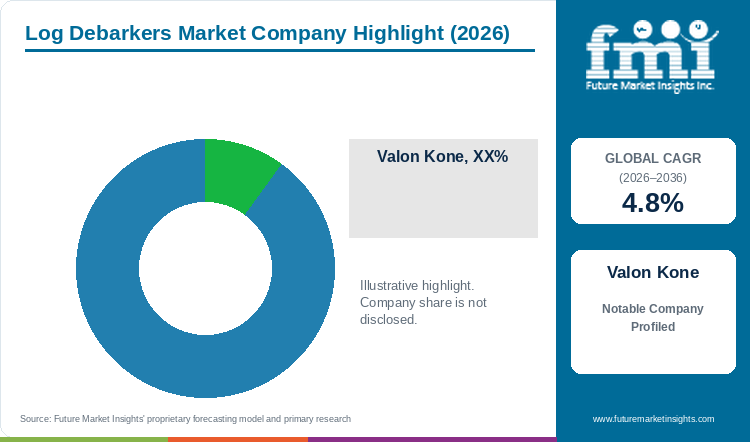
The log debarkers market is fragmented because suppliers sell different levels of equipment scope. FMI identifies Valon Kone and Nicholson Manufacturing with dedicated ring debarkers, while USNR and Comact place debarking inside wider sawmill systems. ANDRITZ competes through larger woodyard projects, while Raute links debarking with veneer preparation and Morbark and Kadant Carmanah Design serve narrower routes. The buyer's decision centers on how much line integration one supplier can manage and how much service remains available during operation.
- Dedicated ring platforms: Valon Kone and Nicholson Manufacturing focus on rotor and ring debarking within Kadant’s wood-processing businesses.
- Integrated woodyard and sawmill systems: USNR, ANDRITZ, and Comact connect debarking with broader material-flow or processing scopes.
- Application-specific wood processing: Kadant Carmanah Design, Morbark, and Raute serve panel, sawmill, or veneer workflows with distinct raw-material requirements.
Competitive Benchmarking: Log Debarkers Market
| Company | Direct Debarker Product Depth | Automated Line Integration | Parts and Lifecycle Support | Geographic Reach |
|---|---|---|---|---|
| Valon Kone | High | High | High | High |
| USNR | High | High | High | High |
| ANDRITZ | Medium | High | High | High |
| Raute | Medium | High | High | High |
| Comact | Medium | High | High | Medium |
| Nicholson Manufacturing | High | Medium | High | High |
| Kadant Carmanah Design | Medium | High | Medium | High |
| Morbark | High | Medium | High | Medium |
Scoring basis: High indicates broad product depth or service reach for the named criterion, while Medium indicates a narrower but relevant capability. Low indicates limited breadth or smaller current capability for the same criterion. The ratings compare documented capability and reach, not product quality or market share.
Key Developments in the Log Debarkers Market
- In July 2026, ANDRITZ announced a 400 m³/h debarking and chipping line for Lenzing with automation and commissioning.
- In December 2025, Comact announced Niagara Sawmilling’s brownfield modernization with a Versa Ring Debarker and new log infeed.
- In May 2025, Kadant announced USD 18 million in wood-processing orders for three lumber producers. The orders included debarking and stranding systems with chipping and batch-feed equipment.
- In May 2025, Valon Kone introduced the VK4000 debarker series for small and midsize mills with modular construction.
Key Players in the Log Debarkers Market
Dedicated Rotor and Ring Debarking Platforms
- Valon Kone
- Nicholson Manufacturing
Integrated Woodyard and Sawmill Systems
- USNR
- ANDRITZ
- Comact
Application-Specific Wood Processing Systems
- Kadant Carmanah Design
- Morbark
- Raute
Log Debarkers Market - Report Scope
| Coverage field | Report scope |
|---|---|
| Market breakdown | Debarker Type, Log Size, End Use, Automation, Sales Channel, and Region. |
| Quantitative Units | USD million. |
| Market Definition | Revenue includes industrial log debarking equipment sold across the defined debarker types and end uses. It also includes debarker-specific feedworks, controls, and aftermarket rebuilds where sold as part of the named debarking system. Downstream lumber, pulp, panel, pellet, and biomass revenue is excluded, as are adjacent stand-alone chippers, bark shredders, and harvesting equipment. |
| Regions Covered | North America; Latin America; Western Europe; Eastern Europe; East Asia; South Asia and Pacific; Middle East and Africa. |
| Countries Covered | USA, Germany, Japan, Brazil, France, Italy, Mexico, and more than twenty-five additional countries in the full report. |
| Key Companies Profiled | Valon Kone, USNR, ANDRITZ, Raute, Comact, Nicholson Manufacturing, Kadant Carmanah Design, Morbark. |
| Forecast Period | 2026 to 2036. |
| Approach | Primary and secondary research with market triangulation. |
Log Debarkers Market - Research Methodology
| Method | Approach |
|---|---|
| Primary Research | FMI analysts gathered input from manufacturers, service providers, technology developers, distributors, end users, procurement teams, and subject-matter experts. Interviews examined purchasing decisions, product or service evaluation, adoption barriers, approval requirements, pricing considerations, and expectations for technical or commercial support. Respondents were also asked what evidence is required before a trial, pilot, or initial order develops into regular purchasing. |
| Desk Research | Desk research covered government statistics, regulatory publications, trade data, industry associations, technical literature, standards, company filings, product information, and official corporate announcements. Sources were reviewed for relevance, publication date, geographic coverage, and consistency with the defined market scope. Claims relating to performance, applications, approvals, capacity, investment, and commercial activity were retained only when supported by credible public evidence. |
| Market Sizing and Forecasting | The market model combined the baseline value with historical performance, segment structure, pricing and volume indicators, adoption levels, company participation, and country-level demand conditions. Forecast assumptions considered economic activity, investment trends, regulatory developments, technology adoption, purchasing cycles, supply availability, and barriers to wider market use. Segment and regional estimates were reconciled before the final market total was calculated. |
| Data Validation | Estimates were checked against multiple independent indicators, including public data, company activity, trade patterns, industry developments, and findings from primary interviews. Validation also tested whether products, services, applications, and company revenues fell within the defined market boundaries. Adjacent categories, unsupported claims, overlapping revenues, and activities without direct market relevance were excluded to reduce double counting and maintain consistency across segments and countries. |
Log Debarkers Market by Segments
Log Debarkers Market segmented by Debarker Type:
- Ring debarkers
- Drum debarkers
- Rosserhead debarkers
- Flail debarkers
- Cambio-style debarkers
Log Debarkers Market segmented by Log Size:
- Medium logs
- Small logs
- Large logs
- Mixed-diameter logs
Log Debarkers Market segmented by End Use:
- Sawmills
- Pulp mills
- Panel mills
- Biomass plants
- Wood pellet mills
Log Debarkers Market segmented by Automation:
- Fully automated
- Semi-automatic
- Manual feed
- Line-integrated scanning
Log Debarkers Market segmented by Sales Channel:
- Wood processing OEMs
- Sawmill projects
- Dealer/service network
- Aftermarket rebuild
Log Debarkers Market by Region:
- North America
- United States
- Canada
- Latin America
- Brazil
- Mexico
- Argentina
- Chile
- Western Europe
- Germany
- France
- United Kingdom
- Italy
- Spain
- Benelux
- Nordics
- Eastern Europe
- Poland
- Czech Republic
- Romania
- Hungary
- East Asia
- China
- Japan
- South Korea
- South Asia and Pacific
- India
- ASEAN
- Australia and New Zealand
- Middle East and Africa
- GCC Countries
- South Africa
- Türkiye
- Israel
Research Sources and Bibliography
- U.S. Department of Agriculture, Rural Development. (2026, March 23). USDA announces $115.2 million investment to expand timber production and enhance forest health in eight states.
- Statistisches Bundesamt (Destatis). (2026, April 15). Holzeinschlag 2025 insgesamt um 6,4 % gesunken, Schadholzaufkommen halbiert [2025 timber harvest fell 6.4% overall; damaged-wood volume halved].
- Forestry Agency of Japan. (2026, June 2). [FY2025 forest and forestry white paper released today].
- U.S. Department of Agriculture, Forest Service. (2026). Forest resources of the United States, 2022: A technical document supporting the Forest Service 2020 RPA Assessment (General Technical Report WO-107).
- Statistisches Bundesamt (Destatis). (2026, May 13). Erzeugerpreise der Produkte des Holzeinschlags [Producer prices for timber-harvest products].
- Instituto Brasileiro de Geografia e Estatística. (2026, September 24). Value of forestry activities grows 6.7% and adds up to R$ 47.9 billion.
- Agreste. (2025, November 14). Récolte de bois et production de sciages en 2024 : recul global de la récolte, hausse des sciages de conifères [Wood harvest and sawmill production in 2024: Overall harvest declines; conifer sawnwood rises].
- CREA. (2026, March 3). Online il rapporto finale del Progetto FILFor [Final FILFor project report published online].
- Comisión Nacional Forestal. (2025, December 31). Sector Forestal en México 2024 [Mexico forestry sector 2024].
- Comisión Nacional Forestal. (2025). Programa Institucional de la CONAFOR 2025-2030 [CONAFOR institutional program 2025-2030].
- Valon Kone. (2025, October). Better customer support in Canada.
- Comact. (accessed September 2026). Debarker with VTO Ring.
- ANDRITZ. (2026, July 15). Lenzing, Austria, selects ANDRITZ to supply new debarking and chipping line.
- Comact. (2025, December 9). Niagara Sawmilling Company selects Comact for major modernization project in Invercargill, New Zealand.
- Kadant Inc. (2025, May 28). Kadant awarded $18 million in orders for wood processing systems.
- Valon Kone. (2025, May). Valon Kone to launch VK4000 debarker series at LIGNA in Germany.
- ANDRITZ. (2025, July). Steam deicing in the debarking drum - less energy, less water, more savings.
- Valon Kone. (2025, December). New subsidiary in Austria.
- Raute. (2026, May 21). Log Cutting Line R7.
- Nicholson Manufacturing Ltd. (2026, September). Introducing 50-inch R2 Ring Debarker [LinkedIn post].
- Kadant Inc. (accessed September 2026). Our Businesses: Nicholson Manufacturing Ltd. and Valon Kone Oy.
- Comact. (accessed September 2026). Debarker with Versa Ring.
- Morbark. (accessed September 2026). Sawmill Products.
- Raute. (accessed September 2026). Block Round-up Lathe R3.
- USNR. (accessed September 2026). Transverse Merchandising Line.
This bibliography is provided for reader reference. The full report contains the complete reference list and detailed citations.
This Report Answers
- What is the Log Debarkers Market size in 2026 and 2036?
- What CAGR is projected for the Log Debarkers Market through 2036?
- Which segments hold notable 2026 shares in the Log Debarkers Market?
- Which countries show distinct Log Debarkers Market expansion outlooks through 2036?
- Which companies are notable in the Log Debarkers Market supply field?
- What equipment scope does the Log Debarkers Market report include?
Frequently Asked Questions
How large is the Log Debarkers Market value during 2026?
The Log Debarkers Market is estimated at USD 1,182.6 million in 2026 and is forecast to reach USD 1,882.6 million by 2036.
What CAGR is projected for the Log Debarkers Market through 2036?
The Log Debarkers Market is projected to grow at 4.8% CAGR from 2026 to 2036, following a 2025 baseline of USD 1,128.9 million.
Which debarker type records a notable revenue share during 2026?
Ring debarkers are expected to hold 31.0% of debarker type revenue in 2026 because controlled single-log contact limits unnecessary wood removal at production speed.
Which sales channel records a notable revenue share during 2026?
Wood processing OEMs are anticipated at 42.0% of sales channel revenue in 2026 because one project team can manage integration with adjacent mill equipment.
Which country shows a notable Log Debarkers expansion outlook through 2036?
Germany is forecast to expand at 6.1% CAGR through 2036 as higher stemwood prices increase the value of fiber recovery during replacement decisions.
Which companies are notable suppliers in the Log Debarkers Market?
The Log Debarkers Market includes Valon Kone, USNR, ANDRITZ, Raute, Comact, Nicholson Manufacturing, Kadant Carmanah Design, and Morbark.
Preview the report firsthand - request a free sample
Get SampleGet the brochure for pricing and purchase details.
Get PDFTable of Content
- Key Takeaways
- Market Size and CAGR
- Top Growth Driver
- Fastest Growing Segment
- Leading Region
- Key Companies
- Emerging Opportunities
- Executive Summary
- Global Market Outlook
- Demand-side Trends
- Supply-side Trends
- Technology Roadmap Analysis
- Analysis and Recommendations
- Analyst Perspective (What is happening? Why now? What should investors know?)
- Key Questions Answered
- How large is the market?
- What is the CAGR?
- What are key trends?
- Which region dominates?
- Who are the leaders?
- Market Overview
- Market Coverage / Taxonomy
- Market Definition / Scope / Limitations
- Research Methodology
- Chapter Orientation
- Analytical Lens and Working Hypotheses
- Market Structure, Signals, and Trend Drivers
- Benchmarking and Cross-market Comparability
- Market Sizing, Forecasting, and Opportunity Mapping
- Research Design and Evidence Framework
- Desk Research Programme (Secondary Evidence)
- Expert Input and Fieldwork (Primary Evidence)
- Tooling, Models, and Reference Databases
- Data Engineering and Model Build
- Quality Assurance and Audit Trail
- Market Background
- Market Dynamics (Drivers, Restraints, Opportunity, Trends)
- Scenario Forecast (Optimistic, Likely, Conservative)
- Impact Analysis
- AI Impact
- Sustainability Impact
- Regulatory Impact
- Technology Impact
- Consumer / Buyer Analysis
- Purchase Drivers
- Adoption Barriers
- Buyer Journey
- Opportunity Map Analysis
- Product Life Cycle Analysis
- Supply Chain Analysis
- Investment Feasibility Matrix
- Value Chain Analysis
- PESTLE and Porter's Analysis
- Regulatory Landscape
- Regional Parent Market Outlook
- Production and Consumption Statistics
- Import and Export Statistics
- Global Market Analysis and Forecast, 2021 to 2036
- Historical Market Size Value (USD Million) Analysis, 2021 to 2025
- Current and Future Market Size Value (USD Million) Projections, 2026 to 2036
- Y-o-Y Growth Trend Analysis
- Absolute $ Opportunity Analysis
- Global Market Pricing Analysis, 2021 to 2036
- Global Market Analysis and Forecast, By Debarker Type, 2021 to 2036
- Introduction / Key Findings
- Historical Market Size Value (USD Million) Analysis By Debarker Type, 2021 to 2025
- Current and Future Market Size Value (USD Million) Analysis and Forecast By Debarker Type, 2026 to 2036
- Ring debarkers
- Drum debarkers
- Rosserhead debarkers
- Flail debarkers
- Cambio-style debarkers
- Y-o-Y Growth Trend Analysis By Debarker Type, 2021 to 2025
- Absolute $ Opportunity Analysis By Debarker Type, 2026 to 2036
- Global Market Analysis and Forecast, By Log Size, 2021 to 2036
- Introduction / Key Findings
- Historical Market Size Value (USD Million) Analysis By Log Size, 2021 to 2025
- Current and Future Market Size Value (USD Million) Analysis and Forecast By Log Size, 2026 to 2036
- Medium logs
- Small logs
- Large logs
- Mixed-diameter logs
- Y-o-Y Growth Trend Analysis By Log Size, 2021 to 2025
- Absolute $ Opportunity Analysis By Log Size, 2026 to 2036
- Global Market Analysis and Forecast, By End Use, 2021 to 2036
- Introduction / Key Findings
- Historical Market Size Value (USD Million) Analysis By End Use, 2021 to 2025
- Current and Future Market Size Value (USD Million) Analysis and Forecast By End Use, 2026 to 2036
- Sawmills
- Pulp mills
- Panel mills
- Biomass plants
- Wood pellet mills
- Y-o-Y Growth Trend Analysis By End Use, 2021 to 2025
- Absolute $ Opportunity Analysis By End Use, 2026 to 2036
- Global Market Analysis and Forecast, By Automation, 2021 to 2036
- Introduction / Key Findings
- Historical Market Size Value (USD Million) Analysis By Automation, 2021 to 2025
- Current and Future Market Size Value (USD Million) Analysis and Forecast By Automation, 2026 to 2036
- Fully automated
- Semi-automatic
- Manual feed
- Line-integrated scanning
- Y-o-Y Growth Trend Analysis By Automation, 2021 to 2025
- Absolute $ Opportunity Analysis By Automation, 2026 to 2036
- Global Market Analysis and Forecast, By Sales Channel, 2021 to 2036
- Introduction / Key Findings
- Historical Market Size Value (USD Million) Analysis By Sales Channel, 2021 to 2025
- Current and Future Market Size Value (USD Million) Analysis and Forecast By Sales Channel, 2026 to 2036
- Wood processing OEMs
- Sawmill projects
- Dealer/service network
- Aftermarket rebuild
- Y-o-Y Growth Trend Analysis By Sales Channel, 2021 to 2025
- Absolute $ Opportunity Analysis By Sales Channel, 2026 to 2036
- Global Market Analysis and Forecast, By Region, 2021 to 2036
- Introduction
- Historical Market Size Value (USD Million) Analysis By Region, 2021 to 2025
- Current Market Size Value (USD Million) Analysis and Forecast By Region, 2026 to 2036
- North America
- Latin America
- Western Europe
- Eastern Europe
- East Asia
- South Asia and Pacific
- Middle East and Africa
- Market Attractiveness Analysis By Region
- North America Market Analysis and Forecast, By Country, 2021 to 2036
- Historical Market Size Value (USD Million) Trend Analysis By Market Taxonomy, 2021 to 2025
- Market Size Value (USD Million) Forecast By Market Taxonomy, 2026 to 2036
- By Country
- United States
- Canada
- By Debarker Type
- By Log Size
- By End Use
- By Automation
- By Sales Channel
- By Country
- Market Attractiveness Analysis
- By Country
- By Debarker Type
- By Log Size
- By End Use
- By Automation
- By Sales Channel
- Key Takeaways
- Latin America Market Analysis and Forecast, By Country
- Historical Market Size Value (USD Million) Trend Analysis By Market Taxonomy, 2021 to 2025
- Market Size Value (USD Million) Forecast By Market Taxonomy, 2026 to 2036
- By Country
- Brazil
- Mexico
- Argentina
- Chile
- By Debarker Type
- By Log Size
- By End Use
- By Automation
- By Sales Channel
- By Country
- Market Attractiveness Analysis
- By Country
- By Debarker Type
- By Log Size
- By End Use
- By Automation
- By Sales Channel
- Key Takeaways
- Western Europe Market Analysis and Forecast, By Country
- Historical Market Size Value (USD Million) Trend Analysis By Market Taxonomy, 2021 to 2025
- Market Size Value (USD Million) Forecast By Market Taxonomy, 2026 to 2036
- By Country
- Germany
- France
- United Kingdom
- Italy
- Spain
- Benelux
- Nordics
- By Debarker Type
- By Log Size
- By End Use
- By Automation
- By Sales Channel
- By Country
- Market Attractiveness Analysis
- By Country
- By Debarker Type
- By Log Size
- By End Use
- By Automation
- By Sales Channel
- Key Takeaways
- Eastern Europe Market Analysis and Forecast, By Country
- Historical Market Size Value (USD Million) Trend Analysis By Market Taxonomy, 2021 to 2025
- Market Size Value (USD Million) Forecast By Market Taxonomy, 2026 to 2036
- By Country
- Poland
- Czech Republic
- Romania
- Hungary
- By Debarker Type
- By Log Size
- By End Use
- By Automation
- By Sales Channel
- By Country
- Market Attractiveness Analysis
- By Country
- By Debarker Type
- By Log Size
- By End Use
- By Automation
- By Sales Channel
- Key Takeaways
- East Asia Market Analysis and Forecast, By Country
- Historical Market Size Value (USD Million) Trend Analysis By Market Taxonomy, 2021 to 2025
- Market Size Value (USD Million) Forecast By Market Taxonomy, 2026 to 2036
- By Country
- China
- Japan
- South Korea
- By Debarker Type
- By Log Size
- By End Use
- By Automation
- By Sales Channel
- By Country
- Market Attractiveness Analysis
- By Country
- By Debarker Type
- By Log Size
- By End Use
- By Automation
- By Sales Channel
- Key Takeaways
- South Asia and Pacific Market Analysis and Forecast, By Country
- Historical Market Size Value (USD Million) Trend Analysis By Market Taxonomy, 2021 to 2025
- Market Size Value (USD Million) Forecast By Market Taxonomy, 2026 to 2036
- By Country
- India
- ASEAN
- Australia and New Zealand
- By Debarker Type
- By Log Size
- By End Use
- By Automation
- By Sales Channel
- By Country
- Market Attractiveness Analysis
- By Country
- By Debarker Type
- By Log Size
- By End Use
- By Automation
- By Sales Channel
- Key Takeaways
- Middle East and Africa Market Analysis and Forecast, By Country
- Historical Market Size Value (USD Million) Trend Analysis By Market Taxonomy, 2021 to 2025
- Market Size Value (USD Million) Forecast By Market Taxonomy, 2026 to 2036
- By Country
- GCC Countries
- South Africa
- Türkiye
- Israel
- By Debarker Type
- By Log Size
- By End Use
- By Automation
- By Sales Channel
- By Country
- Market Attractiveness Analysis
- By Country
- By Debarker Type
- By Log Size
- By End Use
- By Automation
- By Sales Channel
- Key Takeaways
- Key Countries Market Analysis
- United States
- Pricing Analysis
- Market Share Analysis, 2025
- By Debarker Type
- By Log Size
- By End Use
- By Automation
- By Sales Channel
- Canada
- Pricing Analysis
- Market Share Analysis, 2025
- By Debarker Type
- By Log Size
- By End Use
- By Automation
- By Sales Channel
- Mexico
- Pricing Analysis
- Market Share Analysis, 2025
- By Debarker Type
- By Log Size
- By End Use
- By Automation
- By Sales Channel
- Brazil
- Pricing Analysis
- Market Share Analysis, 2025
- By Debarker Type
- By Log Size
- By End Use
- By Automation
- By Sales Channel
- Chile
- Pricing Analysis
- Market Share Analysis, 2025
- By Debarker Type
- By Log Size
- By End Use
- By Automation
- By Sales Channel
- Germany
- Pricing Analysis
- Market Share Analysis, 2025
- By Debarker Type
- By Log Size
- By End Use
- By Automation
- By Sales Channel
- United Kingdom
- Pricing Analysis
- Market Share Analysis, 2025
- By Debarker Type
- By Log Size
- By End Use
- By Automation
- By Sales Channel
- Italy
- Pricing Analysis
- Market Share Analysis, 2025
- By Debarker Type
- By Log Size
- By End Use
- By Automation
- By Sales Channel
- Spain
- Pricing Analysis
- Market Share Analysis, 2025
- By Debarker Type
- By Log Size
- By End Use
- By Automation
- By Sales Channel
- France
- Pricing Analysis
- Market Share Analysis, 2025
- By Debarker Type
- By Log Size
- By End Use
- By Automation
- By Sales Channel
- India
- Pricing Analysis
- Market Share Analysis, 2025
- By Debarker Type
- By Log Size
- By End Use
- By Automation
- By Sales Channel
- ASEAN
- Pricing Analysis
- Market Share Analysis, 2025
- By Debarker Type
- By Log Size
- By End Use
- By Automation
- By Sales Channel
- Australia and New Zealand
- Pricing Analysis
- Market Share Analysis, 2025
- By Debarker Type
- By Log Size
- By End Use
- By Automation
- By Sales Channel
- China
- Pricing Analysis
- Market Share Analysis, 2025
- By Debarker Type
- By Log Size
- By End Use
- By Automation
- By Sales Channel
- Japan
- Pricing Analysis
- Market Share Analysis, 2025
- By Debarker Type
- By Log Size
- By End Use
- By Automation
- By Sales Channel
- South Korea
- Pricing Analysis
- Market Share Analysis, 2025
- By Debarker Type
- By Log Size
- By End Use
- By Automation
- By Sales Channel
- Poland
- Pricing Analysis
- Market Share Analysis, 2025
- By Debarker Type
- By Log Size
- By End Use
- By Automation
- By Sales Channel
- Hungary
- Pricing Analysis
- Market Share Analysis, 2025
- By Debarker Type
- By Log Size
- By End Use
- By Automation
- By Sales Channel
- Türkiye
- Pricing Analysis
- Market Share Analysis, 2025
- By Debarker Type
- By Log Size
- By End Use
- By Automation
- By Sales Channel
- South Africa
- Pricing Analysis
- Market Share Analysis, 2025
- By Debarker Type
- By Log Size
- By End Use
- By Automation
- By Sales Channel
- United States
- Market Structure Analysis
- Competition Dashboard
- Competition Benchmarking
- Market Share Analysis of Top Players
- By Regional
- By Debarker Type
- By Log Size
- By End Use
- By Automation
- By Sales Channel
- Emerging Startups
- Innovation Benchmarking
- Competition Analysis
- Competition Deep Dive
- Valon Kone
- Overview
- Product Portfolio
- Profitability by Market Segments
- Sales Footprint
- Strategy Overview
- Marketing Strategy
- Product Strategy
- Channel Strategy
- USNR
- ANDRITZ
- Raute
- Comact
- Nicholson Manufacturing
- Kadant Carmanah Design
- Morbark
- Valon Kone
- Case Studies
- Success Stories
- Recent Developments
- Competition Deep Dive
- Assumptions & Acronyms Used


