

- Market Size (2026)
- USD 1.5 Bn
- Forecast (2036)
- USD 2.4 Bn
- CAGR (2026 to 2036)
- 4.9%
How big is Log Grapples Market in 2026?
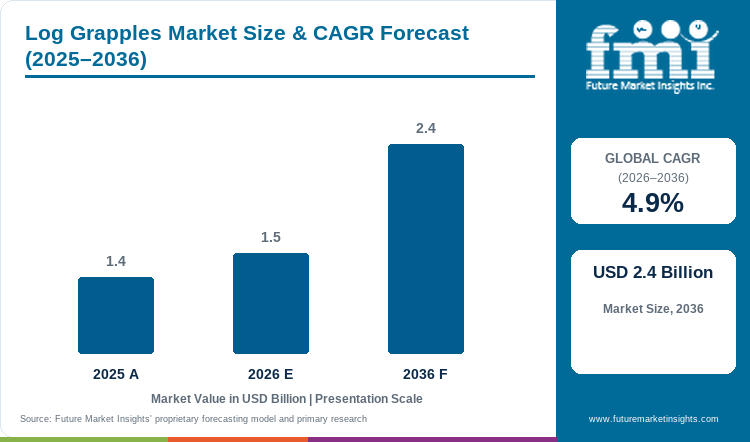
USD 1.5 billion in 2026 and USD 2.4 billion by 2036, expanding at 4.9% CAGR.
Demand for log grapples is projected to expand at 4.9% CAGR from 2026 to 2036. Valuation grows from USD 1.4 billion in 2025 to USD 1.5 billion in 2026 and reaches USD 2.4 billion by 2036. Forestry contractors are replacing worn grapples when slower jaw movement or rotation begins reducing loading output. Kesla launched new tree-length cranes for demanding timber loading in June 2025. The launch keeps crane selection and grapple fit aligned with hydraulic response during one coordinated equipment purchase.
Replacement needs differ by country because harvest volume and service access change across forest operations. Destatis reported in April 2026 that Germany harvested 57.3 million cubic meters in 2025. Lower timber output can slow fleet growth and increase planned repairs for older equipment. Australian plantation machines often work far from repair centers and depend on reliable parts access. Crews in both countries compare hydraulic flow with mount geometry before choosing a grapple. Carrier duty and service life also influence long-term use across demanding timber operations. Remote fleets weigh parts availability carefully because delayed repairs can change the final purchase decision.
Key Takeaways
- High-cycle grapple replacement is driven by jaw and rotator wear that reduces loader output during repeated timber handling.
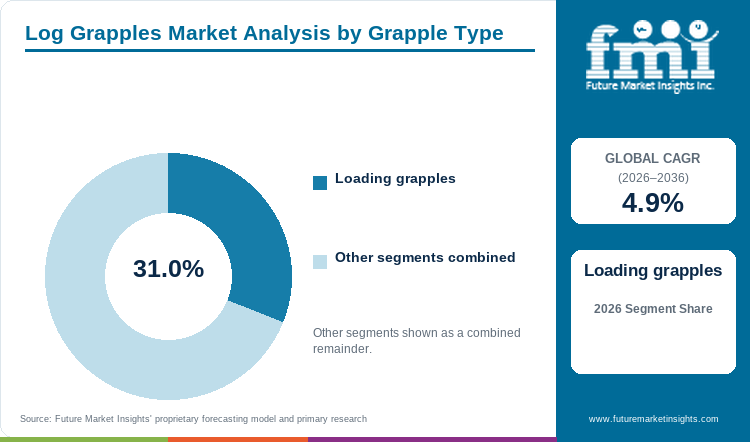
- Based on grapple type, loading grapples are projected to account for 31.0% in 2026, supported by frequent timber loading at landings.
- By mounting, loader mounted grapples are estimated to hold 30.0% in 2026, reinforced by repeated use on dedicated forestry loaders.
- In 2026, forestry harvesting is expected to lead end use with 34.0% share, influenced by repeated gripping and transfer during extraction.
- Carrier hydraulics and capital approval can delay replacement while older grapples remain repairable despite rising service needs.
- Some of the key players in this market include Rotobec, Palfinger, Cranab, Hultdins, John Deere, Caterpillar, Komatsu Forest, Tigercat, Kesla, and Waratah.
Analyst Perspective
"Replacement demand is strongest when a new grapple improves control without forcing contractors to replace a productive carrier. The purchase case weakens when hydraulic flow or rotator fit conflicts with timber size and local service needs."
- Nikhil Kaitwade, Principal Consultant, Future Market Insights
How is the log grapples market segmented?
The log grapples market is segmented by Grapple Type, Mounting, End Use, Capacity, Sales Channel, and Region.
The log grapples market is segmented by grapple type, mounting, end use, capacity, sales channel, and region. Grapple type includes loading, sorting, processing, rotating, and heavy-duty mill yard designs. Mounting options cover loader, excavator, truck crane, and forestry crane interfaces. End use includes forestry harvesting, sawmill yards, log terminals, biomass handling, and pulpwood operations. Capacity ranges from below 0.3 m² through above 1.0 m² across supported carriers. Sales channels include forestry equipment OEMs, dealer networks, aftermarket attachment suppliers, and rental or service providers.
How do loading grapples support repeated timber transfer at landings?
Loading grapples move logs through landings and transfer points during repeated timber loading cycles. Roundwood can roll during movement, so material handling equipment needs jaws that hold each load securely. Crews compare opening width with log weight and roll-in control before choosing an attachment. Cylinder protection also matters because repeated impacts can reduce control and shorten service life. Reliable jaw control helps crews keep a steady loading pace through repeated transfer work. Tigercat added a grapple-saw option to LG4053 and LG5057 loader grapples in April 2026. The option keeps selected cutting at the loader station while reducing extra handling between work steps.
- Loading grapples are set to lead the grapple type category with 31.0% share in 2026, owing to frequent transfers at landings.
- Tigercat added the grapple-saw option in April 2026 to keep selected cutting work at the loader station.
Why do loader mounted units remain important for carrier matching?
Loader mounted units pair grapples with carriers built for repeated lifting and swing work during timber transfer. Crews compare construction equipment attachments with available hydraulic flow before choosing each grapple for the carrier. Forestry loaders need steady rotation and grip force because poor matching can cut usable payload. Attachment weight also changes how much timber the carrier can lift safely during high-use work. Caterpillar introduced the FM528 GF/LL forest machine in February 2025 with support for several Cat grapple sizes. Matching grapple size with carrier hydraulics and dealer support makes the full system easier to choose and service.
- Loader mounted grapples are projected to hold 30.0% share in 2026 because dedicated forestry loaders use these attachments repeatedly.
- Caterpillar introduced the FM528 GF/LL in February 2025 with supported grapple sizes that keep carrier fit inside one equipment system.
How does forestry harvesting create repeated grapple handling demand?
Forestry harvesting uses grapples before logs reach mill yards or transport terminals for later processing. The grapple gathers stems and moves timber between machines across rough ground during repeated extraction work. Other forestry equipment supports the same work sequence, so grapple fit must stay reliable between carriers. Damaged jaws can stop a carrier and raise repair costs during high-use harvest work. Steady grip control also helps crews move timber safely between machines. Hultdins introduced its SuperGrip CS grapple in August 2026 for compact high-strength handling. The model bridges standard and heavier grapple families for crews balancing attachment weight with grip strength.
- By end use, forestry harvesting is forecast to represent 34.0% in 2026, shaped by repeated gripping during extraction.
- Hultdins introduced the SuperGrip CS in August 2026 as a compact option between its standard and heavier grapple families.
Why does the 0.3-0.6 m² class balance payload and attachment weight?
The 0.3-0.6 m² class balances payload and attachment weight across many forwarders and forestry loaders. Smaller grapples suit lighter cranes because those carriers have less lift available for attachment weight. Larger grapples require more lift capacity before crews can use their full handling volume safely. The middle class also suits compact loader platforms that need manageable attachment weight through repeated work cycles. This capacity range provides useful handling volume without pushing each carrier into a heavier grapple class. Komatsu Forest launched the 898 forwarder with a 205F crane in June 2025 and offered a 0.55 m² G88H grapple.
- In 2026, the 0.3-0.6 m² class is expected to lead capacity with 38.0% share, influenced by common carrier payload limits.
- Komatsu Forest paired the 205F crane with a 0.55 m² G88H grapple option in June 2025 for heavy forwarding work.
How do forestry equipment OEMs reduce grapple installation uncertainty?
Forestry equipment OEMs check grapple fit before delivery so crews avoid setup problems on supported carriers. Teams compare boom shape with hydraulic pressure before they review rotator needs and carrier limits. Truck loader cranes use different links between the rotator and grapple during timber work. Dealer networks stock parts for the carrier combinations they sell and repair. Kesla reappointed Rosenqvist Maskin AB as a Swedish tractor-equipment dealer in June 2026. The appointment expanded local sales and service for timber equipment across Sweden. OEM channels keep grapple selection close to known technical help and repair support after delivery.
- Forestry equipment OEMs are set to lead the sales channel category with 39.0% share in 2026, enabled by pre-delivery fit checks.
- Kesla reappointed a Swedish tractor-equipment dealer in June 2026 and expanded local sales and service for timber equipment.
What are the drivers, restraints, and opportunities in the Log Grapples Market?
Mechanized timber handling supports replacement demand, carrier integration can slow orders, and safer multifunction attachments can widen retrofit activity.
- Driver: Frequent mechanized log movement wears jaws and pins alongside hydraulic parts throughout repeated harvesting and loading cycles.
- Restraint: Hydraulic fit and tight capital budgets can extend repair cycles before operators approve replacement attachments.
- Opportunity: Multifunction grapples can add cutting or load-control functions without forcing operators to replace productive carriers.
Timber handling keeps grapples active through extraction and loading across regular forest work. The Swedish Forest Agency reported in June 2026 that gross felling reached 87.0 million cubic meters in 2025. That timber volume creates many grapple cycles before logs move to mills or terminals. Repeated cycles wear jaws and rotators, which can reduce grip control and machine uptime. Crews replace grapples when repair work begins taking too many hours from active carriers. Carrier upgrades can also change the grapple size and hydraulic match needed for replacement. Wood movement and spending on timber cutting machines reinforce demand and keep grapple replacement inside regular fleet planning.
Carrier fit can delay a grapple order even when the old attachment needs more repairs. The Swedish Forest Agency reported in June 2026 that regeneration harvest costs rose 4% in 2025. Higher harvest costs can tighten budgets and extend repair cycles for older grapples. A replacement grapple must match hydraulic flow and rated lift before crews can use it safely. Procurement teams also compare boom interfaces with heavy lifting equipment needs before approval. A low purchase price can raise lifetime costs if poor matching reduces payload or uptime. Long travel for parts can further weaken the case for replacement across remote forest work sites.
Multifunction grapples can prompt replacement even when older attachments still work during regular forest work cycles. Crews cut ground work by moving some cutting or load-control tasks into the cab. Newer crane systems can add control functions without forcing crews to change the carrier. Hultdins introduced a load-holding valve option for SuperGrip S grapples in August 2026. The valve holds a load during a hydraulic hose failure and helps crews keep control. That safety function gives contractors another reason to replace grapples before normal wear ends service life. Carrier-fit checks let crews add these controls without replacing the full machine.
Which country CAGRs are profiled in the Log Grapples Market?
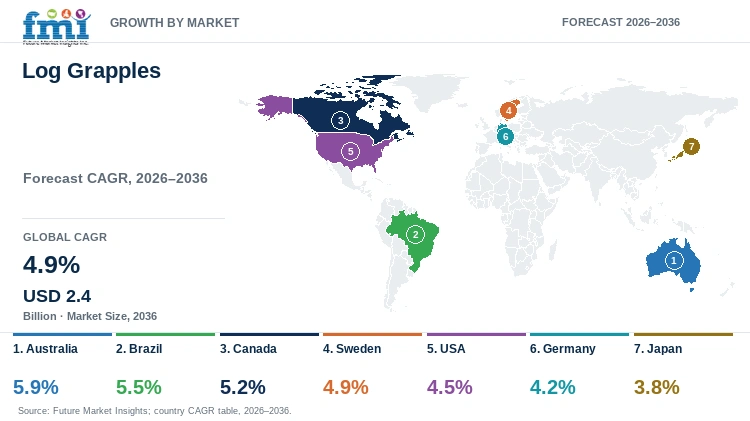
| Country | CAGR |
|---|---|
| Australia | 5.9% |
| Brazil | 5.5% |
| Canada | 5.2% |
| Sweden | 4.9% |
| USA | 4.5% |
| Germany | 4.2% |
| Japan | 3.8% |
How do country-level CAGRs compare in the Log Grapples Market?
Australia and Brazil form the upper forecast group, while Canada and Sweden occupy the middle range. The USA and Germany follow with lower rates, and Japan completes the profiled set. The 2.1-point spread describes different forecast paths rather than a ranking by current revenue.
- Australia's plantation logging keeps parts access and grapple service life central to replacement decisions across remote forestry operations.
- Brazil's plantation logging makes local parts stock important for remote crews facing long service travel and demanding operating conditions.
- Canada's changing timber access can shift replacement timing as fleets balance attachment renewal against uncertain regional harvesting conditions.
- Sweden's mature forestry fleets keep rotator fit and service life central to replacement decisions across high-use machinery.
- Mature logging fleets in the USA value carrier fit and fast dealer service when planning new attachment orders.
- Lower timber output in Germany keeps equipment purchases focused on work efficiency and carrier matching with dependable regional service.
- Japan's labor-saving forestry systems favor compact grapples that provide precise control without adding unnecessary carrier weight.
Similar CAGRs can produce different order patterns because fleet age and timber access vary between countries. Service reach also changes purchase timing across mature forestry regions with widely different operating distances. The full report provides country-level CAGR analysis across North America, Latin America, Western Europe, Eastern Europe, East Asia, South Asia and Pacific, and the Middle East and Africa.
Country-wise Analysis
- Australian forest crews work in plantation areas where long shifts and service gaps shape buying plans. By 2036, Australia is projected to grow at 5.9% CAGR, supported by concentrated plantation harvesting. The Australian Government announced 16 new plantation grants in May 2026 for new forestry development. The program supports almost 40,000 hectares of new hardwood and softwood plantations nationwide. Remote travel can extend downtime when replacement parts remain distant. Nearby spare parts help crews return worn grapples to work faster. Long work cycles also wear grapple pins and hydraulic parts during regular harvests. Dealer coverage and planned spare stock influence replacement timing by reducing downtime risk during long harvest runs.
- Brazil is projected to record 5.5% CAGR through 2036, tied to managed forests and remote service needs. Brazilian plantations use grapples often as eucalyptus and pine move from harvest areas to transport points. Brazil's Forest Service reported in December 2025 that federal forest concessions covered about 1.33 million hectares under 24 contracts. The concession program creates timber work that needs extraction and repeated log handling. Local parts stock shortens repair time during remote harvest peaks. Local service also helps crews plan needed repairs before peak work. Long travel distances can delay repairs while high-cycle work increases cylinder wear. Durable grapple designs help plantation carriers stay available through demanding harvest schedules.
- Canadian log fleets work across a large forest sector where timber access differs by region. Log grapple demand in Canada is forecast to rise at 5.2% CAGR through 2036, influenced by fleet renewal and changing timber supply. Natural Resources Canada released the Forest Sector Action Plan in June 2026 to address costs and fiber supply. The plan supports investment but also identifies regional limits on accessible timber. Cold weather can raise service needs across remote forestry fleets. Tighter timber access can delay attachment orders when crews expect less harvesting work. Replacement planning and remote parts coverage help crews limit attachment downtime across wider harvest schedules.
- Adoption of log grapples in Sweden is estimated to expand at 4.9% CAGR through 2036, reinforced by replacement needs across mature fleets. Swedish forestry uses a mature cut-to-length system that keeps forwarders and loaders active through regular harvest cycles. The Swedish Forest Agency reported in June 2026 that gross felling reached 87.0 million cubic meters in 2025. The agency also reported four consecutive years of declining felling by June 2026. Reliable parts support reduces long repair stops during scheduled work. A large installed fleet keeps service life and replacement timing central to purchase decisions. Crews compare grapple weight with crane payload and rotation needs before choosing replacements.
- Logging crews in the USA use loaders and swing machines across mature mechanized forestry fleets. In the USA, log grapple demand is predicted to advance at 4.5% CAGR through 2036, linked to replacement needs in mechanized logging. The U.S. Bureau of Labor Statistics reported in August 2026 that logging workers held about 40,400 jobs in 2025. The agency also reports that greater machine use raises output across logging operations. Fast parts support helps high-use carriers avoid costly idle time. Mature fleets make uptime central to replacement decisions for high-use carriers and attachments. Firms serving excavator platforms compare attachment weight with hydraulic flow and boom limits before approving new grapples.
- Log grapple demand in Germany is forecast to grow at 4.2% CAGR through 2036, shaped by replacement and work-efficiency needs. German logging crews use forwarders and truck cranes across managed forest operations. Destatis reported in April 2026 that Germany harvested 57.3 million cubic meters of timber in 2025. Lower output keeps equipment spending tied to active forest work and fleet efficiency. Regional parts coverage reduces repair delays across scheduled forest work. Crews compare grapple weight and rotator fit with carrier limits before choosing replacements. Suppliers document fit with common European crane systems used for timber handling. Better fit helps crews avoid lost payload and slow rotation during scheduled forest work.
- Japanese forestry crews work on steep terrain where compact machines and fewer workers shape equipment choices. Japan is estimated to post 3.8% CAGR over the forecast period, supported by labor-saving forest systems and compact equipment needs. The Forestry Agency published its Smart Forestry Implementation Vision in March 2026 for safer forest work. The plan promotes remote and automated machine functions that can reduce manual work. Compact grapples remain useful when steep terrain restricts carrier size. Grapples also need low boom weight and precise jaw control across uneven ground. Suppliers can speed technical reviews by documenting carrier limits for compact forestry machines.
Who are the notable companies in the Log Grapples Market?
Rotobec, Palfinger, Cranab, Hultdins, John Deere, Caterpillar, Komatsu Forest, Tigercat, Kesla, and Waratah are active within the defined log grapple supply boundary.
Dedicated grapple makers focus on jaw design and rotators for repeated timber handling across forestry operations. Timber-crane firms match grapples with carrier hydraulics and boom limits across supported equipment. Large OEMs connect grapple selection with machine fit and dealer service across truck mounted cranes and loader platforms. Waratah operates as a Deere forestry brand, while fleet operators compare parts access and local service before choosing suppliers.
- Rotobec, Cranab, Hultdins, and Kesla make dedicated forestry attachments or crane-and-grapple systems for repeated timber handling work.
- Palfinger, Waratah, and Tigercat link grapples with timber cranes, purpose-built loaders, and supported forestry platforms.
- John Deere, Caterpillar, and Komatsu Forest connect grapple selection with carrier hydraulics, machine controls, and established dealer service.
Competitive Benchmarking: Log Grapples Market
| Company | Dedicated Grapple Range | Carrier and Rotator Integration | High-Cycle Forestry Coverage | Geographic Reach |
|---|---|---|---|---|
| Rotobec | High | High | High | North America and international forestry markets |
| Palfinger | Medium | High | High | Europe and international timber-crane markets |
| Cranab | High | High | High | Europe and international forestry-equipment markets |
| Hultdins | High | High | High | Europe, North America, and export markets |
| John Deere | Medium | High | High | North America, Europe, and other forestry dealer regions |
| Caterpillar | Medium | High | High | North America and selected global forestry markets |
| Komatsu Forest | High | High | High | Nordics, Europe, the Americas, Australia, and other forestry markets |
| Tigercat | High | High | High | North America, South America, Australasia, Europe, and dealer-supported markets |
| Kesla | High | High | Medium | Europe and international forestry-equipment markets |
| Waratah | High | High | High | USA, Canada, Europe, Australia, New Zealand, Asia Pacific, Brazil, and Latin America |
Benchmarking uses three rating levels based on verified evidence for log grapple products and supported forestry equipment. High requires broad proof across the rated area, while Medium records narrower evidence and Low records a documented limit. Integration ratings assess carrier or rotator fit across equipment used for timber handling. Forestry ratings cover harvesting and forwarding work together with yard loading across documented applications. Geographic reach records the regions supported by each company through verified operating coverage.
Key Developments in the Log Grapples Market
- In July 2026, Cranab signed a deal with Setra Group for 12 FC13 cranes serving the Malå sawmill in Sweden.
- In June 2026, Kesla launched its F-series forestry cranes for common forwarder classes and expanded its crane platform.
- In February 2026, Rotobec launched the RGP-600 and RLP-602 rotators for different hydraulic flow needs in material handling.
Key Players in the Log Grapples Market
Dedicated grapple and attachment specialists
- Rotobec
- Cranab
- Hultdins
- Kesla
Forestry handling platform suppliers
- Palfinger
- Waratah
- Tigercat
Integrated forestry machine OEMs
- John Deere
- Caterpillar
- Komatsu Forest
Log Grapples Market - Report Scope
| Coverage field | Report scope |
|---|---|
| Market breakdown | By grapple type, mounting, end use, capacity, sales channel, and region. |
| Quantitative Units | USD billion. |
| Market Definition | Revenue includes standalone and OEM-supplied log grapple attachments within the defined segmentation universe. Carrier machines, downstream timber revenue, and non-log handling attachments are excluded. |
| Regions Covered | North America, Latin America, Western Europe, Eastern Europe, East Asia, South Asia and Pacific, and Middle East and Africa. |
| Countries Covered | USA, Germany, Japan, Australia, Brazil, Canada, Sweden, and 20+ countries included in the full report. |
| Key Companies Profiled | Rotobec, Palfinger, Cranab, Hultdins, John Deere, Caterpillar, Komatsu Forest, Tigercat, Kesla, Waratah. |
| Forecast Period | 2026 to 2036. |
| Approach | Primary and secondary research with market triangulation. |
Log Grapples Market - Research Methodology
| Method | Approach |
|---|---|
| Primary Research | FMI analysts gathered input from manufacturers, service providers, technology developers, distributors, end users, procurement teams, and subject-matter experts. Interviews examined purchasing decisions, product or service evaluation, adoption barriers, approval requirements, pricing considerations, and expectations for technical or commercial support. Respondents were also asked what evidence is required before a trial, pilot, or initial order develops into regular purchasing. |
| Desk Research | Desk research covered government statistics, regulatory publications, trade data, industry associations, technical literature, standards, company filings, product information, and official corporate announcements. Sources were reviewed for relevance, publication date, geographic coverage, and consistency with the defined market scope. Claims relating to performance, applications, approvals, capacity, investment, and commercial activity were retained only when supported by credible public evidence. |
| Market Sizing and Forecasting | The market model combined the baseline value with historical performance, segment structure, pricing and volume indicators, adoption levels, company participation, and country-level demand conditions. Forecast assumptions considered economic activity, investment trends, regulatory developments, technology adoption, purchasing cycles, supply availability, and barriers to wider market use. Segment and regional estimates were reconciled before the final market total was calculated. |
| Data Validation | Estimates were checked against multiple independent indicators, including public data, company activity, trade patterns, industry developments, and findings from primary interviews. Validation also tested whether products, services, applications, and company revenues fell within the defined market boundaries. Adjacent categories, unsupported claims, overlapping revenues, and activities without direct market relevance were excluded to reduce double counting and maintain consistency across segments and countries. |
Log Grapples Market by Segments
Log Grapples Market segmented by Grapple Type:
- Loading grapples
- Sorting grapples
- Processing grapples
- Rotating grapples
- Heavy-duty mill yard grapples
Log Grapples Market segmented by Mounting:
- Loader mounted
- Excavator mounted
- Truck crane mounted
- Forestry crane mounted
Log Grapples Market segmented by End Use:
- Forestry harvesting
- Sawmill yards
- Log terminals
- Biomass handling
- Pulpwood operations
Log Grapples Market segmented by Capacity:
- 0.3-0.6 m²
- Below 0.3 m²
- 0.6-1.0 m²
- Above 1.0 m²
Log Grapples Market segmented by Sales Channel:
- Forestry equipment OEMs
- Dealer network
- Aftermarket attachment suppliers
- Rental/service
Log Grapples Market by Region:
- North America
- United States
- Canada
- Latin America
- Brazil
- Mexico
- Chile
- Rest of Latin America
- Western Europe
- Germany
- United Kingdom
- Italy
- Spain
- France
- Nordics
- Benelux
- Rest of Western Europe
- Eastern Europe
- Russia
- Poland
- Hungary
- Balkan and Baltic States
- Rest of Eastern Europe
- East Asia
- China
- Japan
- South Korea
- South Asia and Pacific
- India
- ASEAN
- Australia and New Zealand
- Rest of South Asia and Pacific
- Middle East and Africa
- Kingdom of Saudi Arabia
- Other GCC Countries
- Türkiye
- South Africa
- Other African Union Countries
- Rest of Middle East and Africa
Research Sources and Bibliography
- Kesla Plc. (2025, June 18). Kesla introduces new tree-length cranes 2225 and 2228 for demanding timber loading.
- Federal Statistical Office of Germany (Destatis). (2026, April 15). Timber harvest declined by 6.4% in 2025.
- Tigercat Industries. (2026, April 16). Grapple Saw Adds Versatility.
- Caterpillar Inc. (2025, February 6). Caterpillar Introduces Cat FM528 GF/LL Forest Machine.
- Hultdin System AB. (2026, August 18). SuperGrip CS - New Product Development.
- Komatsu Forest. (2025, June 9). New forwarder with 25 tonne load capacity - Komatsu 898.
- Kesla Plc. (2026, June 1). Kesla reappoints Rosenqvist Maskin AB as tractor equipment dealer in Sweden.
- Swedish Forest Agency. (2026, June 9). Felling continued to decrease in 2025.
- Swedish Forest Agency. (2026, June 16). Costs for forest roads doubled since 2019.
- Hultdin System AB. (2026, August 11). New SuperGrip S with load-holding valve.
- U.S. Bureau of Labor Statistics. (2026, August 27). Logging Workers, Occupational Outlook Handbook.
- Forestry Agency of Japan. (2026, March). Smart Forestry Implementation Vision.
- Australian Government, Minister for Agriculture, Fisheries and Forestry. (2026, May 19). Albanese Labor Government backing sustainable forestry industry.
- Brazilian Forest Service. (2025, December). Federal forest concession indicators.
- Natural Resources Canada. (2026, June 4). Forest Sector Action Plan.
- Cranab AB. (2026, July 8). Cranab signs landmark deal with Setra Group: 12 FC13 cranes for Malå sawmill.
- Kesla Plc. (2026, June 5). Kesla launches new F-Series forestry cranes.
- Rotobec. (2026, February). New Rotator Launch: RGP-600/RLP-602.
- Palfinger Epsilon. (2026, July 9). Pressure signal based sequence control for crane outriggers.
- Cranab AB. (2026, January 8). The new Cranab TL12: a versatile and compact crane for forestry and heavy road transport.
- Deere & Company. (2026, February 17). John Deere Announces Acquisition of Risutec Oy.
- Komatsu Forest. (2026, April 1). Komatsu Forest completes the acquisition of Malwa Forest AB.
- Tigercat Industries. (2026, May 26). New 820 Series.
- Waratah Forestry Equipment. (2025, March 4). Waratah Forestry Equipment launches forestry grapple line.
This bibliography is provided for reader reference and is not exhaustive. The full report contains the complete reference list and detailed citations.
This Report Answers
- What are the 2026 value and projected 2036 market size?
- Which operating conditions support log grapple replacement across mechanized forestry operations?
- Why are loading grapples projected to hold 31.0% of grapple type demand?
- Why are loader mounted units projected to hold 30.0% of mounting demand?
- Why is forestry harvesting projected to hold 34.0% of end-use demand?
- How do carrier fit and capital approval delay log grapple replacement decisions?
- How do forecast growth rates differ across the seven profiled countries?
- Which companies supply dedicated grapples or integrate attachments with supported forestry carriers?
Frequently Asked Questions
How large is the global log grapples market in 2026?
The log grapples market is valued at USD 1.5 billion in 2026. It is projected to reach USD 2.4 billion by 2036. Frequent timber handling and normal fleet replacement support that value path across regular forestry equipment renewal.
What is the CAGR of the log grapples market from 2026 to 2036?
The log grapples market is projected to grow at 4.9% CAGR from 2026 through 2036. The forecast is supported by fleet renewal as worn jaws and rotators reduce machine uptime during timber handling.
Which grapple type leads the log grapples market in 2026?
Loading grapples are projected to hold 31.0% of grapple type demand in 2026. Frequent loading cycles keep these grapples active at landings and yards as timber moves through transfer points.
Which mounting type leads the log grapples market in 2026?
Loader mounted grapples are estimated to hold 30.0% of mounting demand in 2026. Purpose-built loaders use these grapples often because each attachment must fit the carrier. Hydraulic response influences control during repeated lifting and swing work. Parts access helps fleets plan replacement before attachment failures interrupt operations.
Which end use leads the log grapples market in 2026?
Forestry harvesting is forecast to represent 34.0% of end-use demand in 2026. Primary extraction requires frequent gripping and transfer before timber reaches transport points. Repeated handling wears jaws and rotators across machines used through each harvest cycle.
How much value is the log grapples market expected to add through 2036?
The log grapples market is expected to add USD 0.9 billion between 2026 and 2036. Replacement cycles and mechanized timber handling support the increase through normal fleet renewal.
Which countries are projected to record higher growth in the log grapples market?
Australia is projected to grow at 5.9% CAGR through 2036. Brazil follows at 5.5% CAGR, while Canada reaches 5.2% through the same period. Plantation scale and remote service needs shape the different purchase conditions behind these forecast paths.
Which companies are active suppliers in the global log grapples market?
Active companies include Rotobec, Palfinger, Cranab, Hultdins, John Deere, Caterpillar, Komatsu Forest, Tigercat, Kesla, and Waratah. Attachment specialists focus on grapples and rotators, while integrated suppliers connect grapples with carriers and dealer service.
Preview the report firsthand - request a free sample
Get SampleGet the brochure for pricing and purchase details.
Get PDFTable of Content
- Key Takeaways
- Market Size and CAGR
- Top Growth Driver
- Fastest Growing Segment
- Leading Region
- Key Companies
- Emerging Opportunities
- Executive Summary
- Global Market Outlook
- Demand-side Trends
- Supply-side Trends
- Technology Roadmap Analysis
- Analysis and Recommendations
- Analyst Perspective (What is happening? Why now? What should investors know?)
- Key Questions Answered
- How large is the market?
- What is the CAGR?
- What are key trends?
- Which region dominates?
- Who are the leaders?
- Market Overview
- Market Coverage / Taxonomy
- Market Definition / Scope / Limitations
- Research Methodology
- Chapter Orientation
- Analytical Lens and Working Hypotheses
- Market Structure, Signals, and Trend Drivers
- Benchmarking and Cross-market Comparability
- Market Sizing, Forecasting, and Opportunity Mapping
- Research Design and Evidence Framework
- Desk Research Programme (Secondary Evidence)
- Expert Input and Fieldwork (Primary Evidence)
- Tooling, Models, and Reference Databases
- Data Engineering and Model Build
- Quality Assurance and Audit Trail
- Market Background
- Market Dynamics (Drivers, Restraints, Opportunity, Trends)
- Scenario Forecast (Optimistic, Likely, Conservative)
- Impact Analysis
- AI Impact
- Sustainability Impact
- Regulatory Impact
- Technology Impact
- Consumer / Buyer Analysis
- Purchase Drivers
- Adoption Barriers
- Buyer Journey
- Opportunity Map Analysis
- Product Life Cycle Analysis
- Supply Chain Analysis
- Investment Feasibility Matrix
- Value Chain Analysis
- PESTLE and Porter's Analysis
- Regulatory Landscape
- Regional Parent Market Outlook
- Production and Consumption Statistics
- Import and Export Statistics
- Global Market Analysis and Forecast, 2021 to 2036
- Historical Market Size Value (USD Billion) Analysis, 2021 to 2025
- Current and Future Market Size Value (USD Billion) Projections, 2026 to 2036
- Y-o-Y Growth Trend Analysis
- Absolute $ Opportunity Analysis
- Global Market Pricing Analysis, 2021 to 2036
- Global Market Analysis and Forecast, By Grapple Type, 2021 to 2036
- Introduction / Key Findings
- Historical Market Size Value (USD Billion) Analysis By Grapple Type, 2021 to 2025
- Current and Future Market Size Value (USD Billion) Analysis and Forecast By Grapple Type, 2026 to 2036
- Loading grapples
- Sorting grapples
- Processing grapples
- Rotating grapples
- Heavy-duty mill yard grapples
- Y-o-Y Growth Trend Analysis By Grapple Type, 2021 to 2025
- Absolute $ Opportunity Analysis By Grapple Type, 2026 to 2036
- Global Market Analysis and Forecast, By Mounting, 2021 to 2036
- Introduction / Key Findings
- Historical Market Size Value (USD Billion) Analysis By Mounting, 2021 to 2025
- Current and Future Market Size Value (USD Billion) Analysis and Forecast By Mounting, 2026 to 2036
- Loader mounted
- Excavator mounted
- Truck crane mounted
- Forestry crane mounted
- Y-o-Y Growth Trend Analysis By Mounting, 2021 to 2025
- Absolute $ Opportunity Analysis By Mounting, 2026 to 2036
- Global Market Analysis and Forecast, By End Use, 2021 to 2036
- Introduction / Key Findings
- Historical Market Size Value (USD Billion) Analysis By End Use, 2021 to 2025
- Current and Future Market Size Value (USD Billion) Analysis and Forecast By End Use, 2026 to 2036
- Forestry harvesting
- Sawmill yards
- Log terminals
- Biomass handling
- Pulpwood operations
- Y-o-Y Growth Trend Analysis By End Use, 2021 to 2025
- Absolute $ Opportunity Analysis By End Use, 2026 to 2036
- Global Market Analysis and Forecast, By Capacity, 2021 to 2036
- Introduction / Key Findings
- Historical Market Size Value (USD Billion) Analysis By Capacity, 2021 to 2025
- Current and Future Market Size Value (USD Billion) Analysis and Forecast By Capacity, 2026 to 2036
- 0.3-0.6 m²
- Below 0.3 m²
- 0.6-1.0 m²
- Above 1.0 m²
- Y-o-Y Growth Trend Analysis By Capacity, 2021 to 2025
- Absolute $ Opportunity Analysis By Capacity, 2026 to 2036
- Global Market Analysis and Forecast, By Sales Channel, 2021 to 2036
- Introduction / Key Findings
- Historical Market Size Value (USD Billion) Analysis By Sales Channel, 2021 to 2025
- Current and Future Market Size Value (USD Billion) Analysis and Forecast By Sales Channel, 2026 to 2036
- Forestry equipment OEMs
- Dealer network
- Aftermarket attachment suppliers
- Rental/service
- Y-o-Y Growth Trend Analysis By Sales Channel, 2021 to 2025
- Absolute $ Opportunity Analysis By Sales Channel, 2026 to 2036
- Global Market Analysis and Forecast, By Region, 2021 to 2036
- Introduction
- Historical Market Size Value (USD Billion) Analysis By Region, 2021 to 2025
- Current Market Size Value (USD Billion) Analysis and Forecast By Region, 2026 to 2036
- North America
- Latin America
- Western Europe
- Eastern Europe
- East Asia
- South Asia and Pacific
- Middle East and Africa
- Market Attractiveness Analysis By Region
- North America Market Analysis and Forecast, By Country, 2021 to 2036
- Historical Market Size Value (USD Billion) Trend Analysis By Market Taxonomy, 2021 to 2025
- Market Size Value (USD Billion) Forecast By Market Taxonomy, 2026 to 2036
- By Country
- United States
- Canada
- By Grapple Type
- By Mounting
- By End Use
- By Capacity
- By Sales Channel
- By Country
- Market Attractiveness Analysis
- By Country
- By Grapple Type
- By Mounting
- By End Use
- By Capacity
- By Sales Channel
- Key Takeaways
- Latin America Market Analysis and Forecast, By Country
- Historical Market Size Value (USD Billion) Trend Analysis By Market Taxonomy, 2021 to 2025
- Market Size Value (USD Billion) Forecast By Market Taxonomy, 2026 to 2036
- By Country
- Brazil
- Mexico
- Chile
- Rest of Latin America
- By Grapple Type
- By Mounting
- By End Use
- By Capacity
- By Sales Channel
- By Country
- Market Attractiveness Analysis
- By Country
- By Grapple Type
- By Mounting
- By End Use
- By Capacity
- By Sales Channel
- Key Takeaways
- Western Europe Market Analysis and Forecast, By Country
- Historical Market Size Value (USD Billion) Trend Analysis By Market Taxonomy, 2021 to 2025
- Market Size Value (USD Billion) Forecast By Market Taxonomy, 2026 to 2036
- By Country
- Germany
- United Kingdom
- Italy
- Spain
- France
- Nordics
- Benelux
- Rest of Western Europe
- By Grapple Type
- By Mounting
- By End Use
- By Capacity
- By Sales Channel
- By Country
- Market Attractiveness Analysis
- By Country
- By Grapple Type
- By Mounting
- By End Use
- By Capacity
- By Sales Channel
- Key Takeaways
- Eastern Europe Market Analysis and Forecast, By Country
- Historical Market Size Value (USD Billion) Trend Analysis By Market Taxonomy, 2021 to 2025
- Market Size Value (USD Billion) Forecast By Market Taxonomy, 2026 to 2036
- By Country
- Russia
- Poland
- Hungary
- Balkan and Baltic States
- Rest of Eastern Europe
- By Grapple Type
- By Mounting
- By End Use
- By Capacity
- By Sales Channel
- By Country
- Market Attractiveness Analysis
- By Country
- By Grapple Type
- By Mounting
- By End Use
- By Capacity
- By Sales Channel
- Key Takeaways
- East Asia Market Analysis and Forecast, By Country
- Historical Market Size Value (USD Billion) Trend Analysis By Market Taxonomy, 2021 to 2025
- Market Size Value (USD Billion) Forecast By Market Taxonomy, 2026 to 2036
- By Country
- China
- Japan
- South Korea
- By Grapple Type
- By Mounting
- By End Use
- By Capacity
- By Sales Channel
- By Country
- Market Attractiveness Analysis
- By Country
- By Grapple Type
- By Mounting
- By End Use
- By Capacity
- By Sales Channel
- Key Takeaways
- South Asia and Pacific Market Analysis and Forecast, By Country
- Historical Market Size Value (USD Billion) Trend Analysis By Market Taxonomy, 2021 to 2025
- Market Size Value (USD Billion) Forecast By Market Taxonomy, 2026 to 2036
- By Country
- India
- ASEAN
- Australia and New Zealand
- Rest of South Asia and Pacific
- By Grapple Type
- By Mounting
- By End Use
- By Capacity
- By Sales Channel
- By Country
- Market Attractiveness Analysis
- By Country
- By Grapple Type
- By Mounting
- By End Use
- By Capacity
- By Sales Channel
- Key Takeaways
- Middle East and Africa Market Analysis and Forecast, By Country
- Historical Market Size Value (USD Billion) Trend Analysis By Market Taxonomy, 2021 to 2025
- Market Size Value (USD Billion) Forecast By Market Taxonomy, 2026 to 2036
- By Country
- Kingdom of Saudi Arabia
- Other GCC Countries
- Türkiye
- South Africa
- Other African Union Countries
- Rest of Middle East and Africa
- By Grapple Type
- By Mounting
- By End Use
- By Capacity
- By Sales Channel
- By Country
- Market Attractiveness Analysis
- By Country
- By Grapple Type
- By Mounting
- By End Use
- By Capacity
- By Sales Channel
- Key Takeaways
- Key Countries Market Analysis
- United States
- Pricing Analysis
- Market Share Analysis, 2025
- By Grapple Type
- By Mounting
- By End Use
- By Capacity
- By Sales Channel
- Canada
- Pricing Analysis
- Market Share Analysis, 2025
- By Grapple Type
- By Mounting
- By End Use
- By Capacity
- By Sales Channel
- Mexico
- Pricing Analysis
- Market Share Analysis, 2025
- By Grapple Type
- By Mounting
- By End Use
- By Capacity
- By Sales Channel
- Brazil
- Pricing Analysis
- Market Share Analysis, 2025
- By Grapple Type
- By Mounting
- By End Use
- By Capacity
- By Sales Channel
- Chile
- Pricing Analysis
- Market Share Analysis, 2025
- By Grapple Type
- By Mounting
- By End Use
- By Capacity
- By Sales Channel
- Germany
- Pricing Analysis
- Market Share Analysis, 2025
- By Grapple Type
- By Mounting
- By End Use
- By Capacity
- By Sales Channel
- United Kingdom
- Pricing Analysis
- Market Share Analysis, 2025
- By Grapple Type
- By Mounting
- By End Use
- By Capacity
- By Sales Channel
- Italy
- Pricing Analysis
- Market Share Analysis, 2025
- By Grapple Type
- By Mounting
- By End Use
- By Capacity
- By Sales Channel
- Spain
- Pricing Analysis
- Market Share Analysis, 2025
- By Grapple Type
- By Mounting
- By End Use
- By Capacity
- By Sales Channel
- France
- Pricing Analysis
- Market Share Analysis, 2025
- By Grapple Type
- By Mounting
- By End Use
- By Capacity
- By Sales Channel
- India
- Pricing Analysis
- Market Share Analysis, 2025
- By Grapple Type
- By Mounting
- By End Use
- By Capacity
- By Sales Channel
- ASEAN
- Pricing Analysis
- Market Share Analysis, 2025
- By Grapple Type
- By Mounting
- By End Use
- By Capacity
- By Sales Channel
- Australia and New Zealand
- Pricing Analysis
- Market Share Analysis, 2025
- By Grapple Type
- By Mounting
- By End Use
- By Capacity
- By Sales Channel
- China
- Pricing Analysis
- Market Share Analysis, 2025
- By Grapple Type
- By Mounting
- By End Use
- By Capacity
- By Sales Channel
- Japan
- Pricing Analysis
- Market Share Analysis, 2025
- By Grapple Type
- By Mounting
- By End Use
- By Capacity
- By Sales Channel
- South Korea
- Pricing Analysis
- Market Share Analysis, 2025
- By Grapple Type
- By Mounting
- By End Use
- By Capacity
- By Sales Channel
- Russia
- Pricing Analysis
- Market Share Analysis, 2025
- By Grapple Type
- By Mounting
- By End Use
- By Capacity
- By Sales Channel
- Poland
- Pricing Analysis
- Market Share Analysis, 2025
- By Grapple Type
- By Mounting
- By End Use
- By Capacity
- By Sales Channel
- Hungary
- Pricing Analysis
- Market Share Analysis, 2025
- By Grapple Type
- By Mounting
- By End Use
- By Capacity
- By Sales Channel
- Kingdom of Saudi Arabia
- Pricing Analysis
- Market Share Analysis, 2025
- By Grapple Type
- By Mounting
- By End Use
- By Capacity
- By Sales Channel
- Türkiye
- Pricing Analysis
- Market Share Analysis, 2025
- By Grapple Type
- By Mounting
- By End Use
- By Capacity
- By Sales Channel
- South Africa
- Pricing Analysis
- Market Share Analysis, 2025
- By Grapple Type
- By Mounting
- By End Use
- By Capacity
- By Sales Channel
- Australia
- Pricing Analysis
- Market Share Analysis, 2025
- By Grapple Type
- By Mounting
- By End Use
- By Capacity
- By Sales Channel
- Sweden
- Pricing Analysis
- Market Share Analysis, 2025
- By Grapple Type
- By Mounting
- By End Use
- By Capacity
- By Sales Channel
- United States
- Market Structure Analysis
- Competition Dashboard
- Competition Benchmarking
- Market Share Analysis of Top Players
- By Regional
- By Grapple Type
- By Mounting
- By End Use
- By Capacity
- By Sales Channel
- Emerging Startups
- Innovation Benchmarking
- Competition Analysis
- Competition Deep Dive
- Rotobec
- Overview
- Product Portfolio
- Profitability by Market Segments
- Sales Footprint
- Strategy Overview
- Marketing Strategy
- Product Strategy
- Channel Strategy
- Palfinger
- Cranab
- Hultdins
- John Deere
- Caterpillar
- Komatsu Forest
- Tigercat
- Kesla
- Waratah
- Rotobec
- Case Studies
- Success Stories
- Recent Developments
- Competition Deep Dive
- Assumptions & Acronyms Used


