

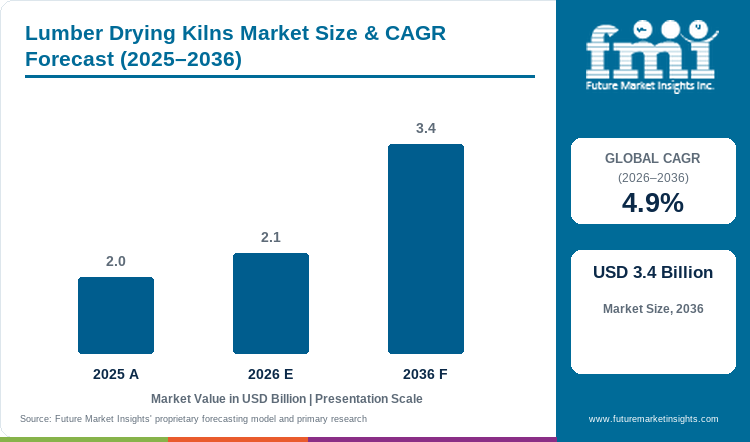
- Market Size (2026)
- USD 2.1 Bn
- Forecast (2036)
- USD 3.4 Bn
- CAGR (2026 to 2036)
- 4.9%
How big is Lumber Drying Kilns Market in 2026?
USD 2.1 billion in 2026 and USD 3.4 billion by 2036, expanding at 4.9% CAGR.
Sales of lumber drying kilns are estimated to rise at 4.9% CAGR through 2036, increasing valuation from USD 2.0 billion in 2025 to USD 2.1 billion in 2026, and reaching USD 3.4 billion by 2036. Mills need more drying space when fresh-cut lumber piles up before the kilns. The U.S. Forest Products Laboratory says controlled drying limits moisture change and reduces shrink or swelling. Good drying helps mills protect lumber grade and send dry boards to the planer. A faster sawline can produce more wood than the kilns can dry. Wet stock then becomes a clear limit on output. Mills can approve new chambers when the added space clears that queue and protects saleable lumber.
Poland is projected to grow at 6.0% CAGR through 2036 compared with 3.9% for Japan. Both countries need steady moisture control, but mills buy under different conditions. Poland's State Forests said in July 2026 that nine in ten wood-sector firms employ fewer than ten people. Small firms may prefer kiln projects that add capacity in steps. Japan has a mature wood-processing base with tight sites and firm operating limits. Suppliers need chamber sizes and setup plans that match each country's mill base. Service models must match the same conditions and forecast path.
Key Takeaways
- Sawmills add drying capacity when fresh-cut lumber reaches the kilns faster than existing chambers can dry it.
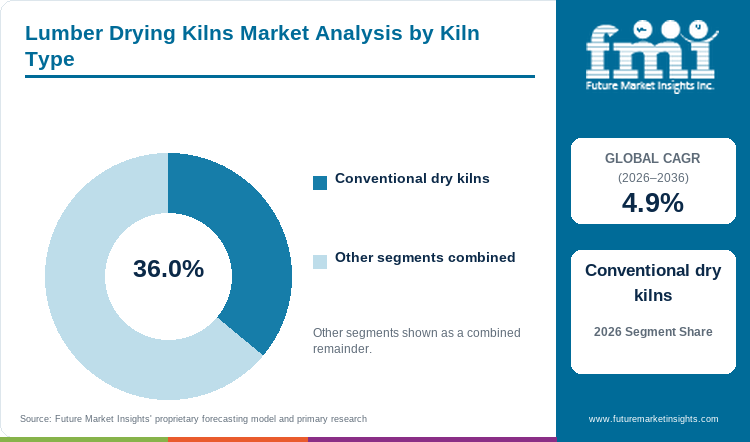
- By kiln type, conventional dry kilns are estimated to hold 36.0% in 2026 because familiar schedules lower process-change risk.
- In 2026, steam is expected to lead heat source with 31.0% share as one boiler system can serve several kiln chambers.
- Softwood is projected to hold 39.0% of lumber type revenue in 2026 since structural mills need steady high-volume drying.
- High project cost and lost production can slow approval if the setup plan does not protect an operating sawmill.
- Key players include Valutec and Nyle Systems. The group includes Mühlböck and Brunner-Hildebrand. USNR and Comact serve large mill projects. WDE Maspell and Ebac Industrial Products cover other drying routes. Nova Dry Kiln and American Wood Dryers complete the listed group.
Analyst Perspective
“Kiln suppliers win projects by proving steady moisture control at the mill's real output rate. Many mills need more drying space without rebuilding the full heat system.”
- Nikhil Kaitwade, Principal Consultant, Future Market Insights
How is the lumber drying kilns market segmented?
The lumber drying kilns market is segmented by Kiln Type, Heat Source, Lumber Type, Capacity, Sales Channel, and Region.
The market uses kiln type, heat source, lumber type, capacity, sales channel, and region as its main groups. Kiln type includes conventional, dehumidification, vacuum, continuous, and high-temperature systems. Heat source includes steam, natural gas, biomass, electric, and heat-pump/dehumidification systems. Lumber type includes softwood, hardwood, engineered lumber, pallet lumber, and specialty timber. Capacity groups systems as large industrial, medium, small batch, or continuous high-throughput. Sales channel includes kiln OEMs, sawmill projects, energy retrofit projects, and aftermarket service.
What makes conventional dry kilns central to the kiln type category?
Conventional chambers can dry several wood species and load types. Their layout can work beside existing woodworking machines without forcing a full production-line rebuild.
- By kiln type, conventional dry kilns are estimated to hold 36.0% in 2026, supported by flexible chambers and well-known drying schedules.
- The Forest Products Laboratory describes track-loaded and package-loaded kilns as common systems for drying lumber at industrial mills.
Why does steam retain a strong position within the heat source category?
Steam suits mills that already run a central boiler system. Site heat can come from biomass boilers that burn bark and sawdust from the mill.
- The heat source category is forecast to be led by steam at 31.0% share in 2026, reinforced by existing mill heat systems.
- Mühlböck's 2026 Woodlink project used steam heat to supply six kilns that dry Japanese cedar.
How does softwood shape demand within the lumber type category?
Softwood mills repeat the same drying schedules across large volumes. Kiln loading stays tied to planer use, while timber construction adds demand for steady moisture control in structural wood.
- Softwood is set to lead the lumber type category with 39.0% share in 2026, driven by large-volume structural lumber output.
- Statistics Canada reported that softwood made up about 98% of Canadian wood production in 2024.
What supports large industrial systems within the capacity category?
Large kilns spread design and setup costs across more dried lumber. Their controls can link with sorting lines, while industrial automation moves loads between these steps.
- In 2026, large industrial systems are expected to lead capacity with 35.0% share, supported by the lower unit cost of multi-chamber operation.
- Valutec said its June 2026 Vida Bruza order would add about 120,000 cubic meters of drying capacity each year.
Why do kiln OEMs lead the sales channel category?
A kiln project combines chamber design with airflow and heat control. The project includes setup and start-up tests. Control loops use humidity sensors to track the air inside each chamber.
- Based on sales channel, kiln OEMs are projected to account for 42.0% in 2026, supported by one team handling design and start-up.
- Nyle Systems introduced its HT-Series in April 2026 for new chambers and existing kiln structures.
What are the drivers, restraints and opportunities in the Lumber Drying Kilns Market?
Sawmill debottlenecking supports kiln investment, installation and utility constraints slow approvals, and retrofit controls provide a practical expansion route.
- Driver: Mills add or replace kilns when fresh-cut lumber output or moisture rules exceed current drying capacity.
- Restraint: Downtime and limits on heat or power can make a kiln project harder to approve.
- Opportunity: Mills can improve fans and controls without replacing every sound chamber. Heat recovery and dehumidification offer more upgrade paths.
Wet lumber can block planer output at a busy mill. The Forest Products Laboratory links controlled drying with stable board size and fewer moisture defects. Mills use industrial fans to move warm air through each load and keep moisture levels more even. A faster sawline adds little value if the kilns cannot clear fresh-cut lumber at the same pace. Wet stock then becomes a costly plant bottleneck. Mills may add chambers or tune fan speed and kiln controls to clear the queue without slowing the sawline. More drying space can protect grade and reduce stock waiting between sawing and planing. Plant teams compare added drying cost with lost output and lower-grade lumber before they approve capital.
Site limits can make a sound kiln project hard to install. Kilns must match available heat and power while the mill stays in service. Steam demand can restrict projects that depend on industrial boilers already near their plant limit. Crews need clear access through an active mill. Mühlböck's February 2026 Woodlink project required snow-load design and work beside an active railway. That project shows why chamber price is one part of approval for a working sawmill. Mills need a shutdown plan and a safe way to connect new equipment without blocking the normal flow of lumber. Good site planning can cut lost output during start-up and help the kiln reach its normal rate sooner.
An upgrade gives mills another choice besides full kiln replacement. Mills can improve fan drives and drying controls while keeping sound chamber structures in service. New seals and heat recovery can stay in the same upgrade plan for the existing kiln. Operators use variable frequency drives to change fan speed for each stage of the drying cycle. Nyle introduced its HT-Series in April 2026 for high-temperature dehumidification and heat capture. Retrofit work can shorten shutdowns at active mills. Mills can target energy use and drying time while they fix uneven moisture without rebuilding the whole kiln system. Suppliers first measure the process and find its main loss point so a smaller project can offer a clear payback case.
Which country CAGRs are profiled in the Lumber Drying Kilns Market?
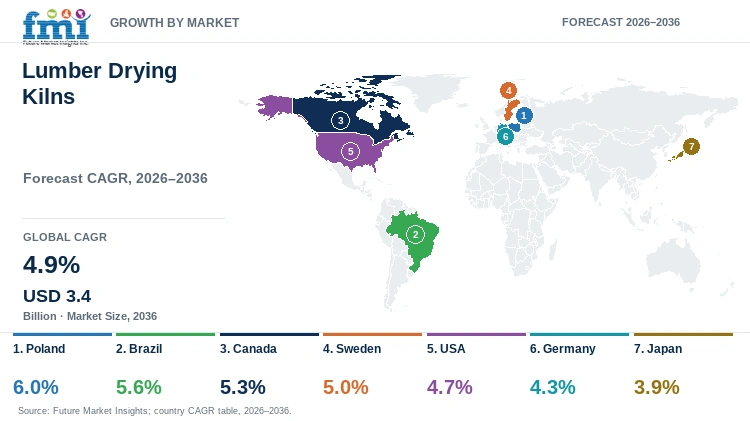
| Country | CAGR |
|---|---|
| Poland | 6.0% |
| Brazil | 5.6% |
| Canada | 5.3% |
| Sweden | 5.0% |
| USA | 4.7% |
| Germany | 4.3% |
| Japan | 3.9% |
How do country-level CAGRs compare in the Lumber Drying Kilns Market?
Poland and Brazil form the upper forecast group. Canada and Sweden make up the middle group. The USA follows as mills focus more on replacement work. Germany and Japan grow at a slower rate because site limits and approval needs carry more weight. The 2.1-point spread compares forecast speed and does not show current market size.
- Poland: Many small wood firms need kiln projects that can add capacity in steps and use nearby service teams.
- Brazil: Large planted forests feed wood plants, while long travel distances raise the value of remote checks and local parts.
- Canada: High softwood output supports large kilns, while export cycles keep mill spending tied to prices and plant output.
- Sweden: Softwood mills use automated lines and need kiln controls that match boiler output with planer demand.
- USA: Existing mills favor phased kiln upgrades that add drying output without stopping sawmill and planer lines.
- Germany: Higher-value wood work needs tighter moisture control and more heat recovery when mills approve an upgrade.
- Japan: Domestic wood policy supports timber use, while compact mills need smaller chambers and local help with drying schedules.
Similar CAGRs can lead to different project sizes because mill scale and wood species vary by country. The full report covers North America and Latin America. It covers Western Europe and Eastern Europe. The full report covers East Asia and South Asia and Pacific. It includes the Middle East and Africa.
Country-wise Analysis
- Poland's large wood sector includes many small firms. By 2036, Poland is projected to grow at 6.0% CAGR. Staged kiln upgrades and local service needs support that outlook. State Forests said in July 2026 that about 339,000 people work in the national wood sector. The same source said nine in ten wood-sector firms employ fewer than ten people. Small mills need drying systems that can grow in steps as their orders rise. Sites using biomass heat may plan fuel around wood pellets. Cost and service access can slow projects outside major wood centers while local start-up support can cut downtime for mills without kiln experts.
- Brazil has large pine and eucalyptus areas that feed wood plants across wide regions. Lumber drying kiln demand in Brazil is forecast to rise at 5.6% CAGR over the forecast period, influenced by its planted-forest base. IBGE reported 9.9 million hectares of planted forests in 2024. Eucalyptus made up 77.6% of that area. These forests give large mills a steady log supply. Kiln design must match each wood species and the heat available at the site. Long travel distances raise the value of remote checks. Local parts and service can shorten the time needed to bring a new kiln up to normal output.
- Canadian mills handle large softwood volumes and match kiln size with boiler load and export cycles. Canada is estimated to post 5.3% CAGR over the forecast period, supported by its large softwood base. Statistics Canada reported 47.9 million cubic meters of softwood lumber production in 2024. Softwood made up about 98% of national wood production. That volume gives large kilns a steady drying load across long mill runs. Project timing changes with lumber prices and export demand. Mills far from major service centers need good remote support and sound heat planning. Fast support can cut repair delays during busy softwood runs at remote sites.
- Swedish sawmills use automated softwood lines that place kiln drying between sorting and planing. In Sweden, lumber drying kiln demand is predicted to advance at 5.0% CAGR through 2036. Continued mill upgrades support the country's forecast path. The Swedish Forest Agency reported 87.0 million cubic meters of gross felling in 2025. Spruce made up 58% of the volume and pine made up 31% in 2025. Those species suit repeated structural-lumber drying schedules at large softwood mills. Large sites use heat exchangers to cut heat loss. Mills need proof that energy changes will keep moisture levels even while control settings match automated handling and each site's boilers.
- US mills add kilns during upgrades at existing sawmills. Lumber drying kiln sales in the USA are forecast to expand at 4.7% CAGR by 2036, shaped by replacement work at mills. The USDA Forest Service runs national surveys of primary wood-processing plants through its Timber Products Output program. The surveys track roundwood received and mill residue by product type. A large installed base creates repeat demand for chamber repair and control upgrades. Project approval depends on planned downtime and available heat. Suppliers can lower production risk by planning work around active sawlines. Clear work steps help an operating mill add or replace kiln equipment without blocking normal lumber flow.
- German mills use strict moisture targets and pay close attention to heat recovery and lumber flow. Germany's lumber drying kiln outlook is anticipated to advance at 4.3% CAGR over the assessment period, shaped by selective mill upgrades. Destatis reported 57.3 million cubic meters of timber felled in Germany during 2025. The same release said damaged timber made up a meaningful share of the harvest. Kiln schedules must handle changes in wood species and condition without hurting grade. Plant layouts can limit chamber space and heat routes. Mills need clear design plans and good start-up support before they approve a replacement project.
- Japanese wood processors work in compact mills with strict moisture targets for domestic timber products. Adoption of lumber drying kilns in Japan is estimated to expand at 3.9% CAGR through 2036, supported by domestic wood policy. The Forestry Agency's 2024 white paper put national wood self-sufficiency at 43%. The paper promoted more wood use in mid-rise and high-rise buildings. Many local mills face tight space and uneven output. Modular chambers can ease space limits, while clear drying schedules can cut setup work. Suppliers need controls that keep results steady without adding more work for operators. Local support can shorten the first production runs and help mill teams tune new kiln settings.
Who are the notable companies in the Lumber Drying Kilns Market?
Valutec, Nyle Systems, Mühlböck, Brunner-Hildebrand, USNR, Comact, WDE Maspell, Ebac Industrial Products, Nova Dry Kiln, and American Wood Dryers.
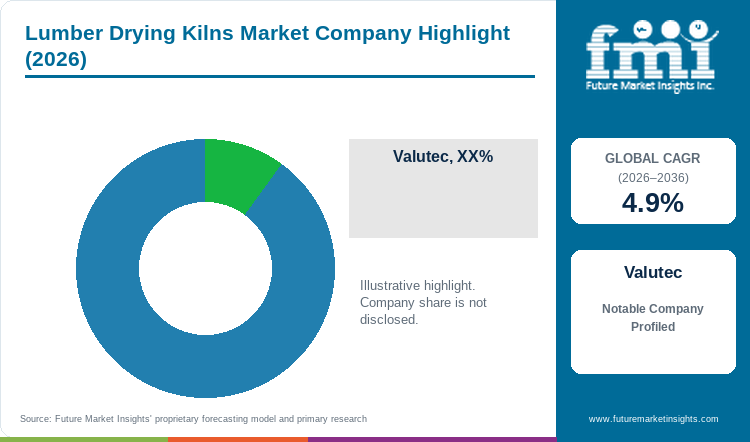
Competition covers large industrial kiln systems as well as smaller dehumidification and vacuum systems. Mills need proven drying schedules and controls that keep moisture within product limits. Service matters because chambers and controls do not wear at the same rate. A supplier that suits a large mill may not suit a smaller site or a different heat source.
- Valutec and Mühlböck focus on large industrial kiln projects. USNR and Comact add controls or wider sawmill engineering.
- Nyle Systems and Brunner-Hildebrand cover different drying methods. WDE Maspell adds special drying schedules.
- Ebac Industrial Products and Nova Dry Kiln serve packaged systems or retrofit work. American Wood Dryers serves smaller-capacity projects.
Competitive Benchmarking: Lumber Drying Kilns Market
| Company | Industrial Throughput Fit | Heat / Energy Integration | Controls & Service Depth | Geographic Reach |
|---|---|---|---|---|
| Valutec | High | High | High | Europe, North America and selected global sawmill markets |
| Nyle Systems | Medium | High | High | North America and international project markets |
| Mühlböck | High | High | High | Europe, North America and Asia |
| Brunner-Hildebrand | High | Medium | High | Europe, North America and international distributor markets |
| USNR | High | Medium | High | North America and global sawmill markets |
| Comact | High | High | High | North America and selected international wood-processing markets |
| WDE Maspell | Medium | High | Medium | Europe, North America and Latin America |
| Ebac Industrial Products | Low | High | Medium | North America and overseas distributor markets |
| Nova Dry Kiln | Medium | Medium | Medium | North America and installations in 23 countries |
| American Wood Dryers | High | Medium | High | North America and international installation markets |
Scoring basis: High industrial fit means the company shows systems for large production loads. Medium means proven mill use at a smaller scale. Low means smaller packaged systems. High heat integration means several heat options or heat recovery. High controls and service depth means strong start-up and retrofit support. The rating covers fault checks and ongoing service.
Key Developments in the Lumber Drying Kilns Market
- In September 2026, Mühlböck announced 15 combined drying and steaming kilns for the new Fagus Slovenica hardwood site.
- In June 2026, Valutec announced two OTC continuous kilns for Vida Bruza. The order would add about 120,000 cubic meters of annual drying capacity.
- In April 2026, Nyle Systems introduced the HT-Series for high-temperature dehumidification in new and existing chambers.
Key Players in the Lumber Drying Kilns Market
Integrated Industrial Kiln Platforms
- Valutec
- Mühlböck
- USNR
- Comact
Multi-Technology Drying Specialists
- Nyle Systems
- Brunner-Hildebrand
- WDE Maspell
Packaged and Flexible-Capacity Suppliers
- Ebac Industrial Products
- Nova Dry Kiln
- American Wood Dryers
Lumber Drying Kilns Market - Report Scope
| Coverage field | Report scope |
|---|---|
| Market breakdown | By Kiln Type, Heat Source, Lumber Type, Capacity, Sales Channel, and Region. |
| Quantitative Units | USD billion. |
| Market Definition | Commercial lumber drying kiln systems, integrated chambers, kiln controls, heat interfaces, installation, commissioning, kiln-specific retrofits, and aftermarket service are included. Finished lumber revenue and unrelated sawmill equipment are excluded. |
| Regions Covered | North America, Latin America, Western Europe, Eastern Europe, East Asia, South Asia and Pacific, and Middle East and Africa. |
| Countries Covered | Poland, Brazil, Canada, Sweden, USA, Germany, Japan, and 20+ countries included in the full report. |
| Key Companies Profiled | Valutec, Nyle Systems, Mühlböck, Brunner-Hildebrand, USNR, Comact, WDE Maspell, Ebac Industrial Products, Nova Dry Kiln, American Wood Dryers. |
| Forecast Period | 2026 to 2036. |
| Approach | Primary and secondary research with market triangulation. |
Lumber Drying Kilns Market - Research Methodology
| Method | Approach |
|---|---|
| Primary Research | FMI analysts gathered input from manufacturers, service providers, technology developers, distributors, end users, procurement teams, and subject-matter experts. Interviews examined purchasing decisions, product or service evaluation, adoption barriers, approval requirements, pricing considerations, and expectations for technical or commercial support. Respondents were also asked what evidence is required before a trial, pilot, or initial order develops into regular purchasing. |
| Desk Research | Desk research covered government statistics, regulatory publications, trade data, industry associations, technical literature, standards, company filings, product information, and official corporate announcements. Sources were reviewed for relevance, publication date, geographic coverage, and consistency with the defined market scope. Claims relating to performance, applications, approvals, capacity, investment, and commercial activity were retained only when supported by credible public evidence. |
| Market Sizing and Forecasting | The market model combined the baseline value with historical performance, segment structure, pricing and volume indicators, adoption levels, company participation, and country-level demand conditions. Forecast assumptions considered economic activity, investment trends, regulatory developments, technology adoption, purchasing cycles, supply availability, and barriers to wider market use. Segment and regional estimates were reconciled before the final market total was calculated. |
| Data Validation | Estimates were checked against multiple independent indicators, including public data, company activity, trade patterns, industry developments, and findings from primary interviews. Validation also tested whether products, services, applications, and company revenues fell within the defined market boundaries. Adjacent categories, unsupported claims, overlapping revenues, and activities without direct market relevance were excluded to reduce double counting and maintain consistency across segments and countries. |
Lumber Drying Kilns Market by Segments
Lumber Drying Kilns Market segmented by Kiln Type:
- Conventional dry kilns
- Dehumidification kilns
- Vacuum kilns
- Continuous kilns
- High-temperature kilns
Lumber Drying Kilns Market segmented by Heat Source:
- Steam
- Natural gas
- Biomass
- Electric
- Heat pump/dehumidification
Lumber Drying Kilns Market segmented by Lumber Type:
- Softwood
- Hardwood
- Engineered lumber
- Pallet lumber
- Specialty timber
Lumber Drying Kilns Market segmented by Capacity:
- Large industrial
- Medium capacity
- Small batch
- Continuous high-throughput
Lumber Drying Kilns Market segmented by Sales Channel:
- Kiln OEMs
- Sawmill projects
- Energy retrofit projects
- Aftermarket/service
Lumber Drying Kilns Market by Region:
- North America
- United States
- Canada
- Latin America
- Brazil
- Mexico
- Argentina
- Chile
- Western Europe
- Germany
- France
- United Kingdom
- Italy
- Spain
- Benelux
- Nordics
- Eastern Europe
- Poland
- Czech Republic
- Romania
- Hungary
- East Asia
- China
- Japan
- South Korea
- South Asia and Pacific
- India
- ASEAN
- Australia and New Zealand
- Middle East and Africa
- GCC Countries
- South Africa
- Türkiye
- Israel
Research Sources and Bibliography
- Bergman, R.. (2021). Chapter 13: Drying and control of moisture content and dimensional changes.
- State Forests National Forest Holding. (2026, July 8). Polish Bestseller.
- Statistics Canada. (2025, December 12; corrected 2026, February 17). A look at Canada’s lumber industry in 2024.
- Swedish Forest Agency. (2026, June 9). Felling continued to decrease in 2025.
- U.S. Forest Service Research and Development. (2025, April 7). National Resource Use Monitoring.
- Federal Statistical Office of Germany (Destatis). (2026, April 15). 57.3 million cubic metres of timber felled in 2025.
- Forestry Agency of Japan. (2025, June 3). Fiscal 2024 White Paper on Forests and Forestry.
- Brazilian Institute of Geography and Statistics (IBGE). (2025, September 25). Production value of silviculture and wild-crop harvesting grows 16.7%.
- Mühlböck Holztrocknungsanlagen GmbH. (2026, September 11). Major project in Slovenia: Mühlböck supplies 15 drying and steaming kilns.
- Mühlböck Holztrocknungsanlagen GmbH. (2026, August 27). Japanese timber processor relies on Mühlböck technology.
- Valutec. (2026, June 10). Vida invests in increased capacity: Valutec to deliver two continuous kilns to Bruza.
- Nyle Systems. (2026, April 23). High-temp dehumidification done right: Introducing the Nyle HT-Series.
- Comact. (2026, May 4). Comact launches new generation Miller Planer.
- WDE Maspell. (2026, September 7). Meet WDE MASPELL at the NHLA Annual Convention 2026.
- Brunner-Hildebrand Lumber Dry Kilns Co.. (2026). Company profile and 2026 industry updates.
- USNR. (2026). Millwide Insider 2026.
- Ebac Industrial Products Inc.. (2026). Company profile and current industrial drying updates.
- Nova Dry Kiln. (2026). In Action.
- American Wood Dryers, LLC. (2026). American Wood Dryers.
This bibliography gives readers the main sources used in the article. The full report contains the complete source list and detailed citations.
This Report Answers
- How large is the lumber drying kilns market in 2026 and 2036?
- Which operating pressures cause sawmills to add or replace kiln capacity?
- Why do conventional dry kilns lead the kiln type category?
- Why does steam hold the largest verified heat-source share in 2026?
- How does softwood production affect industrial lumber drying requirements?
- Which country conditions explain the spread in forecast growth rates?
- Which companies serve large industrial and specialized drying applications?
- How do heat supply and installation downtime constrain project approval?
- Which retrofit routes can raise kiln performance without chamber replacement?
Frequently Asked Questions
How big is the lumber drying kilns market in 2026?
The lumber drying kilns market is worth USD 2.1 billion in 2026. It is projected to reach USD 3.4 billion by 2036. Mills invest when existing kilns cannot keep up with fresh-cut lumber output or required moisture levels.
What is the CAGR of the lumber drying kilns market from 2026 to 2036?
The lumber drying kilns market is projected to grow at 4.9% CAGR between 2026 and 2036. Replacement work and added drying space support growth as mills match kiln output with fresh-cut lumber production.
Which kiln type leads the lumber drying kilns market in 2026?
The conventional dry kiln segment is estimated to hold 36.0% of kiln type revenue in 2026. Mills know these drying schedules well, and the chamber design can handle several species and load patterns.
Which heat source leads the lumber drying kilns market in 2026?
The steam segment is expected to represent 31.0% of heat-source revenue in 2026. Many large mills already have boilers that can feed steady heat to several kiln chambers.
Which companies are active in the lumber drying kilns market?
Key companies include Valutec and Nyle Systems. The group includes Mühlböck and Brunner-Hildebrand. USNR and Comact serve large mill projects. WDE Maspell and Ebac Industrial Products cover other drying routes. Nova Dry Kiln and American Wood Dryers complete the listed group. They compete on kiln type and project size. Controls and service reach create further points of difference.
Preview the report firsthand - request a free sample
Get SampleGet the brochure for pricing and purchase details.
Get PDFTable of Content
- Key Takeaways
- Market Size and CAGR
- Top Growth Driver
- Fastest Growing Segment
- Leading Region
- Key Companies
- Emerging Opportunities
- Executive Summary
- Global Market Outlook
- Demand-side Trends
- Supply-side Trends
- Technology Roadmap Analysis
- Analysis and Recommendations
- Analyst Perspective (What is happening? Why now? What should investors know?)
- Key Questions Answered
- How large is the market?
- What is the CAGR?
- What are key trends?
- Which region dominates?
- Who are the leaders?
- Market Overview
- Market Coverage / Taxonomy
- Market Definition / Scope / Limitations
- Research Methodology
- Chapter Orientation
- Analytical Lens and Working Hypotheses
- Market Structure, Signals, and Trend Drivers
- Benchmarking and Cross-market Comparability
- Market Sizing, Forecasting, and Opportunity Mapping
- Research Design and Evidence Framework
- Desk Research Programme (Secondary Evidence)
- Expert Input and Fieldwork (Primary Evidence)
- Tooling, Models, and Reference Databases
- Data Engineering and Model Build
- Quality Assurance and Audit Trail
- Market Background
- Market Dynamics (Drivers, Restraints, Opportunity, Trends)
- Scenario Forecast (Optimistic, Likely, Conservative)
- Impact Analysis
- AI Impact
- Sustainability Impact
- Regulatory Impact
- Technology Impact
- Consumer / Buyer Analysis
- Purchase Drivers
- Adoption Barriers
- Buyer Journey
- Opportunity Map Analysis
- Product Life Cycle Analysis
- Supply Chain Analysis
- Investment Feasibility Matrix
- Value Chain Analysis
- PESTLE and Porter's Analysis
- Regulatory Landscape
- Regional Parent Market Outlook
- Production and Consumption Statistics
- Import and Export Statistics
- Global Market Analysis and Forecast, 2021 to 2036
- Historical Market Size Value (USD Billion) Analysis, 2021 to 2025
- Current and Future Market Size Value (USD Billion) Projections, 2026 to 2036
- Y-o-Y Growth Trend Analysis
- Absolute $ Opportunity Analysis
- Global Market Pricing Analysis, 2021 to 2036
- Global Market Analysis and Forecast, By Kiln Type, 2021 to 2036
- Introduction / Key Findings
- Historical Market Size Value (USD Billion) Analysis By Kiln Type, 2021 to 2025
- Current and Future Market Size Value (USD Billion) Analysis and Forecast By Kiln Type, 2026 to 2036
- Conventional dry kilns
- Dehumidification kilns
- Vacuum kilns
- Continuous kilns
- High-temperature kilns
- Y-o-Y Growth Trend Analysis By Kiln Type, 2021 to 2025
- Absolute $ Opportunity Analysis By Kiln Type, 2026 to 2036
- Global Market Analysis and Forecast, By Heat Source, 2021 to 2036
- Introduction / Key Findings
- Historical Market Size Value (USD Billion) Analysis By Heat Source, 2021 to 2025
- Current and Future Market Size Value (USD Billion) Analysis and Forecast By Heat Source, 2026 to 2036
- Steam
- Natural gas
- Biomass
- Electric
- Heat pump/dehumidification
- Y-o-Y Growth Trend Analysis By Heat Source, 2021 to 2025
- Absolute $ Opportunity Analysis By Heat Source, 2026 to 2036
- Global Market Analysis and Forecast, By Lumber Type, 2021 to 2036
- Introduction / Key Findings
- Historical Market Size Value (USD Billion) Analysis By Lumber Type, 2021 to 2025
- Current and Future Market Size Value (USD Billion) Analysis and Forecast By Lumber Type, 2026 to 2036
- Softwood
- Hardwood
- Engineered lumber
- Pallet lumber
- Specialty timber
- Y-o-Y Growth Trend Analysis By Lumber Type, 2021 to 2025
- Absolute $ Opportunity Analysis By Lumber Type, 2026 to 2036
- Global Market Analysis and Forecast, By Capacity, 2021 to 2036
- Introduction / Key Findings
- Historical Market Size Value (USD Billion) Analysis By Capacity, 2021 to 2025
- Current and Future Market Size Value (USD Billion) Analysis and Forecast By Capacity, 2026 to 2036
- Large industrial
- Medium capacity
- Small batch
- Continuous high-throughput
- Y-o-Y Growth Trend Analysis By Capacity, 2021 to 2025
- Absolute $ Opportunity Analysis By Capacity, 2026 to 2036
- Global Market Analysis and Forecast, By Sales Channel, 2021 to 2036
- Introduction / Key Findings
- Historical Market Size Value (USD Billion) Analysis By Sales Channel, 2021 to 2025
- Current and Future Market Size Value (USD Billion) Analysis and Forecast By Sales Channel, 2026 to 2036
- Kiln OEMs
- Sawmill projects
- Energy retrofit projects
- Aftermarket/service
- Y-o-Y Growth Trend Analysis By Sales Channel, 2021 to 2025
- Absolute $ Opportunity Analysis By Sales Channel, 2026 to 2036
- Global Market Analysis and Forecast, By Region, 2021 to 2036
- Introduction
- Historical Market Size Value (USD Billion) Analysis By Region, 2021 to 2025
- Current Market Size Value (USD Billion) Analysis and Forecast By Region, 2026 to 2036
- North America
- Latin America
- Western Europe
- Eastern Europe
- East Asia
- South Asia and Pacific
- Middle East and Africa
- Market Attractiveness Analysis By Region
- North America Market Analysis and Forecast, By Country, 2021 to 2036
- Historical Market Size Value (USD Billion) Trend Analysis By Market Taxonomy, 2021 to 2025
- Market Size Value (USD Billion) Forecast By Market Taxonomy, 2026 to 2036
- By Country
- United States
- Canada
- By Kiln Type
- By Heat Source
- By Lumber Type
- By Capacity
- By Sales Channel
- By Country
- Market Attractiveness Analysis
- By Country
- By Kiln Type
- By Heat Source
- By Lumber Type
- By Capacity
- By Sales Channel
- Key Takeaways
- Latin America Market Analysis and Forecast, By Country
- Historical Market Size Value (USD Billion) Trend Analysis By Market Taxonomy, 2021 to 2025
- Market Size Value (USD Billion) Forecast By Market Taxonomy, 2026 to 2036
- By Country
- Brazil
- Mexico
- Argentina
- Chile
- By Kiln Type
- By Heat Source
- By Lumber Type
- By Capacity
- By Sales Channel
- By Country
- Market Attractiveness Analysis
- By Country
- By Kiln Type
- By Heat Source
- By Lumber Type
- By Capacity
- By Sales Channel
- Key Takeaways
- Western Europe Market Analysis and Forecast, By Country
- Historical Market Size Value (USD Billion) Trend Analysis By Market Taxonomy, 2021 to 2025
- Market Size Value (USD Billion) Forecast By Market Taxonomy, 2026 to 2036
- By Country
- Germany
- France
- United Kingdom
- Italy
- Spain
- Benelux
- Nordics
- By Kiln Type
- By Heat Source
- By Lumber Type
- By Capacity
- By Sales Channel
- By Country
- Market Attractiveness Analysis
- By Country
- By Kiln Type
- By Heat Source
- By Lumber Type
- By Capacity
- By Sales Channel
- Key Takeaways
- Eastern Europe Market Analysis and Forecast, By Country
- Historical Market Size Value (USD Billion) Trend Analysis By Market Taxonomy, 2021 to 2025
- Market Size Value (USD Billion) Forecast By Market Taxonomy, 2026 to 2036
- By Country
- Poland
- Czech Republic
- Romania
- Hungary
- By Kiln Type
- By Heat Source
- By Lumber Type
- By Capacity
- By Sales Channel
- By Country
- Market Attractiveness Analysis
- By Country
- By Kiln Type
- By Heat Source
- By Lumber Type
- By Capacity
- By Sales Channel
- Key Takeaways
- East Asia Market Analysis and Forecast, By Country
- Historical Market Size Value (USD Billion) Trend Analysis By Market Taxonomy, 2021 to 2025
- Market Size Value (USD Billion) Forecast By Market Taxonomy, 2026 to 2036
- By Country
- China
- Japan
- South Korea
- By Kiln Type
- By Heat Source
- By Lumber Type
- By Capacity
- By Sales Channel
- By Country
- Market Attractiveness Analysis
- By Country
- By Kiln Type
- By Heat Source
- By Lumber Type
- By Capacity
- By Sales Channel
- Key Takeaways
- South Asia and Pacific Market Analysis and Forecast, By Country
- Historical Market Size Value (USD Billion) Trend Analysis By Market Taxonomy, 2021 to 2025
- Market Size Value (USD Billion) Forecast By Market Taxonomy, 2026 to 2036
- By Country
- India
- ASEAN
- Australia and New Zealand
- By Kiln Type
- By Heat Source
- By Lumber Type
- By Capacity
- By Sales Channel
- By Country
- Market Attractiveness Analysis
- By Country
- By Kiln Type
- By Heat Source
- By Lumber Type
- By Capacity
- By Sales Channel
- Key Takeaways
- Middle East and Africa Market Analysis and Forecast, By Country
- Historical Market Size Value (USD Billion) Trend Analysis By Market Taxonomy, 2021 to 2025
- Market Size Value (USD Billion) Forecast By Market Taxonomy, 2026 to 2036
- By Country
- GCC Countries
- South Africa
- Türkiye
- Israel
- By Kiln Type
- By Heat Source
- By Lumber Type
- By Capacity
- By Sales Channel
- By Country
- Market Attractiveness Analysis
- By Country
- By Kiln Type
- By Heat Source
- By Lumber Type
- By Capacity
- By Sales Channel
- Key Takeaways
- Key Countries Market Analysis
- United States
- Pricing Analysis
- Market Share Analysis, 2025
- By Kiln Type
- By Heat Source
- By Lumber Type
- By Capacity
- By Sales Channel
- Canada
- Pricing Analysis
- Market Share Analysis, 2025
- By Kiln Type
- By Heat Source
- By Lumber Type
- By Capacity
- By Sales Channel
- Mexico
- Pricing Analysis
- Market Share Analysis, 2025
- By Kiln Type
- By Heat Source
- By Lumber Type
- By Capacity
- By Sales Channel
- Brazil
- Pricing Analysis
- Market Share Analysis, 2025
- By Kiln Type
- By Heat Source
- By Lumber Type
- By Capacity
- By Sales Channel
- Chile
- Pricing Analysis
- Market Share Analysis, 2025
- By Kiln Type
- By Heat Source
- By Lumber Type
- By Capacity
- By Sales Channel
- Germany
- Pricing Analysis
- Market Share Analysis, 2025
- By Kiln Type
- By Heat Source
- By Lumber Type
- By Capacity
- By Sales Channel
- United Kingdom
- Pricing Analysis
- Market Share Analysis, 2025
- By Kiln Type
- By Heat Source
- By Lumber Type
- By Capacity
- By Sales Channel
- Italy
- Pricing Analysis
- Market Share Analysis, 2025
- By Kiln Type
- By Heat Source
- By Lumber Type
- By Capacity
- By Sales Channel
- Spain
- Pricing Analysis
- Market Share Analysis, 2025
- By Kiln Type
- By Heat Source
- By Lumber Type
- By Capacity
- By Sales Channel
- France
- Pricing Analysis
- Market Share Analysis, 2025
- By Kiln Type
- By Heat Source
- By Lumber Type
- By Capacity
- By Sales Channel
- India
- Pricing Analysis
- Market Share Analysis, 2025
- By Kiln Type
- By Heat Source
- By Lumber Type
- By Capacity
- By Sales Channel
- ASEAN
- Pricing Analysis
- Market Share Analysis, 2025
- By Kiln Type
- By Heat Source
- By Lumber Type
- By Capacity
- By Sales Channel
- Australia and New Zealand
- Pricing Analysis
- Market Share Analysis, 2025
- By Kiln Type
- By Heat Source
- By Lumber Type
- By Capacity
- By Sales Channel
- China
- Pricing Analysis
- Market Share Analysis, 2025
- By Kiln Type
- By Heat Source
- By Lumber Type
- By Capacity
- By Sales Channel
- Japan
- Pricing Analysis
- Market Share Analysis, 2025
- By Kiln Type
- By Heat Source
- By Lumber Type
- By Capacity
- By Sales Channel
- South Korea
- Pricing Analysis
- Market Share Analysis, 2025
- By Kiln Type
- By Heat Source
- By Lumber Type
- By Capacity
- By Sales Channel
- Poland
- Pricing Analysis
- Market Share Analysis, 2025
- By Kiln Type
- By Heat Source
- By Lumber Type
- By Capacity
- By Sales Channel
- Hungary
- Pricing Analysis
- Market Share Analysis, 2025
- By Kiln Type
- By Heat Source
- By Lumber Type
- By Capacity
- By Sales Channel
- Türkiye
- Pricing Analysis
- Market Share Analysis, 2025
- By Kiln Type
- By Heat Source
- By Lumber Type
- By Capacity
- By Sales Channel
- South Africa
- Pricing Analysis
- Market Share Analysis, 2025
- By Kiln Type
- By Heat Source
- By Lumber Type
- By Capacity
- By Sales Channel
- Sweden
- Pricing Analysis
- Market Share Analysis, 2025
- By Kiln Type
- By Heat Source
- By Lumber Type
- By Capacity
- By Sales Channel
- United States
- Market Structure Analysis
- Competition Dashboard
- Competition Benchmarking
- Market Share Analysis of Top Players
- By Regional
- By Kiln Type
- By Heat Source
- By Lumber Type
- By Capacity
- By Sales Channel
- Emerging Startups
- Innovation Benchmarking
- Competition Analysis
- Competition Deep Dive
- Valutec
- Overview
- Product Portfolio
- Profitability by Market Segments
- Sales Footprint
- Strategy Overview
- Marketing Strategy
- Product Strategy
- Channel Strategy
- Nyle Systems
- Mühlböck
- Brunner-Hildebrand
- USNR
- Comact
- WDE Maspell
- Ebac Industrial Products
- Nova Dry Kiln
- American Wood Dryers
- Valutec
- Case Studies
- Success Stories
- Recent Developments
- Competition Deep Dive
- Assumptions & Acronyms Used


