

- Market Size (2026)
- USD 1240.6 Mn
- Forecast (2036)
- USD 2653.7 Mn
- CAGR (2026 to 2036)
- 7.9%
How big is Low Warpage Resins Market in 2026?
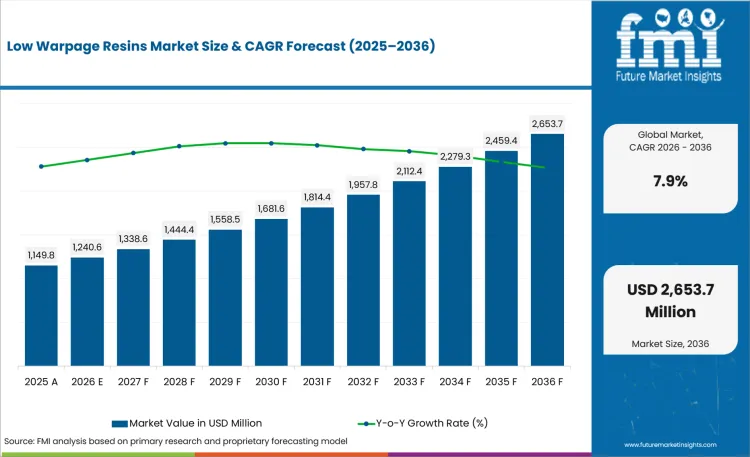
USD 1240.6 million in 2026 and USD 2653.7 million by 2036 at a 7.9% CAGR.
Demand for low warpage resins is projected to expand at 7.9% CAGR between 2026 and 2036, increasing valuation from USD 1240.6 million in 2026 to USD 2653.7 million by 2036. Growth is being driven by rising connector production and the increasing miniaturization of electronic assemblies, which require dimensionally stable connector housings to maintain precise terminal alignment. According to JEITA, production of connecting components in Japan increased by 9.6% year-to-date in 2025, reflecting sustained expansion in connector manufacturing. As connector volumes and terminal densities increase, resin suppliers face greater qualification requirements for engineering plastics that can minimize warpage and withstand repeated molding and thermal cycling processes without compromising electrical reliability.
Key Takeaways of Low Warpage Resins Market
- Miniaturized connectors and electrified systems increase demand for compounds that preserve dimensional accuracy across high-volume molding cycles.
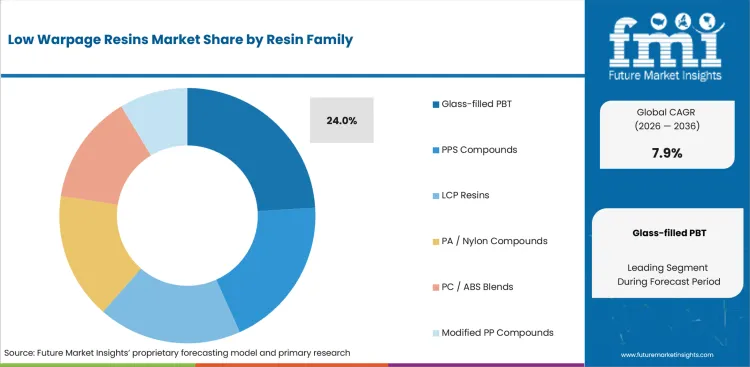
- Glass-filled PBT is projected to account for 24.0% share in 2026 due to balanced processing across precision components.
- Glass fiber is estimated to hold 42.0% share in 2026 owing to measurable stiffness across precision geometries.
- Electronic connectors are forecast to represent 31.0% share in 2026 as compact layouts require narrow positional tolerances.
- Uneven fiber orientation and unbalanced cooling can distort precision parts despite selecting a low-warpage resin grade.
- Celanese, SABIC and BASF cover broad platforms as Daicel, Envalior, Asahi Kasei, Syensqo and RTP Company address precision applications.
Analyst Perspective
"Low-warpage performance cannot be approved from a datasheet as cavity geometry determines whether a reinforced resin remains flat. Engineering teams that approve the compound and production tool together can prevent dimensional disputes from returning during plant transfers."
- Nikhil Kaitwade, Principal Consultant, Future Market Insights
How is the Low Warpage Resins Market segmented?
The industry is segmented by resin family, filler system, application, processing method, end use and region.
The low warpage resins market covers resin family, filler system, application, processing method, end use and region. Resin families include glass-filled PBT, PPS, LCP, nylon, PC or ABS and modified PP compounds. Filler systems cover glass, mineral, hybrid and specialty options that support connectors, sensors, power modules, precision housings and electronics parts. Processing includes injection, insert, micro and thin-wall molding across electrical, automotive, industrial and medical end uses.
Why does glass-filled PBT lead demand within the resin family category?
Glass-filled PBT combines rapid crystallization with reinforcement strength for repeatable connector housing dimensions across high-volume molding cycles. Process engineers compare this familiar route with polyphenylene sulfide compounds that require higher temperatures and narrower processing windows in precision tools.
- Based on resin family, glass-filled PBT is projected to account for 24.0% in 2026 due to balanced cost and dimensional control across electrical housings.
- Glass-filled PBT is drawing demand from connector toolmakers supported by coordinated gate placement and cooling balance during transferred-tool qualification. The combined discipline gives quality teams a stable baseline for comparing dimensional drift across production sites under representative thermal and assembly conditions.
Why does glass fiber lead demand within the filler system category?
Glass fiber raises stiffness and heat resistance without removing the flow needed for thin connector walls. Use across glass-fiber composites gives compounders benchmarks for adjusting shrinkage around ribs and sealing surfaces. Directional shrinkage increases whenever fiber paths diverge across cavities with unequal filling pressure and cooling rates.
- The glass fiber segment is likely to capture 42.0% share in 2026 attributable to broad availability and measurable stiffness gains across precision parts.
- Automotive sensor molders are increasingly selecting glass fiber owing to established methods for matching fiber length with gate design. The method limits differential shrinkage across multi-cavity tools serving automotive sensors with narrow sealing tolerances.
How are electronic connectors positioned within the application category?
Compact assemblies require electronic connectors to preserve pin alignment through molding and soldering under narrow terminal spacing. Designers compare wire-to-board connectors through production qualification routes that measure flatness under repeated thermal loads. The thermal checks connect connector geometry with the cavity behavior that controls final pin position during qualification.
- In 2026, electronic connectors are expected to lead the application category with 31.0% share because miniaturized interfaces require narrow positional tolerances.
- Electronic connector adoption is gaining momentum in high-density assemblies driven by cavity studies that measure flatness under production conditions. The resulting data supports repeatable qualification for high-density interconnects across approved plants and transferred programs.
What supports injection molding within the processing method category?
Injection molding gives process engineers direct control over filling speed and packing pressure across electrical geometries. Injection molding machines help isolate resin effects from tool imbalance during qualification across production sites. Direct process control matters during commercial transfers between tools with different runners and cooling circuits.
- Injection molding is set to lead the processing method category with 51.0% share in 2026 due to high output and precise process control.
- Sales of injection-molded low-warpage compounds are forecast to gain traction in multi-site programs supported by mold-flow analysis and dimensional checks. The method reduces troubleshooting across low-warpage grades and conductive plastics used in compact electronic assemblies.
What are the drivers, restraints and opportunities in the Low Warpage Resins Market?
Compact electrical assemblies need flatter housings, yet directional shrinkage limits resin performance and coordinated qualification improves dimensional control.
- Driver: Compact connectors and power modules require stable terminal alignment through thin-wall molding and repeated assembly heating.
- Restraint: Directional fiber flow can distort ribs and sealing faces despite a resin grade's low-warpage formulation.
- Opportunity: Compounders can integrate material selection with simulation and plant trials through one coordinated qualification program.
Connector and power-module designers reduce housing walls as terminal counts increase across compact electrical assemblies. Low-warpage compounds limit shrinkage differences that can misalign terminals during automated assembly and soldering operations.
Reinforcement cannot compensate for an unbalanced mold or poorly positioned gate during repeated production cycles. Cavity measurements separate compound behavior from cooling errors and prevent incorrect material rejection during qualification.
Joint resin and tooling trials identify dimensional drift early across customer production programs and transferred molds. Compounders with simulation data and local molding support can reduce repeated trials and standardize approval records.
Which country CAGRs are profiled in the Low Warpage Resins Market?
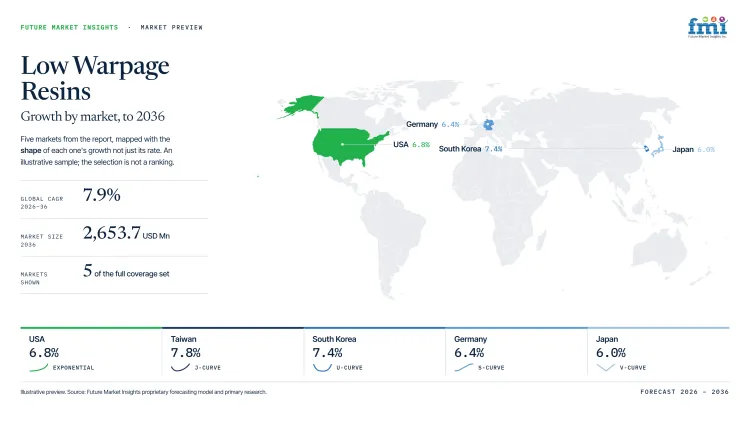
| Country | CAGR |
|---|---|
| United States | 6.8% |
| Germany | 6.4% |
| Japan | 6.0% |
| South Korea | 7.4% |
| Taiwan | 7.8% |
How do country-level CAGRs compare in the Low Warpage Resins Market?
The country forecasts remain closely grouped across the low warpage resins market, with only 1.8 percentage points separating Taiwan and Japan. The pattern suggests that growth is being driven by increasing requirements for miniaturized electronics, thermal reliability and high-performance substrates rather than major differences in industrial activity.
- Taiwan benefits from its central role in semiconductor manufacturing, where low warpage resins are increasingly used to improve package reliability and assembly yields.
- South Korea supports strong demand through advanced semiconductor, display and electronics production that requires materials with enhanced dimensional stability.
- The United States reflects steady adoption across electronics, aerospace and industrial applications that require high-performance resin systems.
- Germany maintains growth through its focus on precision engineering, automotive electronics and advanced materials development.
- Japan continues to support the market through established expertise in electronic materials and ongoing innovation in high-reliability packaging technologies.
Comparable CAGRs may still reflect different market conditions because semiconductor production intensity, electronics supply chains, material qualification requirements and end-use applications vary across countries. The full report provides country-level CAGR analysis across North America, Latin America, Europe, East Asia, South Asia, Oceania and the Middle East and Africa.
Country-wise Analysis
- The United States combines a large resin-production base with regional application laboratories that support connector and sensor trials across multiple molding sites serving electronics and mobility programs. Federal Reserve data published in July 2026 placed the seasonally adjusted plastics material and resin production index at 107.6 during the second quarter and confirms active domestic compound output. The United States is estimated to post 6.8% CAGR over the forecast period, supported by established compound distribution and specialized molding support near major domestic electronics clusters even as customer-specific tool validation and separate process records raise transfer costs between qualified regional production plants.
- Germany combines experienced automotive molders with application laboratories that test dimensional stability across sensor housings and compact power-control components during transfers between regional plants serving vehicle and industrial electronics programs under established automotive quality and traceability systems for serial production. Low warpage resin sales in Germany are forecast to expand at 6.4% CAGR by 2036, reinforced by technical distributors and established tool-trial support across major industrial regions. VDA reported in February 2026 that Germany produced 1.67 million electric passenger cars during 2025 and the production base supports local connector qualification although lengthy material approvals can delay unfamiliar compounds across conservative multi-plant programs.
- Japan supports connector qualification through electronics manufacturers that require traceable dimensional records across narrow-pitch components and later capacity transfers within established production networks serving automotive and electronics supply chains nationwide under strict quality controls. JEITA reported in March 2026 that electronic-component production increased 5.8% during 2025 and the increase adds qualification work for precision housings although separate customer approvals and site-specific process files can lengthen commercial transfers across affiliated plants. By 2036, Japan is projected to grow at 6.0% CAGR due to disciplined plant validation and distributors that provide controlled trial quantities with technical assistance across major domestic automotive connector centers.
- South Korea operates dense semiconductor and electronics networks that require molded components to preserve terminal alignment during automated assembly across major production clusters and vehicle-electronics programs supported by experienced toolmakers and nearby testing services. South Korea's low warpage resins outlook is anticipated to advance at 7.4% CAGR over the assessment period, aided by advanced molding capacity and nearby application laboratories. Korea's trade ministry reported in June 2025 that semiconductor exports reached USD 13.8 billion during May and the regional export base sustains precision-part qualification although demanding schedules restrict compounders without local technical support or established access to major electronics accounts.
- Taiwan's electronic-component production base generates frequent qualification work for connector housings and precision molded parts used across server equipment and compact assemblies within contract-manufacturing clusters. The Ministry of Economic Affairs reported in May 2026 that electronic-component output increased 25.29% during the first quarter and the rise expands trial workloads for low-warpage grades although customer-specific tool validation and raw-material costs remain material frictions across regional export programs. Low warpage resin demand in Taiwan is forecast to rise at 7.8% CAGR over the forecast period, driven by concentrated electronics manufacturing and accessible compounding support near experienced toolmaking centers and local testing services.
Who are the notable companies in the Low Warpage Resins Market?
Celanese, SABIC, BASF, Daicel, Envalior, Asahi Kasei, Syensqo and RTP Company are notable companies shaping this market.
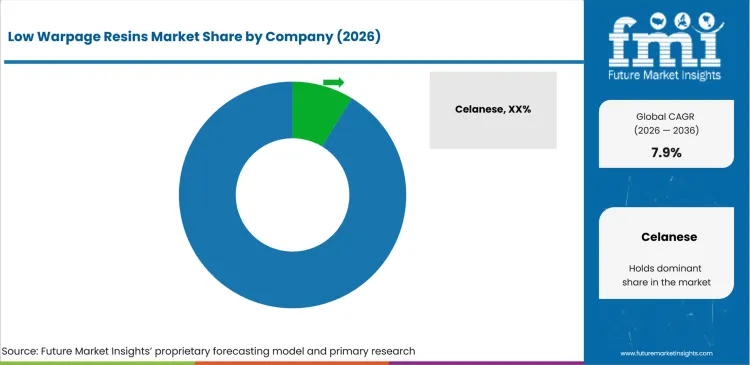
Competition remains moderately fragmented as engineering-resin groups face specialist compounders across PBT, PPS and liquid crystal polymers. Entrants need application data and regional molding support to qualify complete resin-tool combinations across demanding customer programs.
- Broad engineering-resin platforms: Celanese, SABIC and BASF combine global production with electrical application support programs.
- Precision compound specialists: Daicel, Envalior and Asahi Kasei focus on low-warpage grades for molded geometries. Daicel's wholly owned subsidiary Polyplastics continues to operate under its own brand, developing new engineering-plastics grades such as recycled-content DURAFIDE PPS compounds announced in January 2026.
- High-temperature compounders: Syensqo and RTP Company address PPS or tailored reinforcement systems for precision parts.
Competitive Benchmarking: Low Warpage Resins Market
| Company | Low-Warpage Evidence | Reinforcement Options | Electrical Application Fit | Geographic Reach |
|---|---|---|---|---|
| Celanese Corporation | High | High | High | Global |
| SABIC | High | High | High | Global |
| BASF SE | High | Medium | High | Global |
| Daicel Corporation | High | Medium | Medium | Global |
| Envalior | High | High | High | Global |
| Asahi Kasei Corporation | Medium | High | Medium | Asia with global sales |
| Syensqo | Medium | High | High | Global |
| RTP Company | Medium | High | Medium | North America, Europe and Asia |
Key Developments in the Low Warpage Resins Market
- In May 2026, SABIC launched LNP™ ELCRIN™ WF0061BiQ, a polybutylene terephthalate (PBT) resin repolymerized from recycled ocean-bound PET bottles, targeted at electrical and electronics housings and connectors.
- In February 2026, Celanese opened an expanded Michigan Technology Center in Troy, Michigan, consolidating piloting, application development and engineering prototyping to strengthen North American Engineered Materials development, including Crastin and Celanex PBT programs used in connector and precision-molding applications.
- In November 2025, BASF began supplying locally manufactured Ultradur PBT specialty grades from India for automotive and electronics applications. The route improves regional access to flame-retardant and hydrolysis-resistant grades for precision connectors and sensors.
- In August 2024, Syensqo broke ground on a battery-grade PVDF facility in Augusta, Georgia, intended to be the largest PVDF production site in North America, supporting the company's Materials segment serving electronics and mobility end markets.
Low Warpage Resins Market - Report Scope
| Coverage field | Report scope |
|---|---|
| Market breakdown | By resin family, filler system, application, processing method, end use and region. |
| Quantitative Units | Revenue in USD million and CAGR in %. |
| Market Definition | The market covers commercially sold resin compounds formulated to reduce molded-part warpage across precision electrical, automotive, industrial and medical applications. |
| Regions Covered | North America, Latin America, Western Europe, Eastern Europe, East Asia, South Asia and Pacific, and Middle East and Africa. |
| Countries Covered | United States, Germany, Japan, South Korea, Taiwan and more than twenty-five additional countries in the full report. |
| Key Companies Profiled | Celanese Corporation, SABIC, BASF SE, Daicel Corporation, Envalior, Asahi Kasei Corporation, Syensqo and RTP Company. |
| Forecast Period | 2026 to 2036. |
| Approach | Primary and secondary research with market triangulation. |
Low Warpage Resins Market - Research Methodology
| Method | Approach |
|---|---|
| Primary Research | FMI analysts gathered input from manufacturers, service providers, technology developers, distributors, end users, procurement teams, and subject-matter experts. Interviews examined purchasing decisions, product or service evaluation, adoption barriers, approval requirements, pricing considerations, and expectations for technical or commercial support. Respondents were also asked what evidence is required before a trial, pilot, or initial order develops into regular purchasing. |
| Desk Research | Desk research covered government statistics, regulatory publications, trade data, industry associations, technical literature, standards, company filings, product information, and official corporate announcements. Sources were reviewed for relevance, publication date, geographic coverage, and consistency with the defined market scope. Claims relating to performance, applications, approvals, capacity, investment, and commercial activity were retained only when supported by credible public evidence. |
| Market Sizing and Forecasting | The market model combined the baseline value with historical performance, segment structure, pricing and volume indicators, adoption levels, company participation, and country-level demand conditions. Forecast assumptions considered economic activity, investment trends, regulatory developments, technology adoption, purchasing cycles, supply availability, and barriers to wider market use. Segment and regional estimates were reconciled before the final market total was calculated. |
| Data Validation | Estimates were checked against multiple independent indicators, including public data, company activity, trade patterns, industry developments, and findings from primary interviews. Validation also tested whether products, services, applications, and company revenues fell within the defined market boundaries. Adjacent categories, unsupported claims, overlapping revenues, and activities without direct market relevance were excluded to reduce double counting and maintain consistency across segments and countries. |
Low Warpage Resins Market by Segments
Low Warpage Resins Market segmented by Resin Family:
- Glass-filled PBT
- PPS Compounds
- LCP Resins
- PA / Nylon Compounds
- PC / ABS Blends
- Modified PP Compounds
Low Warpage Resins Market segmented by Filler System:
- Glass Fiber
- Mineral-filled
- Glass / Mineral Hybrid
- Carbon Fiber / Specialty
Low Warpage Resins Market segmented by Application:
- Electronic Connectors
- Automotive Sensors
- Power Modules
- Precision Housings
- Consumer Electronics Parts
Low Warpage Resins Market segmented by Processing Method:
- Injection Molding
- Insert Molding
- Micro Molding
- Thin-wall Molding
Low Warpage Resins Market segmented by End Use:
- Electrical & Electronics
- Automotive
- Industrial Equipment
- Medical Devices
Low Warpage Resins Market by Region:
- North America
- United States
- Canada
- Latin America
- Brazil
- Chile
- Mexico
- Rest of Latin America
- Western Europe
- Germany
- United Kingdom
- Italy
- Spain
- France
- Nordics
- Benelux
- Rest of Western Europe
- Eastern Europe
- Russia
- Poland
- Hungary
- Balkan and Baltic States
- Rest of Eastern Europe
- East Asia
- China
- Japan
- South Korea
- South Asia and Pacific
- India
- ASEAN
- Australia and New Zealand
- Rest of South Asia and Pacific
- Middle East and Africa
- Kingdom of Saudi Arabia
- Other GCC Countries
- Türkiye
- South Africa
- Other African Union Countries
- Rest of Middle East and Africa
Research Sources and Bibliography
- Japan Electronics and Information Technology Industries Association. (2026, March 19). December 2025 Production by the Japanese Electronics Industry.
- Board of Governors of the Federal Reserve System. (2026, July 17). Industrial Production: Manufacturing: Nondurable Goods: Plastics Material and Resin (NAICS = 325211) (IPN325211SQ).
- German Association of the Automotive Industry. (2026, February 3). New record: 40% electric share of passenger car production in 2025.
- Ministry of Trade, Industry and Energy. (2025, June 2). Korea’s exports decline 1.3% in May.
- Ministry of Economic Affairs, R.O.C. (2026, May 19). 115年第1季製造業產值統計.
- Celanese Corporation. (2026, June 4). Celanese to Optimize Engineered Materials Compounding Footprint in Asia Region.
- BASF SE. (2025, November 13). BASF scales up in India with Ultradur® PBT to meet rising market demand.
- SABIC. (2026, June 22). SABIC launches novel PCR-based LNP™ ELCRIN™ compound with enhanced performance.
- Syensqo. (2025, May 14). Syensqo expands Ryton® PPS compounding capabilities in the United States.
- Celanese Corporation. (n.d.). Polybutylene Terephthalate (PBT) | Celanex® & Crastin®.
- BASF SE. (n.d.). Ultradur® (PBT) - The polybutylene terephthalate for high-quality components.
- Polyplastics Co., Ltd. (n.d.). 733LD EF2001/ED3002 物性カタログ.
- Envalior. (n.d.). Pocan® PBT: Engineered Thermoplastics based on PBT for Long-Lasting Performance.
- Asahi Kasei Corporation. (n.d.). LEONA™ | Products | Asahi Kasei Engineering Plastics.
- Syensqo. (n.d.). Ryton® PPS - Applications.
- Kohner, M. (n.d.). Low Warp Compounds. RTP Company.
- RTP Company. (n.d.). Electric & Autonomous Vehicles.
- Asahi Kasei Corporation. (n.d.). Technical Support | Asahi Kasei Engineering Plastics.
This bibliography is provided for reader reference and is not exhaustive. The full report contains the complete reference list and detailed citations.
This Report Answers
- What values define low warpage resin sales in 2026 and 2036?
- Which molding conditions support demand for dimensionally stable resin compounds?
- Why does glass-filled PBT hold the largest approved resin-family share in 2026?
- How do filler systems influence shrinkage across precision molded components?
- Which country conditions shape low warpage resin conversion through 2036?
- Which companies provide verified low warpage resin and application support?
- What technical conditions materially limit broader low warpage resin adoption?
- How should engineers compare resin behavior with production-tool performance during qualification?
Frequently Asked Questions
How big is the Low Warpage Resins Market in 2026?
The low warpage resins market is valued at USD 1240.6 million in 2026 and is forecast to reach USD 2653.7 million by 2036. Growth is supported by rising connector production and increasing miniaturization of electronic assemblies that require dimensionally stable housings across high-volume molding programs.
What is the CAGR of the Low Warpage Resins Market from 2026 to 2036?
The low warpage resins market grows at a CAGR of 7.9% between 2026 and 2036, supported by compact connectors, power modules and precision housings that require stable terminal alignment through thin-wall molding and repeated assembly heating across electrical and automotive production programs.
Which resin family leads the Low Warpage Resins Market?
Glass-filled PBT leads the low warpage resins market with a 24.0% share in 2026, because it combines rapid crystallization with reinforcement strength for repeatable connector housing dimensions across high-volume molding cycles, giving quality teams a stable baseline for comparing dimensional drift across production sites.
How much will the Low Warpage Resins Market add between 2026 and 2036?
The low warpage resins market is set to add USD 1413.1 million between 2026 and 2036, growing from USD 1240.6 million to USD 2,653.7 million as connector, sensor and power-module qualification programs expand across electrical, automotive, industrial and medical molding applications worldwide.
Who are the leading companies in the Low Warpage Resins Market?
The low warpage resins market is led by 8 companies, including Celanese, SABIC, BASF, Daicel, Envalior, Asahi Kasei, Syensqo and RTP Company, competing through resin platforms, reinforcement systems and application support for connector, sensor and precision-housing qualification programs across regional molding networks.
Preview the report firsthand - request a free sample
Get SampleGet the brochure for pricing and purchase details.
Get PDFTable of Content
- Key Takeaways
- Market Size and CAGR
- Top Growth Driver
- Fastest Growing Segment
- Leading Region
- Key Companies
- Emerging Opportunities
- Executive Summary
- Global Market Outlook
- Demand-side Trends
- Supply-side Trends
- Technology Roadmap Analysis
- Analysis and Recommendations
- Analyst Perspective (What is happening? Why now? What should investors know?)
- Key Questions Answered
- How large is the market?
- What is the CAGR?
- What are key trends?
- Which region dominates?
- Who are the leaders?
- Market Overview
- Market Coverage / Taxonomy
- Market Definition / Scope / Limitations
- Research Methodology
- Chapter Orientation
- Analytical Lens and Working Hypotheses
- Market Structure, Signals, and Trend Drivers
- Benchmarking and Cross-market Comparability
- Market Sizing, Forecasting, and Opportunity Mapping
- Research Design and Evidence Framework
- Desk Research Programme (Secondary Evidence)
- Expert Input and Fieldwork (Primary Evidence)
- Tooling, Models, and Reference Databases
- Data Engineering and Model Build
- Quality Assurance and Audit Trail
- Market Background
- Market Dynamics (Drivers, Restraints, Opportunity, Trends)
- Scenario Forecast (Optimistic, Likely, Conservative)
- Impact Analysis
- AI Impact
- Sustainability Impact
- Regulatory Impact
- Technology Impact
- Consumer / Buyer Analysis
- Purchase Drivers
- Adoption Barriers
- Buyer Journey
- Opportunity Map Analysis
- Product Life Cycle Analysis
- Supply Chain Analysis
- Investment Feasibility Matrix
- Value Chain Analysis
- PESTLE and Porter's Analysis
- Regulatory Landscape
- Regional Parent Market Outlook
- Production and Consumption Statistics
- Import and Export Statistics
- Global Market Analysis and Forecast, 2021 to 2036
- Historical Market Size Value (USD Million) Analysis, 2021 to 2025
- Current and Future Market Size Value (USD Million) Projections, 2026 to 2036
- Y-o-Y Growth Trend Analysis
- Absolute $ Opportunity Analysis
- Global Market Pricing Analysis, 2021 to 2036
- Global Market Analysis and Forecast, By Resin Family, 2021 to 2036
- Introduction / Key Findings
- Historical Market Size Value (USD Million) Analysis By Resin Family, 2021 to 2025
- Current and Future Market Size Value (USD Million) Analysis and Forecast By Resin Family, 2026 to 2036
- Glass-filled PBT
- PPS Compounds
- LCP Resins
- PA / Nylon Compounds
- PC / ABS Blends
- Modified PP Compounds
- Glass-filled PBT
- Y-o-Y Growth Trend Analysis By Resin Family, 2021 to 2025
- Absolute $ Opportunity Analysis By Resin Family, 2026 to 2036
- Global Market Analysis and Forecast, By Filler System, 2021 to 2036
- Introduction / Key Findings
- Historical Market Size Value (USD Million) Analysis By Filler System, 2021 to 2025
- Current and Future Market Size Value (USD Million) Analysis and Forecast By Filler System, 2026 to 2036
- Glass Fiber
- Mineral-filled
- Glass / Mineral Hybrid
- Carbon Fiber / Specialty
- Glass Fiber
- Y-o-Y Growth Trend Analysis By Filler System, 2021 to 2025
- Absolute $ Opportunity Analysis By Filler System, 2026 to 2036
- Global Market Analysis and Forecast, By Application, 2021 to 2036
- Introduction / Key Findings
- Historical Market Size Value (USD Million) Analysis By Application, 2021 to 2025
- Current and Future Market Size Value (USD Million) Analysis and Forecast By Application, 2026 to 2036
- Electronic Connectors
- Automotive Sensors
- Power Modules
- Precision Housings
- Consumer Electronics Parts
- Electronic Connectors
- Y-o-Y Growth Trend Analysis By Application, 2021 to 2025
- Absolute $ Opportunity Analysis By Application, 2026 to 2036
- Global Market Analysis and Forecast, By Processing Method, 2021 to 2036
- Introduction / Key Findings
- Historical Market Size Value (USD Million) Analysis By Processing Method, 2021 to 2025
- Current and Future Market Size Value (USD Million) Analysis and Forecast By Processing Method, 2026 to 2036
- Injection Molding
- Insert Molding
- Micro Molding
- Thin-wall Molding
- Injection Molding
- Y-o-Y Growth Trend Analysis By Processing Method, 2021 to 2025
- Absolute $ Opportunity Analysis By Processing Method, 2026 to 2036
- Global Market Analysis and Forecast, By End Use, 2021 to 2036
- Introduction / Key Findings
- Historical Market Size Value (USD Million) Analysis By End Use, 2021 to 2025
- Current and Future Market Size Value (USD Million) Analysis and Forecast By End Use, 2026 to 2036
- Electrical & Electronics
- Automotive
- Industrial Equipment
- Medical Devices
- Electrical & Electronics
- Y-o-Y Growth Trend Analysis By End Use, 2021 to 2025
- Absolute $ Opportunity Analysis By End Use, 2026 to 2036
- Global Market Analysis and Forecast, By Region, 2021 to 2036
- Introduction
- Historical Market Size Value (USD Million) Analysis By Region, 2021 to 2025
- Current Market Size Value (USD Million) Analysis and Forecast By Region, 2026 to 2036
- North America
- Latin America
- Western Europe
- Eastern Europe
- East Asia
- South Asia and Pacific
- Middle East & Africa
- Market Attractiveness Analysis By Region
- North America Market Analysis and Forecast, By Country, 2021 to 2036
- Historical Market Size Value (USD Million) Trend Analysis By Market Taxonomy, 2021 to 2025
- Market Size Value (USD Million) Forecast By Market Taxonomy, 2026 to 2036
- By Country
- USA
- Canada
- By Resin Family
- By Filler System
- By Application
- By Processing Method
- By End Use
- By Country
- Market Attractiveness Analysis
- By Country
- By Resin Family
- By Filler System
- By Application
- By Processing Method
- By End Use
- Key Takeaways
- Latin America Market Analysis and Forecast, By Country
- Historical Market Size Value (USD Million) Trend Analysis By Market Taxonomy, 2021 to 2025
- Market Size Value (USD Million) Forecast By Market Taxonomy, 2026 to 2036
- By Country
- Brazil
- Mexico
- Chile
- Rest of Latin America
- By Resin Family
- By Filler System
- By Application
- By Processing Method
- By End Use
- By Country
- Market Attractiveness Analysis
- By Country
- By Resin Family
- By Filler System
- By Application
- By Processing Method
- By End Use
- Key Takeaways
- Western Europe Market Analysis and Forecast, By Country
- Historical Market Size Value (USD Million) Trend Analysis By Market Taxonomy, 2021 to 2025
- Market Size Value (USD Million) Forecast By Market Taxonomy, 2026 to 2036
- By Country
- Germany
- UK
- Italy
- Spain
- France
- Nordic
- BENELUX
- Rest of Western Europe
- By Resin Family
- By Filler System
- By Application
- By Processing Method
- By End Use
- By Country
- Market Attractiveness Analysis
- By Country
- By Resin Family
- By Filler System
- By Application
- By Processing Method
- By End Use
- Key Takeaways
- Eastern Europe Market Analysis and Forecast, By Country
- Historical Market Size Value (USD Million) Trend Analysis By Market Taxonomy, 2021 to 2025
- Market Size Value (USD Million) Forecast By Market Taxonomy, 2026 to 2036
- By Country
- Russia
- Poland
- Hungary
- Balkan & Baltic
- Rest of Eastern Europe
- By Resin Family
- By Filler System
- By Application
- By Processing Method
- By End Use
- By Country
- Market Attractiveness Analysis
- By Country
- By Resin Family
- By Filler System
- By Application
- By Processing Method
- By End Use
- Key Takeaways
- East Asia Market Analysis and Forecast, By Country
- Historical Market Size Value (USD Million) Trend Analysis By Market Taxonomy, 2021 to 2025
- Market Size Value (USD Million) Forecast By Market Taxonomy, 2026 to 2036
- By Country
- China
- Japan
- South Korea
- By Resin Family
- By Filler System
- By Application
- By Processing Method
- By End Use
- By Country
- Market Attractiveness Analysis
- By Country
- By Resin Family
- By Filler System
- By Application
- By Processing Method
- By End Use
- Key Takeaways
- South Asia and Pacific Market Analysis and Forecast, By Country
- Historical Market Size Value (USD Million) Trend Analysis By Market Taxonomy, 2021 to 2025
- Market Size Value (USD Million) Forecast By Market Taxonomy, 2026 to 2036
- By Country
- India
- ASEAN
- Australia & New Zealand
- Rest of South Asia and Pacific
- By Resin Family
- By Filler System
- By Application
- By Processing Method
- By End Use
- By Country
- Market Attractiveness Analysis
- By Country
- By Resin Family
- By Filler System
- By Application
- By Processing Method
- By End Use
- Key Takeaways
- Middle East & Africa Market Analysis and Forecast, By Country
- Historical Market Size Value (USD Million) Trend Analysis By Market Taxonomy, 2021 to 2025
- Market Size Value (USD Million) Forecast By Market Taxonomy, 2026 to 2036
- By Country
- Kingdom of Saudi Arabia
- Other GCC Countries
- Türkiye
- South Africa
- Other African Union
- Rest of Middle East & Africa
- By Resin Family
- By Filler System
- By Application
- By Processing Method
- By End Use
- By Country
- Market Attractiveness Analysis
- By Country
- By Resin Family
- By Filler System
- By Application
- By Processing Method
- By End Use
- Key Takeaways
- Key Countries Market Analysis
- USA
- Pricing Analysis
- Market Share Analysis, 2025
- By Resin Family
- By Filler System
- By Application
- By Processing Method
- By End Use
- Canada
- Pricing Analysis
- Market Share Analysis, 2025
- By Resin Family
- By Filler System
- By Application
- By Processing Method
- By End Use
- Mexico
- Pricing Analysis
- Market Share Analysis, 2025
- By Resin Family
- By Filler System
- By Application
- By Processing Method
- By End Use
- Brazil
- Pricing Analysis
- Market Share Analysis, 2025
- By Resin Family
- By Filler System
- By Application
- By Processing Method
- By End Use
- Chile
- Pricing Analysis
- Market Share Analysis, 2025
- By Resin Family
- By Filler System
- By Application
- By Processing Method
- By End Use
- Germany
- Pricing Analysis
- Market Share Analysis, 2025
- By Resin Family
- By Filler System
- By Application
- By Processing Method
- By End Use
- UK
- Pricing Analysis
- Market Share Analysis, 2025
- By Resin Family
- By Filler System
- By Application
- By Processing Method
- By End Use
- Italy
- Pricing Analysis
- Market Share Analysis, 2025
- By Resin Family
- By Filler System
- By Application
- By Processing Method
- By End Use
- Spain
- Pricing Analysis
- Market Share Analysis, 2025
- By Resin Family
- By Filler System
- By Application
- By Processing Method
- By End Use
- France
- Pricing Analysis
- Market Share Analysis, 2025
- By Resin Family
- By Filler System
- By Application
- By Processing Method
- By End Use
- India
- Pricing Analysis
- Market Share Analysis, 2025
- By Resin Family
- By Filler System
- By Application
- By Processing Method
- By End Use
- ASEAN
- Pricing Analysis
- Market Share Analysis, 2025
- By Resin Family
- By Filler System
- By Application
- By Processing Method
- By End Use
- Australia & New Zealand
- Pricing Analysis
- Market Share Analysis, 2025
- By Resin Family
- By Filler System
- By Application
- By Processing Method
- By End Use
- China
- Pricing Analysis
- Market Share Analysis, 2025
- By Resin Family
- By Filler System
- By Application
- By Processing Method
- By End Use
- Japan
- Pricing Analysis
- Market Share Analysis, 2025
- By Resin Family
- By Filler System
- By Application
- By Processing Method
- By End Use
- South Korea
- Pricing Analysis
- Market Share Analysis, 2025
- By Resin Family
- By Filler System
- By Application
- By Processing Method
- By End Use
- Russia
- Pricing Analysis
- Market Share Analysis, 2025
- By Resin Family
- By Filler System
- By Application
- By Processing Method
- By End Use
- Poland
- Pricing Analysis
- Market Share Analysis, 2025
- By Resin Family
- By Filler System
- By Application
- By Processing Method
- By End Use
- Hungary
- Pricing Analysis
- Market Share Analysis, 2025
- By Resin Family
- By Filler System
- By Application
- By Processing Method
- By End Use
- Kingdom of Saudi Arabia
- Pricing Analysis
- Market Share Analysis, 2025
- By Resin Family
- By Filler System
- By Application
- By Processing Method
- By End Use
- Türkiye
- Pricing Analysis
- Market Share Analysis, 2025
- By Resin Family
- By Filler System
- By Application
- By Processing Method
- By End Use
- South Africa
- Pricing Analysis
- Market Share Analysis, 2025
- By Resin Family
- By Filler System
- By Application
- By Processing Method
- By End Use
- USA
- Market Structure Analysis
- Competition Dashboard
- Competition Benchmarking
- Market Share Analysis of Top Players
- By Regional
- By Resin Family
- By Filler System
- By Application
- By Processing Method
- By End Use
- Emerging Startups
- Innovation Benchmarking
- Competition Analysis
- Competition Deep Dive
- Celanese
- Overview
- Product Portfolio
- Profitability by Market Segments
- Sales Footprint
- Strategy Overview
- Marketing Strategy
- Product Strategy
- Channel Strategy
- DuPont
- SABIC
- Solvay
- BASF
- Toray
- Polyplastics
- Mitsubishi Chemical
- RTP Company
- Ensinger
- Celanese
- Case Studies
- Success Stories
- Recent Developments
- Competition Deep Dive
- Assumptions & Acronyms Used


