

- Market Size (2026)
- USD 28.8 Mn
- Forecast (2036)
- USD 233.9 Mn
- CAGR (2026 to 2036)
- 23.3%
How big is Magnonic Logic Devices Market in 2026?
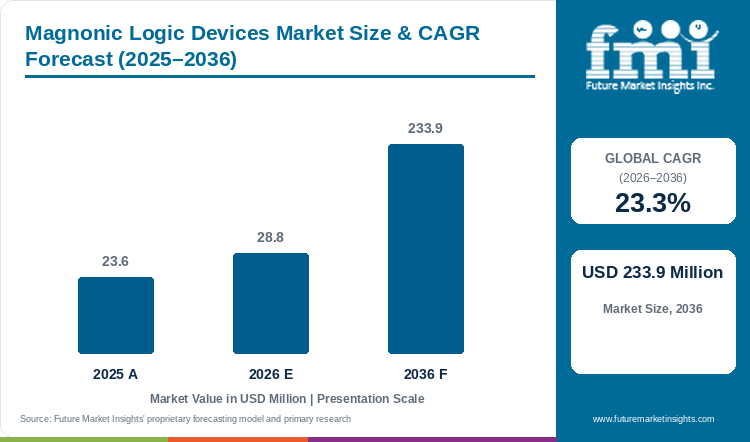
Rising from USD 23.6 million in 2025 to USD 28.8 million in 2026, global magnonic logic devices sales are anticipated to reach USD 233.9 million by 2036 at a 23.3% compound annual rate.
Eliminating mobile electron charge transport allows phase-encoded spin waves to process logic gates and filter sub-terahertz radio frequencies without resistive Joule heating. Radio-frequency front-end architects and wave-computing engineers specify magnonic waveguides because micrometer-wavelength magnons shrink 6G filters and majority logic gates by three orders of magnitude compared with electromagnetic cavity resonators. Worldwide magnonic logic devices turnover climbs from USD 23.6 million in 2025 to USD 28.8 million during 2026 and is anticipated to reach USD 233.9 million by 2036, expanding at a 23.3% CAGR and generating an annual revenue increase of USD 205.1 million between 2026 and 2036. An Adam Mickiewicz University study in Physical Review Applied during November 2025 showed that planar inverse split-ring resonators using coherent photon-magnon coupling boost microwave-to-spin-wave conversion efficiency more than fourfold in nanometer-thin ferromagnetic films [1]. Nanometer-Thick Yttrium Iron Garnet (YIG) LPE/Sputtered Films hold an estimated 62.4% of 2026 medium share alongside sub-terahertz RF filter assemblies in advanced wireless transceivers.
Key Market Trends & Insights
- By spin-wave propagation medium: Nanometer-Thick Yttrium Iron Garnet (YIG) LPE/Sputtered Films command a projected 62.4% of 2026 medium expenditure because magnetic insulator films exhibit Gilbert damping constants below 10^-4.
- By device function: 6G Sub-THz Spin-Wave RF Filters, Isolators & Phase Shifters capture an estimated 53.8% of 2026 functional revenue since surface acoustic wave devices suffer severe acoustic attenuation above 6 gigahertz.
- By wafer substrate: Gadolinium Gallium Garnet (GGG) & Substituted SGGG Wafers secure a forecasted 68.2% of 2026 substrate volume owing to exact 12.376-angstrom cubic crystal lattice matching with epitaxial YIG layers.
Regional Highlights
- Fastest national growth trajectory: South Korea leads the six major spin-wave hardware countries at a projected 25.2% per annum across the 10-year forecast window fueled by 6G sub-terahertz RF front-end pilot programs and CMOS spin-wave foundry research.
- Alpine and Central European momentum: Austrian quantum-magnonic fabrication hubs are slated to expand at 24.1% per year while Swiss spin-physics and precision RF laboratories advance at an estimated 23.9% through 2036.
- Foundational crystal and defense hubs: German epitaxial garnet wafer suppliers are anticipated to grow at 23.0% annually ahead of United States defense RF programs (22.7%) and Japanese rare-earth garnet crystal pullers (22.5%).
Market Size & Forecast
Table 1: Market Size and Forecast for the Magnonic Logic Devices Market (USD million and CAGR percentage), 2025 to 2036
| Metric | Value |
|---|---|
| 2025 Market Size | USD 23.6 million |
| Estimated Market Size in 2026 | USD 28.8 million |
| Projected Market Size by 2036 | USD 233.9 million |
| CAGR, 2026 to 2036 | 23.3% |
| Added Revenue, 2026 to 2036 | USD 205.1 million |
National 6G spectrum allocations between 7 and 24 gigahertz (FR3) and sub-terahertz bands above 90 gigahertz are forcing wireless infrastructure vendors to replace bulky ferrite circulators and acoustic resonators with planar spin-wave waveguides. In October 2026, National Institute of Standards and Technology metrologists demonstrated chip-based optical and wave metrology architectures designed to synchronize high-frequency mobile timekeeping and secure communications [2]. Consequently, defense radar primes and telecom transceiver builders are integrating non-reciprocal YIG phase shifters alongside compact cavity RF filter banks to suppress self-interference in full-duplex arrays. Epitaxial wafer vendors that control liquid-phase epitaxy film thickness down to 20 nanometers capture high-margin supply agreements across European and East Asian semiconductor hubs.
Epitaxial Garnet Wafer Output and Spin-Wave Damping Sizing
Table 2: Epitaxial Garnet Wafer Output and Spin-Wave Propagation Indicators for the Magnonic Logic Devices Market (USD million, wafer units, and damping metrics), mixed historical and forecast years from 2025 to 2036
| Metric | 2025 | 2026 | 2036 |
|---|---|---|---|
| Market size (USD million) | 23.6 | 28.8 | 233.9 |
| Epitaxial YIG-on-GGG / YOI wafer shipments (3-inch to 200mm wafers) | 6,400 to 7,200 | 7,800 to 8,800 | 68,000 to 78,000 |
| Typical nanometer-YIG ferromagnetic resonance linewidth at 10 GHz (Oe) | 0.8 to 1.4 | 0.7 to 1.2 | 0.3 to 0.6 |
| Energy per 3-input magnonic majority-gate operation (fJ) | 1.8 to 2.6 | 1.4 to 2.1 | 0.2 to 0.5 |
Operational note: Epitaxial wafer shipments encompass 3-inch and 4-inch liquid-phase epitaxy YIG-on-GGG substrates alongside 150-millimeter and 200-millimeter sputtered or direct-bonded YIG-on-insulator wafers.
Achieving millimeter-scale spin-wave decay lengths in sub-100-nanometer yttrium iron garnet films requires eliminating lead and platinum crucible inclusions during liquid-phase epitaxy growth. An October 2025 Physical Review Letters paper by Delft spin-wave experimentalists demonstrated coherent magnon-magnon interactions induced by nonlinear spin-wave dynamics in low-damping magnetic resonators [3]. Fabrication engineers pair these ultra-narrow linewidth garnet films with coplanar inductive micro-antennas and millimeter-wave front-end circuits to reduce insertion loss below 3 decibels.
Foundry R&D Line Spending & Transceiver Module Benchmarks
Table 3: Foundry Line Allocation and Module Spending Indicators for the Magnonic Logic Devices Market (USD and facility metrics), mixed historical and forecast years from 2025 to 2036
| Metric | 2025 | 2026 | 2036 |
|---|---|---|---|
| Active magnonic wafer & spin-wave device fabrication lines | 24 | 29 | 82 |
| Average annual magnonic revenue per active fabrication line (USD million) | 0.98 | 0.99 | 2.85 |
| Annual spend per 6G RF & quantum-magnonic system integrator (USD thousand) | 280 to 330 | 310 to 370 | 850 to 1,040 |
| Spin-wave group velocity in 50nm YIG waveguides (km/s) | 1.2 to 3.5 | 1.5 to 4.2 | 4.0 to 12.0 |
Table 4: Segment Revenue & Substrate Allocation Benchmarks for the Magnonic Logic Devices Market (USD million and percentages), mixed reporting years from 2025 to 2026
| Benchmark Indicator | Reported / Modeled Value | Institutional Reference Basis |
|---|---|---|
| Market size, 2026 | USD 28.8 million | Report value |
| Nanometer-thick YIG LPE/sputtered film revenue, 2026 | USD 18.0 million | 62.4% propagation medium share |
| 6G sub-THz spin-wave RF component revenue, 2026 | USD 15.5 million | 53.8% device function share |
| GGG & substituted SGGG wafer substrate revenue, 2026 | USD 19.6 million | 68.2% wafer substrate share |
Transitioning spin-wave majority gates from standalone garnet crystals onto standard silicon interposers depends on direct plasma-activated wafer bonding and ion-cut layer transfer. Packaging engineers utilize precision semiconductor wafer bonding equipment to laminate nanometer-thin YIG chiplets onto pre-patterned CMOS metallization planes without cracking brittle garnet dies. Meanwhile, cryogenic quantum computing builders deploy yttrium iron garnet spheres and planar resonators inside dilution refrigerators to transduce microwave qubit states into optical photons.
Analyst Perspective
"Epitaxial nanometer-thick yttrium iron garnet waveguides allow 6G sub-terahertz filters and majority logic gates to process signals at a fraction of CMOS footprint and thermal dissipation. Commercial volume scaling still depends on migrating three-inch GGG crystal epitaxy onto 200-millimeter silicon-integrated YIG-on-insulator wafers."
- Sudip Saha, Co-founder, FMI
How is the magnonic logic devices market segmented?
The magnonic logic devices market is segmented by spin-wave propagation medium, device function, wafer substrate, and region. In 2026, Nanometer-Thick Yttrium Iron Garnet (YIG) LPE/Sputtered Films is projected at 62.4%, 6G Sub-THz Spin-Wave RF Filters, Isolators & Phase Shifters at 53.8%, and Gadolinium Gallium Garnet (GGG) & Substituted SGGG Wafers at 68.2%.
By spin-wave propagation medium: Nanometer-Thick Yttrium Iron Garnet (YIG) LPE/Sputtered Films, Permalloy (Ni80Fe20) & CoFeB Metallic Magnonic Waveguides, and Antiferromagnetic Terahertz Spin-Wave Channels.
By device function: 6G Sub-THz Spin-Wave RF Filters, Isolators & Phase Shifters, Majority-Gate & Mach-Zehnder Interferometer Magnonic Logic, and Cryogenic Quantum Magnonics (Magnon-Photon Cavity Couplers).
By wafer substrate: Gadolinium Gallium Garnet (GGG) & Substituted SGGG Wafers, Silicon-Integrated YIG-on-Insulator (YOI) Bonding, and High-Resistivity Silicon & Piezoelectric Hybrid Substrates.
What Enables Nanometer-Thick Yttrium Iron Garnet LPE and Sputtered Films to Lead Spin-Wave Propagation Media?
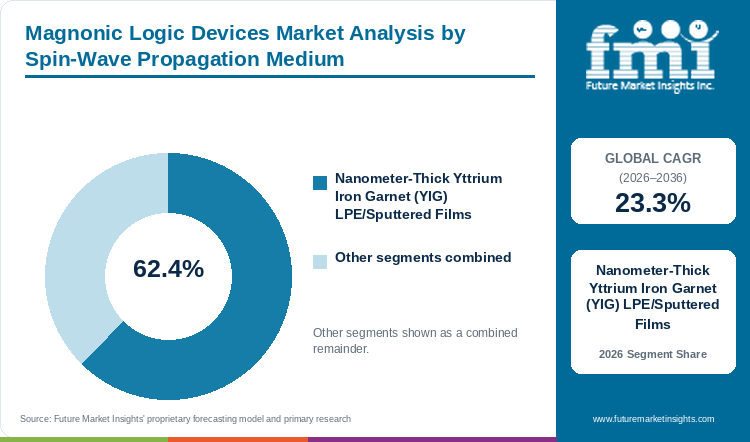
Nanometer-Thick Yttrium Iron Garnet (YIG) LPE/Sputtered Films capture 62.4% of spin-wave propagation medium revenue in 2026, linked to ultralow damping.
Table 5: Spin-Wave Propagation Medium Share for the Magnonic Logic Devices Market (percentage share), 2026
| Spin-Wave Propagation Medium Segment | Share (2026) |
|---|---|
| Nanometer-Thick Yttrium Iron Garnet (YIG) LPE/Sputtered Films | 62.4% |
| Permalloy (Ni80Fe20) & CoFeB Metallic Magnonic Waveguides | 23.1% |
| Antiferromagnetic Terahertz Spin-Wave Channels | 14.5%* |
| Total | 100.0% |
*Note: Combined share of remaining spin-wave propagation medium categories totaling 100.0% of 2026 market demand.
Table 6: Spin-Wave Propagation Medium Leadership and Market Growth for the Magnonic Logic Devices Market (segment and CAGR percentage), 2026 to 2036
| Metric | Value |
|---|---|
| Global CAGR (2026 to 2036) | 23.3% |
| Leading Segment | Nanometer-Thick Yttrium Iron Garnet (YIG) LPE/Sputtered Films |
Ferrimagnetic insulator yttrium iron garnet possesses the lowest known magnetic relaxation damping of any solid-state material, allowing phase-coherent spin waves to propagate across cascaded logic gates without amplification. Metallic permalloy and CoFeB waveguides offer higher saturation magnetization and easier CMOS sputtering, yet free-electron eddy currents shorten their magnon decay length to a few micrometers. While antiferromagnetic hematites and orthoferrites support terahertz clock frequencies, high external bias fields complicate on-chip excitation. Device fabricators therefore combine nanometer-thin liquid-phase epitaxy YIG films with integrated photonics waveguides and inductive transducers to build low-loss wave circuits.
- Millimeter-scale magnon propagation lengths give Nanometer-Thick Yttrium Iron Garnet (YIG) LPE/Sputtered Films a projected 62.4% share of 2026 medium demand.
- In April 2026, Infineon Technologies AG contributed industrial 200-millimeter and 300-millimeter wafer processing know-how to European quantum and wave-electronics pilot lines in Villach, Austria [4].
Why Do 6G Sub-THz Spin-Wave RF Filters, Isolators & Phase Shifters Command Over Half of Device Function Revenue?
6G Sub-THz Spin-Wave RF Filters, Isolators & Phase Shifters secure 53.8% of device function sales in 2026, enabled by non-reciprocal filtering.
Operating wireless transceivers across upper-midband FR3 (7 to 24 GHz) and sub-terahertz 6G frequencies exceeds the lithographic and acoustic-loss limits of piezoelectric surface acoustic wave and bulk acoustic wave filters. Magnetostatic spin waves excited in biased YIG micro-resonators tune continuously from 3 to 60 gigahertz while exhibiting intrinsic non-reciprocity that blocks reflected antenna power from damaging low-noise amplifiers. Rather than assembling discrete garnet spheres onto printed circuit boards, RF module designers integrate planar spin-wave isolators alongside automotive radar on-chip transceivers and base-station beamformers. This immediate telecom and radar utility keeps RF front-end functions ahead of digital majority-gate processors.
- Replacing bulky discrete ferrite circulators above 7 GHz places 6G Sub-THz Spin-Wave RF Filters, Isolators & Phase Shifters at an estimated 53.8% share of 2026 functional revenue.
- In July 2025, researchers at the University of Colorado Colorado Springs and the University of Ferrara demonstrated in Physical Review Applied that field-tunable nanomagnonic heterojunctions generate reconfigurable spin-wave packets and nonlinear magnonic frequency combs [5].
How Do Gadolinium Gallium Garnet and Substituted SGGG Wafers Retain Two-Thirds of Wafer Substrate Demand?
Gadolinium Gallium Garnet (GGG) & Substituted SGGG Wafers represent 68.2% of wafer substrate volume in 2026, backed by defect-free epitaxy.
Growing monocrystalline yttrium iron garnet with sub-oersted ferromagnetic resonance linewidth requires a substrate whose cubic lattice constant matches YIG's 12.376 angstroms within 0.05%. Czochralski-pulled gadolinium gallium garnet (GGG) and calcium-magnesium-zirconium substituted GGG (SGGG) wafers eliminate interfacial misfit dislocations during high-temperature liquid-phase dipping and post-sputter oxygen annealing. Directly sputtering YIG onto bare silicon creates polycrystalline grain boundaries that multiply spin-wave scattering tenfold. Until ion-sliced transfer of compound semiconductor donor wafers and YIG-on-insulator layers reaches cost parity, epi-ready GGG and SGGG boules remain indispensable.
- Zero-misfit cubic epitaxy enables Gadolinium Gallium Garnet (GGG) & Substituted SGGG Wafers to capture a forecasted 68.2% share of 2026 substrate revenue.
- In April 2026, researchers at the University of Central Florida Experimental Quantum Magnetics Laboratory and Bluefors demonstrated hybrid magnetic thin-film and superconducting cavity transducers on single-crystal garnet substrates [6].
What are the drivers, restraints, and opportunities in the magnonic logic devices market?
Across the Magnonic Logic Devices Market, 6G FR3/sub-terahertz RF filtering and femtojoule wave-majority logic gates are forecast to drive rapid commercialization through 2036, while inductive transducer conversion losses and paramagnetic GGG cryogenic damping constrain turnkey CMOS replacement.
- Driver: Expanding 6G FR3/sub-terahertz wireless spectrum allocations and ultra-low-energy wave-computing programs compel RF and logic architects to adopt planar spin-wave resonators and majority gates.
- Restraint: Inefficient microwave-to-magnon inductive antenna transduction and paramagnetic gadolinium spin damping in GGG substrates at millikelvin temperatures elevate insertion loss.
- Opportunity: Ion-sliced YIG-on-insulator wafer bonding onto 200mm silicon and hybrid magnon-photon quantum cavity couplers open lucrative telecom and quantum interconnect markets.
Growth Analysis and Future Potential: Qualitative Demand Catalysts
Conventional CMOS logic gates dissipate tens of attojoules per transistor switch through capacitive charging, whereas three-input magnonic majority gates compute Boolean logic in a single phase-interference step using less than 1.5 femtojoules. At the same time, radar and 6G base-station designers require planar tunable notch filters and non-reciprocal phase shifters operating above 10 gigahertz where acoustic filters fail. In October 2026, NIST joined the White House microelectronics and quantum science initiative to accelerate post-CMOS wave and materials discovery [7]. Integrating spin-wave interferometers with high-speed optical transceivers allows telecom switches to route microwave signals with minimal thermal footprint.
Risk Assessment of the Magnonic Logic Devices Market: Operational and Formulation Friction
Converting electrical clock signals into sub-micrometer exchange spin waves via metallic microstrip antennas suffers from severe impedance mismatch between 50-ohm RF lines and sub-micrometer magnonic waveguides. In addition to this, standard gadolinium gallium garnet substrates become strongly paramagnetic below 4 Kelvin, inducing parasitic magnetic damping that broadens YIG resonance linewidths inside quantum dilution refrigerators. In October 2026, the Austrian Science Fund and Austrian Research Promotion Agency convened the Quantum Austria Closing Forum on translating basic research into practical applications, noting that wafer-scale packaging and cryogenic transduction remain key engineering bottlenecks [8]. Foundries must therefore pair magnetoelectric transducers with metamaterial electromagnetic absorbers to suppress parasitic crosstalk across delicate spin-wave channels.
Commercial Opportunity Analysis: Formulation Differentiation and Value-Add Formats
Transferring sub-100-nanometer single-crystal YIG layers onto oxidized high-resistivity silicon wafers via helium-ion implantation and plasma bonding eliminates paramagnetic GGG substrate damping at millikelvin temperatures. These silicon-integrated YIG-on-insulator (YOI) platforms allow CMOS foundries to co-integrate spin-wave majority gates alongside standard silicon control logic and cryogenic microwave resonators. In June 2026, Infineon Technologies AG entered mass production with its RASIC CTRX8188F 76-to-81-gigahertz monolithic microwave integrated circuit, reflecting rapid commercial adoption of high-frequency radar and wave-processing front-ends [9]. Substrate vendors that supply 150-millimeter and 200-millimeter YOI wafers to phased-array radar system builders capture premium per-wafer margins.
Magnonic Logic Devices Market by Country (2026 to 2036)
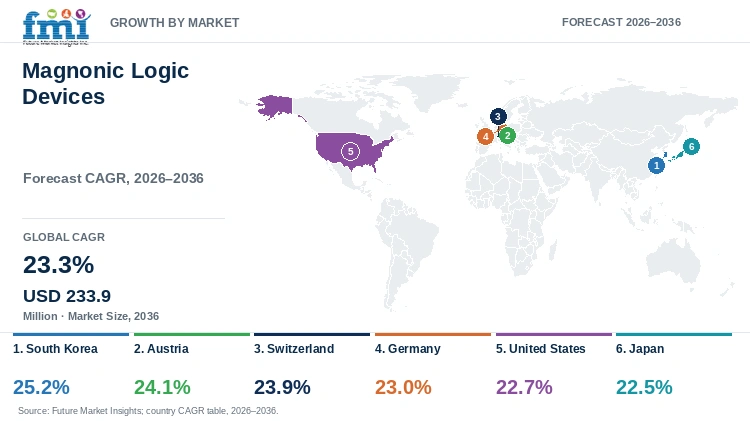
South Korea is forecasted to outpace the other five magnonic logic devices nations at 25.2% per year from 2026 to 2036, ahead of Austria (24.1%) and Switzerland (23.9%) as well as Germany (23.0%) plus the United States (22.7%) and Japan (22.5%). National 6G FR3 transceiver testbeds together with European quantum-magnonic foundry pilot lines and Japanese rare-earth garnet boule capacity explain these country growth trajectories.
Table 7: Country CAGR and Primary Growth Levers for the Magnonic Logic Devices Market (CAGR percentage and operational drivers), 2026 to 2036
| Country | CAGR (2026 to 2036) | Primary Growth Lever |
|---|---|---|
| South Korea | 25.2% | MSIT 6G sub-THz RF front-end pilot programs and CMOS spin-wave majority-gate R&D |
| Austria | 24.1% | Quantum Austria magnon-photon cavity research and Villach 200mm/300mm wafer pilot lines |
| Switzerland | 23.9% | SNSF/ETH Zurich spin-physics breakthroughs and precision sub-THz RF resonator fabrication |
| Germany | 23.0% | Jena LPE YIG wafer production, Kaiserslautern magnonics hubs, and Munich RF integration |
| United States | 22.7% | DARPA/DoD electronic-warfare tunable RF filters and Northrop Grumman Synoptics garnet crystals |
| Japan | 22.5% | Shin-Etsu and Granopt GGG/SGGG boule growth and bismuth-substituted garnet epitaxy |
Source: Future Market Insights analysis
South Korea Magnonic Logic Devices Market Outlook (2026 to 2036)
Early commercial deployment of 6G upper-midband and sub-terahertz base-station prototypes makes South Korea the fastest-expanding market for spin-wave RF filters and magnonic logic gates. In January 2026, South Korea's MSIT science ministry unveiled its First Quantum Master Plan for the Next-AI Era to fund post-CMOS spin-wave and quantum-coherent components through 2035 [10]. Supported by telecom transceiver manufacturing in Suwon and Gumi, South Korean magnonic logic device turnover is slated to expand 25.2% annually through 2036. However, domestic fabs remain reliant on imported Japanese and German gadolinium gallium garnet substrates for liquid-phase YIG epitaxy. Korean semiconductor institutes are mitigating import dependence by developing sputtered CoFeB waveguides and bonded YIG-on-silicon interposers.
Key takeaway: In South Korea, national 6G sub-terahertz transceiver programs and post-CMOS hardware funding drive a forecasted 25.2% annual pace until 2036.
Austria Magnonic Logic Devices Market Outlook (2026 to 2036)
Close integration between university spin-wave physics groups in Vienna and industrial 200-millimeter semiconductor pilot fabs in Carinthia gives Austria exceptional momentum in magnonic device fabrication. In June 2026, the Austrian Research Promotion Agency (FFG) and Austrian Science Fund (FWF) highlighted over EUR 107 million allocated under the Quantum Austria initiative to solid-state quantum and wave-computing hardware [11]. This public-private commercialization pipeline is forecast to lift Austrian magnonic logic devices revenue at a 24.1% compound annual rate from 2026 to 2036. Even so, domestic startups face high cleanroom qualification costs when scaling inverse-design magnonic demultiplexers from single dies to full wafers. Austrian fabs overcome scaling friction by pooling multi-project wafer runs across European Chips Act pilot lines.
Key takeaway: In Austria, Quantum Austria hardware grants and Villach industrial wafer pilot lines sustain an estimated 24.1% yearly climb through 2036.
Switzerland Magnonic Logic Devices Market Outlook (2026 to 2036)
World-renowned solid-state spin physics laboratories in Zurich and Basel alongside Villigen position Switzerland as a premier innovation hub for cryogenic quantum magnonics and sub-micrometer spin-wave interferometers. In September 2026, the Swiss National Science Foundation (SNSF) launched its Swiss Quantum Call 2026 to fund translational research in quantum transduction and magnon-photon cavity coupling alongside precision RF instrumentation [12]. Backed by high-value defense and telecom component exports, Swiss magnonic logic device sales are anticipated to advance 23.9% per year through 2036. Nevertheless, lofty Swiss cleanroom engineering salaries and limited high-volume wafer foundry capacity restrict domestic mass production of commodity RF filters. Swiss companies consequently focus on high-margin cryogenic magnonic couplers and precision lithography intellectual property.
Key takeaway: In Switzerland, SNSF quantum-transduction grants and ETH/PSI spin-wave engineering support a projected 23.9% annual growth pace until 2036.
Germany Magnonic Logic Devices Market Outlook (2026 to 2036)
Commercial liquid-phase epitaxy YIG wafer production in Jena combined with Europe's largest magnonic research clusters in Kaiserslautern and Halle alongside Munich anchors Germany's magnonic supply chain. In July 2026, Fraunhofer ISI published its analysis on transmitting quantum information over long distances and strengthening hardware sovereignty across German microelectronics fabs [13]. Supported by automotive radar and industrial 6G transceiver demand, German magnonic logic devices turnover is expected to rise 23.0% annually between 2026 and 2036. However, stringent European chemical permitting around lead-oxide flux baths used in traditional liquid-phase YIG epitaxy raises environmental compliance expenses for crystal growers. German substrate specialists are addressing flux restrictions by scaling lead-free sputtering and pulsed-laser garnet deposition.
Key takeaway: In Germany, domestic LPE YIG wafer production in Jena and automotive radar integration drive an estimated 23.0% yearly growth rate through 2036.
United States Magnonic Logic Devices Market Outlook (2026 to 2036)
Electronic-warfare spectral agility programs and domestic single-crystal garnet boule manufacturing in North Carolina make the United States the largest single-country buyer of magnonic RF and logic hardware. In October 2026, the U.S. Department of War announced USD 350.0 million in quantum and advanced microelectronics hardware initiatives coordinated with DARPA benchmarking programs [14]. Driven by wideband tunable notch filters and cryogenic qubit-readout isolators, United States magnonic logic device revenues are anticipated to climb 22.7% per annum through 2036. Still, strict defense export licensing on sub-oersted linewidth YIG crystals and multi-year military qualification schedules slow commercial telecom spillover. American suppliers counter defense procurement delays by marketing planar YIG-on-silicon filter chiplets to commercial satellite broadband operators.
Key takeaway: In the United States, defense electronic-warfare filter procurement and domestic Czochralski garnet crystal growth sustain a forecast 22.7% annual pace through 2036.
Japan Magnonic Logic Devices Market Outlook (2026 to 2036)
Vertical integration across rare-earth oxide refining, Czochralski GGG/SGGG crystal pulling, and bismuth-substituted garnet liquid-phase epitaxy gives Japan foundational control over global magnonic wafer supply. In December 2025, Japan's National Institute of Advanced Industrial Science and Technology (AIST) detailed strategic industrial plans at its Global Research and Development Center for Business by Quantum-AI Technology [15]. Anchored by optical-magnonic isolator and 6G RF filter exports, Japanese magnonic logic devices revenue is anticipated to progress at a 22.5% yearly rate through 2036. Even so, rising rare-earth gallium and gadolinium oxide raw material costs periodically squeeze wafer polishing margins. Japanese crystal producers protect operating profitability by reclaiming wafer kerf-loss gallium oxides and supplying pre-diced YIG-on-insulator filter chiplets.
Key takeaway: In Japan, dominant GGG/SGGG crystal boule capacity and AIST wave-computing collaborations support a projected 22.5% annual expansion through 2036.
Full report country CAGRs cover: North America; Latin America; Western Europe; Eastern Europe; East Asia; South Asia and Pacific; Middle East and Africa.
Who are the notable companies in the magnonic logic devices market?
Matesy GmbH, Granopt Co., Ltd., Shin-Etsu Chemical Co., Ltd., imec, Infineon Technologies AG, Northrop Grumman Synoptics, Coherent Corp., and Qorvo, Inc. are the notable companies in the magnonic logic devices market.
Competitive positioning across the magnonic logic devices sector separates into epitaxial YIG film and rare-earth garnet wafer producers, spin-wave logic and sub-terahertz RF component manufacturers, and single-crystal garnet boule and magneto-optic substrate specialists. Epitaxial garnet film and substrate leaders including Matesy GmbH and Granopt Co., Ltd. alongside Shin-Etsu Chemical Co., Ltd. supply nanometer-thick liquid-phase epitaxy YIG films and lattice-matched GGG/SGGG wafers. Spin-wave logic and RF front-end developers such as imec and Infineon Technologies AG together with Qorvo, Inc. engineer majority-gate wave processors and tunable 6G sub-terahertz filters. Meanwhile, Northrop Grumman Synoptics and Coherent Corp. grow bulk single-crystal YIG and rare-earth garnet boules for defense electronic warfare and cryogenic quantum cavities.
- Epitaxial YIG Film & Rare-Earth Garnet Wafer Producers: Matesy GmbH and Granopt Co., Ltd. alongside Shin-Etsu Chemical Co., Ltd. manufacture nanometer-thick LPE YIG films and bismuth-substituted garnet layers on polished GGG/SGGG substrates.
- Spin-Wave Logic & Sub-THz RF Component Manufacturers: imec and Infineon Technologies AG together with Qorvo, Inc. develop CMOS-integrated magnonic majority gates and Mach-Zehnder spin-wave interferometers alongside non-reciprocal 6G RF filters.
- Single-Crystal Garnet Boule & Magneto-Optic Substrate Specialists: Northrop Grumman Synoptics and Coherent Corp. produce ultra-narrow-linewidth YIG crystals and epitaxial garnet slabs for cryogenic magnon-photon cavity elements.
Competitive Benchmarking: Magnonic Logic Devices Market
Table 8: Competitive Benchmarking for the Magnonic Logic Devices Market (qualitative capability ratings), 2026
| Company | YIG / Garnet Epitaxy | Sub-THz RF & Logic Design | Silicon / CMOS Integration | Global Supply Reach |
|---|---|---|---|---|
| Matesy GmbH | High | High | Medium | Medium |
| Granopt Co., Ltd. | High | Medium | Medium | High |
| Shin-Etsu Chemical Co., Ltd. | High | Medium | High | High |
| imec | Medium | High | High | High |
| Infineon Technologies AG | Medium | High | High | High |
| Northrop Grumman Synoptics | High | High | Medium | Medium |
| Coherent Corp. | High | Medium | Medium | High |
| Qorvo, Inc. | Medium | High | High | High |
Scoring basis: YIG / Garnet Epitaxy earns a High mark where a vendor grows Czochralski GGG/SGGG boules or sub-100-nanometer liquid-phase epitaxy YIG films with sub-oersted ferromagnetic resonance linewidth, while Medium reflects foundry consumption of external substrates. Sub-THz RF & Logic Design evaluates documented spin-wave majority gates and non-reciprocal phase shifters alongside tunable 6G filter demonstrations. Silicon / CMOS Integration reflects 200-millimeter or 300-millimeter wafer bonding and coplanar inductive transducer fabrication.
Key Developments in the Magnonic Logic Devices Market
- In October 2026, Polar Semiconductor collaborated with IC-Link by imec to manufacture 8-inch specialty gallium nitride and compound wave-device wafers across North America and Europe [16].
- In March 2026, Coherent Corp. unveiled breakthrough AI-scale optical and magneto-optic garnet isolator innovations at OFC 2026 for high-speed data-center transceivers [17].
- In October 2025, Infineon Technologies AG launched its highly integrated XENSIV 60-gigahertz CMOS millimeter-wave radar sensor line for compact low-power RF sensing solutions [18].
Key Players in the Magnonic Logic Devices Market
Epitaxial YIG Film & Rare-Earth Garnet Wafer Producers
- Matesy GmbH
- Granopt Co., Ltd.
- Shin-Etsu Chemical Co., Ltd.
Spin-Wave Logic & Sub-THz RF Component Manufacturers
- imec
- Infineon Technologies AG
- Qorvo, Inc.
Single-Crystal Garnet Boule & Magneto-Optic Substrate Specialists
- Northrop Grumman Synoptics
- Coherent Corp.
Magnonic Logic Devices Market - Report Scope
Table 9: Report Scope for the Magnonic Logic Devices Market (coverage fields and definitions), 2026 to 2036
| Coverage field | Report scope |
|---|---|
| Market breakdown | Spin-Wave Propagation Medium; Device Function; Wafer Substrate; Region |
| Quantitative Units | USD Million |
| Market Definition | Includes merchant revenue from nanometer-thick epitaxial YIG-on-GGG/SGGG wafers, YIG-on-insulator (YOI) bonded substrates, 6G sub-terahertz spin-wave RF filters, isolators, and phase shifters, magnonic majority-gate logic chips, and cryogenic magnon-photon cavity couplers sold within the listed segmentation. Category Scope Note: The valuation strictly encompasses solid-state spin-wave (magnonic) logic and RF wave-processing components and dedicated epitaxial garnet wafers, excluding bulk commodity microwave ferrite circulators above 1 millimeter thickness, piezoelectric SAW/BAW filters, and optical fiber spools. |
| Regions Covered | North America; Latin America; Western Europe; Eastern Europe; East Asia; South Asia and Pacific; Middle East and Africa |
| Countries Covered | South Korea, Austria, Switzerland, Germany, United States, Japan, and additional countries in the full report |
| Key Companies Covered | Matesy GmbH, Granopt Co., Ltd., Shin-Etsu Chemical Co., Ltd., imec, Infineon Technologies AG, Northrop Grumman Synoptics, Coherent Corp., Qorvo, Inc. |
| Forecast Period | 2026 to 2036 |
| Approach | Primary and secondary research with rigorous market triangulation. |
Magnonic Logic Devices Market - Research Methodology
Table 10: Research Methodology for the Magnonic Logic Devices Market (research methods and approach), 2026 edition
| Method | Approach |
|---|---|
| Primary Research | Primary interviews were conducted with liquid-phase epitaxy YIG crystal growers, GGG/SGGG substrate polishers, 6G RF filter designers, nanoelectronics research hubs, and cryogenic quantum-magnonics physicists to validate ferromagnetic resonance linewidths, wafer prices, and transduction efficiency. |
| Secondary Research | Secondary research included company annual reports, product catalogs from Matesy, Shin-Etsu, and Granopt, imec spin-wave majority-gate technical papers, PSI/ETH Zurich, FFG/FWF, and NIST publications, and verified corporate releases. |
| Market Sizing and Forecasting | Market sizing and forecasting for 2026 to 2036 were constructed using top-down and bottom-up models reconciling 3-inch to 200mm epitaxial garnet wafer shipments, defense tunable RF filter orders, and foundry spin-wave shuttle programs. |
| Data Triangulation and Validation | Data is triangulated against rare-earth gallium garnet boule furnace capacities, 6G FR3/sub-THz base-station testbed deployments, and quantum dilution-fridge cavity shipments without double counting legacy acoustic filters. |
| Country Forecasting Model | Country-level CAGRs are projected via FMI's wave-electronics econometric model, calibrating national expansion rates against the 23.3% global baseline through national 6G spectrum testbeds, European Chips Act pilot lines, and garnet crystal production. |
| Operational Benchmark Traceability | Operational benchmarks (YIG-on-GGG wafer shipments, ferromagnetic resonance linewidth in Oersteds, and majority-gate switching energy in femtojoules) represent modeled scenario ranges derived from imec, PSI/ETH Zurich, and NIST metrology benchmarks. |
Magnonic Logic Devices Market by Segments
Magnonic Logic Devices Market segmented by Spin-Wave Propagation Medium:
- Nanometer-Thick Yttrium Iron Garnet (YIG) LPE/Sputtered Films
- Permalloy (Ni80Fe20) & CoFeB Metallic Magnonic Waveguides
- Antiferromagnetic Terahertz Spin-Wave Channels
Magnonic Logic Devices Market segmented by Device Function:
- 6G Sub-THz Spin-Wave RF Filters, Isolators & Phase Shifters
- Majority-Gate & Mach-Zehnder Interferometer Magnonic Logic
- Cryogenic Quantum Magnonics (Magnon-Photon Cavity Couplers)
Magnonic Logic Devices Market segmented by Wafer Substrate:
- Gadolinium Gallium Garnet (GGG) & Substituted SGGG Wafers
- Silicon-Integrated YIG-on-Insulator (YOI) Bonding
- High-Resistivity Silicon & Piezoelectric Hybrid Substrates
Magnonic Logic Devices Market by Region
- North America
- United States
- Canada
- Latin America
- Brazil
- Mexico
- Argentina
- Chile
- Western Europe
- Germany
- France
- United Kingdom
- Italy
- Spain
- Benelux
- Nordics
- Eastern Europe
- Poland
- Czech Republic
- Romania
- Hungary
- East Asia
- China
- Japan
- South Korea
- South Asia and Pacific
- India
- ASEAN
- Australia and New Zealand
- Middle East and Africa
- GCC Countries
- South Africa
- Türkiye
- Israel
Research Sources and Bibliography
- [1] Ivzhenko, L., Polevoy, S., Nedukh, S., & Krawczyk, M. (2025, November 19). Influence of photon-magnon coupling on spin-wave-excitation enhancement. Physical Review Applied, 24(5), 054056 (American Physical Society).
- [2] National Institute of Standards and Technology (NIST). (2026, October 16). New Chip-Based 'Tape Measure' for Light Could Revolutionize Mobile Timekeeping and Enhance National Security. U.S. Department of Commerce.
- [3] Arfini, M., Bermejillo-Seco, A., Bondarenko, A., Potts, C. A., Blanter, Y. M., van der Zant, H. S. J., & Steele, G. A. (2025, October 15). Magnon-Magnon Interaction Induced by Nonlinear Spin-Wave Dynamics. Physical Review Letters, 135(16), 166703 (American Physical Society).
- [4] Infineon Technologies AG. (2026, April 22). Quantum chips: Infineon contributes industrialization know-how to European quantum pilot lines. Infineon Technologies Press Releases.
- [5] Roxburgh, A., Micaletti, P., Montoncello, F., & Iacocca, E. (2025, July 24). Generation of spin-wave packets by reconfigurable nanomagnonic heterojunctions. Physical Review Applied, 24(1), 014047 (American Physical Society).
- [6] Bluefors Oy & University of Central Florida EQMag Lab. (2026, April 21). Quantum Magnonics: Toward Interconnected Quantum Systems. Bluefors Quantum Stories.
- [7] National Institute of Standards and Technology (NIST). (2026, October 08). NIST Joins White House Effort to Drive 'A New Golden Age of Science'. U.S. Department of Commerce.
- [8] Austrian Science Fund (FWF). (2026, October 12). Quantum Austria Closing Forum – From Basic Research to Practical Application. Austrian Science Fund (FWF).
- [9] Infineon Technologies AG. (2026, June 24). Infineon RASIC™ CTRX8188F enters mass production as automotive industry's first 8Tx8Rx imaging radar MMIC. Infineon Technologies Press Releases.
- [10] Ministry of Science and ICT (MSIT). (2026, January 29). Korea Unveils First Quantum Master Plan for the Next-AI Era. Ministry of Science and ICT Republic of Korea.
- [11] Austrian Research Promotion Agency (FFG). (2026, June 22). Quantum Nation. Austrian Research Promotion Agency (FFG).
- [12] Swiss National Science Foundation (SNSF). (2026, September 01). Swiss Quantum Call 2026. Swiss National Science Foundation News.
- [13] Fraunhofer Institute for Systems and Innovation Research (ISI). (2026, July 30). How can quantum information be transmitted over long distances in the future?. Fraunhofer ISI Press Releases.
- [14] U.S. Department of War. (2026, October 08). Department of War Announces $350 Million in Quantum Computing Initiatives. U.S. Department of War News Releases.
- [15] National Institute of Advanced Industrial Science and Technology (AIST). (2025, December 03). “Quantum Technology Will Become the Infrastructure That Connects People”. AIST Magazine (Global Research and Development Center for Business by Quantum-AI Technology).
- [16] Interuniversity Microelectronics Centre (imec). (2026, October 12). Polar collaborates with IC-Link by imec to manufacture 8-inch GaN technology. imec Press Releases.
- [17] Coherent Corp. (2026, March 17). Coherent to Unveil Breakthrough AI-Scale Optical Innovations and Industry Leadership at OFC 2026. Coherent Corp. Press Releases.
- [18] Infineon Technologies AG. (2025, October 14). Infineon launches next-generation highly integrated XENSIV™ 60 GHz CMOS radar for low-power IoT solutions. Infineon Technologies Press Releases.
- [19] Interuniversity Microelectronics Centre (imec). (2025, March 31). Imec pioneers photonic code-division multiplexing FMCW 144GHz distributed radar. imec Press Releases.
- [20] Microwave Journal & Qorvo, Inc. (2026, October 02). Qorvo® Sets Benchmark with New X-Band RF Front-end Solution Tailored for Radar Systems. Microwave Journal.
This bibliography is provided for reader reference and is not exhaustive. The full report contains the complete reference list and detailed citations.
This Report Answers
- How large is the magnonic logic devices market in 2026 and what is forecast for 2036?
- Which 6G sub-terahertz RF and wave-computing pressures accelerate magnonic device adoption?
- Why do Nanometer-Thick Yttrium Iron Garnet (YIG) LPE/Sputtered Films lead propagation media?
- Why do 6G Sub-THz Spin-Wave RF Filters, Isolators & Phase Shifters lead device functions?
- How do growth rates compare across South Korea, Austria, Switzerland, Germany, the United States, and Japan?
- Which epitaxial garnet growers, RF chipmakers, and nanoelectronics hubs lead the market today?
- What transduction and cryogenic substrate damping challenges restrain commercial scaling?
- What should RF transceiver and quantum hardware buyers evaluate when sourcing YIG wafers?
Frequently Asked Questions
How big is the magnonic logic devices market in 2026, and what is forecast for 2036?
Worldwide magnonic logic devices revenue reaches an estimated USD 28.8 million in 2026 (up from USD 23.6 million in 2025) and is anticipated to climb to USD 233.9 million by 2036 as 6G transceivers and wave-computing processors adopt low-loss spin-wave waveguides.
What is the CAGR for the magnonic logic devices market from 2026 to 2036?
As per FMI, global magnonic logic devices sales are slated to progress at 23.3% per year from 2026 to 2036, yielding USD 205.1 million in incremental epitaxial YIG wafer and spin-wave RF component orders.
Which spin-wave propagation medium segment leads the magnonic logic devices market?
Nanometer-Thick Yttrium Iron Garnet (YIG) LPE/Sputtered Films account for a projected 62.4% of 2026 propagation medium turnover because ultralow magnetic Gilbert damping enables millimeter-scale coherent magnon propagation.
Which device function segment leads the magnonic logic devices market?
6G Sub-THz Spin-Wave RF Filters, Isolators & Phase Shifters hold an estimated 53.8% of 2026 functional demand as planar magnetostatic wave resonators replace high-loss acoustic filters above 7 gigahertz.
Which country registers the fastest growth in the magnonic logic devices market?
FMI projects that South Korea paces the six major spin-wave nations at a forecasted 25.2% per annum through 2036, fueled by national 6G sub-terahertz RF front-end testbeds and post-CMOS spin-wave R&D.
Who are the key players in the magnonic logic devices market?
Notable market participants include Matesy GmbH, Granopt Co., Ltd., Shin-Etsu Chemical Co., Ltd., imec, Infineon Technologies AG, Northrop Grumman Synoptics, Coherent Corp., and Qorvo, Inc.
Preview the report firsthand - request a free sample
Get SampleGet the brochure for pricing and purchase details.
Get PDFTable of Content
- Key Takeaways
- Market Size and CAGR
- Top Growth Driver
- Fastest Growing Segment
- Leading Region
- Key Companies
- Emerging Opportunities
- Executive Summary
- Global Market Outlook
- Demand-side Trends
- Supply-side Trends
- Technology Roadmap Analysis
- Analysis and Recommendations
- Analyst Perspective (What is happening? Why now? What should investors know?)
- Key Questions Answered
- How large is the market?
- What is the CAGR?
- What are key trends?
- Which region dominates?
- Who are the leaders?
- Market Overview
- Market Coverage / Taxonomy
- Market Definition / Scope / Limitations
- Research Methodology
- Chapter Orientation
- Analytical Lens and Working Hypotheses
- Market Structure, Signals, and Trend Drivers
- Benchmarking and Cross-market Comparability
- Market Sizing, Forecasting, and Opportunity Mapping
- Research Design and Evidence Framework
- Desk Research Programme (Secondary Evidence)
- Expert Input and Fieldwork (Primary Evidence)
- Tooling, Models, and Reference Databases
- Data Engineering and Model Build
- Quality Assurance and Audit Trail
- Market Background
- Market Dynamics (Drivers, Restraints, Opportunity, Trends)
- Scenario Forecast (Optimistic, Likely, Conservative)
- Impact Analysis
- AI Impact
- Sustainability Impact
- Regulatory Impact
- Technology Impact
- Consumer / Buyer Analysis
- Purchase Drivers
- Adoption Barriers
- Buyer Journey
- Opportunity Map Analysis
- Product Life Cycle Analysis
- Supply Chain Analysis
- Investment Feasibility Matrix
- Value Chain Analysis
- PESTLE and Porter's Analysis
- Regulatory Landscape
- Regional Parent Market Outlook
- Production and Consumption Statistics
- Import and Export Statistics
- Global Market Analysis and Forecast, 2021 to 2036
- Historical Market Size Value (USD Million) Analysis, 2021 to 2025
- Current and Future Market Size Value (USD Million) Projections, 2026 to 2036
- Y-o-Y Growth Trend Analysis
- Absolute $ Opportunity Analysis
- Global Market Pricing Analysis, 2021 to 2036
- Global Market Analysis and Forecast, By Spin-Wave Propagation Medium, 2021 to 2036
- Introduction / Key Findings
- Historical Market Size Value (USD Million) Analysis By Spin-Wave Propagation Medium, 2021 to 2025
- Current and Future Market Size Value (USD Million) Analysis and Forecast By Spin-Wave Propagation Medium, 2026 to 2036
- Nanometer-Thick Yttrium Iron Garnet (YIG) LPE/Sputtered Films
- Permalloy (Ni80Fe20) & CoFeB Metallic Magnonic Waveguides
- Antiferromagnetic Terahertz Spin-Wave Channels
- Y-o-Y Growth Trend Analysis By Spin-Wave Propagation Medium, 2021 to 2025
- Absolute $ Opportunity Analysis By Spin-Wave Propagation Medium, 2026 to 2036
- Global Market Analysis and Forecast, By Device Function, 2021 to 2036
- Introduction / Key Findings
- Historical Market Size Value (USD Million) Analysis By Device Function, 2021 to 2025
- Current and Future Market Size Value (USD Million) Analysis and Forecast By Device Function, 2026 to 2036
- 6G Sub-THz Spin-Wave RF Filters, Isolators & Phase Shifters
- Majority-Gate & Mach-Zehnder Interferometer Magnonic Logic
- Cryogenic Quantum Magnonics (Magnon-Photon Cavity Couplers)
- Y-o-Y Growth Trend Analysis By Device Function, 2021 to 2025
- Absolute $ Opportunity Analysis By Device Function, 2026 to 2036
- Global Market Analysis and Forecast, By Wafer Substrate, 2021 to 2036
- Introduction / Key Findings
- Historical Market Size Value (USD Million) Analysis By Wafer Substrate, 2021 to 2025
- Current and Future Market Size Value (USD Million) Analysis and Forecast By Wafer Substrate, 2026 to 2036
- Gadolinium Gallium Garnet (GGG) & Substituted SGGG Wafers
- Silicon-Integrated YIG-on-Insulator (YOI) Bonding
- High-Resistivity Silicon & Piezoelectric Hybrid Substrates
- Y-o-Y Growth Trend Analysis By Wafer Substrate, 2021 to 2025
- Absolute $ Opportunity Analysis By Wafer Substrate, 2026 to 2036
- Global Market Analysis and Forecast, By Region, 2021 to 2036
- Introduction
- Historical Market Size Value (USD Million) Analysis By Region, 2021 to 2025
- Current Market Size Value (USD Million) Analysis and Forecast By Region, 2026 to 2036
- North America
- Latin America
- Western Europe
- Eastern Europe
- East Asia
- South Asia and Pacific
- Middle East and Africa
- Market Attractiveness Analysis By Region
- North America Market Analysis and Forecast, By Country, 2021 to 2036
- Historical Market Size Value (USD Million) Trend Analysis By Market Taxonomy, 2021 to 2025
- Market Size Value (USD Million) Forecast By Market Taxonomy, 2026 to 2036
- By Country
- United States
- Canada
- By Spin-Wave Propagation Medium
- By Device Function
- By Wafer Substrate
- By Country
- Market Attractiveness Analysis
- By Country
- By Spin-Wave Propagation Medium
- By Device Function
- By Wafer Substrate
- Key Takeaways
- Latin America Market Analysis and Forecast, By Country
- Historical Market Size Value (USD Million) Trend Analysis By Market Taxonomy, 2021 to 2025
- Market Size Value (USD Million) Forecast By Market Taxonomy, 2026 to 2036
- By Country
- Brazil
- Mexico
- Argentina
- Chile
- By Spin-Wave Propagation Medium
- By Device Function
- By Wafer Substrate
- By Country
- Market Attractiveness Analysis
- By Country
- By Spin-Wave Propagation Medium
- By Device Function
- By Wafer Substrate
- Key Takeaways
- Western Europe Market Analysis and Forecast, By Country
- Historical Market Size Value (USD Million) Trend Analysis By Market Taxonomy, 2021 to 2025
- Market Size Value (USD Million) Forecast By Market Taxonomy, 2026 to 2036
- By Country
- Germany
- France
- United Kingdom
- Italy
- Spain
- Benelux
- Nordics
- By Spin-Wave Propagation Medium
- By Device Function
- By Wafer Substrate
- By Country
- Market Attractiveness Analysis
- By Country
- By Spin-Wave Propagation Medium
- By Device Function
- By Wafer Substrate
- Key Takeaways
- Eastern Europe Market Analysis and Forecast, By Country
- Historical Market Size Value (USD Million) Trend Analysis By Market Taxonomy, 2021 to 2025
- Market Size Value (USD Million) Forecast By Market Taxonomy, 2026 to 2036
- By Country
- Poland
- Czech Republic
- Romania
- Hungary
- By Spin-Wave Propagation Medium
- By Device Function
- By Wafer Substrate
- By Country
- Market Attractiveness Analysis
- By Country
- By Spin-Wave Propagation Medium
- By Device Function
- By Wafer Substrate
- Key Takeaways
- East Asia Market Analysis and Forecast, By Country
- Historical Market Size Value (USD Million) Trend Analysis By Market Taxonomy, 2021 to 2025
- Market Size Value (USD Million) Forecast By Market Taxonomy, 2026 to 2036
- By Country
- China
- Japan
- South Korea
- By Spin-Wave Propagation Medium
- By Device Function
- By Wafer Substrate
- By Country
- Market Attractiveness Analysis
- By Country
- By Spin-Wave Propagation Medium
- By Device Function
- By Wafer Substrate
- Key Takeaways
- South Asia and Pacific Market Analysis and Forecast, By Country
- Historical Market Size Value (USD Million) Trend Analysis By Market Taxonomy, 2021 to 2025
- Market Size Value (USD Million) Forecast By Market Taxonomy, 2026 to 2036
- By Country
- India
- ASEAN
- Australia and New Zealand
- By Spin-Wave Propagation Medium
- By Device Function
- By Wafer Substrate
- By Country
- Market Attractiveness Analysis
- By Country
- By Spin-Wave Propagation Medium
- By Device Function
- By Wafer Substrate
- Key Takeaways
- Middle East and Africa Market Analysis and Forecast, By Country
- Historical Market Size Value (USD Million) Trend Analysis By Market Taxonomy, 2021 to 2025
- Market Size Value (USD Million) Forecast By Market Taxonomy, 2026 to 2036
- By Country
- GCC Countries
- South Africa
- Türkiye
- Israel
- By Spin-Wave Propagation Medium
- By Device Function
- By Wafer Substrate
- By Country
- Market Attractiveness Analysis
- By Country
- By Spin-Wave Propagation Medium
- By Device Function
- By Wafer Substrate
- Key Takeaways
- Key Countries Market Analysis
- United States
- Pricing Analysis
- Market Share Analysis, 2025
- By Spin-Wave Propagation Medium
- By Device Function
- By Wafer Substrate
- Canada
- Pricing Analysis
- Market Share Analysis, 2025
- By Spin-Wave Propagation Medium
- By Device Function
- By Wafer Substrate
- Mexico
- Pricing Analysis
- Market Share Analysis, 2025
- By Spin-Wave Propagation Medium
- By Device Function
- By Wafer Substrate
- Brazil
- Pricing Analysis
- Market Share Analysis, 2025
- By Spin-Wave Propagation Medium
- By Device Function
- By Wafer Substrate
- Chile
- Pricing Analysis
- Market Share Analysis, 2025
- By Spin-Wave Propagation Medium
- By Device Function
- By Wafer Substrate
- Germany
- Pricing Analysis
- Market Share Analysis, 2025
- By Spin-Wave Propagation Medium
- By Device Function
- By Wafer Substrate
- United Kingdom
- Pricing Analysis
- Market Share Analysis, 2025
- By Spin-Wave Propagation Medium
- By Device Function
- By Wafer Substrate
- Italy
- Pricing Analysis
- Market Share Analysis, 2025
- By Spin-Wave Propagation Medium
- By Device Function
- By Wafer Substrate
- Spain
- Pricing Analysis
- Market Share Analysis, 2025
- By Spin-Wave Propagation Medium
- By Device Function
- By Wafer Substrate
- France
- Pricing Analysis
- Market Share Analysis, 2025
- By Spin-Wave Propagation Medium
- By Device Function
- By Wafer Substrate
- India
- Pricing Analysis
- Market Share Analysis, 2025
- By Spin-Wave Propagation Medium
- By Device Function
- By Wafer Substrate
- ASEAN
- Pricing Analysis
- Market Share Analysis, 2025
- By Spin-Wave Propagation Medium
- By Device Function
- By Wafer Substrate
- Australia and New Zealand
- Pricing Analysis
- Market Share Analysis, 2025
- By Spin-Wave Propagation Medium
- By Device Function
- By Wafer Substrate
- China
- Pricing Analysis
- Market Share Analysis, 2025
- By Spin-Wave Propagation Medium
- By Device Function
- By Wafer Substrate
- Japan
- Pricing Analysis
- Market Share Analysis, 2025
- By Spin-Wave Propagation Medium
- By Device Function
- By Wafer Substrate
- South Korea
- Pricing Analysis
- Market Share Analysis, 2025
- By Spin-Wave Propagation Medium
- By Device Function
- By Wafer Substrate
- Poland
- Pricing Analysis
- Market Share Analysis, 2025
- By Spin-Wave Propagation Medium
- By Device Function
- By Wafer Substrate
- Hungary
- Pricing Analysis
- Market Share Analysis, 2025
- By Spin-Wave Propagation Medium
- By Device Function
- By Wafer Substrate
- Türkiye
- Pricing Analysis
- Market Share Analysis, 2025
- By Spin-Wave Propagation Medium
- By Device Function
- By Wafer Substrate
- South Africa
- Pricing Analysis
- Market Share Analysis, 2025
- By Spin-Wave Propagation Medium
- By Device Function
- By Wafer Substrate
- Austria
- Pricing Analysis
- Market Share Analysis, 2025
- By Spin-Wave Propagation Medium
- By Device Function
- By Wafer Substrate
- Switzerland
- Pricing Analysis
- Market Share Analysis, 2025
- By Spin-Wave Propagation Medium
- By Device Function
- By Wafer Substrate
- United States
- Market Structure Analysis
- Competition Dashboard
- Competition Benchmarking
- Market Share Analysis of Top Players
- By Regional
- By Spin-Wave Propagation Medium
- By Device Function
- By Wafer Substrate
- Emerging Startups
- Innovation Benchmarking
- Competition Analysis
- Competition Deep Dive
- Matesy GmbH
- Overview
- Product Portfolio
- Profitability by Market Segments
- Sales Footprint
- Strategy Overview
- Marketing Strategy
- Product Strategy
- Channel Strategy
- Granopt Co., Ltd.
- Shin-Etsu Chemical Co., Ltd.
- imec
- Infineon Technologies AG
- Northrop Grumman Synoptics
- Coherent Corp.
- Qorvo, Inc.
- Matesy GmbH
- Case Studies
- Success Stories
- Recent Developments
- Competition Deep Dive
- Assumptions & Acronyms Used


