- Market Size (2026)
- USD 1.8 Bn
- Forecast (2036)
- USD 3.5 Bn
- CAGR (2026 to 2036)
- 6.5%
How Big Is the Mass Flow Controller Market in 2026?
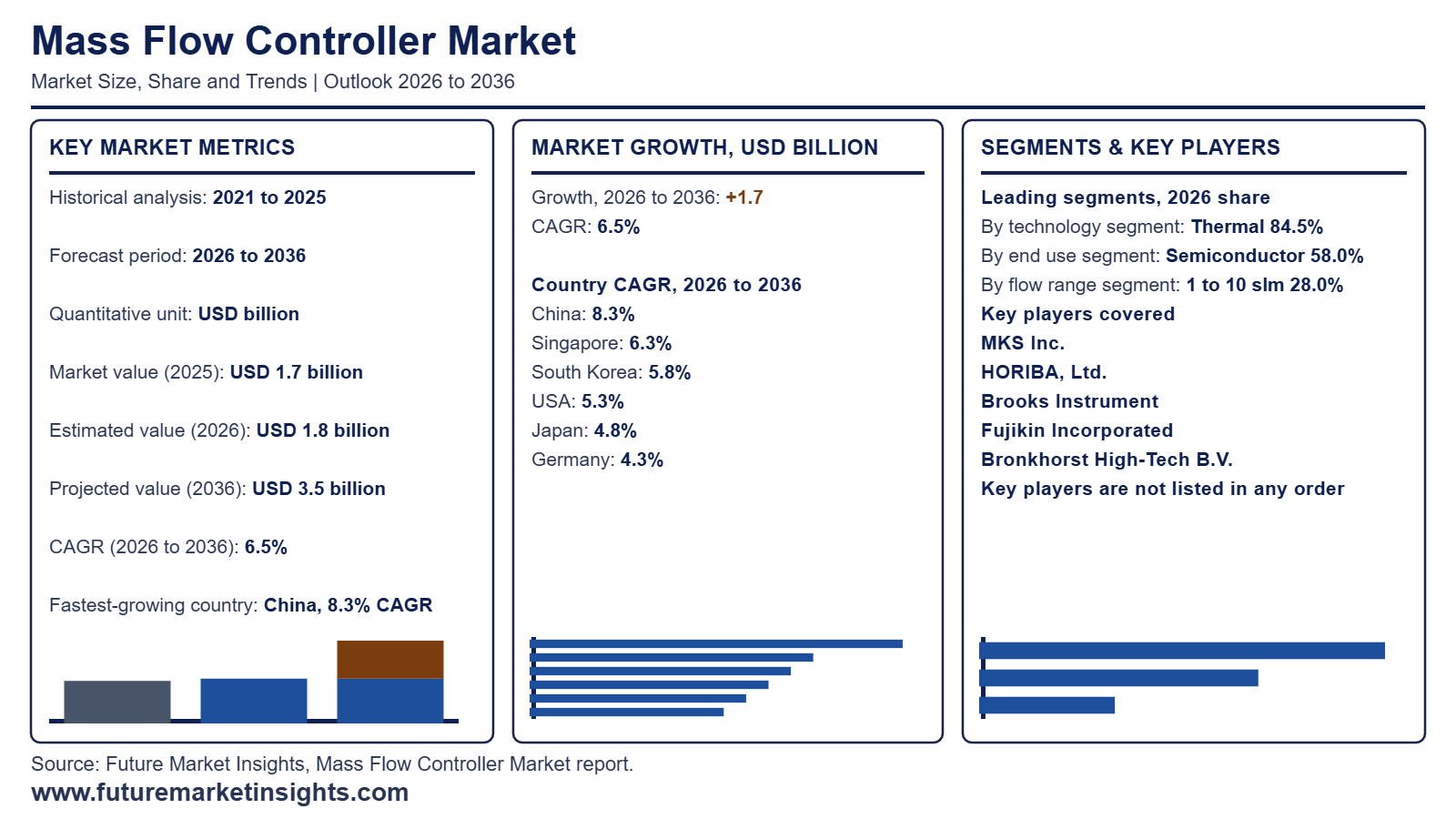
Global mass flow controller market valuation demonstrated steady progress from USD 1.7 billion in 2025 to USD 1.8 billion in 2026, building toward a targeted valuation of USD 3.5 billion by 2036 at a CAGR of 6.5%. Higher process-gas channel counts across advanced wafer fabrication tools generate an incremental dollar opportunity of USD 1.7 billion over the decade. As per FMI, semiconductor deposition and etch equipment builders anchor this recurring hardware demand by specifying ultra-clean closed-loop gas dosing modules across multi-chamber cluster tools.
| Market Metric | Valuation / Share / Forecast Benchmark |
|---|---|
| 2025 Market Size (Historical) | USD 1.7 billion |
| 2026 Market Size (Estimated) | USD 1.8 billion |
| 2036 Market Size (Projected) | USD 3.5 billion |
| Compound Annual Growth Rate (2026 to 2036) | 6.5% CAGR |
| Incremental Dollar Opportunity (2026 to 2036) | USD 1.7 billion |
| Dominant Technology Segment (2026 Share) | Thermal (84.5% share in 2026) | Other Segment Combined (15.5%) |
| Leading End Use Segment (2026 Share) | Semiconductor (58.0% share in 2026) | Other Segment Combined (42.0%) |
| Leading Flow Range Segment (2026 Share) | 1 to 10 slm (28.0% share in 2026) | Other Segment Combined (72.0%) |
| Leading Material Segment (2026 Share) | Stainless Steel (85.1% share in 2026) | Other Segment Combined (14.9%) |
| Fastest-Growing Country Markets (2026 to 2036) | China (8.3% CAGR), Taiwan (6.8% CAGR), Singapore (6.3% CAGR) |
| Leading Tier-1 Companies | MKS Inc., HORIBA, Ltd., Brooks Instrument, Fujikin Incorporated, Bronkhorst High-Tech B.V. |
Source: Future Market Insights analysis of the mass flow controller market, 2026.
Executive Market Overview
Adoption of mass flow controllers is expanding across semiconductor, specialty chemical, and bioprocessing plants driven by rising gas-channel counts inside atomic layer deposition and extreme-ultraviolet etching chambers. Survey findings tracked by FMI indicate that each transition to smaller logic nodes and taller 3D memory stacks multiplies the number of independent dopant, precursor, and purge lines installed with high purity gas flow meters. Equipment billing records published by SEMI (April 2026) confirm that global semiconductor manufacturing equipment sales rose by 15.0 percent in 2025, while SEMI (July 2026) projects sustained fab tool expansion through 2028. Across country markets, China is projected to grow fastest at an 8.3% CAGR, followed by Taiwan at 6.8% and Singapore at 6.3%, ahead of the USA at 5.3% and Germany at 4.3% due to intensive 300 mm wafer fab construction and domestic tool-OEM assembly across East and Southeast Asia.
Demand growth still encounters switching friction because replacing a qualified controller on a semiconductor gas panel requires live-gas calibration traceability, metal-seal leak testing, and digital EtherCAT firmware verification. FMI expects the broader flow meters sector to grow at a 5.1% CAGR, stainless steel control valves at 5.9%, and high purity gas flow meters at 6.0% through 2036, whereas mass flow controllers advance at 6.5% owing to integrated proportional valves and multi-gas digital diagnostics commanding higher unit value. Recent product launches reflect this compact digital shift, as HORIBA, Ltd. (January 2025) released its DZ-107 ultra-thin 10 mm mass flow controller rated up to 20 slm and Brooks Instrument (June 2026) introduced its ultra-compact AMF Series with 1,000:1 turndown. Market sizing tracks hardware revenue from sold gas and liquid mass flow controllers, while excluding standalone flow meters, separate pressure regulators, and downstream process machinery.
This Report Answers
- How large the mass flow controller market is in 2026 and what it reaches by 2036
- Which technology, end use, flow range and material segments lead in 2026
- What is driving precision gas-dosing demand and what is slowing supplier switching
- Which countries grow fastest between 2026 and 2036 across global semiconductor hubs
- What HORIBA, Ltd., Brooks Instrument and Alicat Scientific, Inc. have launched
- How the mass flow controller market is defined, segmented and measured
Analyst Perspective
"Mass flow controller suppliers will capture premium margin growth by shrinking controller body widths to 10 mm while embedding onboard multi-gas conversion libraries and real-time valve leak-by diagnostics. Key commercial friction comes from live-gas calibration drift between nitrogen surrogates and toxic semiconductor precursors, which delays OEM tool qualification."
- Nikhil Kaitwade, Principal Consultant, Future Market Insights.
Key Market Trends & Insights
- Ultra-Thin 10 mm Controller Envelopes Relieve Semiconductor Gas-Box Crowding: Buyer preference for miniature 10 mm controller bodies is rising because modern wafer processing tools pack dozens of gas sticks into tight sub-fab cabinets. In FMI's view, narrower enclosures let equipment builders add precursor channels without widening gas boxes or redesigning high purity flow meters manifolds. Product releases from HORIBA, Ltd. (January 2025) confirm the launch of the DZ-107 ultra-thin mass flow controller featuring a 10 mm width, a 20 slm full-scale flow rating, and EtherCAT communication, while Brooks Instrument (June 2026) introduced its ultra-compact AMF Series with leak-by below 0.005 sccm. As a matter of fact, higher channel density per gas cabinet directly increases controller unit orders per shipped wafer tool.
- MEMS Surface-Channel Thermal Sensors and Onboard Multi-Gas Libraries Speed Reconfiguration: Industrial and analytical instrument makers are adopting micro-electromechanical thermal chip sensors paired with pre-loaded gas algorithms so one controller can switch across dozens of gas mixtures without factory recalibration. FMI observes that fast 30 ms to 300 ms settling times improve plasma etching stability and FTIR gas analysers sampling accuracy. Technical publications from Bronkhorst High-Tech B.V. (February 2025) on its FLEXI-FLOW surface-channel flow and pressure sensor and Alicat Scientific, Inc. (April 2025) expanding its laminar differential-pressure controller line up to 12,000 slm with 130 pre-loaded gases demonstrate why multi-gas configurability matters to buyers. In fact, digital gas libraries allow plant managers to cut spare-parts inventory across chemical and laboratory skids.
- Low-Flow Metrology Traceability and Bioprocess Automation Expand Non-Fab Demand: Beyond semiconductor plants, biopharmaceutical fermentation suites and green-hydrogen test stands are ordering media-separated capillary and Coriolis controllers to meter humid or corrosive gas streams. Analysts at FMI note that accurate low-flow sparging prevents dissolved-oxygen spikes in bioreactors and complements hydrogen pressure control valves in clean-energy equipment. Metrology updates from the National Institute of Standards and Technology (February 2025) show that its SLowFlowS semiconductor gas-flow standard calibrates flows down to 0.01 cubic centimeters per minute, while Bürkert Fluid Control Systems (June 2025) released fermentation mass-flow dosing guidelines for automated bioreactors. Traceable low-flow standards and corrosion-resistant sensors are projected to widen controller sales across life-science and energy markets through 2036.
What Are the Main Drivers, Restraints, and Opportunities?
Higher gas-channel density across 300 mm wafer fabrication tools and automated bioprocessors drives core controller orders, whereas surrogate-gas calibration uncertainty and lengthy OEM tool qualification cycles restrain supplier substitution, leaving compact multi-parameter digital controllers as the primary growth opportunity.
Driver: 300 mm Semiconductor Fab Expansions and Atomic-Scale Deposition Complexity
Sales of mass flow controllers are growing rapidly due to semiconductor toolmakers adding more closed-loop gas lines per chamber to manufacture gate-all-around transistors and 3D DRAM stacks. FMI finds that every new 300 mm deposition or etch chamber requires dozens of synchronized gas sticks that meter toxic and pyrophoric precursors with air flow sensors and vacuum gauges. Fab spending projections from SEMI (April 2026) confirm double-digit global 300 mm equipment investment growth across 2026 and 2027, while Rapidus Corporation (July 2025) started 2 nm transistor prototyping at its Hokkaido IIM-1 foundry and SK hynix Inc. (July 2025) advanced its Cheongju M15X DRAM and HBM fab. Higher global shipments of multi-chamber wafer tools are therefore projected to multiply unit demand for high-purity controllers through 2036.
Restraint: Surrogate-Gas Calibration Transfer Errors and OEM Qualification Lock-In
However, issues such as surrogate-gas calibration drift and copy-exact OEM qualification rules restrain buyers from switching controller brands on active process tools. Research by FMI indicates that heat-transfer differences between inert nitrogen calibration gas and reactive precursors like tungsten hexafluoride or silane can cause dosing errors if inlet pressure shifts, unlike simple manual control valves. Fluid metrology studies published by the National Institute of Standards and Technology (February 2025) on semiconductor gas flow standards document how real-gas heat capacity and viscosity nonlinearities create measurement uncertainty at flows down to 0.01 cubic centimeters per minute. High wafer-yield requalification costs consequently keep equipment builders locked into incumbent controller suppliers across multi-year tool generations.
Opportunity: Multi-Parameter Diagnostics and Bioprocess/Clean-Energy Skid Integration
Market expansion opportunities are predicted to rise for instrument makers that combine mass flow, pressure, and temperature sensing with embedded EtherNet/IP, PROFINET, and EtherCAT web diagnostics inside compact housings. FMI suggests that onboard pressure and valve-drive telemetry lets plant engineers spot orifice clogging or valve wear before a production batch fails, offering clear advantages over standalone oil pressure sensors and rotameters. Product launches from Brooks Instrument (June 2026) featuring embedded web diagnostics and 1,000:1 turndown in its AMF Series, and Bronkhorst High-Tech B.V. (January 2025) expanding its IQ+FLOW microfluidic and FLEXI-FLOW Compact multi-parameter lines, confirm strong buyer adoption and demand for smart diagnostics. Pre-tested multi-channel gas manifolds are expected to capture recurring OEM orders across biopharma, analytical, and semiconductor plants through 2036.
How Is the Mass Flow Controller Market Segmented?
Mass Flow Controller Market is segmented by Technology, End Use, Flow Range, Material, and Region. Forecast period from 2026 to 2036.
| Segmentation Axis | Sub-Segments Covered | 2026 Leading Segment & Share | Other Segment Combined & Total |
|---|---|---|---|
| Technology | Thermal, Pressure-Based, Coriolis | Thermal (84.5% share in 2026) | Other Segment Combined (15.5%) | Total (100.0%) |
| End Use | Semiconductor, Industrial and Chemical, Analytical and Laboratory, Solar and Display, Medical and Others | Semiconductor (58.0% share in 2026) | Other Segment Combined (42.0%) | Total (100.0%) |
| Flow Range | 1 to 10 slm, 10 to 100 slm, Below 1 slm, Above 100 slm | 1 to 10 slm (28.0% share in 2026) | Other Segment Combined (72.0%) | Total (100.0%) |
| Material | Stainless Steel, Hastelloy and Exotic Alloys, Titanium and Coated Bodies | Stainless Steel (85.1% share in 2026) | Other Segment Combined (14.9%) | Total (100.0%) |
| Region | North America, Latin America, Western Europe, Eastern Europe, East Asia, South Asia and Pacific, Middle East and Africa | East Asia (led by China at 8.3% CAGR) | Global Coverage Across 7 Core Countries (100.0%) |
Source: Future Market Insights analysis of the mass flow controller market, 2026.
Why Does the Thermal Segment Lead by Technology?
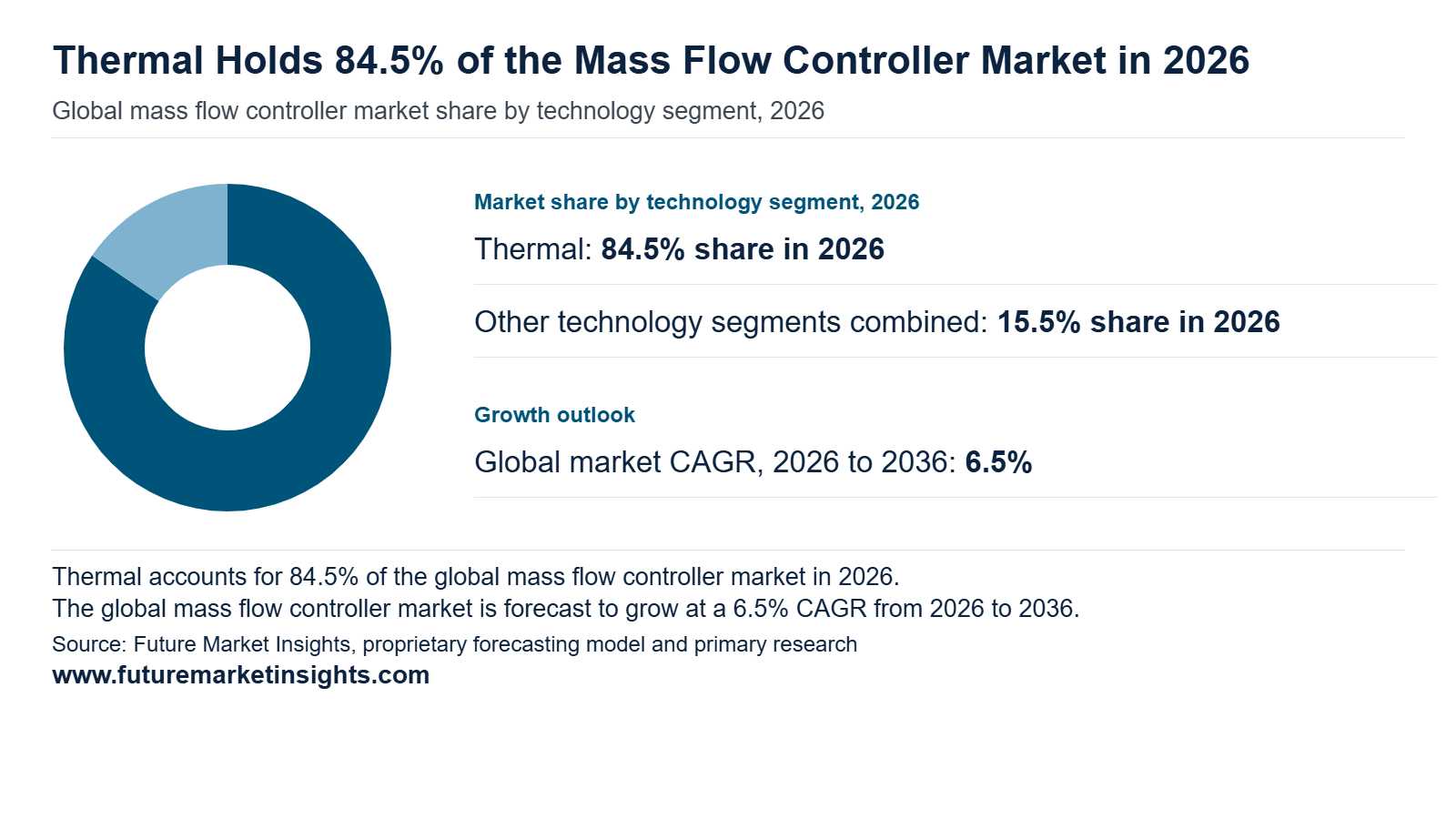
In 2026, thermal mass flow controllers hold 84.5% of technology segment share, owing to widespread buyer preference for capillary bypass and MEMS heat-transfer sensors across clean gas-dosing lines. FMI believes that thermal sensing remains the industry standard because measuring temperature gradients across a heated sensor tube delivers reliable repeatability at a lower unit price than Coriolis or laminar pressure controllers in high purity gas flow meters loops. Product specifications from Azbil Corporation (2026) on its Model F4Q and Model MQV micro-thermal controllers with 300 ms response times and Bronkhorst High-Tech B.V. (February 2025) on its surface-channel thermal FLEXI-FLOW line confirm continuous sensor upgrades. Wide multi-gas conversion libraries and compact valve integration are expected to keep thermal controllers at the top of the technology mix through 2036.
What Keeps Semiconductor Ahead Within End Use?
Purchases by semiconductor fabs and toolmakers generate 58.0% of end use demand in 2026, supported by the fact that every plasma etch, chemical vapor deposition, and atomic layer deposition chamber requires a multi-line gas delivery box. In FMI's assessment, minor flow fluctuations in precursor gas lines ruin wafer film uniformity, which compels fab equipment builders to order electropolished, metal-sealed controllers with high purity flow meters. Financial and product disclosures from MKS Inc. (August 2026) on semiconductor gas-delivery demand and HORIBA, Ltd. (January 2025) launching its 10 mm DZ-107 controller for wafer etch and deposition tools show why suppliers prioritize semiconductor qualifications. Strategic investments in 2 nm logic and HBM memory fabs are projected to sustain semiconductor end-use leadership through 2036.
Why Is 1 to 10 slm the Principal Flow Range?
Orders for 1 to 10 slm instruments represent 28.0% of flow range share in 2026, driven by mainstream process-gas dosing requirements across wafer fabrication chambers, pilot chemical reactors, and bioreactor sparging lines. According to FMI analysts, while sub-1 slm units handle trace dopant injection and units above 100 slm manage bulk carrier purge beside 3-way pilot operated directional control valves, the 1 to 10 slm bracket covers the largest share of chamber gas sticks. Technical releases from HORIBA, Ltd. (January 2025) extending compact 10 mm controller flow rates up to 20 slm and Bürkert Fluid Control Systems (2025) covering 0.01 to 100 normal liters per minute in its Type 8743/8744 series confirm heavy SKU demand across moderate flow ranges. High channel counts per gas manifold are anticipated to preserve 1 to 10 slm leadership through 2036.
How Does Stainless Steel Retain Material Leadership?
Within material options, stainless steel bodies secure 85.1% of 2026 segment share due to vacuum-melted 316L stainless steel offering high corrosion resistance, cleanroom electropolishing quality, and precision machinability for metal-sealed gas paths. FMI's demand analysis shows that buyers reserve expensive nickel alloys like Hastelloy C-22 for highly corrosive halide gases where standard steel pits, similar to specialty stainless steel control valves in sour-gas service. Technical documentation from Bürkert Fluid Control Systems (2025) on 316L stainless-steel capillary sensors in its Type 8743/8744 controllers and Fujikin Incorporated (2026) on ultra-high-purity stainless-steel semiconductor flow blocks verify this material preference. Favorable machining economics and broad gas compatibility are predicted to keep stainless steel as the dominant body material through 2036.
Regional & Country Outlook
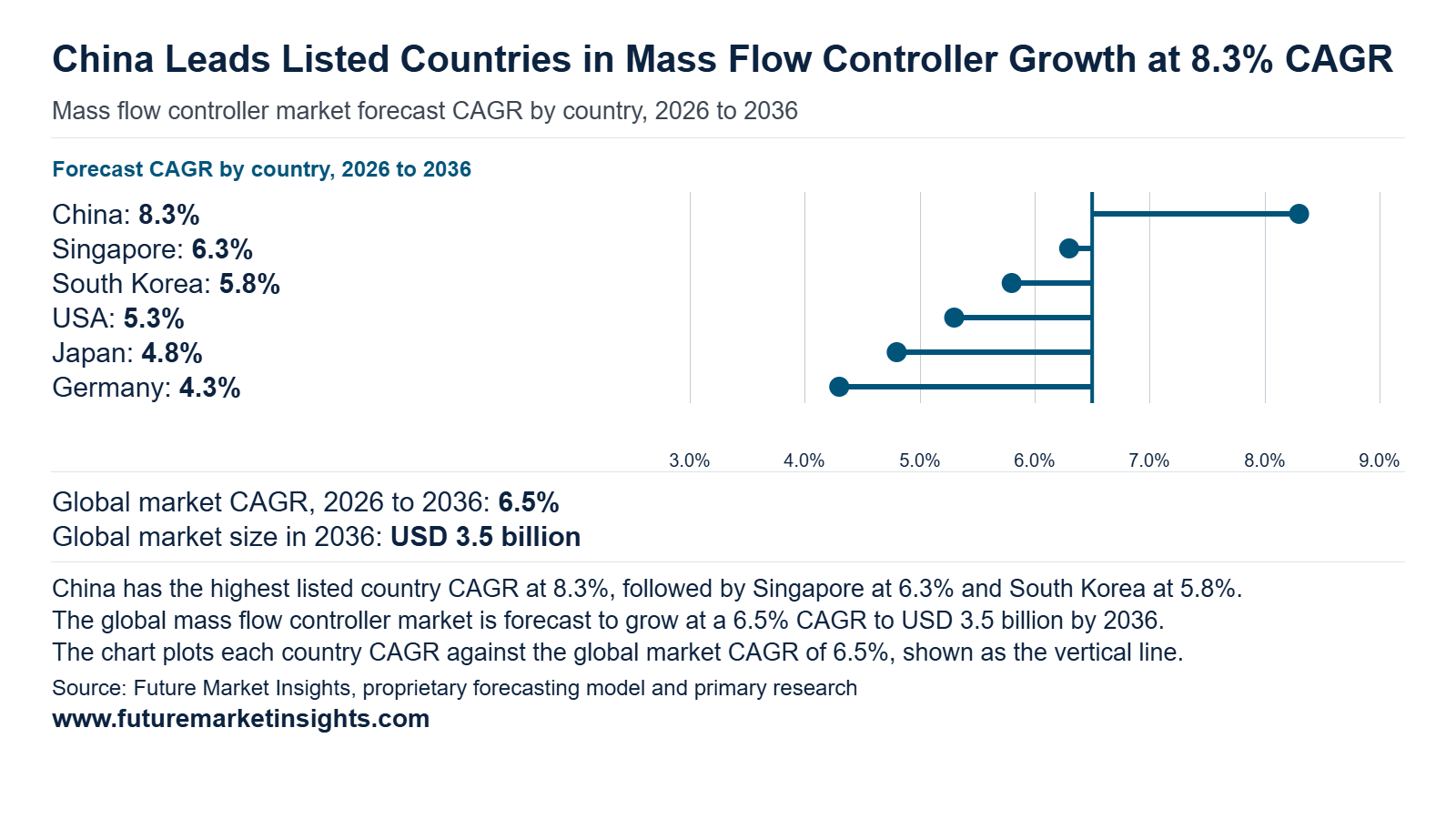
East Asia and North America anchor global mass flow controller demand, while Southeast Asia and Western Europe record steady sales tied to greenfield wafer fabs and specialty chemical automation. FMI projects China to lead national growth rates at an 8.3% CAGR from 2026 to 2036, followed by Taiwan at 6.8% and Singapore at 6.3%. Meanwhile, South Korea expands at 5.8%, the USA at 5.3%, Japan at 4.8%, and Germany at 4.3%, creating a 4.0 percentage point spread across the seven profiled countries as semiconductor and industrial buyers qualify digital gas-control platforms.
| Country | 2026 Revenue | 2036 Revenue | 10-Year Addition | 2026 to 2036 CAGR | Global Share (2026 -> 2036) |
|---|---|---|---|---|---|
| China | USD 0.4 billion | USD 0.9 billion | +USD 0.5 billion | 8.3% | 22.2% -> 25.7% |
| Taiwan | USD 0.3 billion | USD 0.6 billion | +USD 0.3 billion | 6.8% | 16.7% -> 17.1% |
| Singapore | USD 0.1 billion | USD 0.2 billion | +USD 0.1 billion | 6.3% | 5.6% -> 5.7% |
| South Korea | USD 0.2 billion | USD 0.4 billion | +USD 0.2 billion | 5.8% | 11.1% -> 11.4% |
| USA | USD 0.5 billion | USD 0.8 billion | +USD 0.3 billion | 5.3% | 27.8% -> 22.9% |
| Japan | USD 0.1 billion | USD 0.2 billion | +USD 0.1 billion | 4.8% | 5.6% -> 5.7% |
| Germany | USD 0.1 billion | USD 0.2 billion | +USD 0.1 billion | 4.3% | 5.6% -> 5.7% |
Source: Future Market Insights analysis of the mass flow controller market, 2026.
China
Demand for mass flow controller across China is projected to climb from USD 0.4 billion in 2026 to USD 0.9 billion by 2036, advancing at a 8.3% CAGR, contributing +USD 0.5 billion in incremental revenue. In FMI's assessment, China differs from Western markets due to urgent domestic tool-OEM programs that qualify both imported and local EtherCAT controllers with subsea multiphase flowmeters and chemical plant instrumentation. Industry billing records from SEMI (April 2026) confirm that China remained the top global buyer of semiconductor manufacturing equipment in 2025, while Beijing Sevenstar Flow Co., Ltd. (2026) expanded domestic supply of CS Series EtherCAT digital mass flow controllers for wafer tools. New fab construction and local OEM design wins are expected to drive sustained Chinese controller sales through 2036.
Taiwan
Demand for mass flow controller across Taiwan is forecast to advance from USD 0.3 billion in 2026 to USD 0.6 billion by 2036, advancing at a 6.8% CAGR, contributing +USD 0.3 billion in incremental revenue. FMI believes that Taiwanese buyers stand apart from industrial flow markets by ordering ultra-thin 10 mm pressure-insensitive controllers that fit high-channel-count gas boxes without expanding cleanroom space. Equipment spending logs from SEMI (April 2026) rank Taiwan among the top global wafer-fab investors, while Taiwan Semiconductor Manufacturing Company Limited (2025) documented the move of its 2 nm technology into high-volume manufacturing in its 2025 Annual Report. Continued recipe densification across Hsinchu, Taichung, and Kaohsiung fabs is projected to sustain Taiwanese demand for high-purity controllers through 2036.
Singapore
Demand for mass flow controller across Singapore is estimated to rise from USD 0.1 billion in 2026 to USD 0.2 billion by 2036, advancing at a 6.3% CAGR, contributing +USD 0.1 billion in incremental revenue. FMI observes that Singaporean fab procurement teams prioritize suppliers with local cleanroom calibration centers, drop-in manifold dimensions, and low zero-drift rates. Official government and corporate announcements from the Singapore Economic Development Board (April 2025) on UMC's new 22 nm Singapore fab expansion slated for 2026 volume production and Micron Technology, Inc. (January 2026) breaking ground on an advanced wafer fabrication plant in Singapore explain why instrument vendors are expanding Southeast Asian service hubs. New gas-panel hookups and recurring spare-parts replacements are anticipated to anchor Singaporean revenue through 2036.
South Korea
Demand for mass flow controller across South Korea is projected to expand from USD 0.2 billion in 2026 to USD 0.4 billion by 2036, advancing at a 5.8% CAGR, contributing +USD 0.2 billion in incremental revenue. FMI's analysis indicates that South Korean memory fabs differ from general industrial buyers by requiring fast 100 ms to 300 ms valve settling times to handle rapid atomic layer deposition gas pulsing. Facility disclosures from SK hynix Inc. (July 2025) on completion milestones for its Cheongju M15X DRAM and HBM fab and SK hynix Inc. (January 2026) on its HBM-led memory supercycle roadmap confirm strong domestic cleanroom tool demand. Fab upgrades toward higher-layer NAND and HBM4 stacks are expected to support steady Korean orders for high-purity controllers through 2036.
USA
Demand for mass flow controller across USA is anticipated to grow from USD 0.5 billion in 2026 to USD 0.8 billion by 2036, advancing at a 5.3% CAGR, contributing +USD 0.3 billion in incremental revenue. In FMI's view, American buyers place strong emphasis on NIST-traceable low-flow calibration, onboard multi-gas libraries, and Ethernet diagnostics. Metrology and corporate updates from the National Institute of Standards and Technology (February 2025) on its SLowFlowS 0.01 cubic centimeter per minute gas-flow standard, Taiwan Semiconductor Manufacturing Company Limited (2026) advancing its fourth Arizona fab, and Brooks Instrument (June 2026) launching the AMF Series in Pennsylvania highlight domestic supply-chain investment. Multi-year fab tool installations and bioprocess skid production are predicted to sustain American sales growth through 2036.
Japan
Demand for mass flow controller across Japan is projected to climb from USD 0.1 billion in 2026 to USD 0.2 billion by 2036, advancing at a 4.8% CAGR, contributing +USD 0.1 billion in incremental revenue. FMI expects Japanese buyers to focus on single-wafer processing speed and 200-degree-Celsius precursor delivery for next-generation logic nodes. Corporate milestones from Rapidus Corporation (July 2025) confirming 2 nm GAA transistor prototyping at its Hokkaido IIM-1 foundry and HORIBA, Ltd. (January 2025) launching its 10 mm DZ-107 controller rated up to 20 slm show close technical coordination between Japanese fabs and local instrument makers. Commercial ramp-ups across domestic 2 nm and image-sensor fabs are projected to guide Japanese demand through 2036.
Germany
Demand for mass flow controller across Germany is forecast to advance from USD 0.1 billion in 2026 to USD 0.2 billion by 2036, advancing at a 4.3% CAGR, contributing +USD 0.1 billion in incremental revenue. Analysts at FMI note that Germany records a steadier CAGR than East Asian fab hubs because industrial chemical and laboratory skids account for a larger share of national demand, where buyers prioritize 316L capillary corrosion resistance and ATEX certifications. Technical disclosures from Bürkert Fluid Control Systems (June 2025) on automated bioreactor fermentation gas dosing and Bronkhorst High-Tech B.V. (January 2025) on compact European analytical flow controllers illustrate this broad industrial base. Long-term chemical, hydrogen, and Dresden cleanroom upgrades are expected to sustain German orders through 2036.
Competitive Environment and Notable Companies
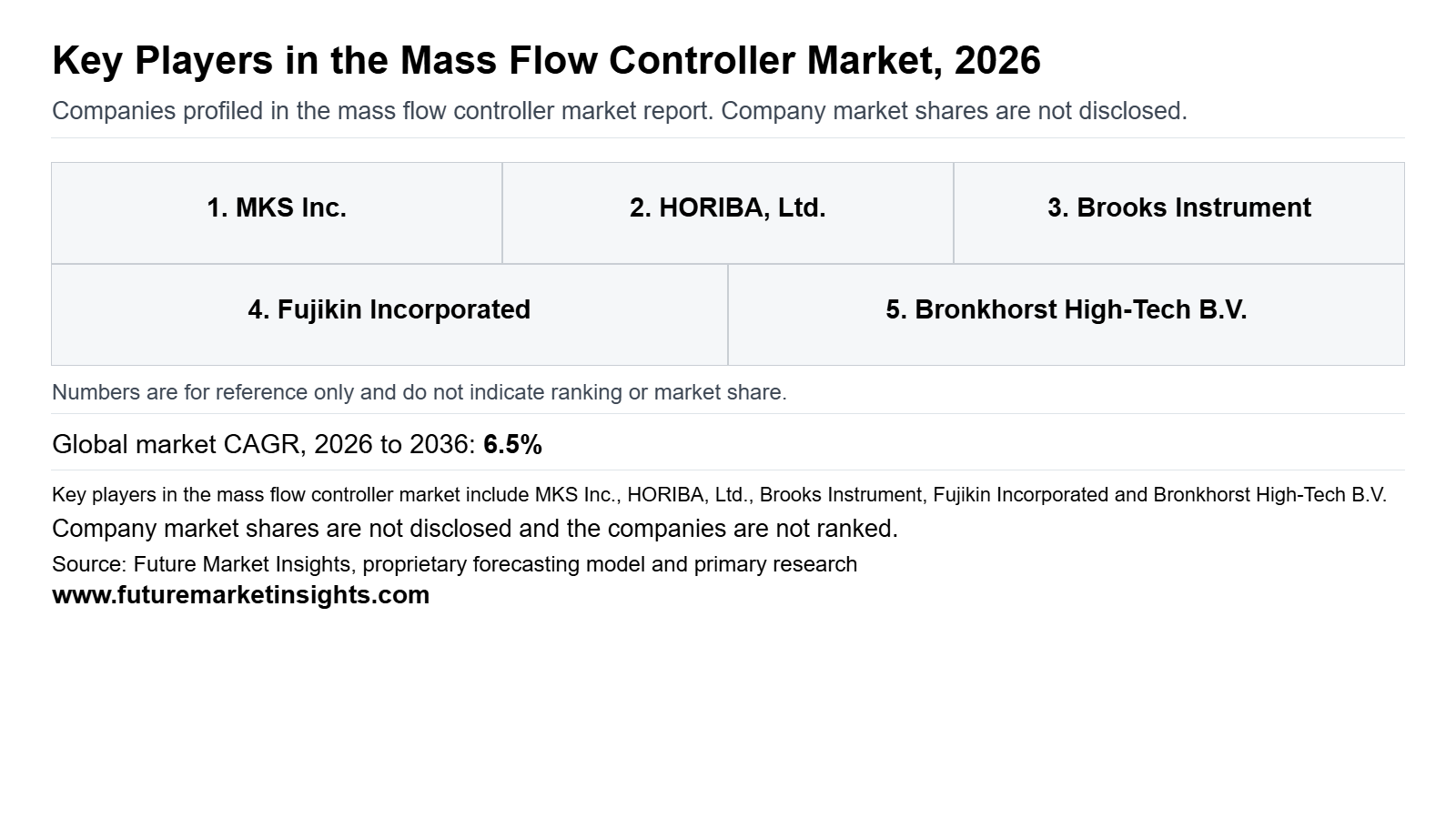
Notable companies operating in the global mass flow controller market include MKS Inc., HORIBA, Ltd., Brooks Instrument, Fujikin Incorporated, Bronkhorst High-Tech B.V., Azbil Corporation, Alicat Scientific, Inc., Proterial, Ltd., Bürkert Fluid Control Systems, and Beijing Sevenstar Flow Co., Ltd. Competition spans three commercial tiers covering ultra-high-purity semiconductor gas-panel specialists, industrial process and bioreactor automation suppliers, and configurable multi-gas and Coriolis low-flow platform builders.
How Are Companies Positioned in the Mass Flow Controller Market?
Ultra-high-purity semiconductor gas-control leaders including HORIBA, Ltd., MKS Inc., Brooks Instrument, Fujikin Incorporated, Proterial, Ltd., and Beijing Sevenstar Flow Co., Ltd. anchor wafer-fab positioning through metal-sealed, pressure-insensitive, and high-temperature controller families. Azbil Corporation and Bürkert Fluid Control Systems concentrate on industrial burner, chemical, and bioreactor automation, while Bronkhorst High-Tech B.V. and Alicat Scientific, Inc. lead in configurable MEMS, laminar differential-pressure, and Coriolis controllers.
What Matters When a Buyer Selects a Mass Flow Controller Supplier?
Semiconductor tool engineers and plant instrumentation buyers evaluate suppliers on zero-point stability, valve leak-by rates below 0.005 sccm, live-gas conversion accuracy, and 316L or Hastelloy wetted-surface cleanliness. Wafer-fab OEMs prioritize 10 mm compact widths and high-speed EtherCAT synchronization from HORIBA, Ltd., MKS Inc., and Brooks Instrument, whereas analytical and hydrogen equipment builders value onboard gas-select libraries and ATEX hazardous-location approvals.
Which Capabilities Distinguish Product Offers?
Product differentiation centers on sensing architecture, turndown ratio, and operating temperature limits. HORIBA, Ltd. (January 2025) distinguishes its DZ-107 model with a 20 slm flow rating inside a 10 mm width, while Brooks Instrument (June 2026) offers 1,000:1 turndown and embedded Ethernet web diagnostics in its AMF Series. Alicat Scientific, Inc. (April 2025) differentiates its laminar DP line with 30 ms response and flows up to 12,000 slm, while Bronkhorst High-Tech B.V. (February 2025) integrates flow, pressure, and temperature sensing in FLEXI-FLOW.
How Does Geographic Reach Affect Competition?
Vendors operating regional cleanroom calibration and repair centers across East Asia, North America, and Europe win preferred-supplier status because fab downtime requires rapid swap-out support. HORIBA, Ltd. and MKS Inc. maintain extensive manufacturing and calibration networks across Japan, the USA, China, South Korea, and Taiwan, while Brooks Instrument, Bronkhorst High-Tech B.V., and Bürkert Fluid Control Systems combine North American, European, and Asian technical centers.
| Verified Company Evidence (2025 to 2026) | Commercial Effect | Buyer Action |
|---|---|---|
| June 2026: Brooks Instrument launched its ultra-compact AMF Series digital mass flow controller with 1,000:1 turndown and <0.005 sccm leak-by (Brooks Instrument, June 2026). | Reduces gas-panel footprint and consolidates multiple flow-range SKUs into one digital device. | Specify wide-turndown compact controllers to shrink OEM gas cabinets and simplify spare-parts stocking. |
| April 2025: Alicat Scientific, Inc. expanded its laminar differential-pressure mass flow controller range to 12,000 slm with 130 onboard gas calibrations (Alicat Scientific, Inc., April 2025). | Extends fast-response multi-gas control into high-volume industrial, hydrogen, and test-stand lines. | Use onboard multi-gas libraries to reconfigure analytical and industrial skids without factory recalibration. |
| January 2025: HORIBA, Ltd. released the DZ-107 ultra-thin 10 mm mass flow controller supporting up to 20.0 slm and EtherCAT communication (HORIBA, Ltd., January 2025). | Delivers high flow capacity inside a 10 mm width for dense semiconductor etch and deposition gas boxes. | Qualify 10 mm EtherCAT controllers when adding precursor channels to space-constrained 300 mm wafer tools. |
Source: Verified corporate disclosures and Future Market Insights analysis, 2026.
| Company | Core Positioning | Verified Activity & Source Attribution |
|---|---|---|
| MKS Inc. | High-purity thermal and pressure-based semiconductor mass flow controllers | Reported strong semiconductor gas-delivery demand in its August 2026 Q2 and November 2026 Q3 financial disclosures (MKS Inc., August 2026). |
| HORIBA, Ltd. | Semiconductor fluid control leader (~60% global MFC share); DZ-107 ultra-thin series | Launched the DZ-107 10 mm ultra-thin mass flow controller rated up to 20.0 slm with EtherCAT support in January 2025 (HORIBA, Ltd., January 2025). |
| Brooks Instrument | Ultra-compact digital, thermal, and Coriolis mass flow controllers | Released the ultra-compact AMF Series with 1,000:1 turndown and embedded web diagnostics in June 2026 (Brooks Instrument, June 2026). |
| Fujikin Incorporated | Ultra-high-purity semiconductor mass flow controllers and integrated gas panels | Supplies electropolished stainless-steel mass flow controllers and valve blocks for global wafer fab OEMs (Fujikin Incorporated, 2026). |
| Bronkhorst High-Tech B.V. | FLEXI-FLOW surface-channel thermal, IQ+FLOW MEMS, and mini CORI-FLOW Coriolis controllers | Published technical updates on FLEXI-FLOW multi-parameter and IQ+FLOW microfluidic controllers in January and February 2025 (Bronkhorst High-Tech B.V., February 2025). |
| Azbil Corporation | Model F4Q and Model MQV micro-thermal digital mass flow controllers | Supplies 300 ms fast-response digital thermal mass flow controllers for industrial and semiconductor automation (Azbil Corporation, 2026). |
| Alicat Scientific, Inc. | Laminar differential-pressure, MEMS thermal, and CODA Coriolis controllers | Expanded laminar DP controller capacity to 12,000 slm in April 2025 and updated multi-technology lines in June 2025 (Alicat Scientific, Inc., April 2025). |
| Proterial, Ltd. | Aera and SAM semiconductor mass flow controllers; SFC1772FX high-temperature series | Supplies 200 degrees C ultra-high-temperature mass flow controllers for low-vapor-pressure semiconductor precursors (Proterial, Ltd., 2026). |
| Bürkert Fluid Control Systems | Type 8743/8744 316L capillary thermal controllers for aggressive gases and bioreactors | Published automated bioreactor fermentation mass flow control application guidelines in June 2025 (Bürkert Fluid Control Systems, June 2025). |
| Beijing Sevenstar Flow Co., Ltd. | CS Series EtherCAT digital mass flow controllers under NAURA / AURASKY | Supplies domestic high-purity digital mass flow controllers for Chinese semiconductor etch and CVD tools (Beijing Sevenstar Flow Co., Ltd., 2026). |
Source: Verified corporate disclosures and Future Market Insights analysis, 2026.
Key takeaways from the Mass Flow Controller Market Report
- The market is estimated at USD 1.8 billion in 2026, on track to reach USD 3.5 billion by 2036.
- Over the ten-year forecast period, the market is expected to add USD 1.7 billion at a 6.5% CAGR.
- The technology segment is led by thermal controllers at 84.5% share in 2026.
- 58.0% of end use share goes to semiconductor manufacturing in 2026.
- China is forecast to grow at a notable 8.3% CAGR, ahead of Taiwan at 6.8% and Singapore at 6.3%.
Mass Flow Controller Market Report Scope and Research Methodology
FMI analysts size the global mass flow controller market through primary interviews with semiconductor gas-panel engineers, instrument product managers, bioprocess skid integrators, and metrology specialists, paired with desk research across semiconductor equipment billing logs, national metrology institute publications, and corporate financial filings. Base 2025 and 2026 valuations reconcile controller unit shipments and average selling prices across semiconductor, industrial, and laboratory channels in all seven profiled countries and regional clusters. Segment shares across technology, end use, flow range, and material axes are validated against OEM gas-box architectures, while excluding standalone flow meters without control valves, separate pressure regulators, and downstream wafer-processing equipment revenues to prevent double counting.
| Coverage Field | Report Scope |
|---|---|
| Market Definition | Revenue from mass flow controller hardware combining flow sensing, feedback electronics, and proportional control valves for gas and liquid dosing. |
| Technology Segments | Thermal, Pressure-Based, and Coriolis. |
| End Use Segments | Semiconductor, Industrial and Chemical, Analytical and Laboratory, Solar and Display, and Medical and Others. |
| Flow Range Segments | 1 to 10 slm, 10 to 100 slm, Below 1 slm, and Above 100 slm. |
| Material Segments | Stainless Steel, Hastelloy and Exotic Alloys, and Titanium and Coated Bodies. |
| Exclusions | Downstream semiconductor and industrial process equipment, standalone mass flow meters without control valves, separate pressure regulators, and standalone calibration services. |
| Quantitative Units | USD Billion for global market sizing; percentage shares and CAGRs for segment and country benchmarks. |
| Historical & Base Years | 2025 (Historical) and 2026 (Estimated Base Year). |
| Forecast Period | 2026 to 2036 (10-Year Projection Window). |
| Regions Covered | North America, Latin America, Western Europe, Eastern Europe, East Asia, South Asia and Pacific, and Middle East and Africa. |
| Countries Profiled | China, Taiwan, Singapore, South Korea, USA, Japan, and Germany. |
| Companies Covered | MKS Inc., HORIBA, Ltd., Brooks Instrument, Fujikin Incorporated, Bronkhorst High-Tech B.V., Azbil Corporation, Alicat Scientific, Inc., Proterial, Ltd., Bürkert Fluid Control Systems, and Beijing Sevenstar Flow Co., Ltd. |
| Research Approach | Primary OEM gas-panel and instrumentation buyer interviews combined with secondary metrology, trade association, and corporate disclosure triangulation. |
Source: Future Market Insights analysis of the mass flow controller market, 2026.
Research Sources and Bibliography
- Alicat Scientific, Inc. (2025, April 30). Alicat Increases Mass Flow Range to 12,000 SLPM. https://www.alicat.com/articles/alicat-increases-mass-flow-range-to-12000-slpm/
- Alicat Scientific, Inc. (2025, June). Mass Flow Meter and Controller Technologies: Laminar Differential Pressure, Coriolis and Thermal MEMS. https://www.alicat.com/support/mass-flow-meter-technologies/
- Azbil Corporation. (2026). Digital Mass Flow Controller Model F4Q and Model MQV Micro-Thermal Sensor Specifications. https://aa-industrial.azbil.com/en/products/flow-sensor/mass-flow-controller
- Beijing Sevenstar Flow Co., Ltd. (2026). CS Series EtherCAT Digital Mass Flow Controllers for Semiconductor Equipment. https://www.ethercat.org.cn/en/products/BE1B5412C2E94C86A34B2473160D2085.htm
- Bürkert Fluid Control Systems. (2025). Thermal Mass Flow Controllers and Meters with 316L Capillary Sensor for Aggressive Gases (Type 8743/8744). https://www.burkert.com/en/company-career/what-s-new/news/thermal-mass-flow-controllers-and-meters-with-capillary-sensor-for-aggressive-gases-and-gas-mixtures
- Bürkert Fluid Control Systems. (2025, June). Flow Control in Laboratory Equipment and Bioreactor Fermentation Processes. https://www.burkert.com/en/content/download/269366/file/flyer_01304_2025_Application-Flyer-Lab-Equipment-Fermentation_pdf-web_en-GB.pdf?inLanguage=eng-INT&version=15
- Bronkhorst High-Tech B.V. (2025, January 23). Miniaturization in Flow Solutions: IQ+FLOW Microfluidic and Compact Mass Flow Controllers. https://www.bronkhorst.com/products/gas-flow/iqplusflow/
- Bronkhorst High-Tech B.V. (2025, February 20). Flow Sensor with Surface Channel Technology: FLEXI-FLOW Compact Multi-Parameter Mass Flow Controller. https://www.bronkhorst.com/knowledge-base/mass-flow-control-redefined/
- Brooks Instrument. (2026, June 18). Brooks Instrument Launches Ultra-Compact, High-Performance Mass Flow Controllers (AMF Series). https://www.brooksinstrument.com/company/news/brooks-instrument-launches-ultra-compact-high-performance-mass-flow-controllers
- Fujikin Incorporated. (2026). Ultra-High-Purity Mass Flow Controllers and Semiconductor Fluid Control Systems. https://www.fujikin.co.jp/en/product/products/list?category_id=100
- HORIBA, Ltd. (2025, January 14). Release of the DZ-107 Ultra-thin Mass Flow Controller. https://www.horiba.com/int/company/news/detail/news/1/2025/20250114dz/
- Micron Technology, Inc. (2026, January 27). Micron Breaks Ground on Advanced Wafer Fabrication Facility in Singapore. https://investors.micron.com/news/press-release/2026/Micron-Breaks-Ground-on-Advanced-Wafer-Fabrication-Facility-in-Singapore-01-26-2026/default.aspx
- MKS Inc. (2026, August 5). MKS Inc. Reports Second Quarter 2026 Financial Results and Semiconductor Flow Control Performance. https://investor.mks.com/news-releases/news-release-details/mks-inc-reports-second-quarter-2026-financial-results
- MKS Inc. (2026). Mass Flow Controllers and Semiconductor Gas Delivery Solutions. https://www.mks.com/c/mass-flow-controllers
- National Institute of Standards and Technology. (2025, February 20). Standards and Models for Flow Metering Semiconductor Gases at Low Flow Rates (SLowFlowS). https://www.nist.gov/programs-projects/gas-flow-and-properties-standards-and-models-flow-metering-semiconductor-gases
- Proterial, Ltd. (2026). Mass Flow Controllers: Aera, SAM and Ultra-High-Temperature SFC1772FX Product Specifications. https://www.china.proterial.com/category/%E4%BA%A7%E5%93%81%E4%BB%8B%E7%BB%8D/%E8%B4%A8%E9%87%8F%E6%B5%81%E9%87%8F%E6%8E%A7%E5%88%B6%E5%99%A8
- Rapidus Corporation. (2025, July 18). Rapidus Achieves Significant Milestone at its IIM-1 Foundry with Prototyping of 2nm GAA Transistors. https://www.rapidus.inc/en/news_topics/information/rapidus-achieves-significant-milestone-at-its-state-of-the-art-foundry-with-prototyping-of-leading-edge-2nm-gaa-transistors/
- SEMI. (2026, April 1). SEMI Projects Double-Digit Growth in Global 300mm Fab Equipment Spending for 2026 and 2027. https://www.semi.org/en/semi-press-release/semi-projects-double-digit-growth-in-global-300mm-fab-equipment-spending-for-2026-and-2027
- SEMI. (2026, April 7). SEMI Reports Global Semiconductor Equipment Billings Reached $135 Billion in 2025, Up 15% Year-on-Year. https://www.semi.org/en/SEMI-Reports-Global-Semiconductor-Equipment-Billings-Reached-135-Billion-in-2025
- SEMI. (2026, July 14). Global Semiconductor Equipment Sales Forecast to Reach a Record $229 Billion in 2028, SEMI Reports. https://www.semi.org/en/semi-press-release/global-semiconductor-equipment-sales-forecast-to-reach-a-record-229-billion-dollars-in-2028-semi-reports
- Singapore Economic Development Board. (2025, April 1). UMC Unveils New Fab Expansion in Singapore in Grand Opening Ceremony. https://www.edb.gov.sg/en/about-edb/media-releases-publications/umc-unveils-new-fab-expansion-in-singapore.html
- SK hynix Inc. (2025, July 16). One-Team Spirit: Cheongju M15X DRAM and HBM Fab Construction and TSV Expansion. https://news.skhynix.com/en/one-team-spirit-vision-for-a-tech-revolution/
- SK hynix Inc. (2026, January 5). 2026 Market Outlook: Focus on the HBM-Led Memory Supercycle. https://news.skhynix.com/en/2026-market-outlook-focus-on-the-hbm-led-memory-supercycle/
- Taiwan Semiconductor Manufacturing Company Limited. (2025). TSMC 2025 Annual Report: 2nm Technology High-Volume Manufacturing and Global Fab Operations. https://investor.tsmc.com/static/annualReports/2025/english/index.html
- Taiwan Semiconductor Manufacturing Company Limited. (2026). TSMC Arizona: Leading-Edge Multi-Fab and Advanced Packaging Construction Update. https://www.tsmc.com/static/abouttsmcaz/index.htm
Table of Content
- Key Takeaways
- Market Size and CAGR
- Top Growth Driver
- Fastest Growing Segment
- Leading Region
- Key Companies
- Emerging Opportunities
- Executive Summary
- Global Market Outlook
- Demand-side Trends
- Supply-side Trends
- Technology Roadmap Analysis
- Analysis and Recommendations
- Analyst Perspective (What is happening? Why now? What should investors know?)
- Key Questions Answered
- How large is the market?
- What is the CAGR?
- What are key trends?
- Which region dominates?
- Who are the leaders?
Read More...
- Market Overview
- Market Coverage / Taxonomy
- Market Definition / Scope / Limitations
- Research Methodology
- Chapter Orientation
- Analytical Lens and Working Hypotheses
- Market Structure, Signals, and Trend Drivers
- Benchmarking and Cross-market Comparability
- Market Sizing, Forecasting, and Opportunity Mapping
- Research Design and Evidence Framework
- Desk Research Programme (Secondary Evidence)
- Expert Input and Fieldwork (Primary Evidence)
- Tooling, Models, and Reference Databases
- Data Engineering and Model Build
- Quality Assurance and Audit Trail
- Market Background
- Market Dynamics (Drivers, Restraints, Opportunity, Trends)
- Scenario Forecast (Optimistic, Likely, Conservative)
- Impact Analysis
- AI Impact
- Sustainability Impact
- Regulatory Impact
- Technology Impact
- Consumer / Buyer Analysis
- Purchase Drivers
- Adoption Barriers
- Buyer Journey
- Opportunity Map Analysis
- Product Life Cycle Analysis
- Supply Chain Analysis
- Investment Feasibility Matrix
- Value Chain Analysis
- PESTLE and Porter's Analysis
- Regulatory Landscape
- Regional Parent Market Outlook
- Production and Consumption Statistics
- Import and Export Statistics
- Global Market Analysis and Forecast, 2021 to 2036
- Historical Market Size Value (USD Billion) Analysis, 2021 to 2025
- Current and Future Market Size Value (USD Billion) Projections, 2026 to 2036
- Y-o-Y Growth Trend Analysis
- Absolute $ Opportunity Analysis
- Global Market Pricing Analysis, 2021 to 2036
- Global Market Analysis and Forecast, By Technology, 2021 to 2036
- Introduction / Key Findings
- Historical Market Size Value (USD Billion) Analysis By Technology, 2021 to 2025
- Current and Future Market Size Value (USD Billion) Analysis and Forecast By Technology, 2026 to 2036
- Thermal
- Pressure-Based
- Coriolis
- Y-o-Y Growth Trend Analysis By Technology, 2021 to 2025
- Absolute $ Opportunity Analysis By Technology, 2026 to 2036
- Global Market Analysis and Forecast, By End Use, 2021 to 2036
- Introduction / Key Findings
- Historical Market Size Value (USD Billion) Analysis By End Use, 2021 to 2025
- Current and Future Market Size Value (USD Billion) Analysis and Forecast By End Use, 2026 to 2036
- Semiconductor
- Industrial and Chemical
- Analytical and Laboratory
- Solar and Display
- Medical and Others
- Y-o-Y Growth Trend Analysis By End Use, 2021 to 2025
- Absolute $ Opportunity Analysis By End Use, 2026 to 2036
- Global Market Analysis and Forecast, By Flow Range, 2021 to 2036
- Introduction / Key Findings
- Historical Market Size Value (USD Billion) Analysis By Flow Range, 2021 to 2025
- Current and Future Market Size Value (USD Billion) Analysis and Forecast By Flow Range, 2026 to 2036
- 1 to 10 slm
- 10 to 100 slm
- Below 1 slm
- Above 100 slm
- Y-o-Y Growth Trend Analysis By Flow Range, 2021 to 2025
- Absolute $ Opportunity Analysis By Flow Range, 2026 to 2036
- Global Market Analysis and Forecast, By Material, 2021 to 2036
- Introduction / Key Findings
- Historical Market Size Value (USD Billion) Analysis By Material, 2021 to 2025
- Current and Future Market Size Value (USD Billion) Analysis and Forecast By Material, 2026 to 2036
- Stainless Steel
- Hastelloy and Exotic Alloys
- Titanium and Coated Bodies
- Y-o-Y Growth Trend Analysis By Material, 2021 to 2025
- Absolute $ Opportunity Analysis By Material, 2026 to 2036
- Global Market Analysis and Forecast, By Region, 2021 to 2036
- Introduction
- Historical Market Size Value (USD Billion) Analysis By Region, 2021 to 2025
- Current Market Size Value (USD Billion) Analysis and Forecast By Region, 2026 to 2036
- North America
- Western Europe
- East Asia
- South Asia and Pacific
- Market Attractiveness Analysis By Region
- North America Market Analysis and Forecast, By Country, 2021 to 2036
- Historical Market Size Value (USD Billion) Trend Analysis By Market Taxonomy, 2021 to 2025
- Market Size Value (USD Billion) Forecast By Market Taxonomy, 2026 to 2036
- By Country
- United States
- Canada
- By Technology
- By End Use
- By Flow Range
- By Material
- By Country
- Market Attractiveness Analysis
- By Country
- By Technology
- By End Use
- By Flow Range
- By Material
- Key Takeaways
- Western Europe Market Analysis and Forecast, By Country
- Historical Market Size Value (USD Billion) Trend Analysis By Market Taxonomy, 2021 to 2025
- Market Size Value (USD Billion) Forecast By Market Taxonomy, 2026 to 2036
- By Country
- United Kingdom
- Germany
- France
- By Technology
- By End Use
- By Flow Range
- By Material
- By Country
- Market Attractiveness Analysis
- By Country
- By Technology
- By End Use
- By Flow Range
- By Material
- Key Takeaways
- East Asia Market Analysis and Forecast, By Country
- Historical Market Size Value (USD Billion) Trend Analysis By Market Taxonomy, 2021 to 2025
- Market Size Value (USD Billion) Forecast By Market Taxonomy, 2026 to 2036
- By Country
- China
- Japan
- South Korea
- By Technology
- By End Use
- By Flow Range
- By Material
- By Country
- Market Attractiveness Analysis
- By Country
- By Technology
- By End Use
- By Flow Range
- By Material
- Key Takeaways
- South Asia and Pacific Market Analysis and Forecast, By Country
- Historical Market Size Value (USD Billion) Trend Analysis By Market Taxonomy, 2021 to 2025
- Market Size Value (USD Billion) Forecast By Market Taxonomy, 2026 to 2036
- By Country
- India
- Australia
- Rest of world aggregate
- By Technology
- By End Use
- By Flow Range
- By Material
- By Country
- Market Attractiveness Analysis
- By Country
- By Technology
- By End Use
- By Flow Range
- By Material
- Key Takeaways
- Key Countries Market Analysis
- United States
- Pricing Analysis
- Market Share Analysis, 2025
- By Technology
- By End Use
- By Flow Range
- By Material
- Canada
- Pricing Analysis
- Market Share Analysis, 2025
- By Technology
- By End Use
- By Flow Range
- By Material
- Germany
- Pricing Analysis
- Market Share Analysis, 2025
- By Technology
- By End Use
- By Flow Range
- By Material
- United Kingdom
- Pricing Analysis
- Market Share Analysis, 2025
- By Technology
- By End Use
- By Flow Range
- By Material
- France
- Pricing Analysis
- Market Share Analysis, 2025
- By Technology
- By End Use
- By Flow Range
- By Material
- India
- Pricing Analysis
- Market Share Analysis, 2025
- By Technology
- By End Use
- By Flow Range
- By Material
- China
- Pricing Analysis
- Market Share Analysis, 2025
- By Technology
- By End Use
- By Flow Range
- By Material
- Japan
- Pricing Analysis
- Market Share Analysis, 2025
- By Technology
- By End Use
- By Flow Range
- By Material
- South Korea
- Pricing Analysis
- Market Share Analysis, 2025
- By Technology
- By End Use
- By Flow Range
- By Material
- Australia
- Pricing Analysis
- Market Share Analysis, 2025
- By Technology
- By End Use
- By Flow Range
- By Material
- United States
- Market Structure Analysis
- Competition Dashboard
- Competition Benchmarking
- Market Share Analysis of Top Players
- By Regional
- By Technology
- By End Use
- By Flow Range
- By Material
- Emerging Startups
- Innovation Benchmarking
- Competition Analysis
- Competition Deep Dive
- MKS Inc.
- Overview
- Product Portfolio
- Profitability by Market Segments
- Sales Footprint
- Strategy Overview
- Marketing Strategy
- Product Strategy
- Channel Strategy
- HORIBA, Ltd.
- Brooks Instrument
- Fujikin Incorporated
- Bronkhorst High-Tech B.V.
- Azbil Corporation
- Alicat Scientific, Inc.
- Proterial, Ltd.
- Bürkert Fluid Control Systems
- Beijing Sevenstar Flow Co., Ltd.
- MKS Inc.
- Case Studies
- Success Stories
- Recent Developments
- Competition Deep Dive
- Assumptions & Acronyms Used
List of Tables
- Table 1: Global Market Value (USD Billion) Forecast by Region, 2021 to 2036
- Table 2: Global Market Value (USD Billion) Forecast by Technology, 2021 to 2036
- Table 3: Global Market Value (USD Billion) Forecast by End Use, 2021 to 2036
- Table 4: Global Market Value (USD Billion) Forecast by Flow Range, 2021 to 2036
- Table 5: Global Market Value (USD Billion) Forecast by Material, 2021 to 2036
- Table 6: North America Market Value (USD Billion) Forecast by Country, 2021 to 2036
- Table 7: North America Market Value (USD Billion) Forecast by Technology, 2021 to 2036
- Table 8: North America Market Value (USD Billion) Forecast by End Use, 2021 to 2036
- Table 9: North America Market Value (USD Billion) Forecast by Flow Range, 2021 to 2036
- Table 10: North America Market Value (USD Billion) Forecast by Material, 2021 to 2036
- Table 11: Western Europe Market Value (USD Billion) Forecast by Country, 2021 to 2036
- Table 12: Western Europe Market Value (USD Billion) Forecast by Technology, 2021 to 2036
- Table 13: Western Europe Market Value (USD Billion) Forecast by End Use, 2021 to 2036
- Table 14: Western Europe Market Value (USD Billion) Forecast by Flow Range, 2021 to 2036
- Table 15: Western Europe Market Value (USD Billion) Forecast by Material, 2021 to 2036
- Table 16: East Asia Market Value (USD Billion) Forecast by Country, 2021 to 2036
- Table 17: East Asia Market Value (USD Billion) Forecast by Technology, 2021 to 2036
- Table 18: East Asia Market Value (USD Billion) Forecast by End Use, 2021 to 2036
- Table 19: East Asia Market Value (USD Billion) Forecast by Flow Range, 2021 to 2036
- Table 20: East Asia Market Value (USD Billion) Forecast by Material, 2021 to 2036
- Table 21: South Asia and Pacific Market Value (USD Billion) Forecast by Country, 2021 to 2036
- Table 22: South Asia and Pacific Market Value (USD Billion) Forecast by Technology, 2021 to 2036
- Table 23: South Asia and Pacific Market Value (USD Billion) Forecast by End Use, 2021 to 2036
- Table 24: South Asia and Pacific Market Value (USD Billion) Forecast by Flow Range, 2021 to 2036
- Table 25: South Asia and Pacific Market Value (USD Billion) Forecast by Material, 2021 to 2036
List of Figures
- Figure 1: Global Market Pricing Analysis
- Figure 2: Global Market Value (USD Billion) Forecast 2021-2036
- Figure 3: Global Market Value Share and BPS Analysis by Technology, 2026 and 2036
- Figure 4: Global Market Y-o-Y Growth Comparison by Technology, 2026-2036
- Figure 5: Global Market Attractiveness Analysis by Technology
- Figure 6: Global Market Value Share and BPS Analysis by End Use, 2026 and 2036
- Figure 7: Global Market Y-o-Y Growth Comparison by End Use, 2026-2036
- Figure 8: Global Market Attractiveness Analysis by End Use
- Figure 9: Global Market Value Share and BPS Analysis by Flow Range, 2026 and 2036
- Figure 10: Global Market Y-o-Y Growth Comparison by Flow Range, 2026-2036
- Figure 11: Global Market Attractiveness Analysis by Flow Range
- Figure 12: Global Market Value Share and BPS Analysis by Material, 2026 and 2036
- Figure 13: Global Market Y-o-Y Growth Comparison by Material, 2026-2036
- Figure 14: Global Market Attractiveness Analysis by Material
- Figure 15: Global Market Value (USD Billion) Share and BPS Analysis by Region, 2026 and 2036
- Figure 16: Global Market Y-o-Y Growth Comparison by Region, 2026-2036
- Figure 17: Global Market Attractiveness Analysis by Region
- Figure 18: North America Market Incremental Dollar Opportunity, 2026-2036
- Figure 19: Western Europe Market Incremental Dollar Opportunity, 2026-2036
- Figure 20: East Asia Market Incremental Dollar Opportunity, 2026-2036
- Figure 21: South Asia and Pacific Market Incremental Dollar Opportunity, 2026-2036
- Figure 22: North America Market Value Share and BPS Analysis by Country, 2026 and 2036
- Figure 23: North America Market Value Share and BPS Analysis by Technology, 2026 and 2036
- Figure 24: North America Market Y-o-Y Growth Comparison by Technology, 2026-2036
- Figure 25: North America Market Attractiveness Analysis by Technology
- Figure 26: North America Market Value Share and BPS Analysis by End Use, 2026 and 2036
- Figure 27: North America Market Y-o-Y Growth Comparison by End Use, 2026-2036
- Figure 28: North America Market Attractiveness Analysis by End Use
- Figure 29: North America Market Value Share and BPS Analysis by Flow Range, 2026 and 2036
- Figure 30: North America Market Y-o-Y Growth Comparison by Flow Range, 2026-2036
- Figure 31: North America Market Attractiveness Analysis by Flow Range
- Figure 32: North America Market Value Share and BPS Analysis by Material, 2026 and 2036
- Figure 33: North America Market Y-o-Y Growth Comparison by Material, 2026-2036
- Figure 34: North America Market Attractiveness Analysis by Material
- Figure 35: Western Europe Market Value Share and BPS Analysis by Country, 2026 and 2036
- Figure 36: Western Europe Market Value Share and BPS Analysis by Technology, 2026 and 2036
- Figure 37: Western Europe Market Y-o-Y Growth Comparison by Technology, 2026-2036
- Figure 38: Western Europe Market Attractiveness Analysis by Technology
- Figure 39: Western Europe Market Value Share and BPS Analysis by End Use, 2026 and 2036
- Figure 40: Western Europe Market Y-o-Y Growth Comparison by End Use, 2026-2036
- Figure 41: Western Europe Market Attractiveness Analysis by End Use
- Figure 42: Western Europe Market Value Share and BPS Analysis by Flow Range, 2026 and 2036
- Figure 43: Western Europe Market Y-o-Y Growth Comparison by Flow Range, 2026-2036
- Figure 44: Western Europe Market Attractiveness Analysis by Flow Range
- Figure 45: Western Europe Market Value Share and BPS Analysis by Material, 2026 and 2036
- Figure 46: Western Europe Market Y-o-Y Growth Comparison by Material, 2026-2036
- Figure 47: Western Europe Market Attractiveness Analysis by Material
- Figure 48: East Asia Market Value Share and BPS Analysis by Country, 2026 and 2036
- Figure 49: East Asia Market Value Share and BPS Analysis by Technology, 2026 and 2036
- Figure 50: East Asia Market Y-o-Y Growth Comparison by Technology, 2026-2036
- Figure 51: East Asia Market Attractiveness Analysis by Technology
- Figure 52: East Asia Market Value Share and BPS Analysis by End Use, 2026 and 2036
- Figure 53: East Asia Market Y-o-Y Growth Comparison by End Use, 2026-2036
- Figure 54: East Asia Market Attractiveness Analysis by End Use
- Figure 55: East Asia Market Value Share and BPS Analysis by Flow Range, 2026 and 2036
- Figure 56: East Asia Market Y-o-Y Growth Comparison by Flow Range, 2026-2036
- Figure 57: East Asia Market Attractiveness Analysis by Flow Range
- Figure 58: East Asia Market Value Share and BPS Analysis by Material, 2026 and 2036
- Figure 59: East Asia Market Y-o-Y Growth Comparison by Material, 2026-2036
- Figure 60: East Asia Market Attractiveness Analysis by Material
- Figure 61: South Asia and Pacific Market Value Share and BPS Analysis by Country, 2026 and 2036
- Figure 62: South Asia and Pacific Market Value Share and BPS Analysis by Technology, 2026 and 2036
- Figure 63: South Asia and Pacific Market Y-o-Y Growth Comparison by Technology, 2026-2036
- Figure 64: South Asia and Pacific Market Attractiveness Analysis by Technology
- Figure 65: South Asia and Pacific Market Value Share and BPS Analysis by End Use, 2026 and 2036
- Figure 66: South Asia and Pacific Market Y-o-Y Growth Comparison by End Use, 2026-2036
- Figure 67: South Asia and Pacific Market Attractiveness Analysis by End Use
- Figure 68: South Asia and Pacific Market Value Share and BPS Analysis by Flow Range, 2026 and 2036
- Figure 69: South Asia and Pacific Market Y-o-Y Growth Comparison by Flow Range, 2026-2036
- Figure 70: South Asia and Pacific Market Attractiveness Analysis by Flow Range
- Figure 71: South Asia and Pacific Market Value Share and BPS Analysis by Material, 2026 and 2036
- Figure 72: South Asia and Pacific Market Y-o-Y Growth Comparison by Material, 2026-2036
- Figure 73: South Asia and Pacific Market Attractiveness Analysis by Material
- Figure 74: Global Market - Tier Structure Analysis
- Figure 75: Global Market - Company Share Analysis
Frequently Asked Questions
How big is the mass flow controller market in 2026?
Future Market Insights estimates the global mass flow controller market valuation at USD 1.8 billion in 2026, advancing from USD 1.7 billion in 2025 as semiconductor gas-panel channels expand.
What is the projected size and CAGR of the mass flow controller market through 2036?
Global mass flow controller sales are projected to reach USD 3.5 billion by 2036, expanding at a 6.5% CAGR from 2026 to 2036 and generating USD 1.7 billion in incremental revenue.
Which Technology segment leads the mass flow controller market in 2026?
Thermal controllers lead the technology axis with an 84.5% revenue share in 2026 due to proven capillary and MEMS heat-transfer repeatability across clean process gases.
Which End Use segment captures the largest share of mass flow controller sales?
Semiconductor manufacturing holds 58.0% of end use revenue in 2026 because every wafer etch and deposition chamber requires multiple closed-loop gas-dosing channels.
How much share does the 1 to 10 slm bracket hold in the mass flow controller market?
Flow rates from 1 to 10 slm account for 28.0% of 2026 revenue by covering mainstream chamber process-gas and bioreactor sparging requirements.
Why does Stainless Steel lead mass flow controller body materials?
Stainless steel captures 85.1% of 2026 material revenue because electropolished 316L alloys deliver high corrosion resistance and ultra-clean metal-sealed surfaces at manageable cost.
Which countries are projected to grow fastest in the mass flow controller market?
China leads national growth at an 8.3% CAGR from 2026 to 2036, followed by Taiwan at 6.8% and Singapore at 6.3% as 300 mm wafer fab investments scale.
Which companies are profiled as key players in the mass flow controller market?
Key profiled companies include MKS Inc., HORIBA, Ltd., Brooks Instrument, Fujikin Incorporated, Bronkhorst High-Tech B.V., Azbil Corporation, Alicat Scientific, Inc., Proterial, Ltd., Bürkert Fluid Control Systems, and Beijing Sevenstar Flow Co., Ltd.
Preview the report firsthand - request a free sample
Get SampleGet the brochure for pricing and purchase details.
Get PDF