

- Market Size (2026)
- USD 1.7 Bn
- Forecast (2036)
- USD 4.1 Bn
- CAGR (2026 to 2036)
- 9.2%
How big is Medical Specimen Tracking System Market in 2026?
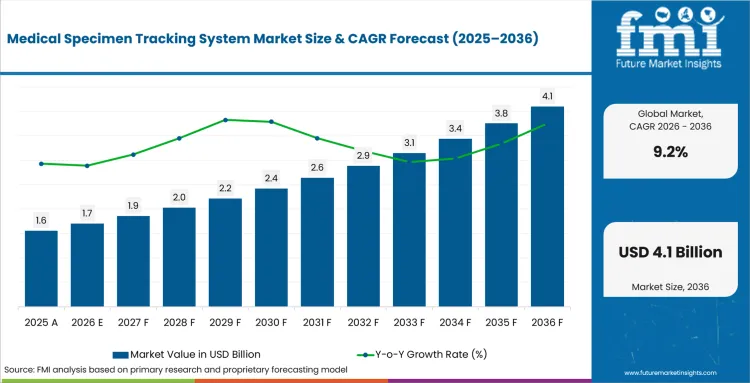
USD 1.7 billion in 2026 and USD 4.1 billion by 2036 at a 9.2% CAGR.
Demand for medical specimen tracking systems is projected to expand at 9.2% CAGR between 2026 and 2036, increasing valuation from USD 1.7 billion to USD 4.1 billion. Laboratories need a continuous identity record as self-collection and digital pathology extend specimen handling beyond accession benches. Expanded collection routes change the requirement from a label check into a linked record across collection and reporting. The College of American Pathologists reported in December 2025 that updated accreditation checklists added provisions for digital pathology and specimen self-collection. The expanded requirements increase the value of laboratory information systems that preserve one specimen identity across locations without repeated data entry. Healthcare laboratory labels must carry the same record into physical workflows as scanners and middleware preserve the audit trail.
United States laboratories operate across a large CLIA-certified testing base that requires public performance records and corrective-action visibility. Japanese providers face a different problem as national record sharing depends on exact interfaces between local laboratory systems and prescribed data structures. The Centers for Medicare & Medicaid Services listed the 2025 Laboratory Registry on a page updated in June 2026 with performance and adverse-action information for public evaluation. Public oversight rewards platforms that retain corrections and collection details without interrupting routine laboratory work. Laboratories using digital pathology workflows also need physical specimens to remain linked with images and final reports across every review stage. Country differences therefore reflect interface design and service coverage rather than scanner hardware alone during enterprise deployment.
Key Takeaways of Medical Specimen Tracking System Market
- Hospitals and laboratory networks invest in specimen tracking to prevent identification failures across every handoff from collection through final reporting.
- Laboratory information management systems are projected to account for 32.0% share in 2026, supported by their control over specimen status and audit history.
- Clinical diagnostics is estimated to represent 36.0% share in 2026, reflecting the direct safety consequence of an incorrect patient or specimen match.
- Hospitals are forecast to hold 34.0% share in 2026 due to complex handoffs spanning wards and collection areas across laboratories and referral sites.
- Legacy instrument interfaces and workflow disruption can delay implementation despite a clear patient-safety case for improved specimen traceability.
- Competition includes Thermo Fisher Scientific, LabVantage Solutions, LabWare, Clinisys, Oracle Health, Sapio Sciences, SCC Soft Computer, and Cirdan with roles spanning enterprise informatics, bedside specimen management and pathology-focused laboratory workflows.
Analyst Perspective
“Medical specimen tracking earns budget approval by preventing identity loss throughout collection, accessioning, testing and storage. Scanner hardware cannot protect the chain if instrument interfaces or emergency overrides break the patient-specimen link. Expansion across departments should follow measured improvement in mislabeled specimens and unresolved exceptions with one accountable support route for technical failures.”
- Anurag Sharma, Principal Analyst, Future Market Insights
How is the Medical Specimen Tracking System Market segmented?
The medical specimen tracking system market is assessed by Product Type, Application, End User, Distribution Channel, Technology, and Region.
The market is segmented by product type, application, end user, distribution channel, technology and region. Product type separates LIMS, barcode systems, RFID systems, collection software and chain-of-custody platforms by record ownership. Application distinguishes diagnostics, pathology, research, blood services and forensic testing through specimen workflows and evidence controls. End user identifies hospitals, laboratories, research institutes, biopharmaceutical companies and blood banks with separate purchasing routes.
Distribution channel compares direct contracts, integrators, resellers and cloud purchasing by implementation responsibility and service ownership. Technology evaluates barcode, RFID, cloud monitoring and analytics through their roles across specimen handoffs and exception review. Regional analysis compares regulation, service access and digital infrastructure across national laboratory systems with different operating structures. The framework separates software ownership from clinical use so laboratory automation does not include every connected instrument.
Why do laboratory information management systems lead the product type category?
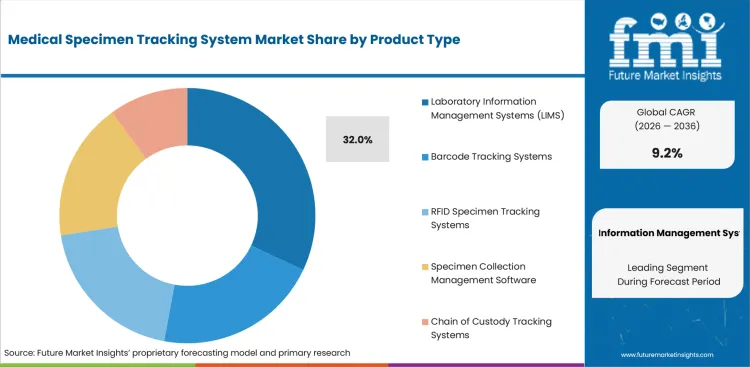
Laboratory information management systems coordinate accessioning and test status across instruments until results enter clinical records. Disconnected analyzer and clinical records force staff to reconstruct specimen history through repeated manual checks. Referral networks face a larger challenge as orders and results pass between several connected laboratories. An Australian Government report published in March 2025 found that pathology informatics interoperability produced benefits but exposed barriers across laboratories and clinical care. Interoperability barriers increase the value of laboratory management platforms that preserve specimen identity through validated interfaces and controlled user roles.
- The laboratory information management systems (LIMS) segment is likely to capture 32.0% share in 2026 attributable to the need for one record across specimen status and audit history. Laboratories use the platform to connect patient identifiers with testing and storage events across routine and exception workflows. Share depends on dependable instrument interfaces and consistent links with electronic health records across every connected department.
- Hospital laboratories adopt LIMS to reduce manual reconciliation across accession benches and referral workflows that use several downstream systems. One specimen may produce several aliquots or tests across connected departments and each event must remain attached to the original order. Adoption slows if legacy analyzers require custom interfaces that laboratory informatics teams cannot maintain without specialist configuration support.
How does clinical diagnostics shape demand within the application category?
Clinical diagnostics begins with a verified match between the patient and specimen container at collection. Later correction cannot recreate that encounter, so laboratory staff need immediate confirmation at the bedside. The Joint Commission updated its guidance in April 2026 and requires two identifiers on specimen containers in the patient's presence. Barcode scanner infrastructure can apply that rule through direct verification with a documented emergency exception route. Bedside labeling therefore depends on disciplined scanning and clear exception handling rather than barcode hardware alone.
- Clinical diagnostics is set to lead the application category with 36.0% share in 2026 due to the safety consequence of an incorrect specimen identity. The application requires immediate verification at collection and continuous status visibility through result release without duplicate documentation. Its position depends on tracking records that support safe release and clear exception handling across high-volume diagnostic workflows.
- Diagnostic laboratories use tracking systems to connect collection time with test routing and final result release across routine and urgent workflows. Faster verification reduces repeat work across emergency departments and outpatient collection sites without changing the clinical testing method. Adoption weakens if scanner interruptions produce undocumented overrides during peak periods or urgent clinical decisions.
What keeps hospitals central to the end user category?
Hospital networks manage specimen handoffs across wards and operating rooms until samples reach centralized laboratories. Shared platforms become valuable as several clinical services use one laboratory network and require continuous result routing. Large test volumes turn specimen status into a clinical coordination issue rather than a local laboratory record. Stockport NHS Foundation Trust reported in September 2025 that its new LIMS would manage information from more than 9.5 million annual laboratory tests. Local support remains necessary during migrations that preserve historical records and validated instrument interfaces throughout deployment.
- Hospitals are projected to hold 34.0% share in 2026 owing to the number of collection points and internal specimen handoffs across each care episode. A patient sample can cross wards and operating rooms on its route to pathology or an external laboratory. Hospital-wide systems defend this position by preserving one specimen history across clinical and laboratory settings without repeated manual reconciliation.
- Hospitals combine tracking software with specimen-handling robotics to preserve identity during automated sorting and movement across laboratory areas. Adoption expands as every physical action updates the same record without undocumented manual changes across connected laboratory areas. Implementation stalls if laboratory and information technology teams divide interface ownership so contracts need one accountable support and validation route.
Which purchasing mechanism supports direct sales within distribution channel?
Direct sales gives hospital groups one accountable route for software delivery and interface validation across a shared laboratory network. Enterprise contracts can combine implementation, testing and stabilization support under one service structure across complex projects. Contracts Finder published a LIMS support award in April 2025 covering test strategy, end-to-end testing and post-go-live stabilization. The award scope links commercial responsibility with the technical work required throughout complex laboratory deployment. Smaller laboratories may instead use local integrators if internal project capacity cannot manage a full enterprise implementation.
- The distribution channel category is forecast to be led by direct sales at 41.0% share in 2026 due to complex implementation and long-term support requirements. Hospital groups can place software and integration support under one commercial agreement that also covers maintenance. The channel remains attractive for shared laboratory networks that need consistent governance and controlled platform changes across several sites.
- Large laboratory networks use direct contracts to define uptime and interface responsibilities across several connected sites. The same agreement can include automated sample storage integration alongside staged training and planned validation. Demand shifts toward local integrators if laboratories need field support or must connect equipment from several manufacturers within a constrained implementation budget.
What supports barcode-based tracking within the technology category?
Barcode tracking gives collection teams a scannable identifier for patient-side verification throughout routine specimen handling. Specimen information must remain readable during transport so the receiving laboratory verifies the same container identity. Transport adds another handoff that can separate the physical label from the verified patient record. The Centers for Disease Control and Prevention stated in February 2026 that monkeypox specimens require two patient identifiers and clear specimen information prior to shipment. Barcode platforms encode those details and preserve the verified link throughout collection and transport workflows.
- By technology, barcode-based tracking is estimated to hold 38.0% share in 2026 owing to low deployment complexity and broad scanner availability. Printed identifiers fit established collection routines and connect each container with the patient record through accessible infrastructure. Reliable label quality and scanning discipline support the segment's position across storage and transport workflows.
- Laboratories select barcodes for routine specimens that travel through predictable handoffs and standard containers across established collection workflows. RFID identification is more suitable for workflows that justify higher tag and reader costs through automated location updates. Barcode adoption remains broader through installed printers and scanners but unreadable labels or manual overrides can weaken operational control.
What are the drivers, restraints, and opportunities in the Medical Specimen Tracking System Market ?
Patient-identification rules and expanding collection routes support demand for auditable specimen records. Legacy instruments and fragmented interfaces extend validation work. The clearest opportunity lies in interoperable platforms that link collection, transport, testing, storage and reporting through one identity record.
- Driver: Laboratory networks need reliable identity controls as collection routes expand across hospital and community settings.
- Restraint: Legacy instruments and fragmented records extend interface validation beyond the original laboratory software implementation plan.
- Opportunity: Interoperable platforms can connect physical specimen events with clinical records and digital pathology workflows across several sites.
Patient-identification requirements give laboratories a direct reason to fund tracking systems rather than rely on manual logs. The requirement applies across testing sites with different complexity and certification routes throughout the United States. The Centers for Medicare & Medicaid Services stated in May 2026 that CLIA covers approximately 320,000 laboratory entities. The broad CLIA oversight base requires reviewable quality records and corrective actions across laboratories with different testing complexity. Tracking platforms support that work by recording collection and transfer events as reviewable control points across the specimen pathway.
Legacy instrument connectivity remains a material restraint across laboratory platforms installed during different technology cycles. Specimen status must pass reliably between connected systems throughout collection and daily analytical testing workflows. Hospital groups must test every instrument interface and reporting route during a controlled implementation program. NHS England guidance published in February 2025 requires suitable digital histopathology equipment with maintenance, documented training and validation plans. The combined requirements protect clinical interpretation but extend deployment until technical teams prove dependable status changes and one escalation route.
Interoperability gives platform developers a practical expansion route across laboratory networks that share orders, specimens and final reports. The Australian Government reported in February 2026 that funded pathology projects were developing informatics assurance and terminology management. The funded projects establish the standards work needed for repeatable exchange across collection and analytical systems. Several sites require common terminology and quality controls to use one workflow without local reinterpretation. Platform developers can earn recurring interface and workflow revenue by maintaining one identity record as laboratories add collection sites or services.
Which country CAGRs are profiled in the Medical Specimen Tracking System Market?
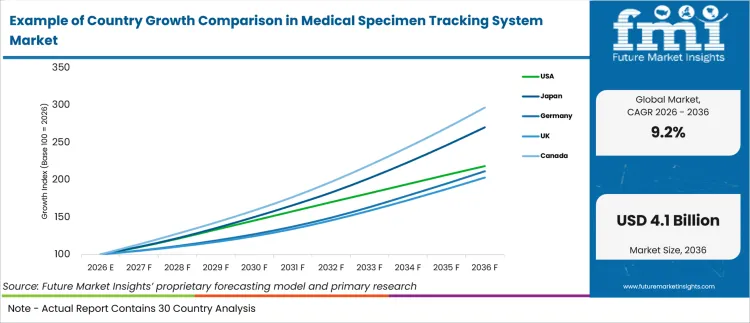
| Country | CAGR |
|---|---|
| Canada | 11.5% |
| Australia | 10.9% |
| Japan | 10.4% |
| Brazil | 9.3% |
| USA | 8.1% |
| Germany | 7.8% |
| UK | 7.3% |
How do country-level CAGRs compare in the Medical Specimen Tracking System Market?
The profiled forecasts span 4.2 percentage points from Canada to the UK and form a gradual progression across the assessment period. Canada and Australia sit within a 0.6-point band that reflects similar needs for connected records across dispersed service routes. Japan remains 0.5 points below Australia as national interface planning adds defined requirements for local system integration. Brazil and the USA form a wider middle gap even though both countries support large laboratory networks. Germany and the UK differ by 0.5 points under formal validation and regional governance requirements. The spacing shows that implementation capacity influences commercial timing almost as strongly as the approved forecast rates. Similar growth rates can therefore carry different interface costs and service obligations across the seven profiled countries.
- Canada combines provincial purchasing with laboratory information exchange across distributed health systems and requires support that remains practical across remote service routes.
- Australia combines large collection workloads with long referral routes across metropolitan and remote pathology services. A coordinated support model must cover scanners and interfaces without duplicating specimen records between participating laboratories and collection sites.
- Japan sits 0.5 points below Australia as national interface specifications increase the value of local implementation teams and disciplined acceptance testing.
- Brazil combines direct specimen-identification rules with uneven service capacity across regional laboratory networks and collection sites. Local financing and dependable field support determine whether deployment can extend beyond larger urban laboratory providers.
- The USA supports enterprise expansion through large health networks but legacy interfaces and state survey relationships can extend multi-site validation schedules.
- Germany links purchasing decisions with formal laboratory quality controls and detailed documentation across accredited diagnostic services. Local implementation partners must translate platform functions into records accepted during structured reviews and external audits.
- The UK increasingly relies on shared pathology platforms across regional networks and needs migration plans that preserve result routing for every participating facility.
Comparable CAGRs produce different entry conditions through country-specific assignments of integration ownership and service responsibility. Commercial plans must separate forecast momentum from the validation effort and support costs required for each country. The full report provides country-level CAGR analysis across North America, Latin America, Europe, East Asia, South Asia, Oceania and the Middle East and Africa.
Country-wise Analysis
- Canadian laboratory deployments must work across provincial health systems that use different purchasing and interface arrangements. Medical specimen tracking system sales in Canada are forecast to expand at 11.5% CAGR by 2036, supported by provincial laboratory information exchange. Ontario Health described OLIS in June 2026 as a central platform for laboratory orders and results from hospitals with public health and community laboratories. The system allows results to follow patients between care settings and reduces errors linked to illegible or misinterpreted orders. Provincial exchange supports connected specimen records across participating services and referral networks that share patient orders. Fragmented purchasing and long service distances raise support costs for laboratories outside major urban centers.
- Australian pathology networks transfer specimens across metropolitan laboratories and remote collection routes that span several service regions. Australia's medical specimen tracking system outlook is anticipated to advance at 10.9% CAGR over the assessment period, influenced by dispersed collection and transport workloads. National workload data provides a direct measure of the handoffs that tracking systems must document outside hospital laboratories. The Australian Institute of Health and Welfare reported in July 2026 that 49.5 million patient episode initiation services covered specimen collection and transport during 2024-25. Shared identifiers and remote maintenance can extend platform coverage, but long travel distances and uneven technical capacity lengthen recovery during scanner or interface failures.
- Japanese health providers are preparing defined interfaces for a national electronic health record information-sharing service. Adoption of medical specimen tracking systems in Japan is estimated to expand at 10.4% CAGR through 2036, supported by standardized exchange requirements. The Ministry of Health, Labour and Welfare released version 2.1.0 of its technical guide for system developers in June 2026. National specifications give local implementation teams a defined integration target for specimen events and shared records. Laboratory platforms must align status changes with prescribed data structures within national exchange workflows for safe clinical reporting. Local technical support remains necessary during acceptance testing and corrective interface work across connected hospital laboratories. Extended validation limits platform companies that lack local teams able to resolve failures during laboratory service.
- Brazilian clinical laboratories must identify biological material at collection or receipt and maintain traceability throughout transport. In Brazil, medical specimen tracking demand is predicted to advance at 9.3% CAGR through 2036 due to current identification controls. Laboratories and collection posts need the same identity controls across referral routes to preserve traceability during transport. ANVISA published questions and answers for RDC 978/2025 in August 2025 covering clinical laboratories and collection posts that document specimen identity. National rules favor barcode and workflow systems across referral networks, but local interface testing and service coverage can limit deployment outside larger laboratory groups with dispersed collection posts.
- United States laboratories operate within a federal certification framework that depends on state survey capacity and accreditation organizations. Medical specimen tracking system demand in the USA is forecast to rise at 8.1% CAGR over the forecast period, shaped by enterprise networks and demanding interface requirements. The Centers for Medicare & Medicaid Services issued its fiscal year 2026 CLIA budget call letter in July 2025 and tied state staffing targets to laboratory survey workload. Auditable records must remain available across connected sites throughout recurring survey cycles and corrective reviews. Multi-state deployment requires shared technical resources and coordinated implementation across hospital and laboratory networks nationwide. Legacy systems and state survey coordination extend validation and contract review across complex deployment programs.
- German laboratories operate within a formal quality-assurance framework for medical examinations and documented method control. The German medical specimen tracking system sector is projected to record 7.8% CAGR during the assessment period, influenced by structured evaluation and conformity requirements. Platform controls must translate into records that laboratory organizations can use during quality review and corrective action planning. The German Medical Association approved a Rili-BAEK amendment in July 2025 and published the change in August 2025. Formal documentation requirements favor experienced implementation teams but lengthen acceptance work for laboratory organizations that lack dedicated local technical support and established quality-management resources.
- United Kingdom pathology networks are replacing fragmented systems with shared laboratory platforms across several clinical disciplines. Regional programs need one implementation route that preserves historical results during the introduction of new workflows. By 2036, medical specimen tracking demand in the UK is projected to grow at 7.3% CAGR supported by pathology network consolidation. Regional migration needs tested report links with primary care to keep historical and current results available. University College London Hospitals announced in September 2025 that blood sciences would transition to the Helix LIMS through tested report links with general practices. Shared NHS platforms support coordinated purchasing, but migration risk and regional governance remain material frictions across participating services.
Who are the notable companies in the Medical Specimen Tracking System Market?
Thermo Fisher Scientific, LabVantage Solutions, LabWare, Clinisys, Oracle Health, Sapio Sciences, SCC Soft Computer, and Cirdan are notable companies in the Medical Specimen Tracking System Market.
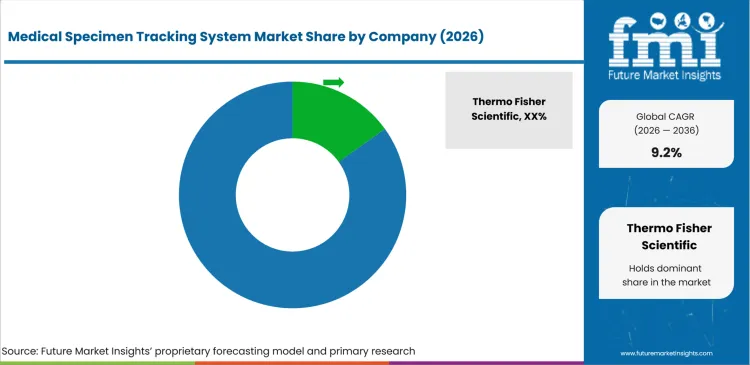
Competition has a concentrated enterprise core and a more fragmented specialist layer around pathology, bedside collection and research workflows. Large LIMS and LIS providers defend multi-site hospital accounts through validated instrument interfaces, shared governance and local support. Clinical specialists enter through one discipline or collection route that established platforms handle less efficiently. Configurable research platforms compete in clinical trial biorepositories and central laboratories that need rapid workflow changes. Cloud deployment lowers infrastructure barriers for smaller laboratories but does not remove validation or migration work. Expansion depends on proving specimen lineage across connected sites with a support model that protects result release during system changes.
- LabVantage Solutions, LabWare and Clinisys compete for enterprise laboratory networks that require broad clinical workflows with validated instrument connectivity. Their platforms support shared governance across several testing disciplines and sites within regional and national networks. Selection depends on how well each provider migrates historical records and resolves interface failures without delaying result release.
- Oracle Health, SCC Soft Computer and Thermo Fisher Scientific address different parts of the clinical specimen pathway. Oracle Health connects bedside collection with the wider patient record, while SCC Soft Computer and Thermo Fisher Scientific provide laboratory workflow depth. Hospital groups compare them through specimen lifecycle coverage and the ability to preserve one identifier across departmental handoffs.
- Sapio Sciences and Cirdan serve more specialized deployment routes through configurable research workflows and pathology-focused laboratory systems. Sapio Sciences supports distributed central-laboratory operations that require flexible sample lineage across global studies and sites. Cirdan competes through clinical pathology integration and local implementation support for laboratories that need controlled migration from established LIS environments.
Competitive Benchmarking: Medical Specimen Tracking System Market
| Company | Specimen Lifecycle Coverage | Clinical and Instrument Integration | Multi-site Deployment Support | Geographic Reach |
|---|---|---|---|---|
| Thermo Fisher Scientific | High | High | High | Global |
| LabVantage Solutions | High | High | High | Global |
| LabWare | High | High | High | Global |
| Clinisys | High | High | High | Global |
| Oracle Health | Medium | High | High | Global |
| Sapio Sciences | High | Medium | High | Global |
| SCC Soft Computer | High | High | High | North America |
| Cirdan | High | High | Medium | Multi-country |
Key Developments in the Medical Specimen Tracking System Market
- In March 2025, LabVantage Solutions released LabVantage 8.9 with faster database handling and automated configuration transfer for complex laboratory workflows. The update can reduce manual intervention and preserve audit filtering with controlled data movement across specimen status changes. Laboratories must validate local instruments and permissions so these functions can replace existing manual checks during controlled production releases across live diagnostic workflows.
- In September 2025, LabWare introduced Clinical Health 5.06 with refined send-out workflows and improved result-review dashboards for clinical laboratories. The release added clearer visibility for specimens sent to referral laboratories and tests awaiting results. The capability reduces status loss during external handoffs and preserves local review across internal and referred testing pathways under one governed review process with validated interfaces.
- In October 2025, Clinisys announced CLS v2025.2 with preconfigured clinical pathology workflows and more flexible specimen receipt options for North American laboratories. Expanded API endpoints and instrument connectivity support faster intake without separating patient orders from specimen status. Scalable cloud subscriptions support wider use, but each participating site must validate interfaces and exception rules during broader deployment across participating laboratories.
- In August 2025, Sapio Sciences announced the full deployment of Sapio LIMS across more than 30 LabConnect locations on six continents. The unified platform replaced fragmented workflows and gave distributed clinical research teams one sample lineage across participating sites. The deployment demonstrates multi-site availability but requires consistent configuration and support across several time zones under shared governance with local support teams.
Medical Specimen Tracking System Market - Report Scope
| Coverage field | Report scope |
|---|---|
| Market breakdown | Product Type, Application, End User, Distribution Channel, Technology, and Region. |
| Quantitative Units | Revenue in USD Billion and CAGR in %. |
| Market Definition | Barcode, RFID, LIMS, middleware, labeling, chain-of-custody, and workflow systems that identify and track human medical specimens from collection through testing, storage, transfer, reporting, and disposal. |
| Regions Covered | North America, Latin America, Europe, East Asia, South Asia, Oceania, and Middle East and Africa. |
| Countries Covered | Canada, Australia, Japan, Brazil, USA, Germany, and UK. |
| Key Companies Profiled | Thermo Fisher Scientific, LabVantage Solutions, LabWare, Clinisys, Oracle Health, Sapio Sciences, SCC Soft Computer, and Cirdan. |
| Forecast Period | 2026 to 2036. |
| Approach | Hybrid bottom-up and top-down market sizing supported by primary interviews and official desk research. |
Medical Specimen Tracking System Market - Research Methodology
| Method | Approach |
|---|---|
| Primary Research | FMI analysts gathered input from manufacturers, service providers, technology developers, distributors, end users, procurement teams, and subject-matter experts. Interviews examined purchasing decisions, product or service evaluation, adoption barriers, approval requirements, pricing considerations, and expectations for technical or commercial support. Respondents were also asked what evidence is required before a trial, pilot, or initial order develops into regular purchasing. |
| Desk Research | Desk research covered government statistics, regulatory publications, trade data, industry associations, technical literature, standards, company filings, product information, and official corporate announcements. Sources were reviewed for relevance, publication date, geographic coverage, and consistency with the defined market scope. Claims relating to performance, applications, approvals, capacity, investment, and commercial activity were retained only when supported by credible public evidence. |
| Market Sizing and Forecasting | The market model combined the baseline value with historical performance, segment structure, pricing and volume indicators, adoption levels, company participation, and country-level demand conditions. Forecast assumptions considered economic activity, investment trends, regulatory developments, technology adoption, purchasing cycles, supply availability, and barriers to wider market use. Segment and regional estimates were reconciled before the final market total was calculated. |
| Data Validation | Estimates were checked against multiple independent indicators, including public data, company activity, trade patterns, industry developments, and findings from primary interviews. Validation also tested whether products, services, applications, and company revenues fell within the defined market boundaries. Adjacent categories, unsupported claims, overlapping revenues, and activities without direct market relevance were excluded to reduce double counting and maintain consistency across segments and countries. |
Medical Specimen Tracking System Market by Segments
Medical Specimen Tracking System Market segmented by Product Type:
- Laboratory Information Management Systems (LIMS)
- Cloud-Based LIMS
- On-Premise LIMS
- Barcode Tracking Systems
- 1D Barcode Systems
- 2D Barcode Systems
- RFID Specimen Tracking Systems
- Passive RFID Systems
- Active RFID Systems
- Specimen Collection Management Software
- Mobile Collection Applications
- Collection Scheduling Software
- Chain of Custody Tracking Systems
- Forensic Specimen Tracking
- Clinical Trial Specimen Tracking
Medical Specimen Tracking System Market segmented by Application:
- Clinical Diagnostics
- Hospital Laboratories
- Reference Laboratories
- Pathology Laboratories
- Histopathology
- Cytopathology
- Clinical Research
- Biobanking
- Clinical Trials
- Blood Banks & Transfusion Services
- Blood Component Tracking
- Donor Sample Tracking
- Forensic & Toxicology Testing
- Drug Testing
- DNA Evidence Tracking
Medical Specimen Tracking System Market segmented by End User:
- Hospitals
- Public Hospitals
- Private Hospitals
- Diagnostic Laboratories
- Independent Laboratories
- Reference Laboratories
- Research Institutes
- Academic Research Centers
- Government Research Institutes
- Biopharmaceutical Companies
- Drug Development Companies
- Biotechnology Companies
- Blood Banks
- Public Blood Banks
- Private Blood Centers
Medical Specimen Tracking System Market segmented by Distribution Channel:
- Direct Sales
- Enterprise Contracts
- Institutional Procurement
- System Integrators
- Healthcare IT Integrators
- Laboratory Automation Partners
- Value-Added Resellers
- Regional Resellers
- Authorized Solution Partners
- Cloud Marketplace
- SaaS Marketplace
- Healthcare Cloud Platforms
- Online Procurement
- B2B Procurement Platforms
- E-Commerce Portals
Medical Specimen Tracking System Market segmented by Technology:
- Barcode-Based Tracking
- Linear Barcode Technology
- 2D Barcode Technology
- RFID-Based Tracking
- Passive RFID
- Active RFID
- Cloud-Based Tracking
- Public Cloud
- Private Cloud
- IoT-Enabled Monitoring
- Real-Time Temperature Monitoring
- Location Tracking Sensors
- AI & Analytics Platforms
- Predictive Workflow Analytics
- Smart Specimen Identification
Medical Specimen Tracking System Market by Region:
- North America
- Canada
- USA
- Europe
- Germany
- UK
- East Asia
- Japan
- South Asia and Pacific
- Australia
- Latin America
- Brazil
- Middle East and Africa
Research Sources and Bibliography
- College of American Pathologists. (2025, December 10). CAP Puts Patient Safety and Regulatory Clarity at the Forefront with New Laboratory Checklist.
- Centers for Medicare & Medicaid Services. (2026, June 2). Laboratory Demographics Lookup and Registry.
- Australian Government Department of Health, Disability and Ageing. (2025, March). Final report for the Pathology informatics and interoperability pilot: pathology and the patient project.
- The Joint Commission. (2026, April 21). Two Patient Identifiers - Understanding The Requirements.
- Stockport NHS Foundation Trust. (2025, September 26). New Stockport NHS laboratory information system goes live to enhance services for patients and clinicians.
- Contracts Finder. (2025, April 7). Laboratory Information Management System (LIMS) Support via G-Cloud 14 Framework Agreement (RM1557.14).
- Centers for Disease Control and Prevention. (2026, February 6). Collecting and Handling Specimens for Monkeypox PCR Testing.
- Centers for Medicare & Medicaid Services. (2026, May 14). Clinical Laboratory Improvement Amendments (CLIA).
- NHS England. (2025, February 5). Digital histopathology in the NHS cancer screening programmes.
- Australian Government Department of Health, Disability and Ageing. (2026, February 24). Current funded projects under the Quality Use of Pathology Project Stream.
- Ontario Health. (2026, June 4). Ontario Laboratories Information System (OLIS).
- Australian Institute of Health and Welfare. (2026, July 9). Pathology, imaging and other diagnostic services.
- Ministry of Health, Labour and Welfare. (2026, June 30). 電子カルテ情報共有サービス.
- Agência Nacional de Vigilância Sanitária. (2025, August 27). Perguntas e respostas - RDC 978/2025.
- Centers for Medicare & Medicaid Services. (2025, July 1). Fiscal Year (FY) 2026 Clinical Laboratory Improvement Amendments (CLIA) Budget Call Letter.
- Bundesärztekammer. (2025, August 8). Änderung der Richtlinie der Bundesärztekammer zur Qualitätssicherung laboratoriumsmedizinischer Untersuchungen - Rili-BÄK.
- University College London Hospitals NHS Foundation Trust. (2025, September 8). Health Services Laboratories (HSL) update: Helix platform - UCLH.
- LabVantage Solutions. (2025, March 3). LabVantage Solutions Unveils Version 8.9 of Its Industry-Leading LIMS Platform to Improve Lab Productivity and Efficiency.
- LabWare. (2025, September 21). The Next Step in Clinical Lab Innovation: LabWare Clinical Health 5.06.
- Clinisys. (2025, November 4). Clinisys™ launches Clinisys™ Laboratory Solution (CLS) v2025.2.
- Sapio Sciences. (2025, August 6). LabConnect Deploys Sapio LIMS Across Global Operation.
- Thermo Fisher Scientific. (2025, June 17). Thermo Scientific SampleManager LIMS software v21.3: New features and capabilities.
- Oracle. (2025, May 9). VPAT - Oracle Health Specimen Management 2018.20.
- SCC Soft Computer. (2025, April 2). A First in Quebec: ovo Labo Implements SoftLab, a State-of-the-Art LIS to Optimize Medical Analyses.
- Cirdan. (2025, June 30). Sherwood Forest Hospitals NHS Foundation Trust Goes Live with Cirdan ULTRA LIMS.
This bibliography is provided for reader reference and is not exhaustive. The full report contains the complete reference list and detailed citations
This Report Answers
- How large is the medical specimen tracking system market in 2026 and 2036?
- Which patient-identification and laboratory workflow pressures support investment in specimen tracking platforms?
- Why do LIMS and barcode-based tracking hold notable positions within their respective categories?
- How do country growth rates differ across Canada, Australia, Japan, Brazil, USA, Germany, and UK?
- Which integration and service conditions determine successful hospital deployment?
- How do enterprise informatics providers differ from configurable laboratory software specialists?
- Which current company developments are changing specimen workflow and multi-site deployment capabilities?
- What limits return on investment for hospital laboratory networks implementing specimen tracking systems?
- Which operating measures should executives use to evaluate identity control and workflow performance?
Frequently Asked Questions
How big is the Medical Specimen Tracking System Market in 2026?
The medical specimen tracking system market is valued at USD 1.7 billion in 2026 and is forecast to reach USD 4.1 billion by 2036. Growth is supported by self-collection and digital pathology that extend specimen handling beyond accession benches, requiring a continuous identity record across every workflow stage.
What is the CAGR of the Medical Specimen Tracking System Market from 2026 to 2036?
The medical specimen tracking system market grows at a CAGR of 9.2% between 2026 and 2036, supported by expanded collection routes that turn a simple label check into a linked record spanning collection, transport, testing, and final reporting across laboratory networks.
Which product type leads the Medical Specimen Tracking System Market?
Laboratory information management systems account for 32.0% of the medical specimen tracking system market by product type in 2026, driven by their ability to preserve one specimen identity and audit history across instruments until results enter clinical records.
How much will the Medical Specimen Tracking System Market add between 2026 and 2036?
The medical specimen tracking system market is set to add USD 2.4 billion between 2026 and 2036, growing from USD 1.7 billion to USD 4.1 billion as interoperable platforms link collection, transport, testing, storage, and reporting through one identity record.
Who are the leading companies in the Medical Specimen Tracking System Market?
Eight companies lead the medical specimen tracking system market, including Thermo Fisher Scientific, LabVantage Solutions, LabWare, Clinisys, Oracle Health, Sapio Sciences, SCC Soft Computer, and Cirdan, competing through enterprise informatics, bedside specimen management, and pathology-focused laboratory workflows worldwide.
Preview the report firsthand - request a free sample
Get SampleGet the brochure for pricing and purchase details.
Get PDFTable of Content
- Key Takeaways
- Market Size and CAGR
- Top Growth Driver
- Fastest Growing Segment
- Leading Region
- Key Companies
- Emerging Opportunities
- Executive Summary
- Global Market Outlook
- Demand-side Trends
- Supply-side Trends
- Technology Roadmap Analysis
- Analysis and Recommendations
- Analyst Perspective (What is happening? Why now? What should investors know?)
- Key Questions Answered
- How large is the market?
- What is the CAGR?
- What are key trends?
- Which region dominates?
- Who are the leaders?
- Market Overview
- Market Coverage / Taxonomy
- Market Definition / Scope / Limitations
- Research Methodology
- Chapter Orientation
- Analytical Lens and Working Hypotheses
- Market Structure, Signals, and Trend Drivers
- Benchmarking and Cross-market Comparability
- Market Sizing, Forecasting, and Opportunity Mapping
- Research Design and Evidence Framework
- Desk Research Programme (Secondary Evidence)
- Expert Input and Fieldwork (Primary Evidence)
- Tooling, Models, and Reference Databases
- Data Engineering and Model Build
- Quality Assurance and Audit Trail
- Market Background
- Market Dynamics (Drivers, Restraints, Opportunity, Trends)
- Scenario Forecast (Optimistic, Likely, Conservative)
- Impact Analysis
- AI Impact
- Sustainability Impact
- Regulatory Impact
- Technology Impact
- Consumer / Buyer Analysis
- Purchase Drivers
- Adoption Barriers
- Buyer Journey
- Opportunity Map Analysis
- Product Life Cycle Analysis
- Supply Chain Analysis
- Investment Feasibility Matrix
- Value Chain Analysis
- PESTLE and Porter's Analysis
- Regulatory Landscape
- Regional Parent Market Outlook
- Production and Consumption Statistics
- Import and Export Statistics
- Global Market Analysis and Forecast, 2021 to 2036
- Historical Market Size Value (USD Billion) Analysis, 2021 to 2025
- Current and Future Market Size Value (USD Billion) Projections, 2026 to 2036
- Y-o-Y Growth Trend Analysis
- Absolute $ Opportunity Analysis
- Global Market Pricing Analysis, 2021 to 2036
- Global Market Analysis and Forecast, By Product Type, 2021 to 2036
- Introduction / Key Findings
- Historical Market Size Value (USD Billion) Analysis By Product Type, 2021 to 2025
- Current and Future Market Size Value (USD Billion) Analysis and Forecast By Product Type, 2026 to 2036
- Laboratory Information Management Systems (LIMS)
- Cloud-Based LIMS
- On-Premise LIMS
- Barcode Tracking Systems
- 1D Barcode Systems
- 2D Barcode Systems
- RFID Specimen Tracking Systems
- Passive RFID Systems
- Active RFID Systems
- Specimen Collection Management Software
- Mobile Collection Applications
- Collection Scheduling Software
- Chain of Custody Tracking Systems
- Forensic Specimen Tracking
- Clinical Trial Specimen Tracking
- Laboratory Information Management Systems (LIMS)
- Y-o-Y Growth Trend Analysis By Product Type, 2021 to 2025
- Absolute $ Opportunity Analysis By Product Type, 2026 to 2036
- Global Market Analysis and Forecast, By Application, 2021 to 2036
- Introduction / Key Findings
- Historical Market Size Value (USD Billion) Analysis By Application, 2021 to 2025
- Current and Future Market Size Value (USD Billion) Analysis and Forecast By Application, 2026 to 2036
- Clinical Diagnostics
- Hospital Laboratories
- Reference Laboratories
- Pathology Laboratories
- Histopathology
- Cytopathology
- Clinical Research
- Biobanking
- Clinical Trials
- Blood Banks & Transfusion Services
- Blood Component Tracking
- Donor Sample Tracking
- Forensic & Toxicology Testing
- Drug Testing
- DNA Evidence Tracking
- Clinical Diagnostics
- Y-o-Y Growth Trend Analysis By Application, 2021 to 2025
- Absolute $ Opportunity Analysis By Application, 2026 to 2036
- Global Market Analysis and Forecast, By End User, 2021 to 2036
- Introduction / Key Findings
- Historical Market Size Value (USD Billion) Analysis By End User, 2021 to 2025
- Current and Future Market Size Value (USD Billion) Analysis and Forecast By End User, 2026 to 2036
- Hospitals
- Public Hospitals
- Private Hospitals
- Diagnostic Laboratories
- Independent Laboratories
- Reference Laboratories
- Research Institutes
- Academic Research Centers
- Government Research Institutes
- Biopharmaceutical Companies
- Drug Development Companies
- Biotechnology Companies
- Blood Banks
- Public Blood Banks
- Private Blood Centers
- Hospitals
- Y-o-Y Growth Trend Analysis By End User, 2021 to 2025
- Absolute $ Opportunity Analysis By End User, 2026 to 2036
- Global Market Analysis and Forecast, By Distribution Channel, 2021 to 2036
- Introduction / Key Findings
- Historical Market Size Value (USD Billion) Analysis By Distribution Channel, 2021 to 2025
- Current and Future Market Size Value (USD Billion) Analysis and Forecast By Distribution Channel, 2026 to 2036
- Direct Sales
- Enterprise Contracts
- Institutional Procurement
- System Integrators
- Healthcare IT Integrators
- Laboratory Automation Partners
- Value-Added Resellers
- Regional Resellers
- Authorized Solution Partners
- Cloud Marketplace
- SaaS Marketplace
- Healthcare Cloud Platforms
- Online Procurement
- B2B Procurement Platforms
- E-Commerce Portals
- Direct Sales
- Y-o-Y Growth Trend Analysis By Distribution Channel, 2021 to 2025
- Absolute $ Opportunity Analysis By Distribution Channel, 2026 to 2036
- Global Market Analysis and Forecast, By Technology, 2021 to 2036
- Introduction / Key Findings
- Historical Market Size Value (USD Billion) Analysis By Technology, 2021 to 2025
- Current and Future Market Size Value (USD Billion) Analysis and Forecast By Technology, 2026 to 2036
- Barcode-Based Tracking
- Linear Barcode Technology
- 2D Barcode Technology
- RFID-Based Tracking
- Passive RFID
- Active RFID
- Cloud-Based Tracking
- Public Cloud
- Private Cloud
- IoT-Enabled Monitoring
- Real-Time Temperature Monitoring
- Location Tracking Sensors
- AI & Analytics Platforms
- Predictive Workflow Analytics
- Smart Specimen Identification
- Barcode-Based Tracking
- Y-o-Y Growth Trend Analysis By Technology, 2021 to 2025
- Absolute $ Opportunity Analysis By Technology, 2026 to 2036
- Global Market Analysis and Forecast, By Region, 2021 to 2036
- Introduction
- Historical Market Size Value (USD Billion) Analysis By Region, 2021 to 2025
- Current Market Size Value (USD Billion) Analysis and Forecast By Region, 2026 to 2036
- North America
- Latin America
- Western Europe
- Eastern Europe
- East Asia
- South Asia and Pacific
- Middle East & Africa
- Market Attractiveness Analysis By Region
- North America Market Analysis and Forecast, By Country, 2021 to 2036
- Historical Market Size Value (USD Billion) Trend Analysis By Market Taxonomy, 2021 to 2025
- Market Size Value (USD Billion) Forecast By Market Taxonomy, 2026 to 2036
- By Country
- USA
- Canada
- By Product Type
- By Application
- By End User
- By Distribution Channel
- By Technology
- By Country
- Market Attractiveness Analysis
- By Country
- By Product Type
- By Application
- By End User
- By Distribution Channel
- By Technology
- Key Takeaways
- Latin America Market Analysis and Forecast, By Country
- Historical Market Size Value (USD Billion) Trend Analysis By Market Taxonomy, 2021 to 2025
- Market Size Value (USD Billion) Forecast By Market Taxonomy, 2026 to 2036
- By Country
- Brazil
- Mexico
- Chile
- Rest of Latin America
- By Product Type
- By Application
- By End User
- By Distribution Channel
- By Technology
- By Country
- Market Attractiveness Analysis
- By Country
- By Product Type
- By Application
- By End User
- By Distribution Channel
- By Technology
- Key Takeaways
- Western Europe Market Analysis and Forecast, By Country
- Historical Market Size Value (USD Billion) Trend Analysis By Market Taxonomy, 2021 to 2025
- Market Size Value (USD Billion) Forecast By Market Taxonomy, 2026 to 2036
- By Country
- Germany
- UK
- Italy
- Spain
- France
- Nordic
- BENELUX
- Rest of Western Europe
- By Product Type
- By Application
- By End User
- By Distribution Channel
- By Technology
- By Country
- Market Attractiveness Analysis
- By Country
- By Product Type
- By Application
- By End User
- By Distribution Channel
- By Technology
- Key Takeaways
- Eastern Europe Market Analysis and Forecast, By Country
- Historical Market Size Value (USD Billion) Trend Analysis By Market Taxonomy, 2021 to 2025
- Market Size Value (USD Billion) Forecast By Market Taxonomy, 2026 to 2036
- By Country
- Russia
- Poland
- Hungary
- Balkan & Baltic
- Rest of Eastern Europe
- By Product Type
- By Application
- By End User
- By Distribution Channel
- By Technology
- By Country
- Market Attractiveness Analysis
- By Country
- By Product Type
- By Application
- By End User
- By Distribution Channel
- By Technology
- Key Takeaways
- East Asia Market Analysis and Forecast, By Country
- Historical Market Size Value (USD Billion) Trend Analysis By Market Taxonomy, 2021 to 2025
- Market Size Value (USD Billion) Forecast By Market Taxonomy, 2026 to 2036
- By Country
- China
- Japan
- South Korea
- By Product Type
- By Application
- By End User
- By Distribution Channel
- By Technology
- By Country
- Market Attractiveness Analysis
- By Country
- By Product Type
- By Application
- By End User
- By Distribution Channel
- By Technology
- Key Takeaways
- South Asia and Pacific Market Analysis and Forecast, By Country
- Historical Market Size Value (USD Billion) Trend Analysis By Market Taxonomy, 2021 to 2025
- Market Size Value (USD Billion) Forecast By Market Taxonomy, 2026 to 2036
- By Country
- India
- ASEAN
- Australia & New Zealand
- Rest of South Asia and Pacific
- By Product Type
- By Application
- By End User
- By Distribution Channel
- By Technology
- By Country
- Market Attractiveness Analysis
- By Country
- By Product Type
- By Application
- By End User
- By Distribution Channel
- By Technology
- Key Takeaways
- Middle East & Africa Market Analysis and Forecast, By Country
- Historical Market Size Value (USD Billion) Trend Analysis By Market Taxonomy, 2021 to 2025
- Market Size Value (USD Billion) Forecast By Market Taxonomy, 2026 to 2036
- By Country
- Kingdom of Saudi Arabia
- Other GCC Countries
- Türkiye
- South Africa
- Other African Union
- Rest of Middle East & Africa
- By Product Type
- By Application
- By End User
- By Distribution Channel
- By Technology
- By Country
- Market Attractiveness Analysis
- By Country
- By Product Type
- By Application
- By End User
- By Distribution Channel
- By Technology
- Key Takeaways
- Key Countries Market Analysis
- USA
- Pricing Analysis
- Market Share Analysis, 2025
- By Product Type
- By Application
- By End User
- By Distribution Channel
- By Technology
- Canada
- Pricing Analysis
- Market Share Analysis, 2025
- By Product Type
- By Application
- By End User
- By Distribution Channel
- By Technology
- Mexico
- Pricing Analysis
- Market Share Analysis, 2025
- By Product Type
- By Application
- By End User
- By Distribution Channel
- By Technology
- Brazil
- Pricing Analysis
- Market Share Analysis, 2025
- By Product Type
- By Application
- By End User
- By Distribution Channel
- By Technology
- Chile
- Pricing Analysis
- Market Share Analysis, 2025
- By Product Type
- By Application
- By End User
- By Distribution Channel
- By Technology
- Germany
- Pricing Analysis
- Market Share Analysis, 2025
- By Product Type
- By Application
- By End User
- By Distribution Channel
- By Technology
- UK
- Pricing Analysis
- Market Share Analysis, 2025
- By Product Type
- By Application
- By End User
- By Distribution Channel
- By Technology
- Italy
- Pricing Analysis
- Market Share Analysis, 2025
- By Product Type
- By Application
- By End User
- By Distribution Channel
- By Technology
- Spain
- Pricing Analysis
- Market Share Analysis, 2025
- By Product Type
- By Application
- By End User
- By Distribution Channel
- By Technology
- France
- Pricing Analysis
- Market Share Analysis, 2025
- By Product Type
- By Application
- By End User
- By Distribution Channel
- By Technology
- India
- Pricing Analysis
- Market Share Analysis, 2025
- By Product Type
- By Application
- By End User
- By Distribution Channel
- By Technology
- ASEAN
- Pricing Analysis
- Market Share Analysis, 2025
- By Product Type
- By Application
- By End User
- By Distribution Channel
- By Technology
- Australia & New Zealand
- Pricing Analysis
- Market Share Analysis, 2025
- By Product Type
- By Application
- By End User
- By Distribution Channel
- By Technology
- China
- Pricing Analysis
- Market Share Analysis, 2025
- By Product Type
- By Application
- By End User
- By Distribution Channel
- By Technology
- Japan
- Pricing Analysis
- Market Share Analysis, 2025
- By Product Type
- By Application
- By End User
- By Distribution Channel
- By Technology
- South Korea
- Pricing Analysis
- Market Share Analysis, 2025
- By Product Type
- By Application
- By End User
- By Distribution Channel
- By Technology
- Russia
- Pricing Analysis
- Market Share Analysis, 2025
- By Product Type
- By Application
- By End User
- By Distribution Channel
- By Technology
- Poland
- Pricing Analysis
- Market Share Analysis, 2025
- By Product Type
- By Application
- By End User
- By Distribution Channel
- By Technology
- Hungary
- Pricing Analysis
- Market Share Analysis, 2025
- By Product Type
- By Application
- By End User
- By Distribution Channel
- By Technology
- Kingdom of Saudi Arabia
- Pricing Analysis
- Market Share Analysis, 2025
- By Product Type
- By Application
- By End User
- By Distribution Channel
- By Technology
- Türkiye
- Pricing Analysis
- Market Share Analysis, 2025
- By Product Type
- By Application
- By End User
- By Distribution Channel
- By Technology
- South Africa
- Pricing Analysis
- Market Share Analysis, 2025
- By Product Type
- By Application
- By End User
- By Distribution Channel
- By Technology
- USA
- Market Structure Analysis
- Competition Dashboard
- Competition Benchmarking
- Market Share Analysis of Top Players
- By Regional
- By Product Type
- By Application
- By End User
- By Distribution Channel
- By Technology
- Emerging Startups
- Innovation Benchmarking
- Competition Analysis
- Competition Deep Dive
- Thermo Fisher Scientific
- Overview
- Product Portfolio
- Profitability by Market Segments
- Sales Footprint
- Strategy Overview
- Marketing Strategy
- Product Strategy
- Channel Strategy
- LabVantage Solutions
- LabWare
- Abbott Laboratories
- Sunquest Information Systems
- Clinisys
- Oracle Health
- STARLIMS Corporation
- Siemens Healthineers
- CGM LAB
- Thermo Fisher Scientific
- Case Studies
- Success Stories
- Recent Developments
- Competition Deep Dive
- Assumptions & Acronyms Used


