

- Market Size (2026)
- USD 1.3 Bn
- Forecast (2036)
- USD 14.8 Bn
- CAGR (2026 to 2036)
- 27.5%
How big is Micro-Fulfillment Center Automation Market in 2026?
USD 1.3 billion in 2026 and USD 14.8 billion by 2036 at a 27.5% CAGR.
Demand for micro-fulfillment center automation is anticipated to increase the industry valuation of USD 1.3 billion in 2026 to USD 14.8 billion by 2036, at a 27.5% CAGR, reflecting the shift from isolated trials toward repeatable local fulfillment programs. Retailers, grocery chains and third-party logistics providers are increasingly investing in automated micro-fulfillment facilities to reduce order processing times and support same-day and next-day delivery expectations. For instance, in 2025, Amazon introduced a 10,000-square-foot automated micro-fulfillment center inside a Whole Foods Market in Plymouth Meeting, Pennsylvania to manage more than 12,000 items through Fulfil robotics for faster pickup and delivery. As urban order densities continue to rise, compact automated fulfillment sites enable businesses to position inventory closer to consumers while lowering last-mile transportation costs. E-commerce logistics becomes commercially useful as inventory, picking and dispatch share one local operating plan.
Country conditions change the investment case through order density and the space available near urban customers. The India Brand Equity Foundation reported in June 2026 that quick-commerce revenue reached USD 7 billion to USD 8 billion during FY25, which supports smaller urban sites with focused assortments. Japan follows a different route as its Ministry of Economy, Trade and Industry placed the national e-commerce ratio at 9.8% in August 2025. Retail networks in both countries must match bin sizes and temperature zones with local basket patterns during equipment approval. Goods-to-person robots reduce walking, but replenishment discipline decides whether the system lowers the cost of a completed customer order.
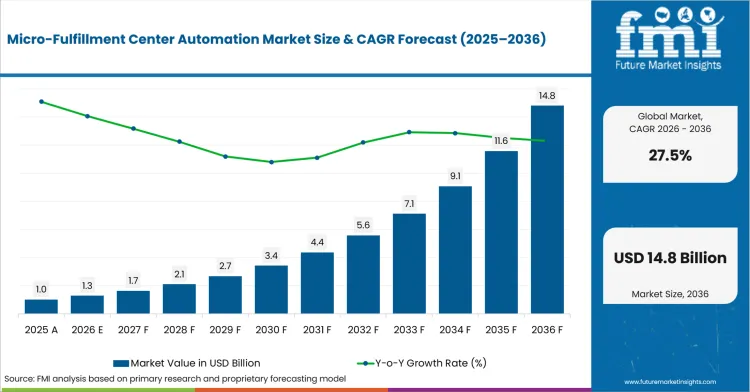
Key Takeaways of Micro-Fulfillment Center Automation Market
- Demand for micro-fulfillment center automation is driven by dense grocery and retail order clusters that support repeatable local fulfillment, with compact automation gaining approval where higher basket volumes keep picking stations active across daily order windows.
- By component, hardware is expected to lead with 58.0% share in 2026, reflecting substantial upfront investment in storage structures, robotics, conveyors, and related equipment.
- Grocery e-commerce is the dominant application segment, projected to hold 40.0% share in 2026, as mixed baskets create concentrated picking and consolidation work across fresh, ambient, and irregularly packaged products.
- Cube storage MFC is estimated to lead the system type category with 36.0% share in 2026, supported by vertical grid designs that maximize storage density and allow modular robot expansion within constrained facilities.
- Urban property costs remain a key driver, favoring vertical storage systems that protect selling space and place frequently ordered inventory close to local dispatch points without a separate regional building.
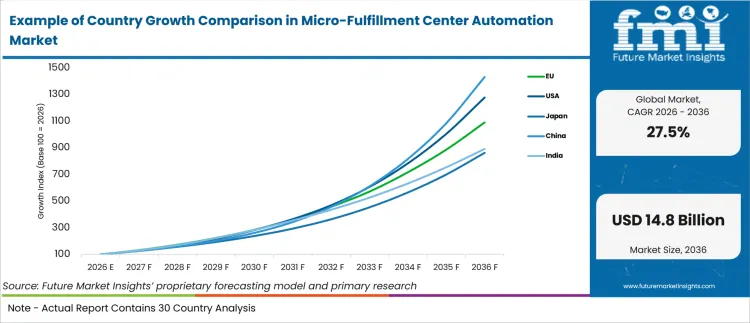
- The United States and Japan are expected to lead growth at 29.0% and 24.0% CAGR respectively through 2036, with China also expanding strongly, while the European Union advances as retailers adapt common controls to varied buildings and labor practices.
- Competition centers on AutoStore, KNAPP, Ocado Group, Symbotic, Veloq, and Exotec, with vendors differentiating through cube storage density, integrated grocery workflow software, and compact rack-based robotics for constrained buildings.
Analyst Perspective
"The micro-fulfillment automation market is shifting from capacity expansion to execution quality, with retailers focusing on whether automated systems can sustain consistent order fulfillment during daily demand fluctuations. High storage density alone is no longer sufficient if inventory availability, replenishment workflows, and exception management fail to support reliable customer service. The strongest market opportunities will emerge for providers that help retailers standardize operating practices across diverse store formats while maintaining flexible automation architectures that support long-term network efficiency."
- Nikhil Kaitwade, Principal Analyst at Future Market Insights
How is the Micro-Fulfillment Center Automation Market segmented?
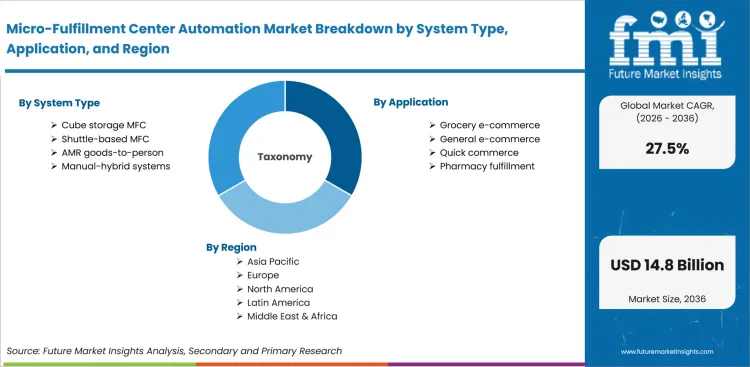
The industry is segmented by System Type, Application, Component, End-use Industry, Sales Channel, and Region.
The segmentation separates physical system design from the retail problem that each compact site is expected to solve. Cube storage favors vertical density, while shuttle systems and mobile robots offer different routes to expansion and item access. Application analysis distinguishes grocery baskets from general e-commerce and pharmacy orders as each category requires a different mix of storage conditions and handling rules. Component analysis links installed equipment with control software and support services that direct daily order flow. End-use Industry and Sales Channel then show who operates the site and how the project reaches commercial use. The final comparison places these choices within automated material handling equipment used for compact local fulfillment rather than general warehouse automation.
What makes Cube storage MFC central to the System Type category?
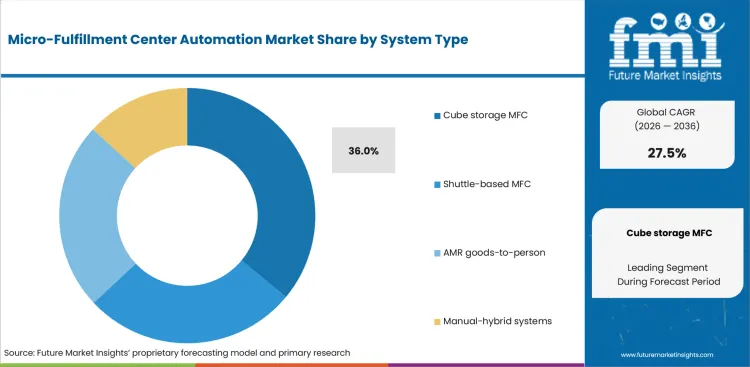
Cube storage places bins inside a vertical grid and brings selected inventory to workstations without fixed picking aisles. This also reflects the value of vertical density inside stores and constrained urban properties. Its advantage depends on orderly replenishment and enough port capacity to serve local demand peaks without creating workstation delays.
- By System Type, Cube storage MFC is estimated to hold 36.0% in 2026 as vertical grids protect floor area and allow robot capacity to expand without rebuilding the complete site. The configuration suits products that fit standard bins and rotate often enough to justify dense storage. Conveyor systems must then move completed totes without creating a new queue outside the grid.
- Grocery retailers and urban e-commerce operators favor cube storage for sites that need a broad sellable assortment within limited floor area. The purchase decision turns on port throughput and bin rules rather than the grid footprint alone. A retailer gains little from added density if workers wait for bins or if replenishment blocks outbound order flow.
What supports demand for Grocery e-commerce within the Application category?
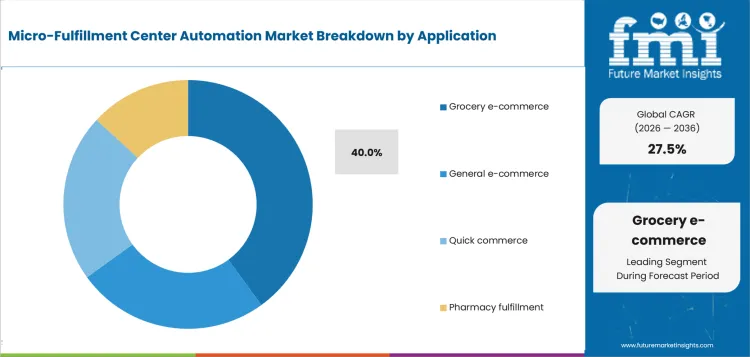
Grocery orders combine many individual items with short preparation windows and several storage conditions across one customer basket. This shows why repeated store walking can become a material cost as online baskets expand.
- In 2026, Grocery e-commerce is expected to represent 40.0% of Application revenue as mixed baskets create concentrated picking and consolidation work. Automation can place common ambient products near a workstation, but fresh items and irregular packages often remain in separate processes. The site must join every zone before dispatch to protect basket completeness and promised delivery times.
- Grocers are expected to favor compact automation in locations with enough online demand to support several order waves each day. The economic case improves as the automated assortment covers a larger share of each basket and reduces repeated aisle travel. Poor substitution rules can erase this gain because missing items still require manual intervention near the dispatch deadline.
How is Hardware positioned within the Component category?
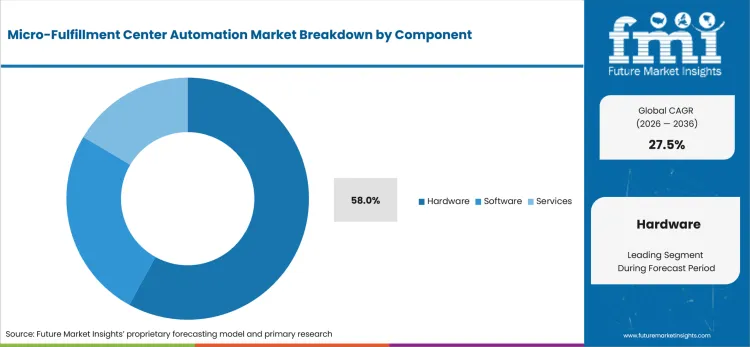
Hardware includes the storage structure and robots with ports and local movement equipment inside each compact fulfillment site. AutoStore announced CarouselAI and VersaPort in March 2025 as additions that connect robotic piece picking with flexible workstation tasks. The launch shows how physical equipment is extending beyond storage toward the controlled transfer of individual items during routine local order preparation at each site.
- Hardware is projected to hold 58.0% of Component revenue during 2026 owing to the installed value of storage and robotic handling equipment. The share reflects the cost of building a complete physical flow before software licenses and support services begin. Maintenance access and spare parts coverage become important selection criteria because a local site has limited room for prolonged equipment downtime.
- Retail automation teams are expected to increase software spending as collaborative picking platforms coordinate people with automated tasks across each shift. The added software value remains dependent on a reliable hardware base that supports steady workstation flow. A system purchase therefore requires a clear division of responsibility for controls and mechanical service throughout regular operations.
What are the drivers, restraints, and opportunities in the Micro-Fulfillment Center Automation Market?
Driver: Wider assortments and short service windows raise demand for compact automation. Restraint: Weak integration can shift delays beyond the storage system. Opportunity: Modular sites can serve focused urban demand with staged investment.
- Driver: Grocery and retail networks need compact systems that can hold more product types without giving up local picking speed.
- Restraint: Inventory errors and poor facility planning can reduce useful throughput even if the storage equipment works as designed.
- Opportunity: Smaller configurations and recurring service models can align automation spending with measured order growth at each site.
Assortment complexity is raising demand for systems that handle more products inside the same compact footprint. AutoStore introduced FlexBins and a Frozen-Only Grid in October 2025, which added mixed bin sizes and a dedicated frozen configuration. The development shows how grocery automation is adapting to local baskets that combine ambient and temperature-sensitive items. Sites that solve this mix can support express parcel services through a predictable dispatch schedule rather than a separate manual recovery process.
Integration remains a commercial restraint because storage speed cannot correct inaccurate inventory or poor dispatch planning. Eurostat reported in February 2026 that 20% of EU online shoppers experienced delivery that was slower than expected during 2025. That result does not measure automation directly, but it identifies the service failure that local systems are expected to reduce. Warehouse design and layout must therefore protect replenishment access and outbound staging so that faster picking does not create a delay elsewhere.
The opportunity lies in modular sites that expand as a local order base becomes more predictable. The India Brand Equity Foundation reported in June 2026 that the country had about 7,000 fulfillment centers supporting digital commerce. This operating base creates room for compact automation in locations that need faster service without a full regional building. Inventory-tracking drones can support cycle counts outside the main grid, which helps the site maintain accurate stock across manual and automated zones.
Which country CAGRs are profiled in the Micro-Fulfillment Center Automation Market?
| Country | CAGR |
|---|---|
| USA | 29.0% |
| European Union | 27.0% |
| Japan | 24.0% |
Source: FMI's proprietary forecasting model and primary research.
How do country-level CAGRs compare in the Micro-Fulfillment Center Automation Market?
The comparison spans 5.0 percentage points across the micro-fulfillment center automation market. The United States records the highest CAGR at 29.0%, followed by the European Union at 27.0% and Japan at 24.0%. The distribution reflects different rates of investment in compact automated fulfillment facilities that support high-frequency order processing close to end customers.
- The United States leads with a CAGR of 29.0%. Retailers and logistics providers are deploying automated micro-fulfillment centers to increase order processing capacity, shorten delivery times and improve inventory management for e-commerce and omnichannel operations.
- The European Union follows at 27.0%, 2.0 percentage points below the United States. Automation projects increasingly focus on compact fulfillment facilities located near urban demand centers. Adoption varies among member states because retail logistics networks, warehouse investment and automation priorities differ across the region.
- Japan records a CAGR of 24.0%, 3.0 percentage points behind the European Union. Operators are integrating robotics and automated storage systems into space-constrained fulfillment facilities to improve picking efficiency, maximize storage utilization and support rapid order handling.
Comparable CAGRs do not indicate identical market conditions. Differences in fulfillment network design, warehouse density, automation investment and retail distribution strategies influence deployment patterns and long-term commercial opportunities. The full report provides country-level CAGR analysis across North America, Latin America, Europe, East Asia, South Asia, Oceania and the Middle East and Africa.
Country-wise Analysis
Country growth reflects a different balance of digital order density and urban property constraints across each national retail system. The USA offers a large online order pool, while the European Union places more weight on property adaptation and service consistency. Japan favors compact systems that fit existing buildings. Local electricity and maintenance coverage can further change the preferred design during site selection decisions. Projects that use mobile robots must plan AMR charging stations around the same order peaks that determine workstation capacity.
- Large retail networks in the USA can compare compact automation with regional fulfillment through existing store and distribution footprints. Demand for compact local automation in the USA is forecast to rise at 29.0% CAGR from 2026 to 2036, reflecting tests of local capacity against delivery distance and inventory duplication. The USA Census Bureau reported in May 2026 that e-commerce represented 16.9% of total retail sales during the first quarter of 2026. The share gives retail automation teams a measurable basis for selecting urban locations with enough digital demand. A local site must improve delivery speed without creating a costly duplicate assortment that turns too slowly. Retail chains will value service agreements that protect peak operations across several locations instead of supporting one demonstration site.
- European Union projects must fit compact automation into varied buildings and operating rules across national retail networks. Adoption is estimated to expand at 27.0% CAGR through 2036, with online purchasing supporting urban pickup and short-distance delivery. Eurostat recorded online shopping participation of 78% among EU internet users in February 2026 for the 2025 measurement year. The participation rate broadens the order base, but each system must fit local property limits and labor practices. Retail groups can reduce engineering cost through common controls that adapt to several building shapes across national operations. Supplier selection will depend on documented commissioning and maintenance support across multiple countries instead of equipment performance at one site.
- Japan’s constrained urban properties give compact storage a practical advantage inside established retail and logistics buildings. Sales of compact fulfillment automation in Japan are forecast to expand at 24.0% CAGR by 2036, supported by demand for more output from limited floor area. According to the Ministry of Economy, Trade and Industry, Japan’s B2C e-commerce ratio reached 9.8% in 2024, up 0.4 percentage points year over year. The increase supports local order preparation, but Japanese projects place close attention on maintenance access and equipment reliability. A compact system must fit an existing building without blocking receiving activity or customer dispatch. Repeat investment will depend on stable performance during normal operating periods rather than peak-speed claims alone.
Who are the notable companies in the Micro-Fulfillment Center Automation Market?
The notable companies include AutoStore, Exotec, KNAPP, Ocado Group, Dematic, Swisslog, Symbotic, and Veloq across compact automated fulfillment systems.
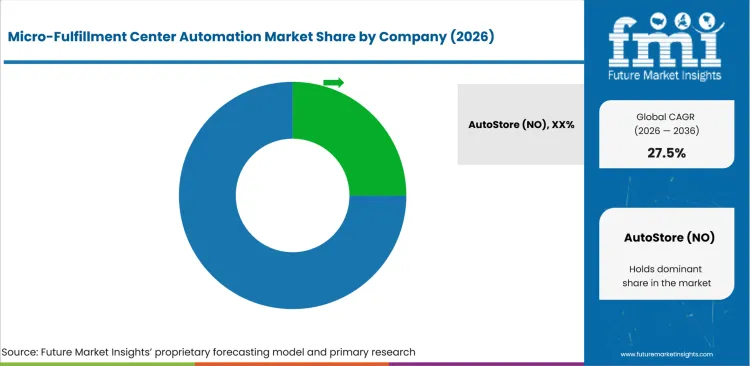
Competition covers dense storage platforms and integrated grocery systems with specialists that manage local order routing. AutoStore and Exotec focus on compact goods-to-person storage through different robot designs suited to constrained facilities. KNAPP and Swisslog connect automation with grocery processes, and Ocado Group and Dematic offer wider software and integration scope. Symbotic brings store-level automation through its SymMicro offer, and Veloq connects grocery software with side-of-store facilities. The commercial advantage grows as local picking connects with middle-mile delivery and customer time slots under one accountable operating plan.
- AutoStore and Exotec focus on compact storage density and goods-to-person workstations inside constrained local fulfillment sites. Project delivery for AutoStore relies on integration partners, and Exotec supplies a mobile robot system with storage and conveyor elements. Retail networks compare these platforms through item fit and station throughput as well as the service coverage available near each planned site.
- KNAPP and Swisslog compete through integrated grocery workflows that can cover ambient and temperature-controlled operations. Ocado Group adds grocery software and automation across a wider fulfillment model, and Dematic contributes software and material movement integration. These companies suit retailers that want fewer handoffs across storage and order consolidation during a multi-site rollout.
- Symbotic and Veloq address local fulfillment from different positions inside store and back-of-store operating environments. Symbotic’s SymMicro offer applies its case-handling technology to store and back-of-store environments, and Veloq combines grocery software with side-of-store automation. Their competitive value depends on how clearly each offer connects inventory decisions with route release and daily service ownership.
Competitive Benchmarking: Micro-Fulfillment Center Automation Market
| Company | Compact Storage Capability | Grocery Workflow Integration | Software and Service Coverage | Geographic Reach |
|---|---|---|---|---|
| AutoStore | High | High | Medium | Multi-region |
| KNAPP | High | High | High | Multi-region |
| Ocado Group | Medium | High | High | Multi-region |
| Dematic | High | Medium | High | Multi-region |
| Swisslog | High | High | High | Multi-region |
| Exotec | High | Medium | High | Multi-region |
| Symbotic | High | High | Medium | North America |
| Veloq | Medium | High | High | Europe |
Scoring basis: High indicates documented direct capability in the stated dimension, while Medium indicates a narrower role or greater dependence on project partners during delivery.
Source: Future Market Insights competitive analysis, 2026. The ratings reflect documented product scope and operating evidence used for this comparison table.
Key Developments in the Micro-Fulfillment Center Automation Market
- In June 2025, KNAPP announced a Woolworths grocery milestone that included six automated Micro Fulfillment Centers operating across Australia and New Zealand and the launch of a new 22,000-square-meter Central Fulfillment Centre in Western Sydney designed for as many as 60,000 online orders each week. The combined program shows how compact sites and larger automated capacity can serve different order clusters within one grocery network. The operating scale provides a reference point for future grocery investment decisions across regional networks.
- In January 2025, Symbotic, announced an agreement to acquire Walmart’s Advanced Systems and Robotics business and develop automated Accelerated Pickup and Delivery centers (APDs) . Walmart committed USD 520 million to the development program and planned systems for 400 centers subject to performance criteria. The agreement extends store-level automation beyond regional distribution and places local customer orders inside Symbotic’s commercial scope. The program gives store-based automation a defined multi-year commercial route across local retail networks and store portfolios.
- In October 2025,Veloq announced a global partnership with AutoStore and the opening of a Vienna grocery fulfillment center. The site routes orders from more than 20,000 products to delivery within 30 minutes across seven temperature zones, with a three-hour click-to-delivery commitment. The project connects compact grocery storage with order routing and dispatch, which gives local fulfillment a clearer operating model. The seven-zone setup demonstrates the coordination needed across automated grocery sites with mixed customer baskets.
Key Players in the Micro-Fulfillment Center Automation Market
Compact Storage Platform Providers
- AutoStore
- Exotec
Integrated Grocery Automation Providers
- KNAPP
- Ocado Group
- Dematic
- Swisslog
Store-Level Fulfillment Specialists
- Symbotic
- Veloq
Micro-Fulfillment Center Automation Market - Report Scope
| Coverage Field | Report Scope |
|---|---|
| Market Breakdown | System Type, Application, Component, End-use Industry, Sales Channel, and Region. |
| Quantitative Units | Revenue in USD billion and compound annual growth rates in percent. |
| Market Definition | Automation revenue for compact fulfillment centers placed close to concentrated customer demand. |
| Regions Covered | North America, Latin America, Europe, East Asia, South Asia, Oceania, and Middle East and Africa. |
| Countries Covered | USA, Canada, China, Japan, India, major European countries, and selected countries within each regional model. |
| Key Companies Profiled | AutoStore, KNAPP, Ocado Group, Dematic, Swisslog, Exotec, Symbotic, and Veloq. |
| Forecast Period | 2026 to 2036 with 2025 used as the base year. |
| Approach | Bottom-up site analysis combined with demand checks at the national level and primary interviews. |
Source: Future Market Insights analysis based on proprietary forecasting models and primary research.
Micro-Fulfillment Center Automation Market - Research Methodology
| Method | Approach |
|---|---|
| Primary Research | FMI analysts gathered input from manufacturers, service providers, technology developers, distributors, end users, procurement teams, and subject-matter experts. Interviews examined purchasing decisions, product or service evaluation, adoption barriers, approval requirements, pricing considerations, and expectations for technical or commercial support. Respondents were also asked what evidence is required before a trial, pilot, or initial order develops into regular purchasing. |
| Desk Research | Desk research covered government statistics, regulatory publications, trade data, industry associations, technical literature, standards, company filings, product information, and official corporate announcements. Sources were reviewed for relevance, publication date, geographic coverage, and consistency with the defined market scope. Claims relating to performance, applications, approvals, capacity, investment, and commercial activity were retained only when supported by credible public evidence. |
| Market Sizing and Forecasting | The market model combined the baseline value with historical performance, segment structure, pricing and volume indicators, adoption levels, company participation, and country-level demand conditions. Forecast assumptions considered economic activity, investment trends, regulatory developments, technology adoption, purchasing cycles, supply availability, and barriers to wider market use. Segment and regional estimates were reconciled before the final market total was calculated. |
| Data Validation | Estimates were checked against multiple independent indicators, including public data, company activity, trade patterns, industry developments, and findings from primary interviews. Validation also tested whether products, services, applications, and company revenues fell within the defined market boundaries. Adjacent categories, unsupported claims, overlapping revenues, and activities without direct market relevance were excluded to reduce double counting and maintain consistency across segments and countries. |
Micro-Fulfillment Center Automation Market by Segments
Micro-Fulfillment Center Automation Market segmented by System Type:
- Cube Storage MFC
- Shuttle-based MFC
- AMR Goods-to-Person
- Manual-Hybrid Systems
Micro-Fulfillment Center Automation Market segmented by Application:
- Grocery E-commerce
- General E-commerce
- Quick Commerce
- Pharmacy Fulfillment
Micro-Fulfillment Center Automation Market segmented by Component:
- Hardware
- Software
- Services
Micro-Fulfillment Center Automation Market segmented by End-use Industry:
- Grocers
- Retail Chains
- 3PL Urban Hubs
- Pharmacies
Micro-Fulfillment Center Automation Market segmented by Sales Channel:
- Direct Sales
- System Integrators
- Robotics as a Service
- Pilot Programs
Micro-Fulfillment Center Automation Market by Region:
- North America
- United States
- Canada
- Latin America
- Brazil
- Mexico
- Argentina
- Europe
- Germany
- United Kingdom
- France
- Italy
- Spain
- East Asia
- China
- Japan
- South Korea
- South Asia
- India
- Thailand
- Indonesia
- Oceania
- Australia
- New Zealand
- Middle East and Africa
- GCC Countries
- South Africa
- Türkiye
Research Sources and Bibliography
- USA Census Bureau. "Quarterly Retail E-Commerce Sales Report." USA Census Bureau, 18 May 2026.
- National Bureau of Statistics of China. "Statistical Communiqué of the People’s Republic of China on the 2024 National Economic and Social Development." National Bureau of Statistics of China, 28 February 2025.
- Ministry of Economy, Trade and Industry. "Results of FY2024 E-Commerce Market Survey Compiled." METI, 26 August 2025.
- Eurostat. "E-commerce statistics for individuals." Eurostat, February 2026.
- India Brand Equity Foundation. "E-commerce Industry in India." IBEF, June 2026.
- AutoStore. "AutoStore unveils new AI-powered robotics." AutoStore, 4 March 2025.
- AutoStore. "AutoStore introduces Fall 2025 Product Portfolio, including AutoCase, FlexBins, and Frozen-Only Grid." AutoStore, 22 October 2025.
- Amazon Staff. "Whole Foods Market debuts new ‘store within a store’ experience where customers can shop for groceries and household essentials from Amazon in one trip." About Amazon, 5 November 2025.
- KNAPP. "Woolworths and KNAPP set a new benchmark in e-grocery fulfillment." KNAPP, 24 June 2025.
- Symbotic. "Symbotic to Acquire Walmart’s Advanced Systems and Robotics Business and Announces Commercial Agreement with Walmart." Symbotic, 16 January 2025.
- AutoStore. "AutoStore and Veloq partner on new Vienna fulfilment centre." AutoStore, 17 October 2025.
This bibliography is provided for reader reference and uses primary government, standards-body, official trade body, and company sources.
This Report Answers
- What market value is estimated for 2026 and 2036?
- What CAGR is projected from 2026 to 2036?
- Why does Cube storage MFC account for 36.0% of System Type revenue during 2026?
- How does Grocery e-commerce create demand for compact automated picking?
- Why does Hardware represent 58.0% of Component revenue during 2026?
- Which operating conditions determine the economics of a local automated site?
- How do the three market growth rates differ across the forecast period?
- Which companies provide compact storage and integrated grocery automation?
- What should retail networks resolve before approving a multi-site rollout?
Frequently Asked Questions
What is driving growth in the Micro-Fulfillment Center Automation Market?
Dense online order clusters create enough repeated work to justify compact automation near concentrated customer demand. Vertical storage can reduce worker travel and protect selling space during local order preparation inside existing retail properties.
Who are the key players in the Micro-Fulfillment Center Automation Market?
AutoStore and Exotec provide compact storage platforms for constrained fulfillment sites, while KNAPP and Ocado Group offer integrated grocery automation. Symbotic and Veloq address store-level order preparation through different operating models and defined software responsibilities.
What is a notable restraint in the Micro-Fulfillment Center Automation Market?
Weak inventory records can leave automated stations waiting for unavailable products during concentrated peak periods. Poor building access can raise installation cost and restrict maintenance work throughout the operating life of the system.
Why should executives track the Micro-Fulfillment Center Automation Market?
The market changes how retail networks balance delivery speed with property cost and duplicated inventory across several locations. Each local site can alter labor needs and service performance throughout the wider fulfillment operation.
What business problem does the Micro-Fulfillment Center Automation Market address?
The market addresses repeated aisle travel and limited storage space during local order preparation near customers. Automated systems bring selected products to workstations and support shorter delivery distances across dense urban service areas.
What should procurement teams evaluate?
Procurement teams should compare item sizes and temperature needs with the proposed storage design during site approval. Port capacity and maintenance access determine whether the system can sustain peak order waves throughout regular service.
What limits return on investment?
Low order density can leave equipment underused during ordinary operating periods across the local service area. Building work and inventory duplication can reduce savings gained through shorter delivery routes and lower picking labor.
What supports long-term commercial confidence?
Measured peak throughput and clear service ownership give retail networks evidence for approving additional new locations. Repeatable integration and practical expansion plans reduce uncertainty after the first site enters regular service.
Preview the report firsthand - request a free sample
Get SampleGet the brochure for pricing and purchase details.
Get PDFTable of Content
- Key Takeaways
- Market Size and CAGR
- Top Growth Driver
- Fastest Growing Segment
- Leading Region
- Key Companies
- Emerging Opportunities
- Executive Summary
- Global Market Outlook
- Demand-side Trends
- Supply-side Trends
- Technology Roadmap Analysis
- Analysis and Recommendations
- Analyst Perspective (What is happening? Why now? What should investors know?)
- Key Questions Answered
- How large is the market?
- What is the CAGR?
- What are key trends?
- Which region dominates?
- Who are the leaders?
- Market Overview
- Market Coverage / Taxonomy
- Market Definition / Scope / Limitations
- Research Methodology
- Chapter Orientation
- Analytical Lens and Working Hypotheses
- Market Structure, Signals, and Trend Drivers
- Benchmarking and Cross-market Comparability
- Market Sizing, Forecasting, and Opportunity Mapping
- Research Design and Evidence Framework
- Desk Research Programme (Secondary Evidence)
- Expert Input and Fieldwork (Primary Evidence)
- Tooling, Models, and Reference Databases
- Data Engineering and Model Build
- Quality Assurance and Audit Trail
- Market Background
- Market Dynamics (Drivers, Restraints, Opportunity, Trends)
- Scenario Forecast (Optimistic, Likely, Conservative)
- Impact Analysis
- AI Impact
- Sustainability Impact
- Regulatory Impact
- Technology Impact
- Consumer / Buyer Analysis
- Purchase Drivers
- Adoption Barriers
- Buyer Journey
- Opportunity Map Analysis
- Product Life Cycle Analysis
- Supply Chain Analysis
- Investment Feasibility Matrix
- Value Chain Analysis
- PESTLE and Porter's Analysis
- Regulatory Landscape
- Regional Parent Market Outlook
- Production and Consumption Statistics
- Import and Export Statistics
- Global Market Analysis and Forecast, 2021 to 2036
- Historical Market Size Value (USD Bn) Analysis, 2021 to 2025
- Current and Future Market Size Value (USD Bn) Projections, 2026 to 2036
- Y-o-Y Growth Trend Analysis
- Absolute $ Opportunity Analysis
- Global Market Pricing Analysis, 2021 to 2036
- Global Market Analysis and Forecast, By System Type, 2021 to 2036
- Introduction / Key Findings
- Historical Market Size Value (USD Bn) Analysis By System Type, 2021 to 2025
- Current and Future Market Size Value (USD Bn) Analysis and Forecast By System Type, 2026 to 2036
- Cube storage MFC
- Shuttle-based MFC
- AMR goods-to-person
- Manual-hybrid systems
- Cube storage MFC
- Y-o-Y Growth Trend Analysis By System Type, 2021 to 2025
- Absolute $ Opportunity Analysis By System Type, 2026 to 2036
- Global Market Analysis and Forecast, By Application, 2021 to 2036
- Introduction / Key Findings
- Historical Market Size Value (USD Bn) Analysis By Application, 2021 to 2025
- Current and Future Market Size Value (USD Bn) Analysis and Forecast By Application, 2026 to 2036
- Grocery e-commerce
- General e-commerce
- Quick commerce
- Pharmacy fulfillment
- Grocery e-commerce
- Y-o-Y Growth Trend Analysis By Application, 2021 to 2025
- Absolute $ Opportunity Analysis By Application, 2026 to 2036
- Global Market Analysis and Forecast, By Component, 2021 to 2036
- Introduction / Key Findings
- Historical Market Size Value (USD Bn) Analysis By Component, 2021 to 2025
- Current and Future Market Size Value (USD Bn) Analysis and Forecast By Component, 2026 to 2036
- Hardware
- Software
- Services
- Hardware
- Y-o-Y Growth Trend Analysis By Component, 2021 to 2025
- Absolute $ Opportunity Analysis By Component, 2026 to 2036
- Global Market Analysis and Forecast, By End-use Industry, 2021 to 2036
- Introduction / Key Findings
- Historical Market Size Value (USD Bn) Analysis By End-use Industry, 2021 to 2025
- Current and Future Market Size Value (USD Bn) Analysis and Forecast By End-use Industry, 2026 to 2036
- Grocers
- Retail chains
- 3PL urban hubs
- Pharmacies
- Grocers
- Y-o-Y Growth Trend Analysis By End-use Industry, 2021 to 2025
- Absolute $ Opportunity Analysis By End-use Industry, 2026 to 2036
- Global Market Analysis and Forecast, By Sales Channel, 2021 to 2036
- Introduction / Key Findings
- Historical Market Size Value (USD Bn) Analysis By Sales Channel, 2021 to 2025
- Current and Future Market Size Value (USD Bn) Analysis and Forecast By Sales Channel, 2026 to 2036
- Direct
- System integrators
- RaaS
- Pilot programs
- Direct
- Y-o-Y Growth Trend Analysis By Sales Channel, 2021 to 2025
- Absolute $ Opportunity Analysis By Sales Channel, 2026 to 2036
- Global Market Analysis and Forecast, By Region, 2021 to 2036
- Introduction
- Historical Market Size Value (USD Bn) Analysis By Region, 2021 to 2025
- Current Market Size Value (USD Bn) Analysis and Forecast By Region, 2026 to 2036
- North America
- Latin America
- Western Europe
- Eastern Europe
- East Asia
- South Asia and Pacific
- Middle East & Africa
- Market Attractiveness Analysis By Region
- North America Market Analysis and Forecast, By Country, 2021 to 2036
- Historical Market Size Value (USD Bn) Trend Analysis By Market Taxonomy, 2021 to 2025
- Market Size Value (USD Bn) Forecast By Market Taxonomy, 2026 to 2036
- By Country
- USA
- Canada
- By System Type
- By Application
- By Component
- By End-use Industry
- By Sales Channel
- By Country
- Market Attractiveness Analysis
- By Country
- By System Type
- By Application
- By Component
- By End-use Industry
- By Sales Channel
- Key Takeaways
- Latin America Market Analysis and Forecast, By Country
- Historical Market Size Value (USD Bn) Trend Analysis By Market Taxonomy, 2021 to 2025
- Market Size Value (USD Bn) Forecast By Market Taxonomy, 2026 to 2036
- By Country
- Brazil
- Mexico
- Chile
- Rest of Latin America
- By System Type
- By Application
- By Component
- By End-use Industry
- By Sales Channel
- By Country
- Market Attractiveness Analysis
- By Country
- By System Type
- By Application
- By Component
- By End-use Industry
- By Sales Channel
- Key Takeaways
- Western Europe Market Analysis and Forecast, By Country
- Historical Market Size Value (USD Bn) Trend Analysis By Market Taxonomy, 2021 to 2025
- Market Size Value (USD Bn) Forecast By Market Taxonomy, 2026 to 2036
- By Country
- Germany
- UK
- Italy
- Spain
- France
- Nordic
- BENELUX
- Rest of Western Europe
- By System Type
- By Application
- By Component
- By End-use Industry
- By Sales Channel
- By Country
- Market Attractiveness Analysis
- By Country
- By System Type
- By Application
- By Component
- By End-use Industry
- By Sales Channel
- Key Takeaways
- Eastern Europe Market Analysis and Forecast, By Country
- Historical Market Size Value (USD Bn) Trend Analysis By Market Taxonomy, 2021 to 2025
- Market Size Value (USD Bn) Forecast By Market Taxonomy, 2026 to 2036
- By Country
- Russia
- Poland
- Hungary
- Balkan & Baltic
- Rest of Eastern Europe
- By System Type
- By Application
- By Component
- By End-use Industry
- By Sales Channel
- By Country
- Market Attractiveness Analysis
- By Country
- By System Type
- By Application
- By Component
- By End-use Industry
- By Sales Channel
- Key Takeaways
- East Asia Market Analysis and Forecast, By Country
- Historical Market Size Value (USD Bn) Trend Analysis By Market Taxonomy, 2021 to 2025
- Market Size Value (USD Bn) Forecast By Market Taxonomy, 2026 to 2036
- By Country
- China
- Japan
- South Korea
- By System Type
- By Application
- By Component
- By End-use Industry
- By Sales Channel
- By Country
- Market Attractiveness Analysis
- By Country
- By System Type
- By Application
- By Component
- By End-use Industry
- By Sales Channel
- Key Takeaways
- South Asia and Pacific Market Analysis and Forecast, By Country
- Historical Market Size Value (USD Bn) Trend Analysis By Market Taxonomy, 2021 to 2025
- Market Size Value (USD Bn) Forecast By Market Taxonomy, 2026 to 2036
- By Country
- India
- ASEAN
- Australia & New Zealand
- Rest of South Asia and Pacific
- By System Type
- By Application
- By Component
- By End-use Industry
- By Sales Channel
- By Country
- Market Attractiveness Analysis
- By Country
- By System Type
- By Application
- By Component
- By End-use Industry
- By Sales Channel
- Key Takeaways
- Middle East & Africa Market Analysis and Forecast, By Country
- Historical Market Size Value (USD Bn) Trend Analysis By Market Taxonomy, 2021 to 2025
- Market Size Value (USD Bn) Forecast By Market Taxonomy, 2026 to 2036
- By Country
- Kingdom of Saudi Arabia
- Other GCC Countries
- Türkiye
- South Africa
- Other African Union
- Rest of Middle East & Africa
- By System Type
- By Application
- By Component
- By End-use Industry
- By Sales Channel
- By Country
- Market Attractiveness Analysis
- By Country
- By System Type
- By Application
- By Component
- By End-use Industry
- By Sales Channel
- Key Takeaways
- Key Countries Market Analysis
- USA
- Pricing Analysis
- Market Share Analysis, 2025
- By System Type
- By Application
- By Component
- By End-use Industry
- By Sales Channel
- Canada
- Pricing Analysis
- Market Share Analysis, 2025
- By System Type
- By Application
- By Component
- By End-use Industry
- By Sales Channel
- Mexico
- Pricing Analysis
- Market Share Analysis, 2025
- By System Type
- By Application
- By Component
- By End-use Industry
- By Sales Channel
- Brazil
- Pricing Analysis
- Market Share Analysis, 2025
- By System Type
- By Application
- By Component
- By End-use Industry
- By Sales Channel
- Chile
- Pricing Analysis
- Market Share Analysis, 2025
- By System Type
- By Application
- By Component
- By End-use Industry
- By Sales Channel
- Germany
- Pricing Analysis
- Market Share Analysis, 2025
- By System Type
- By Application
- By Component
- By End-use Industry
- By Sales Channel
- UK
- Pricing Analysis
- Market Share Analysis, 2025
- By System Type
- By Application
- By Component
- By End-use Industry
- By Sales Channel
- Italy
- Pricing Analysis
- Market Share Analysis, 2025
- By System Type
- By Application
- By Component
- By End-use Industry
- By Sales Channel
- Spain
- Pricing Analysis
- Market Share Analysis, 2025
- By System Type
- By Application
- By Component
- By End-use Industry
- By Sales Channel
- France
- Pricing Analysis
- Market Share Analysis, 2025
- By System Type
- By Application
- By Component
- By End-use Industry
- By Sales Channel
- India
- Pricing Analysis
- Market Share Analysis, 2025
- By System Type
- By Application
- By Component
- By End-use Industry
- By Sales Channel
- ASEAN
- Pricing Analysis
- Market Share Analysis, 2025
- By System Type
- By Application
- By Component
- By End-use Industry
- By Sales Channel
- Australia & New Zealand
- Pricing Analysis
- Market Share Analysis, 2025
- By System Type
- By Application
- By Component
- By End-use Industry
- By Sales Channel
- China
- Pricing Analysis
- Market Share Analysis, 2025
- By System Type
- By Application
- By Component
- By End-use Industry
- By Sales Channel
- Japan
- Pricing Analysis
- Market Share Analysis, 2025
- By System Type
- By Application
- By Component
- By End-use Industry
- By Sales Channel
- South Korea
- Pricing Analysis
- Market Share Analysis, 2025
- By System Type
- By Application
- By Component
- By End-use Industry
- By Sales Channel
- Russia
- Pricing Analysis
- Market Share Analysis, 2025
- By System Type
- By Application
- By Component
- By End-use Industry
- By Sales Channel
- Poland
- Pricing Analysis
- Market Share Analysis, 2025
- By System Type
- By Application
- By Component
- By End-use Industry
- By Sales Channel
- Hungary
- Pricing Analysis
- Market Share Analysis, 2025
- By System Type
- By Application
- By Component
- By End-use Industry
- By Sales Channel
- Kingdom of Saudi Arabia
- Pricing Analysis
- Market Share Analysis, 2025
- By System Type
- By Application
- By Component
- By End-use Industry
- By Sales Channel
- Türkiye
- Pricing Analysis
- Market Share Analysis, 2025
- By System Type
- By Application
- By Component
- By End-use Industry
- By Sales Channel
- South Africa
- Pricing Analysis
- Market Share Analysis, 2025
- By System Type
- By Application
- By Component
- By End-use Industry
- By Sales Channel
- USA
- Market Structure Analysis
- Competition Dashboard
- Competition Benchmarking
- Market Share Analysis of Top Players
- By Regional
- By System Type
- By Application
- By Component
- By End-use Industry
- By Sales Channel
- Emerging Startups
- Innovation Benchmarking
- Competition Analysis
- Competition Deep Dive
- AutoStore (NO)
- Overview
- Product Portfolio
- Profitability by Market Segments
- Sales Footprint
- Strategy Overview
- Marketing Strategy
- Product Strategy
- Channel Strategy
- KNAPP (AT)
- Takeoff (US)
- Fabric (IL)
- AutoStore (NO)
- Case Studies
- Success Stories
- Recent Developments
- Competition Deep Dive
- Assumptions & Acronyms Used


