

- Industry Size (2025)
- USD 104.3 Mn
- Forecast (2035)
- USD 137.5 Mn
- CAGR (2025 to 2035)
- 2.8%
Microfilm Reader Market Forecast and Outlook 2025 to 2035
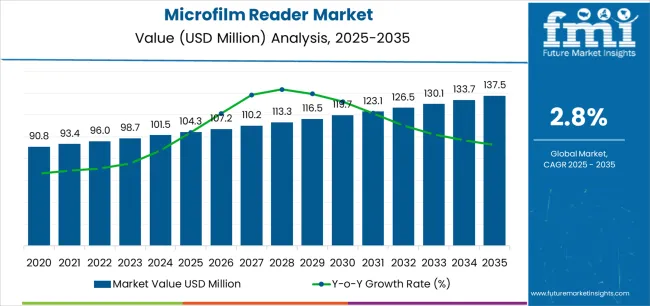
The global microfilm reader market is valued at USD 104.3 million in 2025 and is set to reach USD 137.5 million by 2035, recording an absolute increase of USD 33.2 million over the forecast period. This translates into a total growth of 31.8%, with the market forecast to expand at a compound annual growth rate (CAGR) of 2.8% between 2025 and 2035. The overall market size is expected to grow by approximately 1.3X during the same period, supported by increasing digitization requirements in archival institutions, growing demand for document preservation solutions, and rising need for efficient microform viewing technologies across libraries, government agencies, and research facilities.
The global microfilm reader market represents a specialized segment within the document imaging and archival equipment industry, driven by the critical need for accessing historical records, preserving valuable documents, and maintaining legacy information systems. These precision optical devices enable the viewing and analysis of microfilmed documents, newspapers, manuscripts, and archival materials that have been reduced to microscopic formats for long-term storage and preservation. The market encompasses various reader configurations, from portable units designed for field research to sophisticated desktop systems equipped with advanced optics and digital conversion capabilities.
Modern microfilm readers incorporate enhanced optical systems, improved illumination technology, and ergonomic design features that facilitate extended viewing sessions while maintaining image clarity and user comfort. The integration of digital conversion capabilities, motorized film transport mechanisms, and adjustable magnification systems has expanded the utility of these devices beyond traditional viewing applications to include digitization workflows and hybrid document management processes. Many contemporary systems feature LED lighting systems, automatic focusing mechanisms, and compatibility with various microfilm formats including 16mm and 35mm films, microfiche, and aperture cards.
Market dynamics are significantly influenced by the ongoing digitization initiatives undertaken by libraries, museums, government agencies, and educational institutions seeking to preserve and provide access to historical documents and records. The archival community's emphasis on maintaining access to legacy microfilm collections while transitioning to digital formats has created steady demand for reliable microfilm reader systems capable of supporting both traditional viewing and digital conversion processes. Research institutions, legal offices, and genealogical organizations continue to rely on microfilm readers for accessing specialized collections and conducting historical research activities.
Consumer purchasing patterns show preference for versatile reader systems that combine traditional viewing capabilities with digital output options, multiple format compatibility, and user-friendly operation for diverse institutional applications. The market has witnessed technological advancement in optical design, lighting systems, and mechanical transport mechanisms, making these devices more suitable for demanding archival environments, extended operational periods, and precision viewing requirements across various microform formats.
Between 2025 and 2030, the microfilm reader market is projected to expand from USD 104.3 million to USD 119.8 million, resulting in a value increase of USD 15.5 million, which represents 46.7% of the total forecast growth for the decade. This phase of development will be shaped by increasing digitization adoption, rising demand for archival access solutions, and growing availability of advanced optical systems across libraries, museums, and government institutions requiring efficient microform viewing capabilities.
Between 2030 and 2035, the market is forecast to grow from USD 119.8 million to USD 137.5 million, adding another USD 17.7 million, which constitutes 53.3% of the overall ten-year expansion. This period is expected to be characterized by the advancement of hybrid viewing and digitization systems, the development of enhanced optical technologies for specialized archival applications, and the expansion of microfilm reader networks across diverse institutional and research applications. The growing emphasis on document preservation and digital conversion will drive demand for advanced microfilm reader varieties with enhanced imaging capabilities, improved mechanical reliability, and superior optical performance profiles.
Between 2020 and 2024, the microfilm reader market experienced moderate growth, driven by institutional modernization requirements and growing recognition of microfilm readers' essential role in preserving access to historical documents following extensive archival digitization initiatives. The market developed as institutions recognized the advantages of maintaining microfilm reading capabilities alongside digital systems in comprehensive document management applications and began seeking specialized solutions designed for precision viewing requirements. Technological advancement in optical systems and mechanical engineering began emphasizing the critical importance of maintaining viewing quality while enhancing user experience and improving operational reliability across diverse microform reading applications.
Quick Stats for Microfilm Reader Market
- Microfilm Reader Market Value (2025): USD 104.3 million
- Microfilm Reader Market Forecast Value (2035): USD 137.5 million
- Microfilm Reader Market Forecast CAGR: 2.8%
- Leading Type Category in Microfilm Reader Market: Desktop Type (62.4%)
- Key Growth Regions in Microfilm Reader Market: Asia Pacific, North America, Europe
- Key Players in Microfilm Reader Market: The Crowley Company, Digital Check Corp., SunRise Imaging, Eastman Park Micrographics, Konica Minolta
Microfilm Reader Market Key Takeaways
| Metric | Value |
|---|---|
| Estimated Value in (2025E) | USD 104.3 million |
| Forecast Value in (2035F) | USD 137.5 million |
| Forecast CAGR (2025 to 2035) | 2.8% |
From 2030 to 2035, the market is forecast to grow from USD 119.8 million to USD 137.5 million, adding another USD 17.7 million, which constitutes 53.3% of the overall ten-year expansion. This period is expected to be characterized by the advancement of integrated digitization capabilities in reader systems, the integration of enhanced optical performance for specialized viewing applications, and the development of specialized reader configurations for high-resolution archival applications. The growing emphasis on document preservation and institutional efficiency will drive demand for premium varieties with enhanced optical performance capabilities, improved mechanical systems, and superior user interface characteristics.
Between 2020 and 2024, the microfilm reader market experienced steady growth, driven by increasing awareness of archival preservation requirements and growing recognition of specialized reader systems' effectiveness in supporting efficient institutional operations across libraries, government facilities, and research institutions. The market developed as users recognized the potential for microfilm readers to deliver operational advantages while meeting modern requirements for precise document viewing and reliable archival access. Technological advancement in optical optimization and mechanical system development began emphasizing the critical importance of maintaining viewing precision while extending operational life and improving user satisfaction across diverse microfilm reader applications.
Why is the Microfilm Reader Market Growing?
Market expansion is being supported by the increasing global emphasis on document preservation and the corresponding need for specialized viewing systems that can provide superior optical performance while meeting user requirements for precision microform access and cost-effective archival management solutions. Modern institutional managers are increasingly focused on incorporating reader systems that can enhance research capabilities while satisfying demands for consistent, precisely controlled document viewing and optimized archival workflow practices. Microfilm readers' proven ability to deliver optical excellence, format versatility, and diverse application possibilities makes them essential components for research-focused institutions and quality-focused archival professionals.
The growing emphasis on historical research and archival accessibility is driving demand for high-performance microfilm reader systems that can support distinctive research outcomes and comprehensive document access across library applications, museum installations, and premium institutional systems. User preference for reader solutions that combine functional excellence with preservation compatibility is creating opportunities for innovative implementations in both traditional and emerging archival applications. The rising influence of hybrid document management systems and advanced research methodologies is also contributing to increased adoption of specialized microfilm reader solutions that can provide authentic research benefits and reliable archival access characteristics.
What is the Segmental Analysis of the Microfilm Reader Market by Type, Application, and Other Factors?
The market is segmented by type, application, lens magnification, film format, and region. By type, the market is divided into desktop type, portable type, and specialty configurations. Based on application, the market is categorized into libraries and museums, government agencies, universities and institutions, and others. By lens magnification, the market includes low magnification, medium magnification, and high magnification categories. By film format, the market encompasses 16mm film, 35mm film, microfiche, and aperture cards. Regionally, the market is divided into North America, Europe, Asia Pacific, Latin America, Middle East & Africa, and other regions.
By Type, the Desktop Type Segment Accounts for 62.4% Market Share
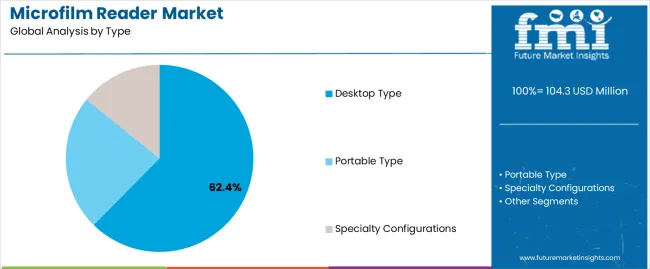
The desktop type segment is projected to account for 62.4% of the microfilm reader market in 2025, reaffirming its position as the leading type category. Institutional operators and archival professionals increasingly utilize desktop systems for their superior optical performance characteristics, established operational stability, and essential functionality in diverse high-volume viewing applications across multiple institutional sectors. Desktop readers' proven performance characteristics and established cost-effectiveness directly address user requirements for reliable document viewing and optimal operational precision in library and research applications.
This type segment forms the foundation of modern archival access performance patterns, as it represents the configuration with the greatest viewing versatility and established compatibility across multiple institutional document management systems. Institutional investments in advanced optical technology and viewing optimization continue to strengthen adoption among research-focused users. With archival managers prioritizing viewing quality and operational reliability, desktop systems align with both performance objectives and institutional requirements, making them the central component of comprehensive microfilm access strategies.
By Application, Libraries and Museums Segment Shows Strong Market Dominance
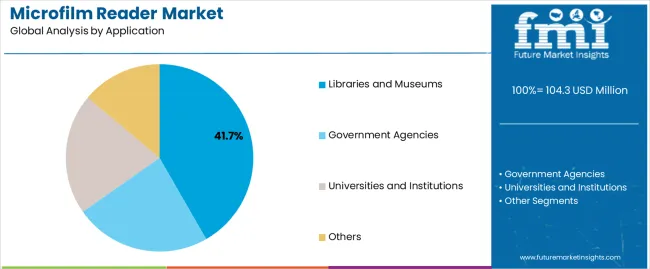
Libraries and museums is projected to represent 41.7% of the microfilm reader market in 2025, underscoring its critical role as the primary application for research-focused users seeking superior document access benefits and enhanced archival management credentials. Library and museum users and institutional operators prefer these applications for their established research requirements, proven access demand, and ability to maintain exceptional viewing precision while supporting versatile collection coverage during diverse research activities. Positioned as essential applications for research-focused institutional managers, library and museum offerings provide both operational excellence and archival access advantages.
The segment is supported by continuous improvement in archival technology and the widespread availability of established institutional standards that enable performance assurance and premium positioning at the facility level. Library and museum users are optimizing reader selections to support collection-specific applications and comprehensive research strategies. As archival technology continues to advance and institutions seek efficient access methods, library and museum applications will continue to drive market growth while supporting research efficiency and document preservation strategies.
What are the Drivers, Restraints, and Key Trends of the Microfilm Reader Market?
The microfilm reader market is advancing steadily due to increasing archival preservation adoption and growing need for specialized document access solutions that emphasize superior optical performance across institutional segments and research applications. The market faces challenges, including competition from digital document systems, technology transition considerations, and equipment replacement cost factors affecting adoption rates. Innovation in optical enhancement and advanced viewing systems continues to influence market development and expansion patterns.
Expansion of Digital Integration and Hybrid Viewing Applications
The growing adoption of microfilm readers with digital conversion capabilities and hybrid document integration is enabling users to develop archival strategies that provide distinctive preservation benefits while commanding automated operation and enhanced real-time document analysis characteristics. Digital integration applications provide superior operational consistency while allowing more sophisticated preservation features across various institutional categories. Users are increasingly recognizing the operational advantages of intelligent reader positioning for comprehensive archival outcomes and technology-integrated document management.
Integration of Enhanced Optical Systems and Performance Monitoring
Modern microfilm reader manufacturers are incorporating advanced optical sensors, real-time performance monitoring capabilities, and enhanced viewing systems to improve operational precision, enhance equipment effectiveness, and meet institutional demands for specialized document access solutions. These systems improve viewing effectiveness while enabling new applications, including continuous quality monitoring programs and automated optimization protocols. Advanced optical integration also allows users to support proactive performance positioning and quality assurance beyond traditional reader operation requirements.
What are the Key Country Insights in the Microfilm Reader Market?
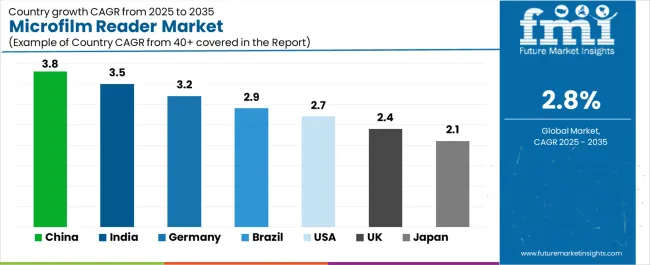
| Country | CAGR (2025-2035) |
|---|---|
| China | 3.8% |
| India | 3.5% |
| Germany | 3.2% |
| Brazil | 2.9% |
| USA | 2.7% |
| UK | 2.4% |
| Japan | 2.1% |
The microfilm reader market is experiencing moderate growth globally, with China leading at a 3.8% CAGR through 2035, driven by the expanding institutional sector, growing archival modernization requirements, and increasing adoption of advanced document management systems. India follows at 3.5%, supported by rising educational infrastructure, expanding library development industry, and growing acceptance of archival preservation technologies. Germany shows growth at 3.2%, emphasizing established institutional standards and comprehensive archival development. Brazil records 2.9%, focusing on institutional modernization and archival efficiency growth. The USA demonstrates 2.7% growth, prioritizing advanced research technologies and document preservation optimization.
The report covers an in-depth analysis of 40+ countries, with top-performing countries highlighted below.
How is China Leading Global Market Growth with Institutional Modernization?
Revenue from microfilm reader consumption and sales in China is projected to exhibit strong growth with a CAGR of 3.8% through 2035, driven by the country's rapidly expanding institutional sector, favorable government policies toward archival modernization, and initiatives promoting document preservation technologies across major urban regions. China's position as a global educational hub and increasing focus on historical preservation systems are creating substantial demand for high-quality microfilm readers in both domestic and institutional markets. Major archival equipment companies and institutional distributors are establishing comprehensive reader capabilities to serve growing demand and emerging preservation opportunities.
- Established institutional culture and expanding preservation consciousness are driving demand for microfilm readers across library facilities, museum developments, and comprehensive archival systems throughout Chinese institutional markets.
- Strong educational infrastructure and preservation adoption initiatives are supporting the rapid adoption of premium microfilm readers among research-focused institutions seeking to meet evolving archival standards and access requirements.
What Drives India’s Strong Market Potential with Educational Development Focus?
Demand for microfilm reader products in India is expanding at a CAGR of 3.5%, supported by rising educational investment, growing archival consciousness, and expanding equipment distributor capabilities. The country's developing institutional infrastructure and increasing investment in preservation technologies are driving demand for microfilm readers across both traditional and modern archival applications. International archival equipment companies and domestic distributors are establishing comprehensive operational networks to address growing market demand for document access devices and efficient preservation solutions.
- Rising educational development and expanding institutional capabilities are creating opportunities for microfilm reader adoption across library projects, modern archival developments, and distributor companies throughout major Indian educational regions.
- Growing preservation awareness initiatives and document access technology advancement are driving the adoption of specialized reader products and services among institutional users seeking to enhance their research efficiency and meet increasing archival demand.
How Does Germany Maintain Market Leadership with Archival Excellence?
Revenue from microfilm reader products in Germany is projected to grow at a CAGR of 3.2% through 2035, supported by the country's mature institutional standards, established archival regulations, and leadership in document preservation technology. Germany's sophisticated institutional standards and strong support for advanced archival systems are creating steady demand for both traditional and innovative microfilm reader varieties. Leading archival equipment manufacturers and specialty distributors are establishing comprehensive operational strategies to serve both domestic markets and growing export opportunities.
- Advanced institutional technology capabilities and established research-focused markets are driving demand for premium microfilm readers across library facilities, museum buildings, and comprehensive archival companies seeking superior performance profiles and institutional innovation.
- Strong archival excellence culture and regulatory leadership are supporting the adoption of innovative reader technology among users prioritizing operational reliability and institutional precision in document access applications.
What Factors are Strengthening Brazil’s Position with Institutional Modernization Growth?
Demand for microfilm reader products in Brazil is anticipated to expand at a CAGR of 2.9% through 2035, driven by the country's emphasis on institutional development, archival modernization growth, and growing preservation distributor capabilities. Brazilian institutional users and archival facilities consistently seek research-focused equipment that enhances operational performance and supports modernization excellence for both traditional and modern document applications. The country's position as a Latin American institutional leader continues to drive innovation in specialized document access applications and archival standards.
- Expanding institutional culture and growing archival markets are driving demand for commercial microfilm readers across library consumers, preservation providers, and research-focused distributors seeking superior document access and distinctive operational profiles.
- Increasing focus on archival efficiency and institutional modernization systems is supporting the adoption of specialty microfilm reader varieties among users and distributors seeking authentic Brazilian preservation-focused products in regional markets with established institutional expertise.
How is the USA Anchoring Growth with Technology Integration?
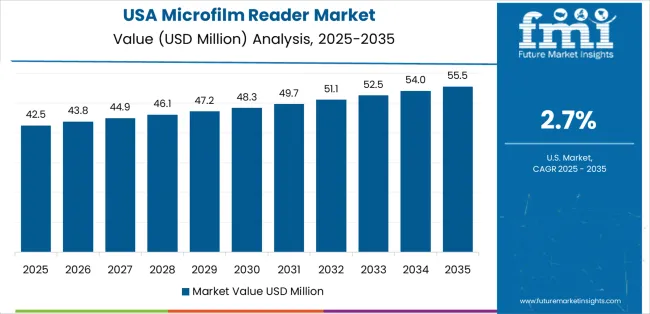
Revenue from microfilm reader products in the USA is forecasted to increase at a CAGR of 2.7% through 2035, supported by the country's emphasis on research technology advancement, document preservation optimization, and advanced archival system integration requiring efficient document access solutions. American institutional users and research-focused facilities prioritize performance reliability and archival precision, making specialized microfilm readers essential components for both traditional and modern document management applications. The country's comprehensive research technology leadership and advancing preservation patterns support continued market expansion.
- Advanced research technology capabilities and growing precision document management are driving demand for microfilm readers across specialty applications, modern institutional formats, and technology-integrated preservation programs serving domestic markets with increasing operational requirements.
- Strong focus on research optimization and performance excellence is encouraging users and distributors to adopt reader solutions that support archival objectives and meet American quality standards for document access applications.
What Contributes to the UK’s Steady Growth with Archival Efficiency Focus?
Demand for microfilm reader products in the UK is expected to expand at a CAGR of 2.4% through 2035, supported by established institutional standards, mature archival markets, and emphasis on document preservation across library and research sectors. British institutional users and archival professionals prioritize quality performance and operational consistency, creating steady demand for premium reader solutions. The country's comprehensive market maturity and established institutional practices support continued development in specialized applications.
- Established archival markets and mature institutional industry are driving demand for quality microfilm readers across library operations, museum facilities, and professional archival companies throughout British institutional regions.
- Strong emphasis on quality standards and preservation efficiency is supporting the adoption of premium reader varieties among users seeking proven performance and established institutional credentials in archival applications.
How is Japan Demonstrating Precision-Focused Growth?
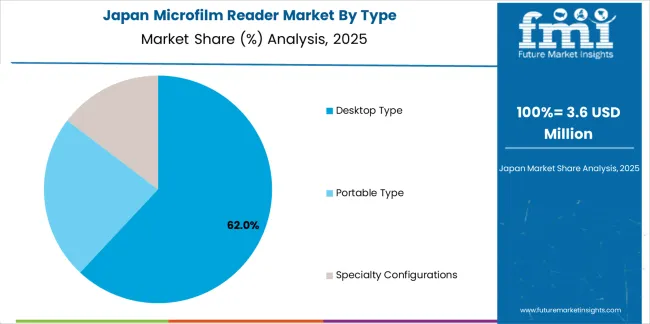
Revenue from microfilm reader products in Japan is projected to grow at a CAGR of 2.1% through 2035, supported by the country's emphasis on precision engineering, operational excellence, and advanced technology integration requiring efficient document access solutions. Japanese institutional users and research-focused facilities prioritize technical performance and engineering precision, making specialized microfilm readers essential components for both traditional and modern archival applications. The country's comprehensive engineering leadership and advancing precision patterns support continued market expansion.
- Advanced precision engineering technology capabilities and growing technical archival applications are driving demand for microfilm readers across specialty institutional applications, modern precision formats, and technology-integrated research programs serving domestic markets with increasing quality requirements.
- Strong focus on technical precision and operational excellence is encouraging users and distributors to adopt reader solutions that support engineering objectives and meet Japanese precision standards for document access applications.
How is the Microfilm Reader Market Split Across European Countries?
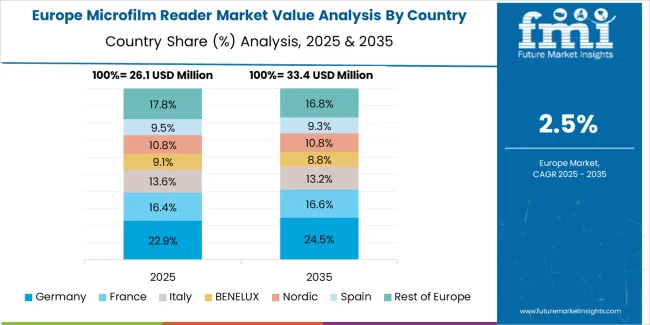
The Europe microfilm reader market is projected to grow from USD 31.2 million in 2025 to USD 41.8 million by 2035, recording a CAGR of 3.0% over the forecast period. Germany leads the region with a 43.6% share in 2025, moderating slightly to 43.1% by 2035, supported by its strong institutional traditions and demand for premium, precision-manufactured reader solutions. The United Kingdom follows with 24.8% in 2025, easing to 24.3% by 2035, driven by a mature archival market and emphasis on document preservation and quality performance.
France accounts for 16.1% in 2025, rising to 16.6% by 2035, reflecting steady adoption of institutional technologies and preservation optimization. Italy holds 7.9% in 2025, expanding to 8.4% by 2035 as archival modernization and specialty preservation applications grow. Spain contributes 4.2% in 2025, growing to 4.6% by 2035, supported by expanding institutional development and preservation awareness modernization. The Nordic countries rise from 2.1% in 2025 to 2.3% by 2035 on the back of strong research consciousness and advanced archival methodologies. BENELUX remains at 1.3% share across both 2025 and 2035, reflecting mature, efficiency-focused institutional markets.
What are the Key Drivers of the Competitive Landscape in the Microfilm Reader Market?
The microfilm reader market is characterized by competition among established archival equipment manufacturers, specialized optical companies, and integrated document management providers. Companies are investing in advanced optical technologies, specialized mechanical engineering, product innovation capabilities, and comprehensive distribution networks to deliver consistent, high-quality, and reliable microfilm reader systems. Innovation in optical system optimization, mechanical advancement, and research-focused product development is central to strengthening market position and customer satisfaction.
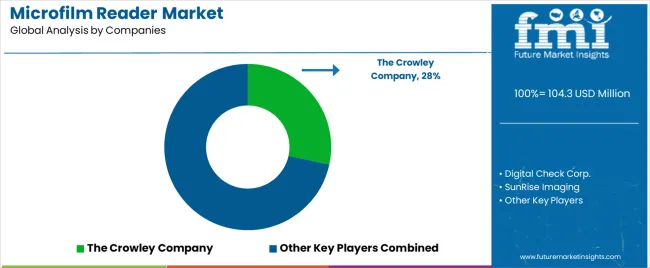
The Crowley Company leads the market with 28.4% share with a strong focus on archival technology innovation and comprehensive document management solutions, offering institutional and research systems with emphasis on performance excellence and optical heritage. Digital Check Corp. provides integrated document processing with a focus on institutional market applications and precision viewing networks. SunRise Imaging delivers comprehensive archival technology solutions with a focus on research positioning and operational efficiency. Eastman Park Micrographics specializes in comprehensive microform systems with an emphasis on preservation applications. Konica Minolta focuses on comprehensive imaging equipment with advanced design and premium positioning capabilities.
Global Microfilm Reader Market - Stakeholder Contribution Framework
The success of microfilm readers in meeting archival demands, document preservation requirements, and institutional integration will not only enhance research performance outcomes but also strengthen global archival technology manufacturing capabilities. It will consolidate emerging regions' positions as hubs for efficient microfilm reader production and align advanced economies with comprehensive preservation systems. This calls for a concerted effort by all stakeholders -- governments, industry bodies, manufacturers, distributors, and investors. Each can be a crucial enabler in preparing the market for its next phase of growth.
How Governments Could Spur Local Production and Adoption?
- Targeted Incentives: Introduce archival modernization subsidies for institutions adopting advanced microfilm reader production technologies in educational and research regions, and production-linked incentives for facilities producing devices for domestic consumption and export markets.
- Trade Agreements: Accelerate export growth through bilateral and multilateral agreements that classify microfilm readers under "archival equipment," easing cross-border regulatory approvals and institutional safety certifications.
- Facilitate Innovation: Establish Centers of Excellence for archival technology innovation and optical engineering. Fund R&D into efficient viewing systems, optical optimization, and institutional-standard integration for library and research applications.
How Industry Bodies Could Support Market Development?
- Foster Connectivity: Constitute a global archival technology consortium linking microfilm reader manufacturers, document management suppliers, users, and policymakers to align production targets with preservation and research commitments.
- Promote Exports: Work with export councils to brand microfilm readers as premium, research-focused archival solutions. Facilitate trade fairs to connect archival technology innovators with global buyers in library, museum, and institutional sectors.
- Upskilling Programs: Develop curricula on advanced reader manufacturing, optical technology, archival processes, and preservation optimization to prepare manufacturers and operators for premium institutional market opportunities.
How Distributors and Archival Equipment Players Could Strengthen the Ecosystem?
- Drive Integration: Bundle microfilm readers with research-focused marketing and preservation messaging systems. Position specialized readers as part of holistic "archival optimization solutions."
- Forge Partnerships: Collaborate with reader manufacturers and technology providers for joint R&D on preservation applications, research enhancement initiatives, and global quality assurance for premium markets.
How Manufacturers Could Navigate the Shift?
- Capture Premium Markets: Leverage government incentives and rising preservation demand to offer microfilm readers into growth markets where general viewing solutions face performance and quality challenges.
- Invest in Technology: Partner with technology providers to advance efficient optical workflows, institutional-grade quality, and advanced manufacturing practices.
- Build Capabilities: Train technical staff and archival specialists to demonstrate microfilm readers' operational advantages, repositioning institutional relationships toward long-term preservation partnerships.
Key Players in the Microfilm Reader Market
- The Crowley Company
- Digital Check Corp.
- SunRise Imaging
- Eastman Park Micrographics
- Konica Minolta
- e-ImageData
- SMA Electronic Document
- Indus International
- Microbox
- FujiFilm
- Dashengfenghua
Scope of the Report
| Items | Values |
|---|---|
| Quantitative Units (2025) | USD 104.3 million |
| Type | Desktop Type, Portable Type, Specialty Configurations |
| Application | Libraries and Museums, Government Agencies, Universities and Institutions, Others |
| Lens Magnification | Low Magnification, Medium Magnification, High Magnification |
| Film Format | 16mm Film, 35mm Film, Microfiche, Aperture Cards |
| Regions Covered | North America, Europe, Asia Pacific, Latin America, Middle East & Africa, Other Regions |
| Countries Covered | China, India, Germany, Brazil, United States, United Kingdom, Japan, and 40+ countries |
| Key Companies Profiled | The Crowley Company, Digital Check Corp., SunRise Imaging, Eastman Park Micrographics, Konica Minolta, and other leading microfilm reader companies |
| Additional Attributes | Dollar sales by type, application, lens magnification, film format, and region; regional demand trends, competitive landscape, technological advancements in optical engineering, viewing optimization initiatives, preservation enhancement programs, and premium product development strategies |
Microfilm Reader Market by Segments
Type:
- Desktop Type
- Portable Type
- Specialty Configurations
Application:
- Libraries and Museums
- Government Agencies
- Universities and Institutions
- Others
Lens Magnification:
- Low Magnification
- Medium Magnification
- High Magnification
Film Format:
- 16mm Film
- 35mm Film
- Microfiche
- Aperture Cards
Region:
North America
- United States
- Canada
- Mexico
Europe
- Germany
- United Kingdom
- France
- Italy
- Spain
- Nordic Countries
- BENELUX
- Rest of Europe
Asia Pacific
- China
- India
- Japan
- South Korea
- Australia
- Rest of Asia Pacific
Latin America
- Brazil
- Argentina
- Rest of Latin America
Middle East & Africa
- Kingdom of Saudi Arabia
- United Arab Emirates
- South Africa
- Rest of Middle East & Africa
Other Regions
- Oceania
- Central Asia
- Other Markets
Frequently Asked Questions
How big is the microfilm reader market in 2025?
The global microfilm reader market is estimated to be valued at USD 104.3 million in 2025.
What will be the size of microfilm reader market in 2035?
The market size for the microfilm reader market is projected to reach USD 137.5 million by 2035.
How much will be the microfilm reader market growth between 2025 and 2035?
The microfilm reader market is expected to grow at a 2.8% CAGR between 2025 and 2035.
What are the key product types in the microfilm reader market?
The key product types in microfilm reader market are desktop type , portable type and specialty configurations.
Which application segment to contribute significant share in the microfilm reader market in 2025?
In terms of application, libraries and museums segment to command 41.7% share in the microfilm reader market in 2025.
Preview the report firsthand - request a free sample
Get SampleGet the brochure for pricing and purchase details.
Get PDFTable of Content
- Executive Summary
- Global Market Outlook
- Demand-side Trends
- Supply-side Trends
- Technology Roadmap Analysis
- Analysis and Recommendations
- Market Overview
- Market Coverage / Taxonomy
- Market Definition / Scope / Limitations
- Market Background
- Market Dynamics
- Drivers
- Restraints
- Opportunity
- Trends
- Scenario Forecast
- Demand in Optimistic Scenario
- Demand in Likely Scenario
- Demand in Conservative Scenario
- Opportunity Map Analysis
- Product Life Cycle Analysis
- Supply Chain Analysis
- Investment Feasibility Matrix
- Value Chain Analysis
- PESTLE and Porter’s Analysis
- Regulatory Landscape
- Regional Parent Market Outlook
- Production and Consumption Statistics
- Import and Export Statistics
- Market Dynamics
- Global Market Analysis 2020 to 2024 and Forecast, 2025 to 2035
- Historical Market Size Value (USD Million) Analysis, 2020 to 2024
- Current and Future Market Size Value (USD Million) Projections, 2025 to 2035
- Y-o-Y Growth Trend Analysis
- Absolute $ Opportunity Analysis
- Global Market Pricing Analysis 2020 to 2024 and Forecast 2025 to 2035
- Global Market Analysis 2020 to 2024 and Forecast 2025 to 2035, By Type
- Introduction / Key Findings
- Historical Market Size Value (USD Million) Analysis By Type , 2020 to 2024
- Current and Future Market Size Value (USD Million) Analysis and Forecast By Type , 2025 to 2035
- Desktop Type
- Portable Type
- Specialty Configurations
- Y-o-Y Growth Trend Analysis By Type , 2020 to 2024
- Absolute $ Opportunity Analysis By Type , 2025 to 2035
- Global Market Analysis 2020 to 2024 and Forecast 2025 to 2035, By Application
- Introduction / Key Findings
- Historical Market Size Value (USD Million) Analysis By Application, 2020 to 2024
- Current and Future Market Size Value (USD Million) Analysis and Forecast By Application, 2025 to 2035
- Libraries and Museums
- Government Agencies
- Universities and Institutions
- Others
- Y-o-Y Growth Trend Analysis By Application, 2020 to 2024
- Absolute $ Opportunity Analysis By Application, 2025 to 2035
- Global Market Analysis 2020 to 2024 and Forecast 2025 to 2035, By Region
- Introduction
- Historical Market Size Value (USD Million) Analysis By Region, 2020 to 2024
- Current Market Size Value (USD Million) Analysis and Forecast By Region, 2025 to 2035
- North America
- Latin America
- Western Europe
- Eastern Europe
- East Asia
- South Asia and Pacific
- Middle East & Africa
- Market Attractiveness Analysis By Region
- North America Market Analysis 2020 to 2024 and Forecast 2025 to 2035, By Country
- Historical Market Size Value (USD Million) Trend Analysis By Market Taxonomy, 2020 to 2024
- Market Size Value (USD Million) Forecast By Market Taxonomy, 2025 to 2035
- By Country
- USA
- Canada
- Mexico
- By Type
- By Application
- By Country
- Market Attractiveness Analysis
- By Country
- By Type
- By Application
- Key Takeaways
- Latin America Market Analysis 2020 to 2024 and Forecast 2025 to 2035, By Country
- Historical Market Size Value (USD Million) Trend Analysis By Market Taxonomy, 2020 to 2024
- Market Size Value (USD Million) Forecast By Market Taxonomy, 2025 to 2035
- By Country
- Brazil
- Chile
- Rest of Latin America
- By Type
- By Application
- By Country
- Market Attractiveness Analysis
- By Country
- By Type
- By Application
- Key Takeaways
- Western Europe Market Analysis 2020 to 2024 and Forecast 2025 to 2035, By Country
- Historical Market Size Value (USD Million) Trend Analysis By Market Taxonomy, 2020 to 2024
- Market Size Value (USD Million) Forecast By Market Taxonomy, 2025 to 2035
- By Country
- Germany
- UK
- Italy
- Spain
- France
- Nordic
- BENELUX
- Rest of Western Europe
- By Type
- By Application
- By Country
- Market Attractiveness Analysis
- By Country
- By Type
- By Application
- Key Takeaways
- Eastern Europe Market Analysis 2020 to 2024 and Forecast 2025 to 2035, By Country
- Historical Market Size Value (USD Million) Trend Analysis By Market Taxonomy, 2020 to 2024
- Market Size Value (USD Million) Forecast By Market Taxonomy, 2025 to 2035
- By Country
- Russia
- Poland
- Hungary
- Balkan & Baltic
- Rest of Eastern Europe
- By Type
- By Application
- By Country
- Market Attractiveness Analysis
- By Country
- By Type
- By Application
- Key Takeaways
- East Asia Market Analysis 2020 to 2024 and Forecast 2025 to 2035, By Country
- Historical Market Size Value (USD Million) Trend Analysis By Market Taxonomy, 2020 to 2024
- Market Size Value (USD Million) Forecast By Market Taxonomy, 2025 to 2035
- By Country
- China
- Japan
- South Korea
- By Type
- By Application
- By Country
- Market Attractiveness Analysis
- By Country
- By Type
- By Application
- Key Takeaways
- South Asia and Pacific Market Analysis 2020 to 2024 and Forecast 2025 to 2035, By Country
- Historical Market Size Value (USD Million) Trend Analysis By Market Taxonomy, 2020 to 2024
- Market Size Value (USD Million) Forecast By Market Taxonomy, 2025 to 2035
- By Country
- India
- ASEAN
- Australia & New Zealand
- Rest of South Asia and Pacific
- By Type
- By Application
- By Country
- Market Attractiveness Analysis
- By Country
- By Type
- By Application
- Key Takeaways
- Middle East & Africa Market Analysis 2020 to 2024 and Forecast 2025 to 2035, By Country
- Historical Market Size Value (USD Million) Trend Analysis By Market Taxonomy, 2020 to 2024
- Market Size Value (USD Million) Forecast By Market Taxonomy, 2025 to 2035
- By Country
- Kingdom of Saudi Arabia
- Other GCC Countries
- Turkiye
- South Africa
- Other African Union
- Rest of Middle East & Africa
- By Type
- By Application
- By Country
- Market Attractiveness Analysis
- By Country
- By Type
- By Application
- Key Takeaways
- Key Countries Market Analysis
- USA
- Pricing Analysis
- Market Share Analysis, 2024
- By Type
- By Application
- Canada
- Pricing Analysis
- Market Share Analysis, 2024
- By Type
- By Application
- Mexico
- Pricing Analysis
- Market Share Analysis, 2024
- By Type
- By Application
- Brazil
- Pricing Analysis
- Market Share Analysis, 2024
- By Type
- By Application
- Chile
- Pricing Analysis
- Market Share Analysis, 2024
- By Type
- By Application
- Germany
- Pricing Analysis
- Market Share Analysis, 2024
- By Type
- By Application
- UK
- Pricing Analysis
- Market Share Analysis, 2024
- By Type
- By Application
- Italy
- Pricing Analysis
- Market Share Analysis, 2024
- By Type
- By Application
- Spain
- Pricing Analysis
- Market Share Analysis, 2024
- By Type
- By Application
- France
- Pricing Analysis
- Market Share Analysis, 2024
- By Type
- By Application
- India
- Pricing Analysis
- Market Share Analysis, 2024
- By Type
- By Application
- ASEAN
- Pricing Analysis
- Market Share Analysis, 2024
- By Type
- By Application
- Australia & New Zealand
- Pricing Analysis
- Market Share Analysis, 2024
- By Type
- By Application
- China
- Pricing Analysis
- Market Share Analysis, 2024
- By Type
- By Application
- Japan
- Pricing Analysis
- Market Share Analysis, 2024
- By Type
- By Application
- South Korea
- Pricing Analysis
- Market Share Analysis, 2024
- By Type
- By Application
- Russia
- Pricing Analysis
- Market Share Analysis, 2024
- By Type
- By Application
- Poland
- Pricing Analysis
- Market Share Analysis, 2024
- By Type
- By Application
- Hungary
- Pricing Analysis
- Market Share Analysis, 2024
- By Type
- By Application
- Kingdom of Saudi Arabia
- Pricing Analysis
- Market Share Analysis, 2024
- By Type
- By Application
- Turkiye
- Pricing Analysis
- Market Share Analysis, 2024
- By Type
- By Application
- South Africa
- Pricing Analysis
- Market Share Analysis, 2024
- By Type
- By Application
- USA
- Market Structure Analysis
- Competition Dashboard
- Competition Benchmarking
- Market Share Analysis of Top Players
- By Regional
- By Type
- By Application
- Competition Analysis
- Competition Deep Dive
- The Crowley Company
- Overview
- Product Portfolio
- Profitability by Market Segments (Product/Age /Sales Channel/Region)
- Sales Footprint
- Strategy Overview
- Marketing Strategy
- Product Strategy
- Channel Strategy
- Digital Check Corp.
- SunRise Imaging
- Eastman Park Micrographics
- Konica Minolta
- e-ImageData
- SMA Electronic Document
- Indus International
- Microbox
- FujiFilm
- Dashengfenghua
- The Crowley Company
- Competition Deep Dive
- Assumptions & Acronyms Used
- Research Methodology


