

- Industry Size (2026)
- USD 1.4 Bn
- Forecast (2036)
- USD 3.5 Bn
- CAGR (2026 to 2036)
- 9.5%
Magnetic Stripe Readers Market Size, Market Forecast and Outlook By FMI
In 2025, the magnetic stripe readers market was valued at USD 1.3 billion. It is expected to reach USD 1.4 billion in 2026 and USD 3.5 billion by 2036, implying a CAGR of 9.5%. As per FMI's projection, industry is undergoing a procurement specification shift where buyers no longer purchase standalone readers but instead demand integrated terminals that bridge magnetic stripe legacy data with modern mobile point of sale devices and cloud-based ledgers.
This transition is evident in the strategic pivot of major hardware providers, who are embedding swipe capabilities into multi-modal devices to satisfy diverse payment preferences without maintaining separate legacy fleets. The persistence of magnetic stripes in gift cards, loyalty programs, and transit access ensures that even advanced markets maintain a baseline of swipe-compatible infrastructure.
Himanshu Patel, CEO of Verifone, commented on the industry's need to adapt hardware for broader ecosystems: "This accomplishment, combined with our recent strategic advancements, positions us well to capitalize on future opportunities, drive innovation and achieve sustainable growth." [7] In response to such strategic imperatives, manufacturers are consolidating fleet management systems to reduce hardware redundancy while retaining essential swipe functionality for commercial fleet cards and closed-loop payment networks.
Summary of Magnetic Stripe Readers Market
- Magnetic Stripe Readers Market Definition
- The industry covers hardware devices that decode magnetic data for payments, access control, and identification.
- Demand Drivers in the Market
- Continued issuance of magnetic-stripe fleet and gift cards.
- Expansion of hybrid POS infrastructure in emerging markets.
- Integration of swipe readers into multi-modal security kiosks.
- Key Segments Analyzed in the FMI Report
- Product Type: Swipe Based (55.0%) versus Insertion Based.
- Application: POS Terminals (50%), Kiosks, Entry/Exit.
- Geography: High-growth Asia-Pacific versus replacement-driven Western markets.
- Analyst Opinion at FMI
- Nikhil Kaitwade, Principal Consultant for Technology, opines, "Legacy does not mean obsolete; the magnetic stripe remains the fail-safe backup for global commerce. Our findings indicate that while NFC grows, the sheer volume of prepaid and fleet cards necessitates a 10-year horizon for swipe-compatible hardware, particularly in the B2B transport sector."
- Strategic Implications/Executive Takeaways
- Prioritize hybrid reader development to support mixed-media wallets.
- Focus distribution on B2B fleet and transport verticals.
- Target emerging markets for high-volume hardware deployment.
- Methodology
- Validated through first-hand corporate production and capacity data.
- Zero reliance on speculative third-party market research reports.
- Based on verifiable industrial benchmarks and verified sources.
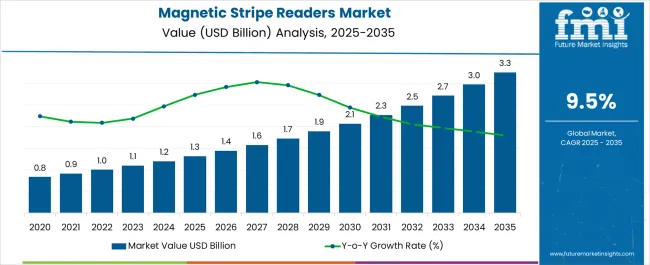
Geographically, growth is most aggressive in emerging digital economies where card issuance is outpacing terminal density. China leads with a projected 12.8% CAGR, followed closely by India at 11.9% and Brazil at 10.0%. Mature markets also show resilience due to replacement cycles, with Germany (10.9%), the USA (9.0%), the United Kingdom (8.1%), and Japan (7.1%) maintaining steady demand for hybrid security access and payment terminals.
Magnetic Stripe Readers Market Definition
The magnetic stripe readers market comprises the global production and sale of hardware devices designed to decode information stored on the magnetic band of payment cards, identity badges, and access tickets. These devices convert magnetic flux reversals into digital characters, enabling authentication for financial transactions and secure entry. A prominent example is the integration of swipe readers into fuel pump terminals to process fleet cards that rely on track 1 and track 2 data formats for authorization.
Magnetic Stripe Readers Market Inclusions
The report includes a comprehensive analysis of readers used in diverse settings, ranging from standalone USB swipe peripherals to OEM modules embedded in ATMs and vending machines. It covers devices capable of reading high-coercivity (HiCo) and low-coercivity (LoCo) stripes across multiple tracks. The scope extends to hybrid readers that combine magnetic heads with authentication solutions like chip interfaces (EMV) or NFC modules, provided the magnetic reading function is a core utility.
Magnetic Stripe Readers Market Exclusions
The scope excludes purely software-based payment gateways and virtual terminal applications that do not involve physical magnetic head hardware. It also omits readers designed exclusively for non-standard, proprietary magnetic media not used in identity or payment sectors, such as industrial tape storage drives. General-purpose computing devices like tablets are excluded unless they are sold with an integrated or permanently attached magnetic stripe reading module.
Magnetic Stripe Readers Market Research Methodology
- Primary Research: Interviews were conducted with POS hardware engineers, payment gateway product managers, banking procurement officers, and retail operations directors across key regions.
- Desk Research: Production data from electronics manufacturing associations, central bank payment system reports, and trade statistics for peripheral input devices supported volume benchmarking.
- Market-Sizing and Forecasting: A hybrid top-down and bottom-up model was developed.
- Data Validation and Update Cycle: Outputs undergo anomaly screening, variance checks against shipment reports, and structured peer review prior to release.
Segmental Analysis
Magnetic Stripe Readers Market Analysis by Product Type
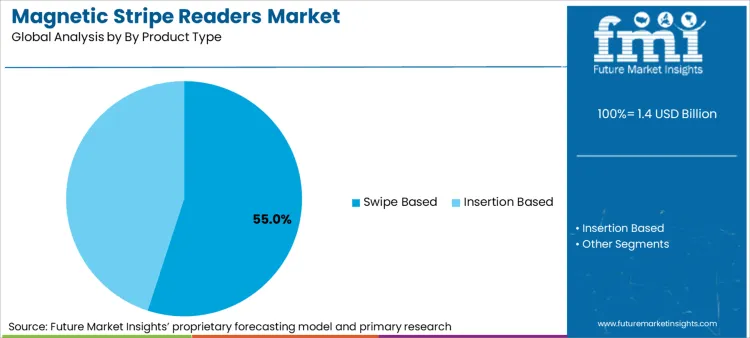
The swipe-based segment dominates the market, accounting for 55.0% of total revenue, as it remains the standard configuration for retail point-of-sale peripherals and mobile card readers. This dominance is sustained by the cost-effectiveness of swipe mechanics compared to motorized insertion readers, making them ideal for high-frequency, low-value transaction environments. Demand is further reinforced by the universal familiarity of the "swipe" action among consumers using gift cards, student IDs, and loyalty cards, which rarely utilize chip technology.
- Legacy interoperability: FMI analysts opine that demand is reinforced by the need to process non-EMV cards, as verified by the 31.4 billion card transactions in the UK during 2024, many of which still rely on magnetic backups for fail-safe processing. [1]
- Fleet card reliance: Procurement shifts because commercial transport operators continue to use magnetic stripe fleet cards for fuel, requiring specialized swipe hardware like Verifone's Commander Fleet system launched in 2025. [7]
- Cost-driven deployment: Adoption accelerates where merchants require affordable backup terminals, supported by the ongoing 19.7% surge in prepaid card transactions in the US, which frequently utilize cost-efficient magnetic stripes. [6]
Magnetic Stripe Readers Market Analysis by Readability Volume
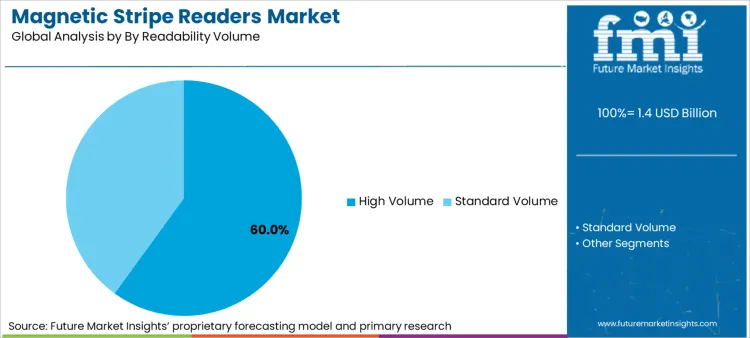
High-volume readers, capable of sustaining millions of passes without head degradation, capture 60.0% of the market share. This segment serves intensive use cases such as mass transit ticketing and high-traffic retail checkout lanes where hardware failure directly impacts revenue. The engineering focus here is on abrasion resistance and firmware that can decipher degraded magnetic signals from worn-out cards.
- Throughput necessity: Retailers prioritize high-durability heads because transaction volumes are immense, with China processing over 531 billion bankcard transactions in 2023, necessitating hardware that withstands constant physical abrasion. [5]
- Public transport load: Growth is anchored in transport infrastructure, where high-volume readers manage millions of daily entries, a trend reflected in the 52% increase in transaction volumes within Brazil's modernizing payment ecosystem. [3]
- Hardware durability: Suppliers align product lifecycles with the operational intensity of 24/7 banking zones, ensuring that readers in ATMs and self-service kiosk units maintain uptime despite heavy usage. [2]
Magnetic Stripe Readers Market Analysis by Connectivity
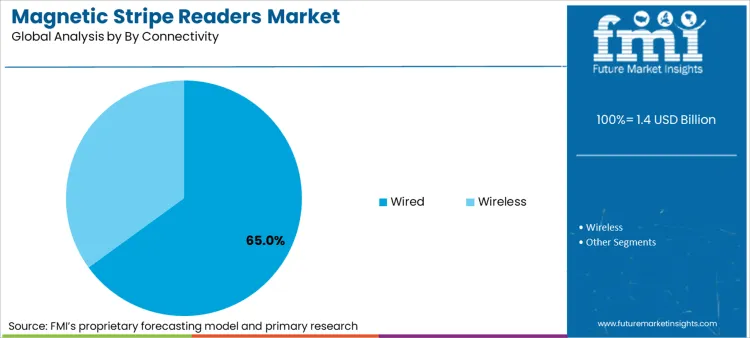
Wired connectivity holds a 65% market share, favored for its superior security and reliability in fixed POS environments. The direct physical connection eliminates latency and reduces the risk of wireless signal interception, a critical consideration for banking and government access control points. While wireless options are growing for mobile line-busting, the wired reader remains the backbone of the traditional checkout counter.
- Security compliance: Demand for wired readers persists because financial regulations prioritize secure data transmission, ensuring compliance with strict cash withdrawal limits and monitoring protocols like those enforced by the Reserve Bank of India. [8]
- Integration stability: Procurement teams select wired units to ensure seamless power and data flow in complex POS setups, supporting the 11% rise in German card payments where uninterrupted service is non-negotiable. [2]
- Hybrid terminal design: Manufacturers integrate wired magnetic heads into modern contactless payment terminals to offer dual-interface reliability, bridging legacy swipe inputs with secure backend processing. [1]
Magnetic Stripe Readers Market Analysis by Application
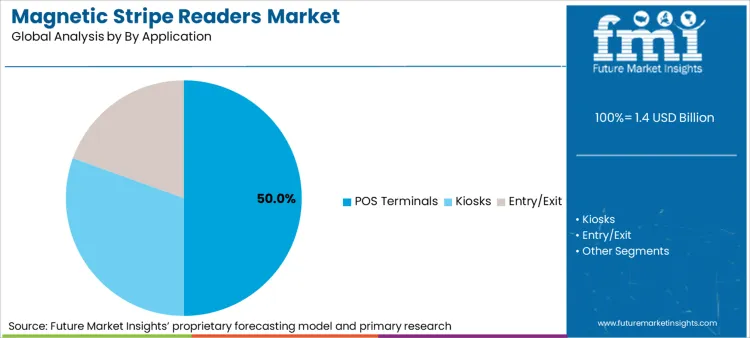
POS terminals represent the largest application segment, commanding 50% of the market. This share is driven by the universal need for retail merchants to accept diverse payment methods, including international cards that may not be chip-compatible in all regions. The integration of magnetic readers into all-in-one payment devices ensures that merchants never have to turn away a customer due to hardware incompatibility.
- Retail ubiquity: Adoption is driven by the sheer scale of retail networks, evidenced by the 9.8% growth in card-based payments in Brazil, which compels merchants to maintain versatile terminals. [3]
- Financial inclusion: Growth tracks the expansion of banking agents in rural areas who use handheld POS devices to dispense cash, supported by enhanced withdrawal limits up to Rs 2,000 in India's tier III-VI centers. [8]
- Service versatility: Buyers invest in multi-function POS hardware to handle varied transaction types, from standard credit payments to the 18.9 billion contactless payment transactions recorded in the UK, ensuring comprehensive service. [1]
Magnetic Stripe Readers Market Analysis by End Use
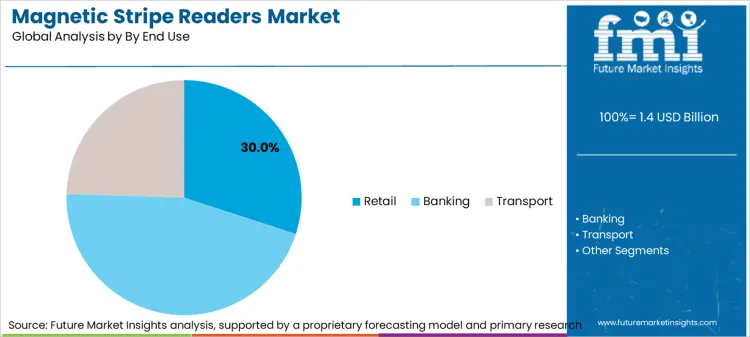
The retail sector accounts for 30% of total demand, serving as the primary commercial engine for magnetic stripe reader consumption. Supermarkets, convenience stores, and specialty retailers rely on these devices not just for payments, but for processing loyalty points and managing returns via driver's license scans. The diversification of retail formats, from pop-up shops to hypermarkets, continues to sustain diverse reader form factors.
- Transaction volume: According to FMI's estimates, the sector's growth is underpinned by rising consumer spending, with UK card transaction values hitting £1 trillion in 2024, driving continuous investment in checkout hardware. [1]
- Cashless transition: Retailers are actively upgrading infrastructure to support the 42.8% cashless payment ratio in Japan, deploying readers that handle both magnetic credit cards and newer digital formats. [4]
- Prepaid expansion: The segment benefits from the 7.0% value growth in US prepaid cards, which are predominantly used in retail environments and often rely on magnetic stripe data for authorization. [6]
Magnetic Stripe Readers Market Drivers, Restraints, and Opportunities
The primary driver propelling the market is the massive scale of hybrid financial infrastructure in emerging economies where digital and physical payment methods coexist. As governments push for financial inclusion, the issuance of debit and credit cards has exploded, necessitating a corresponding expansion of reading hardware. This mechanism converts policy-driven banking access into direct procurement of POS terminals. For instance, the People's Bank of China reported a 3.26% year-on-year increase in bankcards, reaching 9.787 billion cards in 2023, creating an immense installed base that requires compatible reading devices. [5]
A significant restraint is the inherent security vulnerability of magnetic stripe technology compared to EMV chips, which are prone to skimming and cloning. This flaw slows uptake in premium segments and forces buyers to implement costly fraud detection and prevention overlays or migrate to chip-first hardware. Manufacturers mitigate this by developing "encrypt-at-head" readers that secure data the instant it is swiped. However, regulatory bodies like the Reserve Bank of India enforce strict transaction limits to manage this risk, capping cash withdrawals at POS terminals to contain potential losses from compromised data. [8]
- SME Digitalization: The proliferation of low-cost mPOS solutions allows micro-merchants to accept card payments, supported by Shift4's $180 million acquisition of Smartpay to expand hardware access in Australia and New Zealand. [9]
- Fleet Management Integration: Logistics operators require specialized terminals for fuel and maintenance tracking, a niche addressed by Verifone's launch of the Commander Fleet system that consolidates fleet card processing. [7]
- Financial Inclusion Hardware: Banking agents in under-served regions need ruggedized, simple readers to facilitate cash-out services, leveraging the 52% transaction volume growth seen in Brazil's payment ecosystem. [3]
Regional Analysis
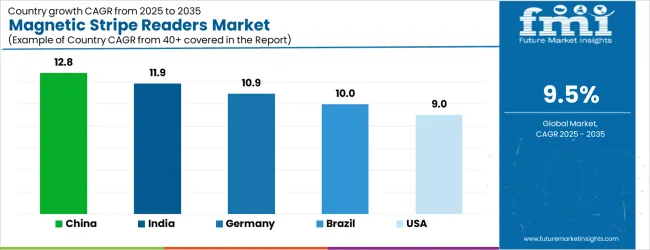
Based on the regional analysis, the magnetic stripe readers market is segmented into North America, Latin America, Europe, East Asia, South Asia, Oceania and Middle East & Africa across 40+ countries. The full report also offers market attractiveness analysis based on regional trends.
| Country | CAGR (2026 to 2036) |
|---|---|
| China | 12.8% |
| India | 11.9% |
| Germany | 10.9% |
| Brazil | 10.0% |
| United States | 9.0% |
| United Kingdom | 8.1% |
| Japan | 7.1% |
Source: Future Market Insights (FMI) analysis, based on proprietary forecasting model and primary research
Asia Pacific Magnetic Stripe Readers Market Analysis
Asia Pacific leads global demand, fueled by a dual-track financial evolution where advanced economies digitize legacy systems while developing nations aggressively expand basic card infrastructure. The growth mechanism is centered on "hybrid inclusion," where governments mandate banking access for rural populations, necessitating durable, low-cost POS terminals that can read standard magnetic debit cards issued by state banks. This demand is anchored by the region's massive manufacturing capacity, allowing for rapid deployment of compliant hardware. A key indicator of this trend is the 3.26% year-on-year increase in bankcards in China, reaching nearly 9.8 billion cards, which sustains a vast installed base of swipe-compatible readers despite the rise of mobile wallets. [5]
- China: Growth in magnetic stripe readers across China is estimated at 12.8% CAGR through 2036, driven by the sheer scale of the banking ecosystem that requires physical card acceptance for redundancy. This is evidenced by the 9.787 billion bankcards in circulation as of 2023, which necessitates a vast network of compatible POS terminals to ensure universal acceptance, pushing suppliers to maintain legacy track-reading capabilities [5].
- India: India is likely to see magnetic stripe readers revenues increase at 11.9% CAGR during 2026 to 2036, given the regulatory push to utilize POS terminals as mini-ATMs in underserved regions. The Reserve Bank of India’s enhancement of cash withdrawal limits to ₹2,000 per transaction at POS terminals directly incentivizes the deployment of ruggedized, hybrid reading hardware in tier III-VI centers to serve rural account holders [8].
- Japan: The outlook for magnetic stripe readers in Japan indicates a 7.1% CAGR from 2026 to 2036 as the government’s "Cashless Vision" drives merchants to upgrade legacy cash registers to integrated terminals. With the cashless payment ratio reaching 42.8% in 2024, retailers are compelled to install multi-modal readers that accept domestic magnetic cards alongside international digital wallets, ensuring no transaction is lost due to hardware incompatibility [4].
FMI’s report includes a detailed growth analysis for the Asia Pacific region. Beyond the major economies, countries like Indonesia, Vietnam, and Thailand represent significant opportunities as they modernize their retail sectors and expand banking access. Suppliers in these markets should monitor the rapid adoption of handheld mobile point of sale devices that combine card reading with inventory management apps, a trend increasingly visible in Southeast Asia's informal retail sector. [9]
North America Magnetic Stripe Readers Market Analysis
North America remains a critical market due to the high volume of legacy prepaid and gift card transactions that rely exclusively on magnetic stripe technology. The region is characterized by a "compliance-plus" procurement approach, where retailers purchase terminals that must support every available payment method—from EMV chips to magnetic swipes—to minimize friction at checkout. This resilience is supported by the 19.7% surge in prepaid card transactions, which confirms that swipe-based authentication remains a vital, growing component of the payments mix rather than a dying legacy format. [6]
- United States: Demand for magnetic stripe readers in the United States is set to grow at 9.0% CAGR through 2036, supported by the persistent consumer preference for prepaid and gift cards which predominantly rely on swipe technology. This demand is reinforced by a 19.7% surge in prepaid card transactions in 2023, forcing merchants to maintain swipe-compatible hardware at checkout lanes to capture this high-growth volume [6].
FMI’s report includes a comprehensive assessment of the North American landscape. The analysis highlights Canada and Mexico as key neighboring markets where cross-border trade and tourism drive demand for interoperable payment hardware. In Mexico specifically, the modernization of small business payments infrastructure presents a growing channel for low-cost reader deployment, mirroring trends seen in the US prepaid sector where payment processing solutions are increasingly integrated into tablet-based registers. [7]
Europe Magnetic Stripe Readers Market Analysis
Europe serves as a mature market where demand is driven by the replacement of aging infrastructure and the integration of secure, wired readers into regulated banking environments. The growth mechanism here is "security-first replacement," where banks and retailers upgrade to encrypted heads that can safely process non-EMV international cards (like those from US tourists) while meeting strict GDPR and banking standards. The region's stability is underpinned by consistent transaction growth, such as the 11% rise in German card payments, which compels merchants to invest in hardware that guarantees uptime and security compliance. [2]
- Germany: Germany is expected to record 10.9% CAGR in magnetic stripe readers demand over 2026 to 2036 as the shift away from cash necessitates robust, secure card acceptance points. The 11% rise in card payments during 2024 underscores the critical need for terminals that can reliably process physical cards when contactless methods fail or for high-value identity verification, ensuring continuous revenue flow for merchants [2].
- United Kingdom: The magnetic stripe readers sector in the United Kingdom is poised to expand at 8.1% CAGR during 2026 to 2036 because high transaction velocity demands fail-safe hardware redundancy. This is supported by the record £1 trillion in card transaction value processed in 2024, which requires merchants to keep swipe-enabled terminals operational for non-contactless domestic and international cards to avoid service denials during peak periods [1].
FMI’s report includes an in-depth evaluation for Europe. Markets such as France, Italy, and Spain are identified as vital expansion zones where tourism flows necessitate terminals that can accept non-EMV cards from outside the Eurozone. Suppliers should watch for regulatory updates on terminal security standards in these countries, which drive periodic hardware refresh cycles for authentication solutions at point-of-sale. [10]
Latin America Magnetic Stripe Readers Market Analysis
Latin America is experiencing robust growth as financial inclusion programs bring millions of unbanked consumers into the formal economy, creating a "dual-infrastructure" need. The market is defined by the simultaneous expansion of instant payment networks (like Pix) and physical card issuance, compelling merchants to procure versatile hardware that can handle both QR codes and magnetic stripes. The 14% increase in active credit cards in Brazil exemplifies this trend, driving the installation of hybrid POS terminals that prevent merchant lock-in to a single payment rail. [3]
- Brazil: Brazil is projected to post 10.0% CAGR for magnetic stripe readers between 2026 and 2036 as the financial ecosystem expands to accommodate both instant payments and traditional credit infrastructure. The 14% increase in active credit cards in 2024 drives the continued procurement of hybrid POS devices that can read physical magnetic stripes alongside generating Pix QR codes, ensuring merchants can service the entire banked population [3].
FMI’s report includes a strategic analysis of Latin America's evolving payment hardware sector. Argentina, Chile, and Colombia are highlighted as emerging opportunities where retail automation is driving the installation of self-checkout kiosks equipped with hybrid readers. In these markets, the integration of readers into public transport and toll systems offers a stable revenue stream for hardware providers looking to diversify beyond standard retail. [3]
Competitive Aligners for Market Players
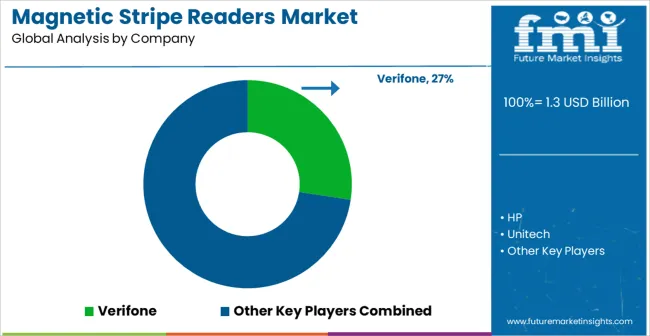
The competitive landscape is bifurcated between global incumbents focusing on integrated ecosystems and regional players targeting low-cost hardware deployment. Large players like Verifone and Ingenico are leveraging their installed base to upsell unified commerce platforms, treating the magnetic reader as a gateway to broader SaaS revenues. This strategy is evident in Verifone's partnership with Stripe, which combines hardware reliability with agile payment processing.
Mid-sized competitors are finding success by specializing in niche verticals such as fleet management and unattended retail. By developing ruggedized readers for fuel pumps and kiosks, these firms insulate themselves from the commoditization of standard countertop terminals. The ability to certify hardware against specific regional standards, such as India's RuPay or Brazil's local schemes, serves as a critical entry barrier and competitive differentiator.
Consolidation is reshaping the vendor tier, with acquirers seeking to control the entire merchant relationship. Recent M&A activity, such as Shift4's acquisition of Smartpay, illustrates a race to capture merchant endpoints across new geographies. Companies that can offer a "terminal-as-a-service" model, bundling hardware with processing and analytics, are gaining leverage over those selling standalone readers. [9]
Recent Developments
The report includes full coverage of key trends from competitive benchmarking. Some of the recent developments covered in the reports:
- In October 2025, Verifone launched the Commander Fleet unified POS system to streamline fleet card processing for convenience retailers. [7]
- In August 2025, Nedbank acquired the fintech provider iKhokha for approximately USD 94 million to scale its SME merchant acquiring capabilities in South Africa. [10]
Key Players in Magnetic Stripe Readers Market
- Verifone
- HP
- Unitech
- Posiflex
- Honeywell
- ID Tech
- Ingenico
- MagTek
- Promag
- Uniform Industrial Corp
Scope of the Report
| Metric | Value |
|---|---|
| Quantitative Units | USD 1.4 billion (2026) to USD 3.5 billion (2036), at a CAGR of 9.5% |
| Market Definition | The magnetic stripe readers market comprises the global production and sale of hardware devices designed to decode information stored on the magnetic band of payment cards, identity badges, and access tickets. |
| Product Type Segmentation | Swipe Based, Insertion Based |
| Readability Volume Segmentation | High Volume, Standard Volume |
| Connectivity Segmentation | Wired, Wireless |
| Application Coverage | POS Terminals, Kiosks, Entry/Exit, Others |
| End Use Coverage | Retail, Banking, Transport, Others |
| Regions Covered | North America, Latin America, Europe, East Asia, South Asia, Oceania, Middle East and Africa |
| Countries Covered | United States, Canada, Mexico, Brazil, Argentina, Germany, France, United Kingdom, Italy, Spain, China, India, Japan, South Korea, Indonesia, Australia and 40 plus countries |
| Key Companies Profiled | Verifone, HP, Unitech, Posiflex, Honeywell, ID Tech, Ingenico, MagTek, Promag, Uniform Industrial Corp |
| Forecast Period | 2026 to 2036 |
| Approach | Hybrid top down and bottom up market modeling validated through primary interviews with POS hardware engineers and payment gateway product managers |
Magnetic Stripe Readers Market by Segments
Product Type
- Swipe Based
- Insertion Based
Readability Volume
- High Volume
- Standard Volume
Connectivity
- Wired
- Wireless
Application
- POS Terminals
- Kiosks
- Entry/Exit
- Others
End Use
- Retail
- Banking
- Transport
- Others
Region
- Asia Pacific
- India
- China
- Japan
- South Korea
- Indonesia
- Australia & New Zealand
- ASEAN
- Rest of Asia Pacific
- Europe
- Germany
- Italy
- France
- United Kingdom
- Spain
- Benelux
- Nordics
- Central & Eastern Europe
- Rest of Europe
- North America
- United States
- Canada
- Mexico
- Latin America
- Brazil
- Argentina
- Chile
- Rest of Latin America
- Middle East & Africa
- Kingdom of Saudi Arabia
- United Arab Emirates
- South Africa
- Turkey
- Rest of Middle East & Africa
Bibliography
- [1] UK Finance. (2024). £1 trillion worth of UK card transactions in 2024. UK Finance Press Release.
- [2] Deutsche Bundesbank. (2024). Card payments are growing steadily. Deutsche Bundesbank Press Release.
- [3] Banco Central do Brasil. (2024). Retail payments and Pix growth statistics. BCB Press Note.
- [4] Ministry of Economy, Trade and Industry. (2024). Cashless payment ratio in Japan reaches 42.8%. METI Press Release.
- [5] People's Bank of China. (2023). Payment System Report - China 2023. PBOC.
- [6] Federal Reserve. (2023). Federal Reserve Payments Study: Debit and Credit Card Issuer Study. Federal Reserve Board.
- [7] Verifone. (2025). Verifone Launches Commander Fleet to Simplify Fleet Card Processing. Verifone Press Release.
- [8] Reserve Bank of India. (2023). Enhancement of limit for cash withdrawal at POS. RBI Notification.
- [9] Shift4. (2025). Shift4 acquires Smartpay to expand Australasian footprint. Fintech Futures.
- [10] Nedbank. (2025). Nedbank acquires iKhokha to scale SME merchant services. Fintech Futures.
This Report Addresses
- Market intelligence to enable structured strategic decision making across mature and emerging payment economies.
- Market size estimation and 10 year revenue forecasts from 2026 to 2036, supported by validated capacity and trade benchmarks.
- Growth opportunity mapping across swipe and insertion forms with emphasis on hybrid POS transitions.
- Segment and regional revenue forecasts covering retail, banking, transport, and kiosk applications.
- Competition strategy assessment including M&A models, cost survivability positioning, and compliance capability benchmarking.
- Product reformulation and security compliance tracking including EMV integration and encryption upgrades.
- Regulatory impact analysis covering financial inclusion mandates, transaction limits, and fraud prevention standards.
- Market report delivery in PDF, Excel, PPT, and interactive dashboard formats for executive and operational use.
Frequently Asked Questions
How large is the demand for Magnetic Stripe Readers in the global market in 2026?
Demand for Magnetic Stripe Readers in the global market is estimated to be valued at USD 1.4 billion in 2026.
What will be the market size of Magnetic Stripe Readers in the global market by 2036?
Market size for Magnetic Stripe Readers is projected to reach USD 3.5 billion by 2036.
What is the expected demand growth for Magnetic Stripe Readers in the global market between 2026 and 2036?
Demand for Magnetic Stripe Readers in the global market is expected to grow at a CAGR of 9.5% between 2026 and 2036.
Which Product Type is poised to lead global sales by 2026?
Swipe Based readers are expected to be the dominant form, capturing approximately 55.0% of global market share in 2026 due to cost advantages and legacy compatibility.
How significant is the role of Retail End Use in driving Magnetic Stripe Readers adoption in 2026?
Retail represents a critical segment, projected to hold a substantial 30.0% share of the total market in 2026 as high transaction volumes drive hardware renewal.
What is driving demand in China?
Demand is driven by the massive installed base of 9.78 billion bankcards and the continuous expansion of retail payment infrastructure.
What compliance standards or regulations are referenced for India?
Reserve Bank of India (RBI) regulations regarding cash withdrawal limits at POS terminals are referenced as key operational benchmarks.
What is the China growth outlook in this report?
China is projected to grow at a CAGR of 12.8% during 2026 to 2036.
Why is Europe described as a priority region in this report?
Europe is prioritized due to the strict regulatory environment requiring secure, wired terminals for banking and retail compliance.
What type of demand dominates in Europe?
Replacement driven demand for secure, high-durability readers dominates regional consumption to meet privacy and encryption standards.
What is India growth outlook in this report?
India is projected to expand at a CAGR of 11.9% during 2026 to 2036.
Does the report cover Japan in its regional analysis?
Yes, Japan is included within East Asia under the regional scope of analysis.
What are the sources referred to for analyzing Japan?
Official statistics published by the Ministry of Economy, Trade and Industry (METI) regarding cashless payment ratios are cited.
What is the main demand theme linked to Japan in Asia Coverage?
Asia Pacific demand is associated with the government-led push towards a higher cashless payment ratio, driving terminal upgrades.
Does the report cover Brazil in its regional analysis?
Yes, Brazil is included within Latin America under the regional coverage framework.
What is the main Brazil related demand theme in its region coverage?
Growth is linked to the simultaneous expansion of instant payments (Pix) and physical card usage, necessitating versatile hardware.
Which product formats or configurations are strategically important for Asia Pacific supply chains?
Hybrid terminals that combine magnetic swipe with QR and chip reading capabilities are prioritized for diverse consumer bases.
What is Magnetic Stripe Readers and what is it mainly used for?
Magnetic Stripe Readers are hardware devices used to decode data from magnetic bands on cards for payments, access control, and identification.
What does Magnetic Stripe Readers Market Mean in this Report?
Magnetic Stripe Readers market refers to the global production, trade, and industrial consumption of these hardware devices across retail and banking sectors.
What is Included in the Scope of this Magnetic Stripe Readers report?
Scope covers swipe and insertion readers, key applications such as POS and kiosks, and end use industries including retail and transport.
What is excluded from the scope of this report?
Purely software-based payment gateways and general-purpose tablets without integrated reading modules are excluded.
What does market forecast mean on this page?
Market forecast represents a model based projection built on defined assumptions for strategic planning purposes.
How does FMI build and validate the Magnetic Stripe Readers forecast?
Forecast is developed using hybrid top down and bottom up modeling validated through primary interviews and production data benchmarking.
What does zero reliance on speculative third party market research mean here?
Primary interviews and verifiable public datasets are used instead of unverified syndicated market estimates.
Preview the report firsthand - request a free sample
Get SampleGet the brochure for pricing and purchase details.
Get PDFTable of Content
- Executive Summary
- Global Market Outlook
- Demand-side Trends
- Supply-side Trends
- Technology Roadmap Analysis
- Analysis and Recommendations
- Market Overview
- Market Coverage / Taxonomy
- Market Definition / Scope / Limitations
- Research Methodology
- Chapter Orientation
- Analytical Lens and Working Hypotheses
- Market Structure, Signals, and Trend Drivers
- Benchmarking and Cross-market Comparability
- Market Sizing, Forecasting, and Opportunity Mapping
- Research Design and Evidence Framework
- Desk Research Programme (Secondary Evidence)
- Company Annual and Sustainability Reports
- Peer-reviewed Journals and Academic Literature
- Corporate Websites, Product Literature, and Technical Notes
- Earnings Decks and Investor Briefings
- Statutory Filings and Regulatory Disclosures
- Technical White Papers and Standards Notes
- Trade Journals, Industry Magazines, and Analyst Briefs
- Conference Proceedings, Webinars, and Seminar Materials
- Government Statistics Portals and Public Data Releases
- Press Releases and Reputable Media Coverage
- Specialist Newsletters and Curated Briefings
- Sector Databases and Reference Repositories
- FMI Internal Proprietary Databases and Historical Market Datasets
- Subscription Datasets and Paid Sources
- Social Channels, Communities, and Digital Listening Inputs
- Additional Desk Sources
- Expert Input and Fieldwork (Primary Evidence)
- Primary Modes
- Qualitative Interviews and Expert Elicitation
- Quantitative Surveys and Structured Data Capture
- Blended Approach
- Why Primary Evidence is Used
- Field Techniques
- Interviews
- Surveys
- Focus Groups
- Observational and In-context Research
- Social and Community Interactions
- Stakeholder Universe Engaged
- C-suite Leaders
- Board Members
- Presidents and Vice Presidents
- R&D and Innovation Heads
- Technical Specialists
- Domain Subject-matter Experts
- Scientists
- Physicians and Other Healthcare Professionals
- Governance, Ethics, and Data Stewardship
- Research Ethics
- Data Integrity and Handling
- Primary Modes
- Tooling, Models, and Reference Databases
- Desk Research Programme (Secondary Evidence)
- Data Engineering and Model Build
- Data Acquisition and Ingestion
- Cleaning, Normalisation, and Verification
- Synthesis, Triangulation, and Analysis
- Quality Assurance and Audit Trail
- Market Background
- Market Dynamics
- Drivers
- Restraints
- Opportunity
- Trends
- Scenario Forecast
- Demand in Optimistic Scenario
- Demand in Likely Scenario
- Demand in Conservative Scenario
- Opportunity Map Analysis
- Product Life Cycle Analysis
- Supply Chain Analysis
- Investment Feasibility Matrix
- Value Chain Analysis
- PESTLE and Porter’s Analysis
- Regulatory Landscape
- Regional Parent Market Outlook
- Production and Consumption Statistics
- Import and Export Statistics
- Market Dynamics
- Global Market Analysis 2021 to 2025 and Forecast, 2026 to 2036
- Historical Market Size Value (USD Million) Analysis, 2021 to 2025
- Current and Future Market Size Value (USD Million) Projections, 2026 to 2036
- Y-o-Y Growth Trend Analysis
- Absolute $ Opportunity Analysis
- Global Market Pricing Analysis 2021 to 2025 and Forecast 2026 to 2036
- Global Market Analysis 2021 to 2025 and Forecast 2026 to 2036, By By Product Type
- Introduction / Key Findings
- Historical Market Size Value (USD Million) Analysis By By Product Type , 2021 to 2025
- Current and Future Market Size Value (USD Million) Analysis and Forecast By By Product Type , 2026 to 2036
- Swipe Based
- Insertion Based
- Swipe Based
- Y-o-Y Growth Trend Analysis By By Product Type , 2021 to 2025
- Absolute $ Opportunity Analysis By By Product Type , 2026 to 2036
- Global Market Analysis 2021 to 2025 and Forecast 2026 to 2036, By By Readability Volume
- Introduction / Key Findings
- Historical Market Size Value (USD Million) Analysis By By Readability Volume, 2021 to 2025
- Current and Future Market Size Value (USD Million) Analysis and Forecast By By Readability Volume, 2026 to 2036
- High Volume
- Standard Volume
- High Volume
- Y-o-Y Growth Trend Analysis By By Readability Volume, 2021 to 2025
- Absolute $ Opportunity Analysis By By Readability Volume, 2026 to 2036
- Global Market Analysis 2021 to 2025 and Forecast 2026 to 2036, By By Connectivity
- Introduction / Key Findings
- Historical Market Size Value (USD Million) Analysis By By Connectivity, 2021 to 2025
- Current and Future Market Size Value (USD Million) Analysis and Forecast By By Connectivity, 2026 to 2036
- Wired
- Wireless
- Wired
- Y-o-Y Growth Trend Analysis By By Connectivity, 2021 to 2025
- Absolute $ Opportunity Analysis By By Connectivity, 2026 to 2036
- Global Market Analysis 2021 to 2025 and Forecast 2026 to 2036, By By Application
- Introduction / Key Findings
- Historical Market Size Value (USD Million) Analysis By By Application, 2021 to 2025
- Current and Future Market Size Value (USD Million) Analysis and Forecast By By Application, 2026 to 2036
- POS Terminals
- Kiosks
- Entry/Exit
- POS Terminals
- Y-o-Y Growth Trend Analysis By By Application, 2021 to 2025
- Absolute $ Opportunity Analysis By By Application, 2026 to 2036
- Global Market Analysis 2021 to 2025 and Forecast 2026 to 2036, By By End Use
- Introduction / Key Findings
- Historical Market Size Value (USD Million) Analysis By By End Use, 2021 to 2025
- Current and Future Market Size Value (USD Million) Analysis and Forecast By By End Use, 2026 to 2036
- Retail
- Banking
- Transport
- Retail
- Y-o-Y Growth Trend Analysis By By End Use, 2021 to 2025
- Absolute $ Opportunity Analysis By By End Use, 2026 to 2036
- Global Market Analysis 2021 to 2025 and Forecast 2026 to 2036, By Region
- Introduction
- Historical Market Size Value (USD Million) Analysis By Region, 2021 to 2025
- Current Market Size Value (USD Million) Analysis and Forecast By Region, 2026 to 2036
- North America
- Latin America
- Western Europe
- Eastern Europe
- East Asia
- South Asia and Pacific
- Middle East & Africa
- Market Attractiveness Analysis By Region
- North America Market Analysis 2021 to 2025 and Forecast 2026 to 2036, By Country
- Historical Market Size Value (USD Million) Trend Analysis By Market Taxonomy, 2021 to 2025
- Market Size Value (USD Million) Forecast By Market Taxonomy, 2026 to 2036
- By Country
- USA
- Canada
- Mexico
- By By Product Type
- By By Readability Volume
- By By Connectivity
- By By Application
- By By End Use
- By Country
- Market Attractiveness Analysis
- By Country
- By By Product Type
- By By Readability Volume
- By By Connectivity
- By By Application
- By By End Use
- Key Takeaways
- Latin America Market Analysis 2021 to 2025 and Forecast 2026 to 2036, By Country
- Historical Market Size Value (USD Million) Trend Analysis By Market Taxonomy, 2021 to 2025
- Market Size Value (USD Million) Forecast By Market Taxonomy, 2026 to 2036
- By Country
- Brazil
- Chile
- Rest of Latin America
- By By Product Type
- By By Readability Volume
- By By Connectivity
- By By Application
- By By End Use
- By Country
- Market Attractiveness Analysis
- By Country
- By By Product Type
- By By Readability Volume
- By By Connectivity
- By By Application
- By By End Use
- Key Takeaways
- Western Europe Market Analysis 2021 to 2025 and Forecast 2026 to 2036, By Country
- Historical Market Size Value (USD Million) Trend Analysis By Market Taxonomy, 2021 to 2025
- Market Size Value (USD Million) Forecast By Market Taxonomy, 2026 to 2036
- By Country
- Germany
- UK
- Italy
- Spain
- France
- Nordic
- BENELUX
- Rest of Western Europe
- By By Product Type
- By By Readability Volume
- By By Connectivity
- By By Application
- By By End Use
- By Country
- Market Attractiveness Analysis
- By Country
- By By Product Type
- By By Readability Volume
- By By Connectivity
- By By Application
- By By End Use
- Key Takeaways
- Eastern Europe Market Analysis 2021 to 2025 and Forecast 2026 to 2036, By Country
- Historical Market Size Value (USD Million) Trend Analysis By Market Taxonomy, 2021 to 2025
- Market Size Value (USD Million) Forecast By Market Taxonomy, 2026 to 2036
- By Country
- Russia
- Poland
- Hungary
- Balkan & Baltic
- Rest of Eastern Europe
- By By Product Type
- By By Readability Volume
- By By Connectivity
- By By Application
- By By End Use
- By Country
- Market Attractiveness Analysis
- By Country
- By By Product Type
- By By Readability Volume
- By By Connectivity
- By By Application
- By By End Use
- Key Takeaways
- East Asia Market Analysis 2021 to 2025 and Forecast 2026 to 2036, By Country
- Historical Market Size Value (USD Million) Trend Analysis By Market Taxonomy, 2021 to 2025
- Market Size Value (USD Million) Forecast By Market Taxonomy, 2026 to 2036
- By Country
- China
- Japan
- South Korea
- By By Product Type
- By By Readability Volume
- By By Connectivity
- By By Application
- By By End Use
- By Country
- Market Attractiveness Analysis
- By Country
- By By Product Type
- By By Readability Volume
- By By Connectivity
- By By Application
- By By End Use
- Key Takeaways
- South Asia and Pacific Market Analysis 2021 to 2025 and Forecast 2026 to 2036, By Country
- Historical Market Size Value (USD Million) Trend Analysis By Market Taxonomy, 2021 to 2025
- Market Size Value (USD Million) Forecast By Market Taxonomy, 2026 to 2036
- By Country
- India
- ASEAN
- Australia & New Zealand
- Rest of South Asia and Pacific
- By By Product Type
- By By Readability Volume
- By By Connectivity
- By By Application
- By By End Use
- By Country
- Market Attractiveness Analysis
- By Country
- By By Product Type
- By By Readability Volume
- By By Connectivity
- By By Application
- By By End Use
- Key Takeaways
- Middle East & Africa Market Analysis 2021 to 2025 and Forecast 2026 to 2036, By Country
- Historical Market Size Value (USD Million) Trend Analysis By Market Taxonomy, 2021 to 2025
- Market Size Value (USD Million) Forecast By Market Taxonomy, 2026 to 2036
- By Country
- Kingdom of Saudi Arabia
- Other GCC Countries
- Turkiye
- South Africa
- Other African Union
- Rest of Middle East & Africa
- By By Product Type
- By By Readability Volume
- By By Connectivity
- By By Application
- By By End Use
- By Country
- Market Attractiveness Analysis
- By Country
- By By Product Type
- By By Readability Volume
- By By Connectivity
- By By Application
- By By End Use
- Key Takeaways
- Key Countries Market Analysis
- USA
- Pricing Analysis
- Market Share Analysis, 2025
- By By Product Type
- By By Readability Volume
- By By Connectivity
- By By Application
- By By End Use
- Canada
- Pricing Analysis
- Market Share Analysis, 2025
- By By Product Type
- By By Readability Volume
- By By Connectivity
- By By Application
- By By End Use
- Mexico
- Pricing Analysis
- Market Share Analysis, 2025
- By By Product Type
- By By Readability Volume
- By By Connectivity
- By By Application
- By By End Use
- Brazil
- Pricing Analysis
- Market Share Analysis, 2025
- By By Product Type
- By By Readability Volume
- By By Connectivity
- By By Application
- By By End Use
- Chile
- Pricing Analysis
- Market Share Analysis, 2025
- By By Product Type
- By By Readability Volume
- By By Connectivity
- By By Application
- By By End Use
- Germany
- Pricing Analysis
- Market Share Analysis, 2025
- By By Product Type
- By By Readability Volume
- By By Connectivity
- By By Application
- By By End Use
- UK
- Pricing Analysis
- Market Share Analysis, 2025
- By By Product Type
- By By Readability Volume
- By By Connectivity
- By By Application
- By By End Use
- Italy
- Pricing Analysis
- Market Share Analysis, 2025
- By By Product Type
- By By Readability Volume
- By By Connectivity
- By By Application
- By By End Use
- Spain
- Pricing Analysis
- Market Share Analysis, 2025
- By By Product Type
- By By Readability Volume
- By By Connectivity
- By By Application
- By By End Use
- France
- Pricing Analysis
- Market Share Analysis, 2025
- By By Product Type
- By By Readability Volume
- By By Connectivity
- By By Application
- By By End Use
- India
- Pricing Analysis
- Market Share Analysis, 2025
- By By Product Type
- By By Readability Volume
- By By Connectivity
- By By Application
- By By End Use
- ASEAN
- Pricing Analysis
- Market Share Analysis, 2025
- By By Product Type
- By By Readability Volume
- By By Connectivity
- By By Application
- By By End Use
- Australia & New Zealand
- Pricing Analysis
- Market Share Analysis, 2025
- By By Product Type
- By By Readability Volume
- By By Connectivity
- By By Application
- By By End Use
- China
- Pricing Analysis
- Market Share Analysis, 2025
- By By Product Type
- By By Readability Volume
- By By Connectivity
- By By Application
- By By End Use
- Japan
- Pricing Analysis
- Market Share Analysis, 2025
- By By Product Type
- By By Readability Volume
- By By Connectivity
- By By Application
- By By End Use
- South Korea
- Pricing Analysis
- Market Share Analysis, 2025
- By By Product Type
- By By Readability Volume
- By By Connectivity
- By By Application
- By By End Use
- Russia
- Pricing Analysis
- Market Share Analysis, 2025
- By By Product Type
- By By Readability Volume
- By By Connectivity
- By By Application
- By By End Use
- Poland
- Pricing Analysis
- Market Share Analysis, 2025
- By By Product Type
- By By Readability Volume
- By By Connectivity
- By By Application
- By By End Use
- Hungary
- Pricing Analysis
- Market Share Analysis, 2025
- By By Product Type
- By By Readability Volume
- By By Connectivity
- By By Application
- By By End Use
- Kingdom of Saudi Arabia
- Pricing Analysis
- Market Share Analysis, 2025
- By By Product Type
- By By Readability Volume
- By By Connectivity
- By By Application
- By By End Use
- Turkiye
- Pricing Analysis
- Market Share Analysis, 2025
- By By Product Type
- By By Readability Volume
- By By Connectivity
- By By Application
- By By End Use
- South Africa
- Pricing Analysis
- Market Share Analysis, 2025
- By By Product Type
- By By Readability Volume
- By By Connectivity
- By By Application
- By By End Use
- USA
- Market Structure Analysis
- Competition Dashboard
- Competition Benchmarking
- Market Share Analysis of Top Players
- By Regional
- By By Product Type
- By By Readability Volume
- By By Connectivity
- By By Application
- By By End Use
- Competition Analysis
- Competition Deep Dive
- Verifone
- Overview
- Product Portfolio
- Profitability by Market Segments (Product/Age /Sales Channel/Region)
- Sales Footprint
- Strategy Overview
- Marketing Strategy
- Product Strategy
- Channel Strategy
- HP
- Value (USD Million)ech
- Posiflex
- Honeywell
- ID Tech
- Ingenico
- Verifone
- Competition Deep Dive
- Assumptions & Acronyms Used


