

- Industry Size (2026)
- USD 24.0 Mn
- Forecast (2036)
- USD 190.2 Mn
- CAGR (2026 to 2036)
- 23.00%
Microneedle Patch Influenza Vaccine Delivery Market Size, Market Forecast and Outlook By FMI
The influenza vaccine patch market size was valued at USD 19.5 million in 2025. The microneedle flu vaccine market is poised to surpass USD 24.0 million in 2026 at a CAGR of 23.00% during the forecast period. Demand outlook propels the valuation to USD 190.2 million through 2036 as public health procurement models switch from cold-chain dependent liquid vials to thermostable solid-dose formats, establishing the positive trend for influenza vaccine patch forecast 2036.
Immunization programs are fundamentally re-evaluating their delivery infrastructure to eliminate the logistical friction of refrigerated transport and sharps disposal. Buyers exploring the influenza vaccine patch market are transitioning from purchasing doses to acquiring complete delivery modalities, forcing microneedle drug delivery systems out of experimental pilot phases and into commercial supply agreements. National health agencies that delay integrating these solid-state formats forfeit the ability to rapidly distribute a pandemic influenza microneedle patch outside of clinical settings. The actual driver of this transition is not patient preference for pain-free administration, but the operational imperative to decouple vaccination rates from the availability of trained healthcare personnel.
Summary of Microneedle Patch Influenza Vaccine Delivery Market
-
Microneedle Patch Influenza Vaccine Delivery Market Definition
- This market represents the transition of influenza immunization from liquid, cold-chain-dependent injections to thermostable, self-administrable solid-dose transdermal platforms, fundamentally restructuring how public health agencies stockpile and deploy seasonal countermeasures.
- Demand Drivers in the Market
- Cold-chain vulnerability forces national stockpile administrators to prioritize a thermostable flu vaccine patch.
- Healthcare workforce shortages push retail pharmacy chains to seek an adult influenza vaccination patch format that does not require certified immunizers.
- The imperative for rapid pandemic response compels biopharma developers to integrate formulations with dissolving microneedles for mail-to-home deployment.
- Key Segments Analyzed in the FMI Report
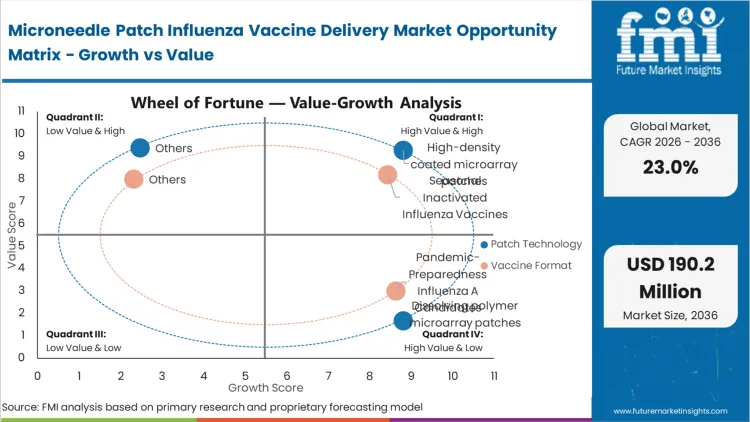
- High-density coated microarray patches: High-density coated microarray patches are poised to account for 34.8% share in 2026, driven by their ability to concentrate antigen delivery to the immune-rich epidermis without altering the underlying vaccine protein structure.
- Seasonal inactivated influenza vaccines: Seasonal inactivated influenza vaccines are expected to record 46.2% share in 2026, as manufacturers prioritize transitioning the highest-volume commercial product to establish manufacturing scale.
- Provider-administered clinic/pharmacy vaccination: This sub-segment is estimated to grab 54.1% share in 2026, serving as the necessary transitional bridge before regulators authorize truauthorisee mail-to-home models.
- Public health agencies and immunization programs: Projected to hold 40.7% share in 2026, as governmental procurement guarantees derisk the initial capital required for continuous manufacturing lines.
- Clinical trial and pilot procurement: Estimated to garner 61.5% share in 2026, reflecting the current regulatory stage of the dominant pipeline candidates.
- Australia: 25.1% compound growth, enabled by an aggressive national framework that rewards premium needle-free formats.
- Analyst Opinion at FMI
- Sabyasachi Ghosh, Principal Analyst, Healthcare, at FMI, estimates, "Public health agencies publicly celebrate microneedle patches for their pain-free patient appeal, but the actual procurement trigger is waste management. The elimination of millions of biohazardous sharps from the annual seasonal flu campaign changes the backend logistics cost so dramatically that governments are willing to subsidize the upfront device premium."
- Strategic Implications / Executive Takeaways
- Biopharma developers must secure exclusive device partnerships with microneedle flu vaccine manufacturing partners to prevent their legacy influenza antigens from being commoditized.
- Supply chain directors should pivot infrastructure planning away from expanded cold storage toward high-throughput ambient distribution networks.
- Regulatory affairs teams face a compressed timeline to overcome influenza vaccine patch commercialization barriers before public tenders begin mandating solid-state delivery capabilities.
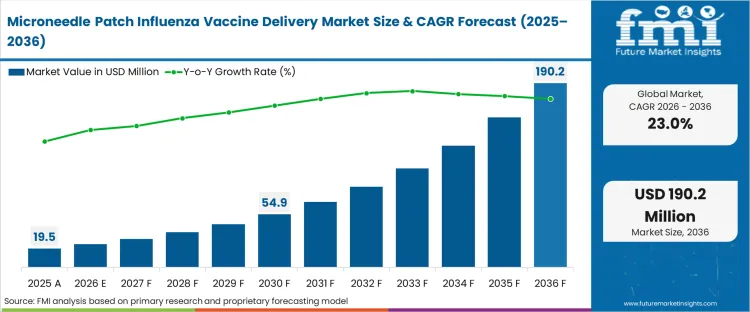
Microneedle Patch Influenza Vaccine Delivery Market Key Takeaways
| Metric | Details |
|---|---|
| Industry Size (2026) | USD 24.0 million |
| Industry Value (2036) | USD 190.2 million |
| CAGR (2026-2036) | 23.00% |
Source: Future Market Insights (FMI) analysis, based on proprietary forecasting model and primary research
Before this needle-free influenza vaccine patch can displace conventional syringes at scale, national regulatory authorities must establish standardized monographs for evaluating combined vaccine-device immunogenicity. Once this regulatory gateway is defined, biopharma developers can seamlessly transition legacy liquid formulations to patch substrates without re-running phase three efficacy trials from scratch.
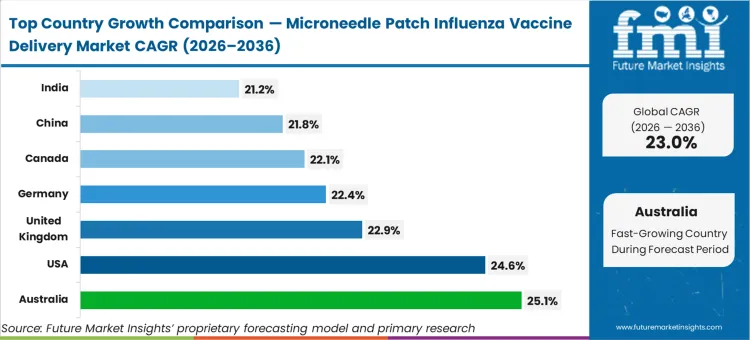
Australia is expected to advance at 25.1%, followed closely by the United States at 24.6% and the United Kingdom at 22.9%. Germany and Canada track at 22.4% and 22.1% respectively, while the China influenza vaccine patch opportunity is anticipated to expand at 21.8%, and India garners 21.2%. The divergence across these jurisdictions stems directly from their baseline integration of pharmacy-led and self-administered immunization frameworks, rather than mere population size.
Microneedle Patch Influenza Vaccine Delivery Market Definition
The microneedle patch influenza vaccine delivery market encompasses the commercialization and procurement of solid-state transdermal delivery devices specifically formulated with influenza antigens. This market is analytically distinct from general wearable injectors and legacy transdermal drug patches because it explicitly tracks the convergence of vaccine stabilization chemistry with micro-scale epidermal disruption technology, capturing the value of the delivery device, the stabilization matrix, and the specific application to seasonal or pandemic influenza formats.
Microneedle Patch Influenza Vaccine Delivery Market Inclusions
Scope inclusions encompass an influenza vaccine microarray patch, including high-density coated patches, dissolving polymer matrices, and silk-based architectures pre-loaded with inactivated, live-attenuated, or mRNA influenza antigens. The market captures revenue generated through early-stage clinical procurement, public health stockpiling contracts, and direct-to-pharmacy seasonal distributions. Additionally, microarray patch licensing milestones and influenza vaccine patch licensing opportunities tied directly to commercialization are fully included in the valuation.
Microneedle Patch Influenza Vaccine Delivery Market Exclusions
Standalone liquid influenza vaccines delivered via conventional needle and syringe are explicitly excluded, as they do not possess the thermostable or self-administration characteristics that define this market's boundary. Hollow microneedle devices that require a separate liquid reservoir and plunger mechanism are excluded if they do not feature pre-loaded, integrated influenza formulations. General transdermal patches for continuous small-molecule drug delivery are also excluded to isolate the specific dynamics of epidermal vaccine immunology.
Microneedle Patch Influenza Vaccine Delivery Market Research Methodology
- Primary Research: Procurement directors at national health agencies, chief medical officers at global vaccine manufacturers, and clinical development leads managing phase II/III influenza vaccine patch suppliers.
- Desk Research: Clinical trial registries, BARDA/CEPI funding disbursements, extended producer responsibility guidelines for medical waste, and regulatory pathway filings for combination products.
- Market-Sizing and Forecasting: Baseline valuation anchors to verifiable pilot procurement contracts, clinical trial material supply agreements, and publicized licensing milestones.
- Data Validation and Update Cycle: Forecast trajectories are triangulated against published national immunization strategy documents and commercial manufacturing scale-up timelines for active patch lines.
Segmental Analysis
Microneedle Patch Influenza Vaccine Delivery Market Analysis by Patch technology
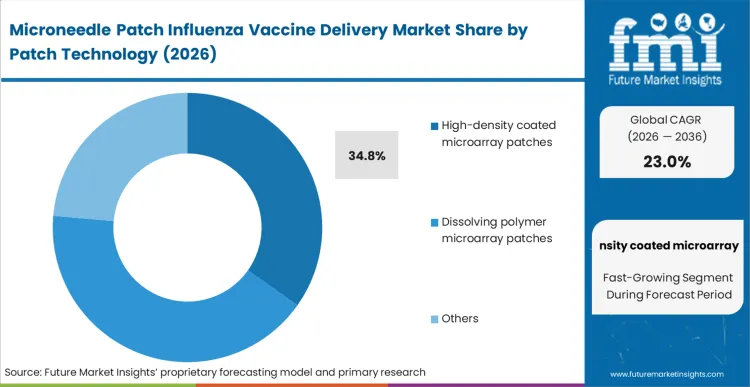
The legacy approach of liquid injection inherently relies on muscle tissue, which is immunologically sparse compared to the skin. The HD-MAP influenza vaccine dominates this dimension, securing a 34.8% share in 2026, because it successfully targets the antigen-presenting Langerhans cells in the epidermis, enabling profound dose sparing.
According to FMI's estimates, this influenza patch dose-sparing technology is the critical economic lever that makes the format viable for seasonal campaigns where antigen yield is frequently a manufacturing bottleneck. These seasonal influenza vaccines formulators leverage coating techniques that dry the active ingredient instantly, bypassing the degradation risks associated with thermal or chemical integration methods. Developers who commit to a dissolving microneedle influenza vaccine matrix instead must clear significantly higher regulatory hurdles regarding the clearance of the polymer from the human body.
- Coating physics: Rapid evaporation stabilizes the antigen on the solid microstructure without chemical crosslinking. Formulation scientists avoid the complex thermal degradation profiles that plague bulk polymer integration.
- Polymer clearance: Dissolving structures eliminate the need to dispose of a sharp medical device post-administration. Public health procurement officers capture immediate reductions in biohazardous waste management expenditures.
- Material architecture: Silk-based platforms offer extreme ambient temperature resilience extending beyond 12 months. Strategic stockpile administrators utilize this profile to position pandemic countermeasures outside of centralized cold chain hubs.
Microneedle Patch Influenza Vaccine Delivery Market Analysis by Vaccine format
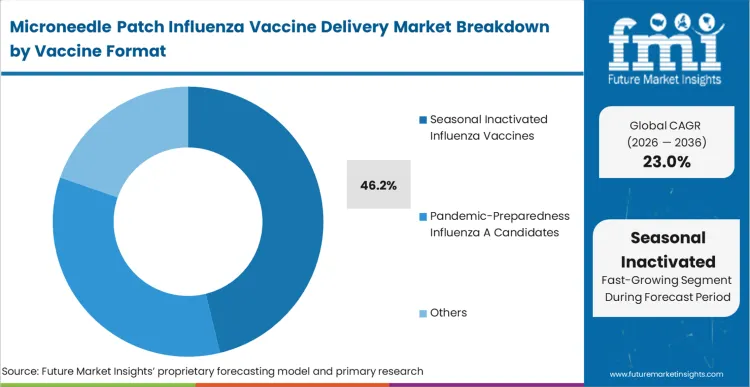
Seasonal inactivated influenza vaccines hold 46.2% of the market in 2026, primarily because this format provides the massive, predictable volume required to justify the capital expenditure of building custom patch manufacturing lines. The established safety profile of inactivated antigens reduces the combination-product regulatory risk, allowing developers to focus purely on the delivery mechanism rather than defending a novel immunology pathway. Biopharma sponsors utilize these established vaccines profile to advance clinical trials at an accelerated pace, securing non-dilutive government funding based on clear feasibility. However, as manufacturing yields scale, the integration within the mRNA vaccine patch market will drastically alter the value proposition. Formulators who fail to prove their patch technology is compatible with next-generation mRNA lipid nanoparticles will be excluded from future pandemic preparedness contracts entirely.
- Antigen stability: Inactivated formats tolerate the desiccation process required for patch integration without losing integrity. Quality assurance directors achieve lot-to-lot consistency faster than with live-attenuated variations.
- Formulation compatibility: Pandemic-preparedness candidates require rapid iteration and modular device loading. Stockpile managers demand pharmaceutical drug delivery platforms that can accept updated strain variations within weeks of identification.
- Nucleic acid integration: Combining mRNA fragility with solid-state desiccation remains a distinct technical threshold. Manufacturing engineers who solve this barrier secure exclusive access to next-generation defense procurement tenders.
Microneedle Patch Influenza Vaccine Delivery Market Analysis by Administration model
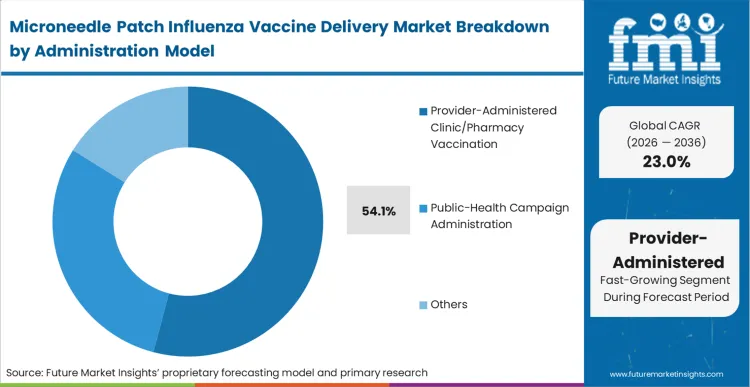
Provider-administered clinic and pharmacy vaccination holds 54.1% of the market in 2026 as it represents the mandatory first step in commercializing any novel delivery device. Regulatory agencies globally require extensive post-market surveillance in controlled settings before authorising full direct-to-patient deployment.
In FMI's view, this institutional oversight phase is not a long-term limitation, but a necessary bridge to establish real-world immunogenicity equivalence. Retail pharmacy chains deploy these drug delivery technology formats to increase their throughput during peak seasonal demand, effectively treating more patients per hour than is possible with traditional sharps. Health systems that delay integrating a self-administered flu vaccine patch pathway will rapidly lose their commercial distribution footprint once competitors roll out verified mail-to-home models.
- Clinical supervision: Institutional deployment satisfies immediate regulatory demands for administration tracking and adverse event monitoring. Liability directors maintain strict compliance while gathering the data necessary for future label expansions.
- Throughput economics: Pharmacy administrators eliminate the observation period typically mandated for vasovagal syncope risks associated with traditional needles. Clinic managers capture higher seasonal revenue yields by condensing appointment times.
- Self-deployment: Mail-to-home models fundamentally bypass the geographic and logistical bottlenecks of physical vaccination sites. Public health campaign directors leverage this capability to access historically non-compliant adult populations.
Microneedle Patch Influenza Vaccine Delivery Market Analysis by End user
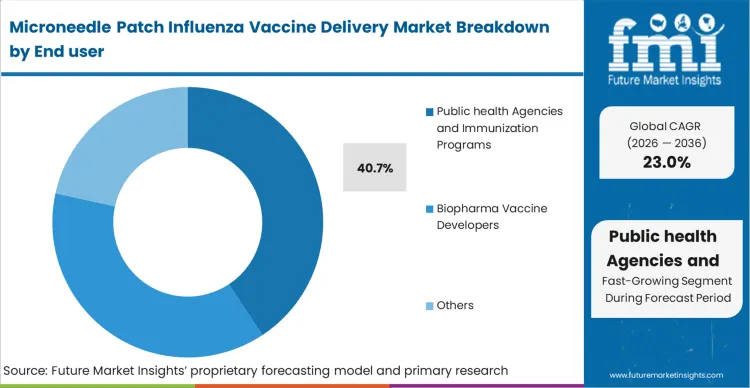
A public health immunization microneedle patch deployment accounts for 40.7% of the market in 2026, functioning as the primary commercial catalyst because agency purchasing power dictates the survival of early-stage needle-free injection system innovators. The massive upfront capital required to build continuous microarray production lines cannot be justified by fragmented retail demand; it requires the volume guarantees that only national stockpiles can provide.
FMI analysts opine that these agencies are actively moving forward-purchasing agreements specifically to derisk the industrialization phase for preferred device partners. Biopharma developers operate in parallel, licensing the technology to protect their legacy antigen portfolios from obsolescence. Manufacturers that cannot secure public-sector validation find themselves unable to raise the capital necessary to reach commercial manufacturing scale.
- Volume underwriting: Government procurement contracts provide the financial baseline required to transition from pilot facilities to industrial-scale production. Manufacturing leads utilize these agreements to secure secondary equipment financing.
- Portfolio defense: Biopharma entities acquire patch technology rights to differentiate otherwise identical seasonal quadrivalent formulations. Category managers prevent margin erosion by offering a premium delivery experience to institutional buyers.
- Logistical simplification: Preparedness agencies eliminate the need to stockpile corresponding liquid syringes, vials, and sharps containers. Logistics directors simplify crisis deployment protocols by managing a single, integrated SKU.
Microneedle Patch Influenza Vaccine Delivery Market Analysis by Revenue stage
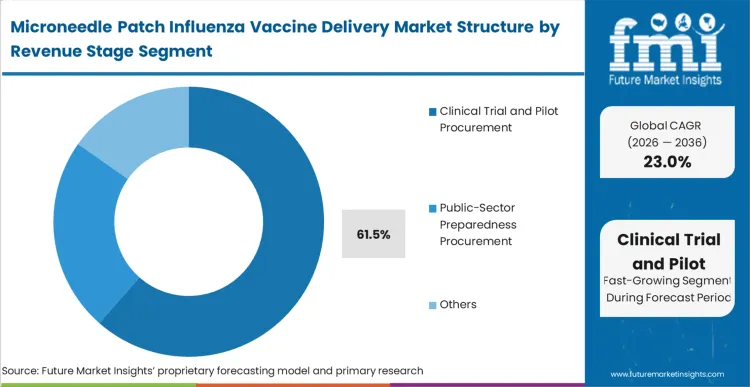
Clinical trial and pilot procurement dominates this dimension with 61.5% share in 2026, an accurate reflection of a market operating right at the commercial inflection point. The vast majority of immediate capital flow consists of milestone payments, phase II/III material supply contracts, and non-dilutive defense grants rather than routine seasonal sales. This needle-free injectors revenue will invert violently over the next 48 months as late-stage candidates transition into approved commercial products. Public-sector preparedness procurement acts as the immediate secondary tier, absorbing pilot capacity as it comes online. Vendors who mismanage their clinical material supply chain jeopardize not only their trial timelines but their ability to demonstrate industrial readiness to major government buyers.
- Validation milestones: Non-dilutive funding relies entirely on achieving specific immunogenicity and thermostability endpoints. Program directors use these clinical readouts to unlock sequential tranches of government capital.
- Scale-up financing: Co-development revenue allows device specialists to fund the engineering of proprietary manufacturing equipment. Chief financial officers align these licensing inflows directly with capital expenditure schedules.
- Tender qualification: Preparedness procurement represents the first actual commercial utilization of the technology outside of a controlled study. Commercial strategists target these tenders to establish the baseline pricing architecture for future seasonal markets.
Microneedle Patch Influenza Vaccine Delivery Market Drivers, Restraints, and Opportunities
The necessity to deploy countermeasures outside of established clinical infrastructure compels national defense and public health agencies to aggressively fund thermostable delivery solutions. The vulnerability of centralized cold-chain networks during crisis scenarios forces logistics directors to seek alternatives that can sit in ambient warehouses for years and be distributed via conventional mail. This pressure moves needle-free vaccine injectors from an optional consumer convenience to a national security imperative. Agencies that fail to secure advance purchase agreements for solid-state formats will remain dangerously tethered to the availability of refrigerated transport and certified nursing staff.
The primary structural friction dragging adoption is the total absence of a unified regulatory monograph for evaluating solid-dose epidermal vaccine-device combinations, which represents one of the steepest influenza vaccine patch commercialization barriers. Unlike conventional syringes which are universally characterized, every microarray architecture currently requires a bespoke regulatory pathway, dramatically increasing the cost and timeline for phase III validation. While the FDA and EMA are issuing ad-hoc guidance for specific clinical trial sponsors, this fragmented approach prevents smaller formulation developers from entering the space.
Opportunities in the Microneedle Patch Influenza Vaccine Delivery Market
- Direct-to-consumer pharmacy distribution: The elimination of sharps disposal requirements allows retail networks to dispense vaccinations identically to over-the-counter therapeutics. Pharmacy category managers can capture previously unrealized revenue by moving the seasonal administration out of the clinical room and into the patient's home.
- Pediatric compliance differentiation: The total elimination of needle-associated trauma provides a definitive competitive advantage for seasonal quadrivalent manufacturers. Biopharma product leads who integrate vaccine packaging and delivery patch technology first will monopolize pediatric immunization recommendations.
- Premium demographic targeting: Offering an older adult flu vaccine patch addresses a demographic that seeks convenience but often suffers from immune senescence. By utilizing dose-sparing formats, formulators can deliver enhanced immunogenicity without the reactogenicity of traditional adjuvanted shots.
Regional Analysis
The regional assessment divides the microneedle patch influenza vaccine delivery market into North America, Europe, and the Asia Pacific region, covering more than 40 countries.
.webp "Top Country Growth Comparison Microneedle Patch Influenza Vaccine Delivery Market Cagr (2026 2036)")
| Country | CAGR (2026 to 2036) |
|---|---|
| Australia | 25.1% |
| United States | 24.6% |
| United Kingdom | 22.9% |
| Germany | 22.4% |
| Canada | 22.1% |
| China | 21.8% |
| India | 21.2% |
Source: Future Market Insights (FMI) analysis, based on proprietary forecasting model and primary research
Asia Pacific Microneedle Patch Influenza Vaccine Delivery Market Analysis
Australia's mandate to aggressively integrate premium immunization formats stems from its highly proactive national influenza program, which actively rewards innovation in administration technology. As per FMI's projection, this dynamic provides a secure landing zone for high-density microarray platforms to achieve immediate commercial viability before expanding globally. The region's vast geographic disparities further amplify the utility of vaccine packaging formats that decouple distribution from refrigerated transport.
- Australia: The Australian influenza vaccine patch market features a localised concentration of pioneering microarray intellectual property that creates a closed-loop ecosystem of academic development and government procurement. Public health directors leverage this domestic capability to fundamentally modernize their national immunization strategies ahead of global peers. The market in Australia is forecast to register a CAGR of 25.1%. Early integration positions the national healthcare system to seamlessly execute true direct-to-patient pandemic countermeasures.
- China: China is expected to see its sector grow at a compound annual rate of 21.8%. The sheer volume demands of China's expanding immunisation coverage compel domestic manufacturers to prioritize continuous patch production technologies. Operations managers in state-backed biopharma entities recognize that scaling liquid vial filling is ultimately constrained by glass supply and cold-chain limitations. Overcoming the initial capital expenditure barrier enables these manufacturers to capture massive domestic tenders.
- India: India's trajectory is defined by its role as the global center for high-volume, low-cost vaccine manufacturing, forcing local players to eventually adapt their antigen output to solid-state substrates. Demand in India is estimated to expand at a CAGR of 21.2%. Formulation scientists face intense pressure to ensure their legacy inactivated strains remain compatible with licensed patch technologies. Securing technology transfer agreements ensures Indian facilities remain the primary suppliers for global pediatric immunisation campaigns.
FMI's report includes secondary Asian markets such as Japan and South Korea. These advanced healthcare economies demonstrate a distinct preference for self-administration paradigms, driven by severe demographic aging and healthcare workforce limitations.
North America Microneedle Patch Influenza Vaccine Delivery Market Analysis

The intense concentration of Biomedical Advanced Research and Development Authority (BARDA) funding directly shapes the commercial timeline for North American patch developers. This government-backed underwriting effectively eliminates the early-stage capitalization risks that typically kill novel vaccine shippers hardware. North American biopharma leaders utilize this public-private framework to advance clinical trials at a pace unmatched in other geographies.
- United States: Over the forecast period, the United States is set for a CAGR of 24.6%. The United States market dynamic is entirely dictated by the convergence of massive seasonal influenza demand (up to 148 million doses) and explicit federal mandates for pandemic rapid-response capabilities. Defense procurement officers require formats that can be distributed via the postal service without cold-chain integrity monitoring. The ability to bypass physical pharmacy infrastructure completely reshapes the commercial modeling for next-generation mRNA influenza candidates.
- Canada: Canada's highly decentralized provincial healthcare structures naturally favor self-administered vaccine transport carrier solutions to service remote and rural populations. Provincial health ministers seek to reduce the exorbitant per-dose logistical costs associated with flying refrigerated vials into northern territories. The Canadian market is likely to post a CAGR of 22.1%. Aligning procurement with solid-state formats permanently lowers the operational baseline of the national health budget.
FMI's report includes secondary North American and Caribbean markets. These territories function primarily as technology importers, heavily reliant on the regulatory pathways established by the FDA and Health Canada to authorize domestic distribution.
Europe Microneedle Patch Influenza Vaccine Delivery Market Analysis
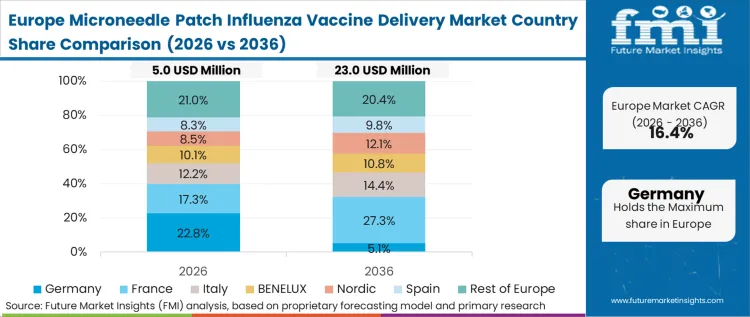
European adoption is heavily influenced by the continent's stringent extended producer responsibility regulations regarding medical waste and sharps disposal. Procurement frameworks in the EU actively penalize the utilization of legacy isothermal boxes and single-use plastics inherent in syringe distribution. Based on FMI's assessment, this environmental compliance pressure forces national health systems to assign a definitive financial premium to dissolving microneedle platforms.
- United Kingdom: Procurement practices within the National Health Service prioritize interventions that immediately alleviate clinical workforce bottlenecks during winter demand surges. The UK market is anticipated to increase by a CAGR of 22.9%. Trust administrators utilise pilot patch distributions specifically to shift the burden of adult immunization out of primary cimmunisationare facilities entirely. Success in this jurisdiction serves as the ultimate real-world validation for high-throughput, self-administered public health campaigns.
- Germany: Germany's complex network of statutory health insurance funds requires quantifiable pharmacoeconomic data before reimbursing premium delivery devices. Health economic strategists must mathematically prove that the elimination of temperature-controlled packaging and sharps disposal offsets the unit cost increase of the microarray patch. Germany is projected to witness growth at a CAGR of 22.4%. Firms that fail to articulate this total-cost-of-ownership advantage will find themselves locked out of the largest central European procurement tenders.
FMI's report includes broad coverage of the European Union member states. A unified regulatory posture from the European Medicines Agency regarding combination products serves as the critical gate unlocking simultaneous multi-country commercialization.
Competitive Aligners for Market Players
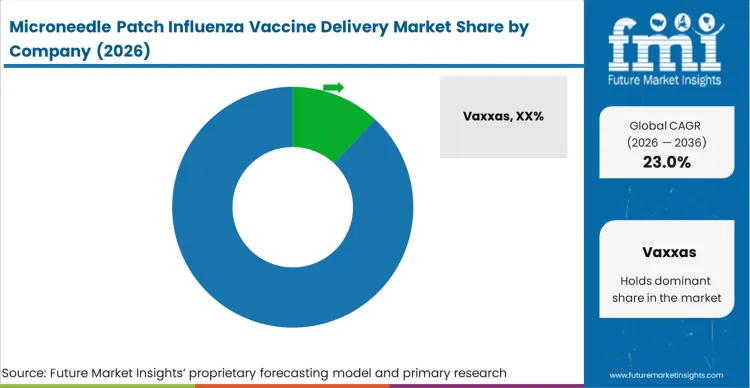
The competitive structure of this market is intensely concentrated, defined entirely by the ownership of proprietary microarray engineering patents rather than raw vaccine stabilizers production capacity. Leading entities dominate early-stage negotiations because they have successfully navigated the transition from academic cleanrooms to scalable, continuous roll-to-roll manufacturing. Procurement directors at global biopharma firms utilize demonstrated manufacturing scalability, not simply phase I immunogenicity data, as the sole variable separating qualified device partners from unviable academic projects.
Incumbents holding functional, high-density coated or dissolving polymer architectures possess an advantage protected by extreme technological moats. Replicating an anti-infective vaccines patch requires challengers to simultaneously master epidermal micro-molding, ambient-temperature desiccation chemistry, and automated packaging alignment. A challenger entering the space must build a completely novel coating mechanism to circumvent existing IP, a process that requires years of specialized capital expenditure.
Large public health buyers actively resist lock-in by funding multiple competing patch architectures simultaneously, ensuring no single device manufacturer monopolizes future pandemic supply chains. The tension between biopharma entities demanding exclusive device rights for their influenza antigens and device manufacturers seeking agnostic, multi-partner platforms will dictate commercial behaviour through 2036. The market is projected to consolidate heavily around three or four foundational device architectures, as the sheer cost of late-stage clinical trials forces smaller players into acquisition or licensing models.
Key Players in Microneedle Patch Influenza Vaccine Delivery Market
- Vaxxas
- Vaxess Technologies
- Micron Biomedical
- LTS Lohmann Therapie-Systeme AG
- BioNet
- Zipcode Bio
- PopVax
Scope of the Report
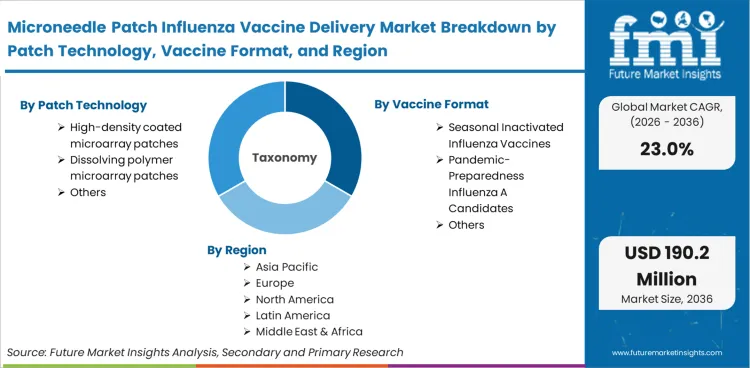
| Metric | Value |
|---|---|
| Quantitative Units | USD 24.0 million to USD 190.2 million, at a CAGR of 23.00% |
| Market Definition | The commercialization and procurement of solid-state transdermal delivery devices specifically formulated with influenza antigens, capturing the value of the delivery device, stabilization matrix, and application. |
| Patch technology Segmentation | High-density coated microarray patches, Dissolving polymer microarray patches, Silk-based sustained-release microneedle patches, Hollow / liquid-compatible microneedle patches |
| Vaccine format Segmentation | Seasonal inactivated influenza vaccines, Pandemic-preparedness influenza A candidates, mRNA / broadly protective influenza vaccines, Adjuvanted influenza formulations |
| Administration model Segmentation | Provider-administered clinic/pharmacy vaccination, Public-health campaign administration, Workplace / institutional immunization, Self-administration / mail-to-home models |
| End user Segmentation | Public health agencies and immunization programs, Biopharma vaccine developers, Hospitals and retail pharmacy chains, Preparedness and stockpile agencies |
| Regions Covered | North America, Europe, Asia Pacific |
| Countries Covered | United States, Australia, United Kingdom, Germany, Canada, China, India, and 40 plus countries |
| Key Companies Profiled | Vaxxas, Vaxess Technologies, Micron Biomedical, LTS Lohmann Therapie-Systeme AG, BioNet, Zipcode Bio, PopVax |
| Forecast Period | 2026 to 2036 |
| Approach | Primary interviews targeted procurement directors and clinical development leads. Baseline valuation anchors to verifiable pilot procurement and trial material contracts. Forecasts were cross-validated against published national immunization schedules and scale-up timelines. |
Source: Future Market Insights (FMI) analysis, based on proprietary forecasting model and primary research
Microneedle Patch Influenza Vaccine Delivery Market Analysis by Segments
Patch technology:
- High-density coated microarray patches
- Dissolving polymer microarray patches
- Silk-based sustained-release microneedle patches
- Hollow / liquid-compatible microneedle patches
Vaccine format:
- Seasonal inactivated influenza vaccines
- Pandemic-preparedness influenza A candidates
- mRNA / broadly protective influenza vaccines
- Adjuvanted influenza formulations
Administration model:
- Provider-administered clinic/pharmacy vaccination
- Public-health campaign administration
- Workplace / institutional immunization
- Self-administration / mail-to-home models
End user:
- Public health agencies and immunization programs
- Biopharma vaccine developers
- Hospitals and retail pharmacy chains
- Preparedness and stockpile agencies
Revenue stage:
- Clinical trial and pilot procurement
- Public-sector preparedness procurement
- Commercial seasonal immunization procurement
- Technology licensing and co-development revenue
Region:
- North America
- United States
- Canada
- Europe
- Germany
- United Kingdom
- France
- Italy
- Spain
- Asia Pacific
- China
- Japan
- South Korea
- Taiwan
- Singapore
- Latin America
- Brazil
- Mexico
- Argentina
- Middle East & Africa
- GCC Countries
- South Africa
Bibliography
- World Health Organization. (2024, January). WHO Seasonal Influenza Vaccine Global Market Study, January 2024. World Health Organization.
- Centers for Disease Control and Prevention. (2025). 2024-2025 Influenza Season Summary: Severity, Disease Burden, and Burden Prevented.
- UK Health Security Agency. (2025, May). Influenza in the UK, annual epidemiological report: winter 2024 to 2025. UK Government.
- Australian Government Department of Health and Aged Care. (2025, June). Influenza (flu) vaccine.
- Coalition for Epidemic Preparedness Innovations. (2025, January). CEPI and Micron Biomedical accelerate needle-free vaccines against Disease X.
- Davies, C., Baker, B., Berger, M. N., Knox, S. L., Mowbray, E., Stewart, B. G., Booy, R., Hacker, E., Marmol, A., Ross, C., Muller, D. A., Mortimore, A. M., Siller, G., Forster, A. H., & Skinner, S. R. (2025). Vaccine microarray patch self-administration: A preliminary study in adults 50 years of age and over. Vaccine.
- Nguyen, H. X. (2025). Beyond the Needle: Innovative Microneedle-Based Transdermal Vaccination. Medicines.
- International Organization for Standardization. (2024). Medical devices , Quality management systems.
This bibliography is provided for reader reference. The full FMI report contains the complete reference list with primary source documentation.
This Report Addresses
- Market intelligence to support strategic decision making across high-density coated microarray patches and dissolving polymer microarray patches
- Market size estimation and 10-year revenue forecasts from 2026 to 2036, supported by clinical trial milestone tracking and phase II/III scale-up timelines
- Growth opportunity mapping across Administration model with emphasis on the regulatory gateway defining true self-administration mail-to-home models
- Segment and regional revenue forecasts covering seasonal inactivated influenza vaccines across stringent extended producer responsibility frameworks
- Competition strategy assessment including proprietary microarray engineering patents and continuous roll-to-roll manufacturing scale
- Technology development tracking including specific mRNA lipid nanoparticle integration and ambient-temperature desiccation chemistry
- Market access analysis covering combination-product monographs and Biomedical Advanced Research and Development Authority procurement pathways
- Market report delivery in PDF, Excel, PPT, and interactive dashboard formats for executive strategy, national stockpile logistics planning, and operational benchmarking use
Frequently Asked Questions
What is the current size of the microneedle patch influenza vaccine delivery market?
The market reaches USD 24.0 million in 2026. This initial valuation represents milestone payments, clinical material supply, and very early-stage pilot procurements, signalling an industry positioned exactly at its commercial evolution.
How large could the market become by 2036?
The valuation expands to USD 190.2 million by 2036. This scale reflects the wholesale change of major national stockpiles away from cold-chain dependent liquid vials toward integrated solid-state mrna synthesis materials distribution paradigms.
Give me the CAGR, key players, and barriers in the influenza vaccine patch market?
The market registers a 23.00% CAGR during the forecast period. Vaxxas, Vaxess Technologies, and Micron Biomedical lead the clinical landscape. The primary barrier is the absence of a unified regulatory monograph for evaluating solid-dose epidermal vaccine-device combinations, forcing bespoke validation pathways.
Which companies are developing flu vaccine patches?
Leading developers include Vaxxas, Vaxess Technologies, Micron Biomedical, LTS Lohmann Therapie-Systeme AG, BioNet, Zipcode Bio, and PopVax. These firms are actively advancing clinical stage programs and establishing continuous manufacturing partnerships.
How do HD-MAP and dissolving microneedle patch platforms differ?
High-density microarray patches (HD-MAP) feature solid structures coated with rapidly evaporating antigen layers, avoiding chemical crosslinking. Dissolving patches integrate the antigen directly into a polymer matrix that safely clears into the body, completely eliminating post-administration medical waste.
Compare HD-MAP and dissolving microneedle flu vaccine platforms?
HD-MAP excels in preserving complex protein structures because the antigen is coated onto the surface, making it ideal for established inactivated strains. Dissolving platforms offer superior waste management profiles but present higher regulatory hurdles regarding the clearance of the proprietary polymer matrix from the patient's system.
Why are microneedle patches being developed for influenza vaccines?
The need to rapidly deploy pandemic countermeasures outside of established clinical infrastructure forces adoption. Stockpile directors mandate thermostable formats because traditional cold-chain networks fail immediately under the logistical stress of population-wide crisis distribution.
What are the main commercialization barriers in this market?
The total absence of a unified regulatory monograph for evaluating solid-dose epidermal vaccine-device combinations throttles the market. Without standardized guidelines, every new patch architecture requires a completely bespoke and highly expensive validation pathway.
Which countries are likely to adopt influenza vaccine patches first?
Australia outpaces the United States (25.1% vs 24.6%) because its national immunization program actively integrates and subsidizes premium delivery modalities. The robust domestic ecosystem of academic microneedle engineering seamlessly translates into accelerated public health procurement.
Are any flu vaccine patches approved for commercial use yet?
While significant phase I and II clinical trial milestones have been achieved by major developers, regulatory bodies have not yet granted full commercial approval for an integrated influenza microarray patch. The market currently operates on pilot procurement and material supply contracts.
Can flu vaccine patches be self-administered at home?
Yes, but regulatory agencies require extensive post-market surveillance in controlled pharmacy or clinic settings first. Once this institutional oversight phase validates immunogenicity and safety equivalence, true mail-to-home models will be authorized for the public.
What role does thermostability play in influenza vaccine patch adoption?
Thermostability completely decouples vaccination distribution from refrigerated transport. This allows public health agencies to pre-position pandemic stockpiles in ambient warehouses and ship seasonal doses via conventional mail, radically lowering the logistical baseline of national health budgets.
microneedle flu vaccine vs intramuscular flu shot: how do they compare?
Microneedle delivery targets the immune-rich Langerhans cells in the epidermis, enabling powerful dose-sparing advantages over intramuscular shots, which rely on immunologically sparse muscle tissue. Furthermore, patches eliminate sharps disposal costs and cold-chain dependency entirely.
Show me the latest outlook for the microneedle patch influenza vaccine delivery market?
The outlook is defined by a rapid transition from clinical exploration to massive public health procurement. Driven by defense mandates and the need to overcome pharmacy workforce bottlenecks, the sector will evolve heavily around proprietary IP licensing and exclusive biopharma device partnerships through 2036.
Preview the report firsthand - request a free sample
Get SampleGet the brochure for pricing and purchase details.
Get PDFTable of Content
- Executive Summary
- Global Market Outlook
- Demand-side Trends
- Supply-side Trends
- Technology Roadmap Analysis
- Analysis and Recommendations
- Market Overview
- Market Coverage / Taxonomy
- Market Definition / Scope / Limitations
- Research Methodology
- Chapter Orientation
- Analytical Lens and Working Hypotheses
- Market Structure, Signals, and Trend Drivers
- Benchmarking and Cross-market Comparability
- Market Sizing, Forecasting, and Opportunity Mapping
- Research Design and Evidence Framework
- Desk Research Programme (Secondary Evidence)
- Company Annual and Sustainability Reports
- Peer-reviewed Journals and Academic Literature
- Corporate Websites, Product Literature, and Technical Notes
- Earnings Decks and Investor Briefings
- Statutory Filings and Regulatory Disclosures
- Technical White Papers and Standards Notes
- Trade Journals, Industry Magazines, and Analyst Briefs
- Conference Proceedings, Webinars, and Seminar Materials
- Government Statistics Portals and Public Data Releases
- Press Releases and Reputable Media Coverage
- Specialist Newsletters and Curated Briefings
- Sector Databases and Reference Repositories
- FMI Internal Proprietary Databases and Historical Market Datasets
- Subscription Datasets and Paid Sources
- Social Channels, Communities, and Digital Listening Inputs
- Additional Desk Sources
- Expert Input and Fieldwork (Primary Evidence)
- Primary Modes
- Qualitative Interviews and Expert Elicitation
- Quantitative Surveys and Structured Data Capture
- Blended Approach
- Why Primary Evidence is Used
- Field Techniques
- Interviews
- Surveys
- Focus Groups
- Observational and In-context Research
- Social and Community Interactions
- Stakeholder Universe Engaged
- C-suite Leaders
- Board Members
- Presidents and Vice Presidents
- R&D and Innovation Heads
- Technical Specialists
- Domain Subject-matter Experts
- Scientists
- Physicians and Other Healthcare Professionals
- Governance, Ethics, and Data Stewardship
- Research Ethics
- Data Integrity and Handling
- Primary Modes
- Tooling, Models, and Reference Databases
- Desk Research Programme (Secondary Evidence)
- Data Engineering and Model Build
- Data Acquisition and Ingestion
- Cleaning, Normalisation, and Verification
- Synthesis, Triangulation, and Analysis
- Quality Assurance and Audit Trail
- Market Background
- Market Dynamics
- Drivers
- Restraints
- Opportunity
- Trends
- Scenario Forecast
- Demand in Optimistic Scenario
- Demand in Likely Scenario
- Demand in Conservative Scenario
- Opportunity Map Analysis
- Product Life Cycle Analysis
- Supply Chain Analysis
- Investment Feasibility Matrix
- Value Chain Analysis
- PESTLE and Porter’s Analysis
- Regulatory Landscape
- Regional Parent Market Outlook
- Production and Consumption Statistics
- Import and Export Statistics
- Market Dynamics
- Global Market Analysis 2021 to 2025 and Forecast, 2026 to 2036
- Historical Market Size Value (USD Million) Analysis, 2021 to 2025
- Current and Future Market Size Value (USD Million) Projections, 2026 to 2036
- Y-o-Y Growth Trend Analysis
- Absolute $ Opportunity Analysis
- Global Market Pricing Analysis 2021 to 2025 and Forecast 2026 to 2036
- Global Market Analysis 2021 to 2025 and Forecast 2026 to 2036, By Patch Technology
- Introduction / Key Findings
- Historical Market Size Value (USD Million) Analysis By Patch Technology , 2021 to 2025
- Current and Future Market Size Value (USD Million) Analysis and Forecast By Patch Technology , 2026 to 2036
- High-density coated microarray patches
- Dissolving polymer microarray patches
- Others
- High-density coated microarray patches
- Y-o-Y Growth Trend Analysis By Patch Technology , 2021 to 2025
- Absolute $ Opportunity Analysis By Patch Technology , 2026 to 2036
- Global Market Analysis 2021 to 2025 and Forecast 2026 to 2036, By Vaccine Format
- Introduction / Key Findings
- Historical Market Size Value (USD Million) Analysis By Vaccine Format, 2021 to 2025
- Current and Future Market Size Value (USD Million) Analysis and Forecast By Vaccine Format, 2026 to 2036
- Seasonal Inactivated Influenza Vaccines
- Pandemic-Preparedness Influenza A Candidates
- Others
- Seasonal Inactivated Influenza Vaccines
- Y-o-Y Growth Trend Analysis By Vaccine Format, 2021 to 2025
- Absolute $ Opportunity Analysis By Vaccine Format, 2026 to 2036
- Global Market Analysis 2021 to 2025 and Forecast 2026 to 2036, By Administration Model
- Introduction / Key Findings
- Historical Market Size Value (USD Million) Analysis By Administration Model, 2021 to 2025
- Current and Future Market Size Value (USD Million) Analysis and Forecast By Administration Model, 2026 to 2036
- Provider-Administered Clinic/Pharmacy Vaccination
- Public-Health Campaign Administration
- Others
- Provider-Administered Clinic/Pharmacy Vaccination
- Y-o-Y Growth Trend Analysis By Administration Model, 2021 to 2025
- Absolute $ Opportunity Analysis By Administration Model, 2026 to 2036
- Global Market Analysis 2021 to 2025 and Forecast 2026 to 2036, By End user
- Introduction / Key Findings
- Historical Market Size Value (USD Million) Analysis By End user, 2021 to 2025
- Current and Future Market Size Value (USD Million) Analysis and Forecast By End user, 2026 to 2036
- Public health Agencies and Immunization Programs
- Biopharma Vaccine Developers
- Others
- Public health Agencies and Immunization Programs
- Y-o-Y Growth Trend Analysis By End user, 2021 to 2025
- Absolute $ Opportunity Analysis By End user, 2026 to 2036
- Global Market Analysis 2021 to 2025 and Forecast 2026 to 2036, By Revenue Stage
- Introduction / Key Findings
- Historical Market Size Value (USD Million) Analysis By Revenue Stage, 2021 to 2025
- Current and Future Market Size Value (USD Million) Analysis and Forecast By Revenue Stage, 2026 to 2036
- Clinical Trial and Pilot Procurement
- Public-Sector Preparedness Procurement
- Others
- Clinical Trial and Pilot Procurement
- Y-o-Y Growth Trend Analysis By Revenue Stage, 2021 to 2025
- Absolute $ Opportunity Analysis By Revenue Stage, 2026 to 2036
- Global Market Analysis 2021 to 2025 and Forecast 2026 to 2036, By Region
- Introduction
- Historical Market Size Value (USD Million) Analysis By Region, 2021 to 2025
- Current Market Size Value (USD Million) Analysis and Forecast By Region, 2026 to 2036
- North America
- Latin America
- Western Europe
- Eastern Europe
- East Asia
- South Asia and Pacific
- Middle East & Africa
- Market Attractiveness Analysis By Region
- North America Market Analysis 2021 to 2025 and Forecast 2026 to 2036, By Country
- Historical Market Size Value (USD Million) Trend Analysis By Market Taxonomy, 2021 to 2025
- Market Size Value (USD Million) Forecast By Market Taxonomy, 2026 to 2036
- By Country
- USA
- Canada
- Mexico
- By Patch Technology
- By Vaccine Format
- By Administration Model
- By End user
- By Revenue Stage
- By Country
- Market Attractiveness Analysis
- By Country
- By Patch Technology
- By Vaccine Format
- By Administration Model
- By End user
- By Revenue Stage
- Key Takeaways
- Latin America Market Analysis 2021 to 2025 and Forecast 2026 to 2036, By Country
- Historical Market Size Value (USD Million) Trend Analysis By Market Taxonomy, 2021 to 2025
- Market Size Value (USD Million) Forecast By Market Taxonomy, 2026 to 2036
- By Country
- Brazil
- Chile
- Rest of Latin America
- By Patch Technology
- By Vaccine Format
- By Administration Model
- By End user
- By Revenue Stage
- By Country
- Market Attractiveness Analysis
- By Country
- By Patch Technology
- By Vaccine Format
- By Administration Model
- By End user
- By Revenue Stage
- Key Takeaways
- Western Europe Market Analysis 2021 to 2025 and Forecast 2026 to 2036, By Country
- Historical Market Size Value (USD Million) Trend Analysis By Market Taxonomy, 2021 to 2025
- Market Size Value (USD Million) Forecast By Market Taxonomy, 2026 to 2036
- By Country
- Germany
- UK
- Italy
- Spain
- France
- Nordic
- BENELUX
- Rest of Western Europe
- By Patch Technology
- By Vaccine Format
- By Administration Model
- By End user
- By Revenue Stage
- By Country
- Market Attractiveness Analysis
- By Country
- By Patch Technology
- By Vaccine Format
- By Administration Model
- By End user
- By Revenue Stage
- Key Takeaways
- Eastern Europe Market Analysis 2021 to 2025 and Forecast 2026 to 2036, By Country
- Historical Market Size Value (USD Million) Trend Analysis By Market Taxonomy, 2021 to 2025
- Market Size Value (USD Million) Forecast By Market Taxonomy, 2026 to 2036
- By Country
- Russia
- Poland
- Hungary
- Balkan & Baltic
- Rest of Eastern Europe
- By Patch Technology
- By Vaccine Format
- By Administration Model
- By End user
- By Revenue Stage
- By Country
- Market Attractiveness Analysis
- By Country
- By Patch Technology
- By Vaccine Format
- By Administration Model
- By End user
- By Revenue Stage
- Key Takeaways
- East Asia Market Analysis 2021 to 2025 and Forecast 2026 to 2036, By Country
- Historical Market Size Value (USD Million) Trend Analysis By Market Taxonomy, 2021 to 2025
- Market Size Value (USD Million) Forecast By Market Taxonomy, 2026 to 2036
- By Country
- China
- Japan
- South Korea
- By Patch Technology
- By Vaccine Format
- By Administration Model
- By End user
- By Revenue Stage
- By Country
- Market Attractiveness Analysis
- By Country
- By Patch Technology
- By Vaccine Format
- By Administration Model
- By End user
- By Revenue Stage
- Key Takeaways
- South Asia and Pacific Market Analysis 2021 to 2025 and Forecast 2026 to 2036, By Country
- Historical Market Size Value (USD Million) Trend Analysis By Market Taxonomy, 2021 to 2025
- Market Size Value (USD Million) Forecast By Market Taxonomy, 2026 to 2036
- By Country
- India
- ASEAN
- Australia & New Zealand
- Rest of South Asia and Pacific
- By Patch Technology
- By Vaccine Format
- By Administration Model
- By End user
- By Revenue Stage
- By Country
- Market Attractiveness Analysis
- By Country
- By Patch Technology
- By Vaccine Format
- By Administration Model
- By End user
- By Revenue Stage
- Key Takeaways
- Middle East & Africa Market Analysis 2021 to 2025 and Forecast 2026 to 2036, By Country
- Historical Market Size Value (USD Million) Trend Analysis By Market Taxonomy, 2021 to 2025
- Market Size Value (USD Million) Forecast By Market Taxonomy, 2026 to 2036
- By Country
- Kingdom of Saudi Arabia
- Other GCC Countries
- Turkiye
- South Africa
- Other African Union
- Rest of Middle East & Africa
- By Patch Technology
- By Vaccine Format
- By Administration Model
- By End user
- By Revenue Stage
- By Country
- Market Attractiveness Analysis
- By Country
- By Patch Technology
- By Vaccine Format
- By Administration Model
- By End user
- By Revenue Stage
- Key Takeaways
- Key Countries Market Analysis
- USA
- Pricing Analysis
- Market Share Analysis, 2025
- By Patch Technology
- By Vaccine Format
- By Administration Model
- By End user
- By Revenue Stage
- Canada
- Pricing Analysis
- Market Share Analysis, 2025
- By Patch Technology
- By Vaccine Format
- By Administration Model
- By End user
- By Revenue Stage
- Mexico
- Pricing Analysis
- Market Share Analysis, 2025
- By Patch Technology
- By Vaccine Format
- By Administration Model
- By End user
- By Revenue Stage
- Brazil
- Pricing Analysis
- Market Share Analysis, 2025
- By Patch Technology
- By Vaccine Format
- By Administration Model
- By End user
- By Revenue Stage
- Chile
- Pricing Analysis
- Market Share Analysis, 2025
- By Patch Technology
- By Vaccine Format
- By Administration Model
- By End user
- By Revenue Stage
- Germany
- Pricing Analysis
- Market Share Analysis, 2025
- By Patch Technology
- By Vaccine Format
- By Administration Model
- By End user
- By Revenue Stage
- UK
- Pricing Analysis
- Market Share Analysis, 2025
- By Patch Technology
- By Vaccine Format
- By Administration Model
- By End user
- By Revenue Stage
- Italy
- Pricing Analysis
- Market Share Analysis, 2025
- By Patch Technology
- By Vaccine Format
- By Administration Model
- By End user
- By Revenue Stage
- Spain
- Pricing Analysis
- Market Share Analysis, 2025
- By Patch Technology
- By Vaccine Format
- By Administration Model
- By End user
- By Revenue Stage
- France
- Pricing Analysis
- Market Share Analysis, 2025
- By Patch Technology
- By Vaccine Format
- By Administration Model
- By End user
- By Revenue Stage
- India
- Pricing Analysis
- Market Share Analysis, 2025
- By Patch Technology
- By Vaccine Format
- By Administration Model
- By End user
- By Revenue Stage
- ASEAN
- Pricing Analysis
- Market Share Analysis, 2025
- By Patch Technology
- By Vaccine Format
- By Administration Model
- By End user
- By Revenue Stage
- Australia & New Zealand
- Pricing Analysis
- Market Share Analysis, 2025
- By Patch Technology
- By Vaccine Format
- By Administration Model
- By End user
- By Revenue Stage
- China
- Pricing Analysis
- Market Share Analysis, 2025
- By Patch Technology
- By Vaccine Format
- By Administration Model
- By End user
- By Revenue Stage
- Japan
- Pricing Analysis
- Market Share Analysis, 2025
- By Patch Technology
- By Vaccine Format
- By Administration Model
- By End user
- By Revenue Stage
- South Korea
- Pricing Analysis
- Market Share Analysis, 2025
- By Patch Technology
- By Vaccine Format
- By Administration Model
- By End user
- By Revenue Stage
- Russia
- Pricing Analysis
- Market Share Analysis, 2025
- By Patch Technology
- By Vaccine Format
- By Administration Model
- By End user
- By Revenue Stage
- Poland
- Pricing Analysis
- Market Share Analysis, 2025
- By Patch Technology
- By Vaccine Format
- By Administration Model
- By End user
- By Revenue Stage
- Hungary
- Pricing Analysis
- Market Share Analysis, 2025
- By Patch Technology
- By Vaccine Format
- By Administration Model
- By End user
- By Revenue Stage
- Kingdom of Saudi Arabia
- Pricing Analysis
- Market Share Analysis, 2025
- By Patch Technology
- By Vaccine Format
- By Administration Model
- By End user
- By Revenue Stage
- Turkiye
- Pricing Analysis
- Market Share Analysis, 2025
- By Patch Technology
- By Vaccine Format
- By Administration Model
- By End user
- By Revenue Stage
- South Africa
- Pricing Analysis
- Market Share Analysis, 2025
- By Patch Technology
- By Vaccine Format
- By Administration Model
- By End user
- By Revenue Stage
- USA
- Market Structure Analysis
- Competition Dashboard
- Competition Benchmarking
- Market Share Analysis of Top Players
- By Regional
- By Patch Technology
- By Vaccine Format
- By Administration Model
- By End user
- By Revenue Stage
- Competition Analysis
- Competition Deep Dive
- Vaxxas
- Overview
- Product Portfolio
- Profitability by Market Segments (Product/Age /Sales Channel/Region)
- Sales Footprint
- Strategy Overview
- Marketing Strategy
- Product Strategy
- Channel Strategy
- Vaxess Technologies
- Micron Biomedical
- LTS Lohmann Therapie-Systeme AG
- BioNet
- Vaxxas
- Competition Deep Dive
- Assumptions & Acronyms Used


