

- Industry Size (2026)
- USD 2.1 Bn
- Forecast (2036)
- USD 6.9 Bn
- CAGR (2026 to 2036)
- 12.8%
MicroRNA Masks Market Forecast and Outlook 2026 to 2036
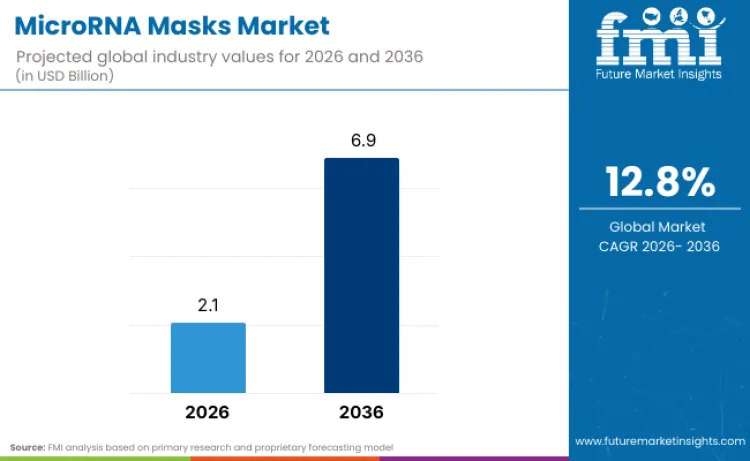
The global microRNA masks market is projected to reach a valuation of USD 2.1 billion in 2026 and advance to USD 6.9 billion by 2036, expanding at a strong 12.8% CAGR. Demand for microRNA masks, as per Future Market Insights, is being shaped by a structural shift in RNA therapeutics, where researchers and drug developers are increasingly targeting post-transcriptional gene regulation rather than permanent gene modification. This evolution positions microRNA-based approaches as a differentiated therapeutic class, capable of modulating complex disease pathways that remain inaccessible to conventional gene therapy and small-molecule drugs.
Scientific leadership has played a defining role in legitimizing microRNA as a standalone market segment. David Baltimore, Nobel Laureate and co-founder of Regulus Therapeutics, articulated this distinction clearly, stating: “I believe that microRNAs represent previously unexplored disease targets where pharmacological approaches could lead to the emergence of novel therapies for many human disorders.” This perspective underscores why microRNA masks are increasingly viewed not as adjunct tools, but as foundational platforms for next-generation RNA medicines.
Clinical and commercial momentum is now accelerating as improved delivery systems, target specificity, and safety profiles move microRNA programs closer to scalable deployment. Developers are prioritizing indications with high unmet need, where reversible gene modulation and multi-pathway control offer measurable advantages over permanent genetic alteration. As regulatory frameworks mature and translational data continues to strengthen, the microRNA masks market is expected to transition from experimental adoption toward a core pillar of the broader RNA therapeutics landscape over the 2026 to 2036 period.
Summary of the MicroRNA Masks Market
What is Growth Outlook for MicroRNA Masks Market as per Future Market Insights Projection?
Future Market Insights projects the MicroRNA masks market to grow at a CAGR of 12.8% from 2026 to 2036, expanding from USD 2.1 billion to USD 6.9 billion.
FMI research approach: Bottom-up revenue modeling by product type and distribution channel, primary interviews with dermatology and cosmeceutical manufacturers, and bioavailability analysis of nanocarrier delivery systems.
How do FMI Analysts Perceive MicroRNA Masks Market to Evolve?
FMI analysts perceive the market transitioning from niche luxury products toward mass-market adoption as manufacturing costs decline and clinical evidence validates efficacy for cellular repair and anti-aging applications.
FMI research approach: Comparative analysis of clinical trial outcomes, regulatory approval tracking for gene-modulating cosmetics, and consumer adoption patterns across professional and retail channels.
Which Country Holds Largest Share in the Global MicroRNA Masks Market?
China holds the largest share of the global MicroRNA masks market by value, driven by rapid adoption of advanced skincare technologies and strong consumer preference for biotech-based beauty products.
FMI research approach: Country-level revenue modeling by end user and distribution channel, analysis of beauty retail penetration rates, and regulatory framework assessment for gene-modulating cosmetics.
How Large Will the MicroRNA Masks Market be by 2036?
The global MicroRNA masks market is estimated to reach USD 6.9 billion by 2036.
FMI research approach: Long-term revenue forecast based on technology adoption curves, nanocarrier cost reduction projections, and clinical validation milestones for microRNA skincare applications.
What is Definition of MicroRNA Masks Market?
The MicroRNA masks market comprises topical skincare products that deliver microRNA molecules to modulate gene expression for therapeutic and cosmetic applications, including anti-aging, skin repair, and pigmentation control.
FMI research approach: Market taxonomy validation across product formats and microRNA delivery technologies, alignment with cosmeceutical and gene-modulating skincare classification principles, and exclusion mapping for non-microRNA bioactive masks.
What are Globally Unique Trends Shaping MicroRNA Masks Market?
Globally unique trends include nanocarrier encapsulation for enhanced penetration, clinical partnerships between cosmetic brands and dermatology research institutions, and regulatory evolution allowing gene-expression claims in skincare.
FMI research approach: Analysis of patent filings for microRNA delivery systems, regulatory guidance tracking from FDA and EU cosmetics authorities, and strategic partnerships between beauty conglomerates and biotechnology firms.
MicroRNA Masks Market Key Takeaways
| Metric | Details |
|---|---|
| Industry Size (2026) | USD 2.1 Billion |
| Industry Value (2036) | USD 6.9 Billion |
| CAGR (2026-2036) | 12.8% |
Source: Future Market Insights (FMI) analysis, based on proprietary forecasting model and primary research
What is Driving Demand for MicroRNA Masks?
Rising consumer awareness of epigenetic skincare is fundamentally reshaping the beauty industry, manifesting as demand for products that target cellular aging mechanisms rather than surface-level hydration. Nanocarrier technology has solved the penetration challenge that previously limited microRNA efficacy, allowing molecules to reach dermal fibroblasts where collagen synthesis occurs. Scientific validation from peer-reviewed dermatology journals is converting skeptical consumers into early adopters, creating sustained demand for clinically proven formulations.
The shift toward personalized skincare is creating opportunities for microRNA masks tailored to specific genetic aging patterns. Advanced sequencing technologies enable brands to identify optimal microRNA combinations for individual skin profiles, elevating masks from commodity products to precision therapeutics. Investment in biotechnology partnerships is accelerating, with major beauty conglomerates acquiring or licensing microRNA sequences from pharmaceutical research institutions.
Regulatory acceptance of gene-modulating claims in cosmetics is expanding permissible marketing language, allowing brands to communicate cellular-level benefits that differentiate microRNA masks from conventional products. This regulatory evolution, combined with declining nanocarrier production costs, is positioning microRNA technology for mass-market penetration beyond initial luxury positioning.
How is the MicroRNA Masks Market Segmented?
The MicroRNA masks market has been segmented based on product type, technology, application, distribution channel, end user, and region. In terms of product type, the market is divided into bio-cellulose masks, sheet masks, hydrogel masks, cream and gel masks, and others. By technology, the market encompasses nanocarrier-based microRNA, synthetic microRNA, natural microRNA, and encapsulated microRNA. By application, the market includes anti-aging, skin repair and regeneration, hydration and moisturizing, acne and inflammation control, and pigmentation and brightening. By distribution channel, the market spans online retail, specialty beauty stores, pharmacies and drug stores, dermatology clinics, and others. By end user, the market includes individual consumers, professional skincare clinics, and medical and aesthetic centers. Regionally, the market covers North America, Europe, East Asia, South Asia, Latin America, and Middle East and Africa.
Why Do Bio-Cellulose Masks Dominate the MicroRNA Masks Market?
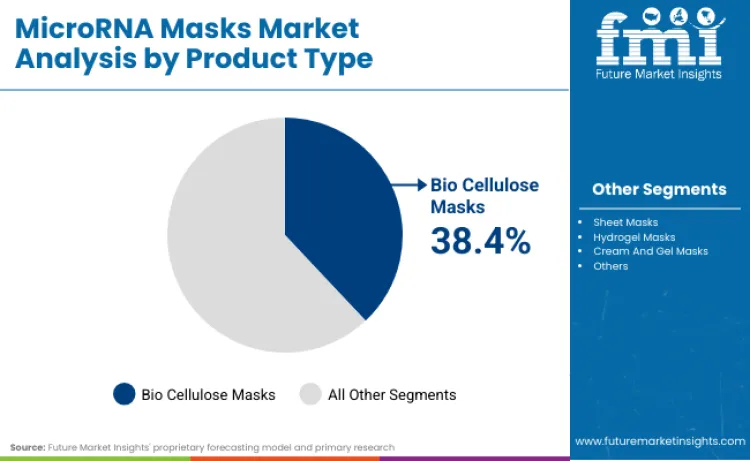
Bio-cellulose masks command a dominant 38.4% market share because their intrinsic material properties fundamentally outperform conventional sheet substrates in microRNA delivery applications. Bio-cellulose exhibits an exceptional water-holding capacity that is over 100 times higher than plant-derived cellulose by mass, with the ability to retain 100-200 times its own dry weight in water. This high hydration reservoir creates a sustained moisture microenvironment on the skin surface, which is critical for maintaining microRNA stability and enabling prolonged diffusion into the stratum corneum during wear.
At a structural level, hydrogen bonding between bio-cellulose fibrillar units stabilizes a uniform, ultrafine nanofiber network that defines its mechanical and delivery performance. High tensile strength, controlled elongation, and a favorable elastic modulus allow the material to conform closely to facial contours without tearing or collapsing. When compressed into sheets, the high planar orientation of ribbon-like fibers further enhances chemical stability, enabling high loading of nanocarrier-encapsulated microRNA while preserving material integrity throughout extended treatment durations.
How Do Technology Platforms Influence MicroRNA Mask Efficacy?
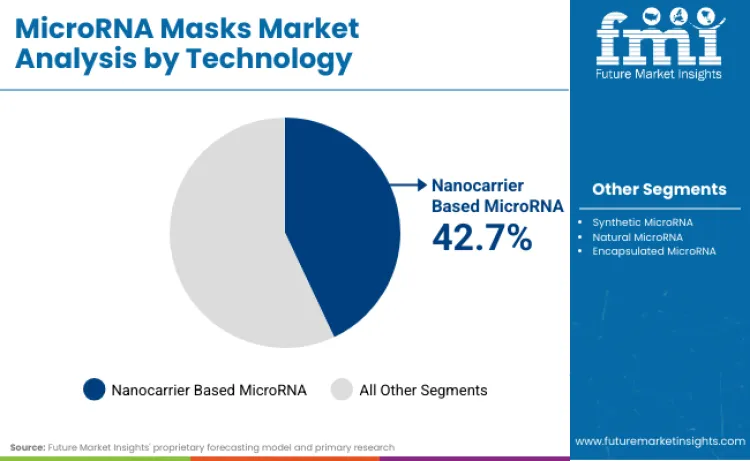
Nanocarrier-based microRNA technology leads with 42.7% share, driven by its ability to protect fragile RNA molecules from enzymatic degradation while enabling controlled release in target cells. Liposomal and polymeric nanocarriers encapsulate microRNA sequences, creating stable formulations that survive manufacturing and shelf storage without refrigeration. This stability breakthrough transformed microRNA from laboratory curiosity to commercially viable skincare ingredient.
Synthetic microRNA offers precise sequence control and scalable manufacturing, while natural microRNA extracts appeal to consumers seeking plant-derived alternatives. Encapsulated formats combine protection with time-release mechanisms, extending therapeutic activity beyond initial application. Technology selection directly impacts bioavailability, with encapsulation efficiency determining whether microRNA reaches cytoplasm to modulate gene expression or degrades in the epidermis.
Why Is Multi-MicroRNA Formulation Strategy Reshaping Product Design?
The microRNA masks sector is shifting decisively away from single-target actives toward multi-microRNA cocktails engineered to address complex, interlinked aging pathways in parallel. Advances in bioinformatics now allow developers to map microRNA interactions across collagen gene expression, elastin synthesis, and inflammatory signaling cascades, enabling the rational design of synergistic combinations rather than isolated effects. This systems-level approach reflects a broader maturation of the category, positioning microRNA masks as pathway-modulating platforms rather than cosmetic delivery vehicles. As formulation science improves and nanocarrier production scales, cost-per-dose is declining, allowing products that were once confined to luxury or professional channels to move toward wider consumer accessibility.
How Are Stability and Analytical Standards Converting MicroRNA Masks into Evidence-Based Cosmeceuticals?
Technical progress in stability testing has resolved one of the sector’s most critical bottlenecks. Contemporary protocols now preserve microRNA integrity for up to two years at ambient temperature, removing cold-chain dependencies that previously restricted global distribution. In parallel, analytical methods for quantifying microRNA delivery and cellular uptake are becoming standardized, allowing brands to support performance claims with validated, reproducible assays. These developments reduce formulation risk, strengthen regulatory defensibility, and shift microRNA masks from experimental skincare concepts into substantiated cosmeceutical products grounded in measurable biological outcomes.
What Role Does Artificial Intelligence Play in Accelerating Formulation and Manufacturing Evolution?
Artificial intelligence is increasingly embedded across microRNA mask development, from sequence selection to production optimization. Machine learning models analyze clinical and preclinical datasets to predict the efficacy of specific microRNA sequences across varied skin types and aging phenotypes, significantly compressing development timelines. At the manufacturing level, automated nanocarrier assembly systems are improving batch-to-batch consistency while lowering unit costs. Together, AI-driven formulation design and automated production are transforming microRNA masks into scalable, precision-engineered products capable of meeting both clinical expectations and mass-market economics.
What is the MicroRNA Masks Market Regional Outlook?
Global adoption of microRNA masks is accelerating as biotechnology-driven skincare gains acceptance across both emerging and mature markets, supported by improving clinical validation and expanding omnichannel distribution. While the global market advances at a 12.8% CAGR, growth momentum is clearly concentrated in high-population and fast-digitizing economies where consumers are more receptive to advanced, gene-modulating beauty solutions. China and India are emerging as primary growth engines, supported by strong biotech manufacturing ecosystems, rising dermatology awareness, and rapid uptake through online-first beauty platforms. In contrast, developed markets are expanding at a steadier pace, with adoption shaped more by regulatory scrutiny, brand credibility, and professional endorsement than by volume expansion alone.
FMI analysis indicates that future growth will be driven by the convergence of clinical credibility and mass accessibility in emerging economies, while mature markets will focus on premiumization, compliance-grade claims, and clinic-led protocols. Regional variation in regulatory acceptance of gene-expression narratives and purchasing preferences between online retail and in-clinic treatments continues to shape country-specific growth trajectories.
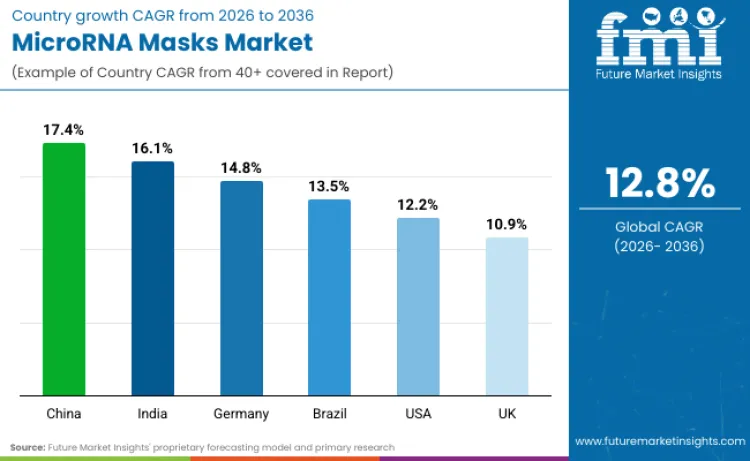
| Country | CAGR (2026 to 2036) |
|---|---|
| China | 17.4% |
| India | 16.1% |
| Germany | 14.8% |
| Brazil | 13.5% |
| United States | 12.2% |
| United Kingdom | 10.9% |
Source: Future Market Insights (FMI) historical analysis and forecast data.
China: How is Biotechnology Beauty Adoption Driving Market Expansion?
China's microRNA masks market is experiencing rapid expansion driven by strong consumer enthusiasm for innovative skincare technologies and established infrastructure for biotech manufacturing. Domestic beauty brands are advancing microRNA formulations targeting Asian skin types, creating products optimized for hyperpigmentation and texture concerns prevalent in Chinese consumers. The Chinese microRNA masks market is set to grow at 17.4% CAGR during the study period.
The regulatory environment for cosmeceuticals has matured significantly, with streamlined approval pathways for products containing novel bioactive ingredients. Investment in contract manufacturing infrastructure is expanding local production capabilities for nanocarrier-based formulations, reducing dependence on imported ingredients. E-commerce platforms provide detailed product education and customer reviews, accelerating adoption of science-based skincare among younger demographics.
India: Is Growing Affluence Elevating Demand for Premium Skincare?
India's market growth shows expanding middle-class purchasing power and increasing awareness of advanced anti-aging technologies among urban consumers. Dermatology clinics are incorporating microRNA masks into treatment protocols for hyperpigmentation and photoaging, conditions with high prevalence in South Asian populations. The Indian microRNA masks market is set to grow at 16.1% CAGR during the study period.
The emergence of domestic beauty brands offering microRNA formulations at competitive price points is making technology accessible beyond luxury segments. Online retail channels provide product education and home-delivery convenience, overcoming distribution challenges in tier-2 and tier-3 cities. Regulatory frameworks are evolving to support cosmeceutical innovation while maintaining safety standards.
Germany: How is Regulatory Rigor Establishing Quality Standards?
Germany's market growth is supported by stringent cosmetic regulations that ensure product safety and substantiate efficacy claims, building consumer trust in microRNA technology. Dermatology research institutions are conducting clinical trials that validate anti-aging benefits, providing evidence-based foundation for medical aesthetic adoption. The German microRNA masks market is set to grow at 14.8% CAGR during the study period.
Pharmacy distribution channels provide professional consultation and product guidance, positioning microRNA masks as therapeutic rather than purely cosmetic. Consumer preference for scientifically validated skincare aligns with the evidence-based positioning of microRNA technology. Investment in biotech manufacturing is strengthening local production capabilities for advanced nanocarrier systems.
Brazil: Can Beauty Innovation Culture Accelerate Technology Adoption?
Brazil's market expansion shows strong consumer openness to novel beauty technologies and established culture of skincare routine adherence. Professional beauty salons and aesthetic clinics are introducing microRNA mask treatments as premium service offerings, educating consumers on cellular-level benefits. The Brazilian microRNA masks market is set to grow at 13.5% CAGR during the study period.
Distribution through pharmacies and specialized beauty retailers provides accessibility across urban centers. Growing middle class with disposable income for premium skincare is expanding the addressable market beyond luxury positioning. Regulatory authorities are developing frameworks for cosmeceutical products that balance innovation with consumer safety.
USA: How is Clinical Validation Supporting Market Maturity?
The USA market maintains substantial scale through advanced dermatology research infrastructure and consumer sophistication regarding active ingredient efficacy. FDA regulatory clarity on cosmetic versus drug classification provides manufacturers with defined pathways for product development and marketing claims. The USA microRNA masks market is set to grow at 12.2% CAGR during the study period.
Investment in clinical trials by major beauty conglomerates is generating peer-reviewed evidence that validates microRNA mechanisms and anti-aging outcomes. Dermatology practices are integrating microRNA masks into comprehensive anti-aging protocols, combining in-office treatments with at-home maintenance. Direct-to-consumer brands are leveraging digital marketing to educate consumers on gene-expression modulation and cellular repair.
UK: How is Premium Positioning Establishing Market Foundation?
The UK market growth shows strong consumer interest in science-based skincare and willingness to invest in clinically validated anti-aging solutions. Beauty retailers are creating dedicated sections for biotechnology skincare, providing education on microRNA mechanisms through in-store consultations. The UK microRNA masks market is set to grow at 10.9% CAGR during the study period.
Regulatory alignment with EU cosmetic standards ensures product safety and claim substantiation, building consumer confidence. Aesthetic clinics in major urban centers are offering microRNA mask treatments as part of comprehensive facial rejuvenation programs. Online beauty communities are driving awareness through reviews and ingredient education, accelerating adoption among informed consumers.
How is the Competition in the MicroRNA Masks Market?
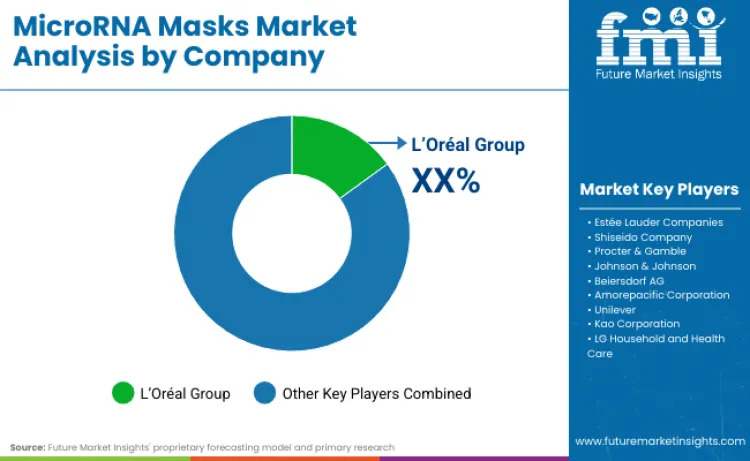
Competition in the microRNA masks market is being reshaped by a decisive shift away from traditional topical hydration toward longevity integrative science, where biomarker precision and delivery architecture define competitive advantage. Established beauty conglomerates are defending their leadership by embedding advanced biological intelligence into skincare, moving beyond visible skin assessment toward proteomic and molecular-level prediction of aging processes. L'Oréal Groupe exemplifies this strategy by integrating microfluidic lab-on-a-chip systems that identify individualized skin biomarkers, enabling proactive intervention rather than reactive treatment. Reflecting this positioning, the company stated: “With the Cell BioPrint device, we offer people the ability to discover deeper insights about their skin through specific biomarkers and to proactively address the beauty and longevity of their skin.”
At the same time, challengers are redefining competition by repurposing biotechnology platforms originally developed for therapeutic use. The Estée Lauder Companies is advancing this frontier through patent-backed work on specific microRNA regulators linked to aging biology, reinforcing credibility at the molecular level. Startups and specialist biotech firms are intensifying pressure by combining modified mRNA concepts and nanofiber delivery systems to create hyper-personalized dermatological formats. This dynamic is pushing competition beyond cosmetics into adjacent regenerative and preventive skin health territory, raising the scientific and strategic threshold for participation in the market.
Key Players in the MicroRNA Masks Market
- L'Oréal Group
- Estée Lauder Companies
- Shiseido Company
- Procter And Gamble
- Johnson And Johnson
- Beiersdorf AG
- Amorepacific Corporation
- Unilever
- Kao Corporation
- LG Household And Health Care
Market Definition
The MicroRNA masks market represents revenue generated from topical skincare products that deliver microRNA molecules to modulate gene expression for therapeutic and cosmetic applications. As operationally defined in the analysis, the market measures commercially deployed microRNA-containing masks used for anti-aging, skin repair, pigmentation control, and inflammation management across consumer and professional channels. Market sizing shows expenditure on microRNA mask products sold through retail and professional distribution channels, analyzed by product type, technology, application, distribution channel, end user, and region, and expressed in USD billion.
Market Inclusion
Included in the microRNA masks market are products explicitly segmented by format: bio-cellulose masks, sheet masks, hydrogel masks, cream and gel masks, and other delivery systems. Technology coverage spans nanocarrier-based microRNA, synthetic microRNA, natural microRNA, and encapsulated microRNA formulations. Applications include anti-aging, skin repair and regeneration, hydration and moisturizing, acne and inflammation control, and pigmentation and brightening. Distribution channels include online retail, specialty beauty stores, pharmacies and drug stores, dermatology clinics, and other professional channels. End users include individual consumers, professional skincare clinics, and medical and aesthetic centers. Geographic scope covers North America, Europe, East Asia, South Asia, Latin America, and Middle East and Africa.
Market Exclusion
Excluded from the market scope are conventional facial masks without microRNA content, including basic hydration masks, clay masks, and peel-off masks containing only traditional active ingredients. Oral supplements and ingestible products targeting skin health through systemic routes are not included. Professional dermatology procedures such as microneedling, laser treatments, and chemical peels are excluded even when used in combination with microRNA products. Equipment sales for mask application and skincare devices are outside market scope. Research-grade microRNA reagents for laboratory use and investigational products not commercially available are excluded. Revenue from dermatology consultation fees and aesthetic clinic service charges are not counted as market revenue, only product sales.
Scope of Report
| Items | Values |
|---|---|
| Quantitative Units | USD billion |
| Product Type | Bio-Cellulose Masks; Sheet Masks; Hydrogel Masks; Cream & Gel Masks; Others |
| Technology | Nanocarrier-Based MicroRNA; Synthetic MicroRNA; Natural MicroRNA; Encapsulated MicroRNA |
| Application | Anti-Aging; Skin Repair & Regeneration; Hydration & Moisturizing; Acne & Inflammation Control; Pigmentation & Brightening |
| Distribution Channel | Online Retail; Specialty Beauty Stores; Pharmacies & Drug Stores; Dermatology Clinics; Others |
| End User | Individual Consumers; Professional Skincare Clinics; Medical & Aesthetic Centers |
| Formulation & Delivery Focus | Nanocarrier Encapsulation Platforms; Bio-Cellulose High-Hydration Substrates; Controlled-Release MicroRNA Systems; Multi-MicroRNA Synergistic Cocktails; AI-Optimized Delivery Architectures |
| Regions Covered | North America, Europe, East Asia, South Asia, Latin America, Middle East & Africa |
| Countries Covered | China, India, Germany, Brazil, United States, United Kingdom, Japan, South Korea, France, and 40+ countries |
| Key Companies Profiled | L’Oréal Group; Estée Lauder Companies; Shiseido Company; Procter & Gamble; Johnson & Johnson; Beiersdorf AG; Amorepacific Corporation; Unilever; Kao Corporation; LG Household & Health Care |
| Additional Attributes | Dollar sales by product type, technology platform, application, distribution channel, and end user; performance benchmarking across microRNA stability, dermal penetration depth, gene-expression modulation efficiency, and clinical anti-aging outcomes; adoption trends for nanocarrier-based delivery systems and bio-cellulose substrates; impact on clinic-led skincare protocols, repeat purchase behavior, and premiumization; regulatory influence on gene-modulating cosmetic claims and cosmeceutical compliance. |
MicroRNA Masks Market by Segments
Product Type:
- Bio-Cellulose Masks
- Sheet Masks
- Hydrogel Masks
- Cream And Gel Masks
- Others
Technology:
- Nanocarrier Based MicroRNA
- Synthetic MicroRNA
- Natural MicroRNA
- Encapsulated MicroRNA
Application:
- Anti-Aging
- Skin Repair And Regeneration
- Hydration And Moisturizing
- Acne And Inflammation Control
- Pigmentation And Brightening
Distribution Channel:
- Online Retail
- Specialty Beauty Stores
- Pharmacies And Drug Stores
- Dermatology Clinics
- Others
End User:
- Individual Consumers
- Professional Skincare Clinics
- Medical And Aesthetic Centers
Region:
- North America
- Europe
- East Asia
- South Asia
- Latin America
- Middle East & Africa
Bibliography
- National Center for Biotechnology Information. (2024). Gene regulation by microRNA and implications for human skin biology. In NCBI Bookshelf.
- International Journal of Nanomedicine. (2025). Nanocarrier systems for skin penetration: microRNA and siRNA delivery. International Journal of Nanomedicine, 20, 1157-1178.
- European Medicines Agency. (2024). Guidelines for advanced therapy medicinal products (ATMPs) and viral vector manufacturing. European Union regulator guidance.
Frequently Asked Questions
What is the current global market size for MicroRNA Masks?
The global MicroRNA masks market is valued at USD 2.1 billion in 2026.
What is the projected CAGR for the MicroRNA Masks market?
The market is projected to grow at a 12.8% CAGR from 2026 to 2036.
Which segment currently dominates the industry?
Bio-cellulose masks lead with a 38.4% share while nanocarrier-based microRNA technology dominates with 42.7%.
What are the primary drivers for adoption in emerging markets?
Adoption is driven by strong biotechnology manufacturing ecosystems, digital beauty platforms, and high consumer receptiveness in China and India.
Who are the leading players in the MicroRNA Masks space?
Key players include L’Oréal Group, Estée Lauder Companies, Shiseido Company, Procter & Gamble, Johnson & Johnson, Beiersdorf AG, Amorepacific Corporation, Unilever, Kao Corporation, and LG Household and Health Care.
Preview the report firsthand - request a free sample
Get SampleGet the brochure for pricing and purchase details.
Get PDFTable of Content
- Executive Summary
- Global Market Outlook
- Demand Side Trends
- Supply Side Trends
- Technology Roadmap Analysis
- Analysis and Recommendations
- Market Overview
- Market Coverage / Taxonomy
- Market Definition / Scope / Limitations
- Research Methodology
- Chapter Orientation
- Analytical Lens and Working Hypotheses
- Market Structure, Signals, and Trend Drivers
- Benchmarking and Cross-market Comparability
- Market Sizing, Forecasting, and Opportunity Mapping
- Research Design and Evidence Framework
- Desk Research Programme (Secondary Evidence)
- Company Annual and Sustainability Reports
- Peer-reviewed Journals and Academic Literature
- Corporate Websites, Product Literature, and Technical Notes
- Earnings Decks and Investor Briefings
- Statutory Filings and Regulatory Disclosures
- Technical White Papers and Standards Notes
- Trade Journals, Industry Magazines, and Analyst Briefs
- Conference Proceedings, Webinars, and Seminar Materials
- Government Statistics Portals and Public Data Releases
- Press Releases and Reputable Media Coverage
- Specialist Newsletters and Curated Briefings
- Sector Databases and Reference Repositories
- FMI Internal Knowledge Base and Historical Datasets
- Subscription Datasets and Paid Sources
- Social Channels, Communities, and Digital Listening Inputs
- Additional Desk Sources
- Expert Input and Fieldwork (Primary Evidence)
- Primary Modes
- Qualitative Interviews and Expert Elicitation
- Quantitative Surveys and Structured Data Capture
- Blended Approach
- Why Primary Evidence is Used
- Field Techniques
- Interviews
- Surveys
- Focus Groups
- Observational and In-context Research
- Social and Community Interactions
- Stakeholder Universe Engaged
- C-suite Leaders
- Board Members
- Presidents and Vice Presidents
- R&D and Innovation Heads
- Technical Specialists
- Domain Subject-matter Experts
- Scientists
- Physicians and Other Healthcare Professionals
- Governance, Ethics, and Data Stewardship
- Research Ethics
- Data Integrity and Handling
- Primary Modes
- Tooling, Models, and Reference Databases
- Desk Research Programme (Secondary Evidence)
- Data Engineering and Model Build
- Data Acquisition and Ingestion
- Cleaning, Normalisation, and Verification
- Synthesis, Triangulation, and Analysis
- Quality Assurance and Audit Trail
- Market Background
- Market Dynamics
- Drivers
- Restraints
- Opportunity
- Trends
- Scenario Forecast
- Demand in Optimistic Scenario
- Demand in Likely Scenario
- Demand in Conservative Scenario
- Opportunity Map Analysis
- Product Life Cycle Analysis
- Supply Chain Analysis
- Investment Feasibility Matrix
- Value Chain Analysis
- PESTLE and Porter's Analysis
- Regulatory Landscape
- Regional Parent Market Outlook
- Production and Consumption Statistics
- Import and Export Statistics
- Market Dynamics
- Global Market Analysis 2021 to 2026 and Forecast, 2026 to 2036
- Historical Market Size Value (USD Million) Analysis, 2021 to 2026
- Current and Future Market Size Value (USD Million) Projections, 2026 to 2036
- Y-o-Y Growth Trend Analysis
- Absolute $ Opportunity Analysis
- Global Market Pricing Analysis 2021 to 2026 and Forecast 2026 to 2036
- Y-o-Y Growth Trend Analysis 2021 to 2026
- Absolute $ Opportunity Analysis 2026 to 2036
- Global Market Analysis 2021 to 2026 and Forecast 2026 to 2036, By Product Type
- Introduction / Key Findings
- Historical Market Size Value (USD Million) Analysis By Product Type, 2021 to 2026
- Current and Future Market Size Value (USD Million) Analysis and Forecast By Product Type, 2026 to 2036
- Bio-Cellulose Masks
- Sheet Masks
- Hydrogel Masks
- Cream & Gel Masks
- Others
- Y-o-Y Growth Trend Analysis By Product Type, 2021 to 2026
- Absolute $ Opportunity Analysis By Product Type, 2026 to 2036
- Global Market Analysis 2021 to 2026 and Forecast 2026 to 2036, By Technology
- Introduction / Key Findings
- Historical Market Size Value (USD Million) Analysis By Technology, 2021 to 2026
- Current and Future Market Size Value (USD Million) Analysis and Forecast By Technology, 2026 to 2036
- Nanocarrier-Based MicroRNA
- Synthetic MicroRNA
- Natural MicroRNA
- Encapsulated MicroRNA
- Y-o-Y Growth Trend Analysis By Technology, 2021 to 2026
- Absolute $ Opportunity Analysis By Technology, 2026 to 2036
- Global Market Analysis 2021 to 2026 and Forecast 2026 to 2036, By Application
- Introduction / Key Findings
- Historical Market Size Value (USD Million) Analysis By Application, 2021 to 2026
- Current and Future Market Size Value (USD Million) Analysis and Forecast By Application, 2026 to 2036
- Anti-Aging
- Skin Repair & Regeneration
- Hydration & Moisturizing
- Acne & Inflammation Control
- Pigmentation & Brightening
- Y-o-Y Growth Trend Analysis By Application, 2021 to 2026
- Absolute $ Opportunity Analysis By Application, 2026 to 2036
- Global Market Analysis 2021 to 2026 and Forecast 2026 to 2036, By Distribution Channel
- Introduction / Key Findings
- Historical Market Size Value (USD Million) Analysis By Distribution Channel, 2021 to 2026
- Current and Future Market Size Value (USD Million) Analysis and Forecast By Distribution Channel, 2026 to 2036
- Online Retail
- Specialty Beauty Stores
- Pharmacies & Drug Stores
- Dermatology Clinics
- Others
- Y-o-Y Growth Trend Analysis By Distribution Channel, 2021 to 2026
- Absolute $ Opportunity Analysis By Distribution Channel, 2026 to 2036
- Global Market Analysis 2021 to 2026 and Forecast 2026 to 2036, By End User
- Introduction / Key Findings
- Historical Market Size Value (USD Million) Analysis By End User, 2021 to 2026
- Current and Future Market Size Value (USD Million) Analysis and Forecast By End User, 2026 to 2036
- Individual Consumers
- Professional Skincare Clinics
- Medical & Aesthetic Centers
- Y-o-Y Growth Trend Analysis By End User, 2021 to 2026
- Absolute $ Opportunity Analysis By End User, 2026 to 2036
- Global Market Analysis 2021 to 2026 and Forecast 2026 to 2036, By Region
- Introduction
- Historical Market Size Value (USD Million) Analysis By Region, 2021 to 2026
- Current Market Size Value (USD Million) Analysis and Forecast By Region, 2026 to 2036
- North America
- Latin America
- Western Europe
- Eastern Europe
- East Asia
- South Asia and Pacific
- Middle East & Africa
- Market Attractiveness Analysis By Region
- North America Market Analysis 2021 to 2026 and Forecast 2026 to 2036, By Country
- Historical Market Size Value (USD Million) Trend Analysis By Market Taxonomy, 2021 to 2026
- Market Size Value (USD Million) Forecast By Market Taxonomy, 2026 to 2036
- By Country
- USA
- Canada
- By Product Type
- By Technology
- By Application
- By Distribution Channel
- By End User
- By Country
- Market Attractiveness Analysis
- By Country
- By Product Type
- By Technology
- By Application
- By Distribution Channel
- By End User
- Key Takeaways
- Latin America Market Analysis 2021 to 2026 and Forecast 2026 to 2036, By Country
- Historical Market Size Value (USD Million) Trend Analysis By Market Taxonomy, 2021 to 2026
- Market Size Value (USD Million) Forecast By Market Taxonomy, 2026 to 2036
- By Country
- Brazil
- Mexico
- Rest of Latin America
- By Product Type
- By Technology
- By Application
- By Distribution Channel
- By End User
- By Country
- Market Attractiveness Analysis
- By Country
- By Product Type
- By Technology
- By Application
- By Distribution Channel
- By End User
- Key Takeaways
- Western Europe Market Analysis 2021 to 2026 and Forecast 2026 to 2036, By Country
- Historical Market Size Value (USD Million) Trend Analysis By Market Taxonomy, 2021 to 2026
- Market Size Value (USD Million) Forecast By Market Taxonomy, 2026 to 2036
- By Country
- Germany
- UK
- France
- Italy
- Spain
- BENELUX
- Rest of Western Europe
- By Product Type
- By Technology
- By Application
- By Distribution Channel
- By End User
- By Country
- Market Attractiveness Analysis
- By Country
- By Product Type
- By Technology
- By Application
- By Distribution Channel
- By End User
- Key Takeaways
- Eastern Europe Market Analysis 2021 to 2026 and Forecast 2026 to 2036, By Country
- Historical Market Size Value (USD Million) Trend Analysis By Market Taxonomy, 2021 to 2026
- Market Size Value (USD Million) Forecast By Market Taxonomy, 2026 to 2036
- By Country
- Russia
- Poland
- Rest of Eastern Europe
- By Product Type
- By Technology
- By Application
- By Distribution Channel
- By End User
- By Country
- Market Attractiveness Analysis
- By Country
- By Product Type
- By Technology
- By Application
- By Distribution Channel
- By End User
- Key Takeaways
- East Asia Market Analysis 2021 to 2026 and Forecast 2026 to 2036, By Country
- Historical Market Size Value (USD Million) Trend Analysis By Market Taxonomy, 2021 to 2026
- Market Size Value (USD Million) Forecast By Market Taxonomy, 2026 to 2036
- By Country
- China
- Japan
- South Korea
- By Product Type
- By Technology
- By Application
- By Distribution Channel
- By End User
- By Country
- Market Attractiveness Analysis
- By Country
- By Product Type
- By Technology
- By Application
- By Distribution Channel
- By End User
- Key Takeaways
- South Asia and Pacific Market Analysis 2021 to 2026 and Forecast 2026 to 2036, By Country
- Historical Market Size Value (USD Million) Trend Analysis By Market Taxonomy, 2021 to 2026
- Market Size Value (USD Million) Forecast By Market Taxonomy, 2026 to 2036
- By Country
- India
- ASEAN
- Australia & New Zealand
- Rest of South Asia and Pacific
- By Product Type
- By Technology
- By Application
- By Distribution Channel
- By End User
- By Country
- Market Attractiveness Analysis
- By Country
- By Product Type
- By Technology
- By Application
- By Distribution Channel
- By End User
- Key Takeaways
- Middle East & Africa Market Analysis 2021 to 2026 and Forecast 2026 to 2036, By Country
- Historical Market Size Value (USD Million) Trend Analysis By Market Taxonomy, 2021 to 2026
- Market Size Value (USD Million) Forecast By Market Taxonomy, 2026 to 2036
- By Country
- Kingdom of Saudi Arabia
- Turkey
- South Africa
- Rest of Middle East & Africa
- By Product Type
- By Technology
- By Application
- By Distribution Channel
- By End User
- By Country
- Market Attractiveness Analysis
- By Country
- By Product Type
- By Technology
- By Application
- By Distribution Channel
- By End User
- Key Takeaways
- Key Countries Market Analysis
- USA
- Pricing Analysis
- Market Share Analysis, 2026
- By Product Type
- By Technology
- By Application
- By Distribution Channel
- By End User
- Canada
- Pricing Analysis
- Market Share Analysis, 2026
- By Product Type
- By Technology
- By Application
- By Distribution Channel
- By End User
- Brazil
- Pricing Analysis
- Market Share Analysis, 2026
- By Product Type
- By Technology
- By Application
- By Distribution Channel
- By End User
- Mexico
- Pricing Analysis
- Market Share Analysis, 2026
- By Product Type
- By Technology
- By Application
- By Distribution Channel
- By End User
- Germany
- Pricing Analysis
- Market Share Analysis, 2026
- By Product Type
- By Technology
- By Application
- By Distribution Channel
- By End User
- UK
- Pricing Analysis
- Market Share Analysis, 2026
- By Product Type
- By Technology
- By Application
- By Distribution Channel
- By End User
- France
- Pricing Analysis
- Market Share Analysis, 2026
- By Product Type
- By Technology
- By Application
- By Distribution Channel
- By End User
- Italy
- Pricing Analysis
- Market Share Analysis, 2026
- By Product Type
- By Technology
- By Application
- By Distribution Channel
- By End User
- Spain
- Pricing Analysis
- Market Share Analysis, 2026
- By Product Type
- By Technology
- By Application
- By Distribution Channel
- By End User
- China
- Pricing Analysis
- Market Share Analysis, 2026
- By Product Type
- By Technology
- By Application
- By Distribution Channel
- By End User
- India
- Pricing Analysis
- Market Share Analysis, 2026
- By Product Type
- By Technology
- By Application
- By Distribution Channel
- By End User
- Japan
- Pricing Analysis
- Market Share Analysis, 2026
- By Product Type
- By Technology
- By Application
- By Distribution Channel
- By End User
- South Korea
- Pricing Analysis
- Market Share Analysis, 2026
- By Product Type
- By Technology
- By Application
- By Distribution Channel
- By End User
- Australia & New Zealand
- Pricing Analysis
- Market Share Analysis, 2026
- By Product Type
- By Technology
- By Application
- By Distribution Channel
- By End User
- ASEAN
- Pricing Analysis
- Market Share Analysis, 2026
- By Product Type
- By Technology
- By Application
- By Distribution Channel
- By End User
- Russia
- Pricing Analysis
- Market Share Analysis, 2026
- By Product Type
- By Technology
- By Application
- By Distribution Channel
- By End User
- Poland
- Pricing Analysis
- Market Share Analysis, 2026
- By Product Type
- By Technology
- By Application
- By Distribution Channel
- By End User
- Kingdom of Saudi Arabia
- Pricing Analysis
- Market Share Analysis, 2026
- By Product Type
- By Technology
- By Application
- By Distribution Channel
- By End User
- Turkey
- Pricing Analysis
- Market Share Analysis, 2026
- By Product Type
- By Technology
- By Application
- By Distribution Channel
- By End User
- South Africa
- Pricing Analysis
- Market Share Analysis, 2026
- By Product Type
- By Technology
- By Application
- By Distribution Channel
- By End User
- USA
- Market Structure Analysis
- Competition Dashboard
- Competition Benchmarking
- Market Share Analysis of Top Players
- By Regional
- By Product Type
- By Technology
- By Application
- By Distribution Channel
- By End User
- Competition Analysis
- Competition Deep Dive
- L'Oréal Group
- Estée Lauder Companies
- Shiseido Company
- Procter & Gamble
- Johnson & Johnson
- Beiersdorf AG
- Amorepacific Corporation
- Unilever
- Kao Corporation
- LG Household and Health Care
- Competition Deep Dive
- Assumptions & Acronyms Used


