

- Market Size (2026)
- USD 420.1 Mn
- Forecast (2036)
- USD 1150.4 Mn
- CAGR (2026 to 2036)
- 10.6%
How big is Mild Cognitive Impairment Nutrition Market in 2026?
USD 420.1 million in 2026 and USD 1,150.4 million by 2036 at a 10.6% CAGR.
Mild cognitive impairment nutrition is projected to rise from USD 420.1 million in 2026 to USD 1150.4 million by 2036 at 10.6% CAGR. Earlier identification of cognitive decline is increasing opportunities for preventive nutrition discussions before more intensive care pathways are required. Danone Nutricia reported in March 2025 that it introduced pharmacy-based AI screening tools designed to support earlier recognition of mild cognitive impairment. Companies in the cognitive health supplement market need evidence-bounded products that fit daily routines before later care intensifies.
Country conversion depends on age exposure plus rules governing medical foods and consumer cognitive products. In June 2025, the United States Census Bureau reported 61.2 million people aged 65 and older in 2024. That aging base enlarges the pool entering assessment pathways but does not establish purchase intent for any nutrition product. Companies in the medical food market can pursue supervised dietary-management routes while consumer brands depend more heavily on claim discipline and convenient replenishment. Comparable differences in access and regulation produce distinct adoption paths across the five profiled countries.
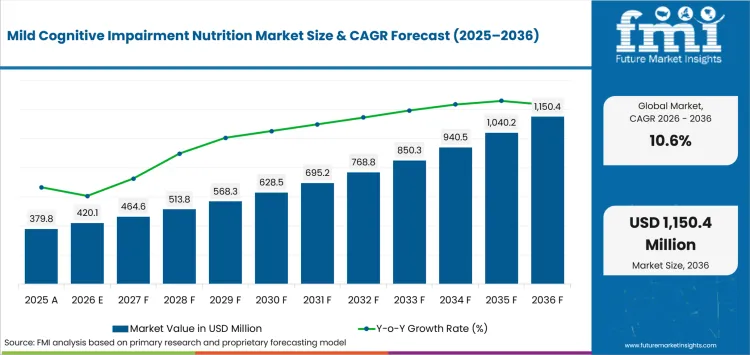
Key Takeaways of Mild Cognitive Impairment Nutrition Market
- Earlier recognition of cognitive decline expands the audience for daily nutrition products that define their intended role without implying disease prevention.
- By key ingredient, omega-3 - DHA blends are estimated to hold 34.9% share in 2026 owing to familiar formulation routes and consumer recognition.
- Medical foods are set to lead product type with 44.3% share in 2026 due to supervised dietary-management positioning around an identified cognitive population.
- In 2026, capsules - softgels are expected to lead product form with 41.6% share because measured dosing supports repeat use without preparation.
- Evidence thresholds and disease-adjacent claim restrictions raise customer-acquisition risk for products whose public messaging exceeds their substantiated cognitive benefit.
- Some of the key players in this market include Danone Nutricia (Souvenaid), Nestle Health Science, Aker BioMarine, Kirin Holdings, SFI Health (Equazen), Reckitt (Neuriva), Thorne, and Quincy Bioscience.
Analyst Perspective
"MCI nutrition earns repeat revenue when the evidence fits the intended cognitive population and the daily dose remains practical for older users. Commercial evaluation should separate medical-food credibility from consumer-channel reach owing to different claim risks and recommendation economics across these routes."
- Nandini Roy Choudhury, Principal Consultant, Future Market Insights
How is the Mild Cognitive Impairment Nutrition Market segmented?
The mild cognitive impairment nutrition market is segmented by key ingredient, product type, product form, end user, sales channel and region.
Key ingredient includes omega-3 - DHA blends, B-vitamin complexes, Fortasyn-type multinutrients, botanical nootropics and others. Product type covers medical foods, cognitive-support supplements, fortified foods and beverages and others. Product form includes capsules / softgels, RTD, powders and others. End user covers home - self-care, memory clinics and hospitals and others. Sales channel includes online / DTC, retail pharmacy, supermarkets and hypermarkets, specialty and health stores and others.
What makes omega-3 - DHA blends central to the key ingredient category?
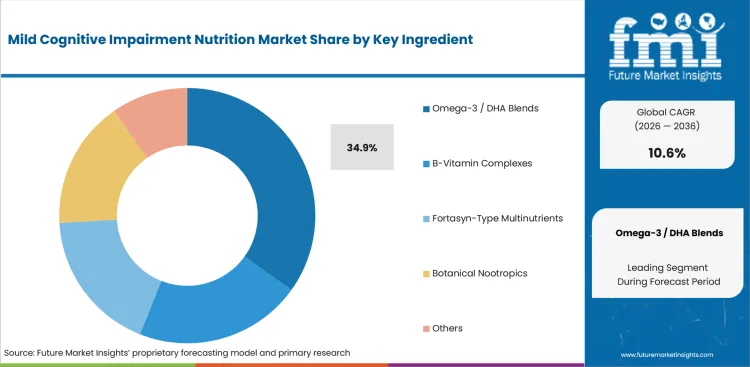
DHA formulators use omega-3 concentrates to build cognitive supplements and multinutrient products across established oral formats. Aker BioMarine reported in May 2025 that its Lysoveta trial would enroll 138 adults aged 50 to 75 who reported mild memory complaints.
- Based on key ingredient, omega-3 - DHA blends are projected to account for 34.9% in 2026 due to broad compatibility. Established consumer recognition lowers the education burden for brands using familiar fatty-acid terminology.
- Commercial adoption of EPA DHA omega-3 ingredients depends on dose density and oxidation control across repeated home-use regimens. Poor sensory performance can reduce adherence even with an ingredient fitting the intended cognitive proposition.
Why do medical foods lead the product type category?
Medical foods address a defined dietary-management need near cognitive assessment and require target-population evidence beyond general wellness positioning during professional review.
- Medical foods are forecast to hold 44.3% of the product type category in 2026, attributable to supervised positioning around an identified cognitive population. The narrower role gives clinicians a clearer basis for product discussion without turning nutrition into a treatment claim.
- Danone reported in May 2026 that a Spanish neurology consensus recommended medical-use foods within nutritional management for mild cognitive impairment. Clinical nutrition providers still need use instructions that separate dietary management from unsupported prevention promises.
How do capsules - softgels retain the lead in product form?
Concentrated softgels preserve measured dosing without requiring users to prepare powders or ready-to-drink products at each intake. Pharmavite announced in June 2025 that MegaFood launched an omega-3 fish-oil softgel delivering 2,000 mg of fish oil concentrate per serving, including 1,200 mg of combined EPA and DHA, positioned for brain, heart, eye, joint and immune health support.
- The capsules - softgels segment is likely to capture 41.6% share in 2026 attributable to measured dosing that fits established supplement routines. Dose concentration can also reduce pill burden for older users managing several daily products.
- Manufacturers using high concentrate omega-3 softgels compete on capsule load and sensory control across repeat purchasing. Large or unpleasant capsules raise discontinuation risk despite otherwise convenient measured dosing.
What supports home - self-care leadership in the end user category?
Within older adults health supplements, home use fits mild cognitive impairment because many people retain enough daily function to follow routine nutrition regimens outside formal care.
- Home - self-care is projected to hold 49.7% share in 2026 owing to repeated consumption occurring mainly outside institutional settings. Caregivers can influence replenishment if reminders are needed, although most doses still occur at home.
- Life Extension reported in July 2026 that it introduced a once-daily memory formula positioned across several memory and processing tasks. Direct consumer access can simplify replenishment while simple preparation and tolerable daily intake govern whether self-care use persists.
What are the drivers, restraints and opportunities in the Mild Cognitive Impairment Nutrition Market?
Earlier recognition expands the addressable population while evidence limits conversion and better product fit provides the clearest revenue route.
- Driver: Earlier cognitive recognition enlarges the population considering manageable daily nutrition before advanced dependency changes the care setting.
- Restraint: Evidence thresholds and limits on disease-related nutrition claims reduce channel confidence if public messaging exceeds product-specific support.
- Opportunity: Better matched ingredients and manageable daily formats can convert cognitive interest into repeat use without widening unsupported clinical claims.
Earlier Recognition Broadens the Consideration Window
Earlier cognitive recognition gives households more time to consider daily nutrition during the transition toward greater care dependency. The World Health Organization reported in July 2026 that nearly 10 million new dementia cases occur worldwide each year, keeping cognitive decline visible across health systems without proving nutrition demand. Nutrition companies gain a clearer commercial opening by defining the intended MCI population and keeping benefit claims inside the evidence available for that product.
Claims Boundaries Raise the Cost of Weak Evidence
Claims risk rises once cognitive nutrition language shifts from general support toward implied prevention or treatment. World Health Organization guidance issued in July 2026 does not recommend omega-3 polyunsaturated fatty acids for reducing cognitive decline or dementia risk without diagnosed deficiency. Manufacturers in the dietary supplements category therefore need product-specific evidence and tightly bounded wording to preserve clinical credibility and retail access.
Commercial Contracts Reward Differentiated Ingredient Evidence
Ingredient developers convert brain-health evidence into revenue most clearly once a finished-product contract follows the research program. Aker BioMarine reported in May 2026 that it secured a Lysoveta brain-health ingredient supply contract valued at about USD 4 million for the first year. The contract gives cognitive-ingredient companies a concrete route from differentiated delivery science into recurring finished-product demand without widening disease claims.
Which country CAGRs are profiled in the Mild Cognitive Impairment Nutrition Market?
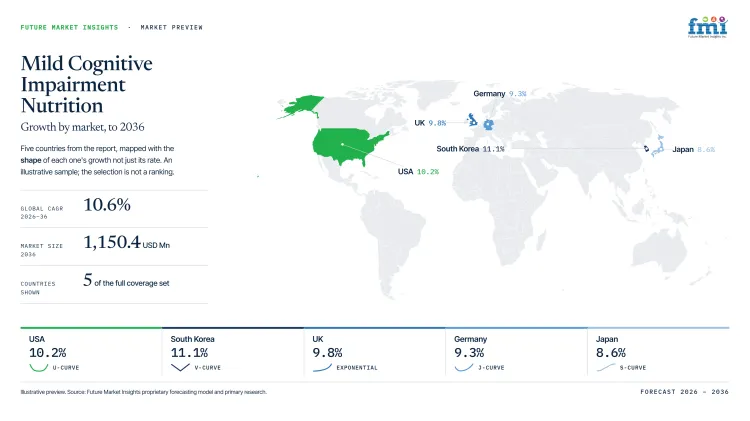
| Country | CAGR |
|---|---|
| South Korea | 11.1% |
| USA | 10.2% |
| UK | 9.8% |
| Germany | 9.3% |
| Japan | 8.6% |
How do country-level CAGRs compare in the Mild Cognitive Impairment Nutrition Market?
The 2.5 percentage-point range separates South Korea's personalization-led outlook from Japan's functional-food route. South Korea and USA form the upper group at 11.1% and 10.2% CAGR. UK and Germany occupy the middle at 9.8% and 9.3%. Japan records 8.6% as documentation requirements temper conversion.
- South Korea gains from regulated personalized health-functional-food services with defined safety controls.
- USA pairs broad consumer access with active enforcement against unsupported cognitive claims.
- UK diagnosis pathways give nutrition brands clearer professional contact around earlier cognitive decline.
- Germany offers pharmacy access while European claim rules narrow consumer cognitive messaging.
- Japan's memory support supplement route uses formal functional-claim notifications but requires evidence documentation from companies.
Similar growth rates therefore conceal materially different claim controls and channel economics. The full report provides country-level CAGR analysis across North America, Latin America, Europe, East Asia, South Asia, Oceania and the Middle East and Africa.
Country-wise Analysis
- Personalized health-functional-food services give cognitive nutrition a regulated customization route based on individual consultation and recognized ingredient combinations for daily portioning across repeat purchases within approved retail services. The Ministry of Food and Drug Safety reported in March 2025 that the personalized health-functional-food system entered full implementation on March 19, and South Korea is estimated to post 11.1% CAGR over the forecast period as this route broadens commercial options beyond standard packs. National labeling rules still apply to customized packs, favoring companies with recognized ingredients plus professional consultation and dependable replenishment over brands relying on broad anti-aging positioning.
- In the United States, pharmacy and direct channels give adults with measurable cognitive concerns several practical points of contact with clinicians and pharmacists during product selection. In May 2025 the FDA cleared the first blood test used to aid Alzheimer’s diagnosis in symptomatic adults aged 55 and older, increasing diagnostic visibility without establishing nutrition demand or changing supplement claim requirements. Demand for mild cognitive impairment nutrition in USA is forecast to expand at 10.2% CAGR over the forecast period, but brands need disciplined claims and professional education because unsupported memory promises carry enforcement risk across high-visibility consumer channels.
- Working through general practice and memory-service pathways gives UK nutrition companies a professional interface that self-directed supplement channels do not provide, although most products remain self-pay purchases. NHS England Digital reported in August 2025 that 506,549 people had a recorded dementia diagnosis in primary care at July month-end while mild cognitive impairment nutrition demand in UK is projected to grow at 9.8% CAGR during the assessment period. Professional visibility can support medical-nutrition discussion but diagnosis does not fund nutrition automatically, so companies need bounded dietary-management language and practical home formats that clinicians can discuss without implying treatment effects.
- Anchored in pharmacies and drugstores, German cognitive nutrition operates inside European food-claim rules that give pharmacists an important local role in product explanation and category separation. Germany’s Federal Statistical Office reported in December 2025 that one person in four is projected to be aged 67 or older by 2035, raising category exposure without changing the legal distinction between foods and medicines. The Germany mild cognitive impairment nutrition sector is projected to record 9.3% CAGR during the assessment period, and manufacturers with German-language evidence files plus distinct medical-food or supplement strategies can reduce friction during pharmacist and retailer review.
- To market memory-positioned functional foods in Japan, companies use a formal notification route that provides a clear domestic retail pathway but leaves responsibility for each stated function with the notifier. The Consumer Affairs Agency renewed its Foods with Function Claims notification database in April 2025 as evidence procedures were strengthened, and mild cognitive impairment nutrition sales in Japan are forecast to expand at 8.6% CAGR by 2036. Imported products face a higher execution burden if Japanese evidence files are weak, making local documentation and convenient daily formats more useful than generalized cognitive claims during retailer and consumer review.
Who are the notable companies in the Mild Cognitive Impairment Nutrition Market?
Danone Nutricia (Souvenaid), Nestle Health Science, Aker BioMarine, Kirin Holdings, SFI Health (Equazen), Reckitt (Neuriva), Thorne, and Quincy Bioscience are the notable companies profiled in this market.
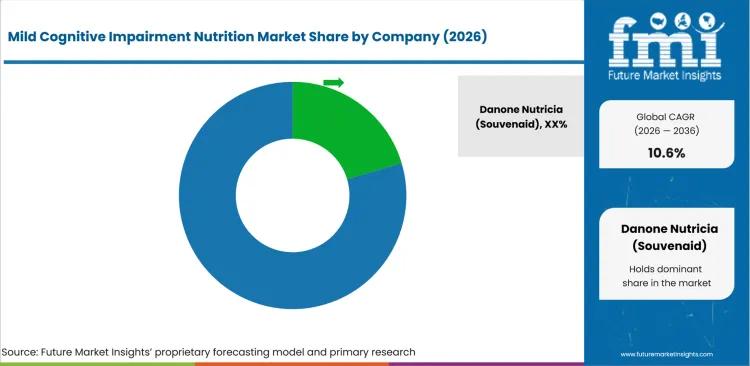
Medical-nutrition companies compete nearest clinical assessment, whereas ingredient firms rely on research and finished-product partnerships across cognitive-support formulations. Consumer brands in the brain health supplement category depend on repeat purchasing under stricter claims scrutiny, while choline supplement development broadens formulation choices. Entry barriers depend on evidence fit and channel access across all three commercial routes.
- Clinical medical nutrition: Danone Nutricia (Souvenaid) and Nestle Health Science compete on supervised dietary management and professional education.
- Cognitive ingredient platforms: Aker BioMarine, Kirin Holdings and SFI Health (Equazen) compete on researched ingredients and regional commercialization.
- Consumer cognitive specialists: Reckitt (Neuriva), Thorne and Quincy Bioscience compete on direct access under different public evidence positions.
Competitive Benchmarking: Mild Cognitive Impairment Nutrition Market
| Company | MCI / Cognitive Target Specificity | Evidence Development Depth | Clinical / Consumer Channel Access | Geographic Reach |
|---|---|---|---|---|
| Danone Nutricia (Souvenaid) | High | High | High | Europe and international markets |
| Nestle Health Science | High | Medium | High | North America, Europe and international markets |
| Aker BioMarine | Medium | High | Medium | North America and international markets |
| Kirin Holdings | Medium | High | High | Japan, Australia and New Zealand |
| SFI Health (Equazen) | Low | Medium | High | Europe and international markets |
| Reckitt (Neuriva) | Medium | Medium | High | United States and international markets |
| Thorne | Low | Medium | High | United States and international markets |
| Quincy Bioscience | Medium | Low | High | United States |
Scoring basis: High target specificity requires documented MCI or early Alzheimer’s activity. Medium identifies a named cognitive product and Low covers broader cognition without MCI-specific evidence. High evidence depth requires multiple clinical assets, whereas Medium requires one current program and Low marks a narrower record. High channel access spans medical or pharmacy routes plus retail or direct access, while Medium and Low indicate narrower documented routes.
Key Developments in the Mild Cognitive Impairment Nutrition Market
- In July 2026, Kirin Holdings announced Blackmores cognitive-support launches in Australia and New Zealand using Cognizin citicoline across pharmacy and e-commerce.
- In June 2026, Quincy Bioscience announced a multi-year Prevagen partnership with USA Swimming across major national events.
- In September 2025, Reckitt launched Neuriva Memory 3D in the USA for short-term, long-term and working memory.
Key Players in the Mild Cognitive Impairment Nutrition Market
Clinical Medical Nutrition Platforms
- Danone Nutricia (Souvenaid)
- Nestle Health Science
Cognitive Ingredient and Functional-Food Platforms
- Aker BioMarine
- Kirin Holdings
- SFI Health (Equazen)
Consumer Cognitive Supplement Specialists
- Reckitt (Neuriva)
- Thorne
- Quincy Bioscience
Mild Cognitive Impairment Nutrition Market - Report Scope
| Coverage field | Report scope |
|---|---|
| Market breakdown | By key ingredient, product type, product form, end user, sales channel and region. |
| Quantitative Units | Revenue USD million and CAGR in %. |
| Market Definition | Commercial nutrition products and ingredients positioned for mild cognitive impairment support across medical-food and consumer cognitive-nutrition routes. |
| Regions Covered | North America, Latin America, Western Europe, Eastern Europe, East Asia, South Asia and Pacific and Middle East and Africa. |
| Countries Covered | USA, UK, Germany, Japan, South Korea, and 25+ countries included in the full report. |
| Key Companies Profiled | Danone Nutricia (Souvenaid), Nestle Health Science, Aker BioMarine, Kirin Holdings, SFI Health (Equazen), Reckitt (Neuriva), Thorne, Quincy Bioscience. |
| Forecast Period | 2026 to 2036. |
| Approach | Primary and secondary research with market triangulation. |
Mild Cognitive Impairment Nutrition Market - Research Methodology
| Method | Approach |
|---|---|
| Primary Research | FMI analysts gathered input from manufacturers, service providers, technology developers, distributors, end users, procurement teams, and subject-matter experts. Interviews examined purchasing decisions, product or service evaluation, adoption barriers, approval requirements, pricing considerations, and expectations for technical or commercial support. Respondents were also asked what evidence is required before a trial, pilot, or initial order develops into regular purchasing. |
| Desk Research | Desk research covered government statistics, regulatory publications, trade data, industry associations, technical literature, standards, company filings, product information, and official corporate announcements. Sources were reviewed for relevance, publication date, geographic coverage, and consistency with the defined market scope. Claims relating to performance, applications, approvals, capacity, investment, and commercial activity were retained only when supported by credible public evidence. |
| Market Sizing and Forecasting | The market model combined the baseline value with historical performance, segment structure, pricing and volume indicators, adoption levels, company participation, and country-level demand conditions. Forecast assumptions considered economic activity, investment trends, regulatory developments, technology adoption, purchasing cycles, supply availability, and barriers to wider market use. Segment and regional estimates were reconciled before the final market total was calculated. |
| Data Validation | Estimates were checked against multiple independent indicators, including public data, company activity, trade patterns, industry developments, and findings from primary interviews. Validation also tested whether products, services, applications, and company revenues fell within the defined market boundaries. Adjacent categories, unsupported claims, overlapping revenues, and activities without direct market relevance were excluded to reduce double counting and maintain consistency across segments and countries. |
Mild Cognitive Impairment Nutrition Market by Segments
Mild Cognitive Impairment Nutrition Market segmented by Key Ingredient:
- Omega-3 - DHA blends
- B-Vitamin Complexes
- Fortasyn-Type Multinutrients
- Botanical Nootropics
- Others
Mild Cognitive Impairment Nutrition Market segmented by Product Type:
- Medical Foods
- Cognitive-Support Supplements
- Fortified Foods & Beverages
- Others
Mild Cognitive Impairment Nutrition Market segmented by Product Form:
- Capsules / Softgels
- RTD
- Powders
- Others
Mild Cognitive Impairment Nutrition Market segmented by End User:
- Home - self-Care
- Memory Clinics & Hospitals
- Others
Mild Cognitive Impairment Nutrition Market segmented by Sales Channel:
- Online / DTC
- Retail Pharmacy
- Supermarkets & Hypermarkets
- Specialty & Health Stores
- Others
Mild Cognitive Impairment Nutrition Market by Region:
- North America:
- USA
- Canada
- Latin America:
- Brazil
- Mexico
- Argentina
- Chile
- Western Europe:
- Germany
- France
- UK
- Italy
- Spain
- Benelux
- Nordics
- Eastern Europe:
- Poland
- Czech Republic
- Romania
- Hungary
- East Asia:
- China
- Japan
- South Korea
- South Asia and Pacific:
- India
- ASEAN
- Australia and New Zealand
- Middle East and Africa:
- GCC Countries
- South Africa
- Türkiye
- Israel
Research Sources and Bibliography
- World Health Organization. (2026, July 3). Dementia.
- World Health Organization. (2026, July 15). New WHO guidelines: up to 45% of dementia risk could be prevented or delayed.
- USA Census Bureau. (2025, June 26). Older Adults Outnumber Children in 11 States and Nearly Half of USA Counties.
- USA Food and Drug Administration. (2025, May 16). FDA Clears First Blood Test Used in Diagnosing Alzheimer’s Disease.
- NHS England Digital. (2025, August 21). Primary Care Dementia Data, July 2025.
- Federal Statistical Office of Germany. (2025, December 11). By 2035, one quarter of Germany’s population will be aged 67 or over.
- Consumer Affairs Agency, Japan. (2025, April 1). 機能性表示食品制度届出データベースを更改しました.
- Ministry of Food and Drug Safety, Republic of Korea. (2025, March 29). 맞춤형건강기능식품 제도 시행 알림.
- Aker BioMarine. (2025, May 8). Aker BioMarine signs agreement for Lysoveta clinical trial.
- Danone Nutricia. (2026, May 19). UN NUEVO CONSENSO DE LA SOCIEDAD ESPAÑOLA DE NEUROLOGÍA RECOMIENDA EL USO DE ALIMENTOS DE USO MÉDICO (AUME) PARA TRATAR EL DETERIORO COGNITIVO LEVE.
- Pharmavite. (2025, June 17). MegaFood® Expands Product Lineup with Science-Backed Ingredients to Support Consumers’ Whole-Body Wellness.
- Danone Nutricia. (2025, March 25). Danone Nutricia refuerza el papel del farmacéutico en el cribado del deterioro cognitivo leve gracias a la Inteligencia Artificial.
- Aker BioMarine. (2026, May 6). Aker BioMarine wins new Lysoveta contract valued at approximately USD 4 million in first year.
- Aker BioMarine. (2026, January 16). Aker BioMarine partners with academia on neurodegenerative disease prevention.
- Kirin Holdings. (2026, July 22). Kirin and Blackmores Team Up to Release Cognitive Function Support Supplements in Australia and New Zealand Formulated with Kirin Group’s Cognizin® Citicoline.
- Quincy Bioscience. (2026, June 5). USA Swimming, Prevagen announce multi-year partnership.
- Reckitt. (2025, September 4). Neuriva launches new Memory 3D formula to support the three dimensions of memory.
- Nestle Health Science. (2024, June 12). Seven-country mild cognitive impairment trial underway.
- Nestlé Health Science. (2025, September 26). Nestlé Health Science is now accepting applications for health economics & outcomes research and advocacy grants.
- Federal Trade Commission. (2024, December 10). Statement on FTC’s Win in Lawsuit Against the Makers of Dietary Supplement Prevagen.
- SFI Health. (2025, February 27). EMEA launches Equazen® in Portugal.
- Thorne. (2025, September 8). THORNE SHINES SPOTLIGHT ON CREATINE WITH NEW CAMPAIGN FEATURING GRAMMY AWARD-WINNING MUSICAL ARTIST CIARA.
- dsm-firmenich. (2025, October 3). From first signs to full support: how we redefine nutritional care for those with special dietary needs.
- Life Extension. (2026, July). New Life Extension® Supplement Supports Multiple Types of Memory.
- Cadila Pharmaceuticals. (2025, September 16). Cadila Pharmaceuticals launches Nu Nutridac Capsule, a nutritional replenisher for neurodegenerative and anxiety-related disorders.
- Kirin Holdings. (2025, August 18). トリプルヘルスクレームの機能性表示食品「青玉プレミアム 免疫と睡眠と記憶力」をエポラ社と共同開発 9月1日(月)より新発売.
- Quincy Bioscience. (2025, October 16). Prevagen Becomes Official Brain Supplement Partner of USA Ski & Snowboard.
- Nestlé Health Science. (2025, October 15). Nestlé Health Science and University of California, Davis Innovation Institute for Food & Health Announce Strategic Partnership to Accelerate Innovation in Nutrition and Health Science.
This bibliography is provided for reader reference and is not exhaustive. The full report contains the complete reference list and detailed citations.
This Report Answers
- What is the Mild Cognitive Impairment Nutrition Market size in 2026 and 2036?
- Which recognition and aging conditions support demand for mild cognitive impairment nutrition?
- Why do omega-3 - DHA blends hold the leading position within key ingredient?
- Why do medical foods lead the product type category?
- Why do capsules - softgels lead product form demand?
- How do forecast growth rates differ across South Korea, USA, UK, Germany and Japan?
- Which companies provide medical nutrition, cognitive ingredients or consumer memory supplements?
- How do evidence and claim requirements limit conversion across sales channels?
Frequently Asked Questions
How big is the Mild Cognitive Impairment Nutrition Market in 2026?
The mild cognitive impairment nutrition market is valued at USD 420.1 million in 2026 and is projected to reach USD 1150.4 million by 2036. Growth is supported by earlier cognitive recognition and manageable daily nutrition formats.
What is the CAGR of the Mild Cognitive Impairment Nutrition Market from 2026 to 2036?
The mild cognitive impairment nutrition market is projected to grow at a CAGR of 10.6% between 2026 and 2036. Expansion is supported by population aging and evidence-bounded nutrition around earlier cognitive decline.
Which product type leads the Mild Cognitive Impairment Nutrition Market?
The medical foods segment is expected to hold 44.3% of the mild cognitive impairment nutrition market in 2026, supported by supervised dietary-management positioning. Defined target populations and professional guidance reinforce its current share position across clinical nutrition channels.
Which countries are projected to record the highest growth in the Mild Cognitive Impairment Nutrition Market?
South Korea is projected to grow at 11.1% CAGR, followed by USA at 10.2% and UK at 9.8% through 2036. Personalized nutrition routes and broad consumer access account for much of the upper growth band.
Which companies are active in the Mild Cognitive Impairment Nutrition Market?
Key companies operating in the mild cognitive impairment nutrition market include Danone Nutricia (Souvenaid), Nestle Health Science, Aker BioMarine, Kirin Holdings, SFI Health (Equazen), Reckitt (Neuriva), Thorne, and Quincy Bioscience. These companies span medical nutrition, cognitive ingredients and consumer memory supplements.
Preview the report firsthand - request a free sample
Get SampleGet the brochure for pricing and purchase details.
Get PDFTable of Content
- Key Takeaways
- Market Size and CAGR
- Top Growth Driver
- Fastest Growing Segment
- Leading Region
- Key Companies
- Emerging Opportunities
- Executive Summary
- Global Market Outlook
- Demand-side Trends
- Supply-side Trends
- Technology Roadmap Analysis
- Analysis and Recommendations
- Analyst Perspective (What is happening? Why now? What should investors know?)
- Key Questions Answered
- How large is the market?
- What is the CAGR?
- What are key trends?
- Which region dominates?
- Who are the leaders?
- Market Overview
- Market Coverage / Taxonomy
- Market Definition / Scope / Limitations
- Research Methodology
- Chapter Orientation
- Analytical Lens and Working Hypotheses
- Market Structure, Signals, and Trend Drivers
- Benchmarking and Cross-market Comparability
- Market Sizing, Forecasting, and Opportunity Mapping
- Research Design and Evidence Framework
- Desk Research Programme (Secondary Evidence)
- Expert Input and Fieldwork (Primary Evidence)
- Tooling, Models, and Reference Databases
- Data Engineering and Model Build
- Quality Assurance and Audit Trail
- Market Background
- Market Dynamics (Drivers, Restraints, Opportunity, Trends)
- Scenario Forecast (Optimistic, Likely, Conservative)
- Impact Analysis
- AI Impact
- Sustainability Impact
- Regulatory Impact
- Technology Impact
- Consumer / Buyer Analysis
- Purchase Drivers
- Adoption Barriers
- Buyer Journey
- Opportunity Map Analysis
- Product Life Cycle Analysis
- Supply Chain Analysis
- Investment Feasibility Matrix
- Value Chain Analysis
- PESTLE and Porter's Analysis
- Regulatory Landscape
- Regional Parent Market Outlook
- Production and Consumption Statistics
- Import and Export Statistics
- Global Market Analysis and Forecast, 2021 to 2036
- Historical Market Size Value (USD Million) Analysis, 2021 to 2025
- Current and Future Market Size Value (USD Million) Projections, 2026 to 2036
- Y-o-Y Growth Trend Analysis
- Absolute $ Opportunity Analysis
- Global Market Pricing Analysis, 2021 to 2036
- Global Market Analysis and Forecast, By Key Ingredient, 2021 to 2036
- Introduction / Key Findings
- Historical Market Size Value (USD Million) Analysis By Key Ingredient, 2021 to 2025
- Current and Future Market Size Value (USD Million) Analysis and Forecast By Key Ingredient, 2026 to 2036
- Omega-3 / DHA Blends
- B-Vitamin Complexes
- Fortasyn-Type Multinutrients
- Botanical Nootropics
- Others
- Omega-3 / DHA Blends
- Y-o-Y Growth Trend Analysis By Key Ingredient, 2021 to 2025
- Absolute $ Opportunity Analysis By Key Ingredient, 2026 to 2036
- Global Market Analysis and Forecast, By Product Type, 2021 to 2036
- Introduction / Key Findings
- Historical Market Size Value (USD Million) Analysis By Product Type, 2021 to 2025
- Current and Future Market Size Value (USD Million) Analysis and Forecast By Product Type, 2026 to 2036
- Medical Foods
- Cognitive-Support Supplements
- Fortified Foods & Beverages
- Others
- Medical Foods
- Y-o-Y Growth Trend Analysis By Product Type, 2021 to 2025
- Absolute $ Opportunity Analysis By Product Type, 2026 to 2036
- Global Market Analysis and Forecast, By Product Form, 2021 to 2036
- Introduction / Key Findings
- Historical Market Size Value (USD Million) Analysis By Product Form, 2021 to 2025
- Current and Future Market Size Value (USD Million) Analysis and Forecast By Product Form, 2026 to 2036
- Capsules / Softgels
- RTD
- Powders
- Others
- Capsules / Softgels
- Y-o-Y Growth Trend Analysis By Product Form, 2021 to 2025
- Absolute $ Opportunity Analysis By Product Form, 2026 to 2036
- Global Market Analysis and Forecast, By End User, 2021 to 2036
- Introduction / Key Findings
- Historical Market Size Value (USD Million) Analysis By End User, 2021 to 2025
- Current and Future Market Size Value (USD Million) Analysis and Forecast By End User, 2026 to 2036
- Home / Self-Care
- Memory Clinics & Hospitals
- Others
- Home / Self-Care
- Y-o-Y Growth Trend Analysis By End User, 2021 to 2025
- Absolute $ Opportunity Analysis By End User, 2026 to 2036
- Global Market Analysis and Forecast, By Sales Channel, 2021 to 2036
- Introduction / Key Findings
- Historical Market Size Value (USD Million) Analysis By Sales Channel, 2021 to 2025
- Current and Future Market Size Value (USD Million) Analysis and Forecast By Sales Channel, 2026 to 2036
- Online / DTC
- Retail Pharmacy
- Supermarkets & Hypermarkets
- Specialty & Health Stores
- Others
- Online / DTC
- Y-o-Y Growth Trend Analysis By Sales Channel, 2021 to 2025
- Absolute $ Opportunity Analysis By Sales Channel, 2026 to 2036
- Global Market Analysis and Forecast, By Region, 2021 to 2036
- Introduction
- Historical Market Size Value (USD Million) Analysis By Region, 2021 to 2025
- Current Market Size Value (USD Million) Analysis and Forecast By Region, 2026 to 2036
- North America
- Latin America
- Western Europe
- Eastern Europe
- East Asia
- South Asia and Pacific
- Middle East & Africa
- Market Attractiveness Analysis By Region
- North America Market Analysis and Forecast, By Country, 2021 to 2036
- Historical Market Size Value (USD Million) Trend Analysis By Market Taxonomy, 2021 to 2025
- Market Size Value (USD Million) Forecast By Market Taxonomy, 2026 to 2036
- By Country
- USA
- Canada
- By Key Ingredient
- By Product Type
- By Product Form
- By End User
- By Sales Channel
- By Country
- Market Attractiveness Analysis
- By Country
- By Key Ingredient
- By Product Type
- By Product Form
- By End User
- By Sales Channel
- Key Takeaways
- Latin America Market Analysis and Forecast, By Country
- Historical Market Size Value (USD Million) Trend Analysis By Market Taxonomy, 2021 to 2025
- Market Size Value (USD Million) Forecast By Market Taxonomy, 2026 to 2036
- By Country
- Brazil
- Mexico
- Chile
- Rest of Latin America
- By Key Ingredient
- By Product Type
- By Product Form
- By End User
- By Sales Channel
- By Country
- Market Attractiveness Analysis
- By Country
- By Key Ingredient
- By Product Type
- By Product Form
- By End User
- By Sales Channel
- Key Takeaways
- Western Europe Market Analysis and Forecast, By Country
- Historical Market Size Value (USD Million) Trend Analysis By Market Taxonomy, 2021 to 2025
- Market Size Value (USD Million) Forecast By Market Taxonomy, 2026 to 2036
- By Country
- Germany
- UK
- Italy
- Spain
- France
- Nordic
- BENELUX
- Rest of Western Europe
- By Key Ingredient
- By Product Type
- By Product Form
- By End User
- By Sales Channel
- By Country
- Market Attractiveness Analysis
- By Country
- By Key Ingredient
- By Product Type
- By Product Form
- By End User
- By Sales Channel
- Key Takeaways
- Eastern Europe Market Analysis and Forecast, By Country
- Historical Market Size Value (USD Million) Trend Analysis By Market Taxonomy, 2021 to 2025
- Market Size Value (USD Million) Forecast By Market Taxonomy, 2026 to 2036
- By Country
- Russia
- Poland
- Hungary
- Balkan & Baltic
- Rest of Eastern Europe
- By Key Ingredient
- By Product Type
- By Product Form
- By End User
- By Sales Channel
- By Country
- Market Attractiveness Analysis
- By Country
- By Key Ingredient
- By Product Type
- By Product Form
- By End User
- By Sales Channel
- Key Takeaways
- East Asia Market Analysis and Forecast, By Country
- Historical Market Size Value (USD Million) Trend Analysis By Market Taxonomy, 2021 to 2025
- Market Size Value (USD Million) Forecast By Market Taxonomy, 2026 to 2036
- By Country
- China
- Japan
- South Korea
- By Key Ingredient
- By Product Type
- By Product Form
- By End User
- By Sales Channel
- By Country
- Market Attractiveness Analysis
- By Country
- By Key Ingredient
- By Product Type
- By Product Form
- By End User
- By Sales Channel
- Key Takeaways
- South Asia and Pacific Market Analysis and Forecast, By Country
- Historical Market Size Value (USD Million) Trend Analysis By Market Taxonomy, 2021 to 2025
- Market Size Value (USD Million) Forecast By Market Taxonomy, 2026 to 2036
- By Country
- India
- ASEAN
- Australia & New Zealand
- Rest of South Asia and Pacific
- By Key Ingredient
- By Product Type
- By Product Form
- By End User
- By Sales Channel
- By Country
- Market Attractiveness Analysis
- By Country
- By Key Ingredient
- By Product Type
- By Product Form
- By End User
- By Sales Channel
- Key Takeaways
- Middle East & Africa Market Analysis and Forecast, By Country
- Historical Market Size Value (USD Million) Trend Analysis By Market Taxonomy, 2021 to 2025
- Market Size Value (USD Million) Forecast By Market Taxonomy, 2026 to 2036
- By Country
- Kingdom of Saudi Arabia
- Other GCC Countries
- Türkiye
- South Africa
- Other African Union
- Rest of Middle East & Africa
- By Key Ingredient
- By Product Type
- By Product Form
- By End User
- By Sales Channel
- By Country
- Market Attractiveness Analysis
- By Country
- By Key Ingredient
- By Product Type
- By Product Form
- By End User
- By Sales Channel
- Key Takeaways
- Key Countries Market Analysis
- USA
- Pricing Analysis
- Market Share Analysis, 2025
- By Key Ingredient
- By Product Type
- By Product Form
- By End User
- By Sales Channel
- Canada
- Pricing Analysis
- Market Share Analysis, 2025
- By Key Ingredient
- By Product Type
- By Product Form
- By End User
- By Sales Channel
- Mexico
- Pricing Analysis
- Market Share Analysis, 2025
- By Key Ingredient
- By Product Type
- By Product Form
- By End User
- By Sales Channel
- Brazil
- Pricing Analysis
- Market Share Analysis, 2025
- By Key Ingredient
- By Product Type
- By Product Form
- By End User
- By Sales Channel
- Chile
- Pricing Analysis
- Market Share Analysis, 2025
- By Key Ingredient
- By Product Type
- By Product Form
- By End User
- By Sales Channel
- Germany
- Pricing Analysis
- Market Share Analysis, 2025
- By Key Ingredient
- By Product Type
- By Product Form
- By End User
- By Sales Channel
- UK
- Pricing Analysis
- Market Share Analysis, 2025
- By Key Ingredient
- By Product Type
- By Product Form
- By End User
- By Sales Channel
- Italy
- Pricing Analysis
- Market Share Analysis, 2025
- By Key Ingredient
- By Product Type
- By Product Form
- By End User
- By Sales Channel
- Spain
- Pricing Analysis
- Market Share Analysis, 2025
- By Key Ingredient
- By Product Type
- By Product Form
- By End User
- By Sales Channel
- France
- Pricing Analysis
- Market Share Analysis, 2025
- By Key Ingredient
- By Product Type
- By Product Form
- By End User
- By Sales Channel
- India
- Pricing Analysis
- Market Share Analysis, 2025
- By Key Ingredient
- By Product Type
- By Product Form
- By End User
- By Sales Channel
- ASEAN
- Pricing Analysis
- Market Share Analysis, 2025
- By Key Ingredient
- By Product Type
- By Product Form
- By End User
- By Sales Channel
- Australia & New Zealand
- Pricing Analysis
- Market Share Analysis, 2025
- By Key Ingredient
- By Product Type
- By Product Form
- By End User
- By Sales Channel
- China
- Pricing Analysis
- Market Share Analysis, 2025
- By Key Ingredient
- By Product Type
- By Product Form
- By End User
- By Sales Channel
- Japan
- Pricing Analysis
- Market Share Analysis, 2025
- By Key Ingredient
- By Product Type
- By Product Form
- By End User
- By Sales Channel
- South Korea
- Pricing Analysis
- Market Share Analysis, 2025
- By Key Ingredient
- By Product Type
- By Product Form
- By End User
- By Sales Channel
- Russia
- Pricing Analysis
- Market Share Analysis, 2025
- By Key Ingredient
- By Product Type
- By Product Form
- By End User
- By Sales Channel
- Poland
- Pricing Analysis
- Market Share Analysis, 2025
- By Key Ingredient
- By Product Type
- By Product Form
- By End User
- By Sales Channel
- Hungary
- Pricing Analysis
- Market Share Analysis, 2025
- By Key Ingredient
- By Product Type
- By Product Form
- By End User
- By Sales Channel
- Kingdom of Saudi Arabia
- Pricing Analysis
- Market Share Analysis, 2025
- By Key Ingredient
- By Product Type
- By Product Form
- By End User
- By Sales Channel
- Türkiye
- Pricing Analysis
- Market Share Analysis, 2025
- By Key Ingredient
- By Product Type
- By Product Form
- By End User
- By Sales Channel
- South Africa
- Pricing Analysis
- Market Share Analysis, 2025
- By Key Ingredient
- By Product Type
- By Product Form
- By End User
- By Sales Channel
- USA
- Market Structure Analysis
- Competition Dashboard
- Competition Benchmarking
- Market Share Analysis of Top Players
- By Regional
- By Key Ingredient
- By Product Type
- By Product Form
- By End User
- By Sales Channel
- Emerging Startups
- Innovation Benchmarking
- Competition Analysis
- Competition Deep Dive
- Danone Nutricia (Souvenaid)
- Overview
- Product Portfolio
- Profitability by Market Segments
- Sales Footprint
- Strategy Overview
- Marketing Strategy
- Product Strategy
- Channel Strategy
- Nestle Health Science
- Abbott
- DSM-Firmenich
- Nordic Naturals
- Thorne
- Quincy Bioscience
- Kirin Holdings
- Danone Nutricia (Souvenaid)
- Case Studies
- Success Stories
- Recent Developments
- Competition Deep Dive
- Assumptions & Acronyms Used


