- Market Size (2026)
- USD 992.8 Mn
- Forecast (2036)
- USD 1541.7 Mn
- CAGR (2026 to 2036)
- 4.5%
How Big Is the Mine Hoisting System Market in 2026?
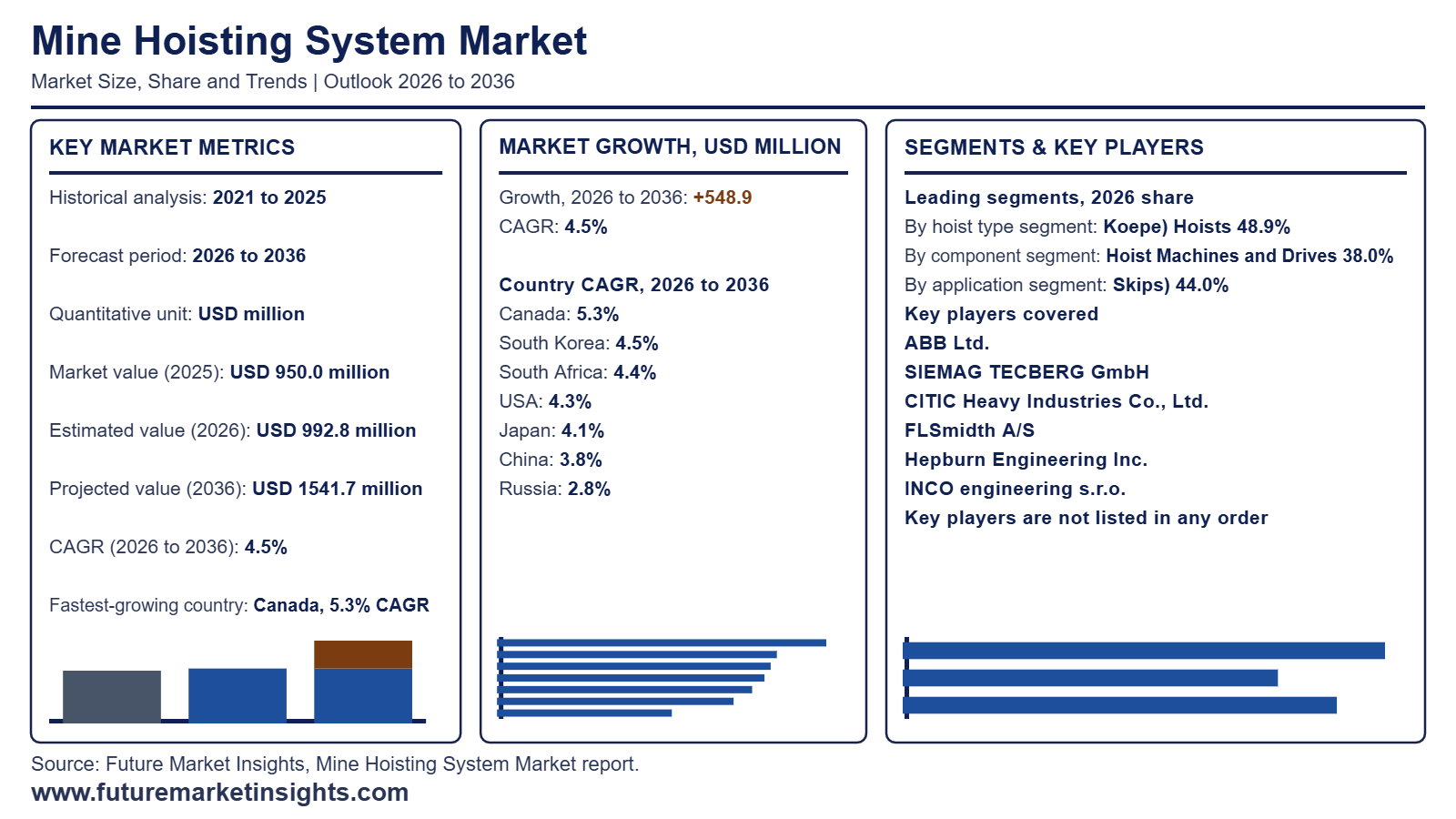
Measured at USD 950.0 million in 2025, global mine hoisting system industry valuation advanced to USD 992.8 million in 2026, with projections pointing toward USD 1,541.7 million by 2036 at a CAGR of 4.5%. FMI analysis suggests that deep underground shaft construction and safety-mandated winder modernizations generate an incremental opportunity of USD 548.9 million over the ten-year forecast horizon. Mining companies are increasing machinery investment in high-capacity friction winders, variable-speed drives, and functional-safety braking packages as shallow open-pit reserves deplete.
| Market Metric | Valuation / Share / Forecast Benchmark |
|---|---|
| 2025 Market Size (Historical) | USD 950.0 million |
| 2026 Market Size (Estimated) | USD 992.8 million |
| 2036 Market Size (Projected) | USD 1,541.7 million |
| Compound Annual Growth Rate (2026 to 2036) | 4.5% CAGR |
| Incremental Dollar Opportunity (2026 to 2036) | USD 548.9 million |
| Dominant Hoist Type Segment (2026 Share) | Friction (Koepe) Hoists (48.9% share in 2026) | Other Segment Combined (51.1%) |
| Leading Component Segment (2026 Share) | Hoist Machines and Drives (38.0% share in 2026) | Other Segment Combined (62.0%) |
| Leading Application Segment (2026 Share) | Production Hoisting (Skips) (44.0% share in 2026) | Other Segment Combined (56.0%) |
| Leading Commodity Segment (2026 Share) | Gold and Platinum (28.0% share in 2026) | Other Segment Combined (72.0%) |
| Fastest-Growing Country Markets (2026 to 2036) | Canada (5.3% CAGR), South Korea (4.5% CAGR), South Africa (4.4% CAGR) |
| Leading Tier-1 Companies | ABB Ltd., SIEMAG TECBERG GmbH, CITIC Heavy Industries Co., Ltd., FLSmidth A/S, Hepburn Engineering Inc., INCO engineering s.r.o. |
Source: Future Market Insights analysis of the mine hoisting system market, 2026.
Executive Market Overview
Demand for mine hoisting systems is rising across underground metal, potash, and coal basins as ore extraction moves below 1,000 meters where diesel ramp haulage becomes too costly. According to machinery investment patterns tracked by FMI analysts, mining houses are shifting capital toward vertical shaft skips and automated multi-rope winders due to escalating underground ventilation and haulage fuel expenses beside underground mining equipment. Project records from ABB Process Automation (ABB Ltd.) (April 2025) confirm the completion of mechanical, electrical, and control upgrades across seven mine hoists at LKAB's Kiruna iron ore mine in Sweden to lift ore from 1,365 meters for at least 25 additional years. Country-wise growth analysis shows Canada leading expansion at a 5.3% CAGR ahead of South Korea at 4.5% and South Africa at 4.4%, whereas the USA at 4.3%, Japan at 4.1%, China at 3.8%, and Russia at 2.8% progress at a more measured pace. Canada, South Korea, and South Africa outpace other countries owing to world-scale greenfield potash shaft construction in Saskatchewan, strategic tungsten mine reopenings in Gangwon Province, and mandatory deep-level gold shaft safety refurbishments.
Sales of digital hoist controls and replacement winder drives are also growing as mine operators modernize aging shaft infrastructure to boost hourly skipping tonnage. In FMI's evaluation of procurement surveys, underground mine owners require SIL 3 functional-safety braking certifications and factory pre-assembly testing before releasing final payments on custom winders. Comparative industry tracking by FMI indicates that compacted strand surface contact wire ropes are projected to expand at a 6.2% CAGR and mine ventilation systems at 5.9% through 2036, compared with 4.5% for mine hoisting systems and 2.2% for general underground mining equipment, because wire ropes require recurring replacement while hoist winders follow multi-year shaft construction schedules. Capital updates from BHP Group Limited (January 2026) confirm an updated Stage 1 investment schedule for the Jansen potash shafts in Canada targeting mid-2027 production. Market scope covers mechanical hoists, drives, conveyances, headframe gear, safety controllers, and hoist ropes while excluding belt conveyors, surface cranes, and mineral processing mills.
This Report Answers
- How large the mine hoisting system market is in 2026 and what it reaches by 2036
- Which hoist type, component, application and commodity segments lead in 2026
- What is driving deep-shaft hoist orders and what slows commissioning
- Which countries grow fastest between 2026 and 2036
- What ABB Ltd., SIEMAG TECBERG GmbH, CITIC Heavy Industries Co., Ltd. and FLSmidth A/S have delivered
- How the mine hoisting system market is defined, segmented and measured
Analyst Perspective
"Mine hoisting suppliers will capture steady high-margin aftermarket revenue by retrofitting SIL 3 digital brake controls and 3D laser shaft inspection suites onto aging winders without replacing existing headframes. Capital expenditure deferrals on greenfield deep-shaft projects remain the primary commercial hurdle, as civil shaft-sinking delays can push equipment acceptance milestones back by several quarters."
- Nikhil Kaitwade, Principal Consultant, Future Market Insights.
Key Market Trends & Insights
- Automated 3D Laser Shaft Scanning Shortens Hoist Inspection Outages: Buyer adoption of automated optical and 3D laser shaft inspection systems is accelerating because manual cage-top shaft checks halt ore production for hours and expose crews to safety risks. FMI finds that integrating laser scanners directly into hoist control platforms allows engineers to detect guide-rail misalignment at normal winding speeds in parallel with excavator safety interlocks. Partnership disclosures from ABB Process Automation (ABB Ltd.) (May 2026) confirm a commercial agreement with Point Laz to integrate Lazaruss 3D laser mine-shaft scanning into ABB Ability Smart Hoisting 4.0 for predictive maintenance. Automated shaft diagnostics are projected to lift digital upgrade sales across deep metal and potash shafts through 2036.
- Factory Pre-Assembly of Double-Drum Blair Winders Cuts Site Erection Risk: Equipment preference among deep-shaft project directors is shifting toward full factory pre-assembly of multi-rope Blair and drum winders prior to shipment. Analysts at FMI observe that testing drum tolerances and hydraulic brake calipers at the manufacturer's plant prevents costly mechanical alignment delays at remote underground mine sites that also operate tunneling equipment. Corporate announcements from SIEMAG TECBERG GmbH (December 2025) confirm that the company pre-assembled and tested a complete double-drum Blair hoisting machine and functional-safety braking system at its Haiger facility during Customer Days 2025. Factory acceptance testing is expected to remain a standard tender requirement for ultra-deep shafts through 2036.
- Permanent-Magnet Direct-Drive Winders and SIL 3 Controls Upgrade Brownfield Shafts: Strategic investments in brownfield shaft life extensions are driving sales of gearless synchronous motors and SIL 3 safety controllers across mature mines. In FMI's view, replacing legacy thyristor drives and mechanical governors increases skip payload efficiency while coordinating with site electric motors and AC switchgear. Contract records from ABB Process Automation (ABB Ltd.) (September 2025) confirm an award from Bluestone Mines Tasmania JV at Australia's Renison tin mine to install Safety Plus SIL 3 hoist controls and modern power conversion for 2026 commissioning. Phased electrical and braking retrofits are anticipated to sustain supplier order backlogs through 2036.
What Are the Main Drivers, Restraints, and Opportunities?
Deeper underground ore horizons and brownfield shaft modernizations drive engineered hoist demand, whereas multi-billion-dollar shaft budget reviews and strict personnel-safety audits restrain project timelines, creating strong opportunities for high-power friction hoists and digital control retrofits.
Driver: Deep-Horizon Underground Ore Access and Shaft Haulage Economics
Sales of high-capacity vertical hoisting systems are rising owing to the transition of copper, nickel, gold, and iron ore mining to depths below 1,200 meters. FMI's demand analysis shows that vertical rope winders deliver far lower operating cost per tonne and less underground heat than diesel truck haulage once deep shaft horizons open in parallel with mine drilling machines. Operational disclosures from MMC Norilsk Nickel PJSC (Nornickel) (May 2025) confirm that the Glubokaya shaft at the Skalisty mine reached rich ore at 1,650 meters and lifted 2,300 tonnes that month toward a 2.2 million tonnes per year target, while FLSmidth A/S (October 2026) fabricated a 7.62-meter hoist sheave engineered for 1,800-meter shaft depths. Deep-level reserve extraction is projected to anchor winder orders through 2036.
Restraint: Escalating Shaft Capital Budgets and Statutory Safety Qualification
High upfront capital expenditure and multi-year engineering lead times restrain rapid adoption of greenfield mine hoists among junior exploration companies. Sinking deep production shafts, erecting headframes, and installing high-power drive motors require tens of millions of dollars before underground ore extraction generates cash flow. In addition, mine safety directives enforced by the Mine Safety and Health Administration (August 2025) mandate rigorous non-destructive rope inspections, automated overspeed trip testing, and emergency braking certifications that increase operating maintenance expenses. Analysts at FMI observe that lengthy shaft development cycles and high debt-financing costs encourage mining operators to extend existing hoisting assets rather than committing to new capital installations through 2036.
Opportunity: High-Power Friction Hoist Localization and Phased Control Retrofits
Substantial revenue opportunities are opening for manufacturers that supply high-power multi-rope friction hoists and modular brake and drive retrofits for existing winding houses. FMI believes that upgrading hydraulic disc brakes, variable-frequency drives, and automated skip-loading pockets allows mine owners to raise shaft throughput without sinking a new shaft beside electric winches. Annual filings from CITIC Limited (April 2026) confirm that CITIC Heavy Industries secured a 2025 contract for a record drive-power friction hoist and manufactured its JKM-6.75x6P IV multi-rope winder, while FLSmidth A/S (October 2026) signed a DKK 360.0 million Chilean copper mine expansion order. Brownfield control upgrades and ultra-large friction winders are expected to generate recurring supplier growth through 2036.
How Is the Mine Hoisting System Market Segmented?
Mine Hoisting System Market is segmented by Hoist Type, Component, Application, Commodity, and Region. Forecast period from 2026 to 2036.
| Segmentation Axis | Sub-Segments Covered | 2026 Leading Segment & Share | Other Segment Combined & Total |
|---|---|---|---|
| Hoist Type | Friction (Koepe) Hoists, Drum Hoists, Blair Multi-Rope Hoists | Friction (Koepe) Hoists (48.9% share in 2026) | Other Segment Combined (51.1%) | Total (100.0%) |
| Component | Hoist Machines and Drives, Conveyances and Headframe Equipment, Control and Safety Systems, Ropes and Ancillaries | Hoist Machines and Drives (38.0% share in 2026) | Other Segment Combined (62.0%) | Total (100.0%) |
| Application | Production Hoisting (Skips), Personnel and Material Hoisting (Cages), Service and Auxiliary Hoists, Emergency and Rescue Hoists | Production Hoisting (Skips) (44.0% share in 2026) | Other Segment Combined (56.0%) | Total (100.0%) |
| Commodity | Gold and Platinum, Coal, Copper and Nickel, Iron Ore and Other Metals, Potash and Other Minerals | Gold and Platinum (28.0% share in 2026) | Other Segment Combined (72.0%) | Total (100.0%) |
| Region | North America, Latin America, Western Europe, Eastern Europe, East Asia, South Asia and Pacific, Middle East and Africa | North America (led by Canada at 5.3% CAGR) | Global Coverage Across 7 Core Countries (100.0%) |
Source: Future Market Insights analysis of the mine hoisting system market, 2026.
Why Does the Friction (Koepe) Hoists Segment Lead by Hoist Type?
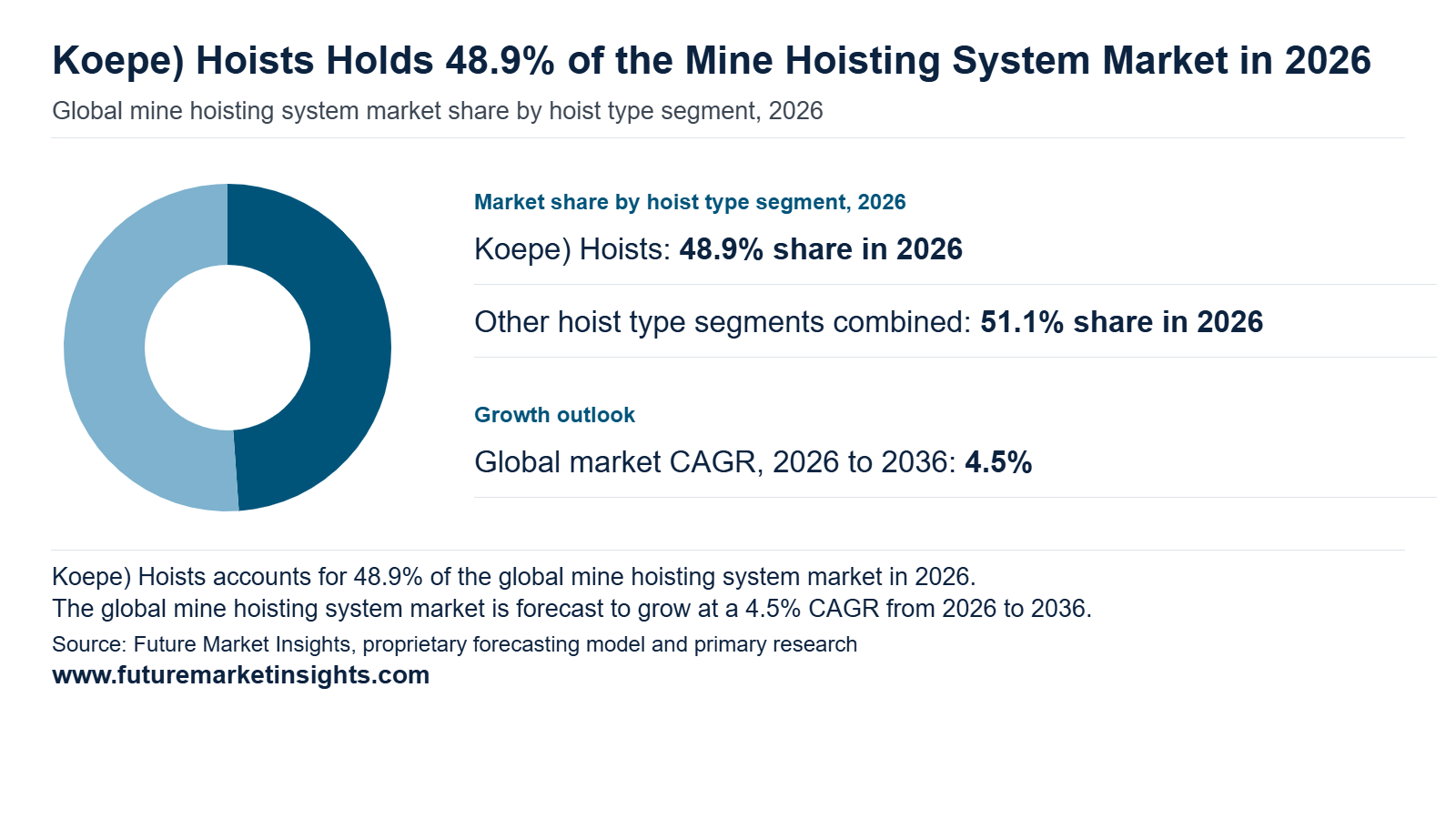
Buyer preference for high-tonnage multi-rope winding places friction (Koepe) hoists in the lead with a 48.9% share of hoist type revenue in 2026, ahead of drum hoists and Blair multi-rope hoists. Underground production shafts favor Koepe traction wheels owing to their ability to divide heavy skip loads across four to six parallel wire ropes without requiring wide drum storage shells beside wire rope slings. While drum hoists remain essential for shaft sinking and multi-level cage servicing and Blair hoists handle ultra-deep horizons beyond 2,000 meters, FMI predicts that friction winders will remain the primary choice for bulk rock lifting. Manufacturing disclosures from CITIC Limited (April 2026) on its JKM-6.75x6P IV multi-rope friction hoist and engineering data from ABB Process Automation (ABB Ltd.) (2026) confirm strong.
What Keeps the Hoist Machines and Drives Segment Ahead Within Component?
In 2026, hoist machines and drives account for 38.0% of component sales, outpacing conveyances and headframe equipment, control and safety systems, and ropes and ancillaries. Capital expenditure concentrates in this segment because the winding drum or friction wheel, main bearings, hydraulic disc brakes, and medium-voltage synchronous motors represent the core mechanical and electrical cost of any hoist installation in parallel with electric motors. Analysts at FMI note that buyers also allocate substantial budgets to direct-drive motor upgrades during mid-life shaft overhauls. Technical catalogs from Hepburn Engineering Inc. (2026) and FLSmidth A/S (2026) detail custom drum and Koepe machines ranging from under 1.0 meter to more than 7.0 meters in diameter with closed-loop braking. High equipment unit prices and gearless drive replacements are anticipated to maintain hoist machines and drives at the top of component demand through 2036.
How Does the Production Hoisting (Skips) Segment Shape Application Demand?
Demand across the application axis is led by production hoisting (skips), which secures 44.0% of segment revenue in 2026 ahead of personnel and material hoisting (cages), service and auxiliary hoists, and emergency and rescue hoists. Mine owners invest heavily in production skip winders because automated ore-lifting cycles operate around the clock and directly determine daily concentrator feed and mine revenue in parallel with compacted strand surface contact wire ropes. FMI's operational survey indicates that even minor skip drive bottlenecks force underground crushers to throttle back output. Contract announcements from ABB Process Automation (ABB Ltd.) (September 2025) for upgrading the main production hoist at Tasmania's Renison tin mine and ABB Process Automation (ABB Ltd.) (April 2025) across seven hoists at LKAB's Kiruna iron ore mine show how operators prioritize skip reliability. Higher underground ore tonnage targets are forecast to sustain production hoisting (skips) leadership through 2036.
Why Is the Gold and Platinum Segment the Leading Commodity?
Gold and platinum extraction captures 28.0% of commodity demand in 2026, leading coal, copper and nickel, iron ore and other metals, and potash and other minerals due to the extreme depth of precious metal reefs in South Africa, Canada, and Russia. Deep vertical and sub-vertical shaft networks at depths of 1,500 to 3,500 meters requires multiple stage winders, personnel cages, and chilled-air shaft infrastructure beside mine ventilation systems. In FMI's commodity assessment, elevated gold prices are giving mining houses the cash flow needed to refurbish aging winders and sink deeper sub-shafts. Safety statistics from the Government of South Africa (January 2025) confirm that gold and platinum shafts remain the primary focus of conveyance safety enforcement after recording zero shaft-conveyance fatalities in 2024, while U.S. Geological Survey (February 2026) data tracks steady underground gold output. Deep-reef life extensions are expected to keep gold and platinum as the leading commodity segment through 2036.
Regional & Country Outlook
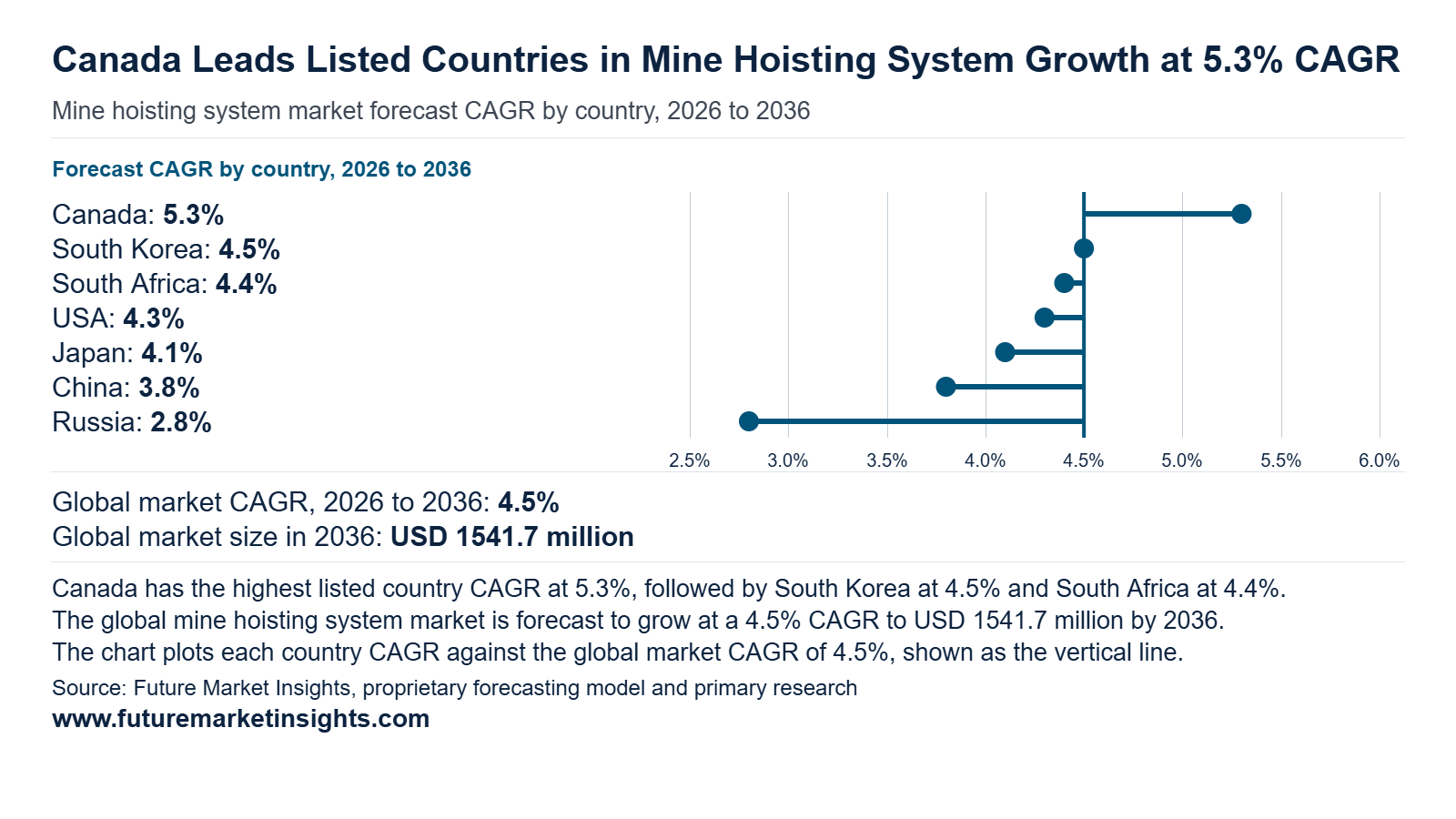
North America, East Asia, and Africa account for the largest regional share of mine hoisting system expenditure, while selective critical-mineral shaft developments in Asia-Pacific and Europe generate high-value engineering and control retrofit orders. FMI projects Canada to lead national growth at a 5.3% CAGR from 2026 to 2036, followed by South Korea at 4.5% and South Africa at 4.4%. USA demand expands at 4.3%, Japan at 4.1%, China at 3.8%, and Russia at 2.8%, creating a 2.5 percentage point growth spread across the seven profiled countries as mining companies balance greenfield potash and polymetallic shaft construction against safety-driven brake and drive upgrades.
| Country | 2026 Revenue | 2036 Revenue | 10-Year Addition | 2026 to 2036 CAGR | Global Share (2026 -> 2036) |
|---|---|---|---|---|---|
| Canada | USD 139.0 million | USD 233.0 million | +USD 94.0 million | 5.3% | 14.0% -> 15.1% |
| South Korea | USD 49.6 million | USD 77.0 million | +USD 27.4 million | 4.5% | 5.0% -> 5.0% |
| South Africa | USD 79.4 million | USD 122.1 million | +USD 42.7 million | 4.4% | 8.0% -> 7.9% |
| USA | USD 99.3 million | USD 151.3 million | +USD 52.0 million | 4.3% | 10.0% -> 9.8% |
| Japan | USD 49.6 million | USD 74.1 million | +USD 24.5 million | 4.1% | 5.0% -> 4.8% |
| China | USD 297.8 million | USD 432.4 million | +USD 134.6 million | 3.8% | 30.0% -> 28.0% |
| Russia | USD 49.6 million | USD 65.4 million | +USD 15.8 million | 2.8% | 5.0% -> 4.2% |
Source: Future Market Insights analysis of the mine hoisting system market, 2026.
USA
Demand for mine hoisting system across USA is projected to climb from USD 99.3 million in 2026 to USD 151.3 million by 2036, advancing at a 4.3% CAGR, contributing +USD 52.0 million in incremental revenue. American market conditions differ from greenfield shaft booms in emerging basins because U.S. expenditure is heavily weighted toward modernizing electrical drives, hydraulic disc brakes, and overspeed controllers on existing gold, silver, copper, and trona shafts in Nevada, Idaho, Arizona, and Wyoming. FMI's regulatory tracking shows that strict federal personnel-hoisting inspections compel operators to upgrade safety controllers on fixed multi-year cycles. Mineral production records from the U.S. Geological Survey (January 2025) and U.S. Geological Survey (February 2026) confirm stable domestic underground metal extraction, while statutory rules under the Office of the Law Revision Counsel, U.S. House of Representatives (2026) enforce mandatory overspeed and automatic stop testing under 30 U.S.C. 874. Phased SIL 3 control retrofits and deep copper shaft expansions in Arizona are expected to sustain U.S. supplier sales through 2036.
Canada
Demand for mine hoisting system across Canada is forecast to advance from USD 139.0 million in 2026 to USD 233.0 million by 2036, advancing at a 5.3% CAGR, contributing +USD 94.0 million in incremental revenue. Canada outpaces the global market because multi-billion-dollar greenfield potash shafts in Saskatchewan and deep gold and nickel shafts in Ontario and Quebec are simultaneously ordering new high-capacity Koepe production winders, Blair service hoists, and automated shaft inspection technologies. Analysts at FMI observe that Canadian mining houses also serve as early adopters of 3D laser shaft scanning to reduce inspection downtime. Project updates from BHP Group Limited (January 2026) and BHP Group Limited (June 2026) confirm that Jansen Stage 1 reached 75.0% completion under its USD 8.4 billion investment program ahead of mid-2027 startup while Stage 2 advances, in parallel with Canadian 3D shaft scanning partnerships launched by ABB Process Automation (ABB Ltd.) (May 2026). Sequenced potash and deep polymetallic shaft deliveries will keep Canada as the fastest-growing country market through 2036.
South Korea
Demand for mine hoisting system across South Korea is estimated to rise from USD 49.6 million in 2026 to USD 77.0 million by 2036, advancing at a 4.5% CAGR, contributing +USD 27.4 million in incremental revenue. South Korea's market structure differs from traditional coal-hoisting nations because the government has phased out state coal mines while backing private redevelopment of strategic critical-mineral deposits such as tungsten, shifting procurement toward compact automated winders and digital shaft safety systems. Based on FMI's East Asian sector analysis, critical-mineral supply security policies are accessing fresh capital for underground mine modernization. Corporate disclosures from Almonty Industries Inc. (September 2026) and Almonty Industries Inc. (November 2025) confirm that final operational certification issued on September 17, 2026 cleared commercial startup at the Sangdong tungsten mine in Gangwon Province, aligning with critical mineral policies tracked by the International Energy Agency (April 2025). New underground tungsten extraction and automated winder upgrades are projected to drive South Korean growth through 2036.
South Africa
Demand for mine hoisting system across South Africa is projected to expand from USD 79.4 million in 2026 to USD 122.1 million by 2036, advancing at a 4.4% CAGR, contributing +USD 42.7 million in incremental revenue. South African hoisting demand is unique compared with global averages because gold and platinum mines operate ultra-deep vertical and sub-vertical shafts between 2,000 and 3,500 meters, where extreme rope loads and strict personnel conveyance audits require frequent brake overhauls, multi-rope Blair servicing, and cage arrestor upgrades. FMI notes that zero-harm regulatory enforcement makes shaft conveyance maintenance a non-discretionary budget item across the Bushveld and Witwatersrand basins. Official safety figures from the Government of South Africa (January 2025) confirm that total mining fatalities dropped to a record low of 42 in 2024 from 55 in 2023, with zero shaft-conveyance deaths recorded following intensive Department of Mineral and Petroleum Resources inspections. Deep-reef life-of-mine extensions and mandatory brake modernizations will anchor South African hoist orders through 2036.
Japan
Demand for mine hoisting system across Japan is anticipated to grow from USD 49.6 million in 2026 to USD 74.1 million by 2036, advancing at a 4.1% CAGR, contributing +USD 24.5 million in incremental revenue. Japan differs from high-volume shaft-sinking markets because domestic underground production is concentrated in high-grade gold and limestone mines, while Japanese mining conglomerates also specify advanced hoisting and automation standards for joint-venture shafts abroad. In FMI's assessment, domestic buyers prioritize seismic-resilient headframe monitoring, precision variable-frequency drives, and long-term preventive maintenance contracts over new shaft construction. Integrated corporate filings from Sumitomo Metal Mining Co., Ltd. (September 2025) and Sumitomo Metal Mining Co., Ltd. (October 2026) confirm continuous underground gold extraction at the Hishikari Mine in Kagoshima, where cumulative production reached 272.6 tonnes by March 2025 under automated safety controls. Electrical drive replacements and lifecycle service agreements are expected to sustain Japanese market expansion through 2036.
China
Equipment orders for mine hoisting systems across China is estimated to advance at a 3.8% CAGR between 2026 and 2036. China's competitive landscape differs from Western markets because domestic heavy machinery manufacturers supply the majority of standard coal and iron ore winders at lower unit prices, leaving international OEMs to compete mainly on ultra-deep 1,500-meter-plus rock shafts and specialized SIL 3 braking controls. According to FMI's industrial equipment tracking, state mine consolidation policies are replacing small shafts with ultra-large multi-rope friction winders. Economic communiqués from the National Bureau of Statistics of China (February 2026) confirm 2025 raw coal output of 4.8 billion tonnes in parallel with major mining machinery investment, while CITIC Limited (April 2026) reported CITIC Heavy Industries' delivery of a record drive-power friction hoist and its JKM-6.75x6P IV winder. Deep iron ore, gold, and coal shaft consolidations will support steady Chinese winder demand through 2036.
Russia
Market growth for mine hoisting systems in Russia is projected at a 2.8% CAGR from 2026 to 2036, representing the slowest pace among the seven profiled countries. Russian market conditions diverge from global norms because trade sanctions restrict imports of Western medium-voltage hoist drives and PLC safety controllers, compelling underground nickel, copper, and potash operators to lengthen commissioning schedules and source domestic or Asian electrical packages. FMI's supply-chain evaluation indicates that deep Polar Division ore bodies still require heavy-duty drum and Koepe winders to sustain mill feed. Production releases from MMC Norilsk Nickel PJSC (Nornickel) (May 2025) and MMC Norilsk Nickel PJSC (Nornickel) (January 2026) confirm that the Glubokaya shaft at the Skalisty mine reached rich ore at 1,650 meters in May 2025 with bottom-discharge ore cars lifting haulage productivity by 15.0% to 20.0%. Localized component engineering and deep-shaft upgrades will govern Russian hoisting expenditure through 2036.
Competitive Environment and Notable Companies
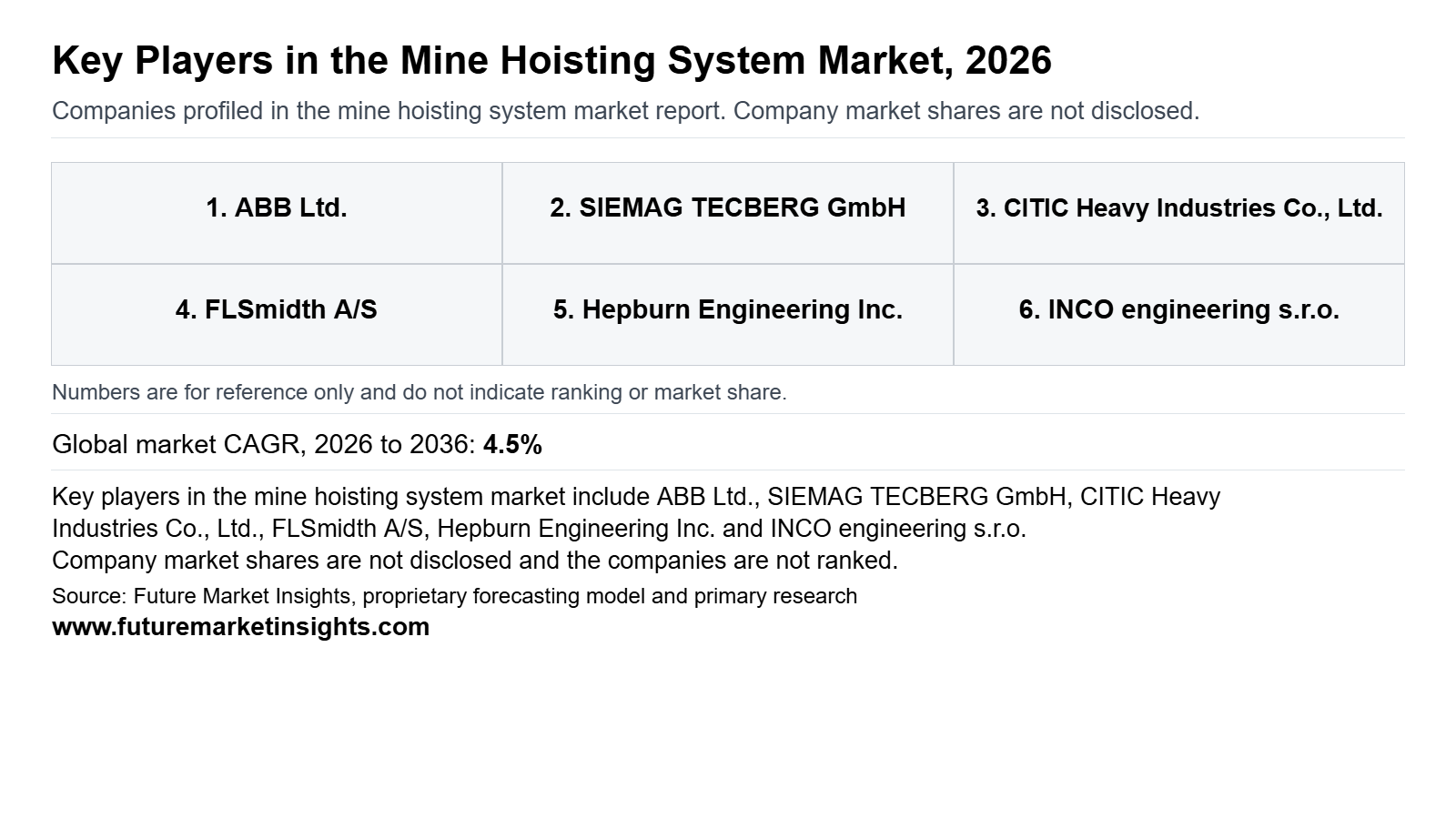
Notable companies operating in the global mine hoisting system market include ABB Ltd., SIEMAG TECBERG GmbH, CITIC Heavy Industries Co., Ltd., FLSmidth A/S, Hepburn Engineering Inc., and INCO engineering s.r.o. Competition spans three commercial tiers across global turnkey mechanical-and-electrical shaft system integrators, specialized deep-shaft Koepe and Blair winder engineers, and heavy industrial hoist manufacturers serving regional coal, iron ore, and base-metal mines.
How Are Companies Positioned in the Mine Hoisting System Market?
Turnkey global integrators led by ABB Process Automation (ABB Ltd.) (2026) and SIEMAG TECBERG GmbH (2026) supply complete mechanical winders, medium-voltage drives, SIL 3 safety controllers, and digital shaft diagnostics. Custom winder specialists including FLSmidth A/S (2026) and Hepburn Engineering Inc. (2026) engineer Koepe, drum, and Blair multi-rope hoists in parallel with shaft conveyances and headframe sheaves, while CITIC Heavy Industries Co., Ltd. (2026) anchors large-scale Chinese and export winder fabrication and INCO engineering s.r.o. (2026) delivers European and international shaft modernizations. FMI's supplier analysis shows that single-point mechanical and electrical responsibility is a decisive advantage in brownfield shaft upgrades.
What Matters When a Buyer Selects a Mine Hoisting System Supplier?
Underground mine owners and EPCM contractors evaluate suppliers on verified deep-shaft reference installations, SIL 3 functional-safety certification for overspeed and brake control, factory pre-assembly testing facilities, and rapid changeover execution during scheduled shaft outages. According to FMI's buyer survey findings, operators upgrading active production shafts favor suppliers with proven multi-hoist retrofit experience, such as the seven-hoist modernization completed by ABB Process Automation (ABB Ltd.) (April 2025) at LKAB Kiruna.
Which Capabilities Distinguish Product Offers?
Technical differentiation centers on ultra-deep winding capacity, closed-loop hydraulic braking, and automated 3D shaft condition monitoring. ABB Process Automation (ABB Ltd.) (2026) distinguishes its portfolio through ABB Ability NGX Hoist Control, Safety Plus SIL 3 Hoist Protector, and Point Laz 3D laser shaft scanning integration, while SIEMAG TECBERG GmbH (December 2025) specializes in pre-assembled double-drum Blair winders. Besides this, FLSmidth A/S (2026) engineers Blair multi-rope hoists for depths down to 3,150 meters with 7.62-meter sheaves, and CITIC Limited (April 2026) builds ultra-high-power JKM multi-rope friction winders. FMI observes that combining predictive shaft scanning with SIL 3 brake controls is becoming a key tender differentiator.
How Does Geographic Reach Affect Competition?
Local engineering hubs and spare-parts depots near major underground mining districts govern aftermarket response times and statutory brake sign-offs. ABB Ltd., FLSmidth A/S, and SIEMAG TECBERG GmbH maintain service centers across Europe, North America, Australia, South Africa, and Latin America, whereas Hepburn Engineering Inc. operates from Toronto with strong North American and international reach, CITIC Heavy Industries Co., Ltd. leads Chinese shaft installations while exporting to Africa and Asia, and INCO engineering s.r.o. serves Central and Eastern Europe and global shaft projects. FMI expects regional service proximity to play a major role in long-term lifecycle maintenance awards through 2036.
| Verified Company Evidence (2025 to 2026) | Commercial Effect | Buyer Action |
|---|---|---|
| May 2026: ABB Ltd. signed a strategic partnership with Point Laz to integrate Lazaruss 3D laser shaft scanning into ABB Ability Smart Hoisting 4.0 (ABB Ltd., May 2026). | Enables automated optical and laser visualization of shaft guides and linings during routine runs, reducing manual inspection downtime. | Specify integrated 3D shaft scanning when tendering digital hoist control upgrades on high-throughput shafts. |
| April 2026: CITIC Limited reported in its 2025 Annual Report that CITIC Heavy Industries secured a contract for a record drive-power friction hoist and built a JKM-6.75x6P IV hoist (CITIC Limited, April 2026). | Demonstrates domestic Chinese fabrication capability for ultra-large multi-rope Koepe winders in deep shafts. | Benchmark local versus international winder suppliers on factory test-bed verification and SIL brake certification. |
| December 2025: SIEMAG TECBERG GmbH presented a pre-assembled double-drum Blair hoisting machine at its Haiger Customer Days 2025 (SIEMAG TECBERG GmbH, December 2025). | De-risks field erection and verifies multi-rope drum tolerances for ultra-deep shaft sinking and production lifts. | Require full factory pre-assembly and functional brake testing prior to shipment on deep Blair hoist orders. |
Source: Verified corporate disclosures and Future Market Insights analysis, 2026.
| Company | Core Positioning | Verified Activity & Source Attribution |
|---|---|---|
| ABB Ltd. | Complete mechanical/electrical mine hoists, NGX controls, and Safety Plus SIL 3 systems | Completed 7-hoist LKAB Kiruna upgrade in April 2025, won Renison tin hoist upgrade in September 2025, and partnered with Point Laz in May 2026 (ABB Ltd., May 2026). |
| SIEMAG TECBERG GmbH | Custom Koepe, drum, and double-drum Blair shaft hoisting systems and braking gear | Showcased pre-assembled double-drum Blair hoisting machine at Haiger Customer Days in December 2025 (SIEMAG TECBERG GmbH, December 2025). |
| CITIC Heavy Industries Co., Ltd. | Large multi-rope friction and drum hoists with integrated hydraulic/electrical drives | Secured record drive-power friction hoist contract and produced JKM-6.75x6P IV winder in 2025-2026 (CITIC Limited, April 2026). |
| FLSmidth A/S | Koepe, single/double-drum, and Blair hoists (up to 3,150 m depth) plus shaft conveyances | Manufactured 7.62 m mine hoist sheave for 1,800 m shaft depth and booked DKK 360.0 million Chilean copper order in October 2026 (FLSmidth A/S, October 2026). |
| Hepburn Engineering Inc. | Turnkey drum, Koepe, and Blair hoists, sinking winches, and Hoist Manager controls | Supplies integrated hoisting plants, electrical controls, and retrofit brake upgrades from Toronto globally (Hepburn Engineering Inc., 2026). |
| INCO engineering s.r.o. | Engineered friction and drum mine hoists, shaft equipment, and braking modernizations | Designs, manufactures, and commissions underground mining and tunneling hoist systems across global markets (INCO engineering s.r.o., 2026). |
Source: Verified corporate disclosures and Future Market Insights analysis, 2026.
Key takeaways from the Mine Hoisting System Market Report
- Global market valuation is estimated at USD 992.8 million in 2026, projected to reach USD 1,541.7 million by 2036.
- Ten-year market expansion is projected to add USD 548.9 million at a 4.5% CAGR.
- Friction (Koepe) Hoists lead the hoist type segment at 48.9% share in 2026.
- Hoist Machines and Drives capture 38.0% of component revenue in 2026.
- Canada is expected to grow at a notable 5.3% CAGR, ahead of South Korea at 4.5% and South Africa at 4.4%.
Mine Hoisting System Market-Report Scope and Research Methodology
FMI analysts size the global mine hoisting system market through primary interviews with underground mine project directors, shaft-sinking EPCM contractors, hoist mechanical and electrical engineers, and mine safety inspectors, combined with desk research across mineral ministry safety reports, capital expenditure disclosures, and manufacturer order backlogs. Core 2025 and 2026 valuations reconcile complete new-build hoist packages, replacement drums and sheaves, electrical drive and SIL-safety control modernizations, and shaft conveyances across all seven tracked countries and regional clusters. Segment shares across hoist type, component, application, and commodity axes are cross-checked against verified shaft project deliveries and installed winder fleets, while excluding standalone belt conveyors, surface cranes, underground loaders, mineral processing mills, and civil shaft excavation labor to prevent double counting.
| Coverage Field | Report Scope |
|---|---|
| Market Definition | Revenue from complete mine hoisting systems and directly attributable winding machines, drives, conveyances, headframe gear, safety controls, ropes, and shaft upgrades. |
| Hoist Type Segments | Friction (Koepe) Hoists, Drum Hoists, and Blair Multi-Rope Hoists. |
| Component Segments | Hoist Machines and Drives, Conveyances and Headframe Equipment, Control and Safety Systems, and Ropes and Ancillaries. |
| Application Segments | Production Hoisting (Skips), Personnel and Material Hoisting (Cages), Service and Auxiliary Hoists, and Emergency and Rescue Hoists. |
| Commodity Segments | Gold and Platinum, Coal, Copper and Nickel, Iron Ore and Other Metals, and Potash and Other Minerals. |
| Exclusions | Standalone belt conveyors, surface cranes, mobile underground haulage trucks, ore processing mills, civil shaft-sinking concrete work, and mineral sales. |
| Quantitative Units | USD Million for global market sizing; CAGR (%) for national growth comparisons. |
| Historical & Base Years | 2025 (Historical: USD 950.0 million) and 2026 (Estimated Base Year: USD 992.8 million). |
| Forecast Period | 2026 to 2036 (Projected 2036 Valuation: USD 1,541.7 million at 4.5% CAGR; USD 548.9 million incremental opportunity). |
| Regions Covered | North America, Latin America, Western Europe, Eastern Europe, East Asia, South Asia and Pacific, and Middle East and Africa. |
| Countries Profiled | USA, Canada, South Korea, South Africa, Japan, China, and Russia. |
| Companies Covered | ABB Ltd., SIEMAG TECBERG GmbH, CITIC Heavy Industries Co., Ltd., FLSmidth A/S, Hepburn Engineering Inc., and INCO engineering s.r.o. |
| Research Approach | Primary underground mine owner and winder OEM interviews combined with secondary shaft capex, safety regulation, and corporate order-book triangulation. |
Source: Future Market Insights analysis of the mine hoisting system market, 2026.
Research Sources and Bibliography
- ABB Process Automation (ABB Ltd.). (2025, April 29). Swedish Mining Company LKAB Set for Future After Major ABB-Led Hoists Upgrade at Kiruna. https://new.abb.com/news/detail/125490/swedish-mining-company-lkab-set-for-future-after-major-abb-led-hoists-upgrade-at-kiruna
- ABB Process Automation (ABB Ltd.). (2025, September 23). Bluestone Mines Tasmania JV Selects ABB to Modernize Hoist System at Australia's Largest Tin Mine. https://new.abb.com/news/detail/129126/bluestone-mines-tasmania-jv-selects-abb-to-modernize-hoist-system-at-australias-largest-tin-mine
- ABB Process Automation (ABB Ltd.). (2026, May 26). ABB and Point Laz Collaborate to Support Safer Mine Hoist Inspections with 3D Scanning. https://new.abb.com/news/detail/136062/abb-and-point-laz-collaborate-to-support-safer-mine-hoist-inspections-with-3d-scanning
- ABB Process Automation (ABB Ltd.). (2026). ABB Hoist Safety Products: NGX Hoist Monitor and Safety Plus Hoist Protector. https://new.abb.com/mining/underground-mining/mine-hoist-systems/abb-hoist-safety-products
- ABB Process Automation (ABB Ltd.). (2026). Types of Mine Hoists: Friction, Drum and Blair Multi-Rope Hoists. https://new.abb.com/mining/underground-mining/mine-hoist-systems/mine-hoist-types
- Almonty Industries Inc.. (2025, November 18). Reopening Sangdong: How a Korean Tungsten Mine Became a Strategic Asset. https://almonty.com/reopening-sangdong-how-a-korean-tungsten-mine-became-a-strategic-asset/
- Almonty Industries Inc.. (2026, September 21). Almonty's Sangdong Processing Plant Receives Final Operational Certification. https://almonty.com/almontys-sangdong-processing-plant-receives-final-operational-certification/
- BHP Group Limited. (2026, January 20). Update: Jansen Stage 1 Potash Project Cost and Schedule Estimate. https://www.bhp.com/news/media-centre/releases/2026/01/jansen-update
- BHP Group Limited. (2026, June 18). Update: Jansen Stage 2 Potash Project Milestones. https://www.bhp.com/news/media-centre/releases/2026/06/update---jansen-stage-2-potash-project
- CITIC Heavy Industries Co., Ltd.. (2026). Mine Hoists: Multi-Rope Friction and Drum Hoisting Equipment. https://www.citicheavyindustries.com/mine-hoists.html
- CITIC Limited. (2025, April 17). Annual Report 2024: CITIC Heavy Industries Manufacturing Operations. https://www.citic.com/ar2024/en/manufacturing/heavyindustries/
- CITIC Limited. (2026, April 21). Annual Report 2025: CITIC Heavy Industries High-Power Friction Hoist Contracts. https://www.citic.com/ar2025/en/manufacturing/heavyindustries/
- FLSmidth A/S. (2026, October 8). FLS Signs DKK 360 Million Order to Supply Market-Leading Technologies to a Copper Mine Expansion Project in Chile. https://fls.com/en/announcements/2026/fls-signs-dkk-360-million-order-to-supply-its-market-leading-crushing-and-grinding-technologies-to-a-copper-mine-expansion-project-in-chile
- FLSmidth A/S. (2026, October 16). Inside the Build of a 7.62 m Mine Hoist Sheave for 1,800 m Shaft Depth. https://video.fls.com/inside-the-build-of-a-762-m-mine
- FLSmidth A/S. (2026). Complete Mine Shaft Equipment and Conveyances from FLS. https://fls.com/equipment/feeding-and-conveying/mineshaft
- FLSmidth A/S. (2026). Innovative Mine Hoists from FLS: Koepe, Drum and Blair Multi-Rope Systems. https://fls.com/equipment/feeding-and-conveying/mine-hoists
- Government of South Africa. (2025, January 23). Minister Gwede Mantashe: Release of 2024 Mine Health and Safety Statistics. https://www.gov.za/news/speeches/minister-gwede-mantashe-release-2024-mine-health-and-safety-statistics-23-jan-2025
- Hepburn Engineering Inc.. (2026). Overview of Hepburn Mining Solutions: Turnkey Mine Hoists and Control Systems. https://hepeng.com/overview-hepburn-mining-solutions/
- INCO engineering s.r.o.. (2026). Mine Hoist Systems and Shaft Reference Projects. https://incoengineering.com/projects
- International Energy Agency. (2025, April 28). The Strategy for Securing Reliable Critical Minerals Supply. https://www.iea.org/policies/17942-the-strategy-for-securing-reliable-critical-minerals-supply
- MMC Norilsk Nickel PJSC (Nornickel). (2025, May 22). Nornickel Reaches First Rich Ore at Glubokaya Shaft of Skalisty Mine. https://nornickel.com/news-and-media/press-releases-and-news/nornickel-reaches-first-rich-ore-at-glubokaya-shaft-of-skalisty-mine-/
- MMC Norilsk Nickel PJSC (Nornickel). (2026, January 28). Nornickel Announces Consolidated Production Results for FY2025 and Skalisty Shaft Horizon Progress. https://nornickel.com/news-and-media/press-releases-and-news/nornickel-announces-consolidated-production-results-for-fy2025/
- National Bureau of Statistics of China. (2026, February 28). Statistical Communiqué of the People's Republic of China on the 2025 National Economic and Social Development. https://www.stats.gov.cn/english/PressRelease/202602/t20260228_1962661.html
- Office of the Law Revision Counsel, U.S. House of Representatives. (2026). 30 U.S.C. 874: Hoisting and Mantrips Mandatory Safety Standards. https://uscode.house.gov/us/usc/t30/s874/
- SIEMAG TECBERG GmbH. (2025, December 5). SIEMAG TECBERG Presents Double-Drum Blair Hoisting Machine at Customer Days 2025. https://www.siemag-tecberg.com/en/application-news/details?cHash=f6466b8fbf8e7d295a85a453a5cb55f5&tx_cccontent_newsview%5Baction%5D=show&tx_cccontent_newsview%5Barticle%5D=283&tx_cccontent_newsview%5Bcontroller%5D=NewsArticle
- SIEMAG TECBERG GmbH. (2026). Shaft Hoisting Technology for Underground Mining. https://www.siemag-tecberg.com/en/technologies/shaft-hoisting-technology
- Sumitomo Metal Mining Co., Ltd.. (2025, September 1). Integrated Report 2025: Mineral Resources Business and Hishikari Mine Operations. https://www.smm.co.jp/en/ir/library/integrated_report/pdf/2025/2025_All_EN.pdf
- Sumitomo Metal Mining Co., Ltd.. (2026, October 30). Integrated Report 2026: Underground Mining Safety and Sustainability. https://www.smm.co.jp/en/ir/library/integrated_report/pdf/2026/2026_All_EN.pdf?261030
- U.S. Geological Survey. (2025, January 31). Mineral Commodity Summaries 2025. https://pubs.usgs.gov/publication/mcs2025
- U.S. Geological Survey. (2026, February 1). Mineral Commodity Summaries 2026: Gold Chapter. https://pubs.usgs.gov/periodicals/mcs2026/mcs2026-gold.pdf
Table of Content
- Key Takeaways
- Market Size and CAGR
- Top Growth Driver
- Fastest Growing Segment
- Leading Region
- Key Companies
- Emerging Opportunities
- Executive Summary
- Global Market Outlook
- Demand-side Trends
- Supply-side Trends
- Technology Roadmap Analysis
- Analysis and Recommendations
- Analyst Perspective (What is happening? Why now? What should investors know?)
- Key Questions Answered
- How large is the market?
- What is the CAGR?
- What are key trends?
- Which region dominates?
- Who are the leaders?
Read More...
- Market Overview
- Market Coverage / Taxonomy
- Market Definition / Scope / Limitations
- Research Methodology
- Chapter Orientation
- Analytical Lens and Working Hypotheses
- Market Structure, Signals, and Trend Drivers
- Benchmarking and Cross-market Comparability
- Market Sizing, Forecasting, and Opportunity Mapping
- Research Design and Evidence Framework
- Desk Research Programme (Secondary Evidence)
- Expert Input and Fieldwork (Primary Evidence)
- Tooling, Models, and Reference Databases
- Data Engineering and Model Build
- Quality Assurance and Audit Trail
- Market Background
- Market Dynamics (Drivers, Restraints, Opportunity, Trends)
- Scenario Forecast (Optimistic, Likely, Conservative)
- Impact Analysis
- AI Impact
- Sustainability Impact
- Regulatory Impact
- Technology Impact
- Consumer / Buyer Analysis
- Purchase Drivers
- Adoption Barriers
- Buyer Journey
- Opportunity Map Analysis
- Product Life Cycle Analysis
- Supply Chain Analysis
- Investment Feasibility Matrix
- Value Chain Analysis
- PESTLE and Porter's Analysis
- Regulatory Landscape
- Regional Parent Market Outlook
- Production and Consumption Statistics
- Import and Export Statistics
- Global Market Analysis and Forecast, 2021 to 2036
- Historical Market Size Value (USD Million) Analysis, 2021 to 2025
- Current and Future Market Size Value (USD Million) Projections, 2026 to 2036
- Y-o-Y Growth Trend Analysis
- Absolute $ Opportunity Analysis
- Global Market Pricing Analysis, 2021 to 2036
- Global Market Analysis and Forecast, By Hoist Type, 2021 to 2036
- Introduction / Key Findings
- Historical Market Size Value (USD Million) Analysis By Hoist Type, 2021 to 2025
- Current and Future Market Size Value (USD Million) Analysis and Forecast By Hoist Type, 2026 to 2036
- Friction (Koepe) Hoists
- Drum Hoists
- Blair Multi-Rope Hoists
- Y-o-Y Growth Trend Analysis By Hoist Type, 2021 to 2025
- Absolute $ Opportunity Analysis By Hoist Type, 2026 to 2036
- Global Market Analysis and Forecast, By Component, 2021 to 2036
- Introduction / Key Findings
- Historical Market Size Value (USD Million) Analysis By Component, 2021 to 2025
- Current and Future Market Size Value (USD Million) Analysis and Forecast By Component, 2026 to 2036
- Hoist Machines and Drives
- Conveyances and Headframe Equipment
- Control and Safety Systems
- Ropes and Ancillaries
- Y-o-Y Growth Trend Analysis By Component, 2021 to 2025
- Absolute $ Opportunity Analysis By Component, 2026 to 2036
- Global Market Analysis and Forecast, By Application, 2021 to 2036
- Introduction / Key Findings
- Historical Market Size Value (USD Million) Analysis By Application, 2021 to 2025
- Current and Future Market Size Value (USD Million) Analysis and Forecast By Application, 2026 to 2036
- Production Hoisting (Skips)
- Personnel and Material Hoisting (Cages)
- Service and Auxiliary Hoists
- Emergency and Rescue Hoists
- Y-o-Y Growth Trend Analysis By Application, 2021 to 2025
- Absolute $ Opportunity Analysis By Application, 2026 to 2036
- Global Market Analysis and Forecast, By Commodity, 2021 to 2036
- Introduction / Key Findings
- Historical Market Size Value (USD Million) Analysis By Commodity, 2021 to 2025
- Current and Future Market Size Value (USD Million) Analysis and Forecast By Commodity, 2026 to 2036
- Gold and Platinum
- Coal
- Copper and Nickel
- Iron Ore and Other Metals
- Potash and Other Minerals
- Y-o-Y Growth Trend Analysis By Commodity, 2021 to 2025
- Absolute $ Opportunity Analysis By Commodity, 2026 to 2036
- Global Market Analysis and Forecast, By Region, 2021 to 2036
- Introduction
- Historical Market Size Value (USD Million) Analysis By Region, 2021 to 2025
- Current Market Size Value (USD Million) Analysis and Forecast By Region, 2026 to 2036
- North America
- Western Europe
- East Asia
- South Asia and Pacific
- Market Attractiveness Analysis By Region
- North America Market Analysis and Forecast, By Country, 2021 to 2036
- Historical Market Size Value (USD Million) Trend Analysis By Market Taxonomy, 2021 to 2025
- Market Size Value (USD Million) Forecast By Market Taxonomy, 2026 to 2036
- By Country
- United States
- Canada
- By Hoist Type
- By Component
- By Application
- By Commodity
- By Country
- Market Attractiveness Analysis
- By Country
- By Hoist Type
- By Component
- By Application
- By Commodity
- Key Takeaways
- Western Europe Market Analysis and Forecast, By Country
- Historical Market Size Value (USD Million) Trend Analysis By Market Taxonomy, 2021 to 2025
- Market Size Value (USD Million) Forecast By Market Taxonomy, 2026 to 2036
- By Country
- United Kingdom
- Germany
- France
- By Hoist Type
- By Component
- By Application
- By Commodity
- By Country
- Market Attractiveness Analysis
- By Country
- By Hoist Type
- By Component
- By Application
- By Commodity
- Key Takeaways
- East Asia Market Analysis and Forecast, By Country
- Historical Market Size Value (USD Million) Trend Analysis By Market Taxonomy, 2021 to 2025
- Market Size Value (USD Million) Forecast By Market Taxonomy, 2026 to 2036
- By Country
- China
- Japan
- South Korea
- By Hoist Type
- By Component
- By Application
- By Commodity
- By Country
- Market Attractiveness Analysis
- By Country
- By Hoist Type
- By Component
- By Application
- By Commodity
- Key Takeaways
- South Asia and Pacific Market Analysis and Forecast, By Country
- Historical Market Size Value (USD Million) Trend Analysis By Market Taxonomy, 2021 to 2025
- Market Size Value (USD Million) Forecast By Market Taxonomy, 2026 to 2036
- By Country
- India
- Australia
- Rest of world aggregate
- By Hoist Type
- By Component
- By Application
- By Commodity
- By Country
- Market Attractiveness Analysis
- By Country
- By Hoist Type
- By Component
- By Application
- By Commodity
- Key Takeaways
- Key Countries Market Analysis
- United States
- Pricing Analysis
- Market Share Analysis, 2025
- By Hoist Type
- By Component
- By Application
- By Commodity
- Canada
- Pricing Analysis
- Market Share Analysis, 2025
- By Hoist Type
- By Component
- By Application
- By Commodity
- Germany
- Pricing Analysis
- Market Share Analysis, 2025
- By Hoist Type
- By Component
- By Application
- By Commodity
- United Kingdom
- Pricing Analysis
- Market Share Analysis, 2025
- By Hoist Type
- By Component
- By Application
- By Commodity
- France
- Pricing Analysis
- Market Share Analysis, 2025
- By Hoist Type
- By Component
- By Application
- By Commodity
- India
- Pricing Analysis
- Market Share Analysis, 2025
- By Hoist Type
- By Component
- By Application
- By Commodity
- China
- Pricing Analysis
- Market Share Analysis, 2025
- By Hoist Type
- By Component
- By Application
- By Commodity
- Japan
- Pricing Analysis
- Market Share Analysis, 2025
- By Hoist Type
- By Component
- By Application
- By Commodity
- South Korea
- Pricing Analysis
- Market Share Analysis, 2025
- By Hoist Type
- By Component
- By Application
- By Commodity
- Australia
- Pricing Analysis
- Market Share Analysis, 2025
- By Hoist Type
- By Component
- By Application
- By Commodity
- United States
- Market Structure Analysis
- Competition Dashboard
- Competition Benchmarking
- Market Share Analysis of Top Players
- By Regional
- By Hoist Type
- By Component
- By Application
- By Commodity
- Emerging Startups
- Innovation Benchmarking
- Competition Analysis
- Competition Deep Dive
- ABB Ltd.
- Overview
- Product Portfolio
- Profitability by Market Segments
- Sales Footprint
- Strategy Overview
- Marketing Strategy
- Product Strategy
- Channel Strategy
- SIEMAG TECBERG GmbH
- CITIC Heavy Industries Co., Ltd.
- FLSmidth A/S
- Hepburn Engineering Inc.
- INCO engineering s.r.o.
- ABB Ltd.
- Case Studies
- Success Stories
- Recent Developments
- Competition Deep Dive
- Assumptions & Acronyms Used
List of Tables
- Table 1: Global Market Value (USD Million) Forecast by Region, 2021 to 2036
- Table 2: Global Market Value (USD Million) Forecast by Hoist Type, 2021 to 2036
- Table 3: Global Market Value (USD Million) Forecast by Component, 2021 to 2036
- Table 4: Global Market Value (USD Million) Forecast by Application, 2021 to 2036
- Table 5: Global Market Value (USD Million) Forecast by Commodity, 2021 to 2036
- Table 6: North America Market Value (USD Million) Forecast by Country, 2021 to 2036
- Table 7: North America Market Value (USD Million) Forecast by Hoist Type, 2021 to 2036
- Table 8: North America Market Value (USD Million) Forecast by Component, 2021 to 2036
- Table 9: North America Market Value (USD Million) Forecast by Application, 2021 to 2036
- Table 10: North America Market Value (USD Million) Forecast by Commodity, 2021 to 2036
- Table 11: Western Europe Market Value (USD Million) Forecast by Country, 2021 to 2036
- Table 12: Western Europe Market Value (USD Million) Forecast by Hoist Type, 2021 to 2036
- Table 13: Western Europe Market Value (USD Million) Forecast by Component, 2021 to 2036
- Table 14: Western Europe Market Value (USD Million) Forecast by Application, 2021 to 2036
- Table 15: Western Europe Market Value (USD Million) Forecast by Commodity, 2021 to 2036
- Table 16: East Asia Market Value (USD Million) Forecast by Country, 2021 to 2036
- Table 17: East Asia Market Value (USD Million) Forecast by Hoist Type, 2021 to 2036
- Table 18: East Asia Market Value (USD Million) Forecast by Component, 2021 to 2036
- Table 19: East Asia Market Value (USD Million) Forecast by Application, 2021 to 2036
- Table 20: East Asia Market Value (USD Million) Forecast by Commodity, 2021 to 2036
- Table 21: South Asia and Pacific Market Value (USD Million) Forecast by Country, 2021 to 2036
- Table 22: South Asia and Pacific Market Value (USD Million) Forecast by Hoist Type, 2021 to 2036
- Table 23: South Asia and Pacific Market Value (USD Million) Forecast by Component, 2021 to 2036
- Table 24: South Asia and Pacific Market Value (USD Million) Forecast by Application, 2021 to 2036
- Table 25: South Asia and Pacific Market Value (USD Million) Forecast by Commodity, 2021 to 2036
List of Figures
- Figure 1: Global Market Pricing Analysis
- Figure 2: Global Market Value (USD Million) Forecast 2021-2036
- Figure 3: Global Market Value Share and BPS Analysis by Hoist Type, 2026 and 2036
- Figure 4: Global Market Y-o-Y Growth Comparison by Hoist Type, 2026-2036
- Figure 5: Global Market Attractiveness Analysis by Hoist Type
- Figure 6: Global Market Value Share and BPS Analysis by Component, 2026 and 2036
- Figure 7: Global Market Y-o-Y Growth Comparison by Component, 2026-2036
- Figure 8: Global Market Attractiveness Analysis by Component
- Figure 9: Global Market Value Share and BPS Analysis by Application, 2026 and 2036
- Figure 10: Global Market Y-o-Y Growth Comparison by Application, 2026-2036
- Figure 11: Global Market Attractiveness Analysis by Application
- Figure 12: Global Market Value Share and BPS Analysis by Commodity, 2026 and 2036
- Figure 13: Global Market Y-o-Y Growth Comparison by Commodity, 2026-2036
- Figure 14: Global Market Attractiveness Analysis by Commodity
- Figure 15: Global Market Value (USD Million) Share and BPS Analysis by Region, 2026 and 2036
- Figure 16: Global Market Y-o-Y Growth Comparison by Region, 2026-2036
- Figure 17: Global Market Attractiveness Analysis by Region
- Figure 18: North America Market Incremental Dollar Opportunity, 2026-2036
- Figure 19: Western Europe Market Incremental Dollar Opportunity, 2026-2036
- Figure 20: East Asia Market Incremental Dollar Opportunity, 2026-2036
- Figure 21: South Asia and Pacific Market Incremental Dollar Opportunity, 2026-2036
- Figure 22: North America Market Value Share and BPS Analysis by Country, 2026 and 2036
- Figure 23: North America Market Value Share and BPS Analysis by Hoist Type, 2026 and 2036
- Figure 24: North America Market Y-o-Y Growth Comparison by Hoist Type, 2026-2036
- Figure 25: North America Market Attractiveness Analysis by Hoist Type
- Figure 26: North America Market Value Share and BPS Analysis by Component, 2026 and 2036
- Figure 27: North America Market Y-o-Y Growth Comparison by Component, 2026-2036
- Figure 28: North America Market Attractiveness Analysis by Component
- Figure 29: North America Market Value Share and BPS Analysis by Application, 2026 and 2036
- Figure 30: North America Market Y-o-Y Growth Comparison by Application, 2026-2036
- Figure 31: North America Market Attractiveness Analysis by Application
- Figure 32: North America Market Value Share and BPS Analysis by Commodity, 2026 and 2036
- Figure 33: North America Market Y-o-Y Growth Comparison by Commodity, 2026-2036
- Figure 34: North America Market Attractiveness Analysis by Commodity
- Figure 35: Western Europe Market Value Share and BPS Analysis by Country, 2026 and 2036
- Figure 36: Western Europe Market Value Share and BPS Analysis by Hoist Type, 2026 and 2036
- Figure 37: Western Europe Market Y-o-Y Growth Comparison by Hoist Type, 2026-2036
- Figure 38: Western Europe Market Attractiveness Analysis by Hoist Type
- Figure 39: Western Europe Market Value Share and BPS Analysis by Component, 2026 and 2036
- Figure 40: Western Europe Market Y-o-Y Growth Comparison by Component, 2026-2036
- Figure 41: Western Europe Market Attractiveness Analysis by Component
- Figure 42: Western Europe Market Value Share and BPS Analysis by Application, 2026 and 2036
- Figure 43: Western Europe Market Y-o-Y Growth Comparison by Application, 2026-2036
- Figure 44: Western Europe Market Attractiveness Analysis by Application
- Figure 45: Western Europe Market Value Share and BPS Analysis by Commodity, 2026 and 2036
- Figure 46: Western Europe Market Y-o-Y Growth Comparison by Commodity, 2026-2036
- Figure 47: Western Europe Market Attractiveness Analysis by Commodity
- Figure 48: East Asia Market Value Share and BPS Analysis by Country, 2026 and 2036
- Figure 49: East Asia Market Value Share and BPS Analysis by Hoist Type, 2026 and 2036
- Figure 50: East Asia Market Y-o-Y Growth Comparison by Hoist Type, 2026-2036
- Figure 51: East Asia Market Attractiveness Analysis by Hoist Type
- Figure 52: East Asia Market Value Share and BPS Analysis by Component, 2026 and 2036
- Figure 53: East Asia Market Y-o-Y Growth Comparison by Component, 2026-2036
- Figure 54: East Asia Market Attractiveness Analysis by Component
- Figure 55: East Asia Market Value Share and BPS Analysis by Application, 2026 and 2036
- Figure 56: East Asia Market Y-o-Y Growth Comparison by Application, 2026-2036
- Figure 57: East Asia Market Attractiveness Analysis by Application
- Figure 58: East Asia Market Value Share and BPS Analysis by Commodity, 2026 and 2036
- Figure 59: East Asia Market Y-o-Y Growth Comparison by Commodity, 2026-2036
- Figure 60: East Asia Market Attractiveness Analysis by Commodity
- Figure 61: South Asia and Pacific Market Value Share and BPS Analysis by Country, 2026 and 2036
- Figure 62: South Asia and Pacific Market Value Share and BPS Analysis by Hoist Type, 2026 and 2036
- Figure 63: South Asia and Pacific Market Y-o-Y Growth Comparison by Hoist Type, 2026-2036
- Figure 64: South Asia and Pacific Market Attractiveness Analysis by Hoist Type
- Figure 65: South Asia and Pacific Market Value Share and BPS Analysis by Component, 2026 and 2036
- Figure 66: South Asia and Pacific Market Y-o-Y Growth Comparison by Component, 2026-2036
- Figure 67: South Asia and Pacific Market Attractiveness Analysis by Component
- Figure 68: South Asia and Pacific Market Value Share and BPS Analysis by Application, 2026 and 2036
- Figure 69: South Asia and Pacific Market Y-o-Y Growth Comparison by Application, 2026-2036
- Figure 70: South Asia and Pacific Market Attractiveness Analysis by Application
- Figure 71: South Asia and Pacific Market Value Share and BPS Analysis by Commodity, 2026 and 2036
- Figure 72: South Asia and Pacific Market Y-o-Y Growth Comparison by Commodity, 2026-2036
- Figure 73: South Asia and Pacific Market Attractiveness Analysis by Commodity
- Figure 74: Global Market - Tier Structure Analysis
- Figure 75: Global Market - Company Share Analysis
Frequently Asked Questions
How big is the mine hoisting system market in 2026?
Future Market Insights estimates the global mine hoisting system market valuation at USD 992.8 million in 2026, advancing from USD 950.0 million in 2025 as underground shaft projects progress.
What is the projected size and CAGR of the mine hoisting system market through 2036?
Global mine hoisting system sales are projected to reach USD 1,541.7 million by 2036, expanding at a 4.5% CAGR from 2026 to 2036 and generating USD 548.9 million in incremental revenue.
Which Hoist Type segment leads the mine hoisting system market in 2026?
Friction (Koepe) Hoists lead the hoist type axis with a 48.9% revenue share in 2026 due to multi-rope traction efficiency in high-capacity production shafts.
Which Component segment captures the largest share of mine hoisting system sales?
Hoist Machines and Drives hold 38.0% of component revenue in 2026 because winding drums, Koepe wheels, motors, and braking assemblies represent the core capital equipment package.
How much share does Production Hoisting (Skips) hold in the mine hoisting system market?
Production Hoisting (Skips) accounts for 44.0% of application revenue in 2026 as continuous ore lifting directly governs underground mine throughput and project economics.
Why does Gold and Platinum lead mine hoisting system commodity segments?
Gold and Platinum captures 28.0% of 2026 commodity revenue because deep-level precious metal reefs require multi-stage vertical shafts and regular safety modernizations.
Which countries are projected to grow fastest in the mine hoisting system market?
Canada leads national growth at a 5.3% CAGR from 2026 to 2036, followed by South Korea at 4.5% and South Africa at 4.4% as potash, tungsten, and deep gold shafts modernize.
Which companies are profiled as key players in the mine hoisting system market?
Key profiled companies include ABB Ltd., SIEMAG TECBERG GmbH, CITIC Heavy Industries Co., Ltd., FLSmidth A/S, Hepburn Engineering Inc., and INCO engineering s.r.o.
Preview the report firsthand - request a free sample
Get SampleGet the brochure for pricing and purchase details.
Get PDF