

- Market Size (2026)
- USD 2.2 Bn
- Forecast (2036)
- USD 3.5 Bn
- CAGR (2026 to 2036)
- 4.8%
How big is Bin Storage Systems Market in 2026?
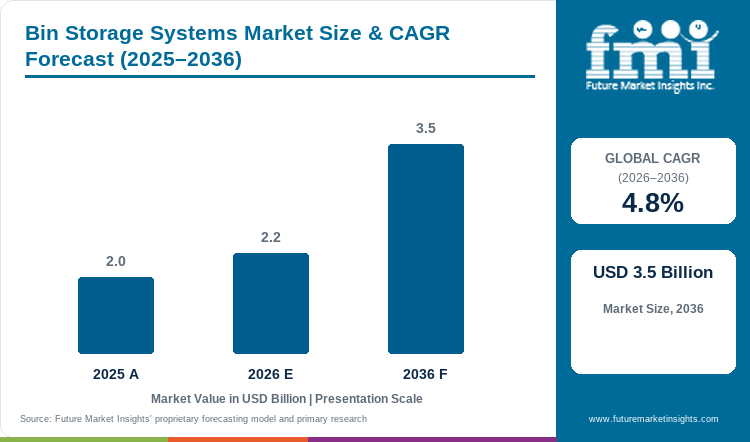
USD 2.2 billion in 2026 and USD 3.5 billion by 2036, expanding at 4.8% CAGR.
Sales of bin storage systems are estimated to rise at 4.8% CAGR through 2036, increasing valuation from USD 2.0 billion in 2025 to USD 2.2 billion in 2026, and reaching USD 3.5 billion by 2036. Warehouses are replacing loose small-parts locations with controlled pick faces as item variety rises inside existing buildings. In September 2026, SSI SCHAEFER documented the same operating pressure in a Würth Industrie Service project that commissioned automated piece placement inside an operating C-parts logistics system. The installation raises throughput without extensive structural changes and preserves modular storage as a practical step ahead of full automation.
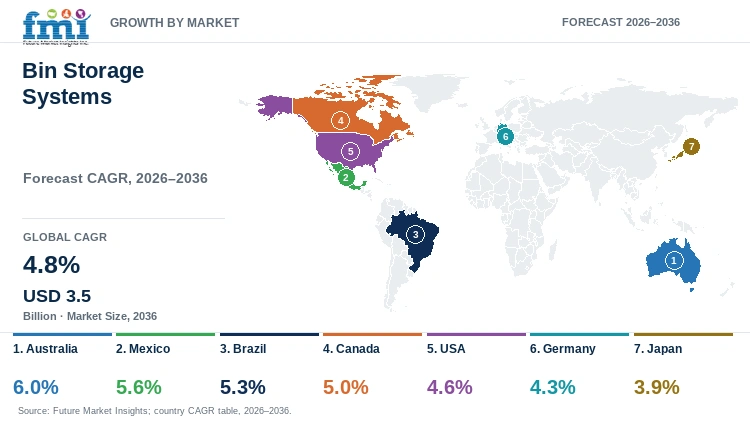
Australia is projected to expand at 6.0% CAGR through 2036 compared with 3.9% for Japan. Australian transport, postal and warehousing sales and service income increased 7.8% during the 2024-25 financial year according to the Australian Bureau of Statistics. Japanese operators face tighter capacity and space constraints that increase the value of compact layouts and predictable recovery. Different operating pressures therefore produce different project economics even when both countries continue investing in storage productivity.
Key Takeaways
- Warehouse and manufacturing teams are buying controlled bin locations because rising item variety makes repeated search and replenishment work more expensive.
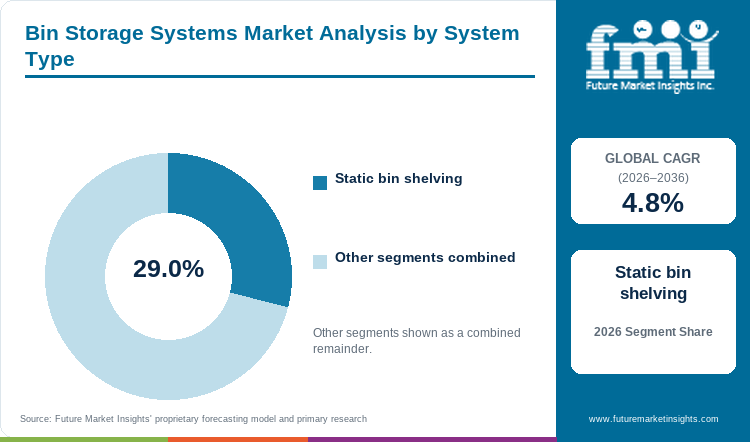
- By system type, static bin shelving is estimated to hold 29.0% share in 2026, supported by direct access and limited installation disruption.
- By bin type, plastic bins are projected to account for 43.0% share in 2026, influenced by low weight and broad shelving compatibility.
- By end use, warehousing is forecast to represent 28.0% share in 2026, attributable to repeated picking and replenishment cycles in active facilities.
- Brownfield fire protection, floor-loading limits and integration checks can extend engineering approval before higher-density or automated systems enter operation.
- Some of the key players in this market include SSI SCHAEFER, Akro-Mils, Quantum Storage Systems, BITO-Lagertechnik, IPL Schoeller, Stanley Black & Decker, Tennsco, LISTA AG, Mecalux, and Vidmar.
Analyst Perspective
“Bin storage earns budget approval when a supplier converts item movement into a measurable layout decision without disrupting an operating site. Buyers should test access frequency and service response before paying for density or automation that exceeds the actual workflow.”
- Nikhil Kaitwade, Principal Consultant, Future Market Insights
How is the bin storage systems market segmented?
The bin storage systems market is segmented by System Type, Bin Type, End Use, Storage Density, Sales Channel, and Region.
System type includes static bin shelving, louvered panels, mobile bin racks, automated storage and modular drawer-bin systems. Bin type covers plastic, metal, ESD, stackable - nestable and parts bins, while end use covers warehousing, manufacturing cells, automotive parts, healthcare - labs and retail backrooms. Storage density includes medium-density racks, low-density shelving, high-density systems and automated micro-fulfillment, while sales channels cover industrial distributors, integrators, direct manufacturer sales and e-commerce - catalog routes. Region follows the standard FMI geography taxonomy used in the global article and report scope.
How does static bin shelving shape demand within the system type category?
Static bin shelving gives operators fixed pick faces without the engineering scope associated with warehouse racking or automated movement. BITO-Lagertechnik documented in February 2026 that warehouse planning must coordinate storage height with fire protection and floor conditions. Facilities preserve direct access and simpler re-slotting when extensive structural changes would delay a storage project.
- Based on system type, static bin shelving is projected to account for 29.0% in 2026, supported by direct access and a lower implementation threshold.
- Warehouse supervisors can resize active locations during re-slotting without introducing motion controls that require a separate integration and recovery plan.
What supports plastic bins within the bin type category?
Plastic bins reduce handling weight and move easily between shelves or workstations used for material handling equipment. Myers Industries identified Akro-Mils organizational bins and related storage equipment in its industrial portfolio during July 2026. Replaceable units let maintenance teams separate parts and change locations without rebuilding the surrounding storage hardware.
- By bin type, plastic bins are estimated to hold 43.0% in 2026, influenced by low weight and compatibility with varied small-parts storage formats.
- Maintenance and assembly teams replace individual damaged bins without redesigning the surrounding shelf or changing every location in the work area.
How does warehousing shape demand within the end use category?
Warehousing generates repeat bin demand because one building may manage thousands of small locations beside warehouse robotics and manual picking zones. SSI SCHAEFER explained in May 2026 that modular RackBot systems can integrate into existing warehouse structures with limited changes to live operations. Clear bin locations let operators test travel and replenishment gains before funding a wider automation project.
- In 2026, warehousing is expected to lead end use with 28.0% share, shaped by repeated picking and replenishment inside active distribution facilities.
- Facility managers favor layouts that improve small-item access without forcing a complete conveyor or building redesign during normal operating hours.
What supports medium-density racks within the storage density category?
Medium-density racks preserve human access while using more cubic space than open low-density shelving or automated material handling systems. OSHA renewed its national emphasis program for warehousing and distribution centers in July 2026. Facilities compare density gains with safe aisle access and handling requirements before approving a more compressed layout in an operating building.
- By storage density, medium-density racks are forecast to represent 38.0% in 2026, supported by higher space use without removing direct access.
- Brownfield sites can increase location count within an existing zone while keeping inspection routes and manual recovery procedures easier to manage.
How do industrial distributors influence selection within the sales channel category?
Industrial distributors convert mixed bin sizes and replacement items into smaller orders that align with routine in-plant logistics spending. A July 2026 U.S. Army notice described a vendor-managed inventory requirement covering contractor-supplied cabinets, bins and shelving at Rock Island Arsenal. Local channel stock reduces downtime when smaller facilities need replacements without opening a capital project for routine storage changes.
- Industrial distributors are likely to capture 36.0% share in 2026, supported by mixed-SKU availability and local replacement support for standard systems.
- Buyers use integrators or direct manufacturers more often when controls and engineered layout responsibility outweigh the value of immediate catalog availability.
What are the drivers, restraints and opportunities in the Bin Storage Systems Market?
Higher small-item throughput increases location-control spending, brownfield qualification delays complex installations, and modular automation provides a staged upgrade route.
- Driver: Rising small-order throughput increases the cost of search and replenishment work when inventory locations remain inconsistent.
- Restraint: Fire protection, floor loading and egress reviews extend project engineering in operating buildings that cannot absorb installation disruption.
- Opportunity: Modular bins and automation-ready storage let operators improve one workflow before financing a larger material-flow redesign.
Small-order throughput turns location control into a labor decision
Warehouse teams are spending on fixed locations because repeated search and replenishment work accumulates over many order cycles. U.S. retail e-commerce sales increased 12.2% year over year in the second quarter of 2026 according to the Census Bureau. Operators can address that workload with labeled bins before adding automated material handling equipment. Managers can justify a smaller first project by comparing travel and mispick changes against installed cost.
Brownfield qualification can delay a technically attractive storage project
Existing facilities must place new storage beside sprinkler coverage, floor limits and established traffic paths. NFPA reported in February 2026 that storage supplies were the first item ignited in 17% of warehouse structure fires. Projects using mobile robots add interface and recovery questions to those physical checks. Engineering review can therefore delay purchase even when the operating need is already clear.
Staged automation gives mid-sized facilities a credible investment sequence
Operators can improve manual locations first and automate selected movement once the storage logic proves stable. Mecalux presented the AMR 100 Box in March 2026 for moving totes and bins alongside trays and packages. The AMR architecture connects defined storage locations with human-robot picking systems without forcing every process to change at once. Suppliers can earn expansion work by specifying interfaces and upgrade rules during the initial order.
Which country CAGRs are profiled in the Bin Storage Systems Market?
| Country | CAGR |
|---|---|
| Australia | 6.0% |
| Mexico | 5.6% |
| Brazil | 5.3% |
| Canada | 5.0% |
| USA | 4.6% |
| Germany | 4.3% |
| Japan | 3.9% |
How do country-level CAGRs compare in the Bin Storage Systems Market?
Australia, Mexico and Brazil form the upper growth group within a 2.1-point spread while Canada occupies the middle position. The USA, Germany and Japan expand more slowly because established facilities demand stronger retrofit proof before operators replace functioning storage.
- Australia’s warehouse expansion pipeline favors storage-system suppliers that can deploy capacity efficiently across geographically dispersed facilities without prolonging commissioning timelines.
- Growing manufacturing activity in Mexico is increasing demand for standardized parts-storage layouts that can be replicated across multiple production sites.
- In Brazil, long logistics routes elevate the importance of regional replenishment networks to minimize delays in component replacement and inventory availability.
- Canada continues to prioritize phased productivity improvements, creating opportunities for storage upgrades that deliver measurable efficiency gains without full-scale automation.
- The rise of small-order fulfillment in the USA is strengthening demand for bin-storage systems that improve picking accuracy and workflow efficiency.
- Germany’s industrial production base keeps configurable small-parts storage relevant alongside highly established manufacturing and assembly operations.
- Japan’s mature distribution facilities often prefer compact retrofit solutions that preserve operational continuity and floor-space efficiency.
Comparable CAGRs can still produce different purchasing conditions because installed assets and approval practices shape each project. The full report provides country-level CAGR analysis across North America, Latin America, Western Europe, Eastern Europe, East Asia, South Asia and Pacific, and Middle East and Africa.
Country-wise Analysis
- Australian operators use modular storage to manage dispersed facilities without making every site dependent on custom installation. By 2036, Australia is projected to grow at 6.0% CAGR, supported by continued warehousing activity and logistics employment. The Australian Bureau of Statistics counted 744,300 jobs in transport and postal services plus warehousing during the June quarter of 2026. Long service distances favor standard components that local teams can replace without extensive specialist travel.
- Mexican manufacturers align parts storage with formal material-handling procedures inside expanding industrial operations and production facilities. Bin storage systems demand in Mexico is forecast to rise at 5.6% CAGR over the forecast period, influenced by national workplace rules for machinery-based storage and handling. NOM-006-STPS-2023 requires documented safety conditions for machinery-based storage and material movement inside operating facilities. Suppliers need repeatable layouts and Spanish-language documentation as facilities add production capacity under localized manufacturing programs.
- Brazilian facilities must integrate new storage with national rules governing material movement and warehouse safety. Bin storage systems demand in Brazil is forecast to rise at 5.3% CAGR over the forecast period, shaped by formal handling requirements at operating sites. Brazil’s Ministry of Labor lists NR-11 as the national rule governing material movement and storage handling. Suppliers that document safe access and loading conditions can reduce site-level review friction during repeated storage additions.
- Canadian operators often improve existing storage in smaller stages because replacement access and ergonomic layout both affect retrofit economics. Adoption of bin storage systems in Canada is estimated to expand at 5.0% CAGR through 2036, influenced by practical small-item storage requirements. The Canadian Centre for Occupational Health and Safety recommends bin racks for small items and adequate aisle space in storage areas. Local stock becomes more valuable when a modest replacement cannot justify a long service delay.
- U.S. operators add bin storage beside existing picking and maintenance areas without redesigning the entire building. USA is estimated to post 4.6% CAGR over the forecast period, supported by retrofit demand under national material-handling rules. OSHA requires safe aisle clearances and secure material storage under 29 CFR 1910.176. Facilities evaluating pick-to-light systems must protect egress and material-handling safety during installation and routine operation. Suppliers win repeat work by measuring documented labor savings against actual warehouse order profiles.
- German manufacturers use small-parts storage near production cells to protect assembly continuity and maintain parts availability. In Germany, bin storage systems demand is predicted to advance at 4.3% CAGR through 2036, shaped by formal rack-safety and inspection requirements. DGUV Information 208-061 covers storage equipment operation with requirements for construction, inspection and maintenance. Retrofit suppliers must document compatible layouts and inspection requirements before equipment enters routine production use.
- Japanese logistics teams prioritize compact footprints and predictable recovery because space constraints make implementation errors costly. Japan's bin storage systems outlook is anticipated to advance at 3.9% CAGR over the assessment period, shaped by national logistics-capacity pressure. Japan’s transport ministry projected a 34% logistics capacity shortfall by fiscal 2030 without corrective measures. Facilities evaluating collaborative mobile robots require storage interfaces that match local aisle geometry and reliability standards already used in operations.
Who are the notable companies in the Bin Storage Systems Market?
SSI SCHAEFER, Akro-Mils, Quantum Storage Systems, BITO-Lagertechnik, IPL Schoeller, Stanley Black & Decker, Tennsco, LISTA AG, Mecalux, and Vidmar are active within the defined bin storage systems boundary.
Competition separates by storage scope and service route more clearly than by corporate scale alone. SSI SCHAEFER and Mecalux connect small-parts storage with automation while Akro-Mils and Quantum Storage Systems emphasize manual bin workflows. Stanley Black & Decker operates Vidmar as a market-facing brand while Tennsco and LISTA AG serve metal storage requirements.
- Integrated storage and automation providers include SSI SCHAEFER, BITO-Lagertechnik and Mecalux for projects that require hardware and movement controls under one engineered scope.
- Bin-led suppliers include Akro-Mils, Quantum Storage Systems and IPL Schoeller for standard locations guided by material choice and replacement availability.
- Tennsco and LISTA AG serve metal storage routes beside Stanley Black & Decker for industrial applications. Stanley Black & Decker markets Vidmar as a distinct storage brand within its broader parent portfolio.
Competitive Benchmarking: Bin Storage Systems Market
| Company | Manual Bin-System Breadth | Automation-Ready Integration | Service or Channel Evidence | Geographic Reach |
|---|---|---|---|---|
| SSI SCHAEFER | High | High | High | Global |
| Akro-Mils | High | Low | High | Primarily North America |
| Quantum Storage Systems | High | Low | High | North America with distributor reach |
| BITO-Lagertechnik | High | High | High | Europe with international operations |
| IPL Schoeller | High | Medium | High | North America and Europe |
| Stanley Black & Decker | Medium | Medium | High | Global corporate reach |
| Tennsco | Medium | Low | High | United States |
| LISTA AG | Medium | Medium | High | Europe with international locations |
| Mecalux | Medium | High | High | Europe and the Americas |
| Vidmar | Medium | Medium | High | Primarily North America |
Scoring basis: High manual breadth requires current evidence for several bin or shelving formats within the defined market. Medium reflects a narrower exact-market range and Low identifies limited evidence for multiple manual storage formats. High automation integration requires current evidence of controls or robotics while Medium indicates a defined smart-storage interface. Service or channel ratings compare documented distribution and project support from multi-route access to narrower availability.
Key Developments in the Bin Storage Systems Market
- In September 2026, SSI SCHAEFER commissioned automated piece placement with Würth Industrie Service inside an established C-parts logistics system in Bad Mergentheim.
- In April 2026, BITO-Lagertechnik introduced an intelligent U-Turn reusable bin with integrated sensor technology and a Sepioo display for storage and transport workflows.
- In March 2026, Mecalux presented the AMR 100 Box for moving totes and bins alongside warehouse automation equipment at IntraLogisteX.
Key Players in the Bin Storage Systems Market
Integrated storage and automation platforms
- SSI SCHAEFER
- BITO-Lagertechnik
- Mecalux
Bin-led storage and reusable container specialists
- Akro-Mils
- Quantum Storage Systems
- IPL Schoeller
Industrial drawer and steel-storage routes
- Stanley Black & Decker
- Tennsco
- LISTA AG
- Vidmar
Bin Storage Systems Market - Report Scope
| Coverage field | Report scope |
|---|---|
| Market breakdown | By system type, bin type, end use, storage density, sales channel and region. |
| Quantitative Units | USD billion. |
| Market Definition | Commercial bins and bin-oriented storage hardware used for organized storage, picking and point-of-use inventory are included. Standalone software, pallet racking, lockers and general cabinetry are excluded unless bundled directly with a bin-storage system. |
| Regions Covered | North America, Latin America, Western Europe, Eastern Europe, East Asia, South Asia and Pacific, and Middle East and Africa. |
| Countries Covered | Australia, Mexico, Brazil, Canada, USA, Germany, Japan, and 20+ countries included in the full report. |
| Key Companies Profiled | SSI SCHAEFER, Akro-Mils, Quantum Storage Systems, BITO-Lagertechnik, IPL Schoeller, Stanley Black & Decker, Tennsco, LISTA AG, Mecalux, Vidmar. |
| Forecast Period | 2026 to 2036. |
| Approach | Primary and secondary research with market triangulation. |
Bin Storage Systems Market - Research Methodology
| Method | Approach |
|---|---|
| Primary Research | FMI analysts gathered input from manufacturers, service providers, technology developers, distributors, end users, procurement teams, and subject-matter experts. Interviews examined purchasing decisions, product or service evaluation, adoption barriers, approval requirements, pricing considerations, and expectations for technical or commercial support. Respondents were also asked what evidence is required before a trial, pilot, or initial order develops into regular purchasing. |
| Desk Research | Desk research covered government statistics, regulatory publications, trade data, industry associations, technical literature, standards, company filings, product information, and official corporate announcements. Sources were reviewed for relevance, publication date, geographic coverage, and consistency with the defined market scope. Claims relating to performance, applications, approvals, capacity, investment, and commercial activity were retained only when supported by credible public evidence. |
| Market Sizing and Forecasting | The market model combined the baseline value with historical performance, segment structure, pricing and volume indicators, adoption levels, company participation, and country-level demand conditions. Forecast assumptions considered economic activity, investment trends, regulatory developments, technology adoption, purchasing cycles, supply availability, and barriers to wider market use. Segment and regional estimates were reconciled before the final market total was calculated. |
| Data Validation | Estimates were checked against multiple independent indicators, including public data, company activity, trade patterns, industry developments, and findings from primary interviews. Validation also tested whether products, services, applications, and company revenues fell within the defined market boundaries. Adjacent categories, unsupported claims, overlapping revenues, and activities without direct market relevance were excluded to reduce double counting and maintain consistency across segments and countries. |
Bin Storage Systems Market by Segments
Bin Storage Systems Market segmented by System Type:
- Static bin shelving
- Louvered panel systems
- Mobile bin racks
- Automated bin storage
- Modular drawer-bin systems
Bin Storage Systems Market segmented by Bin Type:
- Plastic bins
- Metal bins
- ESD bins
- Stackable - nestable bins
- Parts bins
Bin Storage Systems Market segmented by End Use:
- Warehousing
- Manufacturing cells
- Automotive parts
- Healthcare - labs
- Retail backroom
Bin Storage Systems Market segmented by Storage Density:
- Medium-density racks
- Low-density shelving
- High-density systems
- Automated micro-fulfillment
Bin Storage Systems Market segmented by Sales Channel:
- Industrial distributors
- Storage system integrators
- Direct manufacturer sales
- E-commerce - catalog
Bin Storage Systems Market by Region:
- North America
- United States
- Canada
- Latin America
- Brazil
- Mexico
- Chile
- Rest of Latin America
- Western Europe
- Germany
- United Kingdom
- Italy
- Spain
- France
- Nordics
- Benelux
- Rest of Western Europe
- Eastern Europe
- Russia
- Poland
- Hungary
- Balkan and Baltic States
- Rest of Eastern Europe
- East Asia
- China
- Japan
- South Korea
- South Asia and Pacific
- India
- ASEAN
- Australia and New Zealand
- Rest of South Asia and Pacific
- Middle East and Africa
- Kingdom of Saudi Arabia
- Other GCC Countries
- Türkiye
- South Africa
- Other African Union Countries
- Rest of Middle East and Africa
Research Sources and Bibliography
- SSI SCHAEFER. (2026, September 14). Precise Placement, Efficient Consolidation: Würth Industrie Service and SSI SCHAEFER Jointly Advance Picking Robot Technology
- Ministry of Land, Infrastructure, Transport and Tourism, Japan. (2025, June 24). Summary of the White Paper on Land, Infrastructure, Transport and Tourism in Japan, 2025
- BITO-Lagertechnik. (2026, February 18). Hall Height, Fire Protection and Floor Requirements in Warehouses
- Myers Industries. (2026, July 30). Myers Industries Announces 2026 Second Quarter Results
- U.S. Census Bureau. (2026, August 18). Quarterly Retail E-Commerce Sales
- Occupational Safety and Health Administration. (2026, July 31). National Emphasis Program on Warehousing and Distribution Center Operations
- Tennessee Department of General Services. (2026, September 16). Invitations to Bid (ITB): Event 32101-13979, For Shelving and Installation - Updated
- Mecalux. (2026, March 2). Mecalux Set to Present Next-Gen AMR 1500 Pallet Conveyor and 3D Automated Pallet Shuttle at IntraLogisteX 2026
- Australian Bureau of Statistics. (2026, September 10). Labour Account Australia, June 2026
- Secretaría del Trabajo y Previsión Social, Mexico. (2024, March 7). NOM-006-STPS-2023: Storage and Handling of Materials Using Machinery - Occupational Safety Conditions
- Ministério do Trabalho e Emprego, Brazil. (n.d.). Norma Regulamentadora No. 11 (NR-11). Retrieved September 18, 2026.
- Canadian Centre for Occupational Health and Safety. (2023, July 31). MMH - Layouts for Storing
- German Social Accident Insurance (DGUV). (2024, July). DGUV Information 208-061: Lagereinrichtungen und Ladungsträger
- Australian Bureau of Statistics. (2026, June 19). Australian Industry, 2024-25 financial year
- BITO-Lagertechnik. (2026, April 9). BITO Introduces U-Turn with Integrated Sensor Technology and Display
- IPL Schoeller. (2025, July 2). Completion of the Merger of IPL and Schoeller Allibert
- LISTA AG. (2026, June 19). AI for the Configurator: LISTA AI Sales Agent
- NSF. (2026, September 17). NSF Product and Service Listings: Quantum Storage Systems
- U.S. Securities and Exchange Commission. (2026). Stanley Black & Decker, Inc. Form 10-K for the fiscal year ended January 3, 2026
- SSI SCHAEFER. (2026, March 30). Smart Connectivity for Dynamic Material Flows: FastBots Solution by SSI SCHAEFER
- Mecalux. (2026, May 19). Mecalux Strengthens Infrastructure to Advance AI Agents Across Its Software Suite
- SSI SCHAEFER. (2026, March 10). Driving Innovation Together: Schaeffler and SSI SCHAEFER Expand Partnership with New Logistics Hub
- IPL Schoeller. (2026, June 24). Europe Deserves Less: Less Cost, Less Disruption, Less Waste with RTP
- SSI SCHAEFER. (2026, July 1). Oriola Selects SSI SCHAEFER as Their Intralogistics Solution Provider for Its New Distribution Center
- Myers Industries. (2026, March 5). Myers Industries Announces 2025 Fourth Quarter and Full Year Results
- Monroe County, Michigan. (2026, May 27). Addendum #2
- BITO-Lagertechnik. (2026, January 5). Platzsparendes Raumwunder mit einem Dreh
- Mecalux. (2026, September 4). Slaur Sardet: AS/RS with 8 Stacker Cranes to Manage 160 Bottles/Year
- Intercity Transit Authority. (2026, March 18). Intercity Transit Authority Regular Meeting
- SSI SCHAEFER. (2026, May 27). Scalable Automation at Your Own Pace: How RackBot Systems Facilitate the Implementation of Modern Warehouse Logistics
- National Fire Protection Association. (2026, February). Warehouse Structure Fires
- U.S. Army Contracting Command. (2026, July 9). Vendor Managed Inventory for Rock Island Arsenal - Joint Manufacturing Technology Center
- Occupational Safety and Health Administration. (n.d.). 29 CFR 1910.176 - Handling materials - general
- LISTA AG. (2026, September 14). LISTA ward trolleys in the sensitive operating theatre environment
- BITO-Lagertechnik. (n.d.). Certificates
This bibliography is provided for reader reference and is not exhaustive. The full report contains the complete reference list and detailed citations
This Report Answers
- What is the bin storage systems market value in 2026 and 2036?
- Which operating conditions increase organized small-parts storage spending?
- Which system type holds 29.0% share in 2026?
- Which bin type holds 43.0% share in 2026?
- Which end use holds 28.0% share in 2026?
- How do CAGRs differ among the seven profiled countries?
- Which checks delay higher-density and automated storage projects?
- Which companies serve bin, metal-storage or automation routes?
- How should operators compare modular storage with broader automation?
Frequently Asked Questions
How big is the bin storage systems market in 2026?
The bin storage systems market is valued at USD 2.2 billion in 2026 and is projected to reach USD 3.5 billion by 2036. Warehouse teams are spending on controlled locations that reduce repeated search and replenishment work.
What is the CAGR of the bin storage systems market from 2026 to 2036?
The bin storage systems market is projected to grow at 4.8% CAGR between 2026 and 2036. Expansion is supported by retrofit spending that improves small-parts access without forcing a complete building or automation redesign.
Which system type leads the bin storage systems market in 2026?
The static bin shelving segment is projected to hold 29.0% of system type revenue in the bin storage systems market in 2026. Direct access and limited installation disruption support its position in brownfield facilities with existing manual picking workflows.
Which bin type leads the bin storage systems market in 2026?
The plastic bins segment is estimated to hold 43.0% of bin type revenue in the bin storage systems market in 2026. Low handling weight and compatibility with shelves and panels support frequent re-slotting and replacement.
Which companies are active in the bin storage systems market?
Key companies operating in the bin storage systems market include SSI SCHAEFER, Akro-Mils, Quantum Storage Systems, BITO-Lagertechnik, IPL Schoeller, Stanley Black & Decker, Tennsco, LISTA AG, Mecalux, and Vidmar. Their roles span bin supply and metal storage while selected providers also integrate distribution support or automation.
Preview the report firsthand - request a free sample
Get SampleGet the brochure for pricing and purchase details.
Get PDFTable of Content
- Key Takeaways
- Market Size and CAGR
- Top Growth Driver
- Fastest Growing Segment
- Leading Region
- Key Companies
- Emerging Opportunities
- Executive Summary
- Global Market Outlook
- Demand-side Trends
- Supply-side Trends
- Technology Roadmap Analysis
- Analysis and Recommendations
- Analyst Perspective (What is happening? Why now? What should investors know?)
- Key Questions Answered
- How large is the market?
- What is the CAGR?
- What are key trends?
- Which region dominates?
- Who are the leaders?
- Market Overview
- Market Coverage / Taxonomy
- Market Definition / Scope / Limitations
- Research Methodology
- Chapter Orientation
- Analytical Lens and Working Hypotheses
- Market Structure, Signals, and Trend Drivers
- Benchmarking and Cross-market Comparability
- Market Sizing, Forecasting, and Opportunity Mapping
- Research Design and Evidence Framework
- Desk Research Programme (Secondary Evidence)
- Expert Input and Fieldwork (Primary Evidence)
- Tooling, Models, and Reference Databases
- Data Engineering and Model Build
- Quality Assurance and Audit Trail
- Market Background
- Market Dynamics (Drivers, Restraints, Opportunity, Trends)
- Scenario Forecast (Optimistic, Likely, Conservative)
- Impact Analysis
- AI Impact
- Sustainability Impact
- Regulatory Impact
- Technology Impact
- Consumer / Buyer Analysis
- Purchase Drivers
- Adoption Barriers
- Buyer Journey
- Opportunity Map Analysis
- Product Life Cycle Analysis
- Supply Chain Analysis
- Investment Feasibility Matrix
- Value Chain Analysis
- PESTLE and Porter's Analysis
- Regulatory Landscape
- Regional Parent Market Outlook
- Production and Consumption Statistics
- Import and Export Statistics
- Global Market Analysis and Forecast, 2021 to 2036
- Historical Market Size Value (USD Billion) Analysis, 2021 to 2025
- Current and Future Market Size Value (USD Billion) Projections, 2026 to 2036
- Y-o-Y Growth Trend Analysis
- Absolute $ Opportunity Analysis
- Global Market Pricing Analysis, 2021 to 2036
- Global Market Analysis and Forecast, By System Type, 2021 to 2036
- Introduction / Key Findings
- Historical Market Size Value (USD Billion) Analysis By System Type, 2021 to 2025
- Current and Future Market Size Value (USD Billion) Analysis and Forecast By System Type, 2026 to 2036
- Static bin shelving
- Louvered panel systems
- Mobile bin racks
- Automated bin storage
- Modular drawer-bin systems
- Y-o-Y Growth Trend Analysis By System Type, 2021 to 2025
- Absolute $ Opportunity Analysis By System Type, 2026 to 2036
- Global Market Analysis and Forecast, By Bin Type, 2021 to 2036
- Introduction / Key Findings
- Historical Market Size Value (USD Billion) Analysis By Bin Type, 2021 to 2025
- Current and Future Market Size Value (USD Billion) Analysis and Forecast By Bin Type, 2026 to 2036
- Plastic bins
- Metal bins
- ESD bins
- Stackable - nestable bins
- Parts bins
- Y-o-Y Growth Trend Analysis By Bin Type, 2021 to 2025
- Absolute $ Opportunity Analysis By Bin Type, 2026 to 2036
- Global Market Analysis and Forecast, By End Use, 2021 to 2036
- Introduction / Key Findings
- Historical Market Size Value (USD Billion) Analysis By End Use, 2021 to 2025
- Current and Future Market Size Value (USD Billion) Analysis and Forecast By End Use, 2026 to 2036
- Warehousing
- Manufacturing cells
- Automotive parts
- Healthcare - labs
- Retail backroom
- Y-o-Y Growth Trend Analysis By End Use, 2021 to 2025
- Absolute $ Opportunity Analysis By End Use, 2026 to 2036
- Global Market Analysis and Forecast, By Storage Density, 2021 to 2036
- Introduction / Key Findings
- Historical Market Size Value (USD Billion) Analysis By Storage Density, 2021 to 2025
- Current and Future Market Size Value (USD Billion) Analysis and Forecast By Storage Density, 2026 to 2036
- Medium-density racks
- Low-density shelving
- High-density systems
- Automated micro-fulfillment
- Y-o-Y Growth Trend Analysis By Storage Density, 2021 to 2025
- Absolute $ Opportunity Analysis By Storage Density, 2026 to 2036
- Global Market Analysis and Forecast, By Sales Channel, 2021 to 2036
- Introduction / Key Findings
- Historical Market Size Value (USD Billion) Analysis By Sales Channel, 2021 to 2025
- Current and Future Market Size Value (USD Billion) Analysis and Forecast By Sales Channel, 2026 to 2036
- Industrial distributors
- Storage system integrators
- Direct manufacturer sales
- E-commerce - catalog
- Y-o-Y Growth Trend Analysis By Sales Channel, 2021 to 2025
- Absolute $ Opportunity Analysis By Sales Channel, 2026 to 2036
- Global Market Analysis and Forecast, By Region, 2021 to 2036
- Introduction
- Historical Market Size Value (USD Billion) Analysis By Region, 2021 to 2025
- Current Market Size Value (USD Billion) Analysis and Forecast By Region, 2026 to 2036
- North America
- Latin America
- Western Europe
- Eastern Europe
- East Asia
- South Asia and Pacific
- Middle East and Africa
- Market Attractiveness Analysis By Region
- North America Market Analysis and Forecast, By Country, 2021 to 2036
- Historical Market Size Value (USD Billion) Trend Analysis By Market Taxonomy, 2021 to 2025
- Market Size Value (USD Billion) Forecast By Market Taxonomy, 2026 to 2036
- By Country
- United States
- Canada
- By System Type
- By Bin Type
- By End Use
- By Storage Density
- By Sales Channel
- By Country
- Market Attractiveness Analysis
- By Country
- By System Type
- By Bin Type
- By End Use
- By Storage Density
- By Sales Channel
- Key Takeaways
- Latin America Market Analysis and Forecast, By Country
- Historical Market Size Value (USD Billion) Trend Analysis By Market Taxonomy, 2021 to 2025
- Market Size Value (USD Billion) Forecast By Market Taxonomy, 2026 to 2036
- By Country
- Brazil
- Mexico
- Chile
- Rest of Latin America
- By System Type
- By Bin Type
- By End Use
- By Storage Density
- By Sales Channel
- By Country
- Market Attractiveness Analysis
- By Country
- By System Type
- By Bin Type
- By End Use
- By Storage Density
- By Sales Channel
- Key Takeaways
- Western Europe Market Analysis and Forecast, By Country
- Historical Market Size Value (USD Billion) Trend Analysis By Market Taxonomy, 2021 to 2025
- Market Size Value (USD Billion) Forecast By Market Taxonomy, 2026 to 2036
- By Country
- Germany
- United Kingdom
- Italy
- Spain
- France
- Nordics
- Benelux
- Rest of Western Europe
- By System Type
- By Bin Type
- By End Use
- By Storage Density
- By Sales Channel
- By Country
- Market Attractiveness Analysis
- By Country
- By System Type
- By Bin Type
- By End Use
- By Storage Density
- By Sales Channel
- Key Takeaways
- Eastern Europe Market Analysis and Forecast, By Country
- Historical Market Size Value (USD Billion) Trend Analysis By Market Taxonomy, 2021 to 2025
- Market Size Value (USD Billion) Forecast By Market Taxonomy, 2026 to 2036
- By Country
- Russia
- Poland
- Hungary
- Balkan and Baltic States
- Rest of Eastern Europe
- By System Type
- By Bin Type
- By End Use
- By Storage Density
- By Sales Channel
- By Country
- Market Attractiveness Analysis
- By Country
- By System Type
- By Bin Type
- By End Use
- By Storage Density
- By Sales Channel
- Key Takeaways
- East Asia Market Analysis and Forecast, By Country
- Historical Market Size Value (USD Billion) Trend Analysis By Market Taxonomy, 2021 to 2025
- Market Size Value (USD Billion) Forecast By Market Taxonomy, 2026 to 2036
- By Country
- China
- Japan
- South Korea
- By System Type
- By Bin Type
- By End Use
- By Storage Density
- By Sales Channel
- By Country
- Market Attractiveness Analysis
- By Country
- By System Type
- By Bin Type
- By End Use
- By Storage Density
- By Sales Channel
- Key Takeaways
- South Asia and Pacific Market Analysis and Forecast, By Country
- Historical Market Size Value (USD Billion) Trend Analysis By Market Taxonomy, 2021 to 2025
- Market Size Value (USD Billion) Forecast By Market Taxonomy, 2026 to 2036
- By Country
- India
- ASEAN
- Australia and New Zealand
- Rest of South Asia and Pacific
- By System Type
- By Bin Type
- By End Use
- By Storage Density
- By Sales Channel
- By Country
- Market Attractiveness Analysis
- By Country
- By System Type
- By Bin Type
- By End Use
- By Storage Density
- By Sales Channel
- Key Takeaways
- Middle East and Africa Market Analysis and Forecast, By Country
- Historical Market Size Value (USD Billion) Trend Analysis By Market Taxonomy, 2021 to 2025
- Market Size Value (USD Billion) Forecast By Market Taxonomy, 2026 to 2036
- By Country
- Kingdom of Saudi Arabia
- Other GCC Countries
- Türkiye
- South Africa
- Other African Union Countries
- Rest of Middle East and Africa
- By System Type
- By Bin Type
- By End Use
- By Storage Density
- By Sales Channel
- By Country
- Market Attractiveness Analysis
- By Country
- By System Type
- By Bin Type
- By End Use
- By Storage Density
- By Sales Channel
- Key Takeaways
- Key Countries Market Analysis
- United States
- Pricing Analysis
- Market Share Analysis, 2025
- By System Type
- By Bin Type
- By End Use
- By Storage Density
- By Sales Channel
- Canada
- Pricing Analysis
- Market Share Analysis, 2025
- By System Type
- By Bin Type
- By End Use
- By Storage Density
- By Sales Channel
- Mexico
- Pricing Analysis
- Market Share Analysis, 2025
- By System Type
- By Bin Type
- By End Use
- By Storage Density
- By Sales Channel
- Brazil
- Pricing Analysis
- Market Share Analysis, 2025
- By System Type
- By Bin Type
- By End Use
- By Storage Density
- By Sales Channel
- Chile
- Pricing Analysis
- Market Share Analysis, 2025
- By System Type
- By Bin Type
- By End Use
- By Storage Density
- By Sales Channel
- Germany
- Pricing Analysis
- Market Share Analysis, 2025
- By System Type
- By Bin Type
- By End Use
- By Storage Density
- By Sales Channel
- United Kingdom
- Pricing Analysis
- Market Share Analysis, 2025
- By System Type
- By Bin Type
- By End Use
- By Storage Density
- By Sales Channel
- Italy
- Pricing Analysis
- Market Share Analysis, 2025
- By System Type
- By Bin Type
- By End Use
- By Storage Density
- By Sales Channel
- Spain
- Pricing Analysis
- Market Share Analysis, 2025
- By System Type
- By Bin Type
- By End Use
- By Storage Density
- By Sales Channel
- France
- Pricing Analysis
- Market Share Analysis, 2025
- By System Type
- By Bin Type
- By End Use
- By Storage Density
- By Sales Channel
- India
- Pricing Analysis
- Market Share Analysis, 2025
- By System Type
- By Bin Type
- By End Use
- By Storage Density
- By Sales Channel
- ASEAN
- Pricing Analysis
- Market Share Analysis, 2025
- By System Type
- By Bin Type
- By End Use
- By Storage Density
- By Sales Channel
- Australia and New Zealand
- Pricing Analysis
- Market Share Analysis, 2025
- By System Type
- By Bin Type
- By End Use
- By Storage Density
- By Sales Channel
- China
- Pricing Analysis
- Market Share Analysis, 2025
- By System Type
- By Bin Type
- By End Use
- By Storage Density
- By Sales Channel
- Japan
- Pricing Analysis
- Market Share Analysis, 2025
- By System Type
- By Bin Type
- By End Use
- By Storage Density
- By Sales Channel
- South Korea
- Pricing Analysis
- Market Share Analysis, 2025
- By System Type
- By Bin Type
- By End Use
- By Storage Density
- By Sales Channel
- Russia
- Pricing Analysis
- Market Share Analysis, 2025
- By System Type
- By Bin Type
- By End Use
- By Storage Density
- By Sales Channel
- Poland
- Pricing Analysis
- Market Share Analysis, 2025
- By System Type
- By Bin Type
- By End Use
- By Storage Density
- By Sales Channel
- Hungary
- Pricing Analysis
- Market Share Analysis, 2025
- By System Type
- By Bin Type
- By End Use
- By Storage Density
- By Sales Channel
- Kingdom of Saudi Arabia
- Pricing Analysis
- Market Share Analysis, 2025
- By System Type
- By Bin Type
- By End Use
- By Storage Density
- By Sales Channel
- Türkiye
- Pricing Analysis
- Market Share Analysis, 2025
- By System Type
- By Bin Type
- By End Use
- By Storage Density
- By Sales Channel
- South Africa
- Pricing Analysis
- Market Share Analysis, 2025
- By System Type
- By Bin Type
- By End Use
- By Storage Density
- By Sales Channel
- Australia
- Pricing Analysis
- Market Share Analysis, 2025
- By System Type
- By Bin Type
- By End Use
- By Storage Density
- By Sales Channel
- United States
- Market Structure Analysis
- Competition Dashboard
- Competition Benchmarking
- Market Share Analysis of Top Players
- By Regional
- By System Type
- By Bin Type
- By End Use
- By Storage Density
- By Sales Channel
- Emerging Startups
- Innovation Benchmarking
- Competition Analysis
- Competition Deep Dive
- SSI SCHAEFER
- Overview
- Product Portfolio
- Profitability by Market Segments
- Sales Footprint
- Strategy Overview
- Marketing Strategy
- Product Strategy
- Channel Strategy
- Akro-Mils
- Quantum Storage Systems
- BITO-Lagertechnik
- IPL Schoeller
- Stanley Black & Decker
- Tennsco
- LISTA AG
- Mecalux
- Vidmar
- SSI SCHAEFER
- Case Studies
- Success Stories
- Recent Developments
- Competition Deep Dive
- Assumptions & Acronyms Used


