

- Industry Size (2026)
- USD 640.7 Mn
- Forecast (2036)
- USD 1225.5 Mn
- CAGR (2026 to 2036)
- 6.7%
Bin Vent Filter Market Size, Market Forecast and Outlook By FMI
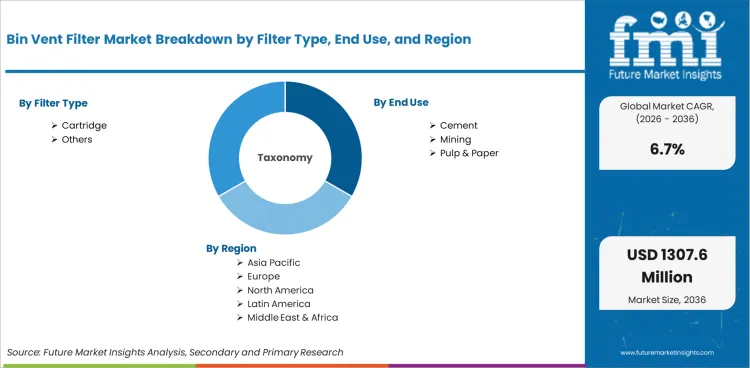
The bin vent filter market was valued at USD 600.5 million in 2025. The market is estimated to reach USD 640.7 million in 2026, reflecting steady demand across bulk material handling operations. The market is projected to reach a CAGR of 6.7% from 2026 to 2036, with total revenue expected to reach USD 1,225.5 million by 2036. Demand is propelled due to ongoing requirements for dust control during silo filling, pneumatic conveying, and material transfer processes.
Summary of Bin Vent Filter Market
- The market is forecast to reach USD 1,225.5 million by 2036.
- The market is expected to grow at a CAGR of 6.7% from 2026 to 2036.
- The market was estimated at USD 600.5 million in 2025.
- The forecast period represents an incremental opportunity of USD 584.8 million.
- Bin vent filters are specification-driven systems used to control dust during pneumatic silo and bin filling operations.
- Demand is driven by increased silo filling cycles across cement, food, and chemical industries where dust containment is critical.
- Cartridge filters lead the product segment with a 53.0% share due to compact design and compatibility with pulse cleaning systems.
- Pulse jet cleaning dominates with a 69.0% share, supporting continuous operation without manual intervention.
- Silo-mounted systems account for 77.0% share as they reduce ducting complexity and simplify installation.
- The cement industry leads end-use demand with a 26.0% share due to high dust generation and continuous material handling.
- India, China, and the United States are the fastest-growing markets, while Europe and Japan show steady replacement-driven demand.
- Market growth is moderated by delayed upgrades in older plants and replacement-led purchasing cycles.
- Leading companies include Donaldson, Camfil, WAMGROUP, Nederman, Parker Hannifin, Aqseptence, and Menardi.
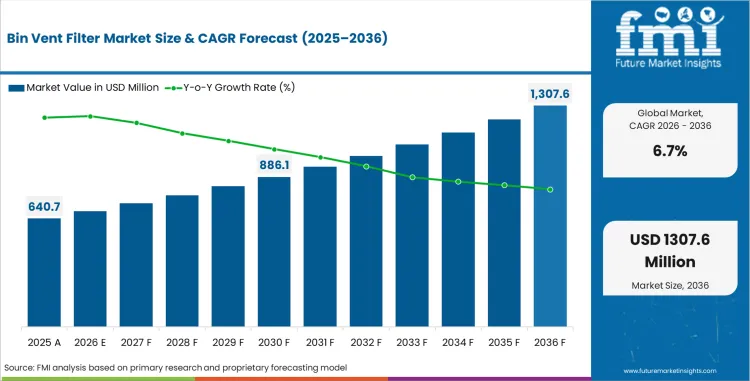
Plants handling cement, food ingredients, and chemical powders are treating vent filters as critical components rather than secondary fittings. Equipment selection now depends on the ability to remain operational during repeated filling cycles, control dust release, and reduce unplanned stoppages caused by cleaning or maintenance issues. Cartridge-based systems are gaining preference where clean-side access and shorter service intervals improve maintenance efficiency.
Repeat demand depends on performance reliability across installed systems. Once a vent filter demonstrates stable pulse cleaning, durability under exposed conditions, and effective dust containment during high-load filling, similar units are specified across additional silos and transfer points. This pattern aligns with broader trends seen in dust collection equipment across industrial facilities.
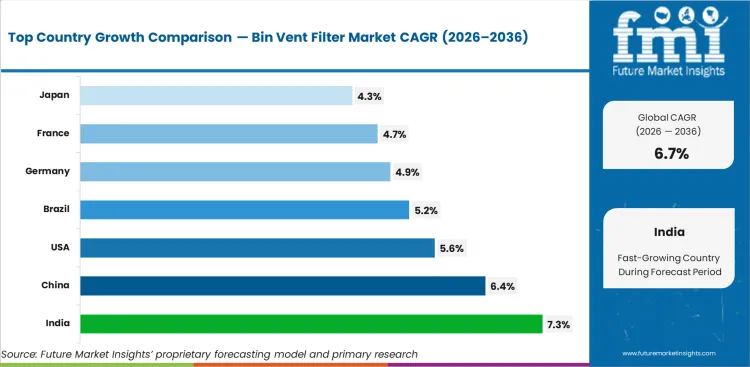
India is projected to reach a CAGR of 7.3% in the bin vent filter market from 2026 to 2036, supported by expansion in cement and bulk material handling capacity. China is expected to expand at a CAGR of 6.4% over the same period, driven by high industrial throughput and stricter dust control requirements. The United States is anticipated to grow at 5.6% over the assessment period, with demand linked to replacement and retrofit activity in established plants. Brazil is forecast to record a CAGR of 5.2% during the forecast period, followed by Germany at 4.9%, France at 4.7%, and Japan at 4.3%. Differences across countries reflect the balance between new installations and replacement-driven demand in mature facilities.
Bin Vent Filter Market Key Takeaways
| Metric | Details |
|---|---|
| Industry Size (2026) | USD 640.7 million |
| Industry Value (2036) | USD 1,225.5 million |
| CAGR (2026-2036) | 6.7% |
Source: Future Market Insights (FMI) analysis, based on proprietary forecasting model and primary research
Segmental Analysis
Bin Vent Filter Market Analysis by Filter Type
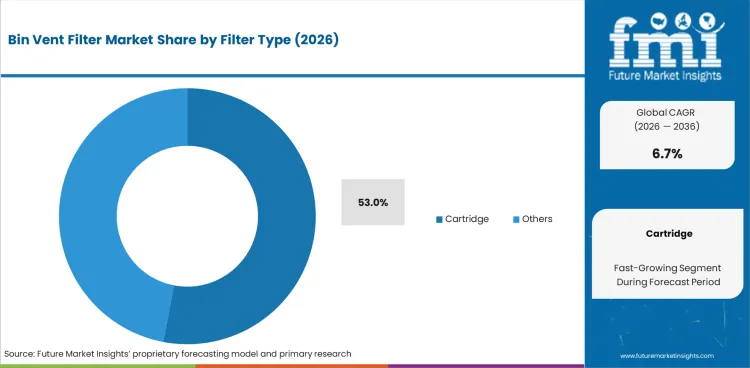
Service teams select vent filters based on how well the unit performs during repeated filling cycles without creating access issues during maintenance. Cartridge bin vents are expected to account for 53.0% share of the filter type segment in 2026, as compact design, pulse cleaning, and clean-side servicing reduce dust exposure at elevated storage points. Equipment choice often prioritizes lower maintenance time and safer access, even when upfront cost is higher. This pattern reflects broader trends where serviceability influences replacement decisions alongside filtration performance. Units that are difficult to service tend to result in longer shutdowns and increased dust accumulation around silo tops.
- Service access: Clean-side maintenance reduces exposure during filter changes and helps keep routine work inside shorter shutdown windows.
- Housing profile: Compact designs fit crowded silo tops where handrails, fill lines, and walkways leave little room for bulky equipment.
- Cleaning discipline: Automatic pulse cleaning supports repeat loading cycles and lowers the risk of dust release caused by overloaded media.
Bin Vent Filter Market Analysis by End Use
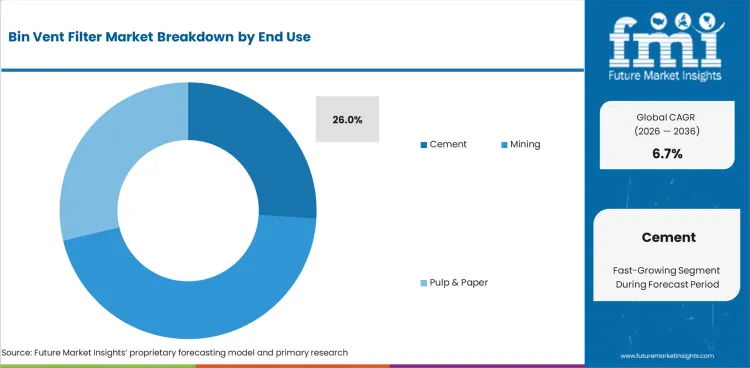
Dust burden at cement sites sets a demanding benchmark for this category. Cement is forecast to contribute 26.0% share in 2026 because daily silo filling, dense powders, and broad housekeeping exposure keep vent performance tied to plant uptime rather than a simple compliance box. Purchasing managers in this end use care about whether a unit can hold stable filtration under frequent loading and survive abrasive service around bulk storage assets. FMI sees that same operating discipline in ambient dust monitors where local plant conditions push buyers toward equipment that stays dependable under sustained particulate load. Weak vent capture at a cement silo quickly turns into product loss, cleanup labor, and dust accumulation around access platforms.
- Throughput pressure: Frequent powder movement raises the value of collectors that hold performance through back-to-back filling events.
- Housekeeping burden: Poor venting lets dust settle on structures and walkways, expanding cleaning routines and exposure around the silo top.
- Plant continuity: Stable filtration matters because repeated interruptions around storage and transfer points can slow wider powder handling schedules.
Bin Vent Filter Market Analysis by Cleaning Mode
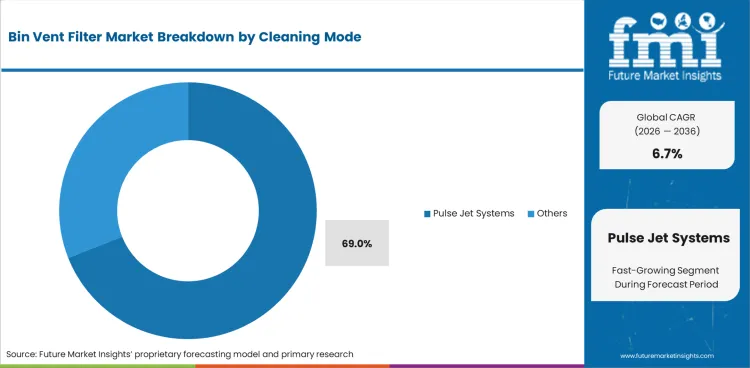
Frequent silo filling increases the need for continuous filter cleaning during operation. Pulse jet systems are anticipated to represent 69.0% share of the cleaning mode segment in 2026, as they remove dust during operation without waiting for manual intervention. Maintenance planning favors cleaning methods that align with repeated loading cycles and reduce the risk of airflow restriction in transfer systems. Equipment selection increasingly reflects the need for uninterrupted operation rather than lower initial cost. Systems with slower or manual cleaning response often lead to reduced airflow and delayed maintenance, which affects overall process efficiency.
- Cycle stability: Pulse cleaning supports repeat loading without forcing operators to pause filling for manual attention.
- Labor demand: Automatic cleaning cuts dependence on intervention at elevated mounting points where access is slower and risk is higher.
- Airflow retention: More consistent media cleaning helps preserve venting capacity and limits dust escape during dense fill events.
Bin Vent Filter Market Analysis by Mounting
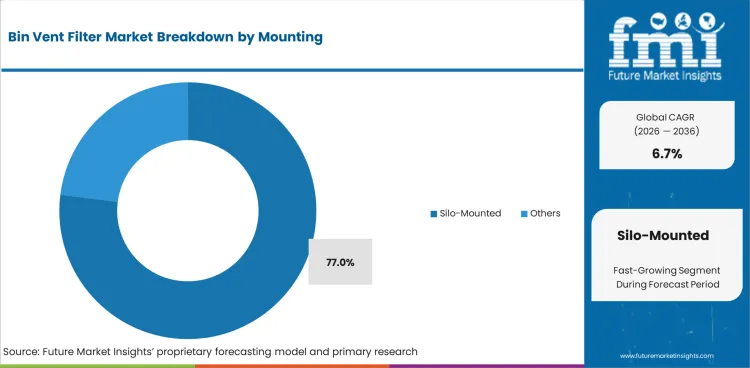
Vent location affects overall system performance and installation complexity. Direct mounting on silos keeps airflow paths short, reduces installation effort, and simplifies retrofit work compared to remote setups with extended ducting. Project engineers prefer this approach when aiming to minimize duct joints, structural modifications, and distance from the dust release point. Similar patterns are seen in other point-of-use filtration systems where direct placement improves control and reduces installation burden. Silo-mounted units are expected to account for 77.0% share of the mounting segment over the study period, reflecting this preference. Remote mounting remains relevant in space-constrained layouts but introduces added routing complexity that most facilities try to avoid.
- Routing simplicity: Direct mounting reduces ductwork, pressure losses, and installation steps around the storage vessel.
- Retrofit ease: Existing silos are easier to upgrade when the collector can mount at the vent point with limited structural change.
- Containment control: Shorter airflow paths help keep displaced dusty air under control before it spreads beyond the top of the vessel.
Bin Vent Filter Market Drivers, Restraints, and Opportunities
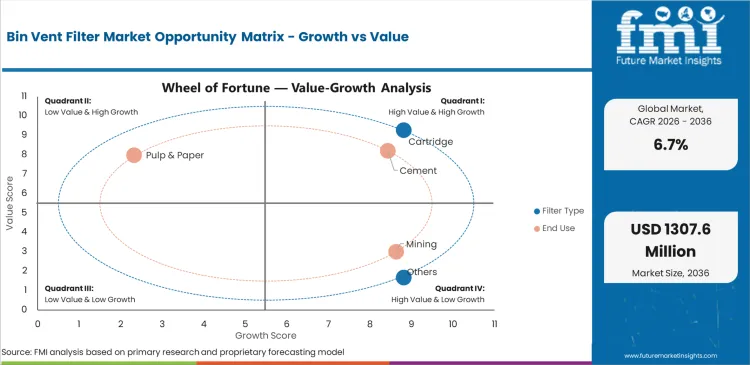
Plant decisions on vent filters are shifting from reactive fixes to planned system specification. Undersized or poorly maintained vent points increase dust release, cleanup effort, and worker exposure during frequent filling cycles. Facilities handling cement, food powders, and chemicals are placing vent filters earlier in equipment planning to ensure stable operation across storage assets. Adoption is slowed by the need to align multiple functions across engineering, maintenance, safety, and budgeting. Vent filters affect several operational areas, which makes it difficult to assign clear ownership for upgrade decisions. Plants with long operating histories often continue using existing designs to avoid changes in spare parts, service routines, and maintenance access.
Retrofit-friendly designs help reduce some of these barriers by simplifying installation within existing layouts. Approval timelines remain extended when shutdown windows are limited or when access to silo tops is restricted. These factors continue to delay replacement even when performance improvements are clear.
Opportunities in the Bin Vent Filter Market
- Retrofit programs: Retrofit work can widen as plant teams replace difficult silo-top units with easier-service housings that cut shutdown time and improve dust capture around older storage assets.
- Powder hygiene: Food and specialty powder sites create room for premium vent filters when sanitation, product recovery, and cleaner service access matter alongside local containment, a pattern close to food air filtration.
- Service coverage: Local service networks gain ground when buyers want faster cartridge supply, installation support, and troubleshooting close to plant clusters instead of waiting on distant channel partners.
Regional Analysis
Based on the regional analysis, the Bin Vent Filter Market is segmented into North America, Latin America, Western Europe, Eastern Europe, East Asia, South Asia & Pacific, and the Middle East & Africa across 40 plus countries.
.webp "Top Country Growth Comparison Bin Vent Filter Market Cagr (2026 2036)")
| Country | CAGR (2026 to 2036) |
|---|---|
| India | 7.3% |
| China | 6.4% |
| USA | 5.6% |
| Brazil | 5.2% |
| Germany | 4.9% |
| France | 4.7% |
| Japan | 4.3% |
Source: Future Market Insights (FMI) analysis, based on proprietary forecasting model and primary research
Asia Pacific Bin Vent Filter Market Analysis
New silo additions still explain more of the regional curve than replacement demand. Buyers across Asia Pacific are adding powder handling assets in cement, chemicals, and food processing, so vent filters are specified with new projects rather than sourced only when old housings fail. FMI associates this pattern with adjacent gcc filtration and other industrial air-control categories where greenfield capacity lifts equipment demand faster than service-led replacement. Regional growth stays strongest where project execution, maintenance labor, and local powder throughput all favor simple silo-top units that can be commissioned quickly.
- India: India is expected to record 7.3% CAGR in the bin vent filter market during 2026 to 2036. Expansion in cement grinding units and food ingredient processing continues to add silo capacity across industrial clusters. Operators prioritize filters that handle frequent fill cycles without increasing maintenance frequency. Undersized systems often lead to visible dust escape during peak operations, which directly affects housekeeping and compliance. Equipment selection is therefore tied to cleaning efficiency and service intervals. These factors support consistent first-fit demand across new installations.
- China: China’s industrial sites operate under high material throughput, where continuous filling and discharge cycles place pressure on venting systems. The market is projected to grow at a CAGR of 6.4% through 2036, supported by sustained activity across chemicals, minerals, and bulk storage operations. Facilities often delay upgrades, which leaves older vent units handling higher dust loads than intended. Maintenance teams compensate through increased cleaning frequency. Equipment demand is shaped by the need to reduce this manual burden. These conditions keep both replacement and fresh installation activity active across processing environments.
- Japan: Replacement discipline defines demand in Japan, where facilities extend equipment life but maintain strict performance expectations. Growth is likely to reach 4.3% through 2036, reflecting selective upgrades rather than expansion-led demand. Operators prioritize compact vent filters that fit existing silo layouts without structural modification. Service predictability and low maintenance disruption are critical evaluation points. Equipment must operate reliably over extended cycles without frequent intervention. These factors sustain demand for precision-engineered systems in controlled processing environments.
FMI's report also covers South Korea, ASEAN process sites, and additional powder-handling locations across the wider region. Shared demand strength across these countries comes from new storage assets and the need to contain dust close to the vessel rather than after it spreads through the work area.
Europe Bin Vent Filter Market Analysis
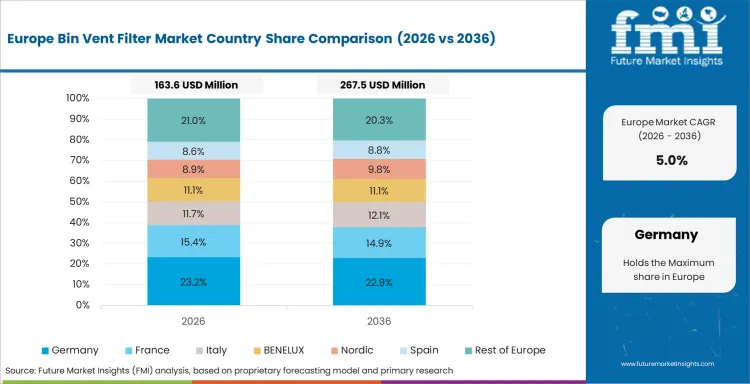
Replacement logic carries more weight in Europe because many process plants already operate mature storage and transfer infrastructure. Procurement teams here spend more time on maintenance access, exposed-location durability, and service routines that fit narrow shutdown windows. FMI reads the same practical focus in share analysis where installed-base behavior shapes supplier choice as much as new project demand. Regional growth stays positive, yet buyers usually want proof that a vent filter cuts recurring maintenance burden before they approve broader rollouts across existing silo fleets.
- Germany: Germany is projected to record 4.9% CAGR in the bin vent filter market over the study period, supported by steady replacement demand across industrial facilities. Engineering teams assess equipment based on total upkeep effort, including cartridge access and cleaning cycles. Systems that complicate maintenance routines often fail to scale beyond pilot installations. Operators prioritize designs that reduce intervention frequency. Integration with existing silo-top layouts remains essential. These factors support demand for durable and service-friendly vent filtration systems.
- France: Facilities in France continue to address dust control as part of broader plant maintenance planning. The market in France is estimated to rise at 4.7% CAGR through 2036, supported by ongoing replacement needs in food, minerals, and materials handling sectors. Operators focus on systems that maintain cleanliness around working areas without increasing service complexity. Delayed upgrades often result in continued reliance on older units with higher maintenance burden. Equipment selection is therefore tied to reducing recurring operational effort. These conditions support steady but selective adoption.
FMI's study extends to the UK, Italy, Spain, Benelux, and Nordic countries. Common across these markets is a preference for durable vent collectors that fit retrofit work cleanly and do not create extra complexity at the top of an already crowded silo.
North America and Latin America Bin Vent Filter Market Analysis
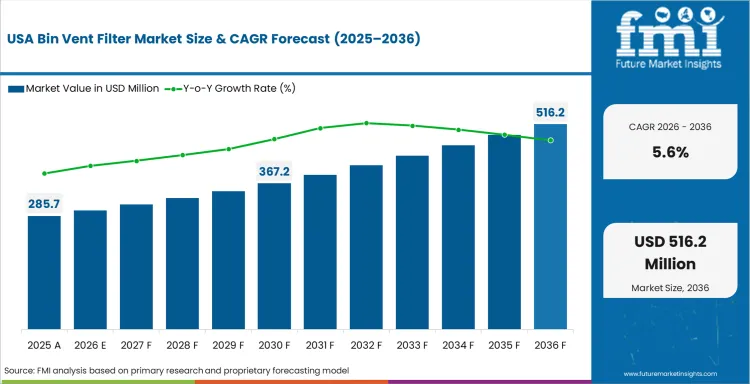
Across the Americas, purchasing decisions are shaped by operating continuity and maintenance cost rather than installation scale. Facilities evaluate vent filters based on how effectively they localize dust during repeated fill cycles. Operators compare systems based on service interval, accessibility, and impact on routine plant operations. Retrofit demand remains strong in established facilities, while new installations are linked to agricultural and industrial expansion.
- USA: Grain, food ingredient, cement, and chemical processing facilities keep dust control high on the specification priority list across the United States. Bin vent filter sales in the USA are projected to grow at a 5.6% CAGR from 2026 to 2036. Expansion is owing to replacement and retrofit demand in mature plants. Facilities that delay upgrades often continue to absorb higher cleanup labor, inconsistent filtration performance, and service inefficiencies around active bulk storage assets. As maintenance costs and exposure concerns accumulate, operators increasingly evaluate vent filters based on service access, cleaning reliability, and their impact on day‑to‑day plant operations.
- Brazil: Brazil shows steady movement in this category, with growth aligned at 5.2% CAGR through 2036, supported by mining and bulk material handling activity. Facilities handling minerals and agricultural products face dust control challenges during high-volume transfer operations. Operators rely on vent filters to contain emissions at the source rather than managing dispersed dust. Equipment must perform under variable humidity and material conditions. Delayed investment often increases reliance on manual cleaning practices. These conditions support continued adoption across logistics and processing environments.
FMI's report also examines Canada, Mexico, and additional Latin American countries. Broader regional demand depends on whether operators treat venting as a dedicated control point near storage assets instead of a minor accessory bought late in the project cycle.
Competitive Aligners for Market Players
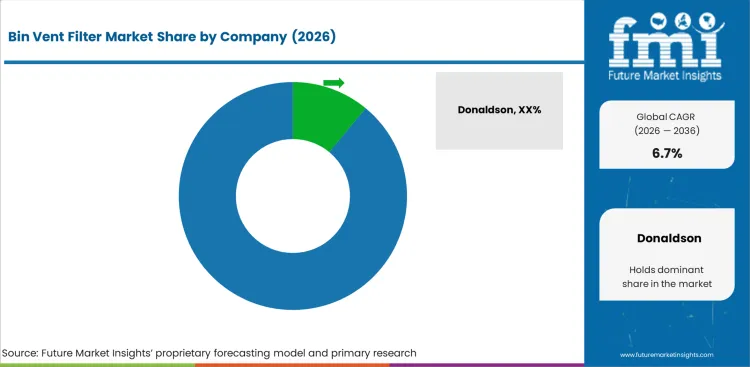
Moderate fragmentation reflects the balance between specialized engineering requirements and broad industrial use. The product category rewards application knowledge, while still allowing regional suppliers to compete in specific end uses. Buyers compare suppliers based on filter life, service access, mounting ease, and performance during repeated silo filling rather than brand visibility. Suppliers such as Donaldson, Camfil, WAMGROUP, Nederman, Parker Hannifin, Aqseptence, and Menardi gain traction when they demonstrate reliable performance in handling difficult powders. Demand patterns also align with other filtration systems where reducing maintenance effort is a key selection factor.
Established suppliers benefit from familiarity with installed systems, strong distribution channels, and confidence in spare part availability. Buyers avoid changing designs unless there is a clear improvement in service access, equipment profile, or cleaning reliability. Companies with broader filtration portfolios remain active in early project discussions by offering solutions across related applications such as membrane filtration and plant utility systems. New entrants can still compete when they address specific service or performance gaps not resolved by existing equipment.
Large industrial users avoid dependence on a single supplier by selecting equipment that supports interchangeable components and practical retrofit options. Local service support remains important to reduce downtime during cartridge replacement. Supplier influence is stronger in facilities where approved vendor lists are already defined. Competition is expected to expand gradually through 2036, though suppliers with strong field support, filtration expertise, and faster service response will retain an advantage in dust-intensive operations.
Key Players in Bin Vent Filter Market
- Donaldson
- Camfil
- WAMGROUP
- Nederman
- Parker Hannifin
- Aqseptence Group
- Menardi
- Schenck Process
- AUMUND
Scope of the Report
| Metric | Value |
|---|---|
| Quantitative Units | USD million |
| Market Definition | Dedicated vent filtration units installed on silos, bins, and hoppers to release displaced air while retaining process dust during pneumatic filling and dry bulk solids handling. |
| Filter Type Segmentation | Cartridge Bin Vents, Bag Bin Vents, Compact Vent Filters |
| End Use Segmentation | Cement, Food, Chemicals, Mining & Minerals, Other |
| Cleaning Mode Segmentation | Pulse Jet, Shaker/Other |
| Mounting Segmentation | Silo-mounted, Remote/Other |
| Regions Covered | North America, Latin America, Western Europe, Eastern Europe, East Asia, South Asia & Pacific, Middle East & Africa |
| Countries Covered | USA, Germany, France, China, India, Japan, Brazil, and 40 plus countries |
| Key Companies Profiled | Donaldson, Camfil, WAMGROUP, Nederman, Parker Hannifin, Aqseptence Group, Menardi, Schenck Process, AUMUND |
| Forecast Period | 2026 to 2036 |
| Approach | FMI combined primary interviews with plant engineers, maintenance managers, and filtration suppliers with desk review of product literature, standards, safety guidance, and adjacent filtration categories. Baseline sizing was anchored to the supplied market inputs and cross-checked against end-use logic, active supplier presence, and country-level industrial handling intensity. Forecast validation focused on replacement behavior, greenfield silo additions, and operating conditions across dusty bulk solids applications. |
Source: Future Market Insights (FMI) analysis, based on proprietary forecasting model and primary research
Air Cannon System Market Analysis by Segments
By Cannon Type
- Standard Air Cannons
- High-temp Air Cannons
- Smart Air Cannons
By End Use
- Cement
- Power Generation
- Mining
- Pulp & Paper
- Other Industries
By Vessel/Application
- Preheaters/Kilns
- Silos/Hoppers
- Cyclones
- Baghouses/ESP Ducts
- Other Vessels
By Control Type
- Manual/Timer-based
- Automated/PLC-based
Region
- North America
- United States
- Canada
- Europe
- Germany
- United Kingdom
- France
- Italy
- Spain
- Asia Pacific
- China
- Japan
- South Korea
- Taiwan
- Singapore
- Latin America
- Brazil
- Mexico
- Argentina
- Middle East & Africa
- GCC Countries
- South Africa
- Israel
Bibliography
- Occupational Safety and Health Administration. (2024). Regional Emphasis Program for Grain Handling Facilities.
- Occupational Safety and Health Administration. (2024). Department of Labor investigators find Nebraska grain cooperative exposed workers to combustible dust, multiple hazards at Hemingford elevator.
- Centers for Disease Control and Prevention, National Institute for Occupational Safety and Health. (2024, January). Quantification of Airborne Dusts From Powders.
- International Organization for Standardization. (2025). ISO 16313-1:2025 Laboratory test of dust collection systems utilizing filter media with automatic online cleaning - Part 1: System utilizing integrated fans.
- National Fire Protection Association. (2025, January). Second Revision No. 17-NFPA 91-2024.
This Report Addresses
- Market intelligence to support strategic decision making across cartridge bin vents, bag bin vents, compact vent filters, and related silo-top dust containment equipment.
- Market size estimation and 10-year revenue forecasts from 2026 to 2036, supported by primary interviews and operating-logic validation across dusty bulk solids applications.
- Growth opportunity mapping across filter type, end use, cleaning mode, mounting, and regional demand with emphasis on repeat specification once plant teams trust vent performance and service access.
- Segment and regional forecasts covering cement, food, chemicals, and mining & minerals across silo filling, dry powder transfer, and retrofit-heavy plant environments.
- Competition strategy assessment including service access, replacement-part confidence, mounting practicality, filter life, and local support coverage.
- Product development tracking across pulse cleaning, compact housings, cartridge servicing, exposed-location durability, and silo-mounted installation preferences.
- Market access analysis covering housekeeping pressure, worker-area dust containment, plant retrofit timing, and qualification delays inside maintenance and engineering teams.
- Market report delivery in PDF, Excel, PPT, and interactive dashboard formats for executive strategy, project planning, and operational benchmarking use.
Frequently Asked Questions
How large is the Bin Vent Filter Market in 2026?
FMI estimates the Bin Vent Filter Market at USD 640.7 million in 2026. Value at that stage reflects a category that sits close to plant operations and is bought for practical containment around silos, bins, and hoppers.
What will Bin Vent Filter Market be valued at by 2036?
Forecast value reaches USD 1,225.5 million by 2036. Expansion comes from a mix of replacement work in mature plants and fresh silo additions in faster-growing industrial countries.
What CAGR is projected for Bin Vent Filter Market during 2026 to 2036?
FMI projects a 6.70% CAGR for Bin Vent Filter Market during 2026 to 2036. Pace stays within the normal band for established industrial filtration equipment rather than an exceptional-growth profile.
Which Filter Type segment leads Bin Vent Filter Market?
Cartridge Bin Vents lead filter type demand with 53.0% share in 2026. Preference comes from compact design, pulse-clean compatibility, and cleaner service access on silo tops.
Which End Use segment leads Bin Vent Filter Market?
Cement leads end use demand with 26.0% share in 2026. Powder throughput, repeated filling, and broad housekeeping exposure make local vent containment especially important at cement sites.
Which Cleaning Mode segment leads Bin Vent Filter Market?
Pulse Jet leads cleaning mode demand with 69.0% share in 2026. Automatic cleaning suits frequent loading cycles better than approaches that need more manual attention.
Which Mounting segment leads Bin Vent Filter Market?
Silo-mounted systems lead mounting demand with 77.0% share in 2026. Buyers prefer direct placement at the vent point because it limits routing complexity and simplifies retrofit work.
What drives faster expansion in this category?
Core demand comes from dusty bulk solids handling where displaced air must be vented without releasing product dust around storage assets. Buyers move faster when silo filling is frequent, housekeeping burden is visible, and maintenance teams want simpler service routines.
Why do buyers increasingly favor cartridge-based bin vent filters?
Service access and compact footprint explain much of that preference. Plants gain value when cartridge changes can be managed from the clean side with less disruption to surrounding work areas.
Why does pulse cleaning dominate this category?
Pulse cleaning lines up with the way many silos are filled in repeated cycles. Operators want a vent filter that keeps working during service demand rather than one that depends on frequent manual intervention.
Why does silo-mounted installation stay ahead of remote mounting?
Direct mounting keeps the vent filter close to the point where dusty air is displaced. That lowers duct burden and makes the containment task easier to manage during retrofit and day-to-day operation.
Which countries show the fastest growth for Bin Vent Filter demand?
India leads at 7.3% CAGR, followed by China at 6.4%. Both countries add more first-fit demand because industrial capacity and powder handling infrastructure continue to expand.
How does the USA compare with faster-growing Asian countries?
USA demand grows at 5.6% CAGR, which is slower than India and China yet still healthy for a mature installed base. More of the USA curve comes from replacement and retrofit work than from broad greenfield volume.
Why do Germany, France, and Japan grow more slowly?
Replacement demand carries more weight in those countries. Buyers there often focus on service discipline, maintenance access, and life extension inside mature process infrastructure rather than on broad new-build additions.
What does the market definition include?
Scope covers dedicated vent filtration units installed on silos, bins, and hoppers to release displaced air while retaining process dust. Product types include cartridge bin vents, bag bin vents, and compact vent filters.
What sits outside the market definition?
Large centralized baghouses, general HVAC filters, and wet scrubbers are excluded. Those products solve different airflow and process-control problems than a dedicated bin or silo vent filter.
Who are the key companies active in this space?
Recognized participants include Donaldson, Camfil, WAMGROUP, Nederman, Parker Hannifin, Aqseptence Group, Menardi, Schenck Process, and AUMUND. Competitive position depends more on reliable application fit and service credibility than on broad branding alone.
Is the competitive structure concentrated or fragmented?
FMI views the structure as moderately fragmented. Donaldson is estimated to lead, while the rest of demand remains spread across multiple regional and application-focused suppliers.
What do buyers usually compare when evaluating suppliers?
Service access, filter life, mounting practicality, replacement-part confidence, and local support all matter. A vent filter that is difficult to service can quickly erase any upfront price advantage.
What is the main restraint on faster adoption?
Qualification delay remains the clearest restraint. Vent filters often need agreement across engineering, maintenance, safety, and project budgeting before a change is approved.
Where are the strongest opportunities likely to appear?
Retrofit programs, powder hygiene applications, and stronger local service networks offer the clearest opportunities. Sites with older silo-top units become attractive once maintenance burden and cleanup cost are easy to see.
How should readers interpret the 2036 outlook?
Outlook suggests a larger installed base with more deliberate specification around cleaning mode, service access, and mounting simplicity. Growth does not depend on novelty alone; it depends on how consistently vent filters solve practical dust containment around active storage assets.
Preview the report firsthand - request a free sample
Get SampleGet the brochure for pricing and purchase details.
Get PDFTable of Content
- Executive Summary
- Global Market Outlook
- Demand-side Trends
- Supply-side Trends
- Technology Roadmap Analysis
- Analysis and Recommendations
- Market Overview
- Market Coverage / Taxonomy
- Market Definition / Scope / Limitations
- Research Methodology
- Chapter Orientation
- Analytical Lens and Working Hypotheses
- Market Structure, Signals, and Trend Drivers
- Benchmarking and Cross-market Comparability
- Market Sizing, Forecasting, and Opportunity Mapping
- Research Design and Evidence Framework
- Desk Research Programme (Secondary Evidence)
- Company Annual and Sustainability Reports
- Peer-reviewed Journals and Academic Literature
- Corporate Websites, Product Literature, and Technical Notes
- Earnings Decks and Investor Briefings
- Statutory Filings and Regulatory Disclosures
- Technical White Papers and Standards Notes
- Trade Journals, Industry Magazines, and Analyst Briefs
- Conference Proceedings, Webinars, and Seminar Materials
- Government Statistics Portals and Public Data Releases
- Press Releases and Reputable Media Coverage
- Specialist Newsletters and Curated Briefings
- Sector Databases and Reference Repositories
- FMI Internal Proprietary Databases and Historical Market Datasets
- Subscription Datasets and Paid Sources
- Social Channels, Communities, and Digital Listening Inputs
- Additional Desk Sources
- Expert Input and Fieldwork (Primary Evidence)
- Primary Modes
- Qualitative Interviews and Expert Elicitation
- Quantitative Surveys and Structured Data Capture
- Blended Approach
- Why Primary Evidence is Used
- Field Techniques
- Interviews
- Surveys
- Focus Groups
- Observational and In-context Research
- Social and Community Interactions
- Stakeholder Universe Engaged
- C-suite Leaders
- Board Members
- Presidents and Vice Presidents
- R&D and Innovation Heads
- Technical Specialists
- Domain Subject-matter Experts
- Scientists
- Physicians and Other Healthcare Professionals
- Governance, Ethics, and Data Stewardship
- Research Ethics
- Data Integrity and Handling
- Primary Modes
- Tooling, Models, and Reference Databases
- Desk Research Programme (Secondary Evidence)
- Data Engineering and Model Build
- Data Acquisition and Ingestion
- Cleaning, Normalisation, and Verification
- Synthesis, Triangulation, and Analysis
- Quality Assurance and Audit Trail
- Market Background
- Market Dynamics
- Drivers
- Restraints
- Opportunity
- Trends
- Scenario Forecast
- Demand in Optimistic Scenario
- Demand in Likely Scenario
- Demand in Conservative Scenario
- Opportunity Map Analysis
- Product Life Cycle Analysis
- Supply Chain Analysis
- Investment Feasibility Matrix
- Value Chain Analysis
- PESTLE and Porter’s Analysis
- Regulatory Landscape
- Regional Parent Market Outlook
- Production and Consumption Statistics
- Import and Export Statistics
- Market Dynamics
- Global Market Analysis 2021 to 2025 and Forecast, 2026 to 2036
- Historical Market Size Value (USD Million) Analysis, 2021 to 2025
- Current and Future Market Size Value (USD Million) Projections, 2026 to 2036
- Y-o-Y Growth Trend Analysis
- Absolute $ Opportunity Analysis
- Global Market Pricing Analysis 2021 to 2025 and Forecast 2026 to 2036
- Global Market Analysis 2021 to 2025 and Forecast 2026 to 2036, By Filter Type
- Introduction / Key Findings
- Historical Market Size Value (USD Million) Analysis By Filter Type , 2021 to 2025
- Current and Future Market Size Value (USD Million) Analysis and Forecast By Filter Type , 2026 to 2036
- Cartridge
- Others
- Cartridge
- Y-o-Y Growth Trend Analysis By Filter Type , 2021 to 2025
- Absolute $ Opportunity Analysis By Filter Type , 2026 to 2036
- Global Market Analysis 2021 to 2025 and Forecast 2026 to 2036, By End Use
- Introduction / Key Findings
- Historical Market Size Value (USD Million) Analysis By End Use, 2021 to 2025
- Current and Future Market Size Value (USD Million) Analysis and Forecast By End Use, 2026 to 2036
- Cement
- Mining
- Pulp & Paper
- Cement
- Y-o-Y Growth Trend Analysis By End Use, 2021 to 2025
- Absolute $ Opportunity Analysis By End Use, 2026 to 2036
- Global Market Analysis 2021 to 2025 and Forecast 2026 to 2036, By Cleaning Mode
- Introduction / Key Findings
- Historical Market Size Value (USD Million) Analysis By Cleaning Mode, 2021 to 2025
- Current and Future Market Size Value (USD Million) Analysis and Forecast By Cleaning Mode, 2026 to 2036
- Pulse Jet Systems
- Others
- Pulse Jet Systems
- Y-o-Y Growth Trend Analysis By Cleaning Mode, 2021 to 2025
- Absolute $ Opportunity Analysis By Cleaning Mode, 2026 to 2036
- Global Market Analysis 2021 to 2025 and Forecast 2026 to 2036, By Mounting
- Introduction / Key Findings
- Historical Market Size Value (USD Million) Analysis By Mounting, 2021 to 2025
- Current and Future Market Size Value (USD Million) Analysis and Forecast By Mounting, 2026 to 2036
- Silo-Mounted
- Others
- Silo-Mounted
- Y-o-Y Growth Trend Analysis By Mounting, 2021 to 2025
- Absolute $ Opportunity Analysis By Mounting, 2026 to 2036
- Global Market Analysis 2021 to 2025 and Forecast 2026 to 2036, By Region
- Introduction
- Historical Market Size Value (USD Million) Analysis By Region, 2021 to 2025
- Current Market Size Value (USD Million) Analysis and Forecast By Region, 2026 to 2036
- North America
- Latin America
- Western Europe
- Eastern Europe
- East Asia
- South Asia and Pacific
- Middle East & Africa
- Market Attractiveness Analysis By Region
- North America Market Analysis 2021 to 2025 and Forecast 2026 to 2036, By Country
- Historical Market Size Value (USD Million) Trend Analysis By Market Taxonomy, 2021 to 2025
- Market Size Value (USD Million) Forecast By Market Taxonomy, 2026 to 2036
- By Country
- USA
- Canada
- Mexico
- By Filter Type
- By End Use
- By Cleaning Mode
- By Mounting
- By Country
- Market Attractiveness Analysis
- By Country
- By Filter Type
- By End Use
- By Cleaning Mode
- By Mounting
- Key Takeaways
- Latin America Market Analysis 2021 to 2025 and Forecast 2026 to 2036, By Country
- Historical Market Size Value (USD Million) Trend Analysis By Market Taxonomy, 2021 to 2025
- Market Size Value (USD Million) Forecast By Market Taxonomy, 2026 to 2036
- By Country
- Brazil
- Chile
- Rest of Latin America
- By Filter Type
- By End Use
- By Cleaning Mode
- By Mounting
- By Country
- Market Attractiveness Analysis
- By Country
- By Filter Type
- By End Use
- By Cleaning Mode
- By Mounting
- Key Takeaways
- Western Europe Market Analysis 2021 to 2025 and Forecast 2026 to 2036, By Country
- Historical Market Size Value (USD Million) Trend Analysis By Market Taxonomy, 2021 to 2025
- Market Size Value (USD Million) Forecast By Market Taxonomy, 2026 to 2036
- By Country
- Germany
- UK
- Italy
- Spain
- France
- Nordic
- BENELUX
- Rest of Western Europe
- By Filter Type
- By End Use
- By Cleaning Mode
- By Mounting
- By Country
- Market Attractiveness Analysis
- By Country
- By Filter Type
- By End Use
- By Cleaning Mode
- By Mounting
- Key Takeaways
- Eastern Europe Market Analysis 2021 to 2025 and Forecast 2026 to 2036, By Country
- Historical Market Size Value (USD Million) Trend Analysis By Market Taxonomy, 2021 to 2025
- Market Size Value (USD Million) Forecast By Market Taxonomy, 2026 to 2036
- By Country
- Russia
- Poland
- Hungary
- Balkan & Baltic
- Rest of Eastern Europe
- By Filter Type
- By End Use
- By Cleaning Mode
- By Mounting
- By Country
- Market Attractiveness Analysis
- By Country
- By Filter Type
- By End Use
- By Cleaning Mode
- By Mounting
- Key Takeaways
- East Asia Market Analysis 2021 to 2025 and Forecast 2026 to 2036, By Country
- Historical Market Size Value (USD Million) Trend Analysis By Market Taxonomy, 2021 to 2025
- Market Size Value (USD Million) Forecast By Market Taxonomy, 2026 to 2036
- By Country
- China
- Japan
- South Korea
- By Filter Type
- By End Use
- By Cleaning Mode
- By Mounting
- By Country
- Market Attractiveness Analysis
- By Country
- By Filter Type
- By End Use
- By Cleaning Mode
- By Mounting
- Key Takeaways
- South Asia and Pacific Market Analysis 2021 to 2025 and Forecast 2026 to 2036, By Country
- Historical Market Size Value (USD Million) Trend Analysis By Market Taxonomy, 2021 to 2025
- Market Size Value (USD Million) Forecast By Market Taxonomy, 2026 to 2036
- By Country
- India
- ASEAN
- Australia & New Zealand
- Rest of South Asia and Pacific
- By Filter Type
- By End Use
- By Cleaning Mode
- By Mounting
- By Country
- Market Attractiveness Analysis
- By Country
- By Filter Type
- By End Use
- By Cleaning Mode
- By Mounting
- Key Takeaways
- Middle East & Africa Market Analysis 2021 to 2025 and Forecast 2026 to 2036, By Country
- Historical Market Size Value (USD Million) Trend Analysis By Market Taxonomy, 2021 to 2025
- Market Size Value (USD Million) Forecast By Market Taxonomy, 2026 to 2036
- By Country
- Kingdom of Saudi Arabia
- Other GCC Countries
- Turkiye
- South Africa
- Other African Union
- Rest of Middle East & Africa
- By Filter Type
- By End Use
- By Cleaning Mode
- By Mounting
- By Country
- Market Attractiveness Analysis
- By Country
- By Filter Type
- By End Use
- By Cleaning Mode
- By Mounting
- Key Takeaways
- Key Countries Market Analysis
- USA
- Pricing Analysis
- Market Share Analysis, 2025
- By Filter Type
- By End Use
- By Cleaning Mode
- By Mounting
- Canada
- Pricing Analysis
- Market Share Analysis, 2025
- By Filter Type
- By End Use
- By Cleaning Mode
- By Mounting
- Mexico
- Pricing Analysis
- Market Share Analysis, 2025
- By Filter Type
- By End Use
- By Cleaning Mode
- By Mounting
- Brazil
- Pricing Analysis
- Market Share Analysis, 2025
- By Filter Type
- By End Use
- By Cleaning Mode
- By Mounting
- Chile
- Pricing Analysis
- Market Share Analysis, 2025
- By Filter Type
- By End Use
- By Cleaning Mode
- By Mounting
- Germany
- Pricing Analysis
- Market Share Analysis, 2025
- By Filter Type
- By End Use
- By Cleaning Mode
- By Mounting
- UK
- Pricing Analysis
- Market Share Analysis, 2025
- By Filter Type
- By End Use
- By Cleaning Mode
- By Mounting
- Italy
- Pricing Analysis
- Market Share Analysis, 2025
- By Filter Type
- By End Use
- By Cleaning Mode
- By Mounting
- Spain
- Pricing Analysis
- Market Share Analysis, 2025
- By Filter Type
- By End Use
- By Cleaning Mode
- By Mounting
- France
- Pricing Analysis
- Market Share Analysis, 2025
- By Filter Type
- By End Use
- By Cleaning Mode
- By Mounting
- India
- Pricing Analysis
- Market Share Analysis, 2025
- By Filter Type
- By End Use
- By Cleaning Mode
- By Mounting
- ASEAN
- Pricing Analysis
- Market Share Analysis, 2025
- By Filter Type
- By End Use
- By Cleaning Mode
- By Mounting
- Australia & New Zealand
- Pricing Analysis
- Market Share Analysis, 2025
- By Filter Type
- By End Use
- By Cleaning Mode
- By Mounting
- China
- Pricing Analysis
- Market Share Analysis, 2025
- By Filter Type
- By End Use
- By Cleaning Mode
- By Mounting
- Japan
- Pricing Analysis
- Market Share Analysis, 2025
- By Filter Type
- By End Use
- By Cleaning Mode
- By Mounting
- South Korea
- Pricing Analysis
- Market Share Analysis, 2025
- By Filter Type
- By End Use
- By Cleaning Mode
- By Mounting
- Russia
- Pricing Analysis
- Market Share Analysis, 2025
- By Filter Type
- By End Use
- By Cleaning Mode
- By Mounting
- Poland
- Pricing Analysis
- Market Share Analysis, 2025
- By Filter Type
- By End Use
- By Cleaning Mode
- By Mounting
- Hungary
- Pricing Analysis
- Market Share Analysis, 2025
- By Filter Type
- By End Use
- By Cleaning Mode
- By Mounting
- Kingdom of Saudi Arabia
- Pricing Analysis
- Market Share Analysis, 2025
- By Filter Type
- By End Use
- By Cleaning Mode
- By Mounting
- Turkiye
- Pricing Analysis
- Market Share Analysis, 2025
- By Filter Type
- By End Use
- By Cleaning Mode
- By Mounting
- South Africa
- Pricing Analysis
- Market Share Analysis, 2025
- By Filter Type
- By End Use
- By Cleaning Mode
- By Mounting
- USA
- Market Structure Analysis
- Competition Dashboard
- Competition Benchmarking
- Market Share Analysis of Top Players
- By Region
- By Filter Type
- By End Use
- By Cleaning Mode
- By Mounting
- Competition Analysis
- Competition Deep Dive
- Donaldson
- Overview
- Product Portfolio
- Profitability by Market Segments (Product/Age /Sales Channel/Region)
- Sales Footprint
- Strategy Overview
- Marketing Strategy
- Product Strategy
- Channel Strategy
- Camfil
- WAMGROUP
- Nederman
- Parker Hannifin
- Aqseptence Group
- Menardi
- Schenck Process
- Donaldson
- Competition Deep Dive
- Assumptions & Acronyms Used


