

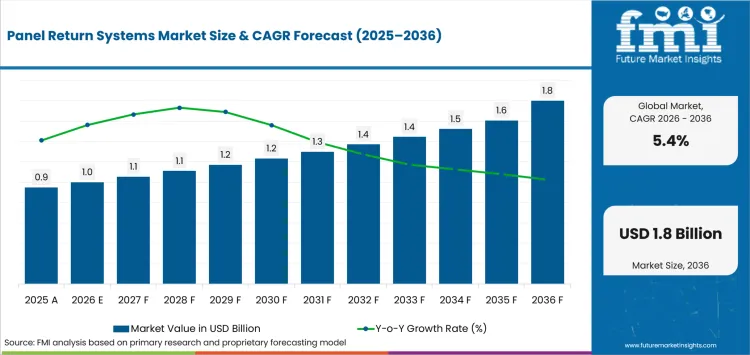
- Market Size (2026)
- USD 1.0 Bn
- Forecast (2036)
- USD 1.8 Bn
- CAGR (2026 to 2036)
- 5.4%
How big is Panel Return Systems Market in 2026?
USD 1.0 billion in 2026 and USD 1.8 billion by 2036 at a 5.4% CAGR.
Demand for panel return systems is projected to expand at a 5.4% CAGR between 2026 and 2036 as furniture plants reduce repeated manual circulation around productive woodworking machines. Biesse reported in May 2026 that HCo 2.0 raised cabinet output from roughly 150 to more than 500 units per day after deploying an integrated batch-one line with automated material flow. That production result does not measure panel-return revenue, but it directly demonstrates why buyers fund automated circulation when repeated transfers constrain machine throughput.
Floor space creates a second investment test because return equipment must fit beside the host machine without disrupting access, controls, or maintenance. HOMAG launched the LOOPTEQ O-400 Footprint Saver package in July 2026 and stated that the configuration can save up to 14 m² while returning workpieces up to 3,100 mm. The development links compact geometry with a practical retrofit route for smaller woodworking plants, where automation must protect throughput without forcing a larger robotic handling cell.
Key Takeaways
- Panel return systems gain demand where repeated passes consume operator time and reduce installed woodworking equipment utilization.
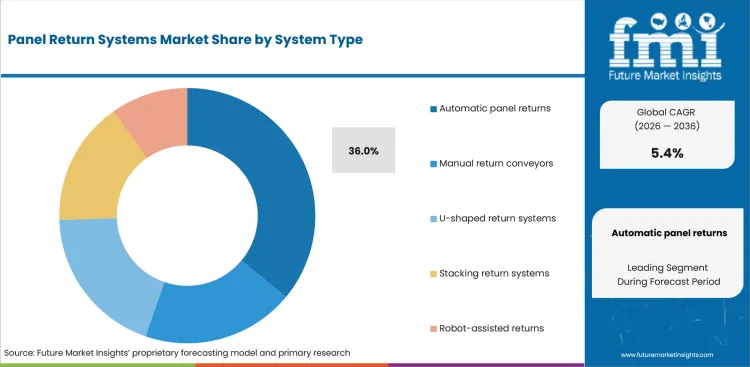
- By system type, automatic panel returns are estimated at 36.0% in 2026 because circulation requires less robotic hardware.
- Edge banders are expected to represent 38.0% of machine integration demand in 2026 owing to repeated passes.
- In 2026, medium panels are forecast to capture 38.0% of panel size demand because standard return geometry handles them.
- Capital approval weakens where floor space or utilization cannot recover integration costs and protect host-machine uptime.
- Some of the key players in this market include Barberán, HOMAG Group, Biesse, SCM Group, IMA Schelling Group, HOMAG Automation (HOMAG Group), Doucet Machineries, VENJAKOB, Cefla Finishing, and KDT Machinery Group.
Analyst Perspective
"Panel return systems justify investment when plants quantify operator time lost between passes and match return geometry to the host machine. Commercial value comes from one-operator flow that fits the plant production mix and service model."
- Nikhil Kaitwade, Principal Consultant, Future Market Insights
How is the panel return systems market segmented?
The panel return systems market is segmented by system type, machine integration, panel size, end use, sales channel and region.
System type includes automatic panel returns, manual return conveyors, U-shaped return systems, stacking return systems and robot-assisted returns. Machine integration covers edge banders, sanding lines, sawing lines, drilling lines and laminating lines. Panel size includes medium, small, large and mixed batch panels while end use covers furniture plants, cabinet factories, panel processors, door manufacturers and modular kitchen lines. Sales channels include machinery OEMs, automation integrators, dealer or distributor networks and aftermarket retrofit for installed equipment.
What supports automatic panel returns within the system type category?
Automatic return equipment sends a processed panel back toward the infeed while keeping movement controlled between passes. Plants evaluating automated material handling can automate circulation before adding robotic loading at every station. At IWF 2026 Biesse demonstrated a broader single-operator panel-flow line combining robotic handling, edgebanding and intelligent sorting inside one connected workflow.
- By system type, automatic panel returns are estimated to account for 36.0% in 2026 because circulation requires less hardware than robotic loading.
- One-operator cells gain value where repeat passes keep return equipment active during regular production shifts.
Why do edge banders represent 38.0% of the machine integration category?
Edge processing requires a controlled return path because rectangular panels often need several sides finished before leaving the cell. Related double edge banders also depend on synchronized workpiece routing and machine logic during repeated processing passes. IMA Schelling described automated edge handling in May 2026 as part of an integrated furniture-production system with connected material flow.
- Edge banders are expected to represent 38.0% of machine integration demand in 2026 owing to repeated processing passes.
- Each additional processed edge requires another controlled pass through the same cell, which raises the value of return equipment.
How do medium panels shape the panel size category?
Medium workpieces fit common belt and roller layouts without the wider turning envelope required for oversized boards. Comparable conveyor systems move panels between woodworking stations under controlled transfer conditions during multi-stage furniture production. HOMAG stated in July 2026 that its LOOPTEQ O-400 Footprint Saver can return workpieces up to 3,100 mm while reducing required floor area.
- In 2026, medium panels are forecast to capture 38.0% of panel size demand owing to manageable turning requirements.
- Standard return widths handle common furniture parts without the larger footprint needed to rotate oversized workpieces safely.
Why do furniture plants represent 34.0% of the end use category?
Furniture plants repeatedly route panel parts through machining and edge-finishing steps where manual unloading can interrupt cycle continuity. Related corner rounding machines add controlled passes in mixed furniture runs where part dimensions change frequently. At ForMóbile 2026 Biesse presented CNC machining and edge-banding automation for furniture manufacturers seeking repeatable production output.
- Furniture plants are projected to represent 34.0% of end use demand in 2026 driven by repetitive panel processing.
- Return cells fit plants where repeat-pass volume keeps one operator productive at the infeed during routine production.
Why do machinery OEMs represent 42.0% of the sales channel category?
Return equipment must match host-machine pass line, controls, and service responsibility before commissioning can proceed without interface rework. Machinery OEMs can align return logic with woodworking CNC tools under one engineering responsibility during new-line installation. KDT reported in June 2026 that its ninth technical-training session of the year was strengthening service expertise for furniture-machinery commissioning and support.
- By sales channel, machinery OEMs are anticipated to hold 42.0% in 2026 attributable to integration responsibility.
- OEM-led sales reduce interface risk because one engineering team can coordinate pass-line settings and machine-control behavior before commissioning.
What are the drivers, restraints and opportunities in the Panel Return Systems Market?
Labor-saving closed-loop handling supports demand while utilization and integration economics constrain purchases and compact modular automation broadens the retrofit opportunity.
- Driver: Furniture and cabinet plants invest where automated return keeps one operator productive during repeated processing passes.
- Restraint: Capital approval weakens if production volume or floor space cannot recover integration and service costs.
- Opportunity: Compact circulation extends automated panel handling into mixed-batch plants that cannot accommodate a large robotic cell.
Repeated handling makes labor savings measurable
Furniture producers can justify return equipment when repeated unloading, carrying, and refeeding consume enough operator time to reduce host-machine utilization. SCM reported in September 2026 that Tecno Logica was expanding integrated automation architectures across edgebanding, drilling, routing, hardware insertion, and furniture-production flow. That company development does not measure panel-return revenue, but it documents the immediate-family shift toward connected cells where repeated panel movement is engineered instead of left to manual labor.
Capital discipline limits overbuilt return cells
Return-system approval weakens when the selected conveyor does not match the host edgebander’s speed, workpiece envelope, or expected production volume. Doucet Machineries stated in its March 2026 XPRS buying guide that lines running above 40 feet per minute or regularly processing parts longer than 15 feet should move to the higher-capacity BT3 configuration. Those thresholds do not measure market demand, but they directly show why an under-specified or over-specified return cell can fail the investment case even when the labor-saving need is clear.
Compact layouts widen the retrofit pool
Plants with restricted floor space can still automate circulation when supporting handling hardware is engineered around the host machine instead of added as a separate oversized cell. HOMAG’s July 2026 Treff program highlighted compact and hybrid robotic systems intended to make automation practical for smaller woodworking operations. The same design logic expands opportunities for industrial robotics and factory automation controls around panel-processing lines. Return suppliers gain a clearer retrofit route when compact geometry and interoperable controls reduce both space consumption and commissioning risk.
Which country CAGRs are profiled in the Panel Return Systems Market?
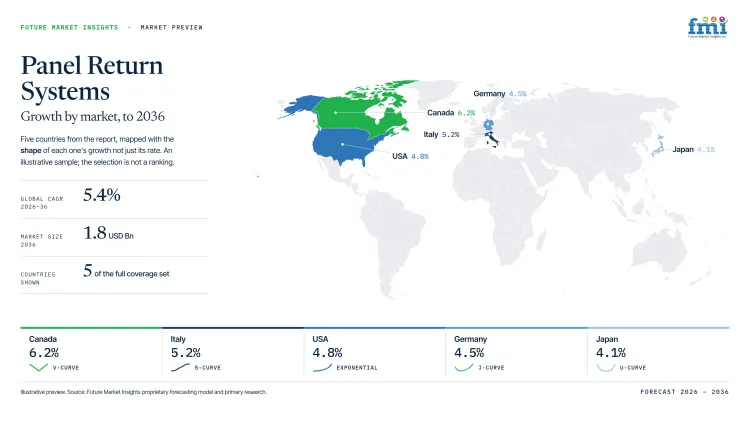
| Country | CAGR |
|---|---|
| Canada | 6.1% |
| Mexico | 5.8% |
| Brazil | 5.5% |
| Italy | 5.1% |
| USA | 4.8% |
| Germany | 4.5% |
| Japan | 4.1% |
How do country-level CAGRs compare in the Panel Return Systems Market?
The seven country forecasts span 2.0 percentage points from Canada at 6.1% to Japan at 4.1% through 2036. The ordering reflects different equipment-purchase routes, service structures, controls requirements, and installed machinery conditions rather than a common national demand mechanism.
- Canada is profiled at 6.1% CAGR, where service reach and retrofit payback become decisive because woodworking plants are dispersed across a large geography.
- Mexico carries a 5.8% CAGR, with imported woodworking machinery increasing the value of local commissioning and controls expertise during retrofit work.
- Brazil is forecast at 5.5% CAGR under a national capital-goods route that explicitly recognizes automated edge-processing equipment and optional workpiece turning.
- At 5.1% CAGR, Italy combines renewed woodworking-machinery spending with mixed installed fleets that keep configurable return engineering important.
- The USA is forecast at 4.8% CAGR, where a substantial domestic machinery base creates room for both compact retrofits and integrated production cells.
- Germany posts 4.5% CAGR as mature automation practices make interoperability and documented interface responsibility central to retrofit approval.
- Japan is forecast at 4.1% CAGR, with an organized national machinery supplier base supporting compact automation and high-mix production requirements.
Country CAGR measures installation pace rather than absolute installed value, so each profile uses national machinery, trade, regulatory, or supplier-network evidence to explain the purchase route. The full report provides country-level CAGR analysis across North America, Latin America, Western Europe, Eastern Europe, East Asia, South Asia and Pacific, and Middle East and Africa.
Country-wise Analysis
- In early 2026, Canadian furniture manufacturing noticed moderate sales, which raises the payback hurdle for discretionary handling automation even where labor savings are visible. Statistics Canada reported seasonally adjusted furniture and related-product manufacturing sales in February 2026, down 2.5% from January. Canada is forecast to grow at 6.1% CAGR through 2036 as plants seek compact retrofits that protect existing machine utilization. Return suppliers can improve conversion by pairing compact material handling equipment with service plans and stocked wear parts, because a remote maintenance delay can erase the labor savings expected from automated circulation.
- Mexican panel processors depend heavily on imported woodworking machinery, so return-system proposals must accommodate varied controls, pass-line heights, and service arrangements. Mexico is forecast to grow at 5.8% CAGR through 2036, with local commissioning becoming more valuable as equipment diversity increases. Data México recorded June 2026 imports of USD 8.59 million and exports of USD 1.47 million for HS 8465 woodworking machine tools. That nationwide trade flow establishes an immediate-family machinery route rather than panel-return revenue itself. Integrators with trained local technicians can reduce interface risk and shorten downtime when return conveyors are added beside imported host machines.
- Brazil’s national capital-goods regime explicitly recognizes automatic panel-edgebanding machinery with optional workpiece turners, giving buyers a defined route for importing closely related automation. GECEX Resolution No. 913 of June 2026 lists such machinery under NCM 8465.94.00 and keeps the cited tariff treatment in force through January 2028. Brazil is forecast to post 5.5% CAGR through 2036, reflecting a market where staged automation can fit plants managing capital carefully. For return-system suppliers, the practical opportunity is to engineer conveyors and turning functions around approved host equipment without forcing a complete production-line replacement.
- Italian woodworking technology in 2026 held a stronger domestic investment base after a year of renewed machinery spending. ACIMALL’s May 2026 final balance reported domestic sales in 2025, up 15%, while imports reached EUR 284 million, up 24.5%. Italy is projected to record 5.1% CAGR through 2036 as mixed installed fleets keep retrofit engineering commercially important. The national machinery rebound creates more openings for return systems, but suppliers still need to solve controls compatibility and pass-line differences so customers can automate circulation without retiring productive edge-processing assets. That constraint favors configurable return layouts over fixed cells designed around uniform equipment and repeated product dimensions.
- USA panel-return projects sit inside a substantial domestic woodworking-machinery base, although cabinet shops and multi-shift plants have very different automation thresholds. The Census Bureau’s February 2026 AIES release reports USD 3.943 billion in 2023 sales, shipments, or revenue for NAICS 333243, covering sawmill, woodworking, and paper machinery manufacturing. The USA is forecast to advance at 4.8% CAGR through 2036 as suppliers address both compact retrofits and integrated cells. That immediate-family statistic does not measure panel-return revenue, so vendors still need plant-level utilization evidence before larger automation packages can clear capital approval.
- German woodworking plants often combine machines from several suppliers and generations, making interoperable controls a condition for adding return automation without replacing productive equipment. VDMA’s third Interoperability Summit in May 2026 focused on seamless data exchange across manufacturers and technologies, a qualification issue that applies directly to connected machine cells. Germany is forecast to expand at 4.5% CAGR through 2036 as buyers require documented interfaces and service responsibility before approving labor-saving retrofits. The commercial limit is integration risk: a return module that cannot exchange reliable production data with the installed line can undermine the value of otherwise capable material-flow hardware.
- Japan’s woodworking-machinery supply base is organized through a national association that maintains both manufacturer and supporting-technology membership. The Japan Woodworking Machinery Association listed 74 regular members and 33 associate members in its directory updated in August 2026. Japan is projected to grow at 4.1% CAGR through 2036, with compact automation remaining relevant for high-mix factories that cannot dedicate large areas to material flow. Supplier depth can improve qualification and service access, but return-system vendors still need flexible controls and dependable local support because a compact footprint alone does not solve frequent recipe changes.
Who are the notable companies in the Panel Return Systems Market?
Barberán, HOMAG Group, Biesse, SCM Group, IMA Schelling Group, HOMAG Automation (HOMAG Group), Doucet Machineries, VENJAKOB, Cefla Finishing, and KDT Machinery Group are notable companies serving this market.
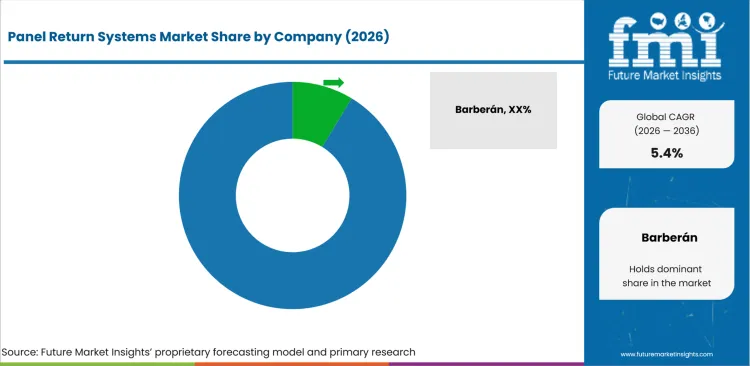
Integrated woodworking groups control more of the machine interface while handling specialists compete on return geometry and panel-flow engineering. HOMAG Automation remains a HOMAG Group company, and integrated suppliers often pair return equipment with edge banders in one engineering package.
- Integrated woodworking cells include HOMAG Group with its HOMAG Automation business plus Biesse, SCM Group and IMA Schelling Group for connected line engineering.
- Dedicated return and handling configurations include Doucet Machineries and KDT Machinery Group for defined conveyor or automated layouts.
- Finishing-line integration includes Barberán, VENJAKOB and Cefla Finishing where engineered panel movement supports coating or lamination operations.
Competitive Benchmarking: Panel Return Systems Market
| Company | Return Architecture Breadth | Processing-Line Integration | Automated Panel Manipulation | Geographic Reach |
|---|---|---|---|---|
| Barberán | Low | Medium | Medium | Europe and international project markets |
| HOMAG Group | High | High | High | Global |
| Biesse | Medium | High | High | Global |
| SCM Group | High | High | High | Global |
| IMA Schelling Group | Medium | High | High | Global |
| HOMAG Automation (HOMAG Group) | High | High | High | HOMAG global service network |
| Doucet Machineries | High | Medium | High | Canada, USA and export markets |
| VENJAKOB | Medium | High | Medium | Europe and North America |
| Cefla Finishing | Medium | High | High | Global project markets |
| KDT Machinery Group | Medium | Medium | Medium | China and export markets |
Scoring basis: High architecture breadth requires return plus turning or stacking while Medium covers one narrower closed-loop configuration. Low identifies one adjacent panel-flow route with documented limits instead of missing public evidence. Processing-line integration is High for several documented woodworking stages and Medium for one relevant stage. Automated manipulation is High for robotic handling plus routing and Medium for one documented automated method. Geographic reach follows documented service operations plus project activity in named regional markets worldwide.
Key Developments in the Panel Return Systems Market
- In July 2026, Biesse acquired Orchestra Srl to strengthen industrial machine interconnection, real-time production monitoring, and manufacturing workflow software across its technology platform.
- In April 2026, IMA Schelling announced the first presentation of VisionAI at its Open House, adding trainable industrial image analysis to woodworking production control and inspection.
- In May 2026, SCM Group company Tecnest announced WinMES as the first MES/MOM solution specifically designed for woodworking and scheduled its market presentation at Xylexpo 2026.
Key Players in the Panel Return Systems Market
Integrated Edge-Processing and Closed-Loop Cells
- HOMAG Group
- HOMAG Automation (HOMAG Group)
- SCM Group
- Biesse
- IMA Schelling Group
Dedicated Return and Handling Platforms
- Doucet Machineries
- KDT Machinery Group
Finishing and Panel-Flow Integrators
- Barberán
- VENJAKOB
- Cefla Finishing
Panel Return Systems Market - Report Scope
| Coverage field | Report scope |
|---|---|
| Market breakdown | By system type, machine integration, panel size, end use, sales channel and region. |
| Quantitative Units | USD million. |
| Market Definition | Commercial panel return conveyors and automated return systems that recirculate processed panels to an operator, machine infeed, stack, or controlled closed-loop path. |
| Regions Covered | North America, Latin America, Western Europe, Eastern Europe, East Asia, South Asia and Pacific and Middle East and Africa. |
| Countries Covered | Canada, Mexico, Brazil, Italy, USA, Germany, Japan, and 20+ countries included in the full report. |
| Key Companies Profiled | Barberán, HOMAG Group, Biesse, SCM Group, IMA Schelling Group, HOMAG Automation (HOMAG Group), Doucet Machineries, VENJAKOB, Cefla Finishing, KDT Machinery Group. |
| Forecast Period | 2026 to 2036. |
| Approach | Primary and secondary research with market triangulation. |
Panel Return Systems Market - Research Methodology
| Method | Approach |
|---|---|
| Primary Research | FMI analysts gathered input from manufacturers, service providers, technology developers, distributors, end users, procurement teams, and subject-matter experts. Interviews examined purchasing decisions, product or service evaluation, adoption barriers, approval requirements, pricing considerations, and expectations for technical or commercial support. Respondents were also asked what evidence is required before a trial, pilot, or initial order develops into regular purchasing. |
| Desk Research | Desk research covered government statistics, regulatory publications, trade data, industry associations, technical literature, standards, company filings, product information, and official corporate announcements. Sources were reviewed for relevance, publication date, geographic coverage, and consistency with the defined market scope. Claims relating to performance, applications, approvals, capacity, investment, and commercial activity were retained only when supported by credible public evidence. |
| Market Sizing and Forecasting | The market model combined the baseline value with historical performance, segment structure, pricing and volume indicators, adoption levels, company participation, and country-level demand conditions. Forecast assumptions considered economic activity, investment trends, regulatory developments, technology adoption, purchasing cycles, supply availability, and barriers to wider market use. Segment and regional estimates were reconciled before the final market total was calculated. |
| Data Validation | Estimates were checked against multiple independent indicators, including public data, company activity, trade patterns, industry developments, and findings from primary interviews. Validation also tested whether products, services, applications, and company revenues fell within the defined market boundaries. Adjacent categories, unsupported claims, overlapping revenues, and activities without direct market relevance were excluded to reduce double counting and maintain consistency across segments and countries. |
Panel Return Systems Market by Segments
Panel Return Systems Market segmented by System Type:
- Automatic panel returns
- Manual return conveyors
- U-shaped return systems
- Stacking return systems
- Robot-assisted returns
Panel Return Systems Market segmented by Machine Integration:
- Edge banders
- Sanding lines
- Sawing lines
- Drilling lines
- Laminating lines
Panel Return Systems Market segmented by Panel Size:
- Medium panels
- Small panels
- Large panels
- Mixed batch panels
Panel Return Systems Market segmented by End Use:
- Furniture plants
- Cabinet factories
- Panel processors
- Door manufacturers
- Modular kitchen lines
Panel Return Systems Market segmented by Sales Channel:
- Machinery OEMs
- Automation integrators
- Dealer - distributor network
- Aftermarket retrofit
Panel Return Systems Market by Region:
- North America
- United States
- Canada
- Latin America
- Brazil
- Mexico
- Argentina
- Chile
- Western Europe
- Germany
- France
- United Kingdom
- Italy
- Spain
- Benelux
- Nordics
- Eastern Europe
- Poland
- Czech Republic
- Romania
- Hungary
- East Asia
- China
- Japan
- South Korea
- South Asia and Pacific
- India
- ASEAN
- Australia and New Zealand
- Middle East and Africa
- GCC Countries
- South Africa
- Türkiye
- Israel
Research Sources and Bibliography
- Biesse. (2026, May 1). Doors Officially Open: Hansen & Company Woodworks Unveils HCo 2.0 in a First-of-Its-Kind National Manufacturing Event Powered by Biesse.
- Statistics Canada. (2026, April 15). Monthly Survey of Manufacturing, February 2026.
- Biesse. (2026, August 25). IWF 2026.
- IMA Schelling Group. (2026, May 18). Connected Manufacturing: The Edge as an Integrated System Component.
- HOMAG Group. (2026, July 24). More Performance with Less Floor Space: The New Footprint Saver package for the LOOPTEQ O-400.
- Biesse. (2026, June 30). ForMóbile 2026.
- KDT Machinery Group. (2026, June 13). 技能进阶 服务升级|技术培训2026年第9期.
- Doucet Machineries. (2026, March 5). Complete Buying Guide - XPRS for Medium-Small Edgebanders.
- HOMAG Group. (2026, July 14). HOMAG Treff 2026 is the perfect platform for discussion, inspiration and the technology of the future.
- SCM Group. (2026, September 7). From furniture to windows and doors, a new automation paradigm.
- Secretaría de Economía, Data México. (2026, June). Machine tools for working wood and similar hard materials: HS 8465.
- Comitê-Executivo de Gestão da Câmara de Comércio Exterior. (2026, June 12). RESOLUÇÃO GECEX Nº 913, DE 12 DE JUNHO DE 2026.
- ACIMALL. (2026, May 5). ACIMALL: The 2025 final balance indicates a stable trend in the wood and furniture technology sector.
- USA Census Bureau. (2026, February 26). Annual Integrated Economic Survey: Selected sectors, NAICS 333243.
- VDMA. (2026, May 7). 3rd Interoperability Summit - Efficient through the digital transformation.
- Japan Woodworking Machinery Association. (2026, August). Members.
- Biesse. (2026, July 5). Biesse acquires Orchestra Srl, strengthening its digital strategy to optimize and simplify manufacturing processes.
- IMA Schelling Group. (2026, April 29). Artificial Intelligence in Production.
- SCM Group. (2026, May 11). Tecnest with SCM at Xylexpo 2026: WinMES Takes Center Stage.
- Biesse. (2026, February 26). Indiawood 2026.
- SCM Group. (2026, June 22). Xylexpo: strong interest in SCM’s solutions.
- HOMAG Group. (2026, August 11). EDGETEQ S-500 Special Offer Models: Faster to the Perfect Edge.
- SCM Group. (2026, September 8). SCM’s new Accord 500 Edge awarded at IWF 2026.
- VENJAKOB. (2026, April). Venjakob at the PaintExpo 2026.
- Barberán. (2026, May 20). Open House Barberán.
- HOMAG Group. (2026, June 2). DRILLTEQ H-610: Welcome to Formula Drill - The new High-Speed Machining Center for the 6-side-processing.
- Biesse. (2026, February 2). Mexican Market: Biesse strengthens its presence in Latin America through expansion in Mexico.
- SCM Group. (2026, February 26). Indiawood.
- IMA Schelling Group. (2026, April 22). Secure Manufacturing with IMA Schelling.
- HOMAG Group. (2026, March 17). Floor-level destacking. Next-level efficiency. Robot Saws.
- Doucet Machineries. (2026, August). IWF 2026 company updates.
- International Woodworking Fair. (2026). Doucet Machineries | IWF Atlanta 2026 Exhibitor.
- VENJAKOB. (2026, March). Venjakob at the Holz-Handwerk 2026.
- Cefla. (2026, August 26). Taking major industrial players towards Industry 4.0: how Cefla Finishing redefined production efficiency at Puertas Proma.
- KDT Machinery Group. (2026, June 6). KDT极东机械 × 德国贝克(BECKER)强强联手,定义稳定开料新标杆.
- Barberán. (n.d.). Quality Policy. Retrieved September 15, 2026.
- VENJAKOB. (n.d.). Downloads. Retrieved September 15, 2026.
This bibliography is provided for reader reference and is not exhaustive. The full report contains the complete reference list and detailed citations
This Report Answers
- How large is the panel return systems market in 2026 and 2036?
- Which operating problems justify closed-loop panel return automation?
- Why do automatic panel returns hold 36.0% of system type demand?
- Why do edge banders hold 38.0% of machine integration demand?
- How do panel size and floor space affect return-system configuration?
- Which conditions explain differences among the seven country CAGR forecasts?
- How do integrated woodworking groups differ from return specialists?
- Which constraints can delay panel-return investment?
- What should plants verify before approving a panel return retrofit beside existing woodworking equipment?
Frequently Asked Questions
How big is the panel return systems market in 2026?
The panel return systems market is valued at USD 1.0 billion in 2026 and is projected to reach USD 1.8 billion by 2036. Furniture plants support expansion by reducing repeated manual handling beside installed equipment during multi-pass processing.
What is the CAGR of the panel return systems market from 2026 to 2036?
The panel return systems market is projected to grow at a 5.4% CAGR between 2026 and 2036. Labor-saving retrofits can integrate panel circulation with existing processing machines without requiring a complete production-line replacement.
Which system type leads the panel return systems market?
The automatic panel returns segment is expected to hold 36.0% of system type demand in 2026, driven by repeated circulation needing less hardware than robotic loading. One-operator cells return workpieces between passes without replacing the existing processing machine or its infeed controls.
Which machine integration category leads the panel return systems market?
The edge banders segment is expected to hold 38.0% of machine integration demand in 2026, attributable to repeated processing passes that require controlled recirculation. Return equipment brings each workpiece back to the same station without repeated manual handling between outfeed and infeed.
Which companies are active in the panel return systems market?
Key companies operating in the panel return systems market include Barberán, HOMAG Group, Biesse, SCM Group and IMA Schelling Group. The company set also includes HOMAG Automation (HOMAG Group), Doucet Machineries, VENJAKOB, Cefla Finishing and KDT Machinery Group.
Preview the report firsthand - request a free sample
Get SampleGet the brochure for pricing and purchase details.
Get PDFTable of Content
- Key Takeaways
- Market Size and CAGR
- Top Growth Driver
- Fastest Growing Segment
- Leading Region
- Key Companies
- Emerging Opportunities
- Executive Summary
- Global Market Outlook
- Demand-side Trends
- Supply-side Trends
- Technology Roadmap Analysis
- Analysis and Recommendations
- Analyst Perspective (What is happening? Why now? What should investors know?)
- Key Questions Answered
- How large is the market?
- What is the CAGR?
- What are key trends?
- Which region dominates?
- Who are the leaders?
- Market Overview
- Market Coverage / Taxonomy
- Market Definition / Scope / Limitations
- Research Methodology
- Chapter Orientation
- Analytical Lens and Working Hypotheses
- Market Structure, Signals, and Trend Drivers
- Benchmarking and Cross-market Comparability
- Market Sizing, Forecasting, and Opportunity Mapping
- Research Design and Evidence Framework
- Desk Research Programme (Secondary Evidence)
- Expert Input and Fieldwork (Primary Evidence)
- Tooling, Models, and Reference Databases
- Data Engineering and Model Build
- Quality Assurance and Audit Trail
- Market Background
- Market Dynamics (Drivers, Restraints, Opportunity, Trends)
- Scenario Forecast (Optimistic, Likely, Conservative)
- Impact Analysis
- AI Impact
- Sustainability Impact
- Regulatory Impact
- Technology Impact
- Consumer / Buyer Analysis
- Purchase Drivers
- Adoption Barriers
- Buyer Journey
- Opportunity Map Analysis
- Product Life Cycle Analysis
- Supply Chain Analysis
- Investment Feasibility Matrix
- Value Chain Analysis
- PESTLE and Porter's Analysis
- Regulatory Landscape
- Regional Parent Market Outlook
- Production and Consumption Statistics
- Import and Export Statistics
- Global Market Analysis and Forecast, 2021 to 2036
- Historical Market Size Value (USD Billion) Analysis, 2021 to 2025
- Current and Future Market Size Value (USD Billion) Projections, 2026 to 2036
- Y-o-Y Growth Trend Analysis
- Absolute $ Opportunity Analysis
- Global Market Pricing Analysis, 2021 to 2036
- Global Market Analysis and Forecast, By System Type, 2021 to 2036
- Introduction / Key Findings
- Historical Market Size Value (USD Billion) Analysis By System Type, 2021 to 2025
- Current and Future Market Size Value (USD Billion) Analysis and Forecast By System Type, 2026 to 2036
- Automatic panel returns
- Manual return conveyors
- U-shaped return systems
- Stacking return systems
- Robot-assisted returns
- Automatic panel returns
- Y-o-Y Growth Trend Analysis By System Type, 2021 to 2025
- Absolute $ Opportunity Analysis By System Type, 2026 to 2036
- Global Market Analysis and Forecast, By Machine Integration, 2021 to 2036
- Introduction / Key Findings
- Historical Market Size Value (USD Billion) Analysis By Machine Integration, 2021 to 2025
- Current and Future Market Size Value (USD Billion) Analysis and Forecast By Machine Integration, 2026 to 2036
- Edge banders
- Sanding lines
- Sawing lines
- Drilling lines
- Laminating lines
- Edge banders
- Y-o-Y Growth Trend Analysis By Machine Integration, 2021 to 2025
- Absolute $ Opportunity Analysis By Machine Integration, 2026 to 2036
- Global Market Analysis and Forecast, By Panel Size, 2021 to 2036
- Introduction / Key Findings
- Historical Market Size Value (USD Billion) Analysis By Panel Size, 2021 to 2025
- Current and Future Market Size Value (USD Billion) Analysis and Forecast By Panel Size, 2026 to 2036
- Medium panels
- Small panels
- Large panels
- Mixed batch panels
- Medium panels
- Y-o-Y Growth Trend Analysis By Panel Size, 2021 to 2025
- Absolute $ Opportunity Analysis By Panel Size, 2026 to 2036
- Global Market Analysis and Forecast, By End Use, 2021 to 2036
- Introduction / Key Findings
- Historical Market Size Value (USD Billion) Analysis By End Use, 2021 to 2025
- Current and Future Market Size Value (USD Billion) Analysis and Forecast By End Use, 2026 to 2036
- Furniture plants
- Cabinet factories
- Panel processors
- Door manufacturers
- Modular kitchen lines
- Furniture plants
- Y-o-Y Growth Trend Analysis By End Use, 2021 to 2025
- Absolute $ Opportunity Analysis By End Use, 2026 to 2036
- Global Market Analysis and Forecast, By Sales Channel, 2021 to 2036
- Introduction / Key Findings
- Historical Market Size Value (USD Billion) Analysis By Sales Channel, 2021 to 2025
- Current and Future Market Size Value (USD Billion) Analysis and Forecast By Sales Channel, 2026 to 2036
- Machinery OEMs
- Automation integrators
- Dealer/distributor network
- Aftermarket retrofit
- Machinery OEMs
- Y-o-Y Growth Trend Analysis By Sales Channel, 2021 to 2025
- Absolute $ Opportunity Analysis By Sales Channel, 2026 to 2036
- Global Market Analysis and Forecast, By Region, 2021 to 2036
- Introduction
- Historical Market Size Value (USD Billion) Analysis By Region, 2021 to 2025
- Current Market Size Value (USD Billion) Analysis and Forecast By Region, 2026 to 2036
- North America
- Latin America
- Western Europe
- Eastern Europe
- East Asia
- South Asia and Pacific
- Middle East & Africa
- Market Attractiveness Analysis By Region
- North America Market Analysis and Forecast, By Country, 2021 to 2036
- Historical Market Size Value (USD Billion) Trend Analysis By Market Taxonomy, 2021 to 2025
- Market Size Value (USD Billion) Forecast By Market Taxonomy, 2026 to 2036
- By Country
- USA
- Canada
- By System Type
- By Machine Integration
- By Panel Size
- By End Use
- By Sales Channel
- By Country
- Market Attractiveness Analysis
- By Country
- By System Type
- By Machine Integration
- By Panel Size
- By End Use
- By Sales Channel
- Key Takeaways
- Latin America Market Analysis and Forecast, By Country
- Historical Market Size Value (USD Billion) Trend Analysis By Market Taxonomy, 2021 to 2025
- Market Size Value (USD Billion) Forecast By Market Taxonomy, 2026 to 2036
- By Country
- Brazil
- Mexico
- Chile
- Rest of Latin America
- By System Type
- By Machine Integration
- By Panel Size
- By End Use
- By Sales Channel
- By Country
- Market Attractiveness Analysis
- By Country
- By System Type
- By Machine Integration
- By Panel Size
- By End Use
- By Sales Channel
- Key Takeaways
- Western Europe Market Analysis and Forecast, By Country
- Historical Market Size Value (USD Billion) Trend Analysis By Market Taxonomy, 2021 to 2025
- Market Size Value (USD Billion) Forecast By Market Taxonomy, 2026 to 2036
- By Country
- Germany
- UK
- Italy
- Spain
- France
- Nordic
- BENELUX
- Rest of Western Europe
- By System Type
- By Machine Integration
- By Panel Size
- By End Use
- By Sales Channel
- By Country
- Market Attractiveness Analysis
- By Country
- By System Type
- By Machine Integration
- By Panel Size
- By End Use
- By Sales Channel
- Key Takeaways
- Eastern Europe Market Analysis and Forecast, By Country
- Historical Market Size Value (USD Billion) Trend Analysis By Market Taxonomy, 2021 to 2025
- Market Size Value (USD Billion) Forecast By Market Taxonomy, 2026 to 2036
- By Country
- Russia
- Poland
- Hungary
- Balkan & Baltic
- Rest of Eastern Europe
- By System Type
- By Machine Integration
- By Panel Size
- By End Use
- By Sales Channel
- By Country
- Market Attractiveness Analysis
- By Country
- By System Type
- By Machine Integration
- By Panel Size
- By End Use
- By Sales Channel
- Key Takeaways
- East Asia Market Analysis and Forecast, By Country
- Historical Market Size Value (USD Billion) Trend Analysis By Market Taxonomy, 2021 to 2025
- Market Size Value (USD Billion) Forecast By Market Taxonomy, 2026 to 2036
- By Country
- China
- Japan
- South Korea
- By System Type
- By Machine Integration
- By Panel Size
- By End Use
- By Sales Channel
- By Country
- Market Attractiveness Analysis
- By Country
- By System Type
- By Machine Integration
- By Panel Size
- By End Use
- By Sales Channel
- Key Takeaways
- South Asia and Pacific Market Analysis and Forecast, By Country
- Historical Market Size Value (USD Billion) Trend Analysis By Market Taxonomy, 2021 to 2025
- Market Size Value (USD Billion) Forecast By Market Taxonomy, 2026 to 2036
- By Country
- India
- ASEAN
- Australia & New Zealand
- Rest of South Asia and Pacific
- By System Type
- By Machine Integration
- By Panel Size
- By End Use
- By Sales Channel
- By Country
- Market Attractiveness Analysis
- By Country
- By System Type
- By Machine Integration
- By Panel Size
- By End Use
- By Sales Channel
- Key Takeaways
- Middle East & Africa Market Analysis and Forecast, By Country
- Historical Market Size Value (USD Billion) Trend Analysis By Market Taxonomy, 2021 to 2025
- Market Size Value (USD Billion) Forecast By Market Taxonomy, 2026 to 2036
- By Country
- Kingdom of Saudi Arabia
- Other GCC Countries
- Türkiye
- South Africa
- Other African Union
- Rest of Middle East & Africa
- By System Type
- By Machine Integration
- By Panel Size
- By End Use
- By Sales Channel
- By Country
- Market Attractiveness Analysis
- By Country
- By System Type
- By Machine Integration
- By Panel Size
- By End Use
- By Sales Channel
- Key Takeaways
- Key Countries Market Analysis
- USA
- Pricing Analysis
- Market Share Analysis, 2025
- By System Type
- By Machine Integration
- By Panel Size
- By End Use
- By Sales Channel
- Canada
- Pricing Analysis
- Market Share Analysis, 2025
- By System Type
- By Machine Integration
- By Panel Size
- By End Use
- By Sales Channel
- Mexico
- Pricing Analysis
- Market Share Analysis, 2025
- By System Type
- By Machine Integration
- By Panel Size
- By End Use
- By Sales Channel
- Brazil
- Pricing Analysis
- Market Share Analysis, 2025
- By System Type
- By Machine Integration
- By Panel Size
- By End Use
- By Sales Channel
- Chile
- Pricing Analysis
- Market Share Analysis, 2025
- By System Type
- By Machine Integration
- By Panel Size
- By End Use
- By Sales Channel
- Germany
- Pricing Analysis
- Market Share Analysis, 2025
- By System Type
- By Machine Integration
- By Panel Size
- By End Use
- By Sales Channel
- UK
- Pricing Analysis
- Market Share Analysis, 2025
- By System Type
- By Machine Integration
- By Panel Size
- By End Use
- By Sales Channel
- Italy
- Pricing Analysis
- Market Share Analysis, 2025
- By System Type
- By Machine Integration
- By Panel Size
- By End Use
- By Sales Channel
- Spain
- Pricing Analysis
- Market Share Analysis, 2025
- By System Type
- By Machine Integration
- By Panel Size
- By End Use
- By Sales Channel
- France
- Pricing Analysis
- Market Share Analysis, 2025
- By System Type
- By Machine Integration
- By Panel Size
- By End Use
- By Sales Channel
- India
- Pricing Analysis
- Market Share Analysis, 2025
- By System Type
- By Machine Integration
- By Panel Size
- By End Use
- By Sales Channel
- ASEAN
- Pricing Analysis
- Market Share Analysis, 2025
- By System Type
- By Machine Integration
- By Panel Size
- By End Use
- By Sales Channel
- Australia & New Zealand
- Pricing Analysis
- Market Share Analysis, 2025
- By System Type
- By Machine Integration
- By Panel Size
- By End Use
- By Sales Channel
- China
- Pricing Analysis
- Market Share Analysis, 2025
- By System Type
- By Machine Integration
- By Panel Size
- By End Use
- By Sales Channel
- Japan
- Pricing Analysis
- Market Share Analysis, 2025
- By System Type
- By Machine Integration
- By Panel Size
- By End Use
- By Sales Channel
- South Korea
- Pricing Analysis
- Market Share Analysis, 2025
- By System Type
- By Machine Integration
- By Panel Size
- By End Use
- By Sales Channel
- Russia
- Pricing Analysis
- Market Share Analysis, 2025
- By System Type
- By Machine Integration
- By Panel Size
- By End Use
- By Sales Channel
- Poland
- Pricing Analysis
- Market Share Analysis, 2025
- By System Type
- By Machine Integration
- By Panel Size
- By End Use
- By Sales Channel
- Hungary
- Pricing Analysis
- Market Share Analysis, 2025
- By System Type
- By Machine Integration
- By Panel Size
- By End Use
- By Sales Channel
- Kingdom of Saudi Arabia
- Pricing Analysis
- Market Share Analysis, 2025
- By System Type
- By Machine Integration
- By Panel Size
- By End Use
- By Sales Channel
- Türkiye
- Pricing Analysis
- Market Share Analysis, 2025
- By System Type
- By Machine Integration
- By Panel Size
- By End Use
- By Sales Channel
- South Africa
- Pricing Analysis
- Market Share Analysis, 2025
- By System Type
- By Machine Integration
- By Panel Size
- By End Use
- By Sales Channel
- USA
- Market Structure Analysis
- Competition Dashboard
- Competition Benchmarking
- Market Share Analysis of Top Players
- By Regional
- By System Type
- By Machine Integration
- By Panel Size
- By End Use
- By Sales Channel
- Emerging Startups
- Innovation Benchmarking
- Competition Analysis
- Competition Deep Dive
- Barberán
- Overview
- Product Portfolio
- Profitability by Market Segments
- Sales Footprint
- Strategy Overview
- Marketing Strategy
- Product Strategy
- Channel Strategy
- HOMAG
- Biesse
- SCM Group
- IMA Schelling
- Ligmatech / HOMAG
- Doucet Machineries
- Venjakob
- Cefla Finishing
- KDT Machinery
- Barberán
- Case Studies
- Success Stories
- Recent Developments
- Competition Deep Dive
- Assumptions & Acronyms Used


