

- Market Size (2026)
- USD 536.1 Mn
- Forecast (2036)
- USD 1006.3 Mn
- CAGR (2026 to 2036)
- 6.5%
How big is Molded Fiber Blister Packs Market in 2026?
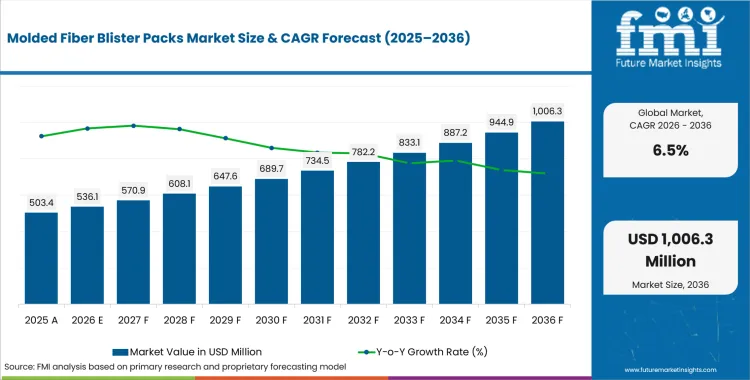
USD 536.1 million in 2026 and USD 1006.3 million by 2036 at a 6.5% CAGR.
Sales of molded fiber blister packs are estimated to rise at 6.5% CAGR through 2036, increasing valuation from USD 536.1 million in 2026 to USD 1006.3 million by 2036. European packaging rules now place recyclability and material reduction directly into sustainable packaging specifications. The European Commission confirmed in February 2025 that the Packaging and Packaging Waste Regulation had entered into force, reinforcing the commercial case for fiber formats that can replace part of the plastic structure without weakening product protection.
California can pull fiber substitution forward if existing sealing equipment and retail handling do not need a full redesign. CalRecycle approved packaging producer-responsibility rules in May 2026 that require a 25% reduction in single-use plastic and make all packaging recyclable or compostable. The rule raises the value of recyclable packaging alternatives, though conversion still depends on tested seals, moisture control, and repeatable forming at commercial speeds.
Key Takeaways
- Plastic-reduction rules and recyclability-linked fees are increasing demand for molded fiber blister packs that can pass seal and line qualification.
- Based on format type, standard formats are projected to account for 40.0% in 2026 due to familiar cavity dimensions that reduce tooling and line-change risk.
- By material, virgin kraft & SBS is estimated to hold 39.0% in 2026 owing to stiffness and predictable converting behavior in retail-facing cavities.
- In 2026, standard retail formats are expected to lead format size with 42.0% share because familiar footprints fit common shelves and packing equipment.
- Barrier and sealing qualification can slow conversion whenever molded fiber must protect the product and still work with the intended recovery route and packing line.
- Some of the key players in this market include Smurfit Westrock, International Paper, Huhtamaki, Graphic Packaging, Stora Enso, Metsa Group, Mayr-Melnhof, and Mondi Group.
Analyst Perspective
"Molded fiber blister conversion is decided on the packing line, where cavity tolerance, liner choice, and seal behavior determine whether plastic can be removed. Programs scale faster once barrier performance and recovery classification are proven before tooling, because late redesigns can erase the savings from material substitution."
- Nandini Roy Choudhury, Principal Consultant, Future Market Insights
How is the molded fiber blister packs market segmented?
Format Type: Standard formats | Material: Virgin kraft & SBS | Format Size: Standard retail | End Use: Food & foodservice
The market is organized by format type, material, format size, end use, sales channel, and region. The four selected blocks focus on 2026 share leaders that shape tooling, barrier selection, retail fit, and adoption in paper packaging applications. The remaining segment axes appear in the detailed taxonomy below.
Why does food & foodservice lead the molded fiber blister packs market by end use?
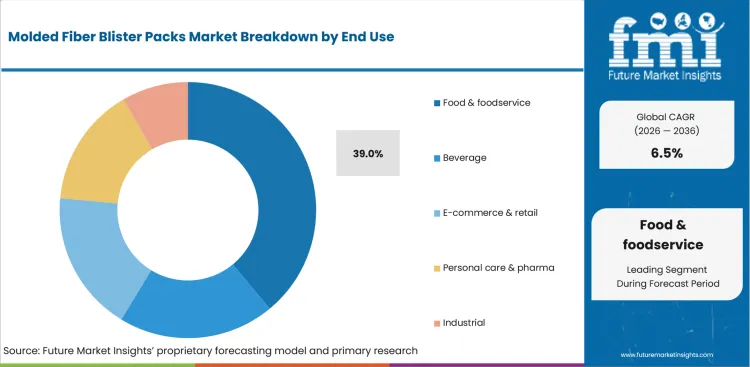
Food and foodservice applications expose molded fiber cavities to filling, handling, moisture, grease, and temperature changes at high volumes. The cavity must hold shape through distribution and meet hygiene and recovery requirements that differ by food packaging category.
- By end use, food & foodservice is forecast to represent 39.0% in 2026 driven by high packaging throughput and continued plastic-reduction programs.
- Huhtamaki acquired Zellwin Farms in April 2025 to expand molded fiber capacity for egg cartons and flats in the southeastern United States. Regional molded-fiber production shortens replenishment routes for food packs that require steady volume at scale.
Why do standard formats lead the molded fiber blister packs market by format type?
Standard formats fit common sealing footprints and dimensions, so converters can qualify a fiber cavity without redesigning downstream equipment. Their advantage is lower tooling-change risk with geometry control retained for automated loading and lidding in blister packaging programs.
- Based on format type, standard formats are projected to account for 40.0% in 2026 due to lower conversion risk for familiar pack sizes.
- Graphic Packaging launched PaperSeal Pressed in August 2025 with a high-barrier liner applied after tray forming and compatibility with existing sealing equipment. Standard pressed structures can enter fresh-protein programs once hermetic sealing is engineered into the pack.
Why does virgin kraft & SBS lead the molded fiber blister packs market by material?
Virgin kraft & SBS gives formed packs a controlled surface for printing, scoring, forming, and barrier application. Predictable stiffness is useful for applications in which cavity dimensions and brand graphics must stay consistent through conversion in molded fiber pulp structures.
- By material, virgin kraft & SBS is estimated to hold 39.0% in 2026 owing to its stiffness and predictable converting response.
- Metsa Group and Amcor announced a May 2025 collaboration on three-dimensional molded fiber food packaging with a high-barrier liner and lidding technology. The collaboration makes liner and lidding qualification part of fiber selection before demanding food programs move into commercial production.
Why do standard retail formats lead the molded fiber blister packs market by format size?
Standard retail sizes reduce the number of pack variants a brand must qualify for shelves, cases, and automated handling. Reusing familiar secondary-pack dimensions shortens line trials and lowers the risk that a molded fiber packaging replacement disrupts logistics.
- In 2026, standard retail formats are expected to lead format size with 42.0% share because they fit existing retail and packing systems.
- Stora Enso and Heiber & Schröder documented a glueless tray line running up to 12,000 units per hour in May 2026. Commercial throughput depends on material behavior, locking geometry and machine setup being qualified as one system.
What are the drivers, restraints and opportunities in the Molded Fiber Blister Packs Market?
Recyclability-linked packaging rules are moving material choice into commercial specifications, but barrier and sealing performance still require application-specific qualification.
Driver - Recyclability-linked design requirements
Recyclability is becoming a purchasing condition instead of a downstream disposal claim for many European packaging programs. PackUK stated in June 2025 that recyclability assessments will influence modulated producer fees for 2026-2027, making material classification more visible in commercial specifications. Fiber-based packaging can enter more programs if its structure is documented within the relevant recycling system without unnecessary mixed materials.
Restraint - Barrier performance can narrow the conversion window
Demanding fiber cavities still need moisture, grease, oxygen and seal control before a plastic blister can be replaced. Stora Enso launched Trayforma Brown in April 2026 with barrier options designed for tray use in paperboard packaging applications. Each added layer must protect the product and fit the intended recovery route, which can lengthen testing before conversion.
Opportunity - Commercial-scale formed fiber can widen the addressable pack set
The near-term opportunity is commercial-scale formed fiber for food and retail cavities that need repeatable output beyond pilot production. Metsa Group signed an EU Innovation Fund agreement for a planned Muoto mill in March 2025 and stated that an investment decision had not yet been made. New capacity becomes commercially useful once demand, price position and manufacturing stability support repeat orders against established paperboard trays.
Which country CAGRs are profiled in the Molded Fiber Blister Packs Market?
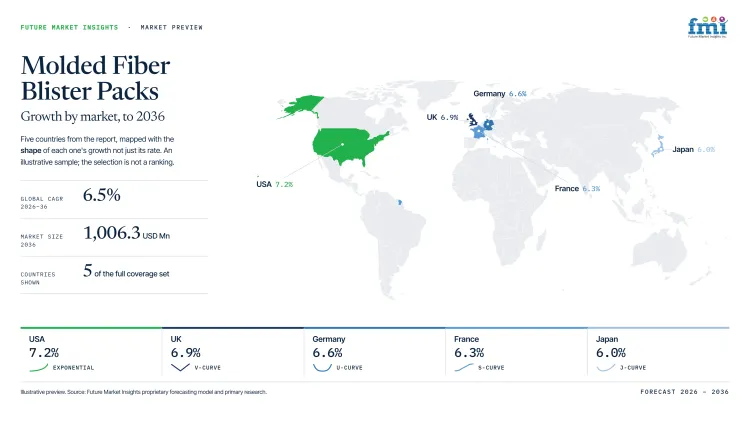
| Country | CAGR |
|---|---|
| UAE | 8.1% |
| Saudi Arabia | 7.8% |
| South Korea | 7.5% |
| USA | 7.2% |
| UK | 6.9% |
| Germany | 6.6% |
| France | 6.3% |
| Japan | 6.0% |
How do country-level CAGRs compare in the Molded Fiber Blister Packs Market?
The countries span 6.0% to 8.1% CAGR from 2026 to 2036, a 2.1 percentage-point spread. UAE, Saudi Arabia, and South Korea form the highest-growth band at 7.5% or above. USA and UK sit in an upper-middle band at 7.2% and 6.9%. Germany and France form a closely spaced European middle band at 6.6% and 6.3%.
- UAE leads under concentrated demand that gives large accounts scale for dedicated tooling.
- Saudi Arabia follows with wholesale produce volumes rewarding standardized cavity dimensions locally.
- South Korea's dense retail system rewards compact packs and early material decisions.
- USA reaches 7.2% CAGR because national production runs absorb dedicated tooling costs.
- UK reaches 6.9% CAGR as private-label programs provide steady replacement cycles nationally.
- Germany german buyers operate inside a formal packaging registration and producer-responsibility system, which makes material documentation part of routine procurement.
- France french brand programs increasingly connect packaging redesign with national plastic-reduction policy and the economics of weak plastic recycling performance.
- Japanese buyers tend to favor packaging changes that can fit disciplined quality systems and established material-recovery practices.
Comparable growth rates still require different qualification routes and rollout plans locally. The full report provides country-level CAGR analysis across North America, Latin America, Europe, East Asia, South Asia, Oceania and the Middle East and Africa.
Country-wise Analysis
- Large food, retail and healthcare channels in the USA can justify dedicated fiber tooling, but national pack programs still cross different state packaging rules and recovery systems. The American Forest & Paper Association reported in August 2026 that 61%-65% of paper and 70%-75% of cardboard available for recovery was recycled in 2025, giving fiber formats a substantial collection base for high-volume packaging programs. By 2036, the USA is projected to grow at 7.2% CAGR given broad paper recovery and plastic-reduction pressure, with national programs favoring one material declaration and stable line settings over state-specific variants that multiply qualification work for each launch.
- Retail and foodservice packaging in the UAE now faces a federal push away from specified single-use plastics, and the Ministry of Climate Change and Environment published its implementation guide in January 2025 for producers, importers, distributors, and retailers. Molded fiber blister pack sales in the UAE are forecast to expand at 8.1% CAGR by 2036, attributable to policy pressure and demand for lower-plastic formats in high-turnover channels. Heat, moisture, and imported filling equipment complicate qualification, so companies entering this market need cavity geometry and barrier systems tested under Gulf distribution conditions ahead of large national retail or foodservice programs at scale.
- Public-market produce handling gives Saudi packaging programs a specific operating brief since cartons must protect fruit and vegetables through storage, display, and distribution in hot conditions before they reach the point of sale. In September 2025, the Saudi Press Agency documented Ministry requirements for plastic and cardboard packs that include recyclable materials, pressure resistance, and ventilation for produce sold in public markets. Saudi Arabia is estimated to post 7.8% CAGR over the forecast period, helped by formal packaging requirements and demand for lower-plastic structures, although entry still depends on formats that tolerate logistics stress and can be adjusted quickly by local converting partners.
- South Korean packaging programs must settle material structure early for retail launches as recyclability grades can force redesign after forming and coating choices are fixed. Molded fiber blister pack demand in South Korea is forecast to rise at 7.5% CAGR through 2036, tied to formal material controls reinforced by the Ministry of Environment's January 7, 2025 amendment to packaging recyclability-grade criteria. Complex coatings or attached components can worsen classification, so entrants need a simple material declaration and test data that can clear local review ahead of tooling and pack graphics being frozen for domestic launches and export-oriented retail programs at scale.
- UK brands now have to treat recyclability data as an operating input since household packaging assessments feed producer-responsibility reporting, and PackUK documented in June 2025 that large producers faced time and resource pressure during H1 recyclability assessments. The UK molded fiber blister packs sector is projected to record 6.9% CAGR during the assessment period as paper-based substitution fits mature national collection. Poorly documented coatings can still weaken a fiber pack's assessment, leaving companies with concise material declarations and complete test files better placed to qualify programs for major retailers than firms relying on broad sustainability claims during national retailer tenders.
- German buyers operate inside a formal packaging registration and producer-responsibility system, which makes material documentation part of routine procurement. Demand for Molded Fiber Blister Packs in Germany is forecast to expand at 6.6% CAGR from 2026 to 2036. From August 12, 2026, the Central Agency Packaging Register states that PPWR changes require producers to review LUCID registration duties and finance packaging recycling under the new producer framework. The main constraint is compliance precision and responsibility allocation across brands, importers, and retailers. Suppliers need to provide clear material declarations, recycling-path evidence, and stable specifications that support producer reporting.
- French brand programs increasingly connect packaging redesign with national plastic-reduction policy and the economics of weak plastic recycling performance. Demand for Molded Fiber Blister Packs in France is forecast to expand at 6.3% CAGR from 2026 to 2036. In June 2026, the Ministry for Ecological Transition opened a national plastics plan built around twelve levers for reduction, reuse, and recycling. It also stated that France pays about EUR 1.5 billion annually to the European Union because plastic packaging recycling is insufficient. The main constraint is proving that alternative packs perform at scale. Suppliers need to target applications where fiber substitution is measurable and operationally low risk.
- Japanese buyers tend to favor packaging changes that can fit disciplined quality systems and established material-recovery practices. Demand for Molded Fiber Blister Packs in Japan is forecast to expand at 6.0% CAGR from 2026 to 2036. Japan’s Ministry of the Environment confirmed that the Plastic Resource Circulation Act took effect on April 1, 2022 and expanded municipal collection beyond plastic containers and packaging to plastic products. The main constraint is conservative qualification where a new fiber structure must prove consistency and finish. Suppliers need to emphasize dimensional control, clean presentation, and designs that reduce plastic while fitting existing sorting and retail workflows.
Who are the notable companies in the Molded Fiber Blister Packs Market?
Smurfit Westrock, International Paper, Huhtamaki, Graphic Packaging, Stora Enso, Metsa Group, Mayr-Melnhof, and Mondi Group.
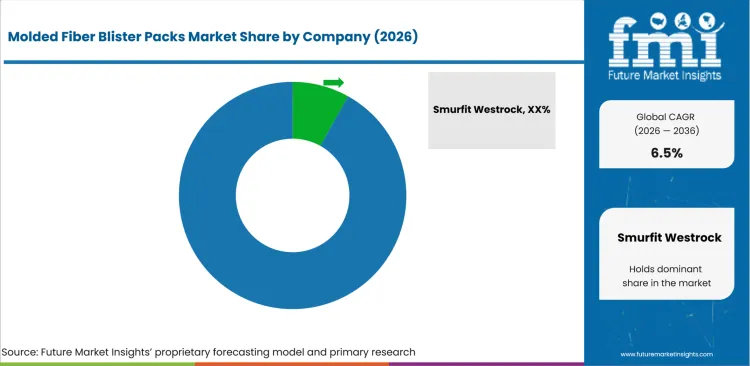
Competition divides between direct formed-fiber producers and paperboard or barrier specialists that can replace parts of a plastic blister system. Huhtamaki, Stora Enso and Metsa Group bring the clearest formed-fiber routes. Smurfit Westrock covers healthcare fiber packaging within the same competitive set through a separate product route. Graphic Packaging and Mayr-Melnhof supply pressed cavities, and International Paper and Mondi Group contribute conversion, coating and barrier depth. Qualification becomes the dividing line once geometry, sealing, product protection and recovery claims must work on the proposed packing line.
- Huhtamaki, Stora Enso and Metsa Group provide direct formed-fiber routes, with Smurfit Westrock covering healthcare fiber packaging in the selected field.
- International Paper, Graphic Packaging, Mayr-Melnhof, and Mondi Group cover paperboard conversion, cavity systems, coating, and barrier work adjacent to molded-fiber formats.
Competitive Benchmarking: Molded Fiber Blister Packs Market
| Company | Molded / 3D Fiber Capability | Barrier & Sealing Integration | Retail / Brand Co-development | Geographic Reach |
|---|---|---|---|---|
| Smurfit Westrock | Medium | Medium | High | North America, Western Europe, Latin America, East Asia and South Asia and Pacific |
| International Paper | Medium | High | High | North America and Western Europe with broader international reach |
| Huhtamaki | High | Medium | High | North America, Western Europe, East Asia and selected other markets |
| Graphic Packaging | Medium | High | High | North America and Western Europe with selected wider markets |
| Stora Enso | High | High | High | Western Europe with partner-enabled North American and East Asian reach |
| Metsa Group | High | High | High | Western Europe with partner activity in broader markets |
| Mayr-Melnhof | Medium | High | High | Western Europe and selected international brand markets |
| Mondi Group | Low | High | Medium | Western Europe and selected global markets |
Scoring basis: High molded or 3D fiber capability requires documented commercial forming platforms or molded-fiber production. Medium covers adjacent pressed-paper or three-dimensional fiber structures. Low identifies a documented portfolio led by other fiber formats, not missing evidence. High barrier and sealing integration requires documented barrier plus sealing work. Medium covers one of those functions, and Low denotes a narrower role. High retail or brand co-development requires repeated named customer or application programs. Medium covers limited documented programs, and Low identifies primarily material supply. Low in the molded or 3D fiber column denotes a verified narrower route, not an absence of evidence. The ratings separate direct forming capability from adjacent barrier, paperboard, and customer-development strength so the table does not use corporate scale as proof of exact-market depth.
Key Developments in the Molded Fiber Blister Packs Market
- In August 2026, Metsa Group committed to a new Muoto fiber-packaging production line in Äänekoski with start-up planned for 2028 and nominal capacity above 100 million products per year.
- In June 2025, Stora Enso entered a partnership with Matrix Pack to accelerate formed-fiber packaging development and scale commercial manufacturing.
- In March 2025, Mayr-Melnhof demonstrated its Carton Cavity System at MM Premium Vienna, producing cartonboard cavity inserts that replace plastic trays.
Key Players in the Molded Fiber Blister Packs Market
Integrated Fiber-Packaging Platforms
- Smurfit Westrock
- International Paper
Molded-Fiber and Retail Tray Platforms
- Huhtamaki
- Graphic Packaging
Formed-Fiber and Material Platforms
- Stora Enso
- Metsa Group
Fiber Fitment and Barrier Platforms
- Mayr-Melnhof
- Mondi Group
Molded Fiber Blister Packs Market - Report Scope
| Coverage field | Report scope |
|---|---|
| Market breakdown | By format type, material, format size, end use, sales channel and region. |
| Quantitative Units | USD million for market value and percentage for CAGR and share. |
| Market Definition | Fiber-based formed cavities and blister-style packs used to hold, protect, display or portion products within the defined packaging applications. |
| Regions Covered | North America, Latin America, Western Europe, Eastern Europe, East Asia, South Asia and Pacific, and Middle East and Africa. |
| Countries Covered | UAE, Saudi Arabia, South Korea, USA, UK, and 20+ countries included in the full report. |
| Key Companies Profiled | Smurfit Westrock, International Paper, Huhtamaki, Graphic Packaging, Stora Enso, Metsa Group, Mayr-Melnhof, and Mondi Group. |
| Forecast Period | 2026 to 2036. |
| Approach | Primary and secondary research with market triangulation. |
Molded Fiber Blister Packs Market - Research Methodology
| Method | Approach |
|---|---|
| Primary Research | FMI analysts gathered input from manufacturers, service providers, technology developers, distributors, end users, procurement teams, and subject-matter experts. Interviews examined purchasing decisions, product or service evaluation, adoption barriers, approval requirements, pricing considerations, and expectations for technical or commercial support. Respondents were also asked what evidence is required before a trial, pilot, or initial order develops into regular purchasing. |
| Desk Research | Desk research covered government statistics, regulatory publications, trade data, industry associations, technical literature, standards, company filings, product information, and official corporate announcements. Sources were reviewed for relevance, publication date, geographic coverage, and consistency with the defined market scope. Claims relating to performance, applications, approvals, capacity, investment, and commercial activity were retained only when supported by credible public evidence. |
| Market Sizing and Forecasting | The market model combined the baseline value with historical performance, segment structure, pricing and volume indicators, adoption levels, company participation, and country-level demand conditions. Forecast assumptions considered economic activity, investment trends, regulatory developments, technology adoption, purchasing cycles, supply availability, and barriers to wider market use. Segment and regional estimates were reconciled before the final market total was calculated. |
| Data Validation | Estimates were checked against multiple independent indicators, including public data, company activity, trade patterns, industry developments, and findings from primary interviews. Validation also tested whether products, services, applications, and company revenues fell within the defined market boundaries. Adjacent categories, unsupported claims, overlapping revenues, and activities without direct market relevance were excluded to reduce double counting and maintain consistency across segments and countries. |
Molded Fiber Blister Packs Market by Segments
Molded Fiber Blister Packs Market segmented by Format Type:
- Standard formats
- Recyclable-optimized formats
- Premium & branded formats
- Custom-engineered formats
Molded Fiber Blister Packs Market segmented by Material:
- Virgin kraft & SBS
- Recycled fiber blends
- Molded pulp
- Barrier-coated fiber
Molded Fiber Blister Packs Market segmented by Format Size:
- Standard retail
- Small unit packs
- Bulk & transit
Molded Fiber Blister Packs Market segmented by End Use:
- Food & foodservice
- Beverage
- E-commerce & retail
- Personal care & pharma
- Industrial
Molded Fiber Blister Packs Market segmented by Sales Channel:
- Direct brand contracts
- Packaging distributors
- Online B2B
Molded Fiber Blister Packs Market by Region:
- North America
- United States
- Canada
- Latin America
- Brazil
- Mexico
- Chile
- Rest of Latin America
- Western Europe
- Germany
- United Kingdom
- Italy
- Spain
- France
- Nordics
- Benelux
- Rest of Western Europe
- Eastern Europe
- Russia
- Poland
- Hungary
- Balkan and Baltic States
- Rest of Eastern Europe
- East Asia
- China
- Japan
- South Korea
- South Asia and Pacific
- India
- ASEAN
- Australia and New Zealand
- Rest of South Asia and Pacific
- Middle East and Africa
- Kingdom of Saudi Arabia
- Other GCC Countries
- Türkiye
- South Africa
- Other African Union Countries
- Rest of Middle East and Africa
Research Sources and Bibliography
- European Commission. (2025, February 11). New rules enter into force for a more sustainable and competitive packaging economy.
- California Department of Resources Recycling and Recovery. (2026, May 1). California approves new plastic and packaging rules that put consumers first.
- Graphic Packaging International. (2025, August 20). Graphic Packaging Adds PaperSeal® Pressed MAP Tray to Award-Winning Food Packaging Portfolio.
- Metsä Group. (2025, May 12). Metsä Group and Amcor partner to develop recyclable food packaging.
- Stora Enso. (2026, May 5). Engineering glueless trays at scale: Heiber & Schröder and Stora Enso combine machine design and CKB performance.
- Huhtamaki. (2025, April 24). Huhtamaki acquires Zellwin Farms Company.
- PackUK. (2025, June 27). PackUK extended producer responsibility (EPR) for packaging: producer disposal fees modulation statement.
- Stora Enso. (2026, April 29). Stora Enso launches Trayforma Brown and reduces basis weight across the Trayforma range.
- Metsä Group. (2025, March 11). Metsä Group signs an agreement on EU funding for the Muoto mill.
- Ministry of Climate Change and Environment, United Arab Emirates. (2025, January 2). Ministry of Climate Change and Environment reveals details of comprehensive guide outlining regulations for single-use plastic products.
- Saudi Press Agency. (2025, September 18). Ministry of Environment announces vegetable and fruit packaging requirements to ensure product quality and food safety.
- Ministry of Environment, Republic of Korea. (2025, January 7).
- American Forest & Paper Association. (2026, August 28). Paper Industry Announces 2025 USA Paper Recycling Rates.
- PackUK. (2025, June 27). PackUK: 2025 recyclability assessment requirements.
- International Paper. (2025, October 14). Paper-based Recyclable Packaging Fuels Design Innovations.
- Smurfit Westrock. (2025, January 22). Smurfit Westrock showcases innovation expertise at WorldStar 2025.
- International Paper. (2025, June 24). Showcasing Innovative Packaging Solutions at Macfrut 2025.
- Stora Enso. (2026, June 10). Stora Enso’s Oulu pulp production granted internationally recognized food safety certification - first in Finland.
- Stora Enso. (2025, June 12). Stora Enso and Matrix Pack partner to accelerate formed fiber packaging innovation.
- Metsä Group. (2026, August 11). Metsä Group invests EUR 25 million in the production of Muoto fibre packaging in Äänekoski, Finland.
- MM Group. (2026, April 8). Annual Report 2025.
- Huhtamaki. (2025, February 14). Huhtamaki to separate Fiber Foodservice business segment into two distinct segments: Fiber Packaging and Foodservice Europe-Asia-Oceania.
- Mondi Group. (2025, August 14). Mondi ramps up FunctionalBarrier Paper Ultimate to meet growing demand for sustainable high-barrier paper-based packaging.
- Graphic Packaging International. (2025, May 14). Graphic Packaging launches new portfolio of paperboard sushi packaging to support the regulatory compliance of European foodservice operators.
- Stora Enso. (2026, April 30). Stora Enso launches dispersion-coated folding boxboard Performa Natura Aqua.
- Metsä Group. (2026, April 21). Metsä Spring advances wood fibre packaging with Amcor and G. Mondini.
- Smurfit Westrock. (2025, November 4). Smurfit Westrock unveils world’s first dedicated clinical packaging facility.
- International Paper. (2025, January 31). About the IP + DS Smith Combination.
- Huhtamaki. (2025, July 16). Huhtamaki launches new compostable ice cream cups.
- Graphic Packaging International. (2025, November 5). Graphic Packaging Launches Advanced Recycled Paperboard Facility in Waco, Texas.
- Stora Enso. (2025, July 11). Stora Enso and Novapor Converting the future of packaging.
- Metsä Group. (2025, September 25). Muoto Laminated Fibre Series is launched for market testing in more demanding food applications.
- MM Group. (2025, March 27). Customers Count on MM Group to Support Ambitious Sustainability Goals.
- MM Group. (2025, December 18). Advent Calendars: Creativity and Sustainability in Packaging to Delight and Impress.
- Mondi Group. (2026, February 18). How Prymat improved spice preservation with Mondi’s recyclable ultra-high barrier paper solution.
This bibliography is provided for reader reference and is not exhaustive. The full report contains the complete reference list and detailed citations.
This Report Answers
- How large is the molded fiber blister packs market in 2026 and where is it expected to reach by 2036?
- Which pack formats, materials, sizes, and end uses hold the leading 2026 shares?
- How do recyclability rules affect molded fiber blister pack specifications?
- Which barrier and sealing requirements can slow conversion from plastic?
- Which five profiled countries post the highest modeled CAGRs?
- How do local packaging rules change market-entry requirements in the UAE, Saudi Arabia, South Korea, USA, and UK?
- Which eight companies are benchmarked in this market?
- What recent company actions are expanding formed-fiber capacity, barrier performance, and customer qualification?
Frequently Asked Questions
How big is the molded fiber blister packs market in 2026?
The molded fiber blister packs market is valued at USD 536.1 million in 2026 and is projected to reach USD 1,006.3 million by 2036. Growth comes from plastic-reduction programs and fiber formats that can pass line and barrier qualification.
What is the CAGR of the molded fiber blister packs market from 2026 to 2036?
The molded fiber blister packs market is projected to grow at a CAGR of 6.5% between 2026 and 2036. Expansion depends on recyclability requirements, higher commercial forming capacity, and pack structures that retain product protection.
Which format type leads the molded fiber blister packs market?
The standard formats segment is expected to hold 40.0% of the molded fiber blister packs market in 2026, driven by familiar sealing footprints and lower tooling-change risk. Common dimensions also simplify retail and packing-line qualification.
Which material leads the molded fiber blister packs market?
The virgin kraft & SBS segment is expected to hold 39.0% of the molded fiber blister packs market in 2026, attributable to stiffness and predictable converting behavior. Those properties support controlled forming, printing, and barrier application for demanding cavities.
Which countries are projected to record the highest growth in the molded fiber blister packs market?
UAE is projected to grow at 8.1% CAGR, followed by Saudi Arabia at 7.8% and South Korea at 7.5% through 2036. Growth is supported by faster plastic substitution in Gulf channels and formal packaging controls in South Korea.
Which companies are active in the molded fiber blister packs market?
Key companies operating in the market include Smurfit Westrock, International Paper, Huhtamaki, Graphic Packaging, Stora Enso, Metsa Group, Mayr-Melnhof, and Mondi Group. They compete through forming depth, barrier integration, customer qualification, and regional manufacturing reach.
Preview the report firsthand - request a free sample
Get SampleGet the brochure for pricing and purchase details.
Get PDFTable of Content
- Key Takeaways
- Market Size and CAGR
- Top Growth Driver
- Fastest Growing Segment
- Leading Region
- Key Companies
- Emerging Opportunities
- Executive Summary
- Global Market Outlook
- Demand-side Trends
- Supply-side Trends
- Technology Roadmap Analysis
- Analysis and Recommendations
- Analyst Perspective (What is happening? Why now? What should investors know?)
- Key Questions Answered
- How large is the market?
- What is the CAGR?
- What are key trends?
- Which region dominates?
- Who are the leaders?
- Market Overview
- Market Coverage / Taxonomy
- Market Definition / Scope / Limitations
- Research Methodology
- Chapter Orientation
- Analytical Lens and Working Hypotheses
- Market Structure, Signals, and Trend Drivers
- Benchmarking and Cross-market Comparability
- Market Sizing, Forecasting, and Opportunity Mapping
- Research Design and Evidence Framework
- Desk Research Programme (Secondary Evidence)
- Expert Input and Fieldwork (Primary Evidence)
- Tooling, Models, and Reference Databases
- Data Engineering and Model Build
- Quality Assurance and Audit Trail
- Market Background
- Market Dynamics (Drivers, Restraints, Opportunity, Trends)
- Scenario Forecast (Optimistic, Likely, Conservative)
- Impact Analysis
- AI Impact
- Sustainability Impact
- Regulatory Impact
- Technology Impact
- Consumer / Buyer Analysis
- Purchase Drivers
- Adoption Barriers
- Buyer Journey
- Opportunity Map Analysis
- Product Life Cycle Analysis
- Supply Chain Analysis
- Investment Feasibility Matrix
- Value Chain Analysis
- PESTLE and Porter's Analysis
- Regulatory Landscape
- Regional Parent Market Outlook
- Production and Consumption Statistics
- Import and Export Statistics
- Global Market Analysis and Forecast, 2021 to 2036
- Historical Market Size Value (USD Million) Analysis, 2021 to 2025
- Current and Future Market Size Value (USD Million) Projections, 2026 to 2036
- Y-o-Y Growth Trend Analysis
- Absolute $ Opportunity Analysis
- Global Market Pricing Analysis, 2021 to 2036
- Global Market Analysis and Forecast, By Format Type, 2021 to 2036
- Introduction / Key Findings
- Historical Market Size Value (USD Million) Analysis By Format Type, 2021 to 2025
- Current and Future Market Size Value (USD Million) Analysis and Forecast By Format Type, 2026 to 2036
- Standard formats
- Recyclable-optimized formats
- Premium & branded formats
- Custom-engineered formats
- Standard formats
- Y-o-Y Growth Trend Analysis By Format Type, 2021 to 2025
- Absolute $ Opportunity Analysis By Format Type, 2026 to 2036
- Global Market Analysis and Forecast, By Material, 2021 to 2036
- Introduction / Key Findings
- Historical Market Size Value (USD Million) Analysis By Material, 2021 to 2025
- Current and Future Market Size Value (USD Million) Analysis and Forecast By Material, 2026 to 2036
- Virgin kraft & SBS
- Recycled fiber
- Molded pulp
- Barrier-coated fiber
- Virgin kraft & SBS
- Y-o-Y Growth Trend Analysis By Material, 2021 to 2025
- Absolute $ Opportunity Analysis By Material, 2026 to 2036
- Global Market Analysis and Forecast, By Format Size, 2021 to 2036
- Introduction / Key Findings
- Historical Market Size Value (USD Million) Analysis By Format Size, 2021 to 2025
- Current and Future Market Size Value (USD Million) Analysis and Forecast By Format Size, 2026 to 2036
- Standard retail
- Small unit packs
- Bulk & transit
- Standard retail
- Y-o-Y Growth Trend Analysis By Format Size, 2021 to 2025
- Absolute $ Opportunity Analysis By Format Size, 2026 to 2036
- Global Market Analysis and Forecast, By End Use, 2021 to 2036
- Introduction / Key Findings
- Historical Market Size Value (USD Million) Analysis By End Use, 2021 to 2025
- Current and Future Market Size Value (USD Million) Analysis and Forecast By End Use, 2026 to 2036
- Food & foodservice
- Beverage
- E-commerce & retail
- Personal care & pharma
- Industrial
- Food & foodservice
- Y-o-Y Growth Trend Analysis By End Use, 2021 to 2025
- Absolute $ Opportunity Analysis By End Use, 2026 to 2036
- Global Market Analysis and Forecast, By Sales Channel, 2021 to 2036
- Introduction / Key Findings
- Historical Market Size Value (USD Million) Analysis By Sales Channel, 2021 to 2025
- Current and Future Market Size Value (USD Million) Analysis and Forecast By Sales Channel, 2026 to 2036
- Direct brand contracts
- Packaging distributors
- Online B2B
- Direct brand contracts
- Y-o-Y Growth Trend Analysis By Sales Channel, 2021 to 2025
- Absolute $ Opportunity Analysis By Sales Channel, 2026 to 2036
- Global Market Analysis and Forecast, By Region, 2021 to 2036
- Introduction
- Historical Market Size Value (USD Million) Analysis By Region, 2021 to 2025
- Current Market Size Value (USD Million) Analysis and Forecast By Region, 2026 to 2036
- North America
- Latin America
- Western Europe
- Eastern Europe
- East Asia
- South Asia and Pacific
- Middle East & Africa
- Market Attractiveness Analysis By Region
- North America Market Analysis and Forecast, By Country, 2021 to 2036
- Historical Market Size Value (USD Million) Trend Analysis By Market Taxonomy, 2021 to 2025
- Market Size Value (USD Million) Forecast By Market Taxonomy, 2026 to 2036
- By Country
- USA
- Canada
- By Format Type
- By Material
- By Format Size
- By End Use
- By Sales Channel
- By Country
- Market Attractiveness Analysis
- By Country
- By Format Type
- By Material
- By Format Size
- By End Use
- By Sales Channel
- Key Takeaways
- Latin America Market Analysis and Forecast, By Country
- Historical Market Size Value (USD Million) Trend Analysis By Market Taxonomy, 2021 to 2025
- Market Size Value (USD Million) Forecast By Market Taxonomy, 2026 to 2036
- By Country
- Brazil
- Mexico
- Chile
- Rest of Latin America
- By Format Type
- By Material
- By Format Size
- By End Use
- By Sales Channel
- By Country
- Market Attractiveness Analysis
- By Country
- By Format Type
- By Material
- By Format Size
- By End Use
- By Sales Channel
- Key Takeaways
- Western Europe Market Analysis and Forecast, By Country
- Historical Market Size Value (USD Million) Trend Analysis By Market Taxonomy, 2021 to 2025
- Market Size Value (USD Million) Forecast By Market Taxonomy, 2026 to 2036
- By Country
- Germany
- UK
- Italy
- Spain
- France
- Nordic
- BENELUX
- Rest of Western Europe
- By Format Type
- By Material
- By Format Size
- By End Use
- By Sales Channel
- By Country
- Market Attractiveness Analysis
- By Country
- By Format Type
- By Material
- By Format Size
- By End Use
- By Sales Channel
- Key Takeaways
- Eastern Europe Market Analysis and Forecast, By Country
- Historical Market Size Value (USD Million) Trend Analysis By Market Taxonomy, 2021 to 2025
- Market Size Value (USD Million) Forecast By Market Taxonomy, 2026 to 2036
- By Country
- Russia
- Poland
- Hungary
- Balkan & Baltic
- Rest of Eastern Europe
- By Format Type
- By Material
- By Format Size
- By End Use
- By Sales Channel
- By Country
- Market Attractiveness Analysis
- By Country
- By Format Type
- By Material
- By Format Size
- By End Use
- By Sales Channel
- Key Takeaways
- East Asia Market Analysis and Forecast, By Country
- Historical Market Size Value (USD Million) Trend Analysis By Market Taxonomy, 2021 to 2025
- Market Size Value (USD Million) Forecast By Market Taxonomy, 2026 to 2036
- By Country
- China
- Japan
- South Korea
- By Format Type
- By Material
- By Format Size
- By End Use
- By Sales Channel
- By Country
- Market Attractiveness Analysis
- By Country
- By Format Type
- By Material
- By Format Size
- By End Use
- By Sales Channel
- Key Takeaways
- South Asia and Pacific Market Analysis and Forecast, By Country
- Historical Market Size Value (USD Million) Trend Analysis By Market Taxonomy, 2021 to 2025
- Market Size Value (USD Million) Forecast By Market Taxonomy, 2026 to 2036
- By Country
- India
- ASEAN
- Australia & New Zealand
- Rest of South Asia and Pacific
- By Format Type
- By Material
- By Format Size
- By End Use
- By Sales Channel
- By Country
- Market Attractiveness Analysis
- By Country
- By Format Type
- By Material
- By Format Size
- By End Use
- By Sales Channel
- Key Takeaways
- Middle East & Africa Market Analysis and Forecast, By Country
- Historical Market Size Value (USD Million) Trend Analysis By Market Taxonomy, 2021 to 2025
- Market Size Value (USD Million) Forecast By Market Taxonomy, 2026 to 2036
- By Country
- Kingdom of Saudi Arabia
- Other GCC Countries
- Türkiye
- South Africa
- Other African Union
- Rest of Middle East & Africa
- By Format Type
- By Material
- By Format Size
- By End Use
- By Sales Channel
- By Country
- Market Attractiveness Analysis
- By Country
- By Format Type
- By Material
- By Format Size
- By End Use
- By Sales Channel
- Key Takeaways
- Key Countries Market Analysis
- USA
- Pricing Analysis
- Market Share Analysis, 2025
- By Format Type
- By Material
- By Format Size
- By End Use
- By Sales Channel
- Canada
- Pricing Analysis
- Market Share Analysis, 2025
- By Format Type
- By Material
- By Format Size
- By End Use
- By Sales Channel
- Mexico
- Pricing Analysis
- Market Share Analysis, 2025
- By Format Type
- By Material
- By Format Size
- By End Use
- By Sales Channel
- Brazil
- Pricing Analysis
- Market Share Analysis, 2025
- By Format Type
- By Material
- By Format Size
- By End Use
- By Sales Channel
- Chile
- Pricing Analysis
- Market Share Analysis, 2025
- By Format Type
- By Material
- By Format Size
- By End Use
- By Sales Channel
- Germany
- Pricing Analysis
- Market Share Analysis, 2025
- By Format Type
- By Material
- By Format Size
- By End Use
- By Sales Channel
- UK
- Pricing Analysis
- Market Share Analysis, 2025
- By Format Type
- By Material
- By Format Size
- By End Use
- By Sales Channel
- Italy
- Pricing Analysis
- Market Share Analysis, 2025
- By Format Type
- By Material
- By Format Size
- By End Use
- By Sales Channel
- Spain
- Pricing Analysis
- Market Share Analysis, 2025
- By Format Type
- By Material
- By Format Size
- By End Use
- By Sales Channel
- France
- Pricing Analysis
- Market Share Analysis, 2025
- By Format Type
- By Material
- By Format Size
- By End Use
- By Sales Channel
- India
- Pricing Analysis
- Market Share Analysis, 2025
- By Format Type
- By Material
- By Format Size
- By End Use
- By Sales Channel
- ASEAN
- Pricing Analysis
- Market Share Analysis, 2025
- By Format Type
- By Material
- By Format Size
- By End Use
- By Sales Channel
- Australia & New Zealand
- Pricing Analysis
- Market Share Analysis, 2025
- By Format Type
- By Material
- By Format Size
- By End Use
- By Sales Channel
- China
- Pricing Analysis
- Market Share Analysis, 2025
- By Format Type
- By Material
- By Format Size
- By End Use
- By Sales Channel
- Japan
- Pricing Analysis
- Market Share Analysis, 2025
- By Format Type
- By Material
- By Format Size
- By End Use
- By Sales Channel
- South Korea
- Pricing Analysis
- Market Share Analysis, 2025
- By Format Type
- By Material
- By Format Size
- By End Use
- By Sales Channel
- Russia
- Pricing Analysis
- Market Share Analysis, 2025
- By Format Type
- By Material
- By Format Size
- By End Use
- By Sales Channel
- Poland
- Pricing Analysis
- Market Share Analysis, 2025
- By Format Type
- By Material
- By Format Size
- By End Use
- By Sales Channel
- Hungary
- Pricing Analysis
- Market Share Analysis, 2025
- By Format Type
- By Material
- By Format Size
- By End Use
- By Sales Channel
- Kingdom of Saudi Arabia
- Pricing Analysis
- Market Share Analysis, 2025
- By Format Type
- By Material
- By Format Size
- By End Use
- By Sales Channel
- Türkiye
- Pricing Analysis
- Market Share Analysis, 2025
- By Format Type
- By Material
- By Format Size
- By End Use
- By Sales Channel
- South Africa
- Pricing Analysis
- Market Share Analysis, 2025
- By Format Type
- By Material
- By Format Size
- By End Use
- By Sales Channel
- USA
- Market Structure Analysis
- Competition Dashboard
- Competition Benchmarking
- Market Share Analysis of Top Players
- By Regional
- By Format Type
- By Material
- By Format Size
- By End Use
- By Sales Channel
- Emerging Startups
- Innovation Benchmarking
- Competition Analysis
- Competition Deep Dive
- Smurfit Westrock
- Overview
- Product Portfolio
- Profitability by Market Segments
- Sales Footprint
- Strategy Overview
- Marketing Strategy
- Product Strategy
- Channel Strategy
- International Paper
- Sonoco
- Huhtamaki
- Graphic Packaging
- Stora Enso
- Metsa Group
- Ranpak
- Mayr-Melnhof
- Mondi Group
- Smurfit Westrock
- Case Studies
- Success Stories
- Recent Developments
- Competition Deep Dive
- Assumptions & Acronyms Used


