

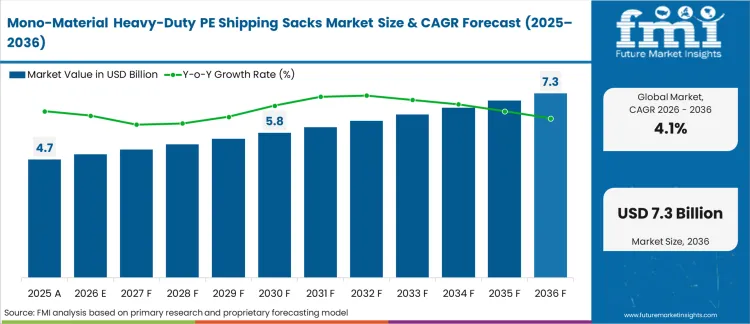
- Industry Size (2026)
- USD 4.9 Bn
- Forecast (2036)
- USD 7.4 Bn
- CAGR (2026 to 2036)
- 4.1%
Mono-Material Heavy-Duty PE Shipping Sacks Market Size, Market Forecast and Outlook By FMI
Mono-material heavy-duty PE shipping sacks market was valued at USD 4.7 billion in 2025, material specification shifts accelerate as chemical and fertilizer producers standardize on single-polymer structures. Industry is set to advance at a 4.1% compound rate, estimating the valuation of USD 4.9 billion in 2026 and crossing USD 7.4 billion by 2036 as regulatory pressures force the elimination of multi-material laminates from industrial supply chains. Packaging compliance leads who delay qualification of mono-PE alternatives to forfeit approved supplier status within multinational vendor networks.
Bulk logistics managers interpret this consolidation as proof that multi-layer plastic structures face rapid obsolescence across global freight channels. Buyers who have not secured high-barrier single-polymer supply contracts face a shrinking pool of qualified extrusion partners before the next compliance audit window closes.
Summary of Mono-Material Heavy-Duty PE Shipping Sacks Market
- Mono-Material Heavy-Duty PE Shipping Sacks Market Definition
- Mono-material heavy-duty PE shipping sacks are high-capacity industrial bags extruded entirely from polyethylene resins, designed without barrier layers of foil or non-PE polymers to ensure complete recyclability. Extrusion lines blend high-density and linear low-density polyethylene to achieve necessary drop-impact and puncture resistance for bulk goods. UN-certified chemical transport bags represent included applications, while paper-plastic multiwall bags are excluded.
- Demand Drivers in the Market
- Extended producer responsibility regulations compel industrial shippers to replace unrecyclable multi-layer bags with fully circular mono-PE structures.
- Downgauging capabilities in metallocene polyethylene resins allow converters to reduce sack weight while maintaining 50-kilogram load capacities.
- Form-fill-seal line automation demands consistent slip and tensile properties that mono-material extrusion configurations consistently deliver.
- Key Segments Analyzed in the FMI Report
- Open Mouth Sacks: 35.7% share driven by manual and semi-automated filling line compatibility across agricultural feed networks.
- Agriculture (Fertilizer/Feed): 32.0% volume anchored by high-throughput bulk material transport requiring puncture-resistant moisture barriers.
- India: 5.6% compound expansion reflecting domestic cement output growth and simultaneous adoption of standardized palletization protocols.
- Analyst Opinion at FMI
- Ismail Sutaria, Principal Consultant for Packaging, opines, “Most bulk material shippers treat mechanical strength as the primary barrier to mono-PE transition, but the actual bottleneck is sealing temperature window compatibility on existing high-speed lines. Specifiers waiting for drop-in replacements will surrender their supply chain resilience to early adopters who adapted their sealing jaws months ago.”
- Strategic Implications/Executive Takeaways
- Calibrate form-fill-seal heating profiles to accommodate the narrower sealing windows inherent to mono-PE resin blends.
- Secure post-consumer recycled resin off-take agreements to guarantee supply continuity for sustainability-mandated sack portfolios.
- Target hazardous chemical transport certifications early to capture margin premiums unavailable in standard agricultural feed categories.
- Methodology
- Primary Research: Direct interviews with resin extrusion plant managers and bulk chemical packaging compliance officers across key manufacturing nodes.
- Desk Research: Customs shipping container import volumes and corporate recycling commitment disclosures.
- Market-Sizing and Forecasting: Bottom-up material conversion models beginning with raw polymer pellet output mapped against industrial packaging demand curves.
- Data Validation and Update Cycle: Findings validated against global fertilizer and cement production volumes prior to final forecast integration.
Elke Kellermann, Sales Manager at Berry, opined, “Our SWS films with Sustane Recycled Content are ideal for rapid and efficient filling automation, offering excellent branding potential all while delivering an improved environmental profile.” [2] This technical capability resets baseline expectations for continuous roll-stock performance on industrial lines. Converters failing to demonstrate equivalent automated throughput without compromising the structural integrity of the single-polymer film will lose primary vendor status among high-volume fertilizer producers.
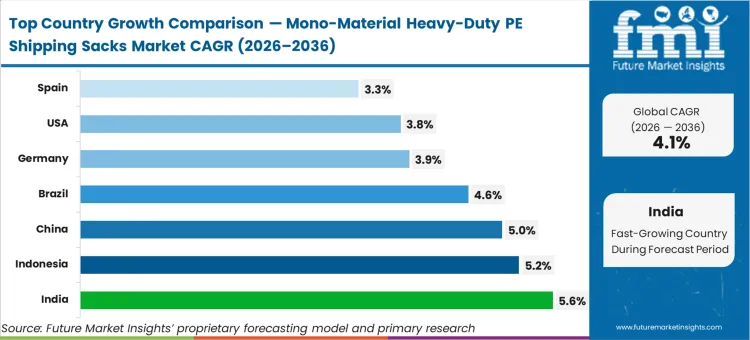
Regional growth trajectories diverge with recycling‑infrastructure maturity and industrial output: India (5.6% CAGR) and Indonesia (5.2%) show the steepest adoption as rising domestic fertilizer production meets export‑driven packaging standards, signaling accelerated mono‑PE conversion in South Asia; China follows at 5.0% as producers substitute legacy multiwall paper sacks with moisture‑resistant mono‑polymer alternatives, reinforcing a steady uptrend from its already large industrial base; Brazil’s 4.6% reflects intensifying scrutiny on agro‑export packaging and a consequent pivot to fully recyclable formats; Europe expands at a moderate but high‑value pace, Germany at 3.9% and Spain at 3.3%, as recycled‑content integration and strict circular‑economy compliance drive specification upgrades across tenders. North America demand, anchored by cross‑border construction material flows, underpins a 3.8% USA CAGR as buyers standardize on high‑density mono‑PE structures for automated, high‑throughput lines.
Mono-Material Heavy-Duty PE Shipping Sacks Market Definition
Mono-material heavy-duty PE shipping sacks constitute flexible industrial containers engineered exclusively from polyethylene variants, eliminating dissimilar polymer layers to ensure mechanical recycling viability. Manufacturers utilize advanced blown film co-extrusion to build puncture-resistant walls capable of securing 25-to-50-kilogram payloads. Products range from valve sacks used in automated powder filling to open-mouth configurations for granular agricultural goods.
Mono-Material Heavy-Duty PE Shipping Sacks Market Inclusions
Coverage includes single-polymer high-density and linear low-density polyethylene sacks designed for bulk commodity transport. Form-fill-seal tubular films, pre-made block-bottom bags, and stretch-hood-compatible sacks containing post-consumer recycled polyethylene fall within scope. A mono-PE bag treated with a microscopic non-PE barrier coating is included if the coating does not disrupt the standard mechanical recycling stream.
Mono-Material Heavy-Duty PE Shipping Sacks Market Exclusions
Multi-material laminates combining polyethylene with PET, nylon, or aluminum foil are strictly excluded. Paper-based multiwall sacks featuring a separate PE inner liner do not qualify. Consumer-facing retail bags, flexible intermediate bulk containers constructed from woven polypropylene tape, and lightweight grocery sacks fall outside the heavy-duty industrial parameters defined.
Mono-Material Heavy-Duty PE Shipping Sacks Market Research Methodology
- Primary Research: Telephone and video interviews conducted with polymer scientists, extrusion facility directors, and supply chain heads at Tier-1 chemical companies.
- Desk Research: Extraction of regulatory phase-out timelines from national environmental ministries and patent analysis of metallocene film structures.
- Market-Sizing and Forecasting: Analysts constructed a bottom-up volume model utilizing base resin capacity data, projecting heavy-duty sack displacement rates over a ten-year horizon.
- Data Validation and Update Cycle: Data points undergo cross-referencing against verified UN maritime trade statistics before integration into the final forecast matrix.
Segmental Analysis
Mono-Material Heavy-Duty PE Shipping Sacks Market Analysis by Sack Format
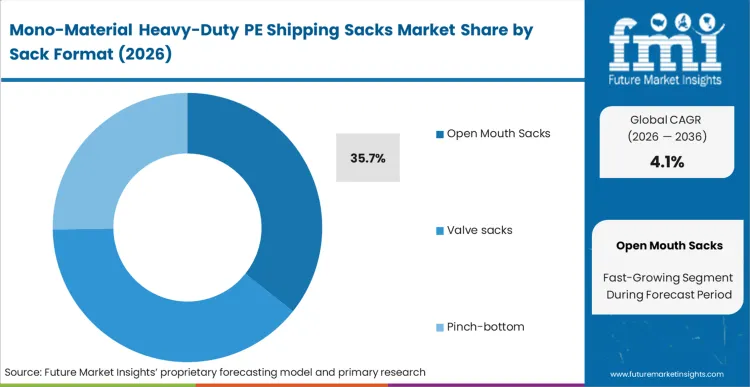
Facility managers utilizing manual or semi-automated sealing stations prefer these industrial plastic bags because they require minimal capital expenditure to integrate into current packing lines. Suppliers who lack reinforced gusset engineering in their open-mouth portfolios lose competitive bids in the demanding pet food and animal feed sectors. Open mouth sacks command 35.7% of 2026 volumes, reflecting their universal compatibility with existing heavy duty bags and sacks filling equipment in agricultural hubs. The structural shift toward fully automated valve-filling systems gradually erodes this dominance toward the end of the forecast decade.
- Process Compatibility: Open mouth configurations accept varied granular sizes without jamming automated auger feeds.
- Sealing Integrity: Mondi launching FlexiBag Reinforced pre-made recyclable bags demonstrates clear market momentum toward puncture-resistant single-polymer alternatives [3].
- Handling Ergonomics: Operators managing 50-kilogram payloads rely on integrated handle features that modern mono-material designs readily support.
Mono-Material Heavy-Duty PE Shipping Sacks Market Analysis by PE Grade
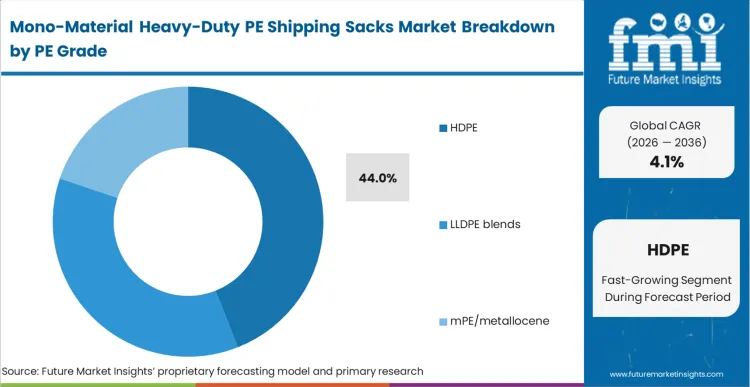
HDPE commands 44.0% of segment volumes, providing the high-tensile stiffness necessary for stacking dense materials. This stiffness allows chemical producers to safely stack pallets four tiers high without deformation, a requirement that softer PE films cannot meet. Extrusion engineers continuously blend LLDPE into these high-density matrices to improve drop-impact resistance, ensuring bags survive rough handling during multimodal transit.
- Stacking Physics: High crystalline density provides the vertical rigidity required for warehouse column stability.
- Impact Resistance: With plastics comprising significant amount of United States municipal solid waste generation, industrial specifiers face immense pressure to transition toward highly recyclable grades.
- Barrier Performance: Moisture vapor transmission rates remain critically low across premium high-density extrusions.
Mono-Material Heavy-Duty PE Shipping Sacks Market Analysis by End Use
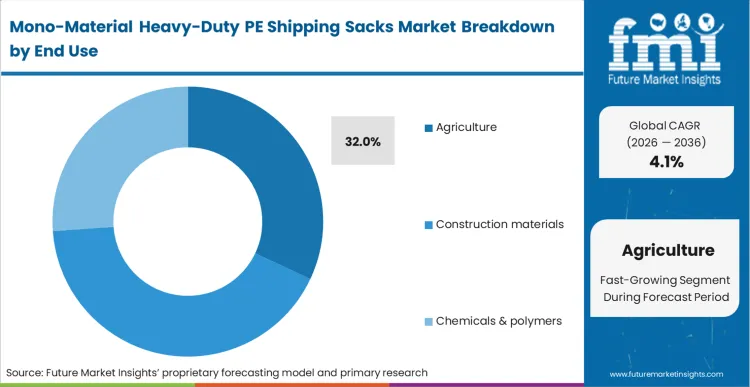
Prior multi-layer laminate approaches failed to provide circular end-of-life pathways for bulk nutrient containers. Agriculture (fertilizer/feed) leads with 32.0% share, driven by outdoor storage environments that demand absolute water resistance. FMI analysts opine that woven sacks lacking continuous film barriers expose hygroscopic fertilizers to humidity degradation during extended field staging. Shippers operating without UV-stabilized mono-PE solutions face unacceptable product loss ratios during peak planting seasons.
- Moisture Exclusion: Single-polymer extrusion inherently blocks water vapor without requiring secondary inner liners.
- UV Degradation Prevention: Outdoor staging of agricultural goods necessitates advanced ultraviolet inhibitors blended directly into the masterbatch.
- Volume Scaling: The International Fertilizer Association forecasting total consumption at 205 million nutrient tonnes in 2025 creates a massive, immediate target for single-polymer substitution [5].
Mono-Material Heavy-Duty PE Shipping Sacks Market Analysis by Load Rating
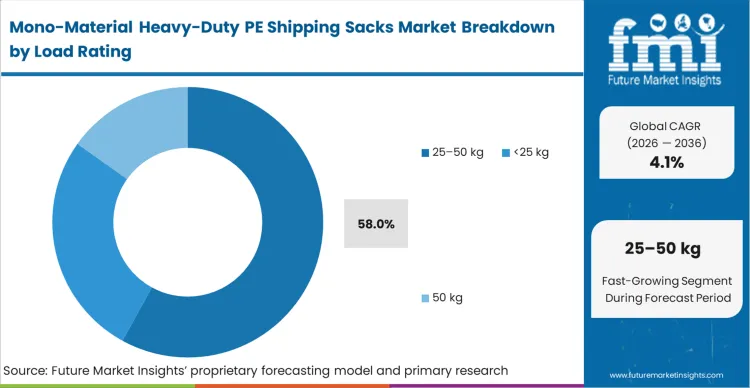
Facility operators managing manual palletization lines enforce strict weight thresholds to comply with occupational safety limits. The 25-50 kg category captures 58.0% of the market, perfectly aligning with standard industrial packaging norms for cement and resin distribution. As automated robotic palletizers replace manual labor, this weight band remains the optimal dimension for maintaining bulk bags stability on standard shipping skids. Packaging buyers who deviate from these standardized load ratings incur severe freight penalties.
- Ergonomic Compliance: Safety regulations restrict manual lifting limits, anchoring demand in the 25-kilogram range.
- Pallet Optimization: ProAmpac rolling out QUADFLEX Recyclable LFQ specifically designed for products up to 40 pounds confirms that the mid-weight tier drives commercial innovation [6].
- Drop-test Survival: Kinetic energy scaling dictates that bags exceeding 50 kilograms require exponentially thicker film gauges.
Mono-Material Heavy-Duty PE Shipping Sacks Market Analysis by Filling Compatibility
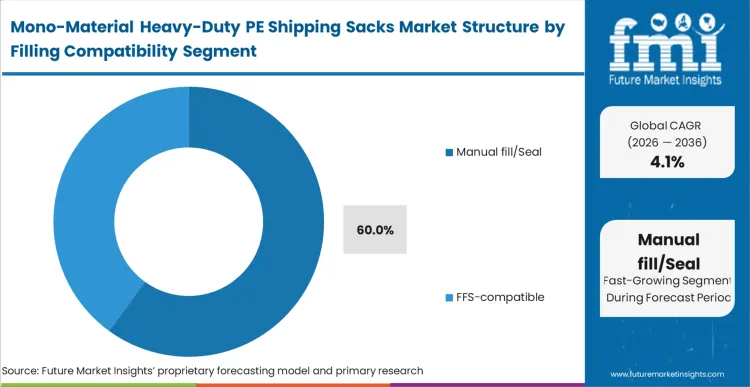
Manual fill/seal retains a 60.0% market share, reflecting the massive installed base of gravity-fed spouts in developing cement packaging economies. Localized fertilizer packaging plants defer the heavy capital expenditure required for automated form-fill-seal equipment, relying instead on pre-made open-mouth mono-PE bags. Extruders failing to provide consistent slip profiles for these semi-automated sealing jaws encounter chronic production rejections.
- Sealing Temperature Control: Single-polymer structures require precise thermal management to prevent burn-through during jaw clamping.
- Line Speed Maintenance: Berry Global and T2 Maschinenbau demonstrating PE bags with recycled content running on vertical form-fill-seal lines at Fachpack 2024 proves that circular materials now meet high-speed automation demands [7].
- Capital Deferment: Plants preserve cash by utilizing existing pre-made bag infrastructure rather than purchasing integrated tubular film units.
Mono-Material Heavy-Duty PE Shipping Sacks Market Drivers, Restraints, and Opportunities
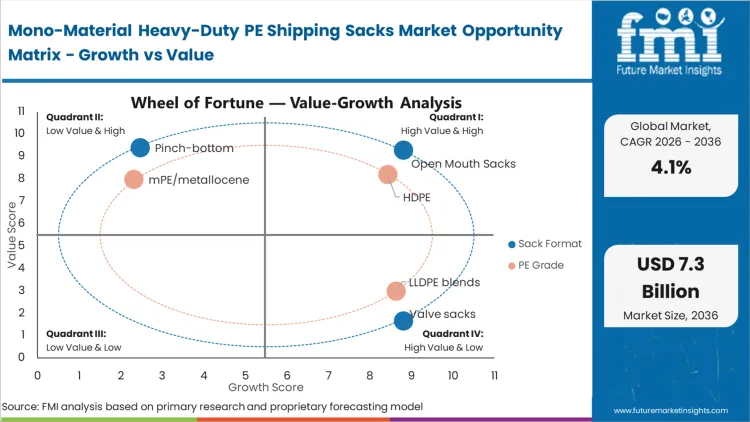
The United Nations Environment Programme reporting global plastic production exceeds 400 million tonnes annually establishes the geopolitical baseline forcing heavy industry to adopt recyclable transport formats [8]. Packaging compliance leads replace unrecyclable multi-material constructions with mono-PE equivalents to meet corporate landfill-diversion targets before impending regulatory deadlines. Supply continuity dictates this shift, as polymer producers scale metallocene production to deliver the required toughness in single-layer films. Converters missing the engineering capability to extrude high-strength agricultural packaging structures find themselves locked out of multinational tender processes.
Post-consumer recycled content mandates expose the severe infrastructure deficit limiting high-quality circular polymer availability. The Recycling Partnership reporting that less than half of plastic packaging is currently recyclable [9] quantifies the collection barrier hindering closed-loop chemical packaging systems. Facility managers mitigate this supply constraint by forming direct off-take partnerships with localized industrial film recyclers to secure verified PCR streams.
- Stretch Hood Integration: Charter Next Generation launching Titanium 5P stretch hood film with 20% recycled content expands the circular palletization ecosystem [10].
- Downgauging Technology: TotalEnergies and SML introducing new downgauging film solutions allows converters to reduce raw material spend while maintaining strength [11].
- Asset Acquisition: Nefab Group acquiring Plastiform strengthens its position in recycled plastic solutions, indicating rapid supply chain consolidation [12].
Regional Analysis
Based on the regional analysis, the Mono-Material Heavy-Duty PE Shipping Sacks market is segmented into North America, Latin America, Europe, East Asia, South Asia, Oceania and Middle East & Africa across 40+ countries. The full report also offers market attractiveness analysis based on regional trends.
.webp "Top Country Growth Comparison Mono Material Heavy Duty Pe Shipping Sacks Market Cagr (2026 2036)")
| Country | CAGR (2026 to 2036) |
|---|---|
| India | 5.6% |
| Indonesia | 5.2% |
| China | 5.0% |
| Brazil | 4.6% |
| Germany | 3.9% |
| USA | 3.8% |
| Spain | 3.3% |
Source: Future Market Insights (FMI) analysis, based on proprietary forecasting model and primary research
Asia Pacific Mono-Material Heavy-Duty PE Shipping Sacks Market Analysis
Export-oriented manufacturing centers dictate the baseline demand for puncture-resistant bulk commodity containment. UNCTAD reporting a 2.4% growth in global maritime trade during 2023 directly translates into elevated consumption of waterproof construction packaging destined for sea freight [13]. Bulk logistics managers operating out of major Asian ports specify mono-PE formats to satisfy the strict recyclability standards enforced by their European and North American import partners. Failing to provide compliant shipping materials results in costly repacking penalties at destination terminals. This inbound regulatory pressure forces domestic extruders to rapidly upgrade their lines from basic woven polypropylene to engineered single-polymer films.
- China: The World Steel Association tracking 1,019.1 million tonnes of crude steel output in 2023 defines the massive industrial base requiring corrosion-protective packaging [14]. This raw material density requires a 5.0% compound rate for mono-PE heavy-duty sacks in China through 2036, steady rather than explosive due to the sheer baseline volume already established. Materials specifiers directing chemical and metallurgical exports must secure ISO-certified mono-polymer bags before Q4 2026 shipping contracts finalize or risk port-of-entry rejections.
- India: India's 140.8 million tonnes of crude steel production in 2023 [15] mirrors a massive simultaneous expansion in domestic cement capacity. This industrial throughput anchors 5.6% compound expansion of single-polymer sack demand in India till 2036, reflecting the urgent transition away from highly porous woven formats toward moisture-blocking films. Cement plant operators who fail to install FFS-compatible bagging lines before the 2027 infrastructure surge will lose critical market share to competitors offering superior weather-resistant pallets.
- Indonesia: The International Fertilizer Association's forecast of a 2.2% global fertilizer use increase in 2025 directly impacts Indonesian production hubs [16]. Sustaining a 5.2% annual growth rate of mono-material agricultural sacks in Indonesia over the forecast period, this agronomic expansion requires reliable humidity barriers for inter-island distribution. Logistics directors not utilizing UV-stabilized PE sacks forfeit their crop-nutrient integrity during extended monsoon transit cycles.
FMI's report includes detailed analysis covering Japan, South Korea, Thailand, and Vietnam. Across these industrial corridors, the localization of metallocene resin production dictates the speed at which mid-market converters can offer high-performance mono-material alternatives to multinational chemical brands.
North America Mono-Material Heavy-Duty PE Shipping Sacks Market Analysis
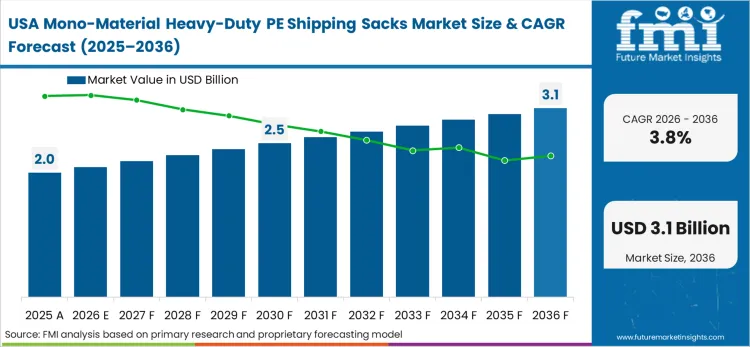
Integrated continental supply chains demand robust palletization structures capable of surviving extensive overland transit. The Bureau of Transportation Statistics reporting nearly USD 3.5 billion in daily cross-border freight shipments across United States land borders quantifies the mechanical stress applied to industrial plastic sacks [17]. Packaging engineers standardize on high-density mono-PE blends to prevent bag rupture during multi-touch warehouse transfers between rail and truck networks. Suppliers that are incapable of delivering consistent drop-test survivability lose their preferred vendor status within the highly consolidated North American chemical distribution grid.
- USA: The USA Plastics Pact reporting a low 13.3% national recycling rate for plastic packaging exposes the structural vulnerability facing industrial brands [18]. This compliance gap drives a 3.8% CAGR for fully recyclable heavy-duty sacks in the USA through 2036, representing the mandated shift away from paper-film composites that clog recovery facilities. Extrusion partners failing to qualify their mono-material structures with the Association of Plastic Recyclers before the 2027 sourcing window will be excluded from major retail and agricultural supply networks.
FMI's report includes comprehensive tracking of Canada and Mexico. The alignment of United States Mexico Canada Agreement trade protocols with emerging extended producer responsibility frameworks forces cross-border resin suppliers to harmonize their heavy-duty sack specifications.
Europe Mono-Material Heavy-Duty PE Shipping Sacks Market Analysis
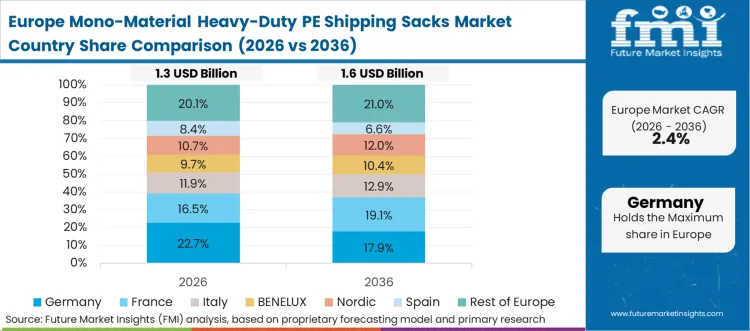
Stringent extended producer responsibility fees penalize multi-material configurations with exorbitant end-of-life tariffs. The WWF Transparent 2024 report indicating a 37% estimated recycling rate for member plastic footprints highlights the immense regulatory gap driving recyclable packaging innovation [19]. Facility managers migrate entirely to mono-polyethylene architectures to qualify for the lowest possible eco-modulation tax brackets. Vendors lacking verified life-cycle analysis documentation for their heavy-duty sacks face immediate disqualification from European chemical and construction material tenders.
- Germany: Mondi showcasing its mono-material packaging innovations at Fachpack 2024 [20] establishes the new technical baseline for domestic converters. Germany's industrial transition models a 3.9% CAGR for sustainable heavy-duty sacks to the 2036 horizon, demonstrating steady integration of post-consumer resins into critical load-bearing applications. Operations managers not deploying verified closed-loop packaging solutions prior to the next legislative phase-out will incur severe financial penalties under the updated Packaging Act.
- Spain: Spain records a 3.3% compound rate for mono-PE shipping formats as the period's compound rate, driven by port-centric chemical exporters upgrading their containment profiles to meet northern European import demands. Plant directors who delay the implementation of fully recyclable FFS films will lose their lucrative export corridors to compliant French and Italian suppliers.
FMI's report includes extensive capacity assessments for the United Kingdom, Italy, and the Nordics. The availability of food-grade mechanical recycling infrastructure across these nations directly accelerates the incorporation of post-consumer recyclate into heavy-duty agricultural sacks.
Latin America Mono-Material Heavy-Duty PE Shipping Sacks Market Analysis
Vast agricultural export networks define the structural requirement for resilient maritime containment. UNCTAD stating that over 80% of world trade volume is carried by sea confirms the reliance on durable sustainable packaging capable of surviving harsh oceanic climates [22]. Bulk logistics managers prioritize mono-PE solutions that block corrosive salt air from degrading sensitive fertilizer and mineral shipments. Film extruders operating without deep resin supply relationships struggle to maintain the consistent film gauge required for these demanding trans-oceanic journeys.
- Brazil: The United Nations Environment Programme citing 19 to 23 million tonnes of plastic waste leaking into aquatic ecosystems annually [23] places intense international scrutiny on South American agro-industrial exporters. This environmental pressure enforces a 4.6% CAGR for recyclable mono-material sacks in Brazil into 2036 as massive soybean and fertilizer networks abandon complex composites. Packaging specifiers failing to transition their bulk export bags to mono-PE structures before international shipping bodies tighten contamination rules will forfeit access to premium European agricultural markets.
FMI's report includes evaluation of Argentina, Chile, and Colombia. Extrusion capacity expansions within these agricultural heavyweights determine the regional transition velocity away from unrecyclable multiwall paper architectures.
Competitive Aligners for Market Players
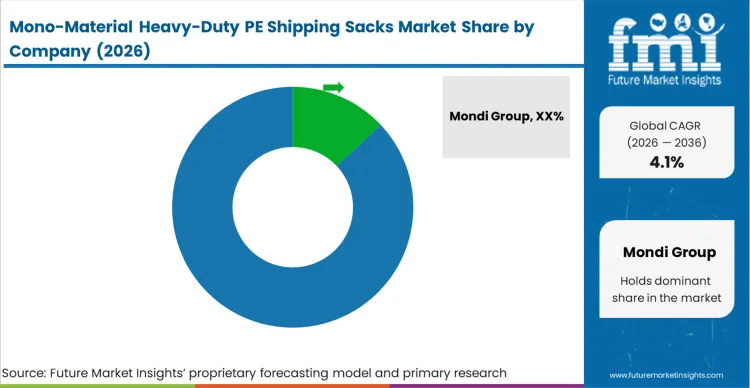
Coveris winning the Green Packaging Star Award 2025 for its recyclable SleeveFlexR Stretch [24] establishes a new certification threshold for load-securing applications. Materials specifiers now utilize recognized sustainability awards as preliminary filters during the vendor shortlisting process, bypassing suppliers who cannot produce third-party validated circularity credentials. Film extruders lacking recognized environmental certification on their FFS films forfeit access to multinational corporate accounts enforcing strict Scope 3 emission targets.
Large-scale pallet packaging conglomerates divest non-core assets to fund intensive research into metallocene blending and downgauging technologies. Converters operating without the capital depth to continuously upgrade their multi-layer blown film lines will be marginalized as leading brands consolidate market share.
The ecosystem requirement for post-consumer recycled resin forces unprecedented integration between waste collectors and film extruders. Packaging compliance leads demand transparent tracking of recycled polymer streams to satisfy impending digital product passport regulations. Manufacturers operating stretch hood film lines without secured, traceable PCR off-take agreements will fail upcoming procurement audits.
Recent Developments
The report includes full coverage of key trends from competitive benchmarking. Some of the recent developments covered in the reports:
- In April 2025, Amcor completed its all-stock combination with Berry Global, creating a broader packaging portfolio and highlighting expanded innovation capacity. [1]
- In April 2024, Greif announced it completed the acquisition of Ipackchem, expanding its global footprint in performance packaging. [21]
- In December 2024, Sonoco announced an agreement to sell its Thermoformed & Flexible Packaging business to TOPPAN as part of portfolio reshaping. [25]
Key Players in Mono-Material Heavy-Duty PE Shipping Sacks Market
- Mondi Group
- Berry Global
- LC Packaging International
- Sonoco Products
- ProAmpac
- NNZ Group
- Greif
- Amcor
- Trioworld
- Coveris
- TC Transcontinental
- Charter Next Generation (CNG)
- Bischof+Klein
Scope of the Report
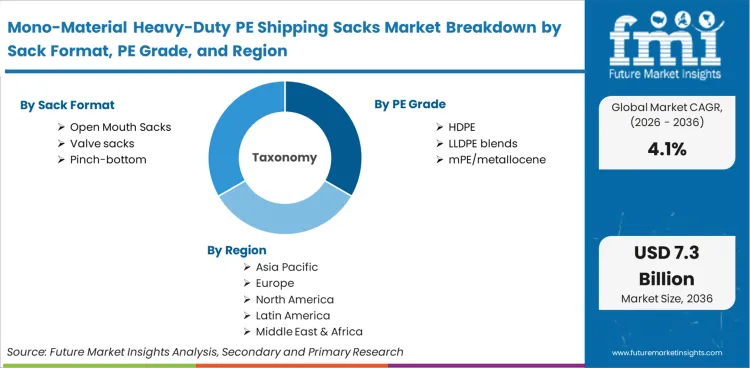
| Metric | Value |
|---|---|
| Quantitative Units | USD 4.9 billion to USD 7.4 billion, at a CAGR of 4.1% |
| Market Definition | Mono-material heavy-duty PE shipping sacks are high-capacity industrial bags extruded entirely from polyethylene resins, designed without barrier layers of foil or non-PE polymers to ensure complete recyclability. |
| Sack format Segmentation | Open mouth sacks, Valve sacks, Pinch-bottom, Others |
| PE grade Segmentation | HDPE, LLDPE blends, mPE/metallocene, Others |
| End use Segmentation | Agriculture (fertilizer/feed), Construction materials, Chemicals & polymers, Others |
| Load rating Segmentation | 25-50 kg, <25 kg, >50 kg |
| Regions Covered | North America, Latin America, Europe, East Asia, South Asia, Oceania, Middle East and Africa |
| Countries Covered | United States, Canada, Mexico, Brazil, Argentina, Germany, France, United Kingdom, Italy, Spain, China, India, Japan, South Korea, Indonesia, Australia and 40 plus countries |
| Key Companies Profiled | Mondi Group, Berry Global, LC Packaging International, Sonoco Products, ProAmpac, NNZ Group, Greif, Amcor |
| Forecast Period | 2026 to 2036 |
| Approach | Bottom-up material conversion models beginning with raw polymer pellet output mapped against industrial packaging demand curves. |
Source: Future Market Insights (FMI) analysis, based on proprietary forecasting model and primary research
Segmental Analysis
Sack Format:
- Open mouth sacks
- Valve sacks
- Pinch-bottom
- Others
PE Grade:
- HDPE
- LLDPE blends
- mPE/metallocene
- Others
End Use:
- Agriculture (fertilizer/feed)
- Construction materials
- Chemicals & polymers
- Others
Load Rating:
- 25-50 kg
- <25 kg
- 50 kg
Filling Compatibility:
- FFS-compatible
- Manual fill/seal
Region:
- Asia Pacific
- India
- China
- Japan
- South Korea
- Indonesia
- Australia & New Zealand
- ASEAN
- Rest of Asia Pacific
- Europe
- Germany
- Italy
- France
- United Kingdom
- Spain
- Benelux
- Nordics
- Central & Eastern Europe
- Rest of Europe
- North America
- United States
- Canada
- Mexico
- Latin America
- Brazil
- Argentina
- Chile
- Rest of Latin America
- Middle East & Africa
- Kingdom of Saudi Arabia
- United Arab Emirates
- South Africa
- Turkey
- Rest of Middle East & Africa
Bibliography
- [1] Amcor. (2025, April 30). Amcor completes combination with Berry Global; Positioned to significantly enhance value for customers and shareholders (Company news release). Amcor.
- [2] Amcor Packaging Solutions. (2024, November 13). Berry Global and T2 join forces to deliver PE bags with 50% recycled plastic content (Article/press release). Amcor.
- [3] Mondi Group. (2024, July 3). Unveiling FlexiBag Reinforced - Mondi’s cost-effective next generation of recyclable packaging (Press release). Mondi.
- [4] USA Environmental Protection Agency. (2025, December 19). National overview: Facts and figures on materials, wastes and recycling (Data page). EPA.
- [5] International Fertilizer Association. (2025, February). Public summary: Short-Term Fertilizer Outlook 2024-2025 (Report PDF). IFA
- [6] ProAmpac. (2024, September 24). New QUADFLEX Recyclable LFQ Bag (Product news). ProAmpac.
- [7] Amcor Packaging Solutions. (2024, November 13). Berry Global and T2 join forces to deliver PE bags with 50% recycled plastic content (Article/press release). Amcor.
- [8] United Nations. (2025, June 5). World Environment Day: Beat plastic pollution (Fact page). United Nations.
- [9] The Recycling Partnership. (2024, January 12). State of Recycling 2024 (Report PDF). The Recycling Partnership.
- [10] Charter Next Generation. (2024, February 13). Charter Next Generation introduces stretch hood film with 20% post-consumer recycled content (Press release). CNG.
- [11] TotalEnergies Polymers. (2025, September 18). New downgauging film solutions to be revealed at K 2025 by TotalEnergies and SML (Press release). TotalEnergies.
- [12] Nefab Group. (2024, April 1). Nefab Group acquires Precision Formed Plastics, Inc. (Press release).
- [13] UN Trade and Development (UNCTAD). (2024, October 22). Review of Maritime Transport 2024 (Publication page). UNCTAD.
- [14] World Steel Association. (2024, May 27). World Steel in Figures 2024 (Report). worldsteel.
- [15] World Steel Association. (2024). World steel in figures 2024: crude steel production rankings (2023) (Data page). worldsteel.
- [16] International Fertilizer Association. (2025, February). Public summary: Short-Term Fertilizer Outlook 2024-2025 (Report PDF). IFA.
- [17] Bureau of Transportation Statistics. (2025, March 20). TransBorder Freight Annual Report 2024 (Government report page). USA DOT BTS.
- [18] USA Plastics Pact. (2024-2025). 2023-24 Impact Report (Impact report page). USA Plastics Pact.
- [19] World Wildlife Fund (WWF). (2025, January 31). Transparent 2024 (ReSource annual report). WWF ReSource.
- [20] Mondi Group. (2024). Mondi will showcase sustainable packaging innovations at FACHPACK 2024 (Press release). Mondi.
- [21] Greif. (2024, April 17). Greif completes acquisition of Ipackchem (Press release). Greif.
- [22] UN Trade and Development (UNCTAD). (2024, October 22). Review of Maritime Transport 2024 (Publication page). UNCTAD.
- [23] United Nations Environment Programme (UNEP). (2025, July 1). Plastic pollution (Topic page).
- [24] Coveris. (2025, September 25). Coveris wins Green Packaging Star Award 2025 for sustainable sleeve solution (Press release). Coveris.
- [25] Sonoco Products Company. (2024, December 18). Sonoco completes strategic review, announces agreement to sell Thermoformed and Flexibles Packaging (TFP) business to TOPPAN Holdings Inc. (Investor news release). Sonoco Investor Relations.
This bibliography is provided for reader reference and is not exhaustive. The full report contains the complete reference list and detailed citations.
This Report Addresses
- Market size estimation establishing the baseline USD 4.9 billion valuation and scaling assumptions for the 2036 forecast.
- Forecast methodology utilizing bottom-up material conversion models beginning with raw polymer pellet output mapped against industrial packaging demand curves.
- Segment analysis detailing the mechanical advantages of HDPE extrusions and the dominance of open-mouth sack formats across agricultural sectors.
- Regional analysis evaluating the strict extended producer responsibility frameworks driving European adoption and the massive industrial throughput anchoring Asian demand.
- Regulatory dynamics mapping the impact of global plastic leakage reduction mandates on corporate sustainable packaging procurement policies.
- Competitive intelligence profiling the capital divestments and acquisitions reshaping the extrusion landscape toward focused material science players.
- Opportunity mapping identifying downgauging technologies and stretch hood integration as key vectors for margin expansion.
- Market report delivery in PDF, Excel, PPT, and interactive dashboard formats for executive and operational use.
Frequently Asked Questions
How large is the demand for Mono-Material Heavy-Duty PE Shipping Sacks in the global market in 2026?
Demand for Mono-Material Heavy-Duty PE Shipping Sacks in the global market is estimated to be valued at USD 4.9 billion in 2026.
What will be the market size of Mono-Material Heavy-Duty PE Shipping Sacks in the global market by 2036?
Market size for Mono-Material Heavy-Duty PE Shipping Sacks is projected to reach USD 7.4 billion by 2036.
What is the expected demand growth for Mono-Material Heavy-Duty PE Shipping Sacks in the global market between 2026 and 2036?
Demand for Mono-Material Heavy-Duty PE Shipping Sacks is expected to grow at a CAGR of 4.1% between 2026 and 2036.
Which Sack format is poised to lead global sales by 2026?
Open mouth sacks commands 35.7% in 2026 as universal compatibility with existing manual and semi-automated filling lines preserves capital capital.
How significant is the role of Agriculture (fertilizer/feed) in driving Mono-Material Heavy-Duty PE Shipping Sacks adoption in 2026?
Agriculture (fertilizer/feed) represents 32.0% of segment share as high-throughput bulk material transport requires puncture-resistant moisture barriers.
What is driving demand in India?
India's massive expansion in domestic cement capacity and standardized palletization protocols drive single-polymer sack adoption.
What compliance standards or regulations are referenced for India?
General industrial output requirements and standardized palletization protocols directly influence domestic procurement behavior.
What is the India growth outlook in this report?
India is projected to grow at a CAGR of 5.6% during 2026 to 2036.
Why is North America described as a priority region in this report?
Integrated continental supply chains demand robust palletization structures capable of surviving extensive overland cross-border transit.
What type of demand dominates in North America?
Cross-border construction material flows and stringent retail recycling requirements dominate regional formulation demand.
What is Indonesia's growth outlook in this report?
Indonesia is projected to expand at a CAGR of 5.2% during 2026 to 2036.
Does the report cover China in its regional analysis?
Yes, China is included within Asia Pacific under the regional scope of analysis.
What are the sources referred to for analyzing China?
Official crude steel output data from the World Steel Association forms the analytical basis.
What is the main demand theme linked to China in its region coverage?
Massive metallurgical and chemical exports requiring ISO-certified mono-polymer bags shape continuous procurement demand.
Does the report cover Brazil in its regional analysis?
Yes, Brazil is included within Latin America under the regional coverage framework.
What is the main Brazil related demand theme in its region coverage?
Intense international scrutiny on aquatic plastic leakage drives agro-industrial exporters toward fully recyclable mono-material containment.
Which product formats or configurations are strategically important for Europe supply chains?
High-density mono-PE structures offering verified life-cycle analysis documentation hold immense strategic importance.
What is Mono-Material Heavy-Duty PE Shipping Sacks and what is it mainly used for?
It is a high-capacity industrial bag extruded entirely from polyethylene resins, utilized primarily for transporting bulk agricultural, chemical, and construction materials.
What does Mono-Material Heavy-Duty PE Shipping Sacks mean in this report?
The market refers to the global production, trade, and industrial consumption of flexible, single-polymer polyethylene bags designed for 25-to-50-kilogram payloads.
What is included in the scope of this Mono-Material Heavy-Duty PE Shipping Sacks report?
Scope includes single-polymer high-density and linear low-density polyethylene sacks, form-fill-seal tubular films, and stretch-hood-compatible sacks.
What is excluded from the scope of this report?
Multi-material laminates combining polyethylene with PET, nylon, or aluminum foil, and paper-based multiwall sacks are strictly excluded.
What does market forecast mean on this page?
The market forecast represents a model-based projection built on defined industrial capacity and adoption assumptions for strategic planning purposes.
How does FMI build and validate the Mono-Material Heavy-Duty PE Shipping Sacks forecast?
Forecasts utilize bottom-up material conversion models, validated against global fertilizer and cement production volumes.
What does zero reliance on speculative third-party market research mean here?
Primary interviews, verified corporate recycling disclosures, and official maritime trade datasets are used exclusively instead of unverified syndicated estimates.
Preview the report firsthand - request a free sample
Get SampleGet the brochure for pricing and purchase details.
Get PDFTable of Content
- Executive Summary
- Global Market Outlook
- Demand-side Trends
- Supply-side Trends
- Technology Roadmap Analysis
- Analysis and Recommendations
- Market Overview
- Market Coverage / Taxonomy
- Market Definition / Scope / Limitations
- Research Methodology
- Chapter Orientation
- Analytical Lens and Working Hypotheses
- Market Structure, Signals, and Trend Drivers
- Benchmarking and Cross-market Comparability
- Market Sizing, Forecasting, and Opportunity Mapping
- Research Design and Evidence Framework
- Desk Research Programme (Secondary Evidence)
- Company Annual and Sustainability Reports
- Peer-reviewed Journals and Academic Literature
- Corporate Websites, Product Literature, and Technical Notes
- Earnings Decks and Investor Briefings
- Statutory Filings and Regulatory Disclosures
- Technical White Papers and Standards Notes
- Trade Journals, Industry Magazines, and Analyst Briefs
- Conference Proceedings, Webinars, and Seminar Materials
- Government Statistics Portals and Public Data Releases
- Press Releases and Reputable Media Coverage
- Specialist Newsletters and Curated Briefings
- Sector Databases and Reference Repositories
- FMI Internal Proprietary Databases and Historical Market Datasets
- Subscription Datasets and Paid Sources
- Social Channels, Communities, and Digital Listening Inputs
- Additional Desk Sources
- Expert Input and Fieldwork (Primary Evidence)
- Primary Modes
- Qualitative Interviews and Expert Elicitation
- Quantitative Surveys and Structured Data Capture
- Blended Approach
- Why Primary Evidence is Used
- Field Techniques
- Interviews
- Surveys
- Focus Groups
- Observational and In-context Research
- Social and Community Interactions
- Stakeholder Universe Engaged
- C-suite Leaders
- Board Members
- Presidents and Vice Presidents
- R&D and Innovation Heads
- Technical Specialists
- Domain Subject-matter Experts
- Scientists
- Physicians and Other Healthcare Professionals
- Governance, Ethics, and Data Stewardship
- Research Ethics
- Data Integrity and Handling
- Primary Modes
- Tooling, Models, and Reference Databases
- Desk Research Programme (Secondary Evidence)
- Data Engineering and Model Build
- Data Acquisition and Ingestion
- Cleaning, Normalisation, and Verification
- Synthesis, Triangulation, and Analysis
- Quality Assurance and Audit Trail
- Market Background
- Market Dynamics
- Drivers
- Restraints
- Opportunity
- Trends
- Scenario Forecast
- Demand in Optimistic Scenario
- Demand in Likely Scenario
- Demand in Conservative Scenario
- Opportunity Map Analysis
- Product Life Cycle Analysis
- Supply Chain Analysis
- Investment Feasibility Matrix
- Value Chain Analysis
- PESTLE and Porter’s Analysis
- Regulatory Landscape
- Regional Parent Market Outlook
- Production and Consumption Statistics
- Import and Export Statistics
- Market Dynamics
- Global Market Analysis 2021 to 2025 and Forecast, 2026 to 2036
- Historical Market Size Value (USD Million) Analysis, 2021 to 2025
- Current and Future Market Size Value (USD Million) Projections, 2026 to 2036
- Y-o-Y Growth Trend Analysis
- Absolute $ Opportunity Analysis
- Global Market Pricing Analysis 2021 to 2025 and Forecast 2026 to 2036
- Global Market Analysis 2021 to 2025 and Forecast 2026 to 2036, By Sack Format
- Introduction / Key Findings
- Historical Market Size Value (USD Million) Analysis By Sack Format , 2021 to 2025
- Current and Future Market Size Value (USD Million) Analysis and Forecast By Sack Format , 2026 to 2036
- Open Mouth Sacks
- Valve sacks
- Pinch-bottom
- Open Mouth Sacks
- Y-o-Y Growth Trend Analysis By Sack Format , 2021 to 2025
- Absolute $ Opportunity Analysis By Sack Format , 2026 to 2036
- Global Market Analysis 2021 to 2025 and Forecast 2026 to 2036, By PE Grade
- Introduction / Key Findings
- Historical Market Size Value (USD Million) Analysis By PE Grade, 2021 to 2025
- Current and Future Market Size Value (USD Million) Analysis and Forecast By PE Grade, 2026 to 2036
- HDPE
- LLDPE blends
- mPE/metallocene
- HDPE
- Y-o-Y Growth Trend Analysis By PE Grade, 2021 to 2025
- Absolute $ Opportunity Analysis By PE Grade, 2026 to 2036
- Global Market Analysis 2021 to 2025 and Forecast 2026 to 2036, By End Use
- Introduction / Key Findings
- Historical Market Size Value (USD Million) Analysis By End Use, 2021 to 2025
- Current and Future Market Size Value (USD Million) Analysis and Forecast By End Use, 2026 to 2036
- Agriculture
- Construction materials
- Chemicals & polymers
- Agriculture
- Y-o-Y Growth Trend Analysis By End Use, 2021 to 2025
- Absolute $ Opportunity Analysis By End Use, 2026 to 2036
- Global Market Analysis 2021 to 2025 and Forecast 2026 to 2036, By Load Rating
- Introduction / Key Findings
- Historical Market Size Value (USD Million) Analysis By Load Rating, 2021 to 2025
- Current and Future Market Size Value (USD Million) Analysis and Forecast By Load Rating, 2026 to 2036
- 25-50 kg
- <25 kg
- 50 kg
- 25-50 kg
- Y-o-Y Growth Trend Analysis By Load Rating, 2021 to 2025
- Absolute $ Opportunity Analysis By Load Rating, 2026 to 2036
- Global Market Analysis 2021 to 2025 and Forecast 2026 to 2036, By Filling Compatibility
- Introduction / Key Findings
- Historical Market Size Value (USD Million) Analysis By Filling Compatibility, 2021 to 2025
- Current and Future Market Size Value (USD Million) Analysis and Forecast By Filling Compatibility, 2026 to 2036
- Manual fill/Seal
- FFS-compatible
- Manual fill/Seal
- Y-o-Y Growth Trend Analysis By Filling Compatibility, 2021 to 2025
- Absolute $ Opportunity Analysis By Filling Compatibility, 2026 to 2036
- Global Market Analysis 2021 to 2025 and Forecast 2026 to 2036, By Region
- Introduction
- Historical Market Size Value (USD Million) Analysis By Region, 2021 to 2025
- Current Market Size Value (USD Million) Analysis and Forecast By Region, 2026 to 2036
- North America
- Latin America
- Western Europe
- Eastern Europe
- East Asia
- South Asia and Pacific
- Middle East & Africa
- Market Attractiveness Analysis By Region
- North America Market Analysis 2021 to 2025 and Forecast 2026 to 2036, By Country
- Historical Market Size Value (USD Million) Trend Analysis By Market Taxonomy, 2021 to 2025
- Market Size Value (USD Million) Forecast By Market Taxonomy, 2026 to 2036
- By Country
- USA
- Canada
- Mexico
- By Sack Format
- By PE Grade
- By End Use
- By Load Rating
- By Filling Compatibility
- By Country
- Market Attractiveness Analysis
- By Country
- By Sack Format
- By PE Grade
- By End Use
- By Load Rating
- By Filling Compatibility
- Key Takeaways
- Latin America Market Analysis 2021 to 2025 and Forecast 2026 to 2036, By Country
- Historical Market Size Value (USD Million) Trend Analysis By Market Taxonomy, 2021 to 2025
- Market Size Value (USD Million) Forecast By Market Taxonomy, 2026 to 2036
- By Country
- Brazil
- Chile
- Rest of Latin America
- By Sack Format
- By PE Grade
- By End Use
- By Load Rating
- By Filling Compatibility
- By Country
- Market Attractiveness Analysis
- By Country
- By Sack Format
- By PE Grade
- By End Use
- By Load Rating
- By Filling Compatibility
- Key Takeaways
- Western Europe Market Analysis 2021 to 2025 and Forecast 2026 to 2036, By Country
- Historical Market Size Value (USD Million) Trend Analysis By Market Taxonomy, 2021 to 2025
- Market Size Value (USD Million) Forecast By Market Taxonomy, 2026 to 2036
- By Country
- Germany
- UK
- Italy
- Spain
- France
- Nordic
- BENELUX
- Rest of Western Europe
- By Sack Format
- By PE Grade
- By End Use
- By Load Rating
- By Filling Compatibility
- By Country
- Market Attractiveness Analysis
- By Country
- By Sack Format
- By PE Grade
- By End Use
- By Load Rating
- By Filling Compatibility
- Key Takeaways
- Eastern Europe Market Analysis 2021 to 2025 and Forecast 2026 to 2036, By Country
- Historical Market Size Value (USD Million) Trend Analysis By Market Taxonomy, 2021 to 2025
- Market Size Value (USD Million) Forecast By Market Taxonomy, 2026 to 2036
- By Country
- Russia
- Poland
- Hungary
- Balkan & Baltic
- Rest of Eastern Europe
- By Sack Format
- By PE Grade
- By End Use
- By Load Rating
- By Filling Compatibility
- By Country
- Market Attractiveness Analysis
- By Country
- By Sack Format
- By PE Grade
- By End Use
- By Load Rating
- By Filling Compatibility
- Key Takeaways
- East Asia Market Analysis 2021 to 2025 and Forecast 2026 to 2036, By Country
- Historical Market Size Value (USD Million) Trend Analysis By Market Taxonomy, 2021 to 2025
- Market Size Value (USD Million) Forecast By Market Taxonomy, 2026 to 2036
- By Country
- China
- Japan
- South Korea
- By Sack Format
- By PE Grade
- By End Use
- By Load Rating
- By Filling Compatibility
- By Country
- Market Attractiveness Analysis
- By Country
- By Sack Format
- By PE Grade
- By End Use
- By Load Rating
- By Filling Compatibility
- Key Takeaways
- South Asia and Pacific Market Analysis 2021 to 2025 and Forecast 2026 to 2036, By Country
- Historical Market Size Value (USD Million) Trend Analysis By Market Taxonomy, 2021 to 2025
- Market Size Value (USD Million) Forecast By Market Taxonomy, 2026 to 2036
- By Country
- India
- ASEAN
- Australia & New Zealand
- Rest of South Asia and Pacific
- By Sack Format
- By PE Grade
- By End Use
- By Load Rating
- By Filling Compatibility
- By Country
- Market Attractiveness Analysis
- By Country
- By Sack Format
- By PE Grade
- By End Use
- By Load Rating
- By Filling Compatibility
- Key Takeaways
- Middle East & Africa Market Analysis 2021 to 2025 and Forecast 2026 to 2036, By Country
- Historical Market Size Value (USD Million) Trend Analysis By Market Taxonomy, 2021 to 2025
- Market Size Value (USD Million) Forecast By Market Taxonomy, 2026 to 2036
- By Country
- Kingdom of Saudi Arabia
- Other GCC Countries
- Turkiye
- South Africa
- Other African Union
- Rest of Middle East & Africa
- By Sack Format
- By PE Grade
- By End Use
- By Load Rating
- By Filling Compatibility
- By Country
- Market Attractiveness Analysis
- By Country
- By Sack Format
- By PE Grade
- By End Use
- By Load Rating
- By Filling Compatibility
- Key Takeaways
- Key Countries Market Analysis
- USA
- Pricing Analysis
- Market Share Analysis, 2025
- By Sack Format
- By PE Grade
- By End Use
- By Load Rating
- By Filling Compatibility
- Canada
- Pricing Analysis
- Market Share Analysis, 2025
- By Sack Format
- By PE Grade
- By End Use
- By Load Rating
- By Filling Compatibility
- Mexico
- Pricing Analysis
- Market Share Analysis, 2025
- By Sack Format
- By PE Grade
- By End Use
- By Load Rating
- By Filling Compatibility
- Brazil
- Pricing Analysis
- Market Share Analysis, 2025
- By Sack Format
- By PE Grade
- By End Use
- By Load Rating
- By Filling Compatibility
- Chile
- Pricing Analysis
- Market Share Analysis, 2025
- By Sack Format
- By PE Grade
- By End Use
- By Load Rating
- By Filling Compatibility
- Germany
- Pricing Analysis
- Market Share Analysis, 2025
- By Sack Format
- By PE Grade
- By End Use
- By Load Rating
- By Filling Compatibility
- UK
- Pricing Analysis
- Market Share Analysis, 2025
- By Sack Format
- By PE Grade
- By End Use
- By Load Rating
- By Filling Compatibility
- Italy
- Pricing Analysis
- Market Share Analysis, 2025
- By Sack Format
- By PE Grade
- By End Use
- By Load Rating
- By Filling Compatibility
- Spain
- Pricing Analysis
- Market Share Analysis, 2025
- By Sack Format
- By PE Grade
- By End Use
- By Load Rating
- By Filling Compatibility
- France
- Pricing Analysis
- Market Share Analysis, 2025
- By Sack Format
- By PE Grade
- By End Use
- By Load Rating
- By Filling Compatibility
- India
- Pricing Analysis
- Market Share Analysis, 2025
- By Sack Format
- By PE Grade
- By End Use
- By Load Rating
- By Filling Compatibility
- ASEAN
- Pricing Analysis
- Market Share Analysis, 2025
- By Sack Format
- By PE Grade
- By End Use
- By Load Rating
- By Filling Compatibility
- Australia & New Zealand
- Pricing Analysis
- Market Share Analysis, 2025
- By Sack Format
- By PE Grade
- By End Use
- By Load Rating
- By Filling Compatibility
- China
- Pricing Analysis
- Market Share Analysis, 2025
- By Sack Format
- By PE Grade
- By End Use
- By Load Rating
- By Filling Compatibility
- Japan
- Pricing Analysis
- Market Share Analysis, 2025
- By Sack Format
- By PE Grade
- By End Use
- By Load Rating
- By Filling Compatibility
- South Korea
- Pricing Analysis
- Market Share Analysis, 2025
- By Sack Format
- By PE Grade
- By End Use
- By Load Rating
- By Filling Compatibility
- Russia
- Pricing Analysis
- Market Share Analysis, 2025
- By Sack Format
- By PE Grade
- By End Use
- By Load Rating
- By Filling Compatibility
- Poland
- Pricing Analysis
- Market Share Analysis, 2025
- By Sack Format
- By PE Grade
- By End Use
- By Load Rating
- By Filling Compatibility
- Hungary
- Pricing Analysis
- Market Share Analysis, 2025
- By Sack Format
- By PE Grade
- By End Use
- By Load Rating
- By Filling Compatibility
- Kingdom of Saudi Arabia
- Pricing Analysis
- Market Share Analysis, 2025
- By Sack Format
- By PE Grade
- By End Use
- By Load Rating
- By Filling Compatibility
- Turkiye
- Pricing Analysis
- Market Share Analysis, 2025
- By Sack Format
- By PE Grade
- By End Use
- By Load Rating
- By Filling Compatibility
- South Africa
- Pricing Analysis
- Market Share Analysis, 2025
- By Sack Format
- By PE Grade
- By End Use
- By Load Rating
- By Filling Compatibility
- USA
- Market Structure Analysis
- Competition Dashboard
- Competition Benchmarking
- Market Share Analysis of Top Players
- By Regional
- By Sack Format
- By PE Grade
- By End Use
- By Load Rating
- By Filling Compatibility
- Competition Analysis
- Competition Deep Dive
- Mondi Group
- Overview
- Product Portfolio
- Profitability by Market Segments (Product/Age /Sales Channel/Region)
- Sales Footprint
- Strategy Overview
- Marketing Strategy
- Product Strategy
- Channel Strategy
- Berry Global
- LC Packaging International
- Sonoco Products
- ProAmpac
- NNZ Group
- Greif
- Amcor
- Trioworld
- Mondi Group
- Competition Deep Dive
- Assumptions & Acronyms Used


