

- Industry Size (2026)
- USD 3.0 Bn
- Forecast (2036)
- USD 5.3 Bn
- CAGR (2026 to 2036)
- 5.9%
Mucopolysaccharidosis Treatment Market Size, Market Forecast and Outlook By FMI
The mucopolysaccharidosis treatment market is expected to expand from USD 3.0 billion in 2026 to USD 5.3 billion by 2036. The market is anticipated to register a 5.9% CAGR during the forecast period. Enzyme replacement therapy is likely to lead therapy type demand with a 56.4% share, while hospitals are projected to account for 53.0% share of the end user segment in 2026.
Summary of the Mucopolysaccharidosis Treatment Market
- Demand and Growth Drivers
- Rare disease diagnosis is expected to support wider use of mucopolysaccharidosis treatment across specialized care centers.
- Newborn screening expansion is likely to improve early intervention and treatment initiation for eligible patients.
- Orphan drug development is anticipated to strengthen therapy availability across lysosomal storage disorder management.
- Product and Segment View
- Enzyme replacement therapy is expected to lead the therapy type segment due to established clinical use.
- Hospitals are likely to remain the leading end user because complex infusions require specialist monitoring.
- Stem cell therapy is anticipated to retain selective use where severe disease profiles need more intensive intervention.
- Geography and Competitive Outlook
- The United States is expected to lead country-level growth due to strong orphan drug access and screening infrastructure.
- Germany is likely to record strong expansion as rare disease funding and university hospital research capacity increase.
- Companies with stronger enzyme portfolios, gene therapy pipelines and patient support systems are anticipated to improve positioning.
- Analyst Opinion
- Sabyasachi Ghosh, Principal Consultant for Healthcare at FMI, suggests, “The mucopolysaccharidosis treatment market is likely to move toward earlier diagnosis and disease-modifying therapies. Suppliers with stronger enzyme replacement portfolios and gene therapy development capability are expected to gain advantage as rare disease care becomes more specialized.”
- Mucopolysaccharidosis Treatment Market Value Analysis
- The mucopolysaccharidosis treatment market is moving from symptom management toward disease-modifying rare disease therapy.
- Demand is likely to rise as screening programs identify patients earlier and support faster treatment access.
- Adoption is expected to improve through enzyme replacement therapy used across established mucopolysaccharidosis care pathways.
- Spending is anticipated to be supported by orphan drug reimbursement and specialist hospital treatment programs.
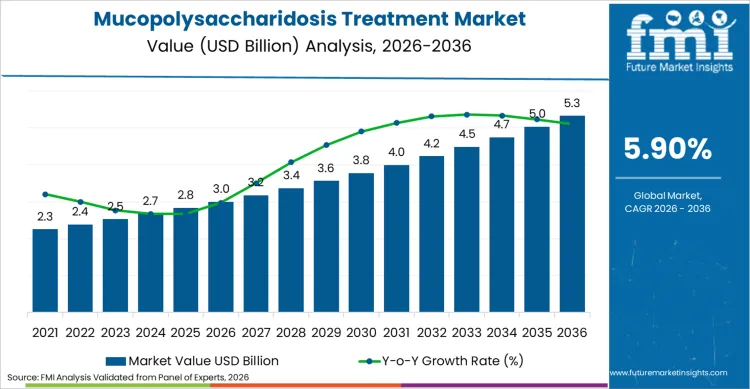
Key Takeaways, Market Size, and Forecast
| Metric | Value |
|---|---|
| Market Size (2026) | USD 3.0 Billion |
| Market Size (2036) | USD 5.3 Billion |
| CAGR (2026–2036) | 5.9% |
| Leading Therapy Type (2026) | Enzyme Replacement Therapy (56.4%) |
| Leading End User (2026) | Hospitals (53.0%) |
| Fastest-Growing Country | United States (7.4% CAGR by 2036) |
Growing understanding of pathophysiology continues to fuel demand for targeted therapies, creating sustained opportunities for orphan drug developers. Government health initiatives targeting rare disease management are facilitating faster regulatory approvals for breakthrough medications. Researchers are combining enzyme replacement therapy with blood-brain barrier crossing technologies to treat neurological symptoms. Companies are witnessing robust growth potential in developing nations, where improving diagnostic infrastructure aligns perfectly with cost-effective treatment adoption.
Innovations in protein engineering are transforming how enzymes are delivered to affected tissues. Development of substrate reduction therapies is gaining traction, offering oral alternatives to infusions. Focus is shifting toward comprehensive chaperone-based therapeutics capable of stabilizing misfolded enzymes. Advancements in autoimmune disease therapeutics enable researchers to mitigate immunogenic responses to exogenous proteins, enhancing therapeutic efficacy while significantly reducing adverse events.
Mucopolysaccharidosis Treatment Market Key Takeaways
| Metric | Value |
|---|---|
| Industry Size (2026) | USD 3.0 Billion |
| Industry Value (2036) | USD 5.3 Billion |
| CAGR (2026-2036) | 5.9% |
Source: Future Market Insights’ proprietary forecasting model and primary research
What Factors Are Propelling Rare Disease R&D?
Shift toward orphan drug development is serving as significant catalyst for broader acceptance of specialized treatments. Recent breakthroughs in fabry disease research have complemented treatment protocols by establishing regulatory pathways for lysosomal storage disorders. This holistic approach appeals to payers managing high-cost claims. Clinical success of sandhoff disease therapeutics in preclinical models has expanded research horizons. Education programs highlighting benefits of early diagnosis are driving screening proactivity. Pharmaceutical firms are capitalizing on these trends by introducing gaucher and pompe diseases enzyme replacement therapy ERT insights into MPS pipelines. Integrating phenylketonuria therapeutics strategies regarding metabolic management is becoming considered, ensuring diverse metabolic needs are met effectively.
How Is the Mucopolysaccharidosis Treatment Market Segmented Across Key Categories?
Global landscape is intricately segmented to address diverse requirements of lysosomal storage disease management, categorizing sector by therapy type, MPS type, and end-user settings. Structural division allows stakeholders to identify specific growth pockets, such as rising demand for stem cell transplants in severe phenotypes or preference for enzyme infusions in attenuated forms. By analyzing these segments, manufacturers can tailor production lines to meet distinct needs of large referral centers versus local clinics. Segmentation also highlights shift from symptomatic management to curative approaches like gene therapy. As industry matures, granular segmentation becomes essential for understanding flow of capital and innovation, ensuring product development aligns perfectly with evolving clinical protocols of genetic medicine community.
Why Does Enzyme Replacement Therapy Maintain Dominance?
Enzyme Replacement Therapy accounts for 56.4% of share in 2026, driven by its established efficacy in clearing glycosaminoglycans from somatic tissues. Leadership position is underpinned by clinical guidelines recommending ERT as standard of care for MPS I, II, IV, and VI. Segment benefits from continuous formulation improvements, such as pediatric diabetes therapeutic delivery modifications applicable to chronic infusions. Research focused on extending half-life is renewing interest among patients seeking reduced dosing frequency. Critical role in managing gastrointestinal rare diseases treatment symptoms further solidifies standing, as these therapies alleviate visceral organ enlargement. As healthcare systems prioritize proven outcomes, demand for high-quality enzymes is expected to remain robust.
Why Are Hospitals the Preferred Setting?
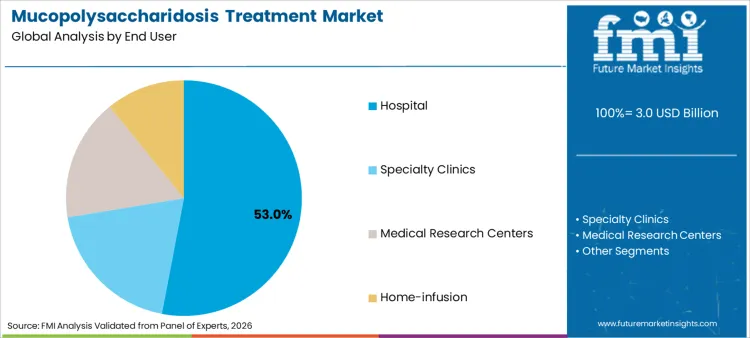
Hospitals command 53.0% share of sector in 2026, reflecting global reliance on specialized centers for complex genetic treatments. Dominance is inextricably linked to need for multidisciplinary care teams including geneticists, cardiologists, and neurologists. Hospitals rely on specialized human identification testing to confirm diagnoses before initiating therapy. These settings are essential for managing infusion reactions, driving priority status in healthcare budgets. Relentless pursuit of patient safety ensures products designed specifically for controlled hospital environments remain top priority. High patient volume necessitates dynamic drug supply, bolstering sustained revenue streams for pharmaceutical manufacturers.
Mucopolysaccharidosis Treatment Market Dynamics
How Will Gene Therapy Innovations Impact Sales?
Gene therapy adoption is set to reshape sales landscapes by offering potential one-time cures. As rare inflammatory disease treatment platforms evolve, patients access viral vectors capable of restoring enzyme production endogenously. Shift toward curative medicine creates demand for long-term follow-up monitoring devices. Manufacturers failing to invest in genomic medicine risk losing visibility among forward-thinking clinicians. Availability of thrombocytopenia treatment protocols to manage conditioning regimens drives complimentary consumption. Rise of inflammatory diseases research stimulates innovation, with companies differentiating offerings by bundling gene therapies with immune modulation support.
How Will the Mucopolysaccharidosis Treatment Industry Evolve in Major Nations?
Global landscape for MPS treatment is characterized by diverse growth patterns, influenced by reimbursement policies and genetic screening infrastructure. Established markets prioritize innovative therapies and newborn screening, whereas emerging economies rely on international aid and compassionate use programs. North America is emerging as rapid growth hub due to favorable orphan drug legislation and high diagnosis rates. Conversely, Asian sectors pivot towards increasing access to basic ERT. Government initiatives in developing nations supporting rare disease funding ensure sustained demand for essential medications across all geographies.
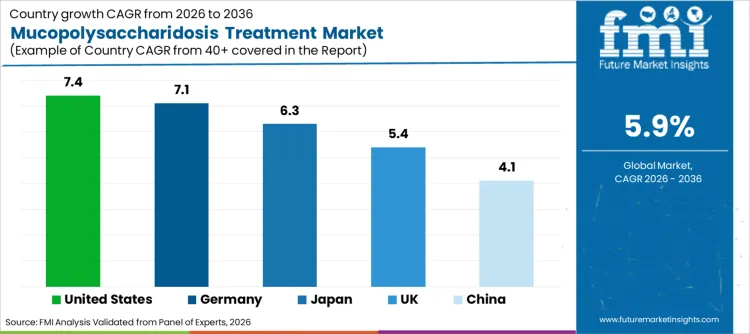
| Country | CAGR (2026 to 2036) |
|---|---|
| United States | 7.4% |
| Germany | 7.1% |
| Japan | 6.3% |
| UK | 5.4% |
| China | 4.1% |
Source: Future Market Insights’ proprietary forecasting model and primary research
Why is the Mucopolysaccharidosis Treatment Industry in the United States Growing?
Demand for MPS therapies in United States is set to grow at 7.4% CAGR through 2036. Expansion is underpinned by robust insurance coverage for high-cost orphan drugs. Growth is fueled by widespread implementation of recommended uniform screening panels for newborns. Rapid adoption of next-generation biologics drives revenue generation per patient. Presence of major biotechnology players headquartered within country streamlines supply chains. Emphasis on personalized medicine continues to be primary driver, maintaining United States position as critical revenue generator.
Why is the Mucopolysaccharidosis Treatment Sector in Germany Expanding?
Sales of treatment options in Germany are projected to rise at 7.1% CAGR during assessment period. Initiatives emphasizing equitable access to healthcare foster favorable environment for domestic and international vendors. Increasing investment in university hospital research centers creates massive supply channel for clinical trial participation. Rising patient registry numbers requiring longitudinal care prompts local administrators to seek sustainable funding models. Shift is supported by government policies encouraging rare disease research, accelerating uptake of novel therapies across country and fueling sector expansion.
Why is the Mucopolysaccharidosis Treatment Industry in Japan Showing Potential?
MPS treatment industry in Japan is poised to expand at 6.3% CAGR. Surge is largely attributed to strong government support for intractable disease sufferers. Government focus on streamlining approval processes for orphan drugs encourages facilities to opt for latest global therapies. Increasing partnerships between Japanese pharma companies and global innovators necessitate availability of high-quality biologics. High healthcare standards combined with comprehensive reimbursement systems attract significant investment. Strict adherence to clinical guidelines further drives adoption of evidence-based treatments.
Why is the Mucopolysaccharidosis Treatment Industry in the UK Growing?
Revenue from MPS drugs in UK is set to grow at 5.4% CAGR. Expansion is underpinned by NHS specialized commissioning for lysosomal storage disorders. Growth is fueled by strong patient advocacy groups driving awareness and access. Moderate adoption of highly specialized treatments drives revenue generation in expert centers. Presence of leading genetic research institutions ensures rapid uptake of innovation. Emphasis on holistic patient care continues to be primary driver, maintaining UK position as steady revenue generator.
Why is the Mucopolysaccharidosis Treatment Industry in China Growing?
Sales of rare disease drugs in China are set to grow at 4.1% CAGR. Expansion is underpinned by recent regulatory reforms accelerating orphan drug review. Growth is fueled by vast population base and improving diagnostic capabilities in tier-1 cities. Gradual inclusion of rare disease drugs in national reimbursement lists drives revenue generation. Presence of emerging domestic biotech firms aiming to develop affordable biosimilars streamlines market access. Emphasis on reducing out-of-pocket costs for families continues to be primary driver, establishing China as emerging revenue generator.
What is the Competitive Outlook for the Mucopolysaccharidosis Treatment Market?
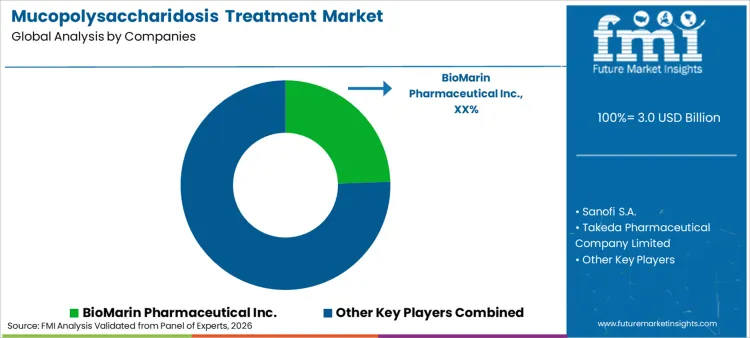
Market participants are increasingly focusing on pipeline diversification to capture value beyond established enzymes. Leading players like BioMarin Pharmaceutical Inc. and Sanofi S.A. are directing investment toward gene therapy vectors. Significant trend involves developing therapies that cross blood-brain barrier to address neurocognitive decline. Companies actively engage in strategic collaborations with patient organizations to improve diagnosis rates. Sustainability emerges as competitive frontier, with providers exploring efficient biomanufacturing processes. Consolidation activities remain high as large pharma conglomerates acquire specialized rare disease firms to broaden their portfolios against generic competition. BioMarin holds a significant 24.5% share, leveraging its diverse portfolio of approved MPS therapies.
Key Players in Mucopolysaccharidosis Treatment Market
- BioMarin Pharmaceutical Inc.
- Sanofi S.A.
- Takeda Pharmaceutical Company Limited
- Sumitomo Pharma Co., Ltd.
- Ultragenyx Pharmaceutical Inc.
- Sarepta Therapeutics
- Sangamo Therapeutics, Inc.
- JCR Pharmaceuticals
- Abeona Therapeutics, Inc.
- Orchard Therapeutics Limited
- REGENXBIO Inc.
Scope of Report
| Items | Values |
|---|---|
| Quantitative Units | USD Billion |
| Therapy Type | Enzyme Replacement Therapy, Stem cell therapy (Bone marrow transplantation; Umbilical cord blood transplantation) |
| Type of MPS | MPS I, MPS II, MPS IV A, MPS VI, MPS VII |
| End User | Hospital, Specialty Clinics, Medical Research Centers, Home-infusion |
| Regions | North America, Europe, East Asia, South Asia, Latin America, MEA |
Mucopolysaccharidosis Treatment Market by Segments
Therapy Type:
- Enzyme Replacement Therapy
- Stem cell therapy (Bone marrow transplantation; Umbilical cord blood transplantation)
Type of MPS:
- MPS I
- MPS II
- MPS IV A
- MPS VI
- MPS VII
End User:
- Hospital
- Specialty Clinics
- Medical Research Centers
- Home-infusion
Bibliography
- National Organization for Rare Disorders. (2023, November 19). Mucopolysaccharidoses. National Organization for Rare Disorders, United States.
- National Institute of Neurological Disorders and Stroke. (2024). Mucopolysaccharidoses: Overview, symptoms, and current research directions. National Institute of Neurological Disorders and Stroke, United States.
- National MPS Society. (2024). Enzyme replacement therapy (ERT) for mucopolysaccharidoses: Current treatment landscape and clinical use. National MPS Society, United States.
- European Medicines Agency. (2024). Orphan designations for medicines intended for the treatment of mucopolysaccharidoses (regulatory status and designation framework). European Medicines Agency, European Union.
- USA Food and Drug Administration. (2024). Rare diseases: Developing drugs for the treatment of mucopolysaccharidoses and related lysosomal storage disorders (current regulatory science guidance and policy update). USA Food and Drug Administration, United States.
Frequently Asked Questions
How large is the demand for Mucopolysaccharidosis Treatment in the global market in 2026?
Demand for Mucopolysaccharidosis Treatment in global market is estimated to be valued at USD 3.0 billion in 2026.
What will be the market size of Mucopolysaccharidosis Treatment in the global market by 2036?
Market size for Mucopolysaccharidosis Treatment is projected to reach USD 5.3 billion by 2036.
What is the expected demand growth for Mucopolysaccharidosis Treatment in the global market between 2026 and 2036?
Demand for Mucopolysaccharidosis Treatment in global market is expected to grow at CAGR of 5.9% between 2026 and 2036.
Which Therapy Type is poised to lead global sales by 2026?
Enzyme Replacement Therapy is expected to be dominant therapy type, capturing approximately 56.4% of global market share in 2026 due to clinical efficacy.
How significant is the role of Hospitals in driving Mucopolysaccharidosis Treatment adoption in 2026?
Hospitals represent critical end user, projected to hold substantial 53.0% share of total market in 2026 as facilities manage complex infusions.
Preview the report firsthand - request a free sample
Get SampleGet the brochure for pricing and purchase details.
Get PDFTable of Content
- Executive Summary
- Global Market Outlook
- Demand-side Trends
- Supply-side Trends
- Technology Roadmap Analysis
- Analysis and Recommendations
- Market Overview
- Market Coverage / Taxonomy
- Market Definition / Scope / Limitations
- Market Background
- Market Dynamics
- Drivers
- Restraints
- Opportunity
- Trends
- Scenario Forecast
- Demand in Optimistic Scenario
- Demand in Likely Scenario
- Demand in Conservative Scenario
- Opportunity Map Analysis
- Product Life Cycle Analysis
- Supply Chain Analysis
- Investment Feasibility Matrix
- Value Chain Analysis
- PESTLE and Porter’s Analysis
- Regulatory Landscape
- Regional Parent Market Outlook
- Production and Consumption Statistics
- Import and Export Statistics
- Market Dynamics
- Global Market Analysis 2021 to 2025 and Forecast, 2026 to 2036
- Historical Market Size Value (USD Million) Analysis, 2021 to 2025
- Current and Future Market Size Value (USD Million) Projections, 2026 to 2036
- Y-o-Y Growth Trend Analysis
- Absolute $ Opportunity Analysis
- Global Market Pricing Analysis 2021 to 2025 and Forecast 2026 to 2036
- Global Market Analysis 2021 to 2025 and Forecast 2026 to 2036, By Therapy Type
- Introduction / Key Findings
- Historical Market Size Value (USD Million) Analysis By Therapy Type , 2021 to 2025
- Current and Future Market Size Value (USD Million) Analysis and Forecast By Therapy Type , 2026 to 2036
- Enzyme Replacement Therapy
- Stem cell therapy
- Enzyme Replacement Therapy
- Y-o-Y Growth Trend Analysis By Therapy Type , 2021 to 2025
- Absolute $ Opportunity Analysis By Therapy Type , 2026 to 2036
- Global Market Analysis 2021 to 2025 and Forecast 2026 to 2036, By End User
- Introduction / Key Findings
- Historical Market Size Value (USD Million) Analysis By End User, 2021 to 2025
- Current and Future Market Size Value (USD Million) Analysis and Forecast By End User, 2026 to 2036
- Hospital
- Specialty Clinics
- Medical Research Centers
- Home-infusion
- Hospital
- Y-o-Y Growth Trend Analysis By End User, 2021 to 2025
- Absolute $ Opportunity Analysis By End User, 2026 to 2036
- Global Market Analysis 2021 to 2025 and Forecast 2026 to 2036, By Type of MPS
- Introduction / Key Findings
- Historical Market Size Value (USD Million) Analysis By Type of MPS, 2021 to 2025
- Current and Future Market Size Value (USD Million) Analysis and Forecast By Type of MPS, 2026 to 2036
- MPS I
- MPS II
- MPS IV A
- MPS VI
- MPS VII
- MPS I
- Y-o-Y Growth Trend Analysis By Type of MPS, 2021 to 2025
- Absolute $ Opportunity Analysis By Type of MPS, 2026 to 2036
- Global Market Analysis 2021 to 2025 and Forecast 2026 to 2036, By Region
- Introduction
- Historical Market Size Value (USD Million) Analysis By Region, 2021 to 2025
- Current Market Size Value (USD Million) Analysis and Forecast By Region, 2026 to 2036
- North America
- Latin America
- Western Europe
- Eastern Europe
- East Asia
- South Asia and Pacific
- Middle East & Africa
- Market Attractiveness Analysis By Region
- North America Market Analysis 2021 to 2025 and Forecast 2026 to 2036, By Country
- Historical Market Size Value (USD Million) Trend Analysis By Market Taxonomy, 2021 to 2025
- Market Size Value (USD Million) Forecast By Market Taxonomy, 2026 to 2036
- By Country
- USA
- Canada
- Mexico
- By Therapy Type
- By End User
- By Type of MPS
- By Country
- Market Attractiveness Analysis
- By Country
- By Therapy Type
- By End User
- By Type of MPS
- Key Takeaways
- Latin America Market Analysis 2021 to 2025 and Forecast 2026 to 2036, By Country
- Historical Market Size Value (USD Million) Trend Analysis By Market Taxonomy, 2021 to 2025
- Market Size Value (USD Million) Forecast By Market Taxonomy, 2026 to 2036
- By Country
- Brazil
- Chile
- Rest of Latin America
- By Therapy Type
- By End User
- By Type of MPS
- By Country
- Market Attractiveness Analysis
- By Country
- By Therapy Type
- By End User
- By Type of MPS
- Key Takeaways
- Western Europe Market Analysis 2021 to 2025 and Forecast 2026 to 2036, By Country
- Historical Market Size Value (USD Million) Trend Analysis By Market Taxonomy, 2021 to 2025
- Market Size Value (USD Million) Forecast By Market Taxonomy, 2026 to 2036
- By Country
- Germany
- UK
- Italy
- Spain
- France
- Nordic
- BENELUX
- Rest of Western Europe
- By Therapy Type
- By End User
- By Type of MPS
- By Country
- Market Attractiveness Analysis
- By Country
- By Therapy Type
- By End User
- By Type of MPS
- Key Takeaways
- Eastern Europe Market Analysis 2021 to 2025 and Forecast 2026 to 2036, By Country
- Historical Market Size Value (USD Million) Trend Analysis By Market Taxonomy, 2021 to 2025
- Market Size Value (USD Million) Forecast By Market Taxonomy, 2026 to 2036
- By Country
- Russia
- Poland
- Hungary
- Balkan & Baltic
- Rest of Eastern Europe
- By Therapy Type
- By End User
- By Type of MPS
- By Country
- Market Attractiveness Analysis
- By Country
- By Therapy Type
- By End User
- By Type of MPS
- Key Takeaways
- East Asia Market Analysis 2021 to 2025 and Forecast 2026 to 2036, By Country
- Historical Market Size Value (USD Million) Trend Analysis By Market Taxonomy, 2021 to 2025
- Market Size Value (USD Million) Forecast By Market Taxonomy, 2026 to 2036
- By Country
- China
- Japan
- South Korea
- By Therapy Type
- By End User
- By Type of MPS
- By Country
- Market Attractiveness Analysis
- By Country
- By Therapy Type
- By End User
- By Type of MPS
- Key Takeaways
- South Asia and Pacific Market Analysis 2021 to 2025 and Forecast 2026 to 2036, By Country
- Historical Market Size Value (USD Million) Trend Analysis By Market Taxonomy, 2021 to 2025
- Market Size Value (USD Million) Forecast By Market Taxonomy, 2026 to 2036
- By Country
- India
- ASEAN
- Australia & New Zealand
- Rest of South Asia and Pacific
- By Therapy Type
- By End User
- By Type of MPS
- By Country
- Market Attractiveness Analysis
- By Country
- By Therapy Type
- By End User
- By Type of MPS
- Key Takeaways
- Middle East & Africa Market Analysis 2021 to 2025 and Forecast 2026 to 2036, By Country
- Historical Market Size Value (USD Million) Trend Analysis By Market Taxonomy, 2021 to 2025
- Market Size Value (USD Million) Forecast By Market Taxonomy, 2026 to 2036
- By Country
- Kingdom of Saudi Arabia
- Other GCC Countries
- Turkiye
- South Africa
- Other African Union
- Rest of Middle East & Africa
- By Therapy Type
- By End User
- By Type of MPS
- By Country
- Market Attractiveness Analysis
- By Country
- By Therapy Type
- By End User
- By Type of MPS
- Key Takeaways
- Key Countries Market Analysis
- USA
- Pricing Analysis
- Market Share Analysis, 2025
- By Therapy Type
- By End User
- By Type of MPS
- Canada
- Pricing Analysis
- Market Share Analysis, 2025
- By Therapy Type
- By End User
- By Type of MPS
- Mexico
- Pricing Analysis
- Market Share Analysis, 2025
- By Therapy Type
- By End User
- By Type of MPS
- Brazil
- Pricing Analysis
- Market Share Analysis, 2025
- By Therapy Type
- By End User
- By Type of MPS
- Chile
- Pricing Analysis
- Market Share Analysis, 2025
- By Therapy Type
- By End User
- By Type of MPS
- Germany
- Pricing Analysis
- Market Share Analysis, 2025
- By Therapy Type
- By End User
- By Type of MPS
- UK
- Pricing Analysis
- Market Share Analysis, 2025
- By Therapy Type
- By End User
- By Type of MPS
- Italy
- Pricing Analysis
- Market Share Analysis, 2025
- By Therapy Type
- By End User
- By Type of MPS
- Spain
- Pricing Analysis
- Market Share Analysis, 2025
- By Therapy Type
- By End User
- By Type of MPS
- France
- Pricing Analysis
- Market Share Analysis, 2025
- By Therapy Type
- By End User
- By Type of MPS
- India
- Pricing Analysis
- Market Share Analysis, 2025
- By Therapy Type
- By End User
- By Type of MPS
- ASEAN
- Pricing Analysis
- Market Share Analysis, 2025
- By Therapy Type
- By End User
- By Type of MPS
- Australia & New Zealand
- Pricing Analysis
- Market Share Analysis, 2025
- By Therapy Type
- By End User
- By Type of MPS
- China
- Pricing Analysis
- Market Share Analysis, 2025
- By Therapy Type
- By End User
- By Type of MPS
- Japan
- Pricing Analysis
- Market Share Analysis, 2025
- By Therapy Type
- By End User
- By Type of MPS
- South Korea
- Pricing Analysis
- Market Share Analysis, 2025
- By Therapy Type
- By End User
- By Type of MPS
- Russia
- Pricing Analysis
- Market Share Analysis, 2025
- By Therapy Type
- By End User
- By Type of MPS
- Poland
- Pricing Analysis
- Market Share Analysis, 2025
- By Therapy Type
- By End User
- By Type of MPS
- Hungary
- Pricing Analysis
- Market Share Analysis, 2025
- By Therapy Type
- By End User
- By Type of MPS
- Kingdom of Saudi Arabia
- Pricing Analysis
- Market Share Analysis, 2025
- By Therapy Type
- By End User
- By Type of MPS
- Turkiye
- Pricing Analysis
- Market Share Analysis, 2025
- By Therapy Type
- By End User
- By Type of MPS
- South Africa
- Pricing Analysis
- Market Share Analysis, 2025
- By Therapy Type
- By End User
- By Type of MPS
- USA
- Market Structure Analysis
- Competition Dashboard
- Competition Benchmarking
- Market Share Analysis of Top Players
- By Regional
- By Therapy Type
- By End User
- By Type of MPS
- Competition Analysis
- Competition Deep Dive
- BioMarin Pharmaceutical Inc.
- Overview
- Product Portfolio
- Profitability by Market Segments (Product/Age /Sales Channel/Region)
- Sales Footprint
- Strategy Overview
- Marketing Strategy
- Product Strategy
- Channel Strategy
- Sanofi S.A.
- Takeda Pharmaceutical Company Limited
- Sumitomo Pharma Co., Ltd.
- Ultragenyx Pharmaceutical Inc.
- BioMarin Pharmaceutical Inc.
- Competition Deep Dive
- Assumptions & Acronyms Used
- Research Methodology


