

- Market Size (2026)
- USD 234.6 Mn
- Forecast (2036)
- USD 696.7 Mn
- CAGR (2026 to 2036)
- 11.5%
How big is Natural Ripening Modulators Market in 2026?
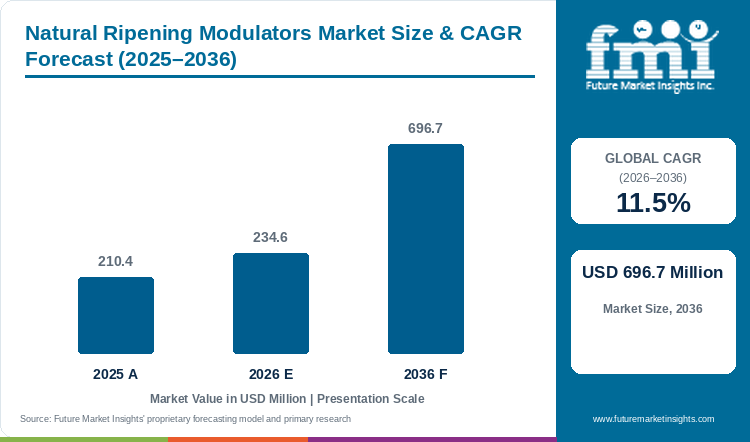
Demand for natural ripening modulators is projected to expand at 11.5% CAGR between 2026 and 2036. Industry value grows from USD 210.4 million in 2025 to USD 234.6 million in 2026 and is projected to reach USD 696.7 million by 2036.
Demand in the natural ripening modulators market is expected to expand at 11.5% CAGR between 2026 and 2036. Industry value grows from USD 210.4 million in 2025 to USD 234.6 million in 2026 and is projected to reach USD 696.7 million by 2036. Movement of fruit through storage is increasing the need for food coating ingredients, washes and active packs which slow moisture loss and ripening. USDA Foreign Agricultural Service placed apple production at 81.72 million tonnes in 2025/2026, showing the volume exposed to storage and shipment[1]. As per FMI, category maturity will increase when treatment fits the line and gain is measured through firmness, weight loss or packout.
Natural ripening modulator adoption progresses unevenly across geographies as the USA is projected to grow at 11.0% CAGR through 2036, while the UK is estimated at 10.1%. The USA has a wider domestic fruit base and repeated packhouse application, whereas UK buying is shaped by imported fruit and the quality left after long inbound routes. Defra reported that UK imports of fresh fruit rose to EUR 5.0 billion in 2025, with fresh fruit and vegetables remaining the highest-value import category at EUR 8.2 billion[2]. This difference is expected to spread the application from packhouse treatment towards transit protection and temperature controlled packaging boxes programs. The final commercial filter will remain crop qualification, residue status, treatment records and measured quality after storage.
Key Takeaways
- Increasing exposure of fruit to storage and shipment is keeping saleable yield and storage life at the centre of buying decisions.
- Edible coatings are expected to account for 37.5% in 2026, as direct surface application can reduce moisture and gas exchange without changing the outer pack.
- Pome and stone fruit are estimated to hold 40.4% in 2026 due to their longer storage cycle and regular requirement for firmness and weight control.
- Packhouse use is projected to lead with 46.4% share in 2026, as washing, coating, drying and dispatch can be controlled at one point.
- The USA is projected at 11.0% CAGR through 2036, whereas South Korea is estimated at 10.7%, with growth coming from different crop and storage conditions.
- Notable companies in the natural ripening modulators market include DECCO, Pace International, Xeda International, Citrosol, Fomesa Fruitech, JBT, StePac, and Janssen PMP.
Analyst Perspective
“Demand will move towards treatments which protect grade, not only extend storage. Active formats will gain where packhouse treatment cannot cover the complete route.”
- Nikhil Kaitwade, Principal Consultant, Future Market Insights.
How is the natural ripening modulators market segmented?
Natural ripening modulators market is segmented by five primary commercial axes and region: product type, commodity, application point, technology base, sales channel, and region. Edible coatings, pome and stone fruit, and packhouse use are projected at 37.5%, 40.4%, and 46.4% respectively in 2026.
By product type: edible coatings, active sachets and liners, wash and drench treatments, storage-room treatments, and others.
By commodity: pome and stone fruit, citrus, berries and grapes, tropical fruit, vegetables, and others.
By application point: packhouse, storage facility, transit and retail, and others.
By technology base: biological or microbial, plant-extract-based, mineral and wax-based, and others.
By sales channel: packhouse suppliers, post-harvest service providers, direct sales, and others.
By region: North America, Latin America, Western Europe, Eastern Europe, East Asia, South Asia and Pacific, and Middle East and Africa.
Why do edible coatings hold notable product type demand?
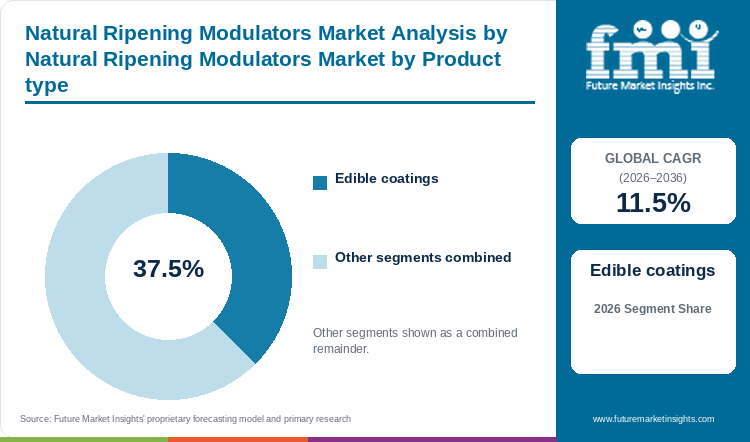
Based on product type, edible coatings are projected to account for 37.5% in 2026, driven by direct surface protection.
Edible films and coating solutions are applied on the fruit surface, which is the first point where moisture loss and gas exchange can be controlled. The format can be used through existing washing, spraying or waxing operations and this reduces the requirement for another treatment stage. In September 2025, Citrosol presented CATsystem for real-time measurement and correction of active ingredients in treatment baths[3]. This development is expected to improve concentration control when fruit load, maturity and line speed changes between lots. Due to this, edible coatings can gain preference where packhouses require repeatable coverage without changing the normal line movement.
- Edible coatings are projected at 37.5% in 2026 because the treatment reaches the fruit without changing the outer pack format.
- A controlled bath can reduce coating variation when maturity and fruit load are not the same.
What keeps pome and stone fruit central to commodity demand?
By commodity, pome and stone fruit are estimated to hold 40.4% in 2026, owing to long storage programs.
Pome and stone fruit stays in storage for a longer period and are sold against firmness, weight and external grade. Commercial handlers often evaluate fruit firmness additives alongside ripening regulators to prevent softening. A small decline in firmness can move premium fruit into a lower selling grade, due to which the treatment has to remain effective through the planned storage cycle. The category also passes through repeated quality checks before dispatch and market release. According to FMI, this longer holding period is expected to keep pome and stone fruit as a prominent commodity for natural ripening modulators. Apart from that, regular monitoring of weight loss and maturity makes the treatment result easier to compare.
- Pome and stone fruit represent 40.4% in 2026 because storage makes quality loss a repeated commercial cost.
- Long storage programs keep firmness checks and weight-loss control connected with commercial grade.
How does packhouse use lead the application point category?
In 2026, packhouse use is expected to lead application point with 46.4% share, supported by controlled dosing.
Packhouse application is becoming important as washing, coating, drying and packing are carried out at one controlled place. Operators frequently pair surface treatments with antimicrobial produce liners to protect fruit in storage bins. The operator can change the dose with fruit maturity and line speed before the lot enters storage. This reduces the requirement for correcting the treatment after every handling stage. Also, treated and untreated lots can be kept under the same storage condition, which makes the result easier to measure. Due to these operating advantages, packhouse use is expected to remain preferred where coverage, drying and dispatch timing has to be managed by one team.
- Packhouse applications hold 46.4% in 2026 because one site controls treatment, coverage checks and dispatch timing.
- One controlled point makes dose correction easier when fruit maturity changes between harvest lots.
Why are biological approaches relevant within technology base?
Biological or microbial technology is projected to hold 52.7% share in 2026, enabled by residue-conscious handling programs.
Biological agents and post-harvest bioprotectants are gaining place in freshness programs where buyers are avoiding a heavier residue profile. However, the response changes with cultivar, crop surface, sanitation and storage temperature, due to which one positive trial cannot become a common commercial protocol. A USDA ARS project started in September 2025 to test biological control agents with natural edible coatings and packaging on berries[4]. The four-year program measures quality, shelf life, disease control and consumer acceptance after storage. Such testing is expected to increase adoption when the biological response can be repeated under the concerned crop and storage condition.
- Biological or microbial technology is projected at 52.7% in 2026 because buyers seek compatible freshness control.
- Cultivar-level testing decides whether a biological response can be repeated under commercial storage.
What supports packhouse suppliers as the main sales route?
Packhouse suppliers are projected to hold 39.2% share in 2026, reinforced by application support and replenishment.
Packhouse suppliers connect product selection with dilution, coverage, drying and storage timing. This makes the channel more than a product sale because the same supplier also supports application, dose correction, and produce packaging integration. In November 2025, AgroFresh announced AI imaging partnerships with Aerobotics and Neolithics for its FreshCloud quality platform[5]. Digital inspection can help technical teams compare fruit condition before and after treatment. FMI research indicates that packhouse suppliers will gain preference where maturity, throughput and storage duration changes between harvest lots and local support is required for correcting the protocol.
- Packhouse suppliers hold 39.2% in 2026 because treatment and application setup are often one operating decision.
- Local technical support reduces the time needed to adjust dose and coverage between harvest lots.
What are the drivers, restraints, and opportunities in the natural ripening modulators market?
In the natural ripening modulators market, the key driver is quality-loss control, the key restraint is crop validation, and the key opportunity is active delivery.
- Driver: Packhouses and produce marketers need more saleable days from perishable fruit and vegetables.
- Restraint: Treatment response changes with maturity, temperature, humidity, storage duration, and application quality.
- Opportunity: Natural coatings, biological agents, and active packaging can move freshness control through more handling stages.
Loss Exposure Supports Treatment Demand
Increasing fruit value moving through storage and trade is expected to boost the demand for post harvesting technologies and natural ripening modulators. USDA Foreign Agricultural Service reported U.S. fruit and vegetable exports of USD 12.92 billion and 7.27 million tonnes during 2025[6]. Every additional day in storage and shipment gives moisture loss, respiration and decay more time to reduce the saleable grade. Due to this, packhouses are focusing on treatments that provide more saleable days without adding a high handling cost. FMI data suggests that adoption will increase when improvement in packout or storage life remains higher than the cost of treatment and application.
Crop Validation Slows Standard Use
A treatment can perform differently with change in cultivar, maturity, temperature, humidity and application quality. This variation is a major restraining factor because the same dose cannot be considered suitable for every crop and storage program. In February 2026, South Korea’s National Agricultural Products Quality Management Service started joint work on AI image sensing for fruit and vegetable quality factors[7]. Better measurement can make the trial result clearer; however, adoption will still require testing under the buyer’s own condition. Dose, drying, residue status and interaction with sanitation will remain part of the qualification process.
Active Delivery Extends Protection
Freshness control is moving beyond liquid treatment and into liners, pouches and pallet formats which remain with the produce after packing. In January 2026, StePacPPC introduced an Xtend modified-atmosphere and modified-humidity format for pitaya moving from Ecuador to the USA and Europe[8]. Sea journeys can extend beyond three weeks, due to which moisture control and reduced respiration remains important after fruit leaves the packhouse. This creates growth opportunities for active packaging delivery formats as another liquid treatment during shipment is not practical. Also, the same format can continue protection through storage, transport and retail handling.
Which country CAGRs are profiled in the natural ripening modulators market?
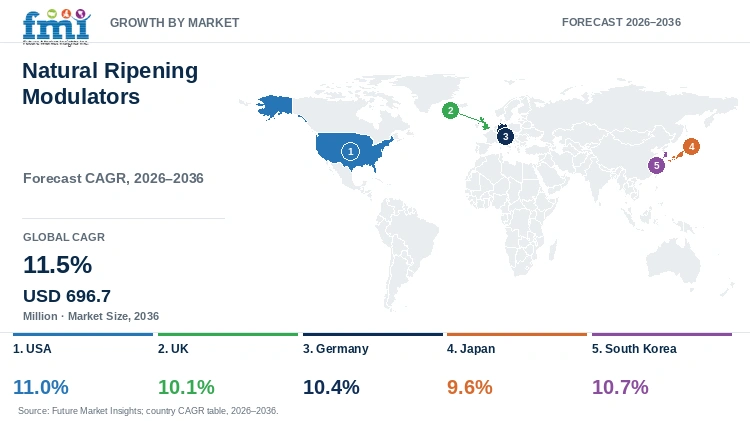
| Country | CAGR from 2026 to 2036 |
|---|---|
| USA | 11.0% |
| UK | 10.1% |
| Germany | 10.4% |
| Japan | 9.6% |
| South Korea | 10.7% |
How do country-level CAGRs compare in the natural ripening modulators market?
Country demand is shaped by fruit throughput, storage practice, import exposure, and the point where treatment can be controlled. The outlook remains positive, but access depends on crop protocols and local buying routes.
- The USA has broad domestic fruit throughput and many packhouse protocols.
- The UK has long inbound routes because imported fruit forms most available supply.
- German storage operators balance harvest variability against strict quality criteria for extended apple marketing programs.
- Japan uses documented low-temperature handling through wholesale markets.
- South Korea has an extended apple storage and release cycle.
Full report country CAGRs cover: North America; Latin America; Western Europe; Eastern Europe; East Asia; South Asia and Pacific; Middle East and Africa.
Country-wise Analysis
- The USA is projected to grow at 11.0% CAGR through 2036, supported by broad fruit throughput and repeated packhouse use. USDA NASS reported 15.8 million tons of utilized production across 21 noncitrus fruit crops in 2025, with grapes, apples and strawberries forming 77% of the volume[9]. This large crop base is expected to increase the requirement for coating, wash and storage treatment programs. However, one common protocol cannot be used across every crop. An FMI analyst notes that coating thickness, dose, drying and storage timing will change with commodity and selling window, which will keep technical support important in the country.
- The UK is expected to grow at 10.1% CAGR over the forecast period, mainly due to imported fruit and longer inbound routes. Defra reported that home-produced fruit reached 577 thousand tonnes in 2025, while imported supply continued to form the larger route[10]. Fruit therefore reaches the importer with different origin, maturity and handling history. This is expected to increase the demand for treatments that protect firmness and weight through the remaining selling period. Apart from that, transit protection can gain preference because the quality is checked after fruit has already completed a major part of its route.
- Demand for natural ripening modulators in Germany is forecast to rise at 10.4% CAGR, supported by apple storage and changing harvest condition. Destatis expected 934 thousand tonnes of apples in 2026, which was 5.4% below the ten-year average[11]. A lower crop can reduce treatment volume; however, it can also increase the requirement for keeping premium fruit within grade. Due to this, storage operators are expected to compare crop condition, planned holding time and expected selling quality before selecting a treatment. Products that maintain firmness under defined storage conditions are likely to gain preference.
- Adoption in Japan is estimated to grow at 9.6% CAGR through 2036, supported by controlled handling and documented quality records. MAFF statistics cover production and shipment for 15 fruit groups, including apples, grapes, pears, peaches, cherries and kiwifruit[12]. A modulator has to work under defined temperature and handling conditions before wholesalers accept the shelf-life result. This makes application records and storage guidance important in the country. Due to this buying practice, products with repeatable results and cold chain packaging compatibility are expected to witness higher adoption than products having only a broad performance claim.
- South Korea is expected to register 10.7% CAGR over the forecast period, backed by apple storage and release after harvest. A January 2026 agriculture ministry briefing reported 448 thousand tonnes of apples for 2025 and stated that storage supply from December through July remained similar to the previous year[13]. This long release cycle increases the requirement for firmness and ripening control. Also, treatment checks during storage can show whether dose and coverage are protecting the grade before fruit returns to market. These factors are expected to support adoption across apple storage programs.
Who are the notable companies in the natural ripening modulators market?
DECCO, Pace International, Xeda International, Citrosol, Fomesa Fruitech, JBT, StePac, and Janssen PMP are notable companies profiled in this market.
The market remains moderately fragmented as companies are working at different points of the postharvest route. DECCO, Pace International and JBT connect treatments with packhouse application, while Xeda, Citrosol and Fomesa Fruitech focus on postharvest chemistry and coating programs. StePac and Janssen PMP carry freshness control into packaging and controlled-release formats. As noted by FMI, buyers are expected to compare crop fit, application reliability, technical support and period of protection instead of selecting a supplier only on product count. Expanding crop coverage and local service is therefore likely to remain a prominent competitive strategy.
- Integrated packhouse platforms: DECCO, Pace International, and JBT combine treatment products with application knowledge.
- Postharvest chemistry specialists: Xeda International, Citrosol, and Fomesa Fruitech compete through crop and coating portfolios.
- Active freshness-control formats: StePac and Janssen PMP extend treatment into storage, transport, liners, pads, or package formats.
Competitive Benchmarking: Natural Ripening Modulators Market
| Company | Portfolio breadth | Packhouse integration | Active formats | Geographic reach |
|---|---|---|---|---|
| DECCO (UPL) | High | High | Medium | High |
| Pace International | High | High | Medium | High |
| Xeda International | High | High | Medium | High |
| Citrosol | High | High | Medium | High |
| Fomesa Fruitech | Medium | High | Low | Medium |
| JBT Corporation | Medium | High | Low | High |
| StePac | Low | Medium | High | High |
| Janssen PMP | Low | Medium | High | Medium |
High represents broad documented capability, Medium represents a narrower documented capability and Low represents limited breadth for the concerned criterion. These ratings are based on public evidence and do not indicate product quality, company revenue or verified market share.
Key Developments in the Natural Ripening Modulators Market
- In September 2025, DECCO announced a production plant in Valencia which was scheduled to begin operations in October[14]. The company stated that the site would increase its worldwide plant network from eight to nine and help in improving lead times.
- In September 2025, Xeda Ibérica published guidance on ecological agriculture certification and products used in organic-compatible postharvest programs[15]. This development gives buyers a clearer route for checking certification, product choice and required records.
- In August 2025, StePac presented Xtend pallet shrouds for modified-atmosphere and modified-humidity protection[16]. The format carries freshness control at pallet level during storage and shipment, where another liquid treatment may not be practical.
Key Players in the Natural Ripening Modulators Market
Integrated Packhouse Coating and Treatment Platforms
- DECCO (UPL)
- Pace International
- JBT Corporation
Natural and Postharvest Chemistry Specialists
- Xeda International
- Citrosol
- Fomesa Fruitech
Active Packaging and Ripening-Control Formats
- StePac
- Janssen PMP
Natural Ripening Modulators Market - Report Scope
| Coverage field | Report scope |
|---|---|
| Market breakdown | Product type; commodity; application point; technology base; sales channel; region |
| Quantitative units | USD million |
| Market definition | Revenue from postharvest products sold to slow or stabilize ripening and senescence in harvested fresh produce. |
| Exclusions | Treated produce value, generic packaging, finished food, and products sold mainly for unrelated disease control. |
| Regions covered | North America; Latin America; Western Europe; Eastern Europe; East Asia; South Asia and Pacific; Middle East and Africa |
| Countries profiled | USA; UK; Germany; Japan; South Korea |
| Forecast period | 2026 to 2036 |
| Approach | The report covers product revenue boundaries, segment structure, company participation, and country adoption conditions. |
Natural Ripening Modulators Market - Research Methodology
| Method | Approach |
|---|---|
| Primary Research | Analysts gathered input from manufacturers, service providers, technology developers, distributors, end users, procurement teams, and subject-matter experts. Interviews examined purchasing decisions, product evaluation, adoption barriers, approval requirements, pricing considerations, and technical support. |
| Desk Research | Desk research covered government statistics, regulatory publications, trade data, industry associations, technical literature, standards, company filings, product information, and official corporate announcements. |
| Market Sizing and Forecasting | The market model combined baseline value with historical performance, segment structure, pricing and volume indicators, adoption levels, company participation, and country demand conditions. |
| Data Validation | Estimates were checked against public data, company activity, trade patterns, industry developments, and primary findings. Adjacent categories and overlapping revenue were excluded. |
| Proprietary estimates | Segment shares and forecast estimates are proprietary analytical estimates. They are not government statistics or direct measurements of global market share. |
Natural Ripening Modulators Market by Segments
Natural Ripening Modulators Market by Product type
- Edible coatings
- Active sachets and liners
- Wash and drench treatments
- Storage-room treatments
- Others
Natural Ripening Modulators Market by Commodity
- Pome and stone fruit
- Citrus
- Berries and grapes
- Tropical fruit
- Vegetables
- Others
Natural Ripening Modulators Market by Application point
- Packhouse
- Storage facility
- Transit and retail
- Others
Natural Ripening Modulators Market by Technology base
- Biological or microbial
- Plant-extract-based
- Mineral and wax-based
- Others
Natural Ripening Modulators Market by Sales channel
- Packhouse suppliers
- Post-harvest service providers
- Direct sales
- Others
Natural Ripening Modulators Market by Region
- North America
- United States
- Canada
- Latin America
- Brazil
- Mexico
- Argentina
- Chile
- Western Europe
- Germany
- France
- United Kingdom
- Italy
- Spain
- Benelux
- Nordics
- Eastern Europe
- Poland
- Czech Republic
- Romania
- Hungary
- East Asia
- China
- Japan
- South Korea
- South Asia and Pacific
- India
- ASEAN
- Australia and New Zealand
- Middle East and Africa
- GCC Countries
- South Africa
- Türkiye
- Israel
Research Sources and Bibliography
- [1] United States Department of Agriculture, Foreign Agricultural Service. (2026). Production: Apples, 2025/2026.
- [2] Department for Environment, Food & Rural Affairs. (2026, September 3). Agriculture in the United Kingdom 2025: Chapter 13 Overseas Trade.
- [3] Citrosol. (2025, September 11). Citrosol renews itself at Fruit Attraction 2025 and premieres location in Hall 10.
- [4] USDA Agricultural Research Service. (2025, September 1). Pre- and postharvest management practices for sustainable production and marketing of blueberries, blackberries, and raspberries.
- [5] AgroFresh. (2025, November 6). AgroFresh announces AI-powered imaging and orchard analytics partnerships.
- [6] United States Department of Agriculture, Foreign Agricultural Service. (2026). Fruits and vegetables trade data.
- [7] Ministry of Agriculture, Food and Rural Affairs, Republic of Korea. (2026, February 26). Joint research on AI-based fruit and vegetable quality evaluation.
- [8] StePacPPC. (2026, January 19). Advanced packaging extends global access of dragon fruit.
- [9] United States Department of Agriculture, National Agricultural Statistics Service. (2026, May 1). Noncitrus Fruits and Nuts 2025 Summary.
- [10] Department for Environment, Food & Rural Affairs. (2026, June 25). Horticulture statistics 2025.
- [11] Statistisches Bundesamt. (2026, August 18). Apfelernte 2026 voraussichtlich 5,4 % unter Zehnjahresschnitt.
- [12] Ministry of Agriculture, Forestry and Fisheries of Japan. (2026). Statistics data on fruit trees.
- [13] Ministry of Agriculture, Food and Rural Affairs, Republic of Korea. (2026, January 13). Apples are currently being supplied stably during the storage shipment period.
- [14] DECCO Postharvest. (2025, September 23). DECCO expands global footprint with new plant in Valencia, Spain.
- [15] Xeda Ibérica. (2025, September 1). Qué es la certificación de agricultura ecológica y cómo la apoyan nuestros productos.
- [16] StePac. (2025, August 25). StePacPPC’s pallet shrouds preserve produce freshness all the way to retail.
This bibliography is provided for reader reference. The full report contains the complete reference list and detailed citations.
This Report Answers
- What is Natural Ripening Modulators Market worth during 2026?
- What value is Natural Ripening Modulators Market projected by 2036?
- Which product type holds notable Natural Ripening Modulators Market share?
- Which commodity holds notable Natural Ripening Modulators Market share?
- Which countries have notable Natural Ripening Modulators Market growth?
- Which companies are notable in Natural Ripening Modulators Market today?
Frequently Asked Questions
How large is the Natural Ripening Modulators Market expected to be in 2026?
Future Market Insights estimates that the natural ripening modulators market will reach USD 234.6 million in 2026. The market is projected to expand further and reach USD 696.7 million by 2036.
What CAGR is forecast for the Natural Ripening Modulators Market through 2036?
As per FMI, the natural ripening modulators market is projected to grow at an 11.5% CAGR from 2026 to 2036. Growth is supported by demand for longer saleable life and controlled ripening.
Which product type holds a notable natural ripening modulators demand share in 2026?
Future Market Insights projects edible coatings to hold 37.5% of product type demand in 2026. The segment benefits from direct surface application through existing washing, spraying, or waxing operations.
Which commodity segment holds a notable natural ripening modulators share in 2026?
FMI finds that pome and stone fruit will hold 40.4% of commodity demand in 2026. Demand is supported by longer commercial storage cycles and recurring firmness checks.
Which country has a notable natural ripening modulators expansion outlook during the forecast period?
Future Market Insights predicts the USA to expand at an 11.0% CAGR during the 2026 to 2036 assessment period. Growth is supported by broad domestic fruit throughput and repeated packhouse treatment programs.
Which companies are active in the Natural Ripening Modulators Market during 2026?
As per FMI analysis, notable companies include DECCO, Pace International, Xeda International, Citrosol, Fomesa Fruitech, JBT, StePac, and Janssen PMP. These companies are focusing on integrated packhouse systems, coating chemistry, and active packaging formats.
Preview the report firsthand - request a free sample
Get SampleGet the brochure for pricing and purchase details.
Get PDFTable of Content
- Key Takeaways
- Market Size and CAGR
- Top Growth Driver
- Fastest Growing Segment
- Leading Region
- Key Companies
- Emerging Opportunities
- Executive Summary
- Global Market Outlook
- Demand-side Trends
- Supply-side Trends
- Technology Roadmap Analysis
- Analysis and Recommendations
- Analyst Perspective (What is happening? Why now? What should investors know?)
- Key Questions Answered
- How large is the market?
- What is the CAGR?
- What are key trends?
- Which region dominates?
- Who are the leaders?
- Market Overview
- Market Coverage / Taxonomy
- Market Definition / Scope / Limitations
- Research Methodology
- Chapter Orientation
- Analytical Lens and Working Hypotheses
- Market Structure, Signals, and Trend Drivers
- Benchmarking and Cross-market Comparability
- Market Sizing, Forecasting, and Opportunity Mapping
- Research Design and Evidence Framework
- Desk Research Programme (Secondary Evidence)
- Expert Input and Fieldwork (Primary Evidence)
- Tooling, Models, and Reference Databases
- Data Engineering and Model Build
- Quality Assurance and Audit Trail
- Market Background
- Market Dynamics (Drivers, Restraints, Opportunity, Trends)
- Scenario Forecast (Optimistic, Likely, Conservative)
- Impact Analysis
- AI Impact
- Sustainability Impact
- Regulatory Impact
- Technology Impact
- Consumer / Buyer Analysis
- Purchase Drivers
- Adoption Barriers
- Buyer Journey
- Opportunity Map Analysis
- Product Life Cycle Analysis
- Supply Chain Analysis
- Investment Feasibility Matrix
- Value Chain Analysis
- PESTLE and Porter's Analysis
- Regulatory Landscape
- Regional Parent Market Outlook
- Production and Consumption Statistics
- Import and Export Statistics
- Global Market Analysis and Forecast, 2021 to 2036
- Historical Market Size Value (USD Million) Analysis, 2021 to 2025
- Current and Future Market Size Value (USD Million) Projections, 2026 to 2036
- Y-o-Y Growth Trend Analysis
- Absolute $ Opportunity Analysis
- Global Market Pricing Analysis, 2021 to 2036
- Global Market Analysis and Forecast, By Natural Ripening Modulators Market by Product type, 2021 to 2036
- Introduction / Key Findings
- Historical Market Size Value (USD Million) Analysis By Natural Ripening Modulators Market by Product type, 2021 to 2025
- Current and Future Market Size Value (USD Million) Analysis and Forecast By Natural Ripening Modulators Market by Product type, 2026 to 2036
- Edible coatings
- Active sachets and liners
- Wash and drench treatments
- Storage-room treatments
- Others
- Y-o-Y Growth Trend Analysis By Natural Ripening Modulators Market by Product type, 2021 to 2025
- Absolute $ Opportunity Analysis By Natural Ripening Modulators Market by Product type, 2026 to 2036
- Global Market Analysis and Forecast, By Natural Ripening Modulators Market by Commodity, 2021 to 2036
- Introduction / Key Findings
- Historical Market Size Value (USD Million) Analysis By Natural Ripening Modulators Market by Commodity, 2021 to 2025
- Current and Future Market Size Value (USD Million) Analysis and Forecast By Natural Ripening Modulators Market by Commodity, 2026 to 2036
- Pome and stone fruit
- Citrus
- Berries and grapes
- Tropical fruit
- Vegetables
- Others
- Y-o-Y Growth Trend Analysis By Natural Ripening Modulators Market by Commodity, 2021 to 2025
- Absolute $ Opportunity Analysis By Natural Ripening Modulators Market by Commodity, 2026 to 2036
- Global Market Analysis and Forecast, By Natural Ripening Modulators Market by Application point, 2021 to 2036
- Introduction / Key Findings
- Historical Market Size Value (USD Million) Analysis By Natural Ripening Modulators Market by Application point, 2021 to 2025
- Current and Future Market Size Value (USD Million) Analysis and Forecast By Natural Ripening Modulators Market by Application point, 2026 to 2036
- Packhouse
- Storage facility
- Transit and retail
- Others
- Y-o-Y Growth Trend Analysis By Natural Ripening Modulators Market by Application point, 2021 to 2025
- Absolute $ Opportunity Analysis By Natural Ripening Modulators Market by Application point, 2026 to 2036
- Global Market Analysis and Forecast, By Natural Ripening Modulators Market by Technology base, 2021 to 2036
- Introduction / Key Findings
- Historical Market Size Value (USD Million) Analysis By Natural Ripening Modulators Market by Technology base, 2021 to 2025
- Current and Future Market Size Value (USD Million) Analysis and Forecast By Natural Ripening Modulators Market by Technology base, 2026 to 2036
- Biological or microbial
- Plant-extract-based
- Mineral and wax-based
- Others
- Y-o-Y Growth Trend Analysis By Natural Ripening Modulators Market by Technology base, 2021 to 2025
- Absolute $ Opportunity Analysis By Natural Ripening Modulators Market by Technology base, 2026 to 2036
- Global Market Analysis and Forecast, By Natural Ripening Modulators Market by Sales channel, 2021 to 2036
- Introduction / Key Findings
- Historical Market Size Value (USD Million) Analysis By Natural Ripening Modulators Market by Sales channel, 2021 to 2025
- Current and Future Market Size Value (USD Million) Analysis and Forecast By Natural Ripening Modulators Market by Sales channel, 2026 to 2036
- Packhouse suppliers
- Post-harvest service providers
- Direct sales
- Others
- Y-o-Y Growth Trend Analysis By Natural Ripening Modulators Market by Sales channel, 2021 to 2025
- Absolute $ Opportunity Analysis By Natural Ripening Modulators Market by Sales channel, 2026 to 2036
- Global Market Analysis and Forecast, By Region, 2021 to 2036
- Introduction
- Historical Market Size Value (USD Million) Analysis By Region, 2021 to 2025
- Current Market Size Value (USD Million) Analysis and Forecast By Region, 2026 to 2036
- North America
- Latin America
- Western Europe
- Eastern Europe
- East Asia
- South Asia and Pacific
- Middle East and Africa
- Market Attractiveness Analysis By Region
- North America Market Analysis and Forecast, By Country, 2021 to 2036
- Historical Market Size Value (USD Million) Trend Analysis By Market Taxonomy, 2021 to 2025
- Market Size Value (USD Million) Forecast By Market Taxonomy, 2026 to 2036
- By Country
- United States
- Canada
- By Natural Ripening Modulators Market by Product type
- By Natural Ripening Modulators Market by Commodity
- By Natural Ripening Modulators Market by Application point
- By Natural Ripening Modulators Market by Technology base
- By Natural Ripening Modulators Market by Sales channel
- By Country
- Market Attractiveness Analysis
- By Country
- By Natural Ripening Modulators Market by Product type
- By Natural Ripening Modulators Market by Commodity
- By Natural Ripening Modulators Market by Application point
- By Natural Ripening Modulators Market by Technology base
- By Natural Ripening Modulators Market by Sales channel
- Key Takeaways
- Latin America Market Analysis and Forecast, By Country
- Historical Market Size Value (USD Million) Trend Analysis By Market Taxonomy, 2021 to 2025
- Market Size Value (USD Million) Forecast By Market Taxonomy, 2026 to 2036
- By Country
- Brazil
- Mexico
- Argentina
- Chile
- By Natural Ripening Modulators Market by Product type
- By Natural Ripening Modulators Market by Commodity
- By Natural Ripening Modulators Market by Application point
- By Natural Ripening Modulators Market by Technology base
- By Natural Ripening Modulators Market by Sales channel
- By Country
- Market Attractiveness Analysis
- By Country
- By Natural Ripening Modulators Market by Product type
- By Natural Ripening Modulators Market by Commodity
- By Natural Ripening Modulators Market by Application point
- By Natural Ripening Modulators Market by Technology base
- By Natural Ripening Modulators Market by Sales channel
- Key Takeaways
- Western Europe Market Analysis and Forecast, By Country
- Historical Market Size Value (USD Million) Trend Analysis By Market Taxonomy, 2021 to 2025
- Market Size Value (USD Million) Forecast By Market Taxonomy, 2026 to 2036
- By Country
- Germany
- France
- United Kingdom
- Italy
- Spain
- Benelux
- Nordics
- By Natural Ripening Modulators Market by Product type
- By Natural Ripening Modulators Market by Commodity
- By Natural Ripening Modulators Market by Application point
- By Natural Ripening Modulators Market by Technology base
- By Natural Ripening Modulators Market by Sales channel
- By Country
- Market Attractiveness Analysis
- By Country
- By Natural Ripening Modulators Market by Product type
- By Natural Ripening Modulators Market by Commodity
- By Natural Ripening Modulators Market by Application point
- By Natural Ripening Modulators Market by Technology base
- By Natural Ripening Modulators Market by Sales channel
- Key Takeaways
- Eastern Europe Market Analysis and Forecast, By Country
- Historical Market Size Value (USD Million) Trend Analysis By Market Taxonomy, 2021 to 2025
- Market Size Value (USD Million) Forecast By Market Taxonomy, 2026 to 2036
- By Country
- Poland
- Czech Republic
- Romania
- Hungary
- By Natural Ripening Modulators Market by Product type
- By Natural Ripening Modulators Market by Commodity
- By Natural Ripening Modulators Market by Application point
- By Natural Ripening Modulators Market by Technology base
- By Natural Ripening Modulators Market by Sales channel
- By Country
- Market Attractiveness Analysis
- By Country
- By Natural Ripening Modulators Market by Product type
- By Natural Ripening Modulators Market by Commodity
- By Natural Ripening Modulators Market by Application point
- By Natural Ripening Modulators Market by Technology base
- By Natural Ripening Modulators Market by Sales channel
- Key Takeaways
- East Asia Market Analysis and Forecast, By Country
- Historical Market Size Value (USD Million) Trend Analysis By Market Taxonomy, 2021 to 2025
- Market Size Value (USD Million) Forecast By Market Taxonomy, 2026 to 2036
- By Country
- China
- Japan
- South Korea
- By Natural Ripening Modulators Market by Product type
- By Natural Ripening Modulators Market by Commodity
- By Natural Ripening Modulators Market by Application point
- By Natural Ripening Modulators Market by Technology base
- By Natural Ripening Modulators Market by Sales channel
- By Country
- Market Attractiveness Analysis
- By Country
- By Natural Ripening Modulators Market by Product type
- By Natural Ripening Modulators Market by Commodity
- By Natural Ripening Modulators Market by Application point
- By Natural Ripening Modulators Market by Technology base
- By Natural Ripening Modulators Market by Sales channel
- Key Takeaways
- South Asia and Pacific Market Analysis and Forecast, By Country
- Historical Market Size Value (USD Million) Trend Analysis By Market Taxonomy, 2021 to 2025
- Market Size Value (USD Million) Forecast By Market Taxonomy, 2026 to 2036
- By Country
- India
- ASEAN
- Australia and New Zealand
- By Natural Ripening Modulators Market by Product type
- By Natural Ripening Modulators Market by Commodity
- By Natural Ripening Modulators Market by Application point
- By Natural Ripening Modulators Market by Technology base
- By Natural Ripening Modulators Market by Sales channel
- By Country
- Market Attractiveness Analysis
- By Country
- By Natural Ripening Modulators Market by Product type
- By Natural Ripening Modulators Market by Commodity
- By Natural Ripening Modulators Market by Application point
- By Natural Ripening Modulators Market by Technology base
- By Natural Ripening Modulators Market by Sales channel
- Key Takeaways
- Middle East and Africa Market Analysis and Forecast, By Country
- Historical Market Size Value (USD Million) Trend Analysis By Market Taxonomy, 2021 to 2025
- Market Size Value (USD Million) Forecast By Market Taxonomy, 2026 to 2036
- By Country
- GCC Countries
- South Africa
- Türkiye
- Israel
- By Natural Ripening Modulators Market by Product type
- By Natural Ripening Modulators Market by Commodity
- By Natural Ripening Modulators Market by Application point
- By Natural Ripening Modulators Market by Technology base
- By Natural Ripening Modulators Market by Sales channel
- By Country
- Market Attractiveness Analysis
- By Country
- By Natural Ripening Modulators Market by Product type
- By Natural Ripening Modulators Market by Commodity
- By Natural Ripening Modulators Market by Application point
- By Natural Ripening Modulators Market by Technology base
- By Natural Ripening Modulators Market by Sales channel
- Key Takeaways
- Key Countries Market Analysis
- United States
- Pricing Analysis
- Market Share Analysis, 2025
- By Natural Ripening Modulators Market by Product type
- By Natural Ripening Modulators Market by Commodity
- By Natural Ripening Modulators Market by Application point
- By Natural Ripening Modulators Market by Technology base
- By Natural Ripening Modulators Market by Sales channel
- Canada
- Pricing Analysis
- Market Share Analysis, 2025
- By Natural Ripening Modulators Market by Product type
- By Natural Ripening Modulators Market by Commodity
- By Natural Ripening Modulators Market by Application point
- By Natural Ripening Modulators Market by Technology base
- By Natural Ripening Modulators Market by Sales channel
- Mexico
- Pricing Analysis
- Market Share Analysis, 2025
- By Natural Ripening Modulators Market by Product type
- By Natural Ripening Modulators Market by Commodity
- By Natural Ripening Modulators Market by Application point
- By Natural Ripening Modulators Market by Technology base
- By Natural Ripening Modulators Market by Sales channel
- Brazil
- Pricing Analysis
- Market Share Analysis, 2025
- By Natural Ripening Modulators Market by Product type
- By Natural Ripening Modulators Market by Commodity
- By Natural Ripening Modulators Market by Application point
- By Natural Ripening Modulators Market by Technology base
- By Natural Ripening Modulators Market by Sales channel
- Chile
- Pricing Analysis
- Market Share Analysis, 2025
- By Natural Ripening Modulators Market by Product type
- By Natural Ripening Modulators Market by Commodity
- By Natural Ripening Modulators Market by Application point
- By Natural Ripening Modulators Market by Technology base
- By Natural Ripening Modulators Market by Sales channel
- Germany
- Pricing Analysis
- Market Share Analysis, 2025
- By Natural Ripening Modulators Market by Product type
- By Natural Ripening Modulators Market by Commodity
- By Natural Ripening Modulators Market by Application point
- By Natural Ripening Modulators Market by Technology base
- By Natural Ripening Modulators Market by Sales channel
- United Kingdom
- Pricing Analysis
- Market Share Analysis, 2025
- By Natural Ripening Modulators Market by Product type
- By Natural Ripening Modulators Market by Commodity
- By Natural Ripening Modulators Market by Application point
- By Natural Ripening Modulators Market by Technology base
- By Natural Ripening Modulators Market by Sales channel
- Italy
- Pricing Analysis
- Market Share Analysis, 2025
- By Natural Ripening Modulators Market by Product type
- By Natural Ripening Modulators Market by Commodity
- By Natural Ripening Modulators Market by Application point
- By Natural Ripening Modulators Market by Technology base
- By Natural Ripening Modulators Market by Sales channel
- Spain
- Pricing Analysis
- Market Share Analysis, 2025
- By Natural Ripening Modulators Market by Product type
- By Natural Ripening Modulators Market by Commodity
- By Natural Ripening Modulators Market by Application point
- By Natural Ripening Modulators Market by Technology base
- By Natural Ripening Modulators Market by Sales channel
- France
- Pricing Analysis
- Market Share Analysis, 2025
- By Natural Ripening Modulators Market by Product type
- By Natural Ripening Modulators Market by Commodity
- By Natural Ripening Modulators Market by Application point
- By Natural Ripening Modulators Market by Technology base
- By Natural Ripening Modulators Market by Sales channel
- India
- Pricing Analysis
- Market Share Analysis, 2025
- By Natural Ripening Modulators Market by Product type
- By Natural Ripening Modulators Market by Commodity
- By Natural Ripening Modulators Market by Application point
- By Natural Ripening Modulators Market by Technology base
- By Natural Ripening Modulators Market by Sales channel
- ASEAN
- Pricing Analysis
- Market Share Analysis, 2025
- By Natural Ripening Modulators Market by Product type
- By Natural Ripening Modulators Market by Commodity
- By Natural Ripening Modulators Market by Application point
- By Natural Ripening Modulators Market by Technology base
- By Natural Ripening Modulators Market by Sales channel
- Australia and New Zealand
- Pricing Analysis
- Market Share Analysis, 2025
- By Natural Ripening Modulators Market by Product type
- By Natural Ripening Modulators Market by Commodity
- By Natural Ripening Modulators Market by Application point
- By Natural Ripening Modulators Market by Technology base
- By Natural Ripening Modulators Market by Sales channel
- China
- Pricing Analysis
- Market Share Analysis, 2025
- By Natural Ripening Modulators Market by Product type
- By Natural Ripening Modulators Market by Commodity
- By Natural Ripening Modulators Market by Application point
- By Natural Ripening Modulators Market by Technology base
- By Natural Ripening Modulators Market by Sales channel
- Japan
- Pricing Analysis
- Market Share Analysis, 2025
- By Natural Ripening Modulators Market by Product type
- By Natural Ripening Modulators Market by Commodity
- By Natural Ripening Modulators Market by Application point
- By Natural Ripening Modulators Market by Technology base
- By Natural Ripening Modulators Market by Sales channel
- South Korea
- Pricing Analysis
- Market Share Analysis, 2025
- By Natural Ripening Modulators Market by Product type
- By Natural Ripening Modulators Market by Commodity
- By Natural Ripening Modulators Market by Application point
- By Natural Ripening Modulators Market by Technology base
- By Natural Ripening Modulators Market by Sales channel
- Poland
- Pricing Analysis
- Market Share Analysis, 2025
- By Natural Ripening Modulators Market by Product type
- By Natural Ripening Modulators Market by Commodity
- By Natural Ripening Modulators Market by Application point
- By Natural Ripening Modulators Market by Technology base
- By Natural Ripening Modulators Market by Sales channel
- Hungary
- Pricing Analysis
- Market Share Analysis, 2025
- By Natural Ripening Modulators Market by Product type
- By Natural Ripening Modulators Market by Commodity
- By Natural Ripening Modulators Market by Application point
- By Natural Ripening Modulators Market by Technology base
- By Natural Ripening Modulators Market by Sales channel
- Türkiye
- Pricing Analysis
- Market Share Analysis, 2025
- By Natural Ripening Modulators Market by Product type
- By Natural Ripening Modulators Market by Commodity
- By Natural Ripening Modulators Market by Application point
- By Natural Ripening Modulators Market by Technology base
- By Natural Ripening Modulators Market by Sales channel
- South Africa
- Pricing Analysis
- Market Share Analysis, 2025
- By Natural Ripening Modulators Market by Product type
- By Natural Ripening Modulators Market by Commodity
- By Natural Ripening Modulators Market by Application point
- By Natural Ripening Modulators Market by Technology base
- By Natural Ripening Modulators Market by Sales channel
- United States
- Market Structure Analysis
- Competition Dashboard
- Competition Benchmarking
- Market Share Analysis of Top Players
- By Regional
- By Natural Ripening Modulators Market by Product type
- By Natural Ripening Modulators Market by Commodity
- By Natural Ripening Modulators Market by Application point
- By Natural Ripening Modulators Market by Technology base
- By Natural Ripening Modulators Market by Sales channel
- Emerging Startups
- Innovation Benchmarking
- Competition Analysis
- Competition Deep Dive
- DECCO (UPL)
- Overview
- Product Portfolio
- Profitability by Market Segments
- Sales Footprint
- Strategy Overview
- Marketing Strategy
- Product Strategy
- Channel Strategy
- Pace International
- Xeda International
- Citrosol
- Fomesa Fruitech
- JBT Corporation
- StePac
- Janssen PMP
- DECCO (UPL)
- Case Studies
- Success Stories
- Recent Developments
- Competition Deep Dive
- Assumptions & Acronyms Used


