
- Market Size (2026)
- USD 349.8 Mn
- Forecast (2036)
- USD 720.9 Mn
- CAGR (2026 to 2036)
- 7.5%
How big is Neohesperidin Market in 2026?
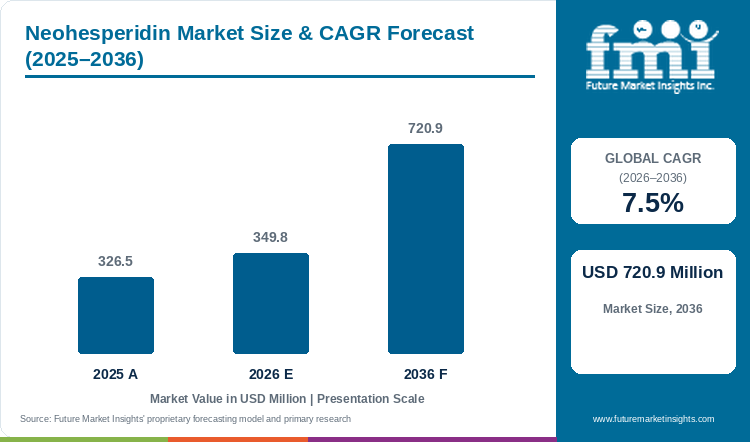
Accounting for USD 326.5 million in 2025 and rising to USD 349.8 million in 2026, the neohesperidin market is projected to expand to USD 720.9 million by 2036, advancing at a CAGR of 7.5%.
Bitter-taste suppression requirements in zero-sugar beverages and post-weaning feed intake goals in commercial piglet nurseries drive customer procurement across the neohesperidin market. Flavorists rarely dose neohesperidin dihydrochalcone as a standalone bulk sweetener, instead using 1 to 5 parts per million to block lingering stevia astringency and build creamy mouthfeel with dihydrochalcone sweetener compounds. FMI research shows that neohesperidin Dihydrochalcone NHDC Pure Crystalline captures 63.4% of 2026 chemical form demand because catalytic hydrogenation of bitter-orange neohesperidin yields a heat-stable molecule roughly 1,500 to 1,800 times sweeter than sucrose. In April 2025, the EFSA FEEDAP Panel confirmed that neohesperidin dihydrochalcone produced at a minimum 96% purity via catalytic hydrogenation of neohesperidin from Citrus aurantium is safe across animal species. A follow-up EFSA renewal assessment in October 2025 validated sensory feed additive 2b959 inclusion at up to 35 mg per kilogram of complete feed for piglets and fattening pigs with calves and dogs. Low cold-water solubility of unformulated crystals and harvest fluctuations across Spanish and Chinese bitter-orange groves remain the main supply-chain constraints.
Key Market Trends & Insights
- By chemical form: Neohesperidin Dihydrochalcone NHDC Pure Crystalline holds an estimated 63.4% share in 2026 since alkaline hydrogenation converts bitter flavanone glycosides into ultra-potent sweetening and taste-modifying crystals.
- By purity compendial grade: USP EP FCC Compendial Food Grade Above 98% represents 67.1% in 2026 because multinational beverage and oral-care plus pediatric syrup brands mandate pharmacopeial heavy-metal and solvent compliance.
- By commercial application: Soft Drinks and Beverages Sweetness and Flavor Modulation account for 45.8% in 2026 as flavorists dose 1 to 5 ppm under FEMA GRAS 3811 or E959 to build sucrose-like mouthfeel in zero-calorie drinks.
- By botanical feedstock: Bitter Orange Citrus aurantium Immature Fruit Extraction secures 61.5% in 2026 owing to high natural neohesperidin glycoside concentrations of 8% to 14% in dried immature Seville orange fruitlets.
- By distribution channel: Direct to Beverage and Feed Manufacturers commands 57.0% in 2026 through custom flavor-house modulation keys and multi-ton swine premix contracts.
Regional Highlights
- Top national expansion: Brazil leads national growth projections at an 8.2% CAGR through 2036 under citrus by-product valorization and large-scale swine starter feed palatability adoption.
- Broader country progression: The Netherlands tracks at a 7.7% CAGR ahead of the United Kingdom at 7.6% and the United States at 7.4%, where zero-sugar beverage innovation and piglet feed mills expand procurement.
Market Size & Forecast
Table 1: Market Size and Forecast for the Neohesperidin Market (USD million and CAGR percentage), 2025 to 2036
| Metric | Value |
|---|---|
| 2025 Market Size | USD 326.5 million |
| Estimated Market Size in 2026 | USD 349.8 million |
| Projected Market Size by 2036 | USD 720.9 million |
| CAGR, 2026 to 2036 | 7.5% |
| Added Value, 2026 to 2036 | USD 371.1 million |
Beverage R&D teams and pharmaceutical formulators struggle to mask sharp metallic and chemical bitterness when formulating high-potency stevia drinks or pediatric liquid medicines. Without a trace dihydrochalcone modulator, high-Reb-A stevia extracts and active pharmaceutical ingredients leave an unpleasant lingering bite that causes repeat-purchase drop-off and poor patient medication adherence. According to an April 2025 human sensory study in Clinical and Translational Science across panels of 97 and 158 adults, neohesperidin dihydrochalcone demonstrated superior bitter suppression against highly bitter pharmaceutical actives tenofovir alafenamide and praziquantel. Flavor houses therefore blend micro-doses of NHDC with citrus sugar-reduction modulators to smooth out harsh taste profiles.
Active Flavonoid Tonnage and Inclusion Sizing
Table 2: Active Flavonoid Tonnage and Inclusion Sizing for the Neohesperidin Market (USD million and operational ranges), 2025 to 2036
| Metric | 2025 | 2026 | 2036 |
|---|---|---|---|
| Market size (USD million) | 326.5 | 349.8 | 720.9 |
| Treated zero-sugar beverage & compound piglet feed volume (million MT) | 18.5 to 21.0 | 19.8 to 22.5 | 39.5 to 44.8 |
| Pure NHDC & neohesperidin flavanone volume (metric tons) | 1,120 to 1,260 | 1,195 to 1,345 | 2,410 to 2,710 |
| Average compendial & formulated price per kg (USD) | 259.0 to 291.0 | 260.0 to 292.0 | 266.0 to 299.0 |
Operational note: Formulated inclusion ranges apply standard 1 to 5 ppm Flavor with Modifying Properties dosing in beverages or 5 to 35 grams per metric ton in compound piglet starter feeds against commercial production.
Pure crystalline neohesperidin and NHDC dissolve poorly in cold water at roughly 0.4 to 0.5 grams per liter at 20 degrees Celsius, creating precipitation risks in unheated beverage batching tanks. When bottling plants dump unformulated dry powder directly into chilled syrup lines, undissolved micro-crystals settle at tank bottoms and cause batch-to-batch sweetness variation. Per a March 2026 study in Molecules examining Citrus aurantium flavanone glycosides, the rhamnose-glucose neohesperidose sugar moiety governs crystal packing and requires cosolvent or cyclodextrin complexation to accelerate aqueous dissolution. Suppliers offering pre-dissolved propylene-glycol concentrates and high-potency natural sweeteners eliminate hot-water pre-dissolution steps on high-speed bottling lines.
Per Capita & Beverage/Feed Line Sizing
Table 3: Per Capita and Formulation Line Allocation Indicators for the Neohesperidin Market (USD), 2025 to 2036
| Metric | 2025 | 2026 | 2036 |
|---|---|---|---|
| World population (million) | 8,200 | 8,300 | 9,000 |
| Market value per 1,000 people (USD) | 39.8 | 42.1 | 80.1 |
| Annual procurement per beverage/feed formulation line (USD thousand) | 64.0 to 72.5 | 68.0 to 77.0 | 134.0 to 152.0 |
| Water-soluble complex & binary modulator blend share (%) | 34.0% to 38.0% | 36.0% to 40.0% | 51.0% to 56.0% |
Table 4: Industrial Formulator & Channel Allocation Indicators for the Neohesperidin Market (USD and percentages), 2026
| Metric | Value | Institutional Reference Basis |
|---|---|---|
| Market size, 2026 | USD 349.8 million | 2026 global valuation baseline |
| Commercial beverage, pharma & swine premix lines global | 4,820 lines | Zero-sugar bottling, syrup & piglet starter feed lines |
| Annual neohesperidin allocation per line | USD 72,572.6 | Annualized NHDC & flavanone procurement |
| Direct to Beverage and Feed Manufacturers value, 2026 | USD 199.4 million | 57.0% distribution channel allocation |
Procurement teams buying citrus dihydrochalcones must navigate a tight seasonal harvest window because immature Citrus aurantium fruitlets are collected only during late spring thinning in Spain and southern China. Unseasonal spring frosts in Andalusia or typhoons in Jiangxi tighten raw Aurantii fructus immaturus availability and push spot flavanone prices upward across 12-month supply contracts. Formulators combining bitter-blocking flavor modulators with enzymatic hesperidin-to-neohesperidin conversion routes insulate beverage and feed accounts from bitter-orange crop swings.
Analyst Perspective
"Beverage flavorists and swine nutritionists do not procure neohesperidin dihydrochalcone as a bulk caloric sugar substitute. They buy parts-per-million receptor modulation that erases stevia metallic tailing and zinc bitterness in piglet starter rations, where Citrus aurantium extraction and cold-soluble flavor complexes lock in high-margin contracts."
- Nandini Roy Choudhury, Principal Consultant, Future Market Insights.
How is the neohesperidin market segmented?
The neohesperidin market is segmented by chemical form and purity compendial grade with commercial application, botanical feedstock, and distribution channel. In 2026, Neohesperidin Dihydrochalcone NHDC Pure Crystalline is projected at 63.4% and USP EP FCC Compendial Food Grade Above 98% at 67.1%, while Soft Drinks and Beverages Sweetness and Flavor Modulation stand at 45.8%, Bitter Orange Citrus aurantium Immature Fruit Extraction at 61.5%, and Direct to Beverage and Feed Manufacturers at 57.0%.
By chemical form: Neohesperidin Dihydrochalcone NHDC Pure Crystalline and Neohesperidin Botanical Flavanone Extract, plus Water-Soluble NHDC Polyol and Cyclodextrin Complexes and Co-Processed Citrus Flavonoid Sweetener Blends.
By purity compendial grade: USP EP FCC Compendial Food Grade Above 98% and Technical Formulation Grade, plus Feed-Grade Sensory Additive 2b959 Above 96% and Pharmaceutical Excipient Bitterness-Masking Grade.
By commercial application: Soft Drinks and Beverages Sweetness and Flavor Modulation and Animal Feed Sweetening and Bitter Masking Piglet Feeds, plus Pharmaceutical API Bitterness Masking Syrups and Oral Care Mouthwashes and Toothpastes.
By botanical feedstock: Bitter Orange Citrus aurantium Immature Fruit Extraction and Grapefruit Citrus paradisi Naringin Bioconversion, plus Pomelo Citrus maxima Naringin Synthesis and Upcycled Citrus Peel By-Product Valorization.
By distribution channel: Direct to Beverage and Feed Manufacturers and Specialty Flavor and Sweetener Distributors, plus Pharmaceutical Excipient Suppliers and Online B2B Chemical Procurement.
Why does Neohesperidin Dihydrochalcone NHDC Pure Crystalline lead the chemical form category?
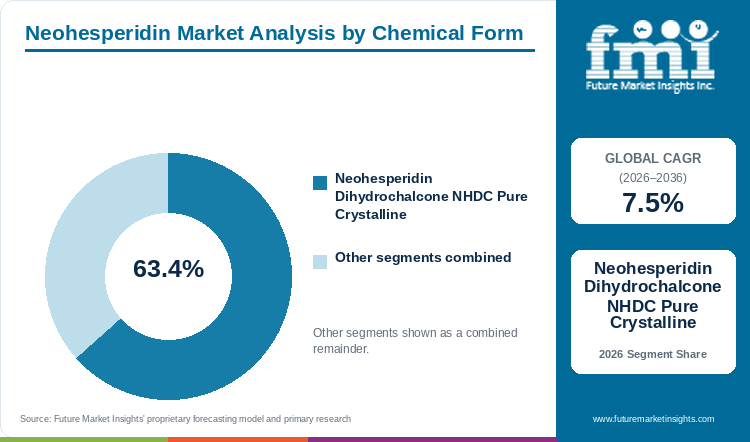
Neohesperidin Dihydrochalcone NHDC Pure Crystalline holds an estimated 63.4% of chemical form demand in 2026, anchored by 1,500x to 1,800x sucrose sweetness potency and TAS2R bitter blocking.
Table 5: Chemical Form Share for the Neohesperidin Market (percentage share), 2026
| Chemical Form | Share (2026) |
|---|---|
| Neohesperidin Dihydrochalcone NHDC Pure Crystalline | 63.4% |
| Other Segments Combined | 36.6%* |
| Total | 100.0% |
*Note that remaining chemical form categories account for the balance of 2026 global neohesperidin demand.
Table 6: Chemical Form Leadership and Market Growth for the Neohesperidin Market (segment and CAGR percentage), 2026 to 2036
| Metric | Value |
|---|---|
| Global CAGR (2026 to 2036) | 7.5% |
| Leading Segment | Neohesperidin Dihydrochalcone NHDC Pure Crystalline |
Neohesperidin Dihydrochalcone NHDC Pure Crystalline dominates value because palladium- or Raney-nickel-mediated alkaline hydrogenation transforms bitter neohesperidin into an intense dihydrochalcone molecule active at 1 to 10 parts per million. Flavor houses combine pure crystalline NHDC with sweet taste-modifying proteins to lengthen sweetness duration and mask bitter active ingredients across beverages and chewable tablets plus livestock premixes.
- Neohesperidin Dihydrochalcone NHDC Pure Crystalline holds 63.4% of chemical form value in 2026 since global food-additive approvals (E959 and FEMA GRAS 3811) center on the hydrogenated dihydrochalcone molecule.
- In October 2025, food chemists reporting in Ultrasonics Sonochemistry characterized hesperidin-stabilized emulsion gels and demonstrated efficient alkaline chalcone-opening and catalytic hydrogenation pathways into neohesperidin dihydrochalcone.
What sustains USP EP FCC Compendial Food Grade Above 98% leadership in the purity compendial grade segment?
USP EP FCC Compendial Food Grade Above 98% represents 67.1% of the purity compendial grade category in 2026, supported by unified beverage, oral-care, and pharmaceutical monograph specifications.
High-purity USP EP FCC Compendial Food Grade Above 98% satisfies United States Pharmacopeia and European Pharmacopoeia monograph limits on residual neohesperidin and naringin dihydrochalcone plus heavy metals. Beverage and oral-care brands require compendial certificates of analysis when blending NHDC with mogroside monk fruit extracts.
- USP EP FCC Compendial Food Grade Above 98% represents 67.1% of the purity compendial grade segment in 2026 as global beverage and healthcare accounts standardize on a single cross-compliant specification.
- In October 2026, Destilaciones Bordas Chinchurreta S.A. presented commercial research at Food Tech Mexico confirming that citrus-derived Neohesperidine DC delivers 1,500 to 1,800 times the sweetening potency of sucrose while exhibiting favorable prebiotic effects in digestive health formulations.
How do Soft Drinks and Beverages Sweetness and Flavor Modulation lead the commercial application category?
Soft Drinks and Beverages Sweetness and Flavor Modulation account for 45.8% of commercial application volume in 2026, driven by sub-threshold stevia bitter masking and mouthfeel enhancement.
Zero-sugar carbonated soft drinks and energy beverages with plant-protein shakes use NHDC at 1 to 5 ppm as a FEMA GRAS flavor modifier or up to 30 ppm as an E959 sweetener to impart sucrose-like viscosity and suppress stevia off-notes. Parallel agricultural volume in swine feed palatability enhancers provides a second high-growth pillar.
- Soft Drinks and Beverages Sweetness and Flavor Modulation capture 36.1% of application volume in 2026 since carbonated soft-drink bottlers require cost-effective stevia bitter masking.
- Corporate technical reporting in September 2026 from Guilin Layn Natural Ingredients Corp. confirmed that standardized citrus bioflavonoids and bitter-orange neohesperidin deliver potent antioxidant and cardiometabolic support while enabling high-efficiency sugar-reduction platforms.
Why does Bitter Orange Citrus aurantium Immature Fruit Extraction lead the botanical feedstock category?
Bitter Orange Citrus aurantium Immature Fruit Extraction secures 61.5% of botanical feedstock value in 2026, supported by high native flavanone glycoside yields in Spanish and Chinese orchards.
Immature fallen fruitlets of Seville bitter orange (Citrus aurantium L.), known in pharmacopeias as Aurantii fructus immaturus, contain 8% to 14% dry-weight neohesperidin flavanone glycoside. Alkaline aqueous extraction and crystallization from bitter orange fruitlets provide the highest direct botanical purity without requiring multi-step retro-aldol condensation from naringin.
- Bitter Orange Citrus aurantium Immature Fruit Extraction secures 61.5% of botanical feedstock demand in 2026 as extraction plants in Spain and China process dedicated bitter-orange orchards.
- In February 2025, natural-product chemists publishing in Molecules detailed green extraction and valorization protocols for Citrus aurantium blossoms and immature fruits to maximize bioflavonoid purity.
What gives Direct to Beverage and Feed Manufacturers the leading position in distribution channel?
Direct to Beverage and Feed Manufacturers commands 57.0% of distribution channel share in 2026, anchored by custom flavor-modulation keys and swine starter feed premix contracts.
Multinational soft-drink bottlers and flavor houses plus integrated swine feed mills contract directly with primary citrus flavonoid extractors and taste-modulation producers to secure multi-year pricing and proprietary Reb-M or saccharin co-blends. Direct technical supply ensures sensory panel calibration across regional beverage and feed plants.
- Direct to Beverage and Feed Manufacturers secures 57.0% of channel sales in 2026 because custom flavor keys and 2b959 feed premixes require direct application testing.
- In commercial ingredient validation, Hunan Kang Biotech Co., Ltd. documented that high-intensity Neohesperidin Dihydrochalcone derived from immature Citrus aurantium fruitlets suppresses receptor astringency at 1 to 5 parts per million in low-calorie beverage bases.
What are the drivers and restraints plus opportunities in the neohesperidin market?
In the neohesperidin market, beverage sugar-tax reformulation and antibiotic-free piglet feed palatability are projected to drive growth whereas low cold-water crystal solubility restrains uncomplexed dosing and enzymatic sweet-orange bioconversion unlocks scalable feedstock supply.
- Driver: Global sugar taxes and antibiotic-free weaning piglet rations accelerate demand for sub-threshold NHDC bitter blockers and Suhuacristal-type feed sweeteners.
- Restraint: Low ambient water solubility of pure NHDC crystals and delayed menthol-licorice aftertaste above 10 ppm constrain unformulated dosing in neutral foods.
- Opportunity: Enzymatic bioconversion of abundant sweet-orange hesperidin and upcycled citrus peel waste unlocks scalable, climate-resilient neohesperidin and NHDC supply.
Growth Analysis and Future Potential: Qualitative Demand Drivers
Simultaneous commercial pull from sugar-taxed beverage reformulation and zinc-oxide-free piglet weaning diets powers the 7.5% CAGR progression of the neohesperidin market through 2036. In human nutrition, beverage flavorists pair trace NHDC with steviol glycosides or sucralose to restore sucrose-like viscosity and suppress bitter receptors without adding calories. In livestock production, compound feed mills blend EU-authorized 2b959 NHDC with livestock feed sweeteners so newly weaned piglets recognize sweet starter pellets immediately and avoid post-weaning growth checks. Per a September 2025 review in Foods on modern sweeteners, neohesperidin dihydrochalcone delivers 1,500 to 1,800 times the sweetness of sucrose with high thermal and acidic pH stability across carbonated drinks.
Risk Assessment of the Neohesperidin Market: Operational and Formulation Friction
Delayed sweetness onset and a lingering menthol-licorice cooling aftertaste above 5 ppm represent the primary sensory ceilings restricting standalone NHDC dosing in foods. When formulators push NHDC inclusion above sub-threshold flavor-modifier levels in delicate lemon-lime sodas or plain yogurts, tasters detect a slow-building herbal sweetness that clashes with crisp fruit notes. According to a November 2025 sensory review in Foods on overcoming sugar-reduction challenges, high-potency dihydrochalcones E959 require precise binary blending to balance sweetness temporal curves and suppress licorice lingering. Manufacturers developing sensory animal feed additives also face strict regional regulatory differences because the United States permits NHDC as a FEMA GRAS flavor modifier while the European Union authorizes E959 as both a sweetener and flavor enhancer.
Commercial Opportunity Analysis: Formulation Differentiation and Value-Add Formats
Flavor modulation leaders and citrus extractors capture premium margins by pairing trace NHDC with allosteric TAS1R2/TAS1R3 sweet-receptor enhancers and bitter-receptor blockers. Knowledge of how dihydrochalcones bind simultaneously to sweet and bitter taste receptors allows formulators to engineer custom ternary blends for plant-protein shakes and chewable vitamins plus compound starter rations. In January 2026, receptor biochemists reporting in Cellular and Molecular Life Sciences mapped how sweet and umami TAS1R receptor modulators create positive allosteric amplification while inhibiting human TAS2R bitter receptors. Beverage and pharmaceutical brands readily pay high kilogram prices for spray-dried cyclodextrin-NHDC inclusion complexes that dissolve instantly in cold batching tanks.
Neohesperidin Market by Country (2026 to 2036)
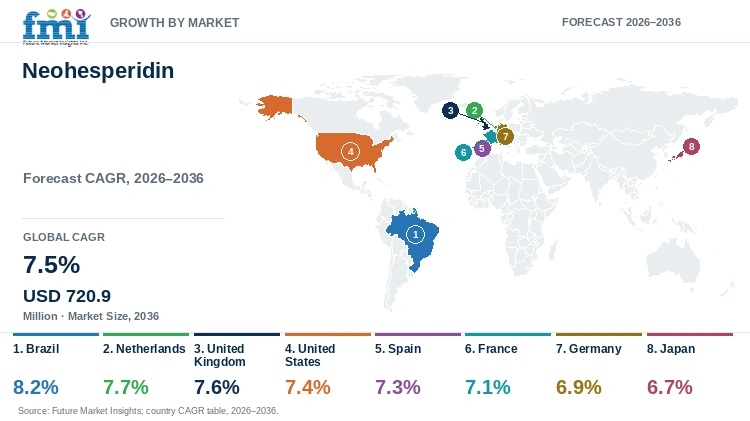
FMI country modeling indicates that Brazil leads neohesperidin expansion at an 8.2% CAGR through 2036, while Japan advances at a steady 6.7% pace.
Table 7: Country CAGR and Primary Growth Levers for the Neohesperidin Market (CAGR percentage and operational drivers), 2026 to 2036
| Country | CAGR (2026 to 2036) | Primary Growth Lever |
|---|---|---|
| Brazil | 8.2% | ANVISA sugar-warning beverage reformulation and commercial swine starter feeds |
| Netherlands | 7.7% | Zinc-free piglet feed premix blending and European beverage flavor modulation |
| United Kingdom | 7.6% | Soft Drinks Industry Levy reformulation and pediatric syrup bitter masking |
| United States | 7.4% | FEMA GRAS 3811 zero-sugar drink modulators and sports hydration formulas |
| Spain | 7.3% | Murcia/Valencia Citrus aurantium extraction and Europe's largest piglet feed base |
| France | 7.1% | European Pharmacopoeia antibiotic syrup masking and Nutri-Score drink reformulation |
| Germany | 6.9% | Zero-alcohol Radler/functional drink sweetening and Lower Saxony swine premixes |
| Japan | 6.7% | Catechin and collagen peptide bitter masking in RTD teas and dysphagia gels |
Source: Future Market Insights analysis
Brazil Neohesperidin Market Outlook (2026 to 2036)
Brazil heads national expansion projections in the neohesperidin market at an 8.2% CAGR from 2026 to 2036, anchored by the world's largest citrus-processing belt in Sao Paulo and Latin America's largest commercial swine-feed industry. Under mandatory ANVISA front-of-pack high-sugar magnifying-glass warning labels, beverage bottlers across Brazil reformulate guarana soft drinks and nectar juices using stevia-NHDC modulator blends. Per the March 2026 USDA GAIN analysis BR2026-0011 covering Brazil, domestic food and drink manufacturing sectors accelerate rapid adoption of sugar-reduction and functional ingredients. Integrated pork producers in Santa Catarina and Parana simultaneously expand NHDC-sweetened piglet pre-starter rations across commercial nursery operations.
Key takeaway: In Brazil, ANVISA front-of-pack sugar reformulation and commercial piglet starter feed palatability programs are projected to drive a leading 8.2% CAGR through 2036.
Netherlands Neohesperidin Market Outlook (2026 to 2036)
In the Netherlands, commercial import demand centers on animal-feed premix manufacturing and specialty flavor-blending facilities, advancing at a 7.7% CAGR through 2036. Multinational livestock nutrition and calf-milk-replacer manufacturers headquartered in Gelderland and Rotterdam formulate EU-authorized 2b959 neohesperidin dihydrochalcone sensory premixes to replace pharmacological zinc oxide in weaned piglets. Per the April 2026 USDA GAIN report covering the Netherlands, domestic agri-food and specialty ingredient blenders maintain a leading export footprint across the European Union single market. Beverage flavor houses in the Netherlands also export liquid NHDC taste-modulation keys to low-alcohol beer and energy-drink bottlers across northern Europe.
Key takeaway: In the Netherlands, zinc-free piglet feed premix manufacturing and export beverage flavor modulation are expected to sustain a 7.7% CAGR through 2036.
United Kingdom Neohesperidin Market Outlook (2026 to 2036)
In the United Kingdom, commercial demand for neohesperidin dihydrochalcone advances at a 7.6% CAGR between 2026 and 2036, driven by the Soft Drinks Industry Levy and aggressive retail HFSS sugar-reduction charters. Beverage manufacturers in the United Kingdom rely on sub-threshold NHDC and E959 sweetening blends to restore sucrose-like body and mask acesulfame-K or stevia bitterness in carbonated drinks and pre-workout powders. Per the March 2026 USDA GAIN report covering the United Kingdom, domestic food and drink manufacturers accelerate recipe reformulation under strict statutory sugar thresholds. Over-the-counter pediatric paracetamol and ibuprofen suspension packers in the United Kingdom also specify compendial NHDC for oral syrups.
Key takeaway: In the United Kingdom, Soft Drinks Industry Levy beverage reformulation and pediatric syrup taste masking are forecast to drive a 7.6% CAGR through 2036.
United States Neohesperidin Market Outlook (2026 to 2036)
In the United States, commercial demand for neohesperidin dihydrochalcone centers on flavor modification rather than standalone tabletop sweetening because regulatory approval operates under FEMA GRAS 3811 guidelines, advancing at a 7.4% CAGR through 2036. Sports-nutrition brands and ready-to-drink coffee bottlers plus gummy supplement co-packers across the United States use 1 to 5 ppm NHDC to mask branched-chain amino acids and caffeine plus botanical alkaloids. Commercial ingredient standards under FEMA GRAS 3811 confirm the efficacy and safety of trace neohesperidin dihydrochalcone in blocking metallic off-notes and enhancing sweetness lingering across low-sugar beverage matrices. Specialized distributors including Penta Fine Ingredients in New Jersey also supply compendial grade NHDC to domestic pharmaceutical contract formulators.
Key takeaway: In the United States, FEMA GRAS 3811 beverage bitter-blocking keys and sports-nutrition hydration formulas are anticipated to sustain a 7.4% CAGR through 2036.
Spain Neohesperidin Market Outlook (2026 to 2036)
Spain acts as the global epicenter of Seville bitter-orange (Citrus aurantium) extraction and Mediterranean swine feed formulation, expanding at a 7.3% CAGR from 2026 to 2036. Extraction and pharmaceutical-chemical complexes in Murcia and Valencia process domestic and imported immature bitter-orange fruitlets into high-purity compendial neohesperidin and NHDC (E959) with feed-grade 2b959. Per the March 2026 USDA GAIN report SP2026-0003 covering Spain, national agri-food processing remains a primary European supplier of specialty citrus bioactives and livestock nutrition inputs. Furthermore, Spain houses Europe's largest commercial pig herd, generating substantial domestic consumption of NHDC-sweetened piglet starter feeds across Aragon and Catalonia swine farms.
Key takeaway: In Spain, domestic Murcia and Valencia Citrus aurantium extraction and Europe's largest swine starter-feed sector are estimated to support a 7.3% CAGR through 2036.
France Neohesperidin Market Outlook (2026 to 2036)
In France, pharmaceutical taste masking drives high-value demand across pediatric syrups, oral suspensions, and Nutri-Score-optimized beverages at a 7.1% CAGR through 2036. Pharmaceutical contract manufacturers and dermocosmetic groups in France incorporate European Pharmacopoeia grade NHDC into antibiotic syrups and alcohol-free mouthwashes to mask bitter active pharmaceutical ingredients and chlorhexidine. Per the April 2026 USDA GAIN report covering France, national food and drink companies accelerate Nutri-Score sugar-reduction reformulations across retail grocery channels. Animal nutrition premixers across Brittany in France also blend 2b959 citrus dihydrochalcones into weaning rations for swine and dairy-calf operations across regional farms.
Key takeaway: In France, European Pharmacopoeia pharmaceutical syrup bitter masking and Nutri-Score beverage reformulation are slated to maintain a 7.1% CAGR through 2036.
Germany Neohesperidin Market Outlook (2026 to 2036)
Germany combines Europe's largest non-alcoholic beer and functional beverage bottling sector with precision pharmaceutical and feed-additive engineering, progressing at a 6.9% CAGR between 2026 and 2036. Breweries and soft-drink manufacturers in Germany apply E959 neohesperidin dihydrochalcone to round out hop and stevia profiles in zero-alcohol Radler shandies and protein puddings. Per the September 2026 USDA GAIN Retail Foods Annual report covering Germany, national food and drink retailers continue to expand sugar-reduced and health-positioned product launches across supermarket channels. Compound feed mills in Lower Saxony and North Rhine-Westphalia simultaneously specify standardized NHDC-saccharin palatability blends for commercial high-health piglet starter feed pellets across agricultural cooperatives.
Key takeaway: In Germany, zero-alcohol beer and functional drink sweetening with Lower Saxony swine feed premixes are likely to support a 6.9% CAGR through 2036.
Japan Neohesperidin Market Outlook (2026 to 2036)
Japan represents a specialized high-purity market where citrus flavonoid extracts and dihydrochalcone modulators support functional Kampo herbal drinks and senior dysphagia gels at a 6.7% CAGR through 2036. Beverage and pharmaceutical formulators in Japan dose micro-quantities of neohesperidin and enzyme-treated citrus flavonoids to suppress the astringency of catechins and geriatric medications without clashing with clean green-tea or yuzu profiles. Per the April 2026 USDA GAIN report JA2026-0012 covering Japan, national food manufacturing sectors prioritize intensive R&D investments in senior nutrition and calorie-free ready-to-drink beverages. High-solubility cyclodextrin-complexed grades command a premium across domestic beverage lines.
Key takeaway: In Japan, catechin and peptide bitterness masking in functional RTD drinks and senior dysphagia gels is predicted to sustain a 6.7% CAGR through 2036.
Full report country CAGRs cover: North America; Latin America; Western Europe; Eastern Europe; East Asia; South Asia and Pacific; Middle East and Africa.
Who are the notable companies in the neohesperidin market?
HealthTech Bio Actives (HTBA) and Destilaciones Bordas Chinchurreta S.A. lead primary Citrus aurantium extraction in Europe, while Hunan Kang Biotech Co., Ltd., Guilin Layn Natural Ingredients Corp., and Sinofi Ingredients anchor Chinese bulk manufacturing of Neohesperidin and Neohesperidin Dihydrochalcone (NHDC).
Competitive positioning in the neohesperidin industry separates primary citrus flavonoid extractors from specialized catalytic hydrogenation synthesis producers and compendial ingredient distributors. HealthTech Bio Actives (HTBA) and Destilaciones Bordas Chinchurreta S.A. anchor primary Citrus aurantium neohesperidin extraction and catalytic NHDC synthesis in Spain. Hunan Kang Biotech Co., Ltd. and Guilin Layn Natural Ingredients Corp. lead Chinese botanical extraction, while Shandong Benyue Biological Technology Co., Ltd. and Sinofi Ingredients formulate high-potency compound sweeteners and commercial bitter-blocking keys.
- Primary Citrus Flavonoid Extraction and Hydrogenation Specialists: HealthTech Bio Actives (HTBA) and Destilaciones Bordas Chinchurreta S.A. lead European primary extraction from Spanish bitter orange orchards, operating dedicated catalytic hydrogenation plants that supply compendial Ph. Eur., FCC, and sensory feed additive 2b959 NHDC. In China, Hunan Kang Biotech Co., Ltd. and Guilin Layn Natural Ingredients Corp. maintain large-scale Citrus aurantium extraction facilities delivering standardized neohesperidin and high-purity NHDC powders.
- Commercial Sweetener and Formulation Modulator Suppliers: Shandong Benyue Biological Technology Co., Ltd. and Sinofi Ingredients specialize in bulk commercial supply of Neohesperidin Dihydrochalcone (NHDC / E959) and compound sweetness systems, formulating micro-dosed premixes that eliminate off-tastes in stevia-sweetened beverages and swine starter feeds.
- Pharmaceutical Compendial and Analytical Reference Standard Providers: Penta Fine Ingredients, Simson Pharma Limited, Conscientia Industrial Co., Ltd., and Otto Chemie Pvt. Ltd. supply high-purity Neohesperidin (CAS 13241-33-3) and NHDC (CAS 20702-77-6), providing certified reference standards, DMF documentation, and bulk chemical inputs for drug bitterness masking and analytical method validation.
Competitive Benchmarking: Neohesperidin Market
Table 8: Competitive Benchmarking for the Neohesperidin Market (qualitative capability ratings), 2026
| Company | Documented Citrus Flavonoid Activity | Beverage & Pharma Support | Sugar-Reduction Modulation Fit | Geographic Reach |
|---|---|---|---|---|
| HealthTech Bio Actives (HTBA) | High | High | High | Primary Murcia Citrus aurantium NHDC (E959/FEMA 3811) and Suhuacristal 2b959 producer |
| Destilaciones Bordas Chinchurreta S.A. (Bordas) | High | High | High | Primary Seville Citrus aurantium extraction, Neohesperidine DC, and swine feed sweetening systems |
| Hunan Kang Biotech Co., Ltd. (Kang Biotech) | High | High | High | Integrated Hunan Citrus aurantium extraction, Neohesperidin 95%, and FCC/USP NHDC 98% production |
| Guilin Layn Natural Ingredients Corp. | High | High | High | Global Guangxi botanical extraction and US application labs supplying bitter orange neohesperidin and Plantae Sense modulators |
| Shandong Benyue Biological Technology Co., Ltd. | Medium | High | High | Dedicated Shandong crystallization facility producing pure Neohesperidin (CAS 13241-33-3) and NHDC compound sweeteners |
| Sinofi Ingredients | Medium | High | High | Shanghai manufacturing and warehouse hub exporting food- and feed-grade NHDC (E959) complying with EFSA and FCC standards |
| Penta Fine Ingredients | Medium | High | High | US Livingston facility distributing EP-grade Neohesperidin Dihydrochalcone for FEMA GRAS 3811 beverage and oral-care modulation |
| Simson Pharma Limited | Medium | High | Medium | Mumbai synthesis labs producing compendial reference standards and certified pure Neohesperidin / NHDC for pharmaceutical dossiers |
| Conscientia Industrial Co., Ltd. | Medium | Medium | Medium | Zhejiang chemical production supplying commercial Neohesperidin (CAS 13241-33-3, >=98.0%) for industrial hydrogenation and dietary inputs |
| Otto Chemie Pvt. Ltd. | Medium | Medium | Medium | Mumbai manufacturing and export channels supplying high-purity Neohesperidin 90% and NHDC 98% for pilot and R&D formulation |
Primary scoring basis: Documented Citrus Flavonoid Activity evaluates primary extraction or FEMA GRAS / E959 / 2b959 dihydrochalcone synthesis and modulation credentials, whereas Beverage and Pharma Application Support rates sensory bitter-blocking and cyclodextrin complexation labs. Sugar-Reduction Modulation Fit scores binary blending with stevia Reb-M or monk fruit, and Geographic Reach reflects multi-region regulatory dossier coverage.
Key Developments in the Neohesperidin Market
- Destilaciones Bordas Chinchurreta S.A. expanded its commercial citrus bioflavonoid and Neohesperidine DC portfolio in October 2026, validating multi-regional distribution for high-potency bitterness masking and prebiotic digestive nutrition across Latin America and Europe.
- HealthTech BioActives (HTBA) reinforced its European manufacturing operations in Murcia, Spain during 2025 and 2026, delivering compendial Ph. Eur. Neohesperidin Dihydrochalcone and expanding Suhuacristal 2b959 sensory feed additive registrations across international markets.
- Guilin Layn Natural Ingredients Corp. spotlighted its citrus bioflavonoid extraction portfolio and bitter-orange neohesperidin modulation platforms at SupplySide Global in October 2026, presenting plant-based sweetness solutions for functional beverages.
Key Players in the Neohesperidin Market
Primary Citrus Flavonoid Synthesis and Bioconversion Specialists
- HealthTech Bio Actives (HTBA)
- Destilaciones Bordas Chinchurreta S.A. (Bordas)
- Global Beverage Sweetening and Taste-Modulation Formulators
- Hunan Kang Biotech Co., Ltd. (Kang Biotech)
Guilin Layn Natural Ingredients Corp.
- Shandong Benyue Biological Technology Co., Ltd.
- Sinofi Ingredients
- Penta Fine Ingredients
- Simson Pharma Limited
Conscientia Industrial Co., Ltd.
- Pharmaceutical Bitterness-Masking and Polyol Carrier Leaders
- Otto Chemie Pvt. Ltd.
Neohesperidin Market - Report Scope
Table 9: Report Scope for the Neohesperidin Market (coverage fields and definitions), 2026 to 2036
| Coverage field | Report scope |
|---|---|
| Market breakdown | Chemical Form; Purity Compendial Grade; Commercial Application; Botanical Feedstock; Distribution Channel |
| Quantitative Units | USD Million |
| Market Definition | Includes commercial B2B supplier valuation from botanical neohesperidin flavanone glycoside and hydrogenated neohesperidin dihydrochalcone (NHDC, CAS 20702-77-6, E959, FEMA GRAS 3811, EU Feed Additive 2b959) in pure crystalline, liquid polyol/cyclodextrin complex, and co-processed modulator blends. Category Scope Note: Excludes unstandardized crude citrus peel meal, unmodified sweet-orange hesperidin sold solely for vascular supplements without neohesperidin/NHDC conversion, and bulk nutritive sugars. |
| Regions Covered | North America; Latin America; Western Europe; Eastern Europe; East Asia; South Asia and Pacific; Middle East and Africa |
| Countries Covered | Brazil, Netherlands, United Kingdom, United States, Spain, France, Germany, Japan, and additional countries in the full report |
| Key Companies Covered | HealthTech Bio Actives (HTBA), Destilaciones Bordas Chinchurreta S.A. (Bordas), Hunan Kang Biotech Co., Ltd. (Kang Biotech), Guilin Layn Natural Ingredients Corp., Shandong Benyue Biological Technology Co., Ltd., Sinofi Ingredients, Penta Fine Ingredients, Simson Pharma Limited, Conscientia Industrial Co., Ltd., Otto Chemie Pvt. Ltd. |
| Forecast Period | 2026 to 2036 |
| Approach | Primary and secondary research with top-down and bottom-up market triangulation. |
Neohesperidin Market - Research Methodology
Table 10: Research Methodology for the Neohesperidin Market (research methods and approach), 2026 edition
| Method | Approach |
|---|---|
| Primary Research | Structured interviews with Spanish and Chinese Citrus aurantium extraction engineers, beverage flavorists, pharmaceutical excipient formulators, and swine nutritionists to validate ppm dosing and kg pricing. |
| Secondary Research | Analysis of Journal of Agricultural and Food Chemistry TAS2R receptor studies, USP/EP/FCC and EFSA 2b959 monographs, USDA FAS Food Processing Ingredients Annual reports, and corporate disclosures. |
| Market Sizing and Forecasting | Top-down global high-potency sweetener, flavor modulator, and feed palatability baselines reconciled against bottom-up pure NHDC and neohesperidin tonnage (1,195 to 1,345 MT in 2026) from 2026 to 2036. |
| Country Forecasting Model | Econometric country projections weight national sugar-tax beverage reformulation volume, commercial weaned-piglet feed tonnage, pediatric syrup production, and domestic citrus extraction capacity across eight countries. |
| Operational Benchmark Traceability | Active flavonoid tonnage and line allocation indicators in Tables 2, 3, and 4 trace to FEMA GRAS 3811 beverage ppm limits (1 to 5 ppm), EU 2b959 piglet feed inclusion (5 to 35 g/MT), and USDA FAS registries. |
| Data Triangulation and Validation | Valuation estimates isolate B2B neohesperidin and NHDC active and complexed ingredient value while strictly excluding bulk stevia/sucralose carrier weight and finished retail beverage bottle markups. |
Neohesperidin Market by Segments
Neohesperidin Market segmented by Chemical Form:
- Neohesperidin Dihydrochalcone NHDC Pure Crystalline
- Neohesperidin Botanical Flavanone Extract
- Water-Soluble NHDC Polyol and Cyclodextrin Complexes
- Co-Processed Citrus Flavonoid Sweetener Blends
Neohesperidin Market segmented by Purity Compendial Grade:
- USP EP FCC Compendial Food Grade Above 98%
- Technical Formulation Grade
- Feed-Grade Sensory Additive 2b959 Above 96%
- Pharmaceutical Excipient Bitterness-Masking Grade
Neohesperidin Market segmented by Commercial Application:
- Soft Drinks and Beverages Sweetness and Flavor Modulation
- Animal Feed Sweetening and Bitter Masking Piglet Feeds
- Pharmaceutical API Bitterness Masking Syrups
- Oral Care Mouthwashes and Toothpastes
- Dietary Supplements and Chewable Nutraceuticals
Neohesperidin Market segmented by Botanical Feedstock:
- Bitter Orange Citrus aurantium Immature Fruit Extraction
- Grapefruit Citrus paradisi Naringin Bioconversion
- Pomelo Citrus maxima Naringin Synthesis
- Upcycled Citrus Peel By-Product Valorization
Neohesperidin Market segmented by Distribution Channel:
- Direct to Beverage and Feed Manufacturers
- Specialty Flavor and Sweetener Distributors
- Pharmaceutical Excipient Suppliers
- Online B2B Chemical Procurement
Neohesperidin Market by Region
- North America
- United States
- Canada
- Latin America
- Brazil
- Mexico
- Argentina
- Chile
- Western Europe
- Germany
- France
- United Kingdom
- Italy
- Spain
- Benelux
- Nordics
- Eastern Europe
- Poland
- Czech Republic
- Romania
- Hungary
- East Asia
- China
- Japan
- South Korea
- South Asia and Pacific
- India
- ASEAN
- Australia and New Zealand
- Middle East and Africa
- GCC Countries
- South Africa
- Türkiye
- Israel
Research Sources and Bibliography
- [1] EFSA Panel on Additives and Products or Substances used in Animal Feed. (2025, April 10). Assessment of the feed additive neohesperidine dihydrochalcone for all animal species. EFSA Journal, 23(4), e9358 (PMC11983774).
- [2] EFSA Panel on Additives and Products or Substances used in Animal Feed. (2025, October 16). Assessment of the feed additive neohesperidine dihydrochalcone 2b959 for piglets, pigs for fattening, calves, sheep, fish and dogs for the renewal of its authorisation. EFSA Journal, 23(10), e9682 (PMC12529050).
- [3] Nguyen, H. et al. (2025, April 1). Thiazolidinediones are partially effective bitter blockers. Clinical and Translational Science, 18(4), Article 11116052 (PMC11116052).
- [4] Kim, D. et al. (2026, March 18). The Impact of Sugar Moieties on the Solubility of Naringin and Neohesperidin Derived from Citrus aurantium. Molecules, 31(6), Article 13516785 (PMC13516785).
- [5] Zhao, Y. et al. (2025, October 15). Formation mechanism and characterization of hesperidin-stabilized Pickering emulsion gels and conversion to neohesperidin dihydrochalcone. Ultrasonics Sonochemistry, 112, Article 12554082 (PMC12554082).
- [6] Destilaciones Bordas Chinchurreta S.A. (2026, October 21). Flavour Modulation and Digestive Health: Bordas Solutions at Food Tech Mexico 2026. Bordas Corporate Technical Publications.
- [7] Guilin Layn Natural Ingredients Corp. (2026, September 24). The Cardiometabolic Benefits of Citrus Flavonoids: Sourcing Bitter Orange Extracts and Functional Glycosides. Layn Corporate Technical Insights.
- [8] Benavente-Garcia, O. et al. (2025, February 11). Citrus aurantium Flowers Overview of Chemistry Functionality and Green Extraction Methods. Molecules, 30(3), Article 11858012 (PMC11858012).
- [9] Hunan Kang Biotech Co., Ltd. (2025, November 14). Neohesperidin Dihydrochalcone (NHDC) Sweetener and Flavor Modulation Technical Specifications. Kang Biotech Corporate Product Monographs.
- [10] Patel, S. et al. (2025, September 12). Beyond Sugar A Holistic Review of Sweeteners and Their Role in Modern Nutrition. Foods, 14(18), Article 12470175 (PMC12470175).
- [11] Ribeiro, M. et al. (2025, November 22). From Sweetness to Mouthfeel A Review on Overcoming Sensory Challenges in Sugar Reduction. Foods, 14(23), Article 12639530 (PMC12639530).
- [12] Servant, G. et al. (2026, January 30). Sweet and umami TAS1R receptors from molecular recognition to sweetener synergy and bitter receptor inhibition. Cellular and Molecular Life Sciences, 83, Article 13034538 (PMC13034538).
- [13] USDA Foreign Agricultural Service. (2026, March 31). Brazil Food Processing Ingredients Annual Report BR2026-0011. U.S. Department of Agriculture.
- [14] USDA Foreign Agricultural Service. (2026, April 2). Netherlands Food Processing Ingredients Annual Report. U.S. Department of Agriculture.
- [15] USDA Foreign Agricultural Service. (2026, March 24). United Kingdom Food Processing Ingredients Annual Report. U.S. Department of Agriculture.
- [16] Flavor and Extract Manufacturers Association. (2025, August 12). GRAS Flavouring Substances 20: Neohesperidin Dihydrochalcone (FEMA 3811). FEMA Flavor Ingredient Library.
- [17] USDA Foreign Agricultural Service. (2026, March 31). Spain Food Processing Ingredients Annual Report SP2026-0003. U.S. Department of Agriculture.
- [18] USDA Foreign Agricultural Service. (2026, April 3). France Food Processing Ingredients Annual Report. U.S. Department of Agriculture.
- [19] USDA Foreign Agricultural Service. (2026, September 15). Germany Retail Foods Annual Report. U.S. Department of Agriculture.
- [20] USDA Foreign Agricultural Service. (2026, April 10). Japan Food Processing Ingredients Annual Report JA2026-0012. U.S. Department of Agriculture.
- [21] Destilaciones Bordas Chinchurreta S.A. (2026, October 21). Bordas Showcases Citrus Flavonoids and Neohesperidine DC Sweeteners at Food Tech Mexico 2026. Bordas Corporate Media Releases.
- [22] HealthTech BioActives. (2026, January 15). HTBA Taste Modulation and Animal Nutrition Technical Capabilities: Beniel Manufacturing Facility Assessment. HTBA Corporate Technical Publications.
- [23] Guilin Layn Natural Ingredients Corp. (2026, October 28). Layn Natural Ingredients Spotlights Citrus Bioflavonoids and High-Potency Botanical Modulators at SupplySide Global 2026. Layn Corporate Newsroom.
- [24] Shandong Benyue Biological Technology Co., Ltd. (2026, March 18). Manufacturing Standards and Purity Specifications for Neohesperidin Dihydrochalcone (CAS 20702-77-6). Benyue Biological Corporate Technical Disclosures.
This bibliography is provided for reader reference and is not exhaustive. The full report contains the complete reference list and detailed citations.
This Report Answers
- How large is the neohesperidin market in 2026 and what is forecast for 2036?
- Which zero-sugar beverage bitter-masking and piglet feed palatability pressures support demand?
- Why does Neohesperidin Dihydrochalcone NHDC Pure Crystalline lead the chemical form category?
- Why does USP EP FCC Compendial Food Grade Above 98% lead the purity compendial grade category?
- How do growth rates differ across Brazil and the Netherlands along with the United Kingdom and the United States?
- Which leading companies supply primary Citrus aurantium NHDC versus beverage and pharma modulator blends?
- What limits cold-water crystal dissolution or causes lingering cooling aftertaste in beverages?
- What should formulators evaluate when pairing NHDC with stevia Reb-M or piglet feed saccharin?
Table of Content
- Key Takeaways
- Market Size and CAGR
- Top Growth Driver
- Fastest Growing Segment
- Leading Region
- Key Companies
- Emerging Opportunities
- Executive Summary
- Global Market Outlook
- Demand-side Trends
- Supply-side Trends
- Technology Roadmap Analysis
- Analysis and Recommendations
- Analyst Perspective (What is happening? Why now? What should investors know?)
- Key Questions Answered
- How large is the market?
- What is the CAGR?
- What are key trends?
- Which region dominates?
- Who are the leaders?
Read More...
- Market Overview
- Market Coverage / Taxonomy
- Market Definition / Scope / Limitations
- Research Methodology
- Chapter Orientation
- Analytical Lens and Working Hypotheses
- Market Structure, Signals, and Trend Drivers
- Benchmarking and Cross-market Comparability
- Market Sizing, Forecasting, and Opportunity Mapping
- Research Design and Evidence Framework
- Desk Research Programme (Secondary Evidence)
- Expert Input and Fieldwork (Primary Evidence)
- Tooling, Models, and Reference Databases
- Data Engineering and Model Build
- Quality Assurance and Audit Trail
- Market Background
- Market Dynamics (Drivers, Restraints, Opportunity, Trends)
- Scenario Forecast (Optimistic, Likely, Conservative)
- Impact Analysis
- AI Impact
- Sustainability Impact
- Regulatory Impact
- Technology Impact
- Consumer / Buyer Analysis
- Purchase Drivers
- Adoption Barriers
- Buyer Journey
- Opportunity Map Analysis
- Product Life Cycle Analysis
- Supply Chain Analysis
- Investment Feasibility Matrix
- Value Chain Analysis
- PESTLE and Porter's Analysis
- Regulatory Landscape
- Regional Parent Market Outlook
- Production and Consumption Statistics
- Import and Export Statistics
- Global Market Analysis and Forecast, 2021 to 2036
- Historical Market Size Value (USD Million) Analysis, 2021 to 2025
- Current and Future Market Size Value (USD Million) Projections, 2026 to 2036
- Y-o-Y Growth Trend Analysis
- Absolute $ Opportunity Analysis
- Global Market Pricing Analysis, 2021 to 2036
- Global Market Analysis and Forecast, By Chemical Form, 2021 to 2036
- Introduction / Key Findings
- Historical Market Size Value (USD Million) Analysis By Chemical Form, 2021 to 2025
- Current and Future Market Size Value (USD Million) Analysis and Forecast By Chemical Form, 2026 to 2036
- Neohesperidin Dihydrochalcone NHDC Pure Crystalline
- Neohesperidin Botanical Flavanone Extract
- Water-Soluble NHDC Polyol and Cyclodextrin Complexes
- Co-Processed Citrus Flavonoid Sweetener Blends
- Y-o-Y Growth Trend Analysis By Chemical Form, 2021 to 2025
- Absolute $ Opportunity Analysis By Chemical Form, 2026 to 2036
- Global Market Analysis and Forecast, By Purity Compendial Grade, 2021 to 2036
- Introduction / Key Findings
- Historical Market Size Value (USD Million) Analysis By Purity Compendial Grade, 2021 to 2025
- Current and Future Market Size Value (USD Million) Analysis and Forecast By Purity Compendial Grade, 2026 to 2036
- USP EP FCC Compendial Food Grade Above 98%
- Technical Formulation Grade
- Feed-Grade Sensory Additive 2b959 Above 96%
- Pharmaceutical Excipient Bitterness-Masking Grade
- Y-o-Y Growth Trend Analysis By Purity Compendial Grade, 2021 to 2025
- Absolute $ Opportunity Analysis By Purity Compendial Grade, 2026 to 2036
- Global Market Analysis and Forecast, By Commercial Application, 2021 to 2036
- Introduction / Key Findings
- Historical Market Size Value (USD Million) Analysis By Commercial Application, 2021 to 2025
- Current and Future Market Size Value (USD Million) Analysis and Forecast By Commercial Application, 2026 to 2036
- Soft Drinks and Beverages Sweetness and Flavor Modulation
- Animal Feed Sweetening and Bitter Masking Piglet Feeds
- Pharmaceutical API Bitterness Masking Syrups
- Oral Care Mouthwashes and Toothpastes
- Dietary Supplements and Chewable Nutraceuticals
- Y-o-Y Growth Trend Analysis By Commercial Application, 2021 to 2025
- Absolute $ Opportunity Analysis By Commercial Application, 2026 to 2036
- Global Market Analysis and Forecast, By Botanical Feedstock, 2021 to 2036
- Introduction / Key Findings
- Historical Market Size Value (USD Million) Analysis By Botanical Feedstock, 2021 to 2025
- Current and Future Market Size Value (USD Million) Analysis and Forecast By Botanical Feedstock, 2026 to 2036
- Bitter Orange Citrus aurantium Immature Fruit Extraction
- Grapefruit Citrus paradisi Naringin Bioconversion
- Pomelo Citrus maxima Naringin Synthesis
- Upcycled Citrus Peel By-Product Valorization
- Y-o-Y Growth Trend Analysis By Botanical Feedstock, 2021 to 2025
- Absolute $ Opportunity Analysis By Botanical Feedstock, 2026 to 2036
- Global Market Analysis and Forecast, By Distribution Channel, 2021 to 2036
- Introduction / Key Findings
- Historical Market Size Value (USD Million) Analysis By Distribution Channel, 2021 to 2025
- Current and Future Market Size Value (USD Million) Analysis and Forecast By Distribution Channel, 2026 to 2036
- Direct to Beverage and Feed Manufacturers
- Specialty Flavor and Sweetener Distributors
- Pharmaceutical Excipient Suppliers
- Online B2B Chemical Procurement
- Y-o-Y Growth Trend Analysis By Distribution Channel, 2021 to 2025
- Absolute $ Opportunity Analysis By Distribution Channel, 2026 to 2036
- Global Market Analysis and Forecast, By Region, 2021 to 2036
- Introduction
- Historical Market Size Value (USD Million) Analysis By Region, 2021 to 2025
- Current Market Size Value (USD Million) Analysis and Forecast By Region, 2026 to 2036
- North America
- Latin America
- Western Europe
- Eastern Europe
- East Asia
- South Asia and Pacific
- Middle East and Africa
- Market Attractiveness Analysis By Region
- North America Market Analysis and Forecast, By Country, 2021 to 2036
- Historical Market Size Value (USD Million) Trend Analysis By Market Taxonomy, 2021 to 2025
- Market Size Value (USD Million) Forecast By Market Taxonomy, 2026 to 2036
- By Country
- United States
- Canada
- By Chemical Form
- By Purity Compendial Grade
- By Commercial Application
- By Botanical Feedstock
- By Distribution Channel
- By Country
- Market Attractiveness Analysis
- By Country
- By Chemical Form
- By Purity Compendial Grade
- By Commercial Application
- By Botanical Feedstock
- By Distribution Channel
- Key Takeaways
- Latin America Market Analysis and Forecast, By Country
- Historical Market Size Value (USD Million) Trend Analysis By Market Taxonomy, 2021 to 2025
- Market Size Value (USD Million) Forecast By Market Taxonomy, 2026 to 2036
- By Country
- Brazil
- Mexico
- Argentina
- Chile
- By Chemical Form
- By Purity Compendial Grade
- By Commercial Application
- By Botanical Feedstock
- By Distribution Channel
- By Country
- Market Attractiveness Analysis
- By Country
- By Chemical Form
- By Purity Compendial Grade
- By Commercial Application
- By Botanical Feedstock
- By Distribution Channel
- Key Takeaways
- Western Europe Market Analysis and Forecast, By Country
- Historical Market Size Value (USD Million) Trend Analysis By Market Taxonomy, 2021 to 2025
- Market Size Value (USD Million) Forecast By Market Taxonomy, 2026 to 2036
- By Country
- Germany
- France
- United Kingdom
- Italy
- Spain
- Benelux
- Nordics
- By Chemical Form
- By Purity Compendial Grade
- By Commercial Application
- By Botanical Feedstock
- By Distribution Channel
- By Country
- Market Attractiveness Analysis
- By Country
- By Chemical Form
- By Purity Compendial Grade
- By Commercial Application
- By Botanical Feedstock
- By Distribution Channel
- Key Takeaways
- Eastern Europe Market Analysis and Forecast, By Country
- Historical Market Size Value (USD Million) Trend Analysis By Market Taxonomy, 2021 to 2025
- Market Size Value (USD Million) Forecast By Market Taxonomy, 2026 to 2036
- By Country
- Poland
- Czech Republic
- Romania
- Hungary
- By Chemical Form
- By Purity Compendial Grade
- By Commercial Application
- By Botanical Feedstock
- By Distribution Channel
- By Country
- Market Attractiveness Analysis
- By Country
- By Chemical Form
- By Purity Compendial Grade
- By Commercial Application
- By Botanical Feedstock
- By Distribution Channel
- Key Takeaways
- East Asia Market Analysis and Forecast, By Country
- Historical Market Size Value (USD Million) Trend Analysis By Market Taxonomy, 2021 to 2025
- Market Size Value (USD Million) Forecast By Market Taxonomy, 2026 to 2036
- By Country
- China
- Japan
- South Korea
- By Chemical Form
- By Purity Compendial Grade
- By Commercial Application
- By Botanical Feedstock
- By Distribution Channel
- By Country
- Market Attractiveness Analysis
- By Country
- By Chemical Form
- By Purity Compendial Grade
- By Commercial Application
- By Botanical Feedstock
- By Distribution Channel
- Key Takeaways
- South Asia and Pacific Market Analysis and Forecast, By Country
- Historical Market Size Value (USD Million) Trend Analysis By Market Taxonomy, 2021 to 2025
- Market Size Value (USD Million) Forecast By Market Taxonomy, 2026 to 2036
- By Country
- India
- ASEAN
- Australia and New Zealand
- By Chemical Form
- By Purity Compendial Grade
- By Commercial Application
- By Botanical Feedstock
- By Distribution Channel
- By Country
- Market Attractiveness Analysis
- By Country
- By Chemical Form
- By Purity Compendial Grade
- By Commercial Application
- By Botanical Feedstock
- By Distribution Channel
- Key Takeaways
- Middle East and Africa Market Analysis and Forecast, By Country
- Historical Market Size Value (USD Million) Trend Analysis By Market Taxonomy, 2021 to 2025
- Market Size Value (USD Million) Forecast By Market Taxonomy, 2026 to 2036
- By Country
- GCC Countries
- South Africa
- Türkiye
- Israel
- By Chemical Form
- By Purity Compendial Grade
- By Commercial Application
- By Botanical Feedstock
- By Distribution Channel
- By Country
- Market Attractiveness Analysis
- By Country
- By Chemical Form
- By Purity Compendial Grade
- By Commercial Application
- By Botanical Feedstock
- By Distribution Channel
- Key Takeaways
- Key Countries Market Analysis
- United States
- Pricing Analysis
- Market Share Analysis, 2025
- By Chemical Form
- By Purity Compendial Grade
- By Commercial Application
- By Botanical Feedstock
- By Distribution Channel
- Canada
- Pricing Analysis
- Market Share Analysis, 2025
- By Chemical Form
- By Purity Compendial Grade
- By Commercial Application
- By Botanical Feedstock
- By Distribution Channel
- Mexico
- Pricing Analysis
- Market Share Analysis, 2025
- By Chemical Form
- By Purity Compendial Grade
- By Commercial Application
- By Botanical Feedstock
- By Distribution Channel
- Brazil
- Pricing Analysis
- Market Share Analysis, 2025
- By Chemical Form
- By Purity Compendial Grade
- By Commercial Application
- By Botanical Feedstock
- By Distribution Channel
- Chile
- Pricing Analysis
- Market Share Analysis, 2025
- By Chemical Form
- By Purity Compendial Grade
- By Commercial Application
- By Botanical Feedstock
- By Distribution Channel
- Germany
- Pricing Analysis
- Market Share Analysis, 2025
- By Chemical Form
- By Purity Compendial Grade
- By Commercial Application
- By Botanical Feedstock
- By Distribution Channel
- United Kingdom
- Pricing Analysis
- Market Share Analysis, 2025
- By Chemical Form
- By Purity Compendial Grade
- By Commercial Application
- By Botanical Feedstock
- By Distribution Channel
- Italy
- Pricing Analysis
- Market Share Analysis, 2025
- By Chemical Form
- By Purity Compendial Grade
- By Commercial Application
- By Botanical Feedstock
- By Distribution Channel
- Spain
- Pricing Analysis
- Market Share Analysis, 2025
- By Chemical Form
- By Purity Compendial Grade
- By Commercial Application
- By Botanical Feedstock
- By Distribution Channel
- France
- Pricing Analysis
- Market Share Analysis, 2025
- By Chemical Form
- By Purity Compendial Grade
- By Commercial Application
- By Botanical Feedstock
- By Distribution Channel
- India
- Pricing Analysis
- Market Share Analysis, 2025
- By Chemical Form
- By Purity Compendial Grade
- By Commercial Application
- By Botanical Feedstock
- By Distribution Channel
- ASEAN
- Pricing Analysis
- Market Share Analysis, 2025
- By Chemical Form
- By Purity Compendial Grade
- By Commercial Application
- By Botanical Feedstock
- By Distribution Channel
- Australia and New Zealand
- Pricing Analysis
- Market Share Analysis, 2025
- By Chemical Form
- By Purity Compendial Grade
- By Commercial Application
- By Botanical Feedstock
- By Distribution Channel
- China
- Pricing Analysis
- Market Share Analysis, 2025
- By Chemical Form
- By Purity Compendial Grade
- By Commercial Application
- By Botanical Feedstock
- By Distribution Channel
- Japan
- Pricing Analysis
- Market Share Analysis, 2025
- By Chemical Form
- By Purity Compendial Grade
- By Commercial Application
- By Botanical Feedstock
- By Distribution Channel
- South Korea
- Pricing Analysis
- Market Share Analysis, 2025
- By Chemical Form
- By Purity Compendial Grade
- By Commercial Application
- By Botanical Feedstock
- By Distribution Channel
- Poland
- Pricing Analysis
- Market Share Analysis, 2025
- By Chemical Form
- By Purity Compendial Grade
- By Commercial Application
- By Botanical Feedstock
- By Distribution Channel
- Hungary
- Pricing Analysis
- Market Share Analysis, 2025
- By Chemical Form
- By Purity Compendial Grade
- By Commercial Application
- By Botanical Feedstock
- By Distribution Channel
- Türkiye
- Pricing Analysis
- Market Share Analysis, 2025
- By Chemical Form
- By Purity Compendial Grade
- By Commercial Application
- By Botanical Feedstock
- By Distribution Channel
- South Africa
- Pricing Analysis
- Market Share Analysis, 2025
- By Chemical Form
- By Purity Compendial Grade
- By Commercial Application
- By Botanical Feedstock
- By Distribution Channel
- Netherlands
- Pricing Analysis
- Market Share Analysis, 2025
- By Chemical Form
- By Purity Compendial Grade
- By Commercial Application
- By Botanical Feedstock
- By Distribution Channel
- United States
- Market Structure Analysis
- Competition Dashboard
- Competition Benchmarking
- Market Share Analysis of Top Players
- By Regional
- By Chemical Form
- By Purity Compendial Grade
- By Commercial Application
- By Botanical Feedstock
- By Distribution Channel
- Emerging Startups
- Innovation Benchmarking
- Competition Analysis
- Competition Deep Dive
- HealthTech Bio Actives (HTBA)
- Overview
- Product Portfolio
- Profitability by Market Segments
- Sales Footprint
- Strategy Overview
- Marketing Strategy
- Product Strategy
- Channel Strategy
- Destilaciones Bordas Chinchurreta S.A. (Bordas)
- Hunan Kang Biotech Co., Ltd. (Kang Biotech)
- Guilin Layn Natural Ingredients Corp.
- Shandong Benyue Biological Technology Co., Ltd.
- Sinofi Ingredients
- Penta Fine Ingredients
- Simson Pharma Limited
- Conscientia Industrial Co., Ltd.
- Otto Chemie Pvt. Ltd.
- Global Beverage Sweetening and Taste-Modulation Formulators
- Pharmaceutical Bitterness-Masking and Polyol Carrier Leaders
- HealthTech Bio Actives (HTBA)
- Case Studies
- Success Stories
- Recent Developments
- Competition Deep Dive
- Assumptions & Acronyms Used
List of Tables
- Table 1: Global Market Value (USD Million) Forecast by Region, 2021 to 2036
- Table 2: Global Market Value (USD Million) Forecast by Chemical Form, 2021 to 2036
- Table 3: Global Market Value (USD Million) Forecast by Purity Compendial Grade, 2021 to 2036
- Table 4: Global Market Value (USD Million) Forecast by Commercial Application, 2021 to 2036
- Table 5: Global Market Value (USD Million) Forecast by Botanical Feedstock, 2021 to 2036
- Table 6: Global Market Value (USD Million) Forecast by Distribution Channel, 2021 to 2036
- Table 7: North America Market Value (USD Million) Forecast by Country, 2021 to 2036
- Table 8: North America Market Value (USD Million) Forecast by Chemical Form, 2021 to 2036
- Table 9: North America Market Value (USD Million) Forecast by Purity Compendial Grade, 2021 to 2036
- Table 10: North America Market Value (USD Million) Forecast by Commercial Application, 2021 to 2036
- Table 11: North America Market Value (USD Million) Forecast by Botanical Feedstock, 2021 to 2036
- Table 12: North America Market Value (USD Million) Forecast by Distribution Channel, 2021 to 2036
- Table 13: Latin America Market Value (USD Million) Forecast by Country, 2021 to 2036
- Table 14: Latin America Market Value (USD Million) Forecast by Chemical Form, 2021 to 2036
- Table 15: Latin America Market Value (USD Million) Forecast by Purity Compendial Grade, 2021 to 2036
- Table 16: Latin America Market Value (USD Million) Forecast by Commercial Application, 2021 to 2036
- Table 17: Latin America Market Value (USD Million) Forecast by Botanical Feedstock, 2021 to 2036
- Table 18: Latin America Market Value (USD Million) Forecast by Distribution Channel, 2021 to 2036
- Table 19: Western Europe Market Value (USD Million) Forecast by Country, 2021 to 2036
- Table 20: Western Europe Market Value (USD Million) Forecast by Chemical Form, 2021 to 2036
- Table 21: Western Europe Market Value (USD Million) Forecast by Purity Compendial Grade, 2021 to 2036
- Table 22: Western Europe Market Value (USD Million) Forecast by Commercial Application, 2021 to 2036
- Table 23: Western Europe Market Value (USD Million) Forecast by Botanical Feedstock, 2021 to 2036
- Table 24: Western Europe Market Value (USD Million) Forecast by Distribution Channel, 2021 to 2036
- Table 25: Eastern Europe Market Value (USD Million) Forecast by Country, 2021 to 2036
- Table 26: Eastern Europe Market Value (USD Million) Forecast by Chemical Form, 2021 to 2036
- Table 27: Eastern Europe Market Value (USD Million) Forecast by Purity Compendial Grade, 2021 to 2036
- Table 28: Eastern Europe Market Value (USD Million) Forecast by Commercial Application, 2021 to 2036
- Table 29: Eastern Europe Market Value (USD Million) Forecast by Botanical Feedstock, 2021 to 2036
- Table 30: Eastern Europe Market Value (USD Million) Forecast by Distribution Channel, 2021 to 2036
- Table 31: East Asia Market Value (USD Million) Forecast by Country, 2021 to 2036
- Table 32: East Asia Market Value (USD Million) Forecast by Chemical Form, 2021 to 2036
- Table 33: East Asia Market Value (USD Million) Forecast by Purity Compendial Grade, 2021 to 2036
- Table 34: East Asia Market Value (USD Million) Forecast by Commercial Application, 2021 to 2036
- Table 35: East Asia Market Value (USD Million) Forecast by Botanical Feedstock, 2021 to 2036
- Table 36: East Asia Market Value (USD Million) Forecast by Distribution Channel, 2021 to 2036
- Table 37: South Asia and Pacific Market Value (USD Million) Forecast by Country, 2021 to 2036
- Table 38: South Asia and Pacific Market Value (USD Million) Forecast by Chemical Form, 2021 to 2036
- Table 39: South Asia and Pacific Market Value (USD Million) Forecast by Purity Compendial Grade, 2021 to 2036
- Table 40: South Asia and Pacific Market Value (USD Million) Forecast by Commercial Application, 2021 to 2036
- Table 41: South Asia and Pacific Market Value (USD Million) Forecast by Botanical Feedstock, 2021 to 2036
- Table 42: South Asia and Pacific Market Value (USD Million) Forecast by Distribution Channel, 2021 to 2036
- Table 43: Middle East and Africa Market Value (USD Million) Forecast by Country, 2021 to 2036
- Table 44: Middle East and Africa Market Value (USD Million) Forecast by Chemical Form, 2021 to 2036
- Table 45: Middle East and Africa Market Value (USD Million) Forecast by Purity Compendial Grade, 2021 to 2036
- Table 46: Middle East and Africa Market Value (USD Million) Forecast by Commercial Application, 2021 to 2036
- Table 47: Middle East and Africa Market Value (USD Million) Forecast by Botanical Feedstock, 2021 to 2036
- Table 48: Middle East and Africa Market Value (USD Million) Forecast by Distribution Channel, 2021 to 2036
List of Figures
- Figure 1: Global Market Pricing Analysis
- Figure 2: Global Market Value (USD Million) Forecast 2021-2036
- Figure 3: Global Market Value Share and BPS Analysis by Chemical Form, 2026 and 2036
- Figure 4: Global Market Y-o-Y Growth Comparison by Chemical Form, 2026-2036
- Figure 5: Global Market Attractiveness Analysis by Chemical Form
- Figure 6: Global Market Value Share and BPS Analysis by Purity Compendial Grade, 2026 and 2036
- Figure 7: Global Market Y-o-Y Growth Comparison by Purity Compendial Grade, 2026-2036
- Figure 8: Global Market Attractiveness Analysis by Purity Compendial Grade
- Figure 9: Global Market Value Share and BPS Analysis by Commercial Application, 2026 and 2036
- Figure 10: Global Market Y-o-Y Growth Comparison by Commercial Application, 2026-2036
- Figure 11: Global Market Attractiveness Analysis by Commercial Application
- Figure 12: Global Market Value Share and BPS Analysis by Botanical Feedstock, 2026 and 2036
- Figure 13: Global Market Y-o-Y Growth Comparison by Botanical Feedstock, 2026-2036
- Figure 14: Global Market Attractiveness Analysis by Botanical Feedstock
- Figure 15: Global Market Value Share and BPS Analysis by Distribution Channel, 2026 and 2036
- Figure 16: Global Market Y-o-Y Growth Comparison by Distribution Channel, 2026-2036
- Figure 17: Global Market Attractiveness Analysis by Distribution Channel
- Figure 18: Global Market Value (USD Million) Share and BPS Analysis by Region, 2026 and 2036
- Figure 19: Global Market Y-o-Y Growth Comparison by Region, 2026-2036
- Figure 20: Global Market Attractiveness Analysis by Region
- Figure 21: North America Market Incremental Dollar Opportunity, 2026-2036
- Figure 22: Latin America Market Incremental Dollar Opportunity, 2026-2036
- Figure 23: Western Europe Market Incremental Dollar Opportunity, 2026-2036
- Figure 24: Eastern Europe Market Incremental Dollar Opportunity, 2026-2036
- Figure 25: East Asia Market Incremental Dollar Opportunity, 2026-2036
- Figure 26: South Asia and Pacific Market Incremental Dollar Opportunity, 2026-2036
- Figure 27: Middle East and Africa Market Incremental Dollar Opportunity, 2026-2036
- Figure 28: North America Market Value Share and BPS Analysis by Country, 2026 and 2036
- Figure 29: North America Market Value Share and BPS Analysis by Chemical Form, 2026 and 2036
- Figure 30: North America Market Y-o-Y Growth Comparison by Chemical Form, 2026-2036
- Figure 31: North America Market Attractiveness Analysis by Chemical Form
- Figure 32: North America Market Value Share and BPS Analysis by Purity Compendial Grade, 2026 and 2036
- Figure 33: North America Market Y-o-Y Growth Comparison by Purity Compendial Grade, 2026-2036
- Figure 34: North America Market Attractiveness Analysis by Purity Compendial Grade
- Figure 35: North America Market Value Share and BPS Analysis by Commercial Application, 2026 and 2036
- Figure 36: North America Market Y-o-Y Growth Comparison by Commercial Application, 2026-2036
- Figure 37: North America Market Attractiveness Analysis by Commercial Application
- Figure 38: North America Market Value Share and BPS Analysis by Botanical Feedstock, 2026 and 2036
- Figure 39: North America Market Y-o-Y Growth Comparison by Botanical Feedstock, 2026-2036
- Figure 40: North America Market Attractiveness Analysis by Botanical Feedstock
- Figure 41: North America Market Value Share and BPS Analysis by Distribution Channel, 2026 and 2036
- Figure 42: North America Market Y-o-Y Growth Comparison by Distribution Channel, 2026-2036
- Figure 43: North America Market Attractiveness Analysis by Distribution Channel
- Figure 44: Latin America Market Value Share and BPS Analysis by Country, 2026 and 2036
- Figure 45: Latin America Market Value Share and BPS Analysis by Chemical Form, 2026 and 2036
- Figure 46: Latin America Market Y-o-Y Growth Comparison by Chemical Form, 2026-2036
- Figure 47: Latin America Market Attractiveness Analysis by Chemical Form
- Figure 48: Latin America Market Value Share and BPS Analysis by Purity Compendial Grade, 2026 and 2036
- Figure 49: Latin America Market Y-o-Y Growth Comparison by Purity Compendial Grade, 2026-2036
- Figure 50: Latin America Market Attractiveness Analysis by Purity Compendial Grade
- Figure 51: Latin America Market Value Share and BPS Analysis by Commercial Application, 2026 and 2036
- Figure 52: Latin America Market Y-o-Y Growth Comparison by Commercial Application, 2026-2036
- Figure 53: Latin America Market Attractiveness Analysis by Commercial Application
- Figure 54: Latin America Market Value Share and BPS Analysis by Botanical Feedstock, 2026 and 2036
- Figure 55: Latin America Market Y-o-Y Growth Comparison by Botanical Feedstock, 2026-2036
- Figure 56: Latin America Market Attractiveness Analysis by Botanical Feedstock
- Figure 57: Latin America Market Value Share and BPS Analysis by Distribution Channel, 2026 and 2036
- Figure 58: Latin America Market Y-o-Y Growth Comparison by Distribution Channel, 2026-2036
- Figure 59: Latin America Market Attractiveness Analysis by Distribution Channel
- Figure 60: Western Europe Market Value Share and BPS Analysis by Country, 2026 and 2036
- Figure 61: Western Europe Market Value Share and BPS Analysis by Chemical Form, 2026 and 2036
- Figure 62: Western Europe Market Y-o-Y Growth Comparison by Chemical Form, 2026-2036
- Figure 63: Western Europe Market Attractiveness Analysis by Chemical Form
- Figure 64: Western Europe Market Value Share and BPS Analysis by Purity Compendial Grade, 2026 and 2036
- Figure 65: Western Europe Market Y-o-Y Growth Comparison by Purity Compendial Grade, 2026-2036
- Figure 66: Western Europe Market Attractiveness Analysis by Purity Compendial Grade
- Figure 67: Western Europe Market Value Share and BPS Analysis by Commercial Application, 2026 and 2036
- Figure 68: Western Europe Market Y-o-Y Growth Comparison by Commercial Application, 2026-2036
- Figure 69: Western Europe Market Attractiveness Analysis by Commercial Application
- Figure 70: Western Europe Market Value Share and BPS Analysis by Botanical Feedstock, 2026 and 2036
- Figure 71: Western Europe Market Y-o-Y Growth Comparison by Botanical Feedstock, 2026-2036
- Figure 72: Western Europe Market Attractiveness Analysis by Botanical Feedstock
- Figure 73: Western Europe Market Value Share and BPS Analysis by Distribution Channel, 2026 and 2036
- Figure 74: Western Europe Market Y-o-Y Growth Comparison by Distribution Channel, 2026-2036
- Figure 75: Western Europe Market Attractiveness Analysis by Distribution Channel
- Figure 76: Eastern Europe Market Value Share and BPS Analysis by Country, 2026 and 2036
- Figure 77: Eastern Europe Market Value Share and BPS Analysis by Chemical Form, 2026 and 2036
- Figure 78: Eastern Europe Market Y-o-Y Growth Comparison by Chemical Form, 2026-2036
- Figure 79: Eastern Europe Market Attractiveness Analysis by Chemical Form
- Figure 80: Eastern Europe Market Value Share and BPS Analysis by Purity Compendial Grade, 2026 and 2036
- Figure 81: Eastern Europe Market Y-o-Y Growth Comparison by Purity Compendial Grade, 2026-2036
- Figure 82: Eastern Europe Market Attractiveness Analysis by Purity Compendial Grade
- Figure 83: Eastern Europe Market Value Share and BPS Analysis by Commercial Application, 2026 and 2036
- Figure 84: Eastern Europe Market Y-o-Y Growth Comparison by Commercial Application, 2026-2036
- Figure 85: Eastern Europe Market Attractiveness Analysis by Commercial Application
- Figure 86: Eastern Europe Market Value Share and BPS Analysis by Botanical Feedstock, 2026 and 2036
- Figure 87: Eastern Europe Market Y-o-Y Growth Comparison by Botanical Feedstock, 2026-2036
- Figure 88: Eastern Europe Market Attractiveness Analysis by Botanical Feedstock
- Figure 89: Eastern Europe Market Value Share and BPS Analysis by Distribution Channel, 2026 and 2036
- Figure 90: Eastern Europe Market Y-o-Y Growth Comparison by Distribution Channel, 2026-2036
- Figure 91: Eastern Europe Market Attractiveness Analysis by Distribution Channel
- Figure 92: East Asia Market Value Share and BPS Analysis by Country, 2026 and 2036
- Figure 93: East Asia Market Value Share and BPS Analysis by Chemical Form, 2026 and 2036
- Figure 94: East Asia Market Y-o-Y Growth Comparison by Chemical Form, 2026-2036
- Figure 95: East Asia Market Attractiveness Analysis by Chemical Form
- Figure 96: East Asia Market Value Share and BPS Analysis by Purity Compendial Grade, 2026 and 2036
- Figure 97: East Asia Market Y-o-Y Growth Comparison by Purity Compendial Grade, 2026-2036
- Figure 98: East Asia Market Attractiveness Analysis by Purity Compendial Grade
- Figure 99: East Asia Market Value Share and BPS Analysis by Commercial Application, 2026 and 2036
- Figure 100: East Asia Market Y-o-Y Growth Comparison by Commercial Application, 2026-2036
- Figure 101: East Asia Market Attractiveness Analysis by Commercial Application
- Figure 102: East Asia Market Value Share and BPS Analysis by Botanical Feedstock, 2026 and 2036
- Figure 103: East Asia Market Y-o-Y Growth Comparison by Botanical Feedstock, 2026-2036
- Figure 104: East Asia Market Attractiveness Analysis by Botanical Feedstock
- Figure 105: East Asia Market Value Share and BPS Analysis by Distribution Channel, 2026 and 2036
- Figure 106: East Asia Market Y-o-Y Growth Comparison by Distribution Channel, 2026-2036
- Figure 107: East Asia Market Attractiveness Analysis by Distribution Channel
- Figure 108: South Asia and Pacific Market Value Share and BPS Analysis by Country, 2026 and 2036
- Figure 109: South Asia and Pacific Market Value Share and BPS Analysis by Chemical Form, 2026 and 2036
- Figure 110: South Asia and Pacific Market Y-o-Y Growth Comparison by Chemical Form, 2026-2036
- Figure 111: South Asia and Pacific Market Attractiveness Analysis by Chemical Form
- Figure 112: South Asia and Pacific Market Value Share and BPS Analysis by Purity Compendial Grade, 2026 and 2036
- Figure 113: South Asia and Pacific Market Y-o-Y Growth Comparison by Purity Compendial Grade, 2026-2036
- Figure 114: South Asia and Pacific Market Attractiveness Analysis by Purity Compendial Grade
- Figure 115: South Asia and Pacific Market Value Share and BPS Analysis by Commercial Application, 2026 and 2036
- Figure 116: South Asia and Pacific Market Y-o-Y Growth Comparison by Commercial Application, 2026-2036
- Figure 117: South Asia and Pacific Market Attractiveness Analysis by Commercial Application
- Figure 118: South Asia and Pacific Market Value Share and BPS Analysis by Botanical Feedstock, 2026 and 2036
- Figure 119: South Asia and Pacific Market Y-o-Y Growth Comparison by Botanical Feedstock, 2026-2036
- Figure 120: South Asia and Pacific Market Attractiveness Analysis by Botanical Feedstock
- Figure 121: South Asia and Pacific Market Value Share and BPS Analysis by Distribution Channel, 2026 and 2036
- Figure 122: South Asia and Pacific Market Y-o-Y Growth Comparison by Distribution Channel, 2026-2036
- Figure 123: South Asia and Pacific Market Attractiveness Analysis by Distribution Channel
- Figure 124: Middle East and Africa Market Value Share and BPS Analysis by Country, 2026 and 2036
- Figure 125: Middle East and Africa Market Value Share and BPS Analysis by Chemical Form, 2026 and 2036
- Figure 126: Middle East and Africa Market Y-o-Y Growth Comparison by Chemical Form, 2026-2036
- Figure 127: Middle East and Africa Market Attractiveness Analysis by Chemical Form
- Figure 128: Middle East and Africa Market Value Share and BPS Analysis by Purity Compendial Grade, 2026 and 2036
- Figure 129: Middle East and Africa Market Y-o-Y Growth Comparison by Purity Compendial Grade, 2026-2036
- Figure 130: Middle East and Africa Market Attractiveness Analysis by Purity Compendial Grade
- Figure 131: Middle East and Africa Market Value Share and BPS Analysis by Commercial Application, 2026 and 2036
- Figure 132: Middle East and Africa Market Y-o-Y Growth Comparison by Commercial Application, 2026-2036
- Figure 133: Middle East and Africa Market Attractiveness Analysis by Commercial Application
- Figure 134: Middle East and Africa Market Value Share and BPS Analysis by Botanical Feedstock, 2026 and 2036
- Figure 135: Middle East and Africa Market Y-o-Y Growth Comparison by Botanical Feedstock, 2026-2036
- Figure 136: Middle East and Africa Market Attractiveness Analysis by Botanical Feedstock
- Figure 137: Middle East and Africa Market Value Share and BPS Analysis by Distribution Channel, 2026 and 2036
- Figure 138: Middle East and Africa Market Y-o-Y Growth Comparison by Distribution Channel, 2026-2036
- Figure 139: Middle East and Africa Market Attractiveness Analysis by Distribution Channel
- Figure 140: Global Market - Tier Structure Analysis
- Figure 141: Global Market - Company Share Analysis
Frequently Asked Questions
How big is the neohesperidin market in 2026, and what is forecast for 2036?
FMI estimates that the global neohesperidin market size stood at USD 326.5 million in 2025 and reached USD 349.8 million in 2026. Overall industry valuation is projected to hit USD 720.9 million by 2036 as beverage flavorists and livestock nutritionists expand bitter-blocking and high-potency sweetening formulations.
What is the CAGR for the neohesperidin market from 2026 to 2036?
The neohesperidin sector is projected to expand at a 7.5% CAGR over the 2026 to 2036 window, adding USD 371.1 million in incremental value across beverage and animal feed plus pharmaceutical and oral-care channels.
Which chemical form segment leads the neohesperidin market?
Neohesperidin Dihydrochalcone NHDC Pure Crystalline holds 63.4% of chemical form demand in 2026 because catalytic hydrogenation yields an intense sweetener and TAS2R bitter receptor blocker active at parts-per-million dosing.
Which purity compendial grade segment leads the neohesperidin market?
USP EP FCC Compendial Food Grade Above 98% represents 67.1% of the purity compendial grade category in 2026 as global beverage and oral-care plus pharmaceutical accounts require pharmacopeial monograph compliance.
Which country has a notable growth outlook during the assessment period?
Brazil leads national expansion projections at an 8.2% CAGR through 2036, driven by ANVISA front-of-pack beverage sugar reformulation and commercial piglet starter feed adoption.
Who are the key players in the market?
HealthTech Bio Actives (HTBA) and Destilaciones Bordas Chinchurreta S.A. lead European Citrus aurantium extraction, while Hunan Kang Biotech Co., Ltd., Guilin Layn Natural Ingredients Corp., Shandong Benyue Biological Technology Co., Ltd., Sinofi Ingredients, Penta Fine Ingredients, Simson Pharma Limited, Conscientia Industrial Co., Ltd., and Otto Chemie Pvt. Ltd. anchor global production, sweetness modulation keys, and compendial supply.
Preview the report firsthand - request a free sample
Get SampleGet the brochure for pricing and purchase details.
Get PDF
