

- Market Size (2026)
- USD 468.7 Mn
- Forecast (2036)
- USD 913.4 Mn
- CAGR (2026 to 2036)
- 6.9%
How big is Oat Beta-Glucan & Functional Oat Fiber Market in 2026?
USD 468.7 million in 2026 and USD 913.4 million by 2036 at a 6.9% CAGR.
Sales of concentrated oat beta-glucan and functional oat fiber is projected to increase at 6.9% CAGR from 2026 to 2036, pushing valuation from USD 468.7 million in 2026 to USD 913.4 million by 2036. Beta-glucan ingredients gain value through defined concentrations and stable behavior across beverages and baked goods as well as nutrition products. In September 2025, the European Food Safety Authority evaluated a modified claim covering oat or barley beta-glucans and postprandial glycemic responses. The opinion shows that claim-ready formulation depends on dose and meal carbohydrate content rather than broad oat inclusion.
National requirements differ across the United States and Northern Europe through separate ingredient records and claim-review systems. The FDA record for beta-glucans from oat bran was updated in July 2026 and lists intended use levels from 0.75 to 3.0 grams per serving across several food formats. American food companies must connect the ingredient with product-specific labeling and permitted claim conditions across every intended commercial format. European manufacturers follow separate authorized wording and serving-level requirements across every intended food or beverage format. Oat-based beverages offer a practical delivery route for soluble fiber although viscosity can restrict commercially acceptable concentration levels. Nordic processors benefit from nearby oat supply and established milling capacity that can shorten development and replenishment cycles.
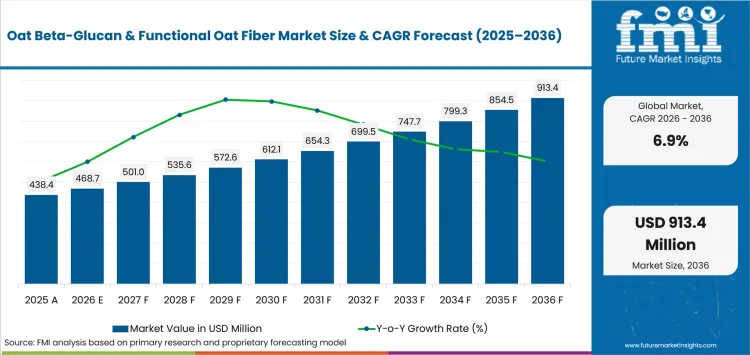
Key Takeaways of Oat Beta-Glucan & Functional Oat Fiber Market
- Defined fiber claims support oat beta-glucan demand across beverages and bakery products as well as nutrition bars and dietary supplements.
- By product, oat beta-glucan is expected to account for 45.9% share in 2026 due to its direct fit with claim-linked dose requirements.
- Metabolic applications are projected to represent 37.5% share in 2026 as measured glucose-response and cholesterol-related formulations gain development attention.
- Molecular-weight changes and excessive viscosity can reduce usable dose levels across beverages and baked foods as well as concentrated nutrition formats.
- Country growth depends on local oat availability and permitted claim wording as well as processing capacity and product-specific technical validation.
- Competition includes Lantmännen Biorefineries; Givaudan SA through OatWell; One Bio Inc.; Avena Foods Limited; Fazer Mills; Grain Millers; COSCIENS Biopharma Inc.; and NiuSource Inc.
Analyst Perspective
"Commercial value depends on preserving beta-glucan concentration and molecular weight from extraction through the final serving. A claim-ready ingredient loses value if beverage viscosity or heat treatment prevents consumers from receiving the intended dose. Producers that pair transparent specifications with application trials can convert reliable oat supply into repeat programs more effectively than companies selling undifferentiated fiber."
- Nandini Roy Choudhury, Principal Analyst, Future Market Insights
How is the Oat Beta-Glucan & Functional Oat Fiber Market segmented?
The oat beta-glucan and functional oat fiber industry is segmented by product, application, and region.
The market is segmented by product, application, and region according to ingredient identity, functional role, and country-level commercialization conditions. Product analysis covers oat beta-glucan, oat fiber, and oat protein through differences in concentration, solubility, and processing behavior. Application analysis compares metabolic health, gut health, heart health, and bakery uses through distinct dose and formulation requirements. Regional analysis compares the United States, Sweden, Finland, the United Kingdom, Germany, and wider geographic markets according to oat supply, claim administration, manufacturing capacity, and technical support. Soluble fiber and dietary fiber requirements influence whether each finished serving delivers the intended functional dose without unacceptable texture. Product performance also depends on molecular weight and stability throughout processing as well as storage.
Why does oat beta-glucan lead the product category?
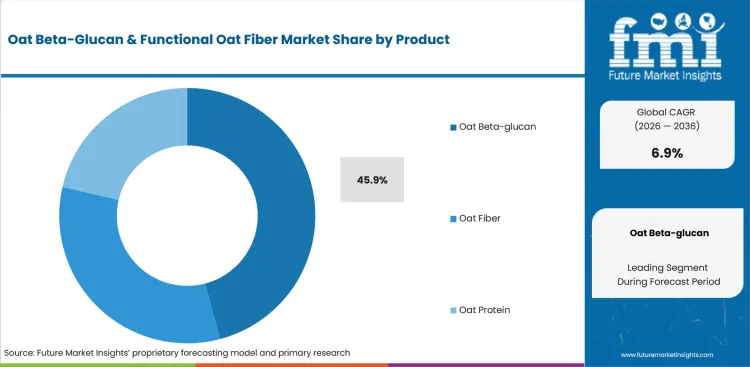
Oat beta-glucan links measurable soluble-fiber concentration with recognized health-claim conditions across commercial foods and nutrition products. In September 2025 Lantmännen Biorefineries released an updated PromOat cookie application note covering cholesterol positioning and moisture management. The note shows how a concentrated ingredient can deliver a defined dose while protecting softness and freshness during storage. Product selection therefore depends on dose delivery and texture performance rather than a broad fiber statement.
- Oat beta-glucan is set to lead the product category with 45.9% share in 2026 due to its direct fit with claim-linked dose requirements across finished foods. Concentrated grades help food manufacturers reach target fiber levels without adding excessive oat solids to finished recipes. Commercial acceptance depends on validated solubility and repeatable viscosity across the full processing and storage range.
- Beverage and nutrition-bar formulators select oat beta-glucan for a measured soluble-fiber dose that maintains acceptable texture through heat treatment and shelf storage. Oat fiber competes with insoluble dietary fiber through bulking and moisture management while oat protein serves fortified foods that require additional protein content.
How does metabolic shape the application category?
Metabolic formulations translate oat beta-glucan concentration into measurable glucose-response or cholesterol-related positioning across daily-use products. Food developers must connect serving size with recipe carbohydrate content across each intended consumption occasion. In February 2026 EFSA reviewed sixteen human studies covering oat beta-glucans and postprandial glucose peaks. The opinion linked the claimed effect with three grams of oat beta-glucan per thirty grams of available carbohydrate.
- The application category is forecast to be led by the metabolic segment at 37.5% share in 2026 due to controlled serving-level delivery requirements. Commercial success depends on actual beta-glucan consumption beside controlled carbohydrate quantities rather than concentration on an ingredient specification.
- Metabolic product teams test viscosity and flavor across representative conditions to preserve acceptable taste and texture at functional inclusion levels. Bakery ingredients provide another delivery route while gut applications compare prebiotic ingredients through separate regulatory evidence requirements and consumption patterns.
What are the drivers, restraints, and opportunities in the Oat Beta-Glucan & Functional Oat Fiber Market?
Claim-linked dose delivery and reliable processing support demand, while molecular-weight changes and formulation limits constrain repeat adoption.
- Driver: Food manufacturers need soluble fiber that supports defined nutrition claims without disrupting familiar product formats or routine production performance.
- Restraint: Heat and shear can change molecular weight or viscosity enough to restrict useful inclusion levels across commercial food processing.
- Opportunity: Application support can translate regulatory conditions into practical recipes with repeatable dose delivery and acceptable finished-product texture.
Food manufacturers increase oat beta-glucan use if one ingredient delivers measurable fiber content and useful texture. In July 2025 Lantmännen Biorefineries demonstrated PromOat as a natural texturizer in low-fat mayonnaise during application testing. The application connects soluble fiber with emulsion stability and creaminess across a familiar production process. Clean-label ingredients support similar reformulation work through recognizable oat-derived inputs and measurable performance across finished commercial products. Repeat orders depend on consistent dose delivery and sensory performance across commercial batches and production sites.
Useful beta-glucan doses can raise viscosity or lose molecular weight during heating, which creates a material processing restraint. A 2026 Journal of Cereal Science study found that industrial heat treatment changed beta-glucan recovery and extract viscosity across oat groats. The result supports process testing under commercial conditions but does not prove adoption across finished food categories. Beverage and bakery manufacturers must verify pumping behavior and texture under representative heat and shear conditions. Failed scale-up can reduce claim relevance and delay product approval across planned commercial launches and distribution programs.
Application support creates an opportunity to translate regulatory conditions into recipes that consumers can use consistently. EFSA published a June 2026 technical report addressing comments on its oat beta-glucan glucose-response assessment. The continuing review raises the value of documented dose decisions and product-matrix evidence across formulation programs. Functional food ingredients companies can build recurring revenue through pilot production and change-control support across several product categories. Food manufacturers gain confidence if each formulation delivers the intended dose with acceptable texture during routine production.
Which country CAGRs are profiled in the Oat Beta-Glucan & Functional Oat Fiber Market?
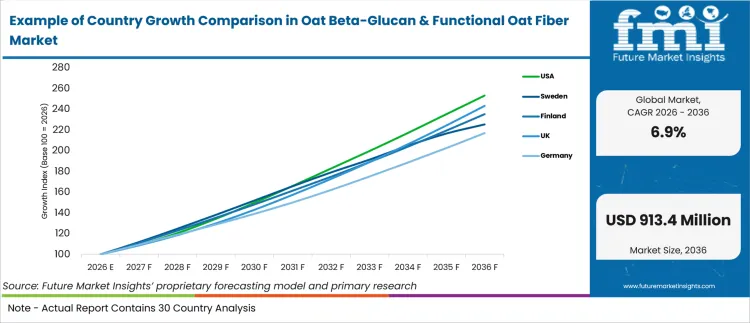
| Country | CAGR |
|---|---|
| USA | 9.7% |
| Sweden | 8.5% |
| Finland | 8.9% |
| UK | 9.3% |
| Germany | 8.1% |
Country-wise Analysis
- United States manufacturers operate under FDA ingredient records and product-specific labeling requirements for finished foods. Oat beta-glucan and functional oat fiber sales in the United States are forecast to expand at 9.7% CAGR by 2036, underpinned by the large cereal and nutrition-product base. USDA data created in January 2026 placed 2025/26 oat production at 1.011 million metric tons. Domestic supply supports ingredient development but does not guarantee concentrated material suitable for claim-linked formulations. Food manufacturers must validate heat stability and finished-product texture across each intended commercial processing and storage format. Regional sourcing can shorten replenishment although detailed specifications can extend qualification and technical review across customer programs.
- Swedish processors benefit from integrated grain cooperatives and established oat-fractionation capacity across the national ingredient chain. Sweden's oat beta-glucan and functional oat fiber market is estimated to post 8.5% CAGR over the forecast period, reinforced by nearby oat supply and Nordic food-development expertise. Statistics Sweden reported in November 2025 that average oat yield reached 4.7 tonnes per hectare. The yield supports reliable sourcing although cultivar choice and processing routes can change concentrated beta-glucan performance. Export programs benefit from regional service networks that support formulation work across nearby European customer facilities. Separate customer documentation requirements can extend qualification across European markets and delay repeat commercial supply.
- Finland combines a large oat harvest with milling expertise that serves bakery and nutrition applications across export markets. Oat beta-glucan and functional oat fiber demand in Finland is forecast to rise at 8.9% CAGR over the forecast period, supported by ingredient availability and export-oriented product-development experience. Natural Resources Institute Finland reported in March 2026 that oat production reached 1.13 million tons during 2025. Organic oats contributed 106,000 tons and support certified programs that require documented agricultural and processing controls. Commercial conversion depends on fractionation yield and lot consistency across repeated customer qualification and manufacturing cycles. Smaller domestic demand requires export channels that support destination-market trials and complete local claim documentation packages.
- United Kingdom demand develops through a large oat-milling base and separate national administration for nutrition claims. The United Kingdom oat beta-glucan and functional oat fiber sector is projected to record 9.3% CAGR during the assessment period, influenced by cereal processing and plant-based beverage development. Defra reported in July 2026 that 510 thousand tonnes of oats were milled during 2025. The volume supports local ingredient availability although variable crop quality can affect beta-glucan consistency between processing seasons. Companies must confirm national claim conditions and formulation performance rather than relying on European Union documentation.
- German food manufacturers apply European Union claim conditions across a large bakery and nutrition-product base. Germany's oat beta-glucan and functional oat fiber outlook is anticipated to advance at 8.1% CAGR over the assessment period, supported by established formulation capacity and ingredient distribution. Destatis reported in May 2026 that the expected oat area reached 189,900 hectares for the 2026 harvest. The acreage supports domestic supply but does not guarantee concentrated output or stable molecular weight. Application teams need reliable viscosity data across each finished format and representative commercial processing condition. Formal claim review can extend commercialization despite strong manufacturing infrastructure and broad access to European ingredient channels.
Who are the notable companies in the Oat Beta-Glucan & Functional Oat Fiber Market?
Lantmännen Biorefineries, Givaudan SA (OatWell), One Bio Inc., Avena Foods Limited, Fazer Mills, Grain Millers, COSCIENS Biopharma Inc., and NiuSource Inc. are notable companies profiled in this market.
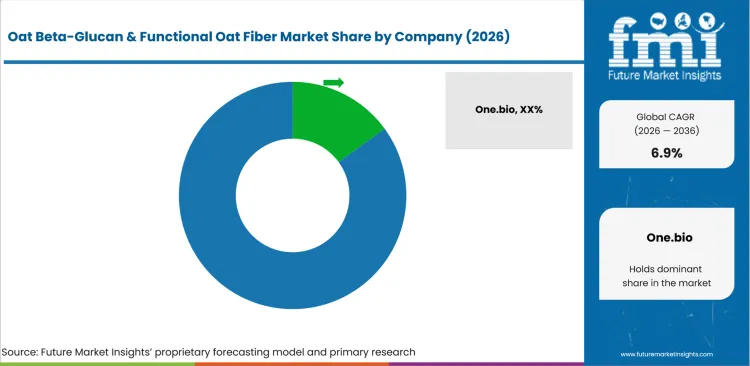
Competition separates concentrated beta-glucan platforms from functional oat-fiber systems and broader oat-milling portfolios across distinct formulation needs. One Bio Inc. develops low-viscosity short-chain oat fiber while Givaudan offers OatWell in three beta-glucan concentrations across multiple food applications. Lantmännen Biorefineries supplies concentrated PromOat while Avena Foods and Grain Millers provide functional fibers for bulking and moisture management. Nutraceutical ingredients programs create another delivery route, although commercial selection depends on dose and molecular weight as well as sensory performance and application support.
- One Bio Inc. develops short-chain oat fiber for higher-dose nutrition formats while COSCIENS Biopharma develops standardized oat beta-glucan products and NiuSource supplies concentrated grades through international distribution. Food formulators should compare dose performance and current commercialization evidence across the intended serving format prior to approving repeat supply.
- Lantmännen Biorefineries and Givaudan provide concentrated beta-glucan grades with documented health and formulation functions across food applications. Fazer Mills supports diversified oat ingredients through Nordic milling and application knowledge serving several export markets. Food manufacturers should compare concentration control and lot consistency with technical support across the intended production process.
- Avena Foods and Grain Millers provide functional oat fibers that emphasize bulking and moisture management across food applications. Their materials address a different technical need from concentrated beta-glucan products used for claim-linked dose delivery. Commercial selection should reflect texture and water binding as well as the fiber declaration required in the finished product.
Competitive Benchmarking: Oat Beta-Glucan & Functional Oat Fiber Market
| Company | Oat Beta-Glucan Fit | Functional Oat Fiber Support | Validation and Scale Support | Geographic Reach |
|---|---|---|---|---|
| Lantmännen Biorefineries | High | High | High | Europe and international |
| Givaudan SA (OatWell) | High | High | High | Global |
| One Bio Inc. | High | High | High | North America |
| Avena Foods Limited | Low | High | High | North America and export markets |
| Fazer Mills | Medium | High | Medium | Europe and international |
| Grain Millers | Low | High | Medium | North America |
| COSCIENS Biopharma Inc. | High | Low | Medium | North America |
| NiuSource Inc. | High | Low | Medium | Global distribution |
Key Developments in the Oat Beta-Glucan & Functional Oat Fiber Market
- In July 2025, Avena Foods launched Avena RegenAg Protocol oat and pulse ingredients with traceability from registered farms to customer delivery. The program gives food manufacturers a documented sourcing route for oat ingredients used in commercial products. Its market effect improves supply transparency across verified oat programs without changing the ingredient concentration itself. Functional oat-fiber programs can use the route while retaining separate formulation and performance testing across finished products.
- In September 2025, Lantmännen Biorefineries joined a Swedish-Finnish export delegation to Japan and South Korea that presented Nordic food ingredients to regional customers. The activity widened direct commercial contact for concentrated oat ingredients across two import-dependent markets in Asia. Its relevance lies in supporting customer evaluation and distribution discussions rather than proving completed ingredient adoption. Local formulation tests and claim reviews remain necessary for repeated production with PromOat or related oat ingredients across these markets.
- In June 2026, One Bio Inc. funded a published human study evaluating its short-chain oat fiber at daily doses from 5 to 20 grams. The study reported gastrointestinal tolerance across healthy adults and provides direct evidence for higher-dose delivery. Commercial relevance remains limited by the open-label design and short study period across a healthy adult population. Food companies need controlled trials and application testing prior to extending claims across finished commercial products.
- In May 2025, COSCIENS Biopharma reported development of a standardized chewable bar containing a high concentration of oat beta-glucan. The company linked the daily dose with approved product monographs across ten developed countries and several regulated commercial routes. The program creates a defined commercialization route for concentrated beta-glucan within a controlled serving format. Market progress depends on stable dose delivery and country-specific compliance throughout manufacturing and international distribution programs.
Oat Beta-Glucan & Functional Oat Fiber Market - Report Scope
| Coverage field | Report scope |
|---|---|
| Market breakdown | Product, Application, Region |
| Quantitative Units | Revenue in USD Million, CAGR in %. |
| Market Definition | Revenue from concentrated oat beta-glucan, functional oat fiber, and oat protein ingredients sold for measurable health or formulation functions. Excludes ordinary oats and commodity oat flour without concentrated functionality. |
| Regions Covered | North America, Latin America, Western Europe, Eastern Europe, East Asia, South Asia and Pacific, Middle East and Africa |
| Countries Covered | USA, Sweden, Finland, UK, Germany, and more than twenty-five additional countries in the full report |
| Key Companies Profiled | Lantmännen Biorefineries, Givaudan SA (OatWell), One Bio Inc., Avena Foods Limited, Fazer Mills, Grain Millers, COSCIENS Biopharma Inc., NiuSource Inc. |
| Forecast Period | 2026 to 2036 |
| Approach | Hybrid bottom-up and top-down market sizing supported by primary interviews and official desk research. |
Oat Beta-Glucan & Functional Oat Fiber Market - Research Methodology
| Method | Approach |
|---|---|
| Primary Research | FMI analysts gathered input from manufacturers, service providers, technology developers, distributors, end users, procurement teams, and subject-matter experts. Interviews examined purchasing decisions, product or service evaluation, adoption barriers, approval requirements, pricing considerations, and expectations for technical or commercial support. Respondents were also asked what evidence is required before a trial, pilot, or initial order develops into regular purchasing. |
| Desk Research | Desk research covered government statistics, regulatory publications, trade data, industry associations, technical literature, standards, company filings, product information, and official corporate announcements. Sources were reviewed for relevance, publication date, geographic coverage, and consistency with the defined market scope. Claims relating to performance, applications, approvals, capacity, investment, and commercial activity were retained only when supported by credible public evidence. |
| Market Sizing and Forecasting | The market model combined the baseline value with historical performance, segment structure, pricing and volume indicators, adoption levels, company participation, and country-level demand conditions. Forecast assumptions considered economic activity, investment trends, regulatory developments, technology adoption, purchasing cycles, supply availability, and barriers to wider market use. Segment and regional estimates were reconciled before the final market total was calculated. |
| Data Validation | Estimates were checked against multiple independent indicators, including public data, company activity, trade patterns, industry developments, and findings from primary interviews. Validation also tested whether products, services, applications, and company revenues fell within the defined market boundaries. Adjacent categories, unsupported claims, overlapping revenues, and activities without direct market relevance were excluded to reduce double counting and maintain consistency across segments and countries. |
Oat Beta-Glucan & Functional Oat Fiber Market by Segments
Oat Beta-Glucan & Functional Oat Fiber Market segmented by Product:
- Oat Beta-glucan
- Oat Fiber
- Oat Protein
Oat Beta-Glucan & Functional Oat Fiber Market segmented by Application:
- Metabolic
- Gut
- Heart Health
- Bakery
Oat Beta-Glucan & Functional Oat Fiber Market by Region:
- North America
- United States
- Canada
- Latin America
- Brazil
- Mexico
- Argentina
- Chile
- Western Europe
- Germany
- France
- United Kingdom
- Italy
- Spain
- Benelux
- Nordics
- Eastern Europe
- Poland
- Czech Republic
- Romania
- Hungary
- East Asia
- China
- Japan
- South Korea
- South Asia and Pacific
- India
- ASEAN
- Australia and New Zealand
- Middle East and Africa
- GCC Countries
- South Africa
- Türkiye
- Israel
Research Sources and Bibliography
- European Food Safety Authority. (2025, September 19). Beta-glucans from oats or barley and reduction of postprandial glycaemic responses: Modification of an authorised health claim pursuant to Article 13(1) of Regulation (EC) No 1924/2006 following a request in accordance with Article 19 of Regulation (EC) No 1924/2006.
- USA Food and Drug Administration. (2013, January 27). GRN No. 437: Beta-glucans from oat bran.
- European Food Safety Authority. (2026, February 20). Oat beta-glucans and reduction of postprandial glucose peak: Evaluation of a health claim pursuant to Article 13(5) of Regulation (EC) No 1924/2006.
- European Food Safety Authority. (2026, June 12). Response to comments on the Scientific Opinion of the EFSA Panel on Nutrition, Novel Foods and Food Allergens on the scientific substantiation of a health claim related to oat beta-glucans and reduction of postprandial glucose peak pursuant to Article 13(5) of Regulation (EC) No 1924/2006.
- USA Department of Agriculture, Foreign Agricultural Service. (2026, January 31). Area, yield and production.
- Statistics Sweden. (2025, November 14). Largest harvest of cereals in over 40 years.
- Natural Resources Institute Finland. (2026, March 13). Crop production 2025.
- Department for Environment, Food & Rural Affairs. (2026, July 9). Chapter 7: Crops.
- Federal Statistical Office of Germany. (2026, May 19). Getreideanbaufläche 2026 hat sich nach Tiefststand von 2024 weiter stabilisiert.
- Pynket, I., Janssen, F., Zehnder-Wyss, O., Nyström, L., Courtin, C. M., & Wouters, A. G. B. (2026). Impact of groat heat treatment and varying extraction conditions on oat β-D-glucan characteristics. Journal of Cereal Science, 127, 104346.
- Lantmännen Biorefineries. (2025, September 9). Cookies That Care: PromOat for Cholesterol Reduction.
- Lantmännen Biorefineries. (2025, July 2). See A Natural Texturizer Perform in Real Applications.
- Marcobal, A. M., Ng, K. M., Drexler, R. A., McConnell, B. R., & Amicucci, M. J. (2026, June 10). Short-chain oat fiber improves gastrointestinal tolerance and regulates glucose metabolism: A two-week open-label study in healthy adults.
- Avena Foods Limited. (2025, July 21). Launching Avena Regen Ag Protocol Oat and Pulse Ingredients.
- Lantmännen. (2025, September 16). Lantmännen joins export delegation to Asia - highlighting quality, health and innovation in food.
- COSCIENS Biopharma Inc. (2025, May 13). COSCIENS Biopharma Inc. reports first quarter 2025 financial results and provides a corporate update.
- One Bio Inc. (n.d.). Restore the Missing Fiber Signal Your Body Needs.
- Lantmännen Biorefineries. (n.d.). PromOat Oat Beta-glucan.
- Givaudan. (n.d.). OatWell™ Natural Prebiotic Fibre.
- Avena Foods Limited. (n.d.). Dietary Fibers.
This bibliography is provided for reader reference and is not exhaustive. The full report contains the complete reference list and detailed citations
This Report Answers
- How large is the oat beta-glucan and functional oat fiber market in 2026 and 2036?
- Which formulation and regulatory conditions support recurring demand for concentrated oat ingredients?
- Why does oat beta-glucan hold the leading product position during 2026?
- How does metabolic influence demand across the application category?
- How do country growth rates compare across USA, Sweden, Finland, UK, and Germany?
- Which companies provide concentrated beta-glucan and functional oat-fiber capability across the profiled competitive set?
- What processing constraints limit usable dose levels across beverages and concentrated foods?
- What evidence should food formulators evaluate before approving an ingredient for repeated commercial production?
- How do company developments and technical validation influence competitive positioning?
Frequently Asked Questions
How big is the Oat Beta-Glucan & Functional Oat Fiber Market in 2026?
The oat beta-glucan & functional oat fiber market is valued at USD 468.7 million in 2026 and is forecast to reach USD 913.4 million by 2036. Growth is supported by food manufacturers requiring soluble fiber ingredients that deliver defined nutrition claims without disrupting familiar product formats across beverages, bakery, and nutrition supplement applications globally.
What is the CAGR of the Oat Beta-Glucan & Functional Oat Fiber Market from 2026 to 2036?
The oat beta-glucan & functional oat fiber market grows at a CAGR of 6.9% between 2026 and 2036, supported by claim-linked dose delivery requirements, expanding metabolic and gut health formulation programs, and application support that translates regulatory conditions into commercially viable recipes with repeatable finished-product texture globally.
Which product leads the Oat Beta-Glucan & Functional Oat Fiber Market?
Oat beta-glucan accounts for 45.9% of the oat beta-glucan & functional oat fiber market by product in 2026, driven by its direct fit with claim-linked dose requirements across finished foods, with concentrated grades enabling food manufacturers to reach target soluble fiber levels without adding excessive oat solids to commercial recipes.
How much will the Oat Beta-Glucan & Functional Oat Fiber Market add between 2026 and 2036?
The oat beta-glucan & functional oat fiber market is set to add USD 444.7 million between 2026 and 2036, growing from USD 468.7 million to USD 913.4 million as application support, expanding oat supply infrastructure, and country-specific claim administration drive recurring ingredient demand across metabolic, gut health, heart health, and bakery applications globally.
Who are the leading companies in the Oat Beta-Glucan & Functional Oat Fiber Market?
Eight companies lead the oat beta-glucan & functional oat fiber market, including Lantmännen Biorefineries, Givaudan SA through OatWell, One Bio Inc., Avena Foods Limited, Fazer Mills, Grain Millers, COSCIENS Biopharma Inc., and NiuSource Inc., competing through concentrated beta-glucan grades, functional oat-fiber systems, human validation programs, and application support across commercial food and nutrition formats globally.
Preview the report firsthand - request a free sample
Get SampleGet the brochure for pricing and purchase details.
Get PDFTable of Content
- Key Takeaways
- Market Size and CAGR
- Top Growth Driver
- Fastest Growing Segment
- Leading Region
- Key Companies
- Emerging Opportunities
- Executive Summary
- Global Market Outlook
- Demand-side Trends
- Supply-side Trends
- Technology Roadmap Analysis
- Analysis and Recommendations
- Analyst Perspective (What is happening? Why now? What should investors know?)
- Key Questions Answered
- How large is the market?
- What is the CAGR?
- What are key trends?
- Which region dominates?
- Who are the leaders?
- Market Overview
- Market Coverage / Taxonomy
- Market Definition / Scope / Limitations
- Research Methodology
- Chapter Orientation
- Analytical Lens and Working Hypotheses
- Market Structure, Signals, and Trend Drivers
- Benchmarking and Cross-market Comparability
- Market Sizing, Forecasting, and Opportunity Mapping
- Research Design and Evidence Framework
- Desk Research Programme (Secondary Evidence)
- Expert Input and Fieldwork (Primary Evidence)
- Tooling, Models, and Reference Databases
- Data Engineering and Model Build
- Quality Assurance and Audit Trail
- Market Background
- Market Dynamics (Drivers, Restraints, Opportunity, Trends)
- Scenario Forecast (Optimistic, Likely, Conservative)
- Impact Analysis
- AI Impact
- Sustainability Impact
- Regulatory Impact
- Technology Impact
- Consumer / Buyer Analysis
- Purchase Drivers
- Adoption Barriers
- Buyer Journey
- Opportunity Map Analysis
- Product Life Cycle Analysis
- Supply Chain Analysis
- Investment Feasibility Matrix
- Value Chain Analysis
- PESTLE and Porter's Analysis
- Regulatory Landscape
- Regional Parent Market Outlook
- Production and Consumption Statistics
- Import and Export Statistics
- Global Market Analysis and Forecast, 2021 to 2036
- Historical Market Size Value (USD Million) Analysis, 2021 to 2025
- Current and Future Market Size Value (USD Million) Projections, 2026 to 2036
- Y-o-Y Growth Trend Analysis
- Absolute $ Opportunity Analysis
- Global Market Pricing Analysis, 2021 to 2036
- Global Market Analysis and Forecast, By Product, 2021 to 2036
- Introduction / Key Findings
- Historical Market Size Value (USD Million) Analysis By Product, 2021 to 2025
- Current and Future Market Size Value (USD Million) Analysis and Forecast By Product, 2026 to 2036
- Oat Beta-glucan
- Oat Fiber
- Oat Protein
- Oat Beta-glucan
- Y-o-Y Growth Trend Analysis By Product, 2021 to 2025
- Absolute $ Opportunity Analysis By Product, 2026 to 2036
- Global Market Analysis and Forecast, By Application, 2021 to 2036
- Introduction / Key Findings
- Historical Market Size Value (USD Million) Analysis By Application, 2021 to 2025
- Current and Future Market Size Value (USD Million) Analysis and Forecast By Application, 2026 to 2036
- Metabolic
- Gut
- Heart Health
- Bakery
- Metabolic
- Y-o-Y Growth Trend Analysis By Application, 2021 to 2025
- Absolute $ Opportunity Analysis By Application, 2026 to 2036
- Global Market Analysis and Forecast, By Region, 2021 to 2036
- Introduction
- Historical Market Size Value (USD Million) Analysis By Region, 2021 to 2025
- Current Market Size Value (USD Million) Analysis and Forecast By Region, 2026 to 2036
- North America
- Latin America
- Western Europe
- Eastern Europe
- East Asia
- South Asia and Pacific
- Middle East & Africa
- Market Attractiveness Analysis By Region
- North America Market Analysis and Forecast, By Country, 2021 to 2036
- Historical Market Size Value (USD Million) Trend Analysis By Market Taxonomy, 2021 to 2025
- Market Size Value (USD Million) Forecast By Market Taxonomy, 2026 to 2036
- By Country
- USA
- Canada
- By Product
- By Application
- By Country
- Market Attractiveness Analysis
- By Country
- By Product
- By Application
- Key Takeaways
- Latin America Market Analysis and Forecast, By Country
- Historical Market Size Value (USD Million) Trend Analysis By Market Taxonomy, 2021 to 2025
- Market Size Value (USD Million) Forecast By Market Taxonomy, 2026 to 2036
- By Country
- Brazil
- Mexico
- Chile
- Rest of Latin America
- By Product
- By Application
- By Country
- Market Attractiveness Analysis
- By Country
- By Product
- By Application
- Key Takeaways
- Western Europe Market Analysis and Forecast, By Country
- Historical Market Size Value (USD Million) Trend Analysis By Market Taxonomy, 2021 to 2025
- Market Size Value (USD Million) Forecast By Market Taxonomy, 2026 to 2036
- By Country
- Germany
- UK
- Italy
- Spain
- France
- Nordic
- BENELUX
- Rest of Western Europe
- By Product
- By Application
- By Country
- Market Attractiveness Analysis
- By Country
- By Product
- By Application
- Key Takeaways
- Eastern Europe Market Analysis and Forecast, By Country
- Historical Market Size Value (USD Million) Trend Analysis By Market Taxonomy, 2021 to 2025
- Market Size Value (USD Million) Forecast By Market Taxonomy, 2026 to 2036
- By Country
- Russia
- Poland
- Hungary
- Balkan & Baltic
- Rest of Eastern Europe
- By Product
- By Application
- By Country
- Market Attractiveness Analysis
- By Country
- By Product
- By Application
- Key Takeaways
- East Asia Market Analysis and Forecast, By Country
- Historical Market Size Value (USD Million) Trend Analysis By Market Taxonomy, 2021 to 2025
- Market Size Value (USD Million) Forecast By Market Taxonomy, 2026 to 2036
- By Country
- China
- Japan
- South Korea
- By Product
- By Application
- By Country
- Market Attractiveness Analysis
- By Country
- By Product
- By Application
- Key Takeaways
- South Asia and Pacific Market Analysis and Forecast, By Country
- Historical Market Size Value (USD Million) Trend Analysis By Market Taxonomy, 2021 to 2025
- Market Size Value (USD Million) Forecast By Market Taxonomy, 2026 to 2036
- By Country
- India
- ASEAN
- Australia & New Zealand
- Rest of South Asia and Pacific
- By Product
- By Application
- By Country
- Market Attractiveness Analysis
- By Country
- By Product
- By Application
- Key Takeaways
- Middle East & Africa Market Analysis and Forecast, By Country
- Historical Market Size Value (USD Million) Trend Analysis By Market Taxonomy, 2021 to 2025
- Market Size Value (USD Million) Forecast By Market Taxonomy, 2026 to 2036
- By Country
- Kingdom of Saudi Arabia
- Other GCC Countries
- Türkiye
- South Africa
- Other African Union
- Rest of Middle East & Africa
- By Product
- By Application
- By Country
- Market Attractiveness Analysis
- By Country
- By Product
- By Application
- Key Takeaways
- Key Countries Market Analysis
- USA
- Pricing Analysis
- Market Share Analysis, 2025
- By Product
- By Application
- Canada
- Pricing Analysis
- Market Share Analysis, 2025
- By Product
- By Application
- Mexico
- Pricing Analysis
- Market Share Analysis, 2025
- By Product
- By Application
- Brazil
- Pricing Analysis
- Market Share Analysis, 2025
- By Product
- By Application
- Chile
- Pricing Analysis
- Market Share Analysis, 2025
- By Product
- By Application
- Germany
- Pricing Analysis
- Market Share Analysis, 2025
- By Product
- By Application
- UK
- Pricing Analysis
- Market Share Analysis, 2025
- By Product
- By Application
- Italy
- Pricing Analysis
- Market Share Analysis, 2025
- By Product
- By Application
- Spain
- Pricing Analysis
- Market Share Analysis, 2025
- By Product
- By Application
- France
- Pricing Analysis
- Market Share Analysis, 2025
- By Product
- By Application
- India
- Pricing Analysis
- Market Share Analysis, 2025
- By Product
- By Application
- ASEAN
- Pricing Analysis
- Market Share Analysis, 2025
- By Product
- By Application
- Australia & New Zealand
- Pricing Analysis
- Market Share Analysis, 2025
- By Product
- By Application
- China
- Pricing Analysis
- Market Share Analysis, 2025
- By Product
- By Application
- Japan
- Pricing Analysis
- Market Share Analysis, 2025
- By Product
- By Application
- South Korea
- Pricing Analysis
- Market Share Analysis, 2025
- By Product
- By Application
- Russia
- Pricing Analysis
- Market Share Analysis, 2025
- By Product
- By Application
- Poland
- Pricing Analysis
- Market Share Analysis, 2025
- By Product
- By Application
- Hungary
- Pricing Analysis
- Market Share Analysis, 2025
- By Product
- By Application
- Kingdom of Saudi Arabia
- Pricing Analysis
- Market Share Analysis, 2025
- By Product
- By Application
- Türkiye
- Pricing Analysis
- Market Share Analysis, 2025
- By Product
- By Application
- South Africa
- Pricing Analysis
- Market Share Analysis, 2025
- By Product
- By Application
- USA
- Market Structure Analysis
- Competition Dashboard
- Competition Benchmarking
- Market Share Analysis of Top Players
- By Regional
- By Product
- By Application
- Emerging Startups
- Innovation Benchmarking
- Competition Analysis
- Competition Deep Dive
- One.bio
- Overview
- Product Portfolio
- Profitability by Market Segments
- Sales Footprint
- Strategy Overview
- Marketing Strategy
- Product Strategy
- Channel Strategy
- Tate & Lyle
- Lantmännen
- Oat Cosmetics
- DSM
- Swedish Oat Fiber
- Bioactor
- One.bio
- Case Studies
- Success Stories
- Recent Developments
- Competition Deep Dive
- Assumptions & Acronyms Used


